Developmental theories and milestones
Scope and prerequisites
Supported GRE topic 14 (DV.1). Use the overview measurement lesson VI when interpreting research evidence. Existing official questions are traced in bank_review_form.yaml; original tasks below are not ETS items.
Concepts and method
object permanence 客体永久性: Knowing that objects continue to exist when out of sight, gained in the sensorimotor stage. theory of mind 心理理论: Understanding that others hold beliefs, including beliefs that are false.
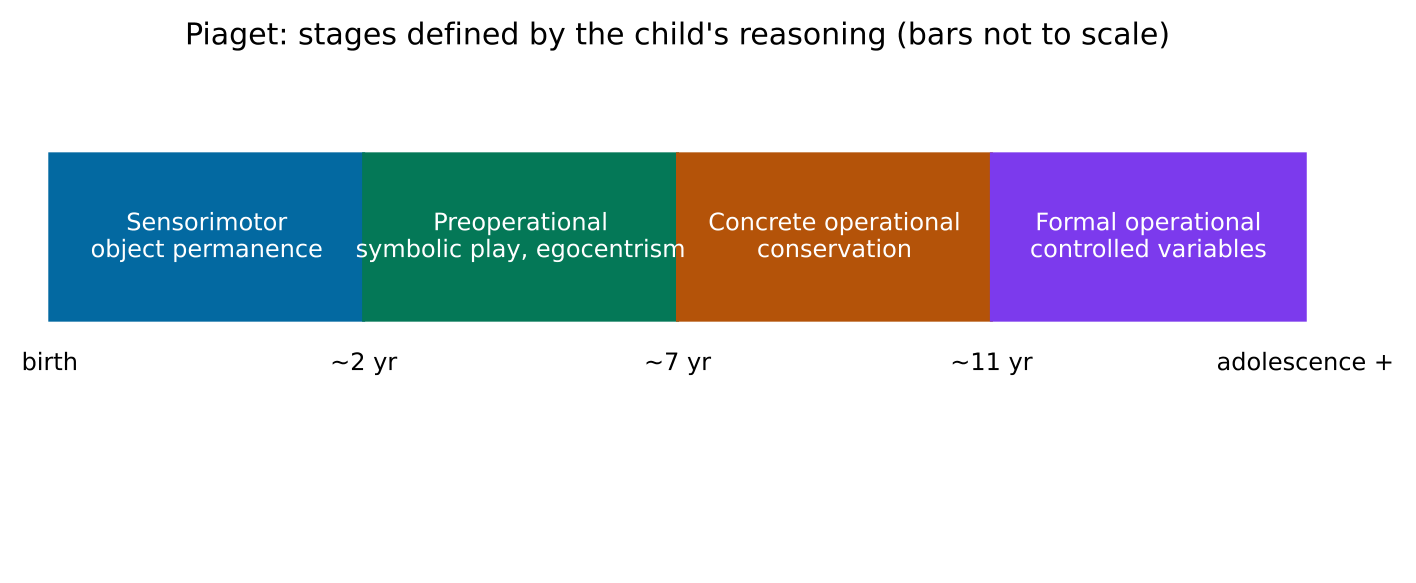
Piaget's stages are defined by what a child can do. Sensorimotor (birth to about 2): object permanence. Preoperational (about 2 to 7): symbolic play but egocentrism and failure of conservation. Concrete operational (about 7 to 11): conservation and reversible operations on concrete material. Formal operational (about 11 up): hypothetico-deductive reasoning, as in the pendulum task, where the solver holds one factor constant while varying another. Ages are approximate; the reasoning profile defines the stage.
Kohlberg ordered moral reasoning into preconventional (consequences to self), conventional (approval and rules) and postconventional (principles) levels. Erikson framed eight lifespan psychosocial crises, from trust versus mistrust in infancy to integrity versus despair in late adulthood; identity versus role confusion belongs to adolescence. Stage theories describe common sequences, not fixed timetables.
Attachment research uses the strange situation: secure infants use the caregiver as a base and are comforted at reunion; avoidant infants keep distance; resistant (ambivalent) infants cling yet are not easily comforted. Caregiver sensitivity predicts the pattern, and early patterns relate to later relationships without determining them.
Theory of mind is understanding that others hold beliefs, including false ones. The false-belief task is its standard test: a child who expects a searcher to look where the object really is, rather than where the searcher saw it, has not yet passed. Intentional lying presupposes modelling what another person believes, so deceptive lying marks a change in mental representation.
Assimilation uses an existing scheme; accommodation changes the scheme when it does not fit. Conservation tasks examine whether a transformation changes a quantity, not merely whether children use an adult word. In a supported-learning account, distinguish a prompt that organizes a child's reasoning from a prompt that supplies the answer. Attachment observations concern relationship-specific behaviour under a protocol, not an adult personality diagnosis.
Worked reasoning
A child who solves the pendulum problem by holding X constant while varying Y shows formal-operational reasoning. Conserving liquid volume across containers marks concrete operations. An infant who is easily comforted at reunion shows a secure pattern. Expecting a searcher to look where the object really is fails the false-belief task.
A child calls every four-legged animal a dog, then creates a separate category for cats after contrasting examples. Explain the two processes.
Using the existing dog category for a cat illustrates assimilation. Revising categories to distinguish cats illustrates accommodation. The example concerns changing classification, not proof of a particular stage or the child's general intelligence. Ask for the child's reasoning and test new examples.
Independent transfer
A child predicts that a taller narrow cup has more water after a transfer. Design a question that tests reasoning rather than giving away the answer.
Attempt independently, then use the matching skill sheet solution.
Review and source limits
Avoid this error: Assigning a stage by age alone, or treating a developmental sequence as a fixed timetable; the reasoning profile, not the birthday, defines the stage. Teaching scope comes from teaching.yaml and the source/key/crop review in bank_review_form.yaml. Detailed current diagnostic criteria require an authenticated manual; neither historical ETS practice nor this educational reference certifies them.