From a collision to a particle accelerator
A car bumper and a particle detector seem very different. Both use momentum and forces. This unit follows those ideas into circular motion, electric fields, magnetic fields and particle interactions.
WPH14 assesses requirements 81–124 of the Issue 3 specification. It can also use knowledge from Units 1–2. Use the seven skill sheets in order. Check units, directions and the assumptions behind each equation. A familiar equation can give a wrong answer when its model does not fit.
Impulse and two-dimensional collisions
Force changes momentum
Momentum 动量 is the vector $\mathbf p=m\mathbf v$. Choose a positive direction before using signs. Impulse 冲量 is the change in momentum. For constant force, or the average force over an interval:
A changing force gives an impulse equal to the signed area under its force–time graph. A triangular pulse has area $\frac12\times\text{base}\times\text{height}$. An area below the time axis is negative. The maximum force is not automatically the average force.
Worked example. A $0.20\ \text{kg}$ ball approaches a wall at $+6.0\ \text{m s}^{-1}$. It rebounds at $-4.0\ \text{m s}^{-1}$. Contact lasts $0.050\ \text{s}$. Find average force on the ball.
- Known: mass, signed initial/final velocities and contact time.
- Why: force impulse changes the ball's momentum; rebound reverses the sign.
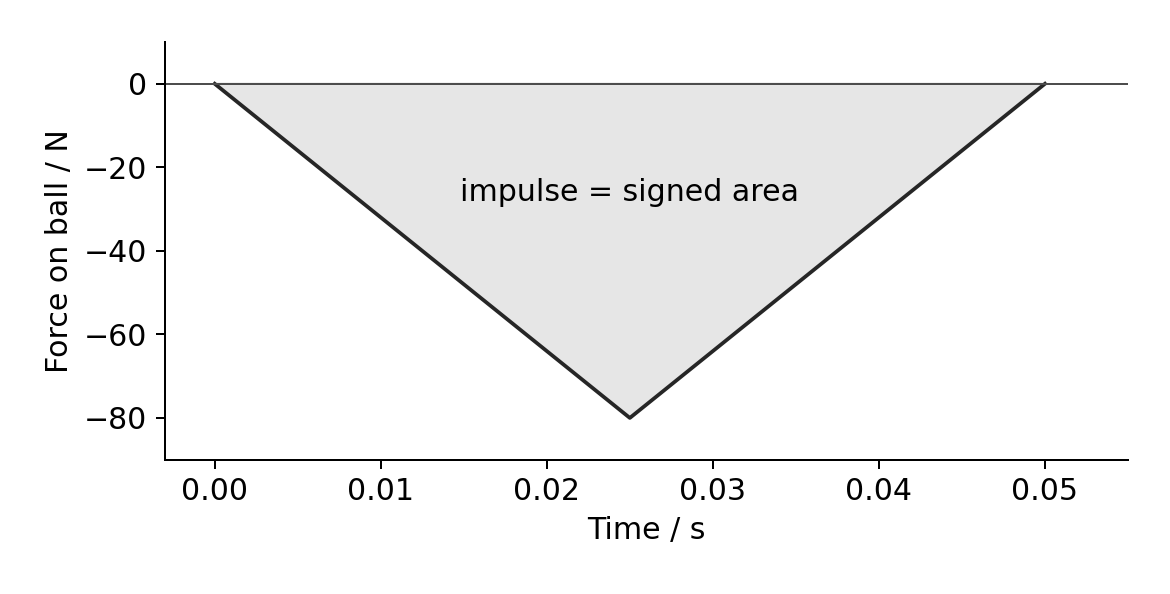
The force is opposite the chosen positive direction. The wall feels an opposite force. A deforming bumper or helmet increases stopping time. For the same momentum change, this reduces average force. It does not remove the momentum change.
Conserve each momentum component
An isolated system 孤立系统 has no significant external impulse during the event. Its total momentum is conserved. Internal forces cancel in opposite pairs. Momentum conservation does not require kinetic energy conservation.
For a collision in a plane, resolve every momentum into two perpendicular axes:
Use the angle measured from the chosen axis. Include signs; a downward component is negative if upwards is positive. Do not add momentum magnitudes when directions differ.
Worked example. A $0.10\ \text{kg}$ sphere moving at $2.0\ \text{m s}^{-1}$ strikes two stationary spheres, each $0.10\ \text{kg}$. It stops. The two others leave symmetrically at $1.2\ \text{m s}^{-1}$, at angles $+\theta$ and $-\theta$ to the original direction. Find their separation angle and classify the collision.
- Why: transverse momenta cancel by symmetry; longitudinal momentum gives $\theta$.
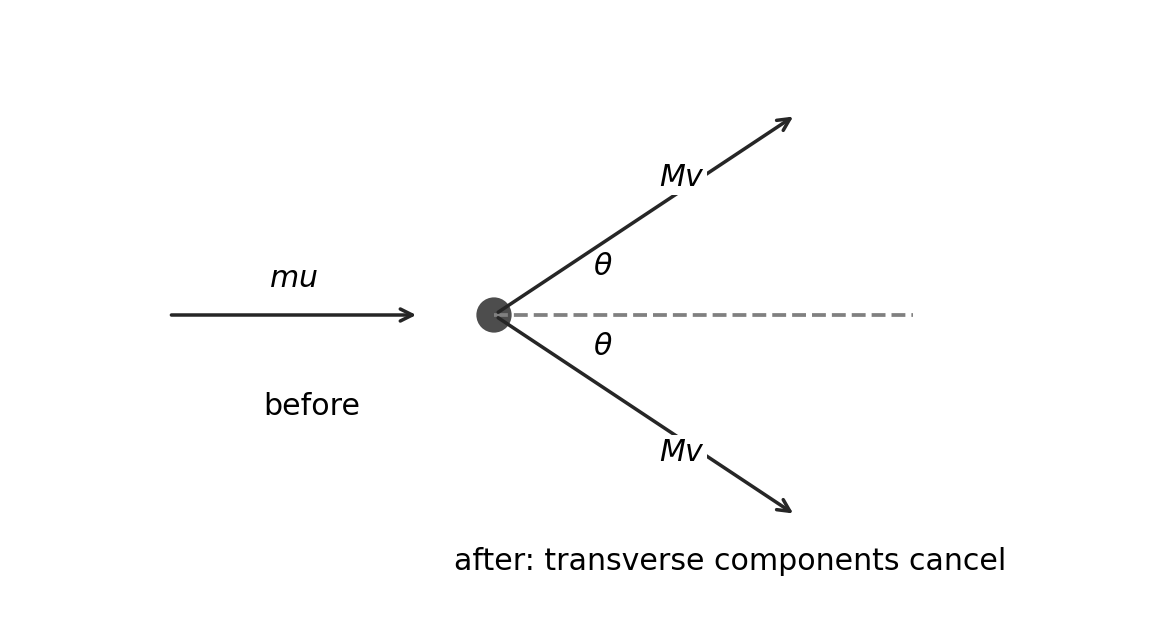
An elastic collision 弹性碰撞 conserves total kinetic energy as well as momentum. An inelastic collision 非弹性碰撞 does not conserve kinetic energy; some becomes other forms of energy.
This collision is inelastic. Total energy is still conserved. In an ordinary passive collision, kinetic energy cannot increase without an additional energy source.
For a non-relativistic particle 非相对论粒子, use $p=mv$ and $E_k=\frac12mv^2$. Substituting $v=p/m$ gives:
At equal kinetic energy, $p=\sqrt{2mE_k}$: a larger mass has larger momentum. At equal momentum, a larger mass has smaller kinetic energy. These equations are not valid for a particle moving close to light speed.
Core practicals 9 and 10
For core practical 9, use a trolley, force sensor and data logger. Measure trolley mass and velocities just before/after contact using light gates or a motion sensor. Record the force–time pulse at a sampling rate fast enough to resolve it. Zero the force sensor; use consistent axes for force and velocity. Integrate the graph area and compare it with $m(v-u)$. Repeat for different contact forces or speeds. A graph of impulse against momentum change should have gradient close to one. Friction, sensor offsets and missed parts of the pulse can cause disagreement. Secure the track and catch the trolley safely.
For core practical 10, record small spheres colliding on a level surface using an overhead camera. Include a length scale in the collision plane and a known frame rate. Keep the camera perpendicular to reduce perspective error. Track centres over several frames before and after the short collision. Convert pixel displacements to metres and frame intervals to seconds. Determine both velocity components, then compare total momentum components and kinetic energies. Repeat with different approach directions. Include uncertainty from positions, timing and scale calibration. A small mismatch within uncertainty is not evidence that momentum fails. Keep spheres contained so they cannot fall or become a slipping hazard.
Circular motion
Angle, angular speed and tangential speed
An angle of one radian 弧度 subtends an arc equal to the radius. Hence $\theta=s/r$, with angle in radians. One revolution is $2\pi$ radians or $360^\circ$.
Angular velocity 角速度 describes the rate of angular displacement. In the plane problems here, use its signed rotational rate or magnitude as appropriate. Points on one rigid turntable have the same angular speed. Points farther from its centre have larger tangential speed 切向速率. Their velocity directions also vary around the circle.
Worked example. A wheel rotates at $120$ revolutions per minute. Find angular speed and acceleration of a point $0.25\ \text{m}$ from its centre.
Keep the unrounded angular speed during the calculation. Use radius, not diameter.
Why acceleration points inward
Uniform circular motion has constant speed but changing velocity. Draw the initial and final tangential velocity vectors. The change is $\Delta\mathbf v=\mathbf v_2-\mathbf v_1$, not their sum. For a small angular change, the velocity triangle and radius triangle are similar:
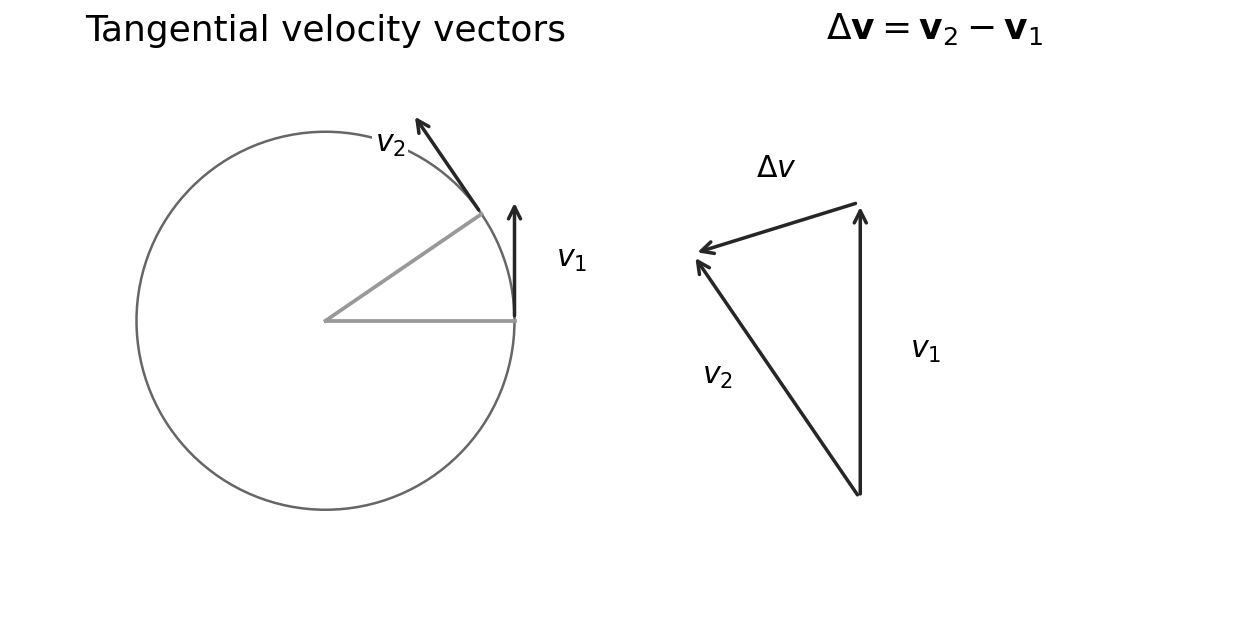
The change in velocity points towards the centre in this limit. A resultant centripetal force 向心力 is therefore needed:
Centripetal force names the resultant of real forces. It is not an extra force to add to a force diagram. Friction can provide it on a turntable. Tension can provide it for a ball on a string.
Write the real-force equation
For clothing against the inside of a vertical drum, weight always points down. The drum's normal reaction points towards the centre. At constant speed:
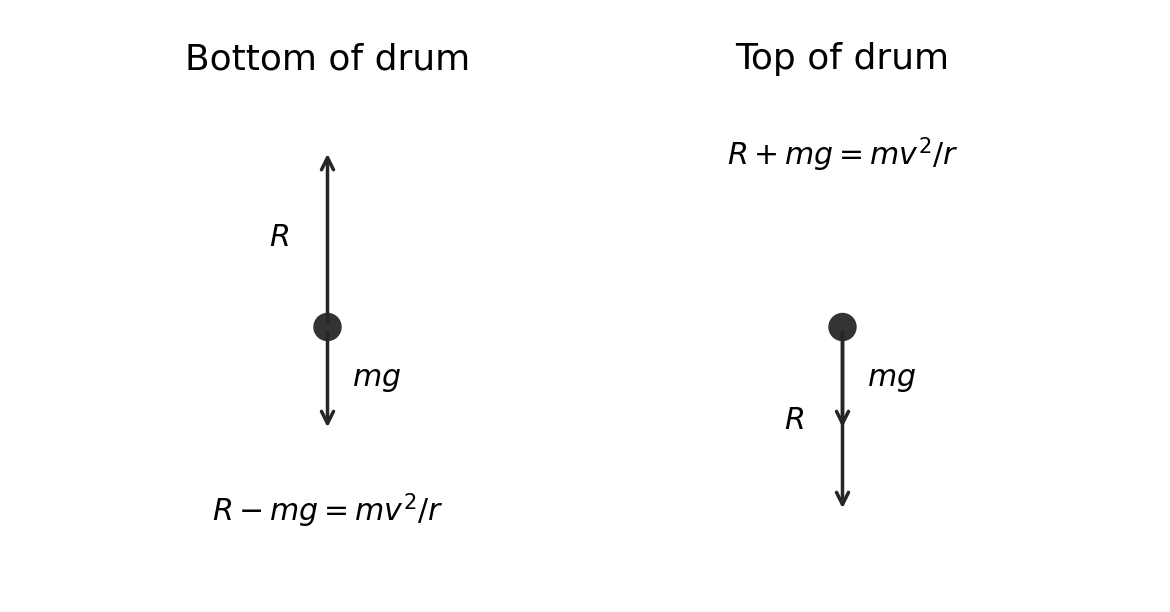
The required resultant has the same magnitude, but the reaction is larger at the bottom. If contact is lost, the surface cannot provide a pulling normal reaction. Check this before using a circular-path model.
For a horizontal turntable, the largest available friction must be at least $mr\omega^2$. If maximum friction is $mg/25$:
Mass cancels because both required and available forces scale with mass. If the inward force disappears, motion initially follows the tangent. Gravity can then curve the later path; “tangent” describes the release direction.
Electric fields and potential
Force and potential describe different things
An electric field 电场 is a region where a charged particle experiences a force. Electric field strength 电场强度 is force per unit positive test charge:
Its units are $\text{N C}^{-1}$ or $\text{V m}^{-1}$. A positive charge feels force along the field; a negative charge feels force opposite it.
Electric potential 电势 is potential energy per unit charge relative to a chosen reference. For a charge $q$ moved through a potential change:
Potential is a scalar; field is a vector. A point with zero potential need not have zero field. Adding signed potentials is different from adding field vectors.
Radial and uniform fields
For point charges, or outside an isolated charged conducting sphere, with $k=1/(4\pi\varepsilon_0)$:
Here $r$ is separation of charge centres; sphere distances are measured from its centre. Like charges repel, unlike charges attract. Potential takes the sign of $Q$ when zero is at infinity.
Between large parallel plates, away from edges, the field is approximately uniform:
The field points from higher to lower potential. Plate separation $d$ is perpendicular to the plates. An equipotential 等势面 has the same potential everywhere. Field lines cross equipotentials at right angles. Moving along one involves no change in electric potential energy.
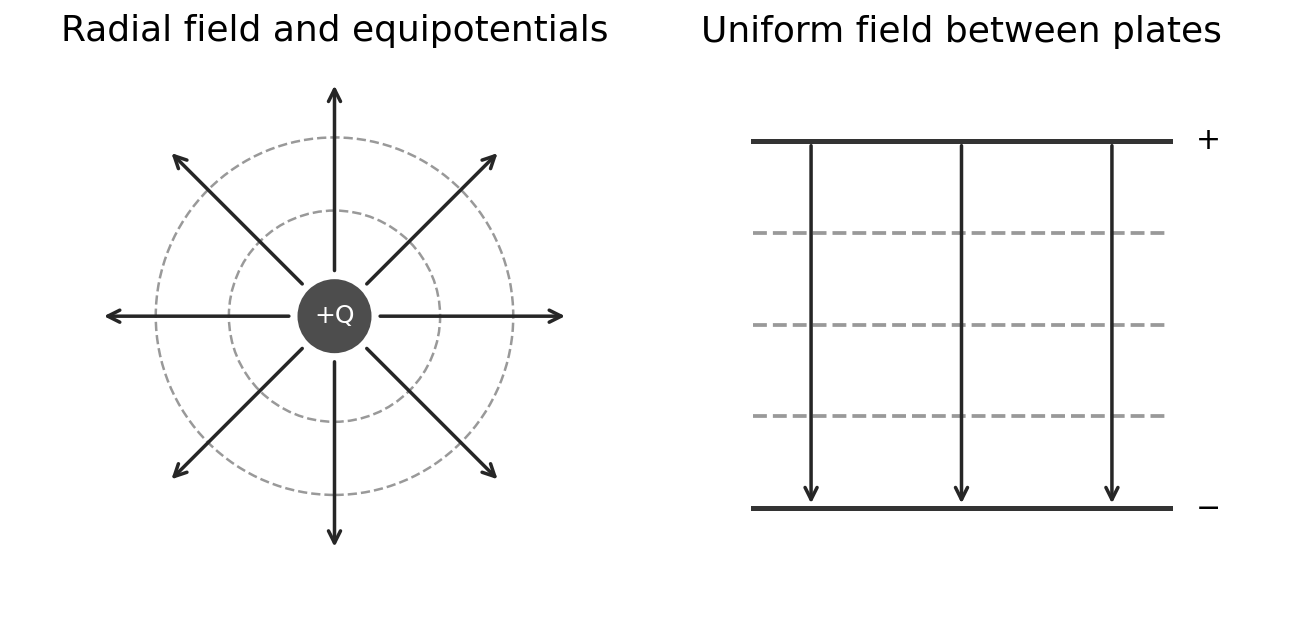
The radial field is the negative potential gradient: $E_r=-\mathrm dV/\mathrm dr$. For a positive source, the signed area under its $E$–$r$ curve from $r$ to infinity equals $V(r)$. The area from zero to $r$ is not that potential. In a uniform field, closer equally spaced potential levels mean stronger field.
Worked example. A sphere of radius $0.20\ \text{m}$ has potential $9.0\ \text{kV}$. Find charge and field at $0.30\ \text{m}$ from its centre. Use $k=8.99\times10^9\ \text{N m}^2\text{C}^{-2}$.
Use the surface radius to find charge, then the new centre-distance to find field. Do not reuse the surface distance for the second step.
Compare electrical and gravitational forces
A stationary charged oil drop can satisfy $|q|E=mg$. Use $m=\rho\mathcal V$ if density and volume are given. Divide the charge magnitude by $e=1.60\times10^{-19}\ \text{C}$ to test whether it is close to an integer multiple. Charge sign follows the direction of force required, not its magnitude alone.
To lift a spherical grain, compare $qE$ with $\rho(4\pi r^3/3)g$. Radius is half the listed diameter. A calculated maximum diameter is a threshold: choose the largest listed diameter below it. On an inclined panel, the normal component of weight is $mg\cos\theta$. The electric force perpendicular to the panel need overcome that component to detach a grain; gravity also has a downslope component.
Capacitors and RC circuits
Charge storage and energy
A capacitor 电容器 stores separated charge on two conductors. They carry equal and opposite charges in the ideal two-plate model. The quoted charge $Q$ is the magnitude on either plate, not the sum of both magnitudes. Capacitance 电容 is charge stored per unit p.d.:
One farad is one coulomb per volt. For constant capacitance, a $V$–$Q$ graph is straight through the origin with gradient $1/C$. Its area gives the work needed to transfer charge onto the capacitor:
The factor one half appears because p.d. rises from zero while charge is transferred. It is not $QV$ at the final voltage throughout charging. For discharge between non-zero voltages, subtract the two stored energies:
This is different from $\frac12C(V_{\text{initial}}-V_{\text{final}})^2$.
Charging and discharging
In an ideal series resistor–capacitor charging circuit, initially uncharged, the capacitor p.d. is zero. The resistor initially has the full supply p.d., so current is maximum. As charge builds, capacitor p.d. rises. Resistor p.d. and current fall. At full charge, current is zero and capacitor p.d. equals supply p.d.
For discharge through a fixed resistance, use signed current consistently or work with its magnitude:
The voltage relation follows from $Q=CV$ with constant $C$. Current magnitude follows from $|I|=V/R$ with constant $R$. The time constant 时间常数 is $\tau=RC$. After one time constant, $Q$, $V$ and current magnitude are $e^{-1}\approx0.368$ of their initial values. After three time constants they are about $5\%$, not zero. Stored energy falls faster because it depends on $V^2$.
For charging from an ideal constant supply $V_s$:
A charging capacitor voltage rises towards $V_s$; charging current falls towards zero. Do not sketch the same curve for both quantities. Equal $V_C$ and $V_R$ means each is $V_s/2$, reached at $t=RC\ln2$.
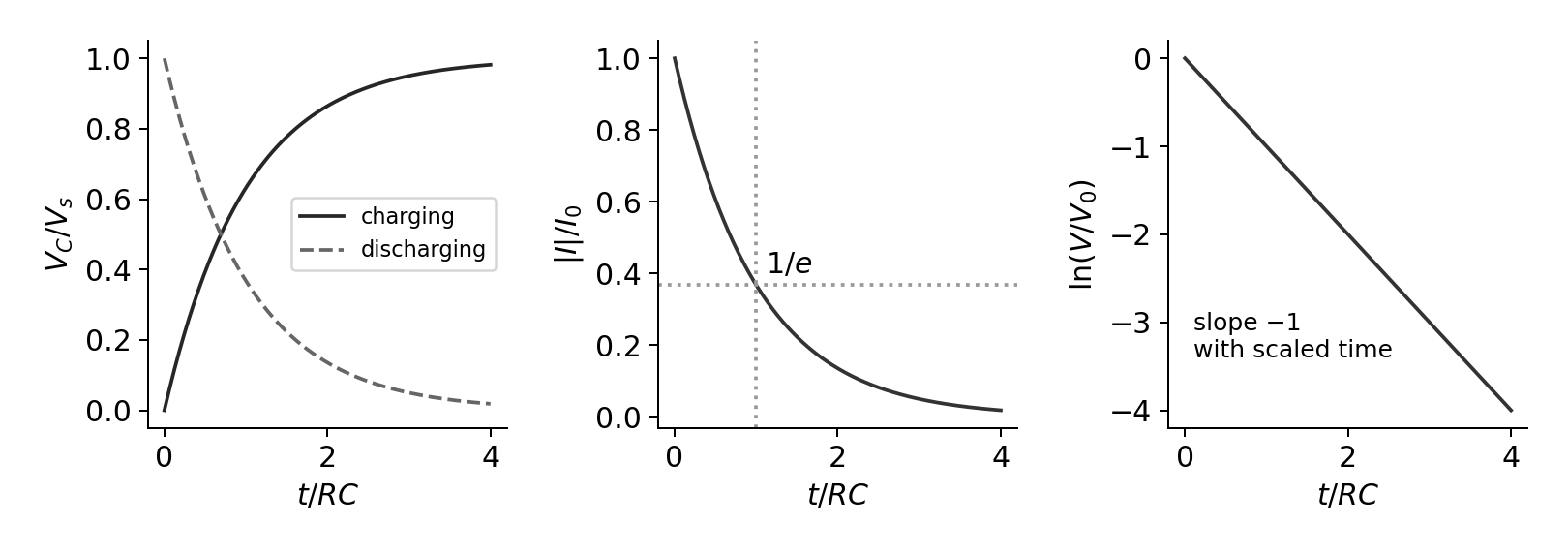
Taking natural logs of the discharge equation gives:
Thus a graph of $\ln V$ against $t$ has gradient $-1/(RC)$ and intercept $\ln V_0$. The same forms hold for $Q$ and current magnitude. Use consistent measurement units inside the logged numerical values.
Worked example. A $100\ \mu\text{F}$ capacitor discharges from $12.0\ \text{V}$ through $20.0\ \text{k}\Omega$. Find p.d. after $3.0\ \text{s}$ and energy lost.
The lost stored energy becomes mainly heat in the discharge resistance. Use unrounded voltage in the final calculation.
Core practical 11 and useful extensions
Use a low-voltage d.c. supply, resistor, capacitor and switch. Charge through the resistor, then disconnect the supply and discharge through the known resistance. Connect a voltage sensor, data logger or oscilloscope across the capacitor. Record time and p.d.; choose a sampling interval short compared with $RC$. Use an instrument input resistance large compared with the discharge resistance, otherwise it changes the discharge path.
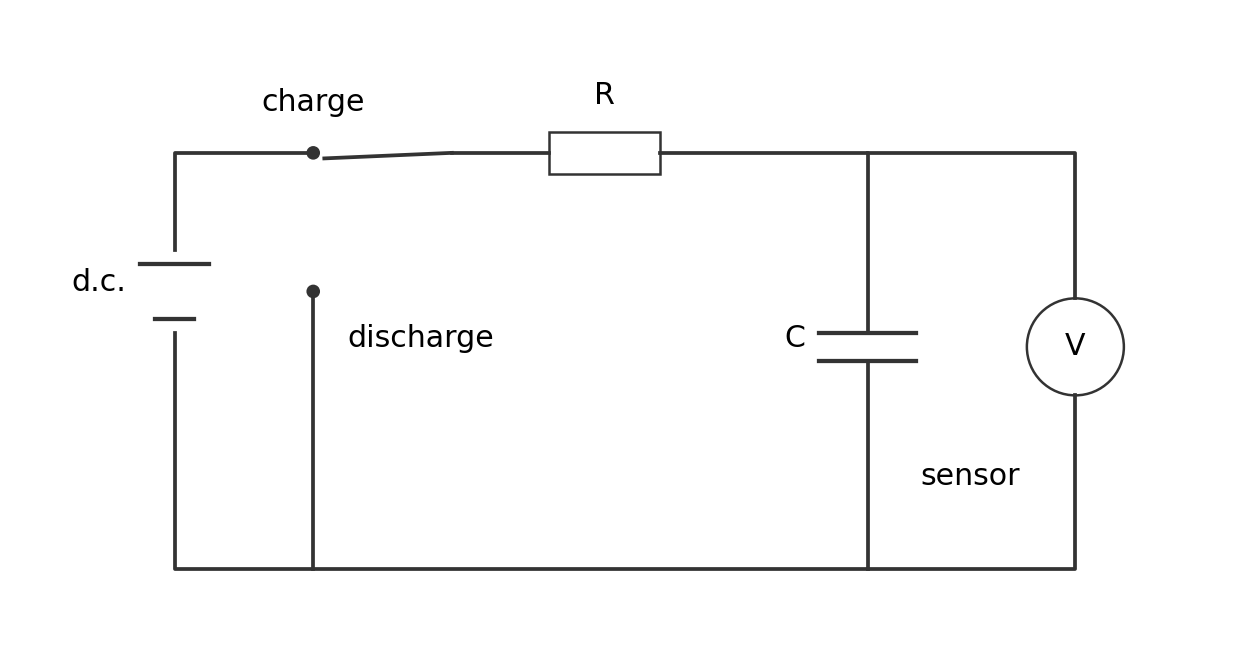
Keep $R$ and $C$ fixed, repeat after restoring the same initial charge, and compare measured curves with exponential predictions. Determine $RC$ from the $1/e$ level or a log-fit gradient. Avoid taking logs of readings near zero where relative uncertainty is large. For a resistance-tolerance test, calculate $R=-\Delta t/[C\ln(V_2/V_1)]$ during one uninterrupted discharge and compare with both limits of the permitted interval.
Use correct polarity for an electrolytic capacitor and remain below its voltage rating. Discharge it safely through a resistor before altering connections; do not short a charged capacitor. Leakage, sensor loading and resistor heating can change the measured curve.
A smoothing capacitor charges near supply peaks and discharges into the load between them. A smaller load resistance gives a smaller time constant, faster discharge and less smoothing. For two identical series capacitors, the same magnitude of charge appears on each. Their equal p.d.s share the supply, so each stores half the charge of one identical capacitor connected alone. This sharing is a useful bridge to the selected paper; it does not replace the main capacitance model.
Magnetic forces and induction
Directions, flux and force
Magnetic flux density 磁感应强度 $B$ describes the field's force effect. For a straight wire of length $l$ in a uniform field:
Here $\theta$ is between conventional current and field. Only the length inside the field counts. For one charged particle:
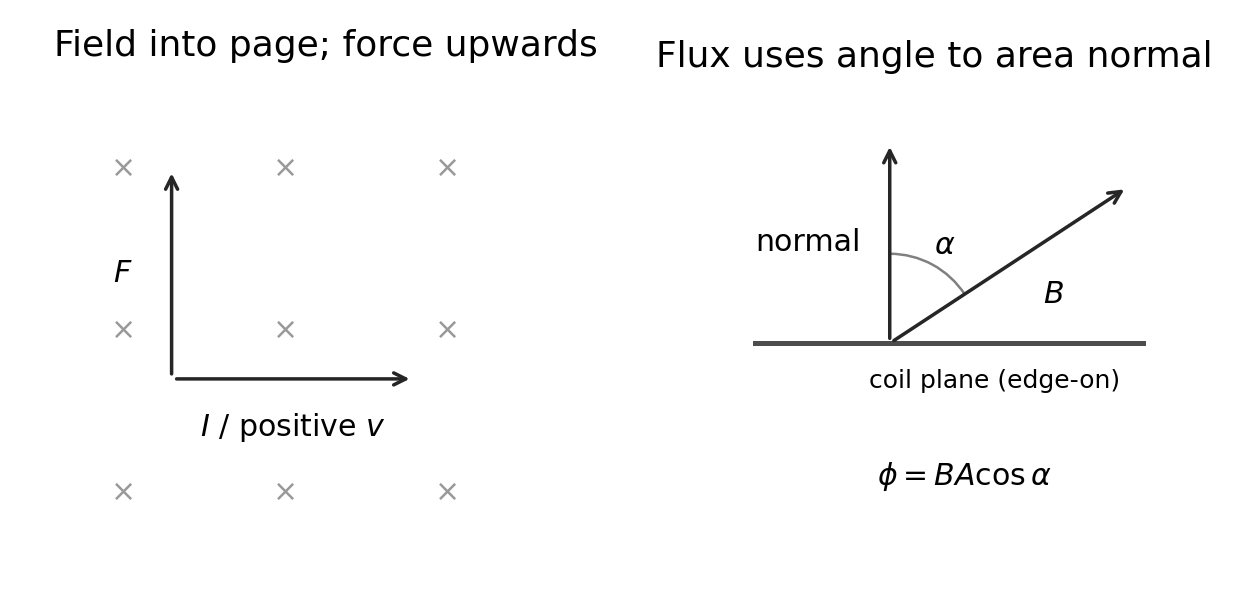
Use Fleming's left-hand rule 弗莱明左手定则: first finger along field, second along conventional current, thumb gives force. A positive charge moves with conventional current. Reverse the result for an electron's motion. Dot symbols mean out of the page; crosses mean into it.
Magnetic force is perpendicular to velocity, so it changes direction without doing work. It cannot, alone, increase the particle's kinetic energy. If $\mathbf v$ is parallel to $\mathbf B$, magnetic force is zero.
Magnetic flux 磁通量 through a flat area in a uniform field is:
Here $\alpha$ is between field and the area's normal, not the plane itself. The unit is the weber. Flux linkage 磁通链 is $N\phi$ when the same flux links each of $N$ turns.
Worked example. A coil has 40 turns and radius $0.015\ \text{m}$. A uniform $0.020\ \text{T}$ field is perpendicular to its plane. Find flux linkage.
Use radius, not diameter, and multiply by turns only when finding linkage. A balance under magnets measures the opposite reaction to a force on a separately supported wire. Convert a balance reading change $\Delta m$ to force $\Delta mg$, not $\Delta m$ itself.
A changing linkage induces an e.m.f.
Electromagnetic induction 电磁感应 occurs when flux linkage changes. Relative movement of a coil and magnet can cause it. Rotating the coil or changing current in another linked coil can also cause it. A stationary coil in a constant field has no induced e.m.f. merely because flux is present.
Faraday's law 法拉第电磁感应定律 relates e.m.f. magnitude to rate of flux-linkage change. Lenz's law 楞次定律 gives the opposing direction:
Induced current, if the circuit is closed, produces a magnetic effect opposing the change that caused it. It does not always oppose the existing field: when that field decreases, the induced effect helps maintain it. This opposition is consistent with energy conservation.
Worked example. Flux through each of 50 turns decreases from $6.0\times10^{-5}$ to $2.0\times10^{-5}\ \text{Wb}$ in $0.020\ \text{s}$. Find average induced e.m.f. magnitude.
Faster movement, stronger field, more turns or larger linked area can increase the rate. Explain which quantity actually changes. In a magnetic-strip reader, reversing pole orientation reverses signal direction. For a straight boundary swept across an area of width $L$ at speed $v$, $\Delta A/\Delta t=Lv$, giving $|\mathcal E|=NBLv$ under that uniform-field model.
Wireless charging uses alternating current in one coil, producing changing magnetic field and changing linkage in the phone coil. That induces an e.m.f. The receiving circuit can then charge the battery. Equal turn counts do not ensure equal voltages: some flux may fail to link the other coil, especially with separation or without an iron core.
Nuclear structure, accelerators and tracks
The nucleus and scattering evidence
In $^{A}_{Z}X$, proton number 质子数 $Z$ counts protons and nucleon number 核子数 $A$ counts protons plus neutrons. The neutron count is $A-Z$. A neutral atom has $Z$ electrons; an ion need not.
The older distributed-positive-charge model could explain small deflections but not the observed rare large-angle alpha scattering. Most alpha particles pass nearly straight through thin foil, showing that most of the atom is empty space. A small fraction experience very large deflections. Positive alpha particles feel strong electrostatic repulsion near a small, dense, positive nucleus containing most atomic mass. Few large-angle events show that the nucleus occupies a small fraction of the atom's volume. Keep each observation linked to the particular conclusion it supports.
Make, accelerate and steer a beam
Thermionic emission 热电子发射 releases electrons from a heated metal. Heating supplies energy so some electrons can leave the surface. A positive accelerating electrode attracts them through a vacuum. A potential difference changes kinetic energy by the electric work:
For speed calculations use the positive energy gain $|q|\,|\Delta V|$ only when the particle is accelerated through the field in the appropriate direction. Starting from rest, well below light speed:
A linear accelerator 直线加速器 uses alternating p.d. across gaps between drift tubes. Particles accelerate in gaps and are shielded inside the conducting tubes. The polarity reverses while particles are inside, so the next gap accelerates them again. At constant alternating frequency, increasing speed requires longer tubes to maintain the time between successive gaps. Across $n$ equal accelerating gaps, total kinetic-energy gain is $n|q|V_{\text{gap}}$.
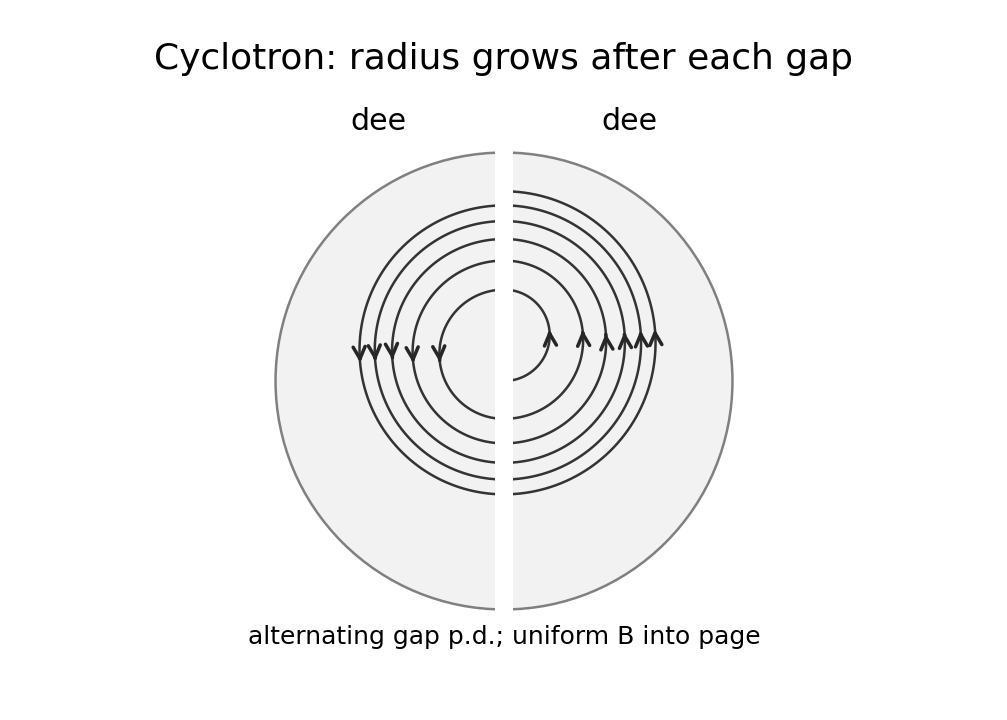
A cyclotron 回旋加速器 uses a magnetic field perpendicular to two hollow dees. Electric field accelerates particles across the gap. Inside a dee, magnetic force curves the path without increasing speed. Polarity reverses during each half-turn, allowing another energy gain at the next crossing. With perpendicular entry:
In the non-relativistic model, the period is independent of speed. Increasing speed increases radius. Time in one dee is $T/2$, not $T$. The formula assumes constant field and fixed mass in this model; synchronisation fails as relativistic effects become important.
Worked example. A proton moves perpendicular to $B=0.40\ \text{T}$ with momentum $2.0\times10^{-20}\ \text{kg m s}^{-1}$. Use proton mass $1.67\times10^{-27}\ \text{kg}$.
When starting instead from a de Broglie wavelength, use $p=h/\lambda$, then $E_k=p^2/(2m)$ and $V=E_k/|q|$. Check that the non-relativistic assumption remains suitable.
Read detector evidence carefully
Charged particles ionise matter along their paths, leaving detectable tracks. A neutral particle does not make a direct ionisation track in this model. Its presence can be inferred from missing momentum or from charged products it later produces.
In a known perpendicular magnetic field, curvature direction together with travel direction can identify charge sign. Without field direction, curvature alone cannot give sign. Radius gives momentum through $p=B|q|r$; comparing radii requires knowledge of charge magnitude. A tightening track often shows momentum being lost. Do not infer travel direction from a constant-radius arc alone.
Conserve charge, total energy and vector momentum at an interaction. If visible outgoing momenta do not add to the incoming momentum, a neutral product may carry the missing component. Draw a vector balance rather than guessing from the number of tracks.
High energies probe nucleon structure in two ways. Large momentum gives a short de Broglie wavelength, allowing small structure to be resolved. High collision energy also allows new massive particles to be created. Quarks are not observed as isolated free particles; do not describe a high-energy collision simply as removing a free quark.
Fast muons can reach the ground because their average lifetime measured in the Earth's frame is increased at speeds close to $c$. This does not mean they exceed light speed. Unit 4 requires the significance of this lifetime increase, not use of relativistic equations.
Particles, antiparticles and conservation
Families and antiparticles
In the quark–lepton model 夸克—轻子模型, baryons and mesons contain quarks. Leptons are fundamental particles in the model.
- A baryon 重子 contains three quarks, for example a proton $uud$ or neutron $udd$. An antibaryon contains three antiquarks.
- A meson 介子 contains one quark and one antiquark, for example a pion.
- A lepton 轻子 is fundamental, for example an electron or neutrino. A positron is an antilepton, not a meson.
- A photon is the quantum of electromagnetic radiation; it is neither a baryon nor a lepton.
Up-type quarks have charge $+2e/3$ and down-type quarks $-e/3$. Antiquarks have opposite charges. For example, $uud$ sums to $+e$ and $udd$ to zero. The symmetry of the quark families predicted a top quark before it was observed. Classification models make testable predictions, not just lists of known particles.
An antiparticle 反粒子 has the same rest mass as its particle and opposite electric charge when charged. Other relevant additive quantum numbers also reverse. An electron has lepton number $+1$; its positron has $-1$. Both have baryon number zero. A neutral antiparticle can differ in quantum numbers despite having no electric charge.
Check conserved totals
Assign baryon number $+1$ to a baryon, $-1$ to an antibaryon, and zero to mesons/leptons/photons. Quarks carry $+1/3$ and antiquarks $-1/3$. Assign lepton number $+1$ to a lepton and $-1$ to an antilepton. Compare total charge, baryon number and lepton number on both sides of a proposed reaction. Also check energy and momentum. Passing the listed conservation checks alone does not prove that an interaction will occur; it establishes that those laws do not forbid it.
Worked example. Test $n\rightarrow p+e^-+\bar\nu_e$.
| Quantity | Before | After |
|---|---|---|
| Charge / $e$ | 0 | $+1-1+0=0$ |
| Baryon number | 1 | $1+0+0=1$ |
| Lepton number | 0 | $0+1-1=0$ |
The antineutrino balances the electron's lepton number. Changing it to a neutrino would make the final total $+2$, so that proposed equation would fail this check. Preserve bars and charge signs when interpreting supplied particle symbols.
Rest energy, creation and annihilation
Mass–energy equivalence 质能等价 relates a rest-mass change to energy:
In pair production 粒子对产生, energy creates a particle–antiparticle pair. The energy must at least supply both rest masses; extra energy can become kinetic energy or recoil. Momentum must also be conserved, so the surrounding interaction matters. In annihilation 湮灭, particle and antiparticle can turn into photons. A pair initially at rest producing two photons gives equal photon energies and opposite momenta. Each photon carries one particle's rest energy for an equal-mass pair; the total is twice that value.
One electronvolt is $e$ joules: $1\ \text{eV}=1.60\times10^{-19}\ \text{J}$. MeV means $10^6$ eV and GeV means $10^9$ eV. A quoted mass in $\text{MeV}/c^2$ is a mass unit, not an energy unit. Multiply by $c^2$ to get its corresponding rest energy.
Worked example. Convert a mass of $140\ \text{MeV}/c^2$ to kilograms.
Use the same units before comparing masses. Percentage difference from an accepted value is $100\times|m_{\text{predicted}}-m_{\text{accepted}}|/m_{\text{accepted}}$. State the reference value. In threshold questions, distinguish rest-energy supply from kinetic energy; do not use $p=mv$ for a photon or a particle close to $c$.
Check yourself
- Can you use signed impulse and two momentum components, then test kinetic energy separately?
- Can you derive centripetal acceleration and draw only actual forces?
- Can you distinguish field vectors, signed potential and energy changes?
- Can you choose the correct capacitor curve and use log slope or tolerance evidence?
- Can you explain induction as a change in linkage, including the opposing direction?
- Can you separate electric acceleration from magnetic steering and halve a cyclotron period correctly?
- Can you preserve particle symbols, conservation totals and energy/mass units?
The skill sheets develop these methods before authentic past-paper tasks. Original practice also covers requirements not sampled in the two recent papers. A short sample of authentic questions does not define the whole syllabus.