Scope and prerequisites
ACT framework, February 2026 revision. Original classroom cases are not an official form; preserve the scored/field-test boundaries of each source form.
- Choose equivalent expanded, factored or vertex forms for a task
- Solve linear and polynomial equations using structure
- Determine quadratic inequality regions from signs rather than roots alone
Prerequisites: Collect like terms; substitute ordered pairs; signed arithmetic.
Explain and choose the method
Translate relationships into expressions before manipulating them. A fixed fee plus a per-unit charge is an affine linear model, while a product of dimensions can create a quadratic. An equivalent form should preserve the original expression on its domain. Factor common terms and recognise identities before expanding every product.
A linear equation can have one, no or infinitely many solutions after simplifying; check zero coefficients before dividing. Multiplying or dividing an inequality by a negative reverses its direction. A polynomial product equals zero when at least one factor is zero. Keep all factors, including an extracted x, to avoid losing a zero root.
A quadratic’s factored form exposes roots and its vertex form 顶点式 exposes an extremum. For an inequality, order the real roots and test the sign in each interval. Include boundaries only for ≤ or ≥. A parabola 抛物线 opening upward is negative between two distinct real roots and positive outside them.
Use substitution into the original relation to check candidate values. An expanded coefficient question may require combining several contributions to the same power. A degree-three polynomial need not require a general cubic formula: a common factor or known root can reduce it to simpler factors. Choose the method based on structure.
An identity holds for every permitted input. Start with $ax+b=cx+d$. Collect terms: $(a-c)x=d-b$. Inspect $a-c$ before dividing. If $a=c$ and $b=d$, every real input works. If only $a=c$, no input works. Otherwise $x=(d-b)/(a-c)$ gives one solution.
Existing worked example: x²-5x+6=(x-2)(x-3), so x²-5x+6<0 gives 2<x<3. x³-4x=x(x-2)(x+2), giving roots -2,0,2. The expression 2(x-3)²+5 has minimum 5 at x=3. In (2x+1)(x-4), the x coefficient is -8+1=-7.
Complete original context
Every transfer question states all data it needs.
Independent practice and checked reasoning
Transfer 1
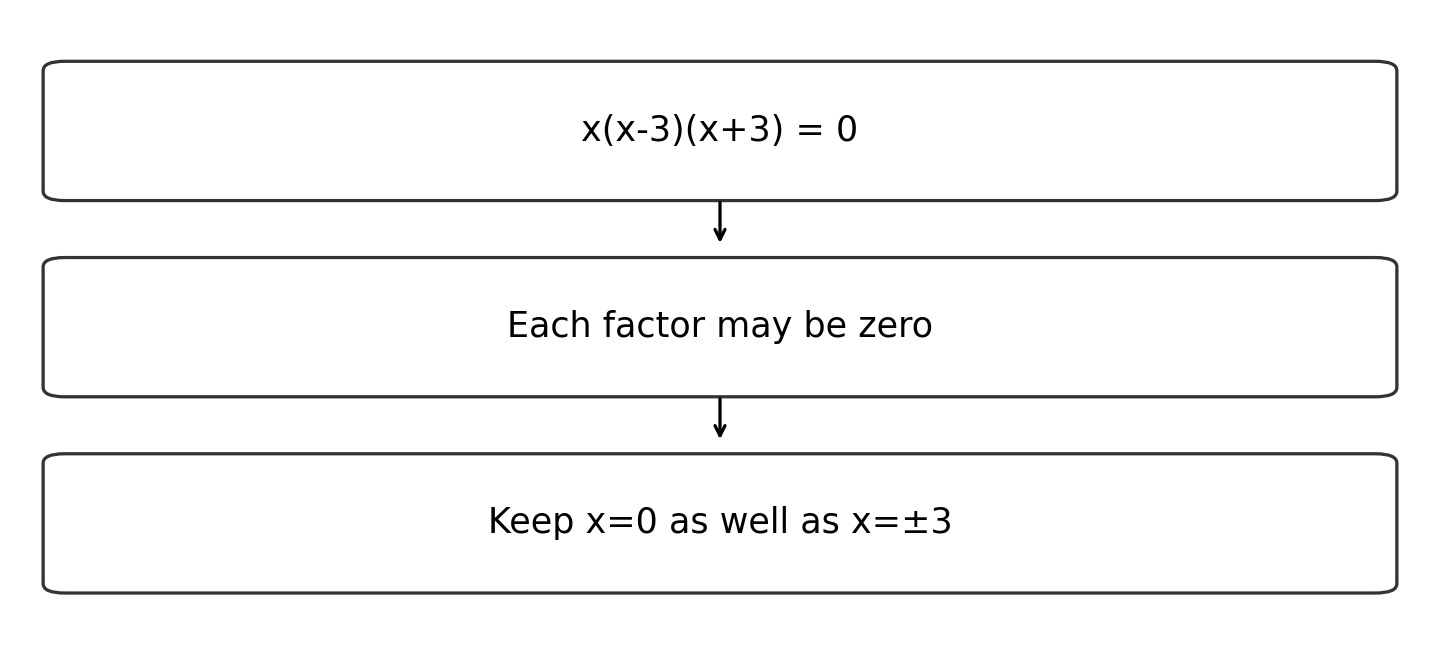
Solve $x^3-9x=0$ and $(x+2)(x-5)\ge0$. Explain why dividing the cubic by $x$ at the start loses a solution.
Reasoning: Factor $x(x-3)(x+3)=0$, giving $-3,0,3$. Dividing by $x$ improperly removes the allowed zero root. For the inequality, roots are $-2,5$; the product is nonnegative outside the roots, including endpoints, so $x\le-2$ or $x\ge5$.
Transfer 2
Write $2x^2-12x+23$ in vertex form and state its minimum. Find the coefficient of $x$ in $(2x-3)(x+4)$.
Reasoning: Completing the square gives $2(x-3)^2+5$, with minimum 5 at $x=3$. Expansion of the product is $2x^2+5x-12$, so the coefficient is 5.
Transfer 3
A printer charges 25 yuan to set up a job and 0.40 yuan per page. Write the total charge for $n$ pages and solve the 65-yuan budget inequality for whole pages. Compare this with the area expression for a rectangle with sides $x$ and $x+3$ metres.
Reasoning: $C=f+pn=25\,\mathrm{yuan}+(0.40\,\mathrm{yuan/page})(n\,\mathrm{pages})$. Budget $25+0.40n\le65$ gives $0\le n\le100$, with integer $n$. The charge is affine linear in $n$. The rectangle has $A=x(x+3)=x^2+3x$ square metres for numerical lengths in metres and $x>0$; multiplication of two variable lengths creates a quadratic, rather than a fixed fee plus a rate 速率.
Limits and next use
Do not omit an extracted factor, include a strict-inequality boundary, or report a vertex x-coordinate when the question asks for the minimum value.
All tasks here are public original practice with authored guidance. They are not official questions or fresh diagnostics. Existing protected tests and mocks remain separate.