Scope and prerequisites
ACT framework, February 2026 revision. Original classroom cases are not an official form; preserve the scored/field-test boundaries of each source form.
- Analyse multiple perspectives and develop a position
- Support reasoning with relevant examples
- Organise and express an argument 论证 clearly
Prerequisites: A clear position; reasons linked to examples; fair treatment of alternatives.
Explain and choose the method
The optional ACT Writing task gives an issue and three perspectives, with 40 minutes for the complete essay. Develop your own position and analyse its relationship to at least one supplied perspective 视角. You may adopt, qualify or challenge a supplied view. Your stance itself is not a reason for a higher score; the quality of the argument matters.
Separate agreement about the goal from agreement about the method. Identify a perspective’s assumption, likely benefit and limitation. A relationship statement should say where your position agrees or differs and why. Do not spend the essay merely restating the three views, or assume that listing all three amounts to analysis.
Development connects a reason to a specific example and explains its implications. A hypothetical example is acceptable as reasoning practice when it is clearly hypothetical; do not invent statistics and present them as measured evidence 证据. Respond to a serious objection, including the conditions under which it would matter. A qualified policy can be stronger than an absolute claim unsupported by its examples.
Organise paragraphs around the argument’s needs: position, developed reasons, engagement with another perspective and a coherent conclusion. This is a possible structure, not an official paragraph-count rule. A suggested practice budget is 6 minutes to plan, 29 to draft and 5 to revise; adjust it after timed trials. Revision checks reasoning, connections, precise wording and sentence control. Local checks teach these moves; the complete essay requires teacher review across four domains and is not exact-string graded or converted into an invented official score.
An argument needs a position, a reason and an explained connection. A counterargument 反论点 tests the position rather than acting as a token objection. Distinguish what a perspective actually says from a stronger claim you find easier to attack. Plan by decision criteria: predictable access, spontaneous access, administration and fairness.
Existing worked example: Original issue: should a community learning centre require advance booking for all equipment? Perspective 1: required booking reduces queues and makes schedules predictable. Perspective 2: open access lets people respond to needs that arise unexpectedly. Perspective 3: a combined system should reserve some capacity while preserving walk-in access. A defensible position is to reserve high-demand machines in peak hours and leave a portion available for walk-ins. This agrees with predictability as a goal but limits compulsory booking because urgent repairs cannot always be planned. Model development: “A resident whose only printer fails before an interview needs access that evening. If every slot must have been reserved yesterday, a nominally fair rule prevents an urgent use. Keeping one walk-in slot per hour would protect such access, though staff would need a clear queue rule to avoid arbitrary exceptions.” The example explains the policy’s mechanism and trade-off; it does not establish a universal optimal percentage.
Complete original context
Original Writing issue: A community learning centre has a small number of shared tools. Should every use require advance booking?
Perspective 1: Requiring bookings for all tools makes access predictable and prevents visitors travelling only to find everything occupied.
Perspective 2: Walk-in access is important because people may discover a need unexpectedly or be unable to book online.
Perspective 3: A mixed system can reserve some capacity while retaining walk-in access, but staff must explain and administer the rules.
Write a sustained argument stating your own position, analysing its relationship with all three perspectives, and developing reasons and examples. This is original classroom practice, not an official prompt, timed form or score prediction. No official word minimum is asserted here.
Independent practice and checked reasoning
Transfer 1
Plan a position and explain how it relates to each perspective without describing them as identical.
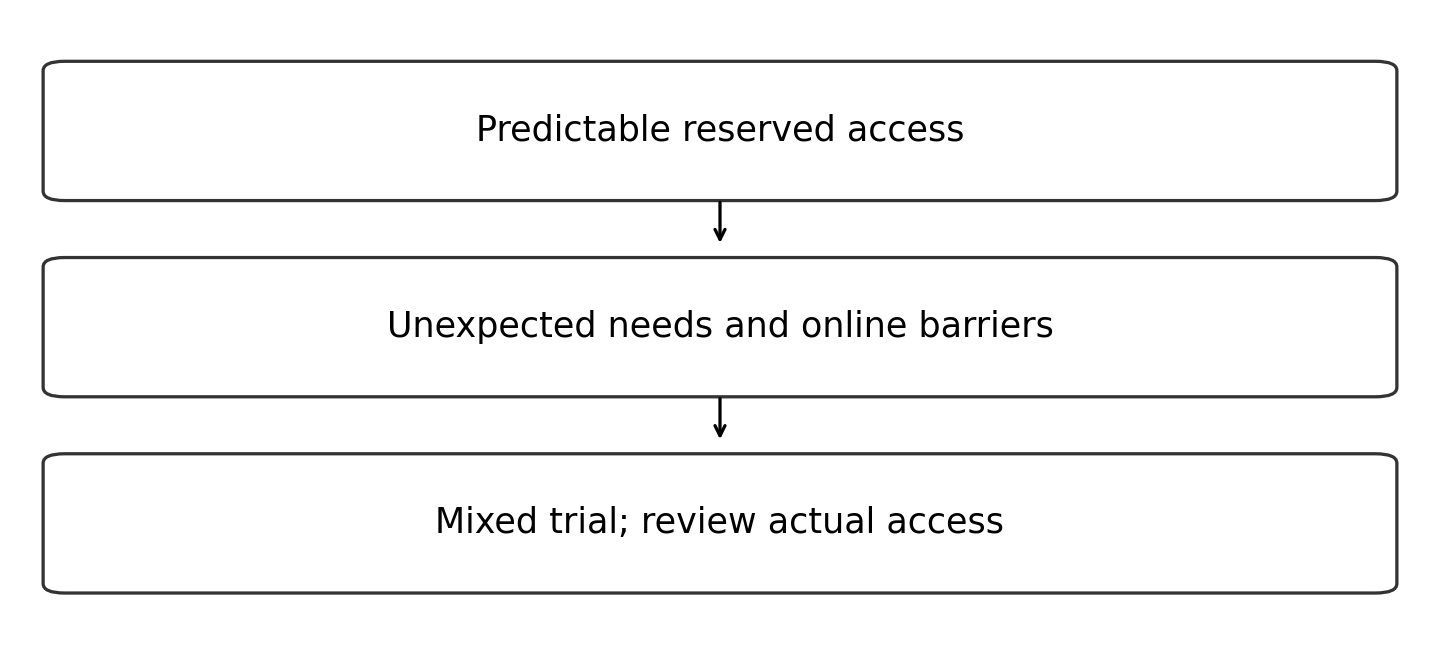
Reasoning: A mixed system agrees with P1 that predictable access matters, accepts P2's concern about unexpected needs and online barriers, and develops P3's compromise by specifying capacity, alternative booking routes and review. It rejects P1's universal requirement while avoiding unrestricted queues.
Transfer 2
Write the complete argument. Then identify a concession that changes or limits your own recommendation.
Reasoning: A learning centre should make access predictable without requiring every visitor to predict every need. I would reserve some tool sessions in advance and keep others available to people who arrive without bookings. This position accepts the first perspective's concern about wasted journeys, the second perspective's concern about unexpected needs, and the third perspective's warning that a compromise requires clear administration. Its success would depend on practical rules rather than the word mixed alone.
Advance booking has an important benefit. Imagine a visitor who needs a particular tool for a supervised project and must travel across town. Knowing that a session is reserved lets the visitor organise transport and bring the right materials. A queue discovered on arrival may waste both the journey and the preparation. The first perspective therefore identifies a real access problem. However, reserving every minute would solve that problem by creating another: someone whose tool breaks unexpectedly might find a room apparently full of reservations, even when several booked users do not arrive. Predictability should be protected, but it should not be confused with maximum use of every tool.
The second perspective is strongest when it focuses on barriers rather than simply celebrating spontaneity. A visitor may not have reliable internet access, may struggle with an online form, or may discover a missing tool only while working. A rule requiring online reservations would treat these different situations as failures to plan. Yet unrestricted walk-in access also has limits. The same confident regular visitors could take the earliest spaces repeatedly, while a newcomer waits without knowing when a turn will come. Removing bookings would not automatically make access fair. The centre needs a visible queue and staff assistance as well as open spaces.
A mixed system can address both sets of concerns. For an initial trial, the centre could offer bookable sessions and a clearly marked number of walk-in sessions for each heavily used tool. Reservations should also be possible in person or by telephone, so that online access does not become a condition of participation. A short grace period could release an unused reservation, provided the rule is stated when the booking is made. Visitors would then know both what a reservation protects and when it expires. These are proposed trial rules, not claims that one proportion of spaces suits every centre.
Administration is a serious objection to this approach. Staff already supervise safe tool use, and a complicated allocation system could distract them. This is where the third perspective places a condition on its own compromise. The centre should start with a simple timetable for only its busiest tools, use one shared booking record, and display the next available session. If staff cannot apply a rule consistently, they should simplify it. Special exceptions that depend on who happens to be at the desk would undermine the fairness the system is intended to improve.
The trial should be judged by more than the number of reservations. Staff could record unused booked sessions, waiting times, visitors turned away, and requests for help with booking. They should also ask whether newcomers and people without internet access can obtain a turn. If unused reservations remain common, more walk-in capacity may be needed. If long journeys frequently end in disappointment, more reserved capacity may be justified. The recommendation thus concedes that the balance should change with evidence rather than remain fixed for the sake of consistency.
Shared tools exist to support learning, not to reward either perfect planning or early arrival alone. A clearly explained mixed system preserves useful certainty while leaving room for unexpected needs. Its limits must remain visible: alternative booking routes, manageable staff work, and a review of actual access. Those conditions turn a compromise into a policy that people can understand and the centre can revise.
Transfer 3
Evaluate the model's perspective relationships, evidence and qualification. Identify one further local fact needed before implementation.
Reasoning: The model accepts predictable access from P1 but rejects making it universal; it accepts P2's barriers but tests the fairness of an unrestricted queue; it develops P3's administrative condition. Imagined visitors illustrate mechanisms and are not presented as measured results. The trial balance is explicitly revisable. Actual staffing, demand and safety requirements would be needed before selecting session lengths or capacity proportions. Other defensible positions are acceptable if they analyse the supplied perspectives and support a sustained argument.
Limits and next use
Mentioning a perspective without analysing its relationship to your argument is not enough.
All tasks here are public original practice with authored guidance. They are not official questions or fresh diagnostics. Existing protected tests and mocks remain separate.