Scope and prerequisites
ACT framework, February 2026 revision. Original classroom cases are not an official form; preserve the scored/field-test boundaries of each source form.
- Infer a word’s local sense from surrounding evidence 证据
- Explain how a passage’s structure shapes its effect
- Distinguish narrator perspective, quoted views and author purpose
Prerequisites: Speaker versus author; figurative meaning; structural shifts.
Explain and choose the method
For vocabulary in context, replace the word with a plain paraphrase and check the whole sentence. Familiar dictionary meanings compete; the passage’s situation selects one. Technical or figurative use may differ from everyday usage. A strongly positive or negative connotation 内涵色彩 also needs contextual support rather than an isolated association.
Structure questions ask what a part does: introduce a problem, illustrate a claim, complicate an initial judgement or return to an image. Describe the function before picking an answer. A narrative may begin at an ending and then explain how it arose; a comparison may alternate topics rather than treating each in a separate block. Identify the effect of the arrangement, not merely the subject of a paragraph.
Point of view 叙述视角 affects access to knowledge. A first-person narrator reports a particular perspective and may express uncertainty about someone else’s motives. A quoted opinion belongs to its speaker; it is not automatically endorsed by the author. Purpose concerns the passage’s communicative task, such as explaining a change or questioning an assumption, and should be supported by the whole text.
Tone emerges from word choice and treatment of evidence. Mild scepticism differs from hostility, and affectionate humour differs from mockery. Use at least two local cues when alternatives differ by degree. Do not infer author biography or certainty from a narrator’s tentative observation. Read the beginning and ending together to see whether the perspective shifts.
Point of view limits access to motives. First-person narration tells us what the narrator notices and thinks. “I could not tell” explicitly leaves the uncle's response uncertain; do not choose approval or ridicule as certain.
Existing worked example: Original extract: “I called the restored clock stubborn when it refused to run. My aunt smiled: ‘It has been waiting longer than you have.’ She opened the case and pointed to a loose spring. By evening, the steady ticking made my accusation seem theatrical. I still do not know whether her smile was patience or amusement.” Stubborn personifies the clock’s resistance, not its deliberate intention. The movement from accusation to a simple repair gently qualifies the narrator’s first judgement. The final uncertainty limits access to the aunt’s motives. The quoted remark adds humour; it does not prove the aunt thought the clock could consciously wait.
Complete original context
Original literary passage — The spare key
When I returned to the workshop after my uncle retired, the key felt too small for the responsibility attached to it. He had left the drawers neatly labelled, as though the labels might continue his explanations in his absence. I turned on the overhead light and read “washers”, “pins”, “springs”. Each word named an orderly compartment. The workbench, however, carried a shallow circular mark where his tea cup had stood, and no label could explain why that empty circle held my attention longer than the stocked shelves.
A neighbour arrived with a bent gate latch. I found a replacement pin quickly, then spent several minutes searching for the washer that would keep it in place. My uncle had sorted objects by size. He could see a repair in his mind before he opened a drawer; I could not. The neighbour waited without complaint, which made the delay feel more noticeable rather than less. At last I found the washer, fitted the pin and watched the latch swing freely. The repair was simple. Finding its parts had not been.
That evening I placed commonly paired pieces in small trays. The shelves lost some of their symmetry. I imagined my uncle raising an eyebrow, then remembered how often he had moved a tool after noticing where his hand expected it to be. His neat labels had been the result of change, not a prohibition against it. I left the rare springs in their old drawer because they had no regular partners. There was no reason to change them merely to prove that the workshop was mine.
A week later my uncle visited. He opened a tray and asked where the larger washers had gone. I showed him the remaining size-labelled drawer. “So you have kept both systems,” he said. I could not tell whether his smile meant approval or amusement at my earnestness. He tested a latch, set it down, and asked for tea. I placed his cup on the old mark without thinking. Only after he left did I notice that I had made room beside it for my own.
I had expected taking charge to mean replacing his habits with mine. Instead, I was learning which habits solved a problem and which had depended on a skill I had not yet acquired. The workshop did not need a dramatic beginning. It needed a washer that could be found, a safe repair, and enough empty space for the next person to work.
Independent practice and checked reasoning
Transfer 1
What does “as though the labels might continue his explanations” suggest? Explain the wording without treating the drawers as literal speakers.
Reasoning: It personifies or imagines the labels carrying the uncle's practical guidance after retirement. “As though” marks the comparison as figurative. It also prepares the contrast between labelled objects and the unlabelled cup mark's personal meaning.
Transfer 2
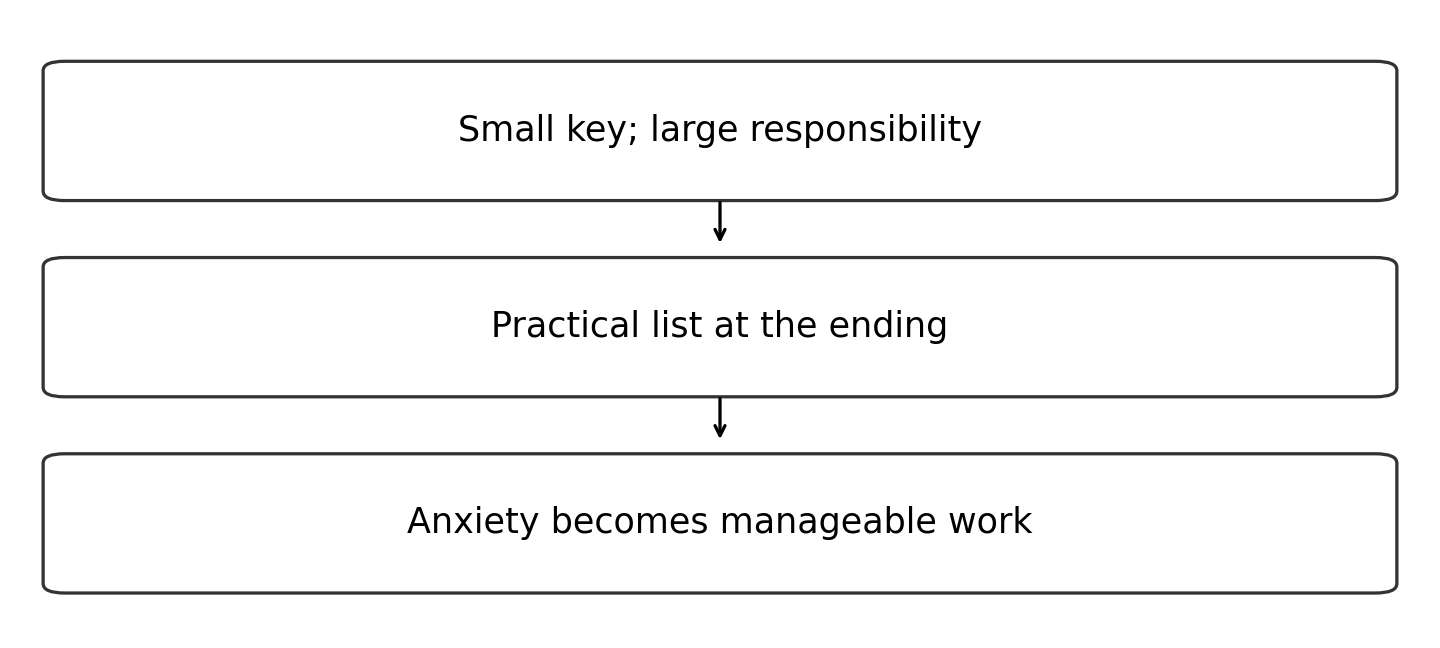
Explain the structural change from the first paragraph's small key to the final paragraph's practical list.
Reasoning: The key initially makes responsibility feel large and abstract. The final list reduces that anxiety to concrete work—finding a washer, repairing safely and leaving room. The change qualifies the narrator's expectation of a dramatic break rather than proving complete expertise.
Transfer 3
Is the tone uniformly hostile to the uncle? Use two details and one limit on what the narrator knows.
Reasoning: No. Remembering the uncle's adaptive tool placement and making room for his cup suggest respect and continuity. The narrator remains unsure about his smile, so neither wholly approving nor wholly mocking motives should be asserted as fact. An interpretation of affectionate unease can explain the mixed evidence.
Limits and next use
A quotation, narrator and author need not share one attitude. Match the answer to the viewpoint the stem names.
All tasks here are public original practice with authored guidance. They are not official questions or fresh diagnostics. Existing protected tests and mocks remain separate.