Scope and prerequisites
ACT framework, February 2026 revision. Original classroom cases are not an official form; preserve the scored/field-test boundaries of each source form.
- Distinguish complete clauses, fragments and comma splices
- Locate the grammatical subject despite intervening phrases
- Punctuate boundaries and modifiers according to structure
Prerequisites: Independent clauses; subject head; possessives and parallel forms.
Explain and choose the method
A complete independent clause 独立分句 has a subject and finite verb 限定动词 and can stand alone. A dependent clause introduced by although or because needs a main clause. Join independent clauses with a period, a semicolon, or a comma plus an appropriate coordinating conjunction. A comma alone generally creates a comma splice. A semicolon does not repair a fragment.
Identify the head of the subject rather than the nearest noun. Prepositional phrases and inserted comments may separate it from the verb. Pronouns must refer clearly to the intended antecedent and use the correct form in their grammatical role. Keep verb tense consistent with the actual sequence of events rather than mechanically making every verb identical.
Use paired commas for a nonessential inserted element and avoid commas separating a subject from its verb. A colon 冒号 can introduce an explanation or list after a complete clause. Apostrophes mark possession or omitted letters, not ordinary plurals. Punctuation choices must be judged in the entire sentence, including material outside the selected span.
Modifiers should attach to what they describe. In “Walking into the archive, the map caught Lena’s attention,” the introductory modifier 修饰语 wrongly makes the map the walker. Revise to “Walking into the archive, Lena noticed the map.” Parallel items should use compatible grammatical forms. Identify the structural error before comparing surface wording.
Conventions 语言规范 depend on grammar, not a preferred sound. “The group of volunteers records outcomes” uses singular group. “Recording the result, Noor checked the card” attaches the modifier to Noor. Use a comma plus conjunction, semicolon or period to separate complete clauses.
Existing worked example: Original editing case: “Although the archive was small. Its collection of local maps were extensive, visitors could compare several editions. Examining a faded sheet, a spelling error surprised Lena.” Revision: “Although the archive was small, its collection of local maps was extensive; visitors could compare several editions. Examining a faded sheet, Lena noticed a spelling error.” The first dependent clause now connects to a main clause. Collection is singular, so was agrees. A semicolon joins the two complete clauses. Lena becomes the subject described by examining.
Complete original context
Original continuous editing passage — A place to mend
[P1] On the first Saturday of each month, a group of volunteers opens a repair table in the public library. [S1] The project began when librarian Noor noticed a row of broken desk lamps outside a nearby building. [S2] Some needed specialist work, but others had loose switches or damaged cables. [S3] Noor did not want untrained visitors to try unsafe electrical repairs. [S4] She invited a qualified repairer to explain which items the group could inspect and which should go to a professional. The first session accepted only battery-powered objects, with damaged batteries excluded. Visitors registered their items and described the faults before any work began.
[P2] At the entrance, two volunteers record each visitor's name and item. This record helps the group reunite objects with their owners. A blue card goes beside an object awaiting inspection; a white card marks one ready for collection. The cards do not certify safety or guarantee a repair. They simply show where an item is in the process. [S5] The library's logo was designed many years ago. Beside the cards, a sign asks visitors to stay while their object is examined. Staying allows owners to explain an intermittent fault that might not appear immediately. It also gives them a chance to learn a simple maintenance habit.
[P3] Space soon became a problem. The repair table shared an alcove with readers who wanted a quiet place to work. During the first two sessions, a visitor log recorded six complaints about conversation near the alcove. Noor proposed moving the table into a meeting room. The room could hold fewer people, so a move alone would not solve the problem. The group introduced short arrival windows and kept two spaces for visitors without bookings. [S6] This totally amazing system fixed every problem forever. In fact, one visitor still waited outside, and the group had to improve the signs leading to the room. The log recorded one noise complaint during the next two sessions; attendance also fell, so the group did not attribute the whole reduction to the move.
[P4] Volunteers were careful about how they described success. An object leaving the table might work again, need another part, or require professional attention. They recorded these outcomes separately. During the trial, forty objects were inspected. Eighteen worked after a permitted minor adjustment, twelve needed a part, and ten were referred elsewhere. Counting all forty as repaired would hide important differences. [S7] The volunteers recorded the outcomes and wrote the results down in their record. Noor used the figures to decide which spare parts might be useful at later sessions. She did not use them to promise that any particular object could be repaired.
[P5] The project now has a practical aim: help visitors make an informed next decision about a broken object. For some, that means a working lamp. For others, it means knowing when further work would be unsafe or too costly. The group plans to keep the arrival windows for another trial and ask readers whether noise remains a problem. It will also compare attendance and waiting times before adding more spaces. A repair table succeeds through careful limits as well as useful repairs.
Independent practice and checked reasoning
Transfer 1
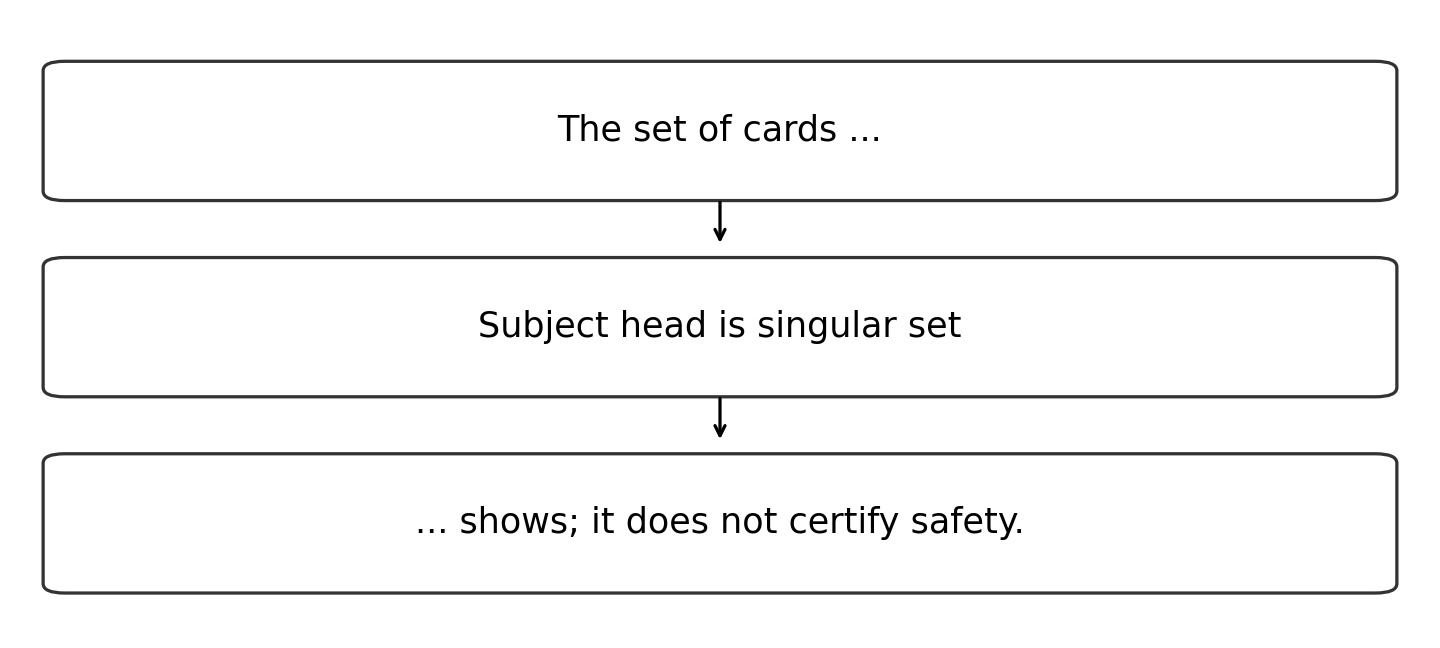
Repair “The set of blue cards show the current stage, they do not certify safety.” Preserve both claims and explain agreement and boundary.
Reasoning: “The set of blue cards shows the current stage; it does not certify safety.” Set is singular; the pronoun it refers to the set. A semicolon joins the independent clauses. A full stop or comma plus but also works with appropriate wording.
Transfer 2
Repair “Inspecting the lamp, a loose switch was noticed by Noor” and “The group aims to inspect, recording, and advise”.
Reasoning: “Inspecting the lamp, Noor noticed a loose switch” attaches the inspection to its actor. “The group aims to inspect, record, and advise” uses parallel infinitive complements under to. Other grammatical rewrites preserving these meanings are acceptable.
Transfer 3
Choose “its/it's” in “The group updates ___ records” and “___ important to label outcomes”. Explain why the same spelling does not fit both.
Reasoning: “its records” needs the possessive form. “It's important” means “It is important”. The apostrophe marks a contraction here, not possession; substitution of it is checks the distinction.
Limits and next use
A pause is not a punctuation rule. Identify clause boundaries, modifier attachment and subject–verb relationships.
All tasks here are public original practice with authored guidance. They are not official questions or fresh diagnostics. Existing protected tests and mocks remain separate.