Scope and prerequisites
ACT framework, February 2026 revision. Original classroom cases are not an official form; preserve the scored/field-test boundaries of each source form.
- Interpret amplitude 振幅, period and vertical shift in a sinusoidal rule
- Use unit-circle signs and basic identities
- Choose a sine, cosine or area relation for a general triangle
Prerequisites: Radians; right-triangle ratios; unit-circle coordinates.
Explain and choose the method
For a right triangle, sin is opposite/hypotenuse, cos adjacent/hypotenuse and tan opposite/adjacent relative to a chosen angle. Similar triangles explain why these ratios depend on angle rather than size. On the unit circle, coordinates are (cos θ,sin θ), extending the ratios to other quadrants with appropriate signs.
sin²θ+cos²θ=1 and tan θ=sin θ/cos θ when cos θ≠0. For y=A sin(Bx)+D with radian x, amplitude is |A|, period 2π/|B| and midline D. A negative A reflects the wave; D shifts it vertically. Check whether the input is in radians or degrees before using a graph interval.
For a general triangle, the cosine rule 余弦定理 c²=a²+b²-2ab cos C uses the included angle 夹角 C between a and b. The sine rule compares each side with the sine of its opposite angle. Area is ab sin C/2 when two sides and their included angle are known. Choose the relationship matching the supplied information.
Do not infer a right angle from the sketch. A sine-based equation may allow more than one angle in a permitted interval; retain the quadrant information and any triangle sum condition. Keep amplitude distinct from total peak-to-trough distance, which is twice the amplitude.
Amplitude is half the peak-to-trough distance. In $y=A\sin(Bx)+D$, it is $|A|$; radian period is $2\pi/|B|$. For a non-right triangle, match known sides and included angle before selecting the cosine rule . $c^2=a^2+b^2-2ab\cos C$.
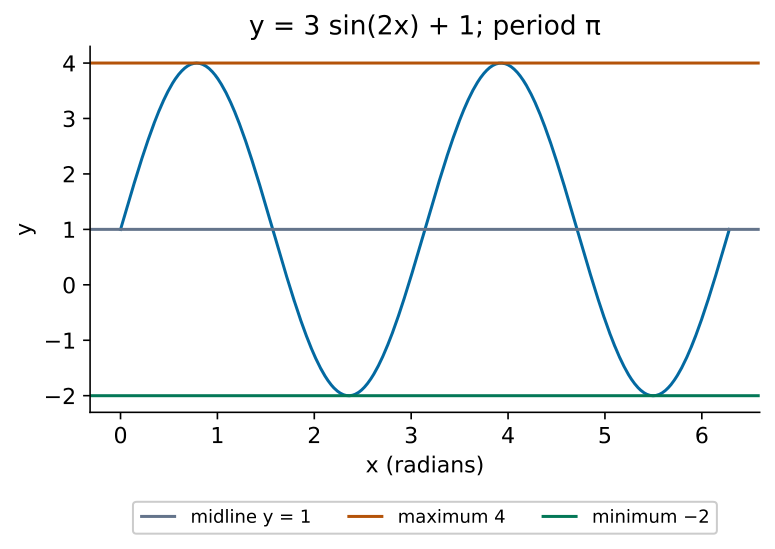
Existing worked example: y=3 sin(2x)+1 has amplitude 3, period π and values between -2 and 4. A triangle with sides 5 and 7 around a 60° angle has third side √(25+49-70·1/2)=√39 and area 35√3/4. At 150°, sine is 1/2 and cosine -√3/2.
Complete original context
Every transfer question states all data it needs.
Independent practice and checked reasoning
Transfer 1
For radian input $y=-4\sin(2x)+3$, give amplitude, period, range and value at $x=\pi/4$.
Reasoning: Amplitude is 4, period $2\pi/2=\pi$, range $-1\le y\le7$. At $x=\pi/4$, $y=-4\sin(\pi/2)+3=-1$. The negative coefficient reflects the wave; it does not make amplitude negative.
Transfer 2
A triangle has sides 6 cm and 10 cm enclosing 60°. Find its third side and area without assuming it is right-angled.
Reasoning: $c^2=a^2+b^2-2ab\cos C=(6\,\mathrm{cm})^2+(10\,\mathrm{cm})^2-2(6\,\mathrm{cm})(10\,\mathrm{cm})\cos60^\circ=76\,\mathrm{cm^2}$, so $c=2\sqrt{19}\,\mathrm{cm}$. $A=ab\sin C/2=(6\,\mathrm{cm})(10\,\mathrm{cm})\sin60^\circ/2=15\sqrt3\,\mathrm{cm^2}$.
Transfer 3
Find every angle in $0^\circ\le\theta<360^\circ$ with $\sin\theta=1/2$. For each, give cosine and tangent.
Reasoning: Angles are 30 and 150 degrees. Cosines are $\sqrt3/2$ and $-\sqrt3/2$; tangents are $1/\sqrt3$ and $-1/\sqrt3$. Sine is positive in quadrants I and II, so one acute answer would be incomplete.
Transfer 4
A right triangle has legs 9 and 12 cm. Find the hypotenuse and sine/cosine of the angle opposite 9 cm. A different triangle has angles 30° and 45° and side 8 cm opposite 30°. Find the side opposite 45°, explaining why the sine rule fits.
Reasoning: $c=\sqrt{(9\,\mathrm{cm})^2+(12\,\mathrm{cm})^2}=15\,\mathrm{cm}$. Thus $\sin\theta=9/15=3/5$ and $\cos\theta=12/15=4/5$; their squares sum to 1. In the second triangle a known opposite side-angle pair permits $b/\sin45^\circ=(8\,\mathrm{cm})/\sin30^\circ$. Hence $b=(8\,\mathrm{cm})(\sqrt2/2)/(1/2)=8\sqrt2\,\mathrm{cm}$. This triangle is not assumed right-angled; its third angle is 105°.
Limits and next use
State angle units and identify the included angle. The highest value is midline plus amplitude, not the amplitude alone.
All tasks here are public original practice with authored guidance. They are not official questions or fresh diagnostics. Existing protected tests and mocks remain separate.