- explain the purpose and content of the income statement and the statement of financial position (balance sheet)
- explain depreciation and how financial statements are used by stakeholders
财务与会计(A Level)
A-Level 商业 · 第 10 主题
 9:35
9:35
Finance and accounting (A Level)
Two shops on the same street. Both sold five hundred thousand pounds of goods last year, and they look identical. But one is about to open three new branches…
英文讲解 · 内嵌中英文字幕
10.1
财务报表

大纲
来源:剑桥国际大纲
财务报表(financial statements)是显示一个企业在钱上做得怎样的官方记录。你学习其中两个:利润表和财务状况表。依法,公司必须每年发布这些。
探索
Financial statements flow
See how business events become the statements users read.
词汇表
训练
| 英文 | 中文 | 拼音 |
|---|---|---|
| financial statements | 财务报表 | cái wù bào biǎo |
10.1
利润表
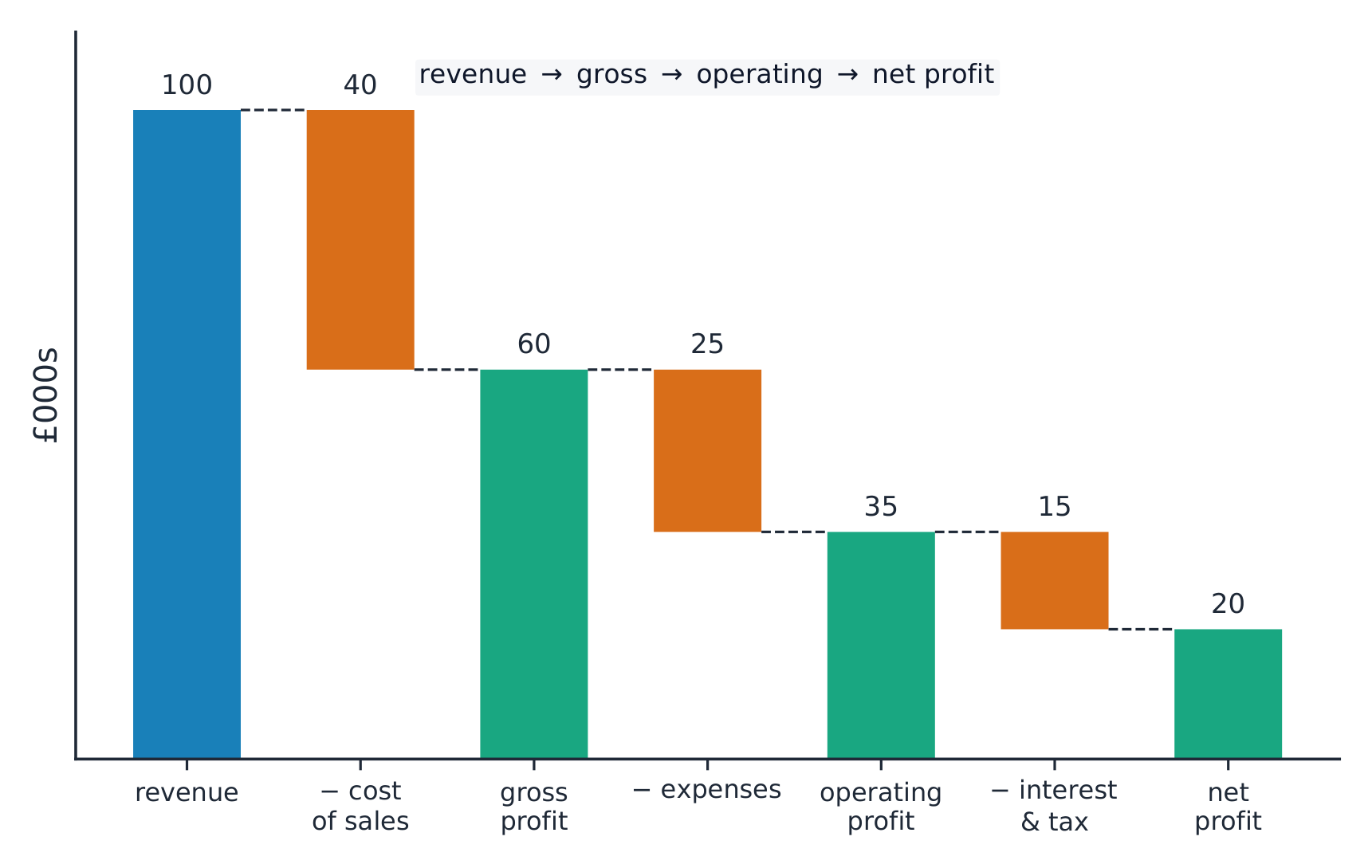
利润表(income statement)显示一个企业一段时间内(通常一年)的营业收入(revenue)和成本,以及每个阶段剩下的利润。
$$\text{gross profit} = \text{revenue} - \text{cost of sales}$$
- 销售成本(cost of sales)是被出售的商品的直接成本。
- 毛利润(gross profit)是从营业收入取出销售成本之后剩下的。
- 取出费用(expenses,如租金、工资和营销)之后,你得到营业利润(operating profit)。
- 在利息和税之后,剩下的是净利润(net profit,这年的利润)。
词汇表
训练
| 英文 | 中文 | 拼音 |
|---|---|---|
| income statement | 利润表 | lì rùn biǎo |
| revenue | 营业收入 | yíng yè shōu rù |
| cost of sales | 销售成本 | xiāo shòu chéng běn |
| gross profit | 毛利润 | máo lì rùn |
| expenses | 费用 | fèi yòng |
| operating profit | 营业利润 | yíng yè lì rùn |
| net profit | 净利润 | jìng lì rùn |
10.1
资产负债表
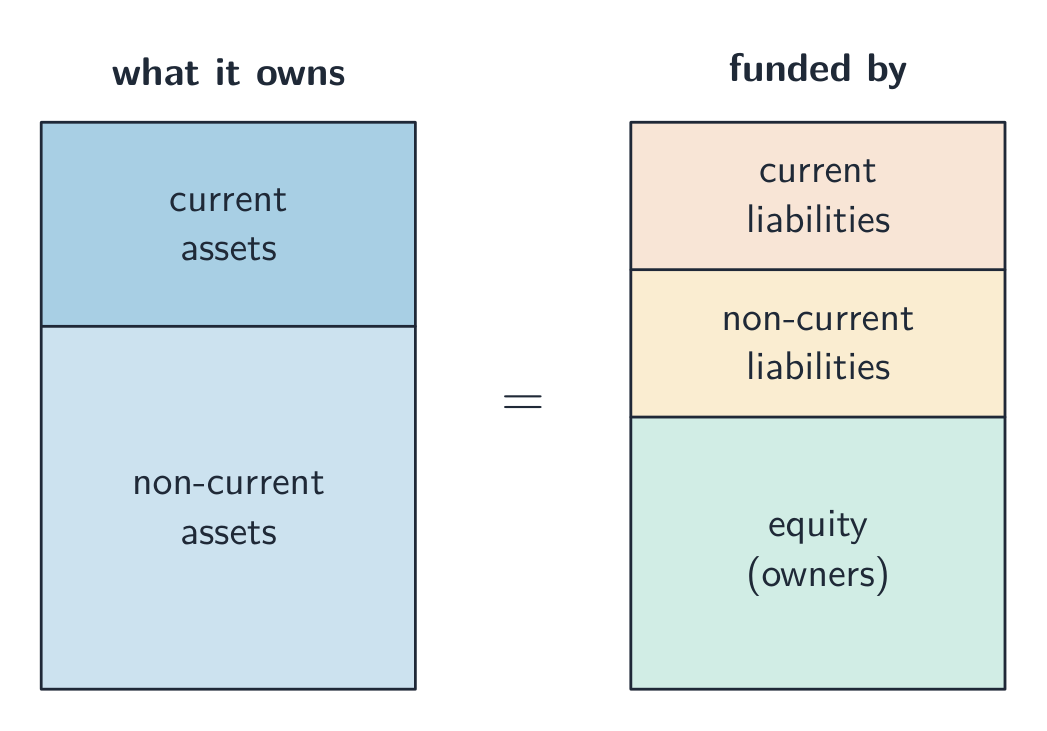
财务状况表(statement of financial position,也叫资产负债表(balance sheet))是企业在某一天拥有和欠什么的一张照片。
- 非流动资产(non-current assets)——保留超过一年的物品,如建筑和机器。
- 流动资产(current assets)——一年内变成现金的物品,如库存和顾客欠的钱。
- 流动负债(current liabilities)——一年内到期的债务。
- 非流动负债(non-current liabilities)——超过一年后到期的债务,如一个长期贷款。
- 所有者权益(equity)——所有者投入的钱,加上保留在企业中的利润。
两边总是平衡:企业拥有的由它欠的加上所有者权益资助。
词汇表
训练
| 英文 | 中文 | 拼音 |
|---|---|---|
| statement of financial position | 财务状况表 | cái wù zhuàng kuàng biǎo |
| balance sheet | 资产负债表 | zī chǎn fù zhài biǎo |
| non-current assets | 非流动资产 | fēi liú dòng zī chǎn |
| current assets | 流动资产 | liú dòng zī chǎn |
| current liabilities | 流动负债 | liú dòng fù zhài |
| non-current liabilities | 非流动负债 | fēi liú dòng fù zhài |
| equity | 所有者权益 | suǒ yǒu zhě quán yì |
10.1
折旧

折旧(depreciation)是把一个非流动资产的成本分摊到它被使用的年份、而不是全部在它被买的那年的方式。例如,一台使用五年的 £10,000 的机器可能每年失去 £2,000 的价值。折旧降低资产在财务状况表上的价值,并在利润表上算作一个费用,所以利润不被高估。
探索
Stakeholder interest lab
See how different stakeholders judge the same business decision.
词汇表
训练
| 英文 | 中文 | 拼音 |
|---|---|---|
| depreciation (assets) | 折旧 | zhé jiù |
10.1
利益相关者如何使用财务报表

不同的利益相关者(stakeholders)出于不同的原因读这些报表:
- 所有者和投资者检查利润和他们钱的回报。
- 贷款方检查企业是否能偿还它的贷款。
- 管理者用它们来做决定并设定预算。
- 政府检查应缴的税;供应商检查企业能付款。
词汇表
训练
| 英文 | 中文 | 拼音 |
|---|---|---|
| stakeholders | 利益相关者 | lì yì xiāng guān zhě |
10.2
已公布账目的分析
大纲
- calculate and interpret profitability, liquidity, efficiency and gearing ratios
- use ratio analysis to assess and compare business performance and explain its limitations
来源:剑桥国际大纲
一个单一的数字本身意义不大。比率分析(ratio analysis)把报表里的两个数字联系起来以判断绩效,并让你把一年与另一年、或一个企业与另一个比较。
词汇表
训练
| 英文 | 中文 | 拼音 |
|---|---|---|
| ratio analysis | 比率分析 | bǐ lǜ fēn xī |
10.2
盈利能力比率

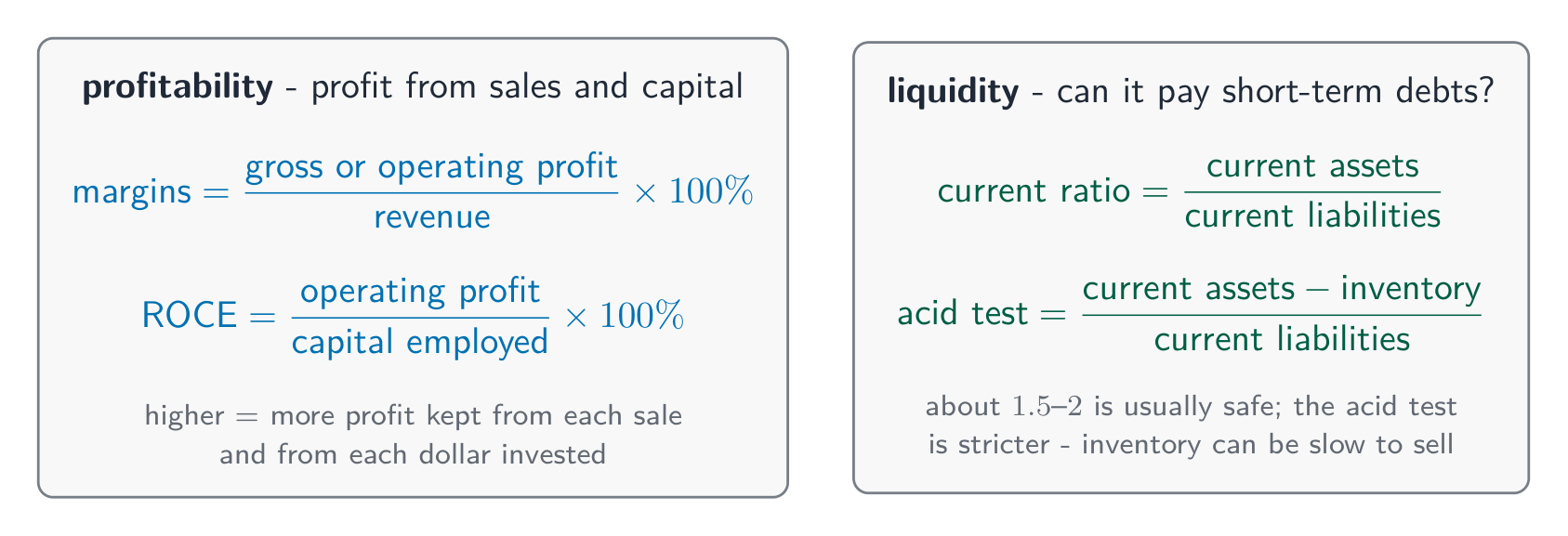
盈利能力(profitability)比率显示企业把销售和资本转化成利润有多好。
$$\text{gross profit margin} = \frac{\text{gross profit}}{\text{revenue}} \times 100\%$$
$$\text{operating profit margin} = \frac{\text{operating profit}}{\text{revenue}} \times 100\%$$
一个更高的毛利率(gross profit margin)或营业利润率(operating profit margin)意味着从每次销售保留更多的利润。关键的总体量度是资本回报率(return on capital employed,ROCE),它把利润与投入的钱比较:
$$\text{ROCE} = \frac{\text{operating profit}}{\text{capital employed}} \times 100\%$$
这里所用资本(capital employed)是企业里的总长期钱。一个更高的 ROCE 意味着钱被很好地使用。
例题。 一个企业有 £500,000 的营业收入、£200,000 的毛利润、£80,000 的营业利润和 £400,000 的所用资本。求它的毛利率、营业利润率和 ROCE。
$$\text{gross profit margin} = \frac{200\,000}{500\,000} \times 100\% = 40\%$$
$$\text{operating profit margin} = \frac{80\,000}{500\,000} \times 100\% = 16\%$$
$$\text{ROCE} = \frac{80\,000}{400\,000} \times 100\% = 20\%$$
探索
Accounts ratio diagnosis
Classify ratios by the question they answer about a business.
词汇表
训练
| 英文 | 中文 | 拼音 |
|---|---|---|
| profitability | 盈利能力 | yíng lì néng lì |
| gross profit margin | 毛利率 | máo lì lǜ |
| operating profit margin | 营业利润率 | yíng yè lì rùn lǜ |
| return on capital employed | 资本回报率 | zī běn huí bào lǜ |
| capital employed | 所用资本 | suǒ yòng zī běn |
| liquidity | 流动性 | liú dòng xìng |
| gearing | 杠杆比率 | gàng gǎn bǐ lǜ |
10.2
流动性比率
流动性(liquidity)意味着一个企业能多容易地支付它的短期债务。两个比率测试它。
$$\text{current ratio} = \frac{\text{current assets}}{\text{current liabilities}}$$
$$\text{acid test ratio} = \frac{\text{current assets} - \text{inventory}}{\text{current liabilities}}$$
约 1.5–2 的流动比率(current ratio)通常安全。速动比率(acid test ratio)更严格,因为它移除库存,库存可能卖得慢。太低有风险;太高可能意味着现金闲置。
例题。 一个企业有 £60,000 的流动资产(包括 £24,000 的库存)和 £30,000 的流动负债。求它的流动比率和速动比率。
$$\text{current ratio} = \frac{60\,000}{30\,000} = 2.0$$
$$\text{acid test ratio} = \frac{60\,000 - 24\,000}{30\,000} = 1.2$$
词汇表
训练
| 英文 | 中文 | 拼音 |
|---|---|---|
| current ratio | 流动比率 | liú dòng bǐ lǜ |
| acid test ratio | 速动比率 | sù dòng bǐ lǜ |
10.2
效率比率与杠杆比率
效率(efficiency)比率显示企业使用它资源有多好——例如,存货周转率(inventory turnover)测量企业一年出售并补充它存货多少次。更快的周转通常套住更少的现金。
杠杆比率(gearing)显示企业的长期钱有多少来自借款而不是来自所有者:
$$\text{gearing} = \frac{\text{non-current liabilities}}{\text{capital employed}} \times 100\%$$
高杠杆意味着大量借款——若利率上升有风险,但在情况好时它能提升回报。
例题。 一个企业有 £150,000 的非流动负债和 £500,000 的所用资本。求它的杠杆比率。
$$\text{gearing} = \frac{150\,000}{500\,000} \times 100\% = 30\%$$
低于 50%,所以企业是低杠杆的——它更多地依赖所有者的钱而不是借款。
探索
Business case lab
Classify real decisions so the main business concept becomes concrete.
词汇表
训练
| 英文 | 中文 | 拼音 |
|---|---|---|
| efficiency | 效率 | xiào lǜ |
| inventory turnover | 存货周转率 | cún huò zhōu zhuǎn lǜ |
10.2
比率分析的局限性
比率有用但有限。它们用过去的数据,它可能不预测未来。它们忽略像员工士气和品牌强度的非钱因素。而一个公平的比较需要同一行业中大小相似的企业。
10.3
投资评估
大纲
- calculate and interpret investment appraisal methods: payback period, accounting rate of return (ARR) and net present value (NPV)
- use investment appraisal to make and evaluate investment decisions
来源:剑桥国际大纲
投资评估(investment appraisal)是研究一个大的支出项目(如一台新机器或工厂)是否值得。三种方法被使用。
探索
Investment appraisal route
Follow how a project is judged from cash flows to decision.
词汇表
训练
| 英文 | 中文 | 拼音 |
|---|---|---|
| investment appraisal | 投资评估 | tóu zī píng gū |
10.3
回收期、平均会计报酬率与净现值

- 回收期(payback period)是项目的现金流入偿还初始成本所花的时间。一个更短的回收期更安全。
- 会计回报率(accounting rate of return,ARR)把平均年利润显示为投入钱的一个百分比:
$$\text{ARR} = \frac{\text{average annual profit}}{\text{initial investment}} \times 100\%$$
例题。 一台机器花 £100,000,预期挣得 £25,000 的平均年利润。求它的会计回报率。
$$\text{ARR} = \frac{25\,000}{100\,000} \times 100\% = 25\%$$
- 净现值(net present value,NPV)认识到未来的钱比今天的钱价值更低。它用折现(discounting)把未来的现金流缩回到今天的价值,然后取走初始成本。一个正的 NPV 意味着项目增加价值。

每种方法都有强项:回收期简单且聚焦于风险;ARR 显示盈利能力;NPV 最完整但需要一个选定的折现率。
探索
Will the machine pay for itself?
Drag the cost, yearly inflow and useful life — the cumulative line crosses zero at the payback period, and ARR is compared with the bank's rate.
词汇表
训练
| 英文 | 中文 | 拼音 |
|---|---|---|
| payback period | 回收期 | huí shōu qī |
| accounting rate of return | 会计回报率 | kuài jì huí bào lǜ |
| net present value | 净现值 | jìng xiàn zhí |
| discounting | 折现 | zhé xiàn |
10.4
财务与会计战略
大纲
- explain the use of financial data and budgets in strategic decision-making
- evaluate the financial implications of strategic decisions
来源:剑桥国际大纲
在顶层,管理者用财务数据和预算在战略之间选择。在一个大决定之前,他们问:我们能负担得起吗、它会如何影响利润、现金流和杠杆比率,以及可能的回报是什么?财务信息把一个有风险的猜测变成一个有理有据的选择——但数字只是画面的一部分,而且必须与市场、员工和企业的目标一起权衡。
探索
Sources of finance lab
Choose the best type of finance by time, risk and ownership.
10.4
考试技巧
- 计算并解释关键比率——毛利率/净利率、流动比率、杠杆比率、ROCE——总是对照一个基准或一个趋势。
- 对于投资评估知道回收期(收回的时间)、ARR(平均 % 回报)和 NPV(折现的;一个正的 NPV 意味着接受)。
- 约 1.5–2 的流动比率是健康的:太高浪费资源,太低冒流动性问题的风险。
- 在你的评估中陈述比率的局限性(历史数字、没有定性因素)。
本主题的互动课程
逐步学习,并即时检测练习。