Investment appraisal
Introduced| English | Meaning |
|---|---|
| investment appraisal/ɪnˈvestmənt əˈpreɪzl/ | investment appraisal |
| payback period/ˈpeɪbæk ˈpɪərɪəd/ | The time taken for an investment to recover its initial cost from net cash inflows. |
| initial cost/ɪˈnɪʃl kɒst/ | initial cost |
| net cash inflows/net kæʃ ˈɪnfləʊz/ | net cash inflows |
| average rate of return/ˈævrɪdʒ reɪt ɒv rɪˈtɜːn/ | average rate of return |
Is this investment worth it?
- A firm has 50,000 to invest in new machinery. Will it pay off — and how fast?
- Investment appraisal 投资评估 puts numbers on that decision.
Investment appraisal route
Follow how a project is judged from cash flows to decision.
An investment costs 24,000 and returns net cash of 6,000 a year. What is the payback period (years)?
Difficulty 2/5 · 140 coins + a small bonus on first completion today
24,000 ÷ 6,000 = 4 years.
The payback period measures:
Difficulty 1/5 · 100 coins + a small bonus on first completion today
Payback is the time to recover the initial outlay.
Payback period 回收期
- The payback period is the time taken for an investment to recover its initial cost 初始成本 from net cash inflows 净现金流入.
- For even annual inflows: payback = initial cost ÷ annual net cash flow.
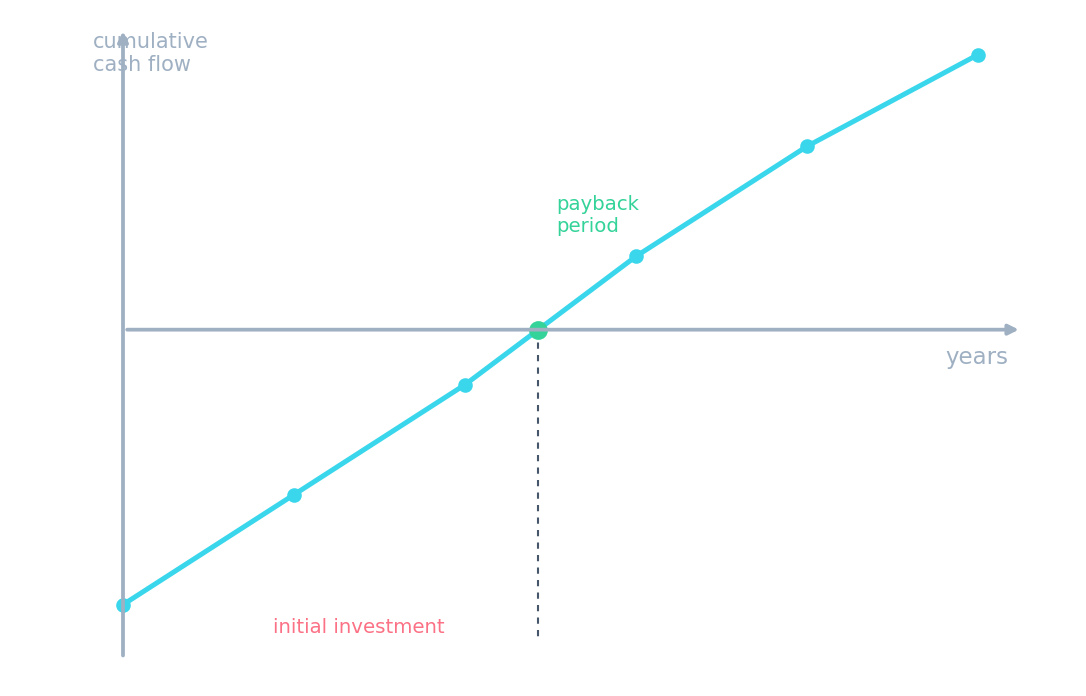
The payback period is where cumulative cash flow climbs back to zero.
An investment of 40,000 gives an average annual profit of 6,000. What is the ARR (%)?
Difficulty 2/5 · 140 coins + a small bonus on first completion today
6,000 ÷ 40,000 × 100 = 15%.
The appraisal method giving a percentage return per year is the average rate of ______.
Difficulty 1/5 · 100 coins + a small bonus on first completion today
ARR = average annual profit ÷ initial cost × 100.
Average rate of return 平均回报率 (ARR)
- ARR = (average annual profit ÷ initial cost) × 100.
- It shows the percentage return per year — easy to compare with interest rates.
Worked example. An investment of 20,000 returns net cash of 5,000 a year. Payback = 20,000 ÷ 5,000 = 4 years. If average annual profit is 3,000, ARR = 3,000 ÷ 20,000 × 100 = 15%.
Will the machine pay for itself?
Drag the cost, the yearly inflow and the machine's life. The line crosses zero at the payback period; ARR compares the yearly return with leaving the money in the bank.
The ARR method takes full account of when cash flows arrive.
Difficulty 1/5 · 100 coins + a small bonus on first completion today
False. ARR averages profit over the project's life and ignores the timing of cash flows. Payback and NPV take timing into account.
Comparing methods
- Payback is simple and focuses on risk (how fast you get your money back) but ignores later returns.
- ARR shows profitability but ignores the timing of cash flows.
A short payback isn't automatically the best choice. A project that pays back fast but earns little afterwards can be worse than a slower one with big long-term returns. Use more than one method.
You've got it
- payback period = time to recover the initial cost (= cost ÷ annual net cash flow if even)
- ARR = (average annual profit ÷ initial cost) × 100
- payback focuses on risk/speed; ARR on profitability — each has blind spots
Write from a payback of 6 years
- An investment costs 18000 and returns net cash of 3000 a year.
- A different project costs 50000 and makes average annual profit of 4000.
- Find the payback period and the ARR.
An investment costs 18000 and returns net cash of 3000 a year. A different investment of 50000 makes an average annual profit of 4000. What are the payback period of the first and the ARR of the second?
18000 divided by 3000 is 6 years. 4000 divided by 50000 is 8 percent.
What is the payback period of the 18000 investment?
Difficulty 1/5 · 100 coins + a small bonus on first completion today
Cost divided by yearly net cash is 6 years. Other options — 4 years (the lesson payback); 8 years (the ARR percent used as a time).