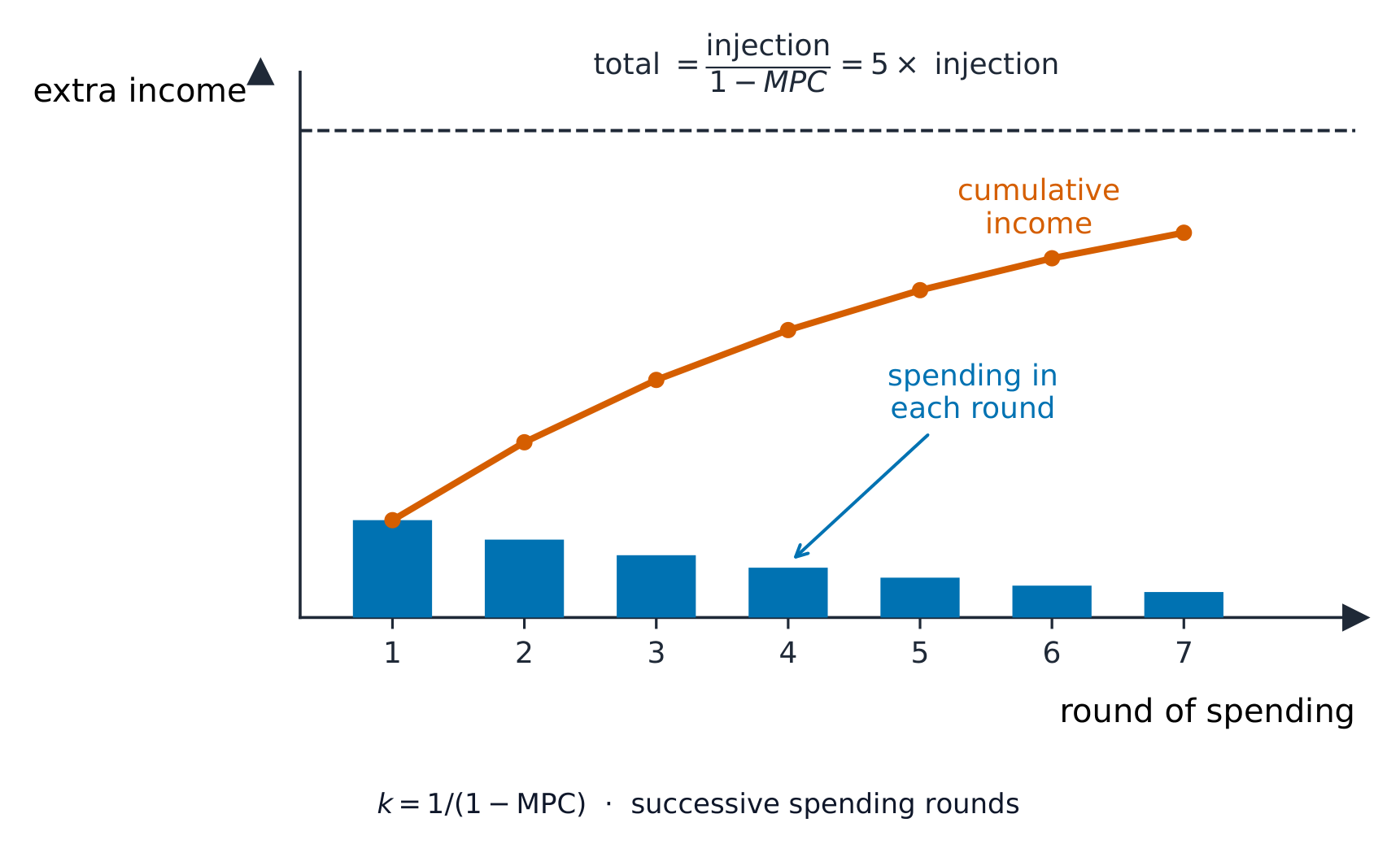
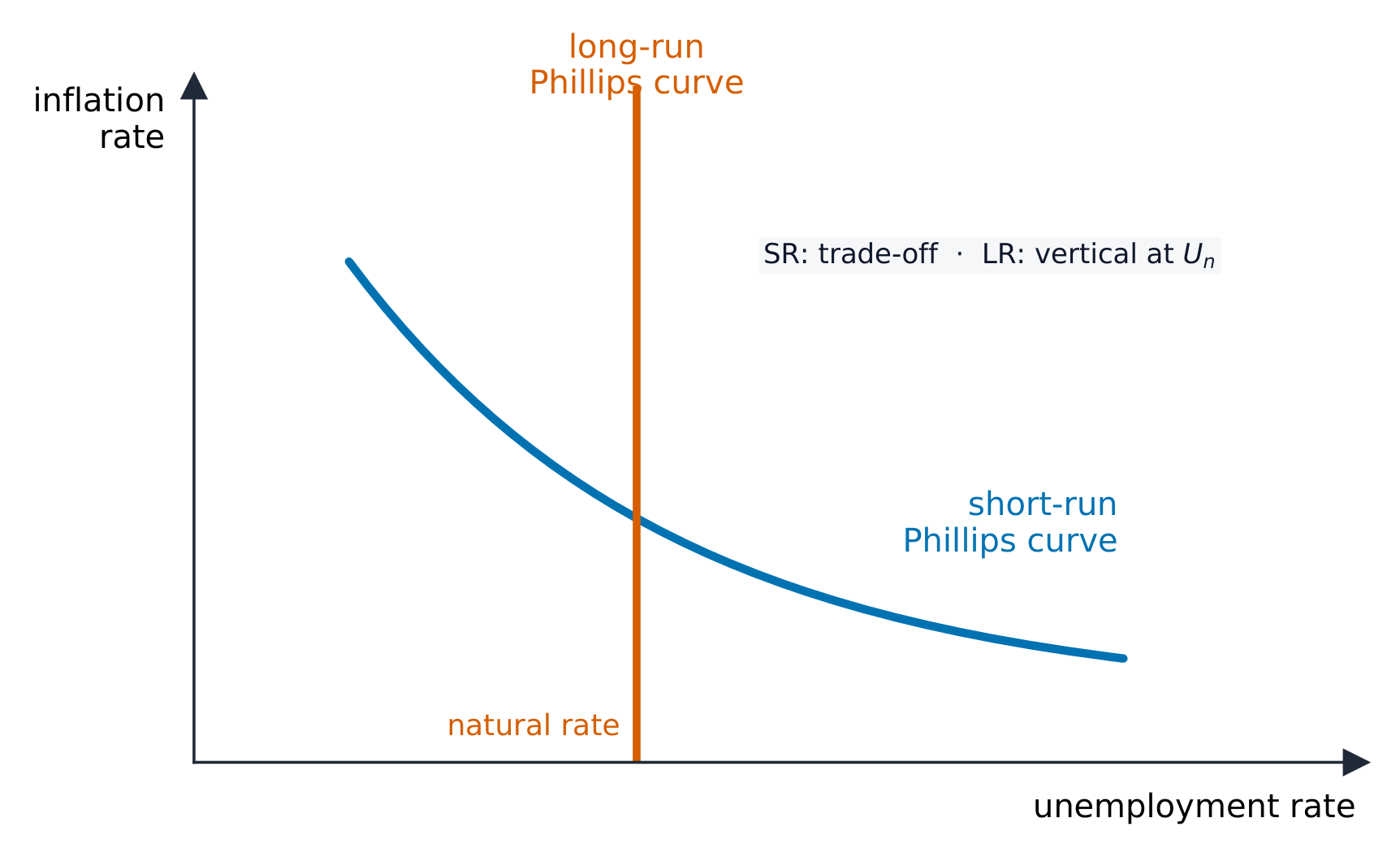
Kinh tế học A-Level (9708) chia làm hai phần. Kinht tế vi mô: khan hiếm, hệ thống giá, độ co giãn, thất bại thị trường, can thiệp của chính phủ. Kinh tế vĩ mô: thu nhập quốc dân, bội số, lạm phát, thất nghiệp, tăng trưởng, chính sách và thương mại. Cấp A2 đi sâu hơn vào cùng nội dung đó thay vì thêm vào lĩnh vực mới.
Kỹ năng đang được kiểm tra không phải là trí nhớ. Đó là vẽ biểu đồ, sau đó đánh giá. Một câu trả lời chỉ mô tả chính sách sẽ bị điểm thấp. Một câu trả lời nêu tác động của chính sách, vẽ biểu đồ, rồi nói khi nào nó sẽ không hoạt động sẽ đạt điểm cao.
"Tùy thuộc vào" không phải là sự thận trọng ở đây — các điều kiện chính là nơi nằm các điểm đánh giá.
explain economics as a social science and the use of the ceteris paribus assumption
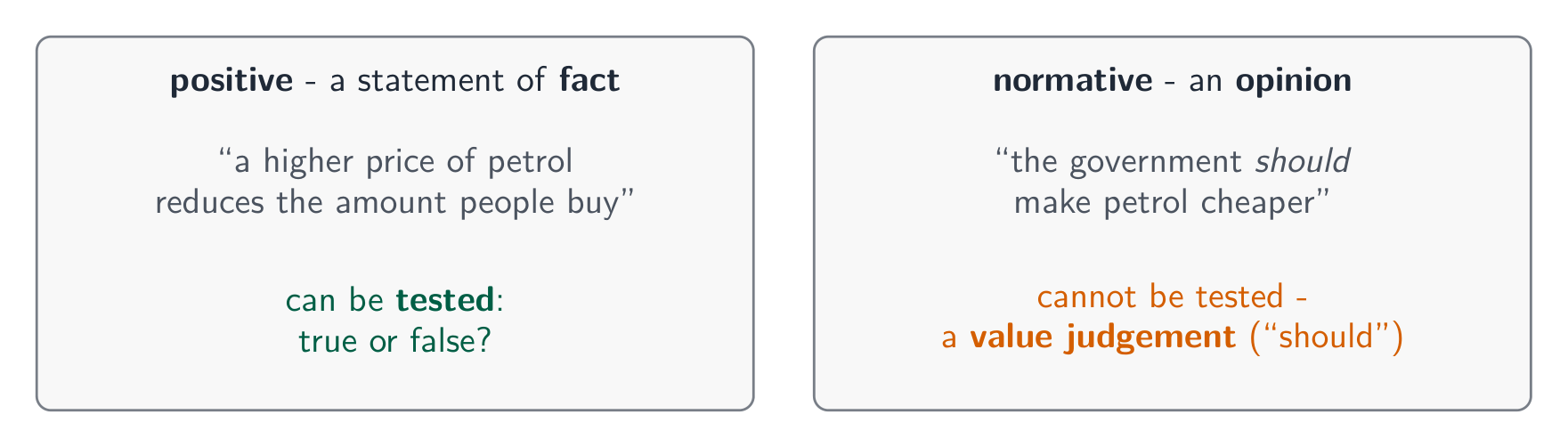
distinguish positive and normative statements and the role of value judgements
distinguish microeconomics and macroeconomics
Tiếng Việt
giải thích kinh tế học là một khoa học xã hội và việc sử dụng giả định ceteris paribus
phân biệt các phát biểu mang tính thực chứng và giá trị, cùng vai trò của đánh giá giá trị
phân biệt kinh tế vi mô và kinh tế vĩ mô
Source: Cambridge International syllabus · Nguồn: Chương trình Cambridge International
Economics as a social science
Economics is a social science 社会科学. It studies how people behave when they make choices. Like other sciences, it builds models 模型 (simple pictures of the real world) and tests them with data.
The real world is complex, so economists change one thing at a time and keep everything else fixed. This is the idea of ceteris paribus 其他条件不变 — a Latin phrase meaning "all other things stay the same". For example: "if the price of coffee rises, people buy less coffee, ceteris paribus".
Positive and normative statements
a positive statement 实证表述 is about fact. It can be tested as true or false. Example: "a higher price of petrol reduces the amount people buy."
a normative statement 规范表述 is about opinion. It says what should happen, and it cannot be tested as true or false. Example: "the government should make petrol cheaper."
Normative statements rest on a value judgement 价值判断 — a personal view about what is good or fair. Two people can agree on the facts and still disagree about what should be done.
A positive statement can be tested; a normative statement is a value judgement
Microeconomics and macroeconomics
microeconomics 微观经济学 studies single parts of the economy: one market, one firm, one consumer.
macroeconomics 宏观经济学 studies the whole economy together: total output 产出, jobs, and rising prices.
Explore · Khám phá
Economic method lab · Phòng thí nghiệm phương pháp kinh tế
Classify statements by the role they play in economic reasoning. · Phân loại các tuyên bố dựa trên vai trò chúng đóng trong suy luận kinh tế.
define land, labour, capital and enterprise and their rewards (rent, wages, interest, profit)
explain division of labour and specialisation and their advantages and disadvantages
explain the mobility of factors of production
Tiếng Việt
định nghĩa đất, lao động, vốn và doanh nghiệp cũng như phần thưởng tương ứng (tiền thuê, tiền lương, lãi suất, lợi nhuận)
giải thích sự phân công lao động và chuyên môn hóa cùng những ưu điểm và nhược điểm của chúng
giải thích sự di chuyển của các yếu tố sản xuất
Source: Cambridge International syllabus · Nguồn: Chương trình Cambridge International
The factors of production 生产要素 are the four kinds of resource used to make goods and services. Each one earns a reward 报酬.
The four factors of production and the reward each earns
Factor
What it is
Its reward
land 土地
natural resources (fields, water, oil, minerals)
rent 地租
labour 劳动
human work, both physical and mental
wages 工资
capital 资本
man-made things used to produce, like machines, tools and factories
interest 利息
enterprise 企业家才能
the skill of bringing the other three together and taking the risk
profit 利润
Land includes some non-renewable resources 不可再生资源 (like oil and coal) that can run out. Enterprise is supplied by the entrepreneur 企业家, the person who has the business idea and risks their own money.
An open-pit copper mine: land includes the natural resources (minerals, oil, water) that firms extract.
Specialisation and division of labour
specialisation 专业化 is when a worker, firm or country makes only the things it is best at, then trades for the rest.
Inside a workplace, specialisation leads to the division of labour 劳动分工: a big job is split into small tasks, and each worker 工人 does one task again and again.
Advantages
Disadvantages
workers get faster and better at one task
doing one task is boring, so workers may quit
less time wasted moving between jobs
if one worker is absent, the whole line can stop
output per worker rises, so costs fall
workers learn only one narrow skill
A car assembly line: capital (machines and robots) plus the division of labour, each worker repeating one task.
Mobility of factors
mobility 流动性 means how easily a factor can move to a new use.
occupational mobility 职业流动性 — how easily a factor moves from one job or use to another. A teacher who retrains as a nurse is occupationally mobile.
geographical mobility 地理流动性 — how easily a factor moves from one place to another. Land cannot move at all, so it has no geographical mobility.
Labour is often not very mobile. Family ties, the cost of housing, and missing skills all make it hard for workers to move.
Explore · Khám phá
Factors of production lab · Nhlab Yếu tố sản xuất
Sort real resources by the factor of production they represent. · Sắp xếp tài nguyên thực tế theo yếu tố sản xuất mà chúng đại diện.
explain how resources are allocated in market, planned and mixed economic systems
explain the role of the price mechanism (signalling, incentive, rationing) in allocating resources
evaluate the advantages and disadvantages of each system
Tiếng Việt
giải thích cách thức phân bổ nguồn lực trong các hệ thống kinh tế thị trường, kế hoạch và hỗn hợp
giải thích vai trò của cơ chế giá cả (tín hiệu, động cơ, phân phối) trong việc phân bổ nguồn lực
đánh giá ưu và nhược điểm của từng hệ thống
Source: Cambridge International syllabus · Nguồn: Chương trình Cambridge International
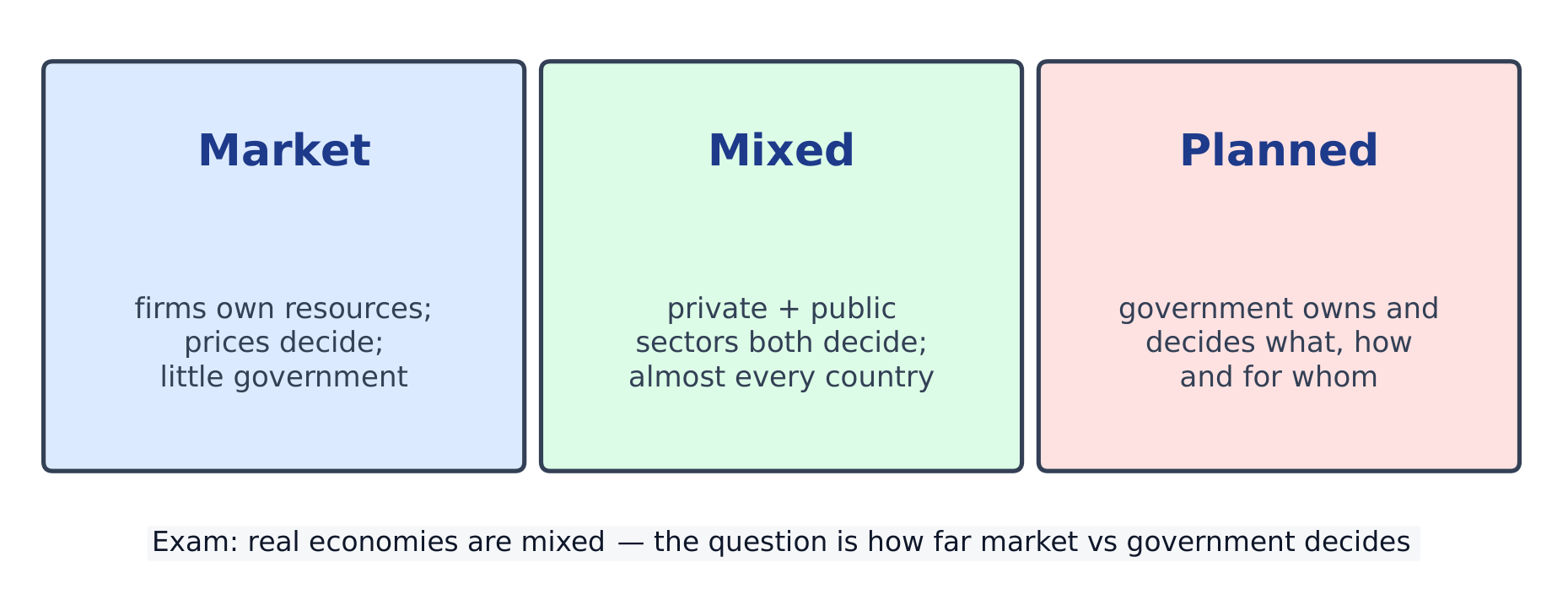
An economic system is the way a country decides how to allocate 配置 (share out) its scarce resources. There are three types.
a market economy 市场经济 — firms and people own resources, and prices decide what is made. The government does little.
a planned economy 计划经济 (also called a command economy 指令经济) — the government owns resources and decides what is made, how, and for whom.
a mixed economy 混合经济 — a blend of the two. The private sector 私营部门 (firms and households) and the public sector 公共部门 (the government) both make decisions. Almost every real country is mixed.
The price mechanism
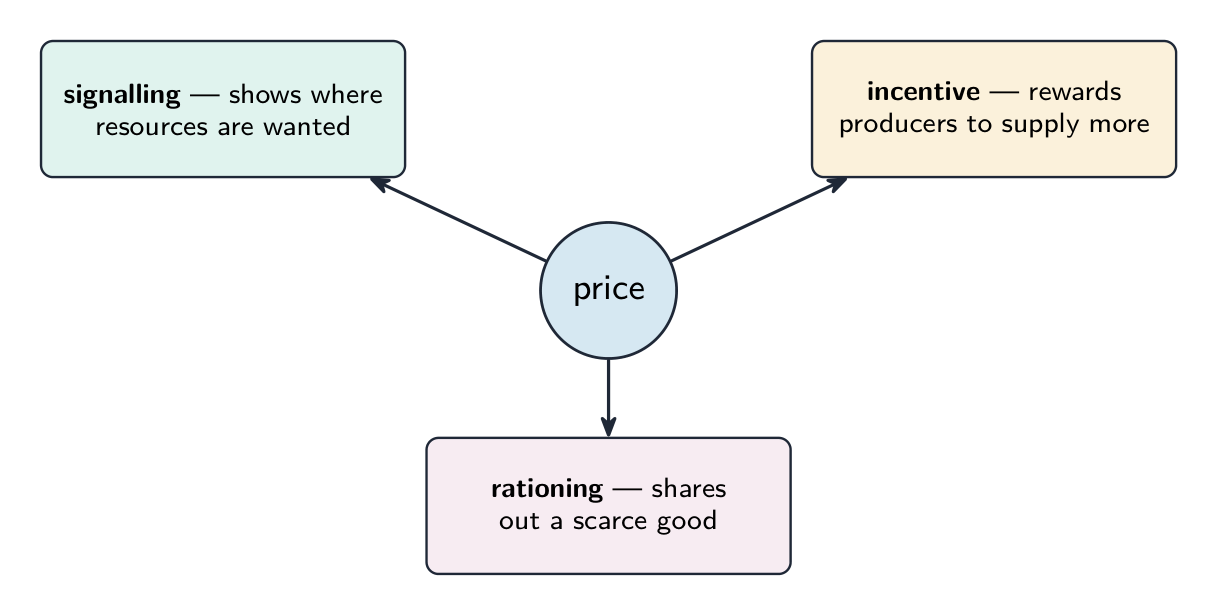
In a market economy, resources are guided by the price mechanism 价格机制. Prices do three jobs:
signalling 信号传递 — a price tells buyers and sellers where resources are wanted. A rising price says "this is wanted — make more".
incentive 激励 — a higher price rewards producers, so they want to supply more of that good.
rationing 配给 — when a good is scarce, a higher price shares it out to those who are willing and able to pay.
In a market the price does three jobs at once — it signals, it gives an incentive, and it rations the scarce good
Comparing the systems
System
Strengths
Weaknesses
market
choice, low prices, strong incentive to work and invent
large gap between rich and poor; some goods not supplied
planned
smaller gap between rich and poor; key goods provided for all
weak incentive; shortages and surpluses; slow to change
mixed
tries to keep the good points of both
the right balance is hard to find
In practice no country sits at a pure extreme. China's economy, for instance, is officially a socialist market economy, where markets set most prices while the government guides key sectors and owns major enterprises. Every real system mixes the two and sits somewhere on the spectrum below.
Economic systems form a spectrum: a pure market at one end, full government planning at the other, mixed economies in between.
draw and interpret PPCs to show opportunity cost, scarcity, choice and efficiency
explain movements along and shifts of the PPC and constant versus increasing opportunity cost
relate the PPC to economic growth and the allocation between capital and consumer goods
Tiếng Việt
vẽ và diễn giải PPCs để thể hiện chi phí cơ hội, sự khan hiếm, sự lựa chọn và hiệu quả
giải thích sự di chuyển dọc theo đường PPC và sự dịch chuyển của đường PPC, cũng như chi phí cơ hội không đổi so với tăng dần
liên hệ PPC với tăng trưởng kinh tế và sự phân bổ giữa hàng hóa tư bản và hàng hóa tiêu dùng
Source: Cambridge International syllabus · Nguồn: Chương trình Cambridge International
The PPF and opportunity cost
A production possibility curve 生产可能性曲线 (PPC) is a line showing the largest combinations of two goods an economy can make when all its resources are fully and well used.
Imagine an economy that makes only food and machines. The PPC is drawn with food on one axis and machines on the other.
a point on the curve: all resources are used with full efficiency 效率.
a point inside the curve: resources are wasted (for example, unemployment 失业 of workers). The economy could do better.
a point outside the curve: impossible today, because there are not enough resources. This shows scarcity.
A point on the curve uses all resources (efficient); inside the curve means waste, e.g. unemployment; outside is not possible yet.
Moving along the curve shows opportunity cost: to make more food, you must move resources away from machines, so you make fewer machines. This is the trade-off 取舍 between the two goods.
The shape of the curve shows how opportunity cost behaves:
a straight-line PPC means constant opportunity cost — each extra unit of food costs the same number of machines.
a curve that bows outwards means increasing opportunity cost — each extra unit of food costs more and more machines, because resources are not equally good at making both goods.
A straight PPC means each extra unit of food costs the same; a bowed PPC means each extra unit costs more and more machines.
Shifts and growth
When the PPC moves outward (to the right), the economy can make more of both goods. This is economic growth 经济增长. It happens when there are more resources, or better ones (new technology 技术, a bigger or more skilled workforce). War or disaster can move the PPC inward — this is economic decline 经济衰退.
More or better resources shift the whole PPC outward (growth); war or disaster shifts it inward (decline).
A country must also choose between two kinds of good now:
capital goods 资本品 — goods used to make other goods (machines, factories).
consumer goods 消费品 — goods people use directly (food, clothes).
Making more capital goods today means fewer consumer goods today. But more capital goods help the economy grow faster, so the PPC shifts out by more in the future.
Choosing more capital goods today means fewer consumer goods now, but the future PPC shifts out further.
Worked example. Why is a production possibility curve usually drawn concave (bowed outwards) rather than as a straight line? A straight line would mean the opportunity cost of each extra unit stays constant. The curve bows out because factors of production are not perfectly substitutable - they are specialised. Starting from all-food production, the first factors moved into making cars are the ones least suited to farming, so very little food is given up for a lot of cars. Keep going and you must move factors that are increasingly good at farming and increasingly bad at making cars, so each extra car costs more and more food. That rising cost is increasing opportunity cost, and the bowed shape is simply its picture. A straight-line PPC is not wrong - it just assumes factors are perfectly substitutable, and naming that assumption is what earns the mark.
Explore · Khám phá
The production possibility frontier · Đường giới hạn khả năng sản xuất
Producing more of one good means giving up some of the other — that trade-off is the opportunity cost, shown by the slope of the frontier. · Sản xuất nhiều hơn một mặt hàng này đồng nghĩa với việc hy sinh một phần mặt hàng kia — sự đánh đổi đó là chi phí cơ hội, được biểu thị bởi độ dốc của đường giới hạn.
An economy can't have more of everything: making more of one good means giving up some of another — the frontier's slope is that opportunity cost. · Một nền kinh tế không thể có nhiều thứ gì đó: sản xuất thêm một loại hàng hóa này đồng nghĩa với việc từ bỏ một số lượng của loại hàng hóa khác — độ dốc của biên chính là chi phí cơ hội đó.
Explore · Khám phá
The production possibility curve · Đường giới hạn khả năng sản xuất
Move along the curve. Producing more of one good means producing less of the other — the curve shows opportunity cost and scarcity. · Di chuyển dọc theo đường cong. Sản xuất thêm một loại hàng hóa này có nghĩa là sản xuất ít hơn loại kia — đường cong thể hiện chi phí cơ hội và sự khan hiếm.
distinguish free goods and economic (private) goods
explain the characteristics of public goods (non-rivalry, non-excludability) and the free-rider problem
explain merit and demerit goods and the role of information and value judgements
Tiếng Việt
phân biệt hàng hóa miễn phí và hàng hóa kinh tế (hàng hóa tư nhân)
giải thích đặc điểm của hàng hóa công cộng (không cạnh tranh, không loại trừ) và vấn đề người đi free
giải thích hàng hóa có lợi ích và hàng hóa bất lợi cùng vai trò của thông tin và đánh giá giá trị
Source: Cambridge International syllabus · Nguồn: Chương trình Cambridge International
Free goods and economic goods
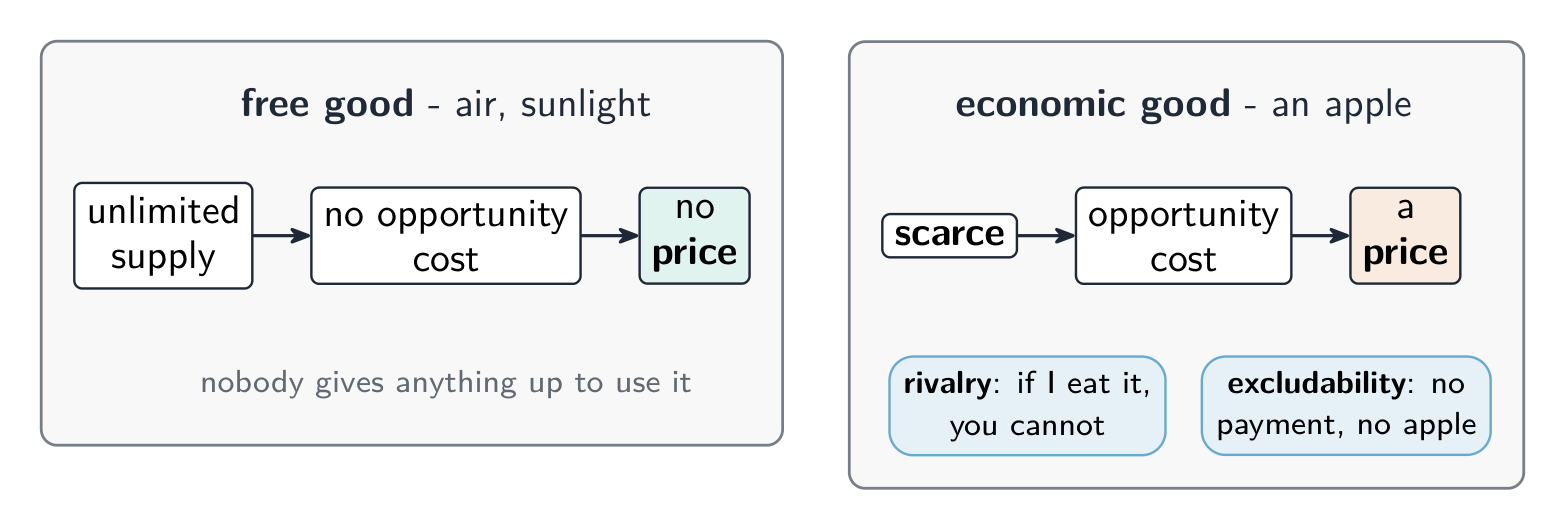
a free good 免费物品 has no opportunity cost. Its supply is unlimited, so it has no price (for example, air or sunlight).
an economic good 经济物品 (also called a private good 私人物品) is scarce. Making it has an opportunity cost, so it has a price.
A private good has two features. It has rivalry 竞争性 (if I eat the apple, you cannot) and excludability 排他性 (the seller can stop you using it unless you pay).
A free good has no opportunity cost and no price; an economic good is scarce, rival and excludable
Public goods
A public good 公共物品 is the opposite of a private good. It has two features:
non-rivalry 非竞争性 — one person using it does not reduce the amount left for others.
non-excludability 非排他性 — you cannot stop people who do not pay from using it.
Because of non-excludability, public goods suffer from the free-rider problem 搭便车问题: people enjoy the good without paying for it. So private firms cannot make a profit and will not supply it. The government must provide public goods instead — for example, street lighting and national defence 国防.
Rivalry and excludability give four types of good: private, club, common resource, and public.
Merit and demerit goods
a merit good 优值品 is better for you (and for society) than you realise, so people buy too little of it. Examples: education and health care.
a demerit good 劣值品 is worse for you than you realise, so people buy too much of it. Examples: cigarettes and alcohol.
Education is a classic merit good. Its full value — better jobs, and a more skilled society — is easy to underestimate, so left to themselves people buy less of it than is good for them or the country. That is why governments provide and subsidise it
People misjudge these goods because of information failure 信息失灵 — they do not have, or do not use, the full facts about the benefit or harm.
Deciding what counts as a merit or demerit good is partly a value judgement, so people may disagree about which goods belong on each list.
Explore · Khám phá
Goods and services lab · Nhlab Hàng hóa và dịch vụ
Classify examples by rivalry, excludability or whether they are services. · Phân loại các ví dụ theo tính cạnh tranh, khả năng loại trừ hoặc liệu chúng có phải là dịch vụ hay không.
explain the determinants of demand and supply and distinguish movements along from shifts of the curves
derive individual and market demand and supply
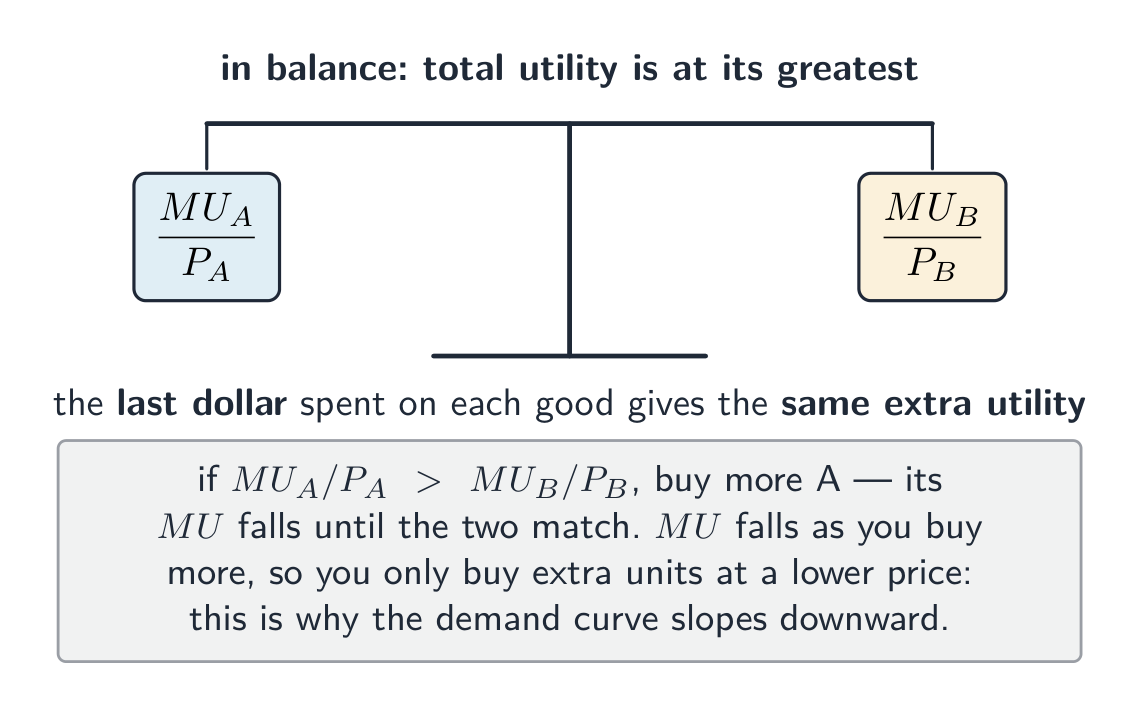
explain the relationship between marginal utility and the demand curve
Tiếng Việt
giải thích các yếu tố quyết định cầu và cung đồng thời phân biệt sự di chuyển dọc theo đường cong và sự dịch chuyển của đường cong
suy ra cầu và cung cá nhân cũng như thị trường
giải thích mối quan hệ giữa lợi ích biên và đường cầu
Source: Cambridge International syllabus · Nguồn: Chương trình Cambridge International
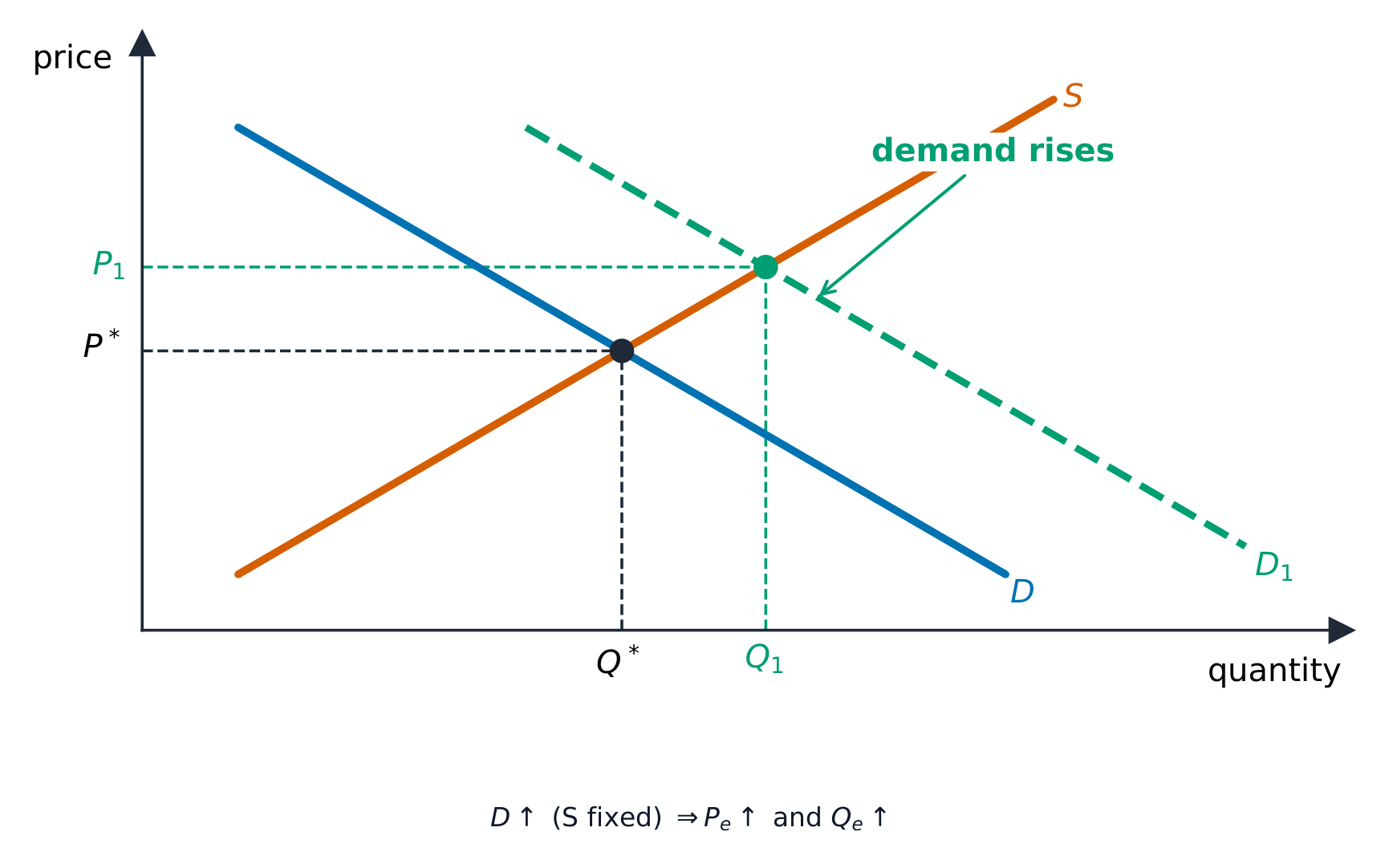
Demand shifts right: P and Q rise
demand 需求 is the quantity of a good that buyers are willing and able to buy at each price 价格 in a period of time. It is not just a wish — buyers must also be able to pay.
The law of demand says: when the price rises, the quantity demanded 需求量 falls; when the price falls, the quantity demanded rises. Price and quantity move in opposite directions.
So the demand curve 需求曲线 slopes downward, from top-left to bottom-right.
What shifts the demand curve
A change in the good's own price is shown as a movement along the demand curve. A change in any other cause shifts the whole curve to a new position — this is a shift 移动 of demand. The main causes (the determinants 决定因素) are:
income 收入 — for most goods, higher income raises demand.
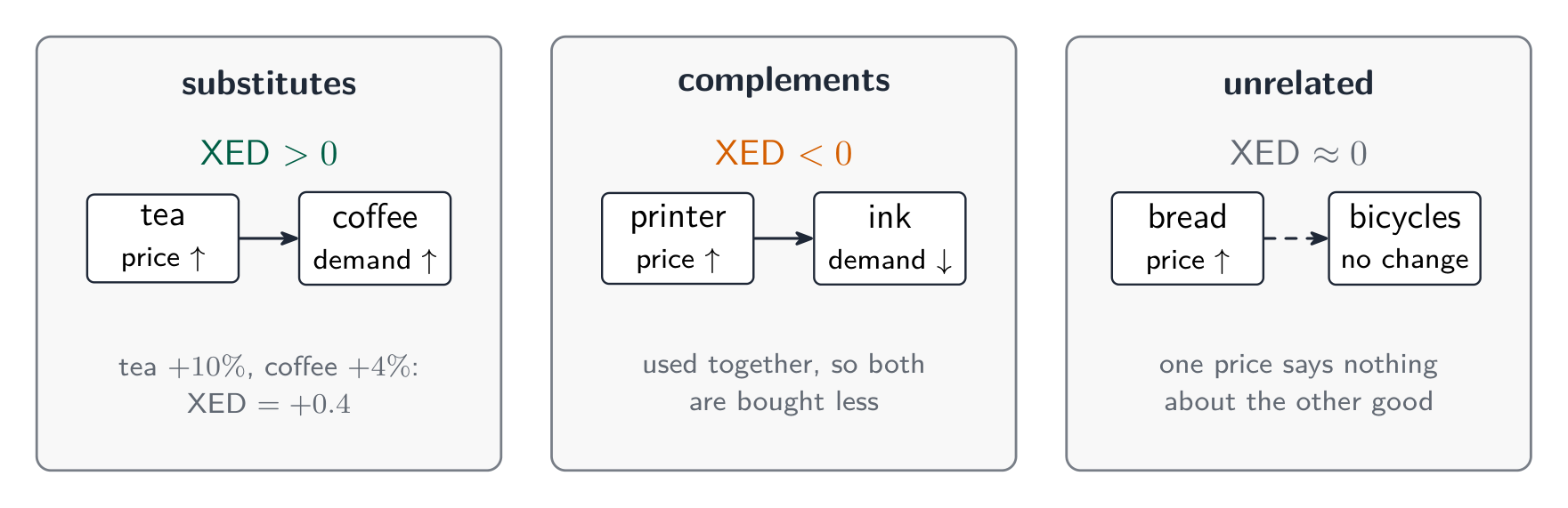
the price of a substitute 替代品 — a good you can use instead (tea for coffee). If the substitute's price rises, demand for this good rises.
the price of a complement 互补品 — a good used together with this one (cars and petrol). If the complement's price rises, demand for this good falls.
tastes and fashion, the size of the population, and advertising.
A change in income, tastes or related prices shifts the whole curve ($D_1$ right, $D_2$ left); a change in the good's own price is a movement along it.
Individual and market demand
One consumer 消费者 has an individual demand. The market demand 市场需求 is found by adding up the quantity that all consumers want at each price (adding the curves sideways).
Marginal utility and demand
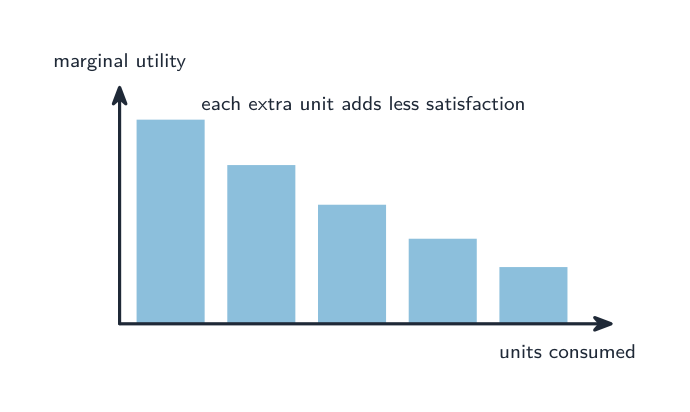
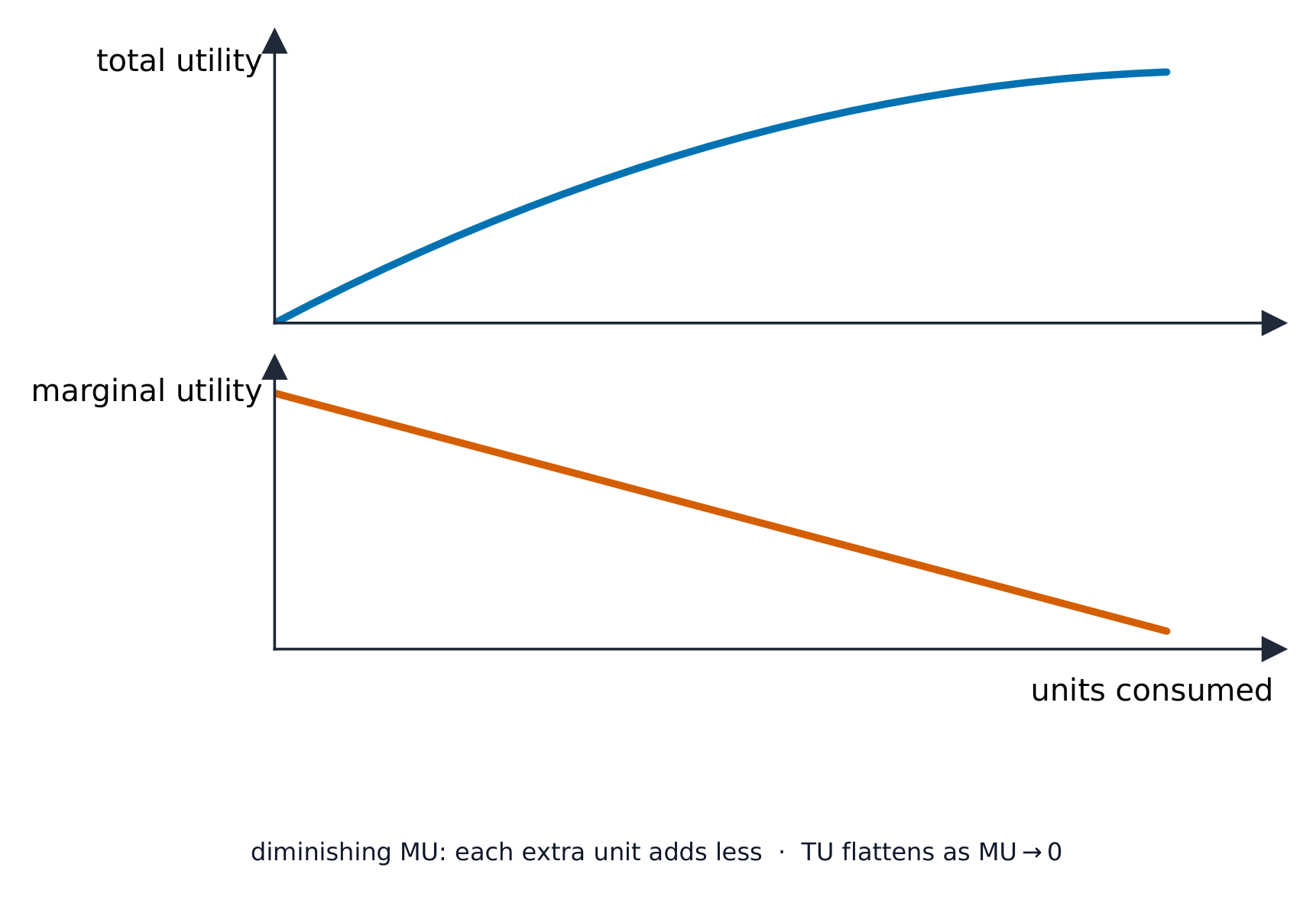
utility 效用 is the satisfaction you get from consuming a good. marginal utility 边际效用 is the extra utility from one more unit.
The law of diminishing marginal utility 边际效用递减 says each extra unit gives less extra satisfaction than the one before. Because later units are worth less to you, you will only buy them at a lower price. This is why the demand curve slopes downward.
Each extra unit adds less satisfaction than the last — so buyers will only pay less for later units, which is why demand slopes downward
Explore · Khám phá
Demand & supply · Cung & Cầu
Demand slopes down — a lower price, more is wanted. · Cầu dốc xuống — giá thấp hơn, lượng mong muốn tăng lên.
supply 供给 is the quantity of a good that producers 生产者 are willing and able to sell at each price in a period of time.
The law of supply says: when the price rises, the quantity supplied 供给量 rises. Higher prices mean more profit 利润, so firms make more. So the supply curve 供给曲线 slopes upward.
What shifts the supply curve
A change in the good's own price is a movement along the supply curve. Other causes shift the whole curve:
costs of production 生产成本 — if wages, raw materials or rent get dearer, supply falls.
technology — better machines raise supply.
a subsidy 补贴 (government payment to producers) raises supply; an indirect tax lowers it.
the number of firms 企业 in the market, and weather (for farm goods).
Lower costs, better technology or a subsidy shift supply right ($S_1$); higher costs or a tax shift it left ($S_2$).
Individual and market supply
The market supply 市场供给 is found by adding up the quantity all firms will sell at each price.
Explore · Khám phá
Demand & supply · Cung & Cầu
Supply slopes up — a higher price, more is produced. · Cung dốc lên — giá cao hơn, sản lượng sản xuất tăng.
define, calculate and interpret price elasticity of demand (PED), income elasticity (YED) and cross elasticity (XED)
explain the determinants of each and the relationship between PED and total revenue/expenditure
explain the usefulness of elasticities to firms and government
Tiếng Việt
định nghĩa, tính toán và diễn giải độ co giãn của giá theo cầu (PED), độ co giãn theo thu nhập (YED) và độ co giãn chéo (XED)
giải thích các yếu tố quyết định của từng loại và mối quan hệ giữa PED với doanh thu tổng/chi tiêu
giải thích tính hữu ích của các độ co giãn đối với doanh nghiệp và chính phủ
Source: Cambridge International syllabus · Nguồn: Chương trình Cambridge International
Supply shifts right: P falls, Q rises
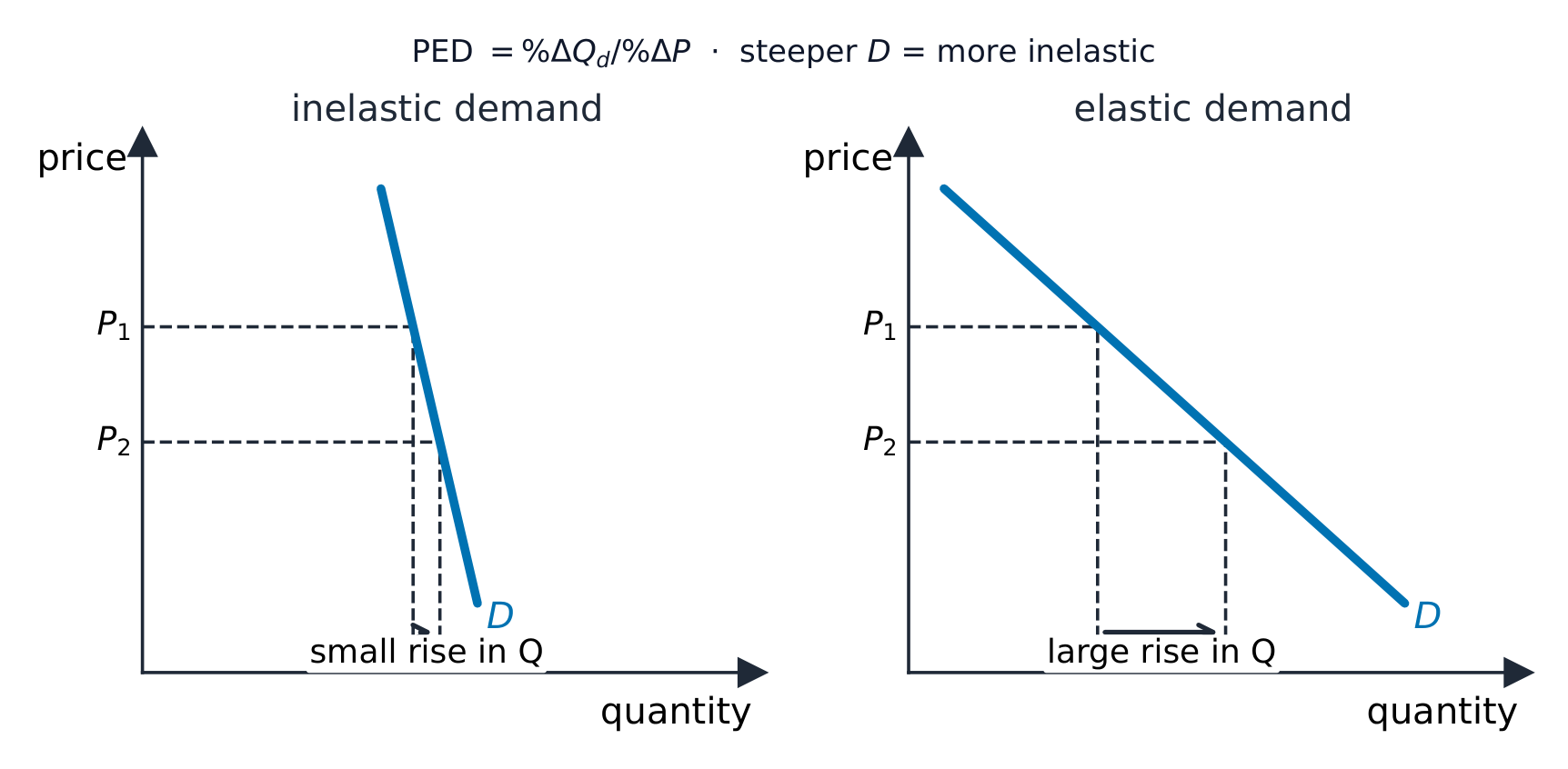
price elasticity of demand 需求价格弹性 (PED) measures how much the quantity demanded responds when the price changes.
$$\text{PED} = \frac{\%\ \text{change in quantity demanded}}{\%\ \text{change in price}}$$
PED is normally negative (because of the law of demand), but we usually look at the size and drop the minus sign.
Worked example. The price of a good rises by 10% and the quantity demanded falls by 25%. Find the PED and classify the demand.
$$\text{PED} = \frac{-25}{10} = -2.5$$
Ignoring the minus sign, $2.5 > 1$, so demand is elastic — quantity responded much more than the price did.
Petrol has price-inelastic demand: drivers must buy it, so a higher price cuts the quantity bought only a little.
Value
Name
Meaning
more than 1
elastic 富有弹性
quantity responds a lot
less than 1
inelastic 缺乏弹性
quantity responds a little
equal to 1
unit elastic 单位弹性
quantity changes by the same % as price
0
perfectly inelastic 完全无弹性
quantity does not change at all
infinity
perfectly elastic 完全有弹性
any price rise sends demand to zero
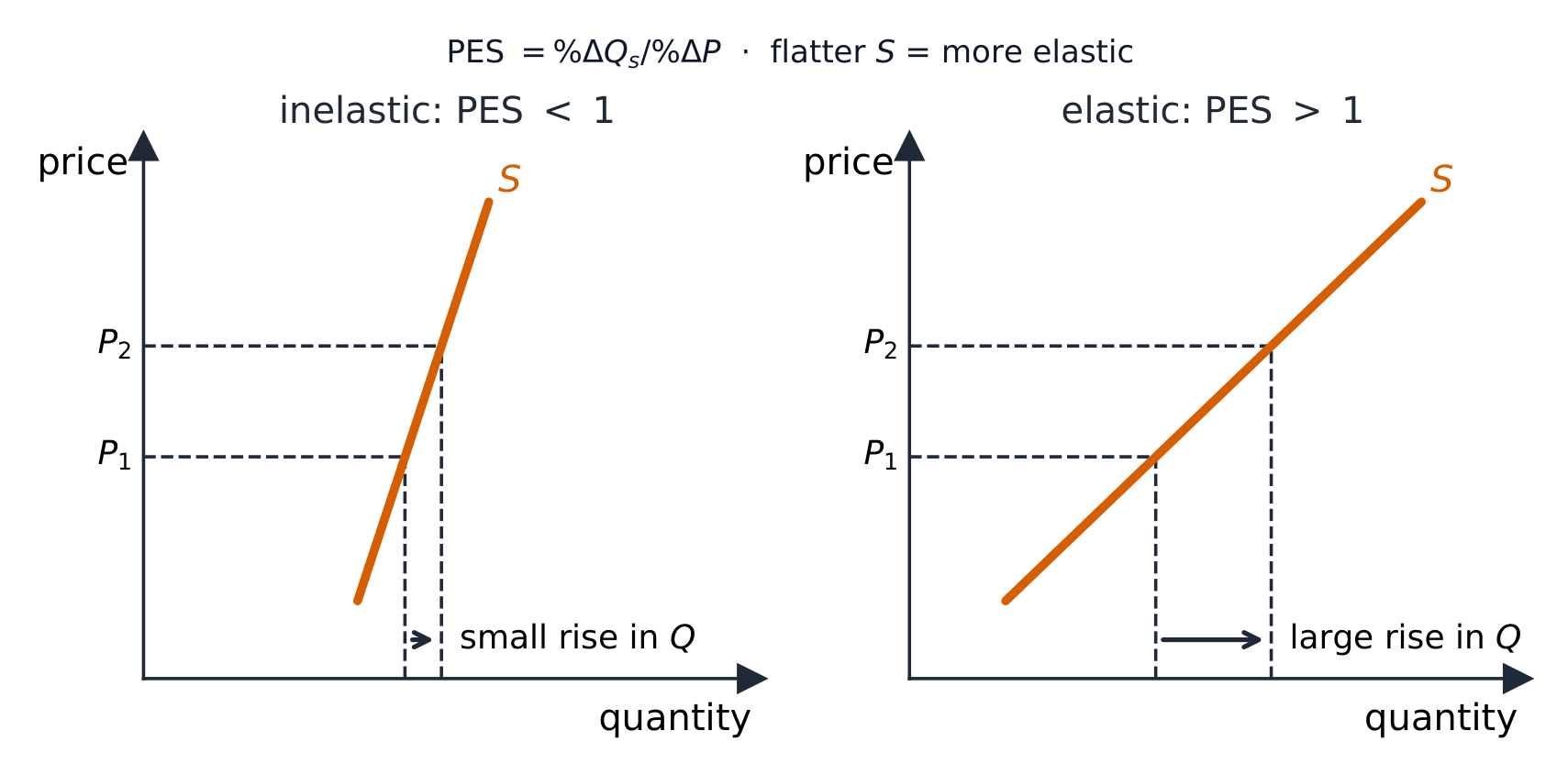
When demand is inelastic (steep), a price change barely moves quantity; when it is elastic (shallow), the same price change moves quantity a lot.
What makes demand elastic or inelastic
the number and closeness of substitutes (more substitutes → more elastic).
whether the good is a necessity 必需品 (inelastic) or a luxury 奢侈品 (elastic).
the share of income spent on the good (a large share → more elastic).
time — demand is more elastic in the long run, when buyers can find other options.
habit or addiction makes demand inelastic.
PED and total revenue
total revenue 总收益 is the money a firm earns: $\text{TR} = \text{price} \times \text{quantity}$. PED tells a firm what happens to revenue when it changes the price:
If demand is…
price rises
price falls
inelastic
total revenue rises
total revenue falls
elastic
total revenue falls
total revenue rises
unit elastic
total revenue stays the same
total revenue stays the same
This is useful to firms (how to price for more revenue) and to governments 政府 (a tax on an inelastic good, like petrol, raises a lot of revenue without cutting sales much).
explain equilibrium price and quantity and how shifts in demand and supply change equilibrium
explain disequilibrium (excess demand and excess supply) and the functions of the price mechanism
apply demand and supply analysis to product, factor and foreign exchange markets
Tiếng Việt
giải thích giá cả và lượng cân bằng cũng như sự thay đổi cân bằng khi cầu và cung dịch chuyển
giải thích mất cân bằng (quá cầu và quá cung) và các chức năng của cơ chế giá cả
áp dụng phân tích cầu và cung vào thị trường hàng hóa, thị trường yếu tố sản xuất và thị trường ngoại hối
Source: Cambridge International syllabus · Nguồn: Chương trình Cambridge International
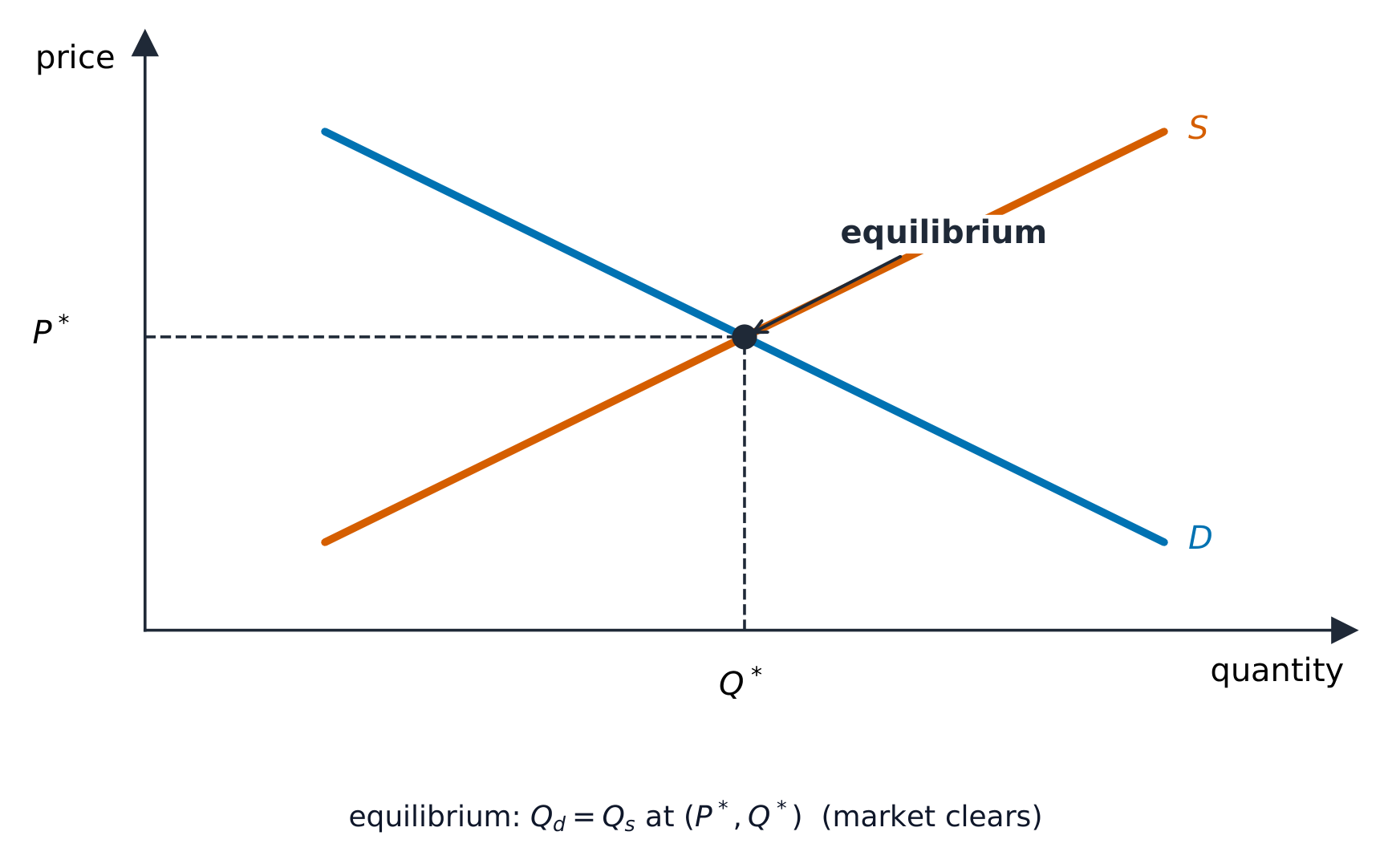
In a market, buyers and sellers meet and the price settles where demand equals supply
Equilibrium
The market is in equilibrium 均衡 where the demand curve crosses the supply curve. Here demand equals supply. This gives the equilibrium price 均衡价格 and the equilibrium quantity 均衡数量. There is no pressure for the price to change.
At the equilibrium price $P^*$ and quantity $Q^*$ the curves cross, so quantity demanded equals quantity supplied.
Disequilibrium
When the price is not at equilibrium, the market is in disequilibrium 非均衡:
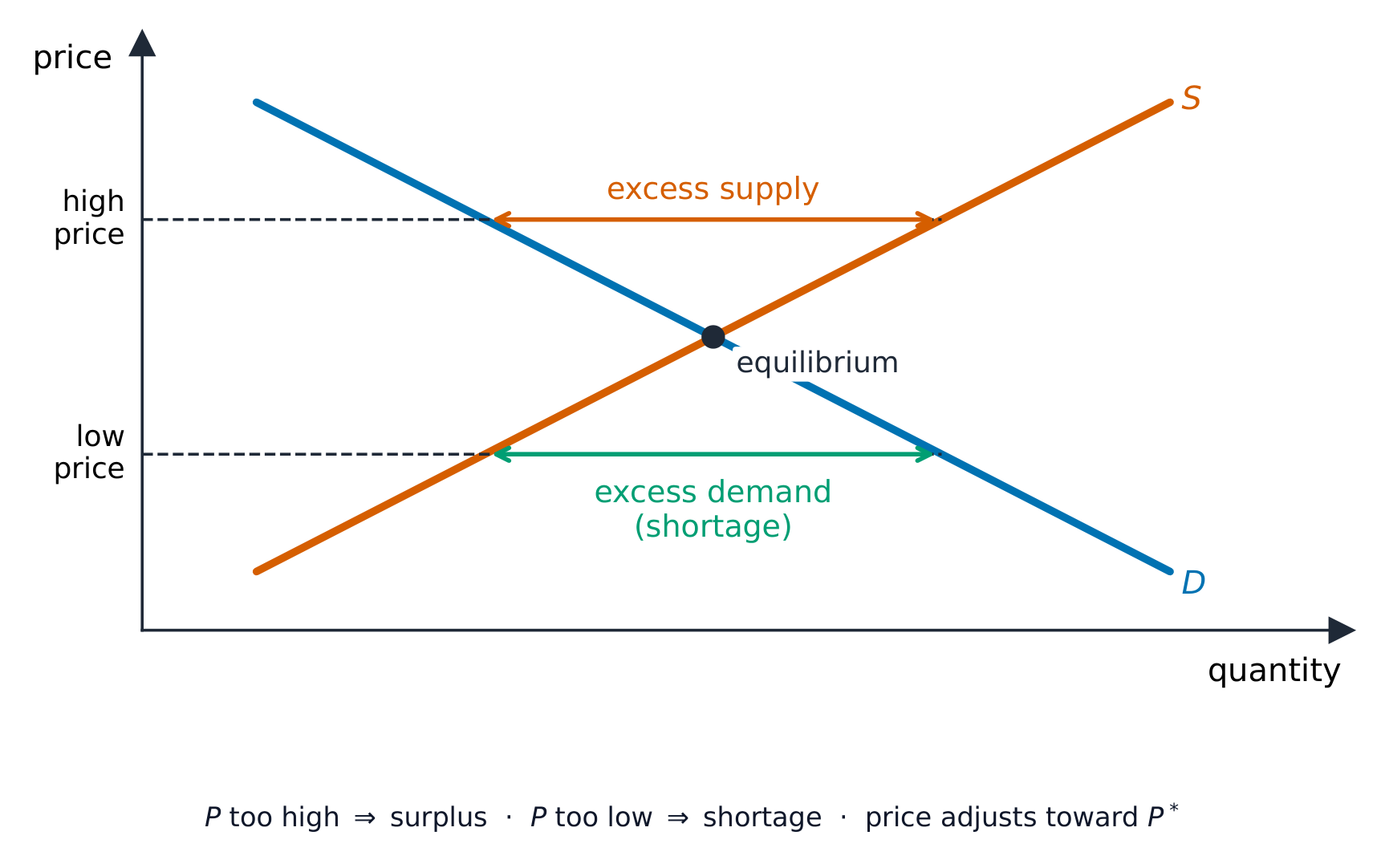
if the price is too low, there is excess demand 超额需求 (a shortage 短缺). Buyers compete, so the price is pushed up.
if the price is too high, there is excess supply 超额供给. Sellers cannot sell everything, so the price is pushed down.
In both cases the price moves back to equilibrium. This shows the price mechanism doing its jobs of signalling, rationing and giving an incentive.
Above the equilibrium price there is excess supply; below it there is excess demand (a shortage). Either way the price is pushed back to equilibrium.
How shifts change the equilibrium
Change
Effect on price
Effect on quantity
demand rises (shifts right)
rises
rises
demand falls (shifts left)
falls
falls
supply rises (shifts right)
falls
rises
supply falls (shifts left)
rises
falls
With supply fixed, a rise in demand ($D \to D_1$) raises both the equilibrium price and the equilibrium quantity.
Demand and supply in different markets
The same analysis works in many markets:
in product markets 产品市场, demand and supply set the price of goods and services.
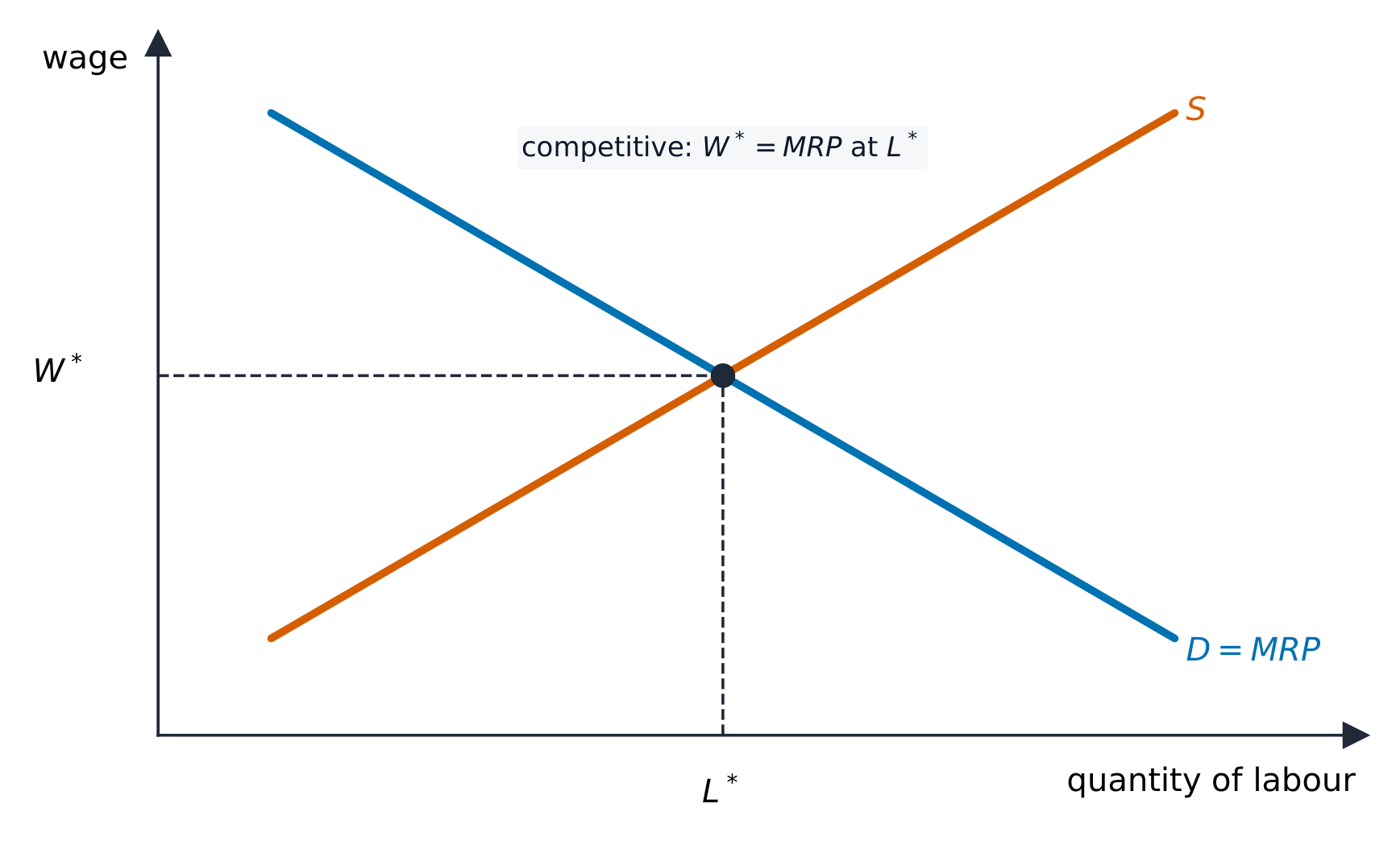
in factor markets 要素市场, they set the price of factors — for example, the demand for and supply of labour set the wage 工资.
in the foreign exchange market 外汇市场, the demand for and supply of a currency set the exchange rate 汇率 (the price of one currency in terms of another).
Explore · Khám phá
Demand & supply · Cung & Cầu
Where demand meets supply sets the equilibrium price and quantity. · Nơi nhu cầu gặp nguồn cung xác định giá cân bằng và sản lượng cân bằng.
Explore · Khám phá
Finding the equilibrium price · Tìm giá trị cân bằng
Shift demand or supply and watch the equilibrium price and quantity move to where the two lines cross. · Dịch chuyển cầu hoặc cung và quan sát giá trị cân bằng cùng lượng giao dịch di chuyển đến điểm giao nhau của hai đường.
define and identify consumer surplus and producer surplus on a diagram
explain how changes in demand, supply and price affect consumer and producer surplus
Tiếng Việt
định nghĩa và xác định thặng dư người tiêu dùng và thặng dư nhà sản xuất trên sơ đồ
giải thích cách thay đổi về cầu, cung và giá ảnh hưởng đến thặng dư người tiêu dùng và thặng dư nhà sản xuất
Source: Cambridge International syllabus · Nguồn: Chương trình Cambridge International
consumer surplus 消费者剩余 is the gain to buyers. It is the difference between the most a consumer was willing to pay and the price actually paid. On a diagram it is the area below the demand curve and above the price line.
producer surplus 生产者剩余 is the gain to sellers. It is the difference between the price a producer receives and the lowest price the producer would have accepted. On a diagram it is the area above the supply curve and below the price line.
Consumer surplus is the area below demand and above the price; producer surplus is the area above supply and below the price.
How they change:
if demand rises, the price and quantity rise, so producer surplus rises and consumer surplus usually rises too.
if supply rises, the price falls and quantity rises, so consumer surplus rises.
a higher price (with the curves fixed) raises producer surplus but lowers consumer surplus.
Together, consumer surplus plus producer surplus is the total welfare 福利 (gain to society) from the market. It is largest at the free-market equilibrium.
Explore · Khám phá
Demand & supply · Cung & Cầu
Surplus sits between the curves and the going price. · Th surplus nằm giữa các đường cong và giá hiện hành.
explain market failure as the failure to achieve an efficient allocation of resources
explain the reasons for intervention: externalities, public goods, merit/demerit goods, monopoly power, inequality, asymmetric information
Tiếng Việt
giải thích thất bại thị trường là sự thất bại trong việc đạt được phân bổ nguồn lực hiệu quả
giải thích các lý do để can thiệp: ngoại tác, hàng hóa công cộng, hàng hóa ưu tiên/không ưu tiên, sức mạnh độc quyền, bất bình đẳng, thông tin không đối xứng
Source: Cambridge International syllabus · Nguồn: Chương trình Cambridge International
A free market often gives a good result, but not always. market failure 市场失灵 is when the market does not allocate 配置 (share out) resources efficiently — too much or too little of a good is made. Then the government may step in.
There are several reasons for market failure.
A coal power station: producing electricity can impose a negative externality such as pollution on people who are not part of the deal.
Externalities
An externality 外部性 is a cost or a benefit that falls on a third party 第三方 — someone who is not the buyer or the seller.
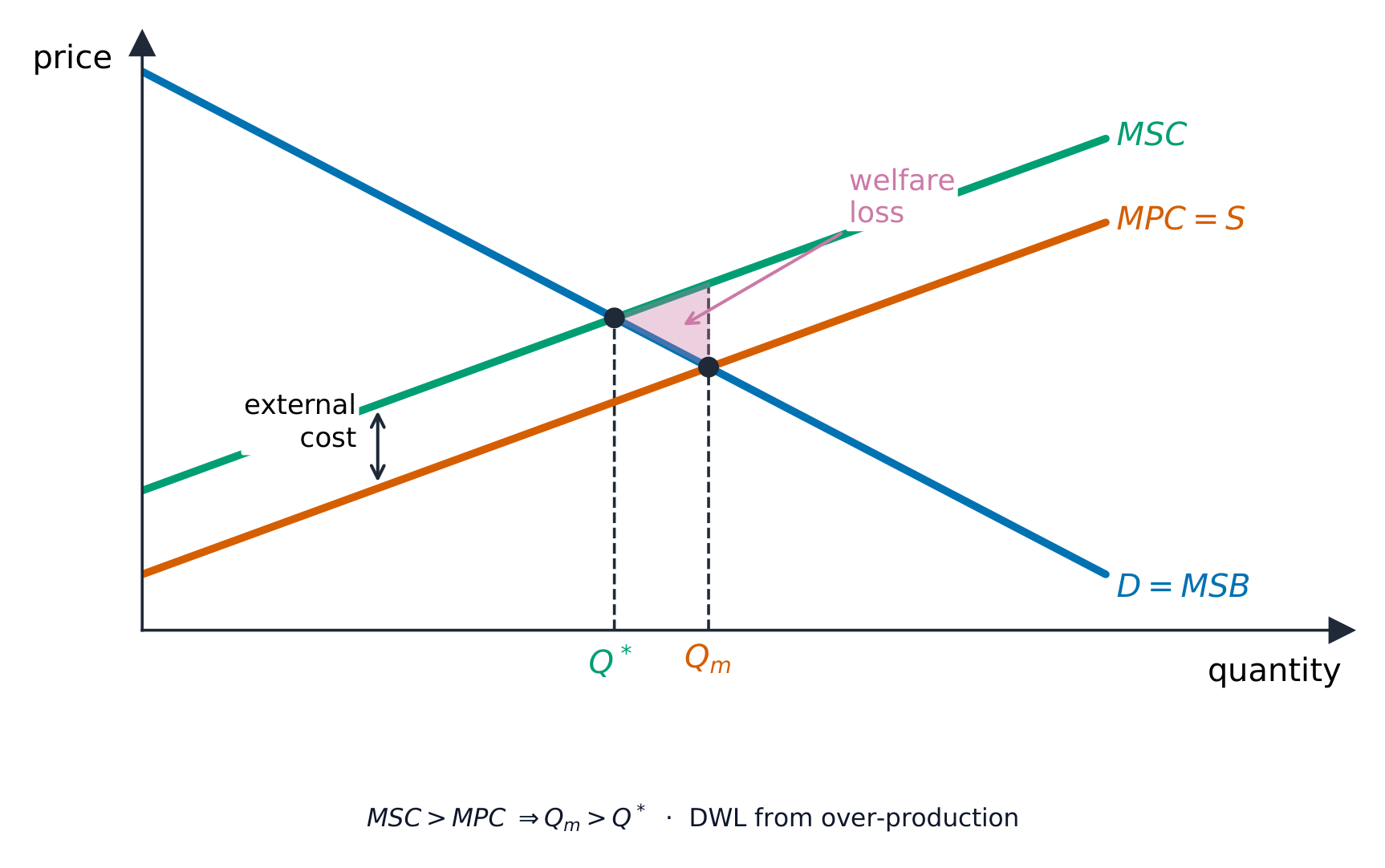
a negative externality 负外部性 is an external cost 外部成本 paid by others, like the pollution from a factory. The social cost 社会成本 (the cost to all of society) is bigger than the private cost 私人成本 (the cost to the producer). When people ignore the external cost, the market makes too much of the good.
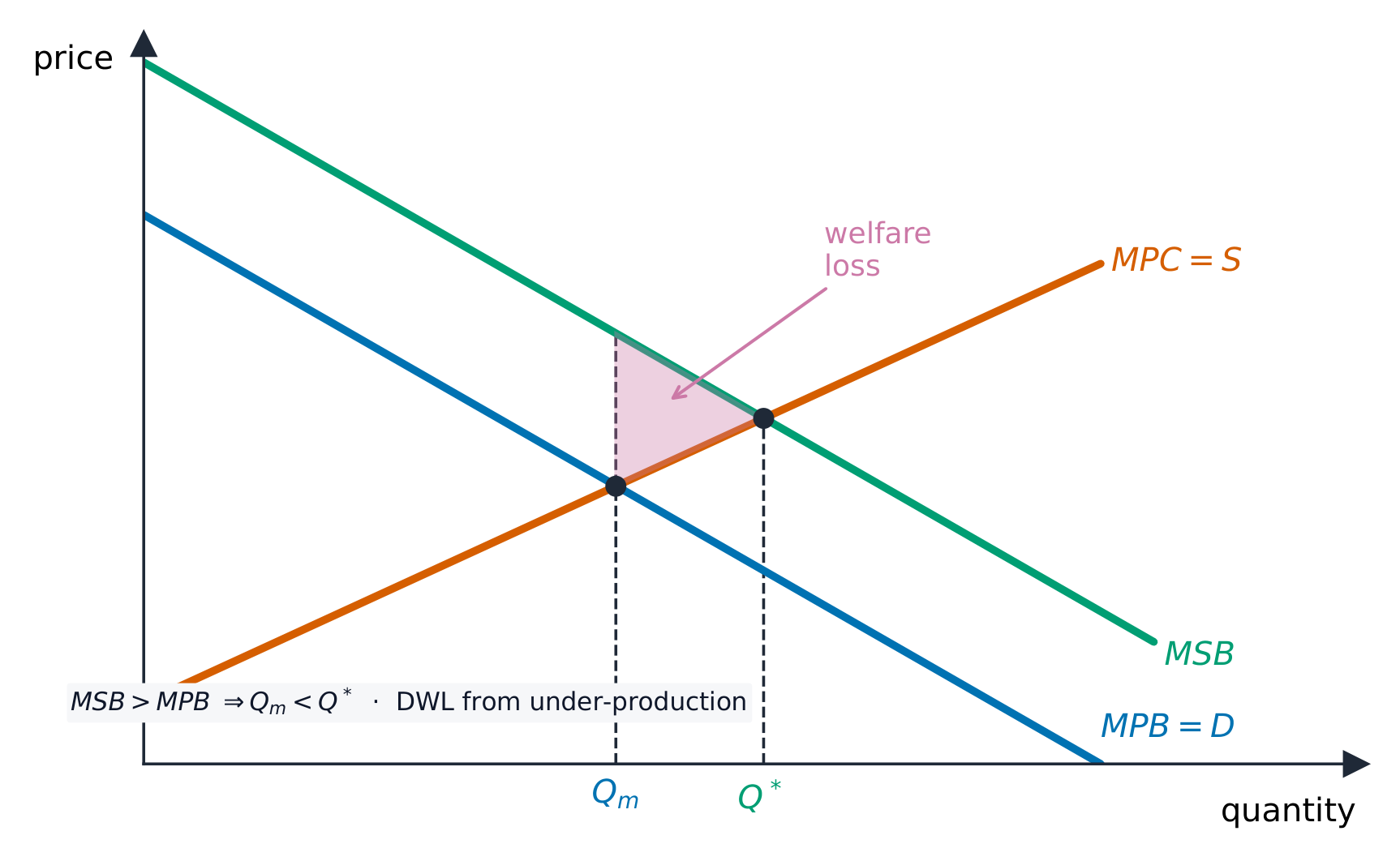
a positive externality 正外部性 is an external benefit 外部收益 enjoyed by others, like the protection that vaccination gives to everyone. Here the market makes too little, because buyers ignore the benefit to others.
With a negative externality, social cost (MSC) is above private cost (MPC), so the market over-produces at $Q_m$ instead of the social optimum $Q^*$; the shaded triangle is the welfare loss.With a positive externality, social benefit (MSB) is above private benefit (MPB), so the market under-produces at $Q_m$ instead of the social optimum $Q^*$.
Public goods
A public good 公共物品 (like street lighting or national defence) has non-rivalry 非竞争性 and non-excludability 非排他性. Because non-payers cannot be shut out, there is a free-rider problem 搭便车问题, so private firms make no profit and supply none. The market fails completely.
Merit and demerit goods
A merit good 优值品 (like education) is under-consumed; a demerit good 劣值品 (like cigarettes) is over-consumed. People misjudge them because of information failure 信息失灵 — they do not know, or do not use, the true benefit or harm.
Monopoly power
monopoly 垄断 means one firm dominates a market. A firm with monopoly power 垄断势力 can cut output and raise the price above the competitive level. This wastes resources and harms consumers.
Inequality and asymmetric information
the market rewards people who own resources, so it can produce great inequality 不平等 — some people are left with too little to live on.
asymmetric information 信息不对称 is when one side of a deal knows more than the other (a used-car seller knows the faults; the buyer does not). This leads to poor decisions and unfair deals.
Explore · Khám phá
The market and where it fails · Thị trường và nơi nó bị suy yếu
Supply and demand set the market price and quantity at their intersection. Market failure is when this free-market outcome is not the best one for society. · Nguồn cung và nhu cầu xác định giá và sản lượng thị trường tại giao điểm của chúng. Suy yếu thị trường là khi kết quả thị trường tự do này không phải là kết quả tốt nhất cho xã hội.
explain methods of intervention: indirect taxes, subsidies, maximum and minimum prices, buffer stocks, regulation, provision, tradable permits
analyse the effects of intervention, including the incidence of indirect taxes and the concept of government failure
Tiếng Việt
giải thích các phương pháp can thiệp: thuế gián tiếp, trợ giá, giá tối đa và tối thiểu, kho dự trữ ổn định, quy định, cung cấp, giấy phép giao dịch
phân tích tác động của can thiệp, bao gồm tính gánh nặng của thuế gián tiếp và khái niệm thất bại chính phủ
Source: Cambridge International syllabus · Nguồn: Chương trình Cambridge International
A maximum price creates a shortage
Indirect taxes
An indirect tax 间接税 is a tax on spending. It raises a firm's costs, shifts the supply curve to the left, and so raises the price and cuts the quantity. Governments tax demerit goods (like tobacco) and goods with negative externalities to make people use less.
Cigarettes are a demerit good — overconsumed because people misjudge the harm — so governments tax them heavily.
The incidence of a tax 税收归宿 is who really pays it. This depends on elasticity:
if demand is inelastic 缺乏弹性, consumers pay most of the tax (the price rises by nearly the full tax).
if demand is elastic 富有弹性, producers pay most of the tax (they cannot pass it on).
An indirect tax shifts supply up to $S+\text{tax}$, raising the price and cutting the quantity; the burden is shared between consumers and producers.
Subsidies
A subsidy 补贴 is a government payment to producers. It lowers their costs, shifts the supply curve to the right, and so lowers the price and raises the quantity. Subsidies are used for merit goods and goods with positive externalities.
A subsidy shifts supply down to $S+\text{subsidy}$, lowering the price and raising the quantity traded.
Maximum and minimum prices
a maximum price 最高限价 is a legal top price, set below equilibrium (for example, rent control). Because the price is held down, quantity demanded is greater than quantity supplied, so there is a shortage 短缺.
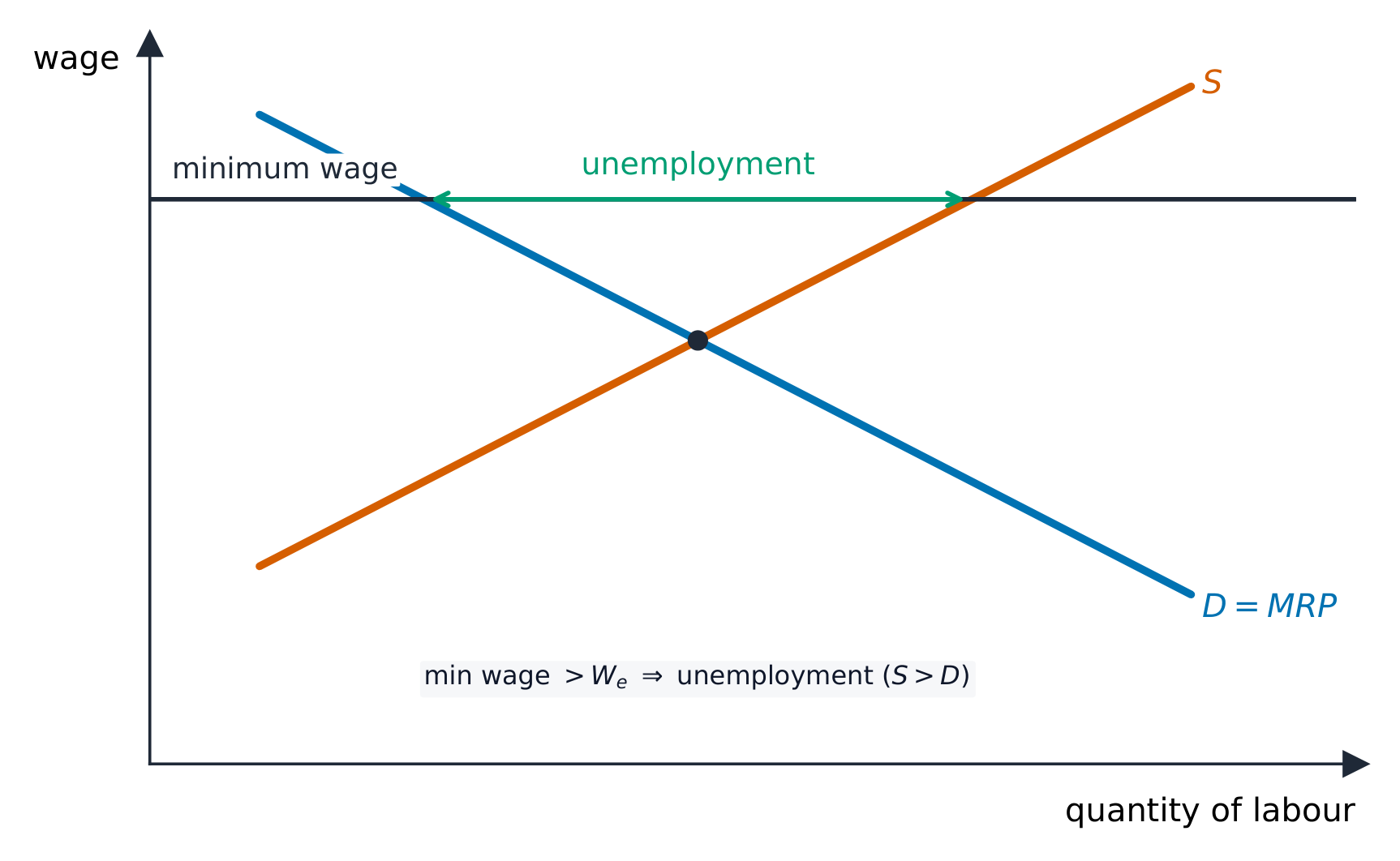
a minimum price 最低限价 is a legal bottom price, set above equilibrium (for example, a minimum wage, or a floor for farm prices). Because the price is held up, quantity supplied is greater than quantity demanded, so there is excess supply 超额供给.
A maximum price set below equilibrium leaves a shortage; a minimum price set above equilibrium leaves a surplus.
Buffer stocks
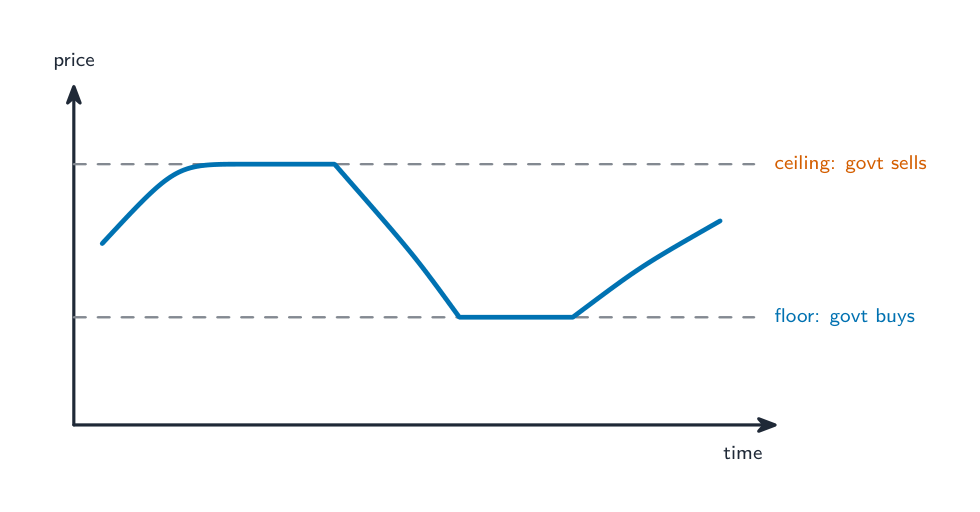
A buffer stock 缓冲库存 is used to steady the price of farm goods. The government buys and stores the good when the price is low, and sells from the store when the price is high. This keeps the price inside a target band.
A buffer stock holds the price in a band: the government buys when it hits the floor and sells when it hits the ceiling
Regulation, provision and permits
regulation 管制 means rules and laws — bans, age limits, safety standards, or pollution limits.
state provision 政府提供 means the government 政府 supplies a good directly, often free at the point of use (public goods and merit goods like schools and hospitals).
tradable permits 可交易许可证 set a total cap on pollution and give firms permits to pollute. Firms that pollute less can sell spare permits to firms that pollute more. This caps total pollution at the lowest cost.
Government failure
Intervention does not always help. government failure 政府失灵 is when the government's action makes the use of resources worse, not better. Common causes:
poor information, so the government sets the wrong tax or subsidy.
high cost of running the policy.
unintended results — for example, a maximum price can create an illegal black market 黑市.
decisions made for political reasons rather than for efficiency.
Worked example. A government puts a £2 per-packet tax on cigarettes, whose demand is very price-inelastic. Who really pays it, and what does that mean for the policy's two aims? The incidence falls mainly on whichever side is less able to respond - the more inelastic one. Because smokers keep buying almost the same quantity as the price rises, producers can pass most of the tax on, so consumers bear most of the incidence: the price might rise by about £1.80, with producers absorbing only about £0.20. That creates the tension the question is really testing. As a revenue raiser the tax succeeds: quantity barely falls, so revenue is large and steady. As a way of cutting consumption it largely fails - for exactly the same reason. And because poorer smokers spend a larger share of their income on it, the tax is regressive. Argue from elasticity to incidence, then judge each aim separately.
Explore · Khám phá
Reasons for intervention · Lý do can thiệp
Governments step into markets when the free-market equilibrium isn't the best outcome for society. · Chính phủ can thiệp vào thị trường khi cân bằng thị trường tự do không phải là kết quả tốt nhất cho xã hội.
distinguish income and wealth and explain the causes of inequality
explain policies to redistribute income and wealth (progressive taxation, benefits, provision of services) and their effects
Tiếng Việt
phân biệt thu nhập và tài sản và giải thích nguyên nhân của bất bình đẳng
giải thích các chính sách tái phân phối thu nhập và tài sản (thuế lũy tiến, lợi ích xã hội, cung cấp dịch vụ) và tác động của chúng
Source: Cambridge International syllabus · Nguồn: Chương trình Cambridge International
It helps to separate two ideas:
income 收入 is a flow 流量 — money received over a period, such as wages, rent and interest.
wealth 财富 is a stock 存量 — the value of assets owned at a point in time, such as houses, shares and savings.
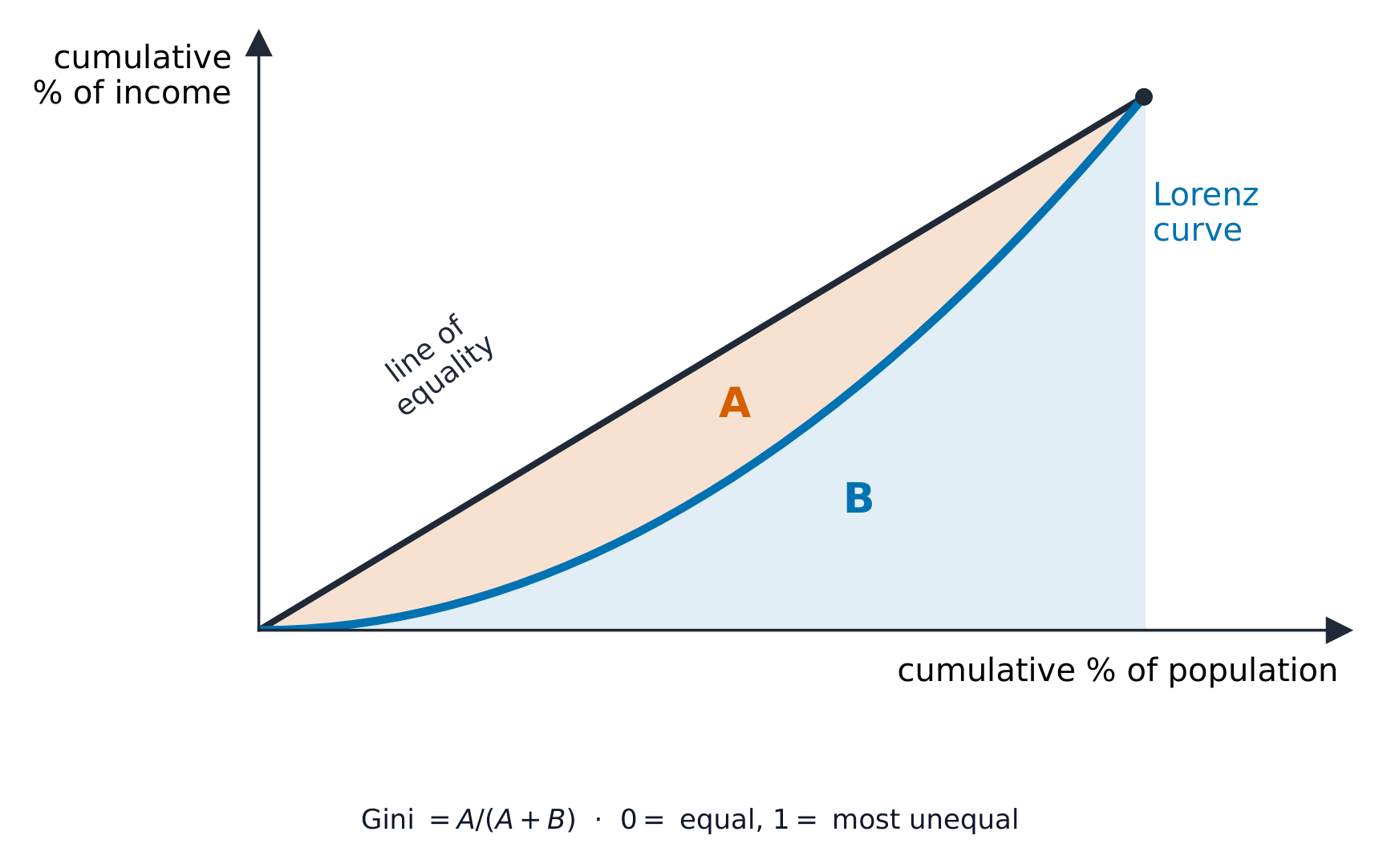
Wealth produces income (savings earn interest), and income can be saved to build wealth, so the two are linked. Inequality has many causes: differences in skills and wages, the ownership of wealth, inheritance, and unemployment.
Policies to reduce inequality
a progressive tax 累进税 takes a larger percentage 百分比 from higher incomes than from lower incomes. This narrows the gap after tax.
benefits 福利金 (also called transfer payments 转移支付) are money paid by the government to the poor, the old, and the unemployed.
state provision of free services, like education and health care, raises the real living standards of poorer people.
Together these policies bring about redistribution 再分配 — moving income and wealth from richer to poorer people. But there is a trade-off 取舍: very high taxes and large benefits may weaken the incentive 激励 to work and to invest.
Wealth and poverty side by side: markets alone may leave large income inequality unaddressed
Explore · Khám phá
Inequality policy route · Con đường chính sách về bất bình đẳng
Follow how policy can change disposable income and opportunity. · Theo dõi cách thức chính sách có thể thay đổi thu nhập khả dụng và cơ hội.
Macroeconomics 宏观经济学 looks at the whole economy at once: its total output, its jobs, and its prices. This handout covers how we measure the economy and the main problems it can face.
4.1
National income statistics
Syllabus · Chương trình
English
define GDP, GNI and national income and distinguish nominal and real, and total and per capita values
explain the uses and limitations of national income statistics for measuring living standards and making comparisons
Tiếng Việt
định nghĩa GDP, GNI và thu nhập quốc gia và phân biệt danh nghĩa và thực tế, cũng như tổng giá trị và giá trị bình quân đầu người
giải thích các ứng dụng và hạn chế của thống kê thu nhập quốc gia trong việc đo lường mức sống và so sánh
Source: Cambridge International syllabus · Nguồn: Chương trình Cambridge International
To judge how an economy is doing, we measure its national income 国民收入 — the total value of everything it produces in a year.
National income (GDP) is the value of all the goods and services a country produces in a year.
gross domestic product 国内生产总值 (GDP) is the value of all goods and services made inside a country in a year.
gross national income 国民总收入 (GNI) is GDP plus the income a country's people and firms earn abroad, minus income foreigners earn inside it.
Two important differences:
nominal 名义 values are measured at current prices. real 实际 values are adjusted to remove the effect of rising prices, so they show the true change in output. Always compare real values over time.
total values cover the whole country. per capita 人均 values are divided by the population, so they show the average per person.
Uses and limitations
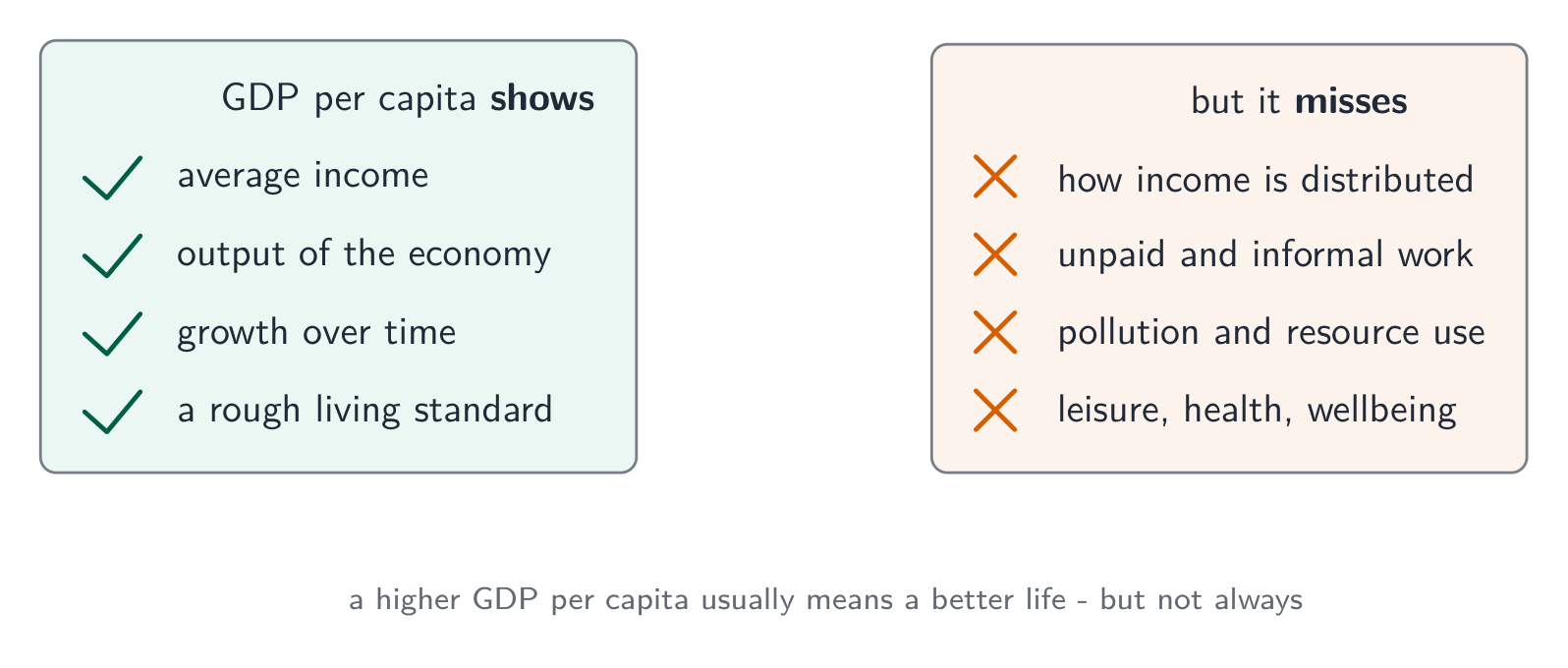
National income is used to measure the standard of living 生活水平 and to compare countries. But it has limits:
it ignores the distribution 分配 of income — a high average can hide great inequality.
it leaves out unpaid work (housework) and the informal economy 非正规经济 (hidden, untaxed activity).
it says nothing about pollution, leisure time, or health.
So a higher GDP per capita usually means a better life, but not always.
GDP per capita shows average income and output, but misses distribution, unpaid work and pollution
Explore · Khám phá
National income flow · Luồng thu nhập quốc dân
Watch spending become income, output and expenditure in the circular flow. · Quan sát việc chi tiêu trở thành thu nhập, sản lượng và chi tiêu trong luồng tuần hoàn.
explain the circular flow of income with injections (investment, government spending, exports) and leakages (saving, taxation, imports)
explain equilibrium in the circular flow and the distinction between a closed and open economy
Tiếng Việt
giải thích dòng lưu chuyển thu nhập với nạp (đầu tư, chi tiêu chính phủ, xuất khẩu) và rò rỉ (tiết kiệm, thuế, nhập khẩu)
giải thích cân bằng trong dòng lưu chuyển thu nhập và sự phân biệt giữa nền kinh tế đóng và nền kinh tế mở
Source: Cambridge International syllabus · Nguồn: Chương trình Cambridge International
The circular flow of income
The circular flow of income 收入循环流 shows money moving around the economy. Households 家庭 supply factors of production to firms 企业 and receive income (wages, rent, interest, profit). They spend that income on goods and services, and the money flows back to firms.
Money also leaves and enters this flow:
leakages 漏出 take money out of the flow: saving 储蓄, taxation 税收, and spending on imports 进口.
injections 注入 put money into the flow: investment 投资, government spending 政府支出, and exports 出口.
The flow is in equilibrium 均衡 when total injections equal total leakages. If injections are greater, the economy grows; if leakages are greater, it shrinks.
Money loops between households and firms; leakages (saving, taxation, imports) drain it, while injections (investment, government spending, exports) add to it.
A closed economy 封闭经济 has no trade with other countries. An open economy 开放经济 trades, so it has exports and imports.
Explore · Khám phá
Injections & leakages · Nạp流入 & Rút流出
Money loops between households and firms. Injections grow national income, leakages shrink it; they are equal at equilibrium. · Tiền lưu vòng giữa các hộ gia đình và doanh nghiệp. Nạp流入 làm tăng thu nhập quốc dân, Rút流出 làm giảm nó; chúng bằng nhau tại điểm cân bằng.
Explore · Khám phá
The circular flow of income · Luồng tuần hoàn thu nhập
Money flows in a loop: households earn income from firms, then spend it back on the firms' goods. Step round the cycle. · Tiền chảy theo vòng tròn: các hộ gia đình nhận thu nhập từ doanh nghiệp, sau đó chi tiêu nó trở lại để mua hàng hóa của doanh nghiệp. Bước quanh chu kỳ.
define the components of aggregate demand (C + I + G + (X−M)) and explain the shape of the AD curve
explain short-run and long-run aggregate supply and the determinants of AD and AS
use AD/AS analysis to determine macroeconomic equilibrium and the price level and real output
Tiếng Việt
định nghĩa các thành phần của tổng cầu (C + I + G + (X−M)) và giải thích hình dạng của đường cong AD
giải thích tổng cung ngắn hạn và tổng cung dài hạn cùng các yếu tố xác định AD và AS
sử dụng phân tích AD/AS để xác định cân bằng vĩ mô và mức giá cùng sản lượng thực tế
Source: Cambridge International syllabus · Nguồn: Chương trình Cambridge International
Aggregate demand and supply
Aggregate demand
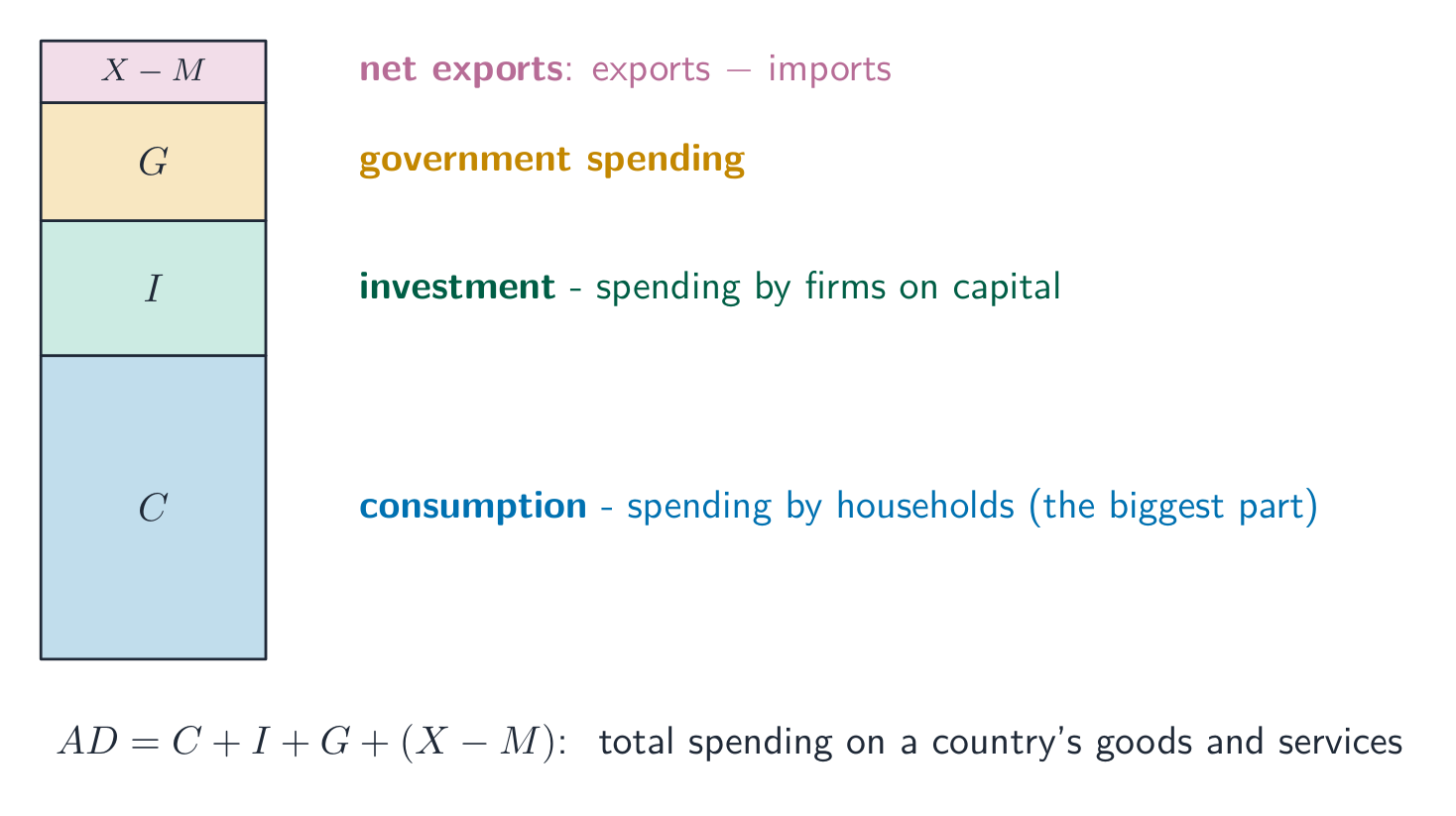
aggregate demand 总需求 (AD) is the total spending on a country's goods and services at each price level. It has four parts:
$$AD = C + I + G + (X - M)$$
C is consumption 消费 — spending by households.
I is investment — spending by firms on capital.
G is government spending.
(X − M) is net exports 净出口 — exports minus imports.
Aggregate demand is total spending: consumption, investment, government spending and net exports
The AD curve slopes downward: a lower price level means higher real spending, so a greater real output is demanded. AD shifts when any of its four parts changes (for example, a tax cut raises C).
Aggregate supply
aggregate supply 总供给 (AS) is the total output firms are willing to make at each price level.
short-run aggregate supply 短期总供给 (SRAS) slopes upward. In the short run, higher prices make production more profitable, so firms supply more. SRAS shifts when costs change (wages, raw materials, taxes).
long-run aggregate supply 长期总供给 (LRAS) shows the economy's full productive capacity 生产能力. It shifts only when the quantity or quality of factors changes.
Macroeconomic equilibrium
macroeconomic equilibrium 宏观经济均衡 is where AD crosses AS. It sets the price level 价格水平 and the real output 实际产出 of the economy. A shift in AD or AS changes both.
Equilibrium sets the price level $P$ and real output $Y$ where AD meets short-run AS; vertical LRAS marks full capacity.
Explore · Khám phá
Aggregate demand & supply · Cung & cầu tổng hợp
AD and AS cross at the price level and national output. · AD và AS cắt nhau tại mức giá và sản lượng quốc gia.
distinguish actual and potential growth and explain the causes of economic growth
explain the costs and benefits of economic growth and the business (trade) cycle
Tiếng Việt
phân biệt tăng trưởng thực tế và tăng trưởng tiềm năng và giải thích nguyên nhân của tăng trưởng kinh tế
giải thích chi phí và lợi ích của tăng trưởng kinh tế cũng như chu kỳ doanh nghiệp (thương mại)
Source: Cambridge International syllabus · Nguồn: Chương trình Cambridge International
economic growth 经济增长 is a rise in a country's real output (real GDP) over time.
actual growth 实际增长 is the rise in output that really happens (a movement to a point further out, or from inside the LRAS towards it).
potential growth 潜在增长 is the rise in the economy's capacity (the LRAS shifting outward).
Growth is caused by more or better factors of production: a bigger or more skilled workforce, more investment in capital, new technology, and higher productivity 生产率 (output per worker).
The business cycle
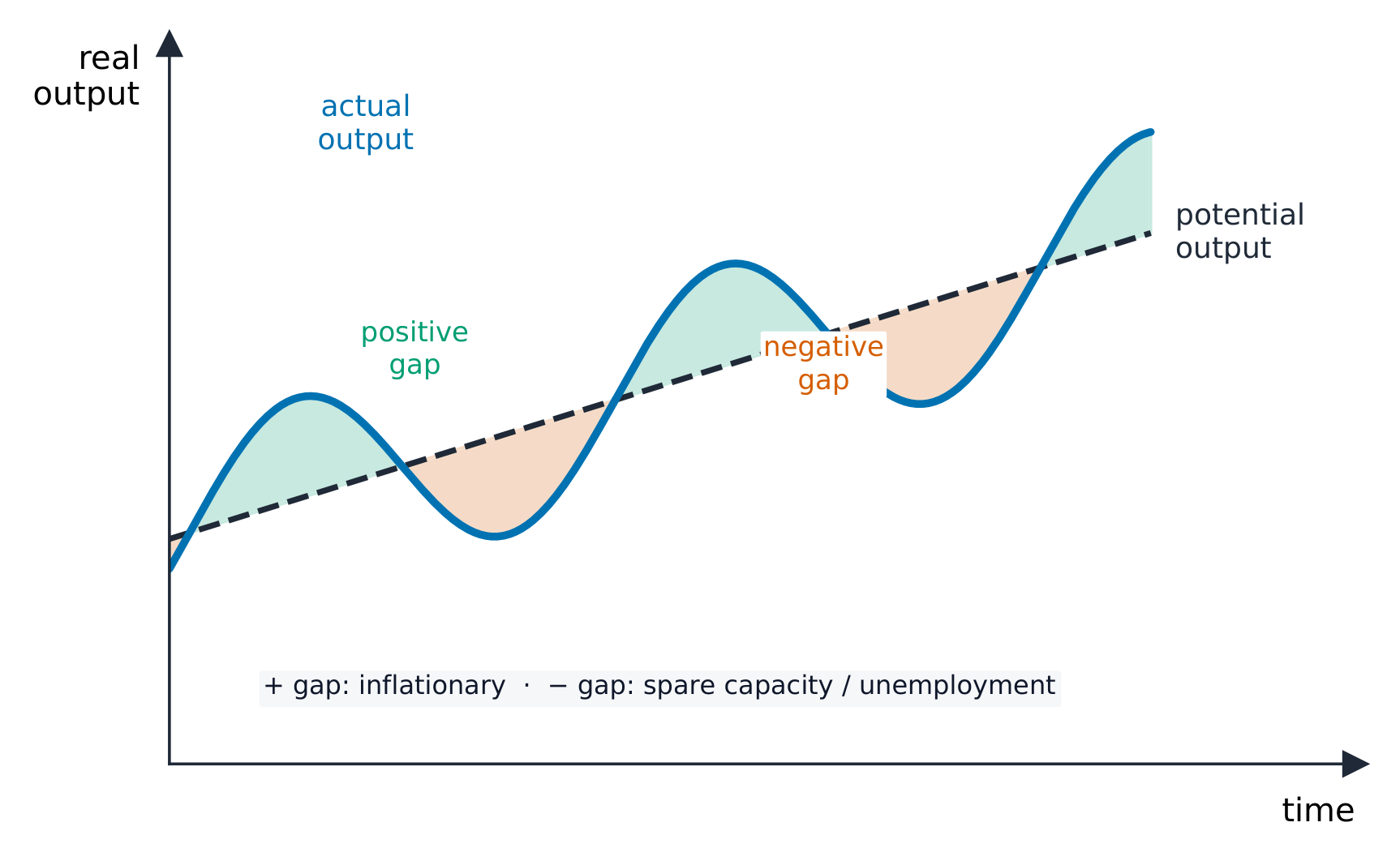
Real output does not grow smoothly. The business cycle 经济周期 (also called the trade cycle) is the up-and-down pattern of output over the years. It has four phases: boom 繁荣 (fast growth), recession 衰退 (falling output), slump 萧条 (the low point), and recovery 复苏.
Real GDP swings through boom, recession, slump and recovery around its rising long-run trend.
Costs and benefits of growth
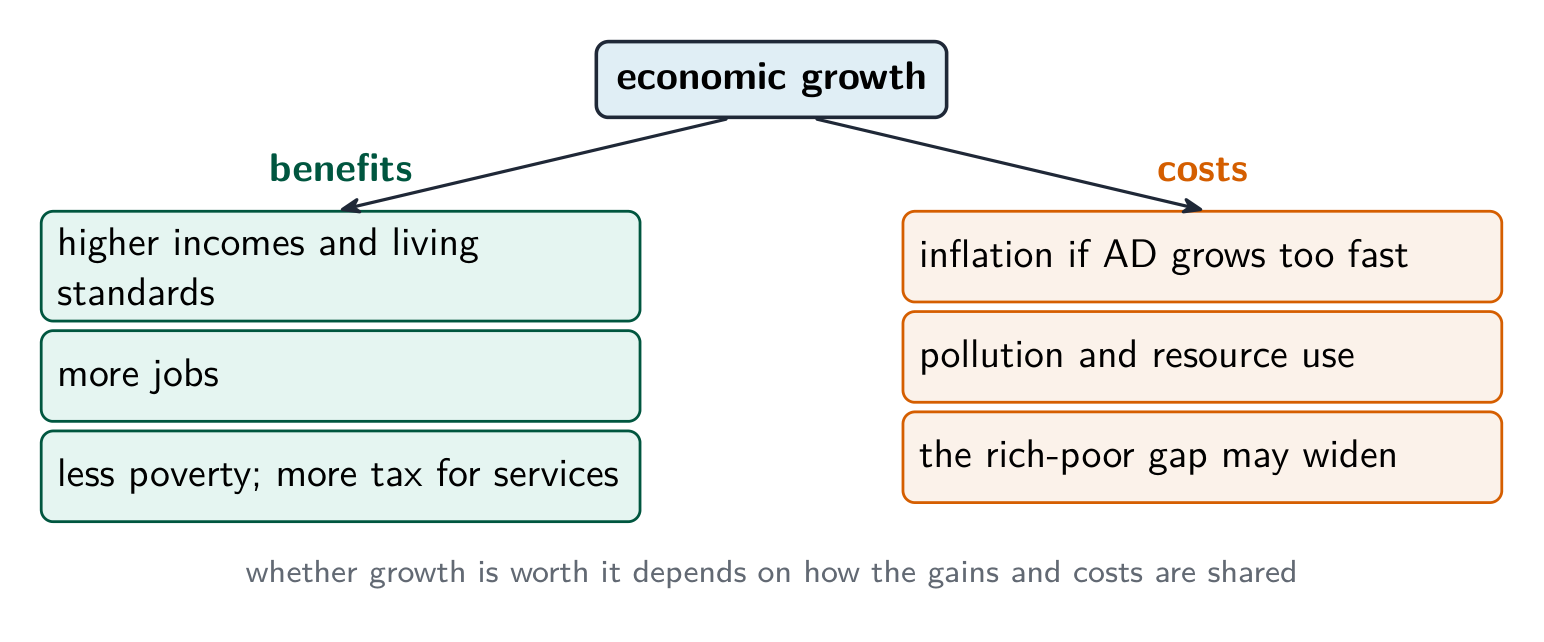
Benefits
Costs
higher incomes and living standards
can cause inflation if AD grows too fast
more jobs
pollution and use of resources
less poverty; more tax for public services
the gap between rich and poor may widen
Economic growth brings higher incomes and jobs, but can bring inflation, pollution and inequality
Explore · Khám phá
Economic growth shifts the frontier out · Tăng trưởng kinh tế đẩy biên khả năng sản xuất ra ngoài
Growth means the economy can produce more of BOTH goods — the whole frontier moves outward as resources or technology improve. · Tăng trưởng có nghĩa là nền kinh tế có thể sản xuất nhiều hơn CẢ hai loại hàng hóa — toàn bộ đường biên dịch chuyển ra ngoài khi nguồn lực hoặc công nghệ cải thiện.
define and measure unemployment (claimant count and labour force survey)
explain the types and causes of unemployment (frictional, structural, cyclical, seasonal) and its consequences
Tiếng Việt
định nghĩa và đo lường thất nghiệp (số người nhận trợ cấp và khảo sát lao động)
giải thích các loại và nguyên nhân của thất nghiệp (ma sát, cấu trúc, chu kỳ, theo mùa) và hậu quả của nó
Source: Cambridge International syllabus · Nguồn: Chương trình Cambridge International
unemployment 失业 means people who are able and willing to work, and are looking for a job, but cannot find one.
Measuring unemployment
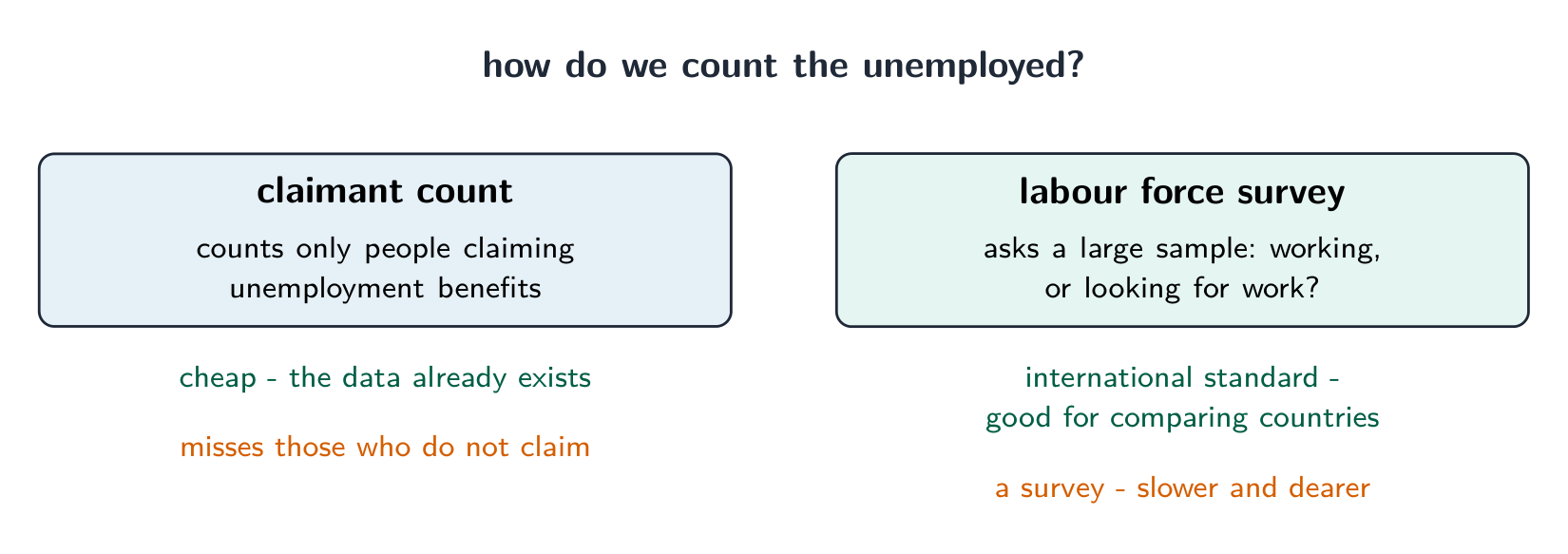
the claimant count 申领救济人数 counts only people claiming unemployment benefits. It is cheap but misses those who do not claim.
the labour force survey 劳动力调查 asks a large sample whether they are working or seeking work. It follows an international standard, so it is better for comparing countries. The labour force 劳动力 is everyone working or looking for work.
Two ways to count the unemployed - and what each one misses
Types and causes
frictional unemployment 摩擦性失业 — short-term, while people move between jobs.
structural unemployment 结构性失业 — when an industry declines and workers' skills no longer match the jobs available.
cyclical unemployment 周期性失业 — caused by low AD in a recession. This is usually the largest type.
seasonal unemployment 季节性失业 — when work is only available at certain times of the year (such as farming or tourism).
Three types of unemployment: frictional, structural and cyclical
Consequences
Unemployment wastes output (the economy produces inside its PPC), lowers incomes, and costs the government (more benefits, less tax). It also harms families and can raise crime and ill health.
Explore · Khám phá
Unemployment in the labour market · Thất nghiệp trong thị trường lao động
If the wage is stuck ABOVE the equilibrium, more workers want jobs than firms will hire — that gap is unemployment. · Nếu mức lương bị cố định ở TRÊN mức cân bằng, số lao động muốn tìm việc sẽ nhiều hơn số vị trí doanh nghiệp tuyển dụng — khoảng chênh lệch đó là thất nghiệp.
define inflation, deflation and disinflation and explain how the price level is measured
explain the causes (demand-pull and cost-push) and consequences of inflation and deflation
Tiếng Việt
định nghĩa lạm phát, deflation và giảm lạm phát và giải thích cách đo lường mức giá
giải thích nguyên nhân (kéo từ cầu và đẩy từ chi phí) và hậu quả của lạm phát và deflation
Source: Cambridge International syllabus · Nguồn: Chương trình Cambridge International
Inflation, deflation and disinflation
inflation 通货膨胀 is a sustained rise in the general price level. Money then buys less, so its purchasing power 购买力 falls.
deflation 通货紧缩 is a sustained fall in the general price level.
disinflation 反通货膨胀 is when inflation is still positive but is slowing down (prices rise, but more slowly).
Inflation is measured from the price of a basket of everyday goods like these.
The price level is measured with the consumer price index 消费者价格指数 (CPI). A typical household's spending is used to build a "basket" of goods. Each good is given a weight 权重 for how much is spent on it, and the change in the basket's cost from year to year is the inflation rate:
$$\text{inflation rate} = \frac{\text{change in index}}{\text{starting index}} \times 100\%.$$
Worked example. A country's CPI rises from $100$ to $104$ over one year, then to $107$ the year after. Find the inflation rate in each year.
Year 1: $\dfrac{104 - 100}{100} \times 100\% = 4\%$. Year 2: $\dfrac{107 - 104}{104} \times 100\% = 2.9\%$.
Notice that prices are still rising in year 2, just more slowly — this fall in the inflation rate (from $4\%$ to $2.9\%$) is disinflation, not deflation.
Worked example. A worker's wage rises from $\text{\pounds} 500$ to $\text{\pounds} 520$ a week (a $4\%$ rise) while the CPI rises by $4\%$. What happens to the real wage?
Money (nominal) pay is up $4\%$, but prices are also up $4\%$, so the real wage — what the pay can actually buy — is unchanged. A pay rise only raises living standards if it beats inflation.
Causes of inflation
demand-pull inflation 需求拉动型通货膨胀 — AD rises faster than AS, so "too much money chases too few goods".
cost-push inflation 成本推动型通货膨胀 — firms' costs rise (wages or raw materials), so they raise prices, shifting SRAS to the left.
Demand-pull inflation comes from AD shifting right; cost-push inflation comes from SRAS shifting left. Both raise the price level.
Consequences
Inflation lowers purchasing power, especially for people on fixed incomes. It creates uncertainty, can make a country's exports dearer, and helps borrowers but harms savers. Deflation sounds good but can be harmful: people delay buying (waiting for lower prices), so AD falls, firms cut output, and unemployment rises.
Explore · Khám phá
Aggregate demand and supply · Cung cầu tổng hợp
The overall price level sits where aggregate demand meets aggregate supply — a shock to either moves prices and output. · Mức giá chung nằm ở nơi cầu tổng hợp gặp cung tổng hợp — một cú sốc vào một trong hai yếu tố sẽ làm thay đổi giá cả và sản lượng.
Governments try to steer the whole economy. This handout covers what they aim for and the three sets of tools they use.
Tiếng Việt
Các chính phủ cố gắng dẫn dắt toàn bộ nền kinh tế. Tài liệu này bao gồm những gì họ的目标 và ba nhóm công cụ mà họ sử dụng.
5.1
Macroeconomic policy objectives · Mục tiêu chính sách vĩ mô
Syllabus · Chương trình
English
state the macroeconomic policy objectives: stable low inflation, full employment, economic growth, balance of payments stability, redistribution of income
explain potential conflicts between objectives
Tiếng Việt
nêu mục tiêu chính sách vĩ mô: lạm phát thấp ổn định, đầy đủ việc làm, tăng trưởng kinh tế, ổn định cán cân thanh toán, tái phân phối thu nhập
giải thích các xung đột tiềm năng giữa các mục tiêu
Source: Cambridge International syllabus · Nguồn: Chương trình Cambridge International
English
A government usually has five main aims:
price stability 物价稳定 — low and steady inflation 通货膨胀 (often a target of about 2% a year).
full employment 充分就业 — jobs for almost everyone who wants to work.
economic growth 经济增长 — a rising real output over time.
balance of payments 国际收支 stability — not importing far more than the country exports for years on end.
redistribution of income 收入再分配 — narrowing the gap between rich and poor.
Conflicts between objectives
The aims can conflict 冲突 — reaching one can hurt another:
growth versus inflation: fast growth raises aggregate demand 总需求, which can pull prices up.
growth versus the balance of payments: as incomes rise, people buy more imports, worsening the trade balance.
unemployment versus inflation: cutting unemployment by raising demand can cause more inflation.
growth versus the environment: more output often means more pollution.
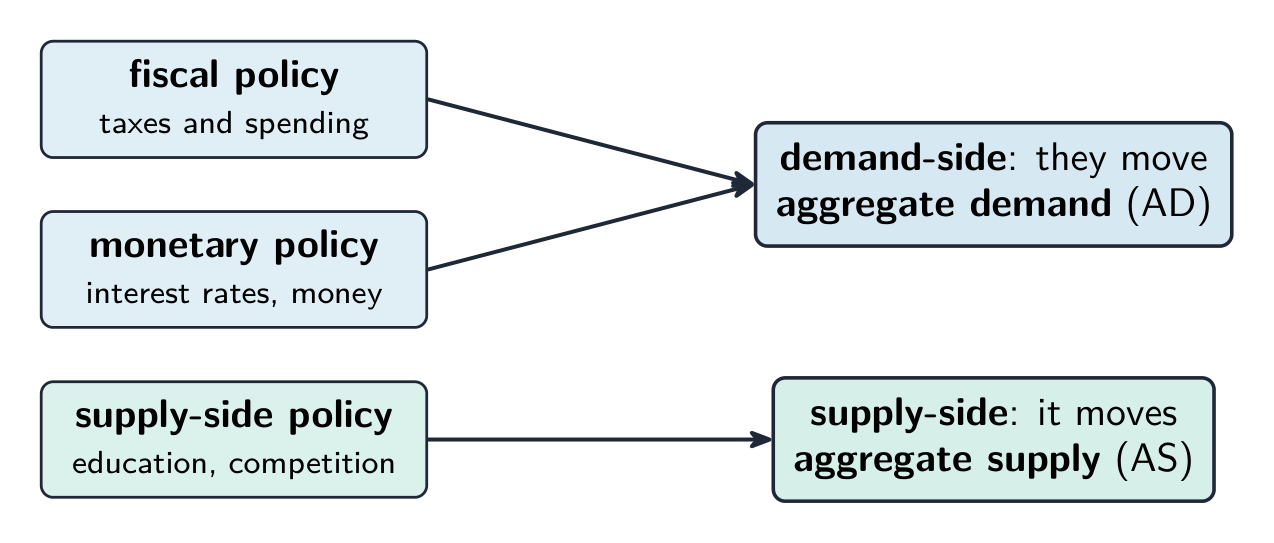
The government has three sets of tools. Fiscal and monetary policy are demand-side policies 需求侧政策 (they work on AD). Supply-side policy works on aggregate supply 总供给.
Tiếng Việt
Một chính phủ thường có năm mục tiêu chính:
stabilité giá cả — mức lạm phát thấp và ổn định (thường là mục tiêu khoảng 2% mỗi năm).
tỷ lệ việc làm đầy đủ — có công việc cho hầu hết mọi người muốn làm việc.
tăng trưởng kinh tế — sản lượng thực tế tăng lên theo thời gian.
stabilité cân bằng thanh toán — không nhập khẩu nhiều hơn nhiều so với xuất khẩu trong nhiều năm liên tiếp.
phân phối lại thu nhập — thu hẹp khoảng cách giữa người giàu và người nghèo.
Xung đột giữa các mục tiêu
Các mục tiêu có thể xung đột — đạt được mục tiêu này có thể gây hại cho mục tiêu khác:
tăng trưởng versus lạm phát: tăng trưởng nhanh làm tăng cầu tổng hợp, có thể đẩy giá lên.
tăng trưởng versus cân bằng thanh toán: khi thu nhập tăng, người dân mua nhiều hàng nhập khẩu hơn, làm xấu đi cân bằng thương mại.
tỷ lệ thất nghiệp versus lạm phát: giảm tỷ lệ thất nghiệp bằng cách tăng cầu có thể dẫn đến lạm phát cao hơn.
tăng trưởng versus môi trường: sản lượng lớn hơn thường đồng nghĩa với ô nhiễm nhiều hơn.
Theo đuổi tăng trưởng nhanh có thể tác động ngược lại sự ổn định giá cả, cân bằng thanh toán và môi trường
Chính phủ có ba nhóm công cụ. Chính sách tài khóa và tiền tệ là chính sách phía cầu (tác động vào AD). Chính sách phía cung tác động vào cung tổng hợp.
Chính sách tài khóa và tiền tệ tác động vào cầu tổng hợp; chính sách phía cung tác động vào cung tổng hợp
explain fiscal policy (government spending and taxation) and the budget balance
distinguish direct and indirect taxes and progressive, proportional and regressive taxes
explain the use and effectiveness of fiscal policy
Tiếng Việt
giải thích chính sách tài khóa (chi tiêu và thuế của chính phủ) và cán cân ngân sách
phân biệt thuế trực tiếp và thuế gián tiếp cũng như thuế lũy tiến, tỷ lệ và thuế nghịch đảo
giải thích việc sử dụng và hiệu quả của chính sách tài khóa
Source: Cambridge International syllabus · Nguồn: Chương trình Cambridge International
English
fiscal policy 财政政策 is the use of government spending and taxation to influence the economy.
The budget 预算 compares the two:
a budget deficit 预算赤字 is when spending is greater than tax revenue. The government must borrow, adding to the national debt 国债.
a budget surplus 预算盈余 is when tax revenue is greater than spending.
Types of tax
a direct tax 直接税 is paid straight to the government on income or profit (income tax, corporation tax).
an indirect tax 间接税 is a tax on spending (added to the price of goods).
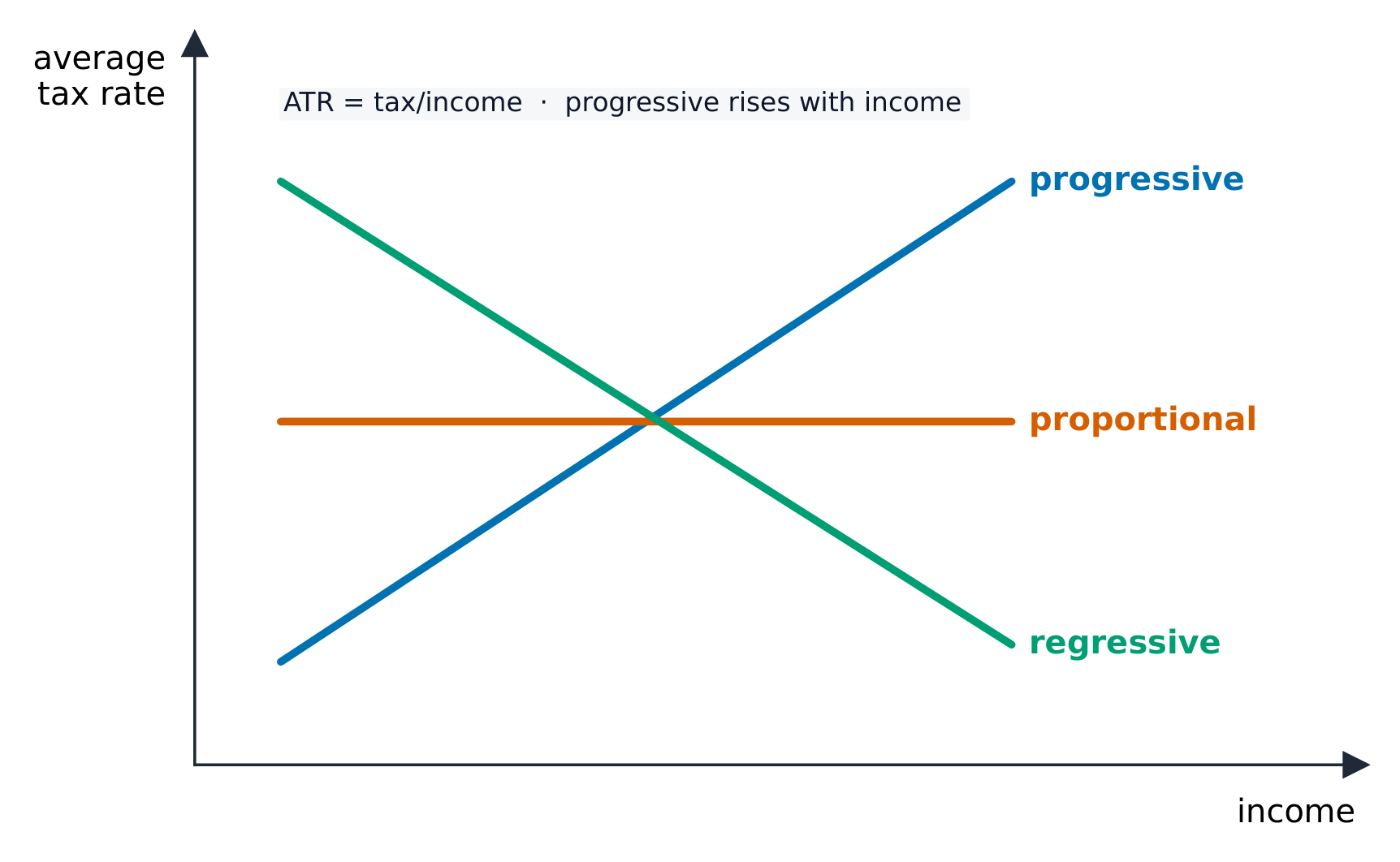
Taxes are also grouped by how the rate changes with income:
Type
How it works
progressive tax 累进税
the rate rises as income rises (the rich pay a larger share)
proportional tax 比例税
the rate stays the same at every income
regressive tax 累退税
the rate falls as income rises (the poor pay a larger share)
Using fiscal policy
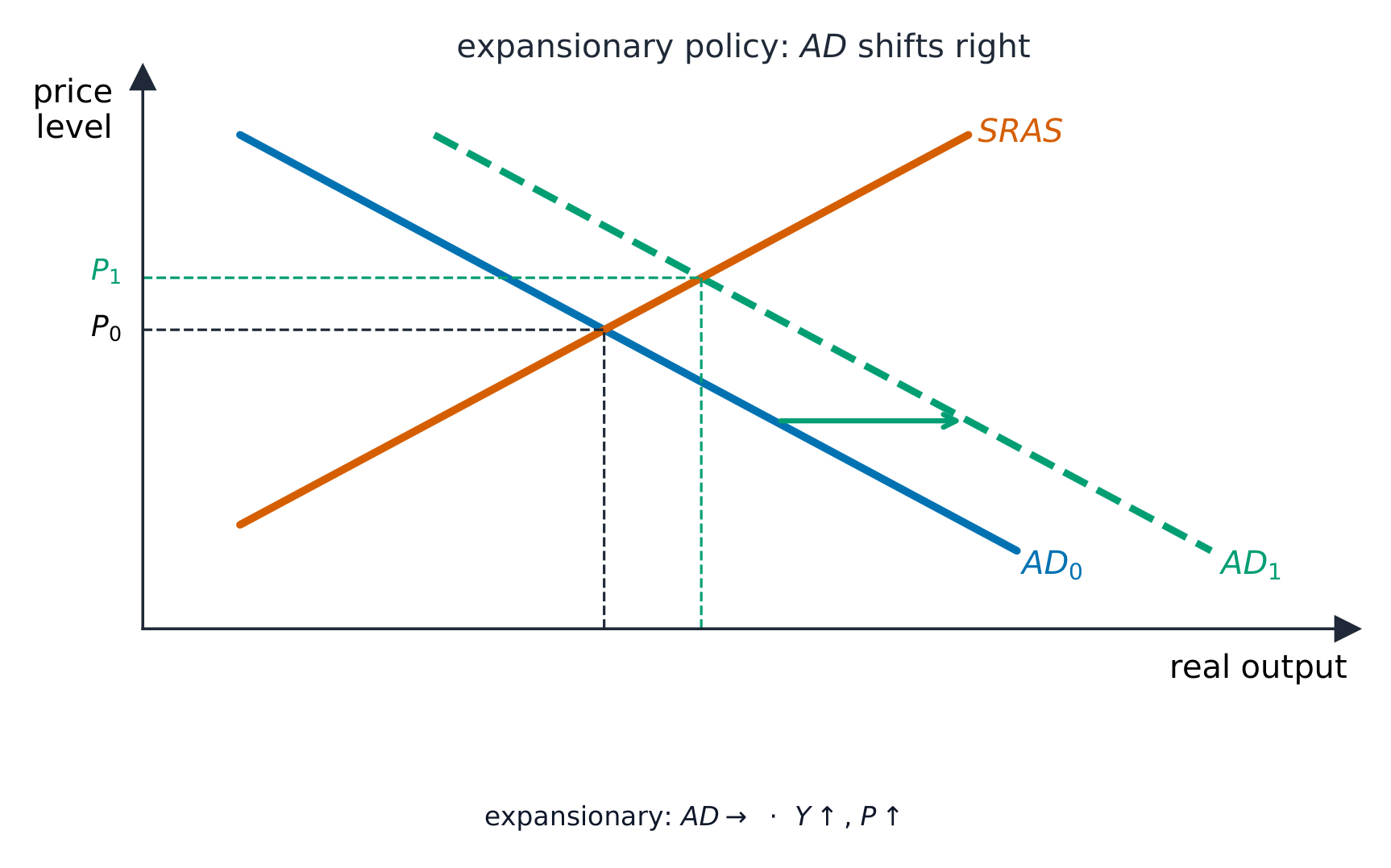
expansionary 扩张性 fiscal policy raises government spending or cuts taxes. This raises AD, to fight a recession and unemployment.
contractionary 紧缩性 fiscal policy cuts spending or raises taxes. This lowers AD, to fight inflation.
Effectiveness. Fiscal policy can act fast on AD, but it has problems: time lags (a budget is set once a year), large deficits and debt, and crowding out 挤出效应 — when heavy government borrowing pushes up interest rates and reduces private investment.
Tiếng Việt
chính sách tài khóa là việc sử dụng chi tiêu và thuế của chính phủ để ảnh hưởng đến nền kinh tế.
Chính phủ sử dụng chính sách tài khóa — chi tiêu và thuế của chính phủ, được thiết lập thông qua cơ quan lập pháp — để điều hướng nền kinh tế.
Ngân sách so sánh hai yếu tố này:
ngân sách thâm hụt xảy ra khi chi tiêu lớn hơn doanh thu thuế. Chính phủ phải vay nợ, làm tăng nợ quốc gia.
ngân sách thặng dư xảy ra khi doanh thu thuế lớn hơn chi tiêu.
Các loại thuế
thuế trực tiếp được trả trực tiếp cho chính phủ trên thu nhập hoặc lợi nhuận (thuế thu nhập, thuế doanh nghiệp).
thuế gián tiếp là thuế đối với chi tiêu (được cộng vào giá hàng hóa).
Thuế cũng được phân loại theo cách thay đổi tỷ lệ theo thu nhập:
Loại
Cách hoạt động
thuế lũy tiến
tỷ lệ tăng khi thu nhập tăng (người giàu đóng một phần lớn hơn)
thuế tỷ lệ
tỷ lệ giữ nguyên ở mọi mức thu nhập
thuế lũy thoái
tỷ lệ giảm khi thu nhập tăng (người nghèo đóng một phần lớn hơn)
Dưới chế độ thuế lũy tiến, tỷ lệ trung bình tăng theo thu nhập; dưới thuế tỷ lệ nó giữ nguyên; dưới thuế lũy thoái nó giảm.
Sử dụng chính sách tài khóa
chính sách tài khóa nới lỏng tăng chi tiêu chính phủ hoặc cắt giảm thuế. Điều này làm tăng AD, nhằm chống lại suy thoái và tỷ lệ thất nghiệp.
chính sách tài khóa thắt chặt cắt giảm chi tiêu hoặc tăng thuế. Điều này làm giảm AD, nhằm chống lại lạm phát.
Chính sách tài khóa hoặc tiền tệ nới lỏng dịch chuyển AD sang phải, làm tăng sản lượng và mức giá chung; chính sách thắt chặt làm ngược lại điều đó.
Hiệu quả. Chính sách tài khóa có thể tác động nhanh lên AD, nhưng nó có những vấn đề: độ trễ thời gian (ngân sách được thiết lập một lần mỗi năm), thâm hụt lớn và nợ, và hiệu ứng đẩy lùi — khi chính phủ vay nợ nhiều đẩy lãi suất lên và làm giảm đầu tư tư nhân.
Explore · Khám phá
Fiscal policy shifts AD · Chính sách tài khóa dịch chuyển AD
Government spending and taxes move aggregate demand (AD). Drag AD to see real output and the price level change. · Chi tiêu và thuế của chính phủ di chuyển tổng cầu (AD). Kéo AD để xem sản lượng thực tế và mức giá thay đổi.
explain monetary policy (interest rates, money supply, exchange rate) and the role of the central bank
explain the transmission mechanism and the effectiveness of monetary policy
Tiếng Việt
giải thích chính sách tiền tệ (lãi suất, cung tiền, tỷ giá) và vai trò của ngân hàng trung ương
giải thích cơ chế truyền dẫn và hiệu quả của chính sách tiền tệ
Source: Cambridge International syllabus · Nguồn: Chương trình Cambridge International
English
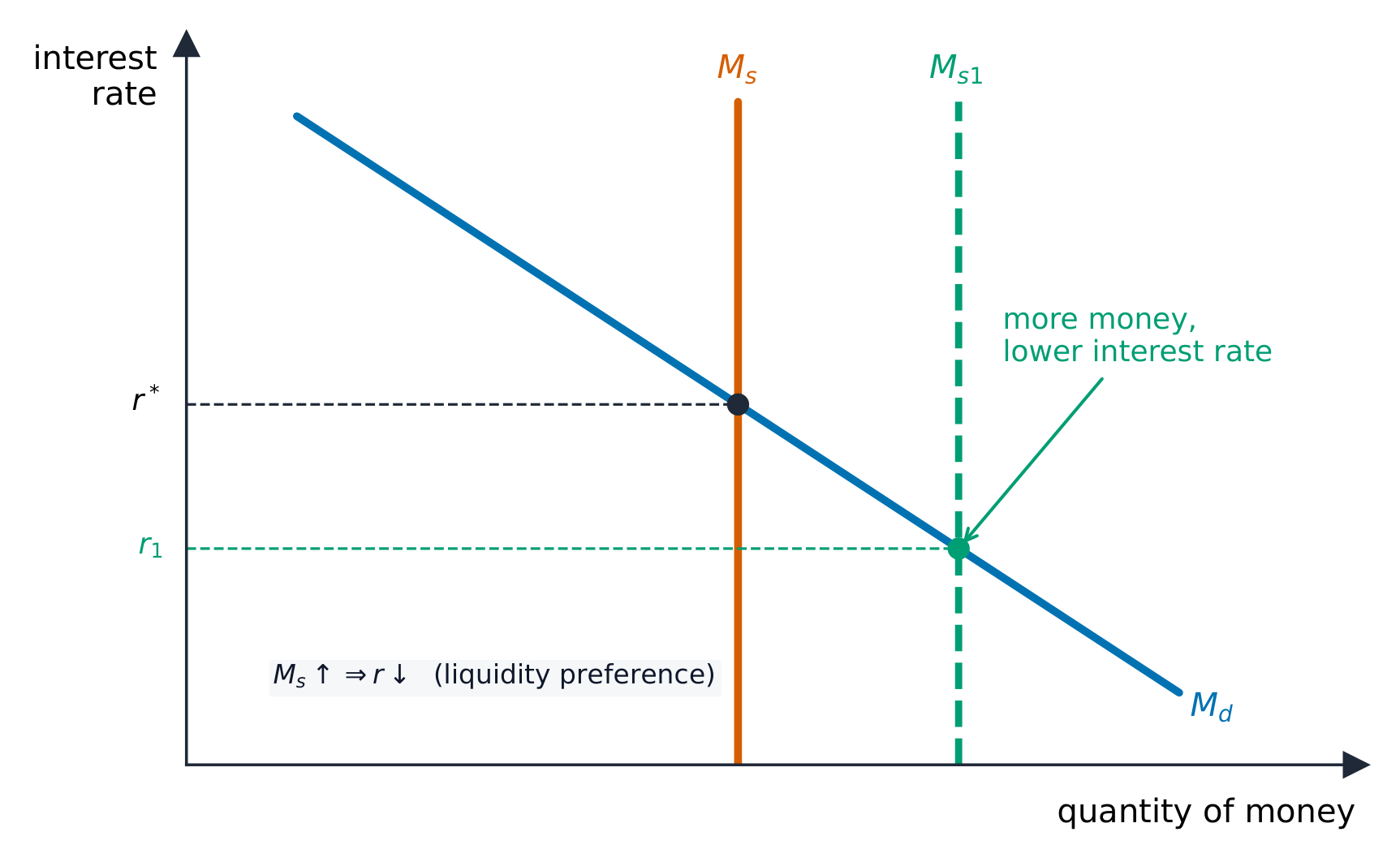
monetary policy 货币政策 is run by the central bank 中央银行. Its main tool is the interest rate 利率, but it can also change the money supply 货币供给 or influence the exchange rate 汇率.
The transmission mechanism
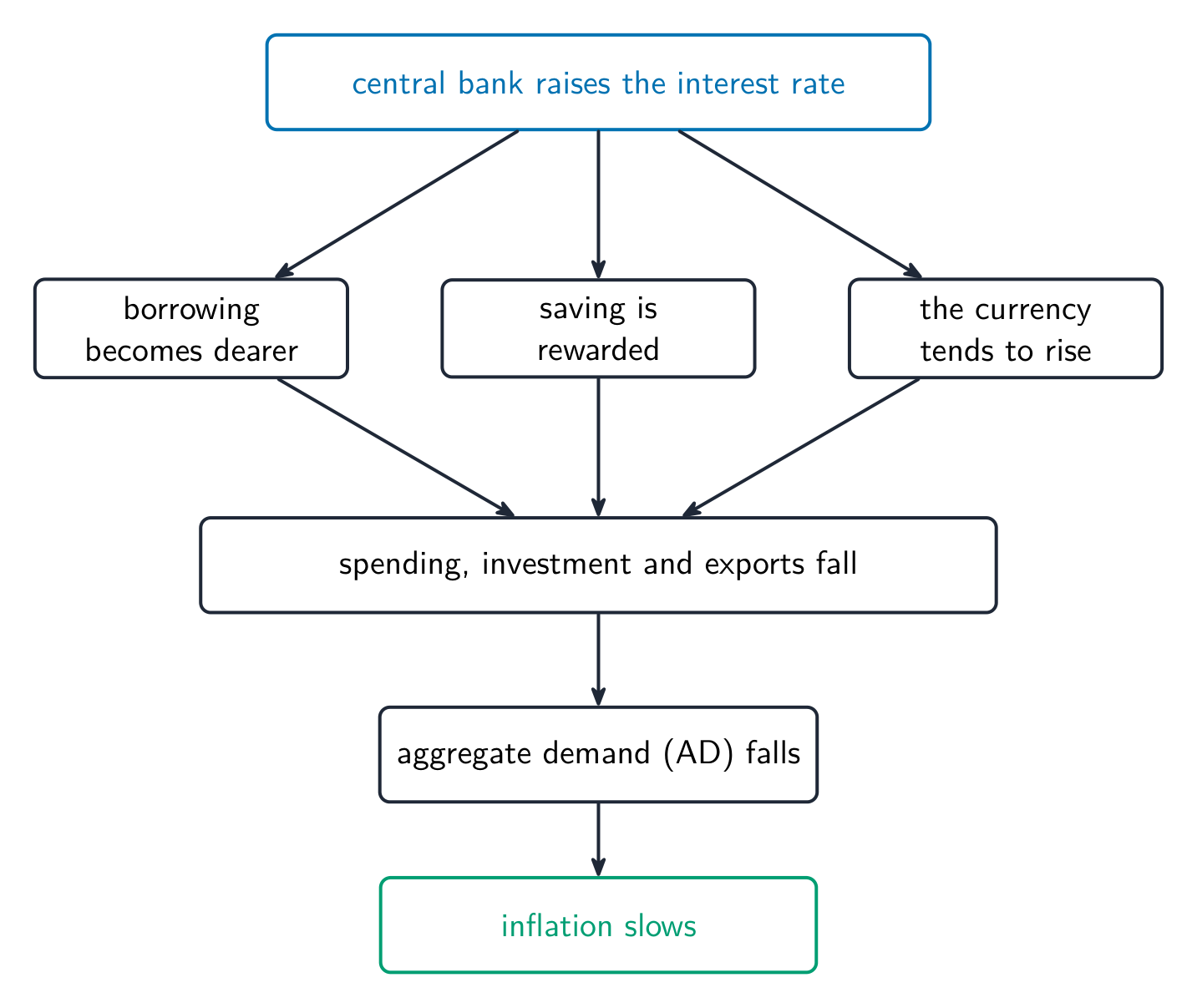
The transmission mechanism 传导机制 is how a change in the interest rate reaches the wider economy. If the central bank raises the interest rate:
borrowing becomes dearer, so households and firms spend and invest less.
saving is rewarded, so people spend less.
the currency tends to rise, so exports fall.
All of these lower AD, which slows inflation. A cut in the interest rate does the opposite, raising AD.
Effectiveness. Monetary policy is flexible (the rate can change at any time), but it works with a time lag of a year or more. In a deep slump, even very low rates may not make worried firms and households borrow.
Tiếng Việt
chính sách tiền tệ do ngân hàng trung ương vận hành. Công cụ chính là lãi suất, nhưng nó cũng có thể thay đổi mức cung tiền hoặc ảnh hưởng đến tỷ giá hối đoái.
Một ngân hàng trung ương, như Ngân hàng Anh, đặt lãi suất — công cụ chính của chính sách tiền tệ.
Cơ chế truyền dẫn
Cơ chế truyền dẫn là cách một sự thay đổi về lãi suất lan tỏa đến nền kinh tế rộng lớn hơn. Nếu ngân hàng trung ương tăng lãi suất:
việc vay trở nên đắt đỏ hơn, nên hộ gia đình và doanh nghiệp chi tiêu và đầu tư ít hơn.
tiết kiệm được khuyến khích, nên mọi người chi tiêu ít hơn.
tiền tệ có xu hướng tăng giá, nên xuất khẩu giảm.
Tất cả những yếu tố này làm giảm AD, từ đó làm chậm lạm phát. Một sự cắt giảm lãi suất sẽ làm ngược lại điều này, làm tăng AD.
Lãi suất cao hơn hoạt động qua ba kênh để cắt giảm chi tiêu, đầu tư và xuất khẩu, làm giảm AD và làm chậm lạm phát.
Hiệu quả. Chính sách tiền tệ linh hoạt (lãi suất có thể thay đổi bất cứ lúc nào), nhưng nó hoạt động với độ trễ thời gian từ một năm trở lên. Trong một đợt suy thoái sâu, ngay cả lãi suất rất thấp cũng có thể không khiến các doanh nghiệp và hộ gia lo lắng vay vốn.
Explore · Khám phá
Monetary policy shifts AD · Chính sách tiền tệ dịch chuyển AD
Changing interest rates moves aggregate demand. Lower rates → more borrowing and spending → AD shifts right. · Thay đổi lãi suất di chuyển tổng cầu. Lãi suất thấp hơn → nhiều vay và chi tiêu hơn → AD dịch chuyển sang phải.
explain supply-side policies (market-based and interventionist: education and training, incentives, privatisation, deregulation, infrastructure)
explain the use and effectiveness of supply-side policy
Tiếng Việt
giải thích chính sách bên cung (theo thị trường và can thiệp: giáo dục và đào tạo, khuyến khích, thị trường hóa, thoái quy định, cơ sở hạ tầng)
giải thích việc sử dụng và hiệu quả của chính sách bên cung
Source: Cambridge International syllabus · Nguồn: Chương trình Cambridge International
English
supply-side policy 供给侧政策 tries to raise the economy's productive capacity 生产能力 — to shift long-run aggregate supply to the right. It aims to make markets work better and raise productivity 生产率.
There are two kinds.
Market-based policies let markets work more freely:
cutting income tax and benefits to strengthen the incentive 激励 to work.
privatisation 私有化 — selling state firms to private owners, who run them for profit.
deregulation 放松管制 — removing rules that block competition.
Interventionist policies use the government directly:
spending on education and training 培训 to raise workers' skills.
spending on infrastructure 基础设施 — roads, ports and broadband.
support for research and new technology.
Effectiveness. Supply-side policy is powerful because it can raise growth and lower inflation at the same time, with no trade-off. But it is slow (education takes years to pay off), costly, and some measures, like cutting benefits, can widen inequality.
Worked example. An economy is in a deep recession with a large output gap, and interest rates are already near zero. Which policy should the government use, and why is the other one weak here? Monetary policy is weak: with the base rate already near zero there is almost no room to cut further, and even cheap credit will not make firms invest when they expect no demand. Fiscal policy is stronger: government spending raises aggregate demand directly, without waiting for anyone to choose to borrow, and the multiplier means each pound spent raises national income by more than a pound as it is re-spent. Weigh the costs against it - a bigger budget deficit and rising debt, plus time lags on large projects. Match the policy to the constraint named in the question: here it is the zero lower bound, and that is precisely what makes fiscal policy the answer.
Tiếng Việt
chính sách phía cung cố gắng nâng cao khả năng sản xuất của nền kinh tế — dịch chuyển cung tổng hợp dài hạn sang phải. Nó nhằm mục đích làm cho thị trường vận hành tốt hơn và nâng cao tchunk suất.
Chính sách phía cung nâng khả năng sản xuất, dịch chuyển LRAS sang phải: sản lượng thực tế tăng và mức giá chung giảm — tăng trưởng đi kèm với lạm phát thấp hơn.
Có hai loại.
Chính sách dựa trên thị trường cho phép thị trường hoạt động tự do hơn:
cắt giảm thuế thu nhập và trợ cấp để tăng cường động lực lao động.
tư hữu hóa—bán các doanh nghiệp nhà nước cho các chủ sở hữu tư nhân, những người vận hành chúng vì lợi nhuận.
thông thoáng hóa—lo bỏ các quy tắc cản trở cạnh tranh.
Chính sách can thiệp sử dụng chính phủ trực tiếp:
chi tiêu cho giáo dục và đào tạo để nâng cao kỹ năng người lao động.
chi tiêu cho cơ sở hạ tầng — đường bộ, cảng biển và mạng băng rộng.
hỗ trợ nghiên cứu và công nghệ mới.
Hiệu quả. Chính sách phía cung mạnh mẽ vì nó có thể thúc đẩy tăng trưởng và giảm lạm phát cùng lúc mà không cần đánh đổi. Nhưng nó chậm (giáo dục mất nhiều năm mới thấy hiệu quả), tốn kém, và một số biện pháp như cắt giảm trợ cấp có thể làm gia tăng bất bình đẳng.
Ví dụ giải. Một nền kinh tế đang trong khủng hoảng sâu với khoảng trống sản lượng lớn, và lãi suất đã gần mức không. Chính phủ nên sử dụng chính sách nào, và tại sao chính sách còn lại yếu ở đây? Chính sách tiền tệ yếu: với lãi suất cơ bản đã gần mức không, hầu như không còn dư địa để cắt giảm hơn nữa, và ngay cả tín dụng rẻ cũng không khiến doanh nghiệp đầu tư khi họ không kỳ vọng nhu cầu. Chính sách tài khóa mạnh hơn: chi tiêu chính phủ tăng tổng cầu trực tiếp, không cần chờ ai quyết định vay vốn, và bội số nhân có nghĩa là mỗi pound chi tiêu sẽ tăng thu nhập quốc gia hơn một pound do được tái chi tiêu. Cân nhắc các chi phí đi kèm - thiếu hụt ngân sách lớn hơn và nợ công tăng, plus độ trễ thời gian trong các dự án lớn. Gắn chính sách với ràng buộc được nêu trong đề bài: ở đây là ngưỡng dưới không, và đó chính xác là lý do chính sách tài khóa là câu trả lời.
Explore · Khám phá
Supply-side policy shifts AS · Chính sách phía cung dịch chuyển AS
Supply-side policies raise the economy's productive capacity — aggregate supply (AS) shifts right, lowering the price level at higher output. · Các chính sách phía cung nâng cao năng lực sản xuất của nền kinh tế — tổng cung (AS) dịch chuyển sang phải, làm giảm mức giá tại mức sản lượng cao hơn.
explain absolute and comparative advantage and the gains from specialisation and trade
explain the terms of trade and the benefits and limitations of trade theory
Tiếng Việt
giải thích lợi thế tuyệt đối và lợi thế tương đối cũng như lợi ích từ chuyên môn hóa và thương mại
giải thích thông số thương mại và những lợi ích cũng như hạn chế của lý thuyết thương mại
Source: Cambridge International syllabus · Nguồn: Chương trình Cambridge International
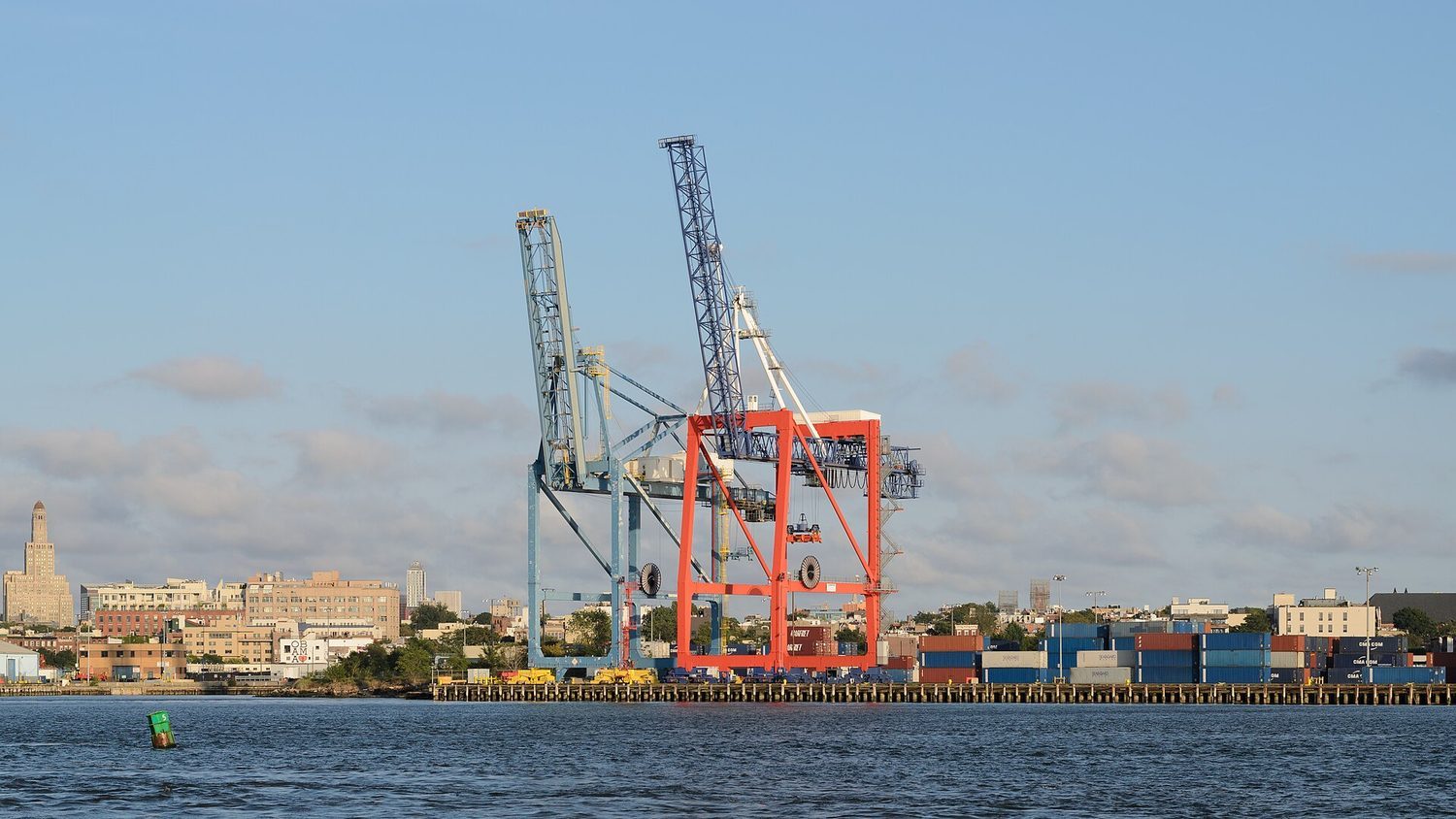
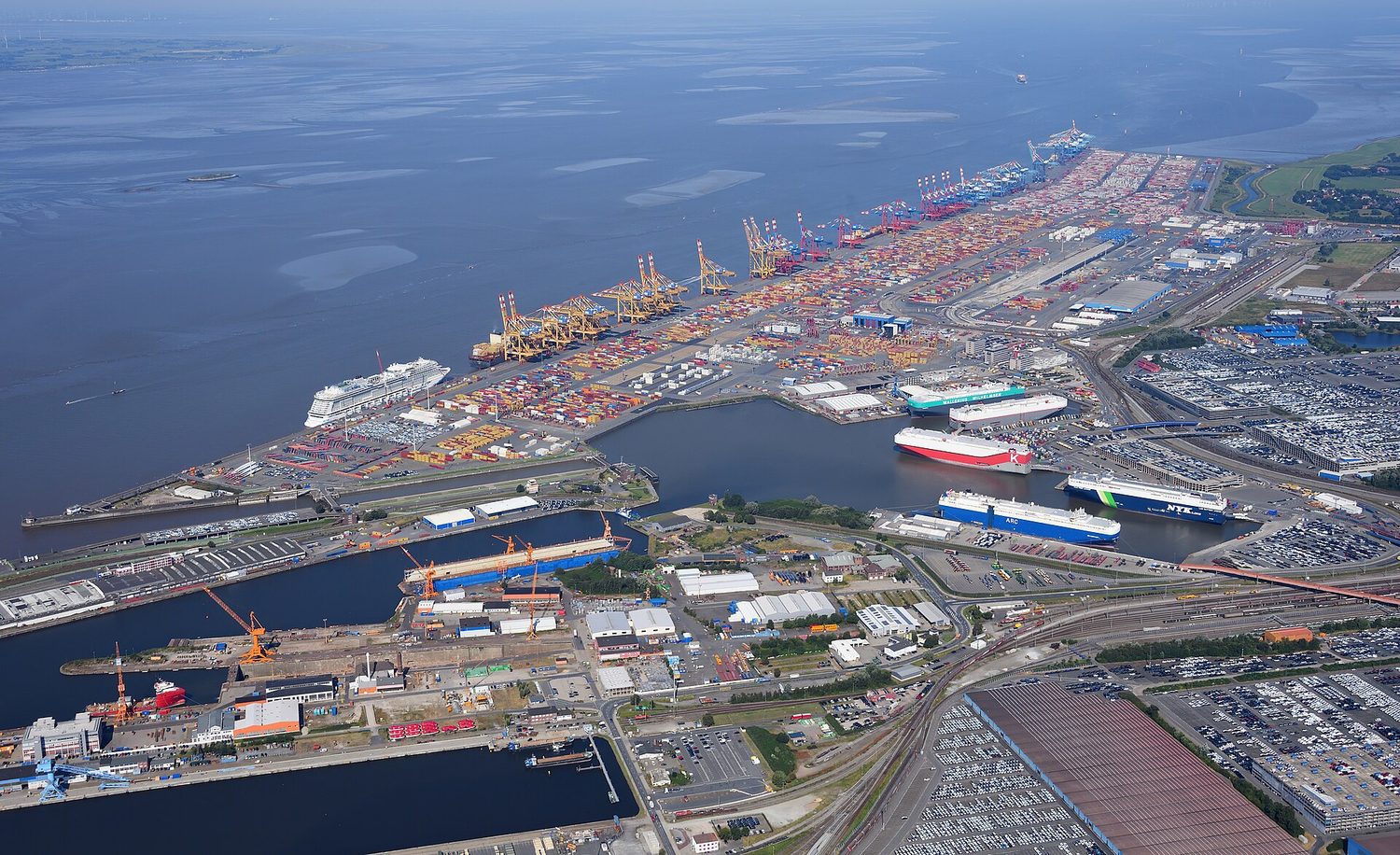
international trade 国际贸易 lets countries buy and sell with each other. Trade lets each country specialise 专业化 in what it makes best, so the world makes more in total.
A container port: international trade moves goods between countries in huge volumes
Absolute and comparative advantage
a country has an absolute advantage 绝对优势 in a good if it can make more of it with the same resources than another country.
a country has a comparative advantage 比较优势 in a good if it can make it at a lower opportunity cost 机会成本 than another country.
Comparative advantage is the key idea: a country should make the goods it gives up least to produce, and trade for the rest. Look at this example, where each country uses the same resources:
Country
Wine (units)
Cloth (units)
Country A
20
10
Country B
5
5
Country A is better at both (absolute advantage in both). But think about opportunity cost:
in A, making 1 cloth means giving up 2 wine.
in B, making 1 cloth means giving up 1 wine.
So B gives up less to make cloth — B has the comparative advantage in cloth. A has it in wine. If A makes only wine and B makes only cloth, and they trade, both can end up with more than before.
Country A can make more of both goods, but its PPC is steeper: it gives up 2 wine per cloth, while B gives up only 1, so B has the comparative advantage in cloth.
Terms of trade
The terms of trade 贸易条件 measure the price of a country's exports compared with the price of its imports. It is worked out as an index:
$$\text{terms of trade} = \frac{\text{index of export prices}}{\text{index of import prices}} \times 100.$$
If export prices rise faster than import prices, the terms of trade "improve" — the country can buy more imports for the same exports.
Worked example. Over a year, a country's export price index rises from $100$ to $110$, while its import price index rises from $100$ to $105$. Find the new terms of trade.
$$\text{terms of trade} = \frac{110}{105} \times 100 = 104.8.$$
The figure is above $100$, so the terms of trade have improved: each unit of exports now buys about $4.8\%$ more imports than before.
Limits of the theory
The gains are real, but the simple theory assumes no transport costs, no trade barriers, and that costs do not change with output. In the real world these do not fully hold, and specialising in one good is risky if its price falls.
Explore · Khám phá
Why countries trade · Tại sao các quốc gia giao thương
Each country specialises where its opportunity cost is lowest, then trades — both can consume beyond their own frontier. · Mỗi quốc gia chuyên môn hóa ở nơi chi phí cơ hội thấp nhất, sau đó giao thương — cả hai đều có thể tiêu thụ vượt ra ngoài đường biên khả năng của mình.
describe tools of protection (tariffs, quotas, subsidies, embargoes, administrative barriers)
explain the arguments for and against protectionism and its effects on stakeholders
Tiếng Việt
mô tả các công cụ bảo hộ (thuế quan, quotas, subsidies, embargoes, barrier hành chính)
giải thích các lập luận ủng hộ và phản đối bảo hộ thương mại cũng như tác động của nó lên các bên liên quan
Source: Cambridge International syllabus · Nguồn: Chương trình Cambridge International
protectionism 贸易保护主义 means a government protecting home producers from foreign competition. The main tools:
Three tools of protection: tariffs, quotas and subsidies
a tariff 关税 — a tax on imports, which raises their price.
a quota 配额 — a legal limit on the quantity of a good that may be imported.
a subsidy 补贴 to home producers, so they can sell more cheaply than foreign rivals.
an embargo 禁运 — a complete ban on trade with a country or in a good.
administrative barriers 行政壁垒 — extra paperwork and tough standards that make importing hard.
A tariff raises the price from the world price to "world price + tariff": domestic supply rises, demand falls, and imports shrink; the shaded box is the government's tariff revenue.
For and against
Arguments for protection include protecting an infant industry 幼稚产业 (a young industry that needs time to grow), saving jobs, and stopping dumping 倾销 (foreign firms selling below cost to destroy local rivals).
Arguments against are strong: protection raises prices for consumers, protects weak firms so they stay inefficient, and can lead to retaliation 报复 — other countries hitting back with their own barriers.
Effects on stakeholders
A tariff affects each stakeholder 利益相关者 differently: home producers gain, the government gains tariff revenue, but consumers lose (higher prices, less choice) and foreign producers lose sales.
Explore · Khám phá
Protectionism in the market · Bảo hộ chủ nghĩa trong thị trường
A tariff or quota shifts effective supply and raises the domestic price, protecting home producers but costing consumers. Shift the lines to see it. · Thuế quan hoặc hạn ngạch dịch chuyển đường cung hiệu dụng và đẩy giá nội địa lên, bảo vệ nhà sản xuất trong nước nhưng gây tốn kém cho người tiêu dùng. Dịch chuyển các đường để xem điều này.
describe the structure of the balance of payments and the components of the current account (trade in goods and services, primary and secondary income)
explain the causes and consequences of current account deficits and surpluses
Tiếng Việt
mô tả cấu trúc cán cân thanh toán và các thành phần của tài khoản thường xuyên (thương mại hàng hóa và dịch vụ, thu nhập sơ cấp và thu nhập thứ cấp)
giải thích nguyên nhân và hậu quả của thiếu hụt và thừa thối tài khoản thường xuyên
Source: Cambridge International syllabus · Nguồn: Chương trình Cambridge International
The balance of payments 国际收支 is a record of all money flows between one country and the rest of the world. Its most-studied part is the current account 经常账户, which has four parts:
trade in goods 货物贸易 — exports and imports of physical goods.
trade in services 服务贸易 — exports and imports of services (tourism, banking).
primary income 初次收入 — income from work and investment abroad (wages, profit, interest).
secondary income 二次收入 — transfers with nothing given back, like foreign aid.
The current account adds up four flows: trade in goods and services, plus primary income (from work and investment) and secondary income (transfers)
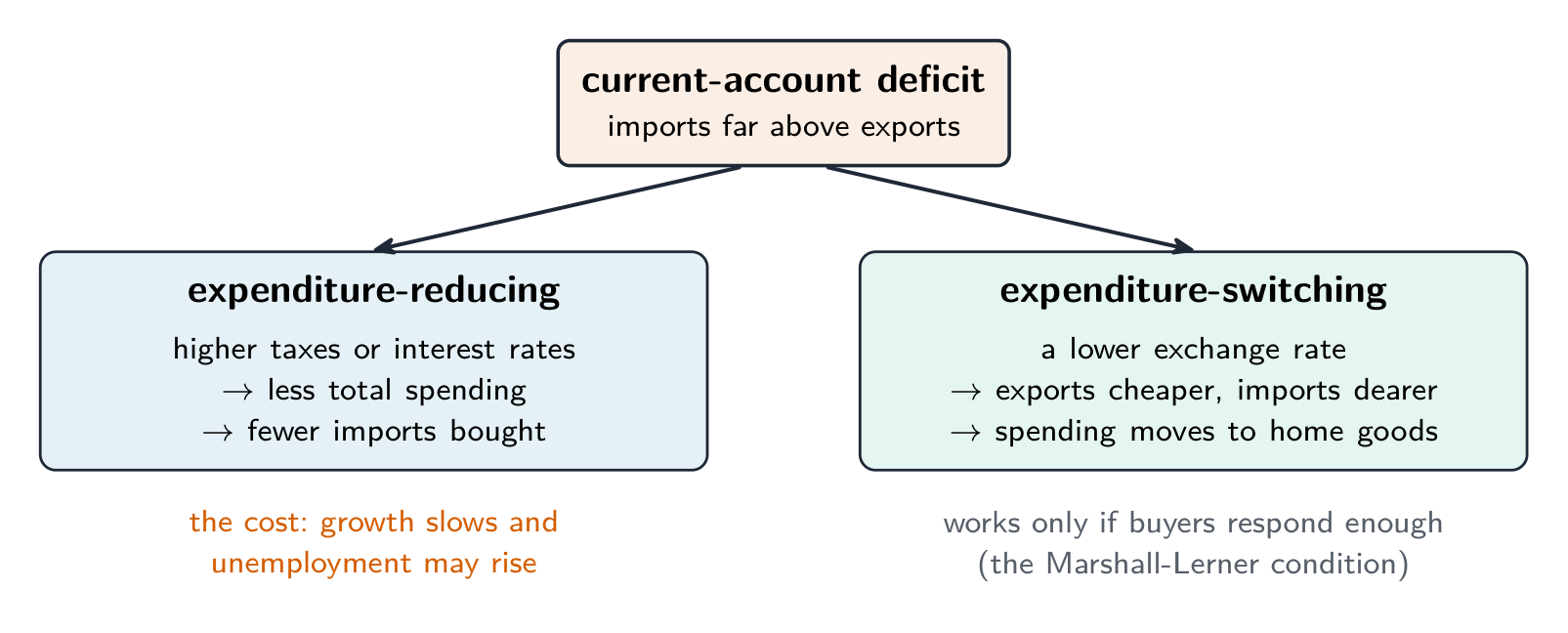
A current account deficit 经常账户赤字 means a country buys more from abroad than it sells. A current account surplus 经常账户盈余 is the opposite. A long deficit can mean rising debt to other countries; a large surplus can mean the country saves a lot but consumes little.
Explore · Khám phá
Current account flow · Luồng tài khoản hiện hành
Track exports, imports and income flows into the current account. · Theo dõi dòng xuất khẩu, nhập khẩu và thu nhập vào tài khoản hiện hành.
explain the determination of floating exchange rates by demand and supply of currency, and fixed and managed systems
explain the causes and effects of appreciation and depreciation on the economy
Tiếng Việt
giải thích sự xác định của tỷ giá thả nổi bởi cung và cầu tiền tệ, cũng như các hệ thống cố định và được quản lý
giải thích nguyên nhân và tác động của tăng giá và giảm giá lên nền kinh tế
Source: Cambridge International syllabus · Nguồn: Chương trình Cambridge International
Exchange rates: appreciation
An exchange rate 汇率 is the price of one currency in terms of another. There are three main systems.
A currency exchange: the exchange rate is the price of one currency in terms of another.
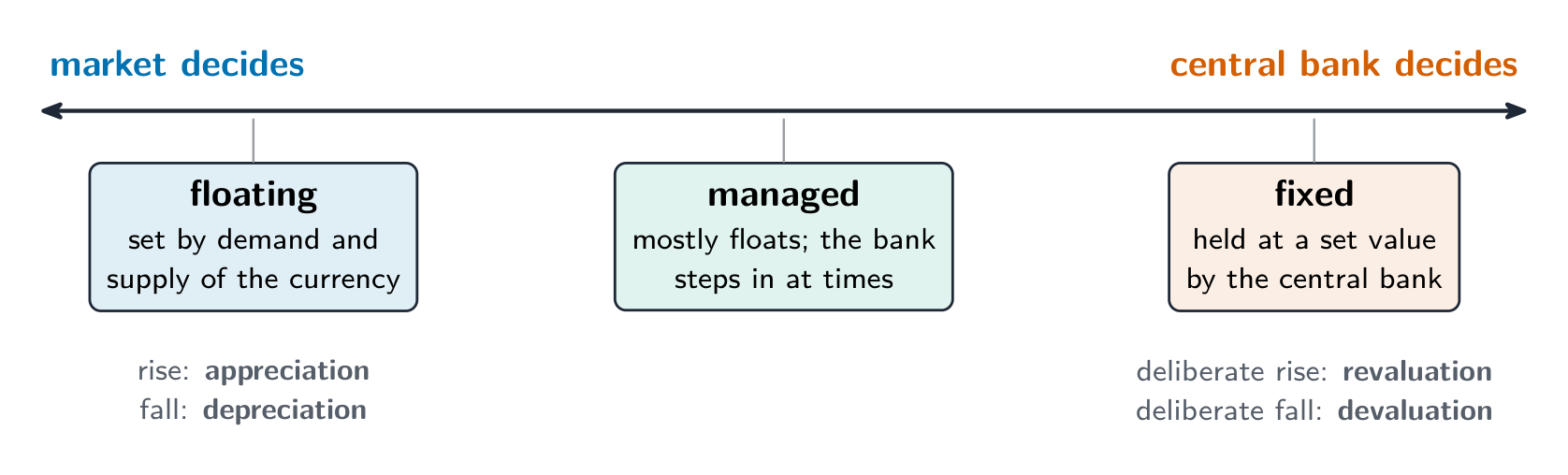
a floating exchange rate 浮动汇率 is set freely by the demand for and supply of the currency. If more people want a currency (to buy its exports), its value rises.
a fixed exchange rate 固定汇率 is held at a set value by the central bank, which buys and sells the currency to keep it there.
a managed exchange rate 管理浮动汇率 mostly floats, but the central bank steps in now and then to steady it.
A floating exchange rate is set where demand for the currency meets supply. More demand for pounds ($D \to D_1$) raises the rate — an appreciation.
Appreciation and depreciation
Under floating rates:
appreciation 升值 is a rise in the currency's value. Exports become dearer for foreigners, and imports become cheaper.
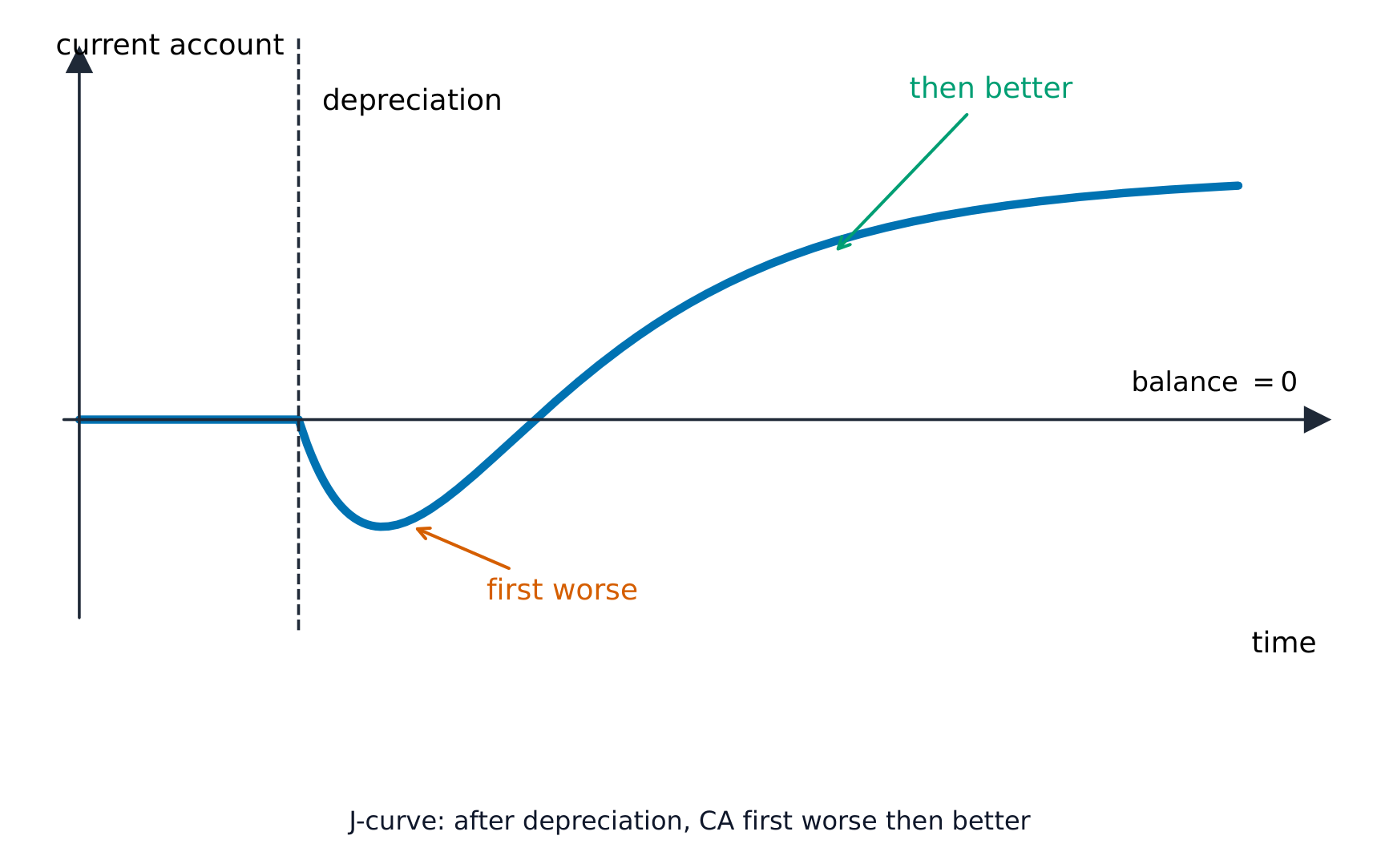
depreciation 贬值 is a fall in the currency's value. Exports become cheaper, and imports become dearer.
A depreciation can therefore raise export sales and cut imports, helping the current account — but it can also raise inflation, because imports cost more.
Worked example. Suppose the exchange rate is $\text{\pounds} 1 = \$1.40$.
A UK exporter's $\text{\pounds} 200$ machine costs an American buyer $\text{\pounds} 200 \times 1.40 = \$280$. If the pound then appreciates to $\text{\pounds} 1 = \$1.60$, the same machine costs $\text{\pounds} 200 \times 1.60 = \$320$ — dearer for the American, so fewer are sold. Going the other way, a $\$700$ invoice from a US supplier costs a UK firm $\$700 \div 1.40 = \text{\pounds} 500$.
Explore · Khám phá
The foreign-exchange market · Thị trường ngoại hối
A currency has its own market. More demand for £ (or less supply) pushes the exchange rate up — it appreciates. · Một đồng tiền có thị trường riêng. Nhu cầu tăng đối với £ (hoặc nguồn cung giảm) sẽ đẩy tỷ giá lên cao — đồng tiền được mạnh lên.
explain expenditure-switching and expenditure-reducing policies and supply-side measures to correct a deficit
evaluate the effectiveness of these policies
Tiếng Việt
giải thích các chính sách chuyển hướng chi tiêu và giảm chi tiêu cùng các biện pháp bên cung để khắc phục thiếu hụt
đánh giá hiệu quả của các chính sách này
Source: Cambridge International syllabus · Nguồn: Chương trình Cambridge International
A government can use three kinds of policy to cut a deficit:
expenditure-reducing 支出减少 policies lower total demand (higher taxes or interest rates), so people buy fewer imports. But they also slow growth and raise unemployment.
expenditure-switching 支出转换 policies move spending away from imports towards home goods (a tariff, or a lower exchange rate). But they can cause retaliation or inflation.
supply-side policies raise the competitiveness 竞争力 of home firms (better skills and technology), so exports rise. These work best in the long run but are slow.
Trade flows at a container port: a current account deficit means imports of goods and services exceed exports
Explore · Khám phá
Current account flow · Luồng tài khoản hiện hành
Track exports, imports and income flows into the current account. · Theo dõi dòng xuất khẩu, nhập khẩu và thu nhập vào tài khoản hiện hành.
This topic looks more deeply at consumers, costs and firms.
7.1
Utility and consumer choice
Syllabus · Chương trình
English
explain total and marginal utility and the law of diminishing marginal utility
derive the equi-marginal principle and explain how it relates to the demand curve, including the limitations of the marginal utility approach
Tiếng Việt
giải thích tiện ích tổng thể và tiện ích biên cùng định luật tiện ích biên giảm dần
rút ra nguyên tắc cân bằng biên và giải thích mối liên hệ của nó với đường cong cầu, bao gồm cả những hạn chế của tiếp cận tiện ích biên
Source: Cambridge International syllabus · Nguồn: Chương trình Cambridge International
utility 效用 is the satisfaction a consumer gets from a good.
Consumers spend a limited income to get the most utility (satisfaction) they can.
total utility 总效用 is the satisfaction from all the units consumed.
marginal utility 边际效用 is the extra satisfaction from one more unit.
The law of diminishing marginal utility 边际效用递减 says each extra unit gives less extra satisfaction. Total utility still rises, but more and more slowly.
As more is consumed, total utility rises but flattens, because marginal utility falls — each extra unit adds less satisfaction.
The equi-marginal principle
A consumer with a fixed budget gets the most total utility when the last dollar spent on each good gives the same extra utility. This is the equi-marginal principle 等边际原则:
$$\frac{MU_A}{P_A} = \frac{MU_B}{P_B}$$
Because marginal utility falls as you buy more, you only buy extra units when the price falls. This is why the demand curve 需求曲线 slopes downward.
Utility is maximised when the last dollar on each good gives the same extra utility
Limitations
The approach is hard to use in practice: utility cannot really be measured in numbers, and people do not calculate like this. It also ignores habit and advertising.
Explore · Khám phá
Diminishing marginal utility lab · Phòng thí nghiệm về tính giảm dần của lợi ích biên
total utility rises more slowly as quantity increases · Tổng lợi ích tăng chậm hơn khi số lượng tăng
Add units consumed and see why extra satisfaction usually falls. · Cộng số lượng hàng tiêu thụ và xem tại sao sự thỏa mãn thêm thường giảm.
explain indifference curves and budget lines and consumer equilibrium
explain income and substitution effects for normal, inferior and Giffen goods
Tiếng Việt
giải thích đường vô sai và đường ngân sách cũng như cân bằng người tiêu dùng
giải thích hiệu ứng thu nhập và hiệu ứng thay thế đối với hàng hóa thường, hàng hóa kém và hàng hóa Giffen
Source: Cambridge International syllabus · Nguồn: Chương trình Cambridge International
An indifference curve 无差异曲线 shows all the combinations of two goods that give a consumer the same total utility. It slopes downward (more of one good means less of the other) and bows in towards the origin.
A budget line 预算线 shows all the combinations the consumer can just afford with their income, at the current prices.
consumer equilibrium 消费者均衡 is the best the consumer can do: the point where the budget line just touches the highest possible indifference curve.
The consumer's best choice is where the budget line is tangent to the highest reachable indifference curve; a higher curve is unaffordable.
Income and substitution effects
When the price of a good falls, the consumer buys more for two reasons:
the substitution effect 替代效应 — the good is now cheaper than others, so the consumer switches towards it.
the income effect 收入效应 — the consumer's money now buys more, so real income has risen.
These effects work differently for different goods:
for a normal good 正常品, both effects raise the quantity bought.
for an inferior good 低档品, the income effect works the other way (higher real income lowers demand), but it is usually weaker, so demand still rises when price falls.
a Giffen good 吉芬品 is a rare, very inferior good where the income effect is so strong that demand actually falls when the price falls. Its demand curve slopes upward.
Explore · Khám phá
Budget line lab · Phòng thí nghiệm đường ngân sách
good B = income / priceB - slope x good A · good B = thu nhập / priceB - slope x good A
Move quantity of one good and see the trade-off with the other good. · Di chuyển lượng của một hàng hóa và xem xét sự đánh đổi với hàng hóa khác.
explain productive and allocative efficiency, Pareto optimality and dynamic efficiency
explain market failure, including from monopoly, externalities, public goods, information failure and factor immobility
Tiếng Việt
giải thích hiệu quả sản xuất và hiệu quả phân bổ, tối ưu Pareto và hiệu quả động
giải thích thất bại thị trường, bao gồm cả từ độc quyền, ngoại lực, hàng hóa công, thất bại thông tin và bất động của yếu tố sản xuất
Source: Cambridge International syllabus · Nguồn: Chương trình Cambridge International
Economists judge how well resources are used.
Productive efficiency is lowest cost; allocative is making what people want
productive efficiency 生产效率 — making goods at the lowest possible cost (using the fewest resources).
allocative efficiency 配置效率 — making the goods people most want, where price equals marginal cost.
Pareto optimality 帕累托最优 — a point where no one can be made better off without making someone else worse off.
dynamic efficiency 动态效率 — improving over time through new technology and better products.
market failure 市场失灵 happens when the free market does not reach an efficient result. The main causes are monopoly power, externalities 外部性, public goods 公共物品, information failure 信息失灵, and factor immobility 要素不流动性 (factors cannot move quickly to where they are needed).
Explore · Khám phá
Allocative efficiency · Hiệu quả phân bổ
The market is allocatively efficient where supply meets demand — price equals marginal cost. Market failure pushes it away from that point. · Thị trường hiệu quả phân bổ nơi cung gặp cầu — giá bằng marginal cost. Thất bại thị trường đẩy nó ra khỏi điểm đó.
distinguish private, external and social costs and benefits
analyse positive and negative externalities of production and consumption using marginal analysis and explain deadweight welfare loss
Tiếng Việt
phân biệt chi phí và lợi ích tư nhân, ngoại lực và xã hội
phân tích ngoại lực tích cực và tiêu cực trong sản xuất và tiêu dùng bằng phân tích biên và giải thích mất mát phúc lợi vô hiệu
Source: Cambridge International syllabus · Nguồn: Chương trình Cambridge International
Some costs and benefits fall on people outside the deal. We separate three levels:
a private cost 私人成本 or private benefit 私人收益 falls on the buyer or seller.
an external cost 外部成本 or external benefit 外部收益 falls on a third party.
the social cost 社会成本 is private cost plus external cost; the social benefit 社会收益 is private benefit plus external benefit.
Marginal analysis
We study externalities with marginal analysis 边际分析, using these curves:
marginal private cost 边际私人成本 (MPC) and marginal social cost 边际社会成本 (MSC).
marginal private benefit 边际私人收益 (MPB) and marginal social benefit 边际社会收益 (MSB).
The best outcome for society is where MSC = MSB. But the market produces where MPC = MPB. The gap between these creates lost welfare.
a negative externality 负外部性 (like pollution) means MSC is above MPC. The market makes too much.
a positive externality 正外部性 (like education) means MSB is above MPB. The market makes too little.
The lost welfare from making too much or too little is the deadweight welfare loss 无谓损失 — the triangle on the diagram between the social and private curves.
Industrial pollution: a negative externality where social cost exceeds private cost
Explore · Khám phá
Externalities shift the social curve · Externalities dịch chuyển đường xã hội
A negative externality means the social cost is above the private supply curve; the free-market quantity is then too high. · A negative externality có nghĩa là social cost nằm trên đường supply riêng tư; lượng thị trường tự do sau đó quá cao.
explain fixed, variable, total, average and marginal cost and short-run and long-run production (law of diminishing returns, returns to scale)
explain total, average and marginal revenue and normal, supernormal (abnormal) and subnormal profit
Tiếng Việt
giải thích chi phí cố định, biến đổi, tổng, trung bình và biên cũng như sản xuất ngắn hạn và dài hạn (luật năng suất giảm dần, hoàn trả theo quy mô)
giải thích doanh thu tổng, trung bình và biên cùng với lợi nhuận bình thường, vừa phải ( phi thường) và lợi nhuận dưới mức bình thường
Source: Cambridge International syllabus · Nguồn: Chương trình Cambridge International
Economies of scale: average cost falls
Costs
In the short run 短期, at least one factor is fixed; in the long run 长期, all factors can change.
A large steel plant: big firms gain economies of scale, so average cost falls as output rises.
Cost
Meaning
fixed cost 固定成本
does not change with output (rent on a factory)
variable cost 可变成本
changes with output (raw materials)
total cost 总成本
fixed cost plus variable cost
average cost 平均成本
total cost per unit: $AC = TC / Q$
marginal cost 边际成本
the cost of one more unit: $MC = \Delta TC / \Delta Q$
Worked example. Making $10$ units costs £500 in total; making $11$ units costs £540. Find the average cost at $10$ units and the marginal cost of the 11th unit.
Here $MC$ ($\text{\pounds} 40$) is below $AC$ ($\text{\pounds} 50$), so making the 11th unit pulls the average cost down — whenever marginal cost is below average cost, average cost falls.
In the short run, output is limited by the law of diminishing returns 边际报酬递减: as you add more of a variable factor (workers) to a fixed factor (machines), each extra worker eventually adds less output. This makes marginal cost rise.
Marginal, average total and average variable cost are all U-shaped; MC cuts the two average curves at their lowest points.
In the long run, all factors vary, so we look at returns to scale 规模报酬. As a firm grows, it can gain economies of scale 规模经济 (lower average cost from buying in bulk, using big machines, and specialising). If it grows too big, it may suffer diseconomies of scale 规模不经济 (poor communication and control), and average cost rises.
Long-run average cost falls with economies of scale, reaches a minimum, then rises with diseconomies of scale.
Revenue
Revenue
Meaning
total revenue 总收益
all money from sales: $TR = P \times Q$
average revenue 平均收益
revenue per unit, which equals the price
marginal revenue 边际收益
the revenue from one more unit: $MR = \Delta TR / \Delta Q$
Worked example. A firm sells $10$ units at £50 each. To sell an 11th unit it must lower the price to £48 on every unit. Find the total revenue at each output and the marginal revenue of the 11th unit.
The marginal revenue ($\text{\pounds} 28$) is well below the £48 price, because the lower price applies to all $11$ units, not just the extra one.
Profit
Profit is total revenue minus total cost. Economists include the opportunity cost of the owner's resources in cost, so:
normal profit 正常利润 is just enough profit to keep the firm in the industry. It counts as a cost.
supernormal profit 超常利润 (also called abnormal profit) is profit above normal.
subnormal profit 次正常利润 is profit below normal — the firm may leave in the long run.
A firm makes the most profit at the output where $MR = MC$.
Worked example. At its best output a firm makes $100$ units, sells each for £12 (its average revenue), and has an average cost of £9. Find the supernormal profit.
Because average revenue (£12) is above average cost (£9), the firm earns supernormal profit. If instead $AR = AC$, it would make only normal profit; if $AR < AC$, it would make a loss.
Explore · Khám phá
Revenue & profit · Doanh thu & lợi nhuận
y = ax² + bx + c
Total revenue rises then falls as price changes. · Total revenue tăng rồi giảm khi giá thay đổi.
Explore · Khám phá
Costs and the firm · Chi phí và doanh nghiệp
Average cost is U-shaped; marginal cost cuts it at the minimum. Different market structures price relative to these curves. · Chi phí bình quân có hình chữ U; chi phí biên cắt nó tại điểm tối thiểu. Các cấu trúc thị trường khác nhau định giá tương đối với các đường cong này.
Explore · Khám phá
Average and marginal cost · Chi phí trung bình và chi phí biên
Change output. Marginal cost cuts average cost at its lowest point — the heart of the theory of the firm. · Thay đổi mức sản xuất. Chi phí biên cắt chi phí trung bình tại điểm thấp nhất — cốt lõi của lý thuyết doanh nghiệp.
explain the assumptions, behaviour and outcomes of perfect competition, monopolistic competition, oligopoly and monopoly
explain price and non-price competition, collusion, price discrimination and the efficiency of each market structure
Tiếng Việt
giải thích các giả định, hành vi và kết quả của cạnh tranh hoàn hảo, cạnh tranh độc quyền, độc quyền nhóm và độc quyền
giải thích cạnh tranh về giá và phi giá, giao thoa, phân biệt giá và hiệu quả của từng cấu trúc thị trường
Source: Cambridge International syllabus · Nguồn: Chương trình Cambridge International
A market structure 市场结构 describes a market by the number of firms, the barriers to entry, and the type of product.
Structure
Firms
Barriers
Product
Long-run profit
perfect competition 完全竞争
very many
none
identical
normal only
monopolistic competition 垄断竞争
many
low
slightly different
normal
oligopoly 寡头垄断
a few
high
varies
often supernormal
monopoly 垄断
one
very high
unique
supernormal
The four structures sit on a spectrum of competition: many firms at one end (perfect competition), a single firm at the other (monopoly)
in perfect competition, each firm is a tiny price taker 价格接受者 — it must accept the market price. Firms make only normal profit in the long run, and the market is both productively and allocatively efficient.
in monopolistic competition, many firms sell slightly different products (product differentiation 产品差异化), so each has a little price-setting power, but free entry competes profit away.
in an oligopoly, a few large firms dominate. They watch each other closely. They may compete hard on price, or they may agree to fix prices — this is collusion 合谋, and a group that does so is a cartel 卡特尔.
a monopoly is a single seller protected by high barriers to entry 进入壁垒. It can earn supernormal profit for a long time but is usually inefficient.
In long-run equilibrium a perfectly competitive firm produces where MC = MR at the bottom of ATC, making only normal profit.A monopoly produces where MC = MR, then charges the higher price buyers will pay (read off the AR curve), keeping a supernormal profit.
Price and non-price competition
price competition 价格竞争 means cutting prices to win customers.
non-price competition 非价格竞争 means competing in other ways — advertising, quality, branding and service.
Price discrimination
price discrimination 价格歧视 is charging different consumers different prices for the same good (for example, cheaper train tickets for students). It needs price-setting power, groups with different elasticities, and a way to stop resale between groups. It raises the firm's profit.
Explore · Khám phá
Pricing and competition · Định giá và cạnh tranh
How a firm prices depends on demand and supply; with market power it can charge above the competitive level. · Cách doanh nghiệp định giá phụ thuộc vào cầu và cung; với quyền lực thị trường, họ có thể bán trên mức cạnh tranh.
explain why firms grow (internal and external — horizontal, vertical, conglomerate integration) and why some remain small
explain barriers to entry and exit and the survival of small firms
Tiếng Việt
giải thích lý do doanh nghiệp phát triển (nội bộ và bên ngoài — tích hợp ngang, dọc, hỗn hợp) và lý do một số vẫn giữ ở quy mô nhỏ
giải thích rào cản gia nhập và rút khỏi thị trường cũng như sự tồn tại của các doanh nghiệp nhỏ
Source: Cambridge International syllabus · Nguồn: Chương trình Cambridge International
Firms grow in two ways:
internal growth 内部增长 (organic) — growing bigger by selling more.
external growth 外部增长 — joining with another firm through a merger 合并 or takeover. Types:
horizontal integration 横向一体化 — joining a firm at the same stage of the same industry (two car makers).
vertical integration 纵向一体化 — joining a firm at a different stage (a car maker buys a tyre maker).
conglomerate integration 混合一体化 — joining a firm in a different industry, to spread risk.
External growth on the production chain: horizontal, vertical and conglomerate integration
Why some firms stay small
Many firms stay small because the market is small (local services), the owner wants to keep control, or there are few economies of scale. They survive by offering personal service or filling a niche 利基市场.
Firms also face barriers to entry and barriers to exit 退出壁垒 (such as costly machines that cannot be sold). High exit barriers can trap a firm in a loss-making market.
explain alternative objectives of firms: profit maximisation, revenue maximisation, sales maximisation, satisficing
explain the divorce of ownership from control (principal–agent problem) and its consequences
Tiếng Việt
giải thích các mục tiêu thay thế của doanh nghiệp: tối đa hóa lợi nhuận, tối đa hóa doanh thu, tối đa hóa khối lượng bán hàng, đáp ứng tối thiểu
giải thích sự tách biệt giữa sở hữu và kiểm soát (vấn đề chủ thể - đại lý) và các hệ quả của nó
Source: Cambridge International syllabus · Nguồn: Chương trình Cambridge International
Not every firm simply chases the most profit.
profit maximisation 利润最大化 — producing where MR = MC. The traditional aim.
revenue maximisation 收益最大化 — producing where MR = 0, perhaps to grow market share.
sales maximisation 销售最大化 — selling as much as possible while still making normal profit.
satisficing 满意化 — aiming for "good enough" results that keep owners, workers and customers all reasonably happy.
Divorce of ownership from control
In large companies the owners (shareholders) are not the managers. This divorce of ownership from control 所有权与控制权分离 creates the principal-agent problem 委托代理问题: managers (the agents) may pursue their own aims — bigger salaries or an easier life — instead of the owners' aim of maximum profit.
Calculate AC, MC, TR and MR, and remember a firm maximises profit where $MR = MC$.
Distinguish the market structures (perfect competition, monopolistic competition, oligopoly, monopoly) by number of firms, barriers and price-setting power.
Distinguish normal from supernormal profit and link long-run entry and exit to it.
On a cost diagram, note that MC cuts AC at the minimum of AC.
8
Government microeconomic intervention (A Level) · Can thiệp vi mô của chính phủ (A Level)
This topic looks at how governments correct market failure 市场失灵, make incomes fairer, and act in the labour market.
Tiếng Việt
Chủ đề này xem xét cách chính phủ khắc phục sự thất bại của thị trường, làm cho thu nhập công bằng hơn, và hành động trong thị trường lao động.
8.1
Correcting market failure · Khắc phục sự thất bại của thị trường
Syllabus · Chương trình
English
explain policies to correct market failure: taxes, subsidies, price controls, tradable permits, regulation, provision, nationalisation and privatisation
explain competition policy and the concept of government failure
Tiếng Việt
giải thích các chính sách sửa chữa thất bại thị trường: thuế, trợ giá, kiểm soát giá, giấy phép giao dịch được, quy định, cung cấp, quốc hữu hóa và tư hữu hóa
giải thích chính sách cạnh tranh và khái niệm thất bại nhà nước
Source: Cambridge International syllabus · Nguồn: Chương trình Cambridge International
English
A government has many tools to push a market towards a better use of resources.
an indirect tax 间接税 on a good with a negative externality (like fuel) raises its price and cuts the quantity used.
a subsidy 补贴 for a good with a positive externality (like solar panels) lowers its price and raises the quantity.
a price control 价格管制 sets a legal maximum or minimum price.
tradable permits 可交易许可证 cap total pollution and let firms buy and sell the right to pollute.
regulation 管制 uses rules and laws, such as bans, safety standards and pollution limits.
state provision 政府提供 means the government supplies a good directly, often free (schools, hospitals, defence).
nationalisation 国有化 is taking an industry into government ownership; privatisation 私有化 is selling a state industry to private owners.
Competition policy
A firm with monopoly power 垄断势力 can raise prices and cut output. competition policy 竞争政策 is the set of laws used to protect competition — for example, blocking mergers that create too much power, banning price-fixing, and fining firms that abuse their position.
Government failure
Intervention can backfire. government failure 政府失灵 is when the government's action leads to a worse use of resources than before — through poor information, high costs, long time lags, or unintended effects (such as a black market caused by a price control).
Tiếng Việt
Chính phủ có nhiều công cụ để đẩy thị trường về phía sử dụng tài nguyên hiệu quả hơn.
một thuế gián tiếp đối với hàng hóa có ngoại tác âm (như nhiên liệu) làm tăng giá và giảm lượng tiêu thụ.
một trợ giá cho hàng hóa có ngoại tác dương (như tấm pin năng lượng mặt trời) làm giảm giá và tăng lượng tiêu thụ.
kiểm soát giá đặt mức giá tối đa hoặc tối thiểu theo luật định.
giấy phép giao dịch giới hạn tổng lượng ô nhiễm và cho phép các doanh nghiệp mua bán quyền gây ô nhiễm.
quy định sử dụng các quy tắc và luật pháp, chẳng hạn như lệnh cấm, tiêu chuẩn an toàn và giới hạn ô nhiễm.
cung cấp bởi nhà nước nghĩa là chính phủ cung cấp trực tiếp một hàng hóa, thường miễn phí (trường học, bệnh viện, quốc phòng).
quốc hữu hóa là đưa một ngành vào sở hữu của chính phủ; thư hữu hóa là bán một ngành do nhà nước sở hữu cho các chủ sở hữu tư nhân.
Chính sách cạnh tranh
Một doanh nghiệp có sức mạnh độc quyền có thể tăng giá và giảm sản lượng. chính sách cạnh tranh là tập hợp các luật dùng để bảo vệ cạnh tranh — ví dụ, chặn lại các vụ sáp nhập tạo ra quá nhiều sức mạnh, cấm cố định giá, và phạt các doanh nghiệp lạm dụng vị thế của mình.
Thất bại của chính phủ
Can thiệp có thể phản tác dụng. sự thất bại của chính phủ là khi hành động của chính phủ dẫn đến việc sử dụng tài nguyên kém hiệu quả hơn trước — thông qua thông tin sai lệch, chi phí cao, thời gian trễ dài, hoặc hậu quả không mong muốn (như thị trường đen gây ra bởi kiểm soát giá).
Hàng hóa bị cấm tiêu dùng như thuốc lá bị tiêu thụ quá mức khi chi phí ngoại tác bị bỏ qua — một sự thất bại của thị trường điển hình
Explore · Khám phá
When a market fails · Khi một thị trường thất bại
An externality (like pollution) means the market price ignores a real cost — output ends up above the efficient level. Add the external cost to see the gap. · Một ngoại lai (như ô nhiễm) có nghĩa là giá thị trường bỏ qua một chi phí thực tế — sản lượng kết quả cao hơn mức hiệu quả. Hãy cộng thêm chi phí ngoại lai để thấy khoảng cách.
Equity and redistribution · Công bằng và phân phối lại
Syllabus · Chương trình
English
distinguish equity, equality, and the difference between income and wealth
explain the Lorenz curve and Gini coefficient and policies to redistribute income and wealth (taxation, benefits, the difficulty of redistributing wealth)
Tiếng Việt
phân biệt công bằng, bình đẳng và sự khác biệt giữa thu nhập và tài sản
giải thích đường cong Lorenz và hệ số Gini cùng các chính sách phân phối lại thu nhập và tài sản (thuế, trợ cấp, khó khăn trong việc phân phối lại tài sản)
Source: Cambridge International syllabus · Nguồn: Chương trình Cambridge International
English
It is important to separate two words that sound alike:
equity 公平 means fairness — people getting what is fair, which may not be an equal share.
equality 平等 means everyone getting the same.
A fair (equitable) outcome is not always an equal one. Most governments worry about too much inequality 不平等.
Remember the difference between the two things being shared:
income 收入 is a flow received over time (wages, rent, interest).
wealth 财富 is a stock of assets owned (houses, shares, savings).
Measuring inequality
the Lorenz curve 洛伦兹曲线 is a graph. It plots the share of total income against the share of the population, from poorest to richest. A straight diagonal line would mean perfect equality. The further the curve bends below the line, the more unequal the country.
the Gini coefficient 基尼系数 turns this into one number between 0 and 1. Zero means perfect equality; one means one person has everything. A higher number means more inequality.
Policies to redistribute
a progressive tax 累进税 takes a larger share from higher incomes.
benefits 福利金 (also called transfer payments 转移支付) give money to the poor, the old and the unemployed.
free state services (education, health care) raise the real living standards of the poor.
These bring about redistribution 再分配 — moving income from richer to poorer people. Wealth is harder to redistribute than income, because the rich can hide assets or move them abroad, and wealth taxes are hard to collect.
Worked example. Country X has a Gini coefficient of 0.25 and country Y one of 0.48. What does that mean, and what does each Lorenz curve look like? The Gini runs from 0 (perfect equality) to 1 (one person has everything), so a higher number means more unequal: country Y at 0.48 is markedly more unequal than X at 0.25. On the graph, Y's Lorenz curve sags further below the 45° line of equality, while X's hugs it more closely. The Gini is exactly the area between the line of equality and the Lorenz curve, as a fraction of the whole triangle beneath that line - which is why a bigger sag gives a bigger number. One caution is worth stating: the Gini measures relative inequality only. It says nothing about absolute living standards, so a poor country and a rich one can share the same Gini.
Tiếng Việt
Rất quan trọng phải phân biệt hai từ nghe giống nhau:
equity (công bằng) có nghĩa là sự công minh — mọi người nhận được những gì công bằng, điều đó có thể không phải là tỷ lệ chia đều.
equality (bình đẳng) có nghĩa là mọi người đều nhận được những thứ giống nhau.
Equality (bình đẳng) mang lại cho mọi người những thứ giống nhau; equity (công bằng) mang lại cho mọi người những gì công bằng — vì vậy một kết quả công bằng không luôn là một kết quả bình đẳngBất bình đẳng thu nhập: khu dân cư tự phát thường nằm gần các khu vực giàu có hơn nhiều.
Một kết quả công bằng (equitable) không luôn là một kết quả bình đẳng. Hầu hết các chính phủ lo lắng về tình trạng bất bình đẳng quá mức.
Hãy nhớ sự khác biệt giữa hai thứ đang được phân chia:
income (thu nhập) là dòng tiền nhận được theo thời gian (lương, tiền thuê, lãi suất).
wealth (tài sản) là một khoản tài sản nắm giữ (nhà cửa, cổ phiếu, tiết kiệm).
Đo lường bất bình đẳng
đường cong Lorenz là một đồ thị. Nó biểu diễn tỷ lệ thu nhập tổng cộng so với tỷ lệ dân số, từ nghèo nhất đến giàu nhất. Một đường chéo thẳng sẽ có nghĩa là bình đẳng tuyệt đối. Đường cong càng cong xuống dưới đường thẳng thì đất nước càng bất bình đẳng.
hệ số Gini biến điều này thành một con số duy nhất từ 0 đến 1. Zero có nghĩa là bình đẳng tuyệt đối; một có nghĩa là một người có tất cả. Con số càng cao có nghĩa là bất bình đẳng càng lớn.
Đường cong Lorenz biểu diễn tỷ lệ thu nhập tích lũy so với tỷ lệ dân số tích lũy; càng cong xuống dưới đường bình đẳng thì hệ số Gini càng cao.
Chính sách phân phối lại
một thuế lũy tiến lấy đi một tỷ lệ lớn hơn từ thu nhập cao.
trợ cấp (còn gọi là chi tiêu chuyển giao) cung cấp tiền cho người nghèo, người già và người thất nghiệp.
các dịch vụ công miễn phí (giáo dục, chăm sóc sức khỏe) nâng cao mức sống thực tế của người nghèo.
Thuế lũy tiến thu tỷ lệ cao hơn từ thu nhập cao
Những điều này dẫn đến sự phân phối lại — chuyển thu nhập từ người giàu sang người nghèo. Tài sản khó phân phối lại hơn thu nhập, vì người giàu có thể giấu tài sản hoặc chuyển ra nước ngoài, và thuế tài sản rất khó thu hồi.
Ví dụ minh họa. Quốc gia X có hệ số Gini là 0,25 và quốc gia Y là 0,48. Điều đó có ý nghĩa gì và đường Lorenz của mỗi quốc gia trông như thế nào? Hệ số Gini chạy từ 0 (bình đẳng tuyệt đối) đến 1 (một người sở hữu tất cả), do đó một con số cao hơn có nghĩa là bất bình đẳng nhiều hơn: quốc gia Y với 0,48 bất bình đẳng rõ rệt hơn X với 0,25. Trên biểu đồ, đường Lorenz của Y cong xuống sâu hơn dưới đường bình đẳng 45°, trong khi đường của X bám sát đường đó hơn. Hệ số Gini chính xác bằng diện tích giữa đường bình đẳng và đường Lorenz, dưới dạng tỷ lệ so với toàn bộ tam giác nằm dưới đường đó - đó là lý do tại sao độ cong lớn hơn tạo ra con số lớn hơn. Một lưu ý đáng được nêu ra: Gini chỉ đo lường bất bình đẳng tương đối. Nó không nói lên điều gì về mức sống tuyệt đối, nên một quốc gia nghèo và một quốc gia giàu có thể cùng chia sẻ cùng một hệ số Gini.
Explore · Khám phá
Inequality policy route · Con đường chính sách về bất bình đẳng
Follow how policy can change disposable income and opportunity. · Theo dõi cách thức chính sách có thể thay đổi thu nhập khả dụng và cơ hội.
Explore · Khám phá
Bend the Lorenz curve · Đường cong Lorenz
Drag each economy's top-20% income share — the curve that hugs the line of equality has the lower Gini, and the quintile chips give the exam-table numbers. · Kéo tỷ lệ thu nhập top-20% của từng nền kinh tế — đường cong ôm sát đường bình đẳng sẽ có chỉ số Gini thấp hơn, còn các mảnh phân vị sẽ hiển thị các con số trong bảng đề thi.
explain the demand for and supply of labour, marginal revenue product (MRP) and wage determination in competitive labour markets
explain monopsony, trade unions, the national minimum wage, wage differentials and discrimination, and government intervention
Tiếng Việt
giải thích nhu cầu và cung lao động, giá trị sản phẩm biên (MRP) và xác định tiền lương trong thị trường lao động cạnh tranh
giải thích độc quyền mua, công đoàn, lương tối thiểu quốc gia, chênh lệch tiền lương và phân biệt đối xử, cũng như can thiệp của nhà nước
Source: Cambridge International syllabus · Nguồn: Chương trình Cambridge International
English
A wage is just a price — the price of labour — so we use demand and supply to study the labour market 劳动力市场.
The demand for labour
The demand for labour 劳动力需求 is a derived demand 派生需求: firms want workers not for their own sake, but to make goods that sell. So labour demand depends on the marginal revenue product 边际收益产品 (MRP) — the extra revenue one more worker brings in. A worker is worth hiring while the MRP is at least as big as the wage.
The supply of labour
The supply of labour 劳动力供给 to a job rises when the wage 工资 rises, and also depends on training needed, working conditions, and how many people have the right skills.
In a competitive labour market, the wage settles where the demand for labour equals the supply of labour.
When the market is not competitive
a monopsony 买方垄断 is a single, dominant buyer of labour (for example, the only large employer in a town). It can pay a wage below the competitive level and hire fewer workers.
a trade union 工会 is an organised group of workers that bargains for higher pay. A union can push the wage above the competitive level, but this may reduce the number of jobs.
a national minimum wage 全国最低工资 is a legal lowest wage. Set above the market wage, it raises low pay but may cause some unemployment. Interestingly, in a monopsony it can raise both the wage and employment.
Wage differentials and discrimination
Wages differ between jobs — this is a wage differential 工资差异. The main reasons are differences in MRP (skilled work is more productive), the training and qualifications needed, and the risk or unpleasantness of the work.
Some wage gaps come from discrimination 歧视 — paying people differently because of gender, race or age rather than their productivity. Governments use equal-pay laws and anti-discrimination laws to reduce this.
Tiếng Việt
Mức lương chỉ là một giá cả — giá của sức lao động — vì vậy chúng ta sử dụng cung và cầu để nghiên cứu thị trường lao động.
Trong thị trường lao động, các doanh nghiệp demand lao động và mức lương là giá của sức lao động.
Cầu lao động
Cầu lao động là một cầu phái sinh: các doanh nghiệp muốn tuyển dụng lao động không phải vì bản thân họ, mà để sản xuất hàng hóa bán được. Do đó, cầu lao động phụ thuộc vào giá trị sản lượng biên (MRP) — khoản doanh thu tăng thêm mà một công nhân mang lại. Một công nhân xứng đáng được thuê khi MRP ít nhất bằng với mức lương.
Cung lao động
Cung lao động cho một công việc tăng lên khi mức lương tăng, và cũng phụ thuộc vào đào tạo cần thiết, điều kiện làm việc, và số lượng người có kỹ năng phù hợp.
Trong thị trường lao động cạnh tranh, mức lương được xác định tại điểm cân bằng nơi cầu lao động bằng cung lao động.
Trong thị trường lao động cạnh tranh, mức lương $W^*$ và việc làm $L^*$ được xác định tại nơi cầu lao động (MRP) gặp cung lao động.
Khi thị trường không cạnh tranh
một đơn phương mua (monopsony) là một người mua duy nhất, thống trị trên thị trường lao động (ví dụ: chủ lao động lớn duy nhất ở một thị trấn). Nó có thể trả mức lương thấp hơn mức cạnh tranh và tuyển dụng ít lao động hơn.
một công đoàn là một nhóm lao động được tổ chức nhằm thương lượng mức lương cao hơn. Công đoàn có thể đẩy mức lương lên trên mức cạnh tranh, nhưng điều này có thể làm giảm số lượng việc làm.
mức lương tối thiểu quốc gia là mức lương pháp lý thấp nhất. Được đặt trên mức lương thị trường, nó nâng cao thu nhập của người có lương thấp nhưng có thể gây ra thất nghiệp. Thú vị thay, trong một đơn phương mua, nó có thể tăng cả hai mức lương và việc làm.
Mức lương tối thiểu được đặt trên mức cân bằng nghĩa là có nhiều lao động muốn tìm việc hơn số lượng mà các doanh nghiệp sẵn sàng tuyển dụng, dẫn đến tình trạng thất nghiệp.
Chênh lệch lương và phân biệt đối xử
Mức lương khác nhau giữa các công việc — đây là chênh lệch lương. Các nguyên nhân chính là sự khác biệt về MRP (công việc có tay nghề cao năng suất hơn), đào tạo và bằng cấp yêu cầu, cũng như rủi ro hoặc tính chất khó chịu của công việc.
Một số chênh lệch lương đến từ phân biệt đối xử — trả lương khác nhau cho mọi người dựa trên giới tính, chủng tộc hoặc tuổi tác thay vì năng suất của họ. Chính phủ sử dụng luật bình đẳng lương và luật chống phân biệt đối xử để giảm bớt vấn đề này.
Explore · Khám phá
The labour market · Thị trường lao động
Wages are a price. The demand for labour (from firms) and the supply of labour (from workers) set the equilibrium wage. · Lương là một mức giá. Nhu cầu lao động (từ doanh nghiệp) và cung lao động (từ người lao động) xác định mức lương cân bằng.
This topic studies the wider economy at A Level depth: how spending multiplies, how growth links to the environment, the jobs–prices link, and money.
9.1
The circular flow and the multiplier
Syllabus · Chương trình
English
explain the circular flow of income, injections and leakages, and the multiplier (including the marginal propensities)
explain the accelerator and the determinants of consumption, saving and investment
Tiếng Việt
giải thích lưu thông vòng tròn thu nhập, sự bơm vào và sự rò rỉ ra, cũng như bộ nhân bội (bao gồm cả xu hướng tiêu dùng/bảo存 biên)
giải thích bộ khuếch đại và các nhân tố quyết định tiêu dùng, tiết kiệm và đầu tư
Source: Cambridge International syllabus · Nguồn: Chương trình Cambridge International
The multiplier effect
The circular flow of income 收入循环流 shows money passing between households and firms. injections 注入 add money to the flow (investment, government spending, exports); leakages 漏出 take it out (saving, taxation, imports).
Income circulates between households and firms, with injections and leakages
The multiplier
An injection raises income by more than the first amount. This is the multiplier 乘数. When a firm builds a factory, the builders earn income, and they spend part of it, which becomes someone else's income, and so on.
How much is spent again depends on the marginal propensity to consume 边际消费倾向 (MPC) — the fraction of extra income that people spend on home goods. The rest leaks out. In a simple model:
$$\text{multiplier} = \frac{1}{1 - MPC}$$
A bigger MPC (smaller leakages) gives a bigger multiplier. The main leakages are measured by the marginal propensity to save 边际储蓄倾向 (MPS) and the marginal propensity to import 边际进口倾向 (MPM).
Worked example. In an economy the MPC is $0.8$. Find the multiplier, then the effect of a $\text{\pounds} 10$ billion rise in investment.
National income therefore rises by $5 \times \text{\pounds} 10\text{ billion} = \text{\pounds} 50\text{ billion}$ — five times the original injection. (Because all income is either spent or saved, $\text{MPC} + \text{MPS} = 1$, so here $\text{MPS} = 0.2$ and the multiplier is also $1/\text{MPS}$.)
An injection is spent round after round (each smaller by the MPC), so total income rises by a multiple of the first injection.
The accelerator
The accelerator 加速数 says that investment 投资 depends on the rate of change of output. When demand is rising quickly, firms need lots of new capital, so investment jumps. When demand merely stays high, investment falls back.
What drives consumption, saving and investment
consumption 消费 and saving 储蓄 depend on disposable income 可支配收入 (income after tax), wealth, interest rates, and confidence.
investment depends on interest rates, expected profit, technology, and business confidence.
Explore · Khám phá
The circular flow and the multiplier · Dòng tuần hoàn và hệ số nhân
Income circles between households and firms. An injection (e.g. investment) is re-spent again and again — the multiplier effect. · Thu nhập luân chuyển giữa hộ gia đình và doanh nghiệp. Một khoản đầu tư (ví dụ: đầu tư) được chi tiêu đi chi tiêu lại — hiệu ứng nhân.
Explore · Khám phá
The multiplier, round by round · Hệ số nhân, theo từng vòng
Drag the injection and the MPC, then press Play — each spending round is MPC times the last, and the total settles at k × the injection. · Kéo khoản đầu tư và MPC, sau đó nhấn Play — mỗi vòng chi tiêu bằng MPC nhân với vòng trước, và tổng kết quả ổn định ở k × khoản đầu tư.
marginal propensity to consume/ˈmɑːdʒɪnl prəˈpensɪti tə kənˈsjuːm/
xu hướng tiêu dùng biên
marginal propensity to save/ˈmɑːdʒɪnl prəˈpensɪti tə seɪv/
xu hướng tiết kiệm cận biên
marginal propensity to import/ˈmɑːdʒɪnl prəˈpensɪti tʊ ɪmˈpɔːt/
xu hướng nhập khẩu biên
accelerator/əkˈseləreɪtə/
máy gia tốc
investment/ɪnˈvestmənt/
đầu tư
consumption/kənˈsʌmpʃn/
tiêu dùng
saving/ˈseɪvɪŋ/
tiết kiệm
disposable income/dɪˈspəʊzəbl ˈɪŋkʌm/
thu nhập khả dụng
9.2
Economic growth and sustainability
Syllabus · Chương trình
English
distinguish actual and potential growth, output gaps and sustainable growth
explain the costs and benefits of growth and the relationship between growth and sustainability
Tiếng Việt
phân biệt tăng trưởng thực tế và tiềm năng, khe hở sản lượng và tăng trưởng bền vững
giải thích chi phí và lợi ích của tăng trưởng cũng như mối quan hệ giữa tăng trưởng và tính bền vững
Source: Cambridge International syllabus · Nguồn: Chương trình Cambridge International
economic growth 经济增长 is a rise in real output.
Investment in new buildings and capital is a key driver of economic growth.
actual growth 实际增长 is the real rise in output that happens.
potential growth 潜在增长 is the rise in the economy's capacity.
The output gap 产出缺口 is the difference between actual output and potential output. A positive gap (actual above potential) tends to cause inflation; a negative gap (actual below potential) means spare capacity and unemployment.
Actual output swings around potential output; above it is a positive (inflationary) gap, below it a negative gap with spare capacity.
Sustainability
sustainable growth 可持续增长 is growth that meets today's needs without harming the ability of future generations to meet theirs. Fast growth can use up non-renewable resources and cause pollution, which threatens sustainability 可持续性. So a country must weigh growth today against the environment and resources of tomorrow.
The wind these turbines use is never used up, and they burn no fuel. Switching output from coal and oil to renewables like this lets an economy keep growing without spending the resources — or filling the air with the pollution — that would rob future generations
Explore · Khám phá
Economics case lab · Phòng thí nghiệm tình huống Kinh tế học
Classify real examples by the economic idea they show. · Phân loại các ví dụ thực tế theo ý tưởng kinh tế mà chúng minh họa.
explain the measurement, types and causes of unemployment and the natural rate of unemployment
explain the relationship between unemployment and inflation (the Phillips curve, short run and long run)
Tiếng Việt
giải thích phương pháp đo lường, các loại và nguyên nhân của thất nghiệp cũng như tỷ lệ thất nghiệp tự nhiên
giải thích mối quan hệ giữa thất nghiệp và lạm phát (đường Phillips, ngắn hạn và dài hạn)
Source: Cambridge International syllabus · Nguồn: Chương trình Cambridge International
unemployment 失业 is measured in two ways: the claimant count 申领救济人数 (people claiming benefits) and the wider labour force survey 劳动力调查 (a sample asked about work).
Four types of unemployment: frictional, structural, cyclical and seasonal
Types
frictional unemployment 摩擦性失业 — short spells between jobs.
structural unemployment 结构性失业 — skills no longer match the jobs, as industries decline.
cyclical unemployment 周期性失业 — caused by low demand in a recession.
seasonal unemployment 季节性失业 — work only at certain times of year.
The natural rate and the Phillips curve
The natural rate of unemployment 自然失业率 is the unemployment left when the labour market is in balance (mainly frictional and structural). It cannot be removed just by raising demand.
The Phillips curve 菲利普斯曲线 shows the link between unemployment and inflation:
in the short run, there is a trade-off: lower unemployment comes with higher inflation, because strong demand pushes up wages and prices.
in the long run, the curve is vertical at the natural rate. Once people expect inflation, there is no lasting trade-off — pushing unemployment below the natural rate only speeds up inflation.
The short-run Phillips curve shows a trade-off between unemployment and inflation; the long-run curve is vertical at the natural rate.
Explore · Khám phá
Development chain lab · Phòng thí nghiệm chuỗi phát triển
Follow how policy and resources can change living standards. · Theo dõi cách chính sách và tài nguyên có thể thay đổi mức sống.
natural rate of unemployment/ˈnætʃərəl reɪt ɒv ʌnemˈplɔɪmənt/
mức失业率 tự nhiên
Phillips curve/ˈfɪlɪps kɜːv/
đường cong Phillips
9.4
Money and banking
Syllabus · Chương trình
English
explain the functions and characteristics of money and the role of the central bank and commercial banks
explain the demand for money (liquidity preference), the money supply, and the determination of interest rates, including moral hazard
Tiếng Việt
giải thích các chức năng và đặc điểm của tiền tệ cũng như vai trò của ngân hàng trung ương và ngân hàng thương mại
giải thích nhu cầu tiền tệ (thuyết ưa thích thanh khoản), cung tiền tệ và xác định lãi suất, bao gồm cả rủi ro đạo đức
Source: Cambridge International syllabus · Nguồn: Chương trình Cambridge International
What money does
money 货币 is anything widely accepted in payment. It has four jobs:
a medium of exchange 交换媒介 — used to buy and sell, avoiding barter.
a store of value 价值储藏 — it keeps its worth over time, so you can save it.
a unit of account 记账单位 — a common way to measure and compare prices.
a standard of deferred payment 延期支付标准 — it lets people borrow and repay later.
Money does four jobs at once — without it, trade would fall back on slow, awkward barter
Good money is durable, easy to carry, easy to divide, hard to fake, and limited in supply.
Banks
the central bank 中央银行 issues notes, runs monetary policy, holds the country's reserves, and acts as lender of last resort 最后贷款人 to banks in trouble.
commercial banks 商业银行 take deposits and make loans. By lending out most of what is deposited, the banking system creates money.
Commercial banks take deposits and make loans — and by lending, the banking system creates most of the money in the economy.
The demand for money and interest rates
People hold money rather than other assets for its liquidity 流动性 (it can be spent at once). The demand for money 货币需求 — also called liquidity preference 流动性偏好 — comes from the need to make everyday payments, to keep a safety buffer, and to be ready to buy assets.
The interest rate 利率 is the price of borrowing money. It is set where the demand for money meets the money supply 货币供给. A larger money supply tends to lower the interest rate.
The interest rate is set where the demand for money meets the money supply; a larger money supply lowers it.
Moral hazard
moral hazard 道德风险 is the danger that banks take bigger risks because they expect to be rescued if things go wrong. If a bank believes the government will bail it out, it may lend recklessly — knowing it keeps the gains but passes losses to others.
Explore · Khám phá
Economics case lab · Phòng thí nghiệm tình huống Kinh tế học
Classify real examples by the economic idea they show. · Phân loại các ví dụ thực tế theo ý tưởng kinh tế mà chúng minh họa.
This topic pulls the macroeconomics together: the goals a government has, how they clash, and how well its tools work.
10.1
Objectives and the tools to reach them
Syllabus · Chương trình
English
state and explain the macroeconomic policy objectives and how they are measured
explain the use of fiscal, monetary and supply-side policy to achieve the objectives
Tiếng Việt
nêu và giải thích các mục tiêu chính sách kinh tế vĩ mô và cách đo lường chúng
giải thích việc sử dụng chính sách tài khóa, chính sách tiền tệ và chính sách bên cung cấp để đạt được các mục tiêu
Source: Cambridge International syllabus · Nguồn: Chương trình Cambridge International
Governments aim at several macroeconomic objectives 宏观经济目标 at once:
Fiscal and monetary policy act on demand; supply-side on capacityThe four macroeconomic objectives
Objective
How it is measured
economic growth 经济增长
the % change in real GDP
price stability 物价稳定 (low inflation 通货膨胀)
the % change in the consumer price index
full employment 充分就业
the unemployment rate
balance of payments 国际收支 stability
the current account balance
To reach these goals, the government uses three sets of tools:
fiscal policy 财政政策 — changing government spending and taxes.
monetary policy 货币政策 — changing the interest rate 利率 and the money supply.
supply-side policy 供给侧政策 — raising the economy's capacity and productivity.
Fiscal and monetary policy mainly work on aggregate demand 总需求, so they are quick but can cause inflation. Supply-side policy works on capacity, so it is slow but lasting.
Central banks, such as the European Central Bank, are a main tool of macroeconomic policy.
explain the links and trade-offs between macroeconomic problems (e.g. growth and inflation, unemployment and inflation, growth and the balance of payments)
analyse the interrelatedness of macroeconomic objectives
Tiếng Việt
giải thích các mối liên kết và sự đánh đổi giữa các vấn đề kinh tế vĩ mô (ví dụ: tăng trưởng và lạm phát, thất nghiệp và lạm phát, tăng trưởng và cân bằng thanh toán)
phân tích tính chất liên quan của các mục tiêu kinh tế vĩ mô
Source: Cambridge International syllabus · Nguồn: Chương trình Cambridge International
The objectives are interrelated — reaching one can move another. Often there is a trade-off 取舍, a conflict 冲突 where gaining on one goal costs you on another.
unemployment versus inflation. Raising demand to cut unemployment tends to push prices up. The Phillips curve 菲利普斯曲线 shows this short-run trade-off. (In the long run it may disappear.)
growth versus inflation. Fast demand-led growth can overheat the economy and cause inflation.
growth versus the balance of payments. As incomes rise, people buy more imports, so the current account can worsen.
growth versus the environment. More output often means more pollution and use of resources.
growth versus equality. Growth does not always reach everyone, so the income gap can widen.
The objectives pull against each other, so a government must trade one off against another — there is rarely a way to win on all of them at once
Because the goals are linked, a government must often accept "second best" on one aim to protect another. A clever policy mix tries to ease the trade-offs — for example, supply-side policy can raise growth and lower inflation, easing the usual clash.
evaluate the effectiveness of fiscal, monetary and supply-side policies in achieving the macroeconomic objectives
explain the limitations of policies (time lags, conflicts, crowding out, the Laffer curve)
Tiếng Việt
đánh giá hiệu quả của chính sách tài khóa, tiền tệ và bên cung cấp trong việc đạt được các mục tiêu kinh tế vĩ mô
giải thích những hạn chế của các chính sách (thời gian trễ, xung đột, hiệu ứng đẩy lùi, đường cong Laffer)
Source: Cambridge International syllabus · Nguồn: Chương trình Cambridge International
Each tool has strengths and weaknesses.
Financial markets react quickly to policy, which affects how well a policy works.
Fiscal policy
It can act directly and powerfully on demand, and it can target particular groups or regions. But:
it suffers time lags 时滞 — a budget is set once a year, and the effects take time.
large deficits add to the national debt 国债.
it can cause crowding out 挤出效应 — heavy government borrowing raises interest rates and reduces private investment.
Heavy government borrowing shifts the demand for loanable funds right, raising the interest rate ($r_0 \to r_1$) and crowding out private investment.
The Laffer curve 拉弗曲线 is a useful warning. It shows that as the tax rate rises, tax revenue 税收收入 first rises but then falls: very high rates discourage work and encourage tax avoidance, so revenue drops. There is a tax rate that raises the most revenue, and going above it is self-defeating.
Tax revenue is zero at both a 0% and a 100% tax rate; it peaks at the rate $t^*$, and pushing rates above $t^*$ actually lowers revenue.
Monetary policy
It is flexible — the interest rate can be changed at any time. But it also works with a long time lag, and in a deep slump even very low rates may fail to make worried firms and households borrow.
Supply-side policy
It is the only tool that can raise growth and lower inflation together, with no trade-off. But it is slow (education and training take years), it is costly, and some measures (like cutting benefits) can widen inequality.
Putting it together
No single policy can hit every target. The objectives conflict, the effects come with delays, and the future is uncertain. So governments usually combine demand-side policies 需求侧政策 (fiscal and monetary) for the short term with supply-side policy for the long term, and accept that some goals must be traded against others.
Worked example. A government cuts interest rates to reduce unemployment. Which other objective is put at risk, and why? Lower rates make borrowing cheaper and saving less attractive, so consumption and investment rise: aggregate demand rises, output rises, and unemployment falls. But that same rise in demand pulls prices up, especially as the economy nears full capacity - so the objective at risk is low inflation. This is the classic Phillips curve trade-off: lower unemployment bought at the price of higher inflation. It also tends to worsen the current account, because richer consumers buy more imports. Name the objective at risk and the mechanism joining the two - and remember that a supply-side policy is the one tool that can improve both objectives at once, which is usually the evaluation the question is fishing for.
Explore · Khám phá
Economics case lab · Phòng thí nghiệm tình huống Kinh tế học
Classify real examples by the economic idea they show. · Phân loại các ví dụ thực tế theo ý tưởng kinh tế mà chúng minh họa.
This final topic covers trade imbalances, exchange rates in depth, and how countries develop and connect.
11.1
Correcting a balance of payments imbalance
Syllabus · Chương trình
English
explain expenditure-switching and expenditure-reducing policies and the Marshall–Lerner condition and J-curve effect
evaluate policies to correct a current account imbalance
Tiếng Việt
giải thích các chính sách chuyển hướng chi tiêu và giảm chi tiêu cùng điều kiện Marshall–Lerner và hiệu ứng J-curve
đánh giá các chính sách nhằm sửa chữa mất cân bằng tài khoản vãng lai
Source: Cambridge International syllabus · Nguồn: Chương trình Cambridge International
A country with a large balance of payments 国际收支 problem — usually a deficit on the current account 经常账户 — can use two kinds of policy.
expenditure-reducing 支出减少 policies cut total demand (higher taxes or interest rates). With less spending, people buy fewer imports. But growth slows and unemployment may rise.
expenditure-switching 支出转换 policies move spending away from imports towards home goods. The main tool is a lower exchange rate 汇率 — a depreciation 贬值 under floating rates, or a devaluation 法定贬值 under a fixed system — which makes exports cheaper and imports dearer.
Two routes out of a deficit: spend less overall, or switch spending to home goods
The Marshall–Lerner condition and the J-curve
A lower exchange rate only improves the current account if buyers respond enough. The Marshall-Lerner condition 马歇尔勒纳条件 says the sum of the price elasticities of demand for exports and imports must be greater than one:
Worked example. After a depreciation, the demand for a country's exports has $PED = 0.6$ and its demand for imports has $PED = 0.7$. Will the current account improve?
$$0.6 + 0.7 = 1.3 > 1,$$
so the Marshall-Lerner condition is met, and the depreciation should improve the current account in the long run. (If the two elasticities had summed to less than $1$ — for example $0.3 + 0.4 = 0.7$ — a depreciation would make the deficit worse.)
Even when this holds, the gain takes time. The J-curve effect J曲线效应 describes what happens: just after a depreciation, the current account first gets worse (imports cost more straight away, but trade volumes are slow to change), then later improves as buyers adjust — tracing the shape of a letter J.
After a depreciation the current account first worsens (imports cost more at once), then improves as trade volumes adjust — tracing a letter J.
Explore · Khám phá
Economics case lab · Phòng thí nghiệm tình huống Kinh tế học
Classify real examples by the economic idea they show. · Phân loại các ví dụ thực tế theo ý tưởng kinh tế mà chúng minh họa.
explain nominal, real and trade-weighted (effective) exchange rates and how they are determined
explain fixed, floating and managed exchange rate systems, devaluation/revaluation and the effects of exchange rate changes
Tiếng Việt
giải thích tỉ giá danh nghĩa, tỉ giá thực tế và tỉ giá gia quyền thương mại (tỉ giá hiệu dụng) cũng như cách xác định chúng
giải thích các hệ thống tỉ giá cố định, tỉ giá tự do và tỉ giá được quản lý, devaluation/revaluation và tác động của thay đổi tỉ giá
Source: Cambridge International syllabus · Nguồn: Chương trình Cambridge International
Exchange rates: appreciation
An exchange rate is the price of one currency in terms of another. There is more than one way to measure it:
the nominal exchange rate 名义汇率 is the everyday market rate between two currencies.
the real exchange rate 实际汇率 adjusts the nominal rate for differences in prices between the countries, so it shows true competitiveness.
the trade-weighted exchange rate 贸易加权汇率, also called the effective exchange rate 有效汇率, is an average of a currency's value against all its trading partners, weighted by how much trade is done with each.
The three systems
a floating exchange rate 浮动汇率 is set by the demand for and supply of the currency.
a fixed exchange rate 固定汇率 is held at a set value by the central bank.
a managed exchange rate 管理浮动汇率 mostly floats, with the central bank stepping in at times.
Under floating rates, a rise in value is an appreciation 升值 and a fall is a depreciation. Under a fixed system, a deliberate rise is a revaluation 法定升值 and a deliberate fall is a devaluation. A weaker currency tends to raise exports and inflation; a stronger currency does the opposite.
The three exchange-rate systems, and the words for a rise or fall in each
Explore · Khám phá
Exchange rates in the FX market · Tỷ giá trong thị trường ngoại hối
The exchange rate is set by the demand for and supply of the currency. Shift either to see the rate appreciate or depreciate. · Tỷ giá được xác định bởi cung và cầu đối với đồng tiền. Dịch chuyển một trong hai để tỷ giá tăng hoặc giảm.
distinguish economic growth and economic development and explain the characteristics of development
explain indicators of development including the Human Development Index (HDI) and other measures
Tiếng Việt
phân biệt tăng trưởng kinh tế và phát triển kinh tế đồng thời giải thích các đặc điểm của sự phát triển
giải thích các chỉ báo về phát triển bao gồm Chỉ số Phát triển Con người (HDI) và các thước đo khác
Source: Cambridge International syllabus · Nguồn: Chương trình Cambridge International
It is important not to confuse two ideas:
Growth is more income; development is wider wellbeing too
economic growth 经济增长 is simply a rise in real output.
economic development 经济发展 is wider. It is about people's standard of living 生活水平 — their health, education, and freedom of choice, not just their income.
Economic development is wider than growth: it is about living standards in a fast-growing developing economy.
A country can grow without developing much (if the extra income goes to a few people). Development usually means rising incomes plus better health, more schooling, and less poverty.
Measuring development
The best-known measure is the Human Development Index 人类发展指数 (HDI). It combines three things into one number between 0 and 1:
income (GNI per person),
health (life expectancy 预期寿命 at birth),
education (mean and expected years of schooling 受教育年限).
The HDI rolls income, health and education into one number — so it captures living standards far better than income alone
Other useful signs of development include access to clean water, the number of doctors per person, and mobile-phone and internet use.
Explore · Khám phá
Development chain lab · Phòng thí nghiệm chuỗi phát triển
Follow how policy and resources can change living standards. · Theo dõi cách chính sách và tài nguyên có thể thay đổi mức sống.
Human Development Index/ˈhjuːmən dɪˈveləpmənt ˈɪndeks/
Chỉ số Phát triển Con người (HDI)
life expectancy/laɪf ekˈspektənsi/
tuổi thọ
years of schooling/jɪəz ɒv ˈskuːlɪŋ/
số năm đi học
11.4
Comparing countries at different levels of development
Syllabus · Chương trình
English
compare the economic and demographic characteristics of countries at different levels of development (income, population, employment structure, education, health)
explain the factors that influence the level of development
Tiếng Việt
so sánh các đặc điểm kinh tế và nhân khẩu học của các quốc gia ở các mức độ phát triển khác nhau (thu nhập, dân số, cấu trúc việc làm, giáo dục, y tế)
giải thích các yếu tố ảnh hưởng đến mức độ phát triển
Source: Cambridge International syllabus · Nguồn: Chương trình Cambridge International
We often compare a developed country 发达国家 (high income, like Germany) with a developing country 发展中国家 (lower income, like Kenya). They differ in clear ways:
Feature
Developed
Developing
income per person
high
low
birth rate 出生率 and population growth
low
often high
life expectancy
high
lower
share of workers in farming
small
large
The employment structure 就业结构 also differs. As a country develops, workers move out of the primary sector 第一产业 (farming and mining), into the secondary sector 第二产业 (making goods), and later into the tertiary sector 第三产业 (services).
As a country develops, workers shift out of the primary sector and into the secondary and then the tertiary (services) sector.
Many things shape development: savings and investment, the quality of education and health, infrastructure, stable government and law, and access to world markets.
Explore · Khám phá
Economics case lab · Phòng thí nghiệm tình huống Kinh tế học
Classify real examples by the economic idea they show. · Phân loại các ví dụ thực tế theo ý tưởng kinh tế mà chúng minh họa.
explain the relationship between developed and developing countries through trade, aid, debt, foreign direct investment and multinationals, and migration/remittances
evaluate the impact of these relationships on development
Tiếng Việt
giải thích mối quan hệ giữa các nước phát triển và đang phát triển thông qua thương mại, trợ giúp, nợ nần, đầu tư trực tiếp từ nước ngoài và công ty đa quốc gia, cũng như di cư/chuyển tiền
đánh giá tác động của những mối quan hệ này lên sự phát triển
Source: Cambridge International syllabus · Nguồn: Chương trình Cambridge International
Richer and poorer countries are linked in several ways, each with good and bad sides.
trade can raise incomes, but many developing countries rely on a few primary exports whose prices swing sharply.
foreign aid 援助 can fund schools and roads, but it may create dependency or be wasted.
debt 债务 owed to other countries can pay for development, but repaying it can drain a poor country's budget.
foreign direct investment 外国直接投资 (FDI) by a multinational corporation 跨国公司 brings money, jobs and technology, but profits may flow back abroad and workers may be poorly treated.
migration 移民 of workers can ease unemployment and bring in remittances 侨汇 (money sent home), but it can also drain a country of its most skilled people.
Explore · Khám phá
Economics case lab · Phòng thí nghiệm tình huống Kinh tế học
Classify real examples by the economic idea they show. · Phân loại các ví dụ thực tế theo ý tưởng kinh tế mà chúng minh họa.
explain globalisation and its causes and the role of multinational corporations and trade blocs
evaluate the benefits and costs of globalisation for developed and developing economies
Tiếng Việt
giải thích toàn cầu hóa và nguyên nhân của nó cùng vai trò của công ty đa quốc gia và khối thương mại
đánh giá lợi ích và chi phí của toàn cầu hóa đối với các nền kinh tế phát triển và đang phát triển
Source: Cambridge International syllabus · Nguồn: Chương trình Cambridge International
globalisation 全球化 is the growing links between countries — in trade, money, technology and people — so that the world acts more like one market. Its causes include cheaper transport and communication, free trade 自由贸易 agreements, and the spread of multinational firms.
Countries often join a trade bloc 贸易集团 — a group that trades freely among themselves (like the European Union).
Globalisation: falling trade and transport costs tie national economies together.
Benefits and costs
Benefits
Costs
lower prices and more choice
some industries and jobs are lost to cheaper countries
faster growth and technology transfer
the gap between rich and poor can widen
larger markets for firms
more pollution and use of resources
poorer countries can industrialise
powerful multinationals may avoid tax and dodge protectionism 贸易保护主义 rules
Globalisation helps developed and developing economies in different ways, but the gains are not shared evenly, which is why it remains so argued about.
Explore · Khám phá
Open economy lab · Phòng thí nghiệm kinh tế mở
See how trade or exchange-rate pressure changes domestic outcomes. · Xem cách áp lực thương mại hoặc tỷ giá thay đổi kết quả nội địa.
Pick one and the site follows you — notes, papers, videos and practice all open on it. · Chọn một môn và trang sẽ điều hướng theo — ghi chú, tài liệu, video và bài tập đều mở ở đó.
Type to search notes, lessons, code, vocabulary and past-paper questions across every subject. · Nhập để tìm ghi chú, bài học, mã, từ vựng và câu hỏi đề thi cũ trên mọi môn học.