English
- recall the reactions (reagents and conditions) by which halogenoalkanes can be produced: (a) the free-radical substitution of alkanes by $\text{Cl}_2$ or $\text{Br}_2$ in the presence of ultraviolet light, as exemplified by the reactions of ethane (b) electrophilic addition of an alkene with a halogen, $\text{X}_2$, or hydrogen halide, $\text{HX(g)}$, at room temperature (c) substitution of an alcohol, e.g. by reaction with $\text{HX(g)}$; or with $\text{KCl}$ and concentrated $\text{H}_2\text{SO}_4$ or concentrated $\text{H}_3\text{PO}_4$; or with $\text{PCl}_3$ and heat; or with $\text{PCl}_5$; or with $\text{SOCl}_2$
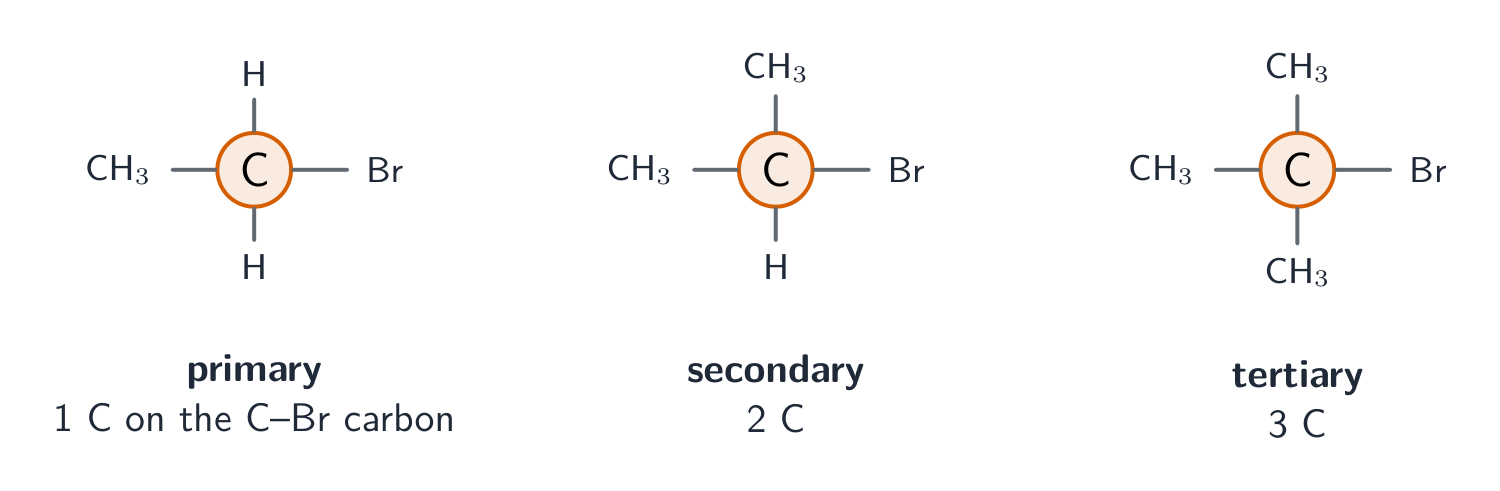
- classify halogenoalkanes into primary, secondary and tertiary
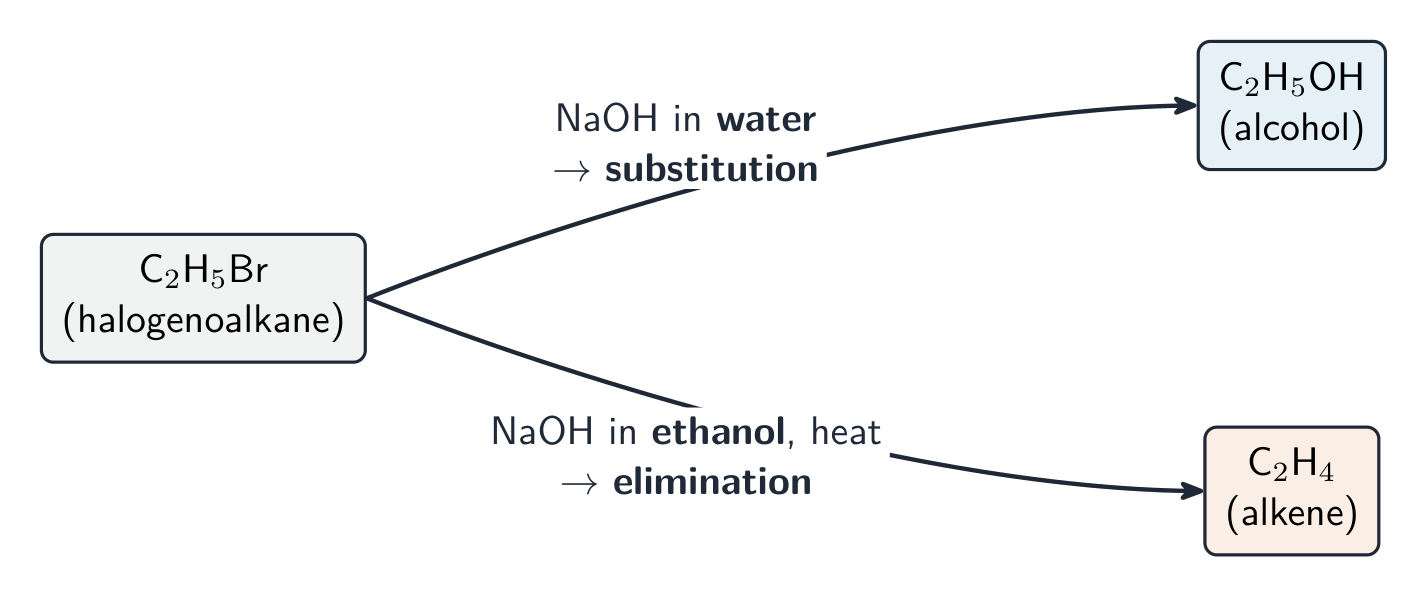
- describe the following nucleophilic substitution reactions: (a) the reaction with $\text{NaOH(aq)}$ and heat to produce an alcohol (b) the reaction with $\text{KCN}$ in ethanol and heat to produce a nitrile (c) the reaction with $\text{NH}_3$ in ethanol heated under pressure to produce an amine (d) the reaction with aqueous silver nitrate in ethanol as a method of identifying the halogen present as exemplified by bromoethane
- describe the elimination reaction with $\text{NaOH}$ in ethanol and heat to produce an alkene as exemplified by bromoethane
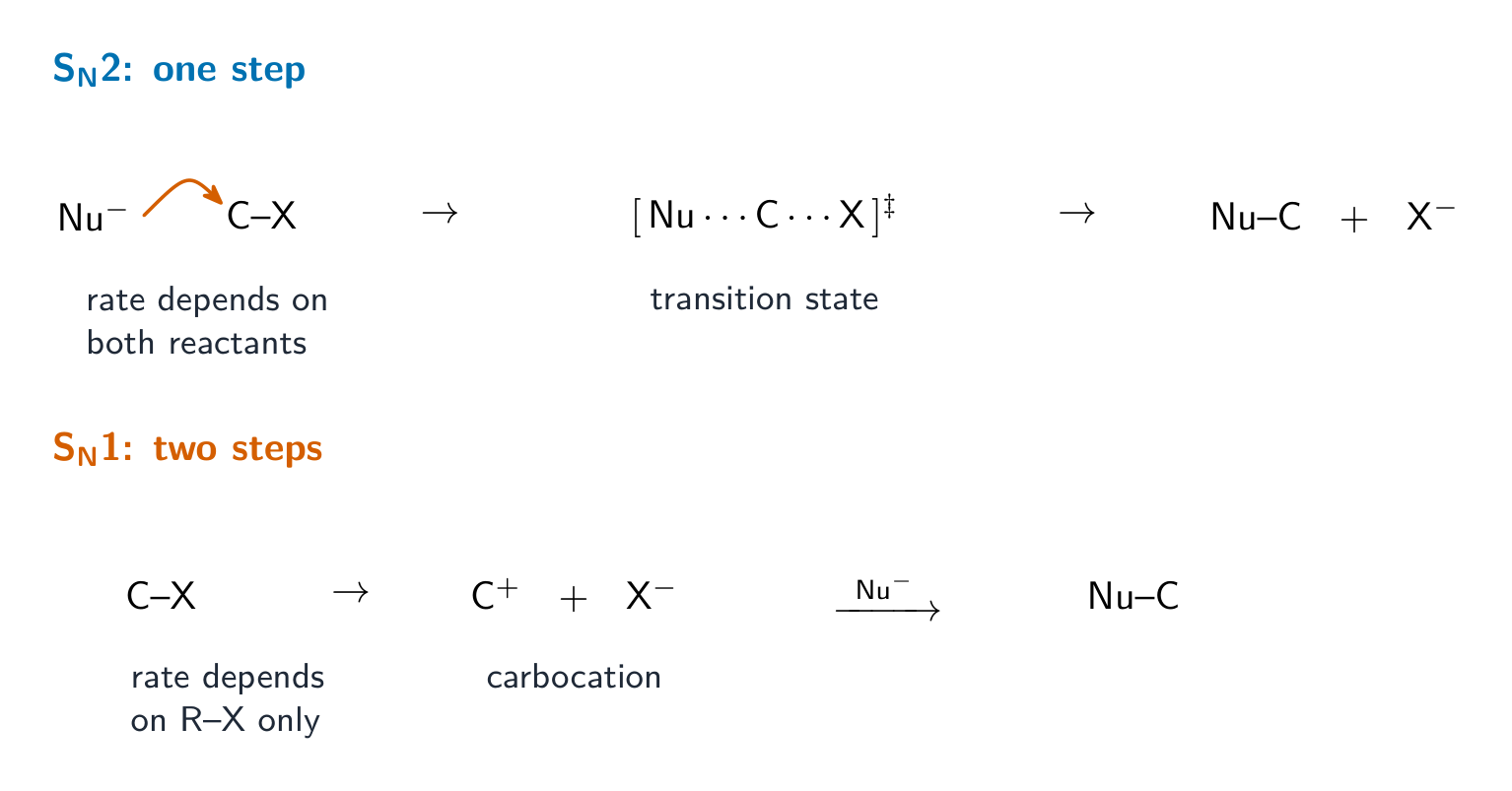
- describe the $\text{S}_\text{N}1$ and $\text{S}_\text{N}2$ mechanisms of nucleophilic substitution in halogenoalkanes including the inductive effects of alkyl groups
- recall that primary halogenoalkanes tend to react via the $\text{S}_\text{N}2$ mechanism; tertiary halogenoalkanes via the $\text{S}_\text{N}1$ mechanism; and secondary halogenoalkanes by a mixture of the two, depending on structure
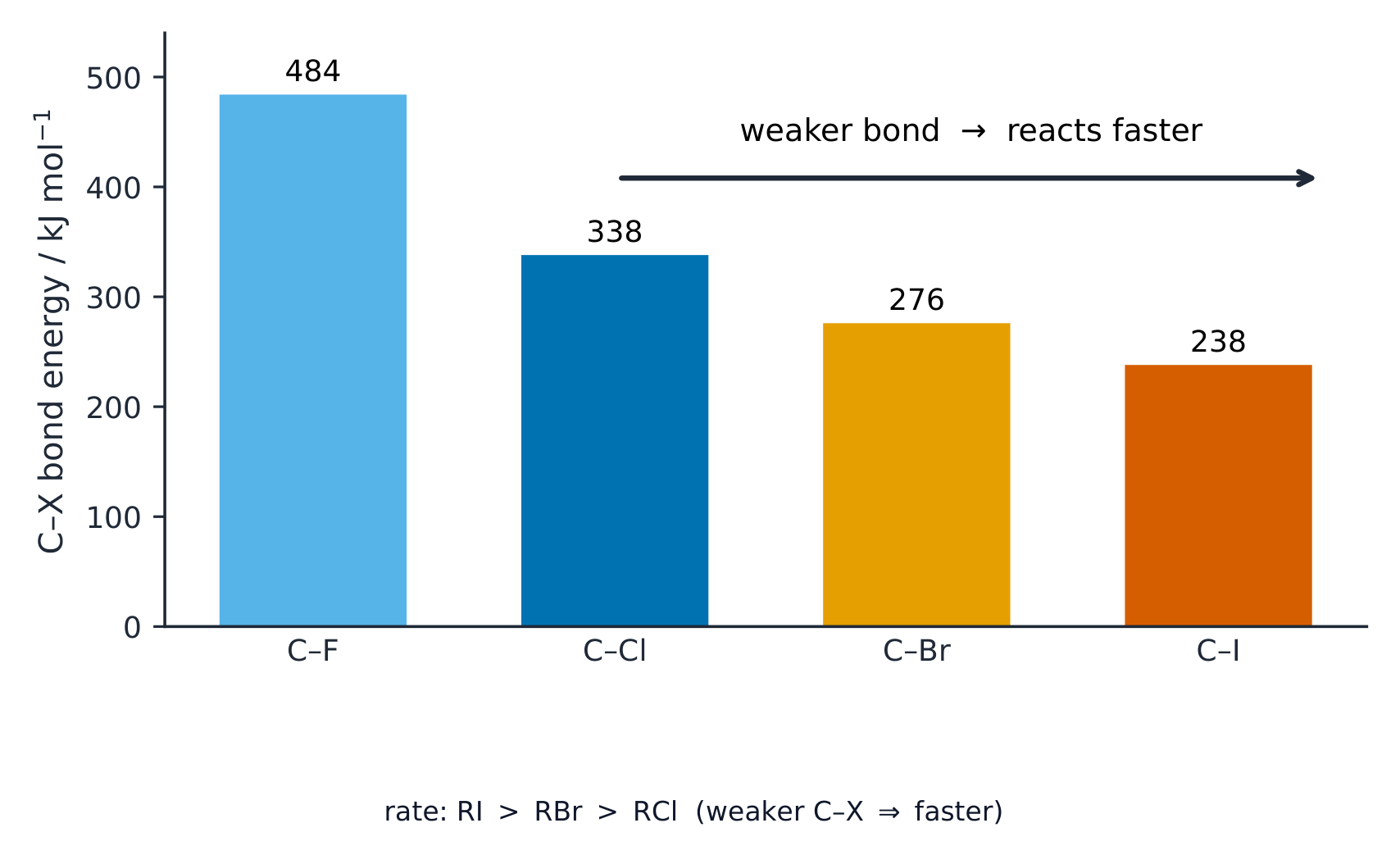
- describe and explain the different reactivities of halogenoalkanes (with particular reference to the relative strengths of the C–X bonds as exemplified by the reactions of halogenoalkanes with aqueous silver nitrates)
Tiếng Việt
- Nhắc lại các phản ứng (chất tham gia và điều kiện) để sản xuất halogenohydrocarbon: (a) phản ứng thế gốc tự do của hydrocacbon no bởi $\text{Cl}_2$ hoặc $\text{Br}_2$ trong điều kiện có ánh sáng tử ngoại, được minh họa bằng phản ứng của etan (b) phản ứng cộng điện tử với anken bởi một halogen, $\text{X}_2$, hoặc hydrogen halogen, $\text{HX(g)}$, ở nhiệt độ phòng (c) phản ứng thế của ancol, ví dụ: phản ứng với $\text{HX(g)}$; hoặc với $\text{KCl}$ và dung dịch $\text{H}_2\text{SO}_4$ đặc hoặc dung dịch $\text{H}_3\text{PO}_4$ đặc; hoặc với $\text{PCl}_3$ và nhiệt; hoặc với $\text{PCl}_5$; hoặc với $\text{SOCl}_2$
- Phân loại halogenohydrocarbon thành nguyên cấp, thứ cấp và third cấp
- Mô tả các phản ứng thế nucleophile sau: (a) phản ứng với $\text{NaOH(aq)}$ và nhiệt để tạo ra ancol (b) phản ứng với $\text{KCN}$ trong ethanol và nhiệt để tạo ra nitril (c) phản ứng với $\text{NH}_3$ trong ethanol đun nóng dưới áp suất để tạo ra amin (d) phản ứng với dung dịch bạc nitrat trong nước trong ethanol như một phương pháp xác định halogen có mặt, được minh họa bởi bromoetan
- Mô tả phản ứng loại bỏ với $\text{NaOH}$ trong ethanol và nhiệt để tạo ra anken, được minh họa bởi bromoetan
- Mô tả cơ chế $\text{S}_\text{N}1$ và $\text{S}_\text{N}2$ của phản ứng thế nucleophile trong halogenohydrocarbon bao gồm cả hiệu ứng cảm ứng của nhóm alkyl
- Nhắc lại rằng halogenohydrocarbon nguyên cấp có xu hướng phản ứng theo cơ chế $\text{S}_\text{N}2$; halogenohydrocarbon third cấp theo cơ chế $\text{S}_\text{N}1$; và halogenohydrocarbon thứ cấp theo hỗn hợp của cả hai, tùy thuộc vào cấu trúc
- Mô tả và giải thích sự khác nhau về tính hoạt động hóa học của halogenohydrocarbon (đặc biệt liên quan đến độ bền tương đối của liên kết C–X như được minh họa bởi phản ứng của halogenohydrocarbon với dung dịch bạc nitrat)