Skip to content · ⁨ข้ามไปยังเนื้อหา⁩

Space physics · ⁨ฟิสิกส์อวกาศ⁩

IGCSE Physics · ⁨Physics IGCSE⁩ · Topic 6 · ⁨หัวข้อ 6⁩

Video lesson for this topic · ⁨บทเรียนวิดีโอสำหรับหัวข้อนี้⁩ Open the video page · ⁨เปิดหน้าวิดีโอ⁩
16:59

ฟิสิกส์อวกาศ

มองขึ้นไปบนท้องฟ้าในคืนที่อากาศใส你可能会看到几千颗星星。但那几乎什么也不是。ดวงอาทิตย์ของเราเป็นเพียงดาวฤกษ์หนึ่งเดียวจากพันล้านดวงในกาแล็กซีของเรา…

English narration · English + 中文 subtitles burned in · ⁨การบรรยายภาษาอังกฤษ · คำบรรยายภาษาอังกฤษ + 中文 ลอยตัวบนภาพ⁩

6.1

The Earth, the Sun and the Moon · ⁨โลก ดวงอาทิตย์ และดวงจันทร์⁩

Syllabus · ⁨หลักสูตร⁩
English

6.1.1 The Earth

Core Supplement
1 Know that the Earth is a planet that rotates on its axis, which is tilted, once in approximately 24 hours, and use this to explain observations of the apparent daily motion of the Sun and the periodic cycle of day and night
2 Know that the Earth orbits the Sun once in approximately 365 days and use this to explain the periodic nature of the seasons 4 Define average orbital speed from the equation $v = \frac{2\pi r}{T}$ where $r$ is the average radius of the orbit and $T$ is the orbital period; recall and use this equation
3 Know that it takes approximately one month for the Moon to orbit the Earth and use this to explain the periodic nature of the Moon’s cycle of phases

6.1.2 The Solar System

Core Supplement
1 Describe the Solar System as containing: (a) one star, the Sun (b) the eight named planets and know their order from the Sun (c) minor planets that orbit the Sun, including dwarf planets such as Pluto and asteroids in the asteroid belt (d) moons, that orbit the planets (e) smaller Solar System bodies, including comets and natural satellites 7 Know that planets, minor planets and comets have elliptical orbits, and recall that the Sun is not at the centre of the elliptical orbit, except when the orbit is approximately circular
8 Analyse and interpret planetary data about orbital distance, orbital duration, density, surface temperature and uniform gravitational field strength at the planet’s surface
2 Know that, in comparison to each other, the four planets nearest the Sun are rocky and small and the four planets furthest from the Sun are gaseous and large, and explain this difference by referring to an accretion model for Solar System formation, to include: (a) the model’s dependence on gravity (b) the presence of many elements in interstellar clouds of gas and dust (c) the rotation of material in the cloud and the formation of an accretion disc
3 Know that the strength of the gravitational field (a) at the surface of a planet depends on the mass of the planet (b) around a planet decreases as the distance from the planet increases
4 Calculate the time it takes light to travel a significant distance such as between objects in the Solar System
5 Know that the Sun contains most of the mass of the Solar System and this explains why the planets orbit the Sun
6 Know that the force that keeps an object in orbit around the Sun is the gravitational attraction of the Sun 9 Know that the strength of the Sun’s gravitational field decreases and that the orbital speeds of the planets decrease as the distance from the Sun increases
10 Know that an object in an elliptical orbit travels faster when closer to the Sun and explain this using the conservation of energy
ไทย

6.1.1 โลก

แก่น เพิ่มเติม
1 รู้ว่าโลกเป็นดาวเคราะห์ที่หมุนรอบแกนตัวเองซึ่งมีมุมเอียง เสร็จสิ้นหนึ่งรอบในประมาณ 24 ชั่วโมง และใช้ความรู้นี้เพื่ออธิบายการสังเกตการณ์การเคลื่อนที่ apparent ของดวงอาทิตย์รายวันและวัฏจักรของกลางวันและกลางคืน
2 รู้ว่าโลกโคจรรอบดวงอาทิตย์หนึ่งรอบในประมาณ 365 วัน และใช้ความรู้นี้เพื่ออธิบายลักษณะเป็นวัฏจักรของฤดูกาล 4 นิยามความเร็ววงโคจรเฉลี่ยจากสมการ $v = \frac{2\pi r}{T}$ โดยที่ $r$ คือรัศมีวงโคจรเฉลี่ยและ $T$ คือช่วงเวลาในการโคจรรอบ; จำและใช้สมการนี้
3 รู้ว่าใช้เวลาประมาณหนึ่งเดือนสำหรับดวงจันทร์ที่จะโคจรรอบโลกและใช้ความรู้นี้เพื่ออธิบายลักษณะเป็นวัฏจักรของรอบเฟสของดวงจันทร์

6.1.2 ระบบสุริยะ

แก่น เพิ่มเติม
1 อธิบาย ระบบสุริยะ ว่าประกอบด้วย: (ก) ดาวหนึ่งดวงคือดวงอาทิตย์ (ข) ดาวเคราะห์ที่มีชื่อทั้งแปดและรู้ลำดับจากดวงอาทิตย์ (ค) ดาวเคราะห์น้อยที่โคจรรอบดวงอาทิตย์ รวมถึงดาวเคราะห์แคระอย่างพลูโตและTraffic asteroid ในเข็มขัดTraffic asteroid (ง) ดวงจันทร์ которыеโคจรรอบดาวเคราะห์ (จ) ร่างกายขนาดเล็กในระบบสุริยะอื่น ๆ รวมถึงดาวหางและดาวเทียมธรรมชาติ 7 รู้ว่าดาวเคราะห์ ดาวเคราะห์น้อย และดาวหางมี วงโคจรแบบวงรี และจำได้ว่าดวงอาทิตย์ไม่ได้อยู่ตรงกลางวงโคจรแบบวงรี เว้นแต่วงโคจรนั้นจะเป็นรูปทรงกลมโดยประมาณ
8 วิเคราะห์และตีความข้อมูลดาวเคราะห์เกี่ยวกับระยะทางวงโคจร ระยะเวลาการโคจรรอบ ความหนาแน่น อุณหภูมิพื้นผิว และความแรงของสนามโน้มถ่วงสม่ำเสมอที่พื้นผิวดาวเคราะห์
2 รู้ว่าเมื่อเทียบกับกันเอง ดาวเคราะห์สี่ดวงที่อยู่ใกล้ดวงอาทิตย์ที่สุดมีลักษณะเป็นหินและมีขนาดเล็ก ในขณะที่ดาวเคราะห์สี่ดวงที่อยู่ไกลจากดวงอาทิตย์ที่สุดมีลักษณะเป็นแก๊สและมีขนาดใหญ่ และอธิบายความแตกต่างนี้โดยการอ้างอิงถึงโมเดลการสะสมตัวสำหรับการเกิดระบบสุริยะ ซึ่งรวมถึง: (ก) การพึ่งพามุมมองของโมเดลต่อแรงโน้มถ่วง (ข) การมีอยู่ของธาตุจำนวนมากในเมฆแก๊สและฝุ่นระหว่างดาว (ค) การหมุนของวัสดุในเมฆและการเกิดแผ่นสะสมตัว
3 รู้ว่าความแรงของสนามโน้มถ่วง (ก) ที่พื้นผิวดาวเคราะห์ขึ้นอยู่กับมวลของดาวเคราะห์ (ข) รอบๆดาวเคราะห์จะลดลงเมื่อระยะห่างจากดาวเคราะห์เพิ่มขึ้น
4 คำนวณเวลาที่ใช้แสงเดินทางในระยะทางที่สำคัญเช่นระหว่างวัตถุในระบบสุริยะ
5 รู้ว่าดวงอาทิตย์มีมวลส่วนใหญ่ของระบบสุริยะและสิ่งนี้อธิบายได้ว่าทำไมดาวเคราะห์จึงโคจรรอบดวงอาทิตย์
6 รู้ว่าแรงที่รักษาสภาพวงโคจรของวัตถุให้โคจรรอบดวงอาทิตย์คือแรงดึงดูดทางโน้มถ่วงของดวงอาทิตย์ 9 รู้ว่าความแรงของสนามโน้มถ่วงของดวงอาทิตย์ลดลงและความเร็ววงโคจรของดาวเคราะห์ลดลงเมื่อระยะห่างจากดวงอาทิตย์เพิ่มขึ้น
10 รู้ว่าวัตถุในวงโคจรแบบวงรีจะเคลื่อนที่เร็วขึ้นเมื่ออยู่ใกล้กับดวงอาทิตย์และอธิบายปรากฏการณ์นี้โดยใช้กฎการอนุรักษ์พลังงาน

Source: Cambridge International syllabus · ⁨แหล่งที่มา: หลักสูตร Cambridge International⁩

English

The Earth spins (rotates 自转) on its axis 轴 once in about $24$ hours. The axis is tilted 倾斜 (not straight up). This spin gives us day and night, and makes the Sun 太阳 appear to move across the sky each day.

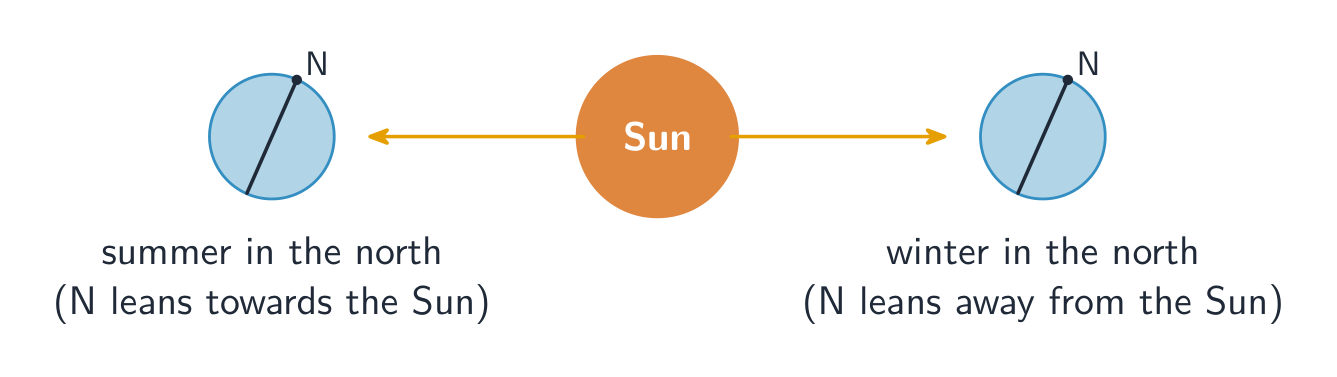
The Earth also moves around the Sun in an orbit 轨道, once in about $365$ days (one year). Because the axis is tilted, different parts of the Earth lean towards the Sun at different times of the year. This gives the seasons 季节: it is summer in the half of the Earth that leans towards the Sun.

The Moon 月球 orbits the Earth once in about one month. As it goes round, we see different amounts of its lit side, which gives the phases 月相 of the Moon (new moon, half moon, full moon).

So, from shortest to longest: one day (Earth's spin) < one month (Moon's orbit) < one year (Earth's orbit).

ไทย

โลกหมุน (หมุนรอบตัวเอง) บน แกน ของตัวเองครั้งละประมาณ $24$ ชั่วโมง แกนมีความ เอียง (ไม่ตั้งฉาก) การหมุนนี้ทำให้เราได้รับกลางวันและกลางคืน และทำให้ ดวงอาทิตย์ ดูเหมือนเคลื่อนที่ข้ามฟ้าทุกวัน

โลกยังโคจรรอบดวงอาทิตย์เป็น วงโคจร ครั้งละประมาณ $365$ วัน (หนึ่งปี) เนื่องจากแกนเอียง ส่วนต่างๆ ของโลกจึงเอียงเข้าหาหรือห่างจากดวงอาทิตย์ในช่วงเวลา的不同ของปี สิ่งนี้ก่อให้เกิด ฤดูกาล: เป็นฤดูร้อนในครึ่งหนึ่งของโลกที่เอียงเข้าหาดวงอาทิตย์

โลกที่เอียงในสองจุดของวงโคจร: ขั้วเหนือเอียงเข้าหาดวงอาทิตย์ และครึ่งปีต่อมาเอียงออก
แกนคงความเอียงเดิมตลอดทั้งปี ดังนั้นแต่ละซีกโลกจึงเอียงเข้าหาดวงอาทิตย์ครึ่งหนึ่งของวงโคจร และเอียงออกอีกครึ่ง

ดวงจันทร์โคจรรอบโลกครั้งละประมาณหนึ่งเดือน เมื่อโคจรรอบ เราจะเห็นปริมาณด้านสว่างที่แตกต่างกัน ซึ่งสร้าง เฟสของดวงจันทร์ (ดวงจันทร์ใหม่, ดวงจันทร์ครึ่งดวง, ดวงจันทร์เต็มดวง)

ดวงจันทร์ในสี่ตำแหน่งรอบวงโคจรของโลก โดยแต่ละตำแหน่งจะมีครึ่งที่หันเข้าหาดวงอาทิตย์ถูกแสงส่องสว่าง
ครึ่งดวงจันทร์ที่สว่างแสงจะหันเข้าหาดวงอาทิตย์เสมอ ดังนั้นเมื่อโคจรรอบ เราจึงเห็นปริมาณที่แตกต่างกัน: ดวงจันทร์ใหม่อยู่ระหว่างเรากับดวงอาทิตย์, ดวงจันทร์เต็มดวงอยู่ตรงข้ามดวงอาทิตย์, และดวงจันทร์ครึ่งดวงอยู่ระหว่างนั้น

ดังนั้น จากสั้นไปยาว: หนึ่งวัน (การหมุนของโลก) < หนึ่งเดือน (วงโคจรของดวงจันทร์) < หนึ่งปี (วงโคจรของโลก)

ดิสก์สีเทาเต็มดวงของดวงจันทร์ ปกคลุมด้วยจุดมืดและหลุมอุกกาบาตสว่าง ตัดกับอวกาศสีดำ
ดวงจันทร์เต็มดวง ดาวเทียมธรรมชาติของโลก
Explore · ⁨สำรวจ⁩

Why the Moon changes shape · ⁨สาเหตุที่ดวงจันทร์เปลี่ยนรูปร่าง⁩

The Sun always lights half the Moon; the phase is simply how much of that lit half faces us as the Moon orbits — it is not Earth's shadow. · ⁨ดวงอาทิตย์ส่องสว่างครึ่งหนึ่งของดวงจันทร์เสมอ; ระยะphase คือปริมาณของครึ่งที่ถูกแสงที่หันหน้าหาเราขณะดวงจันทร์โคจรรอบโลก — ไม่ใช่เงาของโลก⁩

Vocabulary · ⁨คำศัพท์⁩ Train · ⁨ฝึกฝน⁩
English ไทย
seasons/ˈsiːznz/ ฤดูกาล
Moon/muːn/ Moon
phases/ˈfeɪzɪz/ เฟสของดวงจันทร์
circumference/sɜːˈkʌmfrəns/ เส้นรอบวง
orbital speed/ˈɔːbɪtl spiːd/ ความเร็ววงโคจร
period/ˈpɪərɪəd/ รอบ
6.1

Orbital speed · ⁨ความเร็ววงโคจร⁩

English

For an object going round a circle, the distance for one full orbit is the circumference 周长 $2\pi r$, where $r$ is the radius of the orbit. The orbital speed 轨道速率 is this distance divided by the period 周期 $T$ (the time for one orbit):

$$v = \frac{2\pi r}{T}$$

The same equation works for planets, moons and satellites.

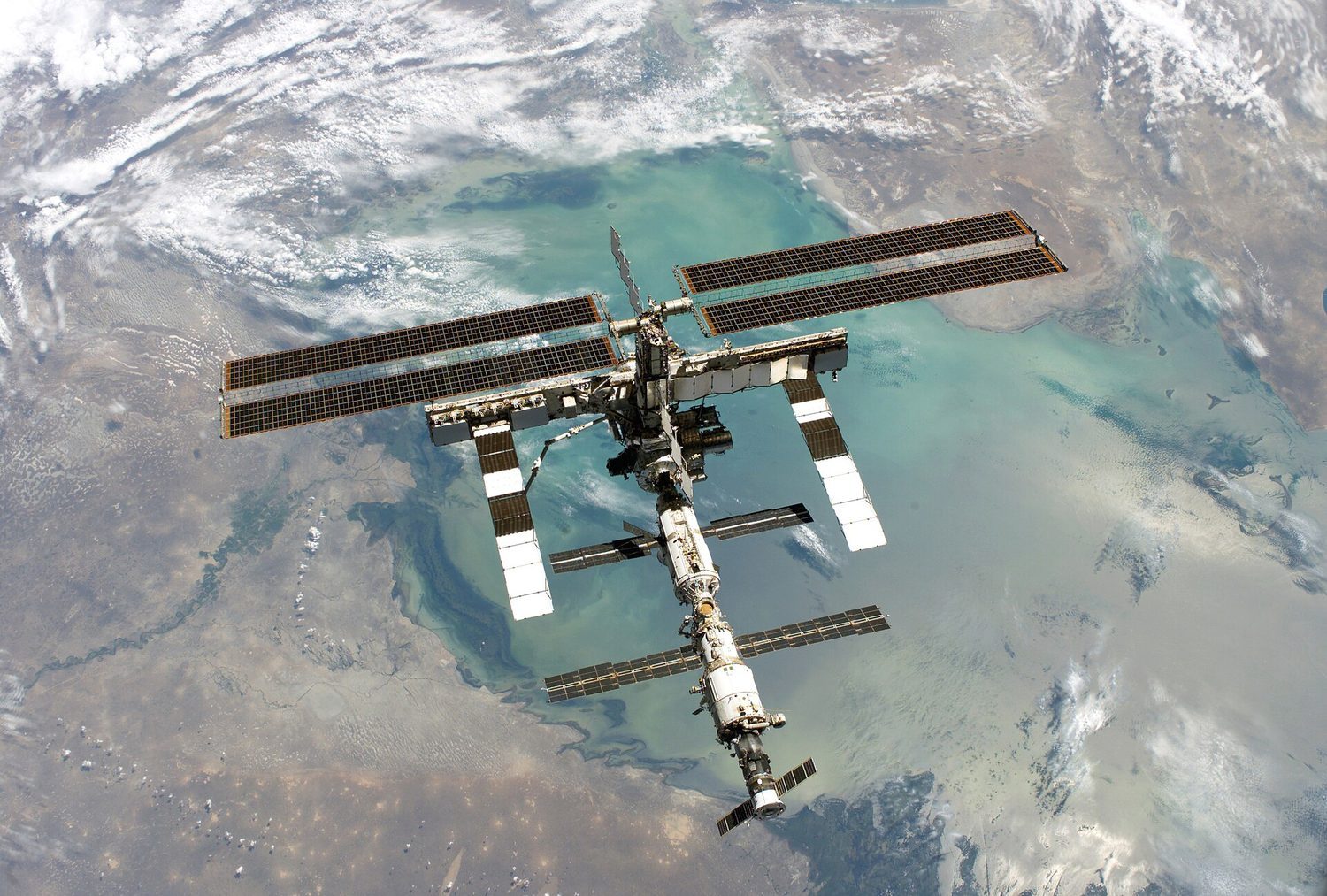
Worked example. A space station orbits the Earth at a radius of $r = 7000\ \text{km}$ and takes $T = 5800\ \text{s}$ for one orbit. Find its orbital speed.

First convert the radius to metres: $7000\ \text{km} = 7.0 \times 10^6\ \text{m}$. Then

$$v = \frac{2\pi r}{T} = \frac{2\pi \times 7.0 \times 10^6}{5800} \approx 7600\ \text{m/s}$$
ไทย

สำหรับวัตถุที่เคลื่อนที่เป็นวงกลม ระยะทางสำหรับการโคจรรอบหนึ่งครั้งคือ เส้นรอบวง $2\pi r$, โดยที่ $r$ คือรัศมีของวงโคจร ความเร็ววงโคจร คือระยะทางนี้หารด้วย คาบ $T$ (เวลาในการโคจรรอบหนึ่งครั้ง):

$$v = \frac{2\pi r}{T}$$

สมการเดียวกันใช้ได้กับดาวเคราะห์ ดวงจันทร์ และดาวเทียม

ตัวอย่างวิธีทำ. สถานีอวกาศโคจรรอบโลกที่รัศมี $r = 7000\ \text{km}$ และใช้เวลา $T = 5800\ \text{s}$ ในการโคจรรอบหนึ่งครั้ง จงหาความเร็ววงโคจรของมัน

แปลงรัศมีเป็นเมตรก่อน: $7000\ \text{km} = 7.0 \times 10^6\ \text{m}$. แล้ว

$$v = \frac{2\pi r}{T} = \frac{2\pi \times 7.0 \times 10^6}{5800} \approx 7600\ \text{m/s}$$
ISS ในวงโคจร: ความเร็ววงโคจรคือความเร็วที่ทำให้ดาวเทียมอยู่ในภาวะตกอย่างอิสระเป็นการเคลื่อนที่วงกลม
Vocabulary · ⁨คำศัพท์⁩ Train · ⁨ฝึกฝน⁩
English ไทย
orbit/ˈɔːbɪt/ วงโคจร
6.1

The Solar System · ⁨ระบบสุริยะ⁩

English

The Solar System 太阳系 has one star, the Sun, at its centre. Around it move the eight planets 行星. In order from the Sun they are: Mercury, Venus, Earth, Mars, Jupiter, Saturn, Uranus and Neptune.

  • The four planets nearest the Sun are small and rocky 岩石.
  • The four planets furthest from the Sun are large and gaseous 气态 — they are made mostly of gas 气体, with no solid surface to stand on.
  • The two nearer giants, Jupiter and Saturn, are gas giants 气态巨行星. The two outer giants, Uranus and Neptune, are ice giants 冰巨行星: they hold much more ice, so they are not true gas giants.

The Solar System also contains:

  • minor planets, such as dwarf planets 矮行星 like Pluto, and asteroids 小行星 (most lie in the asteroid belt between Mars and Jupiter);
  • moons (natural satellites 卫星) that orbit the planets;
  • comets 彗星 and other small bodies.

Orbits and gravity

The Sun holds most of the mass of the Solar System. Its gravity 引力 (gravitational pull) reaches out and keeps the planets in their orbits. This force is the gravitational attraction of the Sun.

The gravitational field strength 重力场强度 tells you how strong gravity is:

  • at the surface of a planet it is bigger for a planet with more mass;
  • around a planet it gets weaker as you move further away.

In the same way, the Sun's gravity gets weaker further out, so the outer planets move more slowly (smaller orbital speed) than the inner ones.

Planetary data

Exam questions often give a table like this one and ask you to read a pattern from it.

Planet Distance from Sun / million km Orbital period Density / g/cm³ Surface temperature / °C Surface $g$ / N/kg
Mercury 58 88 days 5.4 170 3.7
Venus 108 225 days 5.2 460 8.9
Earth 150 365 days 5.5 15 9.8
Mars 228 687 days 3.9 −60 3.7
Jupiter 779 11.9 years 1.3 −110 23
Saturn 1430 29.5 years 0.7 −140 9.0
Uranus 2870 84 years 1.3 −195 8.7
Neptune 4500 165 years 1.6 −200 11

Patterns to notice: the further a planet is from the Sun, the longer its orbital period and the lower its surface temperature. The four inner planets are dense (rock and metal), while the four outer planets have low densities (gas and ice). The gravitational field strength at the surface depends on the planet's mass and size, not on its distance from the Sun.

Elliptical orbits

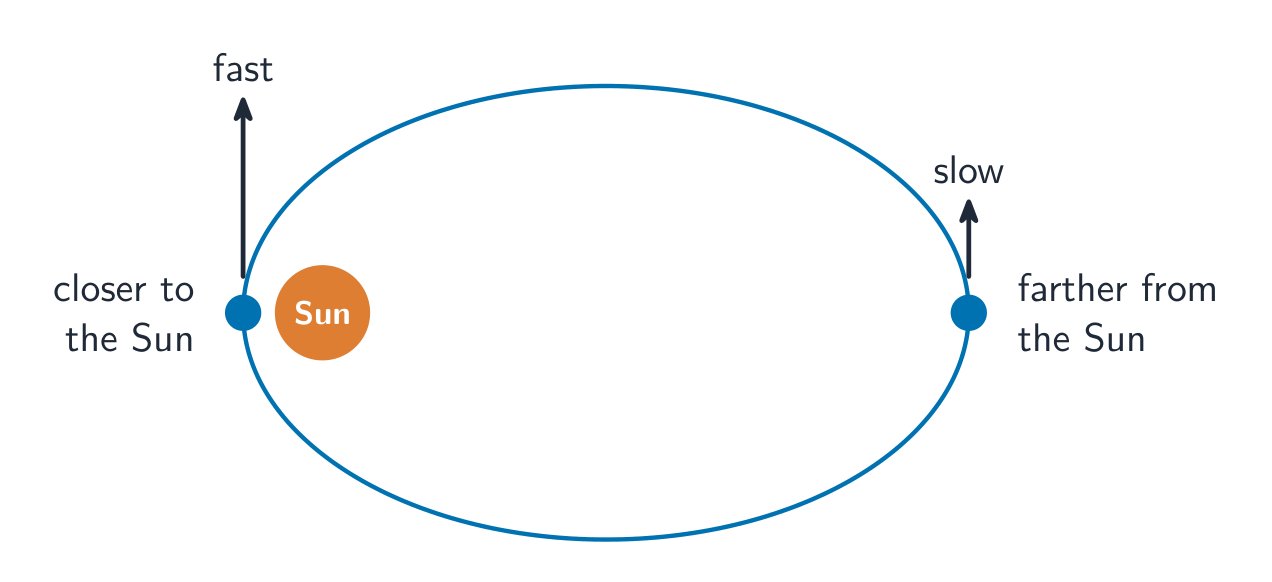
Most orbits are not perfect circles but ellipses 椭圆 (a stretched circle), and the Sun is not at the centre of the ellipse. A comet has a very stretched orbit. An object in an elliptical orbit moves faster when it is closer to the Sun. We explain this with the conservation of energy 能量守恒 — the total energy 能量 stays the same, so as the object's gravitational potential energy 重力势能 falls (coming closer), its kinetic energy 动能 rises (it speeds up).

Light travel time

Distances in space are huge, so we often work out how long light takes to cross them. Light travels at $3.0 \times 10^8\ \text{m/s}$. Using $\text{time} = \dfrac{\text{distance}}{\text{speed}}$, light from the Sun (about $1.5 \times 10^{11}\ \text{m}$ away) takes about $500\ \text{s}$, which is roughly $8$ minutes, to reach the Earth.

ไทย

ระบบสุริยะ มีดาวฤกษ์หนึ่งดวงคือดวงอาทิตย์อยู่ที่ศูนย์กลาง รอบๆ它有 eight ดาวเคราะห์ เรียงลำดับจากดวงอาทิตย์คือ: พฤหัส, ศุภ, โลก,อังคาร, Jupiter, Saturn, Uranus and Neptune.

  • ดาวเคราะห์สี่ดวงใกล้ดวงอาทิตย์ที่สุดมีขนาดเล็กและ เป็นหิน
  • ดาวเคราะห์สี่ดวงไกลจากดวงอาทิตย์ที่สุดมีขนาดใหญ่และ เป็นก๊าซ — ประกอบด้วยก๊าซเป็นหลัก ไม่มีพื้นผิวแข็งให้ยืน
  • TWO giants ที่ใกล้กว่า Jupiter and Saturn are dwarf planets. The two outer giants, Uranus and Neptune, are ice giants: they hold much more ice, so they are not true gas giants.
ดวงอาทิตย์พร้อม Mercury, Venus, Earth and Mars, ตามด้วยแถบittle belt, แล้วตามด้วย Jupiter, Saturn, Uranus and Neptune
ดวงอาทิตย์และดาวเคราะห์แปดดวงเรียงลำดับ: ดาวเคราะห์หินเล็กสี่ดวง, แถบittle belt, แล้วดาวเคราะห์ก๊าซใหญ่สี่ดวง — Gas giants Jupiter and Saturn และ Ice giants Uranus and Neptune (ไม่ตามขนาดจริง)
ดิสก์สีแดงเต็มดวงของ Mars ตัดกับอวกาศสีดำ พร้อมลักษณะพื้นผิวดำและหมอกขั้วบางๆ
ดาวอังคาร ดาวแดง หนึ่งในดาวเคราะห์หินชั้นใน
ดิสก์เต็มดวงของ Jupiter แสดงแถบนิวเมียมสีน้ำตาลและขาว รวมถึงจุดแดงใหญ่สีส้ม
จúpιter ดาวเคราะห์ที่ใหญ่ที่สุดพร้อมแถบแก๊สหมุนวน
Saturn กับระบบวงแหวนกว้างและแบน ถ่ายจากด้านข้างโดยยาน Cassini
ดาวเสาร์และวงแหวน ถ่ายภาพโดยยานอวกาศแคสชินี

ระบบสุริยะยังมี:

  • ดาวเคราะห์minor เช่น ดาวแคระ อย่าง Pluto และ ittle asteroids (ส่วนใหญ่อยู่ในlittle asteroid belt ระหว่าง Mars and Jupiter);
  • ดวงจันทร์ (ดาวเทียมธรรมชาติ) ที่โคจรรอบดาวเคราะห์;
  • Comets และวัตถุขนาดเล็กอื่นๆ

วงโคจรและแรงโน้มถ่วง

ดวงอาทิตย์มีมวลส่วนใหญ่ของระบบสุริยะ แรงโน้มถ่วง ของมันแผ่ขยายออกมาและยึดดาวเคราะห์ไว้บนวงโคจร แรงนี้คือแรงดึงดูดระหว่างดวงอาทิตย์

ความเข้มสนามโน้มถ่วง บอกถึงระดับความแรงของแรงโน้มถ่วง:

  • ที่พื้นผิวของดาวเคราะห์ จะสูงกว่าหากดาวเคราะห์มีมวลมากขึ้น;
  • รอบๆดาวเคราะห์ จะอ่อนลงเมื่อคุณเคลื่อนที่ออกไปไกลขึ้น

ในทำนองเดียวกัน แรงโน้มถ่วงของดวงอาทิตย์จะอ่อนลงเมื่ออยู่ไกลออกไป ดังนั้นดาวเคราะห์ชั้นนอกจึงเคลื่อนที่ช้ากว่า (มีความเร็ววงโคจรน้อยกว่า) ดาวเคราะห์ชั้นใน

ข้อมูลดาวเคราะห์

ข้อสอบมักให้ตารางเช่นนี้และถามให้คุณอ่านรูปแบบจากตารางนั้น

ดาวเคราะห์ ระยะห่างจากดวงอาทิตย์ / ล้านกิโลเมตร ระยะเวลาโคจร ความหนาแน่น / g/cm³ อุณหภูมิพื้นผิว / °C ความเร็วที่พื้นผิว $g$ / N/kg
nama Mercury 58 88 วัน 5.4 170 3.7
Venus 108 225 วัน 5.2 460 8.9
Earth 150 365 วัน 5.5 15 9.8
Mars 228 687 วัน 3.9 −60 3.7
Jupiter 779 11.9 ปี 1.3 −110 23
Saturn 1430 29.5 ปี 0.7 −140 9.0
Uranus 2870 84 ปี 1.3 −195 8.7
Neptune 4500 165 ปี 1.6 −200 11

รูปแบบที่ต้องสังเกต: ยิ่งดาวเคราะห์อยู่ห่างจากดวงอาทิตย์มากเท่าไร ระยะเวลาโคจรยิ่งยาวนานขึ้น และอุณหภูมิพื้นผิวยิ่งต่ำลง ดาวเคราะห์ชั้นในสี่ดวงมีความหนาแน่นสูง (หินและโลหะ) ในขณะที่ดาวเคราะห์ชั้นนอกสี่ดวงมีความหนาแน่นต่ำ (แก๊สและน้ำแข็ง) ความแรงสนาม gravitation ที่พื้นผิวขึ้นอยู่กับมวลและขนาดของดาวเคราะห์ ไม่ใช่ระยะห่างจากดวงอาทิตย์

วงโคจรรูปวงรี

วงโคจรส่วนใหญ่ไม่ใช่วงกลมสมบูรณ์แต่เป็น วงรี (วงกลมที่ถูกยืดออก) และดวงอาทิตย์ไม่ได้อยู่ตรงกลางวงรี ดาวยาวมีวงโคจรที่ยืดออกมาก วัตถุในวงโคจรรูปวงรีจะเคลื่อนที่ เร็วขึ้น เมื่ออยู่ใกล้ดวงอาทิตย์ เราอธิบายสิ่งนี้ได้ด้วย กฎการอนุรักษ์พลังงาน — พลังงานรวมคงที่ ดังนั้นเมื่อ พลังงานศักย์โน้มถ่วง ของวัตถุลดลง (เข้าใกล้ดวงอาทิตย์) พลังงานจลน์ จะเพิ่มขึ้น (ความเร็วเพิ่ม)

วงโคจรรูปวงรีที่มีดวงอาทิตย์อยู่ที่จุดโฟกัสหนึ่ง จุดที่ดาวเคลื่อนที่เร็วเมื่อใกล้และช้าเมื่อไกล
ดวงอาทิตย์อยู่ที่จุดโฟกัสหนึ่งของวงรี; ดาวเคลื่อนที่เร็วขึ้นเมื่อเข้าใกล้และช้าลงเมื่อเคลื่อนที่ห่าง

เวลาเดินทางของแสง

ระยะทางในอวกาศมีขนาดใหญ่มาก เราจึงมักคำนวณว่าแสงใช้เวลาข้ามระยะทางเหล่านั้นนานแค่ไหน แสงเดินทางด้วยความเร็ว $3.0 \times 10^8\ \text{m/s}$ โดยอาศัย $\text{time} = \dfrac{\text{distance}}{\text{speed}}$ แสงจากดวงอาทิตย์ (ซึ่งอยู่ห่างประมาณ $1.5 \times 10^{11}\ \text{m}$) ใช้เวลาประมาณ $500\ \text{s}$ ซึ่งเทียบเท่ากับ $8$ นาที ที่จะมาถึงโลก

Explore · ⁨สำรวจ⁩

Watch the planets race · ⁨ดูการแข่งขันของดาวเคราะห์⁩

The closer a planet is to the Sun, the faster it orbits — Mercury in 88 days, Jupiter in 12 years — because the Sun's gravity is stronger close in. · ⁨ดาวเคราะห์ยิ่งใกล้ดวงอาทิตย์ยิ่งโคจรเร็ว — MERCURY ใน 88 วัน, JUPITER ใน 12 ปี — เพราะแรงโน้มถ่วงของดวงอาทิตย์แรงขึ้นเมื่ออยู่ใกล้⁩

Vocabulary · ⁨คำศัพท์⁩ Train · ⁨ฝึกฝน⁩
English ไทย
Solar System/ˈsəʊlə ˈsɪstəm/ ระบบสุริยะ
planet/ˈplænɪt/ ดาวเคราะห์
rocky/ˈrɒki/ หิน
gaseous/ˈɡeɪsɪəs/ สถานะแก๊ส
gas/ɡæs/ แก๊ส
gas giant/ɡæs ˈdʒaɪənt/ ดาวยักษ์แก๊ส
ice giant/aɪs ˈdʒaɪənt/ ดาวยักษ์น้ำแข็ง
dwarf planet/dwɔːf ˈplænɪt/ ดาวแคระ
asteroid/ˈæstərɔɪd/ Traffic asteroid
satellite/ˈsætəlaɪt/ ดาวเทียม
comet/ˈkɒmɪt/ ดาวหาง
gravity/ˈɡrævɪti/ แรงโน้มถ่วง
gravitational field strength/ˌɡrævɪˈteɪʃənl fiːld streŋθ/ ความเข้มของสนามโน้มถ่วง
ellipse/ɪˈlɪps/ วงรี
conservation of energy/ˌkɒnsəˈveɪʃn ɒv ˈenədʒi/ กฎการอนุรักษ์พลังงาน
energy/ˈenədʒi/ พลังงาน
gravitational potential energy/ˌɡrævɪˈteɪʃənl pəˈtenʃl ˈenədʒi/ พลังงานศักย์โน้มถ่วง
kinetic energy/kɪˈnetɪk ˈenədʒi/ พลังงานจลน์
dust/dʌst/ ฝุ่น
element/ˈelɪmənt/ ธาตุ
6.1

How the Solar System formed · ⁨การก่อตัวของระบบสุริยะ⁩

English

The planets formed from a giant cloud of gas and dust 尘埃 in space, which contained many chemical elements 元素. This is the accretion 吸积 model:

  • gravity pulled the cloud together;
  • the cloud was spinning, so it flattened into a spinning accretion disc 吸积盘;
  • most of the matter fell to the centre and became the Sun, while the planets grew from the leftover material in the disc.

Near the hot young Sun, only rock and metal could stay solid, so the inner planets are rocky. Far out, where it was cold, gases could also collect, so the outer planets grew large and gaseous.

ไทย

ดาวเคราะห์ก่อตัวจากเมฆยักษ์ของ แก๊ส และ ฝุ่น ในอวกาศ ซึ่งมี ธาตุ ทางเคมีจำนวนมาก นี่คือแบบจำลอง การสะสมมวล (accretion):

  • แรงโน้มถ่วงดึงเมฆรวมกัน;
  • เมฆหมุนอยู่ จึงแบนลงกลายเป็น แผ่นสะสมมวลหมุนวน (accretion disc) ที่หมุนอยู่;
  • วัสดุส่วนใหญ่ตกลงสู่ศูนย์กลางและกลายเป็นดวงอาทิตย์ ในขณะที่ดาวเคราะห์เติบโตจากวัสดุที่เหลืออยู่ในแผ่น acumulate

ใกล้กับดวงอาทิตย์ที่ร้อนจัดใหม่ ๆ มีเพียงหินและโลหะเท่านั้นที่สามารถคงสภาพเป็นของแข็งได้ ดังนั้นดาวเคราะห์ชั้นในจึงเป็นหิน jauhออกไป的地方ที่หนาวเย็น แก๊สสามารถสะสมตัวได้เช่นกัน ดังนั้นดาวเคราะห์ชั้นนอกจึงมีขนาดใหญ่และเป็นแก๊ส

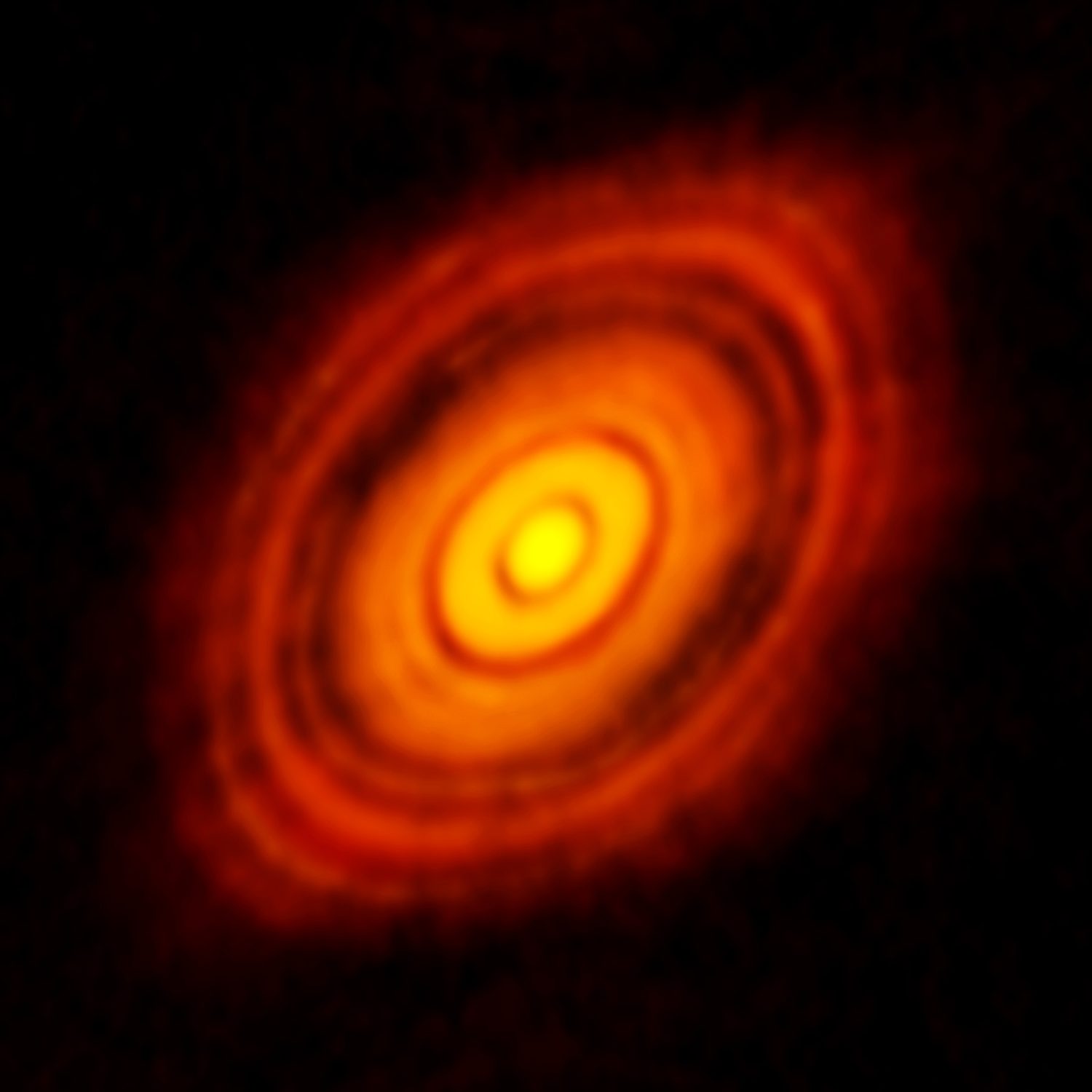
แผ่นฝุ่นสีส้มเรืองแสงรอบดาวฤกษ์วัยเยาว์ ตัดขวางด้วยวงแหวนมืดซึ่งดาวเคราะห์กำลังกวาดเก็บวัสดุ
แผ่นสะสมมวลจริงรอบดาว HL Tauri: ช่องว่างสีดำคือสถานที่ที่ดาวรุ่นใหม่กำลังรวบรวมฝุ่น — ระบบสุริยะของเราเริ่มต้นมาในรูปแบบเดียวกัน
Vocabulary · ⁨คำศัพท์⁩ Train · ⁨ฝึกฝน⁩
English ไทย
accretion/əˈkreʃn/ การรวมมวล
accretion disc/əˈkreʃn dɪsk/ จานการสะสม
6.2

The Sun as a star · ⁨ดวงอาทิตย์ในฐานะดาวฤกษ์⁩

Syllabus · ⁨หลักสูตร⁩
English

6.2.1 The Sun as a star

Core Supplement
1 Know that the Sun is a star of medium size, consisting mostly of hydrogen and helium, and that it radiates most of its energy in the infrared, visible light and ultraviolet regions of the electromagnetic spectrum 2 Know that stars are powered by nuclear reactions that release energy and that in stable stars the nuclear reactions involve the fusion of hydrogen into helium

6.2.2 Stars

Core Supplement
1 State that: (a) galaxies are each made up of many billions of stars (b) the Sun is a star in the galaxy known as the Milky Way (c) other stars that make up the Milky Way are much further away from the Earth than the Sun is from the Earth (d) astronomical distances can be measured in light-years, where one light-year is the distance travelled in (the vacuum of) space by light in one year
2 Know that one light-year is equal to $9.5 \times 10^{15}$ m
3 Describe the life cycle of a star: (a) a star is formed from interstellar clouds of gas and dust that contain hydrogen (b) a protostar is an interstellar cloud collapsing and increasing in temperature as a result of its internal gravitational attraction (c) a protostar becomes a stable star when the inward force of gravitational attraction is balanced by an outward force due to the high temperature in the centre of the star (d) all stars eventually run out of hydrogen as fuel for the nuclear reaction (e) most stars expand to form red giants and more massive stars expand to form red supergiants when most of the hydrogen in the centre of the star has been converted to helium (f) a red giant from a less massive star forms a planetary nebula with a white dwarf star at its centre (g) a red supergiant explodes as a supernova, forming a nebula containing hydrogen and new heavier elements, leaving behind a neutron star or a black hole at its centre (h) the nebula from a supernova may form new stars with orbiting planets

6.2.3 The Universe

Core Supplement
1 Know that the Milky Way is one of many billions of galaxies making up the Universe and that the diameter of the Milky Way is approximately 100 000 light-years
2 Describe redshift as an increase in the observed wavelength of electromagnetic radiation emitted from receding stars and galaxies
3 Know that the light emitted from distant galaxies appears redshifted in comparison with light emitted on the Earth
4 Know that redshift in the light from distant galaxies is evidence that the Universe is expanding and supports the Big Bang Theory
5 Know that microwave radiation of a specific frequency is observed at all points in space around us and is known as cosmic microwave background radiation (CMBR)
6 Explain that the CMBR was produced shortly after the Universe was formed and that this radiation has been expanded into the microwave region of the electromagnetic spectrum as the Universe expanded
7 Know that the speed $v$ at which a galaxy is moving away from the Earth can be found from the change in wavelength of the galaxy’s starlight due to redshift
8 Know that the distance $d$ of a far galaxy can be determined using the brightness of a supernova in that galaxy
9 Define the Hubble constant $H_0$ as the ratio of the speed at which the galaxy is moving away from the Earth to its distance from the Earth; recall and use the equation
$$H_0 = \frac{v}{d}$$
10 Know that the current estimate for $H_0$ is $2.2 \times 10^{-18}$ per second
11 Know that the equation
$$\frac{d}{v} = \frac{1}{H_0}$$
represents an estimate for the age of the Universe and that this is evidence for the idea that all the matter in the Universe was present at a single point
ไทย

6.2.1 ดวงอาทิตย์ในฐานะดาว

แก่น เพิ่มเติม
1 รู้ว่าดวงอาทิตย์เป็นดาวขนาดกลาง ประกอบด้วยไฮโดรเจนและฮีเลียมเป็นหลัก และแผ่รังสีพลังงานส่วนใหญ่ในช่วงอินฟราเรด แสงที่มองเห็นได้และอัลตราไวโอเลตของสเปกตรัมคลื่นแม่เหล็กไฟฟ้า 2 รู้ว่าดาวถูกขับเคลื่อนด้วยปฏิกิริยานิวเคลียร์ที่ปล่อยพลังงานและในดาวที่เสถียร ปฏิกิริยานิวเคลียร์เกี่ยวข้องกับการหลอมรวมไฮโดรเจนให้เป็นฮีเลียม

6.2.2 ดาว

แก่น เพิ่มเติม
1 stating ว่า: (ก) กาแล็กซี แต่ละแห่งประกอบด้วยดาวหลายพันล้านดวง (ข) ดวงอาทิตย์เป็นดาวหนึ่งในกาแล็กซีที่เรียกว่า ทางช้างเผือก (ค) ดาวอื่นๆ ที่ประกอบทางช้างเผือกอยู่ห่างจากโลกมากกว่าดวงอาทิตย์อยู่จากโลกมาก (ง) ระยะทางทางดาราศาสตร์สามารถวัดได้ในหน่วย ปีแสง โดยที่หนึ่งปีแสงคือระยะทางที่แสงเดินทางใน (สุญญากาศของ) อวกาศภายในหนึ่งปี
2 รู้ว่าหนึ่งปีแสงเท่ากับ $9.5 \times 10^{15}$ เมตร
3 อธิบาย วงจรชีวิตของดาว: (ก) ดาวเกิดขึ้นจากเมฆระหว่างดาวของแก๊สและฝุ่นซึ่งมีไฮโดรเจน (ข) ดาวแรกเริ่มคือเมฆระหว่างดาวที่กำลังยุบตัวและเพิ่มอุณหภูมิเนื่องจากแรงดึงดูดภายในของตัวเอง (ค) ดาวแรกเริ่มจะกลายเป็นดาวที่เสถียรเมื่อแรงดึงเข้าจากแรงดึงดูดทางโน้มถ่วงสมดุลกับแรงผลักออกเนื่องจากอุณหภูมิสูงตรงกลางดาว (ง) ดาวทั้งหมดจะหมดไฮโดรเจนไป eventualy เป็นเชื้อเพลิงสำหรับปฏิกิริยานิวเคลียร์ (จ) ดาวส่วนใหญ่จะขยายตัวเป็นดาวยักษ์แดงและดาวที่มีมวลมากจะขยายตัวเป็นดาวยักษ์แดงมโหฬารเมื่อไฮโดรเจนส่วนใหญ่ในใจกลางดาวถูกเปลี่ยนเป็นฮีเลียม (ฉ) ดาวยักษ์แดงจากดาวที่มีมวลน้อยกว่าจะสร้างเนบิวลาดาวเคราะห์พร้อมดาวแคระขาวอยู่ที่ศูนย์กลาง (ช) ดาวยักษ์แดงมโหฬารระเบิดเป็นซูเปอร์โนวา สร้างเนบิวลาที่มีไฮโดรเจนและธาตุหนักใหม่เหลือไว้ข้างหลังเป็นดาวนิวตรอนหรือหลุมดำที่ศูนย์กลาง (ซ) เนบิวลาจากซูเปอร์โนวาอาจสร้างดาวใหม่ที่มีดาวเคราะห์โคจรรอบ

6.2.3 จักรวาล

แก่น เพิ่มเติม
1 รู้ว่าดาราจักรทางubberway เป็นหนึ่งในหลายพันล้านดาราจักรที่ประกอบเป็นเอกภพ และมีเส้นผ่านศูนย์กลางประมาณ 100 000 ปีแสง
2 อธิบาย การเลื่อนไปทางแดง ว่าเป็นการเพิ่มขึ้นของความยาวคลื่นที่สังเกตได้จากรังสีคลื่นแม่เหล็กไฟฟ้าที่ปล่อยออกมาจากดาวและกาแล็กซีที่ถอยห่าง
3 รู้ว่าแสงที่ปล่อยออกจากกาแล็กซีไกลๆ ดูมีการเลื่อนไปทางแดงเมื่อเทียบกับแสงที่ปล่อยมาจากบนโลก
4 รู้ว่าการเลื่อนไปทางแดงในแสงจากกาแล็กซีไกลๆ เป็นหลักฐานว่าจักรวาลกำลังขยายตัวและสนับสนุน ทฤษฎีบิกแบง
5 รู้ว่ารังสีไมโครเวฟที่มีความถี่เฉพาะถูกสังเกต thấy在每个จุดอวกาศรอบตัวเราและเรียกว่า รังสีไมโครเวฟจากพื้นหลังของจักรวาล (CMBR)
6 อธิบายว่า CMBR เกิดขึ้นไม่นานหลังจากเอกภพถูกสร้างขึ้น และรังสีนี้ telahขยายตัวเข้าสู่ย่านไมโครเวฟของสเปกตรัมคลื่นแม่เหล็กไฟฟ้า เมื่อเอกภพขยายตัว
7 รู้ว่าความเร็ว $v$ ที่ดาราจักรเคลื่อนที่ออกจากโลกสามารถหาได้จากค่าการเปลี่ยนแปลงความยาวคลื่นของแสงดาวจากดาราจักรอันเกิดจากการเลื่อนไปทางแดง (redshift)
8 รู้ว่าระยะ $d$ ของดาราจักรที่อยู่ไกลสามารถกำหนดได้โดยใช้ความสว่างของซูเปอร์โนวาในดาราจักรนั้น
9 นิยาม ค่าคงที่ฮับเบิล $H_0$ เป็นอัตราส่วนระหว่างความเร็วที่ดาราจักรเคลื่อนที่ออกจากโลกต่อระยะห่างจากโลก; จำและใช้สมการ
$$H_0 = \frac{v}{d}$$
10 รู้ว่าค่าประมาณปัจจุบันสำหรับ $H_0$ คือ $2.2 \times 10^{-18}$ ต่อวินาที
11 รู้ว่าสมการ
$$\frac{d}{v} = \frac{1}{H_0}$$
แสดงถึงค่าประมาณอายุของเอกภพ และนี่เป็นหลักฐานสนับสนุนแนวคิดที่ว่าสสารทั้งหมดในเอกภพมีอยู่รวมกันอยู่ที่จุดเดียว

Source: Cambridge International syllabus · ⁨แหล่งที่มา: หลักสูตร Cambridge International⁩

English

The Sun is a star 恒星 of medium size, made mostly of hydrogen 氢 and helium 氦. It radiates most of its energy in the infrared, visible light and ultraviolet 紫外线 parts of the electromagnetic spectrum 电磁波谱.

A star is powered by nuclear reactions 核反应 in its core. In a stable star, the reaction is nuclear fusion 核聚变: hydrogen nuclei join to make helium, releasing huge amounts of energy.

ไทย

ดวงอาทิตย์เป็น ดาวฤกษ์ ขนาดกลาง ทำจาก ไฮโดรเจน และ ฮีเลียม เป็นส่วนใหญ่ มันแผ่รังสี พลังงาน ส่วนใหญ่ในช่วงอินฟราเรด แสงที่มองเห็นได้ และ อัลตราไวโอเลต ของ สเปกตรัมคลื่นแม่เหล็กไฟฟ้า

ดาวฤกษ์ได้รับพลังงานจาก ปฏิกิริยานิวเคลียร์ ในแกนกลางของมัน ในดาวที่เสถียร ปฏิกิริยานี้คือ การหลอมรวมนิวเคลียร์: นิวเคลียสไฮโดรเจนรวมกันเพื่อสร้างฮีเลียม ปล่อยพลังงานมหาศาลออกมา

ดวงอาทิตย์แสดงเป็นแผ่นวงกลมสีส้มเรืองแสงพร้อม prominences สว่างที่ขอบ ถ่ายภาพด้วยแสงอัลตราไวโอเลตโดย Solar Dynamics Observatory ของ NASA
ดวงอาทิตย์ ดาว closest กับเรา เห็นผ่านแสงยูวี
Vocabulary · ⁨คำศัพท์⁩ Train · ⁨ฝึกฝน⁩
English ไทย
rotate/rəʊˈteɪt/ หมุน
axis/ˈæksɪs/ แกน
tilted/ˈtɪltɪd/ เอียง
Sun/sʌn/ ดวงอาทิตย์
Watch lesson · ⁨ดูบทเรียน⁩
6.2

Stars, galaxies and the Universe · ⁨ดาวICES, กาแล็กซี และจักรวาล⁩

English

A galaxy 星系 is a group of many billions of stars held together by gravity. Our Sun is one star in the galaxy called the Milky Way 银河系. All the other stars in the Milky Way are very much further from the Earth than the Sun is.

Distances between stars are so big that we measure them in light-years 光年. One light-year is the distance light travels in one year (in the vacuum of space), which is about $9.5 \times 10^{15}\ \text{m}$.

The Milky Way is about $100\,000$ light-years across (its diameter 直径). It is just one of many billions of galaxies. All of these galaxies together make up the Universe 宇宙.

ไทย

กาแล็กซี คือกลุ่มของดาวฤกษ์หลายพันล้านดวงที่จับกันไว้ด้วยแรงโน้มถ่วง ดวงอาทิตย์ของเรามีเป็นดาวหนึ่งในกาแล็กซีที่เรียกว่า ทางช้างเผือก ดาวฤกษ์ทั้งหมดในทางช้างเผือกอยู่ห่างจากโลกมากกว่าดวงอาทิตย์มาก

กาแล็กซีแบบเกลียว viewed จากด้านหน้า พร้อมแขนโค้งของดาว winding ออกจากศูนย์กลางสว่าง และมีกาแล็กซีเพื่อนบ้านขนาดเล็กที่ขอบ
โลกกาแล็กซีรูปทรงเกลียว: ดาวฤกษ์นับพันล้านดวงถูกยึดติดกันด้วยแรงโน้มถ่วง

ระยะทางระหว่างดาวมีขนาดใหญ่มาก เราจึงวัด它们在ด้วย ปีแสง หนึ่งปีแสงคือระยะทางที่แสงเดินทางได้ในหนึ่งปี (ในสุญญากาศของอวกาศ) ซึ่งมีค่าประมาณ $9.5 \times 10^{15}\ \text{m}$

ทางช้างเผือกมีขนาดกว้างประมาณ $100\,000$ ปีแสง (เส้นผ่านศูนย์กลาง) มันเป็นเพียงหนึ่งในหลายพันล้านกาแล็กซี ทุกกาแล็กซีเหล่านี้รวมกันทำให้เกิด จักรวาล

กล้องโทรทรรศน์ขนาดใหญ่บนภูเขาตอนกลางคืน ยิงลำแสงเลเซอร์สีเหลืองบางๆ ตรงขึ้นไปยังแถบเรืองแสงของทางช้างเผือก
กล้องโทรทรรศน์ยักษ์ศึกษาม่านฟ้า; ลำแสงเลเซอร์ช่วย让它สร้างภาพที่คมชัดของดาว distant
Vocabulary · ⁨คำศัพท์⁩ Train · ⁨ฝึกฝน⁩
English ไทย
galaxy/ˈɡæləksi/ กาแล็กซี
Milky Way/ˈmɪlki weɪ/ ทางช้างเผือก
light-year/laɪt jɪə/ ปีแสง
diameter/daɪˈæmɪtə/ เส้นผ่านศูนย์กลาง
6.2

The life cycle of a star · ⁨วงจรชีวิตของดาว⁩

English

A star is born, lives and dies over a very long time:

  1. A star forms from an interstellar cloud 星际云 of gas and dust that contains hydrogen.
  2. Gravity pulls the cloud inwards, and it heats up. This collapsing, heating cloud is a protostar 原恒星.
  3. The protostar becomes a stable 稳定 star when the inward pull of gravity is balanced by an outward push caused by the very high temperature in its centre.
  4. In time, every star runs out of hydrogen fuel 燃料 for fusion.

What happens next depends on the mass of the star:

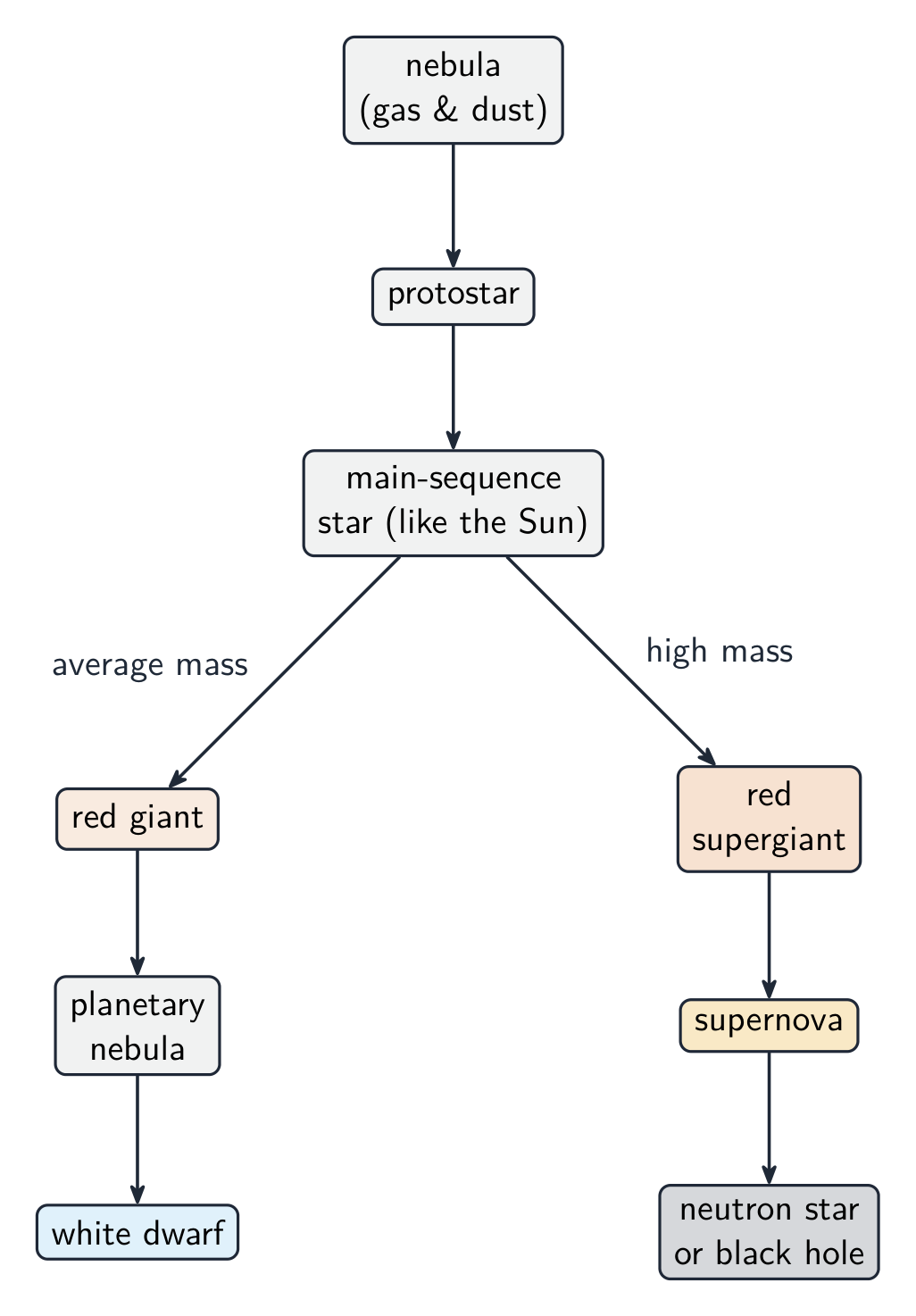
  • A medium star (like the Sun) swells into a red giant 红巨星. It then throws off its outer layers as a glowing cloud called a planetary nebula 星云, leaving a small, hot white dwarf 白矮星 at the centre.
  • A much heavier star swells into a red supergiant 红超巨星 and then explodes as a supernova 超新星. This blast spreads out a nebula containing hydrogen and new, heavier elements, and leaves behind a neutron star 中子星 or a black hole 黑洞.

The nebula from a supernova can later form new stars, with planets orbiting them — so our own Solar System came from earlier stars.

ไทย

ดาวฤกษ์เกิด เติบโต และตายไปตลอดช่วงเวลาที่ยาวนานมาก:

  1. ดาวฤกษ์ก่อตัวจาก เมฆระหว่างดาว ของแก๊สและฝุ่นที่มีไฮโดรเจน
  2. แรงโน้มถ่วงดึงเมฆเข้าหากัน และมันร้อนขึ้น เมฆที่กำลังยุบตัวและร้อนขึ้นนี้คือ ดาวก่อนลำดับหลัก (protostar)
  3. ดาวก่อนลำดับหลักจะกลายเป็นดาว เสถียร เมื่อแรงดึงเข้าหากันของแรงโน้มถ่วงถูกสมดุลด้วยแรงดันออกที่เกิดจากอุณหภูมิสูงมากในแกนกลางของมัน
  4. ในที่สุดแล้ว ดาวทุกดวงจะหมด เชื้อเพลิง ไฮโดรเจนสำหรับการหลอมรวม

สิ่งที่เกิดขึ้นต่อไปขึ้นอยู่กับมวลของดาว:

  • ดาวขนาดกลาง (เช่น ดวงอาทิตย์) จะขยายตัวเป็น ดาวดแดงยักษ์ จากนั้นจะปลดชั้นนอกออกเป็นเมฆเรืองแสงที่เรียกว่า เนบิวลา ทิ้งให้เหลือ ดาวแคระขาว ขนาดเล็กและร้อนแรงอยู่ตรงกลาง
  • ดาวที่มีมวลหนักมากจะขยายตัวเป็น ดาสดแดงยักษ์超大 แล้วระเบิดเป็น ซูเปอร์โนวา การระเบิดนี้จะกระจายเนบิวลาที่มีไฮโดรเจนและธาตุหนักใหม่ๆ ออกไป และทิ้งไว้ข้างหลังเป็น ดาวนิวตรอน หรือ 黑洞
แผนภูมิการไหลของการเกิดชีวิตของดาวฤกษ์ โดยแยกตามมวลไปสู่เส้นทางดาวยักษ์แดงและดาวซุปเปอร์ไจアント
ทุกดวงดาวเริ่มต้นจากเนบิวลา; วิธีการสิ้นสุดขึ้นอยู่กับมวลของมัน

เนบิวลาจากซูเปอร์โนวาสามารถก่อตัวเป็นดาวฤกษ์ใหม่ในภายหลัง พร้อมกับดาวเคราะห์ที่โคจรรอบมัน — ดังนั้นระบบสุริยะของเราจึงมาจากดาวฤกษ์ยุคก่อนหน้า

Explore · ⁨สำรวจ⁩

The life cycle of a star · ⁨วัฏจักรชีวิตของดาว⁩

Gravity pulls a gas cloud together; fusion lights the star; when its fuel runs low it swells and finally fades. · ⁨แรงโน้มถ่วงดึงเมฆแก๊สมารวมกัน; การหลอมรวมทำให้ดาวส่องสว่าง; เมื่อเชื้อเพลิงหมด ดาวจะขยายตัว并最终 faded⁩

Explore · ⁨สำรวจ⁩

The life cycle of a Sun-like star · ⁨วงจรชีวิตของดาวคล้ายดวงอาทิตย์⁩

Step through how a star like our Sun is born, lives and dies. · ⁨เดินผ่านวิธีที่ดาวคล้ายดวงอาทิตย์เกิด มีชีวิต และตาย⁩

Vocabulary · ⁨คำศัพท์⁩ Train · ⁨ฝึกฝน⁩
English ไทย
star/stɑː/ ดาว
hydrogen/ˈhaɪdrədʒn/ ไฮโดรเจน
helium/ˈhiːlɪəm/ ฮีเลียม
ultraviolet/ˌʊltrəˈvaɪəlɪt/ อัลตราไวโอเลต
electromagnetic spectrum/ɪˌlektrəʊməɡˈnetɪk ˈspektrəm/ สเปกตรัมคลื่นแม่เหล็กไฟฟ้า
nuclear reaction/ˈnjuːklɪə rɪˈækʃn/ ปฏิกิริยานิวเคลียร์
nuclear fusion/ˈnjuːklɪə ˈfjuːʒn/ การหลอมรวมนิวเคลียร์
protostar/ˈprəʊtəʊstɑː/ ดาวก่อนลำดับหลัก
stable/ˈsteɪbl/ เสถียร
6.2

The expanding Universe · ⁨จักรวาลที่กำลังขยายตัว⁩

English

When a star or galaxy moves away from us (it is receding 退行), the light we receive from it has a longer wavelength 波长 than normal — it is shifted towards the red end of the spectrum. This is redshift 红移.

The light from distant galaxies is redshifted, and the further away a galaxy is, the bigger its redshift. This tells us that the galaxies are moving apart: the Universe is expanding 膨胀. Running this backwards, everything was once together at a single point — this is the evidence for the Big Bang 大爆炸 theory.

More evidence and the age of the Universe

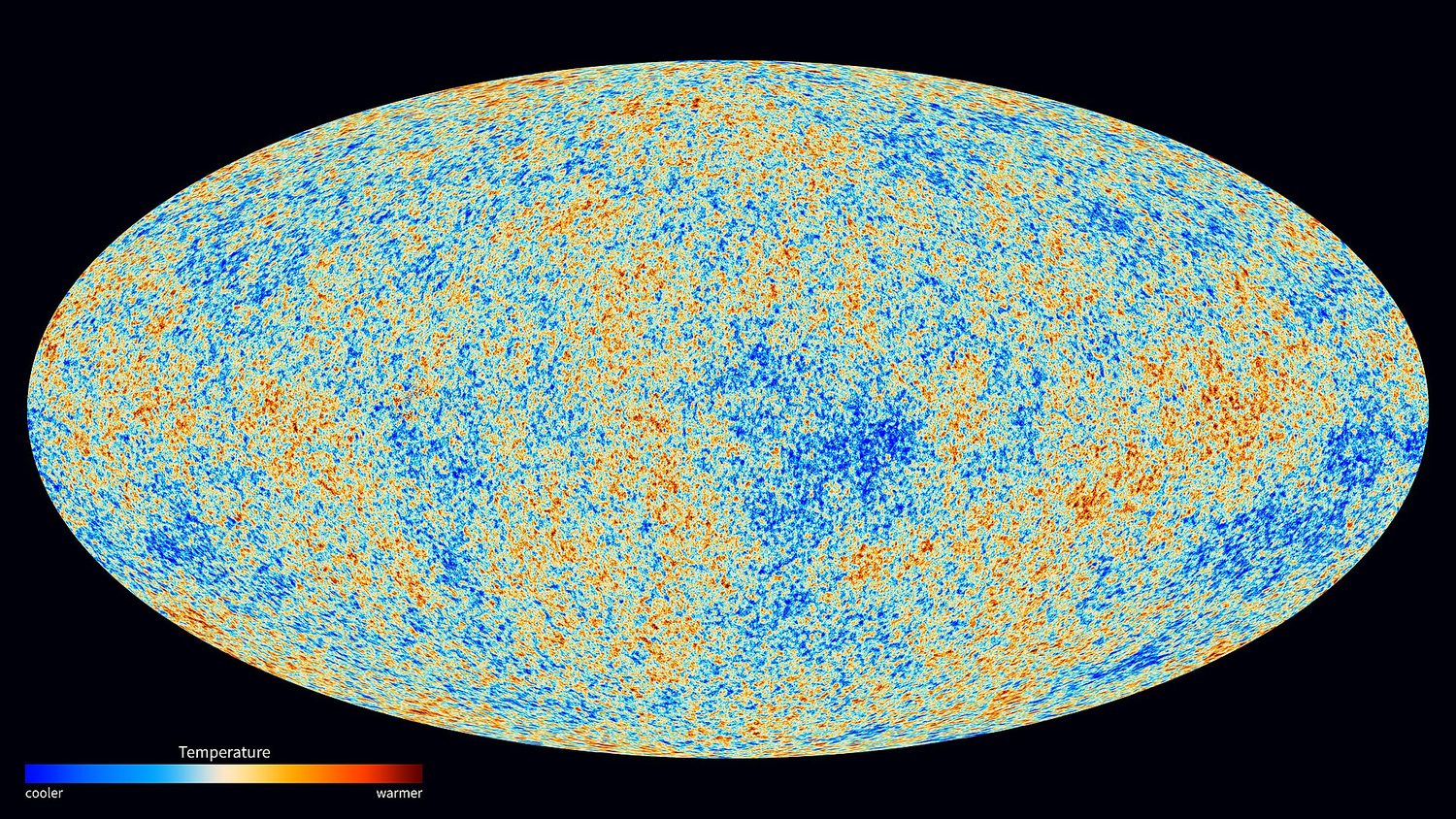
Faint microwave 微波 radiation 辐射 is found coming from every direction in space. This is the cosmic microwave background radiation 宇宙微波背景辐射 (CMBR). It was made as high-energy radiation soon after the Big Bang, and has been stretched out into the microwave part of the spectrum as the Universe expanded.

For a distant galaxy:

  • its speed $v$ of moving away can be found from the redshift of its starlight;
  • its distance $d$ can be found from the brightness of a supernova seen in it.

The Hubble constant 哈勃常数 $H_0$ links these two:

$$H_0 = \frac{v}{d}$$

Its value today is about $2.2 \times 10^{-18}$ per second. Turning this around gives an estimate for the age of the Universe:

$$\frac{d}{v} = \frac{1}{H_0}$$

Worked example. The Hubble constant is about $H_0 = 2.2 \times 10^{-18}$ per second. Estimate the age of the Universe.

$$\frac{1}{H_0} = \frac{1}{2.2 \times 10^{-18}} \approx 4.5 \times 10^{17}\ \text{s}$$

That is roughly $14$ billion years.

This works because every galaxy seems to have started from the same single point at the same time — more support for the Big Bang.

ไทย

เมื่อดาวหรือกาแล็กซีเคลื่อนที่ห่างจากเรา (กำลัง ถอยห่าง), แสงที่เราได้รับจาก它有มี ความยาวคลื่น ที่ยาวกว่าปกติ — มันถูกเลื่อน haciaปลายสีแดงของสเปกตรัม สิ่งนี้เรียกว่า การเลื่อนไปทางแดง (redshift).

สองสเปกตรัม: เส้นของกาแล็กซีที่อยู่ไกลถูกเลื่อน haciaปลายสีแดงเมื่อเทียบกับเส้นใกล้
เส้นมืดในสเปกตรัมของกาแล็กซีที่อยู่ไกลถูกเลื่อน haciaปลายสีแดง — นี่คือ redshift

แสงจากกาแล็กซีที่อยู่ไกลมีการเลื่อนไปทางแดง และยิ่งกาแล็กซีอยู่ไกลมากเท่าไหร่ การเลื่อนไปทางแดงก็ยิ่งมากเท่านั้น สิ่งนี้บ่งบอกว่ากาแล็กซีกำลังเคลื่อนที่ออกจากกัน: จักรวาลกำลัง ขยายตัว เมื่อพิจารณาย้อนกลับ ทุกอย่างเคยอยู่รวมกันเป็นจุดเดียว — นี่คือหลักฐานของทฤษฎี บิgz Bang

กาแล็กซีรอบๆ ตัวเราแต่ละดวงมีลูกศรชี้ออกไปด้านนอก ลูกศรที่ยาวขึ้นสำหรับกาแล็กซีที่อยู่ไกลกว่า
ทุกโลกกาแล็กซีเคลื่อนที่ออกห่างจากเรา และดวงที่อยู่ไกล越远เคลื่อนที่ออกห่าง越快 — จักรวาลกำลังขยายตัว

หลักฐานเพิ่มเติมและอายุของจักรวาล

รังสี ไมโครเวฟ ที่อ่อนแอพบได้มาจากทุกทิศทางในอวกาศ นี่คือ รังสีพื้นหลังไมโครเวฟจากจักรวาล (CMBR)它ถูกผลิตขึ้นในฐานะรังสีพลังงานสูง shortly after บิgz Bang, และถูกยืดออกสู่ส่วนไมโครเวฟของสเปกตรัมขณะจักรวาลขยายตัว

แผนที่ท้องฟ้าทั้งดวงรูปวงรีกระจายจุดสีน้ำเงินและแดง แสดงความแตกต่างของอุณหภูมิเล็กน้อยในพื้นหลังไมโครเวฟ *ท้องฟ้าทั้งหมดถูกทำแผนที่ด้วยไมโครเวฟ: แสงเรืองรองอันอ่อนยานี้มาถึงเราจากทุกทิศทางเป็นความร้อนตกค้างจากจักรวาลวัยเยาว์ — หลักฐานอันแข็งแกร่งสำหรับทฤษฎีบิgz Bang

สำหรับกาแล็กซีที่อยู่ไกล:

  • ความเร็ว $v$ ที่เคลื่อนที่หนีออกจากเรา สามารถหาได้จากค่าการเลื่อนไปทางแดงของแสงดาว;
  • ระยะทาง $d$ ของมัน สามารถหาได้จากความสว่างของ ซูเปอร์โนวา ที่สังเกตได้ในดาราจักรนั้น

นั่นคือประมาณ $H_0$ พันล้านปี

$$H_0 = \frac{v}{d}$$

ค่าปัจจุบันอยู่ที่ประมาณ $2.2 \times 10^{-18}$ ต่อวินาที เมื่อกลับด้านจะได้การประมาณอายุของจักรวาล:

$$\frac{d}{v} = \frac{1}{H_0}$$

ตัวอย่างวิธีทำ ค่าคงที่ฮับเบิลอยู่ที่ประมาณ $H_0 = 2.2 \times 10^{-18}$ ต่อวินาที ให้ประมาณอายุของจักรวาล

$$\frac{1}{H_0} = \frac{1}{2.2 \times 10^{-18}} \approx 4.5 \times 10^{17}\ \text{s}$$

นั่นคือประมาณ $14$ พันล้านปี

สิ่งนี้เกิดขึ้นได้เพราะทุกกาแล็กซีดูเหมือนจะเริ่มจากจุดเดียวเดียวกันในเวลาเดียวกัน — เป็นหลักฐานเพิ่มเติมสนับสนุนทฤษฎีบิกแบง

Explore · ⁨สำรวจ⁩

The expanding Universe · ⁨เอกภพที่กำลังขยายตัว⁩

v = H₀·d

Galaxies recede faster the farther they are — speed is proportional to distance. · ⁨กาแล็กซีที่ห่างออกไปยิ่งจะเคลื่อนที่หนีเราเร็วขึ้น — ความเร็วแปรผันตรงกับระยะทาง⁩

Vocabulary · ⁨คำศัพท์⁩ Train · ⁨ฝึกฝน⁩
English ไทย
Universe/ˈjuːnɪvɜːs/ จักรวาล
interstellar cloud/ˌɪntəˈstelə klaʊd/ เมฆระหว่างดาว
redshift/ˈredʃɪft/ redshift (การ-shift ไปทางสีแดง)
expanding/ekˈspændɪŋ/ กำลังขยายตัว
Big Bang/bɪɡ bæŋ/ บิกแบง
microwave/ˈmaɪkrəʊweɪv/ ไมโครเวฟ
radiation/ˌreɪdɪˈeɪʃn/ รังสี
cosmic microwave background radiation/ˈkɒzmɪk ˈmaɪkrəʊweɪv ˈbækɡraʊnd ˌreɪdɪˈeɪʃn/ รังสีไมโครเวฟจากเอกภพ (cosmic microwave background radiation)
Hubble constant/ˈhʌbl ˈkɒnstənt/ ค่าคงที่ฮับเบิล
6.2

Exam tips · ⁨ข้อแนะนำสำหรับการสอบ⁩

English
  • In $v = \dfrac{2\pi r}{T}$, $r$ is the orbit radius and $T$ is the time for one full orbit in seconds — convert km to m and hours to seconds first.
  • Planets closer to the Sun feel stronger gravity, so they orbit faster and take less time. In an elliptical orbit a body speeds up as it nears the Sun (gravitational potential energy turns into kinetic energy).
  • A light-year is a distance, not a time — how far light travels in one year.
  • A star is stable when the inward pull of gravity is balanced by the outward push from the energy released by fusion in its core. What it becomes when its fuel runs out depends on its mass.
  • Redshift — light from distant galaxies shifted to longer (redder) wavelengths, with a bigger shift the further away — is the evidence that the Universe is expanding, which supports the Big Bang.
ไทย
  • ใน $v = \dfrac{2\pi r}{T}$, $r$ คือรัศมีวงโคจร และ $T$ คือเวลาสำหรับหนึ่งรอบเต็มเป็นวินาที — ต้องแปลงกิโลเมตรเป็นเมตรและชั่วโมงเป็นวินาทีก่อน
  • Redshift — แสงจากกาแล็กซีที่อยู่ไกลเลื่อน towards ความยาวคลื่นที่ยาวกว่า (สีแดงกว่า),越遠越大的 shift — เป็นหลักฐานว่าจักรวาลกำลัง ขยายตัว, ซึ่งสนับสนุนทฤษฎีบิgz Bang
  • แสง-ปี เป็น ระยะทาง ไม่ใช่เวลา — ระยะที่แสงเดินทางได้ในหนึ่งปี
  • ดาวจะ เสถียร เมื่อแรงดึงดูดที่ดึงเข้าหาศูนย์กลางถูกสมดุลด้วยแรงผลักจากพลังงานที่ถูกปล่อยออกมาจากการ ฟิวชัน ในแก่นกลาง ของมัน เมื่อเชื้อเพลิงหมดลง它将取决于其 mass (มวล). What it becomes when its fuel runs out depends on its mass.
  • การเลื่อนไปทางแดง — แสงจากกาแล็กซีไกลๆ ที่มีการเลื่อน hacia波长ที่ยาวกว่า (สีแดงขึ้น) โดยยิ่งเลื่อนมากยิ่งแสดงว่าอยู่ไกล — เป็นหลักฐานว่าจักรวาลกำลัง ขยายตัว ซึ่งสนับสนุนทฤษฎีบิกแบง
Vocabulary · ⁨คำศัพท์⁩ Train · ⁨ฝึกฝน⁩
English ไทย
fuel/ˈfjuːəl/ เชื้อเพลิง
red giant/red ˈdʒaɪənt/ ดาวยักษ์แดง
nebula/ˈnebjʊlə/ เนบิวลา
white dwarf/waɪt dwɔːf/ ดาวแคระขาว
red supergiant/red ˈsuːpədʒaɪənt/ ดาวยักษ์แดง
supernova/ˌsuːpəˈnəʊvə/ ซูเปอร์โนวา
neutron star/ˈnjuːtrɒn stɑː/ ดาวนิวตรอน
black hole/blæk həʊl/ หลุมดำ
receding/rɪˈsiːdɪŋ/ ถอยห่าง
wavelength/ˈweɪvleŋθ/ ความยาวคลื่น

Interactive lessons on this topic · ⁨บทเรียนเชิงโต้ตอบสำหรับหัวข้อนี้⁩

Work through it step by step, with instant-check exercises. · ⁨ทำทีละขั้นตอน พร้อมแบบฝึกหัดตรวจสอบผลทันที⁩

Past Papers · ⁨ข้อสอบย้อนหลัง⁩

More topics in IGCSE Physics · ⁨Physics IGCSE⁩ · ⁨หัวข้อเพิ่มเติมใน IGCSE Physics · ⁨Physics IGCSE⁩⁩

Log in or create account · ⁨เข้าสู่ระบบหรือสร้างบัญชี⁩

IGCSE, A-Level & AP