English narration · English + 中文 subtitles burned in · การบรรยายภาษาอังกฤษ · คำบรรยายภาษาอังกฤษ + 中文 ลอยตัวบนภาพ
5.1
Exothermic and endothermic reactions · ปฏิกิริยาคายความร้อนและปฏิกิริยาดูดความร้อน
Syllabus · หลักสูตร
English
Core
Supplement
1 State that an exothermic reaction transfers thermal energy to the surroundings leading to an increase in the temperature of the surroundings
4 State that the transfer of thermal energy during a reaction is called the enthalpy change, $\Delta H$, of the reaction. $\Delta H$ is negative for exothermic reactions and positive for endothermic reactions
2 State that an endothermic reaction takes in thermal energy from the surroundings leading to a decrease in the temperature of the surroundings
5 Define activation energy, $E_a$, as the minimum energy that colliding particles must have to react
3 Interpret reaction pathway diagrams showing exothermic and endothermic reactions
6 Draw and label reaction pathway diagrams for exothermic and endothermic reactions using information provided, to include: (a) reactants (b) products (c) enthalpy change of the reaction, $\Delta H$ (d) activation energy, $E_a$
7 State that bond breaking is an endothermic process and bond making is an exothermic process and explain the enthalpy change of a reaction in terms of bond breaking and bond making
8 Calculate the enthalpy change of a reaction using bond energies
Source: Cambridge International syllabus · แหล่งที่มา: หลักสูตร Cambridge International
English
Reaction profile: exothermic energy change
In every chemical reaction, energy is transferred. The reaction is either exothermic or endothermic, depending on which way the energy moves.
An exothermic reaction 放热反应 gives out thermal energy 热能 to the surroundings 环境. So the temperature of the surroundings goes up.
An endothermic reaction 吸热反应 takes in thermal energy from the surroundings. So the temperature of the surroundings goes down.
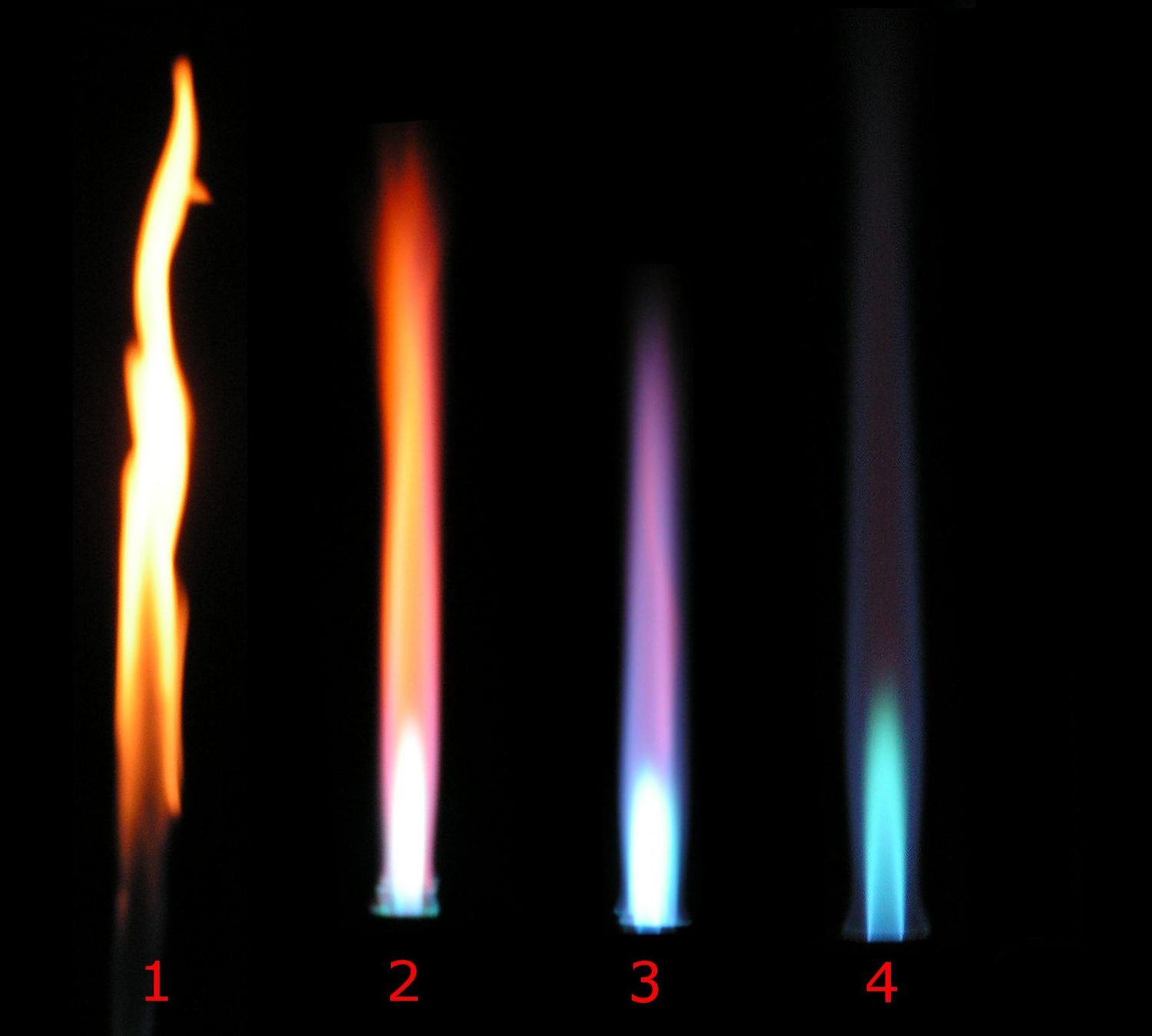
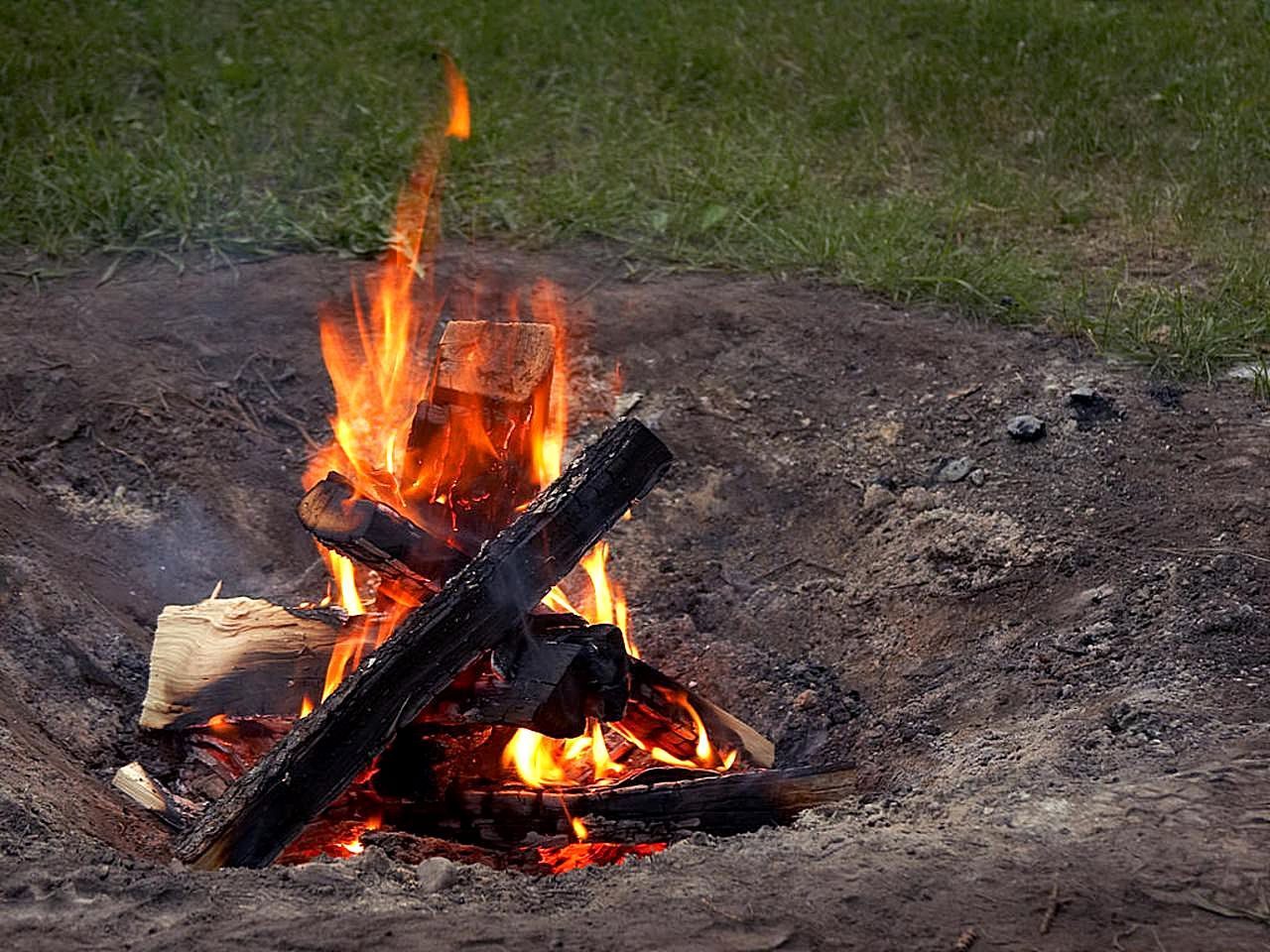
Examples of exothermic reactions are combustion 燃烧 (burning a fuel) and neutralisation 中和 (an acid reacting with an alkali). An example of an endothermic reaction is the thermal decomposition 分解 of a compound (breaking it down using heat).
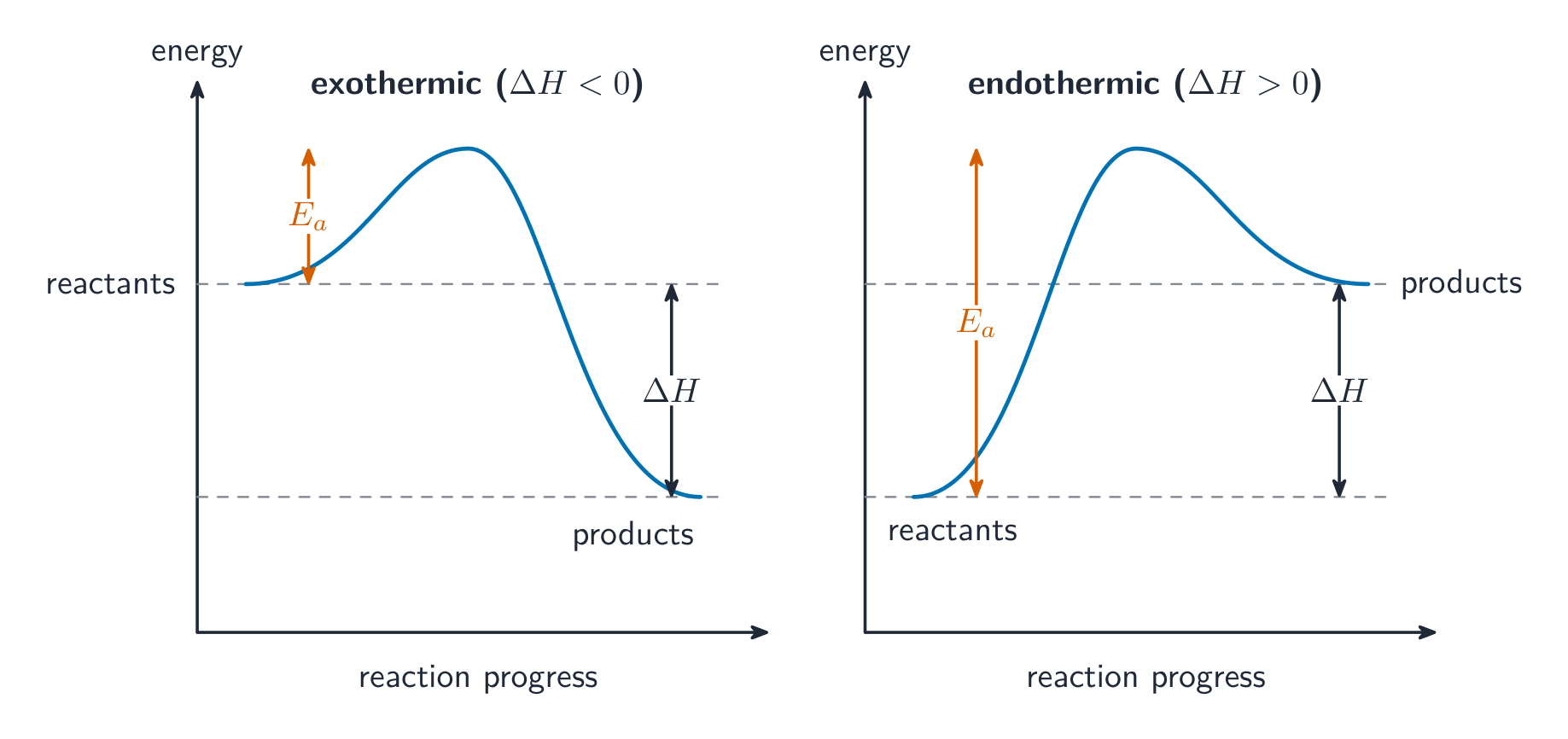
Particles do not react every time they meet. The activation energy 活化能 ($E_a$) is the smallest amount of energy that colliding 碰撞particles 粒子 must have before they can react. It is like a hill the particles must get over before the reaction can happen.
Activation energy · พลังงานกระตุ้น (Activation energy)
Ea = the energy barrier · Ea = กำแพงพลังงาน
Every reaction must climb the activation-energy barrier before products can form. · ทุกปฏิกิริยาต้องข้ามกำแพง พลังงานกัมมันต์ ก่อนที่ผลิตภัณฑ์จะเกิดขึ้น
A reaction pathway diagram 反应进程图 shows how the energy changes as a reaction happens. Energy is on the vertical axis, and the progress of the reaction is on the horizontal axis.
The line starts at the energy level of the reactants 反应物.
It rises over a 'hill' — the height of this hill is the activation energy $E_a$.
It then falls or rises to the energy level of the products 生成物.
The gap between the reactant level and the product level is the enthalpy change $\Delta H$.
For an exothermic reaction, the products are lower than the reactants, so energy is given out and $\Delta H$ is negative.
For an endothermic reaction, the products are higher than the reactants, so energy is taken in and $\Delta H$ is positive.
Drag ΔH and the activation energy. Exothermic releases energy; endothermic takes it in; the hump is the energy barrier. · ลาก ΔH และพลังงานกระตุ้น คายความร้อน ปล่อยพลังงาน; ดูดความร้อน ดูดซับพลังงาน; ปุ่มยอดคือกำแพงพลังงาน
5.1
Bonds and energy · พันธเคมีและพลังงาน
English
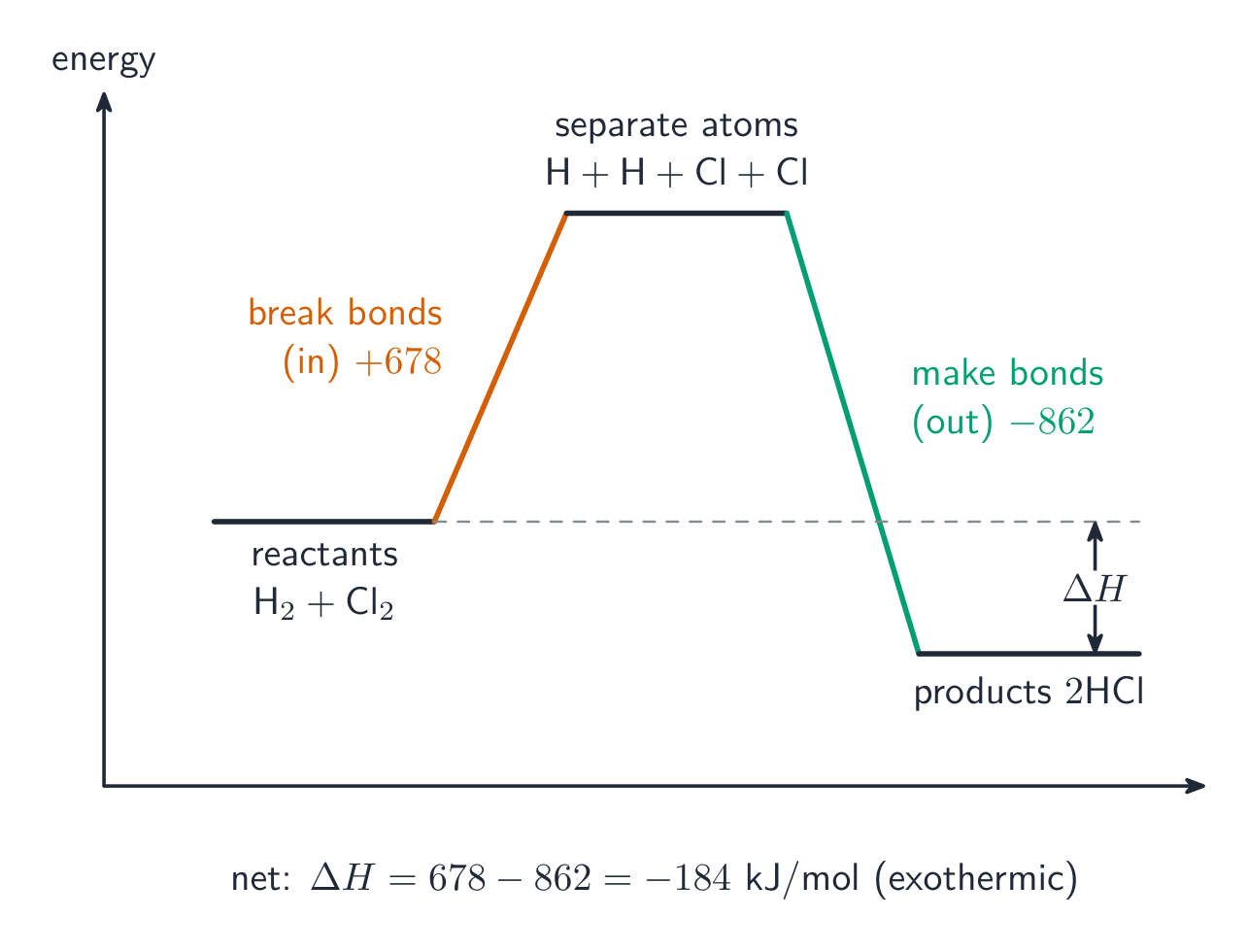
A reaction involves breaking the bonds in the reactants and making new bonds in the products.
Bond breaking 断键 takes in energy, so it is an endothermic step.
Bond making 成键 gives out energy, so it is an exothermic step.
The bond energy 键能 is the energy needed to break one mole of a particular bond. You can use bond energies to find the enthalpy change:
$$\Delta H = (\text{energy to break all bonds}) - (\text{energy released making all bonds})$$
If more energy is given out making bonds than is taken in breaking bonds, the reaction is exothermic ($\Delta H$ negative). If less energy is given out, it is endothermic ($\Delta H$ positive).
Worked example
For the reaction $\text{H}_2 + \text{Cl}_2 \rightarrow 2\text{HCl}$, use these bond energies (in kJ/mol): H–H $= 436$, Cl–Cl $= 242$, H–Cl $= 431$.
Bonds broken: one H–H and one Cl–Cl $= 436 + 242 = 678$.
Bonds made: two H–Cl $= 2 \times 431 = 862$.
$$\Delta H = 678 - 862 = -184 \text{ kJ/mol}$$
The answer is negative, so this reaction is exothermic.
Exothermic gives out heat, so the surroundings warm up and $\Delta H$ is negative; endothermic takes in heat, so the surroundings cool and $\Delta H$ is positive.
Bond breaking takes energy in (endothermic); bond making gives energy out (exothermic). Use $\Delta H = (\text{energy to break bonds}) - (\text{energy released making bonds})$.
If more energy is released making bonds than is used breaking them, the reaction is exothermic. Always check the sign of your final answer.
On a reaction pathway diagram, an exothermic reaction ends lower than it starts; an endothermic one ends higher. The height of the hill is the activation energy.
การแตกพันธ ดูดพลังงานเข้า (ดูดความร้อน); การสร้างพันธ ปล่อยพลังงานออก (คายความร้อน) ใช้ $\Delta H = (\text{energy to break bonds}) - (\text{energy released making bonds})$
Pick one and the site follows you — notes, papers, videos and practice all open on it. · เลือกหนึ่งตัว และเว็บจะติดตามคุณ — หมายเหตุ, ใบงาน, วิดีโอ และการฝึกฝนจะเปิดอยู่ที่นั้น
Type to search notes, lessons, code, vocabulary and past-paper questions across every subject. · พิมพ์เพื่อค้นหาบันทึก, บทเรียน, โค้ด, คำศัพท์ และคำถามข้อสอบเก่าในทุกวิชา