English narration · English + 中文 subtitles burned in · การบรรยายภาษาอังกฤษ · คำบรรยายภาษาอังกฤษ + 中文 ลอยตัวบนภาพ
2.1
Cells: the building blocks of life · เซลล์: หน่วยสร้างพื้นฐานของชีวิต
Syllabus · หลักสูตร
English
Core
Supplement
1 Describe and compare the structure of a plant cell with an animal cell, limited to: cell wall, cell membrane, nucleus, cytoplasm, chloroplasts, ribosomes, mitochondria, vacuoles
2 Describe the structure of a bacterial cell, limited to: cell wall, cell membrane, cytoplasm, ribosomes, circular DNA, plasmids
3 Identify the cell structures listed in 2.1.1 and 2.1.2 in diagrams and images of plant, animal and bacterial cells
4 Describe the functions of the structures listed in 2.1.1 and 2.1.2 in plant, animal and bacterial cells
5 State that new cells are produced by division of existing cells
6 State that specialised cells have specific functions, limited to: (a) ciliated cells – movement of mucus in the trachea and bronchi (b) root hair cells – absorption (c) palisade mesophyll cells – photosynthesis (d) neurones – conduction of electrical impulses (e) red blood cells – transport of oxygen (f) sperm and egg cells (gametes) – reproduction
7 Describe the meaning of the terms: cell, tissue, organ, organ system and organism as illustrated by examples given in the syllabus
Source: Cambridge International syllabus · แหล่งที่มา: หลักสูตร Cambridge International
English
Every living thing is made of cells 细胞. A cell is the smallest part that can carry out the life processes. In this topic you compare a plant 植物 cell, an animal 动物 cell and the cell of a bacterium 细菌. All new cells are made by the division 分裂 of cells that already exist.
Which structures are in each cell?
Structure
Animal cell
Plant cell
Bacterial cell
cell membrane 细胞膜
yes
yes
yes
cytoplasm 细胞质
yes
yes
yes
ribosomes 核糖体
yes
yes
yes
nucleus 细胞核
yes
yes
no — has a loop of DNA instead
mitochondria 线粒体
yes
yes
no
cell wall 细胞壁
no
yes
yes (different material)
chloroplasts 叶绿体
no
yes (only in green parts)
no
large vacuole 液泡
no
yes
no
plasmids
no
no
yes
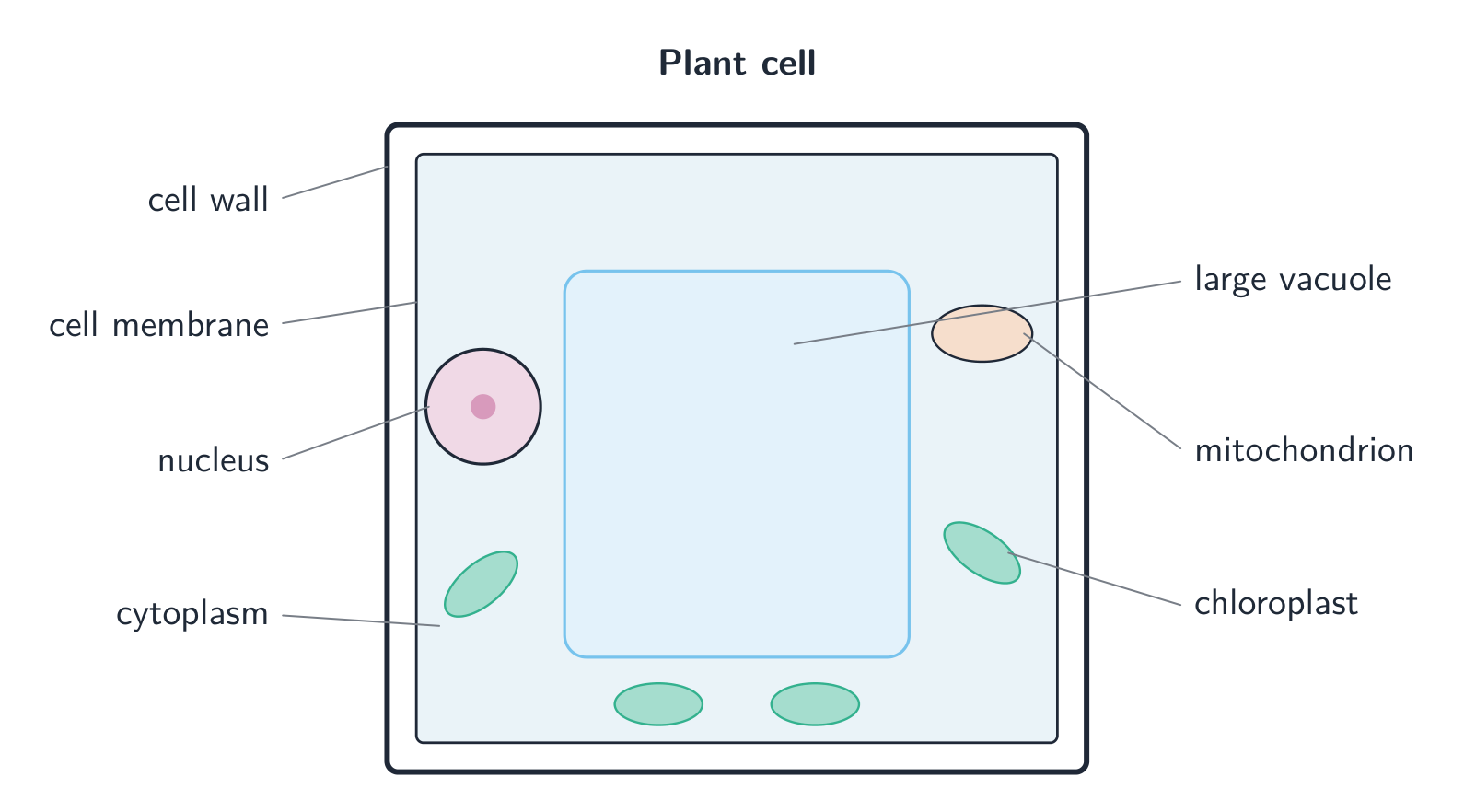
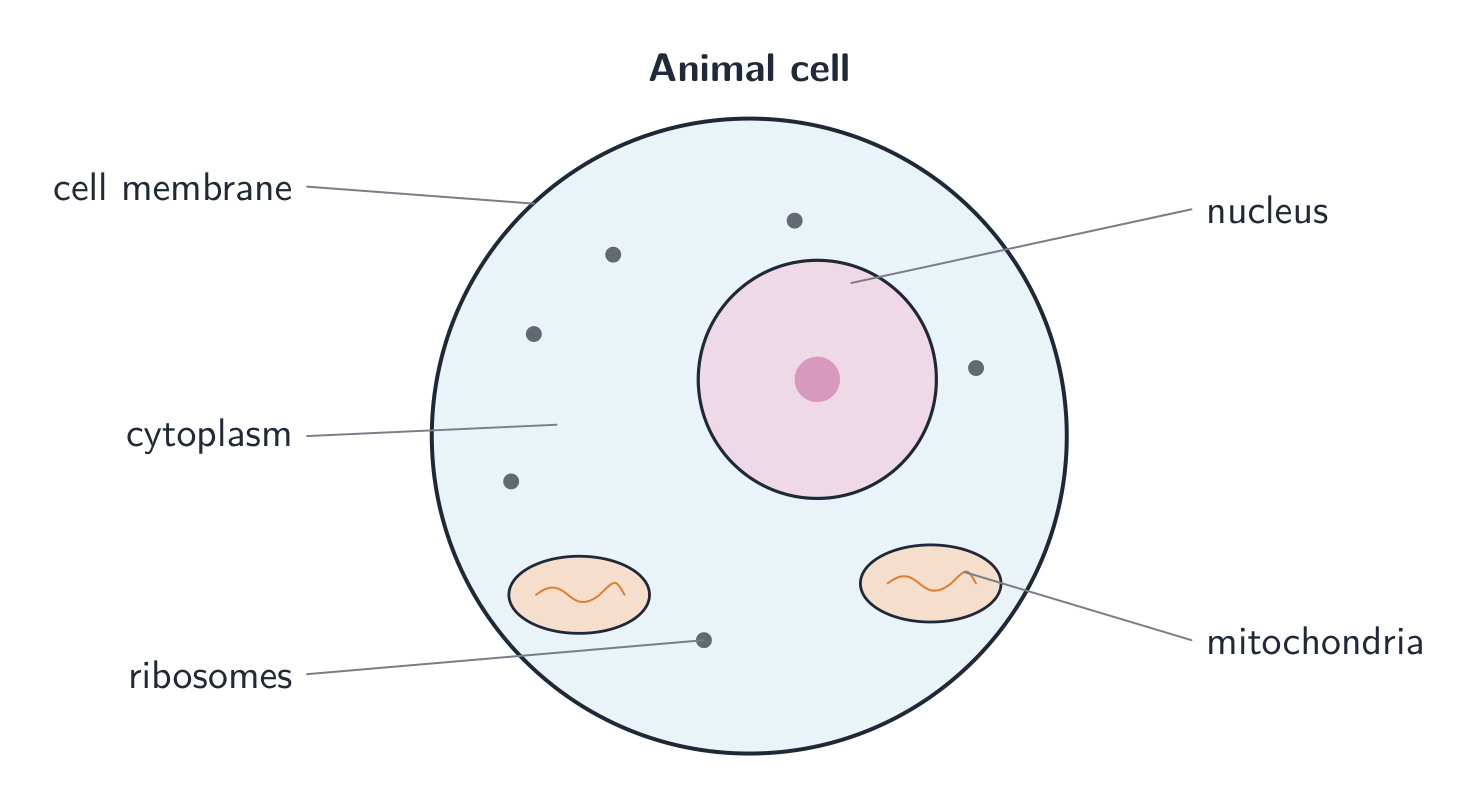
So plant and animal cells share five structures: cell membrane, cytoplasm, ribosomes, nucleus and mitochondria. A plant cell has three extra structures: a cell wall, a large vacuole and (in green parts) chloroplasts.
What each structure does
Cell membrane — controls which substances enter and leave the cell.
Cytoplasm — a jelly-like liquid where many chemical reactions happen.
Nucleus — controls the cell's activities and holds the genetic material 遗传物质.
Ribosomes — where proteins 蛋白质 are made.
Mitochondria — where respiration 呼吸作用 happens to release energy 能量.
Cell wall — made of cellulose 纤维素; it gives a plant cell strength and a fixed shape.
Chloroplasts — contain chlorophyll 叶绿素, a green substance that traps light for photosynthesis 光合作用.
Large vacuole — filled with cell sap 细胞液; it helps keep the plant cell firm.
Bacterial cells
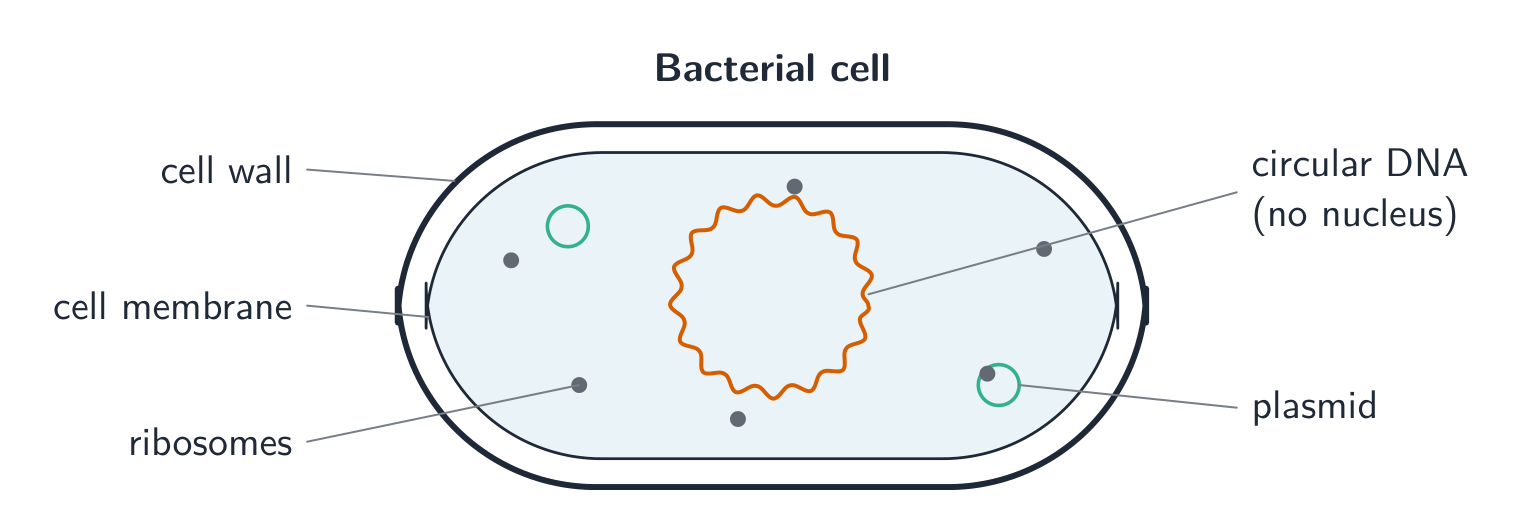
A bacterium is a prokaryote 原核生物 — its cell has no nucleus. Instead its DNA is a single loop (a ring), loose in the cytoplasm. Bacteria also have small extra rings of DNA called plasmids 质粒. A bacterial cell has a cell wall and cell membrane, cytoplasm and ribosomes, but no mitochondria and no chloroplasts.
แบคทีเรีย เป็น โปรคาริโอต — เซลล์ของมันไม่มี นิวเคลียส แทนที่ DNA ของมันจะเป็นวงแหวนเดียว (วงแหวน) ลอยอยู่ในไซโทพลาซึม แบคทีเรียยังมีวงแหวน DNA ขนาดเล็กเพิ่มเติมที่เรียกว่า พ্লাสมิด เซลล์แบคทีเรียมีผนังเซลล์และเยื่อหุ้มเซลล์ ไซโทพลาซึม และไรโบโซม แต่ไม่มีไมโทคอนเดรียและไม่มีคลอโรพลาสต์
เซลล์แบคทีเรียไม่มีนิวเคลียส — DNA ของมันเป็นวงแหวนเดียว พร้อมด้วยพ্লাสมิดขนาดเล็ก
Explore · สำรวจ
Explore the parts of a cell · สำรวจองค์ประกอบของเซลล์
Tap each part of the cell to see what it does. Some parts (cell wall, chloroplast, vacuole) are found only in plant cells. · แตะแต่ละส่วนของเซลล์เพื่อดูหน้าที่ของมัน บางส่วน (ผนังเซลล์, คลอโรพลาสต์, วakyol) พบเฉพาะในเซลล์พืช
Source: Cambridge International syllabus · แหล่งที่มา: หลักสูตร Cambridge International
English
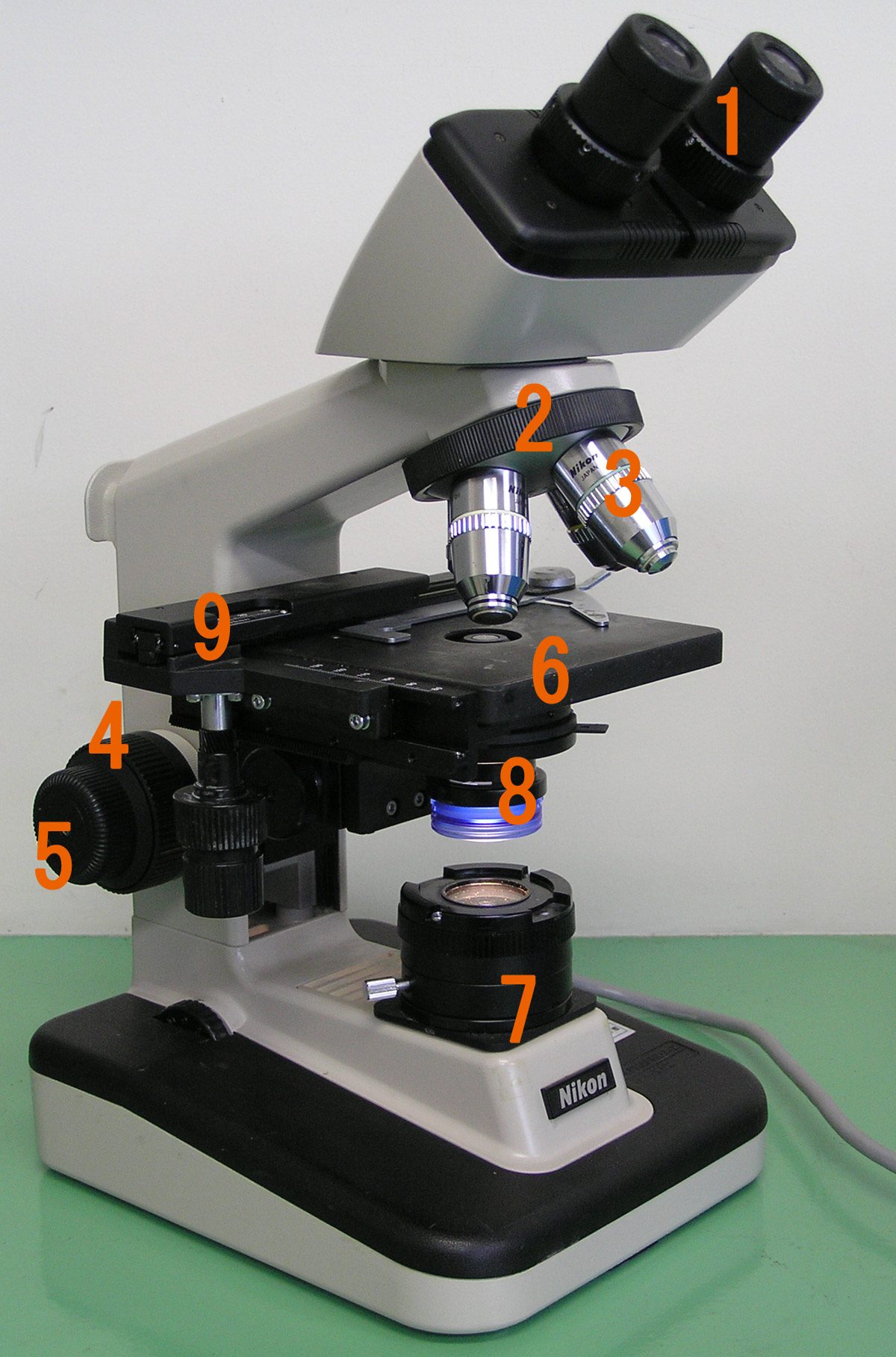
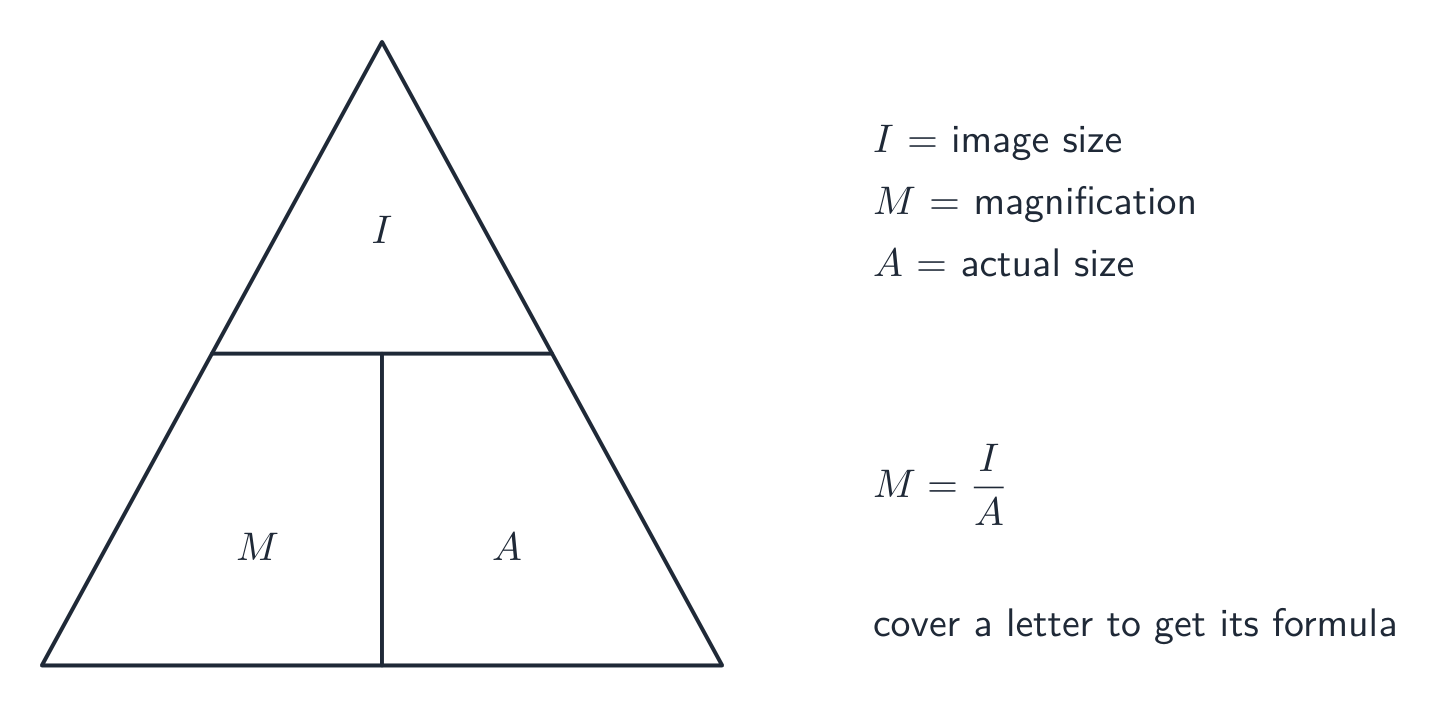
Cells are tiny, so you look at them under a microscope 显微镜, which makes them appear much larger. How many times larger the image is, is called the magnification 放大倍数.
Worked example. A structure is shown at a magnification of 250. Its image size is 5.00 mm. So the actual size = 5.00 ÷ 250 = 0.02 mm. Always put both sizes in the same unit before you divide.
Changing units (Supplement)
Cells are often measured in micrometres 微米 (μm), which are smaller than millimetres (mm):
So 0.02 mm = 20 μm. To change mm into μm, multiply by 1000. To change μm into mm, divide by 1000.
Worked example. A cell is drawn 60 mm wide, and its real width is 30 μm. Find the magnification. First make the units match: image size = 60 mm = 60 × 1000 = 60,000 μm. Then magnification = image ÷ actual = 60,000 ÷ 30 = ×2000. If you forget to convert and divide 60 ÷ 30, you get ×2 — a thousand times too small. This is the most common mistake in the whole topic.
ตัวอย่างวิธีทำ เซลล์วาดขนาดกว้าง 60 มม. และความกว้างจริงคือ 30 ไมโครเมตร หาความขยาย First adjust units: image size = 60 มม. = 60 × 1000 = 60,000 ไมโครเมตร Then magnification = image ÷ actual = 60,000 ÷ 30 = ×2000 If you forget to convert and divide 60 ÷ 30, you get ×2 — เล็กกว่าความเป็นจริงพันเท่า This is the most common mistake in this topic.
A plant cell has a cell wall, a large vacuole and chloroplasts; an animal cell has none of these. Both have a nucleus, cytoplasm, cell membrane, mitochondria and ribosomes.
A cell with no nucleus but with plasmids and a loop of DNA is a bacterium.
For magnification, cover the quantity you want: magnification = image ÷ actual; actual = image ÷ magnification.
Always convert to the same unit before you calculate. Remember 1 mm = 1000 μm.
For a specialised cell, link its job to the one feature that suits it (for example a red blood cell has no nucleus, so it can hold more oxygen).
Pick one and the site follows you — notes, papers, videos and practice all open on it. · เลือกหนึ่งตัว และเว็บจะติดตามคุณ — หมายเหตุ, ใบงาน, วิดีโอ และการฝึกฝนจะเปิดอยู่ที่นั้น
Type to search notes, lessons, code, vocabulary and past-paper questions across every subject. · พิมพ์เพื่อค้นหาบันทึก, บทเรียน, โค้ด, คำศัพท์ และคำถามข้อสอบเก่าในทุกวิชา