English narration · English + 中文 subtitles burned in · การบรรยายภาษาอังกฤษ · คำบรรยายภาษาอังกฤษ + 中文 ลอยตัวบนภาพ
12.1
Respiration and energy · การหายใจระดับเซลล์และพลังงาน
Syllabus · หลักสูตร
English
Core
Supplement
1 State the uses of energy in living organisms, including: muscle contraction, protein synthesis, cell division, active transport, growth, the passage of nerve impulses and the maintenance of a constant body temperature
2 Investigate and describe the effect of temperature on respiration in yeast
ไทย
แก่น
เพิ่มเติม
1 ระบุการใช้งานพลังงานในสิ่งมีชีวิต, including: muscle contraction, protein synthesis, cell division, active transport, growth, the passage of nerve impulses and the maintenance of a constant body temperature
2 ตรวจสอบและอธิบายผลของอุณหภูมิต่อการหายใจในยีสต์
Source: Cambridge International syllabus · แหล่งที่มา: หลักสูตร Cambridge International
English
Aerobic respiration
Respiration 呼吸作用 is the release of energy 能量 from food, and it happens in every living cell, all the time. (It is not the same as breathing.) Cells use this energy for many jobs:
muscle 肌肉 contraction (movement).
protein synthesis 蛋白质合成 (building proteins).
cell division 分裂 (making new cells).
active transport 主动运输.
growth.
the passage of nerve impulses 神经冲动.
keeping a constant body temperature 温度.
You can investigate respiration in yeast 酵母: warmer yeast respires faster (up to its best temperature), giving off bubbles of carbon dioxide 二氧化碳.
Respiration releases energy · การหายใจระดับเซลล์ปล่อยพลังงาน
Every living cell respires to release energy from glucose for its life processes. · ทุกเซลล์มีชีวิตมีการหายใจระดับเซลล์เพื่อปล่อยพลังงานจากกลูโคสสำหรับกระบวนการดำรงชีวิต
1 Describe aerobic respiration as the chemical reactions in cells that use oxygen to break down nutrient molecules to release energy
2 State the word equation for aerobic respiration as: glucose + oxygen → carbon dioxide + water
3 State the balanced chemical equation for aerobic respiration as: $\text{C}_6\text{H}_{12}\text{O}_6 + 6\text{O}_2 \rightarrow 6\text{CO}_2 + 6\text{H}_2\text{O}$
ไทย
แก่น
เพิ่มเติม
1 อธิบายการหายใจแบบใช้ออกซิเจน as the chemical reactions in cells that use oxygen to break down nutrient molecules to release energy
1 Describe anaerobic respiration as the chemical reactions in cells that break down nutrient molecules to release energy without using oxygen
2 State that anaerobic respiration releases much less energy per glucose molecule than aerobic respiration
3 State the word equation for anaerobic respiration in yeast as: glucose → alcohol + carbon dioxide
5 State the balanced chemical equation for anaerobic respiration in yeast as: $\text{C}_6\text{H}_{12}\text{O}_6 \rightarrow 2\text{C}_2\text{H}_5\text{OH} + 2\text{CO}_2$
4 State the word equation for anaerobic respiration in muscles during vigorous exercise as: glucose → lactic acid
6 State that lactic acid builds up in muscles and blood during vigorous exercise causing an oxygen debt
7 Outline how the oxygen debt is removed after exercise, limited to: (a) continuation of fast heart rate to transport lactic acid in the blood from the muscles to the liver (b) continuation of deeper and faster breathing to supply oxygen for aerobic respiration of lactic acid (c) aerobic respiration of lactic acid in the liver
Source: Cambridge International syllabus · แหล่งที่มา: หลักสูตร Cambridge International
English
Anaerobic respiration 无氧呼吸 breaks down glucose to release energy without oxygen. It releases much less energy from each glucose molecule than aerobic respiration, because the glucose is not fully broken down.
The alcohol 酒精 made by yeast is used to make bread rise and to brew drinks.
In muscles (Supplement)
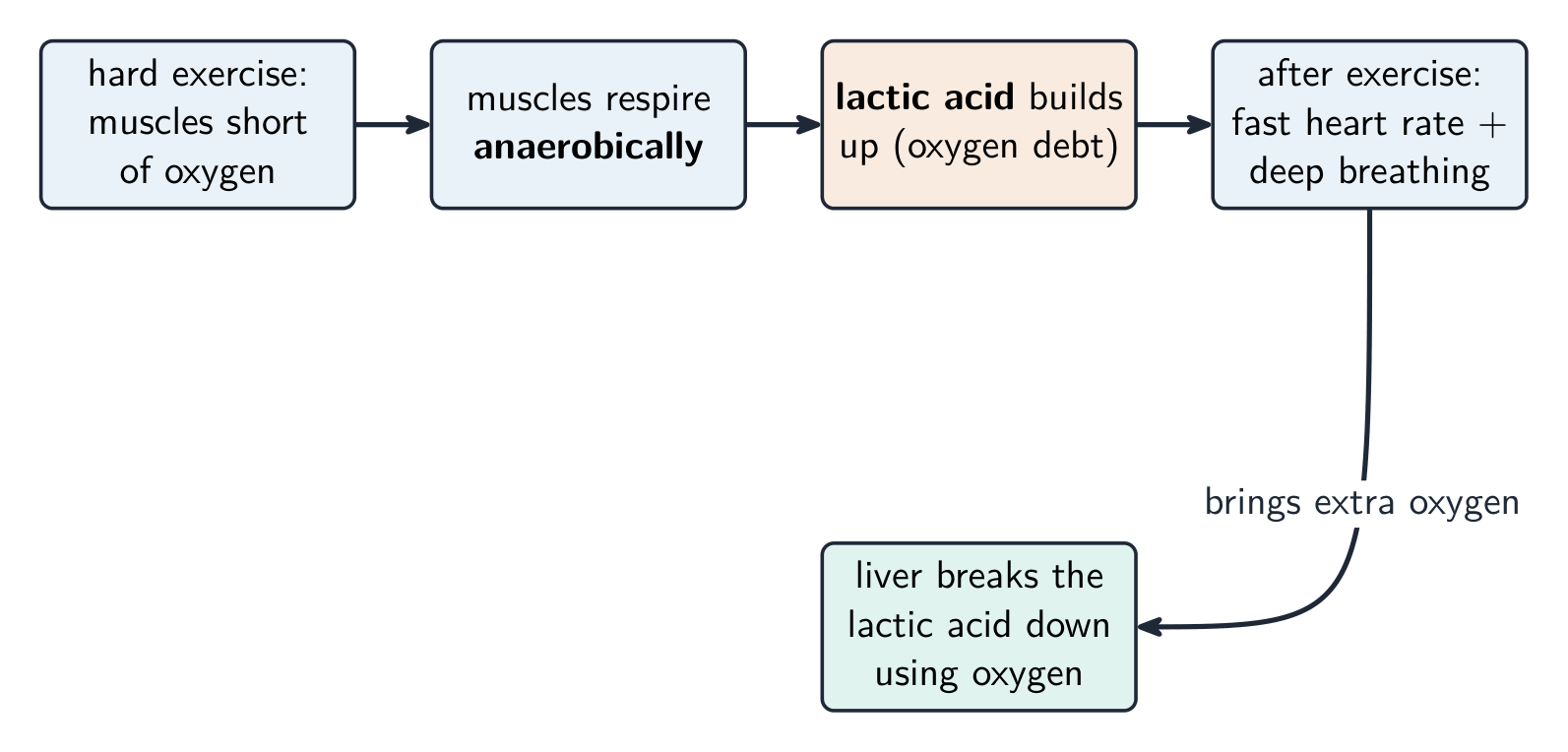
During hard exercise your muscles cannot get enough oxygen, so they respire anaerobically:
$$\text{glucose} \rightarrow \text{lactic acid}$$
The lactic acid 乳酸 builds up in the muscles and the blood. This creates an oxygen debt 氧债 — the extra oxygen the body will need later to break that lactic acid down.
After you stop exercising, the oxygen debt is repaid:
your heart rate 心率 stays high, carrying the lactic acid in the blood from the muscles to the liver 肝脏.
you keep breathing deeply and quickly, taking in extra oxygen.
the liver uses this oxygen to break the lactic acid down by aerobic respiration.
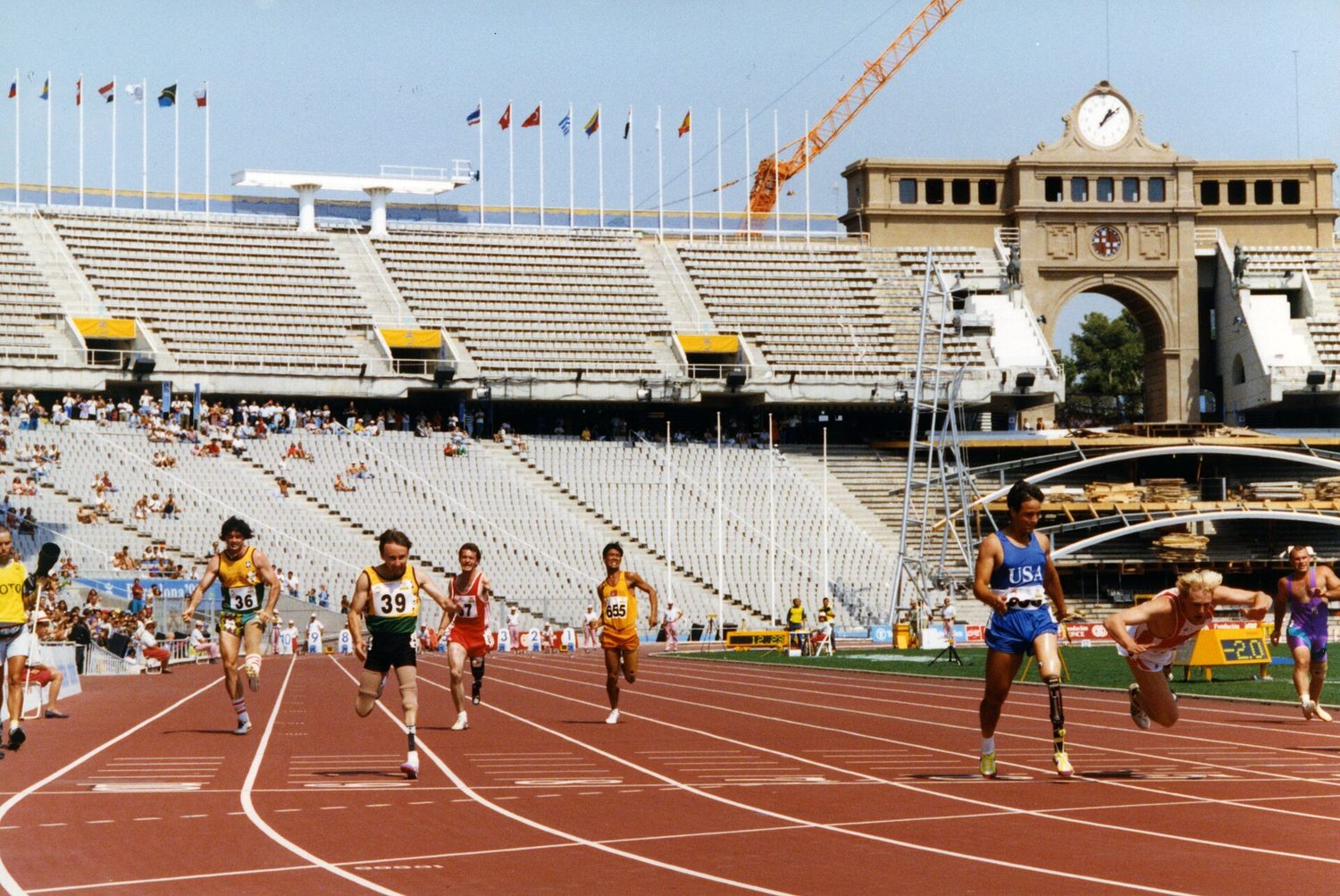
Worked example. A runner sprints hard for 20 seconds, then breathes deeply for several minutes after stopping. Explain why. During the sprint the muscles cannot get oxygen fast enough, so they respire anaerobically and lactic acid builds up, creating an oxygen debt. The deep breathing afterwards takes in the extra oxygen the liver needs to break that lactic acid down by aerobic respiration, while a high heart rate carries the acid from the muscles to the liver. The breathing repays a debt built up during the sprint - it is not simply "because the muscles are still working".
Without oxygen, glucose is only partly broken down — far less energy, and a different waste product. · โดยไม่มีการใช้氧气 กลูโคสจะถูกสลายบางส่วน — พลังงานน้อยกว่ามาก และมีของเสียชนิดอื่น
Pick one and the site follows you — notes, papers, videos and practice all open on it. · เลือกหนึ่งตัว และเว็บจะติดตามคุณ — หมายเหตุ, ใบงาน, วิดีโอ และการฝึกฝนจะเปิดอยู่ที่นั้น
Type to search notes, lessons, code, vocabulary and past-paper questions across every subject. · พิมพ์เพื่อค้นหาบันทึก, บทเรียน, โค้ด, คำศัพท์ และคำถามข้อสอบเก่าในทุกวิชา