Skip to content · ⁨ข้ามไปยังเนื้อหา⁩

Poetry II · ⁨บทกวี II⁩

AP English Literature and Composition · ⁨AP วรรณกรรมและบทวิเคราะห์เชิงลึก⁩ · Topic 5 · ⁨หัวข้อ 5⁩

Video lesson for this topic · ⁨บทเรียนวิดีโอสำหรับหัวข้อนี้⁩ Open the video page · ⁨เปิดหน้าวิดีโอ⁩
9:03

หน่วยที่ 5: กวีนิพนธ์ II

หน่วยที่ 5 เป็นหน่วยกวีนิพนธ์ครั้งที่สอง และทำสองสิ่ง: ชื่ารูปแบบที่บทกวีสามารถมีได้ และเติมเต็มชุดเครื่องมือภาษาเชิงภาพพจน์ รูปแบบปิดรวมถึง...

English narration · English + 中文 subtitles burned in · ⁨การบรรยายภาษาอังกฤษ · คำบรรยายภาษาอังกฤษ + 中文 ลอยตัวบนภาพ⁩

5.1

The Function of Structure in a Text · ⁨หน้าที่ของโครงสร้างในข้อความ⁩

Syllabus · ⁨หลักสูตร⁩
English

Enduring Understanding (STR-1): The arrangement of the parts and sections of a text, the relationship of the parts to each other, and the sequence in which the text reveals information are all structural choices made by a writer that contribute to the reader’s interpretation of a text.

Learning Objective 3.C: Explain the function of structure in a text.

  • STR-1.U Closed forms of poetry include predictable patterns in the structure of lines, stanzas, meter, and rhyme, which develop relationships among ideas in the poem. Note: The AP Exam will not require students to label or identify specific rhyme schemes, metrical patterns, or forms of poetry.
  • STR-1.V Open forms of poetry may not follow expected or predictable patterns in the structure of their lines or stanzas, but they may still have structures that develop relationships between ideas in the poem.
  • STR-1.W Structures combine in texts to emphasize certain ideas and concepts.
ไทย

ความเข้าใจที่ยั่งยืน (STR-1): การจัด arrangement ของส่วนและ section ของข้อความ ความสัมพันธ์ของส่วนต่างๆ ต่อกัน และ sequence ที่ข้อความ revealing ข้อมูล ล้วนเป็น structural choices ที่นักเขียนทำซึ่ง contribute ต่อการ interpretation ของผู้อ่านที่มีต่อข้อความ

จุดประสงค์การเรียนรู้ 3.C: อธิบายหน้าที่ของโครงสร้างในข้อความ

  • STR-1.U Closed forms of poetry รวมถึง predictable patterns ใน structure ของ lines, stanzas, meter และ rhyme ซึ่ง develop relationships among ideas in the poem. หมายเหตุ: การสอบ AP จะไม่要求学生 label หรือ identify specific rhyme schemes, metrical patterns หรือ forms of poetry
  • STR-1.V Open forms of poetry อาจไม่ follow expected หรือ predictable patterns ใน structure ของ lines หรือ stanzas但它们可能有 structures ที่ develop relationships ระหว่าง ideas ในบทกวี
  • STR-1.W Structures combination ใน texts เพื่อ emphasize某些 ideas และ concepts

Source: College Board AP Course and Exam Description · ⁨แหล่งที่มา: คำอธิบายหลักสูตรและข้อสอบ College Board AP⁩

English

Unit 5 is the second poetry unit, and it does two things: it names the forms a poem can take, and it completes the figurative toolkit.

  • Closed forms 格律诗体 include predictable patterns in lines, stanzas, metre, and rhyme.
  • Open forms 自由诗体 may not follow expected or predictable patterns.
  • Structures combine in texts to emphasise certain ideas.

The examinable question is never "which form is this?" but what the form does. In a closed form, the interesting moment is the departure - the line that runs long, the rhyme that fails to arrive. In an open form, the interesting moment is the imposition - the sudden regularity in a poem that has refused it.

ไทย

หน่วยที่5เป็นหน่วยกวีนิพนธ์ที่สอง และทำได้สองอย่าง: ตั้งชื่อ รูปแบบ ที่กวีนิพนธ์สามารถมีได้ และเติมเต็มชุดเครื่องมือ figurative ให้สมบูรณ์

  • รูปแบบปิด 格律诗体 รวมถึง รูปแบบที่คาดเดาได้ ในบรรทัด, ย่อหน้า, จังหวะ และสัมผัส
  • รูปแบบเปิด 自由诗体 อาจไม่ปฏิบัติตามรูปแบบที่คาดหวังหรือคาดเดาได้
  • โครงสร้างรวมกันในข้อความเพื่อเน้นย้ำแนวคิดบางประการ

คำถามที่ออกสอบไม่เคยถามว่า "นี่คือรูปแบบไหน?" แต่ รูปแบบทำอะไร ในรูปแบบปิด ช่วงเวลาที่น่าสนใจคือการเบี่ยงเบน - บรรทัดที่ยาวกว่าปกติ, สัมผัสที่ขาดหายไป ในรูปแบบเปิด ช่วงเวลาที่น่าสนใจคือการบังคับ - ความสม่ำเสมอที่突然出现ในกวีนิพนธ์ที่ปฏิเสธมัน

5.2

Literal and Figurative Meaning · ⁨ความหมายเชิงตัวอักษรและความหมายเชิงเปรียบเทียบ⁩

Syllabus · ⁨หลักสูตร⁩
English

Enduring Understanding (FIG-1): Comparisons, representations, and associations shift meaning from the literal to the figurative and invite readers to interpret a text.

Learning Objective 5.A: Distinguish between the literal and figurative meanings of words and phrases.

  • FIG-1.L Words with multiple meanings or connotations add nuance or complexity that can contribute to interpretations of a text.
ไทย

ความเข้าใจที่ยั่งยืน (FIG-1): การเปรียบเทียบ การแสดงภาพ และการเชื่อมโยง เปลี่ยนความหมายจากตัวอักษรสู่เชิงสัญลักษณ์และชวนให้ผู้读 mx interpret ข้อความ

วัตถุประสงค์การเรียนรู้ 5.A: แยกแยะความแตกต่างระหว่างความหมายตามตัวอักษรและความหมายเชิงพจน์ของคำและวลี

  • FIG-1.L คำที่มีหลายความหมายหรือนัยยะเพิ่มรายละเอียดหรือความซับซ้อนซึ่งสามารถส่งผลต่อการตีความข้อความได้

Source: College Board AP Course and Exam Description · ⁨แหล่งที่มา: คำอธิบายหลักสูตรและข้อสอบ College Board AP⁩

English

Words with multiple meanings or connotations add nuance or complexity that can contribute to interpretation.

In poetry, a word that could mean two things frequently means both. Resist choosing.

ไทย

คำที่มีหลายความหมายหรือนัยแฝงเพิ่ม nuance หรือความซับซ้อน ที่สามารถ contributingต่อการตีความ

ในกวีนิพนธ์ คำที่อาจหมายถึงสองสิ่งมักหมายถึงทั้งสองอย่าง ต้านทานการเลือกข้าง

5.3

The Function of Specific Words and Phrases · ⁨หน้าที่ของคำและวลีเฉพาะ⁩

Syllabus · ⁨หลักสูตร⁩
English

Enduring Understanding (FIG-1): Comparisons, representations, and associations shift meaning from the literal to the figurative and invite readers to interpret a text.

Learning Objective 5.B: Explain the function of specific words and phrases in a text.

  • FIG-1.M Descriptive words, such as adjectives and adverbs, qualify or modify the things they describe and affect readers’ interaction with the text.
  • FIG-1.N Hyperbole exaggerates while understatement minimizes. Exaggerating or minimizing an aspect of an object focuses attention on that trait and conveys a perspective about the object.
ไทย

ความเข้าใจที่ยั่งยืน (FIG-1): การเปรียบเทียบ การแสดงภาพ และการเชื่อมโยง เปลี่ยนความหมายจากตัวอักษรสู่เชิงสัญลักษณ์และชวนให้ผู้读 mx interpret ข้อความ

จุดประสงค์การเรียนรู้ 5.B: อธิบายหน้าที่ของคำและวลีเฉพาะในข้อความ

  • FIG-1.M คำบรรยาย เช่น คำนามคุณศัพท์และคำวิเศษณ์ ช่วยจำกัดหรือปรับแต่งสิ่งที่กำลังถูกบรรยายและส่งผลต่อปฏิสัมพันธ์ของผู้อ่านกับข้อความ
  • FIG-1.N Hyperboleเป็นการอวดขู่ในขณะ understatementเป็นการลดทอน การอวดขู่หรือลดทอนด้านหนึ่งของวัตถุจะมุ่งความสนใจไปที่ลักษณะนั้นและสื่อมุมมองเกี่ยวกับวัตถุนั้น

Source: College Board AP Course and Exam Description · ⁨แหล่งที่มา: คำอธิบายหลักสูตรและข้อสอบ College Board AP⁩

English
  • Descriptive words qualify or modify what they describe and affect how the reader perceives it.
  • Hyperbole 夸张 exaggerates while understatement 低调陈述 minimises. Exaggerating or minimising an aspect of a thing has an effect on how it is understood.

Understatement is the more powerful of the pair and the more often missed by second-language readers. A poem that describes a catastrophe as inconvenient is not being calm; the gap between the event and the word is the poem's whole comment on it.

ไทย
  • คำบรรยาย ระบุลักษณะหรือปรับแก้สิ่งที่ถูกบรรยาย และมีผลต่อ วิธีที่ผู้อ่านรับรู้มัน
  • Hyperbole (夸张) ขยายเกินจริง ในขณะที่ Understatement (低调陈述) ลดทอน การขยายหรือลดทอนด้านหนึ่งของสิ่งใดสิ่งหนึ่งมีผลต่อการเข้าใจมัน

Understatement เป็นเครื่องมือที่ทรงพลังกว่าของคู่นี้และมักถูกมองข้ามโดยผู้อ่านภาษาที่สอง กวีนิพนธ์ที่บรรยายภัยพิบัติว่าเป็น inconvenient ไม่ได้แสดงถึงความสงบ; ช่องว่างระหว่างเหตุการณ์กับคำคือ Commentทั้งหมดของกวีนิพนธ์ที่มีต่อมัน

Vocabulary · ⁨คำศัพท์⁩ Train · ⁨ฝึกฝน⁩
English ไทย
Closed forms/kləʊzd fɔːmz/ รูปแบบปิด
Open forms/ˈəʊpən fɔːmz/ รูปแบบเปิด
Hyperbole/haɪˈpɜːbəli/ Hyperbole (การเกินจริง)
understatement/ˌʌndəˈsteɪtmənt/ การลดทอนความสำคัญ
contribute to sensory imagery/kənˈtrɪbjuːt tə ˈsensəri ˈɪmɪdʒri/ มีส่วนร่วมต่อภาพจำสัมผัส
5.4

The Function of an Image or Imagery · ⁨หน้าที่ของ Image หรือ Imagery⁩

Syllabus · ⁨หลักสูตร⁩
English

Enduring Understanding (FIG-1): Comparisons, representations, and associations shift meaning from the literal to the figurative and invite readers to interpret a text.

Learning Objective 5.D: Identify and explain the function of an image or imagery.

  • FIG-1.O Descriptive words, such as adjectives and adverbs, contribute to sensory imagery.
  • FIG-1.P An image can be literal or it can be a form of a comparison that represents something in a text through associations with the senses.
  • FIG-1.Q A collection of images, known as imagery, may emphasize ideas in parts of or throughout a text.
ไทย

ความเข้าใจที่ยั่งยืน (FIG-1): การเปรียบเทียบ การแสดงภาพ และการเชื่อมโยง เปลี่ยนความหมายจากตัวอักษรสู่เชิงสัญลักษณ์และชวนให้ผู้读 mx interpret ข้อความ

วัตถุประสงค์การเรียนรู้ 5.D: ระบุและอธิบายหน้าที่ของภาพหรือการพรรณนาภาพ

  • FIG-1.O คำบรรยาย เช่น คำนามคุณศัพท์และคำวิเศษณ์ มีส่วนช่วยในการสร้างภาพทางประสาทสัมผัส
  • FIG-1.P ภาพอาจมีความหมายตามตัวอักษรหรืออาจเป็นรูปแบบของการเปรียบเทียบที่แทนสิ่งใดสิ่งหนึ่งในข้อความผ่านความสัมพันธ์กับประสาทสัมผัส
  • FIG-1.Q ชุดของภาพที่เรียกว่า imagery อาจเน้นย้ำแนวคิดในส่วนหรือตลอดทั้งข้อความ

Source: College Board AP Course and Exam Description · ⁨แหล่งที่มา: คำอธิบายหลักสูตรและข้อสอบ College Board AP⁩

English
  • Descriptive words contribute to sensory imagery 感官意象.
  • An image can be literal, or a form of comparison representing something through another thing.
  • A collection of images - imagery - may emphasise ideas in parts of, or throughout, a text.

The plural matters. A single image is a detail; a pattern of images running through a poem is a claim the poem is making without stating it.

ไทย

อุปกรณ์ของกวีนิพนธ์ II, เรียงตามสิ่งที่แต่ละอย่างกระทำต่อผู้อ่าน *การตั้งชื่อนโยบายไม่ได้คะแนน Sayingสิ่งที่คุณทำต่อผู้อ่านคือการวิเคราะห์

  • คำบรรยาย ** contribute到感官意象 (Sensory Imagery)**
  • Image สามารถเป็น literal, หรือรูปแบบของการเปรียบเทียบแทนสิ่งหนึ่งด้วยอีกสิ่งหนึ่ง
  • ชุดภาพ - ภาพจำ - อาจ เน้นย้ำแนวคิด ในบางส่วนของ หรือทั่วทั้งข้อความได้

ความพหูพจน์มีความสำคัญ ภาพเดียวเป็นเพียงรายละเอียด; แต่ ลวดลาย ของภาพที่ไหลผ่านบทกวีคือการอ้างถึงที่บทกวีต้องการสื่อโดยไม่ได้ระบุออกมาตรงๆ

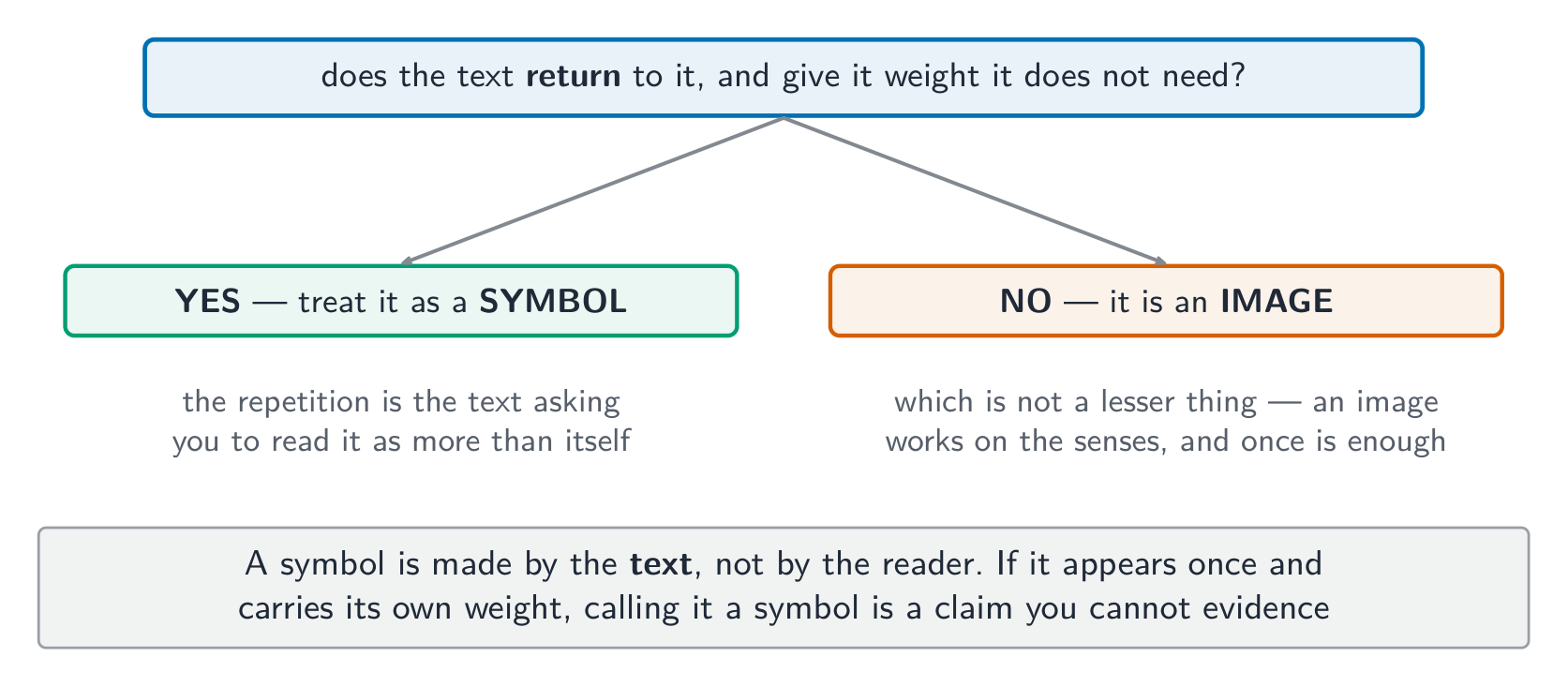
สัญลักษณ์ถูกสร้างโดยตัวข้อความ ไม่ใช่โดยผู้อ่าน
Explore · ⁨สำรวจ⁩

Image or symbol? Apply the test · ⁨ภาพหรือสัญลักษณ์? ใช้การทดสอบ⁩

A symbol is made by the text, not by the reader: the test is whether the text returns to it and gives it weight it does not need. · ⁨สัญลักษณ์ถูกสร้างโดยข้อความ ไม่ใช่โดยผู้อ่าน: การทดสอบคือ apakah ข้อความกลับไปที่มันและให้น้ำหนักที่ไม่จำเป็น⁩

5.5

The Function of a Metaphor · ⁨หน้าที่ของ Metaphor⁩

Syllabus · ⁨หลักสูตร⁩
English

Enduring Understanding (FIG-1): Comparisons, representations, and associations shift meaning from the literal to the figurative and invite readers to interpret a text.

Learning Objective 6.B: Identify and explain the function of a metaphor.

  • FIG-1.R Metaphorical comparisons do not focus solely on the objects being compared; they focus on the particular traits, qualities, or characteristics of the things being compared.
  • FIG-1.S Comparisons not only communicate literal meaning but may also convey figurative meaning or transmit a perspective.
  • FIG-1.T An extended metaphor is created when the comparison of a main subject and comparison subject persists through parts of or an entire text, and when the comparison is expanded through additional details, similes, and images.
  • FIG-1.U Interpretation of an extended metaphor may depend on the context of its use; that is, what is happening in a text may determine what is transferred in the comparison.
ไทย

ความเข้าใจที่ยั่งยืน (FIG-1): การเปรียบเทียบ การแสดงภาพ และการเชื่อมโยง เปลี่ยนความหมายจากตัวอักษรสู่เชิงสัญลักษณ์และชวนให้ผู้读 mx interpret ข้อความ

จุดประสงค์การเรียนรู้ 6.B: ระบุและอธิบายหน้าที่ของอุปมา (Metaphor)

  • FIG-1.R การเปรียบเทียบแบบอุปมามุ่งเน้นไม่ใช่เพียงวัตถุ正在进行การเปรียบเทียบเท่านั้น แต่ยังมุ่งเน้นไปที่ลักษณะ คุณภาพ หรือคุณสมบัติเฉพาะของสิ่งที่กำลังถูกเปรียบเทียบ
  • FIG-1.S การเปรียบเทียบไม่เพียงแต่สื่อสารความหมายตามตัวอักษร แต่ยังอาจสื่อความหมายเชิงพจน์หรือส่งต่อมุมมองได้
  • FIG-1.T อุปมาขยายเกิดจากการเปรียบเทียบระหว่างวัตถุหลักและวัตถุ正在进行การเปรียบเทียบที่ยังคงอยู่ต่อไปตลอด或部分ของข้อความ และการเปรียบเทียบนี้ได้รับการขยายด้วยรายละเอียดเพิ่มเติม เปรียบเทียบ และภาพ
  • FIG-1.U การตีความอุปมาขยายอาจขึ้นอยู่กับบริบทที่ใช้ นั่นคือ สิ่งที่กำลังเกิดขึ้นในข้อความอาจกำหนดว่าอะไรกำลังถูกถ่ายโอนในการเปรียบเทียบ

Source: College Board AP Course and Exam Description · ⁨แหล่งที่มา: คำอธิบายหลักสูตรและข้อสอบ College Board AP⁩

English
  • Metaphorical comparisons do not focus solely on the objects compared; they focus on the particular qualities the comparison brings out.
  • Comparisons communicate literal meaning and may also convey figurative meaning.
  • An extended metaphor 延伸隐喻 is created when the comparison of a main subject and comparison subject persists across a passage or a whole text.
  • Interpretation of an extended metaphor may depend on the context of its use.

An extended metaphor is the most rewarding thing to find in an unseen poem, because it gives you structure and meaning at once: you can trace how the comparison develops, and a comparison that changes as it extends is the poem's argument in motion.

ไทย
  • การเปรียบเทียบแบบนัยยะ ไม่มุ่งเน้นเฉพาะวัตถุที่ถูกเปรียบเทียบ; แต่มุ่งเน้นไปที่ คุณสมบัติเฉพาะเจาะจง ที่การเปรียบเทียบนั้นชี้ให้เห็น
  • การเปรียบเทียบสื่อสารทั้ง ความหมายตามตัวอักษร และอาจสื่อถึง ความหมายเชิงสัญลักษณ์ ได้ด้วย
  • การเปรียบเทียบที่ยาวนาน (extended metaphor) 延伸隐喻 ถูกสร้างขึ้นเมื่อการเปรียบเทียบระหว่างLECTURE utamaและLECTURE เปรียบเทียบ คงอยู่ต่อเนื่องตลอดย่อหน้าหรือทั้งข้อความ
  • การตีความการเปรียบเทียบที่ยาวนาน อาจขึ้นอยู่กับบริบทของการใช้งาน

การเปรียบเทียบที่ยาวนานคือสิ่งที่คุ้มค่าที่สุดในการค้นพบในบทกวีที่ไม่เคยอ่านมาก่อน เพราะมันให้โครงสร้างและความหมายพร้อมกัน: คุณสามารถติดตามได้ว่าเปรียบเทียบนี้พัฒนาไปอย่างไร และการเปรียบเทียบที่ เปลี่ยนแปลง เมื่อขยายตัวออกไป คือข้อโต้แย้งของบทกวีที่กำลังดำเนินอยู่

Vocabulary · ⁨คำศัพท์⁩ Train · ⁨ฝึกฝน⁩
English ไทย
extended metaphor/ekˈstendɪd ˈmetəfɔː/ การเปรียบเปรยต่อเนื่อง (Extended metaphor)
5.6

The Function of Personification · ⁨หน้าที่ของการใช้บุคลิกรูปธรรม⁩

Syllabus · ⁨หลักสูตร⁩
English

Enduring Understanding (FIG-1): Comparisons, representations, and associations shift meaning from the literal to the figurative and invite readers to interpret a text.

Learning Objective 6.C: Identify and explain the function of personification.

  • FIG-1.V Personification is a type of comparison that assigns a human trait or quality to a nonhuman object, entity, or idea, thus characterizing that object, entity, or idea.
ไทย

ความเข้าใจที่ยั่งยืน (FIG-1): การเปรียบเทียบ การแสดงภาพ และการเชื่อมโยง เปลี่ยนความหมายจากตัวอักษรสู่เชิงสัญลักษณ์และชวนให้ผู้读 mx interpret ข้อความ

วัตถุประสงค์การเรียนรู้ 6.C: ระบุและอธิบายหน้าที่ของการ比拟

  • FIG-1.V การ比拟คือการเปรียบเทียบประเภทหนึ่งซึ่งมอบลักษณะหรือคุณภาพของมนุษย์ให้กับวัตถุ องค์กร หรือแนวคิดที่ไม่ใช่มนุษย์ thereby characterization that object, entity, or idea.

Source: College Board AP Course and Exam Description · ⁨แหล่งที่มา: คำอธิบายหลักสูตรและข้อสอบ College Board AP⁩

English

Personification 拟人 is a type of comparison that assigns a human trait or quality to a nonhuman object, animal, or idea.

Treat it as a comparison with the same parts as any other: the main subject is the nonhuman thing, the comparison subject is a person, and the transferred quality is the human trait. Then ask the useful question - what does granting this thing agency do? A wind that decides is not the same claim as a wind that blows.

ไทย

การ/personification 拟人 เป็นรูปแบบหนึ่งของการเปรียบเทียบที่ มอบลักษณะหรือคุณสมบัติของมนุษย์ให้กับวัตถุ สัตว์ หรือแนวคิดที่ไม่มีชีวิต

ให้มองว่าเป็นการเปรียบเทียบกับส่วนประกอบเหมือนอย่างอื่น: LECTURE หลักคือสิ่งไม่มีชีวิต, LECTURE เปรียบเทียบคือคน, และคุณสมบัติที่ถ่ายโอนคือลักษณะของมนุษย์ จากนั้นถามคำถามที่มีประโยชน์ว่า - การมอบอำนาจการตัดสินใจให้กับสิ่งนี้จะทำให้เกิดอะไรขึ้น? ลมที่ ตัดสินใจ มีความหมายต่างจากลมที่พัด

'มันทำให้วัตถุมีชีวิตชีวา' คือนิยาม - คอลัมน์ที่สามคือคำอธิบายวิเคราะห์
Vocabulary · ⁨คำศัพท์⁩ Train · ⁨ฝึกฝน⁩
English ไทย
Personification/pɜːˈsɒnɪfɪkeɪʃn/ Personification (การให้จิตวิญญาณแก่สิ่งไร้ชีวิต)
5.7

The Function of an Allusion · ⁨หน้าที่ของการอ้างอิงอ้อม⁩

Syllabus · ⁨หลักสูตร⁩
English

Enduring Understanding (FIG-1): Comparisons, representations, and associations shift meaning from the literal to the figurative and invite readers to interpret a text.

Learning Objective 6.D: Identify and explain the function of an allusion.

  • FIG-1.W Allusions in a text can reference literary works including myths and sacred texts; other works of art including paintings and music; or people, places, or events outside the text.
ไทย

ความเข้าใจที่ยั่งยืน (FIG-1): การเปรียบเทียบ การแสดงภาพ และการเชื่อมโยง เปลี่ยนความหมายจากตัวอักษรสู่เชิงสัญลักษณ์และชวนให้ผู้读 mx interpret ข้อความ

วัตถุประสงค์การเรียนรู้ 6.D: ระบุและอธิบายหน้าที่ของการอ้างอิง

  • FIG-1.W การอ้างอิงในข้อความอาจชี้ถึงงานวรรณกรรม بما mito และพระคัมภีร์; งานศิลปะอื่นๆ รวมถึงจิตรกรรมและดนตรี; หรือบุคคล สถานที่ หรือเหตุการณ์ภายนอกข้อความ

Source: College Board AP Course and Exam Description · ⁨แหล่งที่มา: คำอธิบายหลักสูตรและข้อสอบ College Board AP⁩

English

Allusions 典故 may reference literary works including myths and sacred texts, other works of art, and historical events.

An allusion imports meaning the poem has not written. That is its efficiency and its risk: it works only for readers who recognise it. When you meet one you do not know, say what the poem does with it structurally - where it is placed, what it interrupts - rather than pretending to a recognition you lack.

ไทย

การอ้างอิงอ้อม (allusions) 典故 อาจเชื่อมโยงถึง งานวรรณกรรม รวมถึงตำนานและพระคัมภีร์ sacred texts, งานศิลปะอื่นๆ และเหตุการณ์ทางประวัติศาสตร์

การอ้างอิงอ้อมนำความหมายเข้ามาในบทกวีซึ่งผู้แต่งไม่ได้เขียนไว้ นั่นคือประสิทธิภาพและความเสี่ยงของมัน: มันใช้ได้กับผู้อ่านที่จดจำได้เท่านั้น เมื่อคุณเจอสิ่งที่คุณไม่รู้จัก ให้บอกเลยว่าบทกวีใช้มันอย่างไรในเชิงโครงสร้าง - วางไว้ที่ไหน ขัดจังหวะอะไร - แทนที่จะแสร้งทำเป็นว่าคุณรู้เรื่องนั้นอยู่

การอ้างอิงอ้อมนำสถานการณ์และการตัดสินเข้ามา - และมันก็ต้องแลกมาด้วยต้นทุนเช่นกัน
Explore · ⁨สำรวจ⁩

Take an allusion past the source · ⁨ดึงการอ้างถึงไปไกลกว่าแหล่งที่มา⁩

Naming the source is not the analysis. An allusion imports a situation and a judgement, and it costs something as well. · ⁨การระบุชื่อแหล่งที่มาไม่ใช่การวิเคราะห์ การอ้างถึงนำสภาวะและคำตัดสินเข้ามา และมันยังต้องแลกด้วยต้นทุนด้วย⁩

Vocabulary · ⁨คำศัพท์⁩ Train · ⁨ฝึกฝน⁩
English ไทย
Allusions/əˈluːʒnz/ การอ้างอิง隐含 (Allusions)
5.8

Developing a Literary Thesis Statement · ⁨การพัฒนาประโยค тезисวรรณกรรม⁩

Syllabus · ⁨หลักสูตร⁩
English

Enduring Understanding (LAN-1): Readers establish and communicate their interpretations of literature through arguments supported by textual evidence.

Learning Objective 7.B: Develop a thesis statement that conveys a defensible claim about an interpretation of literature and that may establish a line of reasoning.

  • LAN-1.D A thesis statement expresses an interpretation of a literary text, and requires a defense, through use of textual evidence and a line of reasoning, both of which are explained in an essay through commentary.
  • LAN-1.E A thesis statement may preview the development or line of reasoning of an interpretation. This is not to say that a thesis statement must list the points of an interpretation, literary elements to be analyzed, or specific evidence to be used in the argument.
ไทย

ความเข้าใจที่ยั่งยืน (LAN-1): ผู้_read者确立并传达对文学作品的解读,通过有文本证据支持的论证。

วัตถุประสงค์การเรียนรู้ 7.B: พัฒนาประโยค luậnะที่แสดงข้ออ้างที่ป้องกันได้เกี่ยวกับการตีความวรรณกรรมและอาจกำหนดเส้นทางการให้เหตุผล

  • LAN-1.D ประโยค论点จุดเด่นแสดงการตีความข้อความทางวรรณกรรม และต้องการการปกป้อง通过使用文本证据和推理,两者都在文章中通过评论来解释。
  • LAN-1.E ประโยค luậnะอาจแสดงการพัฒนาหรือเส้นทางการให้เหตุผลของการตีความ นี่ไม่ได้หมายความว่าประโยค luậnะต้องระบุจุดของการตีความ องค์ประกอบทางวรรณกรรมที่จะวิเคราะห์ หรือหลักฐานเฉพาะที่จะใช้ในข้อโต้แย้ง

Source: College Board AP Course and Exam Description · ⁨แหล่งที่มา: คำอธิบายหลักสูตรและข้อสอบ College Board AP⁩

English

Unchanged: an interpretation requiring textual defence, which may preview the line of reasoning.

ไทย

ไม่เปลี่ยน: การตีความ ที่ต้องการการป้องกันด้วยข้อความ ซึ่ง อาจ ชี้แนวทางการคิดล่วงหน้า

5.9

Developing Commentary · ⁨การพัฒนาคำอธิบายประกอบ⁩

Syllabus · ⁨หลักสูตร⁩
English

Enduring Understanding (LAN-1): Readers establish and communicate their interpretations of literature through arguments supported by textual evidence.

Learning Objective 7.C: Develop commentary that establishes and explains relationships among textual evidence, the line of reasoning, and the thesis.

  • LAN-1.F A line of reasoning is the logical sequence of claims that work together to defend the overarching thesis statement.
  • LAN-1.G A line of reasoning is communicated through commentary that explains the logical relationship between the overarching thesis statement and the claims/evidence within the body of an essay.
ไทย

ความเข้าใจที่ยั่งยืน (LAN-1): ผู้_read者确立并传达对文学作品的解读,通过有文本证据支持的论证。

วัตถุประสงค์การเรียนรู้ 7.C: พัฒนาคำอธิบายเชิงวิเคราะห์ที่สร้างและอธิบายความสัมพันธ์ระหว่างหลักฐานจากข้อความ เส้นทางการให้เหตุผล และประโยค luậnะ

  • LAN-1.F เส้นทางการให้เหตุผลคือลำดับตรรกะของข้ออ้างที่ทำงานร่วมกันเพื่อปกป้องประโยค luậnะหลัก
  • LAN-1.G เส้นทางการให้เหตุผลจะถูกสื่อสารผ่านคำอธิบายเชิงวิเคราะห์ที่อธิบายความสัมพันธ์เชิงตรรกะระหว่างประโยค luậnะหลักกับข้ออ้าง/หลักฐานภายในเนื้อหาบทความ

Source: College Board AP Course and Exam Description · ⁨แหล่งที่มา: คำอธิบายหลักสูตรและข้อสอบ College Board AP⁩

English

A line of reasoning is the logical sequence of claims defending the thesis, communicated through commentary explaining the relationship between evidence and claim.

ไทย

ลำดับการคิด (line of reasoning) คือลำดับตรรกะของข้ออ้างเพื่อสนับสนุน论点主要通过 คำอธิบาย ที่อธิบายความสัมพันธ์ระหว่างหลักฐานและข้ออ้าง

5.10

Selecting Relevant and Sufficient Evidence · ⁨การเลือกหลักฐานที่เกี่ยวข้องและเพียงพอ⁩

Syllabus · ⁨หลักสูตร⁩
English

Enduring Understanding (LAN-1): Readers establish and communicate their interpretations of literature through arguments supported by textual evidence.

Learning Objective 7.D: Select and use relevant and sufficient evidence to both develop and support a line of reasoning.

  • LAN-1.H Writers use evidence strategically and purposefully to illustrate, clarify, exemplify, associate, amplify, or qualify a point.
  • LAN-1.I Evidence is effective when the writer of the essay uses commentary to explain a logical relationship between the evidence and the claim.
  • LAN-1.J Evidence is sufficient when its quantity and quality provide apt support for the line of reasoning.
  • LAN-1.K Developing and supporting an interpretation of a text is a recursive process; an interpretation can emerge from analyzing evidence and then forming a line of reasoning, or the interpretation can emerge from forming a line of reasoning and then identifying relevant evidence to support that line of reasoning.
ไทย

ความเข้าใจที่ยั่งยืน (LAN-1): ผู้_read者确立并传达对文学作品的解读,通过有文本证据支持的论证。

วัตถุประสงค์การเรียนรู้ 7.D: เลือกและใช้หลักฐานที่เกี่ยวข้องและเพียงพอเพื่อพัฒนาและสนับสนุนเส้นทางการให้เหตุผล

  • LAN-1.H ผู้เขียนใช้หลักฐานอย่างมีกลยุทธ์และมีจุดประสงค์เพื่อชี้ให้เห็น ชัดเจน ตัวอย่าง เชื่อมโยง ขยาย หรือจำกัดข้อ某一个点
  • LAN-1.I หลักฐานมีประสิทธิภาพเมื่อผู้เขียนบทความใช้คำอธิบายเชิงวิเคราะห์เพื่ออธิบายความสัมพันธ์เชิงตรรกะระหว่างหลักฐานกับข้ออ้าง
  • LAN-1.J หลักฐานมีเพียงพอเมื่อปริมาณและคุณภาพของมันให้การสนับสนุนที่เหมาะสมสำหรับเส้นทางการให้เหตุผล
  • LAN-1.K การพัฒนาและสนับสนุนการตีความข้อความเป็นกระบวนการที่วนซ้ำ; การตีความสามารถเกิดขึ้นจากการวิเคราะห์หลักฐานแล้วสร้างเส้นทางการให้เหตุผล หรือการตีความสามารถเกิดขึ้นจากการสร้างเส้นทางการให้เหตุผลแล้วระบุหลักฐานที่เกี่ยวข้องเพื่อสนับสนุนเส้นทางการให้เหตุผลนั้น

Source: College Board AP Course and Exam Description · ⁨แหล่งที่มา: คำอธิบายหลักสูตรและข้อสอบ College Board AP⁩

English

Evidence used strategically, effective with commentary, sufficient in quantity and quality, and interpretation as a recursive process.

ไทย

หลักฐานที่ใช้ อย่างมีกลยุทธ์, มีประสิทธิภาพ กับคำอธิบาย, เพียงพอ ทั้งจำนวนและคุณภาพ, และการตีความเป็นกระบวนการ วนซ้ำ (recursive)

5.11

Control Over the Elements of Composition · ⁨การควบคุมองค์ประกอบการเขียน⁩

Syllabus · ⁨หลักสูตร⁩
English

Enduring Understanding (LAN-1): Readers establish and communicate their interpretations of literature through arguments supported by textual evidence.

Learning Objective 7.E: Demonstrate control over the elements of composition to communicate clearly.

  • LAN-1.Q Transitional elements are words or other elements (phrases, clauses, sentences, or paragraphs) that assist in creating coherence between sentences and paragraphs by showing relationships between ideas.
ไทย

ความเข้าใจที่ยั่งยืน (LAN-1): ผู้_read者确立并传达对文学作品的解读,通过有文本证据支持的论证。

วัตถุประสงค์การเรียนรู้ 7.E: แสดงถึงการควบคุมองค์ประกอบของการประพันธ์เพื่อสื่อสารอย่างชัดเจน

  • LAN-1.Q คำเชื่อมเป็นคำหรือองค์ประกอบอื่น (วลี, ประโยคย่อย, ประโยค หรือย่อหน้า) ที่ช่วยสร้างความต่อเนื่องระหว่างประโยคและย่อหน้าโดยแสดงความสัมพันธ์ระหว่างแนวคิด

Source: College Board AP Course and Exam Description · ⁨แหล่งที่มา: คำอธิบายหลักสูตรและข้อสอบ College Board AP⁩

English

Transitional elements - words, phrases, clauses, sentences, or paragraphs - assist in creating coherence.

Worked example (a real AP exam task). A poetry-analysis prompt asks how the poet's use of figurative language conveys the speaker's attitude. A weak answer catalogues: "The poet uses personification, imagery, and a metaphor." A scoring answer traces one device developing: "The extended comparison of the tide to a creditor runs the length of the poem, but the terms change: in the first stanza it 'asks', by the third it 'takes what was always owed'. The comparison subject stays constant while the speaker's account of the relationship hardens - so the attitude the poem conveys is not fear of loss but the recognition that the loss was never hers to prevent." One device, traced, with the attitude it produces.

ไทย

องค์ประกอบเชื่อมโยง (Transitional elements) - คำวลี ประโยค หรือย่อหน้า - ช่วยสร้างความ连贯

ตัวอย่างวิธีทำ (งานสอบ AP จริง). ข้อ hỏiวิเคราะห์บทกวีถามว่านักเขียนใช้ภาษาเชิงสัญลักษณ์อย่างไรเพื่อสื่อทัศนคติของตัวละครผู้บรรยาย คำตอบที่อ่อนแอจะจัดรายการ: “นักเขียนใช้บุคลิกรูปธรรม ภาพจำ และการเปรียบเทียบ” คำตอบที่ได้คะแนนสูงจะติดตามเครื่องมือหนึ่งอย่างละเอียด: “การเปรียบเทียบที่ยาวนานระหว่างน้ำตกับเจ้าหนี้贯穿ทั้งบทกวี แต่เงื่อนไขเปลี่ยนไป: ในท่อนแรกมัน ‘ขอ’ แต่ถึงท่อนที่สามมัน ‘ lấyสิ่งที่ค้างชำระเสมอ’ LECTURE เปรียบเทียบคงเดิมแต่คำบรรยายของตัวละครผู้บรรยายเกี่ยวกับความสัมพันธ์แข็งกระด้างมากขึ้น - ดังนั้นทัศนคติที่บทกวีสื่อจึงไม่ใช่ความกลัวการสูญเสีย แต่เป็นการตระหนักว่าการสูญเสียนั้นไม่เคยเป็นสิ่งที่เธอสามารถป้องกันได้” เครื่องมือหนึ่งอย่าง就被追踪到与之相关的 attitude

5.11

Exam tips · ⁨ข้อแนะนำสำหรับการสอบ⁩

English
  • Never ask "which form is this?" Ask what the form does - and look for the departure or the imposition.
  • A word with two meanings often means both. Do not choose prematurely.
  • Understatement is the more powerful half of the pair, and the more often missed. The gap is the comment.
  • A pattern of images is a claim the poem makes without stating it. A single image is only a detail.
  • An extended metaphor that changes as it extends is the poem's argument in motion. Trace it.
  • Cataloguing devices earns nothing. One device traced beats four devices named.
ไทย
  • อย่าถามว่า “นี่คือรูปแบบไหน?” ให้ถามว่า รูปแบบนี้ทำหน้าที่อย่างไร - และมองหาความเบี่ยงเบนหรือการบังคับใช้
  • คำที่มี สองความหมายมักหมายถึงทั้งสองอย่าง อย่าเลือกก่อนกำหนด
  • การลดทอนความรุนแรง (Understatement) เป็นครึ่งที่ทรงพลังกว่าของคู่คำนี้ และมักถูกลืมไปมากกว่า ช่องว่างคือคำติชม
  • ลวดลายของภาพ คือการอ้างถึงที่บทกวีต้องการสื่อโดยไม่ได้ระบุ出来 ส่วนภาพเดียวเป็นเพียงรายละเอียดเท่านั้น
  • การเปรียบเทียบที่ยาวนาน ที่เปลี่ยนแปลงเมื่อขยายตัวออกไป คือข้อโต้แย้งของบทกวีกำลังดำเนินอยู่ ให้ติดตามดู
  • การจับรายการเครื่องมือไม่ได้อะไรเลย การติดตามเครื่องมือหนึ่งอย่าง ดีกว่าการระบุชื่อสี่เครื่องมือ

Interactive lessons on this topic · ⁨บทเรียนเชิงโต้ตอบสำหรับหัวข้อนี้⁩

Work through it step by step, with instant-check exercises. · ⁨ทำทีละขั้นตอน พร้อมแบบฝึกหัดตรวจสอบผลทันที⁩

Past Papers · ⁨ข้อสอบย้อนหลัง⁩

More topics in AP English Literature and Composition · ⁨AP วรรณกรรมและบทวิเคราะห์เชิงลึก⁩ · ⁨หัวข้อเพิ่มเติมใน AP English Literature and Composition · ⁨AP วรรณกรรมและบทวิเคราะห์เชิงลึก⁩⁩

Log in or create account · ⁨เข้าสู่ระบบหรือสร้างบัญชี⁩

IGCSE, A-Level & AP