| Enduring Understanding | Learning Objective | Essential Knowledge |
|---|---|---|
CHR-1 | 1.A |
|
Short Fiction I
AP English Literature and Composition · Topic 1
 6:41
Unit 1: Short Fiction I
AP English Literature reads texts in three genres across nine units — short fiction, poetry, and longer fiction or drama — each visited three times at…
English narration · English + 中文 subtitles burned in
1.1
What Textual Details Reveal About a Character

Syllabus
Source: College Board AP Course and Exam Description
AP English Literature reads texts in three genres 体裁 across nine units - short fiction 短篇小说, poetry 诗歌, and longer fiction or drama 戏剧 - each visited three times at increasing difficulty. Unit 1 installs the tools for all of them.
In 1894 Vogue magazine printed a story of about a thousand words by Kate Chopin. Its first sentence tells us that Mrs Mallard has "heart trouble"; its last sentence tells us that her heart killed her. Everything between those two sentences changes what "heart trouble" means. That is what this unit trains you to see: how character, setting, order and narration work together.
Character 人物 is revealed by three things, and the CED names them exactly:
- Description 描写, dialogue 对话 and behaviour 行为 reveal characters to readers.
- Descriptions may come from a speaker 说话者, a narrator 叙述者, other characters, or the characters themselves - so who is describing is part of the evidence.
- Perspective 视角 is how narrators, characters, or speakers understand their circumstances, informed by background, experience, and values.
- A character's perspective is both shaped and revealed by relationships with other characters, the environment, and events.
That last point is the one that turns character notes into analysis. A character is not a list of adjectives; a character is a way of seeing, which becomes visible in what they notice, what they misread, and how they respond.
Explore
Take a detail exactly as far as it goes
Over-reading loses as many marks as under-reading: say what the detail establishes, and stop where the evidence stops.
Vocabulary
Train
| English |
|---|
| genre/ˈʒɒnrə/ |
| short fiction |
| poetry |
| drama |
| character/ˈkærɪktə/ |
| description/dɪˈskrɪpʃn/ |
| dialogue |
| behaviour |
| speaker/ˈspiːkə/ |
| narrator/nəˈreɪtə/ |
| perspective/pəˈspektɪv/ |
1.2
Textual Details That Convey Setting
Syllabus
| Enduring Understanding | Learning Objective | Essential Knowledge |
|---|---|---|
SET-1 | 2.A |
|
Source: College Board AP Course and Exam Description
Setting 背景 includes the time and place during which the events of the text occur.
The CED's definition is deliberately minimal, and that is the trap. Setting earns marks not when it is described but when it is shown doing something - constraining a character, explaining a value, or contrasting with an interior state. A paragraph that establishes where a story happens has not yet made a claim.
Vocabulary
Train
| English |
|---|
| setting/ˈsetɪŋ/ |
1.3
How Plot Orders Events

Syllabus
| Enduring Understanding | Learning Objective | Essential Knowledge |
|---|---|---|
STR-1 | 3.A |
|
Source: College Board AP Course and Exam Description
- Plot 情节 is the sequence of events in a narrative; events are connected, each building on those before it.
- The dramatic situation 戏剧情境 includes the setting and action of the plot and how the narrative develops to place characters in conflict 冲突.
The word sequence is doing work. Plot is not the events but their order - and an author who reveals something late that happened early has made a choice you can analyse.
Vocabulary
Train
| English |
|---|
| plot/plɒt/ |
| dramatic situation/drəˈmætɪk ˌsɪtʃuːˈeɪʃn/ |
| conflict/ˈkɒnflɪkt/ |
1.4
The Function of a Sequence of Events
Syllabus
| Enduring Understanding | Learning Objective | Essential Knowledge |
|---|---|---|
STR-1 | 3.B |
|
Source: College Board AP Course and Exam Description
Plot and the exposition 背景交代 that accompanies it focus readers' attention on the parts of the narrative that matter most to the text's meaning.
That sentence is the whole method for prose analysis: proportion is evidence. What the text lingers over, and what it passes in a clause, is the author telling you where to look.
Vocabulary
Train
| English |
|---|
| exposition |
1.5
Identifying the Narrator or Speaker

Syllabus
| Enduring Understanding | Learning Objective | Essential Knowledge |
|---|---|---|
NAR-1 | 4.A |
|
Source: College Board AP Course and Exam Description
- Narrators or speakers relate accounts and establish a relationship between the text and the reader.
- Perspective refers to how narrators, characters, or speakers see their circumstances; point of view 叙述视点 refers to the position from which they relate the account.
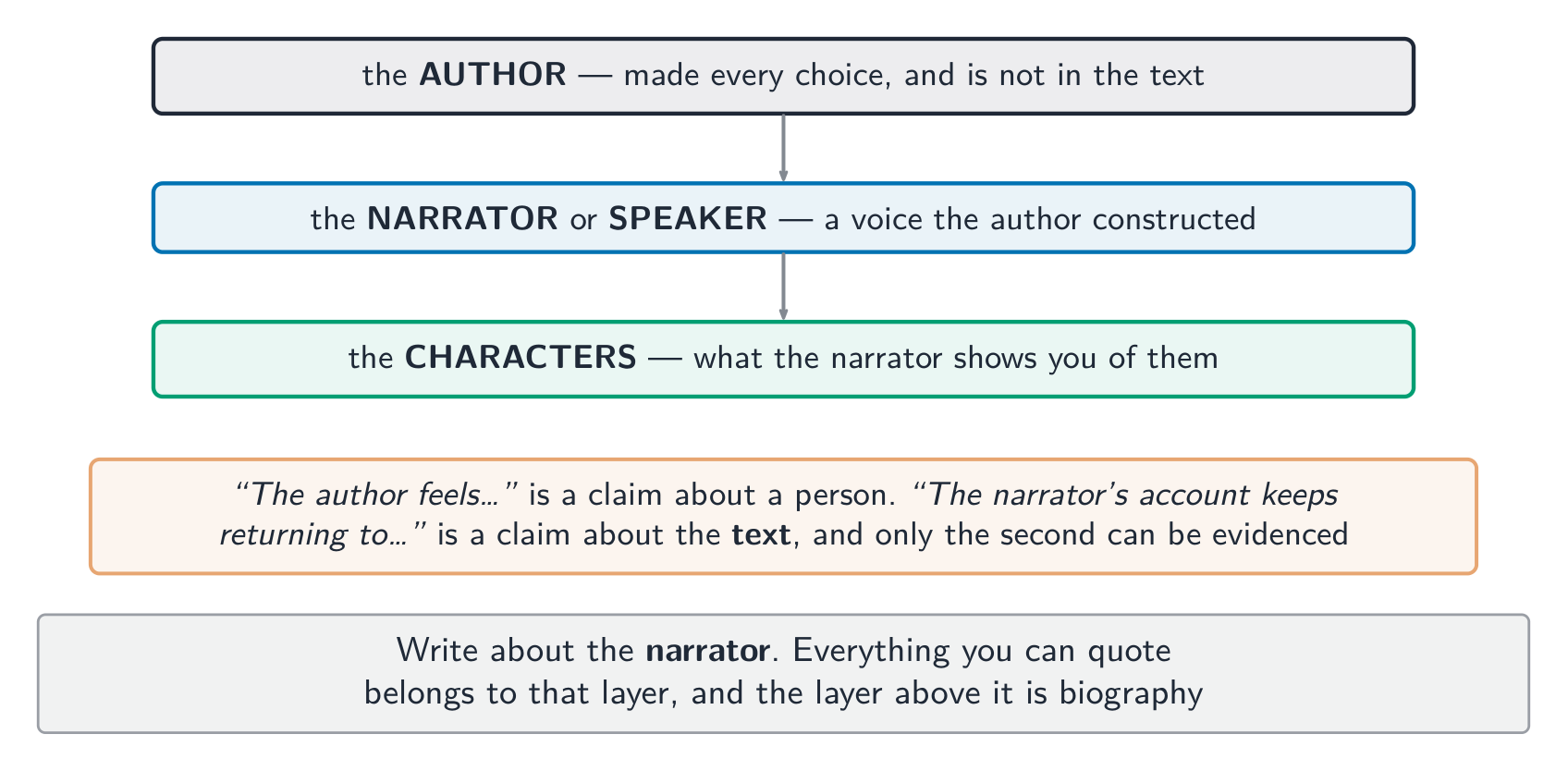
- A speaker or narrator is not necessarily the author. Never write "the author feels" about a first-person narrator.
Explore
Sort each statement by the layer it belongs to
Everything you can quote belongs to the narrator's layer. The layer above it is biography.
Vocabulary
Train
| English |
|---|
| point of view/pɔɪnt ɒv vjuː/ |
1.6
The Function of Point of View
Syllabus
| Enduring Understanding | Learning Objective | Essential Knowledge |
|---|---|---|
NAR-1 | 4.B |
|
Source: College Board AP Course and Exam Description
- Point of view contributes to what narrators can and cannot provide in a text, based on their position.
- Narrators may also be characters, and that role may influence their perspective.
- First-person narrators 第一人称叙述者 are involved in the narrative; their relationship to events and to other characters shapes what they can tell you.
- Third-person narrators 第三人称叙述者 are outside observers, and their knowledge may range from observational (reporting only what can be seen) to omniscient 全知 (all-knowing).
- The outside perspective of a third-person narrator may not be affected by the events of the narrative.
The analytical payoff is the cannot. A first-person narrator may learn about unwitnessed events through reports or inference 推断. Distinguish that indirect knowledge from direct access to another mind, and explain a gap only when the surrounding text supports its significance. A limited third-person narrator confines you to one consciousness, which is a choice about whose experience counts.
Vocabulary
Train
| English |
|---|
| first-person narrator |
| third-person narrator |
| omniscient |
| inference/ˈɪnfərəns/ |
1.7
Developing a Paragraph with Claim and Evidence
Syllabus
| Enduring Understanding | Learning Objective | Essential Knowledge |
|---|---|---|
LAN-1 | 7.A |
|
Source: College Board AP Course and Exam Description
- In literary analysis 文学分析, writers read a text closely to identify details that, in combination, enable them to make and defend a claim.
- A claim 论点 is a statement that requires defence with evidence from the text.
- The initial components of a paragraph are the claim and the textual evidence 文本证据 that defends it.
Note in combination. A single detail rarely supports an interpretive claim; two or three details that point the same way do.
Original practice passage: the unposted letter
This short passage was written for teaching. It is not an extract from an AP paper.
On the last evening before the station closed, I waited beside its locked ticket window. “You could still post it,” Mara said. I folded the letter until her name disappeared inside. “There is nothing left to say,” I told her. Years later, I call that silence kindness. Mara's answer, if she gave one, is the part I no longer remember.
Worked analysis. The first-person narrator presents avoidance as kindness. Folding Mara's name out of sight and insisting there is “nothing left to say” make that self-description questionable. The later admission about memory further limits the account: Mara's response is unavailable, so the passage does not establish that she agreed. The closed station reinforces the situation's narrowing possibilities. This interpretation links several details without claiming that first person automatically means dishonesty or that the narrator's judgement is the author's.
Practice. Explain how the later phrase “Years later” changes your reading of the earlier silence. Use two details and distinguish what the passage establishes from what remains uncertain.
A real text: Kate Chopin, "The Story of an Hour" (1894)
Mrs Mallard is told that her husband has died in a railway accident. She goes to her room alone. An hour later he walks in through the front door, alive: he was never on the train. She dies on the stairs. The story opens and closes like this:
Knowing that Mrs. Mallard was afflicted with a heart trouble, great care was taken to break to her as gently as possible the news of her husband's death.
When the doctors came they said she had died of heart disease—of joy that kills.
Worked analysis.
- Setting. Alone in her room she sees "the tops of trees that were all aquiver with the new spring life". The news is about death; the window shows new life. The setting tells us what she is feeling before she can say it.
- Character through behaviour and dialogue. Her first words alone are not words of grief: "Free! Body and soul free!" she kept whispering. She whispers, because she cannot say this to anyone.
- Plot and proportion. The public events (the news, the return, the death) take a few lines each. The story spends most of its words on one private hour.
- Point of view. The third-person narrator takes us into the room that no other character enters. The doctors see only the outside, so their "joy that kills" is an irony 反讽: we know that the shock was the loss of her new freedom, not joy at seeing her husband.
Claim: Chopin's narrator lets the reader into the one room the other characters never enter, so the doctors' last sentence reads as a confident misreading of the woman everyone was trying to protect.
Vocabulary
Train
| English |
|---|
| literary analysis/ˈlɪtərəri əˈnæləsɪs/ |
| claim/kleɪm/ |
| textual evidence |
| irony/ˈaɪrəni/ |
1.7
Practice
Read this original passage, then answer before reading the model answers.
Mrs Okafor wiped the same clean cup three times while the clock above the sink ticked past midnight. When the key finally turned in the lock, she put the cup down, picked up a book, and opened it somewhere in the middle.
- What do the details reveal about Mrs Okafor's state of mind?
- How does the setting add to the effect?
- Why does the order of her actions matter at the end?
- Write one defensible claim about her that you could develop in an essay.
1.7
Model answers
- She is anxious: wiping a cup that is already clean, three times, is action without purpose, a way of filling the wait.
- Midnight and the ticking clock press the passing time on the reader, so we feel how late the person she waits for is.
- She hides her worry the moment the person arrives: the book, opened "somewhere in the middle", is a pretence of calm. The sequence turns anxiety into concealment.
- For example: "Mrs Okafor's care for the late arrival shows less in what she says than in her effort to look as though she had not been waiting at all."
1.7
Exam tips
- Character is a way of seeing, not a list of adjectives. Analyse what they notice and misread.
- Setting must do something. Describing where a story happens is not yet a claim.
- Plot is the order of events. A late revelation of an early event is an authorial choice worth analysing.
- Proportion is evidence. What the text lingers over is where the meaning is.
- The narrator is not the author. Never write "the author feels" about a first-person narrator.
- The analytical gold in point of view is what the narrator cannot provide.
Vocabulary card meanings
omniscient: Describes a narrator who knows everything, including every character's thoughts. exposition: The background information a story gives about its characters and situation.
Interactive lessons on this topic
Work through it step by step, with instant-check exercises.