Skip to content · ⁨ข้ามไปยังเนื้อหา⁩
Subjects · ⁨รายวิชา⁩

AP English Literature and Composition · ⁨AP วรรณกรรมและบทวิเคราะห์เชิงลึก⁩

Tips · ⁨เคล็ดลับ⁩

AP English Literature and Composition สอนการอ่านอย่างละเอียดและข้อโต้แย้งทางวรรณกรรมข้ามสามประเภทข้อความ ซึ่งแต่ละประเภทจะถูกศึกษาสามครั้ง: เรื่องสั้น, กวีนิพนธ์, และ เรื่องยาวหรือละคร หน่วยการเรียนรู้มีการหมุนเวียน (spiral) sehingga ทักษะเดิมจะกลับมาในระดับลึกยิ่งขึ้น

รายวิชากำหนดโดยองค์ประกอบทางวรรณกรรม: ตัวละคร, Setting, โครงสร้าง, การเล่าเรื่อง, ภาษาเชิงเปรียบเทียบ, และการให้เหตุผลทางวรรณกรรม แต่ละองค์ประกอบมีทักษะของตนเอง และแต่ละองค์ประกอบตั้งคำถามพื้นฐานเดียวกัน - ว่าทางเลือกนี้ *ทำหน้าที่* อะไรในข้อความ?

"The function of" คือวลีที่ต้องสังเกต กรอบการทำงานถามบ่อยครั้งเกี่ยวกับหน้าที่ของสัญลักษณ์, ความแตกต่าง, หรือการเปลี่ยนแปลงในการเล่าเรื่อง การระบุเครื่องมือเป็นขั้นตอนแรก; การอธิบายหน้าที่它所ทำคือคำตอบ

Interpretation ต้องสามารถปกป้องได้ ไม่ใช่เพียงส่วนตัว การอ่านจะได้รับคะแนนเมื่อได้รับการสนับสนุนโดยรายละเอียดจากข้อความและพัฒนาผ่านการให้เหตุผล ซึ่งเป็นเหตุผลว่าทำไมการให้เหตุผลทางวรรณกรรมจึง berjalanคู่ไปกับองค์ประกอบทุกอย่าง

หมายเหตุด้านล่างนี้เป็นไปตามเก้าหน่วยตามลำดับที่ College Board กำหนด sehingga เรื่องสั้น, กวีนิพนธ์ และเรื่องยาวสลับกันอย่างถูกต้องตามที่รายวิชามี

  • 1

    Short Fiction I · ⁨เรื่องสั้น I⁩

    Watch lesson · ⁨ดูบทเรียน⁩
    1.1

    What Textual Details Reveal About a Character · ⁨รายละเอียดทางภาษาเปิดเผยเกี่ยวกับตัวละครอย่างไร⁩

    Syllabus · ⁨หลักสูตร⁩
    English

    Enduring Understanding (CHR-1): Characters in literature allow readers to study and explore a range of values, beliefs, assumptions, biases, and cultural norms represented by those characters.

    Learning Objective 1.A: Identify and describe what specific textual details reveal about a character, that character’s perspective, and that character’s motives.

    • CHR-1.A Description, dialogue, and behavior reveal characters to readers.
    • CHR-1.B Descriptions of characters may come from a speaker, narrator, other characters, or the characters themselves.
    • CHR-1.C Perspective is how narrators, characters, or speakers understand their circumstances, and is informed by background, personality traits, biases, and relationships.
    • CHR-1.D A character’s perspective is both shaped and revealed by relationships with other characters, the environment, the events of the plot, and the ideas expressed in the text.
    ไทย

    ความเข้าใจที่ยั่งยืน (CHR-1): ตัวละครในวรรณกรรมช่วยให้ผู้อ่านศึกษาและสำรวจค่าต่างๆ ความเชื่อ สมมติฐาน อคติ และบรรทัดฐานทางวัฒนธรรมที่ตัวละครเหล่านั้นสะท้อนออกมา

    วัตถุประสงค์การเรียนรู้ 1.A: ระบุและอธิบายว่ารายละเอียดเฉพาะจากข้อความบอกอะไรเกี่ยวกับตัวละคร มุมมองของตัวละคร และแรงจูงใจของตัวละครนั้น

    • CHR-1.A การบรรยาย บทพูด และพฤติกรรมเผยตัวอักษรให้ผู้อ่านเห็น
    • CHR-1.B การบรรยายเกี่ยวกับตัวละครอาจมาจากผู้พูด ผู้บรรยาย ตัวละครอื่น หรือตัวละครเอง
    • CHR-1.C มุมมองคือวิธีการที่ผู้บรรยาย ตัวละคร หรือผู้พูด เข้าใจสถานการณ์ของพวกเขา ซึ่งได้รับอิทธิพลจากภูมิหลัง ลักษณะนิสัย อคติ และความสัมพันธ์
    • CHR-1.D มุมมองของตัวละครทั้งถูก shaped และ revealed โดยความสัมพันธ์กับตัวละครอื่นๆ สิ่งแวดล้อม เหตุการณ์ในเนื้อเรื่อง และความคิดที่ expressed ในข้อความ

    Source: College Board AP Course and Exam Description · ⁨แหล่งที่มา: คำอธิบายหลักสูตรและข้อสอบ College Board AP⁩

    English

    AP English Literature reads texts in three genres across nine units - short fiction, poetry, and longer fiction or drama, each visited three times at increasing difficulty. Unit 1 installs the tools for all of them.

    Character 人物 is revealed by three things, and the CED names them exactly:

    • Description, dialogue, and behaviour 描写、对话与行为 reveal characters to readers.
    • Descriptions may come from a speaker, narrator, other characters, or the characters themselves - so who is describing is part of the evidence.
    • Perspective 视角 is how narrators, characters, or speakers understand their circumstances, informed by background, experience, and values.
    • A character's perspective is both shaped and revealed by relationships with other characters, the environment, and events.

    That last point is the one that turns character notes into analysis. A character is not a list of adjectives; a character is a way of seeing, which becomes visible in what they notice, what they misread, and how they respond.

    ไทย

    AP English Literature อ่านข้อความในสามประเภท Across สี่หน่วย - นิยายสั้น, กวีนิพนธ์ และนวนิยายหรือละครที่ยาวขึ้น, แต่ละอย่างถูกศึกษาสามครั้งด้วยความยากที่เพิ่มขึ้น Unit 1 เป็นจุดเริ่มต้นของเครื่องมือสำหรับทั้งหมดนั้น

    ตัวละคร 人物 ถูกเปิดเผยโดยสามสิ่ง และ CED ชี้ชื่อนั้นอย่างชัดเจน:

    • คำบรรยาย, บทสนทนา และพฤติกรรม 描写、对话与行为 เปิดเผยตัวละครให้ผู้อ่านเห็น
    • คำบรรยายอาจมาจาก ผู้พูด, ผู้บรรยาย, ตัวละครอื่น หรือตัวตัวละครเอง - ดังนั้นใครคือผู้บรรยายก็เป็นส่วนหนึ่งของหลักฐาน
    • มุมมอง 视角 คือ วิธีที่ผู้บรรยาย ตัวละคร หรือผู้พูดเข้าใจสถานการณ์ของตนเอง ซึ่งได้รับอิทธิพลจากพื้นหลัง ประสบการณ์ และค่านิยม
    • มุมมองของตัวละครถูก สร้างและเผยให้เห็นผ่านความสัมพันธ์ กับตัวละครอื่น สิ่งแวดล้อม และเหตุการณ์ต่างๆ

    จุดสุดท้ายนี้คือสิ่งที่เปลี่ยนหมายเหตุตัวละครให้เป็นบทวิเคราะห์ ตัวละครไม่ใช่รายการคุณศัพท์; ตัวละครคือวิธีการมองเห็น ซึ่งปรากฏชัดในสิ่งที่พวกเขาสังเกตเห็น สิ่งที่พวกเขาตีความผิด และวิธีการตอบสนองของพวกเขา

    อธิบายว่ารายละเอียดนั้นกำหนดอะไรไว้ และหยุดลงตรงที่หลักฐานสิ้นสุด
    Explore · ⁨สำรวจ⁩

    Take a detail exactly as far as it goes · ⁨นำรายละเอียดมาพิจารณาให้ครบถ้วนตามขอบเขตของมัน⁩

    Over-reading loses as many marks as under-reading: say what the detail establishes, and stop where the evidence stops. · ⁨การตีความเกินจริงทำให้เสียคะแนนเท่ากับการตีความน้อยเกินไป: บอกสิ่งที่รายละเอียดยืนยัน แล้วหยุดตรงที่หลักฐานสิ้นสุดลง.⁩

    1.2

    Textual Details That Convey Setting · ⁨รายละเอียดทางภาษาที่สื่อถึงฉาก⁩

    Syllabus · ⁨หลักสูตร⁩
    English

    Enduring Understanding (SET-1): Setting and the details associated with it not only depict a time and place, but also convey values associated with that setting.

    Learning Objective 2.A: Identify and describe specific textual details that convey or reveal a setting.

    • SET-1.A Setting includes the time and place during which the events of the text occur.
    ไทย

    ความเข้าใจที่ยั่งยืน (SET-1): ฉากและรายละเอียดที่เกี่ยวข้องไม่เพียงแต่ depict เวลาและสถานที่ แต่ยัง convey ค่าต่างๆ ที่ associated กับฉากนั้นด้วย

    วัตถุประสงค์การเรียนรู้ 2.A: ระบุและอธิบายรายละเอียดเฉพาะจากข้อความที่ convey หรือ reveal ฉาก

    • SET-1.A ฉาก รวมถึงเวลาและสถานที่ที่เหตุการณ์ของข้อความเกิดขึ้น

    Source: College Board AP Course and Exam Description · ⁨แหล่งที่มา: คำอธิบายหลักสูตรและข้อสอบ College Board AP⁩

    English

    Setting 背景 includes the time and place during which the events of the text occur.

    The CED's definition is deliberately minimal, and that is the trap. Setting earns marks not when it is described but when it is shown doing something - constraining a character, explaining a value, or contrasting with an interior state. A paragraph that establishes where a story happens has not yet made a claim.

    ไทย

    ฉาก 背景 รวมถึง เวลาและสถานที่ ที่เหตุการณ์ในข้อความเกิดขึ้น

    นิยามของ CED มีน้อยมากอย่างตั้งใจ และนั่นกับดัก ฉากได้คะแนนไม่เมื่อถูกบรรยาย แต่เมื่อถูกแสดง กำลังทำอะไร - ขัดขวางตัวละคร อธิบายค่านิยม หรือตัดกับสภาวะภายใน_paragraph ที่กำหนดสถานที่เรื่องเกิดขึ้นยังไม่ได้อ้างอิงสิ่งใดเลย

    1.3

    How Plot Orders Events · ⁨วิธีเรียงลำดับเหตุการณ์ของplot⁩

    Syllabus · ⁨หลักสูตร⁩
    English

    Enduring Understanding (STR-1): The arrangement of the parts and sections of a text, the relationship of the parts to each other, and the sequence in which the text reveals information are all structural choices made by a writer that contribute to the reader’s interpretation of a text.

    Learning Objective 3.A: Identify and describe how plot orders events in a narrative.

    • STR-1.A Plot is the sequence of events in a narrative; events throughout a narrative are connected, with each event building on the others, often with a cause-and-effect relationship.
    • STR-1.B The dramatic situation of a narrative includes the setting and action of the plot and how that narrative develops to place characters in conflict(s), and often involves the rising or falling fortunes of a main character or set of characters.
    ไทย

    ความเข้าใจที่ยั่งยืน (STR-1): การจัด arrangement ของส่วนและ section ของข้อความ ความสัมพันธ์ของส่วนต่างๆ ต่อกัน และ sequence ที่ข้อความ revealing ข้อมูล ล้วนเป็น structural choices ที่นักเขียนทำซึ่ง contribute ต่อการ interpretation ของผู้อ่านที่มีต่อข้อความ

    วัตถุประสงค์การเรียนรู้ 3.A: ระบุและอธิบายว่า plot เรียงลำดับเหตุการณ์ในนิยายอย่างไร

    • STR-1.A Plot คือ sequence ของเหตุการณ์ในนิยาย; เหตุการณ์ตลอดทั้งนิยาย interconnected โดยแต่ละเหตุการณ์ build上一 events ก่อนหน้า มักจะมี cause-and-effect relationship
    • STR-1.B สถานการณ์ทางดราม่าของนิยายรวมถึง setting และ action ของ plot以及如何 narrative develops to place characters in conflict(s), และมักเกี่ยวข้องกับ rising หรือ falling fortunes ของ main character หรือ set of characters

    Source: College Board AP Course and Exam Description · ⁨แหล่งที่มา: คำอธิบายหลักสูตรและข้อสอบ College Board AP⁩

    English
    • Plot 情节 is the sequence of events in a narrative; events are connected, each building on those before it.
    • The dramatic situation 戏剧情境 includes the setting and action of the plot and how the narrative develops to place characters in conflict.

    The word sequence is doing work. Plot is not the events but their order - and an author who reveals something late that happened early has made a choice you can analyse.

    ไทย
    • plot 情节 คือ ลำดับของเหตุการณ์ ในเรื่อง; เหตุการณ์เชื่อมต่อกัน แต่ละเหตุการณ์สร้างบนพื้นฐานของเหตุการณ์ก่อนหน้า
    • สถานการณ์แบบละคร 戏剧情境 รวมถึง ฉากและการกระทำ ของ plot และ วิธีที่เรื่องราวพัฒนาไป เพื่อวางตัวละครไว้ในความขัดแย้ง

    คำว่า ลำดับ ทำงานหนัก Plot ไม่ใช่แค่เหตุการณ์แต่คือ ลำดับ - และนักเขียนที่เปิดเผยสิ่งที่เกิดขึ้นก่อนหน้าในภายหลัง ได้เลือกสิ่งที่คุณสามารถวิเคราะห์ได้

    ลำดับเหตุการณ์ที่เกิดขึ้น เทียบกับลำดับที่คุณได้รับทราบ - ความต่างคือการเลือก
    Vocabulary · ⁨คำศัพท์⁩ Train · ⁨ฝึกฝน⁩
    English ไทย
    Character/ˈkærɪktə/ ตัวละคร
    Description, dialogue, and behaviour/dɪˈskrɪpʃn ˈdaɪəlɒɡ ænd bɪˈheɪvjə/ คำบรรยาย บทสนทนา และพฤติกรรม
    Perspective/pəˈspektɪv/ มุมมอง
    Setting/ˈsetɪŋ/ ฉาก (Setting)
    Plot/plɒt/ พล็อตเรื่อง
    dramatic situation/drəˈmætɪk ˌsɪtʃuːˈeɪʃn/ สถานการณ์ทางละคร
    1.4

    The Function of a Sequence of Events · ⁨หน้าที่ของการเรียงลำดับเหตุการณ์⁩

    Syllabus · ⁨หลักสูตร⁩
    English

    Enduring Understanding (STR-1): The arrangement of the parts and sections of a text, the relationship of the parts to each other, and the sequence in which the text reveals information are all structural choices made by a writer that contribute to the reader’s interpretation of a text.

    Learning Objective 3.B: Explain the function of a particular sequence of events in a plot.

    • STR-1.C Plot and the exposition that accompanies it focus readers’ attention on the parts of the narrative that matter most to its development, including characters, their relationships, and their roles in the narrative, as well as setting and the relationship between characters and setting.
    ไทย

    ความเข้าใจที่ยั่งยืน (STR-1): การจัด arrangement ของส่วนและ section ของข้อความ ความสัมพันธ์ของส่วนต่างๆ ต่อกัน และ sequence ที่ข้อความ revealing ข้อมูล ล้วนเป็น structural choices ที่นักเขียนทำซึ่ง contribute ต่อการ interpretation ของผู้อ่านที่มีต่อข้อความ

    วัตถุประสงค์การเรียนรู้ 3.B: อธิบาย function ของ sequence ของเหตุการณ์เฉพาะ在某 plot

    • STR-1.C Plot และ exposition yang accompanying与之 focus ให้ความสนใจของผู้อ่านไปที่ parts ของนิยายที่สำคัญที่สุดสำหรับการพัฒนา củaมัน รวมถึงตัวละคร ความสัมพันธ์ระหว่างตัวละคร และบทบาทของตัวละครในนิยาย ainsi que setting และความสัมพันธ์ระหว่างตัวละครและ setting

    Source: College Board AP Course and Exam Description · ⁨แหล่งที่มา: คำอธิบายหลักสูตรและข้อสอบ College Board AP⁩

    English

    Plot and the exposition that accompanies it focus readers' attention on the parts of the narrative that matter most to the text's meaning.

    That sentence is the whole method for prose analysis: proportion is evidence. What the text lingers over, and what it passes in a clause, is the author telling you where to look.

    ไทย

    plot และการแนะนำเนื้อหาที่ตามมา มุ่งเน้นความสนใจของผู้อ่านไปที่ส่วนที่สำคัญที่สุดของเรื่องราว ต่อความหมายของข้อความ

    ประโยคนั้นคือวิธีการทั้งหมดสำหรับการวิเคราะห์งานเขียน: สัดส่วนคือหลักฐาน สิ่งที่ข้อความ停留 ( linger ) และสิ่งที่ข้ามผ่านในประโยคเดียว คือนักเขียนบอกให้คุณมองหาที่ไหน

    1.5

    Identifying the Narrator or Speaker · ⁨การระบุผู้บรรยายหรือผู้พูด⁩

    Syllabus · ⁨หลักสูตร⁩
    English

    Enduring Understanding (NAR-1): A narrator’s or speaker’s perspective controls the details and emphases that affect how readers experience and interpret a text.

    Learning Objective 4.A: Identify and describe the narrator or speaker of a text.

    • NAR-1.A Narrators or speakers relate accounts to readers and establish a relationship between the text and the reader.
    • NAR-1.B Perspective refers to how narrators, characters, or speakers see their circumstances, while point of view refers to the position from which a narrator or speaker relates the events of a narrative.
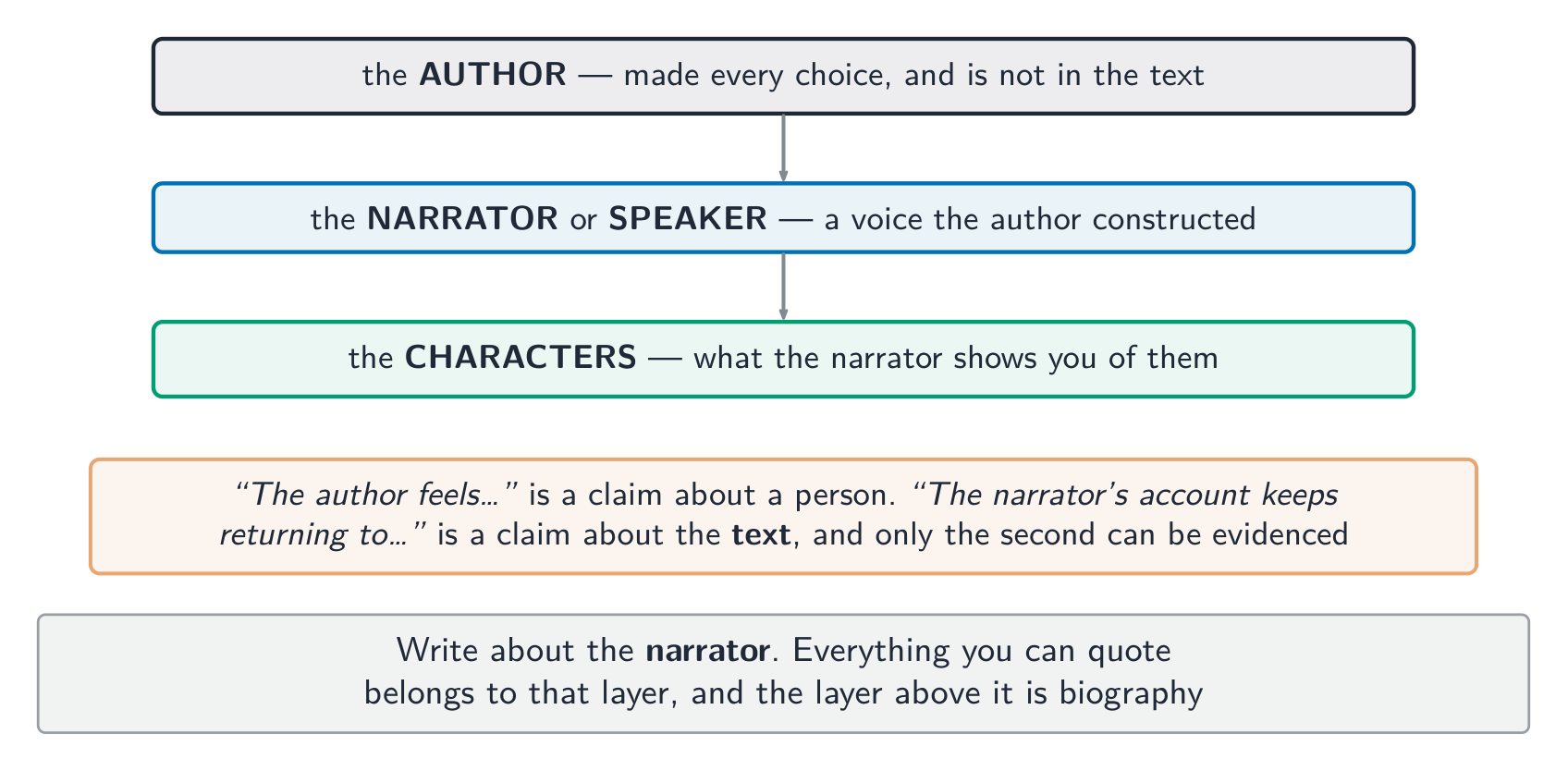
    • NAR-1.C A speaker or narrator is not necessarily the author.
    ไทย

    ความเข้าใจที่ยั่งยืน (NAR-1): มุมมองของผู้บรรยายหรือผู้พูด controlling Details และ emphases yang affecting Cómo readers experience และ interpret ข้อความ

    วัตถุประสงค์การเรียนรู้ 4.A: ระบุและอธิบายผู้บรรยายหรือผู้พูดของข้อความ

    • NAR-1.A ผู้บรรยายหรือผู้พูด relate Accounts ถึงผู้อ่านและ establish Relationship ระหว่างข้อความและผู้อ่าน
    • NAR-1.B มุมมอง (Perspective) หมายถึงวิธีที่ผู้เล่าเรื่อง ตัวละคร หรือผู้พูดมองเห็นสถานการณ์ของตน ในขณะที่มุมมองการเล่าเรื่อง (Point of view) หมายถึงตำแหน่งหรือมุมมองที่ผู้เล่าเรื่องหรือผู้พูดนำเสนอเหตุการณ์ของเรื่องราว
    • NAR-1.C ผู้พูดหรือผู้เล่าเรื่องไม่จำเป็นต้องเป็นผู้เขียน Works เอง

    Source: College Board AP Course and Exam Description · ⁨แหล่งที่มา: คำอธิบายหลักสูตรและข้อสอบ College Board AP⁩

    English
    • Narrators or speakers relate accounts and establish a relationship between the text and the reader.
    • Perspective refers to how narrators, characters, or speakers see their circumstances; point of view 叙述视点 refers to the position from which they relate the account.
    • A speaker or narrator is not necessarily the author. Never write "the author feels" about a first-person narrator.
    ไทย
    แต่ละมุมมองสามารถมอบอะไรให้คุณได้และไม่มอบอะไร - และข้อจำกัดนี้คือบทวิเคราะห์
    มุมมองคือสิ่งที่พวกเขามองเห็น; มุมมองการเล่าเรื่องคือตำแหน่งที่พวกเขายืน CED แยกแยะทั้งสองอย่างนี้ ดังนั้นคุณก็ควรทำเช่นเดียวกัน
    • ผู้บรรยายหรือผู้พูด เล่าเรื่องและ สร้างความสัมพันธ์ระหว่างข้อความและผู้读者
    • มุมมอง หมายถึง วิธี ที่ผู้บรรยาย ตัวละคร หรือผู้พูดมองเห็นสถานการณ์; มุมมองการเล่าเรื่อง 叙述视点 หมายถึง ตำแหน่งจากซึ่ง พวกเขาเล่าเรื่อง
    • ผู้พูดหรือผู้บรรยายไม่จำเป็นต้องเป็นนักเขียน ห้ามเขียนว่า "นักเขียนรู้สึก" เกี่ยวกับผู้บรรยายแบบบุคคลที่หนึ่ง
    เขียนเกี่ยวกับผู้บรรยาย: ทุกสิ่งที่คุณสามารถอ้างถึงได้เป็นของชั้นนี้
    Explore · ⁨สำรวจ⁩

    Sort each statement by the layer it belongs to · ⁨เรียงลำดับแต่ละคำกล่าวโดยชั้นที่มันอยู่ใน⁩

    Everything you can quote belongs to the narrator's layer. The layer above it is biography. · ⁨ทุกอย่างที่คุณสามารถ trích dikutipได้เป็นของชั้นผู้เล่าเรื่อง ชั้นถัดไปคือชีวประวัติ⁩

    Vocabulary · ⁨คำศัพท์⁩ Train · ⁨ฝึกฝน⁩
    English ไทย
    point of view/pɔɪnt ɒv vjuː/ มุมมอง
    observational to all-knowing/ɒbzəˈveɪʃənl tʊ ɔːl ˈnəʊɪŋ/ จากการสังเกตสู่ผู้รู้ทุกthings
    1.6

    The Function of Point of View · ⁨หน้าที่ของมุมมองการเล่าเรื่อง⁩

    Syllabus · ⁨หลักสูตร⁩
    English

    Enduring Understanding (NAR-1): A narrator’s or speaker’s perspective controls the details and emphases that affect how readers experience and interpret a text.

    Learning Objective 4.B: Identify and explain the function of point of view in a narrative.

    • NAR-1.D The point of view contributes to what narrators, characters, or speakers can and cannot provide in a text based on their level of involvement and intimacy with the details, events, or characters.
    • NAR-1.E Narrators may also be characters, and their role as characters may influence their perspective.
    • NAR-1.F First-person narrators are involved in the narrative; their relationship to the events of the plot and the other characters shapes their perspective.
    • NAR-1.G Third-person narrators are outside observers.
    • NAR-1.H Third-person narrators’ knowledge about events and characters may range from observational to all-knowing, which shapes their perspective.
    • NAR-1.I The outside perspective of third-person narrators may not be affected by the events of the narrative.
    ไทย

    ความเข้าใจที่ยั่งยืน (NAR-1): มุมมองของผู้บรรยายหรือผู้พูด controlling Details และ emphases yang affecting Cómo readers experience และ interpret ข้อความ

    จุดประสงค์การเรียนรู้ 4.B: ระบุและอธิบายหน้าที่ของมุมมองการเล่าเรื่องในเรื่องราว

    • NAR-1.D มุมมองการเล่าเรื่องมีผลต่อสิ่งที่ผู้เล่าเรื่อง ตัวละคร หรือผู้พูดสามารถให้ข้อมูลได้หรือไม่ในข้อความ โดยขึ้นอยู่กับระดับการมีส่วนร่วมและความใกล้ชิดกับรายละเอียด เหตุการณ์ หรือตัวละคร
    • NAR-1.E ผู้เล่าเรื่องอาจเป็นตัวละครด้วย และบทบาทในฐานะตัวละครอาจส่งผลต่อมุมมองของพวกเขานี้
    • NAR-1.G ผู้เล่าเรื่องแบบบุคคลที่สามคือผู้สังเกตภายนอก
    • NAR-1.H ความรู้ของผู้เล่าเรื่องแบบบุคคลที่สามเกี่ยวกับเหตุการณ์และตัวละครอาจครอบคลุมตั้งแต่การสังเกตไปจนถึงการรู้ทุกสิ่ง ซึ่งจะกำหนดมุมมองของพวกเขานี้
    • NAR-1.I มุมมองภายนอกของผู้เล่าเรื่องแบบบุคคลที่สามอาจไม่ได้รับผลกระทบจากเหตุการณ์ในเรื่องราว
    • NAR-1.I มุมมองภายนอกของนักบรรยายแบบบุคคลที่สามอาจไม่ได้รับผลกระทบจากเหตุการณ์ในเนื้อเรื่อง

    Source: College Board AP Course and Exam Description · ⁨แหล่งที่มา: คำอธิบายหลักสูตรและข้อสอบ College Board AP⁩

    English
    • Point of view contributes to what narrators can and cannot provide in a text, based on their position.
    • Narrators may also be characters, and that role may influence their perspective.
    • First-person narrators are involved in the narrative; their relationship to events and to other characters shapes what they can tell you.
    • Third-person narrators are outside observers, and their knowledge may range from observational to all-knowing 全知.
    • The outside perspective of a third-person narrator may not be affected by the events of the narrative.

    The analytical payoff is the cannot. A first-person narrator cannot report what they did not witness or will not admit, and every gap is meaningful. A limited third-person narrator confines you to one consciousness, which is a choice about whose experience counts.

    ไทย
    • มุมมองการเล่าเรื่องมีส่วนร่วมใน สิ่งที่ผู้บรรยายสามารถและไม่สามารถให้ ในข้อความ โดยขึ้นอยู่กับตำแหน่งของพวกเขา
    • ผู้บรรยาย อาจเป็นตัวละครด้วย และบทบาทนี้อาจมีผลต่อมุมมองของพวกเขา
    • ผู้บรรยายแบบบุคคลที่หนึ่งมีส่วนร่วมในเรื่องราว; ความสัมพันธ์与他们กับเหตุการณ์และตัวละครอื่นกำหนดสิ่งที่พวกเขาบอกคุณได้
    • ผู้บรรยายแบบบุคคลที่สามเป็นผู้สังเกตภายนอก และความรู้ของพวกเขาอาจตั้งแต่ การสังเกตไปจนถึงรู้ทุกสิ่ง 全知
    • มุมมองภายนอกของผู้บรรยายแบบบุคคลที่สาม อาจไม่ได้รับผลกระทบจากเหตุการณ์ ของเรื่องราว

    ผลตอบแทนจากการวิเคราะห์อยู่ที่คำว่า ไม่สามารถ ผู้บรรยายแบบบุคคลที่หนึ่งไม่สามารถรายงานสิ่งที่他们没有目睹หรือไม่ยอมยอมรับ และช่องว่างทุกอย่างมีความหมาย ผู้บรรยายแบบบุคคลที่สามแบบจำกัดทำให้คุณอยู่ในจิตสำนึกเพียงคนเดียว ซึ่ง это выбор о том чьё переживание считаетсяสำคัญ

    1.7

    Developing a Paragraph with Claim and Evidence · ⁨การพัฒนาย่อหน้าด้วยข้ออ้างและหลักฐาน⁩

    Syllabus · ⁨หลักสูตร⁩
    English

    Enduring Understanding (LAN-1): Readers establish and communicate their interpretations of literature through arguments supported by textual evidence.

    Learning Objective 7.A: Develop a paragraph that includes 1) a claim that requires defense with evidence from the text and 2) the evidence itself.

    • LAN-1.A In literary analysis, writers read a text closely to identify details that, in combination, enable them to make and defend a claim about an aspect of the text.
    • LAN-1.B A claim is a statement that requires defense with evidence from the text.
    • LAN-1.C In literary analysis, the initial components of a paragraph are the claim and textual evidence that defends the claim.
    ไทย

    ความเข้าใจที่ยั่งยืน (LAN-1): ผู้_read者确立并传达对文学作品的解读,通过有文本证据支持的论证。

    วัตถุประสงค์การเรียนรู้ 7.A: พัฒนาพารากราฟที่ประกอบด้วย 1) ข้ออ้างที่ต้องการการปกป้องด้วยหลักฐานจากข้อความ และ 2) ตัวหลักฐานเอง

    • LAN-1.B ข้ออ้างคือประโยคที่จำเป็นต้องมีหลักฐานจากข้อความมาสนับสนุน
    • LAN-1.C ในการวิเคราะห์วรรณกรรม ส่วนประกอบเริ่มต้นของย่อหน้าคือข้ออ้างและหลักฐานจากข้อความ用来 defends the claim
    • LAN-1.C ในการวิเคราะห์วรรณกรรม ส่วนประกอบเริ่มต้นของพารากราฟคือข้ออ้างและหลักฐานจากข้อความ用来捍卫该主张。

    Source: College Board AP Course and Exam Description · ⁨แหล่งที่มา: คำอธิบายหลักสูตรและข้อสอบ College Board AP⁩

    English
    • In literary analysis, writers read a text closely to identify details that, in combination, enable them to make and defend a claim.
    • A claim is a statement that requires defence with evidence from the text.
    • The initial components of a paragraph are the claim and the textual evidence that defends it.

    Note in combination. A single detail rarely supports an interpretive claim; two or three details that point the same way do.

    Worked example (a real AP exam task). The AP Literature free-response section has three questions - poetry analysis, prose fiction analysis, and a literary argument on a work you choose - all marked on a six-point rubric: thesis 1, evidence and commentary 4, sophistication 1. For a prose fiction prompt asking how the author uses narrative techniques to reveal a character's attitude, a weak answer writes "the narrator is first-person, which makes it personal." A scoring answer uses the cannot: "Because the narrator is a participant recounting events years later, the account gives us his present judgement of his younger self and withholds what the other characters thought - so the reader receives his self-criticism as the only available evidence, and must decide whether the harshness of it is accuracy or performance." Point of view, its limit, and the effect on the reader.

    ไทย
    • ในการวิเคราะห์วรรณกรรม นักเขียน อ่านข้อความอย่างละเอียดเพื่อระบุรายละเอียดที่ เมื่อรวมกันแล้ว ทำให้พวกเขาสามารถเสนอและปกป้องข้ออ้างได้
    • ข้ออ้าง คือ statement ที่ ต้องการการปกป้องด้วยหลักฐานจากข้อความ
    • ส่วนประกอบเริ่มต้นของย่อหน้าคือ ข้ออ้างและหลักฐานทางภาษา ที่ปกป้องมัน

    สังเกตคำว่า รวมกันแล้ว รายละเอียดเดี่ยวๆ มักจะไม่รองรับข้ออ้างในการตีความ; สองหรือสามรายละเอียดที่ชี้ไปในทิศทางเดียวกันทำได้

    ตัวอย่างการวิเคราะห์ (โจทย์จริงจากข้อสอบ AP). ส่วนคำตอบแบบอิสระของวิชา AP Literature มี 3 ข้อ - การวิเคราะห์บทกวี, การวิเคราะห์เรื่องสั้น และงานเขียนเชิงวรรณกรรม เกี่ยวกับงานที่คุณเลือก - โดยทั้งหมดใช้เกณฑ์การให้คะแนนแบบ 6 ระดับ: Thesis 1, หลักฐานและคำอธิบาย 4, ความลึกซึ้ง 1. สำหรับโจทย์เรื่องสั้นที่ถามว่าผู้แต่งใช้เทคนิคการเล่าเรื่องอย่างไรเพื่อเผยทัศนคติของตัวละคร คำตอบที่ไม่ดีจะเขียนว่า “ผู้บรรยายเป็นแบบบุคคลที่หนึ่ง ซึ่งทำให้รู้สึกใกล้ชิด” แต่คำตอบที่ได้คะแนนจะใช้คำว่า ไม่สามารถ: “เนื่องจากผู้บรรยายเป็นผู้มีส่วนร่วมที่เล่าเหตุการณ์หลังจากผ่านไปหลายปี การเล่าเรื่องนี้จึงให้มุมมองปัจจุบันของเขาที่มีต่อตัวเองในวัยเยาว์ และปิดบังสิ่งที่ตัวละครอื่นคิด - ดังนั้นผู้อ่านจึงได้รับคำวิพากษ์วิจารณ์ตนเองของเขาเป็นหลักฐานเดียวที่มีอยู่ และต้องตัดสินใจว่าความเข้มงวดนั้นคือความจริงหรือเป็นการแสดง” มุมมอง, ข้อจำกัดของมัน, และผลต่อผู้อ่าน

    1.7

    Exam tips · ⁨ข้อแนะนำสำหรับการสอบ⁩

    English
    • Character is a way of seeing, not a list of adjectives. Analyse what they notice and misread.
    • Setting must do something. Describing where a story happens is not yet a claim.
    • Plot is the order of events. A late revelation of an early event is an authorial choice worth analysing.
    • Proportion is evidence. What the text lingers over is where the meaning is.
    • The narrator is not the author. Never write "the author feels" about a first-person narrator.
    • The analytical gold in point of view is what the narrator cannot provide.
    ไทย
    • ตัวละครคือ วิธีมองโลก ไม่ใช่แค่รายการคำขยาย วิเคราะห์ดูว่าเขาสนใจอะไรและตีความผิดพลาดอย่างไร
    • ฉากหลังต้องทำหน้าที่บางอย่าง. การบรรยายเพียงสถานที่发生的事情 ยังไม่ถือเป็นข้อโต้แย้งทางวรรณกรรม
    • plot คือ ลำดับ ของเหตุการณ์ การเปิดเผยเหตุการณ์ที่เกิดขึ้นก่อนหน้าในภายหลัง เป็นตัวเลือกของผู้แต่ง worthy of analysis.
    • สัดส่วนคือหลักฐาน. สิ่งที่ข้อความเน้นย้ำไว้คือจุดที่มีนัยสำคัญ
    • ผู้บรรยายไม่ใช่ผู้แต่ง. ห้ามเขียนว่า “ผู้แต่งรู้สึก” เมื่อพูดถึงผู้บรรยายแบบบุคคลที่หนึ่ง
    • ทองคำแห่งการวิเคราะห์ในมุมมองคือสิ่งที่ผู้บรรยาย ไม่สามารถ ให้ได้
  • 2

    Poetry I · ⁨บทกวี I⁩

    Watch lesson · ⁨ดูบทเรียน⁩
    2.1

    What Textual Details Reveal About a Character · ⁨รายละเอียดทางภาษาเปิดเผยเกี่ยวกับตัวละครอย่างไร⁩

    Syllabus · ⁨หลักสูตร⁩
    English

    Enduring Understanding (CHR-1): Characters in literature allow readers to study and explore a range of values, beliefs, assumptions, biases, and cultural norms represented by those characters.

    Learning Objective 1.A: Identify and describe what specific textual details reveal about a character, that character’s perspective, and that character’s motives.

    • CHR-1.E Characters reveal their perspectives and biases through the words they use, the details they provide in the text, the organization of their thinking, the decisions they make, and the actions they take.
    ไทย

    ความเข้าใจที่ยั่งยืน (CHR-1): ตัวละครในวรรณกรรมช่วยให้ผู้อ่านศึกษาและสำรวจค่าต่างๆ ความเชื่อ สมมติฐาน อคติ และบรรทัดฐานทางวัฒนธรรมที่ตัวละครเหล่านั้นสะท้อนออกมา

    วัตถุประสงค์การเรียนรู้ 1.A: ระบุและอธิบายว่ารายละเอียดเฉพาะจากข้อความบอกอะไรเกี่ยวกับตัวละคร มุมมองของตัวละคร และแรงจูงใจของตัวละครนั้น

    • CHR-1.E ตัวละครเปิดเผยมุมมองและอคติของตนผ่านคำที่ใช้ รายละเอียดที่นำเสนอในข้อความ การจัดระเบียบความคิด การตัดสินใจ และพฤติกรรมที่ทำ

    Source: College Board AP Course and Exam Description · ⁨แหล่งที่มา: คำอธิบายหลักสูตรและข้อสอบ College Board AP⁩

    English

    Unit 2 is the course's first poetry unit, and it adds two things to Unit 1's toolkit: structure as an object of analysis, and figurative language 比喻性语言 handled precisely rather than by name-dropping.

    One addition on character first: characters reveal their perspectives and biases through the words they use, the details they provide, and the details they omit.

    That last item is the analytical opening. What a speaker does not mention, in a poem where everything is chosen, is evidence.

    ไทย

    Unit 2 เป็นหน่วยกวีครั้งแรกของหลักสูตร และเพิ่มสองสิ่งเข้าไปในชุดเครื่องมือของ Unit 1: โครงสร้าง เป็นวัตถุของการวิเคราะห์, และ ภาษาเชิงสัญลักษณ์ 比喻性语言 ที่จัดการอย่างแม่นยำ แทนที่จะเป็นการแค่กล่าวถึงชื่อบทกวี

    การเพิ่มเติมเกี่ยวกับตัวละครเป็นอันดับแรก: ตัวละครแสดงมุมมองและอคติของตน ผ่าน คำศัพท์ที่พวกเขาเลือกใช้, รายละเอียดที่พวกเขานำเสนอ, และรายละเอียดที่ họละเลย

    หัวข้อสุดท้ายนี้คือจุดเริ่มต้นของการวิเคราะห์ สิ่งที่ผู้พูด ไม่ได้ กล่าวถึง ในบทกวีที่ทุกสิ่งถูกคัดเลือกมาอย่างพิถีพิถัน คือหลักฐาน

    2.2

    The Function of Structure in a Text · ⁨หน้าที่ของโครงสร้างในข้อความ⁩

    Syllabus · ⁨หลักสูตร⁩
    English

    Enduring Understanding (STR-1): The arrangement of the parts and sections of a text, the relationship of the parts to each other, and the sequence in which the text reveals information are all structural choices made by a writer that contribute to the reader’s interpretation of a text.

    Learning Objective 3.C: Explain the function of structure in a text.

    • STR-1.D Line and stanza breaks contribute to the development and relationship of ideas in a poem.
    • STR-1.E The arrangement of lines and stanzas contributes to the development and relationship of ideas in a poem.
    • STR-1.F A text’s structure affects readers’ reactions and expectations by presenting the relationships among the ideas of the text via their relative positions and their placement within the text as a whole.
    ไทย

    ความเข้าใจที่ยั่งยืน (STR-1): การจัด arrangement ของส่วนและ section ของข้อความ ความสัมพันธ์ของส่วนต่างๆ ต่อกัน และ sequence ที่ข้อความ revealing ข้อมูล ล้วนเป็น structural choices ที่นักเขียนทำซึ่ง contribute ต่อการ interpretation ของผู้อ่านที่มีต่อข้อความ

    จุดประสงค์การเรียนรู้ 3.C: อธิบายหน้าที่ของโครงสร้างในข้อความ

    • STR-1.E การจัดวางบรรทัดและท่อน contribute to the development and relationship of ideas in a poem
    • STR-1.F โครงสร้างของข้อความมีผลต่อการตอบสนองและความคาดหวังของผู้อ่าน通过将 ideas among the text via their relative positions and their placement within the text as a whole
    • STR-1.F โครงสร้างของข้อความมีผลต่อการตอบสนองและความคาดหวังของผู้อ่าน โดยแสดงความสัมพันธ์ระหว่างแนวคิดต่างๆ ผ่านตำแหน่งสัมพัทธ์และการวางภายในข้อความโดยรวม

    Source: College Board AP Course and Exam Description · ⁨แหล่งที่มา: คำอธิบายหลักสูตรและข้อสอบ College Board AP⁩

    English
    • Line and stanza breaks 行与诗节的断开 contribute to the development and relationship of ideas in a poem.
    • The arrangement of lines and stanzas contributes to that development.
    • A text's structure affects readers' reactions and expectations by presenting the relationships among ideas.

    Structure in poetry is not decoration; it is punctuation for thought. Where a line breaks decides which words sit at the ends of lines, and the end of a line is the most emphatic position available. A sentence that runs past a line break asks the reader to hold something unresolved; one that stops at the break closes it.

    ไทย
    • การตัดบรรทัดและท่อน 行与诗节的断开 ช่วยในการพัฒนาและความสัมพันธ์ของแนวคิดในบทกวี
    • การจัดเรียงบรรทัดและท่อน ช่วยในการพัฒนาเหล่านั้น
    • โครงสร้างของข้อความ ส่งผลกระทบต่อการตอบสนองและคาดการณ์ของผู้อ่าน โดยนำเสนอความสัมพันธ์ระหว่างแนวคิดต่างๆ

    โครงสร้างในบทกวีไม่ใช่เครื่องประดับ; มันคือเครื่องหมายวรรคตอนสำหรับความคิด การที่บรรทัดจบลงกำหนดว่าคำใดจะอยู่ที่ปลายบรรทัด และปลายบรรทัดคือตำแหน่งที่มีน้ำหนักที่สุดที่หาได้ การประโยคที่ไหลข้ามการจบบรรทัดขอให้ผู้อ่านถือบางสิ่งที่ยังไม่สรุป;而如果จบที่那里则ปิดมัน

    การบรรยายรูปร่างไม่ใช่การระบุหน้าที่ - บอกว่าผู้อ่านถูกให้ทำอะไร
    หน้ากระดาษที่นำคำอธิบายของตัวเองไปในส่วน Margin - การอ่านละเอียด ล่วงหน้าหลายศตวรรษ
    Explore · ⁨สำรวจ⁩

    Match each structural choice to its function · ⁨จับคู่ทางเลือกเชิงโครงสร้างแต่ละอย่างเข้ากับหน้าที่ของมัน⁩

    Describing the shape is not naming the function. Say what the reader is made to do, and where. · ⁨การอธิบายรูปร่างไม่ใช่การระบุหน้าที่ บอกว่าผู้อ่านถูกบังคับให้ทำอะไร และที่ไหน⁩

    2.3

    The Function of Contrasts Within a Text · ⁨หน้าที่ของความแตกต่างภายในข้อความ⁩

    Syllabus · ⁨หลักสูตร⁩
    English

    Enduring Understanding (STR-1): The arrangement of the parts and sections of a text, the relationship of the parts to each other, and the sequence in which the text reveals information are all structural choices made by a writer that contribute to the reader’s interpretation of a text.

    Learning Objective 3.D: Explain the function of contrasts within a text.

    • STR-1.G Contrast can be introduced through focus; tone; point of view; character, narrator, or speaker perspective; dramatic situation or moment; settings or time; or imagery.
    • STR-1.H Contrasts are the result of shifts or juxtapositions or both.
    • STR-1.I Shifts may be signaled by a word, a structural convention, or punctuation.
    • STR-1.J Shifts may emphasize contrasts between particular segments of a text.
    ไทย

    ความเข้าใจที่ยั่งยืน (STR-1): การจัด arrangement ของส่วนและ section ของข้อความ ความสัมพันธ์ของส่วนต่างๆ ต่อกัน และ sequence ที่ข้อความ revealing ข้อมูล ล้วนเป็น structural choices ที่นักเขียนทำซึ่ง contribute ต่อการ interpretation ของผู้อ่านที่มีต่อข้อความ

    จุดประสงค์การเรียนรู้ 3.D: อธิบายหน้าที่ของความแตกต่างในข้อความ

    • STR-1.H ความขัดแย้งเป็นผลจากการเปลี่ยนแปลงหรือการจัดวาง juxtapositions หรือทั้งสองอย่าง
    • STR-1.I การเปลี่ยนแปลงอาจถูก signal by a word, a structural convention, or punctuation
    • STR-1.J การเปลี่ยนแปลงอาจ emphasize contrasts between particular segments of a text
    • STR-1.J การเปลี่ยนแปลงอาจเน้นความแตกต่างระหว่างส่วนย่อยเฉพาะของข้อความได้

    Source: College Board AP Course and Exam Description · ⁨แหล่งที่มา: คำอธิบายหลักสูตรและข้อสอบ College Board AP⁩

    English
    • Contrast 对照 can be introduced through focus, tone, point of view, character or speaker perspective, and dramatic situation.
    • Contrasts are the result of shifts or juxtapositions or both.
    • Shifts may be signalled by a word, a structural convention, or punctuation.
    • Shifts may emphasise contrasts between particular segments of a text.

    This is the most reliable route into an unseen poem. Find the shift - a but, a stanza break, a change of tense or address - and the poem divides into a before and an after. What changed, and what the change costs or gains, is very often the poem's argument.

    ไทย
    • ความแตกต่าง 对照 สามารถนำไปสู่ผ่าน จุดโฟกัส, โทนเสียง, มุมมอง, ตัวละคร หรือมุมมองของผู้พูด, และสถานการณ์ทางละคร
    • ความแตกต่างเป็นผลลัพธ์จากการ เปลี่ยนแปลงหรือการจัดวาง juxtapositions หรือทั้งสองอย่าง
    • การเปลี่ยนแปลงอาจมีสัญญาณบอกโดยคำ, ข้อตกลงทางโครงสร้าง หรือเครื่องหมายวรรคตอน
    • การเปลี่ยนแปลงอาจ เน้นความแตกต่างระหว่างส่วนเฉพาะ ของข้อความ

    นี่คือเส้นทางที่เชื่อถือได้ที่สุดในการเข้าหาคำตอบบทกวีที่ไม่เคยเห็น หาจุดเปลี่ยน - คำว่า แต่, การจบท่อน, การเปลี่ยน tense หรือการเรียกขาน - แล้วบทกวีจะแบ่งออกเป็น ‘ก่อน’ และ ‘หลัง’ สิ่ง πουเปลี่ยนแปลงไป, และสิ่งที่การเปลี่ยนแปลงนั้นเสียสละหรือได้รับ มักจะเป็นข้อโต้แย้งของบทกวี

    สี่สถานที่เพื่อมองหาความแตกต่าง ไม่ใช่เพียงหนึ่ง
    Explore · ⁨สำรวจ⁩

    Find the contrast in four places, not one · ⁨หาความขัดแย้งในสี่จุด ไม่ใช่แค่จุดเดียว⁩

    Students find the obvious pairing and stop — and the contrast inside a character usually carries the complexity question. · ⁨นักเรียนมักพบคู่ที่เห็นชัดแล้วหยุด — และความขัดแย้งภายในตัวละครมักจะสะท้อน问到ความซับซ้อน⁩

    Vocabulary · ⁨คำศัพท์⁩ Train · ⁨ฝึกฝน⁩
    English ไทย
    figurative language/ˈfɪɡjərətɪv ˈlæŋɡwɪdʒ/ ภาษาเชิงสัญลักษณ์
    Line and stanza breaks/laɪn ænd ˈstænzə breɪks/ การจบท่อนและท่อนเพลง
    Contrast/ˈkɒntræst/ ความขัดแย้ง
    2.4

    The Function of Specific Words and Phrases · ⁨หน้าที่ของคำและวลีเฉพาะ⁩

    Syllabus · ⁨หลักสูตร⁩
    English

    Enduring Understanding (FIG-1): Comparisons, representations, and associations shift meaning from the literal to the figurative and invite readers to interpret a text.

    Learning Objective 5.B: Explain the function of specific words and phrases in a text.

    • FIG-1.A An antecedent is a word, phrase, or clause that precedes its referent. Referents may include pronouns, nouns, phrases, or clauses.
    • FIG-1.B Referents are ambiguous if they can refer to more than one antecedent, which affects interpretation.
    • FIG-1.C Words or phrases may be repeated to emphasize ideas or associations.
    • FIG-1.D Alliteration is the repetition of the same letter sound at the beginning of adjacent or nearby words to emphasize those words and their associations or representations.
    ไทย

    ความเข้าใจที่ยั่งยืน (FIG-1): การเปรียบเทียบ การแสดงภาพ และการเชื่อมโยง เปลี่ยนความหมายจากตัวอักษรสู่เชิงสัญลักษณ์และชวนให้ผู้读 mx interpret ข้อความ

    จุดประสงค์การเรียนรู้ 5.B: อธิบายหน้าที่ของคำและวลีเฉพาะในข้อความ

    • FIG-1.B Referents are ambiguous if they can refer to more than one antecedent, which affects interpretation
    • FIG-1.C คำหรือวลีอาจถูก repeated to emphasize ideas or associations
    • FIG-1.D Alliteration is the repetition of the same letter sound at the beginning of adjacent or nearby words to emphasize those words and their associations or representations
    • FIG-1.D การออกเสียงซ้ำ (Alliteration) คือการซ้ำเสียงตัวอักษรเดียวกันที่ต้นคำที่ติดกันหรือใกล้เคียงกัน เพื่อเน้นย้ำคำเหล่านั้นและความเชื่อมโยงหรือการแสดงภาพของมัน

    Source: College Board AP Course and Exam Description · ⁨แหล่งที่มา: คำอธิบายหลักสูตรและข้อสอบ College Board AP⁩

    English
    • An antecedent 先行词 is a word, phrase, or clause that precedes its referent.
    • Referents are ambiguous if they can refer to more than one antecedent, which affects interpretation 影响阐释.
    • Words or phrases may be repeated to emphasise ideas or associations.
    • Alliteration 头韵 is the repetition of the same initial sound in adjacent or nearby words, emphasising those words.

    Ambiguous reference is worth special attention. In prose it is usually a fault; in poetry it is often a device, and a pronoun that could point two ways may be holding both meanings deliberately.

    ไทย
    • Antecedent 先行词 คือคำ วลี หรือ clause ที่มาก่อน referent ของมัน
    • Referents อาจมีความกำกวมหากสามารถชี้ไปยัง antecedent ได้มากกว่าหนึ่ง, ซึ่ง ส่งผลต่อการตีความ 影响阐释
    • คำหรือวลีอาจถูกซ้ำ เพื่อเน้นแนวคิดหรือความเชื่อมโยง
    • Alliteration 头韵 คือการซ้ำเสียงตัวต้นเดียวกันในคำที่อยู่ติดกันหรือใกล้เคียงกัน เพื่อเน้นคำเหล่านั้น

    การอ้างอิงที่กำกวม值得特殊注意。ในเรื่องสั้นมักเป็นข้อบกพร่อง; ในบทกวีมักเป็นอุปกรณ์, และสรรพนามที่ชี้ได้สองทางอาจกำลังถือทั้งสองความหมายไว้อย่างตั้งใจ

    คำที่ถูกเลือกมาหนึ่งคำกำลังทำงานถึงสี่อย่าง - 'ทรงพลัง' ไม่รวมถึงหนึ่งในนั้น
    Vocabulary · ⁨คำศัพท์⁩ Train · ⁨ฝึกฝน⁩
    English ไทย
    antecedent/ˌæntɪˈsiːdənt/ antecedent
    affects interpretation/əˈfekts ɪnˌtɜːprɪˈteɪʃn/ ส่งผลกระทบต่อการตีความ
    Alliteration/əˌlɪtəˈreɪʃn/ Alliteration
    2.5

    The Function of a Simile · ⁨หน้าที่ของ Simile⁩

    Syllabus · ⁨หลักสูตร⁩
    English

    Enduring Understanding (FIG-1): Comparisons, representations, and associations shift meaning from the literal to the figurative and invite readers to interpret a text.

    Learning Objective 6.A: Identify and explain the function of a simile.

    • FIG-1.E A simile uses the words “like” or “as” to liken two objects or concepts to each other.
    • FIG-1.F Similes liken two different things to transfer the traits or qualities of one to the other.
    • FIG-1.G In a simile, the thing being compared is the main subject; the thing to which it is being compared is the comparison subject.
    ไทย

    ความเข้าใจที่ยั่งยืน (FIG-1): การเปรียบเทียบ การแสดงภาพ และการเชื่อมโยง เปลี่ยนความหมายจากตัวอักษรสู่เชิงสัญลักษณ์และชวนให้ผู้读 mx interpret ข้อความ

    จุดประสงค์การเรียนรู้ 6.A: ระบุและอธิบายหน้าที่ของการเปรียบเปรยแบบใช้ 'เหมือน/เช่น' (Simile)

    • FIG-1.F Similes liken two different things to transfer the traits or qualities of one to the other
    • FIG-1.G ใน similes, the thing being compared is the main subject; the thing to which it is being compared is the comparison subject
    • FIG-1.G ในการเปรียบเปรยแบบใช้ 'เหมือน/เช่น' สิ่งที่กำลังถูกเปรียบเทียบคือLECTURE; สิ่งที่นำไปเปรียบเทียบกับสิ่งนั้นคือLECTURE

    Source: College Board AP Course and Exam Description · ⁨แหล่งที่มา: คำอธิบายหลักสูตรและข้อสอบ College Board AP⁩

    English
    • A simile 明喻 uses "like" or "as" to liken two objects or concepts.
    • Similes liken two different things to transfer the traits or qualities of one to the other.
    • In a simile, the thing being compared is the main subject; the thing to which it is compared is the comparison subject.

    Those two terms are the whole method. A scoring answer names the main subject, names the comparison subject, and then says which quality was transferred - because that quality is the claim the poem is making.

    ไทย
     terminology ของ CED เอง - และการถ่ายโอนเกิดขึ้นเพียงทิศทางเดียว
    ระบุ subject หลัก, ระบุ subject การเปรียบเทียบ, แล้วบอกว่าคุณลักษณะไหนที่ข้าม过来了
    • Simile 明喻 ใช้ “like” หรือ “as” เพื่อเปรียบเทียบสองวัตถุหรือแนวคิด
    • Simile เปรียบเทียบสองสิ่งที่แตกต่างกัน เพื่อถ่ายโอนคุณสมบัติหรือคุณลักษณะของสิ่งหนึ่งไปยังอีกสิ่งหนึ่ง
    • ใน Simile, สิ่ง 正在进行比较 คือ subject หลัก; สิ่ง 被比较的对象 คือ subject การเปรียบเทียบ

    สองพจน์นี้คือวิธีการทั้งหมด คำตอบที่ได้คะแนนจะระบุ subject หลัก, ระบุ subject การเปรียบเทียบ, และthen says which quality was transferred - เพราะคุณลักษณะนั้นคือข้อโต้แย้งที่บทกวีกำลังนำเสนอ

    Vocabulary · ⁨คำศัพท์⁩ Train · ⁨ฝึกฝน⁩
    English ไทย
    simile/ˈsɪmɪlɪ/ การเปรียบเปรยแบบมีคำนำหน้า (Simile)
    2.6

    The Function of a Metaphor · ⁨หน้าที่ของ Metaphor⁩

    Syllabus · ⁨หลักสูตร⁩
    English

    Enduring Understanding (FIG-1): Comparisons, representations, and associations shift meaning from the literal to the figurative and invite readers to interpret a text.

    Learning Objective 6.B: Identify and explain the function of a metaphor.

    • FIG-1.H A metaphor implies similarities between two (usually unrelated) concepts or objects in order to reveal or emphasize one or more things about one of them, though the differences between the two may also be revealing.
    • FIG-1.I In a metaphor, as in a simile, the thing being compared is the main subject; the thing to which it is being compared is the comparison subject.
    • FIG-1.J Comparisons between objects or concepts draw on the experiences and associations readers already have with those objects and concepts.
    • FIG-1.K Interpretation of a metaphor may depend on the context of its use; that is, what is happening in a text may determine what is transferred in the comparison.
    ไทย

    ความเข้าใจที่ยั่งยืน (FIG-1): การเปรียบเทียบ การแสดงภาพ และการเชื่อมโยง เปลี่ยนความหมายจากตัวอักษรสู่เชิงสัญลักษณ์และชวนให้ผู้读 mx interpret ข้อความ

    จุดประสงค์การเรียนรู้ 6.B: ระบุและอธิบายหน้าที่ของอุปมา (Metaphor)

    • FIG-1.I ใน metaphors, as in a simile, the thing being compared is the main subject; the thing to which it is being compared is the comparison subject
    • FIG-1.J การเปรียบเทียบระหว่าง objects or concepts draw on the experiences and associations readers already have with those objects and concepts
    • FIG-1.K Interpretation of a metaphor may depend on the context of its use; that is, what is happening in a text may determine what is transferred in the comparison
    • FIG-1.K การตีความอุปมามีความขึ้นอยู่กับบริบทในการใช้งาน นั่นคือสิ่งที่เกิดขึ้นในข้อความอาจกำหนดว่าอะไรถูกถ่ายโอนในการเปรียบเทียบ

    Source: College Board AP Course and Exam Description · ⁨แหล่งที่มา: คำอธิบายหลักสูตรและข้อสอบ College Board AP⁩

    English
    • A metaphor 隐喻 implies similarities between two usually unrelated concepts to reveal or emphasise qualities of the main subject.
    • The same main-subject and comparison-subject structure applies.
    • Comparisons draw on the experiences and associations readers already have with the comparison subject - which is why a metaphor can fail with an audience that lacks those associations.
    • Interpretation of a metaphor may depend on the context of its use: what is happening in the text may determine which of the comparison subject's qualities is meant.

    That last point protects you from the commonest error, which is importing every association a word has. If a poem calls grief a house, the relevant quality might be shelter, or confinement, or the fact that one must live inside it. The text decides which.

    ไทย
    • Metaphor 隐喻 สื่อถึงความคล้ายคลึงกันระหว่างสองแนวคิดที่โดยปกติแล้วไม่เกี่ยวข้องกัน เพื่อเผยหรือเน้นคุณสมบัติของ subject หลัก
    • โครงสร้าง subject หลักและ subject การเปรียบเทียบเช่นเดียวกันก็ใช้ได้กับ Metaphor เช่นกัน
    • การเปรียบเทียบ ดึงประสบการณ์และความเชื่อมโยงที่ผู้อ่านมีอยู่แล้ว กับ subject การเปรียบเทียบ - นั่นคือเหตุผลที่ Metaphor อาจล้มเหลวกับกลุ่มผู้ฟังที่ไม่มี those associations นั้น
    • การตีความ Metaphor อาจขึ้นอยู่กับบริบทที่ใช้: สิ่ง happening ในข้อความอาจ determine ว่า quality nàoของ subject การเปรียบเทียบหมายถึง

    จุดสุดท้ายนี้ช่วยป้องกันคุณจากความผิดพลาดที่พบบ่อยที่สุด นั่นคือการนำความหมายหรือการเชื่อมโยงทั้งหมดของคำมาใช้ หากบทกวีเปรียบความโศกนาฏกรรมว่า เป็นบ้าน คุณลักษณะที่เกี่ยวข้องอาจเป็นการให้ที่พักพิง, การถูกขังอยู่ภายใน, หรือข้อเท็จจริงที่ว่าต้องอาศัยอยู่ในนั้น ข้อความจะชี้ชัดว่าอันไหนคือสิ่งที่มีนัยสำคัญ

    Vocabulary · ⁨คำศัพท์⁩ Train · ⁨ฝึกฝน⁩
    English ไทย
    metaphor/ˈmetəfɔː/ อุปมา
    2.7

    Developing a Paragraph with Claim and Evidence · ⁨การพัฒนาย่อหน้าด้วยข้ออ้างและหลักฐาน⁩

    Syllabus · ⁨หลักสูตร⁩
    English

    Enduring Understanding (LAN-1): Readers establish and communicate their interpretations of literature through arguments supported by textual evidence.

    Learning Objective 7.A: Develop a paragraph that includes 1) a claim that requires defense with evidence from the text and 2) the evidence itself.

    • LAN-1.A In literary analysis, writers read a text closely to identify details that, in combination, enable them to make and defend a claim about an aspect of the text.
    • LAN-1.B A claim is a statement that requires defense with evidence from the text.
    • LAN-1.C In literary analysis, the initial components of a paragraph are the claim and textual evidence that defends the claim.
    ไทย

    ความเข้าใจที่ยั่งยืน (LAN-1): ผู้_read者确立并传达对文学作品的解读,通过有文本证据支持的论证。

    วัตถุประสงค์การเรียนรู้ 7.A: พัฒนาพารากราฟที่ประกอบด้วย 1) ข้ออ้างที่ต้องการการปกป้องด้วยหลักฐานจากข้อความ และ 2) ตัวหลักฐานเอง

    • LAN-1.B ข้ออ้างคือประโยคที่จำเป็นต้องมีหลักฐานจากข้อความมาสนับสนุน
    • LAN-1.C ในการวิเคราะห์วรรณกรรม ส่วนประกอบเริ่มต้นของย่อหน้าคือข้ออ้างและหลักฐานจากข้อความ用来 defends the claim
    • LAN-1.C ในการวิเคราะห์วรรณกรรม ส่วนประกอบเริ่มต้นของพารากราฟคือข้ออ้างและหลักฐานจากข้อความ用来捍卫该主张。

    Source: College Board AP Course and Exam Description · ⁨แหล่งที่มา: คำอธิบายหลักสูตรและข้อสอบ College Board AP⁩

    English

    Same three components as Unit 1: a claim requiring textual defence, the textual evidence, and details identified in combination.

    Worked example (a real AP exam task). A poetry-analysis prompt asks how the speaker's use of comparison conveys their attitude. A weak answer: "The poet uses a metaphor comparing memory to a house, which is effective." A scoring answer uses the CED's terms and the context rule: "The main subject is memory and the comparison subject a house, but the poem withholds warmth from the comparison: the house has 'rooms she no longer enters'. The quality transferred is therefore not shelter but confinement by a structure one built oneself - so the speaker's attitude to her own past is presented as inhabiting something she can neither leave nor fully occupy." Main subject, comparison subject, transferred quality, and the attitude it conveys.

    ไทย

    ประกอบด้วยองค์ประกอบสามอย่างเดิมกับหน่วยที่ 1: ข้ออ้าง ที่ต้องการการสนับสนุนจากข้อความ, หลักฐานทางข้อความ, และรายละเอียดที่ระบุได้ จากการผสมผสานกัน

    ตัวอย่างวิธีทำ (โจทย์จริงจากรายงานผลสอบ AP) คำถามวิเคราะห์บทกวีถามว่าผู้แต่งใช้การเปรียบเทียบเพื่อบอกทัศนคติของตนอย่างไร คำตอบที่ไม่ดี: "กวีใช้ภาพพจน์เปรียบเทียบความทรงจำกับบ้าน ซึ่งมีความน่าเชื่อถือ" คำตอบที่ได้คะแนนสูงจะใช้ศัพท์จาก CED และกฎบริบท: "ประธานหลักคือความทรงจำ และประธานของการเปรียบเทียบคือบ้าน แต่บทกวีไม่ให้ความอบอุ่นแก่การเปรียบเทียบนี้: บ้านมี 'ห้องที่เธอไม่เข้าไปอีกแล้ว' คุณลักษณะที่ถูกถ่ายโอนไปจึงไม่ใช่การให้ที่พักพิง แต่เป็นการถูกจำกัดโดยโครงสร้างที่ตนเองสร้างขึ้น ดังนั้น ทัศนคติของผู้เล่าเรื่องที่มีต่ออดีตของตนเองจึงถูกนำเสนอว่าเป็นการอาศัยอยู่ในสิ่งที่เธอไม่สามารถจากไปหรือครอบครองได้อย่างเต็มที่" ประธานหลัก, ประธานของการเปรียบเทียบ, คุณลักษณะที่ถูกถ่ายโอน, และทัศนคติที่สื่อออกมา

    2.7

    Exam tips · ⁨ข้อแนะนำสำหรับการสอบ⁩

    English
    • What a speaker omits is evidence. In a poem, everything present was chosen.
    • Find the shift first. A but, a stanza break, a change of tense - the poem divides there.
    • Line endings are the emphatic position. Say which words the poet put there.
    • An ambiguous referent in poetry is usually a device, not an error.
    • Always name main subject and comparison subject, then the quality transferred. That quality is the claim.
    • Context decides which quality a metaphor imports. Do not list every association the word has.
    ไทย
    • สิ่งที่ผู้เล่าเรื่อง ละเว้น คือหลักฐาน ในบทกวี ทุกสิ่งที่ปรากฏขึ้นล้วนถูกเลือกไว้
    • หาจุดเปลี่ยนก่อน คำว่า แต่, การจบ stanza, การเปลี่ยนกาล - บทกวีมีการแบ่งส่วนตรงนั้น
    • บรรทัดสุดท้ายเป็นตำแหน่งที่เน้นย้ำ ระบุว่ากวีวางคำใดไว้ที่นั่น
    • ตัวอ้างอิงที่มีความกำกวมในบทกวี มักเป็นเครื่องมือทางวรรณศิลป์ ไม่ใช่ความผิดพลาด
    • ต้องระบุ ประธานหลักและประธานของการเปรียบเทียบ เสมอ แล้วตามด้วย คุณลักษณะที่ถูกถ่ายโอน คุณลักษณะนั้นคือข้ออ้างของคุณ
    • บริบทเป็นตัวกำหนดว่าคุณลักษณะใดที่จะถูกนำมาใช้ จากภาพพจน์ อย่า列举ทุกการเชื่อมโยงของคำ
  • 3

    Longer Fiction or Drama I · ⁨เรื่องยาวหรือละคร I⁩

    Watch lesson · ⁨ดูบทเรียน⁩
    3.1

    What Textual Details Reveal About a Character · ⁨รายละเอียดทางภาษาเปิดเผยเกี่ยวกับตัวละครอย่างไร⁩

    Syllabus · ⁨หลักสูตร⁩
    English

    Enduring Understanding (CHR-1): Characters in literature allow readers to study and explore a range of values, beliefs, assumptions, biases, and cultural norms represented by those characters.

    Learning Objective 1.A: Identify and describe what specific textual details reveal about a character, that character’s perspective, and that character’s motives.

    • CHR-1.F The description of a character creates certain expectations for that character’s behaviors; how a character does or does not meet those expectations affects a reader’s interpretation of that character.
    • CHR-1.G Details associated with a character and/or used to describe a character contribute to a reader’s interpretation of that character.
    • CHR-1.H Readers’ understanding of a character’s perspective may depend on the perspective of the narrator or speaker.
    • CHR-1.I A character’s perspective may shift during the course of a narrative.
    • CHR-1.J When narrators, characters, or speakers compare another character to something or someone else, they reveal their perspective on the compared character and may also reveal something innate about the compared character.
    • CHR-1.K Readers can infer a character’s motives from that character’s actions or inactions.
    ไทย

    ความเข้าใจที่ยั่งยืน (CHR-1): ตัวละครในวรรณกรรมช่วยให้ผู้อ่านศึกษาและสำรวจค่าต่างๆ ความเชื่อ สมมติฐาน อคติ และบรรทัดฐานทางวัฒนธรรมที่ตัวละครเหล่านั้นสะท้อนออกมา

    วัตถุประสงค์การเรียนรู้ 1.A: ระบุและอธิบายว่ารายละเอียดเฉพาะจากข้อความบอกอะไรเกี่ยวกับตัวละคร มุมมองของตัวละคร และแรงจูงใจของตัวละครนั้น

    • CHR-1.F การบรรยายตัวละครสร้างความคาดหวังต่อพฤติกรรมของตัวละครนั้นๆ การที่ตัวละครปฏิบัติตามหรือไม่ปฏิบัติตามความคาดหวังเหล่านี้มีผลต่อการตีความตัวละครของผู้อ่าน
    • CHR-1.G รายละเอียดที่เกี่ยวข้องกับตัวละครและ/หรือใช้เพื่อบรรยายตัวละคร ช่วยในการตีความตัวละครของผู้อ่าน
    • CHR-1.H ความเข้าใจของผู้_readers_ เกี่ยวกับมุมมองของตัวละครอาจขึ้นอยู่กับมุมมองของนักเขียนเรื่องหรือผู้เล่าเรื่อง
    • CHR-1.I มุมมองของตัวละครอาจเปลี่ยนแปลงได้ระหว่างกระบวนการเล่าเรื่อง
    • CHR-1.J เมื่อนักเขียนเรื่อง ตัวละคร หรือผู้เล่าเรื่องเปรียบเทียบตัวละครอื่นกับสิ่งใดสิ่งหนึ่งหรือบุคคลอื่น พวกเขาจะแสดงมุมมองต่อบุคคลที่ถูกเปรียบเทียบกับตัวเขาเอง และอาจเปิดเผยลักษณะบางอย่างโดยธรรมชาติของบุคคลที่ถูกเปรียบเทียบกับด้วย
    • CHR-1.K ผู้_readers_ สามารถอนุมานเจตนาของตัวละครได้จากพฤติกรรมหรือการไม่กระทำของตัวละครนั้น

    Source: College Board AP Course and Exam Description · ⁨แหล่งที่มา: คำอธิบายหลักสูตรและข้อสอบ College Board AP⁩

    English

    Unit 3 is the first longer-fiction-or-drama unit, and the length changes what is analysable: characters can now change, conflicts can intersect, and setting acquires a social and historical dimension.

    The CED's additions on character:

    • The description of a character creates expectations for that character's behaviour, and how a character meets or fails those expectations is meaningful.
    • Details associated with a character contribute to a reader's interpretation of them.
    • A reader's understanding of a character's perspective may depend on the perspective of the narrator.
    • A character's perspective may shift during the narrative.
    • When narrators or characters compare another character to something else, they reveal their own perspective as much as the compared character's.
    • Readers can infer motive from a character's actions or inactions.

    That last word - inactions - is the one worth keeping. What a character declines to do is evidence, and it is usually more revealing than what they do.

    ไทย

    หน่วยที่ 3 เป็นหน่วยแรกที่มีนวนิยายหรือละครที่ยาวขึ้น และความยาวทำให้สิ่งที่สามารถวิเคราะห์ได้เปลี่ยนแปลงไป: ตัวละครสามารถ เปลี่ยนแปลงได้, ความขัดแย้งสามารถ ตัดกัน, และฉากหลังได้รับมิติทาง สังคมและประวัติศาสตร์

    ส่วนเพิ่มของ CED เกี่ยวกับตัวละคร:

    • การบรรยายตัวละครสร้างข้อคาดหวัง ต่อพฤติกรรมของตัวละครนั้น, และ วิธีการที่ตัวละครตอบสนองหรือไม่ตอบสนองต่อข้อคาดหวังเหล่านั้น มีความหมาย
    • รายละเอียดที่เกี่ยวข้องกับตัวละคร มีส่วนร่วมในการตีความของผู้อ่าน ต่อตัวละครคนนั้น
    • ความเข้าใจของผู้อ่านต่อมุมมองของตัวละคร อาจขึ้นอยู่กับมุมมองของนักเขียนเรื่อง
    • มุมมองของตัวละครอาจเปลี่ยนแปลง ระหว่างการเล่านิทาน
    • เมื่อผู้เล่านิทานหรือตัวละคร เปรียบเทียบตัวละครคนอื่นกับสิ่งอื่น พวกเขาเปิดเผยมุมมองของตนเอง autant que ของตัวละครที่ถูกเปรียบเทียบ
    • ผู้อ่านสามารถอนุมานเจตนาได้จากกระทำหรือการไม่กระทำของตัวละคร

    คำสุดท้าย - การไม่กระทำ - คือสิ่งที่ควรจดจำ สิ่งที่ตัวละครปฏิเสธที่จะทำคือหลักฐาน และมักจะบอกเล่าเรื่องราวได้ชัดเจนกว่าสิ่งที่พวกเขาทำ

    3.2

    Characters Who Change or Remain Unchanged · ⁨ตัวละครที่เปลี่ยนแปลงหรือคงที่ไม่เปลี่ยนแปลง⁩

    Syllabus · ⁨หลักสูตร⁩
    English

    Enduring Understanding (CHR-1): Characters in literature allow readers to study and explore a range of values, beliefs, assumptions, biases, and cultural norms represented by those characters.

    Learning Objective 1.B: Explain the function of a character changing or remaining unchanged.

    • CHR-1.L A dynamic character who develops over the course of the narrative often makes choices that directly or indirectly affect the climax and/or the resolution of that narrative.
    • CHR-1.M Character changes can be visible and external, such as changes to health or wealth, or can be internal, psychological, or emotional changes; external changes can lead to internal changes, and vice versa.
    • CHR-1.N Some characters remain unchanged or are largely unaffected by the events of the narrative.
    ไทย

    ความเข้าใจที่ยั่งยืน (CHR-1): ตัวละครในวรรณกรรมช่วยให้ผู้อ่านศึกษาและสำรวจค่าต่างๆ ความเชื่อ สมมติฐาน อคติ และบรรทัดฐานทางวัฒนธรรมที่ตัวละครเหล่านั้นสะท้อนออกมา

    วัตถุประสงค์การเรียนรู้ 1.B: อธิบายบทบาทของตัวละครที่เปลี่ยนแปลงหรือไม่เปลี่ยนแปลง

    • CHR-1.L ตัวละครแบบพลวัต (dynamic character) ที่พัฒนาขึ้นตลอดการเล่าเรื่อง มักจะเลือกทำสิ่งที่ส่งผลโดยตรงหรืออ้อมต่อจุดสูงสุดและ/หรือบทสรุปของเรื่องราว
    • CHR-1.M การเปลี่ยนแปลงของตัวละครอาจเป็นสิ่งที่มองเห็นได้และเป็นภายนอก เช่น การเปลี่ยนแปลงด้านสุขภาพหรือทรัพย์สิน หรืออาจเป็นการเปลี่ยนแปลงภายใน จิตใจ หรืออารมณ์; การเปลี่ยนแปลงภายนอกสามารถนำไปสู่การเปลี่ยนแปลงภายในได้ และในทางกลับกันก็ similarly true
    • CHR-1.N บางตัวละครไม่เปลี่ยนแปลงหรือได้รับผลกระทบน้อยมากจากเหตุการณ์ต่างๆ ในเรื่องราว

    Source: College Board AP Course and Exam Description · ⁨แหล่งที่มา: คำอธิบายหลักสูตรและข้อสอบ College Board AP⁩

    English
    • A dynamic character 动态人物 develops over the narrative and often makes choices that directly or indirectly cause change.
    • Character change can be visible and external - health, wealth, circumstance - or internal, in belief, value, or understanding.
    • Some characters remain unchanged 静态人物 or are largely unaffected by events.

    The unchanged character is not a failure of characterisation; it is often the measure by which the change in others is visible.

    ไทย
    • ตัวละครแบบพลวัต 动态人物 พัฒนาตลอดทั้งนิทานและมักเลือกทำสิ่งที่นำไปสู่การเปลี่ยนแปลงโดยตรงหรืออ้อม
    • การเปลี่ยนแปลงของตัวละครอาจเป็น ที่มองเห็นและภายนอก - สุขภาพ, ทรัพย์สิน, สถานการณ์ - หรือ ภายใน, ในความเชื่อ, ค่านิยม, หรือความเข้าใจ
    • ตัวละครบางรายคงที่ไม่เปลี่ยนแปลง 静态人物 หรือไม่ได้รับผลกระทบจากเหตุการณ์มากนัก

    ตัวละครที่ไม่เปลี่ยนแปลงไม่ใช่ความล้มเหลวในการสร้างตัวละคร แต่มักเป็นมาตรฐานที่ใช้วัดการเปลี่ยนแปลงของตัวละครคนอื่นๆ ให้เห็นชัด

    สามบทคัดย่อ, และบทกลางคือบทที่นักเรียนมักละเว้น
    Explore · ⁨สำรวจ⁩

    Prove a change with three quotations · ⁨พิสูจน์การเปลี่ยนแปลงด้วยคำ tríchสามแห่ง⁩

    Before, hinge, after — and the hinge is the one students omit, which leaves the change asserted. · ⁨ก่อน, จุดเชื่อมโยง, หลัง — และจุดเชื่อมโยงคือสิ่งที่นักเรียนละเลย ซึ่งทำให้การเปลี่ยนแปลงถูกอ้างไว้โดยไม่มีหลักฐานรองรับ⁩

    3.3

    Textual Details That Convey Setting · ⁨รายละเอียดทางภาษาที่สื่อถึงฉาก⁩

    Syllabus · ⁨หลักสูตร⁩
    English

    Enduring Understanding (SET-1): Setting and the details associated with it not only depict a time and place, but also convey values associated with that setting.

    Learning Objective 2.A: Identify and describe specific textual details that convey or reveal a setting.

    • SET-1.B Setting includes the social, cultural, and historical situation during which the events of the text occur.
    ไทย

    ความเข้าใจที่ยั่งยืน (SET-1): ฉากและรายละเอียดที่เกี่ยวข้องไม่เพียงแต่ depict เวลาและสถานที่ แต่ยัง convey ค่าต่างๆ ที่ associated กับฉากนั้นด้วย

    วัตถุประสงค์การเรียนรู้ 2.A: ระบุและอธิบายรายละเอียดเฉพาะจากข้อความที่ convey หรือ reveal ฉาก

    • SET-1.B ฉากหลังรวมถึงสถานการณ์ทางสังคม วัฒนธรรม และประวัติศาสตร์during whichเหตุการณ์ต่างๆ ของข้อความเกิดขึ้น

    Source: College Board AP Course and Exam Description · ⁨แหล่งที่มา: คำอธิบายหลักสูตรและข้อสอบ College Board AP⁩

    English

    Setting now includes the social, cultural, and historical situation in which the events occur - not only time and place.

    This widens what setting can do. A social setting supplies the constraints a character must act within, and constraint is what turns a choice into a revealing one.

    ไทย

    ฉากหลังปัจจุบันรวมถึง สถานการณ์ทางสังคม วัฒนธรรม และประวัติศาสตร์ ที่เหตุการณ์เกิดขึ้น - ไม่ใช่เพียงเวลาและสถานที่เท่านั้น

    สิ่งนี้ขยายขอบเขตหน้าที่ของฉากหลัง ฉากหลังทางสังคมมอบกรอบข้อจำกัดที่ตัวละครต้องดำเนินwithin, และข้อจำกัดคือสิ่งที่เปลี่ยนการตัดสินใจให้เป็นสิ่งที่บ่งบอกตัวตน

    3.4

    Significant Events in a Plot · ⁨เหตุการณ์สำคัญในโครงเรื่อง⁩

    Syllabus · ⁨หลักสูตร⁩
    English

    Enduring Understanding (STR-1): The arrangement of the parts and sections of a text, the relationship of the parts to each other, and the sequence in which the text reveals information are all structural choices made by a writer that contribute to the reader’s interpretation of a text.

    Learning Objective 3.E: Explain the function of a significant event or related set of significant events in a plot.

    • STR-1.K A story, or narrative, is delivered through a series of events that relate to a conflict.
    • STR-1.L Events include episodes, encounters, and scenes in a narrative that can introduce and develop a plot.
    • STR-1.M The significance of an event depends on its relationship to the narrative, the conflict, and the development of characters.
    ไทย

    ความเข้าใจที่ยั่งยืน (STR-1): การจัด arrangement ของส่วนและ section ของข้อความ ความสัมพันธ์ของส่วนต่างๆ ต่อกัน และ sequence ที่ข้อความ revealing ข้อมูล ล้วนเป็น structural choices ที่นักเขียนทำซึ่ง contribute ต่อการ interpretation ของผู้อ่านที่มีต่อข้อความ

    วัตถุประสงค์การเรียนรู้ 3.E: อธิบายบทบาทของเหตุการณ์สำคัญหรือกลุ่มเหตุการณ์สำคัญในพล็อตเรื่อง

    • STR-1.K เรื่องราวหรือการเล่าเรื่องถูกนำเสนอผ่าน سلسلةเหตุการณ์ที่เกี่ยวข้องกับความขัดแย้ง
    • STR-1.L เหตุการณ์ประกอบด้วยเหตุการณ์ย่อย การพบปะ และการจัดฉากในการเล่าเรื่องที่สามารถแนะนำและพัฒนาพล็อตเรื่องได้
    • STR-1.M ความสำคัญของเหตุการณ์ขึ้นอยู่กับความสัมพันธ์它与เรื่องราว ความขัดแย้ง และการพัฒนาตัวละคร

    Source: College Board AP Course and Exam Description · ⁨แหล่งที่มา: คำอธิบายหลักสูตรและข้อสอบ College Board AP⁩

    English
    • A narrative is delivered through a series of events that relate to a conflict.
    • Events include episodes, encounters, and scenes that introduce and develop plot.
    • The significance of an event depends on its relationship to the narrative, the conflict, and character development.

    That third statement is the test for essay selection: an event matters to your argument only if you can say what it does to the conflict or to a character. Retelling a striking scene that does neither is plot summary, which earns nothing.

    ไทย
    • นิทานถูกนำเสนอผ่าน ลำดับเหตุการณ์ที่เกี่ยวข้องกับความขัดแย้ง
    • เหตุการณ์รวมถึง เหตุการณ์ย่อย, การพบปะ, และฉาก ที่แนะนำและพัฒนาโครงเรื่อง
    • ความสำคัญของเหตุการณ์ขึ้นอยู่กับความสัมพันธ์它与นิทาน, ความขัดแย้ง, และการพัฒนาตัวละคร

    ประโยคสุดท้ายนี้คือเกณฑ์สำหรับการเลือกเนื้อหาเรียงความ: เหตุการณ์หนึ่งจะมีความสำคัญต่อข้อโต้แย้งของคุณก็ต่อเมื่อคุณสามารถระบุได้ว่ามันส่งผลต่อความขัดแย้งหรือตัวละครอย่างไร การเล่าฉากที่น่าตื่นเต้นโดยไม่ทำทั้งสองอย่างนั้นคือการสรุปโครงเรื่อง ซึ่งไม่ได้คะแนน

    3.5

    The Function of Conflict in a Text · ⁨หน้าที่ของความขัดแย้งในข้อความ⁩

    Syllabus · ⁨หลักสูตร⁩
    English

    Enduring Understanding (STR-1): The arrangement of the parts and sections of a text, the relationship of the parts to each other, and the sequence in which the text reveals information are all structural choices made by a writer that contribute to the reader’s interpretation of a text.

    Learning Objective 3.F: Explain the function of conflict in a text.

    • STR-1.N Conflict is tension between competing values either within a character, known as internal or psychological conflict, or with outside forces that obstruct a character in some way, known as external conflict.
    • STR-1.O A text may contain multiple conflicts. Often two or more conflicts in a text intersect.
    • STR-1.P A primary conflict can be heightened by the presence of additional conflicts that intersect with it.
    • STR-1.Q Inconsistencies in a text may create contrasts that represent conflicts of values or perspectives.
    ไทย

    ความเข้าใจที่ยั่งยืน (STR-1): การจัด arrangement ของส่วนและ section ของข้อความ ความสัมพันธ์ของส่วนต่างๆ ต่อกัน และ sequence ที่ข้อความ revealing ข้อมูล ล้วนเป็น structural choices ที่นักเขียนทำซึ่ง contribute ต่อการ interpretation ของผู้อ่านที่มีต่อข้อความ

    วัตถุประสงค์การเรียนรู้ 3.F: อธิบายบทบาทของความขัดแย้งในข้อความ

    • STR-1.N ความขัดแย้งคือความตึงเครียดระหว่างค่านิยมที่แข่งขันกันทั้งภายในตัวละคร ซึ่งเรียกว่าความขัดแย้งภายในหรือความขัดแย้งทางจิตวิทยา หรือกับแรงภายนอกที่ขัดขวางตัวละครในรูปแบบใดๆ ซึ่งเรียกว่าความขัดแย้งภายนอก
    • STR-1.O ข้อความอาจมีความขัดแย้งหลายอย่าง มักจะมีสองหรือมากกว่าความขัดแย้งในข้อความที่ตัดกัน
    • STR-1.P ความขัดแย้งหลักสามารถเพิ่มขึ้นได้ด้วยการมีอยู่ของความขัดแย้งเพิ่มเติมที่ตัด consigoมัน
    • STR-1.Q ความไม่สอดคล้องกันในข้อความอาจสร้างความแตกต่างซึ่งแทนถึงความขัดแย้งของค่านิยมหรือมุมมอง

    Source: College Board AP Course and Exam Description · ⁨แหล่งที่มา: คำอธิบายหลักสูตรและข้อสอบ College Board AP⁩

    English
    • Conflict 冲突 is tension between competing values, either within a character - internal or psychological conflict - or between a character and an external force.
    • A text may contain multiple conflicts, and often two or more intersect 交叉.
    • A primary conflict can be heightened by additional conflicts that intersect with it.
    • Inconsistencies in a text may create contrasts that represent conflicts of values or perspectives.

    Note the definition: conflict is between competing values, not merely between people. Two characters who want the same object are in a dispute; two characters who want incompatible goods are in a conflict, and only the second produces meaning.

    ไทย
    ความขัดแย้งมีสองแหล่งกำเนิดและเสริมกัน - وهوสิ่งที่ทำให้นวนิยายยาวๆ สามารถวิเคราะห์ได้
    ความขัดแย้งหลักที่ усиムด้วยความขัดแย้งที่ตัดกันคือรูปทรงมาตรฐานของนวนิยายหรือละคร
    • ความขัดแย้ง 冲突 คือ ความตึงเครียดระหว่างค่านิยมที่ขัดแย้งกัน ทั้ง ภายในตัวละคร - ความขัดแย้งภายในหรือทางจิตวิทยา - หรือ ระหว่างตัวละครกับแรงภายนอก
    • ข้อความอาจมีความขัดแย้งหลายรูปแบบ, และมักจะมีสองหรือมากกว่า ตัดกัน 交叉
    • ความขัดแย้งหลักสามารถ усиムได้ด้วยความขัดแย้งเพิ่มเติมที่ตัดกับมัน
    • ความไม่สอดคล้องกันในข้อความอาจสร้างความแตกต่าง ที่แทนความขัดแย้งของค่านิยมหรือมุมมอง

    สังเกตนิยาม: ความขัดแย้งเกิดขึ้นระหว่าง ค่านิยมที่ขัดแย้งกัน ไม่ใช่แค่ระหว่างบุคคล ตัวละครสองคนที่ต้องการวัตถุเดียวกันกำลังทะเลาะ; ตัวละครสองคนที่ต้องการ สิ่งที่ดีที่ขัดแย้งกัน กำลังเผชิญกับความขัดแย้ง, และเพียงกรณีหลังเท่านั้นที่เกิดความหมาย

    Vocabulary · ⁨คำศัพท์⁩ Train · ⁨ฝึกฝน⁩
    English ไทย
    dynamic character/daɪˈnæmɪk ˈkærɪktə/ ตัวละครที่เปลี่ยนแปลงได้
    Some characters remain unchanged/sʌm ˈkærɪktəz rɪˈmeɪn ʌnˈtʃeɪndʒd/ ตัวละครบางตัวไม่เปลี่ยนแปลง
    Conflict/ˈkɒnflɪkt/ ความขัดแย้ง
    intersect/ˌɪntəˈsekt/ ตัดกัน
    line of reasoning/laɪn ɒv ˈriːzənɪŋ/ เส้นทางการคิด
    3.6

    Developing a Paragraph with Claim and Evidence · ⁨การพัฒนาย่อหน้าด้วยข้ออ้างและหลักฐาน⁩

    Syllabus · ⁨หลักสูตร⁩
    English

    Enduring Understanding (LAN-1): Readers establish and communicate their interpretations of literature through arguments supported by textual evidence.

    Learning Objective 7.A: Develop a paragraph that includes 1) a claim that requires defense with evidence from the text and 2) the evidence itself.

    • LAN-1.A In literary analysis, writers read a text closely to identify details that, in combination, enable them to make and defend a claim about an aspect of the text.
    • LAN-1.B A claim is a statement that requires defense with evidence from the text.
    • LAN-1.C In literary analysis, the initial components of a paragraph are the claim and textual evidence that defends the claim.
    ไทย

    ความเข้าใจที่ยั่งยืน (LAN-1): ผู้_read者确立并传达对文学作品的解读,通过有文本证据支持的论证。

    วัตถุประสงค์การเรียนรู้ 7.A: พัฒนาพารากราฟที่ประกอบด้วย 1) ข้ออ้างที่ต้องการการปกป้องด้วยหลักฐานจากข้อความ และ 2) ตัวหลักฐานเอง

    • LAN-1.B ข้ออ้างคือประโยคที่จำเป็นต้องมีหลักฐานจากข้อความมาสนับสนุน
    • LAN-1.C ในการวิเคราะห์วรรณกรรม ส่วนประกอบเริ่มต้นของย่อหน้าคือข้ออ้างและหลักฐานจากข้อความ用来 defends the claim
    • LAN-1.C ในการวิเคราะห์วรรณกรรม ส่วนประกอบเริ่มต้นของพารากราฟคือข้ออ้างและหลักฐานจากข้อความ用来捍卫该主张。

    Source: College Board AP Course and Exam Description · ⁨แหล่งที่มา: คำอธิบายหลักสูตรและข้อสอบ College Board AP⁩

    English

    Unchanged from Units 1 and 2: a claim requiring textual defence, textual evidence, and details identified in combination.

    ไทย

    ไม่เปลี่ยนแปลงจากหน่วยที่ 1 และ 2: ข้ออ้าง ที่ต้องการการสนับสนุนจากข้อความ, หลักฐานทางข้อความ, และรายละเอียดที่ระบุได้ จากการผสมผสานกัน

    3.7

    Developing a Literary Thesis Statement · ⁨การพัฒนาประโยค тезисวรรณกรรม⁩

    Syllabus · ⁨หลักสูตร⁩
    English

    Enduring Understanding (LAN-1): Readers establish and communicate their interpretations of literature through arguments supported by textual evidence.

    Learning Objective 7.B: Develop a thesis statement that conveys a defensible claim about an interpretation of literature and that may establish a line of reasoning.

    • LAN-1.D A thesis statement expresses an interpretation of a literary text and requires a defense through use of textual evidence and a line of reasoning, both of which are explained in an essay through commentary.
    • LAN-1.E A thesis statement may preview the development or line of reasoning of an interpretation. This is not to say that a thesis statement must list the points of an interpretation, literary elements to be analyzed, or specific evidence to be used in the argument.
    ไทย

    ความเข้าใจที่ยั่งยืน (LAN-1): ผู้_read者确立并传达对文学作品的解读,通过有文本证据支持的论证。

    วัตถุประสงค์การเรียนรู้ 7.B: พัฒนาประโยค luậnะที่แสดงข้ออ้างที่ป้องกันได้เกี่ยวกับการตีความวรรณกรรมและอาจกำหนดเส้นทางการให้เหตุผล

    • LAN-1.D ประโยค luậnะแสดงการตีความข้อความทางวรรณกรรมและต้องการการปกป้อง通过使用 evidence จากข้อความและเส้นทางการให้เหตุผล ทั้งสองอย่างนี้都会被解释ในบทความ通过对 commentary
    • LAN-1.E ประโยค luậnะอาจแสดงการพัฒนาหรือเส้นทางการให้เหตุผลของการตีความ นี่ไม่ได้หมายความว่าประโยค luậnะต้องระบุจุดของการตีความ องค์ประกอบทางวรรณกรรมที่จะวิเคราะห์ หรือหลักฐานเฉพาะที่จะใช้ในข้อโต้แย้ง

    Source: College Board AP Course and Exam Description · ⁨แหล่งที่มา: คำอธิบายหลักสูตรและข้อสอบ College Board AP⁩

    English
    • A thesis statement expresses an interpretation of a literary text and requires defence through textual evidence.
    • It may preview the development or line of reasoning of that interpretation - but is not required to list the reasons.

    The key word is interpretation. A thesis that states what happens in the text is not a thesis; it is a summary. A thesis must say what the text means or does, which is by definition arguable.

    ไทย
    • ประโยค тезisแสดงการตีความ ข้อความวรรณกรรมและ ต้องการการพิสูจน์ ผ่านหลักฐานทางข้อความ
    • มัน อาจแสดงภาพรวมของการพัฒนาหรือเส้นทางการคิด ของการตีความนั้น - แต่ ไม่จำเป็นต้อง ระบุเหตุผล

    คำสำคัญคือ การตีความ บทสรุปที่บอกเพียงว่าเกิดอะไรขึ้นในข้อความนั้น ไม่ใช่บทสรุป แต่เป็นการสรุปเนื้อหา บทสรุปต้องระบุว่าข้อความนี้ มีความหมาย หรือ ทำหน้าที่ อย่างไร ซึ่งโดยนิยามแล้วเป็นเรื่องที่โต้แย้งได้

    บทสรุปเชิงวรรณกรรมเกี่ยวกับสิ่งที่ข้อความทำ ไม่ใช่สิ่งที่มันมีอยู่ภายใน
    Explore · ⁨สำรวจ⁩

    Sort summary from a literary thesis · ⁨แยกสรุปออกจาก tesis文学⁩

    A literary thesis is about what the text does, not what it contains — which is also what stops an essay drifting into summary. · ⁨tesis文学是关于文本做了什么,而不是它包含了什么——这也是阻止文章滑向总结的原因。⁩

    3.8

    Developing Commentary · ⁨การพัฒนาคำอธิบายประกอบ⁩

    Syllabus · ⁨หลักสูตร⁩
    English

    Enduring Understanding (LAN-1): Readers establish and communicate their interpretations of literature through arguments supported by textual evidence.

    Learning Objective 7.C: Develop commentary that establishes and explains relationships among textual evidence, the line of reasoning, and the thesis.

    • LAN-1.F A line of reasoning is the logical sequence of claims that work together to defend the overarching thesis statement.
    • LAN-1.G A line of reasoning is communicated through commentary that explains the logical relationship between the overarching thesis statement and the claims/evidence within the body of an essay.
    ไทย

    ความเข้าใจที่ยั่งยืน (LAN-1): ผู้_read者确立并传达对文学作品的解读,通过有文本证据支持的论证。

    วัตถุประสงค์การเรียนรู้ 7.C: พัฒนาคำอธิบายเชิงวิเคราะห์ที่สร้างและอธิบายความสัมพันธ์ระหว่างหลักฐานจากข้อความ เส้นทางการให้เหตุผล และประโยค luậnะ

    • LAN-1.F เส้นทางการให้เหตุผลคือลำดับตรรกะของข้ออ้างที่ทำงานร่วมกันเพื่อปกป้องประโยค luậnะหลัก
    • LAN-1.G เส้นทางการให้เหตุผลจะถูกสื่อสารผ่านคำอธิบายเชิงวิเคราะห์ที่อธิบายความสัมพันธ์เชิงตรรกะระหว่างประโยค luậnะหลักกับข้ออ้าง/หลักฐานภายในเนื้อหาบทความ

    Source: College Board AP Course and Exam Description · ⁨แหล่งที่มา: คำอธิบายหลักสูตรและข้อสอบ College Board AP⁩

    English
    • A line of reasoning 推理线索 is the logical sequence of claims that together defend the overarching thesis.
    • It is communicated through commentary explaining the logical relationship between evidence and claim.
    ไทย
    • แนวทางการให้เหตุผล 推理线索 คือ ลำดับขั้นตอนของข้ออ้าง ที่ร่วมกันสนับสนุนบทสรุปหลัก
    • มันถูกสื่อสารผ่าน คำอธิบายประกอบที่อธิบายความสัมพันธ์เชิงตรรกะ ระหว่างหลักฐานกับข้ออ้าง
    3.9

    Selecting Relevant and Sufficient Evidence · ⁨การเลือกหลักฐานที่เกี่ยวข้องและเพียงพอ⁩

    Syllabus · ⁨หลักสูตร⁩
    English

    Enduring Understanding (LAN-1): Readers establish and communicate their interpretations of literature through arguments supported by textual evidence.

    Learning Objective 7.D: Select and use relevant and sufficient evidence to both develop and support a line of reasoning.

    • LAN-1.H Writers use evidence strategically and purposefully to illustrate, clarify, exemplify, associate, amplify, or qualify a point.
    • LAN-1.I Evidence is effective when the writer of the essay uses commentary to explain a logical relationship between the evidence and the claim.
    • LAN-1.J Evidence is sufficient when its quantity and quality provide apt support for the line of reasoning.
    • LAN-1.K Developing and supporting an interpretation of a text is a recursive process; an interpretation can emerge from analyzing evidence and then forming a line of reasoning, or the interpretation can emerge from forming a line of reasoning and then identifying relevant evidence to support that line of reasoning.
    ไทย

    ความเข้าใจที่ยั่งยืน (LAN-1): ผู้_read者确立并传达对文学作品的解读,通过有文本证据支持的论证。

    วัตถุประสงค์การเรียนรู้ 7.D: เลือกและใช้หลักฐานที่เกี่ยวข้องและเพียงพอเพื่อพัฒนาและสนับสนุนเส้นทางการให้เหตุผล

    • LAN-1.H ผู้เขียนใช้หลักฐานอย่างมีกลยุทธ์และมีจุดประสงค์เพื่อชี้ให้เห็น ชัดเจน ตัวอย่าง เชื่อมโยง ขยาย หรือจำกัดข้อ某一个点
    • LAN-1.I หลักฐานมีประสิทธิภาพเมื่อผู้เขียนบทความใช้คำอธิบายเชิงวิเคราะห์เพื่ออธิบายความสัมพันธ์เชิงตรรกะระหว่างหลักฐานกับข้ออ้าง
    • LAN-1.J หลักฐานมีเพียงพอเมื่อปริมาณและคุณภาพของมันให้การสนับสนุนที่เหมาะสมสำหรับเส้นทางการให้เหตุผล
    • LAN-1.K การพัฒนาและสนับสนุนการตีความข้อความเป็นกระบวนการที่วนซ้ำ; การตีความสามารถเกิดขึ้นจากการวิเคราะห์หลักฐานแล้วสร้างเส้นทางการให้เหตุผล หรือการตีความสามารถเกิดขึ้นจากการสร้างเส้นทางการให้เหตุผลแล้วระบุหลักฐานที่เกี่ยวข้องเพื่อสนับสนุนเส้นทางการให้เหตุผลนั้น

    Source: College Board AP Course and Exam Description · ⁨แหล่งที่มา: คำอธิบายหลักสูตรและข้อสอบ College Board AP⁩

    English
    • Writers use evidence strategically - to illustrate, clarify, exemplify, associate, or amplify.
    • Evidence is effective when commentary explains its logical relationship to the claim.
    • Evidence is sufficient when its quantity and quality provide apt support.
    • Developing an interpretation is a recursive process: an interpretation can emerge, and change, as you read and write.

    That last point is permission worth taking. If your reading changes while you draft, revise the thesis to match it.

    ไทย
    • นักเขียนใช้หลักฐานอย่าง มีกลยุทธ์ - เพื่อแสดงตัวอย่าง อธิบายให้ชัดเจน ยกตัวอย่าง เชื่อมโยง หรือขยายความ
    • หลักฐานจะ มีประสิทธิภาพ เมื่อคำอธิบายประกอบชี้ให้เห็นถึงความสัมพันธ์เชิงตรรกะ它与ข้ออ้าง
    • หลักฐานจะ เพียงพอ เมื่อ ปริมาณและคุณภาพ ของมันให้การสนับสนุนที่เหมาะสม
    • การพัฒนาการตีความเป็นกระบวนการซ้ำ: การตีความอาจเกิดขึ้นและเปลี่ยนแปลงได้ขณะคุณอ่านและเขียน

    จุดสุดท้ายนี้คือการอนุญาตให้คุณรับไว้ได้ หากการอ่านของคุณเปลี่ยนไปขณะร่างบท ให้แก้ไขบทสรุปให้สอดคล้องกับสิ่งนั้น

    ความล้มเหลวสองแบบพร้อมวิธีแก้ไขตรงกันข้าม:引用的อื่นหรือที่อุดมสมบูรณ์กว่า
    3.10

    Control Over the Elements of Composition · ⁨การควบคุมองค์ประกอบการเขียน⁩

    Syllabus · ⁨หลักสูตร⁩
    English

    Enduring Understanding (LAN-1): Readers establish and communicate their interpretations of literature through arguments supported by textual evidence.

    Learning Objective 7.E: Demonstrate control over the elements of composition to communicate clearly.

    • LAN-1.L Grammar and mechanics that follow established conventions of language allow writers to clearly communicate their interpretation of a text.
    ไทย

    ความเข้าใจที่ยั่งยืน (LAN-1): ผู้_read者确立并传达对文学作品的解读,通过有文本证据支持的论证。

    วัตถุประสงค์การเรียนรู้ 7.E: แสดงถึงการควบคุมองค์ประกอบของการประพันธ์เพื่อสื่อสารอย่างชัดเจน

    • LAN-1.L ไวยากรณ์และกลไกตามมาตรฐานภาษาที่กำหนดไว้ช่วยให้ผู้เขียนสื่อสารการตีความข้อความได้อย่างชัดเจน

    Source: College Board AP Course and Exam Description · ⁨แหล่งที่มา: คำอธิบายหลักสูตรและข้อสอบ College Board AP⁩

    English

    Grammar and mechanics that follow established conventions allow writers to communicate clearly. On this exam, control of language is not a separate mark but a condition of the others: an unclear sentence cannot deliver commentary a reader can credit.

    Worked example (a real AP exam task). A Question 3 literary-argument prompt asks you to choose a work and analyse how a character's conflict contributes to an interpretation of the work as a whole. A weak answer narrates the plot around the conflict. A scoring answer identifies competing values and lets them intersect: "The protagonist's external conflict with his family over the inheritance is heightened by an internal one: he wants the independence the money would buy, and he wants to remain the son who never asked for it. Because the two conflicts share a single object, resolving either resolves neither - which is why the novel ends with a choice that satisfies no one, including him." Two conflicts, named as values, and an interpretation of the whole.

    ไทย

    ไวยากรณ์และกลไกที่ปฏิบัติตามธรรมเนียมปฏิบัติที่ยอมรับกันช่วยให้ผู้เขียนสื่อสารได้อย่างชัดเจน ในการสอบนี้ ความคล่องแคล่วทางภาษาไม่ใช่คะแนนแยกต่างหากแต่เป็นเงื่อนไขของคะแนนอื่นๆ: ประโยคที่ไม่ชัดเจนไม่สามารถนำเสนอคำอธิบายประกอบที่ผู้อ่านยอมรับได้

    ตัวอย่างคำตอบที่ถูกต้อง (โจทย์จริงจากข้อสอบ AP) โจทย์ข้อ 3 แบบอรรถวิเคราะห์วรรณกรรมขอให้เลือกงานหนึ่งและวิเคราะห์ว่าความขัดแย้งของตัวละคร gópส่วนต่อการตีความงานทั้งชิ้นอย่างไร คำตอบที่อ่อนแอจะเล่าพล็อต围绕ความขัดแย้ง คำตอบที่ได้คะแนนจะระบุ ค่านิยมที่แข่งขันกัน และปล่อยให้มันตัดกัน: “ความขัดแย้งภายนอกของตัวละครเอกกับครอบครัวเรื่องมรดกถูกกระตุ้นด้วยความขัดแย้งภายใน: เขาต้องการอิสระที่เงินจะซื้อให้ได้ และเขาต้องการคงความเป็นลูกชายที่ไม่เคยขอร้อง” เนื่องจากความขัดแย้งทั้งสองมีวัตถุเดียวกัน การแก้ปัญหาลำดับใดลำดับหนึ่งก็ไม่ได้แก้ทั้งสอง - นั่นคือเหตุผลที่นวนิยายจบด้วยการตัดสินใจที่ไม่มีใครพอใจ รวมถึงตัวเขาเอง”* ความขัดแย้งสองประการที่ระบุชื่อเป็นค่านิยม และการตีความงานทั้งชิ้น

    3.10

    Exam tips · ⁨ข้อแนะนำสำหรับการสอบ⁩

    English
    • Inactions reveal motive. What a character declines to do is often the strongest evidence available.
    • The unchanged character is the measure by which change in others becomes visible.
    • Setting now includes the social and historical situation - it supplies the constraint that makes choices meaningful.
    • Conflict is between competing values, not merely between people. Name the values.
    • An event matters only if you can say what it does to the conflict or to a character. Otherwise it is plot summary.
    • A thesis must state an interpretation, not what happens. Summary cannot be defended.
    ไทย
    • การไม่กระทำเผยเจตนา สิ่งที่ตัวละครปฏิเสธที่จะทำมักเป็นหลักฐานที่มีน้ำหนักที่สุด
    • ตัวละครที่ไม่เปลี่ยนแปลง เป็นเกณฑ์ที่ใช้วัดการเปลี่ยนแปลงของผู้อื่นให้มองเห็นชัด
    • ฉากตอนนี้รวมถึง สถานการณ์ทางสังคมและประวัติศาสตร์ - มันให้กรอบจำกัดที่ทำให้การเลือกมีความหมาย
    • ความขัดแย้งระหว่าง ค่านิยมที่แข่งขันกัน ไม่ใช่แค่ระหว่างบุคคล ให้ระบุชื่อกัน
    • เหตุการณ์จะมีความหมายก็ต่อเมื่อคุณสามารถบอกได้ว่า มันส่งผลต่อความขัดแย้งหรือตัวละครอย่างไร มิฉะนั้นมันคือการสรุปพล็อต
    • บทสรุปต้องระบุ การตีความ ไม่ใช่สิ่งที่เกิดขึ้น การสรุปเนื้อหาไม่สามารถป้องกันได้
  • 4

    Short Fiction II · ⁨เรื่องสั้น II⁩

    Watch lesson · ⁨ดูบทเรียน⁩
    4.1

    What Textual Details Reveal About a Character · ⁨รายละเอียดทางภาษาเปิดเผยเกี่ยวกับตัวละครอย่างไร⁩

    Syllabus · ⁨หลักสูตร⁩
    English

    Enduring Understanding (CHR-1): Characters in literature allow readers to study and explore a range of values, beliefs, assumptions, biases, and cultural norms represented by those characters.

    Learning Objective 1.A: Identify and describe what specific textual details reveal about a character, that character’s perspective, and that character’s motives.

    • CHR-1.O The significance of characters is often revealed through their agency and through nuanced descriptions.
    • CHR-1.P Characters’ choices—in speech, action, and inaction— reveal what they value.
    ไทย

    ความเข้าใจที่ยั่งยืน (CHR-1): ตัวละครในวรรณกรรมช่วยให้ผู้อ่านศึกษาและสำรวจค่าต่างๆ ความเชื่อ สมมติฐาน อคติ และบรรทัดฐานทางวัฒนธรรมที่ตัวละครเหล่านั้นสะท้อนออกมา

    วัตถุประสงค์การเรียนรู้ 1.A: ระบุและอธิบายว่ารายละเอียดเฉพาะจากข้อความบอกอะไรเกี่ยวกับตัวละคร มุมมองของตัวละคร และแรงจูงใจของตัวละครนั้น

    • CHR-1.O ความสำคัญของตัวละครมักถูกเปิดเผยผ่านความมีอำนาจในการตัดสินใจและการบรรยายอย่างละเอียดอ่อน
    • CHR-1.P การเลือกของตัวละคร—ในบทพูด การกระทำ และการไม่ทำ—สะท้อนถึงสิ่งที่พวกเขามีค่า

    Source: College Board AP Course and Exam Description · ⁨แหล่งที่มา: คำอธิบายหลักสูตรและข้อสอบ College Board AP⁩

    English

    Unit 4 returns to short fiction with a much larger toolkit. Its two most valuable additions are narrative distance and the idea that choices reveal values.

    • The significance of characters is often revealed through their agency 能动性 and through nuanced descriptions.
    • Characters' choices - in speech, action, and inaction - reveal what they value.

    That second statement is the most practical sentence in the whole course for essay-writing. Whenever you need a claim about a character, look at a choice and ask what it must be true for that choice to have made sense to them.

    ไทย

    หน่วยที่ 4 กลับมาสู่เรื่องสั้นด้วยเครื่องมือที่หลากหลายมากขึ้น การเพิ่มที่สำคัญที่สุดสองอย่างคือ ระยะทางในการเล่าเรื่อง และแนวคิดที่ว่า การเลือกเผยค่านิยม

    • ความสำคัญของตัวละครมักถูกเปิดเผยผ่าน การกระทำ 能动性 และผ่าน คำบรรยายที่ละเอียดอ่อน
    • การเลือกของตัวละคร - ในวาจา การกระทำ และการไม่กระทำ - เผยสิ่งที่พวกเขามีค่า

    ทุกครั้งที่คุณต้องการข้ออ้างเกี่ยวกับตัวละคร ให้ดูการเลือกและถามตัวเองว่าเพื่อให้การเลือกนี้มีเหตุผลสำหรับพวกเขา มันต้องเป็นความจริงอะไร

    4.2

    The Function of Contrasting Characters · ⁨หน้าที่ของตัวละครที่เปรียบเทียบกัน⁩

    Syllabus · ⁨หลักสูตร⁩
    English

    Enduring Understanding (CHR-1): Characters in literature allow readers to study and explore a range of values, beliefs, assumptions, biases, and cultural norms represented by those characters.

    Learning Objective 1.C: Explain the function of contrasting characters.

    • CHR-1.Q The main character in a narrative is the protagonist; the antagonist in the narrative opposes the protagonist and may be another character, the internal conflicts of the protagonist, a collective (such as society), or nature.
    • CHR-1.R Protagonists and antagonists may represent contrasting values.
    ไทย

    ความเข้าใจที่ยั่งยืน (CHR-1): ตัวละครในวรรณกรรมช่วยให้ผู้อ่านศึกษาและสำรวจค่าต่างๆ ความเชื่อ สมมติฐาน อคติ และบรรทัดฐานทางวัฒนธรรมที่ตัวละครเหล่านั้นสะท้อนออกมา

    วัตถุประสงค์การเรียนรู้ 1.C: อธิบายฟังก์ชันของตัวละครที่ตรงข้ามกัน

    • CHR-1.Q ตัวละครหลักใน narrative คือ protagonist; antagonist ใน narrative ขัดแย้งกับ protagonist และอาจเป็นตัวละครอื่น ความขัดแย้งภายในของ protagonist กลุ่ม (เช่น สังคม) หรือธรรมชาติ
    • CHR-1.R Protagonists และ antagonists อาจ represent contrasting values

    Source: College Board AP Course and Exam Description · ⁨แหล่งที่มา: คำอธิบายหลักสูตรและข้อสอบ College Board AP⁩

    English
    • The main character is the protagonist 主人公; the antagonist 对立者 opposes them.
    • Protagonists and antagonists may represent contrasting values.

    The word may is doing careful work. An antagonist is not necessarily a villain; the strongest antagonists hold a value the reader can also recognise as good, which is why the conflict is a conflict rather than a rout.

    ไทย
    • ตัวละครหลักคือ ตัวเอก 主人公; ตัวร้าย 对立者 Opposition与之相对抗。
    • ตัวเอกและตัวร้ายอาจแทนค่าที่ขัดแย้งกัน

    คำว่า may ทำงานอย่างพิถีพิถัน ตัวร้ายไม่จำเป็นต้องเป็นตัวเลวเสมอไป ตัวร้ายที่แข็งแกร่งที่สุดถือค่านิยมที่ผู้อ่านสามารถรับรู้ว่าเป็นสิ่งที่ดีได้ นี่คือเหตุผลที่ความขัดแย้งเป็นความขัดแย้งแทนที่จะเป็นการพ่ายแพ้สิ้นเชิง

    ความแตกต่างจะไม่ revealing什么如果没有共同的另一半 -请先命名它
    4.3

    Nuances in Characters' Relationships · ⁨ความละเอียดอ่อนในความสัมพันธ์ของตัวละคร⁩

    Syllabus · ⁨หลักสูตร⁩
    English

    Enduring Understanding (CHR-1): Characters in literature allow readers to study and explore a range of values, beliefs, assumptions, biases, and cultural norms represented by those characters.

    Learning Objective 1.D: Describe how textual details reveal nuances and complexities in characters’ relationships with one another.

    • CHR-1.S Conflict among characters often arises from tensions generated by their different value systems.
    ไทย

    ความเข้าใจที่ยั่งยืน (CHR-1): ตัวละครในวรรณกรรมช่วยให้ผู้อ่านศึกษาและสำรวจค่าต่างๆ ความเชื่อ สมมติฐาน อคติ และบรรทัดฐานทางวัฒนธรรมที่ตัวละครเหล่านั้นสะท้อนออกมา

    วัตถุประสงค์การเรียนรู้ 1.D: อธิบายว่า textual details แสดงให้เห็น nuances และความซับซ้อนในความสัมพันธ์ของตัวละครต่อกันอย่างไร

    • CHR-1.S Conflict Among characters มักเกิดจาก tensions ที่ถูกสร้างโดย value systems ที่แตกต่างกัน

    Source: College Board AP Course and Exam Description · ⁨แหล่งที่มา: คำอธิบายหลักสูตรและข้อสอบ College Board AP⁩

    English

    Conflict among characters often arises from tensions generated by their different value systems.

    This is Unit 3's definition applied to relationships. Two characters in a long-running disagreement usually disagree about something prior to the argument they are having.

    ไทย

    ความขัดแย้งระหว่างตัวละครมักเกิดจากความตึงเครียดที่ผลิตจากระบบค่านิยมที่แตกต่างกัน

    นี่คือนิยามของหน่วยที่ 3 ที่นำมาใช้กับความสัมพันธ์ ตัวละครสองคนในการถกเถียงที่ยาวนานมักไม่เห็นด้วยในบางสิ่งก่อนการโต้วาทีที่กำลังดำเนินอยู่

    4.4

    The Function of Setting in a Narrative · ⁨หน้าที่ของฉากในเรื่องเล่า⁩

    Syllabus · ⁨หลักสูตร⁩
    English

    Enduring Understanding (SET-1): Setting and the details associated with it not only depict a time and place, but also convey values associated with that setting.

    Learning Objective 2.B: Explain the function of setting in a narrative.

    • SET-1.C A setting may help establish the mood and atmosphere of a narrative.
    ไทย

    ความเข้าใจที่ยั่งยืน (SET-1): ฉากและรายละเอียดที่เกี่ยวข้องไม่เพียงแต่ depict เวลาและสถานที่ แต่ยัง convey ค่าต่างๆ ที่ associated กับฉากนั้นด้วย

    วัตถุประสงค์การเรียนรู้ 2.B: อธิบายฟังก์ชันของ setting ใน narrative

    • SET-1.C Setting อาจช่วย establish mood และ atmosphere ของ narrative

    Source: College Board AP Course and Exam Description · ⁨แหล่งที่มา: คำอธิบายหลักสูตรและข้อสอบ College Board AP⁩

    English

    A setting may help establish the mood and atmosphere of a narrative.

    Mood is the reader's feeling; atmosphere is the quality the text creates around events. Both are produced by selection - which details of a place the text mentions, and which it does not.

    ไทย

    ฉากอาจช่วยสร้างอารมณ์และบรรยากาศ ของเรื่องราว

    อารมณ์คือความรู้สึกของผู้อ่าน บรรยากาศคือคุณภาพที่ข้อความสร้างรอบเหตุการณ์ ทั้งสองถูกผลิตจากการเลือก - รายละเอียด什么地方ที่ข้อความกล่าวถึง และ什么地方ที่ไม่กล่าวถึง

    ฉากทำหน้าที่สี่อย่าง และแถวล่างทำงานเกี่ยวกับพล็อต
    Explore · ⁨สำรวจ⁩

    Sort each setting into the job it is doing · ⁨จัดประเภทฉากแต่ละแห่งตามหน้าที่ของมัน⁩

    The bottom two do plot work: a setting that constrains or opposes a character is not scenery. · ⁨สองด้านล่างทำหน้าที่ในพล็อต: ฉากที่จำกัดหรือต่อต้านตัวละครไม่ใช่เพียงฉากหลัง⁩

    4.5

    The Relationship Between Character and Setting · ⁨ความสัมพันธ์ระหว่างตัวละครและฉาก⁩

    Syllabus · ⁨หลักสูตร⁩
    English

    Enduring Understanding (SET-1): Setting and the details associated with it not only depict a time and place, but also convey values associated with that setting.

    Learning Objective 2.C: Describe the relationship between a character and a setting.

    • SET-1.D The environment a character inhabits provides information about that character.
    ไทย

    ความเข้าใจที่ยั่งยืน (SET-1): ฉากและรายละเอียดที่เกี่ยวข้องไม่เพียงแต่ depict เวลาและสถานที่ แต่ยัง convey ค่าต่างๆ ที่ associated กับฉากนั้นด้วย

    วัตถุประสงค์การเรียนรู้ 2.C: อธิบายความสัมพันธ์ระหว่างตัวละครและ setting

    • SET-1.D Environment ที่ตัวละครอาศัยอยู่ให้ข้อมูลเกี่ยวกับตัวละครนั้น

    Source: College Board AP Course and Exam Description · ⁨แหล่งที่มา: คำอธิบายหลักสูตรและข้อสอบ College Board AP⁩

    English

    The environment a character inhabits provides information about that character.

    This is a second route into character that avoids the trap of psychologising. A room described through its neglect, its order, or its borrowed furniture tells you about the person who lives there, and it is textual evidence rather than speculation.

    ไทย

    สิ่งแวดล้อมที่ตัวละครอาศัยอยู่ให้ข้อมูลเกี่ยวกับตัวละครนั้น

    นี่เป็นเส้นทางที่สองเข้าสู่ตัวละครเพื่อหลีกเลี่ยงกับดักของการวิเคราะห์ทางจิตวิทยา ห้องที่อธิบายผ่านการละเลย ความเรียบร้อย หรือเฟอร์นิเจอร์ยืม บอกคุณเกี่ยวกับคนที่อาศัยอยู่ที่นี่ และเป็นหลักฐานจากข้อความแทนการคาดเดา

    4.6

    How Plot Orders Events · ⁨วิธีเรียงลำดับเหตุการณ์ของplot⁩

    Syllabus · ⁨หลักสูตร⁩
    English

    Enduring Understanding (STR-1): The arrangement of the parts and sections of a text, the relationship of the parts to each other, and the sequence in which the text reveals information are all structural choices made by a writer that contribute to the reader’s interpretation of a text.

    Learning Objective 3.A: Identify and describe how plot orders events in a narrative.

    • STR-1.R Some patterns in dramatic situations are so common that they are considered archetypes, and these archetypes create certain expectations for how the dramatic situations will progress and be resolved. Note: For the exam, students are not expected to identify or label archetypes.
    ไทย

    ความเข้าใจที่ยั่งยืน (STR-1): การจัด arrangement ของส่วนและ section ของข้อความ ความสัมพันธ์ของส่วนต่างๆ ต่อกัน และ sequence ที่ข้อความ revealing ข้อมูล ล้วนเป็น structural choices ที่นักเขียนทำซึ่ง contribute ต่อการ interpretation ของผู้อ่านที่มีต่อข้อความ

    วัตถุประสงค์การเรียนรู้ 3.A: ระบุและอธิบายว่า plot เรียงลำดับเหตุการณ์ในนิยายอย่างไร

    • STR-1.R Some patterns in dramatic situations are so common that they are considered archetypes, and these archetypes create certain expectations for how the dramatic situations will progress and be resolved. Note: For the exam, students are not expected to identify or label archetypes.

    Source: College Board AP Course and Exam Description · ⁨แหล่งที่มา: คำอธิบายหลักสูตรและข้อสอบ College Board AP⁩

    English

    Some patterns in dramatic situations are so common that they are considered archetypes 原型, and these archetypes carry associations readers bring with them.

    Use archetypes carefully: recognising one is a starting point, and the interesting analysis is almost always where a text departs from the pattern it invoked.

    ไทย

    รูปแบบบางอย่างในสถานการณ์ทางละครมีทั่วไปจน被视为 archetypes 原型 และ archetypes เหล่านี้มีความเชื่อมโยงที่ผู้อ่านนำ consigo

    修正为:使用 archetypes 时要小心:识别它是一个起点,而有趣的分析几乎总是在文本 偏离 它 invoked 的模式之处。

    Vocabulary · ⁨คำศัพท์⁩ Train · ⁨ฝึกฝน⁩
    English ไทย
    agency/ˈeɪdʒənsi/ อำนาจในการกระทำ
    protagonist/ˈprəʊtəɡənɪst/ ตัวละครหลัก
    antagonist/ænˈtæɡənɪst/ ตัวละครร้าย
    archetypes/ˈɑːkɪtaɪps/ archetype
    4.7

    The Function of Contrasts Within a Text · ⁨หน้าที่ของความแตกต่างภายในข้อความ⁩

    Syllabus · ⁨หลักสูตร⁩
    English

    Enduring Understanding (STR-1): The arrangement of the parts and sections of a text, the relationship of the parts to each other, and the sequence in which the text reveals information are all structural choices made by a writer that contribute to the reader’s interpretation of a text.

    Learning Objective 3.D: Explain the function of contrasts within a text.

    • STR-1.S The differences highlighted by a contrast emphasize the particular traits, aspects, or characteristics important for comparison of the things being contrasted.
    • STR-1.T Contrasts often represent conflicts in values related to character, narrator, or speaker perspectives on ideas represented by a text.
    ไทย

    ความเข้าใจที่ยั่งยืน (STR-1): การจัด arrangement ของส่วนและ section ของข้อความ ความสัมพันธ์ของส่วนต่างๆ ต่อกัน และ sequence ที่ข้อความ revealing ข้อมูล ล้วนเป็น structural choices ที่นักเขียนทำซึ่ง contribute ต่อการ interpretation ของผู้อ่านที่มีต่อข้อความ

    จุดประสงค์การเรียนรู้ 3.D: อธิบายหน้าที่ของความแตกต่างในข้อความ

    • STR-1.S ความแตกต่างที่ถูกเน้นโดย contrast จะ highlighting particular traits, aspects หรือ characteristics สำคัญสำหรับการเปรียบเทียบของสิ่งที่ถูก contrast กับกัน
    • STR-1.T Contrasts มักจะ represent conflicts in values related to character, narrator, หรือ speaker perspectives on ideas represented by a text

    Source: College Board AP Course and Exam Description · ⁨แหล่งที่มา: คำอธิบายหลักสูตรและข้อสอบ College Board AP⁩

    English
    • The differences highlighted by a contrast emphasise particular traits or characteristics in the things contrasted.
    • Contrasts often represent conflicts in values related to character, narrator, or speaker perspectives.
    ไทย
    • Contrasts often represent conflicts in values related to character, narrator, or speaker perspectives.
    • ความแตกต่างมักแสดงถึงความขัดแย้งในค่านิยม เกี่ยวกับมุมมองของตัวละคร ผู้เล่าเรื่อง หรือผู้พูด
    4.8

    Identifying the Narrator or Speaker · ⁨การระบุผู้บรรยายหรือผู้พูด⁩

    Syllabus · ⁨หลักสูตร⁩
    English

    Enduring Understanding (NAR-1): A narrator’s or speaker’s perspective controls the details and emphases that affect how readers experience and interpret a text.

    Learning Objective 4.A: Identify and describe the narrator or speaker of a text.

    • NAR-1.J Narrators may function as characters in the narrative who directly address readers and either recall events or describe them as they occur.
    ไทย

    ความเข้าใจที่ยั่งยืน (NAR-1): มุมมองของผู้บรรยายหรือผู้พูด controlling Details และ emphases yang affecting Cómo readers experience และ interpret ข้อความ

    วัตถุประสงค์การเรียนรู้ 4.A: ระบุและอธิบายผู้บรรยายหรือผู้พูดของข้อความ

    • NAR-1.J Narrators อาจทำหน้าที่เป็น characters ใน narrative ที่ directly address readers และ either recall events หรือ describe them as they occur

    Source: College Board AP Course and Exam Description · ⁨แหล่งที่มา: คำอธิบายหลักสูตรและข้อสอบ College Board AP⁩

    English

    Narrators may function as characters who directly address readers, and who either recall events or relate them as they occur.

    That distinction - recalling versus relating as they occur - is the first axis of narrative distance below.

    ไทย

    ผู้เล่าเรื่องอาจทำหน้าที่เป็นตัวละคร ที่พูดตรงๆ กับผู้อ่าน และทั้งทบทวนเหตุการณ์หรือบรรยายตามความเกิดจริง

    ความแตกต่างนี้ - การทบทวนเทียบกับบรรยายตามความเกิดจริง - คือแกนแรกของการวิเคราะห์ระยะทางในการเล่าเรื่องด้านล่าง

    4.9

    The Function of Point of View · ⁨หน้าที่ของมุมมองการเล่าเรื่อง⁩

    Syllabus · ⁨หลักสูตร⁩
    English

    Enduring Understanding (NAR-1): A narrator’s or speaker’s perspective controls the details and emphases that affect how readers experience and interpret a text.

    Learning Objective 4.B: Identify and explain the function of point of view in a narrative.

    • NAR-1.K Narrative distance refers to the physical distance, chronological distance, relationships, or emotional investment of the narrator to the events or characters of the narrative.
    • NAR-1.L Stream of consciousness is a type of narration in which a character’s thoughts are related through a continuous dialogue or description.
    ไทย

    ความเข้าใจที่ยั่งยืน (NAR-1): มุมมองของผู้บรรยายหรือผู้พูด controlling Details และ emphases yang affecting Cómo readers experience และ interpret ข้อความ

    จุดประสงค์การเรียนรู้ 4.B: ระบุและอธิบายหน้าที่ของมุมมองการเล่าเรื่องในเรื่องราว

    • NAR-1.K Narrative distance หมายถึง physical distance, chronological distance, relationships หรือ emotional investment ของ narrator ต่อ events หรือ characters ของ narrative
    • NAR-1.L Stream of consciousness เป็นประเภทของการบรรยายที่ thoughts ของตัวละครจะถูก relay through a continuous dialogue หรือ description

    Source: College Board AP Course and Exam Description · ⁨แหล่งที่มา: คำอธิบายหลักสูตรและข้อสอบ College Board AP⁩

    English
    • Narrative distance 叙述距离 refers to the physical distance, chronological distance, relationships, or emotional distance between the narrator and the events or characters.
    • Stream of consciousness 意识流 is narration in which a character's thoughts are related through a continuous flow, often with little conventional ordering.

    Narrative distance is the most powerful and least-used tool in this course. A narrator recounting their childhood forty years later is chronologically distant, and that distance supplies irony the child could not have had. Reduce the distance - a narrator relating events as they occur - and the irony vanishes, replaced by immediacy and unreliability.

    ไทย
    สี่ระดับระยะห่างระหว่างผู้เล่าเรื่องกับเหตุการณ์ - และแต่ละระดับคือทางเลือก
    ตำแหน่งของผู้เล่าเรื่องไม่ใช่ข้อเท็จจริงเพียงหนึ่งแต่มีสี่ด้าน และแต่ละด้านสามารถนำมาใช้วิเคราะห์ได้
    • ระยะทางในการเล่าเรื่อง 叙述距离 หมายถึง ระยะทางทางกายภาพ, ระยะทางตามลำดับเวลา, ความสัมพันธ์ หรือระยะทางทางอารมณ์ ระหว่างผู้เล่าเรื่องกับเหตุการณ์หรือตัวละคร
    • กระแสแห่งจิตสำนึก 意识流 เป็นการเล่าเรื่องที่แสดงความคิดของตัวละครผ่านกระแสน้ำไหลต่อเนื่อง มักขาดการจัดระเบียบแบบแผนทั่วไป

    ระยะทางในการเล่าเรื่องคือเครื่องมือที่มีพลังมากที่สุดและถูกใช้งานน้อยที่สุดในรายวิชานี้ ผู้เล่าเรื่องที่บอกเล่าวัยเด็กของตนหลังจากผ่านไป四十ปี จะมีความห่างเหินตามลำดับเวลา และความห่างเหินนั้นสร้างความironyที่เด็กคนนั้นไม่มีอยู่Reduceระยะทาง - ผู้เล่าเรื่องบรรยายเหตุการณ์ตามความเกิดจริง - ironyจะหายไปแทนที่ด้วยความใกล้ชิดและความไม่แน่นอน

    Vocabulary · ⁨คำศัพท์⁩ Train · ⁨ฝึกฝน⁩
    English ไทย
    Narrative distance/ˈnærətɪv ˈdɪstəns/ ระยะการเล่าเรื่อง
    Stream of consciousness/striːm ɒv ˈkɒnʃəsnəs/ Stream of consciousness
    4.10

    Details, Diction, and Syntax Reveal Perspective · ⁨รายละเอียด, คำศัพท์ และการจัดวางประโยคเปิดเผยมุมมอง⁩

    Syllabus · ⁨หลักสูตร⁩
    English

    Enduring Understanding (NAR-1): A narrator’s or speaker’s perspective controls the details and emphases that affect how readers experience and interpret a text.

    Learning Objective 4.C: Identify and describe details, diction, or syntax in a text that reveal a narrator’s or speaker’s perspective.

    • NAR-1.M The narrators’, characters’, or speakers’ backgrounds and perspectives shape the tone they convey about subjects or events in the text.
    • NAR-1.N Descriptive words, such as adjectives and adverbs, not only qualify or modify the things they describe but also convey a perspective toward those things.
    • NAR-1.O The attitude of narrators, characters, or speakers toward an idea, character, or situation emerges from their perspective and may be referred to as tone.
    ไทย

    ความเข้าใจที่ยั่งยืน (NAR-1): มุมมองของผู้บรรยายหรือผู้พูด controlling Details และ emphases yang affecting Cómo readers experience และ interpret ข้อความ

    วัตถุประสงค์การเรียนรู้ 4.C: ระบุและอธิบายรายละเอียด คำศัพท์ หรือโครงสร้างประโยคในข้อความที่บ่งบอกมุมมองของนักเขียนหรือผู้พูด

    • NAR-1.M พื้นหลังและมุมมองของนักเขียน ตัวละคร หรือผู้พูด cursoa จงอารมณ์ที่พวกเขาสื่อเกี่ยวกับหัวข้อหรือเหตุการณ์ในข้อความ
    • NAR-1.N คำศัพท์เชิงพรรณนา เช่น คำนามคุณศัพท์และคำกริยาวิเศษณ์ ไม่ได้เพียงแต่จำกัดหรือแก้ไขสิ่งที่กำลังถูกบรรยาย แต่ยังสื่อถึงมุมมองที่มีต่อสิ่งเหล่านั้นด้วย
    • NAR-1.Oทัศนคติของนักเขียน ตัวละคร หรือผู้พูดที่มีต่อแนวคิด ตัวละคร หรือสถานการณ์จะปรากฏขึ้นจากมุมมองของพวกเขาและอาจเรียกว่าอารมณ์

    Source: College Board AP Course and Exam Description · ⁨แหล่งที่มา: คำอธิบายหลักสูตรและข้อสอบ College Board AP⁩

    English
    • Narrators' and characters' backgrounds and perspectives shape the tone they convey.
    • Descriptive words not only qualify what they describe but convey a perspective toward it.
    • The attitude of a narrator or speaker toward an idea, character, or situation emerges from these choices.
    ไทย
    • พื้นหลังและมุมมอง ของผู้เล่าเรื่องและตัวละครกำหนด น้ำเสียง ที่สื่อออกมา
    • คำบรรยาย ไม่เพียงระบุลักษณะสิ่งที่ถูกบรรยายเท่านั้น แต่ยัง สื่อถึงมุมมอง ที่มีต่อสิ่งนั้นด้วย
    • ทัศนคติของผู้เล่าเรื่องหรือผู้พูดที่มีต่อแนวคิด ตัวละคร หรือสถานการณ์จะปรากฏขึ้น จากตัวเลือกเหล่านี้
    มุมมองสร้างขึ้นจากสามสิ่งที่สังเกตได้ - และสิ่งที่ไม่ถูกสังเกตเห็นก็สำคัญเช่นกัน
    Explore · ⁨สำรวจ⁩

    Build a perspective from three observables · ⁨สร้างมุมมองจากสามสิ่งที่สังเกตได้⁩

    What is not noticed is evidence too: a narrator who never describes a face has told you something. · ⁨สิ่งที่ไม่ถูกสังเกตก็เป็นหลักฐานเช่นกัน: ผู้เล่าเรื่องที่never อธิบายใบหน้า ได้บอกคุณบางสิ่ง⁩

    4.11

    Developing a Literary Thesis Statement · ⁨การพัฒนาประโยค тезисวรรณกรรม⁩

    Syllabus · ⁨หลักสูตร⁩
    English

    Enduring Understanding (LAN-1): Readers establish and communicate their interpretations of literature through arguments supported by textual evidence.

    Learning Objective 7.B: Develop a thesis statement that conveys a defensible claim about an interpretation of literature and that may establish a line of reasoning.

    • LAN-1.D A thesis statement expresses an interpretation of a literary text, and requires a defense, through use of textual evidence and a line of reasoning, both of which are explained in an essay through commentary.
    • LAN-1.E A thesis statement may preview the development or line of reasoning of an interpretation. This is not to say that a thesis statement must list the points of an interpretation, literary elements to be analyzed, or specific evidence to be used in the argument.
    ไทย

    ความเข้าใจที่ยั่งยืน (LAN-1): ผู้_read者确立并传达对文学作品的解读,通过有文本证据支持的论证。

    วัตถุประสงค์การเรียนรู้ 7.B: พัฒนาประโยค luậnะที่แสดงข้ออ้างที่ป้องกันได้เกี่ยวกับการตีความวรรณกรรมและอาจกำหนดเส้นทางการให้เหตุผล

    • LAN-1.D ประโยค论点จุดเด่นแสดงการตีความข้อความทางวรรณกรรม และต้องการการปกป้อง通过使用文本证据和推理,两者都在文章中通过评论来解释。
    • LAN-1.E ประโยค luậnะอาจแสดงการพัฒนาหรือเส้นทางการให้เหตุผลของการตีความ นี่ไม่ได้หมายความว่าประโยค luậnะต้องระบุจุดของการตีความ องค์ประกอบทางวรรณกรรมที่จะวิเคราะห์ หรือหลักฐานเฉพาะที่จะใช้ในข้อโต้แย้ง

    Source: College Board AP Course and Exam Description · ⁨แหล่งที่มา: คำอธิบายหลักสูตรและข้อสอบ College Board AP⁩

    English

    Unchanged: a thesis expresses an interpretation and requires textual defence; it may preview the line of reasoning.

    ไทย

    คงไว้: Thesis แสดงการตีความ และต้องการการปกป้องจากข้อความ; อาจ แนะนำ แนวทางการคิดล่วงหน้าได้

    4.12

    Developing Commentary · ⁨การพัฒนาคำอธิบายประกอบ⁩

    Syllabus · ⁨หลักสูตร⁩
    English

    Enduring Understanding (LAN-1): Readers establish and communicate their interpretations of literature through arguments supported by textual evidence.

    Learning Objective 7.C: Develop commentary that establishes and explains relationships among textual evidence, the line of reasoning, and the thesis.

    • LAN-1.F A line of reasoning is the logical sequence of claims that work together to defend the overarching thesis statement.
    • LAN-1.G A line of reasoning is communicated through commentary that explains the logical relationship between the overarching thesis statement and the claims/evidence within the body of an essay.
    • LAN-1.M The body paragraphs of a written argument develop the reasoning and justify claims using evidence and providing commentary that links the evidence to the overall thesis.
    • LAN-1.N Effective paragraphs are cohesive and often use topic sentences to state a claim and explain the reasoning that connects the various claims and evidence that make up the body of an essay.
    ไทย

    ความเข้าใจที่ยั่งยืน (LAN-1): ผู้_read者确立并传达对文学作品的解读,通过有文本证据支持的论证。

    วัตถุประสงค์การเรียนรู้ 7.C: พัฒนาคำอธิบายเชิงวิเคราะห์ที่สร้างและอธิบายความสัมพันธ์ระหว่างหลักฐานจากข้อความ เส้นทางการให้เหตุผล และประโยค luậnะ

    • LAN-1.F เส้นทางการให้เหตุผลคือลำดับตรรกะของข้ออ้างที่ทำงานร่วมกันเพื่อปกป้องประโยค luậnะหลัก
    • LAN-1.G เส้นทางการให้เหตุผลจะถูกสื่อสารผ่านคำอธิบายเชิงวิเคราะห์ที่อธิบายความสัมพันธ์เชิงตรรกะระหว่างประโยค luậnะหลักกับข้ออ้าง/หลักฐานภายในเนื้อหาบทความ
    • LAN-1.Mย่อหน้าหลักของงานเขียนเชิงarguments会develop reasoning and justify claims using evidence and providing commentary that links the evidence to the overall thesis.
    • LAN-1.Nย่อหน้าที่มีประสิทธิภาพจะมีความสอดคล้องกันและมักใช้ประโยค topic sentences เพื่อ陈述claims อธิบาย reasoning ที่เชื่อมโยง various claims และ evidence ที่ประกอบเป็นเนื้อเรื่องหลักของ essay

    Source: College Board AP Course and Exam Description · ⁨แหล่งที่มา: คำอธิบายหลักสูตรและข้อสอบ College Board AP⁩

    English
    • A line of reasoning is the logical sequence of claims defending the thesis, communicated through commentary.
    • Body paragraphs develop the reasoning and justify claims using evidence.
    • Effective paragraphs are cohesive and often use topic sentences 主题句 to state a claim and explain the reasoning.
    ไทย
    • แนวทางการคิด คือลำดับเหตุผลของการอ้างเพื่อปกป้องThesis สื่อผ่าน คำอธิบาย
    • ย่อหน้าเนื้อหาพัฒนาแนวทางการคิดและสนับสนุนการอ้าง โดยใช้หลักฐาน
    • ย่อหน้าที่มีประสิทธิภาพต้องมีความ เชื่อมโยงกัน และมักใช้ 主题句 (topic sentences) เพื่อกล่าวอ้างและอธิบายเหตุผล
    Vocabulary · ⁨คำศัพท์⁩ Train · ⁨ฝึกฝน⁩
    English ไทย
    topic sentences/ˈtɒpɪk ˈsentənsɪz/ ประโยคหัวข้อ
    4.13

    Selecting Relevant and Sufficient Evidence · ⁨การเลือกหลักฐานที่เกี่ยวข้องและเพียงพอ⁩

    Syllabus · ⁨หลักสูตร⁩
    English

    Enduring Understanding (LAN-1): Readers establish and communicate their interpretations of literature through arguments supported by textual evidence.

    Learning Objective 7.D: Select and use relevant and sufficient evidence to both develop and support a line of reasoning.

    • LAN-1.H Writers use evidence strategically and purposefully to illustrate, clarify, exemplify, associate, amplify, or qualify a point.
    • LAN-1.I Evidence is effective when the writer of the essay uses commentary to explain a logical relationship between the evidence and the claim.
    • LAN-1.J Evidence is sufficient when its quantity and quality provide apt support for the line of reasoning.
    • LAN-1.K Developing and supporting an interpretation of a text is a recursive process; an interpretation can emerge from analyzing evidence and then forming a line of reasoning, or the interpretation can emerge from forming a line of reasoning and then identifying relevant evidence to support that line of reasoning.
    ไทย

    ความเข้าใจที่ยั่งยืน (LAN-1): ผู้_read者确立并传达对文学作品的解读,通过有文本证据支持的论证。

    วัตถุประสงค์การเรียนรู้ 7.D: เลือกและใช้หลักฐานที่เกี่ยวข้องและเพียงพอเพื่อพัฒนาและสนับสนุนเส้นทางการให้เหตุผล

    • LAN-1.H ผู้เขียนใช้หลักฐานอย่างมีกลยุทธ์และมีจุดประสงค์เพื่อชี้ให้เห็น ชัดเจน ตัวอย่าง เชื่อมโยง ขยาย หรือจำกัดข้อ某一个点
    • LAN-1.I หลักฐานมีประสิทธิภาพเมื่อผู้เขียนบทความใช้คำอธิบายเชิงวิเคราะห์เพื่ออธิบายความสัมพันธ์เชิงตรรกะระหว่างหลักฐานกับข้ออ้าง
    • LAN-1.J หลักฐานมีเพียงพอเมื่อปริมาณและคุณภาพของมันให้การสนับสนุนที่เหมาะสมสำหรับเส้นทางการให้เหตุผล
    • LAN-1.K การพัฒนาและสนับสนุนการตีความข้อความเป็นกระบวนการที่วนซ้ำ; การตีความสามารถเกิดขึ้นจากการวิเคราะห์หลักฐานแล้วสร้างเส้นทางการให้เหตุผล หรือการตีความสามารถเกิดขึ้นจากการสร้างเส้นทางการให้เหตุผลแล้วระบุหลักฐานที่เกี่ยวข้องเพื่อสนับสนุนเส้นทางการให้เหตุผลนั้น

    Source: College Board AP Course and Exam Description · ⁨แหล่งที่มา: คำอธิบายหลักสูตรและข้อสอบ College Board AP⁩

    English

    Same four points as Unit 3: evidence used strategically; effective when commentary explains the relationship; sufficient in quantity and quality; and interpretation as a recursive process.

    ไทย

    สี่จุดเดิมเช่นเดียวกับหน่วยที่3: หลักฐานถูกใช้ อย่างมีกลยุทธ์; มีประสิทธิภาพเมื่อคำอธิบายอธิบายความสัมพันธ์; เพียงพอ ทั้งในปริมาณและคุณภาพ; และการตีความเป็นกระบวนการ วนซ้ำ

    4.14

    Control Over the Elements of Composition · ⁨การควบคุมองค์ประกอบการเขียน⁩

    Syllabus · ⁨หลักสูตร⁩
    English

    Enduring Understanding (LAN-1): Readers establish and communicate their interpretations of literature through arguments supported by textual evidence.

    Learning Objective 7.E: Demonstrate control over the elements of composition to communicate clearly.

    • LAN-1.O Coherence occurs at different levels in a piece of writing. In a sentence, the idea in one clause logically links to an idea in the next. In a paragraph, the idea in one sentence logically links to an idea in the next. In a text, the ideas in one paragraph logically link to the ideas in the next.
    • LAN-1.P Writers achieve coherence when the arrangement and organization of reasons, evidence, ideas, or details is logical. Writers may use transitions, repetition, synonyms, pronoun references, or parallel structure to indicate relationships between and among those reasons, evidence, ideas, or details.
    ไทย

    ความเข้าใจที่ยั่งยืน (LAN-1): ผู้_read者确立并传达对文学作品的解读,通过有文本证据支持的论证。

    วัตถุประสงค์การเรียนรู้ 7.E: แสดงถึงการควบคุมองค์ประกอบของการประพันธ์เพื่อสื่อสารอย่างชัดเจน

    • LAN-1.O Coherence เกิดขึ้นในระดับต่างๆ ในชิ้นงานเขียน ในระดับ sentence،idea ใน one clause จะเชื่อมโยงกับ idea ในอีก clause หนึ่งอย่างมีเหตุผล ในระดับ paragraph،idea ใน one sentence จะเชื่อมโยงกับ idea ในอีก sentence หนึ่งอย่างมีเหตุผล ในระดับ text،ideas ใน one paragraph จะเชื่อมโยงกับ ideas ในอีก paragraph หนึ่งอย่างมีเหตุผล
    • LAN-1.P นักเขียนจะบรรลุ coherence เมื่อการจัดวางและ organization ของ reasons, evidence, ideas หรือ details เป็นไปอย่างมี逻辑 นักเขียนสามารถใช้ transitions, repetition, synonyms, pronoun references หรือ parallel structure เพื่อบอกความสัมพันธ์ระหว่างและภายใน reasons, evidence, ideas หรือเหล่านี้

    Source: College Board AP Course and Exam Description · ⁨แหล่งที่มา: คำอธิบายหลักสูตรและข้อสอบ College Board AP⁩

    English

    Coherence occurs at different levels - within a sentence, between sentences, across the essay - and writers achieve it when the arrangement of reasons, evidence, and details makes the line of reasoning followable.

    Worked example (a real AP exam task). A prose fiction prompt asks how the author's narrative choices convey the narrator's attitude to a remembered event. A weak answer: "The narrator is nostalgic and uses descriptive language." A scoring answer uses narrative distance: "The narrator relates a single afternoon from a distance of decades, and the distance is doing the work: he describes his own excitement in the third person - 'the boy ran' - before returning to 'I' for the disappointment. Choosing where to close the chronological gap lets him withhold sympathy from his younger self while claiming the loss as his own." Distance, its variation, and the attitude it produces.

    ไทย

    ความสอดคล้องเกิดขึ้นในระดับต่างๆ - ภายในประโยค, ระหว่างประโยค,AcrossEssay - และนักเขียนสร้างมันได้เมื่อ การจัดเรียงเหตุผล หลักฐาน และรายละเอียด ทำให้แนวทางการคิดติดตามได้ง่าย

    ตัวอย่างการวิเคราะห์ (โจทย์จริงจากการสอบ AP). โจทย์วรรณกรรมขอถามว่าผู้แต่งเลือกวิธีเล่าเรื่องอย่างไรเพื่อสื่อทัศนคติของผู้เล่าเรื่องต่อเหตุการณ์ที่จดจำได้ คำตอบที่ไม่ดี: "ผู้เล่าเรื่องรู้สึกหวน nostalgicallyและใช้ภาษาบรรยาย" คำตอบที่ได้คะแนนสูงใช้ระยะทางในการเล่าเรื่อง: "ผู้เล่าเรื่องบรรยายช่วงเวลาบ่ายเดียวจากความห่างเหินหลายสิบปี และความห่างเหินนั้นทำหน้าที่: เขาบรรยายความตื่นเต้นของตัวเองในนัยยะบุคคลที่สาม - 'เด็กชายวิ่ง' - ก่อนที่จะกลับกลับมาใช้ 'ฉัน' สำหรับความผิดหวัง การเลือกปิดหรือเปิดช่องว่างตามลำดับเวลาส่งให้เขา withholdingความสงสารต่อตัวเองในอดีตในขณะที่ claimการสูญเสียนี้เป็นของตนเอง" ระยะทาง, การเปลี่ยนแปลงของมัน, และทัศนคติที่เกิดขึ้น

    4.14

    Exam tips · ⁨ข้อแนะนำสำหรับการสอบ⁩

    English
    • Choices reveal values. Ask what must have been true for the choice to make sense to that character.
    • An antagonist is not a villain. The strongest hold a value the reader can also recognise as good.
    • The environment tells you about the character - and it is textual evidence, not speculation.
    • Archetypes are a starting point. The analysis is where the text departs from the pattern.
    • Narrative distance has four kinds - physical, chronological, relational, emotional. It is the most underused tool here.
    • A narrator who closes or opens the distance mid-text has made a choice. Say what it produces.
    ไทย
    • ทางเลือกเผยให้เห็นค่านิยม. ถามว่าอะไรที่เป็นจริง/foo must have been trueเพื่อให้ทางเลือกนั้นสมเหตุสมผลสำหรับตัวละครคนนั้น
    • ตัวร้ายไม่ได้เป็นเพียงคนเลว. ตัวร้ายที่แข็งแกร่งที่สุดถือค่านิยมที่ผู้อ่านสามารถยอมรับได้ว่าดี
    • สภาพแวดล้อมบอกคุณเกี่ยวกับตัวละคร - และเป็นหลักฐานจากข้อความ ไม่ใช่การคาดเดา
    • Archetypes เป็น จุดเริ่มต้น การวิเคราะห์อยู่ที่ที่ข้อความเบี่ยงเบนออกจากรูปแบบ
    • ระยะทางในการเล่าเรื่อง มีสี่ประเภท - กายภาพ, ตามลำดับเวลา, ความสัมพันธ์, อารมณ์ เป็นเครื่องมือที่ถูกใช้งานน้อยที่สุดที่นี่
    • ผู้เล่าเรื่อง who ปิดหรือเปิดระยะทาง กึ่งกลางข้อความได้ทำทางเลือกแล้ว บอกว่ามันสร้างอะไรขึ้นมา
  • 5

    Poetry II · ⁨บทกวี II⁩

    Watch lesson · ⁨ดูบทเรียน⁩
    5.1

    The Function of Structure in a Text · ⁨หน้าที่ของโครงสร้างในข้อความ⁩

    Syllabus · ⁨หลักสูตร⁩
    English

    Enduring Understanding (STR-1): The arrangement of the parts and sections of a text, the relationship of the parts to each other, and the sequence in which the text reveals information are all structural choices made by a writer that contribute to the reader’s interpretation of a text.

    Learning Objective 3.C: Explain the function of structure in a text.

    • STR-1.U Closed forms of poetry include predictable patterns in the structure of lines, stanzas, meter, and rhyme, which develop relationships among ideas in the poem. Note: The AP Exam will not require students to label or identify specific rhyme schemes, metrical patterns, or forms of poetry.
    • STR-1.V Open forms of poetry may not follow expected or predictable patterns in the structure of their lines or stanzas, but they may still have structures that develop relationships between ideas in the poem.
    • STR-1.W Structures combine in texts to emphasize certain ideas and concepts.
    ไทย

    ความเข้าใจที่ยั่งยืน (STR-1): การจัด arrangement ของส่วนและ section ของข้อความ ความสัมพันธ์ของส่วนต่างๆ ต่อกัน และ sequence ที่ข้อความ revealing ข้อมูล ล้วนเป็น structural choices ที่นักเขียนทำซึ่ง contribute ต่อการ interpretation ของผู้อ่านที่มีต่อข้อความ

    จุดประสงค์การเรียนรู้ 3.C: อธิบายหน้าที่ของโครงสร้างในข้อความ

    • STR-1.U Closed forms of poetry รวมถึง predictable patterns ใน structure ของ lines, stanzas, meter และ rhyme ซึ่ง develop relationships among ideas in the poem. หมายเหตุ: การสอบ AP จะไม่要求学生 label หรือ identify specific rhyme schemes, metrical patterns หรือ forms of poetry
    • STR-1.V Open forms of poetry อาจไม่ follow expected หรือ predictable patterns ใน structure ของ lines หรือ stanzas但它们可能有 structures ที่ develop relationships ระหว่าง ideas ในบทกวี
    • STR-1.W Structures combination ใน texts เพื่อ emphasize某些 ideas และ concepts

    Source: College Board AP Course and Exam Description · ⁨แหล่งที่มา: คำอธิบายหลักสูตรและข้อสอบ College Board AP⁩

    English

    Unit 5 is the second poetry unit, and it does two things: it names the forms a poem can take, and it completes the figurative toolkit.

    • Closed forms 格律诗体 include predictable patterns in lines, stanzas, metre, and rhyme.
    • Open forms 自由诗体 may not follow expected or predictable patterns.
    • Structures combine in texts to emphasise certain ideas.

    The examinable question is never "which form is this?" but what the form does. In a closed form, the interesting moment is the departure - the line that runs long, the rhyme that fails to arrive. In an open form, the interesting moment is the imposition - the sudden regularity in a poem that has refused it.

    ไทย

    หน่วยที่5เป็นหน่วยกวีนิพนธ์ที่สอง และทำได้สองอย่าง: ตั้งชื่อ รูปแบบ ที่กวีนิพนธ์สามารถมีได้ และเติมเต็มชุดเครื่องมือ figurative ให้สมบูรณ์

    • รูปแบบปิด 格律诗体 รวมถึง รูปแบบที่คาดเดาได้ ในบรรทัด, ย่อหน้า, จังหวะ และสัมผัส
    • รูปแบบเปิด 自由诗体 อาจไม่ปฏิบัติตามรูปแบบที่คาดหวังหรือคาดเดาได้
    • โครงสร้างรวมกันในข้อความเพื่อเน้นย้ำแนวคิดบางประการ

    คำถามที่ออกสอบไม่เคยถามว่า "นี่คือรูปแบบไหน?" แต่ รูปแบบทำอะไร ในรูปแบบปิด ช่วงเวลาที่น่าสนใจคือการเบี่ยงเบน - บรรทัดที่ยาวกว่าปกติ, สัมผัสที่ขาดหายไป ในรูปแบบเปิด ช่วงเวลาที่น่าสนใจคือการบังคับ - ความสม่ำเสมอที่突然出现ในกวีนิพนธ์ที่ปฏิเสธมัน

    5.2

    Literal and Figurative Meaning · ⁨ความหมายเชิงตัวอักษรและความหมายเชิงเปรียบเทียบ⁩

    Syllabus · ⁨หลักสูตร⁩
    English

    Enduring Understanding (FIG-1): Comparisons, representations, and associations shift meaning from the literal to the figurative and invite readers to interpret a text.

    Learning Objective 5.A: Distinguish between the literal and figurative meanings of words and phrases.

    • FIG-1.L Words with multiple meanings or connotations add nuance or complexity that can contribute to interpretations of a text.
    ไทย

    ความเข้าใจที่ยั่งยืน (FIG-1): การเปรียบเทียบ การแสดงภาพ และการเชื่อมโยง เปลี่ยนความหมายจากตัวอักษรสู่เชิงสัญลักษณ์และชวนให้ผู้读 mx interpret ข้อความ

    วัตถุประสงค์การเรียนรู้ 5.A: แยกแยะความแตกต่างระหว่างความหมายตามตัวอักษรและความหมายเชิงพจน์ของคำและวลี

    • FIG-1.L คำที่มีหลายความหมายหรือนัยยะเพิ่มรายละเอียดหรือความซับซ้อนซึ่งสามารถส่งผลต่อการตีความข้อความได้

    Source: College Board AP Course and Exam Description · ⁨แหล่งที่มา: คำอธิบายหลักสูตรและข้อสอบ College Board AP⁩

    English

    Words with multiple meanings or connotations add nuance or complexity that can contribute to interpretation.

    In poetry, a word that could mean two things frequently means both. Resist choosing.

    ไทย

    คำที่มีหลายความหมายหรือนัยแฝงเพิ่ม nuance หรือความซับซ้อน ที่สามารถ contributingต่อการตีความ

    ในกวีนิพนธ์ คำที่อาจหมายถึงสองสิ่งมักหมายถึงทั้งสองอย่าง ต้านทานการเลือกข้าง

    5.3

    The Function of Specific Words and Phrases · ⁨หน้าที่ของคำและวลีเฉพาะ⁩

    Syllabus · ⁨หลักสูตร⁩
    English

    Enduring Understanding (FIG-1): Comparisons, representations, and associations shift meaning from the literal to the figurative and invite readers to interpret a text.

    Learning Objective 5.B: Explain the function of specific words and phrases in a text.

    • FIG-1.M Descriptive words, such as adjectives and adverbs, qualify or modify the things they describe and affect readers’ interaction with the text.
    • FIG-1.N Hyperbole exaggerates while understatement minimizes. Exaggerating or minimizing an aspect of an object focuses attention on that trait and conveys a perspective about the object.
    ไทย

    ความเข้าใจที่ยั่งยืน (FIG-1): การเปรียบเทียบ การแสดงภาพ และการเชื่อมโยง เปลี่ยนความหมายจากตัวอักษรสู่เชิงสัญลักษณ์และชวนให้ผู้读 mx interpret ข้อความ

    จุดประสงค์การเรียนรู้ 5.B: อธิบายหน้าที่ของคำและวลีเฉพาะในข้อความ

    • FIG-1.M คำบรรยาย เช่น คำนามคุณศัพท์และคำวิเศษณ์ ช่วยจำกัดหรือปรับแต่งสิ่งที่กำลังถูกบรรยายและส่งผลต่อปฏิสัมพันธ์ของผู้อ่านกับข้อความ
    • FIG-1.N Hyperboleเป็นการอวดขู่ในขณะ understatementเป็นการลดทอน การอวดขู่หรือลดทอนด้านหนึ่งของวัตถุจะมุ่งความสนใจไปที่ลักษณะนั้นและสื่อมุมมองเกี่ยวกับวัตถุนั้น

    Source: College Board AP Course and Exam Description · ⁨แหล่งที่มา: คำอธิบายหลักสูตรและข้อสอบ College Board AP⁩

    English
    • Descriptive words qualify or modify what they describe and affect how the reader perceives it.
    • Hyperbole 夸张 exaggerates while understatement 低调陈述 minimises. Exaggerating or minimising an aspect of a thing has an effect on how it is understood.

    Understatement is the more powerful of the pair and the more often missed by second-language readers. A poem that describes a catastrophe as inconvenient is not being calm; the gap between the event and the word is the poem's whole comment on it.

    ไทย
    • คำบรรยาย ระบุลักษณะหรือปรับแก้สิ่งที่ถูกบรรยาย และมีผลต่อ วิธีที่ผู้อ่านรับรู้มัน
    • Hyperbole (夸张) ขยายเกินจริง ในขณะที่ Understatement (低调陈述) ลดทอน การขยายหรือลดทอนด้านหนึ่งของสิ่งใดสิ่งหนึ่งมีผลต่อการเข้าใจมัน

    Understatement เป็นเครื่องมือที่ทรงพลังกว่าของคู่นี้และมักถูกมองข้ามโดยผู้อ่านภาษาที่สอง กวีนิพนธ์ที่บรรยายภัยพิบัติว่าเป็น inconvenient ไม่ได้แสดงถึงความสงบ; ช่องว่างระหว่างเหตุการณ์กับคำคือ Commentทั้งหมดของกวีนิพนธ์ที่มีต่อมัน

    Vocabulary · ⁨คำศัพท์⁩ Train · ⁨ฝึกฝน⁩
    English ไทย
    Closed forms/kləʊzd fɔːmz/ รูปแบบปิด
    Open forms/ˈəʊpən fɔːmz/ รูปแบบเปิด
    Hyperbole/haɪˈpɜːbəli/ Hyperbole (การเกินจริง)
    understatement/ˌʌndəˈsteɪtmənt/ การลดทอนความสำคัญ
    contribute to sensory imagery/kənˈtrɪbjuːt tə ˈsensəri ˈɪmɪdʒri/ มีส่วนร่วมต่อภาพจำสัมผัส
    5.4

    The Function of an Image or Imagery · ⁨หน้าที่ของ Image หรือ Imagery⁩

    Syllabus · ⁨หลักสูตร⁩
    English

    Enduring Understanding (FIG-1): Comparisons, representations, and associations shift meaning from the literal to the figurative and invite readers to interpret a text.

    Learning Objective 5.D: Identify and explain the function of an image or imagery.

    • FIG-1.O Descriptive words, such as adjectives and adverbs, contribute to sensory imagery.
    • FIG-1.P An image can be literal or it can be a form of a comparison that represents something in a text through associations with the senses.
    • FIG-1.Q A collection of images, known as imagery, may emphasize ideas in parts of or throughout a text.
    ไทย

    ความเข้าใจที่ยั่งยืน (FIG-1): การเปรียบเทียบ การแสดงภาพ และการเชื่อมโยง เปลี่ยนความหมายจากตัวอักษรสู่เชิงสัญลักษณ์และชวนให้ผู้读 mx interpret ข้อความ

    วัตถุประสงค์การเรียนรู้ 5.D: ระบุและอธิบายหน้าที่ของภาพหรือการพรรณนาภาพ

    • FIG-1.O คำบรรยาย เช่น คำนามคุณศัพท์และคำวิเศษณ์ มีส่วนช่วยในการสร้างภาพทางประสาทสัมผัส
    • FIG-1.P ภาพอาจมีความหมายตามตัวอักษรหรืออาจเป็นรูปแบบของการเปรียบเทียบที่แทนสิ่งใดสิ่งหนึ่งในข้อความผ่านความสัมพันธ์กับประสาทสัมผัส
    • FIG-1.Q ชุดของภาพที่เรียกว่า imagery อาจเน้นย้ำแนวคิดในส่วนหรือตลอดทั้งข้อความ

    Source: College Board AP Course and Exam Description · ⁨แหล่งที่มา: คำอธิบายหลักสูตรและข้อสอบ College Board AP⁩

    English
    • Descriptive words contribute to sensory imagery 感官意象.
    • An image can be literal, or a form of comparison representing something through another thing.
    • A collection of images - imagery - may emphasise ideas in parts of, or throughout, a text.

    The plural matters. A single image is a detail; a pattern of images running through a poem is a claim the poem is making without stating it.

    ไทย

    อุปกรณ์ของกวีนิพนธ์ II, เรียงตามสิ่งที่แต่ละอย่างกระทำต่อผู้อ่าน *การตั้งชื่อนโยบายไม่ได้คะแนน Sayingสิ่งที่คุณทำต่อผู้อ่านคือการวิเคราะห์

    • คำบรรยาย ** contribute到感官意象 (Sensory Imagery)**
    • Image สามารถเป็น literal, หรือรูปแบบของการเปรียบเทียบแทนสิ่งหนึ่งด้วยอีกสิ่งหนึ่ง
    • ชุดภาพ - ภาพจำ - อาจ เน้นย้ำแนวคิด ในบางส่วนของ หรือทั่วทั้งข้อความได้

    ความพหูพจน์มีความสำคัญ ภาพเดียวเป็นเพียงรายละเอียด; แต่ ลวดลาย ของภาพที่ไหลผ่านบทกวีคือการอ้างถึงที่บทกวีต้องการสื่อโดยไม่ได้ระบุออกมาตรงๆ

    สัญลักษณ์ถูกสร้างโดยตัวข้อความ ไม่ใช่โดยผู้อ่าน
    Explore · ⁨สำรวจ⁩

    Image or symbol? Apply the test · ⁨ภาพหรือสัญลักษณ์? ใช้การทดสอบ⁩

    A symbol is made by the text, not by the reader: the test is whether the text returns to it and gives it weight it does not need. · ⁨สัญลักษณ์ถูกสร้างโดยข้อความ ไม่ใช่โดยผู้อ่าน: การทดสอบคือ apakah ข้อความกลับไปที่มันและให้น้ำหนักที่ไม่จำเป็น⁩

    5.5

    The Function of a Metaphor · ⁨หน้าที่ของ Metaphor⁩

    Syllabus · ⁨หลักสูตร⁩
    English

    Enduring Understanding (FIG-1): Comparisons, representations, and associations shift meaning from the literal to the figurative and invite readers to interpret a text.

    Learning Objective 6.B: Identify and explain the function of a metaphor.

    • FIG-1.R Metaphorical comparisons do not focus solely on the objects being compared; they focus on the particular traits, qualities, or characteristics of the things being compared.
    • FIG-1.S Comparisons not only communicate literal meaning but may also convey figurative meaning or transmit a perspective.
    • FIG-1.T An extended metaphor is created when the comparison of a main subject and comparison subject persists through parts of or an entire text, and when the comparison is expanded through additional details, similes, and images.
    • FIG-1.U Interpretation of an extended metaphor may depend on the context of its use; that is, what is happening in a text may determine what is transferred in the comparison.
    ไทย

    ความเข้าใจที่ยั่งยืน (FIG-1): การเปรียบเทียบ การแสดงภาพ และการเชื่อมโยง เปลี่ยนความหมายจากตัวอักษรสู่เชิงสัญลักษณ์และชวนให้ผู้读 mx interpret ข้อความ

    จุดประสงค์การเรียนรู้ 6.B: ระบุและอธิบายหน้าที่ของอุปมา (Metaphor)

    • FIG-1.R การเปรียบเทียบแบบอุปมามุ่งเน้นไม่ใช่เพียงวัตถุ正在进行การเปรียบเทียบเท่านั้น แต่ยังมุ่งเน้นไปที่ลักษณะ คุณภาพ หรือคุณสมบัติเฉพาะของสิ่งที่กำลังถูกเปรียบเทียบ
    • FIG-1.S การเปรียบเทียบไม่เพียงแต่สื่อสารความหมายตามตัวอักษร แต่ยังอาจสื่อความหมายเชิงพจน์หรือส่งต่อมุมมองได้
    • FIG-1.T อุปมาขยายเกิดจากการเปรียบเทียบระหว่างวัตถุหลักและวัตถุ正在进行การเปรียบเทียบที่ยังคงอยู่ต่อไปตลอด或部分ของข้อความ และการเปรียบเทียบนี้ได้รับการขยายด้วยรายละเอียดเพิ่มเติม เปรียบเทียบ และภาพ
    • FIG-1.U การตีความอุปมาขยายอาจขึ้นอยู่กับบริบทที่ใช้ นั่นคือ สิ่งที่กำลังเกิดขึ้นในข้อความอาจกำหนดว่าอะไรกำลังถูกถ่ายโอนในการเปรียบเทียบ

    Source: College Board AP Course and Exam Description · ⁨แหล่งที่มา: คำอธิบายหลักสูตรและข้อสอบ College Board AP⁩

    English
    • Metaphorical comparisons do not focus solely on the objects compared; they focus on the particular qualities the comparison brings out.
    • Comparisons communicate literal meaning and may also convey figurative meaning.
    • An extended metaphor 延伸隐喻 is created when the comparison of a main subject and comparison subject persists across a passage or a whole text.
    • Interpretation of an extended metaphor may depend on the context of its use.

    An extended metaphor is the most rewarding thing to find in an unseen poem, because it gives you structure and meaning at once: you can trace how the comparison develops, and a comparison that changes as it extends is the poem's argument in motion.

    ไทย
    • การเปรียบเทียบแบบนัยยะ ไม่มุ่งเน้นเฉพาะวัตถุที่ถูกเปรียบเทียบ; แต่มุ่งเน้นไปที่ คุณสมบัติเฉพาะเจาะจง ที่การเปรียบเทียบนั้นชี้ให้เห็น
    • การเปรียบเทียบสื่อสารทั้ง ความหมายตามตัวอักษร และอาจสื่อถึง ความหมายเชิงสัญลักษณ์ ได้ด้วย
    • การเปรียบเทียบที่ยาวนาน (extended metaphor) 延伸隐喻 ถูกสร้างขึ้นเมื่อการเปรียบเทียบระหว่างLECTURE utamaและLECTURE เปรียบเทียบ คงอยู่ต่อเนื่องตลอดย่อหน้าหรือทั้งข้อความ
    • การตีความการเปรียบเทียบที่ยาวนาน อาจขึ้นอยู่กับบริบทของการใช้งาน

    การเปรียบเทียบที่ยาวนานคือสิ่งที่คุ้มค่าที่สุดในการค้นพบในบทกวีที่ไม่เคยอ่านมาก่อน เพราะมันให้โครงสร้างและความหมายพร้อมกัน: คุณสามารถติดตามได้ว่าเปรียบเทียบนี้พัฒนาไปอย่างไร และการเปรียบเทียบที่ เปลี่ยนแปลง เมื่อขยายตัวออกไป คือข้อโต้แย้งของบทกวีที่กำลังดำเนินอยู่

    Vocabulary · ⁨คำศัพท์⁩ Train · ⁨ฝึกฝน⁩
    English ไทย
    extended metaphor/ekˈstendɪd ˈmetəfɔː/ การเปรียบเปรยต่อเนื่อง (Extended metaphor)
    5.6

    The Function of Personification · ⁨หน้าที่ของการใช้บุคลิกรูปธรรม⁩

    Syllabus · ⁨หลักสูตร⁩
    English

    Enduring Understanding (FIG-1): Comparisons, representations, and associations shift meaning from the literal to the figurative and invite readers to interpret a text.

    Learning Objective 6.C: Identify and explain the function of personification.

    • FIG-1.V Personification is a type of comparison that assigns a human trait or quality to a nonhuman object, entity, or idea, thus characterizing that object, entity, or idea.
    ไทย

    ความเข้าใจที่ยั่งยืน (FIG-1): การเปรียบเทียบ การแสดงภาพ และการเชื่อมโยง เปลี่ยนความหมายจากตัวอักษรสู่เชิงสัญลักษณ์และชวนให้ผู้读 mx interpret ข้อความ

    วัตถุประสงค์การเรียนรู้ 6.C: ระบุและอธิบายหน้าที่ของการ比拟

    • FIG-1.V การ比拟คือการเปรียบเทียบประเภทหนึ่งซึ่งมอบลักษณะหรือคุณภาพของมนุษย์ให้กับวัตถุ องค์กร หรือแนวคิดที่ไม่ใช่มนุษย์ thereby characterization that object, entity, or idea.

    Source: College Board AP Course and Exam Description · ⁨แหล่งที่มา: คำอธิบายหลักสูตรและข้อสอบ College Board AP⁩

    English

    Personification 拟人 is a type of comparison that assigns a human trait or quality to a nonhuman object, animal, or idea.

    Treat it as a comparison with the same parts as any other: the main subject is the nonhuman thing, the comparison subject is a person, and the transferred quality is the human trait. Then ask the useful question - what does granting this thing agency do? A wind that decides is not the same claim as a wind that blows.

    ไทย

    การ/personification 拟人 เป็นรูปแบบหนึ่งของการเปรียบเทียบที่ มอบลักษณะหรือคุณสมบัติของมนุษย์ให้กับวัตถุ สัตว์ หรือแนวคิดที่ไม่มีชีวิต

    ให้มองว่าเป็นการเปรียบเทียบกับส่วนประกอบเหมือนอย่างอื่น: LECTURE หลักคือสิ่งไม่มีชีวิต, LECTURE เปรียบเทียบคือคน, และคุณสมบัติที่ถ่ายโอนคือลักษณะของมนุษย์ จากนั้นถามคำถามที่มีประโยชน์ว่า - การมอบอำนาจการตัดสินใจให้กับสิ่งนี้จะทำให้เกิดอะไรขึ้น? ลมที่ ตัดสินใจ มีความหมายต่างจากลมที่พัด

    'มันทำให้วัตถุมีชีวิตชีวา' คือนิยาม - คอลัมน์ที่สามคือคำอธิบายวิเคราะห์
    Vocabulary · ⁨คำศัพท์⁩ Train · ⁨ฝึกฝน⁩
    English ไทย
    Personification/pɜːˈsɒnɪfɪkeɪʃn/ Personification (การให้จิตวิญญาณแก่สิ่งไร้ชีวิต)
    5.7

    The Function of an Allusion · ⁨หน้าที่ของการอ้างอิงอ้อม⁩

    Syllabus · ⁨หลักสูตร⁩
    English

    Enduring Understanding (FIG-1): Comparisons, representations, and associations shift meaning from the literal to the figurative and invite readers to interpret a text.

    Learning Objective 6.D: Identify and explain the function of an allusion.

    • FIG-1.W Allusions in a text can reference literary works including myths and sacred texts; other works of art including paintings and music; or people, places, or events outside the text.
    ไทย

    ความเข้าใจที่ยั่งยืน (FIG-1): การเปรียบเทียบ การแสดงภาพ และการเชื่อมโยง เปลี่ยนความหมายจากตัวอักษรสู่เชิงสัญลักษณ์และชวนให้ผู้读 mx interpret ข้อความ

    วัตถุประสงค์การเรียนรู้ 6.D: ระบุและอธิบายหน้าที่ของการอ้างอิง

    • FIG-1.W การอ้างอิงในข้อความอาจชี้ถึงงานวรรณกรรม بما mito และพระคัมภีร์; งานศิลปะอื่นๆ รวมถึงจิตรกรรมและดนตรี; หรือบุคคล สถานที่ หรือเหตุการณ์ภายนอกข้อความ

    Source: College Board AP Course and Exam Description · ⁨แหล่งที่มา: คำอธิบายหลักสูตรและข้อสอบ College Board AP⁩

    English

    Allusions 典故 may reference literary works including myths and sacred texts, other works of art, and historical events.

    An allusion imports meaning the poem has not written. That is its efficiency and its risk: it works only for readers who recognise it. When you meet one you do not know, say what the poem does with it structurally - where it is placed, what it interrupts - rather than pretending to a recognition you lack.

    ไทย

    การอ้างอิงอ้อม (allusions) 典故 อาจเชื่อมโยงถึง งานวรรณกรรม รวมถึงตำนานและพระคัมภีร์ sacred texts, งานศิลปะอื่นๆ และเหตุการณ์ทางประวัติศาสตร์

    การอ้างอิงอ้อมนำความหมายเข้ามาในบทกวีซึ่งผู้แต่งไม่ได้เขียนไว้ นั่นคือประสิทธิภาพและความเสี่ยงของมัน: มันใช้ได้กับผู้อ่านที่จดจำได้เท่านั้น เมื่อคุณเจอสิ่งที่คุณไม่รู้จัก ให้บอกเลยว่าบทกวีใช้มันอย่างไรในเชิงโครงสร้าง - วางไว้ที่ไหน ขัดจังหวะอะไร - แทนที่จะแสร้งทำเป็นว่าคุณรู้เรื่องนั้นอยู่

    การอ้างอิงอ้อมนำสถานการณ์และการตัดสินเข้ามา - และมันก็ต้องแลกมาด้วยต้นทุนเช่นกัน
    Explore · ⁨สำรวจ⁩

    Take an allusion past the source · ⁨ดึงการอ้างถึงไปไกลกว่าแหล่งที่มา⁩

    Naming the source is not the analysis. An allusion imports a situation and a judgement, and it costs something as well. · ⁨การระบุชื่อแหล่งที่มาไม่ใช่การวิเคราะห์ การอ้างถึงนำสภาวะและคำตัดสินเข้ามา และมันยังต้องแลกด้วยต้นทุนด้วย⁩

    Vocabulary · ⁨คำศัพท์⁩ Train · ⁨ฝึกฝน⁩
    English ไทย
    Allusions/əˈluːʒnz/ การอ้างอิง隐含 (Allusions)
    5.8

    Developing a Literary Thesis Statement · ⁨การพัฒนาประโยค тезисวรรณกรรม⁩

    Syllabus · ⁨หลักสูตร⁩
    English

    Enduring Understanding (LAN-1): Readers establish and communicate their interpretations of literature through arguments supported by textual evidence.

    Learning Objective 7.B: Develop a thesis statement that conveys a defensible claim about an interpretation of literature and that may establish a line of reasoning.

    • LAN-1.D A thesis statement expresses an interpretation of a literary text, and requires a defense, through use of textual evidence and a line of reasoning, both of which are explained in an essay through commentary.
    • LAN-1.E A thesis statement may preview the development or line of reasoning of an interpretation. This is not to say that a thesis statement must list the points of an interpretation, literary elements to be analyzed, or specific evidence to be used in the argument.
    ไทย

    ความเข้าใจที่ยั่งยืน (LAN-1): ผู้_read者确立并传达对文学作品的解读,通过有文本证据支持的论证。

    วัตถุประสงค์การเรียนรู้ 7.B: พัฒนาประโยค luậnะที่แสดงข้ออ้างที่ป้องกันได้เกี่ยวกับการตีความวรรณกรรมและอาจกำหนดเส้นทางการให้เหตุผล

    • LAN-1.D ประโยค论点จุดเด่นแสดงการตีความข้อความทางวรรณกรรม และต้องการการปกป้อง通过使用文本证据和推理,两者都在文章中通过评论来解释。
    • LAN-1.E ประโยค luậnะอาจแสดงการพัฒนาหรือเส้นทางการให้เหตุผลของการตีความ นี่ไม่ได้หมายความว่าประโยค luậnะต้องระบุจุดของการตีความ องค์ประกอบทางวรรณกรรมที่จะวิเคราะห์ หรือหลักฐานเฉพาะที่จะใช้ในข้อโต้แย้ง

    Source: College Board AP Course and Exam Description · ⁨แหล่งที่มา: คำอธิบายหลักสูตรและข้อสอบ College Board AP⁩

    English

    Unchanged: an interpretation requiring textual defence, which may preview the line of reasoning.

    ไทย

    ไม่เปลี่ยน: การตีความ ที่ต้องการการป้องกันด้วยข้อความ ซึ่ง อาจ ชี้แนวทางการคิดล่วงหน้า

    5.9

    Developing Commentary · ⁨การพัฒนาคำอธิบายประกอบ⁩

    Syllabus · ⁨หลักสูตร⁩
    English

    Enduring Understanding (LAN-1): Readers establish and communicate their interpretations of literature through arguments supported by textual evidence.

    Learning Objective 7.C: Develop commentary that establishes and explains relationships among textual evidence, the line of reasoning, and the thesis.

    • LAN-1.F A line of reasoning is the logical sequence of claims that work together to defend the overarching thesis statement.
    • LAN-1.G A line of reasoning is communicated through commentary that explains the logical relationship between the overarching thesis statement and the claims/evidence within the body of an essay.
    ไทย

    ความเข้าใจที่ยั่งยืน (LAN-1): ผู้_read者确立并传达对文学作品的解读,通过有文本证据支持的论证。

    วัตถุประสงค์การเรียนรู้ 7.C: พัฒนาคำอธิบายเชิงวิเคราะห์ที่สร้างและอธิบายความสัมพันธ์ระหว่างหลักฐานจากข้อความ เส้นทางการให้เหตุผล และประโยค luậnะ

    • LAN-1.F เส้นทางการให้เหตุผลคือลำดับตรรกะของข้ออ้างที่ทำงานร่วมกันเพื่อปกป้องประโยค luậnะหลัก
    • LAN-1.G เส้นทางการให้เหตุผลจะถูกสื่อสารผ่านคำอธิบายเชิงวิเคราะห์ที่อธิบายความสัมพันธ์เชิงตรรกะระหว่างประโยค luậnะหลักกับข้ออ้าง/หลักฐานภายในเนื้อหาบทความ

    Source: College Board AP Course and Exam Description · ⁨แหล่งที่มา: คำอธิบายหลักสูตรและข้อสอบ College Board AP⁩

    English

    A line of reasoning is the logical sequence of claims defending the thesis, communicated through commentary explaining the relationship between evidence and claim.

    ไทย

    ลำดับการคิด (line of reasoning) คือลำดับตรรกะของข้ออ้างเพื่อสนับสนุน论点主要通过 คำอธิบาย ที่อธิบายความสัมพันธ์ระหว่างหลักฐานและข้ออ้าง

    5.10

    Selecting Relevant and Sufficient Evidence · ⁨การเลือกหลักฐานที่เกี่ยวข้องและเพียงพอ⁩

    Syllabus · ⁨หลักสูตร⁩
    English

    Enduring Understanding (LAN-1): Readers establish and communicate their interpretations of literature through arguments supported by textual evidence.

    Learning Objective 7.D: Select and use relevant and sufficient evidence to both develop and support a line of reasoning.

    • LAN-1.H Writers use evidence strategically and purposefully to illustrate, clarify, exemplify, associate, amplify, or qualify a point.
    • LAN-1.I Evidence is effective when the writer of the essay uses commentary to explain a logical relationship between the evidence and the claim.
    • LAN-1.J Evidence is sufficient when its quantity and quality provide apt support for the line of reasoning.
    • LAN-1.K Developing and supporting an interpretation of a text is a recursive process; an interpretation can emerge from analyzing evidence and then forming a line of reasoning, or the interpretation can emerge from forming a line of reasoning and then identifying relevant evidence to support that line of reasoning.
    ไทย

    ความเข้าใจที่ยั่งยืน (LAN-1): ผู้_read者确立并传达对文学作品的解读,通过有文本证据支持的论证。

    วัตถุประสงค์การเรียนรู้ 7.D: เลือกและใช้หลักฐานที่เกี่ยวข้องและเพียงพอเพื่อพัฒนาและสนับสนุนเส้นทางการให้เหตุผล

    • LAN-1.H ผู้เขียนใช้หลักฐานอย่างมีกลยุทธ์และมีจุดประสงค์เพื่อชี้ให้เห็น ชัดเจน ตัวอย่าง เชื่อมโยง ขยาย หรือจำกัดข้อ某一个点
    • LAN-1.I หลักฐานมีประสิทธิภาพเมื่อผู้เขียนบทความใช้คำอธิบายเชิงวิเคราะห์เพื่ออธิบายความสัมพันธ์เชิงตรรกะระหว่างหลักฐานกับข้ออ้าง
    • LAN-1.J หลักฐานมีเพียงพอเมื่อปริมาณและคุณภาพของมันให้การสนับสนุนที่เหมาะสมสำหรับเส้นทางการให้เหตุผล
    • LAN-1.K การพัฒนาและสนับสนุนการตีความข้อความเป็นกระบวนการที่วนซ้ำ; การตีความสามารถเกิดขึ้นจากการวิเคราะห์หลักฐานแล้วสร้างเส้นทางการให้เหตุผล หรือการตีความสามารถเกิดขึ้นจากการสร้างเส้นทางการให้เหตุผลแล้วระบุหลักฐานที่เกี่ยวข้องเพื่อสนับสนุนเส้นทางการให้เหตุผลนั้น

    Source: College Board AP Course and Exam Description · ⁨แหล่งที่มา: คำอธิบายหลักสูตรและข้อสอบ College Board AP⁩

    English

    Evidence used strategically, effective with commentary, sufficient in quantity and quality, and interpretation as a recursive process.

    ไทย

    หลักฐานที่ใช้ อย่างมีกลยุทธ์, มีประสิทธิภาพ กับคำอธิบาย, เพียงพอ ทั้งจำนวนและคุณภาพ, และการตีความเป็นกระบวนการ วนซ้ำ (recursive)

    5.11

    Control Over the Elements of Composition · ⁨การควบคุมองค์ประกอบการเขียน⁩

    Syllabus · ⁨หลักสูตร⁩
    English

    Enduring Understanding (LAN-1): Readers establish and communicate their interpretations of literature through arguments supported by textual evidence.

    Learning Objective 7.E: Demonstrate control over the elements of composition to communicate clearly.

    • LAN-1.Q Transitional elements are words or other elements (phrases, clauses, sentences, or paragraphs) that assist in creating coherence between sentences and paragraphs by showing relationships between ideas.
    ไทย

    ความเข้าใจที่ยั่งยืน (LAN-1): ผู้_read者确立并传达对文学作品的解读,通过有文本证据支持的论证。

    วัตถุประสงค์การเรียนรู้ 7.E: แสดงถึงการควบคุมองค์ประกอบของการประพันธ์เพื่อสื่อสารอย่างชัดเจน

    • LAN-1.Q คำเชื่อมเป็นคำหรือองค์ประกอบอื่น (วลี, ประโยคย่อย, ประโยค หรือย่อหน้า) ที่ช่วยสร้างความต่อเนื่องระหว่างประโยคและย่อหน้าโดยแสดงความสัมพันธ์ระหว่างแนวคิด

    Source: College Board AP Course and Exam Description · ⁨แหล่งที่มา: คำอธิบายหลักสูตรและข้อสอบ College Board AP⁩

    English

    Transitional elements - words, phrases, clauses, sentences, or paragraphs - assist in creating coherence.

    Worked example (a real AP exam task). A poetry-analysis prompt asks how the poet's use of figurative language conveys the speaker's attitude. A weak answer catalogues: "The poet uses personification, imagery, and a metaphor." A scoring answer traces one device developing: "The extended comparison of the tide to a creditor runs the length of the poem, but the terms change: in the first stanza it 'asks', by the third it 'takes what was always owed'. The comparison subject stays constant while the speaker's account of the relationship hardens - so the attitude the poem conveys is not fear of loss but the recognition that the loss was never hers to prevent." One device, traced, with the attitude it produces.

    ไทย

    องค์ประกอบเชื่อมโยง (Transitional elements) - คำวลี ประโยค หรือย่อหน้า - ช่วยสร้างความ连贯

    ตัวอย่างวิธีทำ (งานสอบ AP จริง). ข้อ hỏiวิเคราะห์บทกวีถามว่านักเขียนใช้ภาษาเชิงสัญลักษณ์อย่างไรเพื่อสื่อทัศนคติของตัวละครผู้บรรยาย คำตอบที่อ่อนแอจะจัดรายการ: “นักเขียนใช้บุคลิกรูปธรรม ภาพจำ และการเปรียบเทียบ” คำตอบที่ได้คะแนนสูงจะติดตามเครื่องมือหนึ่งอย่างละเอียด: “การเปรียบเทียบที่ยาวนานระหว่างน้ำตกับเจ้าหนี้贯穿ทั้งบทกวี แต่เงื่อนไขเปลี่ยนไป: ในท่อนแรกมัน ‘ขอ’ แต่ถึงท่อนที่สามมัน ‘ lấyสิ่งที่ค้างชำระเสมอ’ LECTURE เปรียบเทียบคงเดิมแต่คำบรรยายของตัวละครผู้บรรยายเกี่ยวกับความสัมพันธ์แข็งกระด้างมากขึ้น - ดังนั้นทัศนคติที่บทกวีสื่อจึงไม่ใช่ความกลัวการสูญเสีย แต่เป็นการตระหนักว่าการสูญเสียนั้นไม่เคยเป็นสิ่งที่เธอสามารถป้องกันได้” เครื่องมือหนึ่งอย่าง就被追踪到与之相关的 attitude

    5.11

    Exam tips · ⁨ข้อแนะนำสำหรับการสอบ⁩

    English
    • Never ask "which form is this?" Ask what the form does - and look for the departure or the imposition.
    • A word with two meanings often means both. Do not choose prematurely.
    • Understatement is the more powerful half of the pair, and the more often missed. The gap is the comment.
    • A pattern of images is a claim the poem makes without stating it. A single image is only a detail.
    • An extended metaphor that changes as it extends is the poem's argument in motion. Trace it.
    • Cataloguing devices earns nothing. One device traced beats four devices named.
    ไทย
    • อย่าถามว่า “นี่คือรูปแบบไหน?” ให้ถามว่า รูปแบบนี้ทำหน้าที่อย่างไร - และมองหาความเบี่ยงเบนหรือการบังคับใช้
    • คำที่มี สองความหมายมักหมายถึงทั้งสองอย่าง อย่าเลือกก่อนกำหนด
    • การลดทอนความรุนแรง (Understatement) เป็นครึ่งที่ทรงพลังกว่าของคู่คำนี้ และมักถูกลืมไปมากกว่า ช่องว่างคือคำติชม
    • ลวดลายของภาพ คือการอ้างถึงที่บทกวีต้องการสื่อโดยไม่ได้ระบุ出来 ส่วนภาพเดียวเป็นเพียงรายละเอียดเท่านั้น
    • การเปรียบเทียบที่ยาวนาน ที่เปลี่ยนแปลงเมื่อขยายตัวออกไป คือข้อโต้แย้งของบทกวีกำลังดำเนินอยู่ ให้ติดตามดู
    • การจับรายการเครื่องมือไม่ได้อะไรเลย การติดตามเครื่องมือหนึ่งอย่าง ดีกว่าการระบุชื่อสี่เครื่องมือ
  • 6

    Longer Fiction or Drama II · ⁨เรื่องยาวหรือละคร II⁩

    Watch lesson · ⁨ดูบทเรียน⁩
    6.1

    What Textual Details Reveal About a Character · ⁨รายละเอียดทางภาษาเปิดเผยเกี่ยวกับตัวละครอย่างไร⁩

    Syllabus · ⁨หลักสูตร⁩
    English

    Enduring Understanding (CHR-1): Characters in literature allow readers to study and explore a range of values, beliefs, assumptions, biases, and cultural norms represented by those characters.

    Learning Objective 1.A: Identify and describe what specific textual details reveal about a character, that character’s perspective, and that character’s motives.

    • CHR-1.T Different character, narrator, or speaker perspectives often reveal different information, develop different attitudes, and influence different interpretations of a text and the ideas in it.
    ไทย

    ความเข้าใจที่ยั่งยืน (CHR-1): ตัวละครในวรรณกรรมช่วยให้ผู้อ่านศึกษาและสำรวจค่าต่างๆ ความเชื่อ สมมติฐาน อคติ และบรรทัดฐานทางวัฒนธรรมที่ตัวละครเหล่านั้นสะท้อนออกมา

    วัตถุประสงค์การเรียนรู้ 1.A: ระบุและอธิบายว่ารายละเอียดเฉพาะจากข้อความบอกอะไรเกี่ยวกับตัวละคร มุมมองของตัวละคร และแรงจูงใจของตัวละครนั้น

    • CHR-1.T มุมมองที่แตกต่างกันของตัวละคร ผู้เล่านิทาน หรือผู้พูด มักจะเปิดเผยข้อมูลที่แตกต่างกัน พัฒนาทัศนคติที่แตกต่างกัน และส่งผลต่อการตีความข้อความและแนวคิดต่าง ๆ ในข้อความอย่างแตกต่างกัน

    Source: College Board AP Course and Exam Description · ⁨แหล่งที่มา: คำอธิบายหลักสูตรและข้อสอบ College Board AP⁩

    English

    Unit 6 is the second longer-fiction-or-drama unit and it adds the two most sophisticated tools in the course: narrator reliability and the symbol.

    Different character, narrator, or speaker perspectives often reveal different information and develop different interpretations of the same events.

    In a long work with several perspectives, the discrepancies between them are not a problem to reconcile. They are the text's method.

    ไทย

    หน่วยที่ 6 เป็นหน่วยเรื่องนิยายหรือละครที่ยาวกว่าหน่วยที่สอง และเพิ่มเครื่องมือที่ซับซ้อนที่สุดในหลักสูตรสองอย่าง: ความน่าเชื่อถือของ narrator และ สัญลักษณ์

    มุมมองที่แตกต่างกันของตัวละคร narrator หรือผู้บรรยาย มักเปิดเผยข้อมูลที่แตกต่างกัน และพัฒนาการตีความที่แตกต่างของเหตุการณ์เดียวกัน

    ในงานยาวที่มีหลายมุมมอง ความขัดแย้งระหว่างพวกมันไม่ใช่ปัญหาที่ต้องแก้ให้เข้ากัน它们是文本的方法

    6.2

    The Function of Contrasting Characters · ⁨หน้าที่ของตัวละครที่เปรียบเทียบกัน⁩

    Syllabus · ⁨หลักสูตร⁩
    English

    Enduring Understanding (CHR-1): Characters in literature allow readers to study and explore a range of values, beliefs, assumptions, biases, and cultural norms represented by those characters.

    Learning Objective 1.C: Explain the function of contrasting characters.

    • CHR-1.U Foil characters (foils) serve to illuminate, through contrast, the traits, attributes, or values of another character.
    ไทย

    ความเข้าใจที่ยั่งยืน (CHR-1): ตัวละครในวรรณกรรมช่วยให้ผู้อ่านศึกษาและสำรวจค่าต่างๆ ความเชื่อ สมมติฐาน อคติ และบรรทัดฐานทางวัฒนธรรมที่ตัวละครเหล่านั้นสะท้อนออกมา

    วัตถุประสงค์การเรียนรู้ 1.C: อธิบายฟังก์ชันของตัวละครที่ตรงข้ามกัน

    • CHR-1.U ตัวละครที่เป็น foil (foils) ทำหน้าที่เปิดเผย characteristics, attributes, or values ของตัวละครอื่นผ่านการเปรียบเทียบ

    Source: College Board AP Course and Exam Description · ⁨แหล่งที่มา: คำอธิบายหลักสูตรและข้อสอบ College Board AP⁩

    English

    Foil characters 陪衬人物 serve to illuminate, through contrast, the traits, attributes, or values of another character.

    A foil is not an antagonist. A foil may be an ally, a sibling, a friend - what makes them a foil is that they are similar enough for the difference to be visible. The useful question is always: what does this character have that the protagonist lacks, and what does the text do with that gap?

    ไทย

    ตัวละครเสริม (Foil characters) 陪衬人物 ทำหน้าที่ ส่องสว่าง ผ่านการเปรียบเทียบที่ตรงข้าม, ลักษณะ的属性或价值观 ของตัวละครอีกคน

    Foil ไม่ใช่อันติโกน Foliator อาจเป็นพันธมิตร พี่น้อง หรือเพื่อน - สิ่งที่ทำให้他们是 foil คือพวกเขามีความคล้ายคลึงกันพอที่จะเห็นความแตกต่างได้ คำถามที่มีประโยชน์คือเสมอว่า: ตัวละครนี้มีอะไรที่主角ขาดไป และข้อความใช้ช่องว่างนั้นทำอะไร?

    Vocabulary · ⁨คำศัพท์⁩ Train · ⁨ฝึกฝน⁩
    English ไทย
    Foil characters/fɔɪl ˈkærɪktəz/ ตัวละครสะท้อน
    6.3

    Choices, Actions, and Speech Reveal Complexity · ⁨ตัวเลือก การกระทำ และคำพูดเผยความซับซ้อน⁩

    Syllabus · ⁨หลักสูตร⁩
    English

    Enduring Understanding (CHR-1): Characters in literature allow readers to study and explore a range of values, beliefs, assumptions, biases, and cultural norms represented by those characters.

    Learning Objective 1.E: Explain how a character’s own choices, actions, and speech reveal complexities in that character, and explain the function of those complexities.

    • CHR-1.V Inconsistencies between the private thoughts of characters and their actual behavior reveal tensions and complexities between private and professed values.
    • CHR-1.W A character’s competing, conflicting, or inconsistent choices or actions contribute to complexity in a text.
    ไทย

    ความเข้าใจที่ยั่งยืน (CHR-1): ตัวละครในวรรณกรรมช่วยให้ผู้อ่านศึกษาและสำรวจค่าต่างๆ ความเชื่อ สมมติฐาน อคติ และบรรทัดฐานทางวัฒนธรรมที่ตัวละครเหล่านั้นสะท้อนออกมา

    วัตถุประสงค์การเรียนรู้ 1.E: อธิบายว่าตัวเลือก การกระทำ และคำพูดของตัวละครเองเปิดเผยความซับซ้อนในตัวละครนั้นอย่างไร และอธิบายหน้าที่ของความซับซ้อนเหล่านั้น

    • CHR-1.V ความไม่สอดคล้องกันระหว่างความคิดส่วนตัวของตัวละครและการกระทำจริงของพวกเขาเปิดเผยความตึงเครียดและความซับซ้อนระหว่างค่านะส่วนตัวและค่านะที่ประกาศ
    • CHR-1.W ตัวเลือกหรือการกระทำที่ขัดแย้งกัน ไม่สอดคล้องกัน หรือแข่งขันกันของตัวละครมีส่วนร่วมในความซับซ้อนของข้อความ

    Source: College Board AP Course and Exam Description · ⁨แหล่งที่มา: คำอธิบายหลักสูตรและข้อสอบ College Board AP⁩

    English
    • Inconsistencies between the private thoughts of characters and their actual behaviour reveal tensions.
    • A character's competing, conflicting, or inconsistent choices contribute to complexity.

    This is where AP Literature parts company with simpler reading. Inconsistency is not a flaw in a character; it is the evidence that the character has an interior. A character who always acts on what they think is a position, not a person.

    ไทย
    • ความไม่สอดคล้องกันระหว่างความคิดส่วนตัวของตัวละครกับการกระทำจริงของพวกเขา เผยให้เห็นความตึงเครียด
    • ตัวเลือกที่ขัดแย้งกันหรือไม่สม่ำเสมอของตัวละคร contribute to complexity

    นี่คือจุดที่ AP Literature แยกออกจาก的阅读ที่ง่ายกว่า ความไม่สอดคล้องกันไม่ใช่ข้อบกพร่องในตัวละคร; มันคือหลักฐานที่แสดงว่าตัวละครมีโลกภายใน ตัวละครที่กระทำเสมอตามสิ่งที่เขาคิดว่าเป็นตำแหน่ง ไม่ใช่ความเป็นมนุษย์

    สี่รูปแบบที่ tríchutipable - rubric mark the demonstration, not the assertion
    Explore · ⁨สำรวจ⁩

    Find the quotable sign of complexity · ⁨ค้นหาสัญลักษณ์ของความซับซ้อนที่นำไปอ้างอิงได้⁩

    The rubric marks the demonstration, not the assertion — and each of these is something you can quote. · ⁨คำแนะนำในการตอบข้อสอบชี้ให้เห็นถึงการพิสูจน์ ไม่ใช่แค่การ assertions — และทั้งสองอย่างนี้เป็นสิ่งที่คุณสามารถนำมาร้อง dikutipได้⁩

    6.4

    How Plot Orders Events · ⁨วิธีเรียงลำดับเหตุการณ์ของplot⁩

    Syllabus · ⁨หลักสูตร⁩
    English

    Enduring Understanding (STR-1): The arrangement of the parts and sections of a text, the relationship of the parts to each other, and the sequence in which the text reveals information are all structural choices made by a writer that contribute to the reader’s interpretation of a text.

    Learning Objective 3.A: Identify and describe how plot orders events in a narrative.

    • STR-1.X Some narrative structures interrupt the chronology of a plot; such structures include flashback, foreshadowing, in medias res, and stream of consciousness.
    ไทย

    ความเข้าใจที่ยั่งยืน (STR-1): การจัด arrangement ของส่วนและ section ของข้อความ ความสัมพันธ์ของส่วนต่างๆ ต่อกัน และ sequence ที่ข้อความ revealing ข้อมูล ล้วนเป็น structural choices ที่นักเขียนทำซึ่ง contribute ต่อการ interpretation ของผู้อ่านที่มีต่อข้อความ

    วัตถุประสงค์การเรียนรู้ 3.A: ระบุและอธิบายว่า plot เรียงลำดับเหตุการณ์ในนิยายอย่างไร

    • STR-1.X โครงสร้างบางชนิดของนิทานหยุดชะงัก chronological ของ plot; โครงสร้างเหล่านี้รวมถึง flashback, foreshadowing, in medias res, และ stream of consciousness.

    Source: College Board AP Course and Exam Description · ⁨แหล่งที่มา: คำอธิบายหลักสูตรและข้อสอบ College Board AP⁩

    English

    Some narrative structures interrupt the chronology of a plot: flashback 倒叙, foreshadowing 伏笔, and in medias res 从中间开始.

    ไทย

    บางโครงสร้างการเล่าเรื่อง ขัดจังหวะ Chronology ของplot: Flashback 倒叙, Foreshadowing 伏笔, และ In medias res 从中间开始.

    Vocabulary · ⁨คำศัพท์⁩ Train · ⁨ฝึกฝน⁩
    English ไทย
    flashback/ˈflæʃbæk/ การย้อนกลับ
    foreshadowing/fɔːˈʃædəʊɪŋ/ การบอกล่วงหน้า
    in medias res/ɪn ˈmiːdiːəz rez/ การเริ่มต้นกึ่งกลางเหตุการณ์
    6.5

    The Function of a Sequence of Events · ⁨หน้าที่ของการเรียงลำดับเหตุการณ์⁩

    Syllabus · ⁨หลักสูตร⁩
    English

    Enduring Understanding (STR-1): The arrangement of the parts and sections of a text, the relationship of the parts to each other, and the sequence in which the text reveals information are all structural choices made by a writer that contribute to the reader’s interpretation of a text.

    Learning Objective 3.B: Explain the function of a particular sequence of events in a plot.

    • STR-1.Y Narrative structures that interrupt the chronology of a plot, such as flashback, foreshadowing, in medias res, and stream of consciousness, can directly affect readers’ experiences with a text by creating anticipation or suspense or building tension.
    ไทย

    ความเข้าใจที่ยั่งยืน (STR-1): การจัด arrangement ของส่วนและ section ของข้อความ ความสัมพันธ์ของส่วนต่างๆ ต่อกัน และ sequence ที่ข้อความ revealing ข้อมูล ล้วนเป็น structural choices ที่นักเขียนทำซึ่ง contribute ต่อการ interpretation ของผู้อ่านที่มีต่อข้อความ

    วัตถุประสงค์การเรียนรู้ 3.B: อธิบาย function ของ sequence ของเหตุการณ์เฉพาะ在某 plot

    • STR-1.Y โครงสร้างนิทานที่หยุดชะงัก chronological ของ plot เช่น flashback, foreshadowing, in medias res, และ stream of consciousness สามารถส่งผลโดยตรงต่อประสบการณ์ของผู้อ่านกับข้อความ bằngการสร้าง anticipation หรือ suspense หรือ building tension.

    Source: College Board AP Course and Exam Description · ⁨แหล่งที่มา: คำอธิบายหลักสูตรและข้อสอบ College Board AP⁩

    English

    Those interrupting structures affect the reader's experience of the narrative - what is known when, and therefore what is felt when.

    The analytical move is always to ask what the reader knows at that moment. Foreshadowing gives the reader knowledge the characters lack, which converts suspense into dread. A flashback withholds until a later point, so the earlier scenes are read twice - once in ignorance and once in retrospect.

    ไทย

    โครงสร้างที่ขัดจังหวะเหล่านี้ ส่งผลกระทบต่อประสบการณ์การอ่าน ของผู้อ่านเกี่ยวกับเรื่องราว - สิ่งที่รู้เมื่อไหร่ และดังนั้นสิ่งที่รู้สึกเมื่อไหร่

    การวิเคราะห์คือต้องถามเสมอว่า ผู้อ่านรู้อะไรในขณะนั้น การบอกล่วงหน้า (foreshadowing) ให้ความรู้แก่ผู้อ่านที่ตัวละครไม่มี ซึ่งเปลี่ยนความตึงเครียดให้เป็นความหวาดหวั่น การย้อนกลับ (flashback) จะเก็บไว้จนกว่าจะถึงจุดที่ช้ากว่า ดังนั้นฉากก่อนหน้าจึงถูกอ่านสองครั้ง - ครั้งแรกด้วยความไม่รู้ และครั้งที่สองด้วยการทบทวน

    คำตอบในคอลัมน์ที่สาม: ผู้รู้อะไร และเมื่อไหร่
    Explore · ⁨สำรวจ⁩

    Match each device to what the reader then does · ⁨จับคู่เครื่องมือแต่ละชนิดกับสิ่งที่ผู้อ่านจะทำต่อไป⁩

    A sequence question is about what a reader knows and when, not about the order of events. · ⁨คำถามเกี่ยวกับลำดับเหตุการณ์是关于什么读者知道和何时,而不是关于事件顺序。⁩

    6.6

    The Function of Contrasts Within a Text · ⁨หน้าที่ของความแตกต่างภายในข้อความ⁩

    Syllabus · ⁨หลักสูตร⁩
    English

    Enduring Understanding (STR-1): The arrangement of the parts and sections of a text, the relationship of the parts to each other, and the sequence in which the text reveals information are all structural choices made by a writer that contribute to the reader’s interpretation of a text.

    Learning Objective 3.D: Explain the function of contrasts within a text.

    • STR-1.Z Contrasts often represent contradictions or inconsistencies that introduce nuance, ambiguity, or contradiction into a text. As a result, contrasts make texts more complex.
    ไทย

    ความเข้าใจที่ยั่งยืน (STR-1): การจัด arrangement ของส่วนและ section ของข้อความ ความสัมพันธ์ของส่วนต่างๆ ต่อกัน และ sequence ที่ข้อความ revealing ข้อมูล ล้วนเป็น structural choices ที่นักเขียนทำซึ่ง contribute ต่อการ interpretation ของผู้อ่านที่มีต่อข้อความ

    จุดประสงค์การเรียนรู้ 3.D: อธิบายหน้าที่ของความแตกต่างในข้อความ

    • STR-1.Z ความขัดแย้งมักแสดงถึงความขัดแย้งหรือความไม่สอดคล้องกันที่นำความละเอียดอ่อน ความกำกวม หรือความขัดแย้งเข้าสู่ข้อความ ผล/result ทำให้ข้อความมีความซับซ้อนมากขึ้น

    Source: College Board AP Course and Exam Description · ⁨แหล่งที่มา: คำอธิบายหลักสูตรและข้อสอบ College Board AP⁩

    English

    Contrasts often represent contradictions or inconsistencies that introduce nuance, ambiguity, or contradictory interpretations.

    Note the last phrase. The CED explicitly permits a text to support more than one reading. An essay that acknowledges a competing interpretation and shows why its own is better is doing exactly what the sophistication point rewards.

    ไทย

    ความแตกต่างมักแสดงถึงความขัดแย้งหรือความไม่สอดคล้อง ที่ นำเสนอความละเอียดอ่อน ความคลุมเครือ หรือการตีความที่ขัดแย้งกัน

    สังเกตคำสุดท้าย CED อนุญาตให้ข้อความหนึ่งรองรับการอ่านได้มากกว่าหนึ่งแบบEssay ที่ยอมรับการตีความที่แข่งขันกันและแสดงเหตุผลว่าทำไม interpretation ของตัวเองถึงดีกว่า กำลังทำสิ่งที่จุดความซับซ้อน (sophistication) ตอบรับ

    6.7

    Details, Diction, and Syntax Reveal Perspective · ⁨รายละเอียด, คำศัพท์ และการจัดวางประโยคเปิดเผยมุมมอง⁩

    Syllabus · ⁨หลักสูตร⁩
    English

    Enduring Understanding (NAR-1): A narrator’s or speaker’s perspective controls the details and emphases that affect how readers experience and interpret a text.

    Learning Objective 4.C: Identify and describe details, diction, or syntax in a text that reveal a narrator’s or speaker’s perspective.

    • NAR-1.P The narrator’s or speaker’s tone toward events or characters in a text influences readers’ interpretation of the ideas associated with those things.
    • NAR-1.Q The syntactical arrangement of phrases and clauses in a sentence can emphasize details or ideas and convey a narrator’s or speaker’s tone.
    • NAR-1.R Information included and/or not included in a text conveys the perspective of characters, narrators, and/ or speakers.
    • NAR-1.S A narrator’s or speaker’s perspective may influence the details and amount of detail in a text and may reveal biases, motivations, or understandings.
    ไทย

    ความเข้าใจที่ยั่งยืน (NAR-1): มุมมองของผู้บรรยายหรือผู้พูด controlling Details และ emphases yang affecting Cómo readers experience และ interpret ข้อความ

    วัตถุประสงค์การเรียนรู้ 4.C: ระบุและอธิบายรายละเอียด คำศัพท์ หรือโครงสร้างประโยคในข้อความที่บ่งบอกมุมมองของนักเขียนหรือผู้พูด

    • NAR-1.P Tone ของผู้เล่านิทานหรือผู้พูดต่อ events หรือ characters ในข้อความส่งผลต่อการตีความ ideas ของผู้读的 associated with those things.
    • NAR-1.Q การจัดวาง syntactical ของ phrases และ clauses ในประโยคสามารถเน้น details หรือ ideas และสื่อ tone ของผู้เล่านิทานหรือผู้พูด
    • NAR-1.R ข้อมูลที่รวมอยู่หรือไม่อยู่ในข้อความสะท้อนมุมมองของตัวละคร ผู้เล่าเรื่อง และ/หรือผู้พูด
    • NAR-1.S มุมมองของผู้เล่าเรื่องหรือผู้พูดอาจส่งผลต่อรายละเอียดและปริมาณของรายละเอียดในข้อความ รวมถึงการเปิดเผยความลำเอียง ความตั้งใจ หรือความเข้าใจ

    Source: College Board AP Course and Exam Description · ⁨แหล่งที่มา: คำอธิบายหลักสูตรและข้อสอบ College Board AP⁩

    English
    • A narrator's or speaker's tone toward events or characters influences readers' interpretations.
    • The syntactical arrangement of phrases and clauses can emphasise details or ideas.
    • Information included and not included conveys the perspective of characters and narrators.
    • A narrator's perspective may influence the details and the amount of detail in a text.
    ไทย
    • น้ำเสียงของนักบรรยายหรือผู้พูดที่มีต่อเหตุการณ์หรือตัวละครส่งผลต่อการตีความของผู้ đọc
    • การจัดวางทางไวยากรณ์ ของวลีและประโยคย่อยสามารถ เน้นรายละเอียดหรือความคิด ได้
    • ข้อมูลที่ถูกใส่เข้าไปและไม่ถูกใส่เข้ามามีส่วนในการสื่อมุมมอง ของตัวละครและนักบรรยาย
    • มุมมองของนักบรรยาย อาจส่งผลต่อรายละเอียดและปริมาณรายละเอียด ในข้อความ
    6.8

    How a Narrator's Reliability Affects a Narrative · ⁨ความน่าเชื่อถือของนักบรรยายส่งผลต่อบรรยายอย่างไร⁩

    Syllabus · ⁨หลักสูตร⁩
    English

    Enduring Understanding (NAR-1): A narrator’s or speaker’s perspective controls the details and emphases that affect how readers experience and interpret a text.

    Learning Objective 4.D: Explain how a narrator’s reliability affects a narrative.

    • NAR-1.T Readers can infer narrators’ biases by noting which details they choose to include in a narrative and which they choose to omit.
    • NAR-1.U Readers who detect bias in a narrator may find that narrator less reliable.
    • NAR-1.V The reliability of a narrator may influence a reader’s understanding of a character’s motives.
    ไทย

    ความเข้าใจที่ยั่งยืน (NAR-1): มุมมองของผู้บรรยายหรือผู้พูด controlling Details และ emphases yang affecting Cómo readers experience และ interpret ข้อความ

    วัตถุประสงค์การเรียนรู้ 4.D: อธิบายว่าความน่าเชื่อถือของผู้เล่าเรื่องมีผลต่อนิทานอย่างไร

    • NAR-1.T ผู้อ่านสามารถอนุมานความลำเอียงของผู้เล่าเรื่องได้โดยสังเกตว่าเลือกที่จะรวมรายละเอียดใดไว้ในนิทานและละเว้นรายละเอียดใดไว้
    • NAR-1.U ผู้อ่านที่ตรวจจับพบความลำเอียงของผู้เล่าเรื่องอาจพบว่าผู้เล่านั้นมีความน่าเชื่อถือน้อยลง
    • NAR-1.V ความน่าเชื่อถือของผู้เล่าเรื่องอาจส่งผลต่อการเข้าใจของผู้อ่านเกี่ยวกับเจตนาของตัวละคร

    Source: College Board AP Course and Exam Description · ⁨แหล่งที่มา: คำอธิบายหลักสูตรและข้อสอบ College Board AP⁩

    English
    • Readers can infer narrators' biases by noting which details they choose to include and which they omit.
    • Readers who detect bias in a narrator may find that narrator less reliable.
    • The reliability of a narrator may influence a reader's understanding of a character's motives.

    The CED gives this as a chain, and reproducing the chain is what makes an answer analytical rather than impressionistic. You do not assert that a narrator is unreliable; you show the pattern of inclusion and omission, name the bias it implies, and then say what that bias prevents you from concluding.

    ไทย
    วิธีการตัดสินความน่าเชื่อถือ - และการตัดสินนั้นมาจากข้อความ ไม่ใช่ความรู้สึก
    ความลำเอียงถูกอนุมานจากสิ่งที่ถูกใส่และไม่ถูกใส่ ความลำเอียงที่ตรวจพบลดความน่าเชื่อถือ ความน่าเชื่อถือที่ลดลงเปลี่ยนสิ่งที่คุณสามารถสรุปเกี่ยวกับแรงจูงใจ
    • ผู้读สามารถอนุมานความลำเอียงของนักบรรยาย โดยการสังเกต รายละเอียดใดที่เขาเลือกที่จะใส่ และรายละเอียดใดที่ละเลย
    • ผู้读ที่ตรวจพบความลำเอียงในนักบรรยาย อาจพบว่านักบรรยายคนนั้นมีความน่าเชื่อถือน้อยลง
    • ความน่าเชื่อถือของตัวบรรยายอาจมีผลต่อการเข้าใจของผู้读เกี่ยวกับแรงจูงใจของตัวละคร.

    CED นำเสนอสิ่งนี้เป็นห่วงโซ่ และการทำซ้ำห่วงโซ่นี้คือสิ่งที่ทำให้คำตอบเป็นการวิเคราะห์แทนที่จะเป็นเพียงความรู้สึก คุณไม่ได้ asserted ว่านักบรรยายไม่น่าเชื่อถือ;但你展示了 inclusion และ omission, ชี้ชื่อความลำเอียงที่มันบ่งชี้, แล้วบอกว่าความลำเอียงนั้นป้องกันคุณจากการสรุปอะไร

    6.9

    The Function of a Symbol · ⁨หน้าที่ของสัญลักษณ์⁩

    Syllabus · ⁨หลักสูตร⁩
    English

    Enduring Understanding (FIG-1): Comparisons, representations, and associations shift meaning from the literal to the figurative and invite readers to interpret a text.

    Learning Objective 5.C: Identify and explain the function of a symbol.

    • FIG-1.AA When a character comes to represent, or stand for, an idea or concept, that character becomes symbolic; some symbolic characters have become so common they are archetypal. Note: The AP Exam will not require students to identify or label archetypes.
    • FIG-1.X When a material object comes to represent, or stand for, an idea or concept, it becomes a symbol.
    • FIG-1.Y A symbol is an object that represents a meaning, so it is said to be symbolic or representative of that meaning. A symbol can represent different things depending on the experiences of a reader or the context of its use in a text.
    • FIG-1.Z Certain symbols are so common and recurrent that many readers have associations with them prior to reading a text. Other symbols are more contextualized and only come to represent certain things through their use in a particular text.
    ไทย

    ความเข้าใจที่ยั่งยืน (FIG-1): การเปรียบเทียบ การแสดงภาพ และการเชื่อมโยง เปลี่ยนความหมายจากตัวอักษรสู่เชิงสัญลักษณ์และชวนให้ผู้读 mx interpret ข้อความ

    วัตถุประสงค์การเรียนรู้ 5.C: ระบุและอธิบายบทบาทของสัญลักษณ์

    • FIG-1.AA เมื่อตัวละครเริ่มเป็นตัวแทนหรือสื่อถึงไอเดียหรือแนวคิด ตัวละครนั้นจะกลายเป็นสัญลักษณ์; บางตัวละครที่เป็นสัญลักษณ์กลายเป็น archetype ที่พบบ่อยมาก หมายเหตุ: การสอบ AP จะไม่要求学生要求学生识别或标记archetypes。
    • FIG-1.X เมื่อวัตถุทางกายภาพเริ่มเป็นตัวแทนหรือสื่อถึงไอเดียหรือแนวคิด วัตถุนั้นจะกลายเป็นสัญลักษณ์
    • FIG-1.Y สัญลักษณ์คือวัตถุที่สื่อความหมาย ดังนั้นจึงเรียกว่ามีลักษณะเป็นสัญลักษณ์หรือเป็นตัวแทนของความหมายนั้น สัญลักษณ์สามารถสื่อถึงสิ่งต่างๆ ได้แตกต่างกันไปขึ้นอยู่กับประสบการณ์ของผู้อ่านหรือบริบทที่ใช้ในข้อความ
    • FIG-1.Z สัญลักษณ์บางชนิดพบบ่อยและซ้ำซากจนผู้อ่านจำนวนมากมีข้อเชื่อมโยงกับมันก่อนการอ่านข้อความ สัญลักษณ์อื่นๆ มีบริบทเฉพาะตัวมากขึ้นและเริ่มสื่อถึงสิ่งบางอย่างเฉพาะเมื่อถูกใช้ในข้อความ particular

    Source: College Board AP Course and Exam Description · ⁨แหล่งที่มา: คำอธิบายหลักสูตรและข้อสอบ College Board AP⁩

    English
    • When a material object comes to represent an idea or concept, it becomes a symbol 象征.
    • When a character comes to represent an idea, that character becomes symbolic.
    • A symbol is an object that represents a meaning, so it is said to be symbolic or representative of that meaning.
    • Certain symbols are so common and recurrent that readers bring associations to them before reading.

    The last point is a warning. A conventional symbol arrives with meanings attached, and the text may be using them, refusing them, or inverting them. Check what the text does before importing the convention.

    ไทย
    • เมื่อ วัตถุทางกายภาพ เริ่มเป็นตัวแทนของไอเดียหรือแนวคิด มันกลายเป็น สัญลักษณ์ 象征
    • เมื่อ ตัวละคร เริ่มเป็นตัวแทนของไอเดีย ตัวละครนั้นจะเป็น สัญลักษณ์
    • สัญลักษณ์คือวัตถุที่ มี nghĩaเป็นตัวแทน จึงเรียกว่าเป็นสัญลักษณ์หรือเป็นตัวแทนของความหมายนั้น
    • สัญลักษณ์บางชนิดมีอยู่ทั่วไปและปรากฏบ่อย จนผู้读นำการเชื่อมโยงมาพร้อมกับมันก่อนอ่าน

    จุดสุดท้ายคือการเตือน符号 conventional symbol arriving with meanings attached, and the text may be using them, refusing them, or inverting them. Check what the text does before importing the convention.

    เขียนแถบตรงกลาง - 'is associated with' สามารถใช้ได้ในกรณีที่คุณ 'represents' ไม่สามารถใช้ได้
    Vocabulary · ⁨คำศัพท์⁩ Train · ⁨ฝึกฝน⁩
    English ไทย
    symbol/ˈsɪmbl/ สัญลักษณ์ (Symbol)
    6.10 6.11 6.12

    Developing a Literary Thesis, Commentary, and Evidence · ⁨การพัฒนา Thesis, Commentary และหลักฐานทางวรรณกรรม⁩

    Syllabus · ⁨หลักสูตร⁩
    English

    Enduring Understanding (LAN-1): Readers establish and communicate their interpretations of literature through arguments supported by textual evidence.

    Learning Objective 7.B: Develop a thesis statement that conveys a defensible claim about an interpretation of literature and that may establish a line of reasoning.

    • LAN-1.D A thesis statement expresses an interpretation of a literary text, and requires a defense, through use of textual evidence and a line of reasoning, both of which are explained in an essay through commentary.
    • LAN-1.E A thesis statement may preview the development or line of reasoning of an interpretation. This is not to say that a thesis statement must list the points of an interpretation, literary elements to be analyzed, or specific evidence to be used in the argument.
    ไทย

    ความเข้าใจที่ยั่งยืน (LAN-1): ผู้_read者确立并传达对文学作品的解读,通过有文本证据支持的论证。

    วัตถุประสงค์การเรียนรู้ 7.B: พัฒนาประโยค luậnะที่แสดงข้ออ้างที่ป้องกันได้เกี่ยวกับการตีความวรรณกรรมและอาจกำหนดเส้นทางการให้เหตุผล

    • LAN-1.D ประโยค论点จุดเด่นแสดงการตีความข้อความทางวรรณกรรม และต้องการการปกป้อง通过使用文本证据和推理,两者都在文章中通过评论来解释。
    • LAN-1.E ประโยค luậnะอาจแสดงการพัฒนาหรือเส้นทางการให้เหตุผลของการตีความ นี่ไม่ได้หมายความว่าประโยค luậnะต้องระบุจุดของการตีความ องค์ประกอบทางวรรณกรรมที่จะวิเคราะห์ หรือหลักฐานเฉพาะที่จะใช้ในข้อโต้แย้ง
    English

    Enduring Understanding (LAN-1): Readers establish and communicate their interpretations of literature through arguments supported by textual evidence.

    Learning Objective 7.C: Develop commentary that establishes and explains relationships among textual evidence, the line of reasoning, and the thesis.

    • LAN-1.F A line of reasoning is the logical sequence of claims that work together to defend the overarching thesis statement.
    • LAN-1.G A line of reasoning is communicated through commentary that explains the logical relationship between the overarching thesis statement and the claims/evidence within the body of an essay.
    ไทย

    ความเข้าใจที่ยั่งยืน (LAN-1): ผู้_read者确立并传达对文学作品的解读,通过有文本证据支持的论证。

    วัตถุประสงค์การเรียนรู้ 7.C: พัฒนาคำอธิบายเชิงวิเคราะห์ที่สร้างและอธิบายความสัมพันธ์ระหว่างหลักฐานจากข้อความ เส้นทางการให้เหตุผล และประโยค luậnะ

    • LAN-1.F เส้นทางการให้เหตุผลคือลำดับตรรกะของข้ออ้างที่ทำงานร่วมกันเพื่อปกป้องประโยค luậnะหลัก
    • LAN-1.G เส้นทางการให้เหตุผลจะถูกสื่อสารผ่านคำอธิบายเชิงวิเคราะห์ที่อธิบายความสัมพันธ์เชิงตรรกะระหว่างประโยค luậnะหลักกับข้ออ้าง/หลักฐานภายในเนื้อหาบทความ
    English

    Enduring Understanding (LAN-1): Readers establish and communicate their interpretations of literature through arguments supported by textual evidence.

    Learning Objective 7.D: Select and use relevant and sufficient evidence to both develop and support a line of reasoning.

    • LAN-1.H Writers use evidence strategically and purposefully to illustrate, clarify, exemplify, associate, amplify, or qualify a point.
    • LAN-1.I Evidence is effective when the writer of the essay uses commentary to explain a logical relationship between the evidence and the claim.
    • LAN-1.J Evidence is sufficient when its quantity and quality provide apt support for the line of reasoning.
    • LAN-1.K Developing and supporting an interpretation of a text is a recursive process; an interpretation can emerge from analyzing evidence and then forming a line of reasoning, or the interpretation can emerge from forming a line of reasoning and then identifying relevant evidence to support that line of reasoning.
    ไทย

    ความเข้าใจที่ยั่งยืน (LAN-1): ผู้_read者确立并传达对文学作品的解读,通过有文本证据支持的论证。

    วัตถุประสงค์การเรียนรู้ 7.D: เลือกและใช้หลักฐานที่เกี่ยวข้องและเพียงพอเพื่อพัฒนาและสนับสนุนเส้นทางการให้เหตุผล

    • LAN-1.H ผู้เขียนใช้หลักฐานอย่างมีกลยุทธ์และมีจุดประสงค์เพื่อชี้ให้เห็น ชัดเจน ตัวอย่าง เชื่อมโยง ขยาย หรือจำกัดข้อ某一个点
    • LAN-1.I หลักฐานมีประสิทธิภาพเมื่อผู้เขียนบทความใช้คำอธิบายเชิงวิเคราะห์เพื่ออธิบายความสัมพันธ์เชิงตรรกะระหว่างหลักฐานกับข้ออ้าง
    • LAN-1.J หลักฐานมีเพียงพอเมื่อปริมาณและคุณภาพของมันให้การสนับสนุนที่เหมาะสมสำหรับเส้นทางการให้เหตุผล
    • LAN-1.K การพัฒนาและสนับสนุนการตีความข้อความเป็นกระบวนการที่วนซ้ำ; การตีความสามารถเกิดขึ้นจากการวิเคราะห์หลักฐานแล้วสร้างเส้นทางการให้เหตุผล หรือการตีความสามารถเกิดขึ้นจากการสร้างเส้นทางการให้เหตุผลแล้วระบุหลักฐานที่เกี่ยวข้องเพื่อสนับสนุนเส้นทางการให้เหตุผลนั้น

    Source: College Board AP Course and Exam Description · ⁨แหล่งที่มา: คำอธิบายหลักสูตรและข้อสอบ College Board AP⁩

    English

    Unchanged from Units 3-5: an interpretation requiring textual defence; a line of reasoning of claims communicated through commentary; evidence used strategically, effective with commentary, sufficient in quantity and quality, developed recursively.

    ไทย

    ไม่เปลี่ยนแปลงจากหน่วยที่ 3-5:一个 interpretation requiring textual defence; a line of reasoning of claims communicated through commentary; evidence used strategically, effective with commentary, sufficient in quantity and quality, developed recursively.

    6.13

    Control Over the Elements of Composition · ⁨การควบคุมองค์ประกอบการเขียน⁩

    Syllabus · ⁨หลักสูตร⁩
    English

    Enduring Understanding (LAN-1): Readers establish and communicate their interpretations of literature through arguments supported by textual evidence.

    Learning Objective 7.E: Demonstrate control over the elements of composition to communicate clearly.

    • LAN-1.R Writers convey their ideas in a sentence through strategic selection and placement of phrases and clauses. Writers may use coordination to illustrate a balance or equality between ideas or subordination to illustrate an imbalance or inequality.
    • LAN-1.S Writers use words that enhance the clear communication of an interpretation.
    • LAN-1.T Punctuation conveys relationships between and among parts of a sentence.
    ไทย

    ความเข้าใจที่ยั่งยืน (LAN-1): ผู้_read者确立并传达对文学作品的解读,通过有文本证据支持的论证。

    วัตถุประสงค์การเรียนรู้ 7.E: แสดงถึงการควบคุมองค์ประกอบของการประพันธ์เพื่อสื่อสารอย่างชัดเจน

    • LAN-1.R นักเขียนสื่อความคิดของตนในประโยคผ่านการเลือกและวางตำแหน่งวลีและประโยคย่อยอย่างมีกลยุทธ์ นักเขียนอาจใช้ coordination เพื่อแสดงความสมดุลหรือความเท่าเทียมกันระหว่างแนวคิด หรือใช้ subordination เพื่อแสดงความไม่สมดุลหรือไม่เท่าเทียมกัน
    • LAN-1.S นักเขียนใช้คำที่ช่วยเพิ่มประสิทธิภาพในการสื่อสารการตีความให้ชัดเจน
    • LAN-1.Tเครื่องหมายวรรคตอนสื่อถึงความสัมพันธ์ระหว่างและภายในส่วนของประโยค

    Source: College Board AP Course and Exam Description · ⁨แหล่งที่มา: คำอธิบายหลักสูตรและข้อสอบ College Board AP⁩

    English
    • Writers convey ideas through the strategic selection and placement of phrases and clauses.
    • Writers use words that enhance the clear communication of an interpretation.
    • Punctuation conveys relationships between parts of a sentence.

    Worked example (a real AP exam task). A Question 3 literary-argument prompt asks how an unreliable narrator contributes to an interpretation of a work as a whole. A weak answer asserts: "The narrator is unreliable because he lies." A scoring answer runs the CED's chain: "The narrator records every slight he received in exact detail and summarises his own conduct in a clause - 'there was an argument, and I left'. The asymmetry of detail implies a bias toward self-exculpation, which means his account of the other characters' motives cannot be taken at face value. The novel therefore asks the reader to reconstruct a story the narrator is committed to not telling, and its subject is less the events than his need to arrange them." Inclusion and omission, the bias inferred, and what that bias prevents.

    ไทย
    • นักเขียนสื่อสารความคิดผ่านการ เลือกและการวาง位置上 strategically ของ phrases และ clauses
    • นักเขียนใช้ คำที่ช่วยเพิ่มการสื่อสาร interpretation อย่างชัดเจน
    • เครื่องหมายวรรคตอนสื่อความสัมพันธ์ ระหว่างส่วนต่างๆ ของประโยค

    ตัวอย่างวิธีทำ (โจทย์สอบ AP จริง). Question 3 literary-argument prompt ถามว่านักบรรยายที่ไม่น่าเชื่อถือมีส่วนช่วยในการตีความงานทั้งชิ้นอย่างไร คำตอบที่อ่อน弱的 asserting: “นักบรรยายไม่น่าเชื่อถือเพราะเขาหลอกลวง” คำตอบที่ได้คะแนนตาม chain ของ CED: “นักบรรยายบันทึกทุกความเยียดหยันที่เขาได้รับอย่างละเอียดและสรุปพฤติกรรมของตัวเองใน clause - ‘มีการเถียงกัน และฉันก็จากไป’ ความไม่สมมาตรของรายละเอียดบ่งชี้ถึงความลำเอียงเพื่อปกป้องตนเอง ซึ่งหมายความว่ารายงานของเขาเกี่ยวกับแรงจูงใจของตัวละครอื่นไม่สามารถเชื่อตามตัวอักษรได้ novel ดังนั้นจึงขอให้ผู้读สร้างเรื่องใหม่ที่นักบรรยายมุ่งมั่นจะไม่เล่า และหัวข้อของมันไม่ใช่เหตุการณ์แต่เป็นความต้องการของเขาในการจัดเรียงเหตุการณ์” Inclusion และ omission, ความลำเอียงที่อนุมาน, และสิ่งที่ความลำเอียงนั้นป้องกัน

    6.13

    Exam tips · ⁨ข้อแนะนำสำหรับการสอบ⁩

    English
    • Discrepancies between perspectives are the method, not a problem to reconcile.
    • A foil is similar enough for the difference to show. Ask what they have that the protagonist lacks.
    • Inconsistency is evidence of an interior. A perfectly consistent character is a position, not a person.
    • For any structural interruption, ask what the reader knows at that moment. That is the effect.
    • Reliability is a chain: inclusion and omission, then bias, then what you cannot conclude. Show all three.
    • With a conventional symbol, check whether the text uses, refuses, or inverts the association before importing it.
    ไทย
    • ความขัดแย้งระหว่างมุมมองคือ วิธีการ ไม่ใช่ปัญหาที่ต้องแก้
    • Foil มีความคล้ายคลึงกันพอที่จะทำให้ความแตกต่างปรากฏขึ้น ถามว่าพวกเขามีอะไรที่ protagonist ขาด
    • ความไม่สอดคล้องคือหลักฐานของภายใน ตัวละครที่สอดคล้องกันอย่างสมบูรณ์แบบคือตำแหน่งทางความคิด ไม่ใช่บุคคล
    • สำหรับ每一 structural interruption, ask what the reader knows at that moment. That is the effect.
    • ความน่าเชื่อถือคือ chain: inclusion และ omission, แล้วความลำเอียง, แล้วสิ่งที่ไม่สามารถสรุปได้ Show all three.
    • กับ conventional symbol, ตรวจสอบว่าข้อความ使用该, refuse, หรือ invert association ก่อน import
  • 7

    Short Fiction III · ⁨เรื่องสั้น III⁩

    Watch lesson · ⁨ดูบทเรียน⁩
    7.1

    Characters Who Change or Remain Unchanged · ⁨ตัวละครที่เปลี่ยนแปลงหรือคงที่ไม่เปลี่ยนแปลง⁩

    Syllabus · ⁨หลักสูตร⁩
    English

    Enduring Understanding (CHR-1): Characters in literature allow readers to study and explore a range of values, beliefs, assumptions, biases, and cultural norms represented by those characters.

    Learning Objective 1.B: Explain the function of a character changing or remaining unchanged.

    • CHR-1.AA An epiphany may affect the plot by causing a character to act on his or her sudden realization.
    • CHR-1.X Often the change in a character emerges directly from a conflict of values represented in the narrative.
    • CHR-1.Y Changes in a character’s circumstances may lead to changes in that character.
    • CHR-1.Z While characters can change gradually over the course of a narrative, they can also change suddenly as the result of a moment of realization, known as an epiphany. An epiphany allows a character to see things in a new light and is often directly related to a central conflict of the narrative.
    ไทย

    ความเข้าใจที่ยั่งยืน (CHR-1): ตัวละครในวรรณกรรมช่วยให้ผู้อ่านศึกษาและสำรวจค่าต่างๆ ความเชื่อ สมมติฐาน อคติ และบรรทัดฐานทางวัฒนธรรมที่ตัวละครเหล่านั้นสะท้อนออกมา

    วัตถุประสงค์การเรียนรู้ 1.B: อธิบายบทบาทของตัวละครที่เปลี่ยนแปลงหรือไม่เปลี่ยนแปลง

    • CHR-1.AA Epiphany อาจส่งพล็อตเรื่องโดยการทำให้ตัวละครกระทำตามการตระหนักรู้อย่างฉับพลันของตนเอง
    • CHR-1.X มักจะเห็นการเปลี่ยนแปลงในตัวละครเกิดขึ้นโดยตรงจากความขัดแย้งของค่านิยมที่ถูกนำเสนอในนิทาน
    • CHR-1.Y การเปลี่ยนแปลงในสถานการณ์ของตัวละครอาจนำไปสู่การเปลี่ยนแปลงในตัวตัวละครเอง
    • CHR-1.Z แม้ตัวละครจะเปลี่ยนแปลงได้อย่างค่อยเป็นค่อยไปตลอดนิทาน แต่ก็สามารถเปลี่ยนแปลงได้ทันทีอันเป็นผลจากช่วงเวลาแห่งการตระหนักรู้ ซึ่งเรียกว่า epiphany Epiphany ช่วยให้ตัวละครมองเห็นสิ่งต่างๆ ในมิติใหม่และมักเกี่ยวข้องโดยตรงกับความขัดแย้งหลักของนิทาน

    Source: College Board AP Course and Exam Description · ⁨แหล่งที่มา: คำอธิบายหลักสูตรและข้อสอบ College Board AP⁩

    English

    Unit 7 is the last short-fiction unit, and it sharpens two things: how change happens in a character, and pacing as a deliberate manipulation of time.

    • Often the change in a character emerges directly from a conflict of values represented in the narrative.
    • Changes in a character's circumstances may lead to changes in that character.
    • Characters can change gradually, but they can also change suddenly 骤然.
    • An epiphany 顿悟 may affect the plot by causing a character to act on a sudden realisation.

    The two axes are independent, which is what makes them useful. A change caused by a conflict of values can arrive gradually or in an instant, and an epiphany is only examinable when the character acts on it - a realisation that changes nothing has not affected the plot.

    ไทย

    Unit 7 เป็นหน่วย short-fiction สุดท้าย และทำให้สองสิ่งคมชัดขึ้น: การเปลี่ยนแปลงเกิดขึ้นอย่างไร ในตัวละคร, และ pacing ในฐานะการจัดการเวลาอย่างมีเจตนา

    • มักจะการเปลี่ยนแปลงในตัวละคร ปรากฏโดยตรงจากความขัดแย้งของค่า ที่ถูกแสดงในเรื่องราว
    • การเปลี่ยนแปลงในสภาพแวดล้อมของตัวละครอาจนำไปสู่การเปลี่ยนแปลงในตัวตัวละครเอง
    • ตัวละครสามารถเปลี่ยนแปลงได้ ค่อยๆ แต่他们也 can change ทันที 骤然
    • Epiphany 顿悟 อาจส่งผลต่อ plot โดยทำให้ตัวละคร กระทำตามการตระหนักรู้ทันที
    การเปลี่ยนแปลงมาจากไหน และมาถึงเร็วแค่ไหน - สองคำถามที่เป็นอิสระ
    A change with no source is assertion; a change with no consequence in the plot is decoration

    แกนทั้งสองเป็นอิสระต่อกัน ซึ่งนี่คือเหตุผลที่ทำให้มันมีประโยชน์ การเปลี่ยนแปลงที่เกิดจากความขัดแย้งของค่านิยมอาจเกิดขึ้นอย่างค่อยเป็นค่อยไปหรือทันที และจุดเปลี่ยนทางจิตวิญญาณ (epiphany) จะถูกทดสอบได้ก็ต่อเมื่อตัวละคร กระทำ ตามความตระหนักรู้นั้น - ความตระหนักที่เปลี่ยนแปลงอะไรไม่ได้ไม่ส่งผลต่อพล็อตเรื่อง

    Vocabulary · ⁨คำศัพท์⁩ Train · ⁨ฝึกฝน⁩
    English ไทย
    suddenly/ˈsʌdənli/ อย่างฉับพลัน
    epiphany/ɪˈpɪfənɪ/ การตระหนักรู้อย่างฉับพลัน (epiphany)
    Pacing/ˈpeɪsɪŋ/ จังหวะ
    7.2

    Nuances in Characters' Relationships · ⁨ความละเอียดอ่อนในความสัมพันธ์ของตัวละคร⁩

    Syllabus · ⁨หลักสูตร⁩
    English

    Enduring Understanding (CHR-1): Characters in literature allow readers to study and explore a range of values, beliefs, assumptions, biases, and cultural norms represented by those characters.

    Learning Objective 1.D: Describe how textual details reveal nuances and complexities in characters’ relationships with one another.

    • CHR-1.AB A group or force can function as a character.
    • CHR-1.AC When readers consider a character, they should examine how that character interacts with other characters, groups, or forces and what those interactions may indicate about the character.
    • CHR-1.AD The relationship between a character and a group, including the inclusion or exclusion of that character, reveals the collective attitude of the group toward that character and possibly the character’s attitude toward the group.
    ไทย

    ความเข้าใจที่ยั่งยืน (CHR-1): ตัวละครในวรรณกรรมช่วยให้ผู้อ่านศึกษาและสำรวจค่าต่างๆ ความเชื่อ สมมติฐาน อคติ และบรรทัดฐานทางวัฒนธรรมที่ตัวละครเหล่านั้นสะท้อนออกมา

    วัตถุประสงค์การเรียนรู้ 1.D: อธิบายว่า textual details แสดงให้เห็น nuances และความซับซ้อนในความสัมพันธ์ของตัวละครต่อกันอย่างไร

    • CHR-1.AB กลุ่มหรือแรงโน้มถ่วงสามารถทำหน้าที่เป็นตัวละครได้
    • CHR-1.AC เมื่อผู้อ่านพิจารณาตัวละคร ควรตรวจสอบว่าตัวละครนั้นมีปฏิสัมพันธ์กับตัวละครอื่น กลุ่ม หรือแรงโน้มถ่วงอย่างไร และสิ่งเหล่านั้นบ่งบอกอะไรเกี่ยวกับตัวละคร
    • CHR-1.AD ความสัมพันธ์ระหว่างตัวละครกับกลุ่ม รวมถึงการรวมหรือกีดกันตัวละครนั้น แสดงให้เห็นทัศนคติของกลุ่มที่มีต่อตัวละครและอาจแสดงทัศนคติของตัวละครที่มีต่อกลุ่มด้วย

    Source: College Board AP Course and Exam Description · ⁨แหล่งที่มา: คำอธิบายหลักสูตรและข้อสอบ College Board AP⁩

    English
    • A group or force can function as a character.
    • Readers should examine how a character interacts with other characters.
    • The relationship between a character and a group - including their inclusion in or exclusion from it - is significant.

    The group-as-character idea is worth taking literally. A town, a family, an institution can hold values, exert pressure, and oppose a protagonist exactly as an individual antagonist would, and reading it that way often unlocks a story with no obvious opponent.

    ไทย
    • กลุ่มคนหรือแรงผลักดันสามารถทำหน้าที่เป็นตัวละครได้
    • นักอ่านควรพิจารณาถึง วิธีการที่ตัวละครมีปฏิสัมพันธ์กับตัวละครอื่น
    • ความสัมพันธ์ระหว่างตัวละครกับกลุ่ม - รวมถึงการถูก接纳หรือถูกกีดกันออกจากกลุ่ม - มีความสำคัญ

    แนวคิดที่ว่ากลุ่มทำหน้าที่เป็นตัวละครนั้นควรนำไปตีความตามตัวอักษร เมือง ครอบครัว หรือสถาบันสามารถมีค่านิยม กดดัน และต่อต้านตัวเอกได้เหมือนกับตัวร้ายรายบุคคล และการอ่านแบบนี้มักช่วยให้เข้าใจเรื่องราวที่ไม่มีผู้ opposing ที่ชัดเจน

    การเปลี่ยนแปลงแสดงออกโดยสิ่งเดียวกันที่ถูกวัดสองครั้ง ห่างไกลจากกัน
    7.3

    The Function of Setting in a Narrative · ⁨หน้าที่ของฉากในเรื่องเล่า⁩

    Syllabus · ⁨หลักสูตร⁩
    English

    Enduring Understanding (SET-1): Setting and the details associated with it not only depict a time and place, but also convey values associated with that setting.

    Learning Objective 2.B: Explain the function of setting in a narrative.

    • SET-1.E When a setting changes, it may suggest other movements, changes, or shifts in the narrative.
    • SET-1.F Settings may be contrasted in order to establish a conflict of values or ideas associated with those settings.
    ไทย

    ความเข้าใจที่ยั่งยืน (SET-1): ฉากและรายละเอียดที่เกี่ยวข้องไม่เพียงแต่ depict เวลาและสถานที่ แต่ยัง convey ค่าต่างๆ ที่ associated กับฉากนั้นด้วย

    วัตถุประสงค์การเรียนรู้ 2.B: อธิบายฟังก์ชันของ setting ใน narrative

    • SET-1.E เมื่อ setting เปลี่ยนแปลง อาจบ่งบอกถึงการเคลื่อนไหว การเปลี่ยนแปลง หรือการเลื่อนไหลอื่นๆ ในนิทาน
    • SET-1.F Setting อาจถูกนำมาราย对比กันเพื่อก่อให้เกิดความขัดแย้งของค่านิยมหรือไอเดียที่เกี่ยวข้องกับ setting เหล่านั้น

    Source: College Board AP Course and Exam Description · ⁨แหล่งที่มา: คำอธิบายหลักสูตรและข้อสอบ College Board AP⁩

    English
    • When a setting changes, it may suggest other movements, changes, or shifts in the narrative.
    • Settings may be contrasted to establish a conflict of values or ideas associated with them.

    Two settings placed against each other are rarely just two places. They usually carry the competing value systems the plot is testing.

    ไทย
    • เมื่อฉากหลังเปลี่ยนไป อาจบ่งบอกถึงการเคลื่อนไหว การเปลี่ยนแปลง หรือการเลื่อนไหลอื่นๆ ในเนื้อเรื่อง
    • ฉากหลังอาจถูกตั้งให้ตัดกัน เพื่อกำหนด ความขัดแย้งของค่านิยมหรือความคิด ที่เกี่ยวข้องกับฉากเหล่านั้น

    ฉากหลังสองจุดที่วางคู่กันแทบไม่เคยเป็นเพียงสถานที่สองแห่งเท่านั้น พวกมันมักจะพกพาระบบค่านิยมที่แข่งขันกันซึ่งพล็อตเรื่องกำลังทดสอบอยู่

    7.4

    The Relationship Between Character and Setting · ⁨ความสัมพันธ์ระหว่างตัวละครและฉาก⁩

    Syllabus · ⁨หลักสูตร⁩
    English

    Enduring Understanding (SET-1): Setting and the details associated with it not only depict a time and place, but also convey values associated with that setting.

    Learning Objective 2.C: Describe the relationship between a character and a setting.

    • SET-1.G The way characters interact with their surroundings provides insights about those characters and the setting(s) they inhabit.
    • SET-1.H The way characters behave in or describe their surroundings reveals an attitude about those surroundings and contributes to the development of those characters and readers’ interpretations of them.
    ไทย

    ความเข้าใจที่ยั่งยืน (SET-1): ฉากและรายละเอียดที่เกี่ยวข้องไม่เพียงแต่ depict เวลาและสถานที่ แต่ยัง convey ค่าต่างๆ ที่ associated กับฉากนั้นด้วย

    วัตถุประสงค์การเรียนรู้ 2.C: อธิบายความสัมพันธ์ระหว่างตัวละครและ setting

    • SET-1.G วิธีที่ตัวละครมีปฏิสัมพันธ์กับสภาพแวดล้อมรอบตัวให้ข้อมูลเชิงลึกเกี่ยวกับตัวละครและ setting ที่พวกเขาอาศัยอยู่
    • SET-1.H พฤติกรรมหรือคำบรรยายของตัวละครเกี่ยวกับสภาพแวดล้อมรอบตัวแสดงทัศนคติเกี่ยวกับสภาพแวดล้อมเหล่านั้นและมีส่วนร่วมในการพัฒนาตัวละครและการตีความของผู้อ่าน

    Source: College Board AP Course and Exam Description · ⁨แหล่งที่มา: คำอธิบายหลักสูตรและข้อสอบ College Board AP⁩

    English
    • The way characters interact with their surroundings provides insights about them.
    • The way characters behave in or describe their surroundings reveals an attitude toward those surroundings.
    ไทย
    • วิธีการที่ตัวละคร มีปฏิสัมพันธ์กับสภาพแวดล้อมรอบตัว ให้ข้อมูลเชิงลึกเกี่ยวกับตัวละคร
    • พฤติกรรมหรือคำบรรยายของตัวละครที่มีต่อสภาพแวดล้อม เผยให้เห็นทัศนคติ ต่อสภาพแวดล้อมเหล่านั้น
    7.5

    How Plot Orders Events · ⁨วิธีเรียงลำดับเหตุการณ์ของplot⁩

    Syllabus · ⁨หลักสูตร⁩
    English

    Enduring Understanding (STR-1): The arrangement of the parts and sections of a text, the relationship of the parts to each other, and the sequence in which the text reveals information are all structural choices made by a writer that contribute to the reader’s interpretation of a text.

    Learning Objective 3.A: Identify and describe how plot orders events in a narrative.

    • STR-1.AA Pacing is the manipulation of time in a text. Several factors contribute to the pace of a narrative, including arrangement of details, frequency of events, narrative structures, syntax, the tempo or speed at which events occur, or shifts in tense and chronology in the narrative.
    ไทย

    ความเข้าใจที่ยั่งยืน (STR-1): การจัด arrangement ของส่วนและ section ของข้อความ ความสัมพันธ์ของส่วนต่างๆ ต่อกัน และ sequence ที่ข้อความ revealing ข้อมูล ล้วนเป็น structural choices ที่นักเขียนทำซึ่ง contribute ต่อการ interpretation ของผู้อ่านที่มีต่อข้อความ

    วัตถุประสงค์การเรียนรู้ 3.A: ระบุและอธิบายว่า plot เรียงลำดับเหตุการณ์ในนิยายอย่างไร

    • STR-1.AA Pacing คือการจัดการเวลาในข้อความ ปัจจัยหลายอย่าง contributing ต่อ pace ของนิทาน รวมถึงการจัดเรียงรายละเอียด ความถี่ของเหตุการณ์ โครงสร้างการเล่าเรื่อง Syntax Tempo หรือความเร็วที่เหตุการณ์เกิดขึ้น หรือการเปลี่ยน tense และ chronology ในนิทาน

    Source: College Board AP Course and Exam Description · ⁨แหล่งที่มา: คำอธิบายหลักสูตรและข้อสอบ College Board AP⁩

    English

    Pacing 节奏 is the manipulation of time in a text, and several factors contribute to it - the length given to an event, the compression of long periods, the interruption of chronology.

    ไทย

    จังหวะการเล่าเรื่อง (Pacing) คือ การจัดการเวลาในข้อความ และมีปัจจัยหลายประการ contributing与之: ระยะเวลาที่กำหนดให้กับเหตุการณ์ การบีบอัดช่วงเวลาที่ยาวนาน และการรบกวนลำดับเหตุการณ์

    7.6

    The Function of a Sequence of Events · ⁨หน้าที่ของการเรียงลำดับเหตุการณ์⁩

    Syllabus · ⁨หลักสูตร⁩
    English

    Enduring Understanding (STR-1): The arrangement of the parts and sections of a text, the relationship of the parts to each other, and the sequence in which the text reveals information are all structural choices made by a writer that contribute to the reader’s interpretation of a text.

    Learning Objective 3.B: Explain the function of a particular sequence of events in a plot.

    • STR-1.AB Narrative pacing may evoke an emotional reaction in readers by the order in which information is revealed; the relationships between the information, when it is provided, and other parts of the narrative; and the significance of the revealed information to other parts of the narrative.
    ไทย

    ความเข้าใจที่ยั่งยืน (STR-1): การจัด arrangement ของส่วนและ section ของข้อความ ความสัมพันธ์ของส่วนต่างๆ ต่อกัน และ sequence ที่ข้อความ revealing ข้อมูล ล้วนเป็น structural choices ที่นักเขียนทำซึ่ง contribute ต่อการ interpretation ของผู้อ่านที่มีต่อข้อความ

    วัตถุประสงค์การเรียนรู้ 3.B: อธิบาย function ของ sequence ของเหตุการณ์เฉพาะ在某 plot

    • STR-1.AB Narrative pacing อาจกระตุ้นปฏิกิริยาทางอารมณ์ในผู้อ่านผ่านลำดับที่ข้อมูลถูกเปิดเผย ความสัมพันธ์ระหว่างข้อมูล เมื่อมีการนำเสนอ และส่วนอื่นๆ ของนิทาน และความสำคัญของข้อมูลที่ถูกเปิดเผยต่อส่วนอื่นๆ ของนิทาน

    Source: College Board AP Course and Exam Description · ⁨แหล่งที่มา: คำอธิบายหลักสูตรและข้อสอบ College Board AP⁩

    English

    Narrative pacing may evoke an emotional reaction in readers by the order in which information is revealed.

    Pacing is measurable and therefore very usable as evidence. Count the pages a text gives to an afternoon and to the following decade, and the disproportion is a claim about what mattered.

    ไทย

    จังหวะการเล่าเรื่องอาจกระตุ้นปฏิกิริยาทางอารมณ์จากผู้อ่านผ่านลำดับการเปิดเผยข้อมูล

    จังหวะการเล่าเรื่องสามารถวัดได้ ดังนั้นจึงใช้เป็นหลักฐานได้อย่างมีประสิทธิภาพนับจำนวนหน้าที่ข้อความใช้สำหรับช่วงบ่ายและทศวรรษถัดไป ความไม่สมส่วนนี้เป็นข้ออ้างว่าสิ่งใดมีความสำคัญ

    7.7

    How a Narrator's Reliability Affects a Narrative · ⁨ความน่าเชื่อถือของนักบรรยายส่งผลต่อบรรยายอย่างไร⁩

    Syllabus · ⁨หลักสูตร⁩
    English

    Enduring Understanding (NAR-1): A narrator’s or speaker’s perspective controls the details and emphases that affect how readers experience and interpret a text.

    Learning Objective 4.D: Explain how a narrator’s reliability affects a narrative.

    • NAR-1.W Some narrators or speakers may provide details and information that others do not or cannot provide. Multiple narrators or speakers may provide contradictory information in a text.
    ไทย

    ความเข้าใจที่ยั่งยืน (NAR-1): มุมมองของผู้บรรยายหรือผู้พูด controlling Details และ emphases yang affecting Cómo readers experience และ interpret ข้อความ

    วัตถุประสงค์การเรียนรู้ 4.D: อธิบายว่าความน่าเชื่อถือของผู้เล่าเรื่องมีผลต่อนิทานอย่างไร

    • NAR-1.W ผู้เล่าเรื่องหรือผู้พูดบางคนอาจให้รายละเอียดและข้อมูลที่其他人ไม่ได้หรือไม่สามารถให้ได้ ผู้เล่าเรื่องหรือผู้พูดหลายคนอาจให้ข้อมูลที่ขัดแย้งกันในข้อความ

    Source: College Board AP Course and Exam Description · ⁨แหล่งที่มา: คำอธิบายหลักสูตรและข้อสอบ College Board AP⁩

    English

    Some narrators or speakers may provide details and information that others do not or cannot provide.

    Compare narrators where a text offers more than one. What one can say and another cannot is the clearest possible evidence of how the text is constructed.

    ไทย

    ผู้เล่าเรื่องหรือผู้พูดบางคนอาจให้รายละเอียดและข้อมูลที่ผู้อื่นไม่ให้หรือไม่สามารถให้ได้

    เปรียบเทียบผู้เล่าเรื่องเมื่อข้อความมีมากกว่าหนึ่งคน สิ่งที่หนึ่งคนพูดได้และอีกคนหนึ่งพูดไม่ได้คือหลักฐานที่ชัดเจนที่สุดของการสร้างข้อความ

    7.8

    The Function of a Symbol · ⁨หน้าที่ของสัญลักษณ์⁩

    Syllabus · ⁨หลักสูตร⁩
    English

    Enduring Understanding (FIG-1): Comparisons, representations, and associations shift meaning from the literal to the figurative and invite readers to interpret a text.

    Learning Objective 5.C: Identify and explain the function of a symbol.

    • FIG-1.AB A setting may become symbolic when it is, or comes to be, associated with abstractions such as emotions, ideologies, and beliefs.
    • FIG-1.AC Over time, some settings have developed certain associations such that they almost universally symbolize particular concepts.
    ไทย

    ความเข้าใจที่ยั่งยืน (FIG-1): การเปรียบเทียบ การแสดงภาพ และการเชื่อมโยง เปลี่ยนความหมายจากตัวอักษรสู่เชิงสัญลักษณ์และชวนให้ผู้读 mx interpret ข้อความ

    วัตถุประสงค์การเรียนรู้ 5.C: ระบุและอธิบายบทบาทของสัญลักษณ์

    • FIG-1.AB สถานที่อาจกลายเป็นสัญลักษณ์เมื่อสถานที่นั้น หรือกลายมาเป็นสัญลักษณ์ เชื่อมโยงกับนามธรรม เช่น อารมณ์ แนวคิด และความเชื่อ
    • FIG-1.AC ตามกาลเวลา บางองค์ประกอบได้พัฒนาความเชื่อมโยง特定的ที่ทำให้เกือบจะสื่อถึงแนวคิดเฉพาะได้อย่างเป็นสากล

    Source: College Board AP Course and Exam Description · ⁨แหล่งที่มา: คำอธิบายหลักสูตรและข้อสอบ College Board AP⁩

    English
    • A setting may become symbolic when it is associated with abstractions - emotions, ideas, times of life.
    • Over time, some settings have developed associations so strong that they almost universally symbolise something.
    ไทย
    • ฉากหลังอาจกลายเป็นสัญลักษณ์ เมื่อเชื่อมโยงกับนามธรรม เช่น อารมณ์ ความคิด หรือช่วงเวลาของชีวิต
    • ตามกาลเวลา ฉากหลังบางจุดได้พัฒนาความเชื่อมโยง ที่แข็งแกร่งจนเกือบจะเป็นสากลในการสื่อถึงความหมายบางอย่าง
    ไม่มีสิ่งใดเป็นสัญลักษณ์ในการปรากฏครั้งแรก - 引用 occurrencesซ้ำ
    Explore · ⁨สำรวจ⁩

    Watch repetition build a symbol · ⁨สังเกตการซ้ำซ้อนเพื่อสร้างสัญลักษณ์⁩

    Nothing is a symbol on its first appearance. Quote the recurrences and the claim is evidenced by the text's own structure. · ⁨ไม่มีอะไรเป็นสัญลักษณ์ในการปรากฏครั้งแรกเลย引用的การซ้ำซ้อนและ claim นั้นถูกสนับสนุนโดยโครงสร้างของข้อความเอง⁩

    Vocabulary · ⁨คำศัพท์⁩ Train · ⁨ฝึกฝน⁩
    English ไทย
    motif/məʊˈtiːf/ โม tif
    7.9

    The Function of an Image or Imagery · ⁨หน้าที่ของ Image หรือ Imagery⁩

    Syllabus · ⁨หลักสูตร⁩
    English

    Enduring Understanding (FIG-1): Comparisons, representations, and associations shift meaning from the literal to the figurative and invite readers to interpret a text.

    Learning Objective 5.D: Identify and explain the function of an image or imagery.

    • FIG-1.AD A motif is a unified pattern of recurring objects or images used to emphasize a significant idea in large parts of or throughout a text.
    ไทย

    ความเข้าใจที่ยั่งยืน (FIG-1): การเปรียบเทียบ การแสดงภาพ และการเชื่อมโยง เปลี่ยนความหมายจากตัวอักษรสู่เชิงสัญลักษณ์และชวนให้ผู้读 mx interpret ข้อความ

    วัตถุประสงค์การเรียนรู้ 5.D: ระบุและอธิบายหน้าที่ของภาพหรือการพรรณนาภาพ

    • FIG-1.AD ลวดลาย (motif) คือรูปแบบที่สอดคล้องกันของวัตถุหรือภาพที่ปรากฏซ้ำ ซึ่งใช้เพื่อเน้นย้ำความคิดสำคัญในบางส่วนของข้อความหรือตลอดทั้งข้อความ

    Source: College Board AP Course and Exam Description · ⁨แหล่งที่มา: คำอธิบายหลักสูตรและข้อสอบ College Board AP⁩

    English

    A motif 母题 is a unified pattern of recurring objects or images used to emphasise a significant idea.

    A motif differs from a symbol in that it need not stand for one thing. It accumulates: each recurrence adds to what the pattern means, which is why noting the first and last appearance is usually more productive than listing them all.

    ไทย

    ลวดลาย (Motif) เป็น รูปแบบที่สอดคล้องกันของวัตถุหรือภาพที่ปรากฏซ้ำ เพื่อเน้นย้ำแนวคิดที่สำคัญ

    ลวดลายต่างจากสัญลักษณ์ตรงที่ไม่จำเป็นต้องสื่อถึงสิ่งใดสิ่งหนึ่งเดียว มันสะสม: การปรากฏซ้ำแต่ละครั้งเพิ่มพูนความหมายของรูปแบบ นั่นคือเหตุผลที่การสังเกต การปรากฏครั้งแรก และ การปรากฏครั้งสุดท้าย มักจะมีประสิทธิภาพกว่าการจับรายการทั้งหมด

    7.10

    The Function of a Simile · ⁨หน้าที่ของ Simile⁩

    Syllabus · ⁨หลักสูตร⁩
    English

    Enduring Understanding (FIG-1): Comparisons, representations, and associations shift meaning from the literal to the figurative and invite readers to interpret a text.

    Learning Objective 6.A: Identify and explain the function of a simile.

    • FIG-1.AE The function of a simile relies on the selection of the objects being compared as well as the traits of the objects.
    ไทย

    ความเข้าใจที่ยั่งยืน (FIG-1): การเปรียบเทียบ การแสดงภาพ และการเชื่อมโยง เปลี่ยนความหมายจากตัวอักษรสู่เชิงสัญลักษณ์และชวนให้ผู้读 mx interpret ข้อความ

    จุดประสงค์การเรียนรู้ 6.A: ระบุและอธิบายหน้าที่ของการเปรียบเปรยแบบใช้ 'เหมือน/เช่น' (Simile)

    • FIG-1.AE บทบาทของ simile ขึ้นอยู่กับการเลือกวัตถุที่กำลังถูกเปรียบเทียบ性以及คุณสมบัติของวัตถุนั้นๆ

    Source: College Board AP Course and Exam Description · ⁨แหล่งที่มา: คำอธิบายหลักสูตรและข้อสอบ College Board AP⁩

    English

    The function of a simile relies on the selection of the objects being compared as well as the traits transferred. Both halves are choices, and both can be analysed.

    ไทย

    การทำงานของคำเปรียบrefs relies on การเลือกวัตถุที่กำลังเปรียบเทียบ性以及คุณสมบัติที่ถูกถ่ายโอน ทั้งสองครึ่งเป็นการเลือก และทั้งสองสามารถวิเคราะห์ได้

    ระบุพื้นฐาน - ยานพาหนะสามารถสื่อถึงความคล้ายคลึงกันได้หลากหลาย
    Explore · ⁨สำรวจ⁩

    Name the ground of the comparison · ⁨ระบุพื้นฐานของการเปรียบเทียบ⁩

    A vehicle carries many possible likenesses. Saying which one is operating is the whole of the commentary. · ⁨Vehicle (พาหนะทางภาษา) นำพาลักษณะคล้ายคลึง的可能หลายอย่าง การระบุว่าอันไหนกำลังทำงานอยู่คือการวิเคราะห์ทั้งหมด⁩

    7.11

    The Function of Personification · ⁨หน้าที่ของการใช้บุคลิกรูปธรรม⁩

    Syllabus · ⁨หลักสูตร⁩
    English

    Enduring Understanding (FIG-1): Comparisons, representations, and associations shift meaning from the literal to the figurative and invite readers to interpret a text.

    Learning Objective 6.C: Identify and explain the function of personification.

    • FIG-1.AF By assigning the qualities of a nonhuman object, entity, or idea to a person or character, the narrator, character, or speaker communicates an attitude about that person or character.
    ไทย

    ความเข้าใจที่ยั่งยืน (FIG-1): การเปรียบเทียบ การแสดงภาพ และการเชื่อมโยง เปลี่ยนความหมายจากตัวอักษรสู่เชิงสัญลักษณ์และชวนให้ผู้读 mx interpret ข้อความ

    วัตถุประสงค์การเรียนรู้ 6.C: ระบุและอธิบายหน้าที่ของการ比拟

    • FIG-1.AF โดยมอบคุณสมบัติของวัตถุ entity หรือไอเดียที่ไม่มีชีวิตให้กับบุคคลหรือตัวละคร ผู้เล่าเรื่อง ตัวละคร หรือผู้พูดสื่อสารทัศนคติเกี่ยวกับบุคคลหรือตัวละครนั้น

    Source: College Board AP Course and Exam Description · ⁨แหล่งที่มา: คำอธิบายหลักสูตรและข้อสอบ College Board AP⁩

    English

    The CED adds the reverse move here: assigning the qualities of a nonhuman object, entity, or idea to a person or character - describing a person as mechanical, as weather, as an animal.

    This is worth watching for, because it usually indicates a judgement. A character described in the vocabulary of machinery has been characterised, and by someone.

    ไทย

    CED เพิ่มการเคลื่อนไหวย้อนกลับที่นี่: การมอบคุณลักษณะของวัตถุ สิ่งมีชีวิต หรือความคิดที่ไม่ใช่มนุษย์ให้กับบุคคลหรือตัวละคร - การอธิบายบุคคลว่าเป็นเครื่องจักร เป็นสภาพอากาศ เป็นสัตว์

    สิ่งนี้值得 watch for เพราะมักบ่งบอกถึงคำตัดสิน ตัวละครที่ถูกอธิบายด้วยคำศัพท์ของเครื่องจักรได้รับการกำหนดลักษณะแล้ว และโดยใครสักคน

    7.12 7.13 7.14

    Developing a Literary Thesis, Commentary, and Evidence · ⁨การพัฒนา Thesis, Commentary และหลักฐานทางวรรณกรรม⁩

    Syllabus · ⁨หลักสูตร⁩
    English

    Enduring Understanding (LAN-1): Readers establish and communicate their interpretations of literature through arguments supported by textual evidence.

    Learning Objective 7.B: Develop a thesis statement that conveys a defensible claim about an interpretation of literature and that may establish a line of reasoning.

    • LAN-1.D A thesis statement expresses an interpretation of a literary text, and requires a defense, through use of textual evidence and a line of reasoning, both of which are explained in an essay through commentary.
    • LAN-1.E A thesis statement may preview the development or line of reasoning of an interpretation. This is not to say that a thesis statement must list the points of an interpretation, literary elements to be analyzed, or specific evidence to be used in the argument.
    ไทย

    ความเข้าใจที่ยั่งยืน (LAN-1): ผู้_read者确立并传达对文学作品的解读,通过有文本证据支持的论证。

    วัตถุประสงค์การเรียนรู้ 7.B: พัฒนาประโยค luậnะที่แสดงข้ออ้างที่ป้องกันได้เกี่ยวกับการตีความวรรณกรรมและอาจกำหนดเส้นทางการให้เหตุผล

    • LAN-1.D ประโยค论点จุดเด่นแสดงการตีความข้อความทางวรรณกรรม และต้องการการปกป้อง通过使用文本证据和推理,两者都在文章中通过评论来解释。
    • LAN-1.E ประโยค luậnะอาจแสดงการพัฒนาหรือเส้นทางการให้เหตุผลของการตีความ นี่ไม่ได้หมายความว่าประโยค luậnะต้องระบุจุดของการตีความ องค์ประกอบทางวรรณกรรมที่จะวิเคราะห์ หรือหลักฐานเฉพาะที่จะใช้ในข้อโต้แย้ง
    English

    Enduring Understanding (LAN-1): Readers establish and communicate their interpretations of literature through arguments supported by textual evidence.

    Learning Objective 7.C: Develop commentary that establishes and explains relationships among textual evidence, the line of reasoning, and the thesis.

    • LAN-1.F A line of reasoning is the logical sequence of claims that work together to defend the overarching thesis statement.
    • LAN-1.G A line of reasoning is communicated through commentary that explains the logical relationship between the overarching thesis statement and the claims/evidence within the body of an essay.
    • LAN-1.U More sophisticated literary arguments may explain the significance or relevance of an interpretation within a broader context, discuss alternative interpretations of a text, or use relevant analogies to help an audience better understand an interpretation.
    ไทย

    ความเข้าใจที่ยั่งยืน (LAN-1): ผู้_read者确立并传达对文学作品的解读,通过有文本证据支持的论证。

    วัตถุประสงค์การเรียนรู้ 7.C: พัฒนาคำอธิบายเชิงวิเคราะห์ที่สร้างและอธิบายความสัมพันธ์ระหว่างหลักฐานจากข้อความ เส้นทางการให้เหตุผล และประโยค luậnะ

    • LAN-1.F เส้นทางการให้เหตุผลคือลำดับตรรกะของข้ออ้างที่ทำงานร่วมกันเพื่อปกป้องประโยค luậnะหลัก
    • LAN-1.G เส้นทางการให้เหตุผลจะถูกสื่อสารผ่านคำอธิบายเชิงวิเคราะห์ที่อธิบายความสัมพันธ์เชิงตรรกะระหว่างประโยค luậnะหลักกับข้ออ้าง/หลักฐานภายในเนื้อหาบทความ
    • LAN-1.U คำโต้แย้งทางวรรณกรรมที่ซับซ้อนกว่านี้อาจอธิบายถึงความสำคัญหรือความเกี่ยวข้องของตีความภายในบริบทที่กว้างขึ้น เสนอการตีความอื่นของข้อความ หรือใช้ analogies ที่เกี่ยวข้องเพื่อช่วยให้ผู้ฟังเข้าใจการตีความได้ดีขึ้น
    English

    Enduring Understanding (LAN-1): Readers establish and communicate their interpretations of literature through arguments supported by textual evidence.

    Learning Objective 7.D: Select and use relevant and sufficient evidence to both develop and support a line of reasoning.

    • LAN-1.H Writers use evidence strategically and purposefully to illustrate, clarify, exemplify, associate, amplify, or qualify a point.
    • LAN-1.I Evidence is effective when the writer of the essay uses commentary to explain a logical relationship between the evidence and the claim.
    • LAN-1.J Evidence is sufficient when its quantity and quality provide apt support for the line of reasoning.
    • LAN-1.K Developing and supporting an interpretation of a text is a recursive process; an interpretation can emerge from analyzing evidence and then forming a line of reasoning, or the interpretation can emerge from forming a line of reasoning and then identifying relevant evidence to support that line of reasoning.
    • LAN-1.V Textual evidence may require revision to an interpretation and a line of reasoning if the evidence does not sufficiently support the initial interpretation and line of reasoning.
    ไทย

    ความเข้าใจที่ยั่งยืน (LAN-1): ผู้_read者确立并传达对文学作品的解读,通过有文本证据支持的论证。

    วัตถุประสงค์การเรียนรู้ 7.D: เลือกและใช้หลักฐานที่เกี่ยวข้องและเพียงพอเพื่อพัฒนาและสนับสนุนเส้นทางการให้เหตุผล

    • LAN-1.H ผู้เขียนใช้หลักฐานอย่างมีกลยุทธ์และมีจุดประสงค์เพื่อชี้ให้เห็น ชัดเจน ตัวอย่าง เชื่อมโยง ขยาย หรือจำกัดข้อ某一个点
    • LAN-1.I หลักฐานมีประสิทธิภาพเมื่อผู้เขียนบทความใช้คำอธิบายเชิงวิเคราะห์เพื่ออธิบายความสัมพันธ์เชิงตรรกะระหว่างหลักฐานกับข้ออ้าง
    • LAN-1.J หลักฐานมีเพียงพอเมื่อปริมาณและคุณภาพของมันให้การสนับสนุนที่เหมาะสมสำหรับเส้นทางการให้เหตุผล
    • LAN-1.K การพัฒนาและสนับสนุนการตีความข้อความเป็นกระบวนการที่วนซ้ำ; การตีความสามารถเกิดขึ้นจากการวิเคราะห์หลักฐานแล้วสร้างเส้นทางการให้เหตุผล หรือการตีความสามารถเกิดขึ้นจากการสร้างเส้นทางการให้เหตุผลแล้วระบุหลักฐานที่เกี่ยวข้องเพื่อสนับสนุนเส้นทางการให้เหตุผลนั้น
    • LAN-1.V หลักฐานจากข้อความอาจต้องแก้ไขการตีความและเส้นทางการคิดหากหลักฐานนั้นไม่สนับสนุนการตีความและเส้นทางการคิดเริ่มต้นอย่างเพียงพอ

    Source: College Board AP Course and Exam Description · ⁨แหล่งที่มา: คำอธิบายหลักสูตรและข้อสอบ College Board AP⁩

    English
    • Unchanged: a thesis expresses an interpretation requiring textual defence.
    • New: more sophisticated literary arguments may explain the significance or relevance of an interpretation - why this reading matters, not only that it is supportable. This is the sophistication point stated directly.
    • New: textual evidence may require revision to an interpretation if the evidence does not support it.

    Worked example (a real AP exam task). A prose fiction prompt asks how the author's use of pacing conveys the significance of an event. A weak answer: "The story slows down at the important part." A scoring answer measures and interprets: "The story gives four pages to a conversation lasting minutes and a single sentence to the three years that follow. The disproportion refuses the reader the consolation of aftermath: we are held in the moment of the decision and then denied any account of whether it was right, so the story's subject becomes the irreversibility of the choice rather than its consequences." Pacing measured, and its effect on what the reader is allowed to know.

    ไทย
    • ไม่เปลี่ยนแปลง: Thesis แสดงถึง การตีความ ที่ต้องการการปกป้องด้วยข้อความ
    • ใหม่: ข้อโต้แย้งทางวรรณกรรมที่ซับซ้อนยิ่งขึ้นอาจอธิบายถึงความสำคัญหรือความเกี่ยวข้องของการตีความ - ทำไมการอ่านแบบนี้จึงสำคัญ ไม่ใช่แค่ اینکه it is supportable. นี่คือจุด sophistication stating โดยตรง
    • ใหม่: หลักฐานจากข้อความอาจต้องปรับปรุงการตีความ หากหลักฐานไม่สนับสนุนการตีความนั้น

    ตัวอย่างวิธีทำ (งานสอบ AP จริง). คำสั่งนิทานถามว่าผู้เขียนใช้จังหวะการเล่าเรื่องเพื่อสื่อถึงความสำคัญของเหตุการณ์อย่างไร คำตอบที่อ่อน: "เรื่องชะลอความเร็วลงในส่วนที่สำคัญ." คำตอบที่ได้คะแนนวัดและตีความ: "เรื่อง allocating สี่หน้าสำหรับการสนทนาที่กินเวลาไม่กี่นาที และประโยคเดียวสำหรับสามปีถัดไป ความไม่สมส่วนนี้ปฏิเสธการบรรเทาใจของผู้อ่าน: เราถูกยึดอยู่ในขณะตัดสินใจแล้วถูกปฏิเสธการเล่าว่ามันถูกต้องหรือไม่ ดังนั้นหัวข้อของเรื่องจึงกลายเป็นความไม่สามารถย้อนกลับได้ของการเลือกแทนที่จะเป็นผลตามมา" จังหวะการเล่าเรื่องถูกวัด และผลกระทบ它对สิ่งที่ผู้อ่านได้รับอนุญาตให้รู้

    7.12 7.13 7.14

    Exam tips · ⁨ข้อแนะนำสำหรับการสอบ⁩

    English
    • A change needs a source (a conflict of values, or changed circumstances) and a consequence in the plot.
    • An epiphany is examinable when the character acts on it. A realisation that changes nothing is decoration.
    • A group can function as a character. Try it on any story with no obvious antagonist.
    • Two contrasted settings usually carry the competing values the plot is testing.
    • Pacing is measurable. Count what gets space and what gets a clause; the disproportion is a claim.
    • For a motif, compare the first and last appearance rather than listing every one.
    ไทย
    • การเปลี่ยนแปลงต้องมี แหล่งกำเนิด (ความขัดแย้งของค่านิยม หรือสถานการณ์ที่เปลี่ยนแปลง) และ ผลกระทบ ในพล็อตเรื่อง
    • Epiphany ถูกทดสอบได้เมื่อตัวละคร กระทำ ตามความตระหนักรู้นั้น การตระหนักที่เปลี่ยนแปลงอะไรไม่ได้เป็นเพียงการตกแต่ง
    • กลุ่มคนสามารถทำหน้าที่เป็นตัวละครได้ ลองใช้กับเรื่องราวใดที่ไม่มีตัวร้ายที่ชัดเจน
    • ฉากหลังสองจุดที่ตัดกัน มักจะพกพาค่านิยมที่แข่งขันกันซึ่งพล็อตเรื่องกำลังทดสอบ
    • จังหวะการเล่าเรื่องสามารถวัดได้ นับสิ่งที่ได้รับพื้นที่และสิ่งที่ได้รับ clause; ความไม่สม部分是 claim
    • สำหรับ motif เปรียบเทียบ การปรากฏครั้งแรกและล่าสุด แทนการจับรายการทุกจุด
  • 8

    Poetry III · ⁨บทกวี III⁩

    Watch lesson · ⁨ดูบทเรียน⁩
    8.1

    The Function of Structure in a Text · ⁨หน้าที่ของโครงสร้างในข้อความ⁩

    Syllabus · ⁨หลักสูตร⁩
    English

    Enduring Understanding (STR-1): The arrangement of the parts and sections of a text, the relationship of the parts to each other, and the sequence in which the text reveals information are all structural choices made by a writer that contribute to the reader’s interpretation of a text.

    Learning Objective 3.C: Explain the function of structure in a text.

    • STR-1.AC Ideas and images in a poem may extend beyond a single line or stanza.
    • STR-1.AD Punctuation is often crucial to the understanding of a text.
    • STR-1.AE When structural patterns are created in a text, any interruption in the pattern creates a point of emphasis.
    ไทย

    ความเข้าใจที่ยั่งยืน (STR-1): การจัด arrangement ของส่วนและ section ของข้อความ ความสัมพันธ์ของส่วนต่างๆ ต่อกัน และ sequence ที่ข้อความ revealing ข้อมูล ล้วนเป็น structural choices ที่นักเขียนทำซึ่ง contribute ต่อการ interpretation ของผู้อ่านที่มีต่อข้อความ

    จุดประสงค์การเรียนรู้ 3.C: อธิบายหน้าที่ของโครงสร้างในข้อความ

    • STR-1.AC ความคิดและภาพในบทกวีอาจขยายเกินกว่าบรรทัดเดียวหรือท่อนเดียว
    • STR-1.AD การเว้นวรรคมักมีความสำคัญอย่างยิ่งต่อการทำความเข้าใจข้อความ
    • STR-1.AE เมื่อเกิดรูปแบบโครงสร้างในข้อความ การรบกวนรูปแบบดังกล่าวจะสร้างจุดเน้น

    Source: College Board AP Course and Exam Description · ⁨แหล่งที่มา: คำอธิบายหลักสูตรและข้อสอบ College Board AP⁩

    English

    Unit 8 is the last poetry unit and it handles the hardest material in the course: the family of devices built on contradiction.

    • Ideas and images in a poem may extend beyond a single line or stanza.
    • Punctuation is often crucial to understanding a text.
    • When structural patterns are created, any interruption in the pattern creates a point of emphasis.

    That third statement is the most efficient reading tool in the course. Establish what the poem has been doing, then find the moment it stops doing it. That moment is where the poem points.

    Punctuation deserves the emphasis it gets. In a poem, a semicolon and a full stop are different claims about how tightly two statements are joined, and a poem without punctuation has made a decision about how you must read it.

    ไทย

    หน่วยที่ 8 เป็นหน่วยกวีบทสุดท้ายและจัดการกับเนื้อหาที่ยากที่สุดในหลักสูตร: กลุ่มอุปกรณ์ที่สร้างบน ความขัดแย้ง

    • ไอเดียและภาพในบทกวีอาจขยาย beyond single line หรือ stanza เดียว
    • เครื่องหมายวรรคตอนมักมีความสำคัญมาก ต่อการเข้าใจข้อความ
    • เมื่อรูปแบบโครงสร้างถูกสร้างขึ้น การรบกวนใดๆ ในรูปแบบนั้นสร้างจุดเน้น

    ประโยคที่สามเป็นเครื่องมืออ่านที่มีประสิทธิภาพที่สุดในรายวิชานี้ ให้กำหนดว่าบทกวีกำลังทำอะไรอยู่ แล้วตามด้วยการหยุดทำสิ่งนั้น จุดหยุดนั้นคือสิ่งที่บทกวีต้องการสื่อ

    เครื่องหมายวรรคตอนควรได้รับความสำคัญเท่าที่ควร ในบทกวี จุดกึ่งและจุดจบมีความหมายต่างกันเกี่ยวกับการเชื่อมโยงของข้อความ และบทกวีที่ไม่มีเครื่องหมายวรรคตอนได้ตัดสินใจไว้แล้วว่าผู้อ่านต้องอ่านอย่างไร

    สี่สัญญาณที่บ่งบอกจุดเปลี่ยนทิศทางของบทกวี
    8.2

    The Function of Contrasts Within a Text · ⁨หน้าที่ของความแตกต่างภายในข้อความ⁩

    Syllabus · ⁨หลักสูตร⁩
    English

    Enduring Understanding (STR-1): The arrangement of the parts and sections of a text, the relationship of the parts to each other, and the sequence in which the text reveals information are all structural choices made by a writer that contribute to the reader’s interpretation of a text.

    Learning Objective 3.D: Explain the function of contrasts within a text.

    • STR-1.AF Juxtaposition may create or demonstrate an antithesis.
    • STR-1.AG Situational or verbal irony is created when events or statements in a text are inconsistent with either the expectations readers bring to a text or the expectations established by the text itself.
    • STR-1.AH Paradox occurs when seemingly contradictory elements are juxtaposed, but the contradiction—which may or may not be reconciled—can reveal a hidden or unexpected idea.
    ไทย

    ความเข้าใจที่ยั่งยืน (STR-1): การจัด arrangement ของส่วนและ section ของข้อความ ความสัมพันธ์ของส่วนต่างๆ ต่อกัน และ sequence ที่ข้อความ revealing ข้อมูล ล้วนเป็น structural choices ที่นักเขียนทำซึ่ง contribute ต่อการ interpretation ของผู้อ่านที่มีต่อข้อความ

    จุดประสงค์การเรียนรู้ 3.D: อธิบายหน้าที่ของความแตกต่างในข้อความ

    • STR-1.AF การจัดวางแบบคู่ขนานอาจสร้างหรือแสดงถึงการขัดแย้งอย่างสมบูรณ์ (antithesis)
    • STR-1.AG ความironic จากสถานการณ์หรือถ้อยคำเกิดขึ้นเมื่อเหตุการณ์หรือถ้อยคำในข้อความขัดแย้งกับสิ่งที่ผู้อ่านคาดหวังจากข้อความหรือสิ่งที่ข้อความกำหนดไว้เอง
    • STR-1.AH 悖论出现在看似矛盾的元素被并置时,而这种矛盾——无论是否得到调和——都能揭示隐藏或意想不到的观念。

    Source: College Board AP Course and Exam Description · ⁨แหล่งที่มา: คำอธิบายหลักสูตรและข้อสอบ College Board AP⁩

    English
    • Juxtaposition may create or demonstrate an antithesis.
    • Situational or verbal irony 情境反讽与言语反讽 is created when events or statements are inconsistent with what is expected.
    • Paradox 悖论 occurs when seemingly contradictory elements are juxtaposed, but the contradiction - which may be at odds with ordinary logic - reveals a deeper truth.

    The distinction matters and students routinely collapse it. An antithesis places two opposed things together, and both remain true in their own terms. An irony is a gap between the expected and the actual - and someone, the writer or the reader, is aware of the gap. A paradox looks like a contradiction and survives inspection: the contradiction is the point, not an error.

    ไทย
    สามเทคนิคที่สร้างจากความขัดแย้ง - และไม่ใช่เทคนิคเดียวกัน
    Antithesis วางตรงข้ามกันไว้ข้างเคียง Irony คือความไม่ตรงกัน Paradox ขัดแย้งแต่ยังคงเป็นจริง
    • Juxtaposition อาจสร้างหรือแสดง Antithesis
    • Situational or verbal irony สร้างขึ้นเมื่อเหตุการณ์หรือข้อความ ไม่สอดคล้องกับสิ่งที่คาดหวัง
    • Paradox เกิดขึ้นเมื่อ องค์ประกอบที่ดูเหมือนขัดแย้งกันถูกวางไว้ข้างกัน แต่ความขัดแย้งซึ่งอาจขัดต่อตรรกะทั่วไป กลับเปิดเผยความจริงที่ลึกซึ้ง

    ความแตกต่างนี้มีความสำคัญและนักเรียนมักทำให้สับสน An antithesis วางสองสิ่งที่ตรงกันข้าม放在一起 โดยทั้งสองยังคงเป็นจริงในบริบทของตนเอง An irony คือช่องว่างระหว่างสิ่งที่คาดหวังกับความเป็นจริง - และมีใครสักคน ทั้งผู้เขียนหรือผู้อ่าน ที่ตระหนักถึงช่องว่างนี้ A paradox ดูเหมือนขัดแย้งแต่ทนต่อการตรวจสอบ: ความขัดแย้งคือหัวใจสำคัญ ไม่ใช่ข้อผิดพลาด

    Vocabulary · ⁨คำศัพท์⁩ Train · ⁨ฝึกฝน⁩
    English ไทย
    Situational or verbal irony/ˌsɪtʃuːˈeɪʃənl ɔː ˈvɜːbl ˈaɪrəni/ Irony แบบสถานการณ์หรือถ้อยคำ
    8.3

    The Function of Specific Words and Phrases · ⁨หน้าที่ของคำและวลีเฉพาะ⁩

    Syllabus · ⁨หลักสูตร⁩
    English

    Enduring Understanding (FIG-1): Comparisons, representations, and associations shift meaning from the literal to the figurative and invite readers to interpret a text.

    Learning Objective 5.B: Explain the function of specific words and phrases in a text.

    • FIG-1.AG Ambiguity allows for different readings and understandings of a text by different readers.
    ไทย

    ความเข้าใจที่ยั่งยืน (FIG-1): การเปรียบเทียบ การแสดงภาพ และการเชื่อมโยง เปลี่ยนความหมายจากตัวอักษรสู่เชิงสัญลักษณ์และชวนให้ผู้读 mx interpret ข้อความ

    จุดประสงค์การเรียนรู้ 5.B: อธิบายหน้าที่ของคำและวลีเฉพาะในข้อความ

    • FIG-1.AG ความกำกวม (ambiguity) ทำให้มีหลายการอ่านและการตีความข้อความที่แตกต่างกันโดยผู้อ่านแต่ละคน

    Source: College Board AP Course and Exam Description · ⁨แหล่งที่มา: คำอธิบายหลักสูตรและข้อสอบ College Board AP⁩

    English

    Ambiguity allows for different readings and understandings of a text by different readers.

    In this course, ambiguity is a resource. An essay that identifies a genuinely ambiguous element, explores both readings, and then argues for one is doing exactly what the sophistication point rewards - far more than an essay that pretends the text is simpler than it is.

    ไทย

    Ambiguity อนุญาตให้มีการตีความและการเข้าใจที่แตกต่างของข้อความโดยผู้อ่านแต่ละคน

    ในรายวิชานี้ Ambiguity เป็นทรัพยากร Essays ที่ระบุองค์ประกอบที่แท้จริงแล้วมีความ ambiguously, สำรวจการตีความทั้งสองด้าน และ затем Arguments สำหรับด้านหนึ่ง กำลังทำสิ่งที่เกณฑ์ความซับซ้อน (sophistication point) ชดเชย - มากกว่า Essays ที่ pretending ว่าข้อความมีง่ายกว่าที่เป็นจริง

    การอ้างถึง ambiguity คือการผูกพันที่จะแสดงการตีความทั้งสองด้าน
    Explore · ⁨สำรวจ⁩

    Ambiguity or vagueness? · ⁨ความกำกวมหรือความคลุมเครือ?⁩

    Claiming ambiguity commits you to showing both readings. Without the two quotations it reads as declining to decide. · ⁨การอ้างถึงความกำกวม将你固定在必须展示两种解读上。Without the two quotations it reads as declining to decide.⁩

    8.4

    The Function of a Symbol · ⁨หน้าที่ของสัญลักษณ์⁩

    Syllabus · ⁨หลักสูตร⁩
    English

    Enduring Understanding (FIG-1): Comparisons, representations, and associations shift meaning from the literal to the figurative and invite readers to interpret a text.

    Learning Objective 5.C: Identify and explain the function of a symbol.

    • FIG-1.AH Symbols in a text and the way they are used may imply that a narrator, character, or speaker has a particular attitude or perspective.
    ไทย

    ความเข้าใจที่ยั่งยืน (FIG-1): การเปรียบเทียบ การแสดงภาพ และการเชื่อมโยง เปลี่ยนความหมายจากตัวอักษรสู่เชิงสัญลักษณ์และชวนให้ผู้读 mx interpret ข้อความ

    วัตถุประสงค์การเรียนรู้ 5.C: ระบุและอธิบายบทบาทของสัญลักษณ์

    • FIG-1.AH สัญลักษณ์ในข้อความและวิธีการใช้งานอาจบ่งบอกว่าผู้บรรยาย ตัวละคร หรือผู้พูดมีทัศนคติหรือมุมมองเฉพาะ

    Source: College Board AP Course and Exam Description · ⁨แหล่งที่มา: คำอธิบายหลักสูตรและข้อสอบ College Board AP⁩

    English

    Symbols in a text, and the way they are used, may imply that a narrator, character, or speaker has a particular perspective.

    A symbol is not free-floating. Someone in the text is treating that object as meaningful, and asking who attaches this meaning is often more productive than asking what the meaning is.

    ไทย

    สัญลักษณ์ในข้อความ และการใช้งาน它们的它们可能暗示叙述者、角色或说话者具有特定的视角。

    สัญลักษณ์ไม่ได้ลอยตัว ไม่มีใครในข้อความจะ treating That object as meaningful และการถาม ใคร ที่ attached ความหมายนี้ มักจะเป็นประโยชน์มากกว่าการถามว่าความหมายคืออะไร

    8.5

    The Function of a Metaphor · ⁨หน้าที่ของ Metaphor⁩

    Syllabus · ⁨หลักสูตร⁩
    English

    Enduring Understanding (FIG-1): Comparisons, representations, and associations shift meaning from the literal to the figurative and invite readers to interpret a text.

    Learning Objective 6.B: Identify and explain the function of a metaphor.

    • FIG-1.AI A conceit is a form of extended metaphor that often appears in poetry. Conceits develop complex comparisons that present images, concepts, and associations in surprising or paradoxical ways.
    • FIG-1.AJ Often, conceits are used to make complex comparisons between the natural world and an individual.
    • FIG-1.AK Multiple comparisons, representations, or associations may combine to affect one another in complex ways.
    ไทย

    ความเข้าใจที่ยั่งยืน (FIG-1): การเปรียบเทียบ การแสดงภาพ และการเชื่อมโยง เปลี่ยนความหมายจากตัวอักษรสู่เชิงสัญลักษณ์และชวนให้ผู้读 mx interpret ข้อความ

    จุดประสงค์การเรียนรู้ 6.B: ระบุและอธิบายหน้าที่ของอุปมา (Metaphor)

    • FIG-1.AI การเปรียบเปรยแบบขยาย (conceit) เป็นรูปแบบหนึ่งของการเปรียบเปรยที่ยาวซึ่งมักปรากฏในบทกวี การเปรียบเปรยแบบขยายพัฒนาการเปรียบเทียบที่ซับซ้อนโดยนำเสนอภาพ แนวคิด และความเชื่อมโยงในรูปแบบที่น่าประหลาดใจหรือขัดแย้งกัน
    • FIG-1.AJ โดยทั่วไปแล้ว การเปรียบเปรยแบบขยายมักใช้เพื่อสร้างการเปรียบเทียบที่ซับซ้อนระหว่างโลกธรรมชาติกับบุคคล
    • FIG-1.AK การเปรียบเทียบหลายรูปแบบ การนำเสนอ หรือความสัมพันธ์อาจรวมกันส่งผลต่อกันในลักษณะที่ซับซ้อน

    Source: College Board AP Course and Exam Description · ⁨แหล่งที่มา: คำอธิบายหลักสูตรและข้อสอบ College Board AP⁩

    English
    • A conceit 奇喻 is a form of extended metaphor, common in poetry, developing complex comparisons.
    • Conceits are often used to make complex comparisons between the natural world and an individual.
    • Multiple comparisons, representations, or associations may combine to affect one another in complex ways.

    A conceit is an extended metaphor that has been pushed further than seems reasonable, and the strain is deliberate. When analysing one, follow how far the poet takes the comparison and where it starts to resist - the resistance is usually the poem's real subject.

    ไทย
    • A conceit 奇喻 เป็นรูปแบบของ extended metaphor, พบได้บ่อยในบทกวี พัฒนา complex comparisons
    • Conceits มัก used เพื่อทำให้ complex comparisons ระหว่างโลกธรรมชาติและบุคคล
    • Multiple comparisons, representations, หรือ associations อาจ combine เพื่อ affect друг друга dalam cara yang kompleks

    Conceit คือ extended metaphor ที่ถูก pushed beyond reasonable limit และ strain นั้นเป็นการตั้งใจ When analyzing one, follow how far the poet takes the comparison และ where it starts to resist - resistance มักเป็น subject จริงของบทกวี

    จุดแตกหักคือช่วงเวลาในการสอบ - ข้อความควบคุมไม่ break frame secaraบังเอิญ
    Explore · ⁨สำรวจ⁩

    Follow an extended metaphor to its break · ⁨ติดตามการเปรียบเปรยต่อเนื่องจนถึงจุดแตกหัก⁩

    An extended metaphor is a metaphor with obligations — and the place the writer breaks the frame is deliberate and analysable. · ⁨Extended metaphor เป็นmetaphor ที่มีพันธะผูกพัน — และจุดที่ผู้เขียนทำลายกรอบนั้นเป็นจุดที่จงใจและสามารถวิเคราะห์ได้⁩

    Vocabulary · ⁨คำศัพท์⁩ Train · ⁨ฝึกฝน⁩
    English ไทย
    conceit/kənˈsiːt/ conceit
    8.6

    The Function of an Allusion · ⁨หน้าที่ของการอ้างอิงอ้อม⁩

    Syllabus · ⁨หลักสูตร⁩
    English

    Enduring Understanding (FIG-1): Comparisons, representations, and associations shift meaning from the literal to the figurative and invite readers to interpret a text.

    Learning Objective 6.D: Identify and explain the function of an allusion.

    • FIG-1.AL Because of shared knowledge about a reference, allusions create emotional or intellectual associations and understandings.
    ไทย

    ความเข้าใจที่ยั่งยืน (FIG-1): การเปรียบเทียบ การแสดงภาพ และการเชื่อมโยง เปลี่ยนความหมายจากตัวอักษรสู่เชิงสัญลักษณ์และชวนให้ผู้读 mx interpret ข้อความ

    วัตถุประสงค์การเรียนรู้ 6.D: ระบุและอธิบายหน้าที่ของการอ้างอิง

    • FIG-1.AL 由于对参考素材有共同认知,典故能唤起情感或智力上的联想与理解。

    Source: College Board AP Course and Exam Description · ⁨แหล่งที่มา: คำอธิบายหลักสูตรและข้อสอบ College Board AP⁩

    English

    Because of shared knowledge about a reference, allusions create emotional or intellectual associations in readers who recognise them.

    Note the condition: shared knowledge. An allusion is a bet on the reader's memory, and a poem that alludes heavily has chosen its audience.

    ไทย

    เนื่องจาก shared knowledge เกี่ยวกับ reference, allusions สร้าง emotional หรือ intellectual associations ใน readers ที่ recognize它们

    Note the condition: shared knowledge. An allusion เป็น bet บน memory ของ reader และ poem ที่ allude อย่างหนักได้เลือก audience ของมันเอง

    8.7 8.8 8.9

    Developing a Literary Thesis, Commentary, and Evidence · ⁨การพัฒนา Thesis, Commentary และหลักฐานทางวรรณกรรม⁩

    Syllabus · ⁨หลักสูตร⁩
    English

    Enduring Understanding (LAN-1): Readers establish and communicate their interpretations of literature through arguments supported by textual evidence.

    Learning Objective 7.B: Develop a thesis statement that conveys a defensible claim about an interpretation of literature and that may establish a line of reasoning.

    • LAN-1.D A thesis statement expresses an interpretation of a literary text, and requires a defense, through use of textual evidence and a line of reasoning, both of which are explained in an essay through commentary.
    • LAN-1.E A thesis statement may preview the development or line of reasoning of an interpretation. This is not to say that a thesis statement must list the points of an interpretation, literary elements to be analyzed, or specific evidence to be used in the argument.
    ไทย

    ความเข้าใจที่ยั่งยืน (LAN-1): ผู้_read者确立并传达对文学作品的解读,通过有文本证据支持的论证。

    วัตถุประสงค์การเรียนรู้ 7.B: พัฒนาประโยค luậnะที่แสดงข้ออ้างที่ป้องกันได้เกี่ยวกับการตีความวรรณกรรมและอาจกำหนดเส้นทางการให้เหตุผล

    • LAN-1.D ประโยค论点จุดเด่นแสดงการตีความข้อความทางวรรณกรรม และต้องการการปกป้อง通过使用文本证据和推理,两者都在文章中通过评论来解释。
    • LAN-1.E ประโยค luậnะอาจแสดงการพัฒนาหรือเส้นทางการให้เหตุผลของการตีความ นี่ไม่ได้หมายความว่าประโยค luậnะต้องระบุจุดของการตีความ องค์ประกอบทางวรรณกรรมที่จะวิเคราะห์ หรือหลักฐานเฉพาะที่จะใช้ในข้อโต้แย้ง
    English

    Enduring Understanding (LAN-1): Readers establish and communicate their interpretations of literature through arguments supported by textual evidence.

    Learning Objective 7.C: Develop commentary that establishes and explains relationships among textual evidence, the line of reasoning, and the thesis.

    • LAN-1.F A line of reasoning is the logical sequence of claims that work together to defend the overarching thesis statement.
    • LAN-1.G A line of reasoning is communicated through commentary that explains the logical relationship between the overarching thesis statement and the claims/evidence within the body of an essay.
    • LAN-1.U More sophisticated literary arguments may explain the significance or relevance of an interpretation within a broader context, discuss alternative interpretations of a text, or use relevant analogies to help an audience better understand an interpretation.
    ไทย

    ความเข้าใจที่ยั่งยืน (LAN-1): ผู้_read者确立并传达对文学作品的解读,通过有文本证据支持的论证。

    วัตถุประสงค์การเรียนรู้ 7.C: พัฒนาคำอธิบายเชิงวิเคราะห์ที่สร้างและอธิบายความสัมพันธ์ระหว่างหลักฐานจากข้อความ เส้นทางการให้เหตุผล และประโยค luậnะ

    • LAN-1.F เส้นทางการให้เหตุผลคือลำดับตรรกะของข้ออ้างที่ทำงานร่วมกันเพื่อปกป้องประโยค luậnะหลัก
    • LAN-1.G เส้นทางการให้เหตุผลจะถูกสื่อสารผ่านคำอธิบายเชิงวิเคราะห์ที่อธิบายความสัมพันธ์เชิงตรรกะระหว่างประโยค luậnะหลักกับข้ออ้าง/หลักฐานภายในเนื้อหาบทความ
    • LAN-1.U คำโต้แย้งทางวรรณกรรมที่ซับซ้อนกว่านี้อาจอธิบายถึงความสำคัญหรือความเกี่ยวข้องของตีความภายในบริบทที่กว้างขึ้น เสนอการตีความอื่นของข้อความ หรือใช้ analogies ที่เกี่ยวข้องเพื่อช่วยให้ผู้ฟังเข้าใจการตีความได้ดีขึ้น
    English

    Enduring Understanding (LAN-1): Readers establish and communicate their interpretations of literature through arguments supported by textual evidence.

    Learning Objective 7.D: Select and use relevant and sufficient evidence to both develop and support a line of reasoning.

    • LAN-1.H Writers use evidence strategically and purposefully to illustrate, clarify, exemplify, associate, amplify, or qualify a point.
    • LAN-1.I Evidence is effective when the writer of the essay uses commentary to explain a logical relationship between the evidence and the claim.
    • LAN-1.J Evidence is sufficient when its quantity and quality provide apt support for the line of reasoning.
    • LAN-1.K Developing and supporting an interpretation of a text is a recursive process; an interpretation can emerge from analyzing evidence and then forming a line of reasoning, or the interpretation can emerge from forming a line of reasoning and then identifying relevant evidence to support that line of reasoning.
    ไทย

    ความเข้าใจที่ยั่งยืน (LAN-1): ผู้_read者确立并传达对文学作品的解读,通过有文本证据支持的论证。

    วัตถุประสงค์การเรียนรู้ 7.D: เลือกและใช้หลักฐานที่เกี่ยวข้องและเพียงพอเพื่อพัฒนาและสนับสนุนเส้นทางการให้เหตุผล

    • LAN-1.H ผู้เขียนใช้หลักฐานอย่างมีกลยุทธ์และมีจุดประสงค์เพื่อชี้ให้เห็น ชัดเจน ตัวอย่าง เชื่อมโยง ขยาย หรือจำกัดข้อ某一个点
    • LAN-1.I หลักฐานมีประสิทธิภาพเมื่อผู้เขียนบทความใช้คำอธิบายเชิงวิเคราะห์เพื่ออธิบายความสัมพันธ์เชิงตรรกะระหว่างหลักฐานกับข้ออ้าง
    • LAN-1.J หลักฐานมีเพียงพอเมื่อปริมาณและคุณภาพของมันให้การสนับสนุนที่เหมาะสมสำหรับเส้นทางการให้เหตุผล
    • LAN-1.K การพัฒนาและสนับสนุนการตีความข้อความเป็นกระบวนการที่วนซ้ำ; การตีความสามารถเกิดขึ้นจากการวิเคราะห์หลักฐานแล้วสร้างเส้นทางการให้เหตุผล หรือการตีความสามารถเกิดขึ้นจากการสร้างเส้นทางการให้เหตุผลแล้วระบุหลักฐานที่เกี่ยวข้องเพื่อสนับสนุนเส้นทางการให้เหตุผลนั้น

    Source: College Board AP Course and Exam Description · ⁨แหล่งที่มา: คำอธิบายหลักสูตรและข้อสอบ College Board AP⁩

    English
    • A thesis expresses an interpretation requiring textual defence.
    • More sophisticated literary arguments explain the significance or relevance of an interpretation - the sophistication point, stated by the CED.
    • Evidence: strategic, effective with commentary, sufficient in quantity and quality, developed recursively.
    ไทย
    • A thesis แสดง出一个 interpretation ที่ต้องการ textual defense
    • More sophisticated literary arguments อธิบาย significance หรือ relevance ของ interpretation - sophistication point, stated by CED
    • Evidence: strategic, effective with commentary, sufficient in quantity and quality, developed recursively
    8.10

    Control Over the Elements of Composition · ⁨การควบคุมองค์ประกอบการเขียน⁩

    Syllabus · ⁨หลักสูตร⁩
    English

    Enduring Understanding (LAN-1): Readers establish and communicate their interpretations of literature through arguments supported by textual evidence.

    Learning Objective 7.E: Demonstrate control over the elements of composition to communicate clearly.

    • LAN-1.W Writers must acknowledge words, ideas, images, texts, and other intellectual property of others through attribution, citation, or reference. Note: Students are not expected to use a specific attribution style (like MLA) within the timed essays on the AP Exam, but should follow such guidelines for any extended papers they develop in class through multiple revisions.
    ไทย

    ความเข้าใจที่ยั่งยืน (LAN-1): ผู้_read者确立并传达对文学作品的解读,通过有文本证据支持的论证。

    วัตถุประสงค์การเรียนรู้ 7.E: แสดงถึงการควบคุมองค์ประกอบของการประพันธ์เพื่อสื่อสารอย่างชัดเจน

    • LAN-1.W นักเขียนต้องยกย่องคำ Ideas ภาพ ข้อความ และทรัพย์สินทางปัญญาอื่นๆ ของผู้อื่นผ่านการระบุที่มา การอ้างอิง หรือการยกตัวอย่าง หมายเหตุ: นักเรียนไม่จำเป็นต้องใช้รูปแบบการระบุที่มาเฉพาะ (เช่น MLA) ในบทความสอบ AP ที่กำหนดเวลา แต่ควรปฏิบัติตามคำแนะนำดังกล่าวสำหรับบทความที่ยาวขึ้นที่พัฒนาในห้องเรียนผ่านการแก้ไขหลายรอบ

    Source: College Board AP Course and Exam Description · ⁨แหล่งที่มา: คำอธิบายหลักสูตรและข้อสอบ College Board AP⁩

    English

    Writers must acknowledge the words, ideas, images, texts, and intellectual property of others through attribution and citation.

    Worked example (a real AP exam task). A poetry-analysis prompt asks how the poet's use of contrast conveys a complex attitude. A weak answer calls everything irony. A scoring answer separates the devices: "The poem places the harvest against the emptied village - an antithesis, in which both are simply true. But the speaker calls the year 'generous', and the surrounding stanzas have shown what the generosity cost; that mismatch is verbal irony. The final line is neither: 'the fuller the barn, the fewer to eat from it' is a paradox, and it is the only statement the poem does not undercut - the contradiction is exactly the truth the speaker has arrived at." Three devices, correctly distinguished, and an interpretation that needs all three.

    ไทย

    ผู้เขียนต้อง acknowledge คำ, ความคิด, Images, ข้อความ, และ intellectual property ของผู้อื่นผ่าน attribution และ citation

    Worked example (real AP exam task). A poetry-analysis prompt asking how the poet's use of contrast conveys a complex attitude. A weak answer calls everything irony. A scoring answer แยก devices: "The poem places the harvest against the emptied village - an antithesis, in which both are simply true. But the speaker calls the year 'generous', and the surrounding stanzas have shown what the generosity cost; that mismatch is verbal irony. The final line is neither: 'the fuller the barn, the fewer to eat from it' is a paradox, and it is the only statement the poem does not undercut - the contradiction is exactly the truth the speaker has arrived at." Three devices, correctly distinguished, และ an interpretation ที่ต้องใช้ทั้งสาม

    8.10

    Exam tips · ⁨ข้อแนะนำสำหรับการสอบ⁩

    English
    • Establish the pattern, then find the interruption. The interruption is where the poem points.
    • Punctuation is a claim about how tightly statements are joined. A poem without it has made a decision too.
    • Antithesis, irony, paradox are not synonyms. Learn the three definitions precisely; conflating them costs marks.
    • Ambiguity is a resource. Explore both readings, then argue for one. That is the sophistication point.
    • Ask who attaches the meaning to a symbol. It is usually more productive than asking what it means.
    • A conceit is a comparison pushed past comfort. Follow it to where it resists - that is the subject.
    ไทย
    • Establish pattern, แล้วหาการรบกวน. การรบกวนคือสิ่งที่บทกวีต้องการสื่อ
    • Punctuation เป็น claim เกี่ยวกับการเชื่อมต่อข้อความอย่างแน่นหนา Poem ที่ไม่มี它也做了决定
    • **Antithesis, irony, paradox都不是同义词。**Learn definitions precisely; conflating them costs marks
    • **Ambiguity เป็น资源。**Exploreทั้งสอง解读,然后 argue for one。That是sophistication point
    • Ask who attaches meaning to a symbol。It通常是more productive than asking what it means
    • A conceit是对比推至舒适区之外。Follow它直到resist -那就是subject
    Vocabulary · ⁨คำศัพท์⁩ Train · ⁨ฝึกฝน⁩
    English ไทย
    Paradox/ˈpærədɒks/ Paradox
  • 9

    Longer Fiction or Drama III · ⁨เรื่องยาวหรือละคร III⁩

    Watch lesson · ⁨ดูบทเรียน⁩
    9.1

    Characters Who Change or Remain Unchanged · ⁨ตัวละครที่เปลี่ยนแปลงหรือคงที่ไม่เปลี่ยนแปลง⁩

    Syllabus · ⁨หลักสูตร⁩
    English

    Enduring Understanding (CHR-1): Characters in literature allow readers to study and explore a range of values, beliefs, assumptions, biases, and cultural norms represented by those characters.

    Learning Objective 1.B: Explain the function of a character changing or remaining unchanged.

    • CHR-1.AE Minor characters often remain unchanged because the narrative doesn’t focus on them. They may only be part of the narrative to advance the plot or to interact with major characters.
    • CHR-1.AF Readers’ interpretations of a text are often affected by a character changing—or not—and the meaning conveyed by such changes or lack thereof.
    ไทย

    ความเข้าใจที่ยั่งยืน (CHR-1): ตัวละครในวรรณกรรมช่วยให้ผู้อ่านศึกษาและสำรวจค่าต่างๆ ความเชื่อ สมมติฐาน อคติ และบรรทัดฐานทางวัฒนธรรมที่ตัวละครเหล่านั้นสะท้อนออกมา

    วัตถุประสงค์การเรียนรู้ 1.B: อธิบายบทบาทของตัวละครที่เปลี่ยนแปลงหรือไม่เปลี่ยนแปลง

    • CHR-1.AE ตัวประกอบรองมักไม่เปลี่ยนแปลงเนื่องจากเนื้อเรื่องไม่ได้มุ่งเน้นไปที่พวกเขา พวกเขาอาจมีอยู่ในเนื้อเรื่องเพียงเพื่อขับเคลื่อนพล็อตหรือเพื่อมีปฏิสัมพันธ์กับตัวละครหลัก
    • CHR-1.AF การตีความของผู้อ่านต่อข้อความมักได้รับผลกระทบจากการที่ตัวละครเปลี่ยนแปลงหรือไม่เปลี่ยนแปลง และความหมายที่ถูกส่งผ่านผ่านการเปลี่ยนแปลงหรือขาดการเปลี่ยนแปลงดังกล่าว

    Source: College Board AP Course and Exam Description · ⁨แหล่งที่มา: คำอธิบายหลักสูตรและข้อสอบ College Board AP⁩

    English

    Unit 9 is the final unit, and its subject is how texts end - and what an ending lets a reader conclude about the whole work.

    • Minor characters often remain unchanged because the narrative does not focus on them; they may serve other functions.
    • Readers' interpretations are often affected by a character changing - or not - and by the nature of that change.

    The second is the interpretive move the whole course has been building toward. Whether a character changes is not a fact to report; it is the ground on which a reading of the work stands.

    ไทย

    Unit 9 เป็นหน่วยสุดท้าย และ subject ของมันคือ how texts end - และ ending อนุญาตให้读者 conclude อะไรเกี่ยวกับ work ทั้งหมด

    • Minor characters มัก remain unchanged เพราะ narrative ไม่ focus on them; they may serve other functions
    • Readers' interpretations มัก受影响由一个角色改变-或不改变-以及变化的性质。

    The second is the interpretive move entire course has been building toward。Whether a character changes is not a fact to report; it is the ground on which a reading of the work stands

    9.2

    Choices, Actions, and Speech Reveal Complexity · ⁨ตัวเลือก การกระทำ และคำพูดเผยความซับซ้อน⁩

    Syllabus · ⁨หลักสูตร⁩
    English

    Enduring Understanding (CHR-1): Characters in literature allow readers to study and explore a range of values, beliefs, assumptions, biases, and cultural norms represented by those characters.

    Learning Objective 1.E: Explain how a character’s own choices, actions, and speech reveal complexities in that character, and explain the function of those complexities.

    • CHR-1.AG A character’s responses to the resolution of the narrative—in their words or in their actions—reveal something about that character’s own values; these responses may be inconsistent with the previously established behaviors or perspectives of that character.
    • CHR-1.AH Inconsistencies and unexpected developments in a character affect readers’ interpretation of that character; other characters; events in the plot; conflicts; the perspective of the narrator, character, or speaker; and/or setting.
    ไทย

    ความเข้าใจที่ยั่งยืน (CHR-1): ตัวละครในวรรณกรรมช่วยให้ผู้อ่านศึกษาและสำรวจค่าต่างๆ ความเชื่อ สมมติฐาน อคติ และบรรทัดฐานทางวัฒนธรรมที่ตัวละครเหล่านั้นสะท้อนออกมา

    วัตถุประสงค์การเรียนรู้ 1.E: อธิบายว่าตัวเลือก การกระทำ และคำพูดของตัวละครเองเปิดเผยความซับซ้อนในตัวละครนั้นอย่างไร และอธิบายหน้าที่ของความซับซ้อนเหล่านั้น

    • CHR-1.AG การตอบสนองของตัวละครต่อการแก้ปัญหาของเนื้อเรื่อง—ทั้งในคำพูดและการกระทำ—สะท้อนถึงค่านิยมส่วนตัวของตัวละครนั้น การตอบสนองเหล่านี้อาจขัดแย้งกับพฤติกรรมหรือมุมมองที่เคยกำหนดไว้ก่อนหน้านี้ของตัวละคร
    • CHR-1.AH ความไม่สอดคล้องและการพัฒนาที่ไม่คาดคิดของตัวละครมีผลต่อการตีความของผู้อ่านต่อตัวละครนั้น ตัวละครอื่นๆ เหตุการณ์ในพล็อต ความขัดแย้ง มุมมองของผู้เล่าเรื่อง ตัวละครหรือผู้พูด และ/หรือฉากหลัง

    Source: College Board AP Course and Exam Description · ⁨แหล่งที่มา: คำอธิบายหลักสูตรและข้อสอบ College Board AP⁩

    English
    • A character's responses to the resolution of the narrative - in words or in actions - are revealing.
    • Inconsistencies and unexpected developments in a character affect readers' interpretations.

    How a character behaves after the crisis is resolved is often the most compressed evidence in a text, and it is almost always overlooked, because by then the reader is finishing.

    ไทย
    • การตอบสนองของตัวละครต่อการแก้ปัญหาคดีหรือบทสรุปของเรื่อง - ทั้งในเชิงคำพูดหรือการกระทำ - ล้วนสะท้อนความหมายได้ชัดเจน
    • ความขัดแย้งและความเปลี่ยนแปลงที่คาดไม่ถึงของตัวละคร ส่งผลต่อการตีความของผู้อ่าน

    พฤติกรรมของตัวละคร หลัง การวิกฤตสิ้นสุดลง มักเป็นหลักฐานที่กระชับที่สุดในงานเขียน และมักถูกมองข้ามเสมอ เพราะเมื่อถึงจุดนั้น ผู้読者的ก็กำลังจะจบการอ่านแล้ว

    9.3

    Significant Events in a Plot · ⁨เหตุการณ์สำคัญในโครงเรื่อง⁩

    Syllabus · ⁨หลักสูตร⁩
    English

    Enduring Understanding (STR-1): The arrangement of the parts and sections of a text, the relationship of the parts to each other, and the sequence in which the text reveals information are all structural choices made by a writer that contribute to the reader’s interpretation of a text.

    Learning Objective 3.E: Explain the function of a significant event or related set of significant events in a plot.

    • STR-1.AI Significant events often illustrate competing value systems that relate to a conflict present in the text.
    • STR-1.AJ Events in a plot collide and accumulate to create a sense of anticipation and suspense.
    ไทย

    ความเข้าใจที่ยั่งยืน (STR-1): การจัด arrangement ของส่วนและ section ของข้อความ ความสัมพันธ์ของส่วนต่างๆ ต่อกัน และ sequence ที่ข้อความ revealing ข้อมูล ล้วนเป็น structural choices ที่นักเขียนทำซึ่ง contribute ต่อการ interpretation ของผู้อ่านที่มีต่อข้อความ

    วัตถุประสงค์การเรียนรู้ 3.E: อธิบายบทบาทของเหตุการณ์สำคัญหรือกลุ่มเหตุการณ์สำคัญในพล็อตเรื่อง

    • STR-1.AI เหตุการณ์สำคัญมักสื่อถึงระบบคุณค่าที่ขัดแย้งซึ่งเกี่ยวข้องกับความขัดแย้งที่มีอยู่ในข้อความ
    • STR-1.AJ เหตุการณ์ในพล็อตชนกันและสะสมเข้าด้วยกันจนเกิดความรู้สึกคาดหวังและความตึงเครียด

    Source: College Board AP Course and Exam Description · ⁨แหล่งที่มา: คำอธิบายหลักสูตรและข้อสอบ College Board AP⁩

    English
    • Significant events often illustrate competing value systems related to a conflict in the text.
    • Events collide and accumulate to create anticipation and suspense.

    Note accumulate. Suspense is not produced by a single event but by a series that narrows what can still happen.

    ไทย
    • เหตุการณ์สำคัญ มักแสดงออกถึงความขัดแย้งระหว่างระบบค่านิยมต่างๆ ที่เกี่ยวข้องกับปัญหาในงานเขียน
    • เหตุการณ์ที่ปะทะกันและสะสมเข้าด้วยกัน สร้างความรู้สึกคาดหวังและความตื่นเต้นเร้าใจ

    สังเกตคำว่า accumulate ความตื่นเต้นเร้าใจไม่ได้เกิดจากเหตุการณ์เดียว แต่เกิดจากลำดับเหตุการณ์ที่ค่อยๆ ลดทอนความเป็นไปได้ในอนาคตไปทีละน้อย

    9.4

    The Function of Conflict in a Text · ⁨หน้าที่ของความขัดแย้งในข้อความ⁩

    Syllabus · ⁨หลักสูตร⁩
    English

    Enduring Understanding (STR-1): The arrangement of the parts and sections of a text, the relationship of the parts to each other, and the sequence in which the text reveals information are all structural choices made by a writer that contribute to the reader’s interpretation of a text.

    Learning Objective 3.F: Explain the function of conflict in a text.

    • STR-1.AK The resolution of the anticipation, suspense, or central conflicts of a plot may be referred to as the moment of catharsis or emotional release.
    • STR-1.AL Sometimes things not actually shown in a narrative, such as an unseen character or a preceding action, may be in conflict with or result in conflict for a character.
    • STR-1.AM Although most plots end in resolution of the central conflicts, some have unresolved endings, and the lack of resolution may contribute to interpretations of the text.
    ไทย

    ความเข้าใจที่ยั่งยืน (STR-1): การจัด arrangement ของส่วนและ section ของข้อความ ความสัมพันธ์ของส่วนต่างๆ ต่อกัน และ sequence ที่ข้อความ revealing ข้อมูล ล้วนเป็น structural choices ที่นักเขียนทำซึ่ง contribute ต่อการ interpretation ของผู้อ่านที่มีต่อข้อความ

    วัตถุประสงค์การเรียนรู้ 3.F: อธิบายบทบาทของความขัดแย้งในข้อความ

    • STR-1.AK การคลี่คลายความคาดหวัง ความตึงเครียด หรือความขัดแย้งหลักของพล็อตอาจเรียกว่าช่วงเวลาแห่งการปลดปล่อยอารมณ์ (catharsis)
    • STR-1.AL บางครั้งสิ่งที่ไม่ได้ปรากฏจริงในเนื้อเรื่อง เช่น ตัวละครที่มองไม่เห็นหรือเหตุการณ์ที่เกิดขึ้นก่อนหน้า อาจขัดแย้งกับตัวละครหรือเป็นสาเหตุให้เกิดความขัดแย้งสำหรับตัวละคร
    • STR-1.AM แม้พล็อตส่วนใหญ่จะจบด้วยการคลี่คลายความขัดแย้งหลัก แต่บางพล็อตมีบทสรุปที่ยังไม่ได้คลี่คลาย และความไม่มีบทสรุปนี้อาจมีส่วนร่วมในการตีความข้อความได้

    Source: College Board AP Course and Exam Description · ⁨แหล่งที่มา: คำอธิบายหลักสูตรและข้อสอบ College Board AP⁩

    English
    • The resolution of the anticipation, suspense, or central conflicts of a plot may be called the denouement 结局.
    • Sometimes things not actually shown in a narrative - an unseen character, a preceding action - affect the interpretation of what is shown.
    • Although most plots end in resolution, some have unresolved endings, and those affect interpretation too.

    The middle point is the least used and often the most powerful. What a text keeps offstage - a death that happened before the first page, a character who is discussed and never appears - shapes everything the reader is shown, and is textual evidence like any other.

    ไทย
    สามสิ่งที่ต้องชี้แจงเกี่ยวกับบทจบ - และข้อสามคือสิ่งที่คำตอบส่วนใหญ่พลาด
    อะไรได้รับการแก้ไข, อะไรไม่เคยปรากฏ, และ whether the text resolves at all (งานเขียนนี้มีการแก้ปัญหาลงตัวหรือไม่)
    • การแก้ปัญหาของการคาดหวัง ความตื่นเต้นเร้าใจ หรือข้อขัดแย้งหลักของพล็อต เรื่องราว อาจเรียกว่า denouement结局
    • บางครั้งสิ่งที่ไม่ได้แสดงออกมาโดยตรง ในเนื้อเรื่อง - เช่น ตัวละครที่ไม่มีใครเห็น, เหตุการณ์ที่เกิดขึ้นก่อนหน้า - มีผลต่อการตีความสิ่งที่ปรากฏ
    • แม้ว่าพล็อตเรื่องส่วนใหญ่จะจบด้วยการแก้ปัญหา แต่บางเรื่องกลับจบแบบไม่มีทางออก และสิ่งนั้นก็มีผลต่อการตีความเช่นกัน

    จุดกึ่งกลางคือส่วนที่ถูกใช้งานน้อยที่สุดแต่ก็ทรงพลังมาก สิ่งที่งานเขียนเลือกที่จะเก็บไว้ «นอกฉาก» - การตายที่เกิดขึ้นก่อนหน้าหน้าแรก, ตัวละครที่ถูกพูดถึงแต่ไม่เคยปรากฏตัว - จะกำหนดทุกสิ่งที่ผู้ đọcers ได้เห็น และเป็นหลักฐานทางข้อความเช่นเดียวกับอื่นๆ

    สามรูปแบบที่ข้อขัดแย้งสามารถจบลงได้ และเพียงรูปแบบเดียวเท่านั้นที่เป็นการแก้ปัญหา
    Explore · ⁨สำรวจ⁩

    Sort each ending by how the conflict closes · ⁨เรียงประเภทการจบแต่ละแบบตามวิธีการปิด conflict⁩

    Only one of the three is resolution. A text that refuses to resolve is making a claim about the kind of problem it showed you. · ⁨มีเพียงหนึ่งจากสามอย่างนี้เท่านั้นที่ถือเป็น Resolution (การแก้ไข). A text that refuses to resolve is making a claim about the kind of problem it showed you.⁩

    Vocabulary · ⁨คำศัพท์⁩ Train · ⁨ฝึกฝน⁩
    English ไทย
    denouement/deɪˈnuːmɒ/ การ解开ปม (denouement)
    9.5

    Details, Diction, and Syntax Reveal Perspective · ⁨รายละเอียด, คำศัพท์ และการจัดวางประโยคเปิดเผยมุมมอง⁩

    Syllabus · ⁨หลักสูตร⁩
    English

    Enduring Understanding (NAR-1): A narrator’s or speaker’s perspective controls the details and emphases that affect how readers experience and interpret a text.

    Learning Objective 4.C: Identify and describe details, diction, or syntax in a text that reveal a narrator’s or speaker’s perspective.

    • NAR-1.X Multiple, and even contrasting, perspectives can occur within a single text and contribute to the complexity of the text.
    • NAR-1.Y A narrator or speaker may change over the course of a text as a result of actions and interactions.
    • NAR-1.Z Changes and inconsistencies in a narrator’s or speaker’s perspective may contribute to irony or the complexity of the text.
    ไทย

    ความเข้าใจที่ยั่งยืน (NAR-1): มุมมองของผู้บรรยายหรือผู้พูด controlling Details และ emphases yang affecting Cómo readers experience และ interpret ข้อความ

    วัตถุประสงค์การเรียนรู้ 4.C: ระบุและอธิบายรายละเอียด คำศัพท์ หรือโครงสร้างประโยคในข้อความที่บ่งบอกมุมมองของนักเขียนหรือผู้พูด

    • NAR-1.X มุมมองที่หลากหลายและแม้แต่ขัดแย้งกันสามารถเกิดขึ้นได้ภายในข้อความเดียว และส่งผลต่อความซับซ้อนของข้อความ
    • NAR-1.Y ผู้บรรยายหรือผู้พูดอาจมีการเปลี่ยนแปลงตลอดทั้งข้อความอันเป็นผลมาจากการกระทำและการมีปฏิสัมพันธ์
    • NAR-1.Z การเปลี่ยนแปลงและความไม่สอดคล้องในมุมมองของผู้บรรยายหรือผู้พูดอาจนำไปสู่ความตลกขบขันหรือความซับซ้อนของข้อความ

    Source: College Board AP Course and Exam Description · ⁨แหล่งที่มา: คำอธิบายหลักสูตรและข้อสอบ College Board AP⁩

    English
    • Multiple, and even contrasting, perspectives can occur within a single text and contribute to its complexity.
    • A narrator or speaker may change over the course of a text as a result of actions and interactions.
    • Changes and inconsistencies in a narrator's or speaker's perspective may contribute to irony or to a reader's judgement of reliability.

    A narrator who changes is doubly analysable: as a character who developed, and as a lens that altered. When the lens changes, everything seen through it before is retrospectively re-lit.

    ไทย
    • มุมมองที่หลากหลาย甚至是ขัดแย้งกัน สามารถเกิดขึ้นภายในงานเขียนเดียว และส่งผลต่อความซับซ้อนของงาน
    • ผู้บรรยายหรือผู้พูดอาจเปลี่ยนแปลงไปตามกาลเวลาของงานเขียน อันเนื่องมาจากการกระทำและการปฏิสัมพันธ์
    • การเปลี่ยนแปลงและความไม่สอดคล้องกันในมุมมองของผู้บรรยายหรือผู้พูด อาจ contributing to irony (Irony) หรือการตัดสินความน่าเชื่อถือของผู้读者

    ผู้บรรยายที่เปลี่ยนแปลงได้ถูกวิเคราะห์ได้สอง层面: ในฐานะตัวละครที่พัฒนาขึ้น และในฐานะ lens (เลนส์) ที่เปลี่ยนไป เมื่อเลนส์เปลี่ยน ทุกสิ่งที่เคยเห็นผ่านมัน在此之前จะถูกจัดแสงใหม่โดยย้อนกลับ

    9.6

    Developing a Literary Thesis Statement · ⁨การพัฒนาประโยค тезисวรรณกรรม⁩

    Syllabus · ⁨หลักสูตร⁩
    English

    Enduring Understanding (LAN-1): Readers establish and communicate their interpretations of literature through arguments supported by textual evidence.

    Learning Objective 7.B: Develop a thesis statement that conveys a defensible claim about an interpretation of literature and that may establish a line of reasoning.

    • LAN-1.D A thesis statement expresses an interpretation of a literary text, and requires a defense, through use of textual evidence and a line of reasoning, both of which are explained in an essay through commentary.
    • LAN-1.E A thesis statement may preview the development or line of reasoning of an interpretation. This is not to say that a thesis statement must list the points of an interpretation, literary elements to be analyzed, or specific evidence to be used in the argument.
    ไทย

    ความเข้าใจที่ยั่งยืน (LAN-1): ผู้_read者确立并传达对文学作品的解读,通过有文本证据支持的论证。

    วัตถุประสงค์การเรียนรู้ 7.B: พัฒนาประโยค luậnะที่แสดงข้ออ้างที่ป้องกันได้เกี่ยวกับการตีความวรรณกรรมและอาจกำหนดเส้นทางการให้เหตุผล

    • LAN-1.D ประโยค论点จุดเด่นแสดงการตีความข้อความทางวรรณกรรม และต้องการการปกป้อง通过使用文本证据和推理,两者都在文章中通过评论来解释。
    • LAN-1.E ประโยค luậnะอาจแสดงการพัฒนาหรือเส้นทางการให้เหตุผลของการตีความ นี่ไม่ได้หมายความว่าประโยค luậnะต้องระบุจุดของการตีความ องค์ประกอบทางวรรณกรรมที่จะวิเคราะห์ หรือหลักฐานเฉพาะที่จะใช้ในข้อโต้แย้ง

    Source: College Board AP Course and Exam Description · ⁨แหล่งที่มา: คำอธิบายหลักสูตรและข้อสอบ College Board AP⁩

    English

    Unchanged: an interpretation requiring textual defence, which may preview the line of reasoning. At this stage, the thesis you are aiming for is one that could not be written before reading the whole work - a claim about how the parts add up.

    ไทย

    Unchanged: an interpretation requiring textual defence, which may preview the line of reasoning. At this stage, the thesis you are aiming for is one that could not be written before reading the whole work - a claim about how the parts add up. (ไม่เปลี่ยนแปลง: การตีความที่ต้องมีหลักฐานทางข้อความรองรับ ซึ่ง อาจ ชี้แนวทางในการโต้แย้ง ในขั้นตอนนี้ Thesis ที่คุณมุ่งหวังคือสิ่งที่ไม่สามารถเขียนได้ก่อนอ่านงานทั้งหมด - เป็นการอ้างถึงวิธีการที่ส่วนย่อยรวมกันเป็นภาพรวม)

    เรียงตาม claims และ summary จะกลายเป็นเรื่องยากด้านโครงสร้าง
    9.7

    Developing Commentary · ⁨การพัฒนาคำอธิบายประกอบ⁩

    Syllabus · ⁨หลักสูตร⁩
    English

    Enduring Understanding (LAN-1): Readers establish and communicate their interpretations of literature through arguments supported by textual evidence.

    Learning Objective 7.C: Develop commentary that establishes and explains relationships among textual evidence, the line of reasoning, and the thesis.

    • LAN-1.F A line of reasoning is the logical sequence of claims that work together to defend the overarching thesis statement.
    • LAN-1.G A line of reasoning is communicated through commentary that explains the logical relationship between the overarching thesis statement and the claims/evidence within the body of an essay.
    • LAN-1.U More sophisticated literary arguments may explain the significance or relevance of an interpretation within a broader context, discuss alternative interpretations of a text, or use relevant analogies to help an audience better understand an interpretation.
    ไทย

    ความเข้าใจที่ยั่งยืน (LAN-1): ผู้_read者确立并传达对文学作品的解读,通过有文本证据支持的论证。

    วัตถุประสงค์การเรียนรู้ 7.C: พัฒนาคำอธิบายเชิงวิเคราะห์ที่สร้างและอธิบายความสัมพันธ์ระหว่างหลักฐานจากข้อความ เส้นทางการให้เหตุผล และประโยค luậnะ

    • LAN-1.F เส้นทางการให้เหตุผลคือลำดับตรรกะของข้ออ้างที่ทำงานร่วมกันเพื่อปกป้องประโยค luậnะหลัก
    • LAN-1.G เส้นทางการให้เหตุผลจะถูกสื่อสารผ่านคำอธิบายเชิงวิเคราะห์ที่อธิบายความสัมพันธ์เชิงตรรกะระหว่างประโยค luậnะหลักกับข้ออ้าง/หลักฐานภายในเนื้อหาบทความ
    • LAN-1.U คำโต้แย้งทางวรรณกรรมที่ซับซ้อนกว่านี้อาจอธิบายถึงความสำคัญหรือความเกี่ยวข้องของตีความภายในบริบทที่กว้างขึ้น เสนอการตีความอื่นของข้อความ หรือใช้ analogies ที่เกี่ยวข้องเพื่อช่วยให้ผู้ฟังเข้าใจการตีความได้ดีขึ้น

    Source: College Board AP Course and Exam Description · ⁨แหล่งที่มา: คำอธิบายหลักสูตรและข้อสอบ College Board AP⁩

    English
    • A line of reasoning is the sequence of claims defending the thesis, communicated through commentary.
    • More sophisticated literary arguments explain the significance or relevance of an interpretation.

    For the Question 3 literary argument in particular, the phrase in the prompt is almost always "an interpretation of the work as a whole". That phrase is a requirement: your claim must be about the whole, and the passage or character you analyse must be shown to bear on it.

    ไทย
    • A line of reasoning คือลำดับของ claims ที่ defends thesis (ปกป้อง论点), สื่อสารผ่าน commentary (คำอธิบาย/บทวิจารณ์)
    • ** Arguments ทางวรรณกรรมที่ซับซ้อนมากขึ้น อธิบายถึงความสำคัญหรือความสัมพันธ์ของการตีความ**

    สำหรับ Question 3 ในวิชา文学 argument โดยเฉพาะ คำศัพท์ในโจทย์มักจะเป็น "an interpretation of the work as a whole" (การตีความงานทั้งชิ้น) คำนี้คือ requirement (ข้อกำหนด): claims ของคุณต้องเกี่ยวกับภาพรวม และ passages หรือตัวละครที่คุณวิเคราะห์ ต้องพิสูจน์ได้ว่ามีความเกี่ยวข้องกับมัน

    สี่นิสัย และการทบทวนที่แต่ละอย่างกลายเป็น - ไม่มีสิ่งใดต้องการหลักฐานใหม่
    Explore · ⁨สำรวจ⁩

    Convert each losing habit into its revision · ⁨แปลงนิสัยที่แพ้แต่ละอย่างให้เป็นรูปแบบที่ปรับปรุงแล้ว⁩

    None of the four needs new evidence — only a different question asked of the evidence already there. · ⁨ไม่มีสิ่งใดในสี่อย่างนี้ต้องการหลักฐานใหม่ — เพียงแค่ตั้งคำถามที่แตกต่างกันต่อบทหลักฐานที่มีอยู่แล้ว⁩

    9.8

    Selecting Relevant and Sufficient Evidence · ⁨การเลือกหลักฐานที่เกี่ยวข้องและเพียงพอ⁩

    Syllabus · ⁨หลักสูตร⁩
    English

    Enduring Understanding (LAN-1): Readers establish and communicate their interpretations of literature through arguments supported by textual evidence.

    Learning Objective 7.D: Select and use relevant and sufficient evidence to both develop and support a line of reasoning.

    • LAN-1.H Writers use evidence strategically and purposefully to illustrate, clarify, exemplify, associate, amplify, or qualify a point.
    • LAN-1.I Evidence is effective when the writer of the essay uses commentary to explain a logical relationship between the evidence and the claim.
    • LAN-1.J Evidence is sufficient when its quantity and quality provide apt support for the line of reasoning.
    • LAN-1.K Developing and supporting an interpretation of a text is a recursive process; an interpretation can emerge from analyzing evidence and then forming a line of reasoning, or the interpretation can emerge from forming a line of reasoning and then identifying relevant evidence to support that line of reasoning.
    ไทย

    ความเข้าใจที่ยั่งยืน (LAN-1): ผู้_read者确立并传达对文学作品的解读,通过有文本证据支持的论证。

    วัตถุประสงค์การเรียนรู้ 7.D: เลือกและใช้หลักฐานที่เกี่ยวข้องและเพียงพอเพื่อพัฒนาและสนับสนุนเส้นทางการให้เหตุผล

    • LAN-1.H ผู้เขียนใช้หลักฐานอย่างมีกลยุทธ์และมีจุดประสงค์เพื่อชี้ให้เห็น ชัดเจน ตัวอย่าง เชื่อมโยง ขยาย หรือจำกัดข้อ某一个点
    • LAN-1.I หลักฐานมีประสิทธิภาพเมื่อผู้เขียนบทความใช้คำอธิบายเชิงวิเคราะห์เพื่ออธิบายความสัมพันธ์เชิงตรรกะระหว่างหลักฐานกับข้ออ้าง
    • LAN-1.J หลักฐานมีเพียงพอเมื่อปริมาณและคุณภาพของมันให้การสนับสนุนที่เหมาะสมสำหรับเส้นทางการให้เหตุผล
    • LAN-1.K การพัฒนาและสนับสนุนการตีความข้อความเป็นกระบวนการที่วนซ้ำ; การตีความสามารถเกิดขึ้นจากการวิเคราะห์หลักฐานแล้วสร้างเส้นทางการให้เหตุผล หรือการตีความสามารถเกิดขึ้นจากการสร้างเส้นทางการให้เหตุผลแล้วระบุหลักฐานที่เกี่ยวข้องเพื่อสนับสนุนเส้นทางการให้เหตุผลนั้น

    Source: College Board AP Course and Exam Description · ⁨แหล่งที่มา: คำอธิบายหลักสูตรและข้อสอบ College Board AP⁩

    English

    Evidence used strategically; effective with commentary; sufficient in quantity and quality; and interpretation developed recursively, revised when the evidence does not support it.

    Worked example (a real AP exam question). A Question 3 prompt asks you to select a work in which a character's response to the resolution contributes to an interpretation of the work as a whole. A weak answer describes the ending. A scoring answer uses the unresolved ending and the offstage: "The novel refuses a denouement: the trial's verdict is never given, and the brother whose death set the plot in motion never appears. What we are shown instead is the protagonist returning to work the following Monday. Because the text withholds both the verdict and the origin, that ordinary Monday becomes the only available measure of what has happened - and the interpretation the novel supports is that the loss was never going to be settled by an outcome, only absorbed." An unresolved ending, an offstage cause, and a claim about the whole.

    ไทย

    Evidence ถูกใช้ strategically; effective กับ commentary; sufficient ทั้งจำนวนและคุณภาพ; และการตีความถูกพัฒนา recursively, แก้ไขเมื่อ evidence ไม่สนับสนุนมัน

    Worked example (a real AP exam question). โจทย์ Question 3 ให้เลือกงานเขียนหนึ่งซึ่งการตอบสนองของตัวละครต่อการแก้ปัญหา contribute to an interpretation of the work as a whole (ช่วยสร้างการตีความงานทั้งชิ้น) คำตอบที่อ่อนแอจะแค่บรรยายบทจบ คำตอบที่ได้คะแนนสูงจะใช้บทจบแบบ unresolved และ offstage: “The novel refuses a denouement: the trial's verdict is never given, and the brother whose death set the plot in motion never appears. What we are shown instead is the protagonist returning to work the following Monday. Because the text withholds both the verdict and the origin, that ordinary Monday becomes the only available measure of what has happened - and the interpretation the novel supports is that the loss was never going to be settled by an outcome, only absorbed.” บทจบแบบ unresolved, สาเหตุ offstage, และ claims เกี่ยวกับภาพรวม

    9.8

    Exam tips · ⁨ข้อแนะนำสำหรับการสอบ⁩

    English
    • Whether a character changes is the ground of a reading, not a fact to report.
    • How a character behaves after the crisis is compressed evidence, and almost always overlooked.
    • Suspense accumulates. It comes from a series that narrows what can still happen, not from one event.
    • What is never shown - an unseen character, a prior action - is textual evidence. Use it.
    • An unresolved ending is a choice with meaning, not a failure to finish.
    • Question 3 asks for "the work as a whole". That is a requirement, and it is where most answers fall short.
    ไทย
    • Whether a character changes is the ground of a reading, not a fact to report. (whether ตัวละครเปลี่ยนหรือไม่ เป็นพื้นฐานของการอ่าน ไม่ใช่ข้อเท็จจริงที่ต้องรายงาน)
    • How a character behaves after the crisis is compressed evidence, and almost always overlooked. (พฤติกรรมของตัวละครหลังวิกฤตคือหลักฐานที่กระชับ และมักถูกละเลยเสมอ)
    • Suspense accumulates. It comes from a series that narrows what can still happen, not from one event. (ความตื่นเต้นเร้าใจสะสมมาจากลำดับเหตุการณ์ที่ลดทอนความเป็นไปได้ ไม่ใช่จากเหตุการณ์เดียว)
    • What is never shown - an unseen character, a prior action - is textual evidence. Use it. (สิ่งที่ไม่เคยปรากฏ - ตัวละครที่ไม่มีใครเห็น, เหตุการณ์ในอดีต - คือหลักฐานทางข้อความ ใช้มันให้คุ้มค่า)
    • An unresolved ending is a choice with meaning, not a failure to finish. (บทจบแบบไม่มีทางออกคือการเลือกที่มีนัยยะ ไม่ใช่ความล้มเหลวในการเขียนจนจบ)
    • ข้อ 3 ต้องการ **

Log in or create account · ⁨เข้าสู่ระบบหรือสร้างบัญชี⁩

IGCSE, A-Level & AP