Skip to content · ⁨ข้ามไปยังเนื้อหา⁩

Work, energy and power

A-Level Physics · ⁨Physics A-Level⁩ · Topic 5 · ⁨หัวข้อ 5⁩

Video lesson for this topic · ⁨บทเรียนวิดีโอสำหรับหัวข้อนี้⁩ Open the video page · ⁨เปิดหน้าวิดีโอ⁩
17:09

งานและพลังงาน

รถเหวี่ยงไม่มีเครื่องยนต์บนราง มันถูกดึงขึ้นไปบนเขาลูกแรกด้วยโซ่ และหลังจากนั้นก็ทำงานด้วยตนเอง ดังนั้นมันจึงวิ่งผ่านวงวนทั้งหมดได้อย่างไร…

English narration · English + 中文 subtitles burned in · ⁨การบรรยายภาษาอังกฤษ · คำบรรยายภาษาอังกฤษ + 中文 ลอยตัวบนภาพ⁩

5.1

Work, energy and power · ⁨งาน, พลังงาน และกำลัง⁩

Syllabus · ⁨หลักสูตร⁩
English
  1. understand the concept of work, and recall and use $\text{work done} = \text{force} \times \text{displacement in the direction of the force}$
  2. recall and apply the principle of conservation of energy
  3. recall and understand that the efficiency of a system is the ratio of useful energy output from the system to the total energy input
  4. use the concept of efficiency to solve problems
  5. define power as work done per unit time
  6. solve problems using $P = W/t$
  7. derive $P = Fv$ and use it to solve problems
ไทย
  1. เข้าใจแนวคิดเรื่อง งาน และจำและใช้ $\text{work done} = \text{force} \times \text{displacement in the direction of the force}$
  2. จำและใช้หลักการ การอนุรักษ์พลังงาน
  3. จำและเข้าใจว่า ประสิทธิภาพ ของระบบคืออัตราส่วนระหว่างพลังงานที่มีประโยชน์ที่ระบบผลิตออกมาต่อพลังงานทั้งหมดที่ป้อนเข้าไป
  4. ใช้แนวคิดเรื่องประสิทธิภาพเพื่อแก้ปัญหา
  5. นิยาม กำลัง ว่าคืองานที่ทำต่อหน่วยเวลา
  6. แก้ปัญหาโดยใช้ $P = W/t$
  7. สกัด $P = Fv$ และใช้เพื่อแก้ปัญหา

Source: Cambridge International syllabus · ⁨แหล่งที่มา: หลักสูตร Cambridge International⁩

English

Work done by a force

Work 功 is done when a force moves its point of contact along the line of the force. For the one-mark definition write: work done is the product of the force and the distance moved in the direction of the force. The work done by a constant force $F$ that causes a displacement 位移 $s$ is

$$W = F \cdot s \cdot \cos\theta,$$

where $\theta$ is the angle between the force and the displacement. Only the component 分量 of the force along the displacement does work.

Worked example. A child pulls a sledge $5.0\ \text{m}$ across the snow with a rope, using a force of $20\ \text{N}$ at $60°$ to the ground. Find the work done by the rope.

$$W = Fs\cos\theta = 20 \times 5.0 \times \cos 60° = 20 \times 5.0 \times 0.50 = 50\ \text{J}.$$

Unit: $\text{J} = \text{N m}$. Work is a scalar 标量.

Special cases:

  • force in the same direction as the motion ($\theta = 0$): $W = Fs$, positive work, energy 能量 given to the object.
  • force at right angles to the motion ($\theta = 90°$): $W = 0$. The normal contact force 支持力 on a car on a flat road does no work.
  • force opposite to the motion ($\theta = 180°$): $W = -Fs$, negative work, energy taken from the object (for example friction 摩擦力).

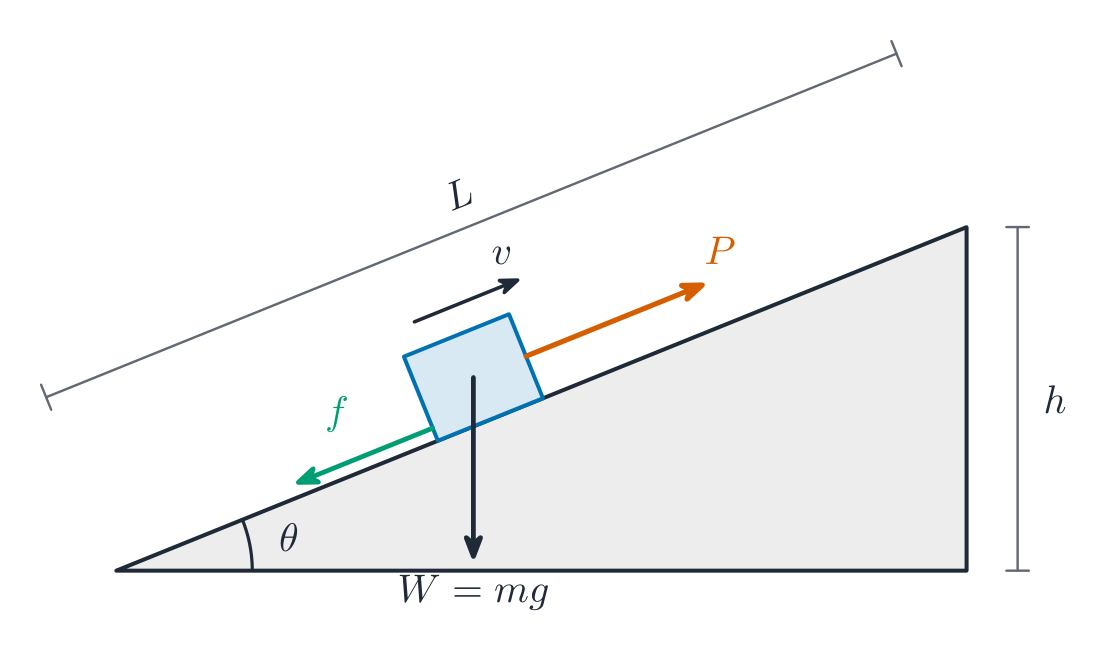
For an object moving up a slope at angle $\alpha$ to the horizontal 水平, the work done against gravity in rising a height $h$ is $mgh$, while the work done by a horizontal push over the slope length $L$ uses $\cos\alpha$.

Two multiple-choice tests of the definition: no work is done on an object that slides at constant velocity along a frictionless surface (no force along the motion), or on one that is simply held still (no distance moved); work is done when a force lifts it. And when a box is pushed at constant velocity across a rough floor, the work done by the push is $F \times d$ for the whole distance, however the path is split into stages.

Worked example. A block of mass $4.9\ \text{kg}$ is pushed at constant velocity up a rough slope of length $8.0\ \text{m}$ that rises $1.5\ \text{m}$, by a force of $12\ \text{N}$ acting along the slope. Find the work done against friction.

Constant velocity means no change in kinetic energy, so the work done by the push is shared between the gain in gravitational potential energy and the work done against friction. Work by the push: $12 \times 8.0 = 96\ \text{J}$. Gain in GPE, using the vertical rise: $4.9 \times 9.81 \times 1.5 = 72\ \text{J}$. So the work done against friction is $96 - 72 = 24\ \text{J}$, and the friction force is $24 / 8.0 = 3.0\ \text{N}$. Using the slope length in $mgh$ is the commonest error on this question.

Conservation of energy

Energy is never made or destroyed — it only changes from one form to another, or moves from one object to another. In a closed system 封闭系统, the total energy stays constant. This is conservation of energy 能量守恒, stated for the marks as: energy cannot be created or destroyed; it can only be transferred from one form to another (so the total energy of a closed system is constant).

When you write an energy equation, list every form the energy starts as and ends as. Common forms in this syllabus: kinetic, gravitational potential, elastic potential energy 弹性势能, electrical 电能, thermal, sound, chemical energy 化学能.

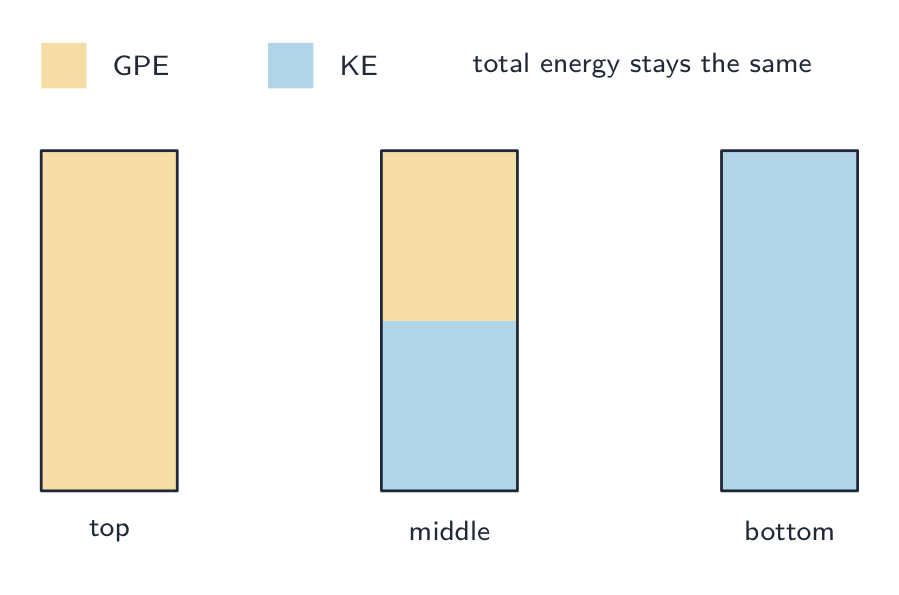
A ball rolling down a frictionless 无摩擦 ramp 斜坡 turns gravitational potential energy 重力势能 into kinetic energy 动能: $mgh = \tfrac{1}{2} m v^{2}$, so $v = \sqrt{2gh}$. With friction, some of this energy becomes thermal energy 热能 of the ramp and the air.

Worked example. A ball is released from rest at the top of a smooth ramp $1.2\ \text{m}$ high. Find its speed at the bottom (take $g = 9.81\ \text{m s}^{-2}$).

All the gravitational potential energy becomes kinetic energy, so $v = \sqrt{2gh}$ (the mass cancels):

$$v = \sqrt{2 \times 9.81 \times 1.2} \approx 4.9\ \text{m s}^{-1}.$$

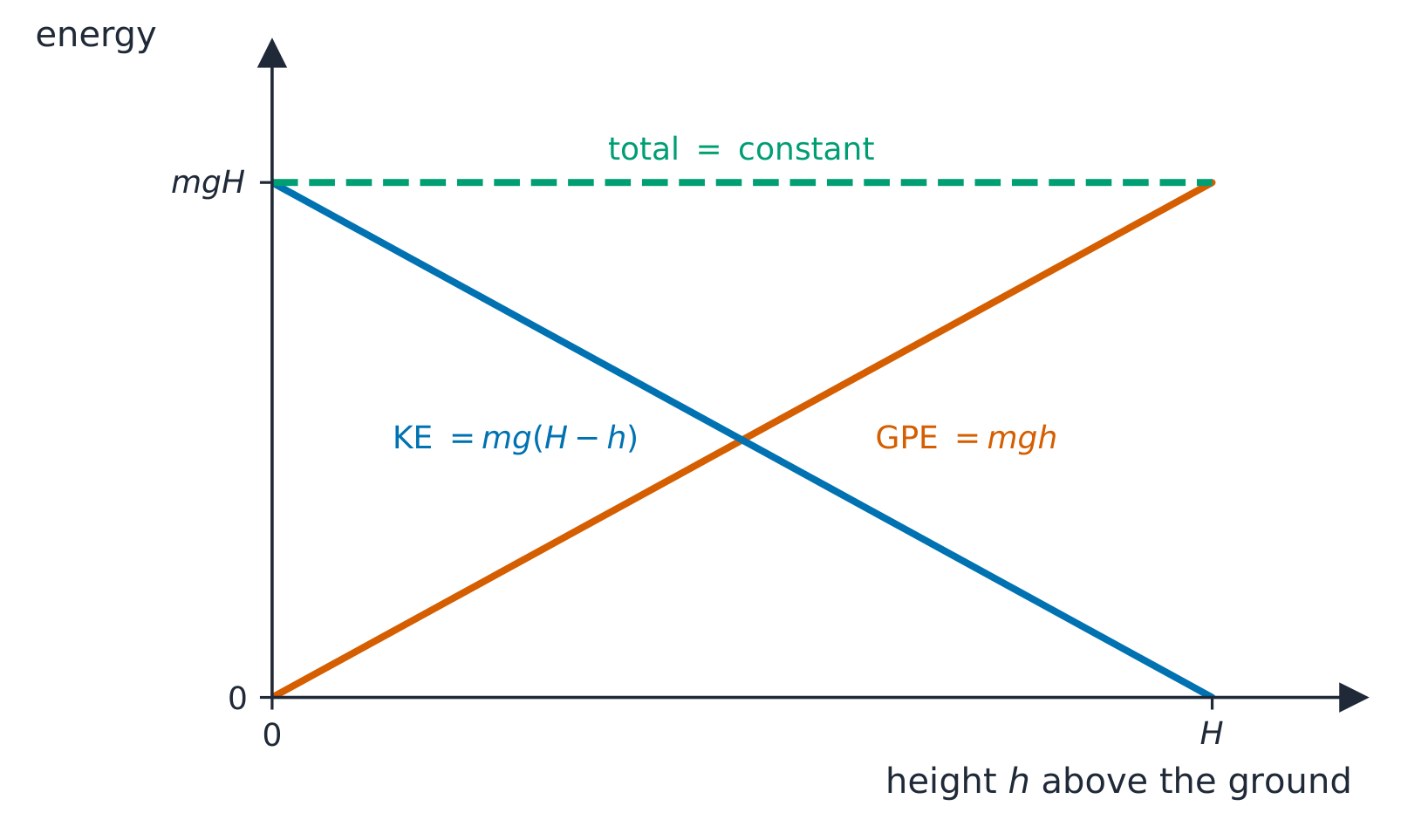
The same idea reads a graph. For a ball falling from height $H$ with air resistance negligible, the GPE falls in a straight line with height ($mgh$), the KE rises in a straight line ($mg(H - h)$), and the two add to the constant $mgH$ at every height.

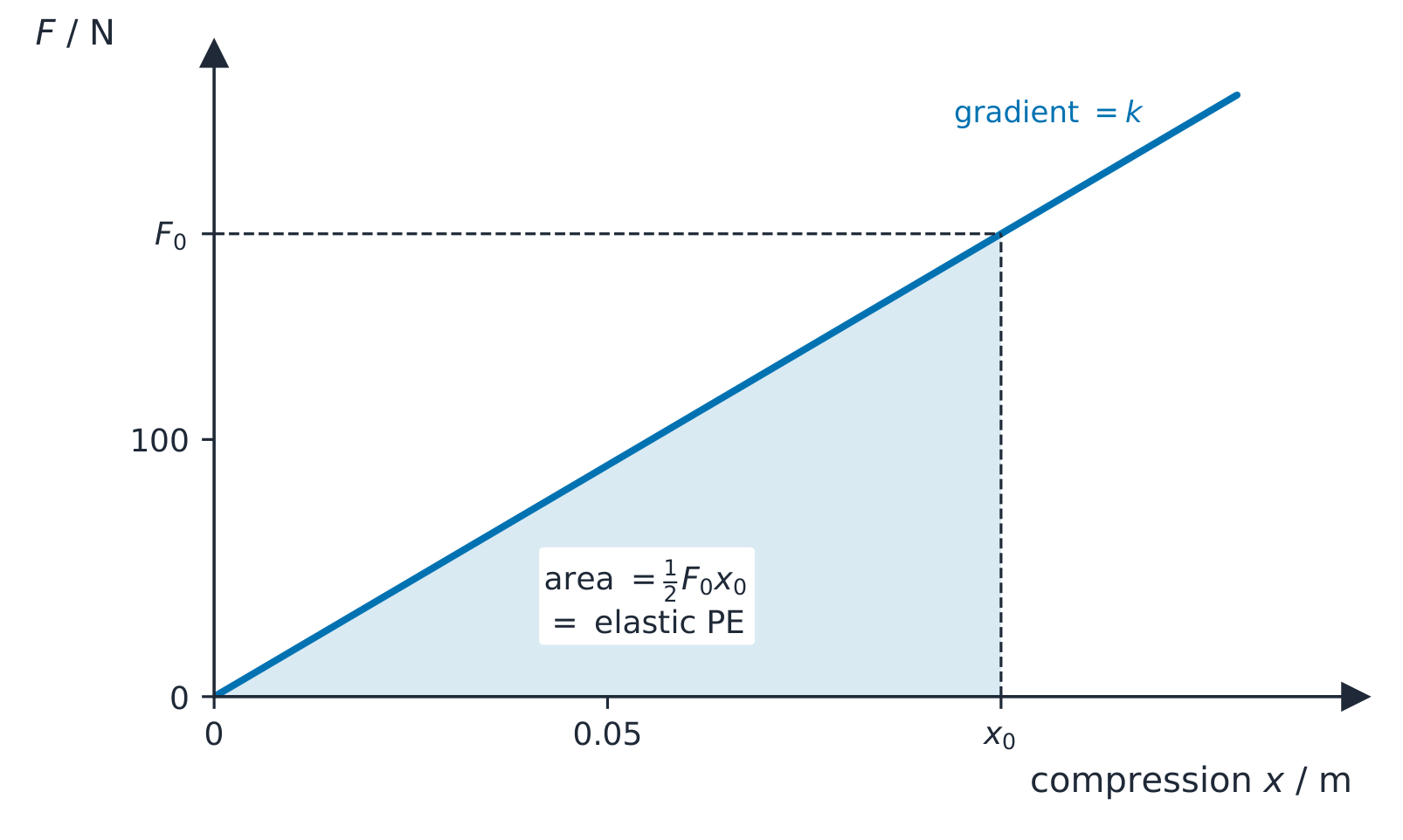
The energy chain can pass through a spring. A block that hits a spring with kinetic energy $110\ \text{J}$ while sliding a little downhill, so that its GPE falls by a further $20\ \text{J}$ before the spring stops it, stores $110 + 20 = 130\ \text{J}$ of elastic potential energy at the greatest compression, if nothing is lost to friction. The spring's force–compression graph then gives the compression: the energy stored is the area under the line, $\tfrac{1}{2} F_{0} x_{0}$ for a spring that obeys Hooke's law (topic 6), so a maximum force of $2600\ \text{N}$ means $x_{0} = 2 \times 130 / 2600 = 0.10\ \text{m}$. At that instant the resultant force on the block is the spring force minus the component of the weight down the slope, and its acceleration follows from $F = ma$ (topic 3).

Efficiency

The efficiency 效率 of a system is

$$\text{efficiency} = \frac{\text{useful energy output}}{\text{total energy input}} \times 100\%.$$

The same idea with power:

$$\text{efficiency} = \frac{\text{useful power output}}{\text{total power input}} \times 100\%.$$

Efficiency is always less than 100% in a real system, because some input energy becomes "useless" forms — usually thermal energy. If a total energy $E$ is supplied and an amount $Q$ is wasted, the useful output is $E - Q$ and the efficiency is $(E - Q) / E$; a motor rated at $1.7\ \text{kW}$ input with efficiency $53\%$ delivers $0.53 \times 1.7 = 0.90\ \text{kW}$ of useful output.

For an electric motor lifting a load with efficiency $\eta$ at voltage 电压 $V$ and current 电流 $I$, the useful output power is $\eta V I$. From this you can find a force, a lifting speed, or a tension 张力.

Worked example. An electric motor lifts a $50\ \text{kg}$ load at a steady $0.40\ \text{m s}^{-1}$ while drawing $250\ \text{W}$ of electrical power. Find its efficiency (take $g = 9.81\ \text{m s}^{-2}$).

The useful output power is $P = mgv = 50 \times 9.81 \times 0.40 = 196\ \text{W}$, so

$$\text{efficiency} = \frac{196}{250} \times 100\% \approx 78\%.$$

Worked example. A motor raises a block with a force of $240\ \text{N}$ through a vertical distance of $12\ \text{m}$ in $60\ \text{s}$. The input power to the motor is $900\ \text{W}$. Find the useful output power and the efficiency.

Work done on the block: $W = Fd = 240 \times 12 = 2880\ \text{J}$. Useful output power: $P = W / t = 2880 / 60 = 48\ \text{W}$. Efficiency: $48 / 900 \times 100\% = 5.3\%$. Most of the input goes into thermal energy in the motor and its cable. Turned round, a lift motor of useful output $20\ \text{kW}$ raising $1500\ \text{kg}$ through $20\ \text{m}$ takes $t = mgh / P = 1500 \times 9.81 \times 20 / 20\,000 = 15\ \text{s}$.

ไทย
กังหันลมเรียงกัน
กังหันลมถ่ายโอนพลังงานจลน์ของลมให้เป็นพลังงานไฟฟ้า

งานที่ทำโดยแรง

งาน เกิดขึ้นเมื่อแรงเคลื่อนที่จุดกระทำของมันไปตามแนวของแรง สำหรับนิยามแบบ 1 คะแนน ให้เขียนว่า: งานคือผลคูณของแรงและระยะทางที่เคลื่อนที่ไปในทิศทางของแรง งานที่ทำโดยแรงคงที่ $F$ ที่ทำให้เกิด การกระจัด $s$ คือ

$$W = F \cdot s \cdot \cos\theta,$$

โดยที่ $\theta$ เป็นมุมระหว่างแรงและการกระจัด มีเพียง องค์ประกอบ ของแรงในแนวการกระจัดเท่านั้นที่ทำงานได้

บล็อคบนพื้นผิวถูกดึงด้วยแรง F ในมุม theta เทียบกับการกระจัดแนวนอน s; F ถูกแยกเป็นองค์ประกอบ F cos theta ตามแนว s และองค์ประกอบตั้งฉาก F sin theta โดยที่เฉพาะ F cos theta เท่านั้นที่ทำงานได้
มีเพียงองค์ประกอบของแรงในแนวการกระจัด ($F\cos\theta$) เท่านั้นที่ทำงานได้

ตัวอย่างวิธีทำ เด็กคนหนึ่งดึงสเลด $5.0\ \text{m}$ ผ่านหิมะด้วยเชือก โดยใช้แรง $20\ \text{N}$ ในมุม $60°$ เทียบกับพื้นดิน จงหางานที่ทำโดยเชือก

$$W = Fs\cos\theta = 20 \times 5.0 \times \cos 60° = 20 \times 5.0 \times 0.50 = 50\ \text{J}.$$

หน่วย: $\text{J} = \text{N m}$. งานเป็น สเกลาร์

กรณีพิเศษ:

  • แรงอยู่ในทิศทางเดียวกับMotion ($\theta = 0$): $W = Fs$, งานเป็นบวก, พลังงาน ถูกส่งเข้าหาวัตถุ
  • แรงตั้งฉากกับMotion ($\theta = 90°$): $W = 0$. แรงปฏิกิริยา ต่อรถบนถนนราบไม่ทำงาน
  • แรงตรงข้ามกับMotion ($\theta = 180°$): $W = -Fs$, งานเป็นลบ, พลังงานถูกดึง ออกจาก วัตถุ (เช่น แรงเสียดทาน)
Two diagrams: top, the force F points along the displacement s, giving positive work W = +Fs and energy to the object; bottom, the force F points opposite to the displacement s, giving negative work W = -Fs and taking energy from the object
งานบวก ($W = +Fs$): แรงตาม Motion (ด้านบน). งานลบ ($W = -Fs$): แรงตรงข้ามกับMotion เช่น แรงเสียดทาน (ด้านล่าง)

สำหรับวัตถุเคลื่อนที่ขึ้นทางลาดชันในมุม $\alpha$ เทียบกับ แนวนอน, งานที่ทำต้านแรงโน้มถ่วงในการยกสูง $h$ คือ $mgh$, ในขณะที่งานที่ทำโดยแรงดันแนวนอนตลอดความยาวทางลาด $L$ ใช้ $\cos\alpha$

ข้อสอบปรนัย 2 ข้อเกี่ยวกับนิยาม: ไม่มีงานที่ทำต่อวัตถุที่ลื่นไถลด้วยความเร็วคงที่ตามพื้นผิวไร้แรงเสียดทาน (ไม่มีแรงตาม Motion), หรือวัตถุที่ถูกถือไว้เฉยๆ (ไม่มีการเคลื่อนที่); จะเกิดงานเมื่อมีแรงยกมันขึ้น และเมื่อผลักกล่องด้วยความเร็วคงที่บนพื้นหยาบ, งานที่ทำโดยการผลักจะเป็น $F \times d$ ตลอดทั้งระยะทาง ไม่ว่าเส้นทางจะถูกแบ่งเป็นขั้นตอนอย่างไรก็ตาม

ตัวอย่างวิธีทำ บล็อคมวล $4.9\ \text{kg}$ ถูกผลักด้วยความเร็วคงที่ขึ้นทางลาดชันหยาบ ความยาว $8.0\ \text{m}$ สูงขึ้น $1.5\ \text{m}$, ด้วยแรง $12\ \text{N}$ ทำตามแนวทางลาด จงหางานที่ทำต้านแรงเสียดทาน

A box on a slope inclined at angle theta, pushed up the slope at constant velocity by a force P along the slope, with friction f acting down the slope and the weight acting vertically; the slope length L and the vertical rise h are marked
กล่องถูกผลักขึ้นทางลาดชันหยาบด้วยความเร็วคงที่: งาน所做的由推力完成用于支付GPE的增加, ซึ่งต้องใช้เพียงการยกสูงในแนวตั้ง $h$, และสำหรับงานต้านแรงเสียดทานตลอดความยาวทั้งหมด $L$

ความเร็วคงที่หมายความว่าไม่มีการเปลี่ยนแปลงพลังงานจลน์ ดังนั้นงาน所做的由推力完成的จะแบ่งปันกันระหว่างการเพิ่มขึ้นของพลังงานศักย์โน้มถ่วงและงาน所做的抵抗摩擦力。推力做功: $12 \times 8.0 = 96\ \text{J}$。GPE的增加,使用垂直上升高度: $4.9 \times 9.81 \times 1.5 = 72\ \text{J}$。因此,克服摩擦力做的功是 $96 - 72 = 24\ \text{J}$,摩擦力是 $24 / 8.0 = 3.0\ \text{N}$。在$mgh$中使用斜面长度是这道题最常见的错误。

การอนุรักษ์พลังงาน

พลังงาน ไม่เคยถูกสร้างหรือทำลาย — มันเพียงเปลี่ยนจากรูปแบบหนึ่งไปเป็นอีกแบบหนึ่ง, หรือเคลื่อนย้ายจากวัตถุหนึ่งไปยังอีกวัตถุหนึ่ง ใน ระบบปิด, พลังงานรวมจะคงที่ นี่คือ การอนุรักษ์พลังงาน,表述为分数: พลังงานไม่สามารถถูกสร้างหรือทำลายได้; มันสามารถถ่ายโอนจากรูปแบบหนึ่งไปเป็นอีกแบบหนึ่ง (ดังนั้นพลังงานรวมของระบบปิดจึงคงที่)

เมื่อคุณเขียนสมการพลังงาน,列出every形式能量开始和结束。这个教学大纲中的常见形式:动能、重力势能、弹性势能、电能、热能、声能、化学能。

ลูกบอลกลิ้งลง ทางลาดชันไร้แรงเสียดทาน เปลี่ยน พลังงานศักย์โน้มถ่วง เป็น พลังงานจลน์: $mgh = \tfrac{1}{2} m v^{2}$, ดังนั้น $v = \sqrt{2gh}$。有摩擦力时,部分能量变成斜面和空气的热能。

Three energy bars for a ball descending a frictionless ramp: at the top all the energy is GPE, at the middle it is half GPE and half KE, at the bottom it is all KE — the total height stays the same
在无摩擦斜坡上,GPE转化为KE,同时总能量保持恒定

ตัวอย่างวิธีทำ ลูกบอลปล่อยจากหยุดนิ่งที่ด้านบนของทางลาดเรียบสูง $1.2\ \text{m}$ จงหาความเร็วที่ด้านล่าง (ใช้ $g = 9.81\ \text{m s}^{-2}$)

พลังงานศักย์โน้มถ่วงทั้งหมดกลายเป็นพลังงานจลน์, ดังนั้น $v = \sqrt{2gh}$ (มวลตัดกัน):

$$v = \sqrt{2 \times 9.81 \times 1.2} \approx 4.9\ \text{m s}^{-1}.$$

แนวคิดเดียวกันนี้สามารถอ่านกราฟได้ สำหรับลูกบอลตกจากความสูง $H$ ที่มีความต้านทานอากาศน้อยมาก, GPE ลดลงในเส้นตรงตามความสูง ($mgh$), KE เพิ่มขึ้นในเส้นตรง ($mg(H - h)$), และทั้งสองรวมกันเป็นค่าคงที่ $mgH$ ที่ทุกความสูง

A graph of energy against height above the ground for a falling ball: the GPE line rises in proportion to height, the KE line falls in proportion to height, and a dashed total line stays level at mgH
ลูกบอลที่กำลังตก: GPE และ KE เปลี่ยนแปลงเป็นเส้นตรงตามความสูง, และผลรวมของพวกมันคงที่

ห่วงโซ่พลังงานสามารถผ่านสปริงได้ บล็อกที่ชนสปริงด้วยพลังงานจลน์ $110\ \text{J}$ ขณะไถลลงทางลาดเล็กน้อย ทำให้พลังงานศักย์โน้มถ่วงลดลงเพิ่มอีก $20\ \text{J}$ ก่อนที่สปริงจะหยุดมัน จะเก็บพลังงานศักย์ยืดหยุ่นไว้ $110 + 20 = 130\ \text{J}$ ที่จุดอัดตัวสูงสุด หากไม่มีการสูญเสียต่อแรงเสียดทาน กราฟแรง–การอัดตัวของสปริงจะบอกค่าการอัดตัว: พลังงานที่เก็บคือ พื้นที่ใต้เส้นกราฟ, $\tfrac{1}{2} F_{0} x_{0}$ สำหรับสปริงที่เป็นไปตามกฎของฮุค (หัวข้อ 6) ดังนั้นแรงสูงสุดที่ $2600\ \text{N}$ แสดงถึง $x_{0} = 2 \times 130 / 2600 = 0.10\ \text{m}$. ในวินาทีนั้น แรงลัพธ์ที่กระทำต่อบล็อกคือแรงสปริงลบด้วยองค์ประกอบของน้ำหนักตามแนวลาด และความเร่งหาได้จาก $F = ma$ (หัวข้อ 3).

กราฟแรง–การอัดตัวของสปริง เป็นเส้นตรงผ่านจุดกำเนิดมีความชัน k; พื้นที่ใต้เส้นกราฟจนถึงการอัดตัว x0 ถูกทาสีและระบุว่าเป็นครึ่งหนึ่งของ F0 x0 ซึ่งเป็นพลังงานศักย์ยืดหยุ่นที่เก็บไว้
พลังงานที่เก็บไว้ในสปริงคือพื้นที่ใต้กราฟแรง–การอัดตัวของมัน: $\tfrac{1}{2} F_{0} x_{0}$ ซึ่งเท่ากับ $\tfrac{1}{2} k x_{0}^{2}$

ประสิทธิภาพ

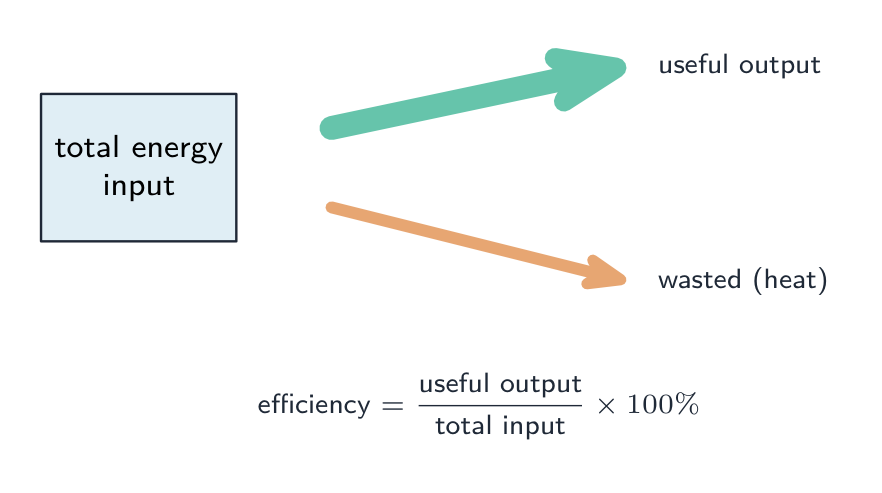
ประสิทธิภาพ ของระบบคือ

$$\text{efficiency} = \frac{\text{useful energy output}}{\text{total energy input}} \times 100\%.$$

แนวคิดเดียวกันนี้ใช้กับกำลัง:

$$\text{efficiency} = \frac{\text{useful power output}}{\text{total power input}} \times 100\%.$$

ประสิทธิภาพในระบบจริงจะน้อยกว่า 100% เสมอ เนื่องจากพลังงานเข้าบางส่วนกลายเป็นรูป "ไร้ประโยชน์" — มักเป็นพลังงานความร้อน หากมีพลังงานรวม $E$ ถูกจ่ายเข้ามา และมี $Q$ ถูกสิ้นเปลือง ผลลัพธ์ที่มีประโยชน์จะเป็น $E - Q$ และประสิทธิภาพจะอยู่ที่ $(E - Q) / E$; มอเตอร์ที่กำหนดให้รับกำลังเข้า $1.7\ \text{kW}$ ที่มีประสิทธิภาพ $53\%$ จะให้ผลลัพธ์ที่มีประโยชน์ออกมา $0.53 \times 1.7 = 0.90\ \text{kW}$.

จากพลังงานเข้าทั้งหมดลูกศรหนาแสดงผลลัพธ์ที่มี_useful output_ และลูกศรบางแสดงพลังงานที่สูญเปล่าเป็นความร้อน; ประสิทธิภาพคือผลลัพธ์ที่มีประโยชน์หารด้วยพลังงานเข้ารวม
ประสิทธิภาพ: มีเพียงส่วนหนึ่งของพลังงานเข้าที่กลายเป็นผลลัพธ์ที่มีประโยชน์ ส่วนที่เหลือถูกสิ้นเปลือง โดยมักเป็นความร้อน

สำหรับมอเตอร์ไฟฟ้ายกโหลดที่มีประสิทธิภาพ $\eta$ ที่ แรงดันไฟฟ้า $V$ และ กระแสไฟฟ้า $I$ กำลังออกที่มีประโยชน์คือ $\eta V I$. จากนี้คุณสามารถหาแรง ความเร็วในการยก หรือ แรงตึง ได้

ตัวอย่างวิธีทำ. มอเตอร์ไฟฟ้ายกโหลด $50\ \text{kg}$ ด้วยความเร็วคงที่ $0.40\ \text{m s}^{-1}$ โดยใช้กำลังไฟฟ้า $250\ \text{W}$. จงหาประสิทธิภาพ (ใช้ $g = 9.81\ \text{m s}^{-2}$).

กำลังออกที่มีประโยชน์คือ $P = mgv = 50 \times 9.81 \times 0.40 = 196\ \text{W}$ ดังนั้น

$$\text{efficiency} = \frac{196}{250} \times 100\% \approx 78\%.$$

ตัวอย่างวิธีทำ. มอเตอร์ยกบล็อกด้วยแรง $240\ \text{N}$ ขึ้นสูงเป็นระยะตั้งฉาก $12\ \text{m}$ ภายในเวลา $60\ \text{s}$. กำลังเข้าสู่มอเตอร์คือ $900\ \text{W}$. จงหากำลังออกที่มีประโยชน์และประสิทธิภาพ.

งานที่ทำต่อบล็อก: $W = Fd = 240 \times 12 = 2880\ \text{J}$. กำลังออกที่มีประโยชน์: $P = W / t = 2880 / 60 = 48\ \text{W}$. ประสิทธิภาพ: $48 / 900 \times 100\% = 5.3\%$. ส่วนใหญ่ของกำลังเข้าเปลี่ยนเป็นพลังงานความร้อนในมอเตอร์และสายเคเบิล. กลับด้านกัน มอเตอร์ลิฟต์ที่มีกำลังออก有用 output $20\ \text{kW}$ ยก $1500\ \text{kg}$ สูงขึ้น $20\ \text{m}$ ใช้เวลา $t = mgh / P = 1500 \times 9.81 \times 20 / 20\,000 = 15\ \text{s}$.

Explore · ⁨สำรวจ⁩

Energy flow & efficiency

The input energy divides into useful work and wasted energy; efficiency = useful ÷ input, and useful + wasted always equals the input. · ⁨พลังงานที่ป้อนเข้าถูกแบ่งออกเป็นงานที่มีประโยชน์และพลังงานที่สูญเสีย; ประสิทธิภาพ = มีประโยชน์ ÷ ป้อนเข้า, และผลรวมของงานที่มีประโยชน์และพลังงานที่สูญเสียจะเท่ากับพลังงานที่ป้อนเข้าเสมอ⁩

Explore · ⁨สำรวจ⁩

Work, energy & power

PE + KE = constant · ⁨PE + KE = ค่าคงที่⁩

Work transfers energy; as it falls, PE becomes KE with the total fixed. · ⁨งานถ่ายโอน พลังงาน; เมื่อตก下来 PE จะเปลี่ยนเป็น KE โดยค่าคงที่⁩

Vocabulary · ⁨คำศัพท์⁩ Train · ⁨ฝึกฝน⁩
English ไทย
work/wɜːk/ งาน
energy/ˈenədʒi/ พลังงาน
power/ˈpaʊə/ กำลัง
kinetic energy/kɪˈnetɪk ˈenədʒi/ พลังงานจลน์
electrical/ɪˈlektrɪkl/ ไฟฟ้า
electrical energy/ɪˈlektrɪkl ˈenədʒi/ พลังงานไฟฟ้า
displacement/dɪˈspleɪsmənt/ การกระจัด
component/kəmˈpəʊnənt/ องค์ประกอบ
horizontal/ˌhɒrɪˈzɒntl/ เป็นแนวนอน
scalar/ˈskeɪlə/ สเกลาร์
normal contact force/ˈnɔːml ˈkɒntækt fɔːs/ แรงสัมผัสปกติ
friction/ˈfrɪkʃn/ แรงเสียดทาน
velocity/vəˈlɒsɪti/ ความเร็ว
frictionless/ˈfrɪkʃənləs/ ไร้แรงเสียดทาน
mass/mæs/ มวล
weight/weɪt/ น้ำหนัก
gravitational potential energy/ˌɡrævɪˈteɪʃənl pəˈtenʃl ˈenədʒi/ พลังงานศักย์โน้มถ่วง
conservation of energy/ˌkɒnsəˈveɪʃn ɒv ˈenədʒi/ กฎการอนุรักษ์พลังงาน
closed system/kləʊzd ˈsɪstəm/ ระบบปิด
elastic potential energy/ɪˈlæstɪk pəˈtenʃl ˈenədʒi/ พลังงานศักย์ยืดหยุ่น
chemical energy/ˈkemɪkl ˈenədʒi/ 化学能
ramp/ræmp/ รางลื่น
thermal energy/ˈθɜːml ˈenədʒi/ 热能
spring/sprɪŋ/ สปริง
compression/kəmˈpreʃn/ การอัดตัว
efficiency/ɪˈfɪʃənsi/ ประสิทธิภาพ
voltage/ˈvəʊltɪdʒ/ แรงดันไฟฟ้า
current/ˈkʌrənt/ 电流的属性
tension/ˈtenʃn/ แรงตึง
drag/dræɡ/ แรงต้านทานการเคลื่อนที่
momentum/məʊˈmentəm/ โมเมนตัม
spring constant/sprɪŋ ˈkɒnstənt/ ค่าคงที่ของสปริง
projectile/prəˈdʒektaɪl/ วัตถุถูกยิง
bungee jumper/ˈbʌndʒiː ˈdʒʌmpə/ นักกระโดดบันจี้
5.1

Power · ⁨กำลัง⁩

English

Power 功率 is the rate of doing work, or the rate of transferring energy:

$$P = \frac{W}{t} = \frac{\Delta E}{\Delta t}.$$

Unit: $\text{W} = \text{J s}^{-1}$. Power is a scalar.

Power, force and velocity

For an object moving at velocity 速度 $v$ with a force $F$ along the direction of motion, in a short time $\Delta t$ the displacement is $v\,\Delta t$ and the work done is $F v\,\Delta t$. Dividing by $\Delta t$:

$$P = F v.$$

This is one of the most useful results in mechanics. A "derive $P = Fv$" answer needs exactly those three lines: $P = W / t$, $W = Fs$ for a force along the motion, and $s / t = v$; then use it to solve problems in which a vehicle or a load moves at constant speed.

Worked example. A car travels at a steady $25\ \text{m s}^{-1}$ against a total resistive force of $600\ \text{N}$. Find the output power of its engine.

At constant speed the driving force equals the resistive force, so

$$P = Fv = 600 \times 25 = 15\,000\ \text{W} = 15\ \text{kW}.$$
  • For a car at constant velocity $v$ on a flat road, the engine power must balance the total resistive force: $P = F_{\text{resist}} \cdot v$. If the drag 阻力 grows with $v^{2}$, doubling the speed roughly quadruples the power needed.
  • For lifting a weight 重力 $mg$ straight up at constant speed $v$, the useful output power is $P = mg \cdot v$.
  • For an aircraft hovering at a fixed height, the lift force equals the weight, and a large power is needed because air must be pushed downwards all the time.
  • A crane raising $600\ \text{kg}$ at a steady $12\ \text{m}$ per minute lifts at $v = 0.20\ \text{m s}^{-1}$, so its useful output power is $mgv = 600 \times 9.81 \times 0.20 = 1.2\ \text{kW}$. Convert the speed to $\text{m s}^{-1}$ first.
  • A sailboat pushed by a constant wind force at constant velocity must also feel an equal resistive force from the water: constant velocity means zero resultant force, so the wind's power $Fv$ is all going into work against the water.
ไทย

กำลัง คืออัตราการทำงาน หรืออัตราการถ่ายโอนพลังงาน:

กำลังคืองานต่อวินาที: งานเท่ากันแต่ใช้เวลาสั้นกว่าแปลว่ากำลังมากกว่า
การทำงานเท่าเดิมแต่ใช้เวลาสั้นกว่า หมายความว่ากำลังสูงกว่า
$$P = \frac{W}{t} = \frac{\Delta E}{\Delta t}.$$

หน่วย: $\text{W} = \text{J s}^{-1}$. กำลังเป็นสเกลาร์

กำลัง, แรง และความเร็ว

สำหรับวัตถุเคลื่อนที่ด้วยความเร็ว ความเร็ว $v$ ภายใต้แรง $F$ ตามทิศทางของการเคลื่อนที่ ในช่วงเวลาสั้น ๆ $\Delta t$ การกระจัดคือ $v\,\Delta t$ และงานที่ทำคือ $F v\,\Delta t$. หารด้วย $\Delta t$:

$$P = F v.$$

นี่เป็นหนึ่งในผลลัพธ์ที่มีประโยชน์ที่สุดในกลศาสตร์ คำตอบแบบ " derivation $P = Fv$" ต้องมีสามบรรทัดนี้เท่านั้น: $P = W / t$, $W = Fs$ สำหรับแรงตามทิศทางการเคลื่อนที่, และ $s / t = v$; จากนั้นนำไปใช้แก้ปัญหาที่ยานพาหนะหรือโหลดเคลื่อนที่ด้วยความเร็วคงที่

ตัวอย่างวิธีทำ. รถยนต์วิ่งด้วยความเร็วคงที่ $25\ \text{m s}^{-1}$ ต้านทานแรงต้านรวม $600\ \text{N}$. จงหากำลังออกของเครื่องยนต์

เมื่อความเร็วคงที่ แรงขับเคลื่อนจะเท่ากับแรงต้านทาน ดังนั้น

$$P = Fv = 600 \times 25 = 15\,000\ \text{W} = 15\ \text{kW}.$$
  • สำหรับรถยนต์ที่มีความเร็วคงที่ $v$ บนถนนราบ แรงแม่เหล็กต้องสมดุลกับแรงต้านทานรวม: $P = F_{\text{resist}} \cdot v$. ถ้า แรงต้านอากาศ เพิ่มขึ้นตาม $v^{2}$, การเพิ่มความเร็วเป็นสองเท่าจะทำให้กำลังที่ต้องการเพิ่มขึ้นประมาณ สี่เท่า
  • สำหรับการยก น้ำหนัก $mg$ ขึ้นตรงๆ ด้วยความเร็วคงที่ $v$, กำลังออกที่มีประโยชน์คือ $P = mg \cdot v$.
  • สำหรับเครื่องบินลอยนิ่งอยู่ในระดับความสูงคงที่ แรงยกจะเท่ากับน้ำหนัก และต้องใช้กำลังมากเพราะต้องผลักอากาศลงตลอดเวลา
  • เกรน crane ยก $600\ \text{kg}$ ด้วยความเร็วคงที่ $12\ \text{m}$ ต่อนาที ยกขึ้นที่ $v = 0.20\ \text{m s}^{-1}$, ดังนั้นกำลังออกที่มีประโยชน์คือ $mgv = 600 \times 9.81 \times 0.20 = 1.2\ \text{kW}$. แปลงความเร็วเป็น $\text{m s}^{-1}$ ก่อน
  • เรือใบที่ถูกพัดด้วยแรงลมคงที่ด้วยความเร็วคงที่ จะต้องได้รับแรงต้านทานจากน้ำเท่ากันด้วย: ความเร็วคงที่หมายถึงแรงลัพธ์เป็นศูนย์ ดังนั้นกำลังของลม $Fv$ จึงถูกใช้ไปกับการทำงานต้านทานน้ำทั้งหมด

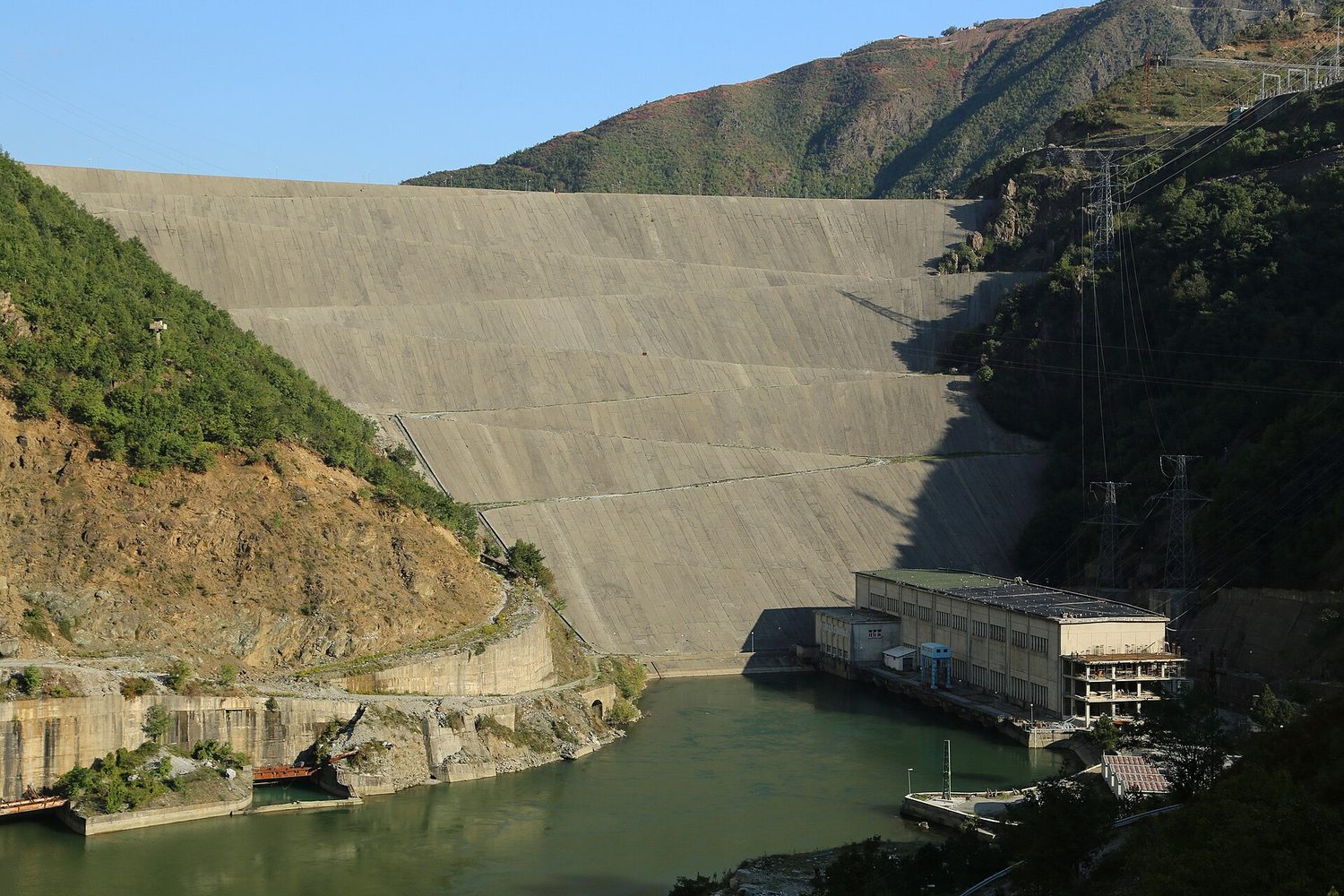
เขื่อนผลิตไฟฟ้าพลังน้ำและสถานีไฟฟ้าย่อย น้ำถูกกักเก็บไว้สูงอยู่หลังกำแพง *สถานีไฟฟ้าพลังน้ำกำหนดกำลังเป็นเมกะวัตต์: พลังงานของน้ำที่กักเก็บ หารด้วยเวลาที่ปล่อยน้ำออก
5.2

Gravitational potential energy · ⁨พลังงานศักย์โน้มถ่วง⁩

Syllabus · ⁨หลักสูตร⁩
English
  1. derive, using $W = Fs$, the formula $\Delta E_{\text{P}} = mg\Delta h$ for gravitational potential energy changes in a uniform gravitational field
  2. recall and use the formula $\Delta E_{\text{P}} = mg\Delta h$ for gravitational potential energy changes in a uniform gravitational field
  3. derive, using the equations of motion, the formula for kinetic energy $E_{\text{K}} = \frac{1}{2}mv^2$
  4. recall and use $E_{\text{K}} = \frac{1}{2}mv^2$
ไทย
  1. สกัด using $W = Fs$, สูตร $\Delta E_{\text{P}} = mg\Delta h$ สำหรับ การเปลี่ยนแปลงพลังงานศักย์โน้มถ่วง ใน สนามโน้มถ่วงสม่ำเสมอ
  2. จำและใช้สูตร $\Delta E_{\text{P}} = mg\Delta h$ เพื่อคำนวณการเปลี่ยนแปลงพลังงานศักย์โน้มถ่วงในสนามโน้มถ่วงสม่ำเสมอ
  3. สกัด using equations of motion, สูตรสำหรับ พลังงานจลน์ $E_{\text{K}} = \frac{1}{2}mv^2$
  4. จำและใช้ $E_{\text{K}} = \frac{1}{2}mv^2$

Source: Cambridge International syllabus · ⁨แหล่งที่มา: หลักสูตร Cambridge International⁩

English
Energy exchange in a pendulum

In a uniform gravitational field (close to a planet's surface), the change in gravitational potential energy of mass 质量 $m$ rising or falling through a height $\Delta h$ is

$$\Delta E_{\text{P}} = m g \Delta h.$$

Where it comes from

The work done against gravity to raise a mass $m$ slowly (no change in kinetic energy) through height $\Delta h$ equals the gravitational potential energy gained:

  • the gravitational force on the mass is $mg$ downwards,
  • the force needed to lift it slowly is $mg$ upwards,
  • the work done by this force is $W = F \cdot s = mg \cdot \Delta h$,
  • this work becomes $\Delta E_{\text{P}}$.

So $\Delta E_{\text{P}} = mg \Delta h$. To use it you need $m$ and $\Delta h$ (and $g$). You do not need speed or time. The two-mark derivation wants the same four lines, with the condition stated: the block is raised at constant speed, so the lifting force equals the weight $mg$, and the work done by that force over the vertical distance $\Delta h$ is $mg\Delta h$, which is the gain in gravitational potential energy. A $100\ \text{g}$ object falling $10\ \text{m}$ loses $0.100 \times 9.81 \times 10 = 9.8\ \text{J}$, about $10\ \text{J}$; the mass must be in kilograms.

ไทย

*การแลกเปลี่ยนพลังงานในลูกตุ้ม

ในสนามโน้มถ่วง สม่ำเสมอ (ใกล้พื้นผิวดาวเคราะห์), การเปลี่ยนแปลงพลังงานศักย์โน้มถ่วงของ มวล $m$ ที่ยกขึ้นหรือตก下来 through a height $\Delta h$ คือ

$$\Delta E_{\text{P}} = m g \Delta h.$$

ที่มาของพลังงานนี้

งานที่ทำ ต่อต้าน แรงโน้มถ่วงเพื่อยกมวล $m$ ขึ้นช้าๆ (ไม่มีการเปลี่ยนแปลงพลังงานจลน์) ผ่านความสูง $\Delta h$ เท่ากับพลังงานศักย์โน้มถ่วงที่ได้รับ:

  • แรงโน้มถ่วงที่กระทำต่อมวลคือ $mg$ ลงด้านล่าง,
  • แรงที่ต้องใช้ในการยกมันอย่างช้าๆ คือ $mg$ ขึ้นด้านบน,
  • งานที่ทำโดยแรงนี้คือ $W = F \cdot s = mg \cdot \Delta h$,
  • งานนี้จะกลายเป็น $\Delta E_{\text{P}}$.

ดังนั้น $\Delta E_{\text{P}} = mg \Delta h$. ในการใช้สูตรนี้ คุณต้องรู้ $m$ และ $\Delta h$ (และ $g$). คุณไม่จำเป็นต้องทราบความเร็วหรือเวลา การหาผล derivation ที่ 2 คะแนน ต้องการบรรทัดทั้งสี่同上相同的,พร้อมระบุเงื่อนไข: บล็อกถูกยกขึ้น ด้วยความเร็วคงที่ ดังนั้นแรงยกจึงเท่ากับน้ำหนัก $mg$, และงานที่ทำโดยแรงนั้นบนระยะทางแนวตั้ง $\Delta h$ คือ $mg\Delta h$, ซึ่งคือพลังงานศักย์โน้มถ่วงที่ได้เพิ่มขึ้นมา. วัตถุ $100\ \text{g}$ ที่ตกจากสูง $10\ \text{m}$ จะสูญเสีย $0.100 \times 9.81 \times 10 = 9.8\ \text{J}$, ประมาณ $10\ \text{J}$; มวลต้องอยู่ในหน่วยกิโลกรัม.

เส้นทางชันและเส้นทางคดเคี้ยวแบบ gentle zig-zag ทั้งสองขึ้นสู่ความสูง h เดียวกัน; พลังงานศักย์โน้มถ่วงเพิ่มขึ้นเป็น mgh ในทั้งสองกรณี เพราะมีเพียงความสูงที่สำคัญ
พลังงานศักย์โน้มถ่วงขึ้นอยู่กับความสูงที่ยกขึ้นไปเท่านั้น ไม่ขึ้นอยู่กับเส้นทางที่ใช้
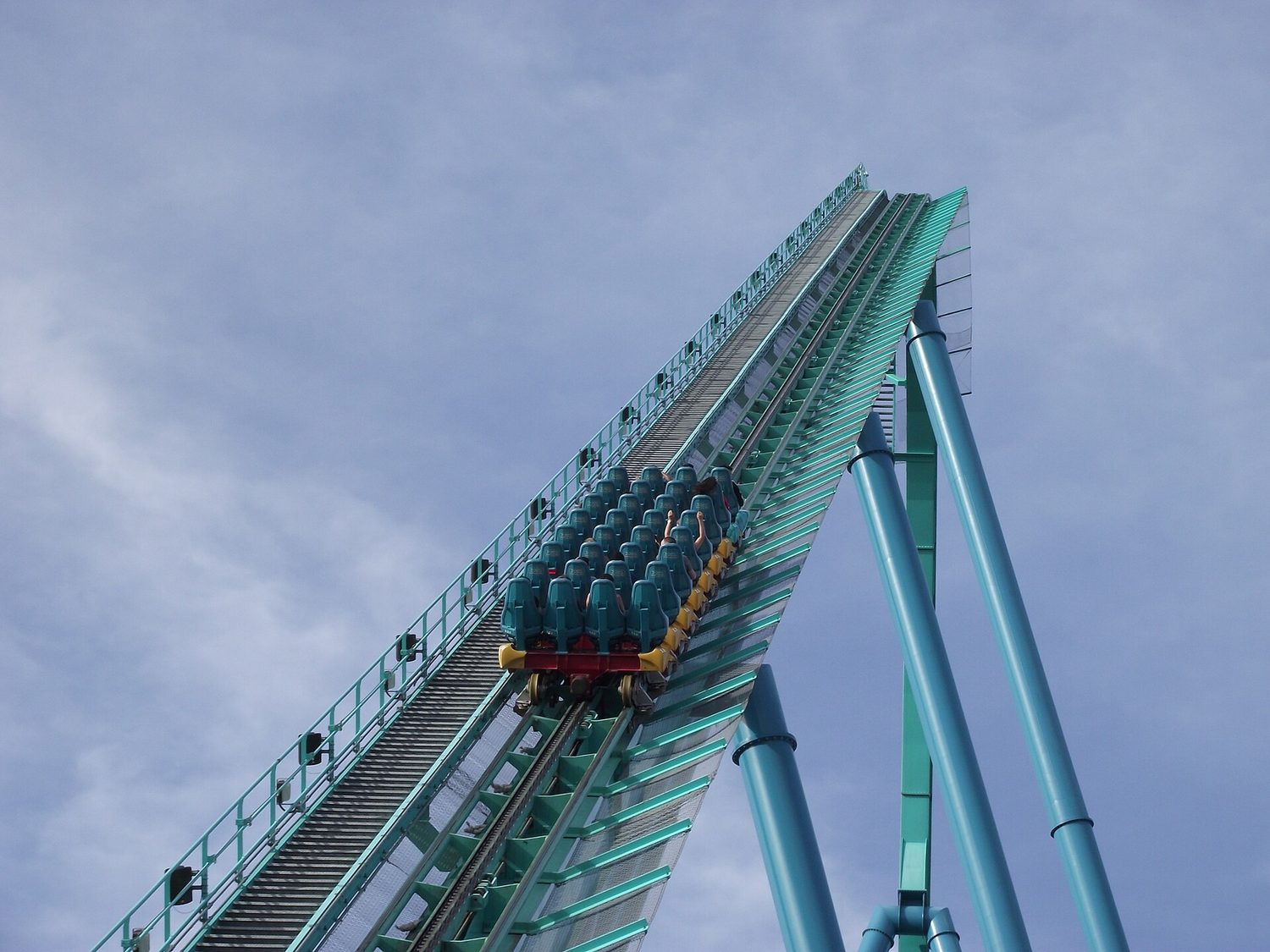
ขบวนรถเท่ลกรอว์ถูกดึงขึ้นเนินยกที่ชันด้วยโซ่
ขบวนรถเท่ลกรอว์ที่ถูกดึงขึ้นเนินยก: งานที่ทำต้านแรงโน้มถ่วงจะถูกเก็บไว้เป็นพลังงานศักย์โน้มถ่วง
5.2

Kinetic energy · ⁨พลังงานจลน์⁩

English

The kinetic energy of an object of mass $m$ moving at speed $v$ is

$$E_{\text{K}} = \tfrac{1}{2} m v^{2}.$$

Where it comes from

Apply a resultant force $F$ to a mass $m$ that starts at rest. It speeds up evenly from $0$ to $v$ over a displacement $s$. From $v^{2} = u^{2} + 2as$ with $u = 0$,

$$s = \frac{v^{2}}{2a}.$$

The work done on the mass is

$$W = F \cdot s = m a \cdot \frac{v^{2}}{2a} = \tfrac{1}{2} m v^{2}.$$

All this work becomes kinetic energy, so $E_{\text{K}} = \tfrac{1}{2} m v^{2}$. In the exam, state the assumptions as you go: the object starts from rest, the force is constant, so the acceleration is uniform, and $F = ma$ is Newton's second law.

Because $E_{\text{K}} \propto v^{2}$, quadrupling the speed multiplies the kinetic energy by sixteen: an object with $1500\ \text{J}$ at $10\ \text{m s}^{-1}$ has $24\,000\ \text{J}$ at $40\ \text{m s}^{-1}$. The same square is why a stopping force is found from energy: a ball of mass $1.2\ \text{kg}$ moving at $3.0\ \text{m s}^{-1}$ that is stopped by a cushion over $0.020\ \text{m}$ loses $\tfrac{1}{2} \times 1.2 \times 3.0^{2} = 5.4\ \text{J}$, so the average force on it is $5.4 / 0.020 = 270\ \text{N}$: the work done by the cushion equals the kinetic energy lost.

Kinetic energy and momentum

Combining $p = mv$ and $E_{\text{K}} = \tfrac{1}{2} m v^{2}$:

$$E_{\text{K}} = \frac{p^{2}}{2m}.$$

This is handy when the momentum 动量 is given but not the velocity. For a momentum change from $p_{1}$ to $p_{2}$ at constant mass, the change in kinetic energy is $(p_{2}^{2} - p_{1}^{2}) / (2m)$.

ไทย

พลังงานจลน์ของวัตถุที่มีมวล $m$ เคลื่อนที่ด้วยความเร็ว $v$ คือ

$$E_{\text{K}} = \tfrac{1}{2} m v^{2}.$$

ที่มาของพลังงานนี้

ใช้แรงลัพธ์ $F$ กับมวล $m$ ที่เริ่มจากหยุดนิ่ง มันเร่งความเร็วอย่างสม่ำเสมอจาก $0$ ถึง $v$ บนการกระจัด $s$. จาก $v^{2} = u^{2} + 2as$ ด้วย $u = 0$,

$$s = \frac{v^{2}}{2a}.$$

งานที่ทำต่อมวลนี้คือ

$$W = F \cdot s = m a \cdot \frac{v^{2}}{2a} = \tfrac{1}{2} m v^{2}.$$

งานทั้งหมดนี้เปลี่ยนเป็นพลังงานจลน์ ดังนั้น $E_{\text{K}} = \tfrac{1}{2} m v^{2}$. ในการสอบ ให้ระบุสมมติฐานขณะทำข้อสอบ: วัตถุเริ่มต้นจากหยุดนิ่ง, แรงมีค่าคงที่, ดังนั้นความเร่งจึงสม่ำเสมอ, และ $F = ma$ คือกฎข้อที่สองของนิวตัน.

เนื่องจาก $E_{\text{K}} \propto v^{2}$, การเพิ่มความเร็วเป็นสี่เท่าจะทำให้พลังงานจลน์เพิ่มขึ้นสิบหกเท่า: วัตถุที่มี $1500\ \text{J}$ ที่ $10\ \text{m s}^{-1}$ จะมี $24\,000\ \text{J}$ ที่ $40\ \text{m s}^{-1}$. สี่เหลี่ยมจัตุรัสเดียวกันนี้คือเหตุผลว่าทำไมแรงเบรกจึงหาได้จากพลังงาน: ลูกบอลมวล $1.2\ \text{kg}$ เคลื่อนที่ด้วยความเร็ว $3.0\ \text{m s}^{-1}$ และถูกหยุดโดยเบาะรองรับภายในระยะ $0.020\ \text{m}$ จะสูญเสีย $\tfrac{1}{2} \times 1.2 \times 3.0^{2} = 5.4\ \text{J}$, ดังนั้นแรงเฉลี่ยที่กระทำต่อมันคือ $5.4 / 0.020 = 270\ \text{N}$: งานที่ทำโดยเบาะรองรับเท่ากับพลังงานจลน์ที่สูญเสียไป.

พลังงานจลน์และโมเมนตัม

รวม $p = mv$ และ $E_{\text{K}} = \tfrac{1}{2} m v^{2}$:

$$E_{\text{K}} = \frac{p^{2}}{2m}.$$

สิ่งนี้มีประโยชน์เมื่อให้ โมเมนตัม มาแต่ไม่ให้ความเร็ว สำหรับการเปลี่ยนแปลงโมเมนตัมจาก $p_{1}$ เป็น $p_{2}$ ที่มวลคงที่, การเปลี่ยนแปลงพลังงานจลน์คือ $(p_{2}^{2} - p_{1}^{2}) / (2m)$.

นักกระโดดค้ำไม้ในช่วงดีดตัว, ค้ำงอเกือบครึ่งอยู่ใต้ตัวเขา
นักกระโดดค้ำไม้: พลังงานจลน์จากการวิ่งเข้าหาถูกเก็บไว้ในค้ำที่งอ, จากนั้นถูกส่งกลับเป็นความสูง
Explore · ⁨สำรวจ⁩

Kinetic & potential energy · ⁨พลังงานจลน์ & พลังงานศักย์⁩

PE + KE = constant · ⁨PE + KE = ค่าคงที่⁩

Potential energy turns into kinetic energy — the total never changes. · ⁨พลังงานศักย์ เปลี่ยนเป็น พลังงานจลน์ — ค่ารวมไม่เปลี่ยนแปลง.⁩

5.2

Using energy methods · ⁨การใช้วิธีพลังงาน⁩

English

A useful plan for problems that mix forces and energy:

  1. Find the start and end states. Write the kinetic and potential energies in each.
  2. List any work done by outside forces (friction, a push). Friction usually takes energy out; a push can add it.
  3. Conservation of energy: $E_{\text{start}} + W_{\text{in}} = E_{\text{end}} + W_{\text{lost as heat etc.}}$.

Examples:

  • A box pushed at constant velocity up a ramp of length $L$ rising by $h$: $E_{\text{K}}$ does not change, so the work done by the push goes into $\Delta E_{\text{P}}$ plus the work done against friction.
  • A block sliding into a spring 弹簧 with kinetic energy $E_{\text{K}}$ on a frictionless surface: at greatest compression 压缩 $x$, all the kinetic energy has become elastic potential energy $\tfrac{1}{2} k x^{2}$ (where $k$ is the spring constant 劲度系数).
  • A ball dropped from height $h_{1}$ that bounces to height $h_{2}$: the ratio $h_{2}/h_{1}$ is the fraction of mechanical energy kept, $h_{2}/h_{1} = (v_{\text{up}}/v_{\text{down}})^{2}$.
  • A projectile 抛体 thrown to the same height at different angles: the final speed is the same (only the height matters); use components to get its direction.
  • A bungee jumper 蹦极者: from the platform to the point where the cord goes taut, GPE becomes KE; from there the cord stretches and takes energy as elastic potential energy, so the KE reaches its maximum where the cord's pull first equals the weight, then falls to zero at the lowest point, where GPE lost $=$ elastic PE stored (plus any thermal energy).
ไทย

แผนที่มีประโยชน์สำหรับปัญหาที่ผสมผสานระหว่างแรงและพลังงาน:

  1. หาสถานะเริ่มต้นและสิ้นสุด. เขียนพลังงานจลน์และศักย์ในแต่ละสถานะ
  2. ระบิงานที่ทำโดยแรงภายนอก (แรงเสียดทาน, แรงผลัก) แรงเสียดทานมักดึงพลังงานออก; แรงผลักสามารถเพิ่มพลังงานได้
  3. อนุรักษ์พลังงาน: $E_{\text{start}} + W_{\text{in}} = E_{\text{end}} + W_{\text{lost as heat etc.}}$.

ตัวอย่าง:

  • กล่องที่ถูกดันด้วย ความเร็วคงที่ ขึ้นทางลาดยาว $L$ สูงขึ้น $h$: $E_{\text{K}}$ ไม่เปลี่ยนแปลง, ดังนั้นงานที่ทำโดยแรงดันจะเข้าสู่ $\Delta E_{\text{P}}$ plus งานที่ทำต้านแรงเสียดทาน.
  • บล็อกที่ลื่นเข้าไปใน สปริง ด้วยพลังงานจลน์ $E_{\text{K}}$ บนพื้นไร้แรงเสียดทาน: ที่การ อัดสูงสุด $x$, พลังงานจลน์ทั้งหมดกลายเป็นพลังงานศักย์ยืดหยุ่น $\tfrac{1}{2} k x^{2}$ (ที่ $k$ คือ ค่าคงที่ของสปริง).
  • ลูกบอลตกจากความสูง $h_{1}$ แล้วเด้งกลับถึงความสูง $h_{2}$: อัตราส่วน $h_{2}/h_{1}$ คือเศษส่วนของพลังงานกลที่คงเหลือ, $h_{2}/h_{1} = (v_{\text{up}}/v_{\text{down}})^{2}$.
  • โปรเจกไทล์ yang ทิ้งไปที่ความสูงเดียวกันด้วยมุมต่างกัน: ความเร็วสุดท้ายเท่าเดิม (มีเพียงความสูงที่สำคัญ); ใช้องค์ประกอบเพื่อหาทิศทาง
  • นักกระโดดบันจี้: จากแท่นไปยังจุดที่เชือกตึง, GPE เปลี่ยนเป็น KE; จากนั้นเชือกยืดและรับพลังงานเป็นพลังงานศักย์ยืดหยุ่น, ดังนั้น KE จะถึงจุดสูงสุดเมื่อแรงดึงของเชือกเท่ากับน้ำหนักเป็นครั้งแรก, แล้วลดลงเป็นศูนย์ที่จุดต่ำสุด, ที่ GPE ที่สูญเสียไป $=$ Elastic PE ถูกเก็บไว้ (บวกกับพลังงานความร้อนใดๆ)
บล็อกเคลื่อนที่ด้วยความเร็ว v (พลังงานจลน์ครึ่งหนึ่ง m v สี่เหลี่ยม) ลื่นเข้าไปในสปริง; ที่การอัดสูงสุด x พลังงานทั้งหมดกลายเป็นพลังงานศักย์ยืดหยุ่นครึ่งหนึ่ง k x สี่เหลี่ยม
พลังงานจลน์ของบล็อกกลายเป็นพลังงานศักย์ยืดหยุ่นขณะมันอัดสปริง
Explore · ⁨สำรวจ⁩

Conservation of energy · ⁨การอนุรักษ์พลังงาน⁩

Drop the mass and watch GPE turn into KE. With no friction the total energy stays the same — that's the energy method. · ⁨ปล่อยมวลลงดู GPE เปลี่ยนเป็น KE หากไม่มีแรงเสียดทาน พลังงานรวมจะคงที่ — นี่คือวิธีการใช้พลังงาน⁩

5.2

Definitions the examiner accepts · ⁨คำนิยามที่ผู้สอบยอมรับ⁩

English

A definition question is marked against fixed wording. Learn these exactly, and give one answer only.

Term Definition
work done by a force the product of the force and the distance moved in the direction of the force
principle of conservation of energy energy cannot be created or destroyed, only transferred from one form to another, so the total energy of a closed system is constant
efficiency the ratio of useful energy (or power) output from a system to the total energy (or power) input, usually as a percentage
power the work done per unit time, or the rate at which energy is transferred
gravitational potential energy the energy an object has because of its position in a gravitational field
kinetic energy the energy an object has because of its motion
elastic potential energy the energy stored in an object that has been stretched or compressed
ไทย

คำถามคำนิยามจะให้คะแนนตามข้อความที่กำหนดไว้你必须 exact. เรียนรู้ให้ถูกต้องและตอบเพียงคำตอบเดียวเท่านั้น

พจน์ นิยาม
งานที่ทำโดยแรง ผลคูณของแรงและระยะทางที่เคลื่อนที่ในทิศทางของแรง
หลักการอนุรักษ์พลังงาน พลังงานไม่สามารถสร้างหรือทำลายได้, สามารถถ่ายโอนจากรูปแบบหนึ่งไปยังอีกแบบหนึ่งเท่านั้น, ดังนั้นพลังงานรวมของระบบปิดจะมีค่าคงที่
ประสิทธิภาพ อัตราส่วนของพลังงาน (หรือกำลัง) ที่มีประโยชน์ที่ระบบส่งออกต่อพลังงาน (หรือกำลัง) ทั้งหมดที่ระบบได้รับ, มักจะเป็นเปอร์เซ็นต์
กำลัง งานที่ทำต่อหน่วยเวลา, หรืออัตราการถ่ายโอนพลังงาน
พลังงานศักย์โน้มถ่วง พลังงานที่วัตถุมีเนื่องจากตำแหน่ง它在สนามโน้มถ่วง
พลังงานจลน์ พลังงานที่วัตถุมีเนื่องจากเคลื่อนที่
พลังงานศักย์ยืดหยุ่น พลังงานที่เก็บไว้ในวัตถุที่ผ่านการยืดหรืออัด
5.2

Exam tips · ⁨ข้อแนะนำสำหรับการสอบ⁩

English
  • Work $=$ force $\times$ distance moved in the direction of the force — use $Fs\cos\theta$ when they are at an angle.
  • Use conservation of energy: loss in GPE $=$ gain in KE ($+$ work done against resistance).
  • Power $=$ work $/$ time $= Fv$; efficiency $=$ useful output $\div$ total input.
  • GPE uses the vertical height gained, not the distance along a slope.

Common mistakes

  • Giving the change in height as the answer to a change-in-energy question. Finish the calculation: $\Delta E_{\text{P}} = mg\Delta h$.
  • Using the distance along a slope as the height in $mg\Delta h$, or using mass where weight is needed. Use the vertical height gained, and check whether the quantity wanted is $m$ in kg or $W$ in N.
  • Putting the resistive force into $P = Fv$ for a car that is accelerating. $F$ is the driving force; only at constant speed does it equal the resistive force.
  • Efficiency above 100%, or efficiency as output divided by wasted. It is useful output divided by total input, and the total input is always the larger number.
  • Reading a force–extension graph's gradient when the question wants the energy. Energy stored is the area under the line, not its slope.
ไทย
  • งาน $=$ แรง $\times$ ระยะทางเคลื่อนที่ในทิศทางของแรง — ใช้ $Fs\cos\theta$ เมื่อ ониเป็นมุม.
  • ใช้ อนุรักษ์พลังงาน: การสูญเสีย GPE $=$ การเพิ่มขึ้น KE ($+$ งานที่ทำต้านแรงต้าน).
  • กำลัง $=$ งาน $/$ เวลา $= Fv$; ประสิทธิภาพ $=$ ผลลัพธ์ที่มีประโยชน์ $\div$ อินพุตรวม.
  • GPE ใช้ ความสูงแนวตั้ง ที่เพิ่มขึ้น, ไม่ใช่ระยะทางตามทางลาด

ข้อผิดพลาดที่พบบ่อย

  • การให้ความเปลี่ยนแปลงของความสูงเป็นคำตอบสำหรับคำถามเกี่ยวกับการเปลี่ยนแปลงพลังงาน. เสร็จสิ้นการคำนวณ: $\Delta E_{\text{P}} = mg\Delta h$.
  • การใช้ระยะทางตามแนวลาดเอียงเป็นความสูงใน $mg\Delta h$, หรือการใช้มวลแทนน้ำหนัก เมื่อต้องการใช้แรง ให้ใช้ความสูงในแนวตั้งที่เพิ่มขึ้นจริง และตรวจสอบว่าปริมาณที่ต้องการหาคือ $m$ เป็น kg หรือ $W$ เป็น N
  • การใส่แรงต้านลงใน $P = Fv$ สำหรับรถที่กำลังเร่ง $F$ คือแรงขับเคลื่อน; จะเท่ากับแรงต้านก็ต่อเมื่อเคลื่อนที่ด้วยความเร็วคงที่เท่านั้น
  • ประสิทธิภาพเกิน 100%, หรือคำนวณประสิทธิภาพด้วยการนำกำลังออกหารด้วยพลังงานสูญเสีย พลังงานที่มีประโยชน์คือกำลังออกหารด้วยกำลังเข้ารวม โดยกำลังเข้ารวมจะมีค่ามากกว่าเสมอ
  • การอ่านความชันของกราฟแรง–การยืดขยาย เมื่อโจทย์ต้องการหาพลังงาน พลังงานสะสมคือพื้นที่ใต้เส้นโค้ง ไม่ใช่ความชันของกราฟ

Interactive lessons on this topic · ⁨บทเรียนเชิงโต้ตอบสำหรับหัวข้อนี้⁩

Work through it step by step, with instant-check exercises. · ⁨ทำทีละขั้นตอน พร้อมแบบฝึกหัดตรวจสอบผลทันที⁩

Past Papers · ⁨ข้อสอบย้อนหลัง⁩

More topics in A-Level Physics · ⁨Physics A-Level⁩ · ⁨หัวข้อเพิ่มเติมใน A-Level Physics · ⁨Physics A-Level⁩⁩

Log in or create account · ⁨เข้าสู่ระบบหรือสร้างบัญชี⁩

IGCSE, A-Level & AP