Skip to content · ⁨ข้ามไปยังเนื้อหา⁩

Electric fields · ⁨สนามไฟฟ้า⁩

A-Level Physics · ⁨Physics A-Level⁩ · Topic 18 · ⁨หัวข้อ 18⁩

Video lesson for this topic · ⁨บทเรียนวิดีโอสำหรับหัวข้อนี้⁩ Open the video page · ⁨เปิดหน้าวิดีโอ⁩
11:03

สนามไฟฟ้า

ลึกเข้าไปในเมฆพายุ ประจุกำลังสะสม ประจุลบสะสมอยู่ที่ฐาน ประจุบวกอยู่บนพื้นด้านล่าง ระหว่าง них ในอากาศว่างเปล่า มี...

English narration · English + 中文 subtitles burned in · ⁨การบรรยายภาษาอังกฤษ · คำบรรยายภาษาอังกฤษ + 中文 ลอยตัวบนภาพ⁩

18.1

Electric fields · ⁨สนามไฟฟ้า⁩

Syllabus · ⁨หลักสูตร⁩
English
  1. understand that an electric field is an example of a field of force and define electric field as force per unit positive charge
  2. recall and use $F = qE$ for the force on a charge in an electric field
  3. represent an electric field by means of field lines
ไทย
  1. เข้าใจว่า สนามไฟฟ้า เป็นตัวอย่างของ สนามแรง และนิยามสนามไฟฟ้าเป็นแรงต่อหน่วยประจุบวก
  2. จำและใช้ $F = qE$ สำหรับแรงที่กระทำต่อประจุในสนามไฟฟ้า
  3. แทนที่สนามไฟฟ้า bằng means of เส้นสนาม

Source: Cambridge International syllabus · ⁨แหล่งที่มา: หลักสูตร Cambridge International⁩

English

An electric field 电场 is a region where a charge feels a force 力 from other charges. The electric field strength 电场强度 $E$ at a point is the force per unit positive charge on a small positive test charge 检验电荷 placed there:

$$E = \frac{F}{q}.$$

Unit: $\text{N C}^{-1}$ (the same as $\text{V m}^{-1}$, as we will see). $E$ is a vector 矢量, pointing the way the force acts on a positive charge. The force on a charge $q$ is

$$F = qE,$$

opposite to the field if $q$ is negative.

The two-mark definition. Electric field strength at a point is the force per unit positive charge acting on a small (test) charge placed at that point. Three words carry the marks: force per unit charge (not "force on a charge"), positive (which fixes the direction), and small or test (so the charge does not disturb the field it is measuring). The multiple-choice version offers "force per unit charge acting on a small mass" and "force per unit mass" as distractors: a field is defined by a charge, never by a mass.

Worked example. A proton accelerates at $2.00\ \text{m s}^{-2}$ in an electric field, with no other force acting. Find the field strength. ($m_{\text{p}} = 1.67 \times 10^{-27}\ \text{kg}$, $e = 1.60 \times 10^{-19}\ \text{C}$.)

$qE = ma$, so

$$E = \frac{m a}{q} = \frac{(1.67 \times 10^{-27})(2.00)}{1.60 \times 10^{-19}} = 2.09 \times 10^{-8}\ \text{V m}^{-1} = 20.9\ \text{nV m}^{-1}.$$

The same rearrangement the other way round gives the acceleration of an electron in a field of $1500\ \text{V m}^{-1}$: $a = eE/m_{\text{e}} = (1.60 \times 10^{-19})(1500)/(9.11 \times 10^{-31}) = 2.6 \times 10^{14}\ \text{m s}^{-2}$, enormous because the electron's mass is so small. Gravity ($9.81\ \text{m s}^{-2}$) is negligible beside it, which is why exam questions about electrons between plates ignore weight.

Field lines

  • field lines 场线 point the way the force acts on a positive test charge.

  • lines start on positive charges and end on negative charges (or go to infinity).

  • lines never cross; closer lines mean a stronger field.

  • every line carries an arrow; lines meet the surface of a conductor at right angles.

What a field line represents. Asked "state what is represented by an electric field line", give both halves: its direction shows the direction of the force on a positive charge placed there, and the spacing of the lines shows the strength of the field (closer lines, stronger field). A sketch is marked on exactly these points: arrows drawn, lines not crossing, even spacing where the field is uniform, and radial lines for a point charge or a sphere.

Examples: a positive point charge 点电荷 has radial lines pointing out; a negative one has lines pointing in; two opposite charges (a dipole 偶极子) have lines curving from + to −; two parallel charged plates give a uniform field 匀强场 of equally spaced parallel lines.

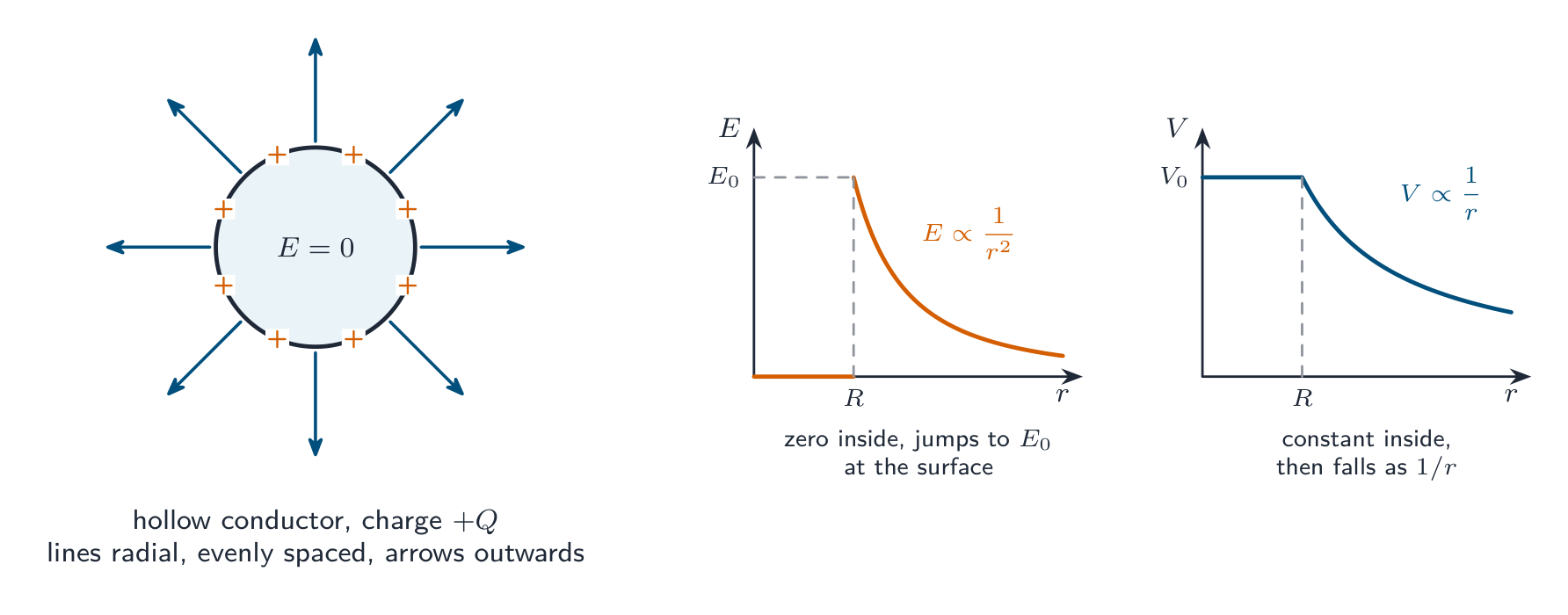
A charged conducting sphere

The charge on an isolated 孤立的 conductor 导体 sits on its outer surface, spread evenly when the sphere is on its own. Outside the sphere the field lines are radial, evenly spaced and pointing outwards (for positive charge), exactly the pattern of a point charge at the centre. Inside a hollow (or solid) conductor the field is zero: the fields of all the surface charges cancel everywhere inside, so no field line enters. Two graphs follow, and both are exam favourites. The field strength $E$ is zero out to the radius $R$, jumps to its surface value $E_0$ and then falls as $1/r^{2}$; the potential $V$ is constant inside (a zero field means a zero potential gradient) and then falls as $1/r$.

Reading the graphs. Given an $E$–$x$ graph for a charged sphere, the radius is the distance at which $E$ jumps from zero, and the charge comes from any point on the curve: $Q = 4\pi\varepsilon_{0} r^{2} E$. Given "$E_0$ at the surface", the value at $2R$ is $E_0/4$ and at $3R$ is $E_0/9$: sketch the curve through those points, starting at $E_0$ on the surface line, never from the origin.

ไทย
ฟ้าผ่าในเวลากลางคืน
ฟ้าผ่าคือประกายไฟยักษ์ที่ถูกขับเคลื่อนด้วยสนามไฟฟ้าอันมหาศาล

สนามไฟฟ้า คือพื้นที่ที่ประจุไฟฟ้า experiencing a แรง จากประจุอื่น ๆ ความเข้มสนามไฟฟ้า $E$ ที่จุดหนึ่งคือ แรงต่อหน่วยประจุบวก作用于 small positive test charge ที่วางไว้ที่จุดนั้น:

$$E = \frac{F}{q}.$$

หน่วย: $\text{N C}^{-1}$ (เช่นเดียวกับ $\text{V m}^{-1}$ ตามที่จะเห็นในภายหลัง) $E$ เป็น เวกเตอร์ ชี้ไปในทิศทางที่แรงกระทำต่อ ประจุบวก แรงที่กระทำต่อประจุ $q$ คือ

$$F = qE,$$

ตรงข้ามกับสนามหาก $q$ เป็นลบ

นิยามสำหรับ 2 คะแนน ความเข้มสนามไฟฟ้าที่จุดหนึ่งคือแรงต่อหน่วยประจุบวกที่กระทำต่อประจุเล็ก (ประจุทดสอบ) ที่วางไว้ที่จุดนั้น คำสามคำที่นำคะแนนมาคือ: แรงต่อหน่วยประจุ (ไม่ใช่ "แรงกระทำต่อประจุ"), บวก (ซึ่งกำหนดทิศทาง), และ เล็ก หรือ ทดสอบ (เพื่อให้ประจุไม่รบกวนสนามที่กำลังวัดอยู่) ตัวเลือกแบบเลือกตอบเสนอ "แรงต่อหน่วยประจุที่กระทำต่อมวลเล็ก" และ "แรงต่อหน่วยมวล" เป็นตัวเลือกหลอก: สนามถูกนิยามโดย ประจุ ไม่เคย由 มวล

ตัวอย่างวิธีทำ. โปรตอนเร่งความเร็วที่ $2.00\ \text{m s}^{-2}$ ในสนามไฟฟ้า โดยไม่มีแรงอื่นกระทำ จงหาความเข้มของสนาม ($m_{\text{p}} = 1.67 \times 10^{-27}\ \text{kg}$, $e = 1.60 \times 10^{-19}\ \text{C}$.)

$qE = ma$, ดังนั้น

$$E = \frac{m a}{q} = \frac{(1.67 \times 10^{-27})(2.00)}{1.60 \times 10^{-19}} = 2.09 \times 10^{-8}\ \text{V m}^{-1} = 20.9\ \text{nV m}^{-1}.$$

การจัดรูปสมการในทางกลับกันนี้ให้ค่าความเร่งของอิเล็กตรอนในสนาม $1500\ \text{V m}^{-1}$: $a = eE/m_{\text{e}} = (1.60 \times 10^{-19})(1500)/(9.11 \times 10^{-31}) = 2.6 \times 10^{14}\ \text{m s}^{-2}$, มีค่ามหาศาลเนื่องจากมวลของอิเล็กตรอนมีน้อยมาก แรงโน้มถ่วง ($9.81\ \text{m s}^{-2}$) มีค่าน้อยเมื่อเทียบกับมัน นั่นเป็นเหตุผลว่าทำไมคำถามข้อสอบเกี่ยวกับอิเล็กตรอนระหว่างแผ่นโลหะจึงไม่คำนึงถึงน้ำหนัก

เส้นสนาม

  • เส้นสนาม บ่งบอกทิศทางของแรงที่กระทำต่อประจุทดสอบบวก

  • เส้นเริ่มจาก ประจุบวก และสิ้นสุดที่ ประจุลบ (หรือ Goes ไปที่อนันต์)

  • เส้นnever ตัดกัน; เส้นที่ใกล้กันหมายถึงสนามที่แรงขึ้น

  • ทุกเส้นมี ลูกศร; เส้นตัดกับพื้นผิวของตัวนำในมุมฉาก

สิ่งที่เส้นสนามแทน. เมื่อถามว่า "ระบุสิ่งที่เส้นสนามไฟฟ้าแทน" ให้ตอบทั้งสองส่วน: ทิศทาง ของมันแสดงทิศทางของแรงที่กระทำต่อ ประจุบวก ที่วางไว้ที่จุดนั้น, และ ระยะห่าง ระหว่างเส้นแสดงความเข้มของสนาม (เส้นใกล้กัน, สนามแรงขึ้น) การวาดภาพจะให้คะแนนตามจุดเหล่านี้เท่านั้น: วาดลูกศร, เส้นไม่ตัดกัน, ระยะห่างเท่ากันเมื่อสนามสม่ำเสมอ, และเส้นรัศมีสำหรับประจุจุดหรือทรงกลม

ตัวอย่าง: ประจุจุด บวกมีเส้นรัศมีชี้ออก; แบบลบมีเส้นชี้เข้า; สองประจุตรงข้าม (ไดโพล) มีเส้นโค้งจาก + ไป −; สองแผ่นขนานที่มีประจุให้ สนามสม่ำเสมอ ของเส้นขนานที่ห่างเท่ากัน

รูปแบบเส้นสนามไฟฟ้าสี่แบบ: a) สนามสม่ำเสมอระหว่างแผ่นขนาน, b) ไดโพลที่มีเส้นโค้งจากบวกไปลบ, c) เส้นรัศมีออกจากประจุจุดบวก, d) ทรงกลมที่มีประจุเหนือแผ่นต่อดิน
รูปแบบเส้นสนามสำหรับแผ่นขนาน, ไดโพล, ประจุจุด, และทรงกลมที่มีประจุเหนือแผ่นต่อดิน
ตัวนำกลวงที่มีประจุพร้อมเส้นรัศมีที่ห่างเท่ากันชี้ออกไปด้านนอกและไม่มีสนามภายใน, คู่กับกราฟ E เทียบกับ r (ศูนย์ภายใน, กระโดดไปที่ E0 ที่ผิว, แล้วลดลงตาม 1/r²) และ V เทียบกับ r (คงที่ภายใน, แล้วลดลงตาม 1/r)
ตัวนำกลวงที่มีประจุ: สนามภายนอกคือของประจุจุดที่ศูนย์กลาง; ภายใน, สนามเป็นศูนย์และศักย์ไฟฟ้าคงที่

ทรงกลมตัวนำที่มีประจุ

ประจุบน ตัวนำ ที่ แยก ออก มาอยู่ที่ ผิวภายนอก ของมัน กระจายอย่างสม่ำเสมอเมื่อทรงกลมอยู่ลำพัง ด้านนอกของทรงกลม เส้นสนามจะเป็น รัศมี, ห่างเท่ากัน และชี้ออกไป (สำหรับประจุบวก), เป็นรูปแบบเดียวกับประจุจุดที่ศูนย์กลาง ภายใน ตัวนำกลวง (หรือทึบ) สนามจะเป็น ศูนย์: สนามของประจุผิวทั้งหมดหักล้างกันทุกจุดภายใน ดังนั้นไม่มีเส้นสนามเข้าไปสองกราฟถัดมา และทั้งสองเป็นตัวเลือกที่นิยมในข้อสอบ ความเข้มของสนาม $E$ เป็นศูนย์จนถึงรัศมี $R$, กระโดด ไปที่ค่าผิว $E_0$ แล้วลดลงตาม $1/r^{2}$; ศักย์ไฟฟ้า $V$ เป็น คงที่ ภายใน (สนามศูนย์หมายถึงเกรเดียนต์ศักย์ศูนย์) แล้วลดลงตาม $1/r$.

อ่านกราฟ. ให้กราฟ $E$–$x$ สำหรับทรงกลมที่มีประจุ รัศมี คือระยะที่ $E$ กระโดดจากศูนย์, และ ประจุ มาจากจุดใดก็ได้บนcurve: $Q = 4\pi\varepsilon_{0} r^{2} E$. ให้ "$E_0$ ที่ผิว", ค่าที่ $2R$ คือ $E_0/4$ และที่ $3R$ คือ $E_0/9$: วาด curve ผ่านจุดเหล่านั้น, เริ่มที่ $E_0$ บนเส้นผิว, ไม่เริ่มจากจุดกำเนิด

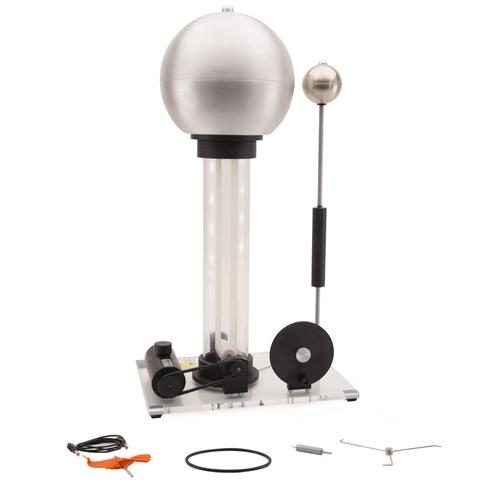
เครื่องกำเนิด Van de Graaff: ถ้วยทองเหลืองขนาดใหญ่ขัดเงาบนเสาใส, พร้อมสายพานยางเคลื่อนที่ภายในและทรงกลมปล่อยประจุขนาดเล็กบนแท่นข้างๆ
เครื่องกำเนิด Van de Graaff เก็บประจุสถิตจำนวนมากบนถ้วยทองเหลือง ทำให้เกิดสนามไฟฟ้าแรงรอบๆ
Explore · ⁨สำรวจ⁩

Electric fields · ⁨สนามไฟฟ้า⁩

E ∝ Q / r²

A charge sets up a radial field — out for +, in for −, obeying the inverse-square law. · ⁨ประจุจะสร้างสนามรัศมี — ออกนอกสำหรับ +, เข้าหาสำหรับ −, เป็นไปตาม กฎกำลังสองผกผัน⁩

Vocabulary · ⁨คำศัพท์⁩ Train · ⁨ฝึกฝน⁩
English ไทย
electric field/ɪˈlektrɪk fiːld/ สนามไฟฟ้า
test charge/test tʃɑːdʒ/ ประจุทดสอบ
vector/ˈvektə/ เวกเตอร์
18.2

Uniform electric fields · ⁨สนามไฟฟ้าสม่ำเสมอ⁩

Syllabus · ⁨หลักสูตร⁩
English
  1. recall and use $E = \Delta V / \Delta d$ to calculate the field strength of the uniform field between charged parallel plates
  2. describe the effect of a uniform electric field on the motion of charged particles
ไทย
  1. จำและใช้ $E = \Delta V / \Delta d$ เพื่อคำนวณ ความเข้มสนาม ของสนามสม่ำเสมอระหว่างแผ่นขนานที่มีประจุ
  2. อธิบายผลกระทบของ สนามไฟฟ้าสม่ำเสมอ ต่อการเคลื่อนที่ของ อนุภาคที่มีประจุ

Source: Cambridge International syllabus · ⁨แหล่งที่มา: หลักสูตร Cambridge International⁩

English

Between two parallel plates a distance $d$ apart with potential difference 电势差 $V$ between them, the field is uniform (apart from edge effects) with size

$$E = \frac{V}{d}.$$

It points from the higher-potential plate to the lower one. The unit $\text{V m}^{-1}$ comes straight from this and equals $\text{N C}^{-1}$.

Worked example. Two parallel plates $5.0\ \text{mm}$ apart have a p.d. of $200\ \text{V}$ between them. Find the field strength, and the force on an electron in the gap. ($e = 1.6 \times 10^{-19}\ \text{C}$.)

$$E = \frac{V}{d} = \frac{200}{5.0 \times 10^{-3}} = 4.0 \times 10^{4}\ \text{V m}^{-1}, \qquad F = qE = (1.6 \times 10^{-19})(4.0 \times 10^{4}) = 6.4 \times 10^{-15}\ \text{N}.$$

Which changes the field? Two things only: $E = V/d$ rises if the p.d. is increased or the plates are moved closer. A resistor in series with the supply changes nothing: no current flows once the plates are charged, so there is no p.d. across the resistor and the plates sit at the full supply voltage. Between plates at $+800\ \text{V}$ and $+1300\ \text{V}$ the field points from the higher potential to the lower; two positive potentials change nothing about the direction rule.

A charged particle in a uniform field

A charge $q$ in a uniform field feels a constant force $F = qE$, so a constant acceleration $a = qE/m$ — just like a mass in a uniform gravitational field.

  • released at rest, it speeds up along the field (positive charge) or against it (negative charge), gaining kinetic energy 动能.
  • entering at right angles to the field, it follows a parabolic 抛物线 path — like a projectile 抛体 in gravity. This is how a cathode-ray tube 阴极射线管 used to steer its beam.

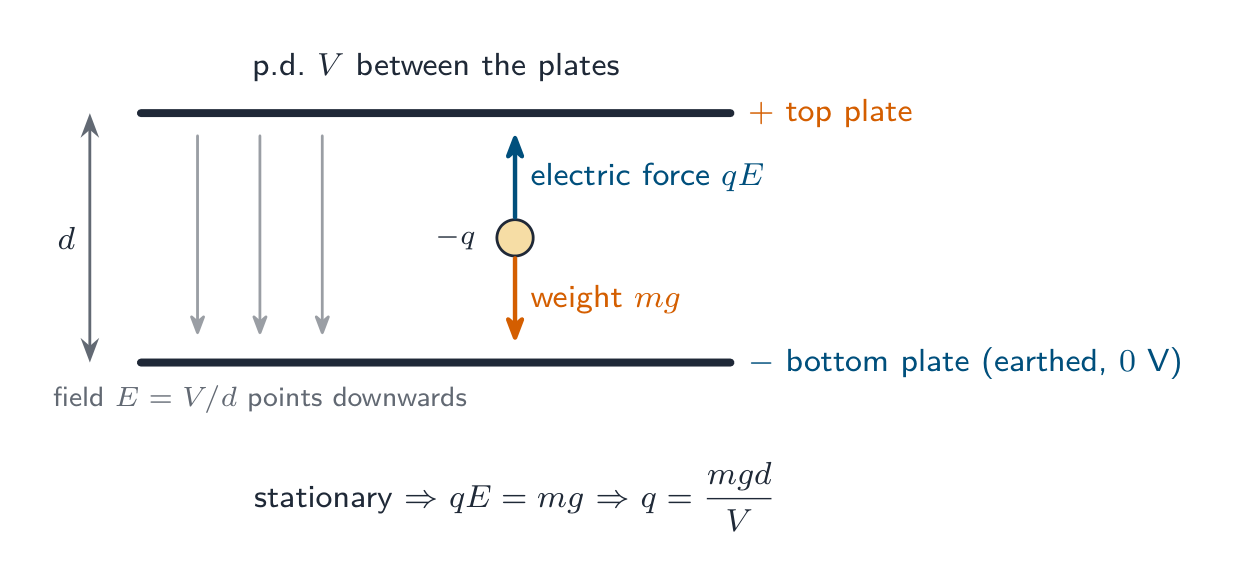
Two forces, not one. A charged oil drop "held stationary" between horizontal plates is the exam's favourite equilibrium 平衡: both an electric force and its weight act on it (the multiple-choice distractor is "electric force only"), and they are equal and opposite. For a negative drop the electric force is opposite to the field, so the top plate must be positive to hold it up.

Worked example. An oil drop of mass $2.6 \times 10^{-15}\ \text{kg}$ carries a charge of $-4.8 \times 10^{-19}\ \text{C}$ and is held stationary in a vacuum between horizontal plates $2.0\ \text{cm}$ apart. Find the p.d. between the plates, and say which plate is positive.

$$qE = mg \;\Rightarrow\; \frac{qV}{d} = mg \;\Rightarrow\; V = \frac{m g d}{q} = \frac{(2.6 \times 10^{-15})(9.81)(0.020)}{4.8 \times 10^{-19}} = 1.1 \times 10^{3}\ \text{V}.$$

The drop is negative, so the force on it is against the field; for the force to be upwards the field must point down, so the top plate is positive. Notice that the charge is $3e$, three excess electrons, which is how Millikan showed that charge comes in multiples of $e$.

Worked example. Two parallel plates in a vacuum are $0.041\ \text{m}$ apart with a p.d. of $250\ \text{V}$ between them. An electron is released from rest at the negative plate. Find (a) the field strength, (b) the force on the electron and its acceleration, (c) the time it takes to reach the positive plate, (d) its kinetic energy on arrival. ($m_{\text{e}} = 9.11 \times 10^{-31}\ \text{kg}$.)

(a) $E = V/d = 250/0.041 = 6.1 \times 10^{3}\ \text{V m}^{-1}$. (b) $F = eE = (1.60 \times 10^{-19})(6.1 \times 10^{3}) = 9.8 \times 10^{-16}\ \text{N}$; $a = F/m_{\text{e}} = 1.07 \times 10^{15}\ \text{m s}^{-2}$, towards the positive plate. (c) From rest with constant acceleration, $d = \tfrac{1}{2} a t^{2}$, so $t = \sqrt{2d/a} = \sqrt{2 \times 0.041 / (1.07 \times 10^{15})} = 8.8 \times 10^{-9}\ \text{s}$. (d) Energy method, no kinematics needed: $E_{\text{k}} = qV = (1.60 \times 10^{-19})(250) = 4.0 \times 10^{-17}\ \text{J}$, so $v = \sqrt{2E_{\text{k}}/m_{\text{e}}} = 9.4 \times 10^{6}\ \text{m s}^{-1}$. (Check: $v = at = (1.07 \times 10^{15})(8.8 \times 10^{-9}) = 9.4 \times 10^{6}\ \text{m s}^{-1}$.)

Worked example (deflection). An electron travelling horizontally at $2.0 \times 10^{7}\ \text{m s}^{-1}$ enters the field between two horizontal plates $18\ \text{mm}$ apart with a p.d. of $400\ \text{V}$. The plates are $30\ \text{mm}$ long. Find the deflection 偏转 of the electron by the time it leaves the field.

The horizontal motion is unaffected: time in the field $t = 0.030/(2.0 \times 10^{7}) = 1.5 \times 10^{-9}\ \text{s}$. Vertically, $a = eE/m_{\text{e}} = eV/(m_{\text{e}} d) = (1.60 \times 10^{-19})(400)/[(9.11 \times 10^{-31})(0.018)] = 3.9 \times 10^{15}\ \text{m s}^{-2}$, so the deflection is $y = \tfrac{1}{2} a t^{2} = \tfrac{1}{2}(3.9 \times 10^{15})(1.5 \times 10^{-9})^{2} = 4.4 \times 10^{-3}\ \text{m}$, less than the half-gap of $9\ \text{mm}$, so the electron does leave the field. Its vertical velocity on exit is $at = 5.9 \times 10^{6}\ \text{m s}^{-1}$, so it leaves at $\tan\theta = 5.9/20$, about $16°$; the path is a parabola, and after the plates (no field) it travels in a straight line in the direction it had on exit.

ไทย

ระหว่างแผ่นขนานสองแผ่นห่างกัน $d$ และมี ผลต่างศักย์ $V$ ระหว่างกัน, สนามจะเป็นสม่ำเสมอ (ยกเว้นผลกระทบขอบ) ด้วยขนาด

ระหว่างแผ่นขนานห่างกัน d ด้วยแรงดัน V, สนามคือ E = V/d
ระหว่างแผ่นขนาน สนามจะเป็นสม่ำเสมอ, E = V/d
$$E = \frac{V}{d}.$$

มันชี้จากแผ่นที่มีศักย์สูงกว่าไปยังแผ่นที่มีศักย์ต่ำกว่า หน่วย $\text{V m}^{-1}$ มาโดยตรงจากสิ่งนี้และเท่ากับ $\text{N C}^{-1}$.

ตัวอย่างวิธีทำ. แผ่นขนานสองแผ่น $5.0\ \text{mm}$之间有 p.d. $200\ \text{V}$. จงหาความเข้มของสนาม, และแรงที่กระทำต่อยอิเล็กตรอนในช่องว่าง ($e = 1.6 \times 10^{-19}\ \text{C}$.)

$$E = \frac{V}{d} = \frac{200}{5.0 \times 10^{-3}} = 4.0 \times 10^{4}\ \text{V m}^{-1}, \qquad F = qE = (1.6 \times 10^{-19})(4.0 \times 10^{4}) = 6.4 \times 10^{-15}\ \text{N}.$$

อะไรเปลี่ยนสนาม? มีเพียงสองอย่าง: $E = V/d$ จะเพิ่มขึ้นหาก p.d. เพิ่มขึ้น หรือแผ่นถูกย้าย เข้าหากัน. เรซิสเตอร์ที่ต่ออนุกรมกับแหล่งจ่ายไฟไม่เปลี่ยนแปลงอะไร: ไม่มีกระแสไหลเมื่อแผ่นชาร์จแล้ว, ดังนั้นไม่มี p.d. Across เรซิสเตอร์ และแผ่นอยู่ที่แรงดันแหล่งจ่ายเต็ม Between Plates at $+800\ \text{V}$ และ $+1300\ \text{V}$, สนามชี้จาก ศักย์สูง ไปยังต่ำ; สองศักย์บวกไม่เปลี่ยนกฎทิศทาง

อนุภาคที่มีประจุในสนามสม่ำเสมอ

ประจุ $q$ ในสนามสม่ำเสมอรับ แรงคงที่ $F = qE$, ดังนั้น ความเร่งคงที่ $a = qE/m$ — เหมือนกับมวลในสนามโน้มถ่วงสม่ำเสมอ

  • ปล่อย จากสถานะหยุดนิ่ง, มันเร่งความเร็วไปตามสนาม (ประจุบวก) หรือสวนทาง (ประจุลบ), ได้รับ พลังงานจลน์
  • เข้า ในมุมฉาก กับสนาม, มันเดินตาม พาราโบลา Path — เหมือนกับ โปรเจกไทล์ ในแรงโน้มถ่วง นี่คือวิธีที่ หลอดรังสีแคโทด ใช้บังคับลำแสง
อนุภาคที่มีประจุเข้าสู่สนามสม่ำเสมอระหว่างแผ่นขนานสองแผ่นในมุมฉากกับสนามและโค้งเป็นเส้นทางพาราโบลาขณะข้าม
ประจุเข้าสู่สนามสม่ำเสมอในมุมฉากจะเดินตามเส้นทางพาราโบลา, เหมือนโปรเจกไทล
หยดน้ำมันที่มีประจุลบอยู่ระหว่างแผ่นบวกด้านบนและแผ่นต่อลงดินด้านล่าง ยืนนิ่งเนื่องจากแรงไฟฟ้าขึ้น qE สมดุลกับน้ำหนัก mg; สนาม E = V/d ชี้ลง
หยดน้ำมันที่มีประจุยืนนิ่งระหว่างแผ่นราบ: แรงไฟฟ้าสมดุลกับน้ำหนัก ดังนั้น q = mgd/V

สองแรง ไม่ใช่หนึ่ง. หยดน้ำมัน "ที่ยืนนิ่ง" ระหว่างแผ่นราบคือ สมดุล ที่ข้อสอบชอบที่สุด: มีทั้ง แรงไฟฟ้าและน้ำหนักกระทำต่อมัน (ตัวเลือกลวงในข้อเลือกคือ "มีเพียงแรงไฟฟ้า") และทั้งสองมีขนาดเท่ากันและทิศทางตรงข้าม สำหรับ หยดที่มีประจุลบ แรงไฟฟ้าจะตรงข้ามกับสนาม ดังนั้นแผ่นบนต้องเป็น บวก เพื่อพยุงมันไว้

ตัวอย่างฝึกหัด. หยดน้ำมันมวล $2.6 \times 10^{-15}\ \text{kg}$ มีประจุ $-4.8 \times 10^{-19}\ \text{C}$ และยืนนิ่งในสุญญากาศระหว่างแผ่นราบ $2.0\ \text{cm}$ แยกกัน จงหาความต่างศักย์ระหว่างแผ่น และระบุว่าแผ่นใดเป็นบวก

$$qE = mg \;\Rightarrow\; \frac{qV}{d} = mg \;\Rightarrow\; V = \frac{m g d}{q} = \frac{(2.6 \times 10^{-15})(9.81)(0.020)}{4.8 \times 10^{-19}} = 1.1 \times 10^{3}\ \text{V}.$$

หยดมีประจุลบ ดังนั้นแรงที่กระทำ对它是对着场; เพื่อให้แรงชี้ขึ้น สนามต้องชี้ ลง ดังนั้น บน แผ่นเป็นบวก ระวังว่าประจุนี้ $3e$ คืออิเล็กตรอนเกินสามตัว นี่คือวิธีที่มิลลิคานพิสูจน์ว่าประจุมีค่าเป็นพหุคูณของ $e$

ตัวอย่างฝึกหัด. แผ่นขนานสองแผ่นในสุญญากาศ $0.041\ \text{m}$ แยกกัน มีความต่างศักย์ $250\ \text{V}$ ระหว่างกัน อิเล็กตรอนปล่อยจากจุดหยุดนิ่งที่แผ่นลบ จงหา (ก) ความเข้มสนาม, (ข) แรงต่ออิเล็กตรอนและความเร่ง, (ค) เวลาที่ใช้才能达到แผ่นบวก, (ง) พลังงานจลน์เมื่อถึง ($m_{\text{e}} = 9.11 \times 10^{-31}\ \text{kg}$.)

(a) $E = V/d = 250/0.041 = 6.1 \times 10^{3}\ \text{V m}^{-1}$. (ข) $F = eE = (1.60 \times 10^{-19})(6.1 \times 10^{3}) = 9.8 \times 10^{-16}\ \text{N}$; $a = F/m_{\text{e}} = 1.07 \times 10^{15}\ \text{m s}^{-2}$, ไปทางแผ่นบวก (ค) จากจุดหยุดนิ่งด้วยความเร่งคงที่ $d = \tfrac{1}{2} a t^{2}$ ดังนั้น $t = \sqrt{2d/a} = \sqrt{2 \times 0.041 / (1.07 \times 10^{15})} = 8.8 \times 10^{-9}\ \text{s}$ (ง) วิธีพลังงาน ไม่ต้องใช้สมการจลนศาสตร์: $E_{\text{k}} = qV = (1.60 \times 10^{-19})(250) = 4.0 \times 10^{-17}\ \text{J}$ ดังนั้น $v = \sqrt{2E_{\text{k}}/m_{\text{e}}} = 9.4 \times 10^{6}\ \text{m s}^{-1}$. (ตรวจสอบ: $v = at = (1.07 \times 10^{15})(8.8 \times 10^{-9}) = 9.4 \times 10^{6}\ \text{m s}^{-1}$.)

ตัวอย่างวิธีทำ (การเบี่ยงเบน). อิเล็กตรอนเคลื่อนที่แนวนอนที่ $2.0 \times 10^{7}\ \text{m s}^{-1}$ เข้าสู่อุณหภูมิตระหว่างแผ่นนำสองแผ่นวางขนานกัน $18\ \text{mm}$ มีต่างศักย์ $400\ \text{V}$ แผ่นนำยาว $30\ \text{mm}$ จงหา การเบี่ยงเบน (deflection) ของอิเล็กตรอนเมื่อออกจากสนาม

การเคลื่อนที่ในแนวราบไม่ถูกกระทบ: เวลาในสนาม $t = 0.030/(2.0 \times 10^{7}) = 1.5 \times 10^{-9}\ \text{s}$. ในแนวตั้ง, $a = eE/m_{\text{e}} = eV/(m_{\text{e}} d) = (1.60 \times 10^{-19})(400)/[(9.11 \times 10^{-31})(0.018)] = 3.9 \times 10^{15}\ \text{m s}^{-2}$, ดังนั้นการเบี่ยงเบนคือ $y = \tfrac{1}{2} a t^{2} = \tfrac{1}{2}(3.9 \times 10^{15})(1.5 \times 10^{-9})^{2} = 4.4 \times 10^{-3}\ \text{m}$, น้อยกว่าครึ่งช่องว่าง $9\ \text{mm}$, ดังนั้นอิเล็กตรอนออกจากระบบได้ ความเร็วในแนวตั้งตอนออกคือ $at = 5.9 \times 10^{6}\ \text{m s}^{-1}$, ดังนั้นออกที่มุม $\tan\theta = 5.9/20$, ประมาณ $16°$; เส้นทางเป็นพาราโบลา, และ หลัง จากแผ่น (ไม่มีสนาม) มันเคลื่อนที่ตามเส้นตรงในทิศทางตอนออก

Explore · ⁨สำรวจ⁩

Uniform electric field lab · ⁨ห้องปฏิบัติการสนามไฟฟ้าสม่ำเสมอ⁩

Follow how a charge behaves between parallel plates. · ⁨ติดตามพฤติกรรมของประจุระหว่างแผ่นขนาน⁩

Vocabulary · ⁨คำศัพท์⁩ Train · ⁨ฝึกฝน⁩
English ไทย
deflection/dɪˈflekʃn/ การเบี่ยงเบน
Coulomb's law/ˈkuːlɒmz lɔː/ กฎของคูลอม
permittivity of free space/ˌpɜːmɪˈtɪvəti ɒv friː speɪs/ ค่าความยอมให้ของสุญญากาศ
tension/ˈtenʃn/ แรงตึง
nucleus/ˈnjuːklɪəs/ นิวเคลียส
resultant force/rɪˈzʌltənt fɔːs/ แรงลัพธ์
centripetal force/senˈtrɪpɪtl fɔːs/ แรงเข้าสู่ศูนย์กลาง
18.3

Coulomb's law · ⁨กฎของคูลอมบ์⁩

Syllabus · ⁨หลักสูตร⁩
English
  1. understand that, for a point outside a spherical conductor, the charge on the sphere may be considered to be a point charge at its centre
  2. recall and use Coulomb’s law $F = Q_1Q_2 / (4\pi\varepsilon_0 r^2)$ for the force between two point charges in free space
ไทย
  1. เข้าใจว่า, สำหรับจุดภายนอก ตัวนำทรงกลม, ประจุบนทรงกลมสามารถพิจารณาว่าเป็น ประจุจุด ที่ศูนย์กลางของมัน
  2. จำและใช้ กฎของคูลอมบ์ $F = Q_1Q_2 / (4\pi\varepsilon_0 r^2)$ สำหรับแรงระหว่างสองประจุจุดในสุญญากาศ

Source: Cambridge International syllabus · ⁨แหล่งที่มา: หลักสูตร Cambridge International⁩

English

For two point charges $Q_{1}$ and $Q_{2}$ a distance $r$ apart in free space, each feels a force of size

$$F = \frac{Q_{1} Q_{2}}{4\pi\varepsilon_{0} r^{2}}.$$

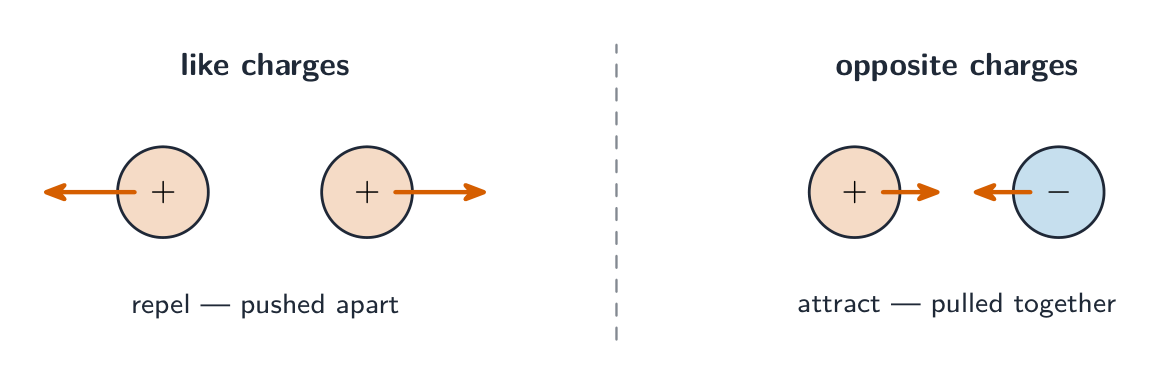
This is Coulomb's law 库仑定律. Here $\varepsilon_{0} = 8.85 \times 10^{-12}\ \text{F m}^{-1}$ is the permittivity of free space 真空电容率, and $1/(4\pi\varepsilon_{0}) \approx 9.0 \times 10^{9}\ \text{N m}^{2}\ \text{C}^{-2}$. The force is along the line joining the charges: repulsive for like charges, attractive for opposite charges.

Stating the law in words. "State Coulomb's law" wants a sentence, not a formula: the (electric) force between two point charges is directly proportional to the product of the charges and inversely proportional to the square of their separation. Both proportionalities are needed, and the charges must be point charges (or spheres treated as point charges at their centres) in a vacuum.

Worked example. Find the electrostatic force between point charges of $+2.0\ \text{nC}$ and $+3.0\ \text{nC}$ placed $4.0\ \text{cm}$ apart. ($1/(4\pi\varepsilon_{0}) = 9.0 \times 10^{9}\ \text{N m}^{2}\ \text{C}^{-2}$.)

$$F = \frac{Q_{1}Q_{2}}{4\pi\varepsilon_{0} r^{2}} = \frac{(9.0 \times 10^{9})(2.0 \times 10^{-9})(3.0 \times 10^{-9})}{(0.040)^{2}} \approx 3.4 \times 10^{-5}\ \text{N (repulsive).}$$

Worked example. In a hydrogen atom the proton and the electron may be treated as point charges $120\ \text{pm}$ apart. Find the electric force between them, and compare it with their gravitational attraction. ($m_{\text{p}} = 1.67 \times 10^{-27}\ \text{kg}$, $m_{\text{e}} = 9.11 \times 10^{-31}\ \text{kg}$, $G = 6.67 \times 10^{-11}\ \text{N m}^{2}\ \text{kg}^{-2}$.)

$$F_{\text{E}} = \frac{e^{2}}{4\pi\varepsilon_{0} r^{2}} = \frac{(8.99 \times 10^{9})(1.60 \times 10^{-19})^{2}}{(1.20 \times 10^{-10})^{2}} = 1.6 \times 10^{-8}\ \text{N (attractive).}$$

Gravity: $F_{\text{G}} = G m_{\text{p}} m_{\text{e}}/r^{2} = (6.67 \times 10^{-11})(1.67 \times 10^{-27})(9.11 \times 10^{-31})/(1.20 \times 10^{-10})^{2} = 7.0 \times 10^{-48}\ \text{N}$, about $10^{39}$ times smaller. Inside atoms, gravity is irrelevant.

Worked example. Two identical oil droplets in a vacuum have their centres $3.8 \times 10^{-6}\ \text{m}$ apart. Each carries the same charge, and they repel with a force of $1.0 \times 10^{-15}\ \text{N}$. Find the charge on each droplet, and the number of excess electrons it carries.

$$F = \frac{Q^{2}}{4\pi\varepsilon_{0} r^{2}} \;\Rightarrow\; Q = \sqrt{4\pi\varepsilon_{0} F r^{2}} = \sqrt{\frac{(1.0 \times 10^{-15})(3.8 \times 10^{-6})^{2}}{8.99 \times 10^{9}}} = 1.3 \times 10^{-18}\ \text{C},$$

that is $1.3 \times 10^{-18}/1.60 \times 10^{-19} \approx 8$ electrons. Identical objects with the same sign of charge always repel; do not write "attract" for the direction.

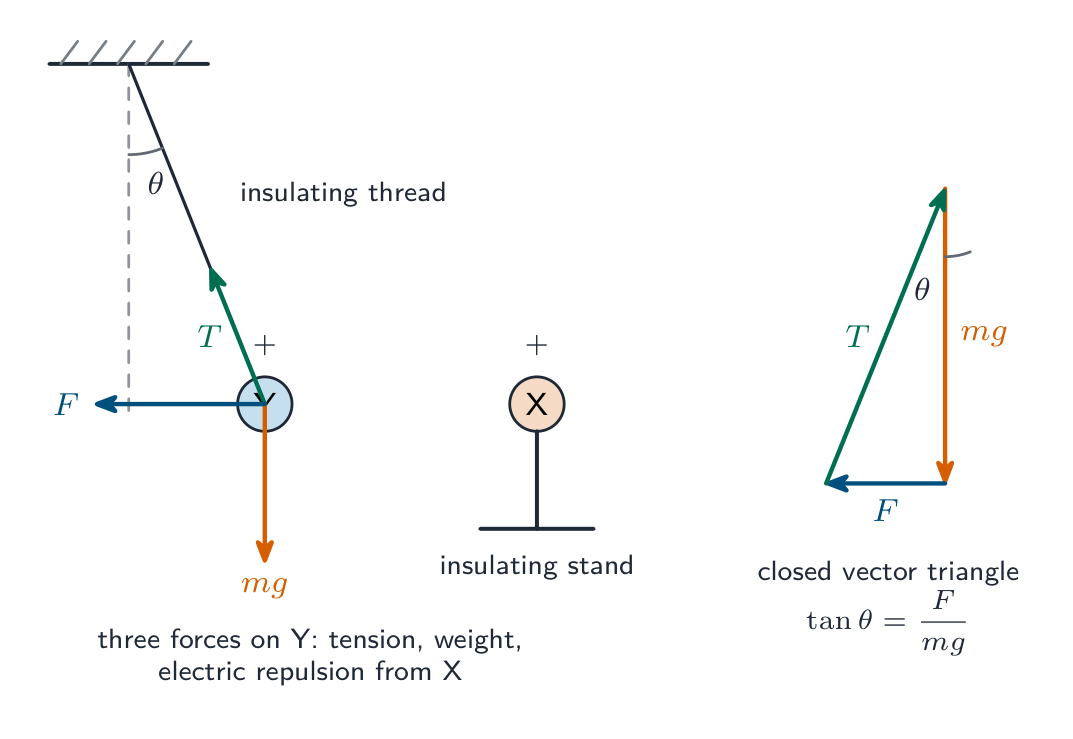
Worked example. A charged sphere X is fixed on an insulating stand. A second sphere Y, of mass $2.0\ \text{g}$, hangs beside it on an insulating thread and settles in equilibrium with the thread at $12°$ to the vertical, its centre $5.0\ \text{cm}$ from the centre of X on the same horizontal level. Find the electric force on Y and, if the spheres carry equal charges, the charge on each.

Three forces act on Y: its weight $mg$ (down), the tension 张力 $T$ (along the thread) and the electric force $F$ (horizontal, away from X because like charges repel). Resolving, $T\cos\theta = mg$ and $T\sin\theta = F$, so

$$F = mg\tan\theta = (2.0 \times 10^{-3})(9.81)\tan 12° = 4.2 \times 10^{-3}\ \text{N}.$$

Then $F = Q^{2}/(4\pi\varepsilon_{0} r^{2})$ gives $Q = \sqrt{4\pi\varepsilon_{0} F r^{2}} = \sqrt{(4.2 \times 10^{-3})(0.050)^{2}/(8.99 \times 10^{9})} = 3.4 \times 10^{-8}\ \text{C}$. A closed vector triangle of the three forces is an equally good method; the exam accepts either, but it must show all three forces.

Worked example (helium). A helium atom may be modelled as a nucleus of charge $+2e$ with two electrons in diametrically opposite circular orbits of radius $170\ \text{pm}$. Find the resultant force 合力 on one electron, and hence its orbital speed.

Two forces act on the electron: attraction to the nucleus, at distance $r$, and repulsion from the other electron, at distance $2r$ on the far side:

$$F_{\text{res}} = \frac{2e^{2}}{4\pi\varepsilon_{0} r^{2}} - \frac{e^{2}}{4\pi\varepsilon_{0} (2r)^{2}} = \frac{e^{2}}{4\pi\varepsilon_{0} r^{2}}\left(2 - \tfrac{1}{4}\right) = 1.75 \times \frac{(8.99 \times 10^{9})(1.60 \times 10^{-19})^{2}}{(1.70 \times 10^{-10})^{2}} = 1.4 \times 10^{-8}\ \text{N},$$

towards the nucleus. This resultant is the centripetal force, $F = m_{\text{e}} v^{2}/r$, so $v = \sqrt{F r/m_{\text{e}}} = \sqrt{(1.4 \times 10^{-8})(1.70 \times 10^{-10})/(9.11 \times 10^{-31})} = 1.6 \times 10^{6}\ \text{m s}^{-1}$. The trap is to forget the second electron, or to put it at distance $r$ rather than $2r$.

Spheres treated as point charges

A spherical conductor with total charge $Q$ gives, at any point outside, the same field as a point charge $Q$ at its centre (measure $r$ from the centre). Inside a hollow charged conductor the field is zero, so the conductor is an equipotential 等势面.

ไทย

สำหรับประจุจุดสองตัว $Q_{1}$ และ $Q_{2}$ ระยะห่าง $r$ ในอวกาศว่าง แต่ละตัวรู้สึกถึงแรงขนาด

$$F = \frac{Q_{1} Q_{2}}{4\pi\varepsilon_{0} r^{2}}.$$

นี่คือ กฎของคูลอมบ์. ที่นี่ $\varepsilon_{0} = 8.85 \times 10^{-12}\ \text{F m}^{-1}$ คือ ค่าสัมประสิทธิ์การยอมผ่านของอวกาศว่าง, และ $1/(4\pi\varepsilon_{0}) \approx 9.0 \times 10^{9}\ \text{N m}^{2}\ \text{C}^{-2}$. แรงอยู่ในแนวเชื่อมประจุ: ผลัก สำหรับประจุชนิดเดียวกัน, ดูด สำหรับประจุต่างชนิด

การกล่าวกฎเป็นคำพูด. "จงกล่าวกฎของคูลอมบ์" ต้องการประโยค ไม่ใช่สูตร: แรง (ไฟฟ้า) ระหว่างประจุจุดสองตัวแปรผันตรงกับผลคูณของประจุและแปรผกผันกับกำลังสองของระยะห่าง. การแปรผันทั้งสองจำเป็น และประจุต้องเป็น ประจุจุด (หรือทรงกลมที่พิจารณาเป็นประจุจุดที่ศูนย์กลาง) ในสุญญากาศ

ทิศทางกฎของคูลอมบ์: ประจุชนิดเดียวกันสองตัว (บวกทั้งคู่) ผลักกันออก; บวกกับลบ ดึงเข้าหากัน *ประจุชนิดเดียวกันผลักกัน; ต่างชนิดดูดกัน — แรงอยู่ในแนวเชื่อม将它们

ตัวอย่างฝึกหัด. จงหาแรงสถิตระหว่างประจุจุด $+2.0\ \text{nC}$ และ $+3.0\ \text{nC}$ วางกัน $4.0\ \text{cm}$. ($1/(4\pi\varepsilon_{0}) = 9.0 \times 10^{9}\ \text{N m}^{2}\ \text{C}^{-2}$.)

$$F = \frac{Q_{1}Q_{2}}{4\pi\varepsilon_{0} r^{2}} = \frac{(9.0 \times 10^{9})(2.0 \times 10^{-9})(3.0 \times 10^{-9})}{(0.040)^{2}} \approx 3.4 \times 10^{-5}\ \text{N (repulsive).}$$

ตัวอย่างฝึกหัด. ในอะตอมไฮโดรเจนโปรตอนและอิเล็กตรอนสามารถพิจารณาเป็นประจุจุด $120\ \text{pm}$ แยกกัน จงหาแรงไฟฟ้าระหว่าง它们 และเปรียบเทียบกับแรงโน้มถ่วง把它们之间 ($m_{\text{p}} = 1.67 \times 10^{-27}\ \text{kg}$, $m_{\text{e}} = 9.11 \times 10^{-31}\ \text{kg}$, $G = 6.67 \times 10^{-11}\ \text{N m}^{2}\ \text{kg}^{-2}$.)

$$F_{\text{E}} = \frac{e^{2}}{4\pi\varepsilon_{0} r^{2}} = \frac{(8.99 \times 10^{9})(1.60 \times 10^{-19})^{2}}{(1.20 \times 10^{-10})^{2}} = 1.6 \times 10^{-8}\ \text{N (attractive).}$$

แรงโน้มถ่วง: $F_{\text{G}} = G m_{\text{p}} m_{\text{e}}/r^{2} = (6.67 \times 10^{-11})(1.67 \times 10^{-27})(9.11 \times 10^{-31})/(1.20 \times 10^{-10})^{2} = 7.0 \times 10^{-48}\ \text{N}$, น้อยกว่าประมาณ $10^{39}$ เท่า. ภายในอะตอม, แรงโน้มถ่วงไม่สำคัญ

ตัวอย่างฝึกหัด. หยดน้ำมันสองหยดเหมือนกันในสุญญากาศมีศูนย์กลาง $3.8 \times 10^{-6}\ \text{m}$ แยกกัน แต่ละหยดมีประจุเท่ากัน และผลักกันด้วยแรง $1.0 \times 10^{-15}\ \text{N}$ จงหาประจุของแต่ละหยด และจำนวนอิเล็กตรอนเกิน它有

$$F = \frac{Q^{2}}{4\pi\varepsilon_{0} r^{2}} \;\Rightarrow\; Q = \sqrt{4\pi\varepsilon_{0} F r^{2}} = \sqrt{\frac{(1.0 \times 10^{-15})(3.8 \times 10^{-6})^{2}}{8.99 \times 10^{9}}} = 1.3 \times 10^{-18}\ \text{C},$$

นั่นคือ $1.3 \times 10^{-18}/1.60 \times 10^{-19} \approx 8$ อิเล็กตรอน วัตถุที่มีประจุชนิดเดียวกันจะ ผลักกันเสมอ; อย่าเขียน "ดึงดูด" สำหรับทิศทาง

ตัวอย่างฝึกหัด. ทรงกลม X ที่มีประจุยึดติดกับแท่นฉนวน ทรงกลม Y มวล $2.0\ \text{g}$ แขวนข้างมันด้วยด้ายฉนวน และ/settle ในสมดุลด้วยด้ายทำมุม $12°$ กับแนวตั้ง, ศูนย์กลาง它的 $5.0\ \text{cm}$ จากศูนย์กลาง X ในระดับแนวนอนเดียวกัน จงหาแรงไฟฟ้าต่อ Y และถ้าทรงกลมมีประจุเท่ากัน จงหาประจุแต่ละตัว

ทรงกลม Y แขวนด้วยด้ายฉนวนใกล้ทรงกลม X ที่มีประจุยึดติดกับแท่นฉนวน, ด้ายทำมุม theta กับแนวตั้ง, พร้อมแรงสามตัว作用于 Y (แรงตึง, น้ำหนัก, แรงผลักไฟฟ้าจาก X) และสามเหลี่ยมแรงปิดข้างๆ, tan theta = F over mg
ทรงกลมที่มีประจุแขวนใกล้ทรงกลมอื่นที่มีประจุ: สามแรงสมดุล, แรงตึงตามด้าย, น้ำหนัก และแรงผลักไฟฟ้าแนวนอน, ดังนั้น tan θ = F/mg

สามแรงกระทำต่อ Y: น้ำหนัก $mg$ (ลง), แรงตึง $T$ (ตามด้าย) และแรงไฟฟ้า $F$ (แนวนอน, ห่างจาก X เพราะประจุชนิดเดียวกันผลัก). การแยกองค์ประกอบ, $T\cos\theta = mg$ และ $T\sin\theta = F$, ดังนั้น

$$F = mg\tan\theta = (2.0 \times 10^{-3})(9.81)\tan 12° = 4.2 \times 10^{-3}\ \text{N}.$$

จากนั้น $F = Q^{2}/(4\pi\varepsilon_{0} r^{2})$ ให้ $Q = \sqrt{4\pi\varepsilon_{0} F r^{2}} = \sqrt{(4.2 \times 10^{-3})(0.050)^{2}/(8.99 \times 10^{9})} = 3.4 \times 10^{-8}\ \text{C}$. สามเหลี่ยมเวกเตอร์ปิดของแรงสามตัวเป็นวิธีที่ดีพอ; ข้อสอบยอมรับทั้งสอง แต่ต้องแสดงแรง สาม ตัวทั้งหมด

ตัวอย่างฝึกหัด (ฮีเลียม). อะตอมฮีเลียมอาจจำลองเป็นนิวเคลียสประจุ $+2e$ denganสองอิเล็กตรอนในวงโคจรวงกลมตรงข้ามกันรัศมี $170\ \text{pm}$. จงหา แรงลัพธ์作用于 one electron, และดังนั้นความเร็ววงโคจร

มีแรงสองกระทำต่ออิเล็กตรอน: แรงดึงดูด toward นิวเคลียส ที่ระยะ $r$ และแรงผลัก from อิเล็กตรอนอื่น ที่ระยะ $2r$ ฝั่งตรงข้าม:

$$F_{\text{res}} = \frac{2e^{2}}{4\pi\varepsilon_{0} r^{2}} - \frac{e^{2}}{4\pi\varepsilon_{0} (2r)^{2}} = \frac{e^{2}}{4\pi\varepsilon_{0} r^{2}}\left(2 - \tfrac{1}{4}\right) = 1.75 \times \frac{(8.99 \times 10^{9})(1.60 \times 10^{-19})^{2}}{(1.70 \times 10^{-10})^{2}} = 1.4 \times 10^{-8}\ \text{N},$$

ไปทางนิวเคลียส ผลรวมของแรงนี้คือแรงเข้าศูนย์กลาง, $F = m_{\text{e}} v^{2}/r$, ดังนั้น $v = \sqrt{F r/m_{\text{e}}} = \sqrt{(1.4 \times 10^{-8})(1.70 \times 10^{-10})/(9.11 \times 10^{-31})} = 1.6 \times 10^{6}\ \text{m s}^{-1}$. กับดักคือการลืมอิเล็กตรอนตัวที่สอง หรือตั้งไว้ที่ระยะ $r$ แทนที่จะเป็น $2r$.

สpheres จัดเป็นประจุจุด

ตัวนำทรงกลมที่มีประจุทั้งหมด $Q$ จะให้สนามไฟฟ้าที่จุดใดๆ ภายนอก เหมือนกับประจุจุด $Q$ ที่ศูนย์กลาง (วัด $r$ จากศูนย์กลาง) ภายใน ตัวนำว่างที่มีประจุ สนามไฟฟ้าจะเป็นศูนย์ ดังนั้นตัวนำจึงเป็น equipotential

Explore · ⁨สำรวจ⁩

Coulomb's law · ⁨กฎของคูลอม⁩

F ∝ Qq / r²

Like charges repel, unlike attract — and the force follows 1/r². · ⁨ประจุชนิดเดียวกันจะผลักกัน, ประจุต่างชนิดจะดูดกัน — และแรงเป็นไปตาม 1/r²⁩

Vocabulary · ⁨คำศัพท์⁩ Train · ⁨ฝึกฝน⁩
English ไทย
force/fɔːs/ แรง
electric field strength/ɪˈlektrɪk fiːld streŋθ/ ความเข้มสนามไฟฟ้า
electron/ɪˈlektrɒn/ อิเล็กตรอน
field line/fiːld laɪn/ เส้นสนามไฟฟ้า
equipotential/ˌiːkwɪpəˈtenʃl/ equipotential
vector sum/ˈvektə sʌm/ ผลบวกเวกเตอร์
18.4

Electric field due to a point charge · ⁨สนามไฟฟ้าจากประจุจุด⁩

Syllabus · ⁨หลักสูตร⁩
English
  1. recall and use $E = Q / (4\pi\varepsilon_0 r^2)$ for the electric field strength due to a point charge in free space
ไทย
  1. จำและใช้ $E = Q / (4\pi\varepsilon_0 r^2)$ สำหรับ ความเข้มสนามไฟฟ้า เนื่องจากประจุจุดในสุญญากาศ

Source: Cambridge International syllabus · ⁨แหล่งที่มา: หลักสูตร Cambridge International⁩

English

Coulomb's law gives the force between two charges. Divide it by the test charge ($E = F/q$) and you are left with the field of the source charge $Q$ alone. The field at distance $r$ from a point charge $Q$ is

$$E = \frac{Q}{4\pi\varepsilon_{0} r^{2}}.$$

It points out from a positive $Q$, in towards a negative $Q$, and falls as $1/r^{2}$ — just like gravitational field 重力场 strength, except gravity is always attractive. For several charges, add the fields as a vector sum 矢量和.

Worked example. The Earth may be treated as a uniform conducting sphere of radius $6.37 \times 10^{6}\ \text{m}$ carrying a total charge of $-4.80 \times 10^{5}\ \text{C}$ spread over its surface. Find the electric field strength at the surface, and compare it with the gravitational field strength there. ($M_{\text{E}} = 5.98 \times 10^{24}\ \text{kg}$.)

$$E = \frac{Q}{4\pi\varepsilon_{0} R^{2}} = \frac{(8.99 \times 10^{9})(4.80 \times 10^{5})}{(6.37 \times 10^{6})^{2}} = 106\ \text{V m}^{-1},$$

directed towards the centre (the charge is negative). Gravity: $g = GM/R^{2} = 9.83\ \text{N kg}^{-1}$, so $E/g \approx 11$; in symbols $E/g = Q/(4\pi\varepsilon_{0} G M)$, which shows that the ratio depends only on the charge-to-mass ratio of the sphere. A charged sphere of mass $m$ and charge $q$ would need $qE = mg$ to float in this field: $q/m = g/E = 0.093\ \text{C kg}^{-1}$.

Worked example. Point charges of $+4.0\ \text{nC}$ and $+1.0\ \text{nC}$ are $30\ \text{cm}$ apart. Where on the line joining them is the resultant field zero?

Between the charges the two fields point in opposite directions; call the distance from the $4.0\ \text{nC}$ charge $x$. Zero resultant needs equal magnitudes:

$$\frac{4.0}{x^{2}} = \frac{1.0}{(0.30 - x)^{2}} \;\Rightarrow\; \frac{0.30 - x}{x} = \frac{1}{2} \;\Rightarrow\; x = 0.20\ \text{m},$$

twice as far from the larger charge. For opposite charges the fields between them point the same way and never cancel: the zero lies outside, beyond the smaller charge.

ไทย

กฎของคูลอมบ์ให้แรงระหว่าง สอง ประจุ หารด้วยประจุทดสอบ ($E = F/q$) แล้วจะเหลือเพียงสนามของประจุแหล่ง $Q$ เพียงอย่างเดียว. สนามที่ระยะ $r$ จากประจุจุด $Q$ คือ

$$E = \frac{Q}{4\pi\varepsilon_{0} r^{2}}.$$

ชี้ออกจากประจุบวก $Q$ เข้าหาประจุลบ $Q$ และลดลงตาม $1/r^{2}$ — เหมือนกับ ความเข้มสนามโน้มถ่วง除 gravity เป็นแรงดึงดูดเสมอ สำหรับหลายประจุ ให้บวกสนามไฟฟ้าในรูปของ ผลบวกเวกเตอร์

ตัวอย่างวิธีทำ. ดินสามารถจัดเป็นทรงกลมตัวนำสม่ำเสมอรัศมี $6.37 \times 10^{6}\ \text{m}$ ที่มีประจุทั้งหมด $-4.80 \times 10^{5}\ \text{C}$ กระจายอยู่บนพื้นผิว หาความเข้มสนามไฟฟ้าที่พื้นผิว และเปรียบเทียบกับความเข้มสนามโน้มถ่วงที่นี่ ($M_{\text{E}} = 5.98 \times 10^{24}\ \text{kg}$.)

$$E = \frac{Q}{4\pi\varepsilon_{0} R^{2}} = \frac{(8.99 \times 10^{9})(4.80 \times 10^{5})}{(6.37 \times 10^{6})^{2}} = 106\ \text{V m}^{-1},$$

ชี้เข้าหา ศูนย์กลาง (เพราะประจุเป็นลบ) โน้ตถ่วง: $g = GM/R^{2} = 9.83\ \text{N kg}^{-1}$, ดังนั้น $E/g \approx 11$; ในสัญลักษณ์ $E/g = Q/(4\pi\varepsilon_{0} G M)$, ซึ่งแสดงว่าอัตราส่วนขึ้นอยู่กับอัตราส่วนประจุต่อมวลของทรงกลมเท่านั้น ทรงกลมที่มีประจุ มวล $m$ และประจุ $q$ จะต้องใช้ $qE = mg$ เพื่อลอยอยู่ในสนามนี้: $q/m = g/E = 0.093\ \text{C kg}^{-1}$.

ตัวอย่างวิธีทำ. ประจุจุดขนาด $+4.0\ \text{nC}$ และ $+1.0\ \text{nC}$ อยู่ห่างกัน $30\ \text{cm}$ จุดใดบนเส้นที่เชื่อม将它们จะมี resultant field เป็นศูนย์?

ระหว่างประจุทั้งสอง สนามชี้ไปในทิศทางตรงกันข้าม ให้เรียก ระยะจากประจุ $4.0\ \text{nC}$ ว่า $x$. การได้ resultant เป็นศูนย์ต้องการขนาดเท่ากัน:

$$\frac{4.0}{x^{2}} = \frac{1.0}{(0.30 - x)^{2}} \;\Rightarrow\; \frac{0.30 - x}{x} = \frac{1}{2} \;\Rightarrow\; x = 0.20\ \text{m},$$

ไกลจากประจุมากกว่าสองเท่า สำหรับ ประจุต่างชนิด สนามระหว่างพวกมันชี้ไปในทิศทางเดียวกันและไม่เคยหักล้างกัน: จุดที่เป็นศูนย์อยู่ ภายนอก, หลังประจุที่มีขนาดเล็กกว่า

Explore · ⁨สำรวจ⁩

Field around a point charge · ⁨สนามรอบประจุจุด⁩

Change the charge. Field lines point away from positive and toward negative, and crowd together where the field is strongest. · ⁨เปลี่ยนประจุ เส้นสนามชี้ ออกจากประจุบวก และเข้าสู่ประจุลบ และหนาแน่นบริเวณที่สนามแรงที่สุด⁩

18.5

Electric potential · ⁨potensial ไฟฟ้า⁩

Syllabus · ⁨หลักสูตร⁩
English
  1. define electric potential at a point as the work done per unit positive charge in bringing a small test charge from infinity to the point
  2. recall and use the fact that the electric field at a point is equal to the negative of potential gradient at that point
  3. use $V = Q / (4\pi\varepsilon_0 r)$ for the electric potential in the field due to a point charge
  4. understand how the concept of electric potential leads to the electric potential energy of two point charges and use $E_P = Qq / (4\pi\varepsilon_0 r)$
ไทย
  1. นิยาม potential ไฟฟ้า ที่จุดหนึ่งเป็นงานที่ทำต่อหน่วยประจุบวกในการนำ ประจุทดสอบ เล็กจากอนันต์มายังจุดนั้น
  2. จำและใช้ความจริงที่ว่าสนามไฟฟ้าที่จุดหนึ่งเท่ากับลบของ gradient potential ที่จุดนั้น
  3. ใช้ $V = Q / (4\pi\varepsilon_0 r)$ สำหรับ potential ไฟฟ้าในสนามเนื่องจากประจุจุด
  4. เข้าใจว่าแนวคิดของ potential ไฟฟ้านำไปสู่ energyPotential ไฟฟ้า ของสองประจุจุดและใช้ $E_P = Qq / (4\pi\varepsilon_0 r)$

Source: Cambridge International syllabus · ⁨แหล่งที่มา: หลักสูตร Cambridge International⁩

English

Electric potential 电势 $V$ at a point is the work done per unit positive charge in bringing a small positive test charge from infinity 无穷远 to that point:

$$V = \frac{W}{q}.$$

Unit: $\text{V}$. The potential is zero at infinity. For a positive source charge $V > 0$ everywhere outside; for a negative source charge $V < 0$.

The two-mark definition. Electric potential at a point is the work done per unit positive charge in bringing a small test charge from infinity to the point. The marks are for work done per unit (positive) charge and from infinity to the point. The potential of a positive charge is positive because work must be done on a positive test charge to push it in against the repulsion; near a negative charge the field does the work, so the potential is negative. "Explain why the potential near an isolated proton is positive" is answered in exactly those words.

Potential due to a point charge

$$V = \frac{Q}{4\pi\varepsilon_{0} r}.$$

Note the $1/r$ here (compared with $1/r^{2}$ for the field). $V$ is a scalar 标量; for several charges, add the potentials (with sign).

Worked example. Find the electric potential $4.0\ \text{cm}$ from a point charge of $+3.0\ \text{nC}$. ($1/(4\pi\varepsilon_{0}) = 9.0 \times 10^{9}\ \text{N m}^{2}\ \text{C}^{-2}$.)

$$V = \frac{Q}{4\pi\varepsilon_{0} r} = \frac{(9.0 \times 10^{9})(3.0 \times 10^{-9})}{0.040} \approx 6.8 \times 10^{2}\ \text{V}.$$

Because potential is a scalar, the potential from several charges is simply their sum (each with its own sign) — no directions to resolve.

Two charged spheres on a line

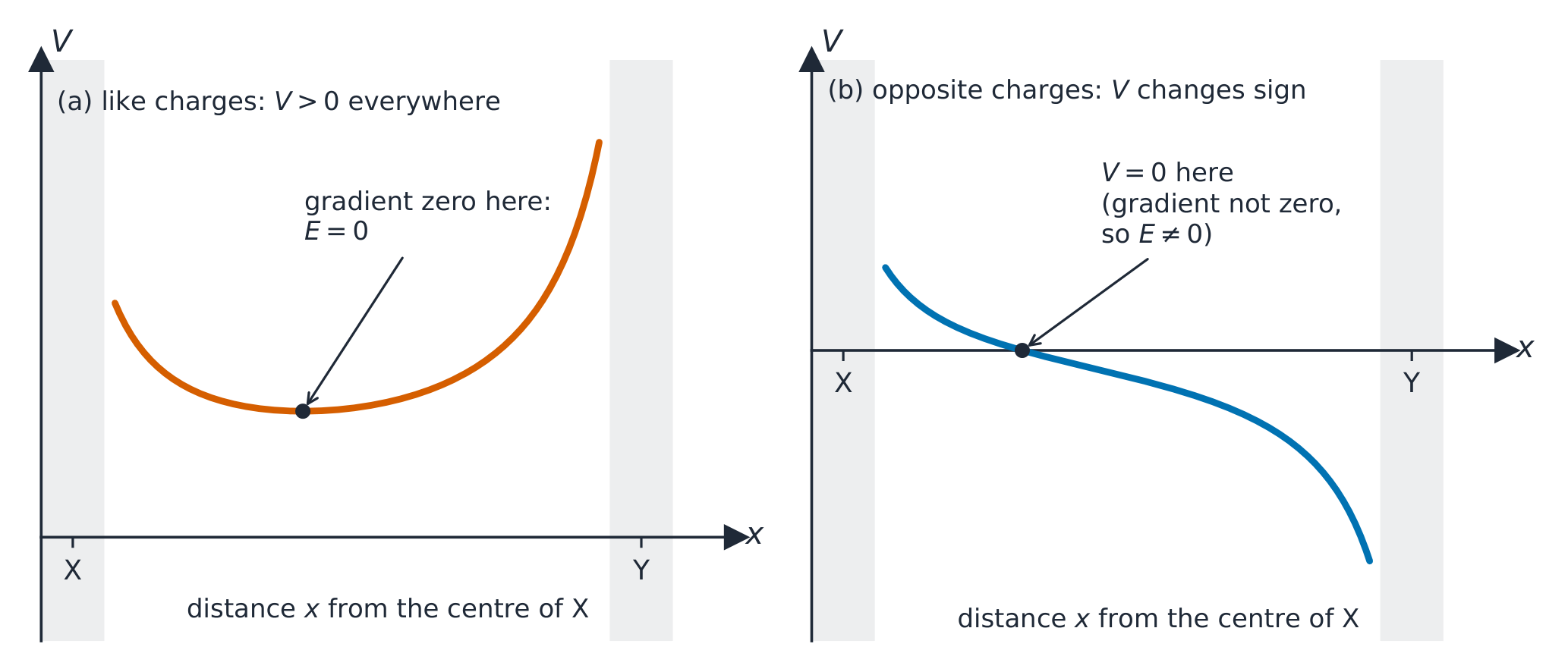
The exam's favourite structured question puts two charged spheres X and Y some distance apart and draws the potential $V$ along the line joining their centres (or asks you to reason from it). Everything follows from two facts: potential is a scalar that adds with sign, and the field is the negative gradient of the graph.

  • Sign of the charges. If $V$ is positive along the whole line, both charges are positive; if $V$ changes sign, the charges are opposite (positive near the positive sphere).
  • Where the field is zero. Where the curve has a minimum (gradient zero). For like charges this lies between them, closer to the smaller charge: $Q_{\text{X}}/x^{2} = Q_{\text{Y}}/(d - x)^{2}$. For opposite charges there is no such point between them: the curve crosses zero there, but its gradient is not zero, so the field is not.
  • Ratio of the charges. Where $V = 0$ between opposite charges, $Q_{\text{X}}/x = Q_{\text{Y}}/(d - x)$: the distances give the ratio directly. For like charges use the minimum instead (the square root of the field condition).
  • Force on a charge placed at P. Read the gradient at P by drawing a tangent 切线; then $E$ is minus the gradient, and $F = qE$.

Worked example. Two isolated charged metal spheres X and Y have their centres $1.2\ \text{m}$ apart in a vacuum. The potential along the line between them is positive everywhere and has a minimum at $x = 0.50\ \text{m}$ from the centre of X. State three conclusions, and then find the force on a proton held at $x = 0.60\ \text{m}$, where the gradient of the graph is $+180\ \text{V m}^{-1}$.

Conclusions: (1) both spheres are positively charged, because the potential is positive everywhere; (2) the electric field is zero at $x = 0.50\ \text{m}$, where the gradient is zero; (3) the charge on Y is larger, because the zero-field point lies closer to X; in fact $Q_{\text{Y}}/Q_{\text{X}} = (0.70/0.50)^{2} = 2.0$. At $x = 0.60\ \text{m}$: $E = -180\ \text{V m}^{-1}$ (pointing towards X, since $V$ rises towards Y), so $F = eE = (1.60 \times 10^{-19})(180) = 2.9 \times 10^{-17}\ \text{N}$ towards X. Released, the proton accelerates towards X, its acceleration increasing as the gradient steepens; it needs an external force to hold it still.

Describing the motion. "A positively charged particle is placed at P and released. Describe and explain its motion." The examiner wants: the direction (towards lower potential, down the slope of the $V$ graph); that the force, and so the acceleration, is not constant (it follows the gradient, which changes along the line); and that the particle speeds up throughout, since the force stays in the direction of motion. If P is the zero-field point the particle stays at rest, in unstable equilibrium: a nudge either way sends it off.

Link between field and potential

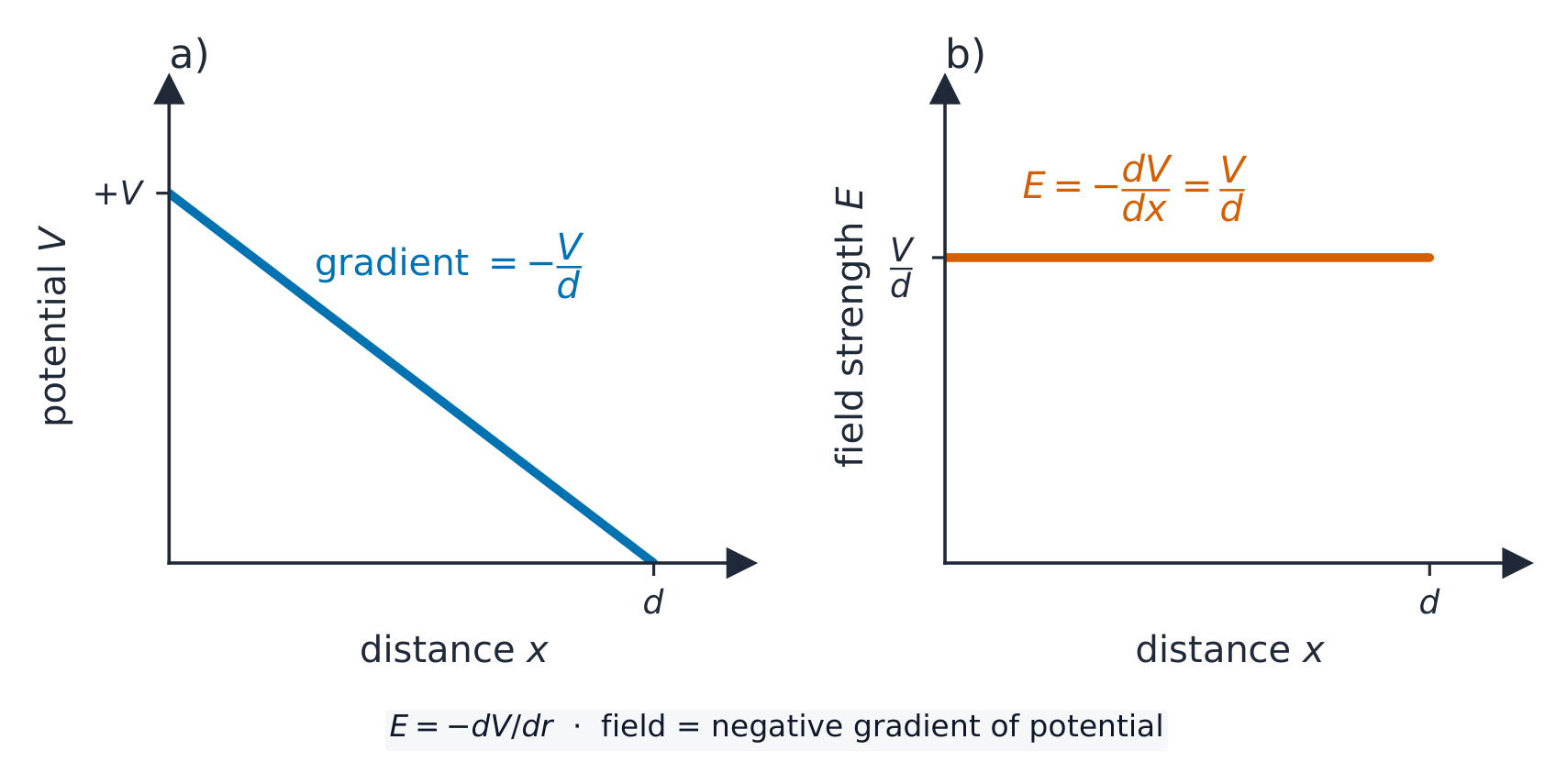
The field equals the negative potential gradient 电势梯度:

$$E = -\frac{dV}{dx}.$$

Between parallel plates $V$ changes evenly with position, giving $E = V/d$ as before. The minus sign means the field points towards lower potential. For a point charge, $-\dfrac{dV}{dr} = \dfrac{Q}{4\pi\varepsilon_{0} r^{2}} = E$.

The one-line relationship. "State the relationship between electric field and electric potential": the field strength is equal to the negative of the potential gradient, $E = -\Delta V/\Delta x$. On a $V$–$x$ graph $E$ is minus the gradient of a tangent; on a $V$–$r$ graph for a point charge the gradient is steepest close to the charge, where the field is strongest, and the sign of $E$ is fixed by "the field points towards lower potential". The uniform-field version $E = V/d$ is the same statement with a constant gradient.

Equipotentials. An equipotential surface joins points of equal potential; no work is done moving a charge along it, so the field is always at right angles to it. Around a point charge the equipotentials are concentric spheres, growing further apart as $V$ falls; between parallel plates they are planes parallel to the plates. The surface of a conductor is an equipotential, which is why field lines meet it at right angles.

Electric potential energy

A charge $q$ at a point of potential $V$ has electric potential energy 电势能 $E_{\text{P}} = qV$. For two point charges $Q$ and $q$ a distance $r$ apart:

$$E_{\text{P}} = \frac{Qq}{4\pi\varepsilon_{0} r}.$$
  • like charges: $E_{\text{P}} > 0$ — stored energy that would be released if they flew apart.
  • opposite charges: $E_{\text{P}} < 0$ — a bound 束缚 system; energy must be supplied to separate them.

In both cases $E_{\text{P}} \to 0$ as $r \to \infty$.

Worked example. The proton and the electron in a hydrogen atom are $5.3 \times 10^{-11}\ \text{m}$ apart. Find the electric potential energy of the pair.

$$E_{\text{P}} = \frac{Qq}{4\pi\varepsilon_{0} r} = \frac{(8.99 \times 10^{9})(+1.60 \times 10^{-19})(-1.60 \times 10^{-19})}{5.3 \times 10^{-11}} = -4.3 \times 10^{-18}\ \text{J} = -27\ \text{eV}.$$

The negative sign is part of the answer: the charges are opposite, so energy ($4.3 \times 10^{-18}\ \text{J}$) must be supplied to pull them apart to infinity. (The electron also has kinetic energy of half that size, so the energy needed to ionise 电离 the atom is $13.6\ \text{eV}$; the "worked-example pattern" below shows why.)

Charge through a p.d. A charge $q$ moved through a potential difference $V$ changes its potential energy by $qV$, which is why an electron accelerated from rest through $250\ \text{V}$ arrives with $250\ \text{eV}$ of kinetic energy whatever the shape of the field. For an MCQ about "moving P a distance $x$ along the field lines", the work done is $qEx$, and its potential energy falls if it moves the way the force pushes it.

Worked-example pattern

An electron 电子 orbits a nucleus 原子核 of charge $+Ze$ at distance $r$. The Coulomb attraction provides the centripetal force 向心力:

$$\frac{Z e^{2}}{4\pi\varepsilon_{0} r^{2}} = \frac{m_{e} v^{2}}{r}, \qquad v = \sqrt{\frac{Z e^{2}}{4\pi\varepsilon_{0} m_{e} r}}.$$

The total energy is kinetic plus potential:

$$E_{\text{total}} = \tfrac{1}{2} m_{e} v^{2} - \frac{Z e^{2}}{4\pi\varepsilon_{0} r} = -\frac{Z e^{2}}{8\pi\varepsilon_{0} r},$$

which is negative (a bound state).

Gravitational versus electric

The two field theories look alike:

Quantity Gravitational Electric
Source mass $M$ (always positive) charge $Q$ (can be ±)
Field strength $g = GM/r^{2}$ $E = Q/(4\pi\varepsilon_{0} r^{2})$
Force on test object $F = mg$ $F = qE$
Potential $\phi = -GM/r$ $V = Q/(4\pi\varepsilon_{0} r)$
PE of two $-GMm/r$ $Qq/(4\pi\varepsilon_{0} r)$
Nature always attractive attractive or repulsive

The minus sign in the gravitational potential 引力势 reflects that gravity is always attractive; the electric potential takes the sign of the source charge.

Similarity and difference (a standard two-marker). Both potentials are proportional to $1/r$, both are zero at infinity, and both are scalars; but gravitational potential is always negative (the force is always attractive) whereas electric potential takes the sign of the charge and can be positive. For the fields: both obey an inverse-square law and both are drawn as radial lines around a point source, but gravitational field lines only ever point inwards (attraction), while electric field lines point outwards from a positive charge and inwards to a negative one.

ไทย

potensial ไฟฟ้า $V$ ที่จุดหนึ่งคือ งานที่ทำต่อหน่วยประจุบวก ในการนำประจุทดสอบบวกเล็กน้อยจาก ** vô cùng** มาที่จุดนั้น:

$$V = \frac{W}{q}.$$

หน่วย: $\text{V}$. PotENTIAL เป็น ศูนย์ที่ vô cùng. สำหรับประจุแหล่งบวก $V > 0$ ทุกที่ภายนอก; สำหรับประจุแหล่งลบ $V < 0$.

นิยามคะแนนสอง. Electric potential at a point is the work done per unit positive charge in bringing a small test charge from infinity to the point. คะแนนอยู่ที่ work done per unit (positive) charge และ from infinity to the point. PotENTIAL ของประจุบวกเป็นบวกเพราะต้อง ทำงานบน ประจุทดสอบบวกเพื่อดันเข้าไปต้านแรงผลัก; ใกล้ประจุลบ สนามทำงานแทน ดังนั้น potential จึงเป็นลบ. "Explain why the potential near an isolated proton is positive" ตอบได้ด้วยคำเหล่านี้เป๊ะๆ

Potential จากประจุจุด

$$V = \frac{Q}{4\pi\varepsilon_{0} r}.$$

สังเกต $1/r$ ที่นี่ (เมื่อเทียบกับ $1/r^{2}$ สำหรับ field). $V$ เป็น scalar; สำหรับหลายประจุ ให้บวก potentials (พร้อมเครื่องหมาย)

ตัวอย่างวิธีทำ. หา electric potential $4.0\ \text{cm}$ จากประจุจุด $+3.0\ \text{nC}$. ($1/(4\pi\varepsilon_{0}) = 9.0 \times 10^{9}\ \text{N m}^{2}\ \text{C}^{-2}$.)

$$V = \frac{Q}{4\pi\varepsilon_{0} r} = \frac{(9.0 \times 10^{9})(3.0 \times 10^{-9})}{0.040} \approx 6.8 \times 10^{2}\ \text{V}.$$

เพราะ potential เป็น scalar, potential จากหลายประจุคือผลบวกของแต่ละตัว (แต่ละตัวมีเครื่องหมายของตัวเอง) — ไม่ต้องแยก components ทิศทาง

Potential ตามเส้นที่เชื่อมทรงกลม X และ Y: สำหรับประจุชนิดเดียวกัน potential เป็นบวกทุกที่และมีค่าต่ำสุดที่ where gradient, และดังนั้น field, เป็นศูนย์; สำหรับประจุต่างชนิด potential ตัดผ่านศูนย์ระหว่างทรงกลม
Potential ตามเส้นระหว่างทรงกลมสองลูก: ประจุชนิดเดียวกันให้ minimum (field ศูนย์ที่นั่น); ประจุต่างชนิดให้ zero crossing

Two charged spheres on a line

ข้อสอบชอบคำถามโครงสร้างที่วางทรงกลม X และ Y ห่างกันบางระยะแล้ววาดกราฟ potential $V$ ตามเส้นที่เชื่อมศูนย์กลาง (หรือถามให้คุณวิเคราะห์จากกราฟ) ทุกอย่างมาจากสองข้อเท็จจริง: potential เป็น scalar ที่บวกกันด้วยเครื่องหมาย, และ field คือ negative gradient ของกราฟ

  • เครื่องหมายของประจุ. ถ้า $V$ เป็นบวกตลอดทั้งเส้น ทั้งสองประจุเป็นบวก; ถ้า $V$ เปลี่ยนเครื่องหมาย, ประจุต่างชนิด (บวกใกล้ทรงกลมบวก)
  • ที่ where field เป็นศูนย์. ที่ where curve มี minimum (gradient ศูนย์). สำหรับประจุชนิดเดียวกัน它就 lies ระหว่าง them, ใกล้ประจุที่มีขนาดเล็กกว่า: $Q_{\text{X}}/x^{2} = Q_{\text{Y}}/(d - x)^{2}$. สำหรับประจุต่างชนิดไม่มี point แบบนั้นระหว่าง them: curve ตัดผ่านศูนย์ที่นั่น, แต่ gradient ไม่ใช่ศูนย์, ดังนั้น field ก็ไม่ใช่.
  • อัตราส่วนของประจุ. ที่ where $V = 0$ ระหว่างประจุต่างชนิด, $Q_{\text{X}}/x = Q_{\text{Y}}/(d - x)$: ระยะทางให้ ratio โดยตรง. สำหรับประจุชนิดเดียวกันใช้ minimum แทน (รากที่สองของเงื่อนไข field).
  • แรง作用于ประจุที่วางที่ P. อ่าน gradient ที่ P โดยวาด tangent; แล้ว $E$ เป็นลบของ gradient, และ $F = qE$.

ตัวอย่างวิธีทำ. Two isolated charged metal spheres X and Y มีศูนย์กลางห่างกัน $1.2\ \text{m}$ ในสุญญากาศ. Potential ตามเส้นระหว่าง them เป็นบวกทุกที่ และมี minimum ที่ $x = 0.50\ \text{m}$ จากศูนย์กลางของ X. ระบุสามข้อสรุป, แล้วหาแรง作用于โปรตอนที่ถูกยึดไว้ที่ $x = 0.60\ \text{m}$, ที่ where gradient of the graph is $+180\ \text{V m}^{-1}$.

สรุปผล: (1) ทั้งสองสpheres มีประจุ บวก เนื่องจากศักย์ไฟฟ้าเป็นบวกทุกจุด; (2) สนามไฟฟ้ามีค่า ศูนย์ ที่ $x = 0.50\ \text{m}$ ซึ่งมีความชันเป็นศูนย์; (3) ประจุของ Y มีมากกว่า X เนื่องจากจุดที่สนามไฟฟ้าเป็นศูนย์อยู่ใกล้ X มากกว่า ในความเป็นจริงคือ $Q_{\text{Y}}/Q_{\text{X}} = (0.70/0.50)^{2} = 2.0$. ที่ $x = 0.60\ \text{m}$: $E = -180\ \text{V m}^{-1}$ (ชี้เข้าหา X เนื่องจาก $V$ เพิ่มขึ้นเมื่อเข้าใกล้ Y), ดังนั้น $F = eE = (1.60 \times 10^{-19})(180) = 2.9 \times 10^{-17}\ \text{N}$ ชี้เข้าหา X. เมื่อปล่อยออก โปรตอนจะเร่งความเร็วเข้าหา X โดยความเร่งจะ เพิ่มขึ้น เมื่อความชันเพิ่มขึ้น; ต้องใช้แรงภายนอกมาพยุงให้มันหยุดนิ่ง

อธิบายการเคลื่อนที่. "อนุภาคที่มีประจุบวกวางอยู่ที่ P และปล่อยให้อิสระ อธิบายและอธิบายการเคลื่อนที่ของมัน" ผู้สอบต้องการคำตอบ: ทิศทาง (ไปหาจุดที่มีศักย์ ต่ำกว่า ตามลาดชันของกราฟ $V$); ว่าแรงและความเร่ง ไม่คงที่ (ตามความชันซึ่งเปลี่ยนแปลงไปตามเส้นตรง); และว่าอนุภาคจะ เร็วขึ้น ตลอดเวลา เนื่องจากแรงยังคงอยู่ในทิศทางการเคลื่อนที่ หาก P เป็นจุดที่สนามไฟฟ้าเป็นศูนย์ อนุภาคจะหยุดนิ่ง处于ในสมดุลที่ไม่เสถียร: การผลักเล็กน้อยไปทางใดทางหนึ่งจะทำให้มันเคลื่อนที่ออกไป

กราฟ 1/r สองเส้นแสดงความสัมพันธ์ระหว่างศักย์ V กับระยะ r จากประจุจุดบนแกนเดียวกัน: แหล่งประจุบวกให้ศักย์บวกที่ลดลง menuju ศูนย์, แหล่งประจุลบให้ศักลบที่เพิ่มขึ้น趋于 ศูนย์
ศักย์ไฟฟ้าใกล้ประจุจุดแปรผันตาม 1/r — เป็นบวกสำหรับประจุบวก และเป็นลบสำหรับประจุลบ

ความสัมพันธ์ระหว่างสนามกับศักย์

สนามไฟฟ้าเท่ากับ ลบของความชันของศักย์ไฟฟ้า:

$$E = -\frac{dV}{dx}.$$

ระหว่างแผ่นขนาน $V$ เปลี่ยนแปลงสม่ำเสมอตามตำแหน่ง ทำให้ได้ $E = V/d$ เหมือนเดิมเครื่องหมายลบหมายถึงสนามชี้ hacia ศักย์ต่ำลง. สำหรับประจุจุด, $-\dfrac{dV}{dr} = \dfrac{Q}{4\pi\varepsilon_{0} r^{2}} = E$.

ความสัมพันธ์แบบบรรทัดเดียว. "ระบุความสัมพันธ์ระหว่างสนามไฟฟ้ากับศักย์ไฟฟ้า": ความเข้มของสนามไฟฟ้าเท่ากับลบของความชันของศักย์ไฟฟ้า, $E = -\Delta V/\Delta x$. บนกราฟ $V$–$x$ $E$ คือลบของ ความชัน ของเส้นสัมผัส; บนกราฟ $V$–$r$ สำหรับประจุจุด ความชันจะชันที่สุดใกล้ประจุ ซึ่งเป็นจุดที่สนามไฟฟ้าแรงที่สุด, และเครื่องหมายของ $E$ ถูกกำหนดโดย "สนามชี้ hacia ศักย์ต่ำลง". รูปแบบสนามสม่ำเสมอ $E = V/d$ ก็เป็นการบอกสิ่งเดียวกันด้วยความชันคงที่

** equipotentials (equipotential surfaces).** ** equipotential surface** เชื่อมต่อจุดที่มีศักย์เท่ากัน; ไม่มีการทำงานเมื่อเคลื่อนประจุตาม equipotential ดังนั้นสนามจึงตั้งฉากกับ equipotential เสมอ รอบๆ ประจุจุด equipotentials เป็นทรงกลมซ้อนกัน expanding far apart as $V$ falls; ระหว่างแผ่นขนาน它们是平行于 plates igh.พื้นผิวของตัวนำเป็น equipotential, นี่คือเหตุผลที่ว่าทำไมเส้นสนามจึงตัดพื้นผิวนั้นด้วยมุมฉาก

กราฟสองเส้นเทียบกับระยะสำหรับสนามสม่ำเสมอ: a) ศักย์ลดลงอย่างต่อเนื่องจาก +V เป็นศูนย์ ด้วยความชัน −V/d, b) ความเข้มสนามคงที่ที่ V/d
ในสนามสม่ำเสมอ ศักย์ลดลงอย่างต่อเนื่องตามระยะทาง ดังนั้นความเข้มของสนาม $V/d$ จึงคงที่

พลังงานศักย์ไฟฟ้า

ประจุ $q$ ที่จุดที่มีศักย์ $V$ จะมี พลังงานศักย์ไฟฟ้า $E_{\text{P}} = qV$. สำหรับประจุจุดสองตัว $Q$ และ $q$ ที่ห่างกัน $r$:

$$E_{\text{P}} = \frac{Qq}{4\pi\varepsilon_{0} r}.$$
  • ประจุชนิดเดียวกัน: $E_{\text{P}} > 0$ — พลังงานที่เก็บไว้ซึ่งจะถูกปลดปล่อยหากพวกมันบินออกจากกัน
  • ประจุต่างชนิด: $E_{\text{P}} < 0$ — ระบบที่ถูก ยึดเกาะ; ต้องมีพลังงานเข้ามาเพื่อแยกพวกมันออก

ในทั้งสองกรณี $E_{\text{P}} \to 0$ เมื่อ $r \to \infty$

ตัวอย่างคำนวณ. โปรตอนและอิเล็กตรอนในอะตอมไฮโดรเจนอยู่ห่างกัน $5.3 \times 10^{-11}\ \text{m}$. หาพลังงานศักย์ไฟฟ้าของคู่นี้

$$E_{\text{P}} = \frac{Qq}{4\pi\varepsilon_{0} r} = \frac{(8.99 \times 10^{9})(+1.60 \times 10^{-19})(-1.60 \times 10^{-19})}{5.3 \times 10^{-11}} = -4.3 \times 10^{-18}\ \text{J} = -27\ \text{eV}.$$

เครื่องหมาย ลบ เป็นส่วนหนึ่งของคำตอบ: ประจุเป็นต่างชนิดกัน ดังนั้นพลังงาน ($4.3 \times 10^{-18}\ \text{J}$) ต้องถูก จ่ายเข้ามา เพื่อดึงพวกมันออกจากกันไปยังอนันต์. (อิเล็กตรอนยังมีพลังงานจลน์ครึ่งหนึ่งของค่านี้นั้น ดังนั้นพลังงานที่ต้องใช้เพื่อ ไอออไนซ์ อะตอมคือ $13.6\ \text{eV}$; "รูปแบบตัวอย่างคำนวณ" ด้านล่างแสดงให้เห็นเหตุผล)

ประจุผ่าน p.d. ประจุ $q$ เคลื่อนที่ผ่านความต่างศักย์ $V$ จะเปลี่ยนพลังงานศักย์由其 $qV$, นั่นคือเหตุผลว่าทำไมอิเล็กตรอนที่ถูกเร่งจากสถานะหยุดนิ่งผ่าน $250\ \text{V}$ จะมาถึงพร้อมกับ $250\ \text{eV}$ ของพลังงานจลน regardless of the field shape. สำหรับ MCQ เกี่ยวกับ "การเคลื่อนย้าย P ระยะ $x$ ตามเส้นสนาม", งานที่ทำคือ $qEx$, และพลังงานศักย์ของ它会 ลดลง ถ้ามันเคลื่อนที่ไปในทิศที่แรงดัน

พลังงานศักย์ไฟฟ้าเทียบกับระยะห่าง: ประจุชนิดเดียวกันให้กราฟบวกที่ลดลงเข้าใกล้ศูนย์ (ปล่อยพลังงานหากแยกออกจากกัน); ประจุต่างชนิดให้กราฟลบที่เพิ่มขึ้นเข้าใกล้ศูนย์ — บ่อผูกมัดที่ต้องใช้พลังงานเพื่อแยกออกจากกัน
PE ไฟฟ้าของประจุสองตัว: เป็นบวกสำหรับประจุชนิดเดียวกัน, เป็นบ่อลบสำหรับประจุต่างชนิด

รูปแบบตัวอย่างคำนวณ

อิเล็กตรอน โคจรรอบ นิวเคลียส ที่มีประจุ $+Ze$ ที่ระยะ $r$. แรงดึงดูดของคูลอมบ์ให้ แรงสู่ศูนย์กลาง:

$$\frac{Z e^{2}}{4\pi\varepsilon_{0} r^{2}} = \frac{m_{e} v^{2}}{r}, \qquad v = \sqrt{\frac{Z e^{2}}{4\pi\varepsilon_{0} m_{e} r}}.$$

พลังงานรวมคือพลังงานจลนบวกศักย์:

$$E_{\text{total}} = \tfrac{1}{2} m_{e} v^{2} - \frac{Z e^{2}}{4\pi\varepsilon_{0} r} = -\frac{Z e^{2}}{8\pi\varepsilon_{0} r},$$

ซึ่งเป็นลบ (สถานะถูกยึดเกาะ)

เปรียบเทียบแรงโน้มถ่วงกับไฟฟ้า

ทฤษฎีสนามทั้งสองดูคล้ายกัน:

ปริมาณ แรงโน้มถ่วง ไฟฟ้า
แหล่งกำเนิด มวล $M$ (เป็นบวกเสมอ) ประจุ $Q$ (อาจเป็น ±)
ความเข้มสนาม $g = GM/r^{2}$ $E = Q/(4\pi\varepsilon_{0} r^{2})$
แรงบนวัตถุทดสอบ $F = mg$ $F = qE$
ศักย์ $\phi = -GM/r$ $V = Q/(4\pi\varepsilon_{0} r)$
PE ของสอง物体 $-GMm/r$ $Qq/(4\pi\varepsilon_{0} r)$
的性质 ดึงดูดเสมอ ดึงดูดหรือผลัก

เครื่องหมายลบใน ศักย์ไฟฟ้า บ่งชี้ว่าแรงโน้มถ่วงเป็นแรงดึงดูดเสมอ; ส่วนศักย์ไฟฟ้าจะมีเครื่องหมายตามประจุของแหล่งกำเนิด

ความคล้ายคลึงและความแตกต่าง (ข้อสอบมาตรฐาน 2 คะแนน) ทั้งสองศักย์แปรผันตรงกับ $1/r$, ทั้งสองมีค่าเป็นศูนย์ที่อนันต์ และทั้งสองเป็นสเกลาร์; แต่ศักย์โน้มถ่วงจะเป็น ลบเสมอ (เนื่องจากแรงเป็นแรงดึงดูดเสมอ) ในขณะที่ศักย์ไฟฟ้าจะมี เครื่องหมายตามประจุ และสามารถเป็นบวกได้ สำหรับสนาม: ทั้งสองปฏิบัติตามกฎกำลังสองผกผันและ BOTH แสดงด้วยเส้นรัศมีรอบจุดกำเนิด แต่เส้นสนามโน้มถ่วงจะชี้เข้าหาจุดกำเนิดเท่านั้น (การดึงดูด) ในขณะที่เส้นสนามไฟฟ้าจะชี้ออกจากประจุบวกและชี้เข้าหาประจุลบ

Explore · ⁨สำรวจ⁩

Electric potential · ⁨ศักย์ไฟฟ้า⁩

V = kQ / r

Potential ∝ 1/r around a charge — steep near it, flattening out. · ⁨ศักย์ ∝ 1/r รอบประจุ — ค่อนข้างชันใกล้ๆ, แล้วแบนราบ⁩

Vocabulary · ⁨คำศัพท์⁩ Train · ⁨ฝึกฝน⁩
English ไทย
infinity/ɪnˈfɪnɪti/ อนันต์
conductor/kənˈdʌktə/ ตัวนำ
point charge/pɔɪnt tʃɑːdʒ/ ประจุจุด
dipole/ˈdaɪpəʊl/ ไดโพล
uniform field/ˈjuːnɪfɔːm fiːld/ สนามสม่ำเสมอ
isolated/ˈaɪsəleɪtɪd/ ถูกตัดขาด
potential gradient/pəˈtenʃl ˈɡreɪdɪənt/ ความชันของศักย์
potential difference/pəˈtenʃl ˈdɪfrəns/ ต่างศักย์
gravitational field/ˌɡrævɪˈteɪʃənl fiːld/ สนามโน้มถ่วง
kinetic energy/kɪˈnetɪk ˈenədʒi/ พลังงานจลน์
parabolic/ˌpærəˈbɒlɪk/ พาราโบลา
electric potential/ɪˈlektrɪk pəˈtenʃl/ ศักย์ไฟฟ้า
scalar/ˈskeɪlə/ สเกลาร์
tangent/ˈtændʒənt/ เส้นสัมผัส
negative potential gradient/ˈneɡətɪv pəˈtenʃl ˈɡreɪdɪənt/ gradienit ความต่างศักย์เชิงลบ
electric potential energy/ɪˈlektrɪk pəˈtenʃl ˈenədʒi/ พลังงานศักย์ไฟฟ้า
bound/baʊnd/ ถูกยึดติด
ionise/ˈaɪənaɪz/ ไอออนไนซ์
gravitational potential/ˌɡrævɪˈteɪʃənl pəˈtenʃl/ ศักย์พลังงานแรงโน้มถ่วง
18.5

Definitions the examiner accepts · ⁨คำนิยามที่ผู้สอบยอมรับ⁩

English

A definition question is marked against fixed wording. Learn these exactly, and give one answer only.

Term Definition
electric field a region in which a charge experiences an (electric) force
electric field strength the force per unit positive charge acting on a small (test) charge placed at the point
electric field line a line whose direction shows the direction of the force on a positive charge; the spacing of the lines shows the field strength
Coulomb's law the force between two point charges is directly proportional to the product of the charges and inversely proportional to the square of their separation
electric potential the work done per unit positive charge in bringing a small test charge from infinity to the point
field and potential the electric field strength is equal to the negative of the potential gradient: $E = -\Delta V/\Delta x$
electric potential energy (of two charges) the work done in bringing the charges from infinity to their separation; $Qq/(4\pi\varepsilon_{0} r)$
equipotential a surface (or line) on which every point has the same potential; the field is at right angles to it
uniform field a field with the same strength and direction at every point, shown by parallel, evenly spaced field lines
ไทย

คำถามคำนิยามจะให้คะแนนตามข้อความที่กำหนดไว้你必须 exact. เรียนรู้ให้ถูกต้องและตอบเพียงคำตอบเดียวเท่านั้น

พจน์ นิยาม
สนามไฟฟ้า พื้นที่ซึ่งประจุใดประจุหนึ่งได้รับแรง (ไฟฟ้า)
ความเข้มสนามไฟฟ้า แรงต่อหน่วยประจุบวกที่กระทำต่อบนประจุทดสอบขนาดเล็กที่วางไว้ ณ จุดนั้น
เส้นสนามไฟฟ้า เส้นที่มีทิศทางแสดงทิศทางของแรงที่กระทำต่อประจุบวก; ระยะห่างระหว่างเส้นแสดงถึงความเข้มของสนาม
กฎของคูลอมบ์ แรงระหว่างประจุจุดสองประจุแปรผันตรงกับผลคูณของประจุและแปรผกผันกับกำลังสองของระยะห่างระหว่างกัน
ศักย์ไฟฟ้า งานที่ทำต่อหน่วยประจุบวกในการนำประจุทดสอบขนาดเล็กจากอนันต์มายังจุดนั้น
สนามและศักย์ ความเข้มสนามไฟฟ้ามีค่าเท่ากับค่าลบของเกรเดียนต์ศักย์: $E = -\Delta V/\Delta x$
พลังงานศักย์ไฟฟ้า (ของประจุสองประจุ) งานที่ทำในการนำประจุจากอนันต์มาไว้ที่ระยะห่างนั้น; $Qq/(4\pi\varepsilon_{0} r)$
department equipotential พื้นผิว (หรือเส้น) ที่ทุกจุดมีศักย์เท่ากัน; สนามตั้งฉากกับพื้นผิวนั้น
สนามสม่ำเสมอ สนามที่มีความเข้มและทิศทางเท่ากันทุกจุด แสดงด้วยเส้นสนามขนานกันและเว้นระยะเท่าๆ กัน
18.5

Exam tips · ⁨ข้อแนะนำสำหรับการสอบ⁩

English
  • Four formulae, two with $r^{2}$ and two with $r$: $F = Q_1 Q_2 / 4\pi\varepsilon_0 r^{2}$ and $E = Q/4\pi\varepsilon_0 r^{2}$ (inverse square), $V = Q/4\pi\varepsilon_0 r$ and $E_{\text{P}} = Qq/4\pi\varepsilon_0 r$. Decide which one before you write.
  • Distinguish a uniform field ($E = V/d$, between plates) from a radial field ($E = Q/4\pi\varepsilon_0 r^{2}$, outside a point charge or a sphere); $r$ for a sphere is measured from the centre, not the surface.
  • The field points from high to low potential and $E$ is minus the potential gradient: draw a tangent on a $V$–$x$ graph to find it.
  • Field is a vector (add components, subtract opposing ones); potential is a scalar (add with sign). Between like charges there is a zero-field point; between opposite charges a zero-potential point.
  • A charged particle in a uniform field: $F = qE$, $a = qE/m$, $E_{\text{k}} = qV$; along the field it is the vertical half of projectile motion, and motion at right angles to the field is unaffected.
  • The data sheet gives both $\varepsilon_0 = 8.85 \times 10^{-12}\ \text{F m}^{-1}$ and $1/(4\pi\varepsilon_0) = 8.99 \times 10^{9}\ \text{m F}^{-1}$; either works, do not mix them up.

Common mistakes

  • Defining field strength as "the force on a charge" or "force per unit mass". It is the force per unit positive charge on a small positive charge.
  • Forgetting to square $r$ in Coulomb's law and in the field, or squaring it in the potential ($V \propto 1/r$).
  • Using the diameter, or the distance from the surface of a sphere, instead of the centre-to-centre distance.
  • Sketching $E$ for a sphere from the origin. It is zero inside and starts at $E_0$ on the surface; $V$ is constant inside, not zero.
  • Field lines without arrows, crossing, or unevenly spaced in a uniform field; lines not at right angles to a conductor.
  • Dropping the negative sign on the potential energy of opposite charges, or taking the direction of $E$ from the sign of $V$ instead of from its gradient.
  • Forgetting the second electron in the helium atom, or placing it at distance $r$ rather than $2r$.
  • Using $E = V/d$ for a point charge, or $E = Q/4\pi\varepsilon_0 r^{2}$ between plates.
  • Giving an electron weight, or using the proton's mass for an electron; in electrons-between-plates questions the weight is negligible.
  • Leaving out the weight in an "oil drop held stationary" question, or getting the polarity of the top plate backwards.
ไทย
  • สมการสี่สมการ, สองสมการใช้ $r^{2}$ และสองสมการใช้ $r$: $F = Q_1 Q_2 / 4\pi\varepsilon_0 r^{2}$ และ $E = Q/4\pi\varepsilon_0 r^{2}$ (กำลังสองผกผัน), $V = Q/4\pi\varepsilon_0 r$ และ $E_{\text{P}} = Qq/4\pi\varepsilon_0 r$. ตัดสินใจก่อนเขียนคำตอบ
  • แยกแยะระหว่าง สนามสม่ำเสมอ ($E = V/d$, ระหว่างแผ่น) กับ สนามรัศมี ($E = Q/4\pi\varepsilon_0 r^{2}$, ข้างนอกประจุจุดหรือทรงกลม); การวัด $r$ สำหรับทรงกลมจะวัดจาก ศูนย์กลาง ไม่ใช่จากพื้นผิว
  • ทิศทางของสนามชี้จากศักย์สูงไปต่ำ และ $E$ คือค่าลบของเกรเดียนต์ศักย์: วาดเส้นสัมผัสบนกราฟ $V$–$x$ เพื่อหาค่าได้
  • สนามเป็นเวกเตอร์ (บวกองค์ประกอบ, ลบส่วนที่ตรงข้าม); ศักย์เป็นสเกลาร์ (บวกโดยพิจารณาเครื่องหมาย) ระหว่างประจุชนิดเดียวกันจะมีจุดที่สนามเป็นศูนย์; ระหว่างประจุต่างชนิดจะมีจุดที่ศักย์เป็นศูนย์
  • อนุภาคที่มีประจุในสนามสม่ำเสมอ: $F = qE$, $a = qE/m$, $E_{\text{k}} = qV$; ตามแนวสนามจะเป็นครึ่งหนึ่งของ运动和กระสุน (projectile motion) ในแนวตั้ง และการเคลื่อนที่ในแนวตั้งฉากกับสนามจะไม่ถูกกระทบ
  • ใบข้อมูลให้ทั้ง $\varepsilon_0 = 8.85 \times 10^{-12}\ \text{F m}^{-1}$ และ $1/(4\pi\varepsilon_0) = 8.99 \times 10^{9}\ \text{m F}^{-1}$; ใช้ตัวใดก็ได้ อย่าสับสน将它们

ข้อผิดพลาดที่พบบ่อย

  • การนิยามความเข้มสนามว่าเป็น "แรงที่กระทำต่อประจุ" หรือ "แรงต่อหน่วยมวล". มันคือแรงต่อหน่วย ประจุบวก ที่กระทำต่อบนประจุบวกขนาดเล็ก
  • ลืมยก $r$ เป็นกำลังสองในกฎของคูลอมบ์และในสนาม, หรือการยกกำลังสองมันในศักย์ ($V \propto 1/r$).
  • การใช้เส้นผ่านศูนย์กลาง, หรือระยะจาก พื้นผิว ของทรงกลม, แทนที่จะเป็นระยะจากศูนย์กลางถึงศูนย์กลาง
  • วาดกราฟ $E$ สำหรับทรงกลมจากจุดเริ่มต้น. มีค่าเป็นศูนย์ภายในและเริ่มที่ $E_0$ บนพื้นผิว; $V$ มีค่าคงที่ภายใน, ไม่เป็นศูนย์
  • เส้นสนามไม่มีลูกศร, ตัดกัน, หรือเว้นระยะไม่เท่ากันในสนามสม่ำเสมอ; เส้นไม่ตั้งฉากกับตัวนำ
  • การทิ้งเครื่องหมายลบบนพลังงานศักย์ของประจุต่างชนิด, หรือการกำหนดทิศทางของ $E$ จากเครื่องหมายของ $V$ แทนที่จะมาจากเกรเดียนต์ของมัน
  • ลืมอิเล็กตรอนตัวที่สองในอะตอมฮีเลียม, หรือวางมันที่ระยะ $r$ แทนที่จะเป็น $2r$.
  • การใช้ $E = V/d$ สำหรับประจุจุด, หรือ $E = Q/4\pi\varepsilon_0 r^{2}$ ระหว่างแผ่น
  • การให้น้ำหนักกับอิเล็กตรอน, หรือการใช้มวลของโปรตอนสำหรับอิเล็กตรอน; ในโจทย์เรื่องอิเล็กตรอนระหว่างแผ่น น้ำหนักมีค่าน้อยมากจนละเลยได้
  • การทิ้งน้ำหนักในโจทย์ "หยดน้ำมันลอยนิ่งอยู่", หรือการกำหนดขั้วของแผ่นด้านบนผิด方向
Vocabulary · ⁨คำศัพท์⁩ Train · ⁨ฝึกฝน⁩
English ไทย
projectile/prəˈdʒektaɪl/ วัตถุถูกยิง
cathode-ray tube/ˈkæθəʊd reɪ tjuːb/ หลอดรังสีแคโทด
equilibrium/ˌiːkwɪˈlɪbrɪəm/ จุดดุลยภาพ

Interactive lessons on this topic · ⁨บทเรียนเชิงโต้ตอบสำหรับหัวข้อนี้⁩

Work through it step by step, with instant-check exercises. · ⁨ทำทีละขั้นตอน พร้อมแบบฝึกหัดตรวจสอบผลทันที⁩

Past Papers · ⁨ข้อสอบย้อนหลัง⁩

More topics in A-Level Physics · ⁨Physics A-Level⁩ · ⁨หัวข้อเพิ่มเติมใน A-Level Physics · ⁨Physics A-Level⁩⁩

Log in or create account · ⁨เข้าสู่ระบบหรือสร้างบัญชี⁩

IGCSE, A-Level & AP