Skip to content · ⁨ข้ามไปยังเนื้อหา⁩

The macroeconomy (A Level) · ⁨มหภาคเศรษฐศาสตร์ (ระดับ A Level)⁩

A-Level Economics · ⁨Economics A-Level⁩ · Topic 9 · ⁨หัวข้อ 9⁩

Video lesson for this topic · ⁨บทเรียนวิดีโอสำหรับหัวข้อนี้⁩ Open the video page · ⁨เปิดหน้าวิดีโอ⁩
8:33

มหภาคเศรษฐศาสตร์ (ระดับ A Level)

มองดูอาคารหลังหนึ่งกำลังถูกสร้าง มีใครคนหนึ่งจ่ายค่าเหล็ก ค่าคอนกรีต และค่าแรง แต่เรื่องราวไม่จบแค่นั้น ผู้ก่อสร้างนำค่าแรงเหล่านั้นกลับบ้านและ…

English narration · English + 中文 subtitles burned in · ⁨การบรรยายภาษาอังกฤษ · คำบรรยายภาษาอังกฤษ + 中文 ลอยตัวบนภาพ⁩

English

This topic studies the wider economy at A Level depth: how spending multiplies, how growth links to the environment, the jobs–prices link, and money.

ไทย

หัวข้อนี้ศึกษาเศรษฐกิจในวงกว้างในระดับ A Level: การคูณของการใช้จ่าย, ความเชื่อมโยงของการเติบโตกับสิ่งแวดล้อม, ความเชื่อมโยงระหว่าง工作与prices, และเงิน

9.1

The circular flow and the multiplier · ⁨การไหลเวียนของรายได้และตัวคูณ⁩

Syllabus · ⁨หลักสูตร⁩
English
  1. explain the circular flow of income, injections and leakages, and the multiplier (including the marginal propensities)
  2. explain the accelerator and the determinants of consumption, saving and investment
ไทย
  1. อธิบาย การหมุนเวียนของรายได้ การฉีดเข้า และ การรั่วไหล และ ตัวคูณ ( รวมถึง ** propensity边际** )
  2. อธิบาย ตัวเร่ง และปัจจัยกำหนด การบริโภค การออม และ การลงทุน

Source: Cambridge International syllabus · ⁨แหล่งที่มา: หลักสูตร Cambridge International⁩

English
The multiplier effect

The circular flow of income 收入循环流 shows money passing between households and firms. injections 注入 add money to the flow (investment, government spending, exports); leakages 漏出 take it out (saving, taxation, imports).

The multiplier

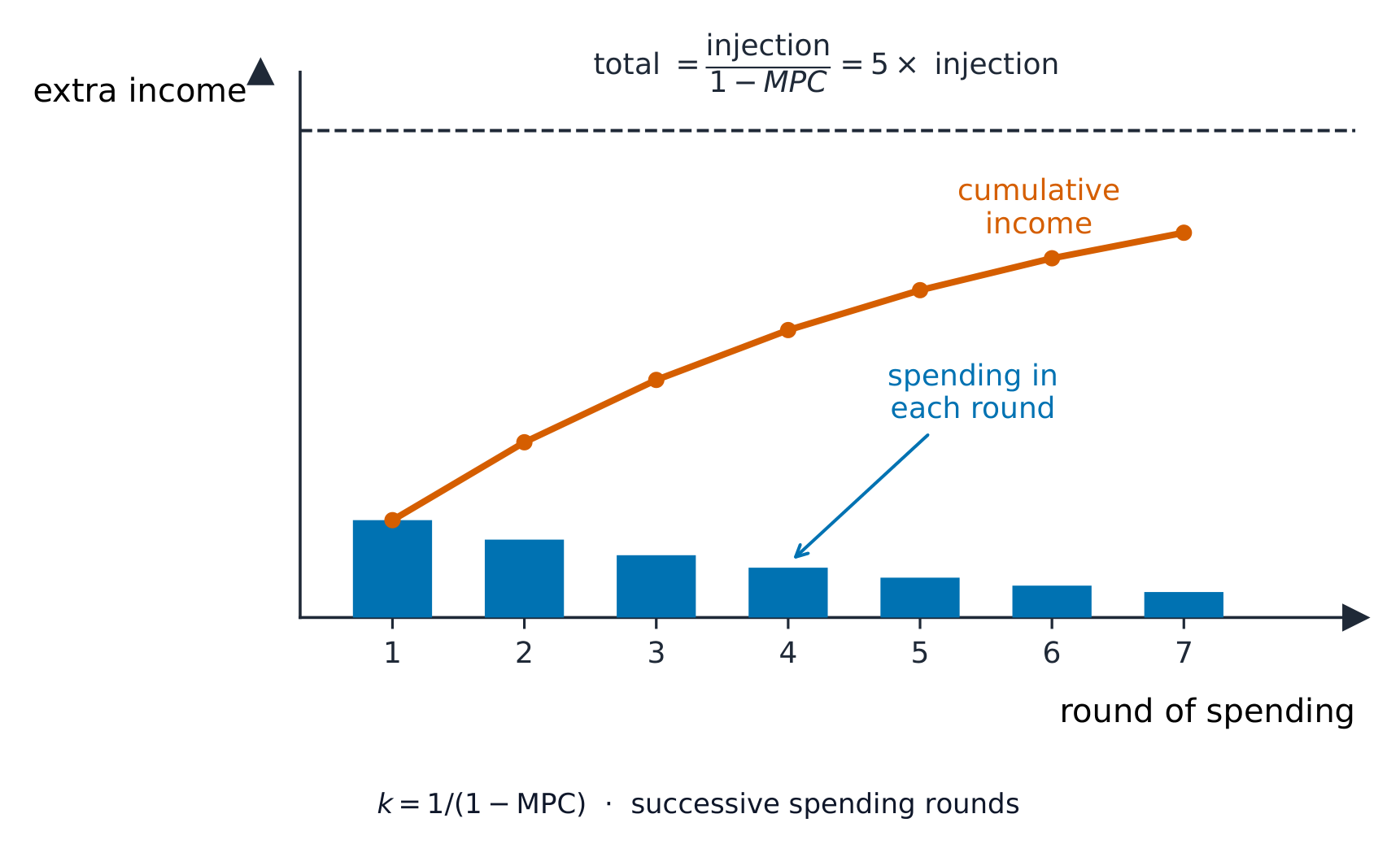
An injection raises income by more than the first amount. This is the multiplier 乘数. When a firm builds a factory, the builders earn income, and they spend part of it, which becomes someone else's income, and so on.

How much is spent again depends on the marginal propensity to consume 边际消费倾向 (MPC) — the fraction of extra income that people spend on home goods. The rest leaks out. In a simple model:

$$\text{multiplier} = \frac{1}{1 - MPC}$$

A bigger MPC (smaller leakages) gives a bigger multiplier. The main leakages are measured by the marginal propensity to save 边际储蓄倾向 (MPS) and the marginal propensity to import 边际进口倾向 (MPM).

Worked example. In an economy the MPC is $0.8$. Find the multiplier, then the effect of a $\text{\pounds} 10$ billion rise in investment.

$$\text{multiplier} = \frac{1}{1 - 0.8} = \frac{1}{0.2} = 5.$$

National income therefore rises by $5 \times \text{\pounds} 10\text{ billion} = \text{\pounds} 50\text{ billion}$ — five times the original injection. (Because all income is either spent or saved, $\text{MPC} + \text{MPS} = 1$, so here $\text{MPS} = 0.2$ and the multiplier is also $1/\text{MPS}$.)

The accelerator

The accelerator 加速数 says that investment 投资 depends on the rate of change of output. When demand is rising quickly, firms need lots of new capital, so investment jumps. When demand merely stays high, investment falls back.

What drives consumption, saving and investment

  • consumption 消费 and saving 储蓄 depend on disposable income 可支配收入 (income after tax), wealth, interest rates, and confidence.
  • investment depends on interest rates, expected profit, technology, and business confidence.
ไทย
ผลกระทบของตัวคูณ

การไหลเวียนของรายได้แสดงการไหลเวียนของเงินระหว่างครัวเรือนและบริษัท injections เพิ่มเงินเข้าสู่การไหลเวียน (การลงทุน การใช้จ่ายของรัฐบาล การส่งออก); leakages ดึงเงินออก (การออม ภาษี การนำเข้า)

การไหลเวียนของเงินระหว่างครัวเรือนและบริษัท พร้อม injections และ leakages
รายได้หมุนเวียนระหว่างครัวเรือนและบริษัท พร้อมกับการฉีดเข้าและการรั่วไหล

ตัวคูณ

Injection เพิ่มรายได้ มากกว่า จำนวนแรก kali This is the multiplier. เมื่อบริษัทสร้างโรงงาน ผู้ก่อสร้างได้รับรายได้ และพวกเขาใช้จ่ายบางส่วน ซึ่งกลายเป็นรายได้ของคนอื่น และ seterusnya

จำนวนที่ใช้จ่ายซ้ำขึ้นอยู่กับ ** propensity เพื่อ tiêuใช้ส่วนเพิ่ม** (MPC) — ส่วนหนึ่งของรายได้ส่วนเพิ่มที่คนใช้จ่ายสำหรับสินค้าภายในประเทศ ส่วนที่เหลือ leaking ออกไป ในโมเดลอย่างง่าย:

$$\text{multiplier} = \frac{1}{1 - MPC}$$

MPC ที่ใหญ่ขึ้น (leakages เล็กกว่า) ให้ตัวคูณที่ใหญ่ขึ้น Leakages หลักถูกวัดโดย propensity เพื่อออมส่วนเพิ่ม (MPS) และ propensity为了importส่วนเพิ่ม (MPM)

ตัวอย่างวิธีทำ. ในเศรษฐกิจ MPC คือ $0.8$. หาตัวคูณ แล้วหาผลกระทบจากการเพิ่มขึ้น $\text{\pounds} 10$ พันล้านในการลงทุน

$$\text{multiplier} = \frac{1}{1 - 0.8} = \frac{1}{0.2} = 5.$$

รายได้แห่งชาติดังนั้นจึงเพิ่มขึ้น $5 \times \text{\pounds} 10\text{ billion} = \text{\pounds} 50\text{ billion}$ — ห้าเท่าของ injection เดิม (เนื่องจาก รายได้ทั้งหมด либо spending หรือ saving, $\text{MPC} + \text{MPS} = 1$, ดังนั้นที่นี่ $\text{MPS} = 0.2$ และตัวคูณก็คือ $1/\text{MPS}$.)

แท่งกราฟของการใช้จ่ายที่ลดลงซ้ำๆ ซึ่งรวมกันเป็นหลายเท่าของการฉีดเงินครั้งแรก
การฉีดเงินจะถูกใช้จ่ายซ้ำๆ รอบ (แต่ละรอบน้อยลงตาม MPC) ดังนั้นรายได้รวมจึงเพิ่มขึ้นเป็นหลายเท่าของการฉีดเงินครั้งแรก

ตัวเร่ง

ตัวเร่ง บอกว่า การลงทุน ขึ้นอยู่กับ อัตราการเปลี่ยนแปลง ของผลผลิต เมื่อความต้องการเพิ่มขึ้นอย่างรวดเร็ว บริษัทจำเป็นต้องใช้ทุนใหม่จำนวนมาก จึงทำให้การลงทุนพุ่งสูงขึ้น เมื่อความต้องการเพียงแต่คงระดับสูง การลงทุนจะลดลงกลับสู่เดิม

สิ่งขับเคลื่อนการบริโภค การออม และการลงทุน

  • การบริโภค และ การออม ขึ้นอยู่กับ รายได้สุทธิ (รายได้หลังหักภาษี) ความมั่งคั่ง อัตราดอกเบี้ย และความเชื่อมั่น
  • การลงทุนขึ้นอยู่กับอัตราดอกเบี้ย กำไรที่คาดหวัง เทคโนโลยี และความเชื่อมั่นทางธุรกิจ
Explore · ⁨สำรวจ⁩

The circular flow and the multiplier · ⁨วงจรไหลเวียนและตัวคูณ⁩

Income circles between households and firms. An injection (e.g. investment) is re-spent again and again — the multiplier effect. · ⁨รายได้หมุนระหว่างครัวเรือนและบริษัท การฉีด注入 (เช่น การลงทุน) ถูกใช้จ่ายซ้ำแล้วซ้ำอีก — ผลกระทบของตัวคูณ⁩

Explore · ⁨สำรวจ⁩

The multiplier, round by round · ⁨ตัวคูณ รอบต่อรอบ⁩

Drag the injection and the MPC, then press Play — each spending round is MPC times the last, and the total settles at k × the injection. · ⁨ลากการแทรกเข้าและ MPC แล้วกด Play — แต่ละรอบการใช้จ่ายจะเป็น MPC คูณด้วยรอบก่อนหน้า และผลรวมจะคงที่ที่ k × การแทรกเข้า⁩

Vocabulary · ⁨คำศัพท์⁩ Train · ⁨ฝึกฝน⁩
English ไทย
circular flow of income/ˈsɜːkjʊlə fləʊ ɒv ˈɪŋkʌm/ การไหลเวียนของรายได้
injections/ɪnˈdʒekʃnz/ การลงทุนเพิ่ม
leakages/ˈliːkɪdʒɪz/ การรั่วไหล
multiplier/ˌmʌltɪˈplaɪə/ ตัวคูณ
marginal propensity to consume/ˈmɑːdʒɪnl prəˈpensɪti tə kənˈsjuːm/ อัตราการบริโภคส่วนเพิ่ม
marginal propensity to save/ˈmɑːdʒɪnl prəˈpensɪti tə seɪv/ marginal propensity to save
marginal propensity to import/ˈmɑːdʒɪnl prəˈpensɪti tʊ ɪmˈpɔːt/ propensity to import边际
accelerator/əkˈseləreɪtə/ เครื่องเร่ง
saving/ˈseɪvɪŋ/ การออม
disposable income/dɪˈspəʊzəbl ˈɪŋkʌm/ รายได้ใช้สละ
economic growth/ˌiːkəˈnɒmɪk ɡrəʊθ/ การเติบโตทางเศรษฐกิจ
actual growth/ˈæktʃuːəl ɡrəʊθ/ การเติบโตจริง
potential growth/pəˈtenʃl ɡrəʊθ/ การเติบโตที่อาจเกิดขึ้น
9.2

Economic growth and sustainability · ⁨การเติบโตทางเศรษฐกิจและความยั่งยืน⁩

Syllabus · ⁨หลักสูตร⁩
English
  1. distinguish actual and potential growth, output gaps and sustainable growth
  2. explain the costs and benefits of growth and the relationship between growth and sustainability
ไทย
  1. แยกแยะระหว่าง การเติบโตจริง และ การเติบโตที่อาจเกิดขึ้น ช่องว่างของผลผลิต และ การเติบโตที่ยั่งยืน
  2. อธิบายต้นทุนและประโยชน์ของการเติบโตและความสัมพันธ์ระหว่างการเติบโตกับ ความยั่งยืน

Source: Cambridge International syllabus · ⁨แหล่งที่มา: หลักสูตร Cambridge International⁩

English

economic growth 经济增长 is a rise in real output.

  • actual growth 实际增长 is the real rise in output that happens.
  • potential growth 潜在增长 is the rise in the economy's capacity.

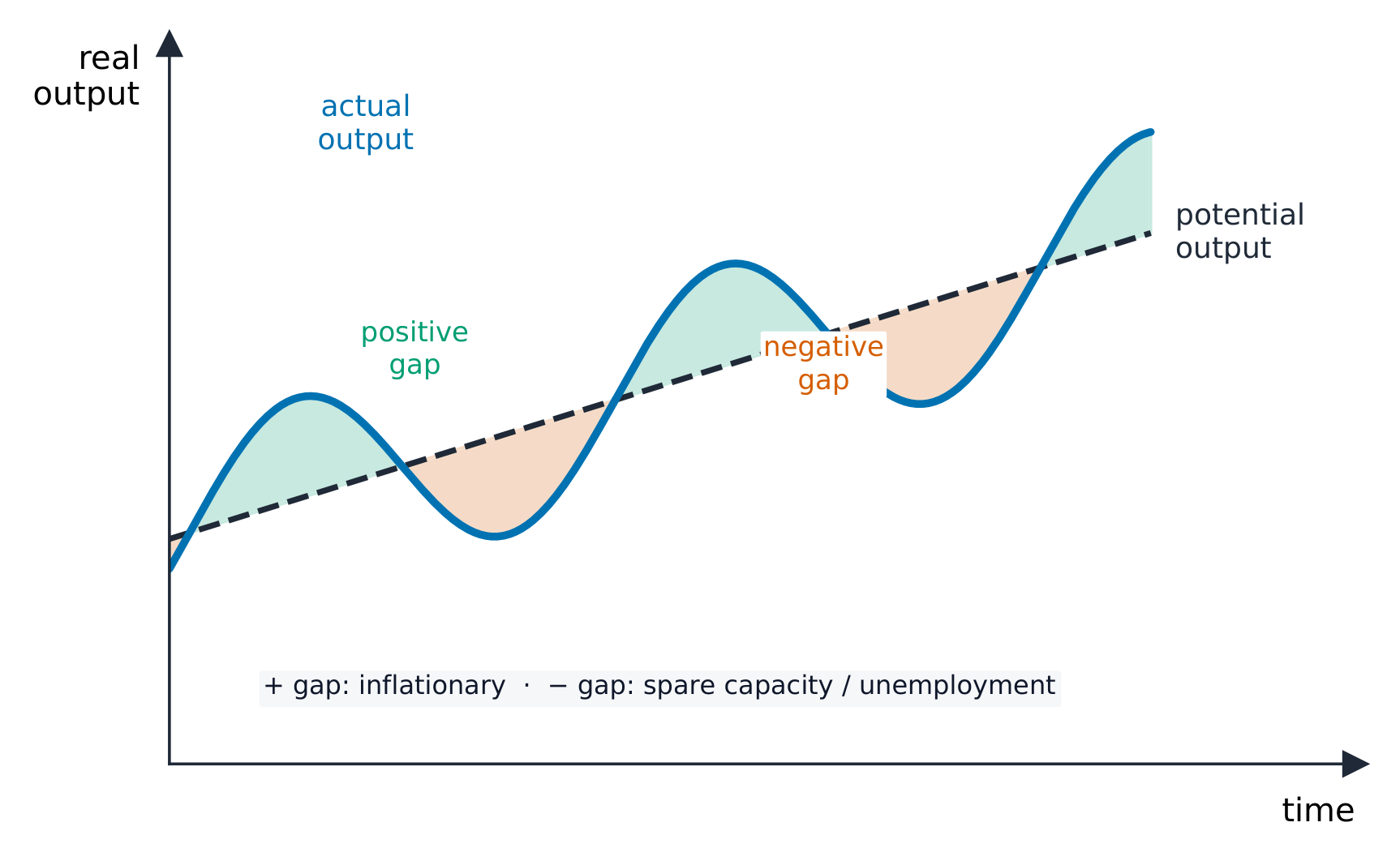
The output gap 产出缺口 is the difference between actual output and potential output. A positive gap (actual above potential) tends to cause inflation; a negative gap (actual below potential) means spare capacity and unemployment.

Sustainability

sustainable growth 可持续增长 is growth that meets today's needs without harming the ability of future generations to meet theirs. Fast growth can use up non-renewable resources and cause pollution, which threatens sustainability 可持续性. So a country must weigh growth today against the environment and resources of tomorrow.

ไทย

การเติบโตทางเศรษฐกิจ คือการเพิ่มขึ้นของผลผลิตจริง

ตึกสูงหลายแห่งกำลังก่อสร้างพร้อมเครนยก
การลงทุนในอาคารและทุนใหม่เป็นปัจจัยสำคัญในการขับเคลื่อนการเติบโตทางเศรษฐกิจ
  • การเติบโตจริง คือการเพิ่มขึ้นของผลผลิตที่เกิดขึ้นจริง
  • ศักยภาพการเติบโต คือการเพิ่มขึ้นของขีดความสามารถของเศรษฐกิจ

ช่องว่างผลผลิต คือความแตกต่างระหว่างผลผลิตจริงกับผลผลิตศักยภาพ ช่องว่าง บวก (ผลผลิตจริงสูงกว่าศักยภาพ) มักนำไปสู่มูลค่าเงินเฟ้อ; ช่องว่าง ลบ (ผลผลิตจริงต่ำกว่าศักยภาพ) แสดงถึงกำลังการผลิตส่วนเกินและการว่างงาน

เส้นแนวโน้มผลผลิตศักยภาพที่ผลผลิตจริงแกว่งขึ้นลงเหนือและใต้เส้นนี้
ผลผลิตจริงแกว่งรอบๆ ผลผลิตศักยภาพ; เหนือเส้นคือช่องว่างบวก (เงินเฟ้อ), ต่ำกว่าเส้นคือช่องว่างลบที่มีกำลังการผลิตส่วนเกิน

ความยั่งยืน

การเติบโตที่ยั่งยืน คือการเติบโตที่ตอบสนองความต้องการในปัจจุบันโดยไม่ทำลายความสามารถของคนรุ่นต่อไปในการตอบสนอง theirs การเติบโตอย่างรวดเร็วอาจใช้ทรัพยากรที่ไม่สามารถฟื้นฟูได้หมดไปและก่อให้เกิดมลพิษ ซึ่งคุกคาม ความยั่งยืน ดังนั้นประเทศต้องถ่วงน้ำหนักการเติบโตในวันนี้ กับสิ่งแวดล้อมและทรัพยากรของวันหน้า

กังหันลมสีขาวสูงหลายต้นตั้งอยู่ในพื้นที่เกษตรกรรมสีเขียวภายใต้ท้องฟ้าสีน้ำเงิน
พลังงานลมที่กังหันเหล่านี้ใช้ไม่ถูกใช้สิ้นไป และไม่มีการเผาไหม้เชื้อเพลิง การเปลี่ยนผลผลิตจากถ่านหินและน้ำมันมาเป็นพลังงานหมุนเวียนเช่นนี้ ทำให้เศรษฐกิจสามารถเติบโตต่อไปโดยไม่ต้องใช้ทรัพยากร — หรือปล่อยมลพิษในอากาศที่จะฉุดรั้งคนรุ่นต่อไป
Explore · ⁨สำรวจ⁩

Economics case lab · ⁨ห้องปฏิบัติการกรณีศึกษาเศรษฐศาสตร์⁩

Classify real examples by the economic idea they show. · ⁨จำแนกตัวอย่างจริงตามแนวคิดทางเศรษฐศาสตร์ที่แสดงออก⁩

Vocabulary · ⁨คำศัพท์⁩ Train · ⁨ฝึกฝน⁩
English ไทย
investment/ɪnˈvestmənt/ การลงทุน
consumption/kənˈsʌmpʃn/ การบริโภค
output gap/ˈaʊtpʊt ɡæp/ output gap
sustainable growth/səˈsteɪnəbl ɡrəʊθ/ การเติบโตที่ยั่งยืน
sustainability/səˌsteɪnəˈbɪlɪti/ ความยั่งยืน
9.3

Employment and unemployment · ⁨การจ้างงานและการว่างงาน⁩

Syllabus · ⁨หลักสูตร⁩
English
  1. explain the measurement, types and causes of unemployment and the natural rate of unemployment
  2. explain the relationship between unemployment and inflation (the Phillips curve, short run and long run)
ไทย
  1. อธิบายการวัด ประเภท และสาเหตุของการว่างงาน และ อัตราการว่างงานธรรมชาติ
  2. อธิบายความสัมพันธ์ระหว่างการว่างงานและเงินเฟ้อ (เส้นโค้งฟิลิปส์ ระยะสั้นและระยะยาว)

Source: Cambridge International syllabus · ⁨แหล่งที่มา: หลักสูตร Cambridge International⁩

English

unemployment 失业 is measured in two ways: the claimant count 申领救济人数 (people claiming benefits) and the wider labour force survey 劳动力调查 (a sample asked about work).

Types

  • frictional unemployment 摩擦性失业 — short spells between jobs.
  • structural unemployment 结构性失业 — skills no longer match the jobs, as industries decline.
  • cyclical unemployment 周期性失业 — caused by low demand in a recession.
  • seasonal unemployment 季节性失业 — work only at certain times of year.

The natural rate and the Phillips curve

The natural rate of unemployment 自然失业率 is the unemployment left when the labour market is in balance (mainly frictional and structural). It cannot be removed just by raising demand.

The Phillips curve 菲利普斯曲线 shows the link between unemployment and inflation:

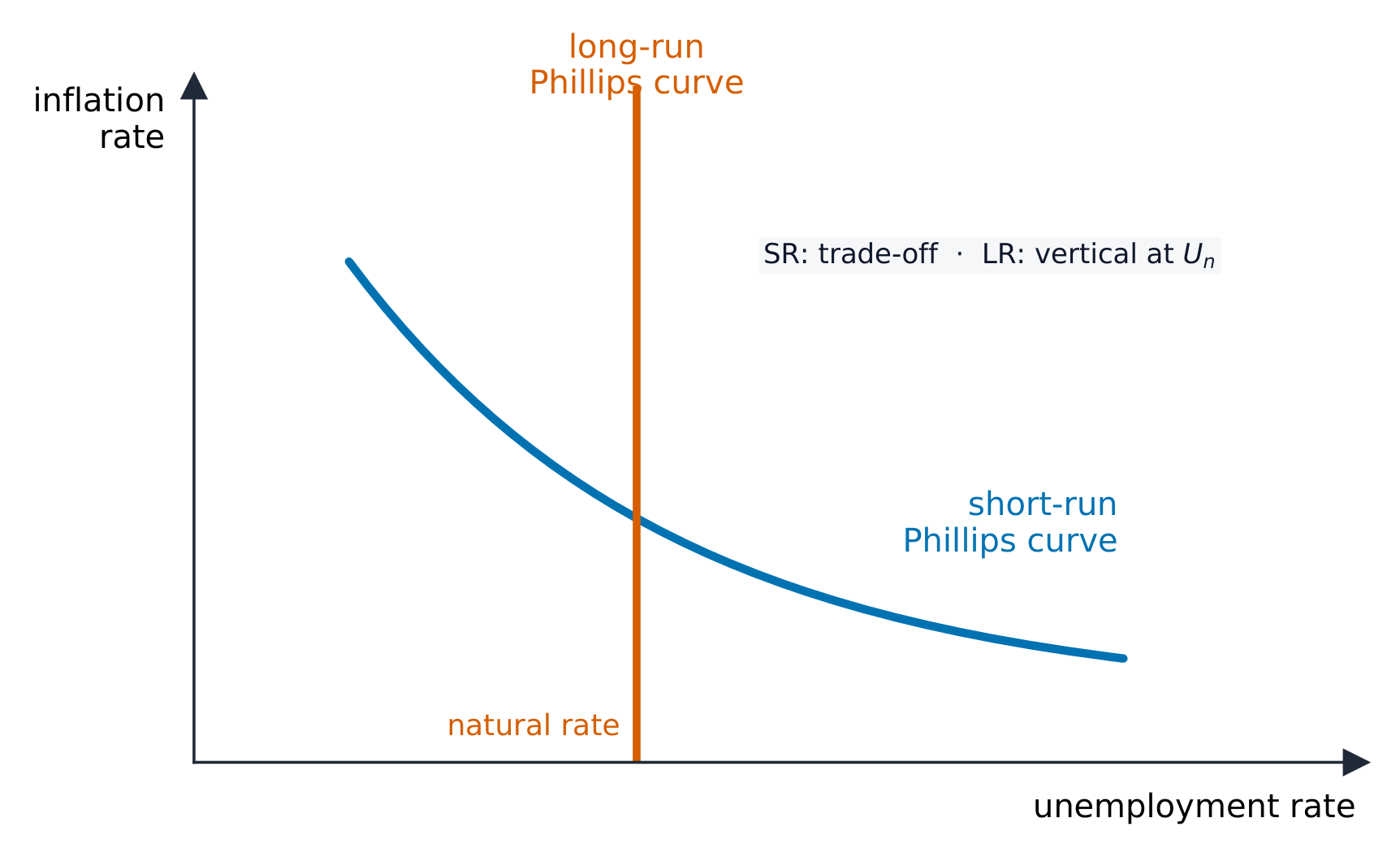
  • in the short run, there is a trade-off: lower unemployment comes with higher inflation, because strong demand pushes up wages and prices.
  • in the long run, the curve is vertical at the natural rate. Once people expect inflation, there is no lasting trade-off — pushing unemployment below the natural rate only speeds up inflation.
ไทย

การว่างงาน วัดด้วยสองวิธี: จำนวนผู้รับสวัสดิการ (บุคคลที่ขอรับผลประโยชน์) และ การสำรวจแรงงานกว้างขวาง (ตัวอย่างที่ถูกถามเกี่ยวกับการทำงาน)

สี่ประเภทของการว่างงาน: frictional, structural, cyclical และ seasonal

ประเภท

  • การว่างงานแบบเสียดทาน — ช่วงเวลาสั้นๆ ระหว่างงาน
  • การว่างงานแบบโครงสร้าง — ทักษะไม่ตรงกับตำแหน่งงานอีกต่อไป เนื่องจากอุตสาหกรรมหดตัว
  • การว่างงานแบบวัฏจักร — เกิดจากความต้องการต่ำในช่วง recession
  • การว่างงานตามฤดูกาล — มีงานเฉพาะ在某些ช่วงเวลาของปี

อัตราธรรมชาติและเส้นโค้งของ Phillips

อัตราว่างงานธรรมชาติ คือการว่างงานที่เหลืออยู่เมื่อตลาดแรงงานสมดุล (ส่วนใหญ่เป็นการว่างงานแบบเสียดทานและแบบโครงสร้าง) ไม่สามารถกำจัดได้ด้วยการเพิ่มความต้องการเท่านั้น

เส้นโค้งของ Phillips แสดงถึงความสัมพันธ์ระหว่างการว่างงานและเงินเฟ้อ:

  • ใน ระยะสั้น มีการแลกเปลี่ยน: การว่างงานต่ำลงมาพร้อมกับเงินเฟ้อที่สูงขึ้น เนื่องจากความต้องการที่แข็งแกร่งดันค่าจ้างและราคา
  • ใน ระยะยาว เส้นโค้งจะเป็นแนวตั้งที่อัตราธรรมชาติ เมื่อผู้คนคาดการณ์เงินเฟ้อแล้ว จะไม่มีTrade-off ที่ยั่งยืน — การผลักการว่างงานให้ต่ำกว่าอัตราธรรมชาติจะเร่งให้เงินเฟ้อสูงขึ้นเท่านั้น
เส้นโค้งของ Phillips ระยะสั้นที่ลาดลงและเส้นโค้งของ Phillips ระยะยาวที่เป็นแนวตั้ง
เส้นโค้งของ Phillips ระยะสั้นแสดงถึงTrade-off ระหว่างการว่างงานและเงินเฟ้อ; เส้นโค้งระยะยาวเป็นแนวตั้งที่อัตราธรรมชาติ
Explore · ⁨สำรวจ⁩

Development chain lab · ⁨ห้องปฏิบัติการห่วงโซ่การพัฒนา⁩

Follow how policy and resources can change living standards. · ⁨ติดตามว่านโยบายและทรัพยากรสามารถเปลี่ยนแปลงมาตรฐานการใช้ชีวิตได้อย่างไร⁩

Vocabulary · ⁨คำศัพท์⁩ Train · ⁨ฝึกฝน⁩
English ไทย
unemployment/ʌnemˈplɔɪmənt/ อัตราการว่างงาน
claimant count/ˈkleɪmənt kaʊnt/ จำนวนผู้ขอรับสวัสดิการ
labour force survey/ˈleɪbə fɔːs ˈsɜːveɪ/ การสำรวจแรงงาน
frictional unemployment/ˈfrɪkʃənl ʌnemˈplɔɪmənt/ การว่างงานแบบเสียดทาน (frictional unemployment)
structural unemployment/ˈstrʌktʃərəl ʌnemˈplɔɪmənt/ การว่างงานเชิงโครงสร้าง (structural unemployment)
cyclical unemployment/ˈsaɪklɪkl ʌnemˈplɔɪmənt/ การว่างงานตามรอบธุรกิจ (cyclical unemployment)
seasonal unemployment/ˈsiːzənl ʌnemˈplɔɪmənt/ การว่างงานตามฤดูกาล (seasonal unemployment)
natural rate of unemployment/ˈnætʃərəl reɪt ɒv ʌnemˈplɔɪmənt/ อัตราการว่างงานตามธรรมชาติ
Phillips curve/ˈfɪlɪps kɜːv/ เส้นโค้งฟิลิปส์
9.4

Money and banking · ⁨เงินและการธนาคาร⁩

Syllabus · ⁨หลักสูตร⁩
English
  1. explain the functions and characteristics of money and the role of the central bank and commercial banks
  2. explain the demand for money (liquidity preference), the money supply, and the determination of interest rates, including moral hazard
ไทย
  1. อธิบายหน้าที่และลักษณะของ เงิน และบทบาทของ ธนาคารกลาง และ ธนาคารพาณิชย์
  2. อธิบายความต้องการเงิน (ความชอบสภาพคล่อง) ปริมาณเงิน และการกำหนด อัตราดอกเบี้ย รวมถึง ความเสี่ยงทางจริยธรรม

Source: Cambridge International syllabus · ⁨แหล่งที่มา: หลักสูตร Cambridge International⁩

English

What money does

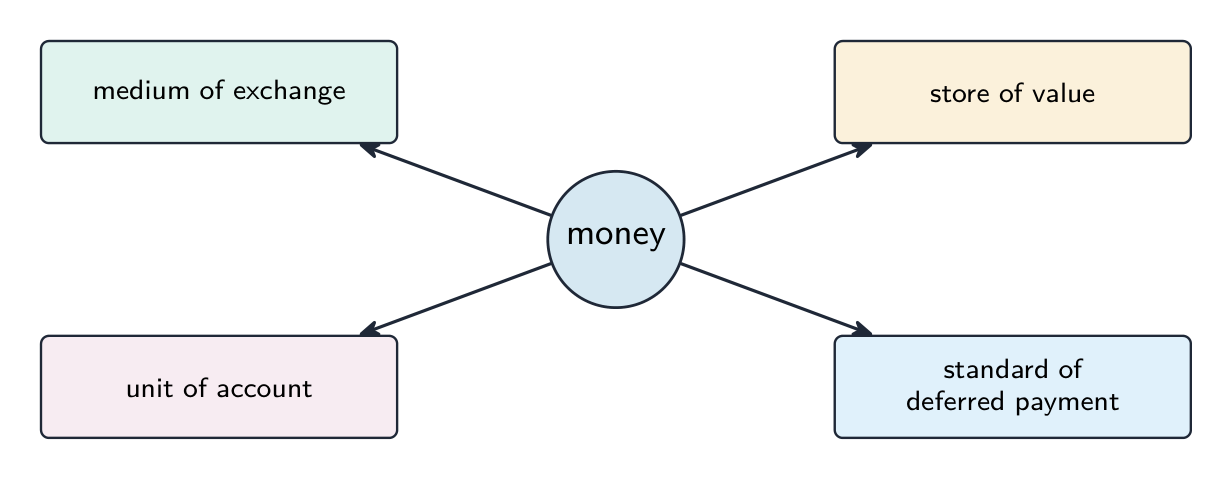
money 货币 is anything widely accepted in payment. It has four jobs:

  • a medium of exchange 交换媒介 — used to buy and sell, avoiding barter.
  • a store of value 价值储藏 — it keeps its worth over time, so you can save it.
  • a unit of account 记账单位 — a common way to measure and compare prices.
  • a standard of deferred payment 延期支付标准 — it lets people borrow and repay later.

Good money is durable, easy to carry, easy to divide, hard to fake, and limited in supply.

Banks

  • the central bank 中央银行 issues notes, runs monetary policy, holds the country's reserves, and acts as lender of last resort 最后贷款人 to banks in trouble.
  • commercial banks 商业银行 take deposits and make loans. By lending out most of what is deposited, the banking system creates money.

The demand for money and interest rates

People hold money rather than other assets for its liquidity 流动性 (it can be spent at once). The demand for money 货币需求 — also called liquidity preference 流动性偏好 — comes from the need to make everyday payments, to keep a safety buffer, and to be ready to buy assets.

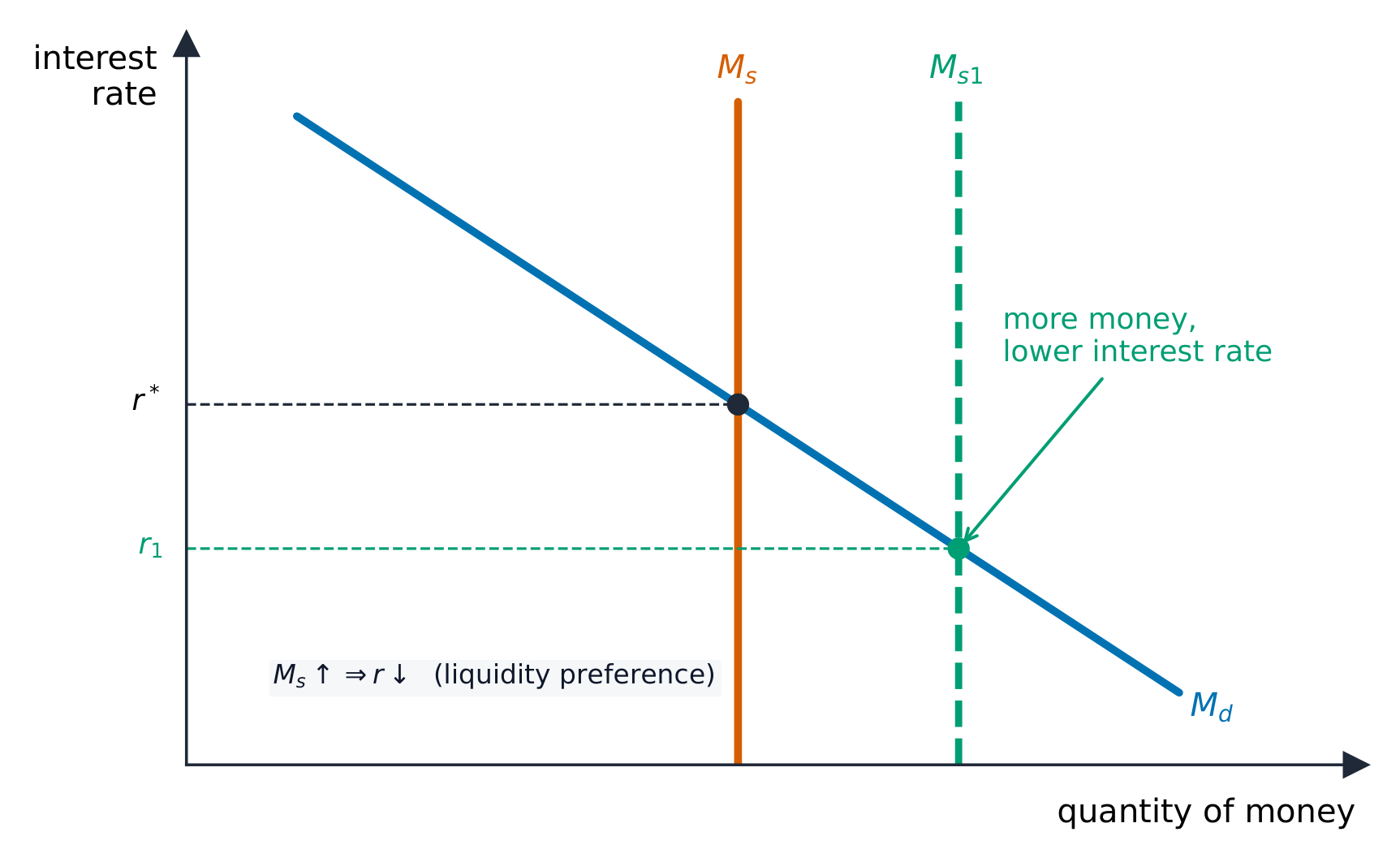
The interest rate 利率 is the price of borrowing money. It is set where the demand for money meets the money supply 货币供给. A larger money supply tends to lower the interest rate.

Moral hazard

moral hazard 道德风险 is the danger that banks take bigger risks because they expect to be rescued if things go wrong. If a bank believes the government will bail it out, it may lend recklessly — knowing it keeps the gains but passes losses to others.

ไทย

เงินทำหน้าที่อย่างไร

เงิน คือสิ่งใดก็ตามที่ได้รับการยอมรับอย่างกว้างขวางในการชำระเงิน它有四个作用:

  • สื่อกลางในการแลกเปลี่ยน — ใช้ในการซื้อและขาย หลีกเลี่ยงการแลกเปลี่ยนสินค้า
  • เครื่องเก็บมูลค่า — รักษาคุณค่าไว้ตามเวลา เพื่อให้คุณสามารถออมได้
  • หน่วยนับ — วิธีมาตรฐานในการวัดและเปรียบเทียบราคา
  • มาตรฐานในการชำระหนี้ในอนาคต — ช่วยให้คนกู้ยืมและชำระคืนได้ในภายหลัง
เงินอยู่ที่ศูนย์กลางพร้อมหน้าที่สี่อย่างรอบๆ: สื่อกลางในการแลกเปลี่ยน, เครื่องเก็บมูลค่า, หน่วยนับ และมาตรฐานในการชำระหนี้ในอนาคต
เงินทำหน้าที่สี่อย่างพร้อมกัน — หากไม่มีเงิน การค้าจะกลับไปใช้การแลกเปลี่ยนสินค้าซึ่งช้าและไม่สะดวก

เงินที่ดีมีความทนทาน พกพาสะดวก แยกย่อยได้ง่าย ลอกเลียนยาก และมีจำนวนจำกัด

ธนาคาร

  • ธนาคารกลาง ออกธนบัตร จัดการนโยบายการเงิน เก็บสำรองเงินของประเทศ และเป็น เจ้าหนี้สุดท้าย ให้ธนาคารที่กำลังมีปัญหา
  • ธนาคารพาณิชย์ รับฝากเงินและให้สินเชื่อ通过将大部分存款贷出,银行系统创造了货币。
สาขาธนาคารพาณิชย์บนถนนหลัก
ธนาคารพาณิชย์รับฝากเงินและให้สินเชื่อ — และการให้สินเชื่อทำให้ระบบธนาคารสร้างเงินส่วนใหญ่ในเศรษฐกิจ

ความต้องการเงินและอัตราดอกเบี้ย

คนถือเงินแทนสินทรัพย์อื่นเนื่องจาก สภาพคล่อง (สามารถใช้จ่ายทันที) ความต้องการเงิน — หรือที่เรียกว่า ความชอบสภาพคล่อง — มาจากความจำเป็นในการชำระเงินในชีวิตประจำวัน การรักษาระดับสำรองความปลอดภัย และการเตรียมพร้อมในการซื้อสินทรัพย์

อัตราดอกเบี้ย คือราคาของการกู้ยืมเงิน ถูกกำหนดจุดที่ความต้องการเงินตัดกับ อุปทานเงิน อุปทานเงินที่มากขึ้นมักจะทำให้ลดอัตราดอกเบี้ยลง

เส้นความต้องการเงินที่ลาดลงตัดกับอุปทานเงินที่เป็นแนวตั้งเพื่อกำหนดอัตราดอกเบี้ย
อัตราดอกเบี้ยถูกกำหนดจุดที่ความต้องการเงินตัดกับอุปทานเงิน; อุปทานเงินที่มากขึ้นจะลดมันลง

ความเสี่ยงทางจริยธรรม

ความเสี่ยงด้านจริยธรรม (moral hazard) คืออันตรายที่ธนาคารนำความเสี่ยงสูงขึ้นเพราะคาดหวังว่าจะได้รับการช่วยเหลือหากเกิดปัญหาขึ้น หากธนาคารเชื่อว่ารัฐบาลจะเข้ามาช่วยกู้ อาจให้สินเชื่ออย่างประมาท — โดยรู้ว่าตนเองได้กำไรแต่โอนความสูญเสียให้ผู้อื่น

Explore · ⁨สำรวจ⁩

Economics case lab · ⁨ห้องปฏิบัติการกรณีศึกษาเศรษฐศาสตร์⁩

Classify real examples by the economic idea they show. · ⁨จำแนกตัวอย่างจริงตามแนวคิดทางเศรษฐศาสตร์ที่แสดงออก⁩

Vocabulary · ⁨คำศัพท์⁩ Train · ⁨ฝึกฝน⁩
English ไทย
money/ˈmʌni/ เงิน
medium of exchange/ˈmiːdɪəm ɒv eksˈtʃeɪndʒ/ สื่อกลางในการแลกเปลี่ยน
store of value/stɔː ɒv ˈvæljuː/ เก็บรักษามูลค่า
unit of account/ˈjuːnɪt ɒv əˈkaʊnt/ หน่วยวัดมูลค่า
standard of deferred payment/ˈstændəd ɒv dɪˈfɜːd ˈpeɪmənt/ มาตรฐานสำหรับการชำระหนี้ในอนาคต
central bank/ˈsentrəl bæŋk/ ธนาคารกลาง
lender of last resort/ˈlendə ɒv læst rɪˈzɔːt/ ผู้ให้กู้的最后选项
commercial bank/kəˈmɜːʃl bæŋk/ ธนาคารพาณิชย์
liquidity/lɪˈkwɪdɪti/ สภาพคล่อง (Liquidity)
demand for money/dɪˈmænd fɔː ˈmʌni/ demand for money
liquidity preference/lɪˈkwɪdɪti ˈprefrəns/ ความชอบสภาพคล่อง
interest rate/ˈɪntrest reɪt/ อัตราดอกเบี้ย
money supply/ˈmʌni səˈplaɪ/ ปริมาณเงิน
moral hazard/ˈmɒrəl ˈhæzəd/ ความเสี่ยงด้านจริยธรรม
9.4

Exam tips · ⁨ข้อแนะนำสำหรับการสอบ⁩

English
  • Calculate the multiplier $= 1 \div (1 - MPC) = 1 \div MPS$ and apply it to an injection.
  • Distinguish actual from potential growth and link sustainability to long-run capacity.
  • Explain the functions of money and the role of banks and the central bank.
  • Explain the Phillips curve trade-off (unemployment vs inflation) and why it may not hold in the long run.
ไทย
  • คำนวณ ตัวคูณ (multiplier) $= 1 \div (1 - MPC) = 1 \div MPS$ และนำไปใช้กับเงิน Injection
  • แยกแยะการเติบโตแบบ จริง (actual) กับศักยภาพ (potential) และเชื่อมโยงความยั่งยืนเข้ากับกำลังการผลิตในระยะยาว
  • อธิบาย หน้าที่ของเงิน以及บทบาทของธนาคารและธนาคารกลาง
  • อธิบาย เส้นโค้งพิลลิปส์ (Phillips curve) ซึ่งเป็นการแลกเปลี่ยนระหว่าง نرخว่างงานกับอัตราเงินเฟ้อ และเหตุผลว่าทำไมมันอาจไม่ถูกต้องในระยะยาว

Interactive lessons on this topic · ⁨บทเรียนเชิงโต้ตอบสำหรับหัวข้อนี้⁩

Work through it step by step, with instant-check exercises. · ⁨ทำทีละขั้นตอน พร้อมแบบฝึกหัดตรวจสอบผลทันที⁩

Past Papers · ⁨ข้อสอบย้อนหลัง⁩

More topics in A-Level Economics · ⁨Economics A-Level⁩ · ⁨หัวข้อเพิ่มเติมใน A-Level Economics · ⁨Economics A-Level⁩⁩

Log in or create account · ⁨เข้าสู่ระบบหรือสร้างบัญชี⁩

IGCSE, A-Level & AP