Skip to content · ⁨ข้ามไปยังเนื้อหา⁩

Electrochemistry · ⁨อิเล็กโทรเคมี⁩

A-Level Chemistry · ⁨Chemistry A-Level⁩ · Topic 24 · ⁨หัวข้อ 24⁩

Video lesson for this topic · ⁨บทเรียนวิดีโอสำหรับหัวข้อนี้⁩ Open the video page · ⁨เปิดหน้าวิดีโอ⁩
7:53

อิเล็กโทรเคมี (A2)

สองสิ่งในกระเป๋าของคุณใช้เคมีเดียวกัน แบตเตอรี่: ปฏิกิริยาที่ต้องการเกิดขึ้นจะดันอิเล็กตรอนผ่านสายไฟ และที่ชาร์จ: เรากดดันอิเล็กตรอนเหล่านั้น…

English narration · English + 中文 subtitles burned in · ⁨การบรรยายภาษาอังกฤษ · คำบรรยายภาษาอังกฤษ + 中文 ลอยตัวบนภาพ⁩

24.1

Electrolysis · ⁨การอิเล็กโทรไลซิส⁩

Syllabus · ⁨หลักสูตร⁩
English
  1. predict the identities of substances liberated during electrolysis from the state of electrolyte (molten or aqueous), position in the redox series (electrode potential) and concentration
  2. state and apply the relationship $F = Le$ between the Faraday constant, $F$, the Avogadro constant, $L$, and the charge on the electron, $e$
  3. calculate: (a) the quantity of charge passed during electrolysis, using $Q = It$ (b) the mass and/or volume of substance liberated during electrolysis
  4. describe the determination of a value of the Avogadro constant by an electrolytic method
ไทย
  1. ทำนายชนิดของสารที่ถูกปลดปล่อยระหว่างการ แยกสารด้วยไฟฟ้า จากสถานะของ อิเล็กโทรไลต์ (หลอมเหลวหรือน้ำ) ตำแหน่งในลำดับรีดอกซ์ (ศักย์ไฟฟ้าอิเล็กโทรด) และความเข้มข้น
  2. ระบุและใช้ความสัมพันธ์ $F = Le$ ระหว่าง ค่าฟาราเดย์, $F$, ค่าอาโวกาโดร, $L$, และประจุบนอิเล็กตรอน, $e$
  3. ทำการคำนวณ: (ก) ปริมาณประจุไฟฟ้าที่ไหลผ่านระหว่างการแยกสารด้วยไฟฟ้า โดยใช้ $Q = It$ (ข) มวลและ/หรือปริมาตรของสารที่ถูกปลดปล่อยระหว่างการแยกสารด้วยไฟฟ้า
  4. อธิบายการกำหนดค่าคงที่ของอาโวกาโดโดยวิธีอิเล็กโทรไลซิส

Source: Cambridge International syllabus · ⁨แหล่งที่มา: หลักสูตร Cambridge International⁩

English
Electrolysis: ions discharge at the electrodes

Electrolysis 电解 uses electricity to break down a molten or aqueous electrolyte 电解质. Positive ions move to the negative electrode and negative ions move to the positive electrode.

At each electrode 电极 a half-reaction happens:

  • at the cathode 阴极 (negative): positive ions gain electrons (reduction).
  • at the anode 阳极 (positive): negative ions lose electrons (oxidation).

Predicting the products

  • a molten electrolyte gives the metal at the cathode and the non-metal at the anode.
  • an aqueous electrolyte also contains water. At the cathode, a less reactive metal is released, but for a reactive metal you get hydrogen instead. At the anode you usually get oxygen, but a concentrated halide solution gives the halogen.

Calculations

The charge on one mole of electrons is the Faraday constant 法拉第常量, linked to the Avogadro constant 阿伏伽德罗常量 ($L$) and the charge on one electron ($e$) by $F = Le$.

The charge passed is $Q = It$ (current $\times$ time). Then:

  1. moles of electrons $= Q / F$.
  2. use the half-equation to find moles of product.
  3. find the mass ($\times M_r$) or the gas volume.

Measuring the mass deposited for a known charge lets you work back to a value of the Avogadro constant.

Worked example. A current of $2.0\ \text{A}$ flows for $30$ minutes through copper(II) sulfate solution, depositing copper at the cathode: $\text{Cu}^{2+} + 2\text{e}^- \rightarrow \text{Cu}$. Find the mass of copper deposited. ($F = 96\,500\ \text{C mol}^{-1}$, $A_r$ Cu $= 64$.)

Charge passed: $Q = It = 2.0 \times (30 \times 60) = 3600\ \text{C}$. Moles of electrons $= Q/F = 3600/96\,500 = 0.0373\ \text{mol}$. From the half-equation, $2\ \text{mol}$ of electrons give $1\ \text{mol}$ of Cu, so $n(\text{Cu}) = 0.0187\ \text{mol}$ and

$$m = nM = 0.0187 \times 64 \approx 1.2\ \text{g}.$$
ไทย
การอิเล็กโทรไลซิส: ไอออนปล่อยประจุที่ขั้วไฟฟ้า

การอิเล็กโทรไลซิส ใช้กระแสไฟฟ้าในการสลาย อิเล็กโทรไลต์ ที่หลอมเหลวหรือละลายน้ำ ไอออนบวกเคลื่อนที่ไปยังขั้วไฟฟ้าลบ และไอออนลบเคลื่อนที่ไปยังขั้วไฟฟ้าบวก

ที่แต่ละ ขั้วไฟฟ้า เกิดปฏิกิริยาครึ่งหนึ่ง:

  • ที่ แคโทด (ขั้วลบ): ไอออนบวกรับอิเล็กตรอน (การลด)
  • ที่ แอโนด (ขั้วบวก): ไอออนลบเสียอิเล็กตรอน (การออกซิเดชัน)
เซลล์อิเล็กโทรไลซิส: แหล่งจ่ายไฟ DC เชื่อมต่อกับขั้วไฟฟ้าสองขั้วในอิเล็กโทรไลต์ โดยไอออนบวกเคลื่อนที่ไปหาแคโทดและไอออนลบเคลื่อนที่ไปหาแอโนด
การอิเล็กโทรไลซิส: แหล่งจ่ายไฟ DC ขับเคลื่อนไอออนบวกไปยังแคโทด (การลด) และไอออนลบไปยังแอโนด (การออกซิเดชัน)
เครื่องวัดโวลต์มิเตอร์ของโฮฟแมนทำจากแก้วบนขาตั้ง เชื่อมต่อกับแหล่งจ่ายไฟ และมีท่อเก็บแก๊สอยู่ทั้งสองข้าง
เครื่องวัดโวลต์มิเตอร์ของโฮฟמןสำหรับการอิเล็กโทรไลซ์น้ำ: แหล่งจ่ายไฟขับเคลื่อนกระแสไฟฟ้าผ่านขั้วไฟฟ้าสองขั้ว และแก๊สที่เกิดขึ้นจะสะสมอยู่ในท่อด้านข้างของแต่ละขั้ว

การทำนายผลิตภัณฑ์

  • อิเล็กโทรไลต์ที่ หลอมเหลว ให้โลหะที่แคโทดและไม่โลหะที่แอโนด
  • อิเล็กโทรไลต์ที่ ละลายน้ำ ยังมีน้ำอยู่ด้วย ที่แคโทด โลหะที่มีความไวต่อปฏิกิริยาน้อยกว่าจะถูกปลดปล่อยออกมา แต่สำหรับโลหะที่มีความไวต่อปฏิกิริยาสูงจะได้ไฮโดรเจนแทน ที่แอโนดโดยทั่วไปจะได้ออกซิเจน แต่สารละลายฮาไคลด์ที่มีความเข้มข้นจะให้ฮาโลเจน
อิเล็กโทรไลต์ที่หลอมเหลวให้โลหะและไม่โลหะ ส่วนที่ละลายน้ำยังมีน้ำอยู่ด้วย
อิเล็กโทรไลต์หลอมเหลวให้โลหะและอโลหะ; ในน้ำยังมีน้ำ

การคำนวณ

ประจุของอิเล็กตรอนหนึ่งโมลคือ ค่าคงที่ฟาราเดย์ ซึ่งเชื่อมโยงกับ ค่าคงที่อาโวกาโดร์ ($L$) และประจุของอิเล็กตรอนหนึ่งตัว ($e$) ผ่าน $F = Le$

ประจุที่ไหลผ่านคือ $Q = It$ (กระแส $\times$ เวลา) จากนั้น:

  1. โมลของอิเล็กตรอน $= Q / F$
  2. ใช้สมการครึ่งเพื่อหามোলของผลิตภัณฑ์
  3. หามวล ($\times M_r$) หรือปริมาตรของแก๊ส

การวัดมวลที่ตกตะกอนสำหรับประจุที่กำหนดช่วยให้สามารถคำนวณกลับเพื่อหาค่าของค่าคงที่อาโวกาโดร์ได้

ตัวอย่างฝึกหัด. กระแสไฟฟ้า $2.0\ \text{A}$ ไหลเป็นเวลา $30$ นาที ผ่านสารละลายทองแดง(II) ซัลเฟต, เกิดการสะสมทองแดงที่แคโทด: $\text{Cu}^{2+} + 2\text{e}^- \rightarrow \text{Cu}$. หามวลของทองแดงที่สะสม. ($F = 96\,500\ \text{C mol}^{-1}$, $A_r$ Cu $= 64$.)

ประจุที่ไหลผ่าน: $Q = It = 2.0 \times (30 \times 60) = 3600\ \text{C}$. โมลของอิเล็กตรอน $= Q/F = 3600/96\,500 = 0.0373\ \text{mol}$. จากสมการครึ่ง, $2\ \text{mol}$ ของอิเล็กตรอนให้ $1\ \text{mol}$ ของ Cu, ดังนั้น $n(\text{Cu}) = 0.0187\ \text{mol}$ และ

$$m = nM = 0.0187 \times 64 \approx 1.2\ \text{g}.$$
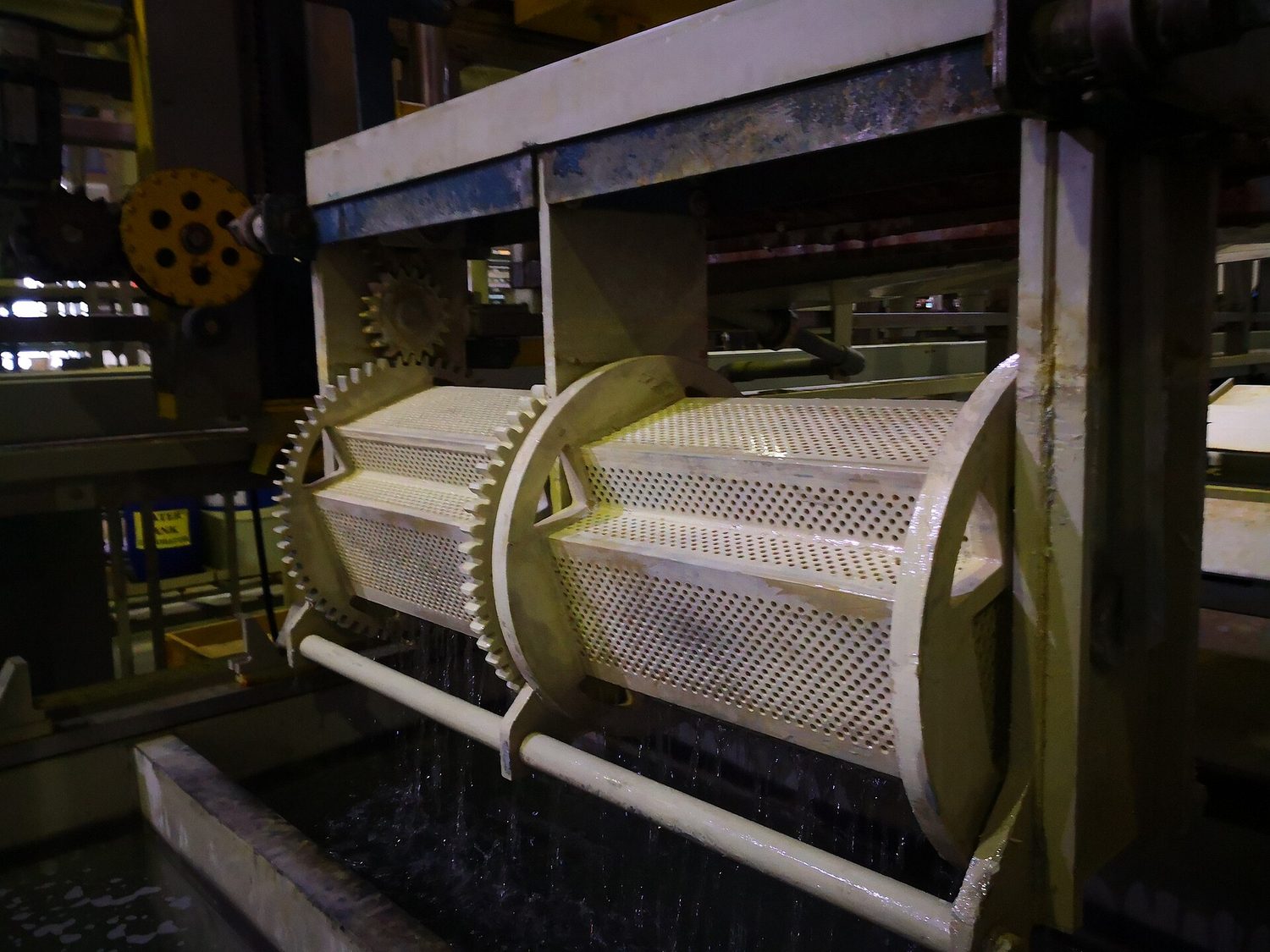
เครื่องชุบไฟฟ้าแบบถังชุบกำลังชุบชิ้นส่วนเล็กๆ
การอิเล็กโทรไลซิสถูกใช้เพื่อชุบวัตถุด้วยชั้นบางๆ เงางามของโลหะเช่นโครเมียม
Explore · ⁨สำรวจ⁩

Faraday's first law · ⁨กฎแรกของ فارาเดย์⁩

m = k·Q

Mass deposited is proportional to the charge passed (Faraday's law). · ⁨มวลที่เกาะติดมี สัดส่วน กับปริมาณประจุที่ไหลผ่าน (กฎของفارาเดย์)⁩

Explore · ⁨สำรวจ⁩

Inside an electrolysis cell · ⁨电解池内部⁩

Choose an electrolyte and watch the ions move: cations to the cathode, anions to the anode, where they are discharged. · ⁨选择电解质并观察离子移动:阳离子向 cathode,阴离子向 anode,在那里它们被放电。⁩

Vocabulary · ⁨คำศัพท์⁩ Train · ⁨ฝึกฝน⁩
English ไทย
electrolysis/ɪlekˈtrɒləsɪs/ electrolysis
electrolyte/ɪˈlektrəlaɪt/ สารอิเล็กโทรไลต์
Watch lesson · ⁨ดูบทเรียน⁩
24.2

Standard electrode potentials and cell potentials · ⁨ศักยภาพขั้วไฟฟ้ามาตรฐานและศักยภาพเซลล์มาตรฐาน⁩

Syllabus · ⁨หลักสูตร⁩
English
  1. define the terms: (a) standard electrode (reduction) potential (b) standard cell potential
  2. describe the standard hydrogen electrode
  3. describe methods used to measure the standard electrode potentials of: (a) metals or non-metals in contact with their ions in aqueous solution (b) ions of the same element in different oxidation states
  4. calculate a standard cell potential by combining two standard electrode potentials
  5. use standard cell potentials to: (a) deduce the polarity of each electrode and hence explain/deduce the direction of electron flow in the external circuit of a simple cell (b) predict the feasibility of a reaction
  6. deduce from $E^{\ominus}$ values the relative reactivity of elements, compounds and ions as oxidising agents or as reducing agents
  7. construct redox equations using the relevant half-equations
  8. predict qualitatively how the value of an electrode potential, $E$, varies with the concentrations of the aqueous ions
  9. use the Nernst equation, e.g. $E = E^{\ominus} + (0.059/z) \log \frac{[\text{oxidised species}]}{[\text{reduced species}]}$, to predict quantitatively how the value of an electrode potential varies with the concentrations of the aqueous ions; examples include $\text{Cu}^{2+}(\text{aq}) + 2\text{e}^- \rightleftharpoons \text{Cu}(\text{s})$, $\text{Fe}^{3+}(\text{aq}) + \text{e}^- \rightleftharpoons \text{Fe}^{2+}(\text{aq})$
  10. understand and use the equation $\Delta G^{\ominus} = -n E^{\ominus}_{\text{cell}} F$
ไทย
  1. นิยามคำศัพท์: (a) ศักย์ไฟฟ้ามาตรฐานของขั้ว (การลด) (b) ศักย์ไฟฟ้ามาตรฐานของเซลล์
  2. อธิบาย ขั้วไฮโดรเจนมาตรฐาน
  3. อธิบายวิธีการวัดศักย์ไฟฟ้ามาตรฐานของขั้วสำหรับ: (a) โลหะหรืออโลหะที่สัมผัสกับไอออน它们在ในสารละลายน้ำ (b) ไอออนของธาตุเดียวกันในสถานะออกซิเดชันที่แตกต่างกัน
  4. คำนวณศักย์ไฟฟ้ามาตรฐานของเซลล์โดยการรวมศักย์ไฟฟ้ามาตรฐานของขั้วสองตัวเข้าด้วยกัน
  5. ใช้ค่าศักย์ไฟฟ้ามาตรฐานเพื่อ: (ก) สรุปขั้วของแต่ละอิเล็กโทรดและดังนั้นอธิบาย/สรุปทิศทางของกระแสอิเล็กตรอนในวงจรภายนอกของเซลล์ đơn (ข) ทำนายความเป็นไปได้ของปฏิกิริยา
  6. สรุปความ реакทีฟสัมพัทธ์ของธาตุ สารประกอบ และไอออน โดยอ้างอิงจากค่า $E^{\ominus}$ ในฐานะตัวออกซิไดซ์หรือตัวรีดิวซ์
  7. เขียนสมการรีดอกซ์โดยใช้สมการครึ่งปฏิกิริยาที่เกี่ยวข้อง
  8. ทำนายเชิงคุณภาพว่าค่าศักย์ไฟฟ้าของขั้ว $E$ จะแปรผันตามความเข้มข้นของไอออนในสารละลายน้ำอย่างไร
  9. ใช้ สมการเนิร์นสต์ เช่น $E = E^{\ominus} + (0.059/z) \log \frac{[\text{oxidised species}]}{[\text{reduced species}]}$, เพื่อทำนายเชิงปริมาณว่าค่าศักย์ไฟฟ้าเปลี่ยนแปลงตามความเข้มข้นของไอออนในสารละลายน้ำอย่างไร; ตัวอย่างเช่น $\text{Cu}^{2+}(\text{aq}) + 2\text{e}^- \rightleftharpoons \text{Cu}(\text{s})$, $\text{Fe}^{3+}(\text{aq}) + \text{e}^- \rightleftharpoons \text{Fe}^{2+}(\text{aq})$
  10. เข้าใจและใช้สมการ $\Delta G^{\ominus} = -n E^{\ominus}_{\text{cell}} F$

Source: Cambridge International syllabus · ⁨แหล่งที่มา: หลักสูตร Cambridge International⁩

English

The electrode potential 电极电势 ($E$) of a half-cell shows how easily it is reduced. We measure it against a reference, under standard conditions, to get the standard electrode potential 标准电极电势 ($E^{\ominus}$), always written as a reduction.

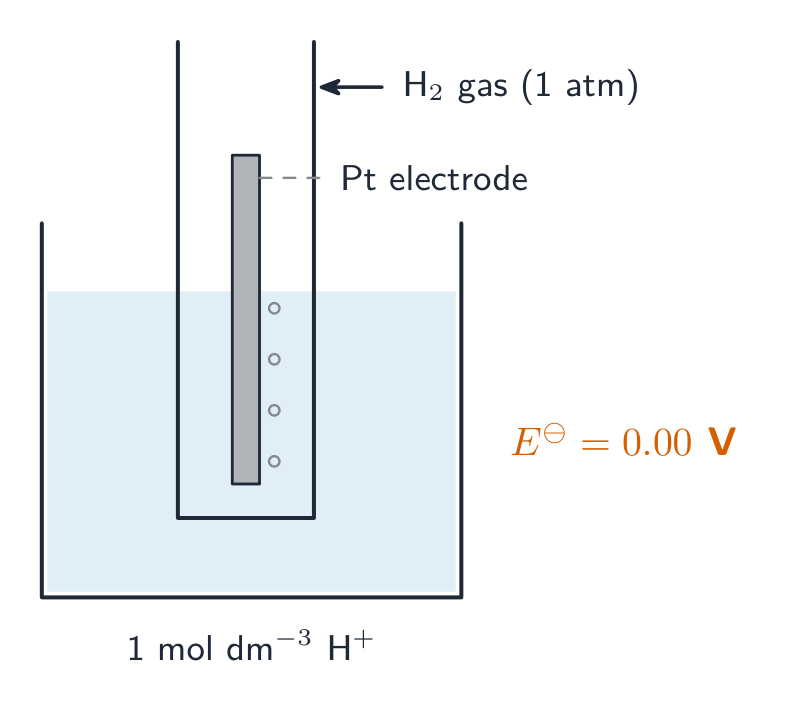
The reference is the standard hydrogen electrode 标准氢电极: hydrogen gas at $1\ \text{atm}$ over platinum in $1\ \text{mol dm}^{-3}$ $\text{H}^+$, defined as exactly $0.00\ \text{V}$.

To measure an $E^{\ominus}$, connect the half-cell to the standard hydrogen electrode and read the voltage. A metal sits in a solution of its ions; for two ions of the same element (such as $\text{Fe}^{3+}/\text{Fe}^{2+}$), a platinum electrode dips into a solution containing both.

Combining half-cells

The standard cell potential 标准电池电势 is the difference between the two standard electrode potentials:

$$E^{\ominus}_{\text{cell}} = E^{\ominus}(\text{more positive}) - E^{\ominus}(\text{less positive})$$

Worked example. Find the standard cell potential of a cell built from the $\text{Zn}^{2+}/\text{Zn}$ half-cell ($E^{\ominus} = -0.76\ \text{V}$) and the $\text{Cu}^{2+}/\text{Cu}$ half-cell ($E^{\ominus} = +0.34\ \text{V}$).

$$E^{\ominus}_{\text{cell}} = E^{\ominus}(\text{more positive}) - E^{\ominus}(\text{less positive}) = (+0.34) - (-0.76) = 1.10\ \text{V}.$$

From $E^{\ominus}$ values you can:

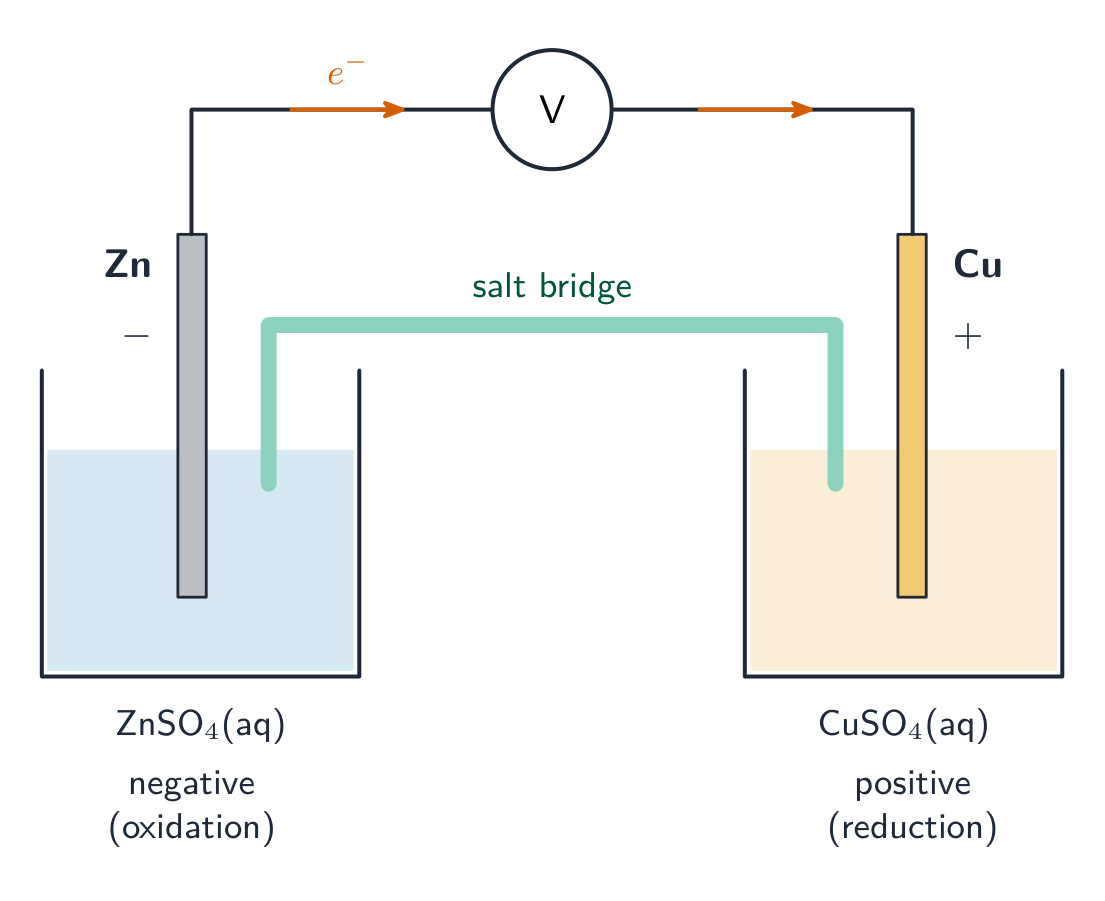
  • find the polarity: the more negative electrode is the negative terminal, and electrons flow from it through the external circuit to the positive electrode.
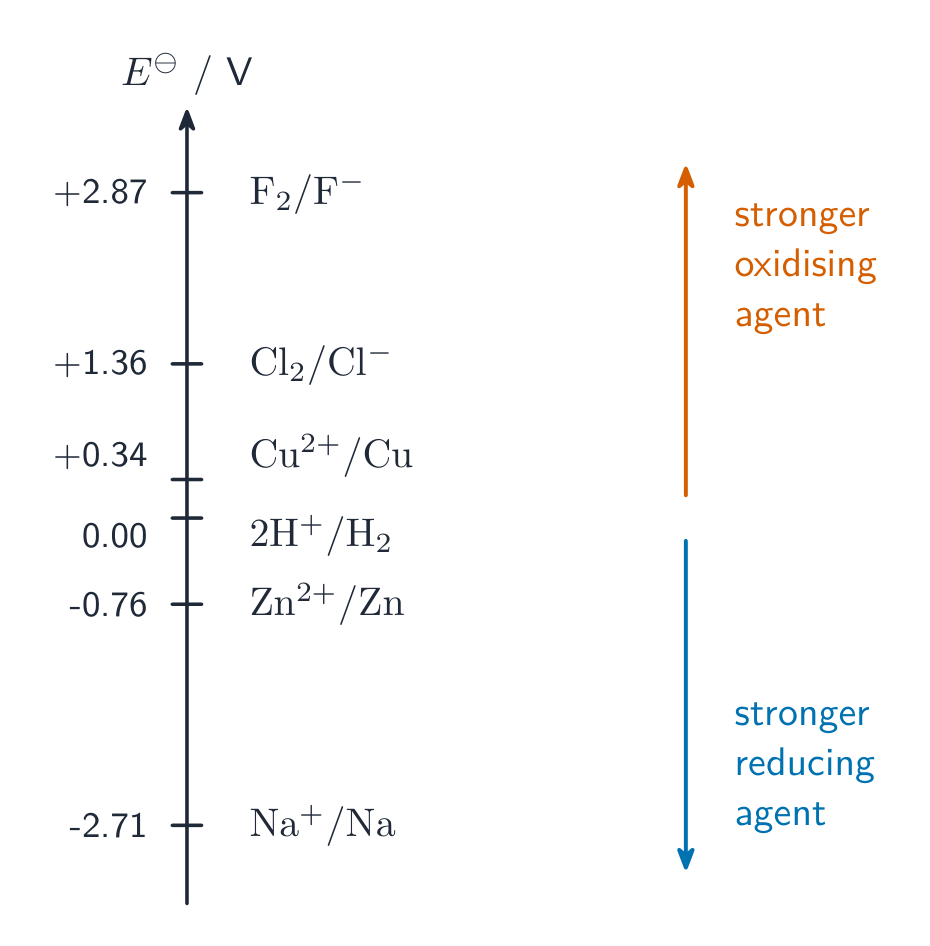
  • judge reactivity: a more positive $E^{\ominus}$ means a better oxidising agent 氧化剂 (easily reduced); a more negative $E^{\ominus}$ means a better reducing agent 还原剂.

Feasibility and redox equations

A reaction is feasible when $E^{\ominus}_{\text{cell}}$ is positive. To build the full equation, take the two half-equations 半反应方程式, reverse the one that is oxidised, and add them so the electrons cancel. This $E^{\ominus}$ test tells you the feasibility 可行性 of the reaction.

You can also link it to free energy: $\Delta G^{\ominus} = -n E^{\ominus}_{\text{cell}} F$, where $n$ is the moles of electrons.

The Nernst equation

If the concentrations are not standard, the electrode potential changes. Raising the concentration of the oxidised species makes $E$ more positive. The Nernst equation 能斯特方程 gives the exact value:

$$E = E^{\ominus} + \frac{0.059}{z} \log \frac{[\text{oxidised species}]}{[\text{reduced species}]}$$

where $z$ is the number of electrons in the half-equation.

ไทย

ศักยภาพขั้วไฟฟ้า ($E$) ของ HALF-CELL แสดงถึงความง่ายที่จะเกิดการลด เราวัดเทียบกับค่าอ้างอิง ภายใต้เงื่อนไขมาตรฐาน เพื่อให้ได้ ศักยภาพขั้วไฟฟ้ามาตรฐาน ($E^{\ominus}$) เขียนเสมอในรูปแบบการลด

reference คือ อิเล็กโทรดไฮโดรเจนมาตรฐาน: ก๊าซไฮโดรเจนที่ $1\ \text{atm}$ บนแพลทินัมใน $1\ \text{mol dm}^{-3}$ $\text{H}^+$, กำหนดให้เท่ากับ $0.00\ \text{V}$ Exactly.

ก๊าซไฮโดรเจนฟองอากาศบนขั้วแพลตินัมในกรดภายในหลอดแก้ว เซลล์ทั้งหมดติดฉลาก 0.00 โวลต์
ขั้วไฟฟ้าไฮโดรเจนมาตรฐาน: H$_2$ ที่ 1 atm บนแพลตินัมใน 1 mol dm$^{-3}$ H$^+$, ค่า $0.00$ V สำหรับอ้างอิงศักยภาพขั้วไฟฟ้าทุกชนิด

เพื่อวัด $E^{\ominus}$, เชื่อมต่อ HALF-CELL กับขั้วไฟฟ้าไฮโดรเจนมาตรฐานและอ่านแรงดันไฟฟ้า โลหะวางอยู่ในสารละลายของไอออนของมัน; สำหรับไอออนสองชนิดของธาตุเดียวกัน (เช่น $\text{Fe}^{3+}/\text{Fe}^{2+}$), ขั้วแพลตินัมจุ่มลงในสารละลายที่มีทั้งสองอย่าง

การรวม HALF-CELLs

ศักยภาพเซลล์มาตรฐาน คือผลต่างระหว่างศักยภาพขั้วไฟฟ้ามาตรฐานสองค่า:

$$E^{\ominus}_{\text{cell}} = E^{\ominus}(\text{more positive}) - E^{\ominus}(\text{less positive})$$
 HALF-CELL สังกะสีและ HALF-CELL ทองแดงเชื่อมต่อกันด้วยสะพานเกลือและโวลต์มิเตอร์ โดยมีอิเล็กตรอนไหลจากสังกะสีไปยังทองแดงผ่านสายไฟ
เซลล์ đơn: HALF-CELL สองข้อเชื่อมต่อกันด้วยสะพานเกลือ มีโวลต์มิเตอร์ อิเล็กตรอนไหลจากขั้วลบ (Zn) ไปยังขั้วบวก (Cu)

ตัวอย่างวิธีทำ. หาศักยภาพเซลล์มาตรฐานของเซลล์ที่สร้างจาก HALF-CELL $\text{Zn}^{2+}/\text{Zn}$ ($E^{\ominus} = -0.76\ \text{V}$) และ HALF-CELL $\text{Cu}^{2+}/\text{Cu}$ ($E^{\ominus} = +0.34\ \text{V}$).

$$E^{\ominus}_{\text{cell}} = E^{\ominus}(\text{more positive}) - E^{\ominus}(\text{less positive}) = (+0.34) - (-0.76) = 1.10\ \text{V}.$$

จากค่า $E^{\ominus}$ คุณสามารถ:

  • หา ขั้วไฟฟ้า: ขั้วไฟฟ้าที่มีค่าลบมากกว่าคือขั้วลบ และอิเล็กตรอนไหลจากนั้นผ่านวงจรภายนอกไปยังขั้วไฟฟ้าบวก
  • ประเมิน ความไวต่อปฏิกิริยา: ค่า $E^{\ominus}$ ที่บวกมากกว่าหมายถึง ตัวออกซิไดซ์ที่ดีกว่า (ลดได้ง่าย); ค่า $E^{\ominus}$ ที่ลบมากกว่าหมายถึง ตัวรีดิวซ์ที่ดีกว่า
มาตราส่วนแนวตั้งของศักยภาพขั้วไฟฟ้ามาตรฐานตั้งแต่ฟลูออรีนด้านบนไปจนถึงโซเดียมด้านล่าง พร้อมลูกศรชี้ตัวออกซิไดซ์ที่แข็งแรงขึ้นขึ้นบนและตัวรีดิวซ์ที่แข็งแรงลงล่าง
อนุกรมเคมีไฟฟ้า: ค่า $E^{\ominus}$ ที่บวกมากกว่า (ด้านบน) คือตัวออกซิไดซ์ที่แข็งแกร่ง; ค่า $E^{\ominus}$ ที่ลบมากกว่า (ด้านล่าง) คือตัวรีดิวซ์ที่แข็งแกร่ง

ความเป็นไปได้และสมการรีด็อกซ์

ปฏิกิริยาทำได้เมื่อ $E^{\ominus}_{\text{cell}}$ เป็น บวก. เพื่อสร้างสมการเต็ม, ใช้สอง ครึ่งสมการ, กลับด้านของฝั่งที่ถูกออกซิไดซ์, และบวกเข้าด้วยกันเพื่อให้ประจุลบหักล้างกัน. การทดสอบ $E^{\ominus}$ นี้บอกคุณถึง ความเป็นไปได้ ของปฏิกิริยานี้.

คุณสามารถเชื่อมโยง它与 free energy ได้: $\Delta G^{\ominus} = -n E^{\ominus}_{\text{cell}} F$, حيث $n$ คือโมลของอิเล็กตรอน

สมการเนิร์นสต์

หากความเข้มข้นไม่เป็นมาตรฐาน ค่าศักย์ไฟฟ้าของขั้วจะเปลี่ยนแปลง การเพิ่มความเข้มข้นของสปีชีส์ ที่ออกซิไดซ์ จะทำให้ $E$ มีค่าเป็นบวกมากขึ้น สมการเนร์สต์ ให้ค่าที่แม่นยำ:

$$E = E^{\ominus} + \frac{0.059}{z} \log \frac{[\text{oxidised species}]}{[\text{reduced species}]}$$

โดยที่ $z$ คือจำนวนอิเล็กตรอนในสมการครึ่งปฏิกิริยา

Explore · ⁨สำรวจ⁩

Electrode potential lab · ⁨ห้องปฏิบัติการศักย์ไฟฟ้าขั้ว⁩

Ecell = Eright - Eleft

Change cell potential and see oxidising power increase. · ⁨เปลี่ยนศักย์เซลล์เพื่อดูความสามารถในการออกซิไดซ์เพิ่มขึ้น⁩

Vocabulary · ⁨คำศัพท์⁩ Train · ⁨ฝึกฝน⁩
English ไทย
electrode/ɪˈlektrəʊd/ อิเล็กโทรด
cathode/ˈkæθəʊd/ แคโทด
anode/ˈænəʊd/ แอนโอด
Faraday constant/ˈfærədeɪ ˈkɒnstənt/ ค่าแฟราเดย์
Avogadro constant/ˌævəˈɡædrəʊ ˈkɒnstənt/ ค่าคงที่อาโวกาโดร
electrode potential/ɪˈlektrəʊd pəˈtenʃl/ ศักย์ไฟฟ้าอิเล็กโทรด
standard electrode potential/ˈstændəd ɪˈlektrəʊd pəˈtenʃl/ ศักย์ไฟฟ้าขั้วมาตรฐาน
standard hydrogen electrode/ˈstændəd ˈhaɪdrədʒn ɪˈlektrəʊd/ อิเล็กโทรดไฮโดรเจนมาตรฐาน
standard cell potential/ˈstændəd sel pəˈtenʃl/ ศักย์เซลล์มาตรฐาน
oxidising agent/ˈɒksɪdaɪzɪŋ ˈeɪdʒənt/ สารออกซิไดซ์
reducing agent/rɪˈdjuːsɪŋ ˈeɪdʒənt/ สารลด
half-equation/hɑːf ɪˈkweɪʒn/ สมการครึ่งหนึ่ง
feasibility/ˌfiːzɪˈbɪlɪti/ ความเป็นไปได้
Nernst equation/nɜːnst ɪˈkweɪʒn/ สมการนرنสต์
Watch lesson · ⁨ดูบทเรียน⁩
24.2

Exam tips · ⁨ข้อแนะนำสำหรับการสอบ⁩

English
  • $E^{\ominus}_{\text{cell}} = E^{\ominus}(\text{more positive}) - E^{\ominus}(\text{less positive})$; a positive $E^{\ominus}_{\text{cell}}$ means the reaction is feasible.
  • Standard conditions for $E^{\ominus}$: 298 K, $1\ \text{mol dm}^{-3}$, 100 kPa, platinum electrode — state them if asked.
  • A more negative electrode potential means a stronger reducing agent; use the series to predict the direction.
  • For electrolysis quantities use $Q = It$ and moles of electrons $= Q/F$.
ไทย
  • $E^{\ominus}_{\text{cell}} = E^{\ominus}(\text{more positive}) - E^{\ominus}(\text{less positive})$; ค่า $E^{\ominus}_{\text{cell}}$ ที่ เป็นบวก แสดงว่าปฏิกิริยานั้นเกิดขึ้นได้เองตามธรรมชาติ
  • สภาวะมาตรฐานสำหรับ $E^{\ominus}$: 298 K, $1\ \text{mol dm}^{-3}$, 100 kPa, ขั้วพลatina — ระบุไว้หากถูกถามถึง
  • ค่าศักย์ไฟฟ้าของขั้วที่ ลบมากกว่า หมายความว่าตัวลดมีกำลัง แรงกว่า; ใช้ลำดับเพื่อทำนายทิศทาง
  • สำหรับปริมาณในการแยกสารด้วยกระแสไฟฟ้าใช้ $Q = It$ และโมลของอิเล็กตรอน $= Q/F$

Interactive lessons on this topic · ⁨บทเรียนเชิงโต้ตอบสำหรับหัวข้อนี้⁩

Work through it step by step, with instant-check exercises. · ⁨ทำทีละขั้นตอน พร้อมแบบฝึกหัดตรวจสอบผลทันที⁩

Past Papers · ⁨ข้อสอบย้อนหลัง⁩

More topics in A-Level Chemistry · ⁨Chemistry A-Level⁩ · ⁨หัวข้อเพิ่มเติมใน A-Level Chemistry · ⁨Chemistry A-Level⁩⁩

Log in or create account · ⁨เข้าสู่ระบบหรือสร้างบัญชี⁩

IGCSE, A-Level & AP