Networks and their types
| English | Chinese | Pinyin |
|---|---|---|
| network | 网络 | wǎng luò |
| local area network | 局域网 | jú yù wǎng |
| latency | 延迟 | yán chí |
| wide area network | 广域网 | guǎng yù wǎng |
| Public Switched Telephone Network | 公共交换电话网 | gōng gòng jiāo huàn diàn huà wǎng |
| client-server | 客户端-服务器 | kè hù duān - fú wù qì |
| servers | 服务器 | fú wù qì |
| clients | 客户端 | kè hù duān |
| peer-to-peer | 对等网络 | duì děng wǎng luò |
| thick client | 胖客户端 | pàng kè hù duān |
| thin client | 瘦客户端 | shòu kè hù duān |
| cloud computing | 云计算 | yún jì suàn |
| public cloud | 公有云 | gōng yǒu yún |
| private cloud | 私有云 | sī yǒu yún |
| scalability | 可扩展性 | kě kuò zhǎn xìng |
| Ethernet | 以太网 | yǐ tài wǎng |
| twisted-pair | 双绞线 | shuāng jiǎo xiàn |
| fibre-optic | 光纤 | guāng xiān |
Two computers, six hundred kilometres, one message
- On 29 October 1969 a student at UCLA typed the first two letters of LOGIN to a computer at Stanford, 600 kilometres away. The link crashed after "LO". An hour later it worked.
- That was ARPANET, four machines by the end of the year. Every network since, from a classroom of laptops to the internet itself, answers the same question: how do separate computers share work and data?
- This lesson is the vocabulary of that question: what a network 网络 is for, how big it is, who is in charge on it, and how much work the machines at its edge do.
The purpose and benefits of a network
- A network is a set of computing devices connected so they can communicate and share resources.
- Share resources: one printer, one file server, one internet connection for everyone, cheaper than equipping each computer.
- Share data: many users open the same files. Central management: install software, manage user accounts and back up once, on a server.
- Communication by email, messaging and video calls, and remote access to files and systems from anywhere.
Select all the genuine benefits of using a network.
Sharing resources, central backup, and communication are all benefits. Networks do not make computers slower.
LAN and WAN
- A local area network 局域网 (LAN) covers a small area, a home, office or school site. The organisation owns the hardware, so data rates are high and latency 延迟 is low.
- A wide area network 广域网 (WAN) covers a large area, a city, a country or the world. It runs over third-party infrastructure, leased lines, fibre or the Public Switched Telephone Network 公共交换电话网 (PSTN), so it is slower and its latency higher.
- A WAN connects LANs together, and the internet is the largest WAN there is.
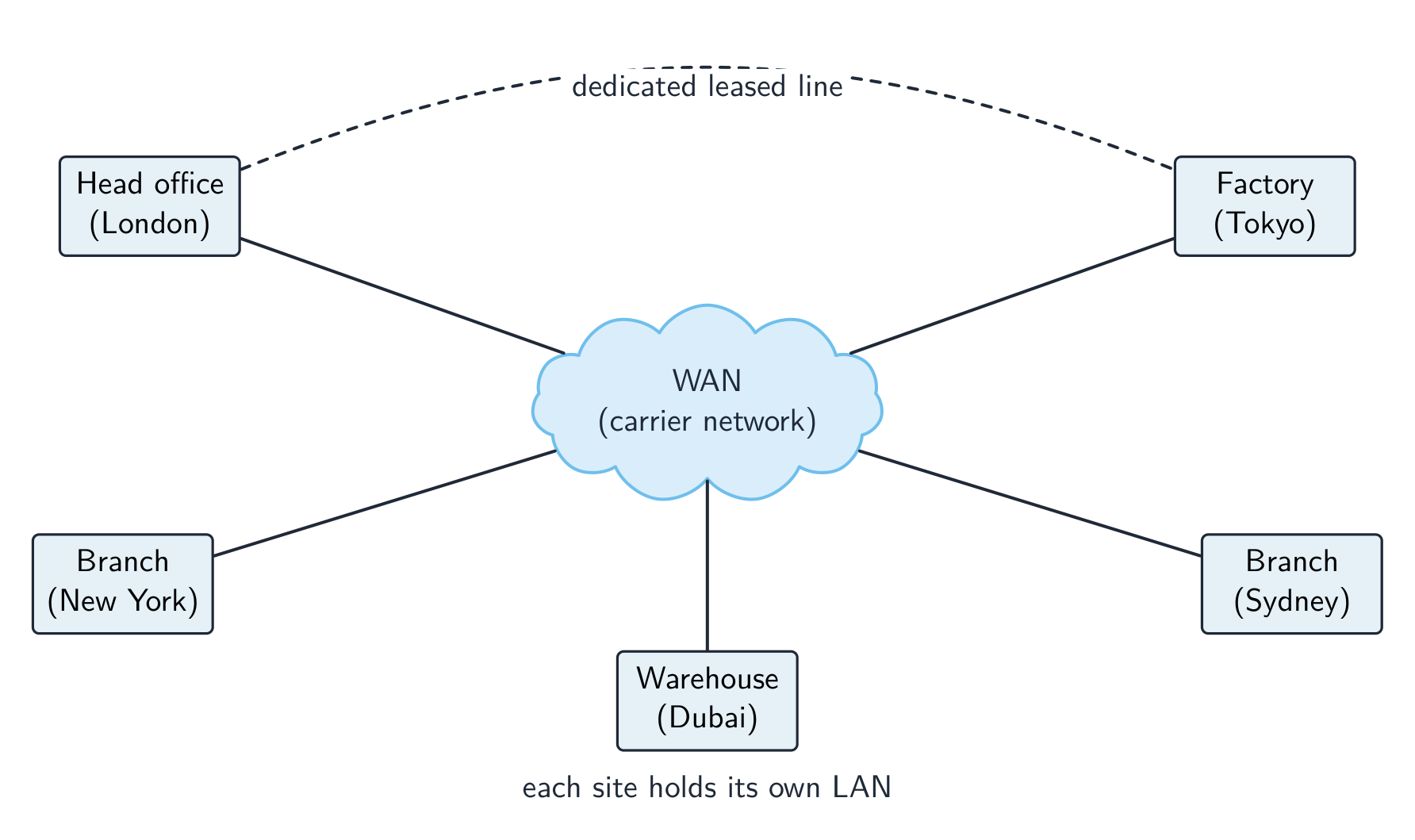
A WAN joins sites that are far apart over infrastructure someone else owns
Network route lab
Follow data from a device through network hardware and protocols.
Which best describes a LAN?
A LAN covers a small area (home/office/school), is usually organisation-owned, and is fast with low latency. A WAN covers a large area.
Match each networking term to what it is.
LAN vs WAN is about size; client-server vs P2P is about whether there is a central server.
Worked example: "give two characteristics"
- Give two characteristics of a LAN. It covers a small geographical area, one site or building; the hardware is owned by the organisation rather than leased from a telecom company; devices connect through the organisation's own switches, cables and access points.
- Give two ways a WAN is different. It covers a large geographical area; it uses third-party leased or public infrastructure; data rates are lower and latency higher.
- Any two from each list. "Bigger" on its own is not a characteristic; say what is bigger.
Which of these are characteristics of a LAN? Select all that apply.
Leased telecom infrastructure is the mark of a WAN. A LAN is small, owned and fast.
Client-server
- In the client-server 客户端-服务器 model, powerful machines act as servers 服务器 providing a service: files, web pages, email, printing. The other machines are clients 客户端 that request those services.
- Everything is central: one login works from any machine, software and security are managed once, files are backed up in one place, and the server can be a powerful machine.
- The drawbacks are the cost of the server and of the technician to run it, and that the server is a single point of failure unless it is duplicated.

Clients ask, the server answers
A weakness of the client-server model is that:
Everything depends on the central server, so if it fails (and is not backed up) the service is lost. Its strength is easy central management.
Peer-to-peer
- In a peer-to-peer 对等网络 (P2P) network every machine is an equal peer: each can be both client and server, and resources are spread across them with no central server.
- No server to buy or manage, and no single failure brings the network down.
- But there is no central control: files live on individual machines that may be switched off, security is set on each peer separately, and there is no one backup.
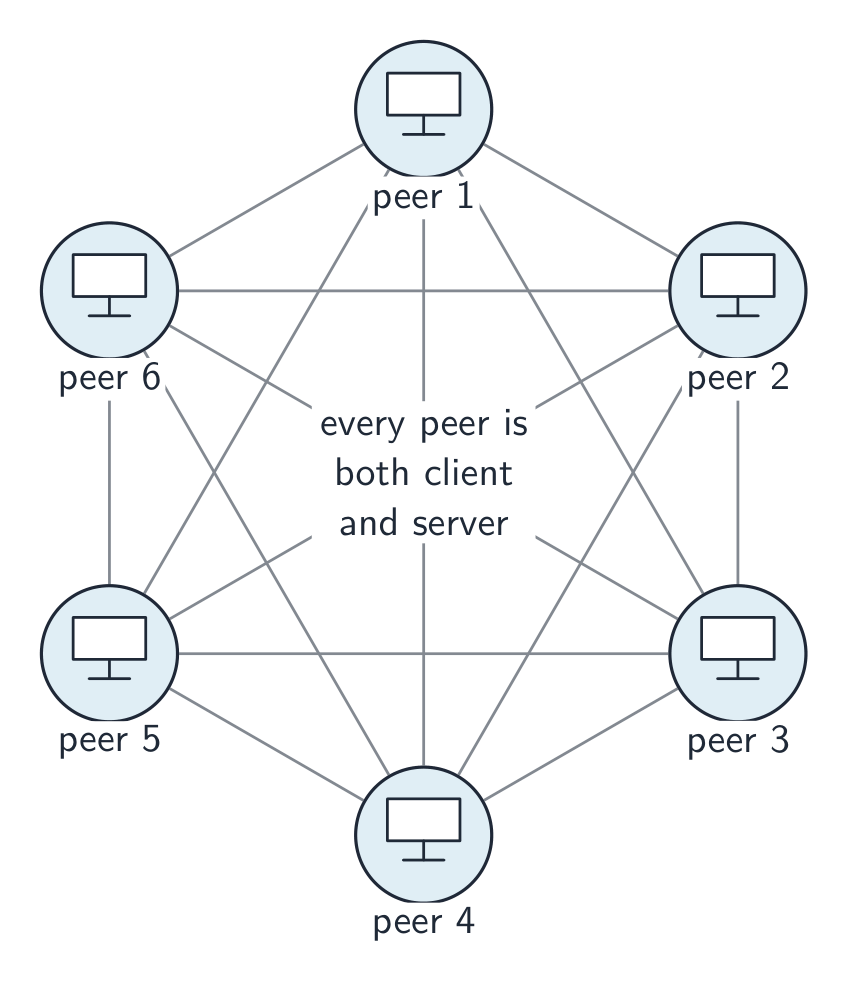
Every peer serves and every peer requests
In a peer-to-peer network:
P2P has no central server — each peer can both request and provide resources, which is robust but harder to secure.
Worked example: justify the model
- A school with 600 students wants a network. Justify a model. Client-server: student files are stored and backed up centrally; a student logs in with one account from any machine; software and security are managed once; the technician controls access rights.
- Four friends want to share files at home. Peer-to-peer: no server to buy, no expert needed, each machine simply shares a folder, and losing one machine does not stop the others.
- The justification names the situation's needs, then the feature of the model that meets each one.
Match each situation to the network model that suits it, with its reason.
Central control and backup point to client-server; low cost and no administrator point to peer-to-peer.
Thin and thick clients
- A thin client 瘦客户端 does little processing itself: the server runs the software and stores the data, and the client only sends input and shows the output. A cheap terminal is enough and everything is updated and backed up on the server, but nothing works if the network or the server fails.
- A thick client 胖客户端 has its own processing power and storage and runs full applications locally, like an ordinary desktop PC. It keeps working without the network, but each machine must be maintained and secured on its own.
- Thin clients load the server and the network heavily; thick clients load them lightly.
A thin client:
A thin client offloads most work to the server (high network reliance); a thick client does its own processing and storage.
Cloud computing
- Cloud computing 云计算 is on-demand computing services, storage, processing and software, provided over the internet by a third party.
- A public cloud 公有云 is owned by a provider and shared by many customers; a private cloud 私有云 is dedicated to one organisation, on its own hardware or hosted for it alone.
- Benefits: scalability 可扩展性, paying only for what is used, access from anywhere, and redundant data centres. Drawbacks: it needs an internet connection, the data is held by someone else, and changing provider can be hard.
A ____ cloud is dedicated to one organisation, while a public cloud is shared by many customers of a provider.
A private cloud can sit on the organisation's own hardware or be hosted for it alone; either way no other customer shares it.
Wired against wireless
- Wired networks use Ethernet 以太网 over twisted-pair 双绞线 copper or fibre-optic 光纤 cable: higher speed, lower latency, fewer errors, and more secure, because a cable has to be physically tapped.
- Wireless networks use radio waves, Wi-Fi, Bluetooth or the cellular network: no cabling and devices can move, but the shared frequency means interference and lower speed, and the signal can be intercepted, so it needs encryption.
- Copper is cheap but weakens with distance and picks up interference; fibre carries light, is immune to interference and covers long distances; microwaves need line of sight; satellites reach anywhere but with a long delay.
Compared with wireless, a wired connection is generally:
Wired wins on speed, latency, reliability and security; wireless wins on convenience and mobility.
Fibre-optic cable is immune to electromagnetic interference and carries data further than copper without a repeater.
Fibre carries light in a glass core, so electrical noise cannot affect it and the signal survives long distances. Its cost and skilled installation are the drawbacks.
Marks that slip away
- The internet is a WAN, not a LAN, and a WAN is not "a big LAN": the difference is who owns the infrastructure.
- A peer-to-peer network has no server. If your description has a machine in charge, it is client-server.
- A thin client is about where the processing happens, not about the size of the device.
- "Wireless is more convenient" scores; "wireless is faster" does not. For the same generation, wired is faster and more reliable.
You've got it
- a network shares resources and data, is managed centrally, and carries communication
- LAN: small area, owned, fast, low latency; WAN: large area, third-party infrastructure, slower; the internet is the largest WAN
- client-server: central servers, one login and one backup, a single point of failure; peer-to-peer: equal peers, no server, no central control
- thin client relies on the server; thick client works alone; cloud = services over the internet, public or private; wired is faster and safer, wireless is mobile