Network topologies and hardware
| English | Chinese | Pinyin |
|---|---|---|
| collision | 冲突 | chōng tū |
| topology | 拓扑 | tuò pū |
| bus | 总线 | zǒng xiàn |
| bandwidth | 带宽 | dài kuān |
| star | 星形 | xīng xíng |
| switch | 交换机 | jiāo huàn jī |
| mesh | 网状 | wǎng zhuàng |
| fault-tolerant | 容错 | róng cuò |
| packet | 数据包 | shù jù bāo |
| network interface card | 网络接口卡 | wǎng luò jiē kǒu kǎ |
| MAC address | MAC地址 | MAC dì zhǐ |
| wireless network interface card | 无线网络接口卡 | wú xiàn wǎng luò jiē kǒu kǎ |
| hub | 集线器 | jí xiàn qì |
| wireless access point | 无线接入点 | wú xiàn jiē rù diǎn |
| bridge | 网桥 | wǎng qiáo |
| repeater | 中继器 | zhōng jì qì |
| router | 路由器 | lù yóu qì |
| IP address | IP地址 | IP dì zhǐ |
| routing table | 路由表 | lù yóu biǎo |
| packet switching | 分组交换 | fēn zǔ jiāo huàn |
| network address translation | 网络地址转换 | wǎng luò dì zhǐ zhuǎn huàn |
| DHCP | 动态主机配置协议 | dòng tài zhǔ jī pèi zhì xié yì |
| firewall | 防火墙 | fáng huǒ qiáng |
| full-duplex | 全双工 | quán shuāng gōng |
| CSMA/CD | 载波侦听多路访问/冲突检测 | zài bō zhēn tīng duō lù fǎng wèn chōng tū jiǎn cè |
The cable that was a party line
- The first Ethernet, in 1973, was a single coaxial cable snaking through a Xerox research building. Every computer tapped into the same wire and shouted onto it.
- If two shouted at once, both messages were ruined, so the designers borrowed a rule from polite conversation: listen first, and if you collide, stop, wait a random moment, and try again.
- That rule is still on the syllabus, even though modern networks arrange their cables so that collisions cannot happen at all.
- This lesson is the shape of a network, the boxes that make it work, and the Ethernet rules for sharing a wire.
The four topologies
- A network's topology 拓扑 is how its nodes and links are arranged.
- Bus 总线: every device on one shared cable with a terminator at each end. Cheap, but if the cable fails the whole LAN fails, and performance drops as more devices share the bandwidth 带宽.
- Star 星形: every device on its own cable to a central switch. A failed cable affects one device; a failed switch brings everything down. The most common LAN today.
- Mesh 网状: every device linked directly to others, so there are many paths and traffic reroutes round a fault. Very fault-tolerant 容错, but a great deal of cabling. A hybrid mixes them: a star in each office, mesh links between offices.

Bus, star and mesh: one cable, one centre, or many paths
Compare the network topologies
Tap through the four topologies. Each trades off cost, speed and how well it survives a failure — notice what breaks the whole network in each one.
Match each topology to its defining feature.
Bus shares one cable, star uses a central switch, mesh has many paths, hybrid mixes them.
In a star topology, what happens if one device's cable fails?
Each device has its own link to the central switch, so one cable failing affects only that device. (If the switch fails, all go down.)
How a packet travels in each topology
- Bus: the sender puts the packet on the shared cable; every device sees it, and only the one whose address matches accepts it. One transmission at a time, so collisions happen.
- Star: the sender passes the packet to the switch, which reads the destination address and forwards it only down the cable to that device. Other pairs can talk at the same time.
- Mesh: the packet is forwarded from node to node along one of several available paths; if a link is down, another path is used.
In a star topology, how does a packet get from PC A to PC B?
The switch reads the destination MAC address and forwards to one port, which is why other pairs can talk at the same time.
Worked example: justify a topology
- A school computer room with thirty PCs. Star: a failed cable affects one PC; a new PC is one more cable to the switch; the switch means no collisions.
- A hospital's critical systems. Mesh: a fault in one link is routed around, so no single failure stops the traffic.
- A temporary link between three devices where cost matters most. Bus: one cable and no switch.
- "Draw the star topology" means a switch in the middle and one line from it to each device: not a ring, not a chain.
Match each situation to the topology that suits it.
Star isolates a cable fault, mesh reroutes round any fault, bus is one cable and nothing else.
LAN hardware
- A network interface card 网络接口卡 (NIC) lets a device send and receive on the network and carries its unique 48-bit MAC address MAC地址. A wireless device uses a wireless network interface card 无线网络接口卡 (WNIC).
- A switch 交换机 forwards each frame only to the port for its destination MAC address; the obsolete hub 集线器 copied every frame to every port. A wireless access point 无线接入点 (WAP) lets wireless clients join the wired LAN.
- A server provides a service to the others; a bridge 网桥 joins two LAN segments into one network; a repeater 中继器 receives a weakened signal and retransmits it at full strength to extend a cable's reach.

The switch at the centre of a star
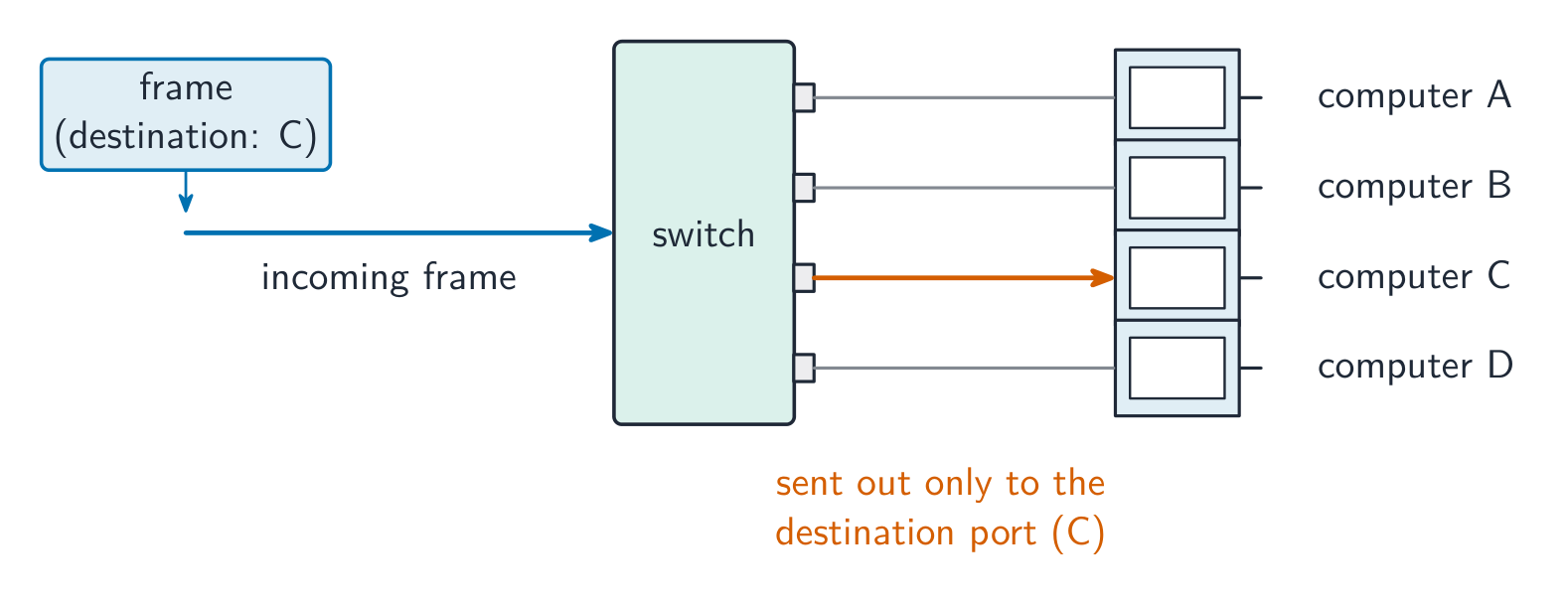
A switch reads the destination MAC address and forwards to one port
A NIC's unique, fixed 48-bit hardware address is called its ______ address.
The MAC address is burned into the network interface card. (DHCP hands out IP addresses, which can change.)
How does a switch differ from a hub?
A switch sends each frame only out the destination's port (efficient, more secure). A hub copied to all ports. Routing by IP is a router's job.
A switch is smarter than a hub because it sends each frame only to the port for its destination, not to every port.
This makes a switched network faster and more secure than the old hub-based one.
Which devices extend or join a LAN's physical reach? Select all that apply.
A repeater lengthens a cable run, a bridge joins two segments, a WAP adds wireless clients. A NIC is inside one device.
Worked example: describe the functions of a WNIC
- The four-mark answer, one point per line.
- It converts the device's data into radio signals and converts incoming radio signals back into data.
- It carries the device's unique MAC address, so frames can be addressed to it.
- It connects the device to a wireless access point and follows the wireless protocol, using the agreed channel and frequency.
A WNIC converts the device's data into ____ signals and back again.
Radio conversion, the MAC address, the connection to an access point and following the wireless protocol are the four functions the exam lists.
The router
- A router 路由器 connects different networks and forwards data between them, usually at the boundary of the LAN and the internet.
- It reads each packet 数据包's destination IP address IP地址 and forwards it out of the right port using its routing table 路由表. That is packet switching 分组交换: the packets of one message may take different routes and are reassembled in order at the destination.
- A home router also does network address translation 网络地址转换 (NAT), letting many private addresses share one public one; runs DHCP 动态主机配置协议 to hand out private addresses; and acts as a firewall 防火墙 against unwanted incoming traffic.
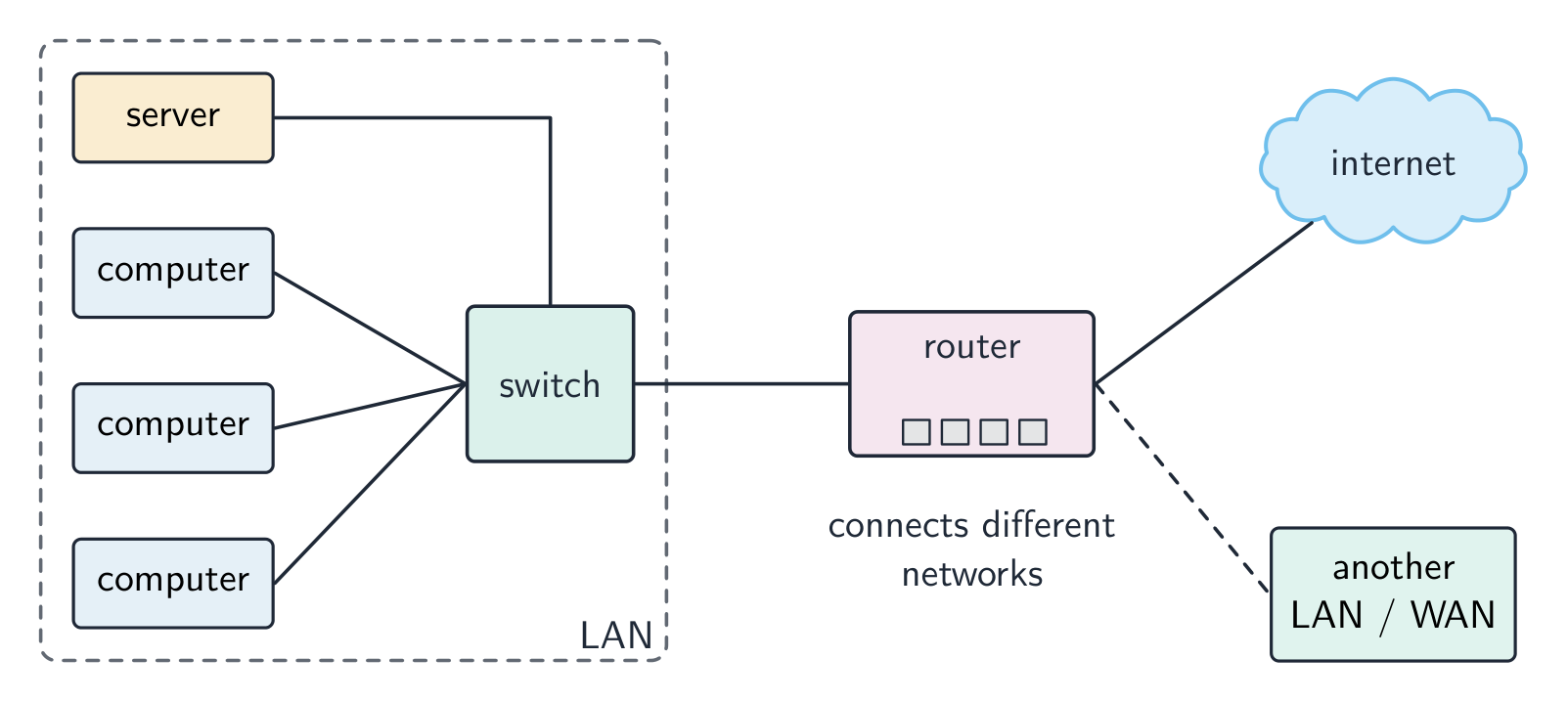
A switch works with MAC addresses inside the LAN; a router works with IP addresses between networks
The main job of a router is to:
A router joins networks (e.g. a LAN to the internet) and forwards packets using their destination IP and a routing table.
Ethernet
- Ethernet is the standard for wired LANs: devices joined by twisted-pair or fibre cable, data sent in frames carrying the source and destination MAC addresses.
- On a shared medium two devices can transmit at once, and the two signals corrupt each other: a collision 冲突.
- Modern switched Ethernet uses full-duplex 全双工 point-to-point links between each device and the switch, so collisions no longer happen, but the protocol for handling them is still examined.
CSMA/CD
- CSMA/CD 载波侦听多路访问/冲突检测 is Carrier Sense Multiple Access with Collision Detection.
- Carrier sense: listen before sending, and wait if the cable is busy. Multiple access: many devices share the medium.
- Collision detection: keep listening while sending. On a collision, stop, send a brief jam signal so every device knows, wait a random backoff time, then try again. The random wait is what stops the same two devices colliding again.

Listen, send, detect, jam, back off, retry
Put the CSMA/CD steps in order for a device that wants to transmit on a shared cable.
Carrier sense → transmit → detect collision → jam → random backoff. The random wait stops both devices clashing again immediately.
Worked example: the three CSMA/CD tasks
- Describe how a device on a shared Ethernet transmits and handles a collision. [3]
- The device listens to the cable, senses the carrier, and transmits only when it is free.
- It keeps checking for a collision while it transmits.
- On a collision it stops, sends a jam signal, waits a random time and retransmits. Three tasks, three marks, in that order.
After a collision, CSMA/CD makes both devices wait the same fixed time before retransmitting.
The backoff is random. If both waited the same time they would collide again the moment they retried.
Marks that slip away
- A switch forwards by MAC address within one network; a router forwards by IP address between networks. Swapping them costs the mark either way.
- In a star topology the switch is the single point of failure, not the cables.
- The backoff time is random. A fixed wait would make the same two devices collide again and again.
- A hub is not a switch: it sends every frame to every port and is why it is obsolete.
You've got it
- bus one shared cable · star one switch, most common · mesh many paths, fault-tolerant · hybrid a mix; justify by cost, reliability and how a failure spreads
- NIC/WNIC carry the 48-bit MAC address; a switch forwards a frame to one port; WAP, server, bridge, repeater each have one job
- a router joins networks and forwards packets by IP address using a routing table, plus NAT, DHCP and a firewall
- CSMA/CD: listen, send while listening, on a collision jam and wait a random backoff; switched full-duplex Ethernet has no collisions