- understand that mass is the property of an object that resists change in motion
- recall $F = ma$ and solve problems using it, understanding that acceleration and resultant force are always in the same direction
- define and use linear momentum as the product of mass and velocity
- define and use force as rate of change of momentum
- state and apply each of Newton’s laws of motion
- describe and use the concept of weight as the effect of a gravitational field on a mass and recall that the weight of an object is equal to the product of its mass and the acceleration of free fall
Dynamics
A-Level Physics · Topic 3
3.1
Mass, momentum and force

Syllabus
Source: Cambridge International syllabus
Mass
Mass 质量 tells you how hard it is to change an object's motion. The larger the mass, the larger the force 力 needed to give it a certain acceleration 加速度. Mass is measured in kilograms ($\text{kg}$) and is a scalar 标量.
Momentum
Linear momentum 动量 is the product of mass and velocity:
$$p = mv.$$
Momentum is a vector 矢量 — it points the same way as the velocity 速度. Its unit is $\text{kg m s}^{-1}$, which is the same as $\text{N s}$.
Force as the rate of change of momentum
Newton's second law, in its general form: the resultant force 合力 on an object equals the rate of change of its momentum.
$$F = \frac{\Delta p}{\Delta t}.$$
When the mass is constant this becomes $F = ma$, because $\Delta p = m\,\Delta v$ and $\Delta v / \Delta t = a$. Cambridge questions often want you to use $F = \Delta p / \Delta t$ directly for a collision 碰撞 or an impulse 冲量: the average force equals the change in momentum divided by the contact time.
A ball hits a wall with momentum $p_{1}$ and bounces back with momentum $p_{2}$ in the opposite direction. The change in momentum is $\Delta p = p_{2} - p_{1}$ (give each direction the correct sign). The average force is $\Delta p / \Delta t$, where $\Delta t$ is the contact time.
Worked example. A $0.20\ \text{kg}$ ball hits a wall at $8.0\ \text{m s}^{-1}$ and bounces straight back at $6.0\ \text{m s}^{-1}$. The contact lasts $0.050\ \text{s}$. Find the average force on the ball.
Take the rebound direction as positive, so $u = -8.0\ \text{m s}^{-1}$ and $v = +6.0\ \text{m s}^{-1}$:
$$\Delta p = m(v - u) = 0.20 \times \big(6.0 - (-8.0)\big) = 2.8\ \text{kg m s}^{-1},$$
$$F = \frac{\Delta p}{\Delta t} = \frac{2.8}{0.050} = 56\ \text{N}.$$
When you know the momentum but not the speed, the change in kinetic energy 动能 is
$$\Delta E_{\text{k}} = \frac{p_{2}^{2} - p_{1}^{2}}{2m}.$$
This comes from $E_{\text{k}} = \tfrac{1}{2} m v^{2} = p^{2} / (2m)$.
Momentum–time graphs
Because $F = \Delta p / \Delta t$, the gradient of a momentum–time graph is the resultant force, just as the gradient of a velocity–time graph is the acceleration. A straight line means a constant resultant force; a horizontal line means zero resultant force; a line sloping down means a force acting against the motion.

Worked example. The graph shows the momentum of a motorcycle. Find the resultant force on it during the first $10\ \text{s}$.
Gradient $= \Delta p / \Delta t = 5000 / 10 = 500\ \text{N}$. Between $10\ \text{s}$ and $16\ \text{s}$ the momentum is constant, so the resultant force is zero: the driving force just balances the resistive forces. From $16\ \text{s}$ to $20\ \text{s}$ the momentum falls by $2000\ \text{kg m s}^{-1}$, so the resultant force is $-500\ \text{N}$, acting backwards.
If a question tells you the speed is changing while the resultant force stays constant, that force cannot be air resistance: drag depends on speed, so it would change as the speed changes, and drag always acts against the motion.
Explore
Free-body diagram (F = ma)
The resultant of the forces, divided by the mass, gives the acceleration.
Explore
Newton's second law
F = ma (resultant)
The resultant force sets the acceleration; balanced forces ⇒ none.
Vocabulary
Train
| English | Chinese | Pinyin |
|---|---|---|
| Mass | 质量 | zhì liàng |
| force | 力 | lì |
| acceleration | 加速度 | jiā sù dù |
| scalar | 标量 | biāo liàng |
| Linear momentum | 动量 | dòng liàng |
| vector | 矢量 | shǐ liàng |
| velocity | 速度 | sù dù |
| resultant force | 合力 | hé lì |
| collision | 碰撞 | pèng zhuàng |
| impulse | 冲量 | chōng liàng |
| kinetic energy | 动能 | dòng néng |
3.1
Newton's three laws of motion

First law
An object stays at rest, or keeps moving at constant velocity in a straight line, unless a resultant external force 外力 acts on it. In short: zero resultant force means zero acceleration.
Second law
The resultant force on an object equals its rate of change of momentum, and acts in the same direction as that change. In SI units,
$$F = \frac{\Delta p}{\Delta t} = ma \quad\text{(for constant mass)}.$$
Acceleration and resultant force always point the same way.


Third law
When body A pushes on body B, body B pushes back on body A with an equal and opposite force. The two forces:
- act on different objects,
- are of the same type (both gravitational, both contact, both electrostatic 静电, and so on),
- have the same size and opposite direction.
A common trap: the weight 重力 of a block on a table and the normal contact force 支持力 from the table are not a third-law pair (they act on the same object and are different types). The third-law partner of the block's weight is the pull the block makes on the Earth. The third-law partner of the table's contact force is the push the block makes on the table.
To name a third-law partner, swap the two bodies in the sentence. "The back wheel of a bicycle pushes backwards on the road" pairs with "the road pushes forwards on the back wheel", and that forward push is what drives the bicycle. "The Earth pulls the Moon" pairs with "the Moon pulls the Earth", with the same size of force.
For a rocket: the thrust 推力 on the rocket and the force on the gases are a third-law pair (the engine pushes the gas down, the gas pushes the engine up). Weight and air resistance are not part of this pair.

Vocabulary
Train
| English | Chinese | Pinyin |
|---|---|---|
| external force | 外力 | wài lì |
| electrostatic | 静电 | jìng diàn |
| weight | 重力 | zhòng lì |
| normal contact force | 支持力 | zhī chí lì |
| thrust | 推力 | tuī lì |
3.1
Weight
Weight is the force on an object from a gravitational field 重力场. Near the Earth's surface,
$$W = mg,$$
where $g \approx 9.81\ \text{m s}^{-2}$ is the acceleration of free fall. Weight is a vector that points towards the centre of the Earth. Do not mix it up with mass: mass is the same everywhere, but weight changes with place.
On the Moon $g$ is about $1.6\ \text{m s}^{-2}$, so an astronaut's mass is unchanged but their weight is about one sixth of its value on Earth. When a multiple-choice question asks which statement describes weight, the answer is the one that says "the force on the object due to a gravitational field", not "mass times acceleration" and not "the resultant force".
Vocabulary
Train
| English | Chinese | Pinyin |
|---|---|---|
| gravitational field | 重力场 | zhòng lì chǎng |
3.2
Non-uniform motion: friction, drag and terminal velocity

Syllabus
- show a qualitative understanding of frictional forces and viscous/drag forces including air resistance (no treatment of the coefficients of friction and viscosity is required, and a simple model of drag force increasing as speed increases is sufficient)
- describe and explain qualitatively the motion of objects in a uniform gravitational field with air resistance
- understand that objects moving against a resistive force may reach a terminal (constant) velocity
Source: Cambridge International syllabus
Friction and drag forces
A friction 摩擦力 force between two solid surfaces acts along the surface and opposes the sliding. A viscous 黏性 or drag 阻力 force is the resistive force from a fluid 流体 (a liquid or gas) on an object moving through it; air resistance is the case for air. You do not need to use any coefficient 系数 of friction or viscosity.
A simple model: the drag gets bigger as the speed gets bigger. At zero speed, the drag is zero. Drag also grows with the cross-sectional area 横截面积 of the object and with the density of the fluid; a parachute works by making the area, and so the drag, much larger. These frictional forces and drag forces are all resistive forces: they act against the direction of motion and transfer kinetic energy to thermal energy.
An object falling through air
For an object dropped from rest and falling through air:
- At first, only weight acts, so the object speeds up downwards at $g$.
- As the speed grows, the upward drag grows. The resultant force gets smaller, so the acceleration gets smaller.
- In the end, the drag equals the weight. The resultant force is zero, the acceleration is zero, and the speed stays constant — the terminal velocity 收尾速度.
On a velocity–time graph, the line starts straight with gradient $g$, then bends and flattens at the terminal velocity. This shape (fast start, then slowing acceleration, then constant speed) is how "falling with air resistance" differs from "free fall in a vacuum" in a uniform gravitational field 匀强重力场. On an acceleration–time graph the acceleration starts at $g$ and decreases, curving down to zero.
Two spheres of the same size but different density have different terminal velocities: the denser sphere has the larger weight, so it needs a larger drag to balance it, and drag only reaches that value at a higher speed. That is also why a parachute changes everything: when it opens, the drag suddenly exceeds the weight, the resultant force is upwards, and the skydiver decelerates (the acceleration is upwards while the velocity is still downwards) until the drag has fallen back to equal the weight at a new, much lower terminal velocity.


Falling through a liquid: three forces
A ball falling through a liquid has three forces on it: its weight downwards, the upthrust 浮力 upwards, and the viscous drag upwards. The upthrust comes from hydrostatic pressure 流体静压强: the pressure in a liquid increases with depth, so the liquid pushes harder on the bottom of the ball than on the top, and the resultant of these pushes is upwards. Its size is the weight of the liquid the ball displaces, $U = \rho_{\text{liquid}} V g$ (topic 4). The drag grows with speed. When weight $=$ upthrust $+$ drag, the resultant force is zero and the ball falls at its terminal speed. A "draw labelled arrows" question wants exactly these three, with the upthrust and drag both up and the weight down.
Worked example. A steel ball of radius $2.0\ \text{mm}$ and weight $2.56 \times 10^{-3}\ \text{N}$ falls through oil of density $850\ \text{kg m}^{-3}$. The viscous drag on it is $F = 6\pi \eta r v$, where $\eta$ is the viscosity 黏度 of the oil and $v$ the speed. (a) Find the SI base units of $\eta$. (b) Show that the upthrust on the ball is $2.8 \times 10^{-4}\ \text{N}$. (c) Taking $\eta = 0.20$ in SI units, find the terminal speed.
(a) $\eta = F / (6\pi r v)$, so its units are $\text{N} / (\text{m} \cdot \text{m s}^{-1}) = \text{kg m s}^{-2} / (\text{m}^{2}\ \text{s}^{-1}) = \text{kg m}^{-1}\ \text{s}^{-1}$.
(b) $V = \tfrac{4}{3}\pi r^{3} = \tfrac{4}{3}\pi (2.0 \times 10^{-3})^{3} = 3.35 \times 10^{-8}\ \text{m}^{3}$, so $U = 850 \times 3.35 \times 10^{-8} \times 9.81 = 2.79 \times 10^{-4}\ \text{N} \approx 2.8 \times 10^{-4}\ \text{N}$.
(c) At the terminal speed, drag $= W - U = 2.56 \times 10^{-3} - 2.8 \times 10^{-4} = 2.28 \times 10^{-3}\ \text{N}$. So $v = F / (6\pi \eta r) = 2.28 \times 10^{-3} / (6\pi \times 0.20 \times 2.0 \times 10^{-3}) = 0.30\ \text{m s}^{-1}$.

Energy during a terminal-velocity fall
At terminal velocity, a parachutist 跳伞者 has constant kinetic energy. But the gravitational potential energy 重力势能 keeps falling as they go down. Where does it go? Almost all of it turns into thermal energy 热能 of the air around them. It does not become kinetic energy of the parachutist — that stays constant.
Cyclist or car at constant speed
A vehicle at constant speed on a flat road has zero resultant force. The forward driving force 驱动力 is equal and opposite to the total resistive force (friction, air resistance, and rolling resistance). At higher speed the drag is larger, so the driving force must be larger too — and so the power 功率 must be larger.
On a slope the weight has a component along the road. Going up at constant speed, the driving force must balance the resistive force and the part of the weight that pulls down the slope, $W\sin\theta$; going down, that same component helps the motion.

Worked example. A car of mass $1500\ \text{kg}$ climbs a road inclined at $12°$ to the horizontal at a constant $30\ \text{m s}^{-1}$. The total resistive force is $1600\ \text{N}$. Find the driving force and the useful output power of the engine.
Constant speed means zero resultant force along the slope: $D = 1600 + 1500 \times 9.81 \times \sin 12° = 1600 + 3060 = 4660\ \text{N} \approx 4700\ \text{N}$. Power is force times velocity (topic 5): $P = Dv = 4660 \times 30 = 1.4 \times 10^{5}\ \text{W}$.
Explore
Stopping a car
Friction is what brakes a car. Set a speed and brake — the car keeps moving while the driver reacts, then friction slows it. Double the speed and watch the braking distance quadruple.
Explore
Reach terminal velocity
Jump and watch the air-resistance arrow grow until it balances the weight — then the speed is constant. Open the parachute and the much bigger drag drops the diver to a slow, safe terminal velocity.
Vocabulary
Train
| English | Chinese | Pinyin |
|---|---|---|
| friction | 摩擦力 | mó cā lì |
| viscous | 黏性 | nián xìng |
| drag | 阻力 | zǔ lì |
| fluid | 流体 | liú tǐ |
| coefficient | 系数 | xì shù |
| cross-sectional area | 横截面积 | héng jié miàn jī |
| terminal velocity | 收尾速度 | shōu wěi sù dù |
| uniform gravitational field | 匀强重力场 | yún qiáng zhòng lì chǎng |
| upthrust | 浮力 | fú lì |
| hydrostatic pressure | 流体静压强 | liú tǐ jìng yā qiáng |
| viscosity | 黏度 | nián dù |
| parachutist | 跳伞者 | tiào sǎn zhě |
| gravitational potential energy | 重力势能 | zhòng lì shì néng |
| thermal energy | 热能 | rè néng |
| driving force | 驱动力 | qū dòng lì |
| power | 功率 | gōng lǜ |
3.3
Conservation of linear momentum

Syllabus
- state the principle of conservation of momentum
- apply the principle of conservation of momentum to solve simple problems, including elastic and inelastic interactions between objects in both one and two dimensions (knowledge of the concept of coefficient of restitution is not required)
- recall that, for an elastic collision, total kinetic energy is conserved and the relative speed of approach is equal to the relative speed of separation
- understand that, while momentum of a system is always conserved in interactions between objects, some change in kinetic energy may take place
Source: Cambridge International syllabus
The principle
For a system with no resultant external force, the total momentum stays constant. This is conservation of momentum 动量守恒. Stated for the two marks the examiner gives: the total momentum of a system of objects remains constant provided no resultant external force acts on the system. Both halves are needed: "total momentum is constant" alone scores one.
It always holds when there is no outside resultant force — in collisions, explosions 爆炸, and recoil 反冲. In two dimensions, momentum is conserved along each direction on its own.
Worked example. A $2.0\ \text{kg}$ trolley and a $3.0\ \text{kg}$ trolley are held together against a compressed spring, then released from rest. The $2.0\ \text{kg}$ trolley flies off at $6.0\ \text{m s}^{-1}$. Find the speed of the other trolley.
The total momentum stays zero (it started at rest), so
$$0 = (2.0)(6.0) + (3.0)(-v) \quad\Rightarrow\quad v = \frac{12}{3.0} = 4.0\ \text{m s}^{-1}$$
in the opposite direction.

Elastic and inelastic collisions
In every collision, momentum is conserved (if there is no outside resultant force).
An elastic collision 弹性碰撞 is one where the total kinetic energy is also conserved. A quick test: in an elastic collision, the relative speed 相对速率 of approach equals the relative speed of separation.
In an inelastic collision 非弹性碰撞, momentum is conserved but kinetic energy goes down — some becomes thermal, sound, or deformation 形变 energy. If the two objects stick together, the collision is perfectly inelastic.
Solving collision problems (one dimension)

For two objects with masses $m_{1}, m_{2}$ and starting velocities $u_{1}, u_{2}$ that hit head-on 正面, write
$$m_{1} u_{1} + m_{2} u_{2} = m_{1} v_{1} + m_{2} v_{2}.$$
Use signed velocities (positive in one chosen direction). If the collision is elastic, add the relative-speed equation
$$u_{1} - u_{2} = -(v_{1} - v_{2}),$$
or, the same thing, $\tfrac{1}{2} m_{1} u_{1}^{2} + \tfrac{1}{2} m_{2} u_{2}^{2} = \tfrac{1}{2} m_{1} v_{1}^{2} + \tfrac{1}{2} m_{2} v_{2}^{2}$. That gives two equations for two unknowns.
Worked example. A $1500\ \text{kg}$ car moving at $12\ \text{m s}^{-1}$ runs into a stationary $1000\ \text{kg}$ car and they lock together. Find their common velocity just after the collision.
Momentum is conserved (the cars stick, so $v_{1} = v_{2} = v$):
$$1500 \times 12 + 1000 \times 0 = (1500 + 1000)\,v \quad\Rightarrow\quad v = \frac{18\,000}{2500} = 7.2\ \text{m s}^{-1}.$$
Questions often go on to ask what fraction of the kinetic energy is transferred to other forms. Before: $E_{\text{k}} = \tfrac{1}{2} \times 1500 \times 12^{2} = 1.08 \times 10^{5}\ \text{J}$. After: $\tfrac{1}{2} \times 2500 \times 7.2^{2} = 6.48 \times 10^{4}\ \text{J}$. So $4.3 \times 10^{4}\ \text{J}$, which is $40\%$ of the original kinetic energy, becomes thermal energy, sound and deformation of the cars. Momentum is conserved; kinetic energy is not.
Worked example. A stationary nucleus of mass $222\,u$ decays by emitting an alpha particle α粒子 of mass $4\,u$ at $1.6 \times 10^{7}\ \text{m s}^{-1}$. Find the speed of the remaining nucleus.
Before the decay the total momentum is zero, so afterwards the two momenta are equal and opposite: $218\,u \times v = 4\,u \times 1.6 \times 10^{7}$, giving $v = 2.9 \times 10^{5}\ \text{m s}^{-1}$ in the opposite direction to the alpha particle. The unit $u$ cancels, so its value is never needed. In a decay the momentum, the charge (proton number), the nucleon number and the total mass–energy are all conserved (topic 11).
A useful result for a head-on elastic collision of mass $m$ with a stationary 静止 mass $M$:
$$v_{m} = \frac{m - M}{m + M} u, \qquad v_{M} = \frac{2m}{m + M} u.$$
Collisions in two dimensions
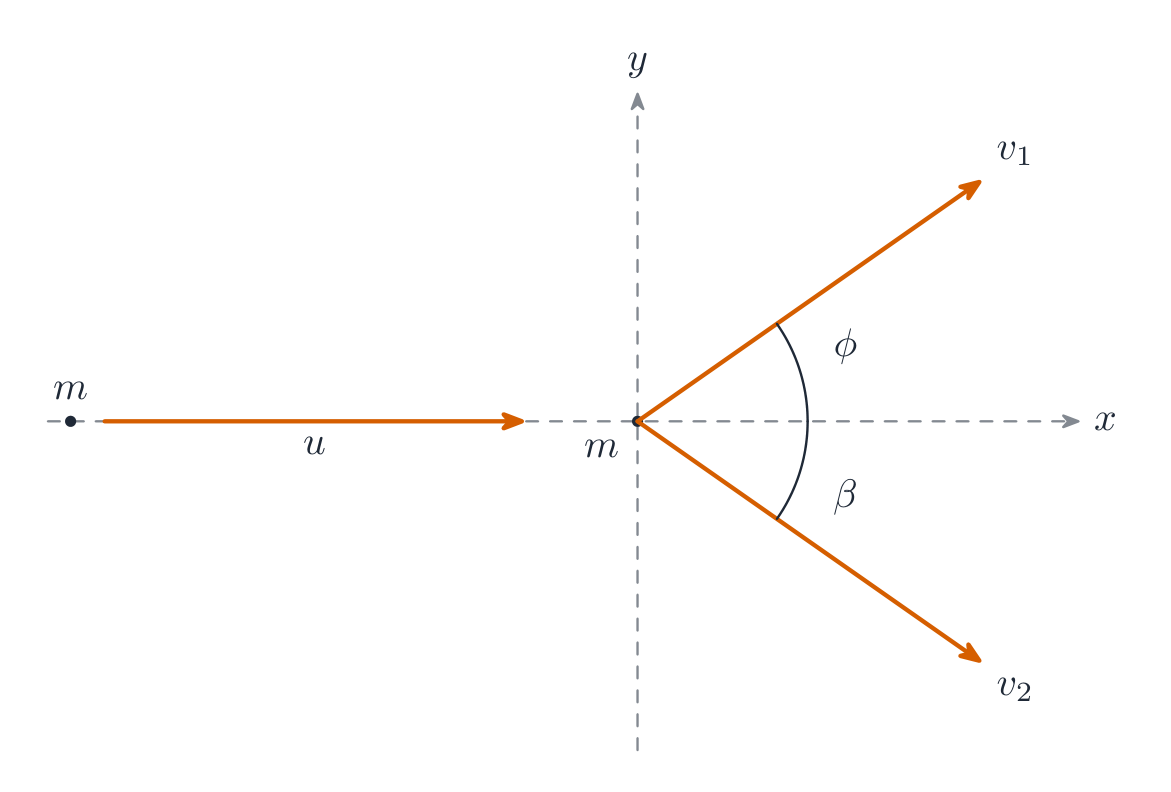
If the objects move in two dimensions, split the velocities into perpendicular 垂直 components 分量 and apply conservation of momentum along each direction on its own. For a collision where the objects hit at an angle, choose one axis along the first object's motion and one across it. The total momentum is conserved along each axis.
Worked example. On a frictionless surface, ball A has momentum $4.0\ \text{N s}$ due east and ball B has momentum $3.0\ \text{N s}$ due north. They collide and stick together. Find the momentum of the combined object.
Momentum is conserved along each axis: $4.0\ \text{N s}$ east and $3.0\ \text{N s}$ north after the collision, exactly as before. The total momentum is the vector sum, $\sqrt{4.0^{2} + 3.0^{2}} = 5.0\ \text{N s}$ at $\tan^{-1}(3.0 / 4.0) = 37°$ north of east; the combined object moves that way at $5.0\ \text{N s}$ divided by the total mass. A multiple-choice diagram of two momentum arrows is asking exactly this: add the arrows tip to tail.
Rocket / pushing out mass
A rocket pushes out gas at velocity $u$ (relative to itself) at a mass-flow rate 质量流率 $\dot m$ (kg per second). It feels a thrust
$$F = \dot m \cdot u,$$
which comes from $F = \Delta p / \Delta t$. The momentum given to the gas each second equals the thrust on the rocket (Newton's third law: the rocket pushes the gas one way, the gas pushes the rocket the other way). An engine ejecting $90\ \text{kg}$ of gas per second at $190\ \text{m s}^{-1}$ produces a thrust of $90 \times 190 = 1.7 \times 10^{4}\ \text{N}$.
Worked example. A rocket of weight $W$ leaves the ground with an initial acceleration $a$. What thrust does its engine produce?
Take upwards as positive. The resultant force is thrust minus weight, so $T - W = ma$. With $m = W / g$, $T = W + Wa / g = W(1 + a / g)$. A rocket of weight $2.0 \times 10^{6}\ \text{N}$ accelerating at $4.0\ \text{m s}^{-2}$ needs a thrust of $2.0 \times 10^{6} \times (1 + 4.0 / 9.81) = 2.8 \times 10^{6}\ \text{N}$. The thrust must exceed the weight before the rocket moves at all.
Explore
A collision
Set the masses and speeds, then collide them. Total momentum is conserved — the total before equals the total after.
Vocabulary
Train
| English | Chinese | Pinyin |
|---|---|---|
| conservation of momentum | 动量守恒 | dòng liàng shǒu héng |
| explosions | 爆炸 | bào zhà |
| recoil | 反冲 | fǎn chōng |
| elastic collision | 弹性碰撞 | tán xìng pèng zhuàng |
| relative speed | 相对速率 | xiāng duì sù lǜ |
| inelastic collision | 非弹性碰撞 | fēi tán xìng pèng zhuàng |
| deformation | 形变 | xíng biàn |
| head-on | 正面 | zhèng miàn |
| alpha particle | α粒子 | α lì zi |
| stationary | 静止 | jìng zhǐ |
| perpendicular | 垂直 | chuí zhí |
| components | 分量 | fèn liàng |
| mass-flow rate | 质量流率 | zhì liàng liú lǜ |
3.3
Definitions the examiner accepts
A definition question is marked against fixed wording. Learn these exactly, and give one answer only.
| Term | Definition |
|---|---|
| mass | the property of an object that resists a change in its motion |
| linear momentum | the product of an object's mass and its velocity |
| force | the rate of change of momentum |
| Newton's first law | an object remains at rest or moves at constant velocity unless acted on by a resultant force |
| Newton's second law | the resultant force on an object is proportional to the rate of change of its momentum, and acts in the direction of the change |
| Newton's third law | when two bodies interact, the force on one is equal in magnitude and opposite in direction to the force on the other |
| weight | the force on an object due to a gravitational field; equal to the product of its mass and the acceleration of free fall |
| principle of conservation of momentum | the total momentum of a system of objects remains constant provided no resultant external force acts on the system |
| elastic collision | a collision in which total kinetic energy is conserved (and the relative speed of approach equals the relative speed of separation) |
| inelastic collision | a collision in which momentum is conserved but some kinetic energy is transferred to other forms |
| terminal velocity | the constant velocity reached when the resistive force on a moving object equals the force driving it, so the resultant force is zero |
3.3
Exam tips
- Newton's second law is $F = \Delta p / \Delta t$ (rate of change of momentum); $F = ma$ is the special case for constant mass.
- Identify third-law pairs correctly: the same type of force, acting on two different bodies — not the balanced forces on one body.
- Momentum is conserved in every collision; kinetic energy is conserved only in an elastic collision.
- For terminal velocity, explain that drag rises with speed until drag $=$ weight, so the acceleration becomes zero.
Common mistakes
- Writing "the forces are balanced" or "the forces cancel out". Say "the resultant force on the object is zero".
- Adding both speeds in a head-on collision because momentum is "total". Choose a positive direction, give the opposing velocity a minus sign, then add.
- Calculating kinetic energy from a component of the velocity. Kinetic energy uses the full speed of each body.
- Calling the weight and the normal contact force on one object a third-law pair. A pair acts on two different objects and is one type of force.
- Stating conservation of momentum without the condition. It holds only when no resultant external force acts on the system.
Interactive lessons on this topic
Work through it step by step, with instant-check exercises.