| Candidates should be able to: | Notes and guidance |
|---|---|
| Select and use appropriate data types for a problem solution | including integer, real, char, string, Boolean, date (pseudocode will use the following data types: INTEGER, REAL, CHAR, STRING, BOOLEAN, DATE, ARRAY, FILE) |
| Show understanding of the purpose of a record structure to hold a set of data of different data types under one identifier | Write pseudocode to define a record structure |
| Write pseudocode to read data from a record structure and save data to a record structure |
Data Types and Structures
A-Level Computer Science · Topic 10
10.1
Choosing data types
Syllabus
Source: Cambridge International syllabus
Every variable needs a data type 数据类型 — the kind of value it holds and the operations allowed:
INTEGER— a whole number (42,-7). For counts, indexes, IDs.REAL— a number with a fractional part (3.14). For money, measurements.STRING— characters in quotes ("Hello"). For text.CHAR— a single character ('A').BOOLEAN—TRUEorFALSE. For flags.DATE— a calendar date.
Pick the smallest precise type that fits: INTEGER for whole counts, BOOLEAN for flags (not the strings "yes"/"no").
The "give the appropriate data type" tables are decided by how the value is used: the average mark of a class is REAL (it has a fractional part); an email address is STRING; the number of students is INTEGER; whether a student has paid is BOOLEAN; a date of birth is DATE; an array index is always INTEGER; a single grade letter is CHAR; a phone number is a STRING, because it starts with 0 and is never used in arithmetic. A BOOLEAN is used for a flag with only two states: whether a search has found its target, whether a member has paid, whether a seat is booked. For the identifier table, the variable name must be meaningful too: NumberOfPeople, not n.
Vocabulary
Train
| English | Chinese | Pinyin |
|---|---|---|
| data type | 数据类型 | shù jù lèi xíng |
10.1
Records

A record 记录 (a record structure 记录结构) holds several fields of different types under one name — useful when several values describe one thing.
TYPE TStockItem
    DECLARE ItemID : INTEGER
    DECLARE Category : STRING
    DECLARE ItemCost : REAL
    DECLARE InStock : BOOLEAN
ENDTYPE
This defines the type TStockItem; declare variables of it:
DECLARE Item1 : TStockItem
DECLARE Items : ARRAY[1:100] OF TStockItem
Use dot notation to reach each field 字段:
Item1.Category ← "Fruit"
OUTPUT Item1.Category, " costs ", Item1.ItemCost
Use a record when values always belong together (a customer, a stock item); use separate variables for unrelated values.
Worked example. A club stores, for each student, a student ID (a string), a name, a date of birth and up to three club numbers (integers). Write pseudocode to declare the record type, an array to hold $3000$ students, and a statement that stores a name in the first element.
TYPE Student
    DECLARE StudentID : STRING
    DECLARE Name : STRING
    DECLARE DateOfBirth : DATE
    DECLARE Club : ARRAY[1:3] OF INTEGER
ENDTYPE

DECLARE Membership : ARRAY[1:3000] OF Student
Membership[1].Name ← "Li Wei"
The marks: TYPE with the identifier and ENDTYPE; each field declared with a suitable type; the array declared with its bounds and OF Student; the field reached with the index and a dot. A "state the error in the record declaration" question usually points at a missing ENDTYPE, a field with no type, or a field declared as a STRING that must hold arithmetic. Two conventions score marks on their own: an unused element is marked with a value that cannot be real data (an empty string, -1, an ID of 0), and it is good practice to use the same marker everywhere so that every module can recognise an unused slot; an unused club field is 0. The benefits of an array of records, for a "state three benefits": all the data for one entity is held under one identifier; the fields can have different data types; one array replaces several parallel arrays that would have to be kept in step; the whole set can be processed by one loop or passed as one parameter; and adding a field changes the type definition only. For one customer the suitable structure is a record (fields of different types under one name); for all customers it is an array of records.
Explore
A record groups fields under one name
A record bundles related fields together. Each field is a named label you reach with dot notation — Item1.Category — not by a numeric index.
Vocabulary
Train
| English | Chinese | Pinyin |
|---|---|---|
| record | 记录 | jì lù |
| record structure | 记录结构 | jì lù jié gòu |
| field | 字段 | zì duàn |
10.2
Arrays

Syllabus
| Candidates should be able to: | Notes and guidance |
|---|---|
| Use the technical terms associated with arrays | Including index, upper bound and lower bound |
| Select a suitable data structure (1D or 2D array) to use for a given task | |
| Write pseudocode for 1D and 2D arrays | |
| Write pseudocode to process array data | Sort using a bubble sort Search using a linear search |
Source: Cambridge International syllabus
An array 数组 is an ordered collection of items of the same type, under one name, reached by an index 索引.
- element 元素 — one item in the array.
- bounds 边界 — the lowest and highest valid indices.
- dimension 维度 — 1-D (a list), 2-D (a table), etc.
- lower bound 下界 and upper bound 上界 — the first and last valid index; the number of elements is upper bound minus lower bound plus one, and for a 2-D array the product of the two counts.
So in ThisArray[n] ← 42 the array has one dimension, the index is the variable n (an INTEGER), and the element at that index receives 42. Before an array can be declared you need its data type as well as its bounds. To declare $120$ values that may include a decimal place: DECLARE Data : ARRAY[1:120] OF REAL; a $150$-row, two-column table of strings: DECLARE Data : ARRAY[1:150, 1:2] OF STRING, which has $300$ elements. The benefits of an array over separate variables, for a two-mark explain: one identifier instead of thirty; the elements can be processed by a loop with the index as the counter; the size is easy to change; and the whole set can be passed to a module as one parameter. An array can also replace a chain of selection statements: DaysInMonth[Month] looks up the answer directly instead of twelve IF clauses, which is shorter, faster to write and easier to maintain.
1-D arrays
DECLARE Names : ARRAY[1:5] OF STRING
Names[3] ← "Cara"
OUTPUT Names[3]
Process every element with a FOR loop:
FOR i ← 1 TO 5
    OUTPUT Names[i]
NEXT i
2-D arrays (2D array)
DECLARE Grid : ARRAY[1:3, 1:4] OF INTEGER
Grid[2, 3] ← 99
The first index is the row, the second the column. Use nested loops to visit every cell. Use 1-D for a single sequence, 2-D for two natural dimensions (a grid, rows × columns).

Common operations
A linear search 线性查找 checks each element until found:
FOR i ← 1 TO n
    IF A[i] = Target THEN
        OUTPUT "Found at ", i
    ENDIF
NEXT i
To find a sum, count, maximum or minimum, set a running variable then sweep through:
Max ← A[1]
FOR i ← 2 TO n
    IF A[i] > Max THEN Max ← A[i]
NEXT i
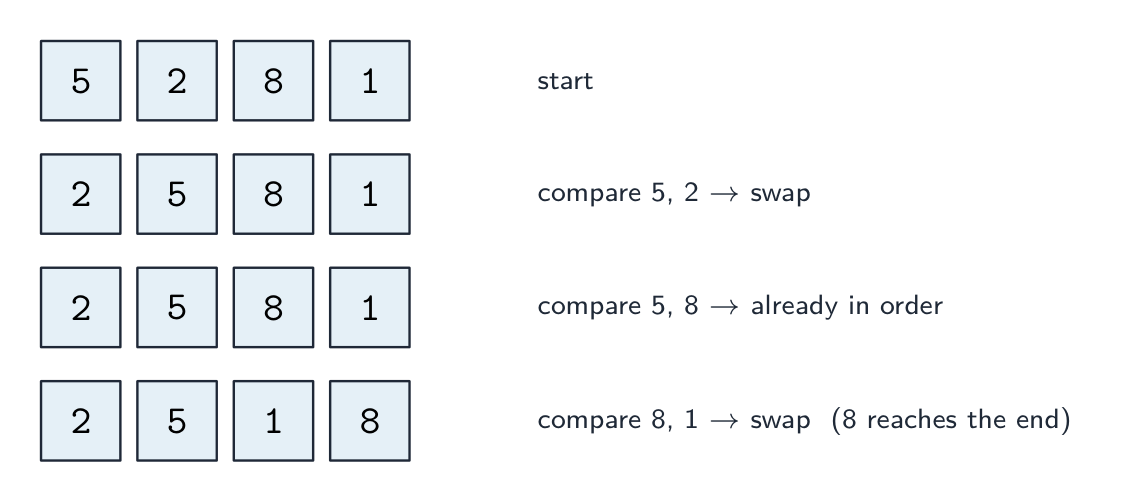
A bubble sort 冒泡排序 puts an array in order: pass through it comparing each adjacent pair and swapping any that are out of order; repeat the passes until one pass makes no swaps.
Paper 2 asks for these algorithms both as pseudocode and as steps in words, and sometimes in their "efficient" form:
- Largest value: set
Largestto the first element; for each remaining element, if it is bigger thanLargest, store it inLargest; after the loop outputLargest. For the position of the largest, keep a second variable that stores the index each timeLargestchanges. - Linear search returning a position: set
FoundAt ← -1before the loop (a value that can never be a valid index, so it means "not found"); loop through the array; when the element matches, store the index and leave the loop; after the loop testFoundAt. - Count or output the non-blank elements: compare each element with the marker for an unused element (
""or-1) and count or output only those that differ. - Remove an item: find its index by a linear search; move every later element one place towards the start, so the gap closes; mark the last element as unused (or decrease the count).
- Insert into a sorted array: find the first index whose element is larger; move that element and every later one one place towards the end; store the new value in the gap.
- Efficient bubble sort: a
Swappedflag so that the passes stop as soon as a pass makes no swap, and an upper limit that falls by one each pass because the largest value has already reached the end.
REPEAT
    Swapped ← FALSE
    FOR Index ← 1 TO Limit - 1
        IF Data[Index] > Data[Index + 1] THEN
            Temp ← Data[Index]
            Data[Index] ← Data[Index + 1]
            Data[Index + 1] ← Temp
            Swapped ← TRUE
        ENDIF
    NEXT Index
    Limit ← Limit - 1
UNTIL Swapped = FALSE
The marks are for the outer loop that repeats until no swaps, the flag set inside the IF, the three-line swap with a temporary variable, and the shrinking limit. A sort in "steps" (stepwise refinement) is: repeat until sorted; on each pass compare adjacent pairs; swap a pair that is out of order; after each pass the largest unsorted value is at the end. Two 1-D arrays of records or of parallel data are processed with one loop and one index; a 2-D array needs a nested loop, the outer over rows and the inner over columns, and a search in one row fixes the row index and loops over the column.
Explore
A 2-D array
Pick a row and column to read one element — how a grid of data is stored and indexed.
Vocabulary
Train
| English | Chinese | Pinyin |
|---|---|---|
| array | 数组 | shù zǔ |
| index | 索引 | suǒ yǐn |
| element | 元素 | yuán sù |
| bounds | 边界 | biān jiè |
| dimension | 维度 | wéi dù |
| lower bound | 下界 | xià jiè |
| upper bound | 上界 | shàng jiè |
| linear search | 线性查找 | xiàn xìng chá zhǎo |
| bubble sort | 冒泡排序 | mào pào pái xù |
10.3
Files
Syllabus
| Candidates should be able to: | Notes and guidance |
|---|---|
| Show understanding of why files are needed | |
| Write pseudocode to handle text files that consist of one or more lines |
Source: Cambridge International syllabus
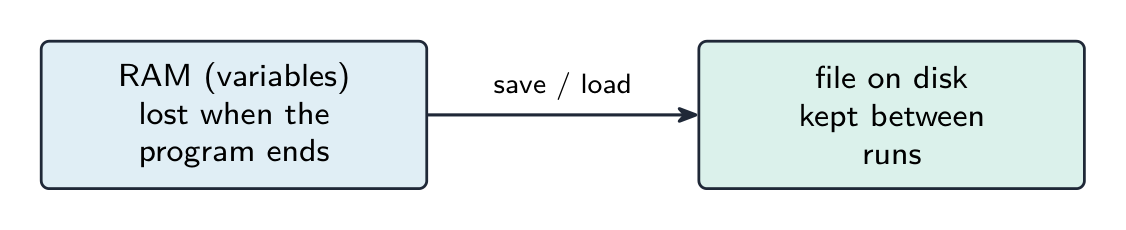
A file 文件 is data stored on secondary storage 辅助存储器, kept between program runs. Variables in RAM disappear when the program ends, so to save data permanently (high scores, records, settings) the program writes to a file. Files also let programs share data and restart from a saved state.
A text file 文本文件 holds one or more lines of readable characters; programs read and write text files line by line. Open a file before use and close it after:
OPENFILE "data.txt" FOR READ      // or FOR WRITE, FOR APPEND
WHILE NOT EOF("data.txt") DO
    READFILE "data.txt", LineString
    OUTPUT LineString
ENDWHILE
CLOSEFILE "data.txt"
EOF tests the end of file 文件结束 before reading. To write:
OPENFILE "log.txt" FOR WRITE
FOR i ← 1 TO 100
    WRITEFILE "log.txt", "Event " & i
NEXT i
CLOSEFILE "log.txt"
Always close every file — otherwise buffered writes may be lost and other programs may be locked out.
Why files (two marks): the data is kept after the program ends, so it is available the next time the program runs; it can be shared with other programs; and it can hold more than fits in memory. The characteristic of a text file that lets a program work through it is that it is a sequence of lines, read one after another from the start. The three modes: READ to read from the start; WRITE to create a new file, which deletes any existing contents, so it cannot be used to add to a file; APPEND to add lines at the end of an existing file. Test EOF before every read, and open the file only once, even when several modules use it.
Worked example. Write pseudocode for a procedure LastLines(FileName : STRING) that outputs the last three lines of a text file, in order.
PROCEDURE LastLines(BYVAL FileName : STRING)
    DECLARE LineX, LineY, LineZ : STRING
    LineX ← ""
    LineY ← ""
    LineZ ← ""
    OPENFILE FileName FOR READ
    WHILE NOT EOF(FileName) DO
        LineX ← LineY
        LineY ← LineZ
        READFILE FileName, LineZ
    ENDWHILE
    CLOSEFILE FileName
    OUTPUT LineX
    OUTPUT LineY
    OUTPUT LineZ
ENDPROCEDURE
Each new line pushes the previous three along, so when the file ends the three variables hold its last three lines; a file with fewer lines outputs empty strings. To output the first five lines, count the lines read and stop the loop at five or at EOF, whichever comes first; a file that is empty is detected by EOF being TRUE immediately after opening.
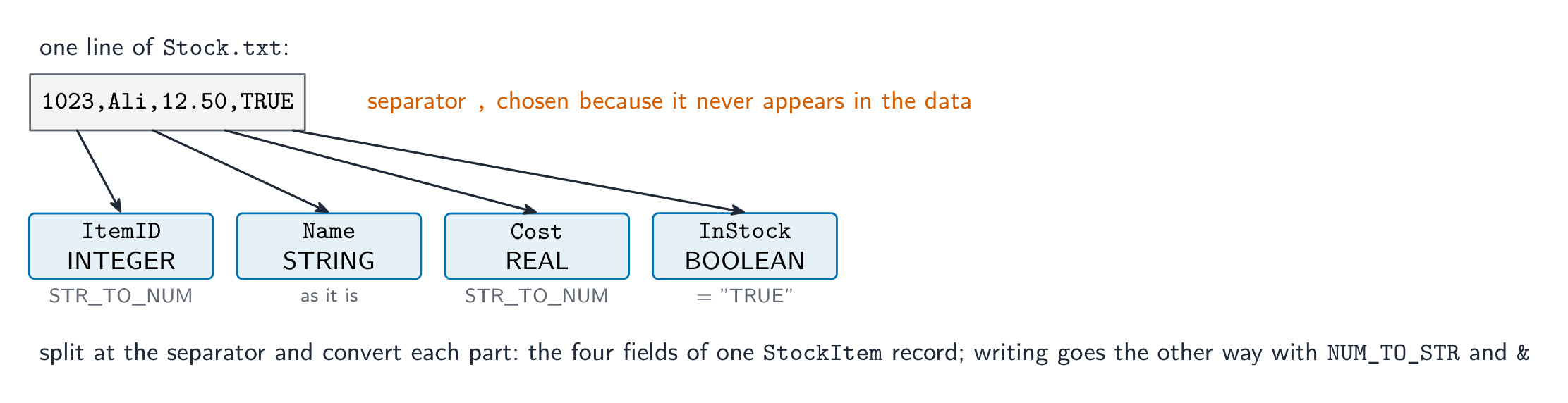
Fields in a line. A text file holds strings, so a record is written as one line with its fields joined by a separator 分隔符 character, and each number or Boolean converted with NUM_TO_STR (and read back with STR_TO_NUM, or by comparing with "TRUE"). Choose a separator that can never appear in the data: a comma or | for names and numbers, never a space when a name may contain one. If a field may contain any character, the separator can be confused with data; the fix is to put each field on its own line, or to write the field's length before it. One item per line is simple to read back but uses more lines and makes a record harder to see as a unit. Reading a file whose lines are in a known order (ascending by an ID) allows the search to stop as soon as a larger ID is read, instead of reading to the end. A save file that is created each time the game is saved needs a meaningful filename, for instance the player's name and the date and time, so that any earlier save can be restored.
Explore
Handling a file: open → use → close
Step through the lifecycle every file follows. The two easy-to-forget parts are testing EOF while reading in a loop, and always closing at the end.
Vocabulary
Train
| English | Chinese | Pinyin |
|---|---|---|
| file | 文件 | wén jiàn |
| secondary storage | 辅助存储器 | fǔ zhù cún chǔ qì |
| text file | 文本文件 | wén běn wén jiàn |
| end of file | 文件结束 | wén jiàn jié shù |
| separator | 分隔符 | fēn gé fú |
10.4
Abstract Data Types (ADTs)

Syllabus
| Candidates should be able to: | Notes and guidance |
|---|---|
| Show understanding that an ADT is a collection of data and a set of operations on those data | |
| Show understanding that a stack, queue and linked list are examples of ADTs | Describe the key features of a stack, queue and linked list and justify their use for a given situation |
| Use a stack, queue and linked list to store data | Candidates will not be required to write pseudocode for these structures, but they should be able to add, edit and delete data from these structures |
| Describe how a queue, stack and linked list can be implemented using arrays |
Source: Cambridge International syllabus
An Abstract Data Type 抽象数据类型 (ADT) is a collection of data plus operations on it, defined by what it does, not how it is stored. The user works only through the operations; the implementation is hidden, so it can change without affecting code that uses the ADT. Know three: stack, queue, linked list.
The one-mark definition: an ADT is a collection of data together with a set of operations on that data. A stack, a queue, a linked list, a binary tree and an array are all ADTs. To justify a choice: a queue when items must be handled in the order they arrived (print jobs, key presses, customers in a shop), because it is first in, first out; a stack when the most recent item must be handled first (undo, going back through web pages, reversing an order, the return addresses of nested calls), because it is last in, first out; a linked list when items are inserted and deleted in the middle of an ordered sequence often, because only pointers change and nothing has to be shifted. To compare a stack and a queue: both are linear structures of items with an order, both are implemented with an array and pointers, and both need a check for full before adding and for empty before removing; a stack has one pointer and adds and removes at the same end, a queue has two pointers and adds at one end and removes at the other.
Stack
A stack 栈 works in LIFO 后进先出 order (Last In, First Out). Operations: push 入栈 (add to the top), pop 出栈 (remove from the top), peek (look at the top), and tests for empty/full. Uses: undo history, function-call return addresses, expression parsing, backtracking.
Worked example. A stack of characters holds, from the bottom, 'P', 'N', 'Z', 'X', 'Y', 'W', with the top-of-stack pointer at 'W' (memory location 202 of 200–207). The operations POP, POP, PUSH 'A', PUSH 'B', POP are performed. What is on the stack, and where does the pointer point?
The two pops remove 'W' then 'Y'; the pushes add 'A' then 'B' in their places; the last pop removes 'B'. The stack now holds 'P', 'N', 'Z', 'X', 'A' and the pointer is at 'A', location 203. The value that has been on the stack longest is the bottom item, 'P'; at most five further pops are possible before the stack is empty, and a pop on an empty stack is an error, which is why Pop() tests for empty first. A Push() function that returns TRUE on success first tests whether the pointer is at the top of the array (full) and returns FALSE if so. The array elements need no initialising before use, because the pointer alone says which elements are in use.

Queue
A queue 队列 works in FIFO 先进先出 order (First In, First Out). Operations: enqueue 入队 (add to the rear), dequeue 出队 (remove from the front), and tests for empty/full. Uses: print spooling, scheduling, breadth-first search, buffering.
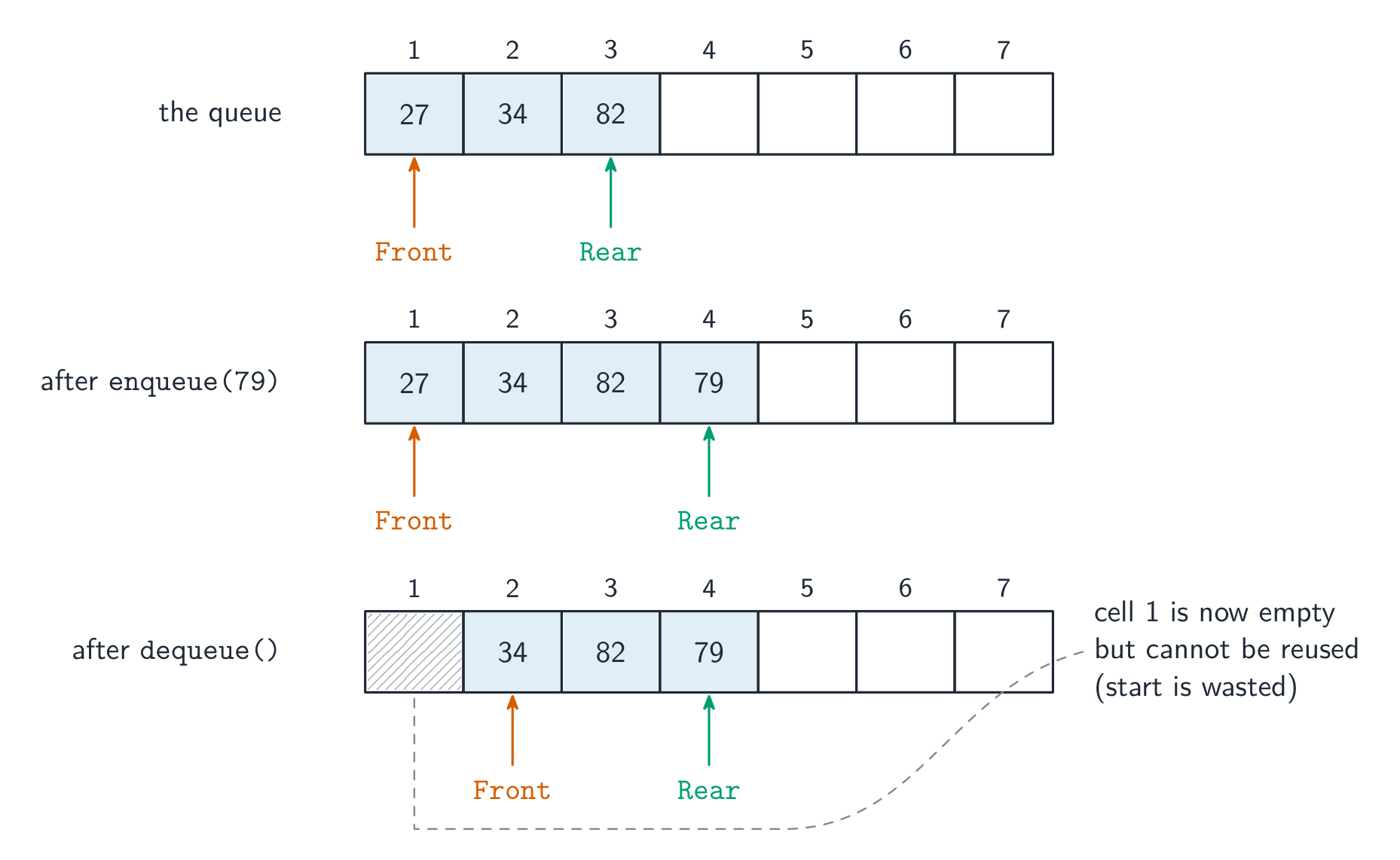
To describe adding an item: check that the queue is not full; store the item at the position given by the end-of-queue pointer; increment the end pointer (and the count). To describe removing: check that the queue is not empty; read the item at the front pointer; increment the front pointer (and decrement the count). State the convention you use: if the end pointer marks the next free space, front and end pointers being equal means the queue is empty; if it marks the last item, equal pointers mean one item. In a linear queue the front pointer only ever moves forward, so cells behind it are wasted; that is what the circular queue below fixes. The two features of a queue to state: items are added at the rear and removed from the front, so the first item added is the first removed.

Linked list
A linked list 链表 stores data as a sequence of nodes 节点. Each node holds a value and a pointer 指针 to the next node; a head pointer marks the start, and the last node's pointer is a sentinel (e.g. NULL). Operations: insert, delete, search, and traverse 遍历 (visit each node in order). Its advantage over an array is cheap insertion/deletion (just adjust pointers); its disadvantage is slow random access (you must follow pointers from the head).

Adding a node in order (four marks): traverse the list from the head, following the pointers, until the node before the position is found (the last node whose value is smaller); take a free node and store the new value in it; set the new node's pointer to the address the previous node pointed to; set the previous node's pointer to the new node. If the new value belongs at the front, the head pointer is changed instead. Deleting a node: find the node before it, and set that node's pointer to the address the deleted node pointed to, so the list bypasses it; the freed node returns to the free list. Compared with a 1-D array, inserting or deleting in a linked list needs no shifting of the other items, and the list can grow until memory runs out; the cost is the extra pointer stored with every item, and that reaching the $n$th item means following $n$ pointers, since there is no direct index.
Explore
A linked list: nodes joined by pointers
Each node stores a value and a pointer to the next node. Inserting or deleting just re-links pointers — no items shift along, unlike an array.
Explore
Stacks and queues
Push and pop. A stack is last-in-first-out; a queue is first-in-first-out — two key ADTs.
Vocabulary
Train
| English | Chinese | Pinyin |
|---|---|---|
| Abstract Data Type | 抽象数据类型 | chōu xiàng shù jù lèi xíng |
| stack | 栈 | zhàn |
| LIFO | 后进先出 | hòu jìn xiān chū |
| push | 入栈 | rù zhàn |
| pop | 出栈 | chū zhàn |
| queue | 队列 | duì liè |
| FIFO | 先进先出 | xiān jìn xiān chū |
| enqueue | 入队 | rù duì |
| dequeue | 出队 | chū duì |
| linked list | 链表 | liàn biǎo |
| nodes | 节点 | jié diǎn |
| pointer | 指针 | zhǐ zhēn |
| traverse | 遍历 | biàn lì |
10.4
Implementing ADTs using arrays

Stack using an array
Hold items in Stack[1:MaxSize] with an integer Top (0 when empty).
Push(x): ifTop = MaxSizethe stack is full (overflow 溢出); elseTop ← Top + 1;Stack[Top] ← x.Pop(): ifTop = 0the stack is empty (underflow 下溢); else returnStack[Top]andTop ← Top - 1.
Queue using a circular array
A simple queue lets Front and Rear march off the end, wasting the start. The fix is a circular array 循环数组 — when a pointer reaches MaxSize it wraps back to 1:
Enqueue(x): check full; elseRear ← (Rear MOD MaxSize) + 1;Queue[Rear] ← x.Dequeue(): check empty; else returnQueue[Front]andFront ← (Front MOD MaxSize) + 1.
Track a separate count to tell empty from full.
The algorithm for the end pointer, in words: if the count equals the size, report that the queue is full and stop; otherwise add one to the end pointer; if it is now past the last index, set it to the first index; store the item there and add one to the count. The declarations that a five-mark "describe the declaration and initialisation" answer lists: the array with its size and element type; a front pointer and an end pointer, both initialised to the first index (or the front to the first index and the end to the next free space); and a count of items, initialised to $0$.
For example, with MaxSize = 6: if Rear = 5, then (5 MOD 6) + 1 = 6, so the next item goes in cell 6; if Rear = 6, then (6 MOD 6) + 1 = 1, so the pointer wraps back to cell 1.
Linked list using an array
Use an array of records, each with a Next index:
TYPE TNode
    DECLARE Value : INTEGER
    DECLARE Next : INTEGER     // index of the next node, or -1 for end
ENDTYPE

DECLARE Nodes : ARRAY[1:MaxSize] OF TNode
DECLARE Head : INTEGER         // index of first node, -1 if empty
DECLARE FreeListHead : INTEGER // first available free node
A free list 空闲列表 chains the unused slots, just as the data list chains its used ones. To insert: take a slot from FreeListHead, set the new node's value and Next, and update the previous node's Next (or Head). To delete: unlink the node and return its slot to the free list. This gives the flexibility of a linked structure with the static allocation of an array.

Worked example. A linked list is held in a Data array and a Pointer array, with Start pointing to index 1. The list is 1 → 3 → 4 (index 1 holds D40, index 3 holds D32, index 4 holds D11, whose pointer is $\emptyset$); the free list starts at index 2 and continues 2 → 5. Insert D6 between D32 and D11.
Take the first free node, index 2, and set FreeStart to its pointer, 5; store D6 in Data[2]; set Pointer[2] to the value Pointer[3] held, which is 4; set Pointer[3] to 2. The list reads 1 → 3 → 2 → 4 and the free list is 5 → $\emptyset$. The answer to "how can the linked list be implemented" is exactly these parts: an array (or array of records) for the data, a parallel array for the pointers holding indices, a start pointer, a free-list pointer and a null value such as $-1$ for the end.
Worked example. A circular queue is held in an array of size 5 (indices 0 to 4) with Front = 3, Rear = 3 and one item stored. Two items are added, then two are removed. Where are the pointers, and why use a circular queue at all? Every move uses (pointer + 1) MOD size, so the pointers wrap. Adding twice moves Rear: $3 \rightarrow 4$, then $4 \rightarrow 0$ (because $(4+1) \bmod 5 = 0$), so Rear = 0 and three items are stored. Removing twice moves Front the same way: $3 \rightarrow 4$, then $4 \rightarrow 0$, leaving Front = 0 and one item. The wrap is the whole point: in a linear array queue the pointers march to the end and the freed space at the front is wasted even when the queue is empty. Remember a queue removes at the Front and adds at the Rear - a stack uses one pointer for both.
Explore
Implementing ADTs with arrays
FIFO
A queue is first-in-first-out — enqueue at the back, dequeue from the front.
Vocabulary
Train
| English | Chinese | Pinyin |
|---|---|---|
| overflow | 溢出 | yì chū |
| underflow | 下溢 | xià yì |
| circular array | 循环数组 | xún huán shù zǔ |
| free list | 空闲列表 | kòng xián liè biǎo |
10.4
Definitions the examiner accepts
A definition question is marked against fixed wording. Learn these exactly.
| Term | Definition |
|---|---|
| record | a data structure that holds a set of data items (fields) of different data types under one identifier |
| array | a data structure that holds a fixed number of elements of the same data type under one identifier, each accessed by an index |
| index | the number that identifies one element of an array |
| upper bound, lower bound | the largest and smallest valid index of an array |
| text file | a file that stores data as lines of characters, which a program reads and writes one line at a time |
| abstract data type | a collection of data together with a set of operations on that data |
| stack | a list in which items are added to and removed from the same end, the top, so the last item added is the first removed (LIFO) |
| queue | a list in which items are added at the rear and removed from the front, so the first item added is the first removed (FIFO) |
| linked list | a list in which each node holds a data item and a pointer to the next node, with a start pointer to the first node |
| pointer | a variable that holds the address (or index) of a node or of a position in a structure |
| linear search | checking each element in turn from the first until the target is found or the end is reached |
| bubble sort | repeated passes through the array comparing adjacent pairs and swapping those out of order, until a pass makes no swaps |
10.4
Exam tips
- Choose the right data structure and justify it (a record for mixed fields, a 2-D array for a grid).
- Know how to implement a stack, queue and linked list with an array and pointers (top; front/rear; next).
- Distinguish an ADT (its behaviour) from its implementation (array plus pointers).
Common mistakes
- A record declaration without
ENDTYPE, or fields without types. Every field is aDECLAREline with a type. - Reading past the end of a file, or writing with
WRITEwhen the file must keep its contents. TestEOFbefore each read; useAPPENDto add. - Writing a number to a text file without converting it. A file holds strings:
NUM_TO_STRout,STR_TO_NUMback. - Forgetting the checks.
Pushand enqueue test for full first;Popand dequeue test for empty first, and the answer says so. - Losing the rest of the list when inserting a node. Set the new node's pointer to the old next node before changing the previous node's pointer.
- A linear search that never says "not found". Initialise the position to $-1$ and test it after the loop.
Interactive lessons on this topic
Work through it step by step, with instant-check exercises.
A-Level Computer Science Past Papers