| Candidates should be able to: | Notes and guidance |
|---|---|
| Show understanding of binary magnitudes and the difference between binary prefixes and decimal prefixes | Understand the difference between and use: • kibi and kilo • mebi and mega • gibi and giga • tebi and tera |
| Show understanding of different number systems | Use the binary, denary, hexadecimal number bases and Binary Coded Decimal (BCD) and one’s complement and two’s complement representation for binary numbers |
| Convert an integer value from one number base/ representation to another | |
| Perform binary addition and subtraction | Using positive and negative binary integers |
| Show understanding of how overflow can occur | |
| Describe practical applications where Binary Coded Decimal (BCD) and Hexadecimal are used | |
| Show understanding of and be able to represent character data in its internal binary form, depending on the character set used | Students are expected to be familiar with ASCII (American Standard Code for Information Interchange), extended ASCII and Unicode. Students will not be expected to memorise any particular character codes |
A-Level Computer Science
Tips
A-Level Computer Science (9618) is two halves that feel like different subjects. The theory half runs from information representation and communication through hardware, processors, system software, security, databases and ethics. The practical half is algorithms, data structures, programming and software development, and A2 adds recursion and object-oriented programming.
The theory papers are marked far more literally than students expect. There is a correct vocabulary — register names, addressing modes, normal forms, the exact difference between validation and verification — and a paraphrase usually scores nothing. Learn the definitions in the syllabus wording.
The programming papers reward writing code by hand until it compiles in your head.
-
1
Information representation
1.1
Number systems

Syllabus
Source: Cambridge International syllabus
Counting in binary: 0 to 15 The three number systems 数制 you must use:
- denary 十进制 (decimal, base 10) — uses digits 0–9. Place values are powers of ten.
- binary 二进制 (base 2) — uses 0 and 1. Place values are powers of two. Every byte 字节 is 8 bits 位.
- hexadecimal 十六进制 (base 16) — uses 0–9 then A–F for 10–15. Each hex digit 数位 stands for exactly 4 bits.
An abacus represents numbers by place value — the same idea behind decimal, binary and hexadecimal Conversions
Denary → binary: keep dividing by 2 and record the remainders, read bottom-up. Or subtract the largest place value 位值 (power of 2) that fits.
Example: $558_{10}$: $558 = 512 + 32 + 8 + 4 + 2 = 2^{9} + 2^{5} + 2^{3} + 2^{2} + 2^{1}$. In 12 bits:
0010 0010 1110.Binary → hex: group the bits into nibbles 半字节 (4 bits) from the right and convert each.
0010 0010 1110→2 2 E→22E.Hex → binary: replace each hex digit with its 4-bit pattern. Hex → denary: multiply each digit by its place value.
22E$= 2 \times 256 + 2 \times 16 + 14 = 558$.Worked example. Convert denary 200 to 8-bit binary, then to hexadecimal.
$200 = 128 + 64 + 8$, so the binary is
11001000. In nibbles,11001000$= 12$ and $8$, i.e. $\text{C}$ and $8$, so the hexadecimal isC8.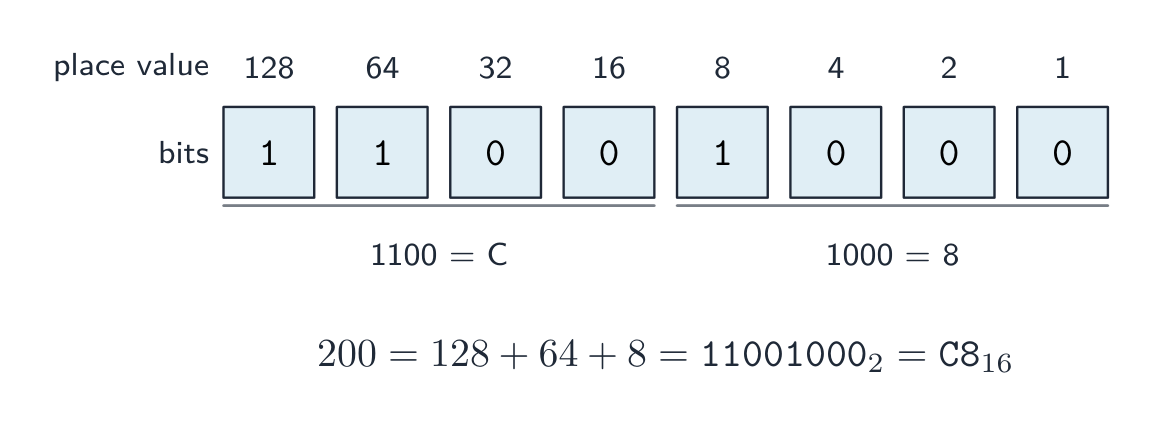
Reading 200 from its place values, then grouping the bits into nibbles to get hex C8 How many bits?
Exam questions fix the register width 寄存器宽度 (8, 12 or 16 bits). Pad with leading zeros to that width: $558$ in 12 bits is
0010 0010 1110, never10 0010 1110.To find the minimum number of bits that can store a value, ask which place values you need:
- an unsigned integer from $0$ to $2^{n} - 1$ needs $n$ bits: $200$ needs 8 bits (the top is $255$), $1000$ needs 10 bits (the top is $1023$), $16$ needs 5 bits (4 bits stop at $15$).
- a signed two's-complement integer from $-2^{n-1}$ to $2^{n-1} - 1$ needs $n$ bits: $-200$ needs 9 bits, because 8 bits stop at $-128$.
- one hexadecimal digit needs 4 bits, one BCD digit needs 4 bits, and one ASCII character needs 7 bits (8 for extended ASCII).
Binary vs decimal prefixes
Two prefix families look similar but differ — decimal (powers of 10) and binary (powers of 2):
Decimal (SI) Binary (memory) kilo $= 10^{3}$ kibi (Ki) $= 2^{10} = 1024$ mega $= 10^{6}$ mebi (Mi) $= 2^{20}$ giga $= 10^{9}$ gibi (Gi) $= 2^{30}$ tera $= 10^{12}$ tebi (Ti) $= 2^{40}$ So a tebibyte (TiB) is slightly more than a terabyte (TB). A "1 TB" drive holds $10^{12}$ bytes, but an operating system that reports in TiB shows a smaller number.
ExploreBinary, denary and hex
Type a number and see it in binary, denary and hexadecimal at once — and how the place values add up.
Vocabulary TrainEnglish Chinese Pinyin number systems 数制 shù zhì denary 十进制 shí jìn zhì binary 二进制 èr jìn zhì byte 字节 zì jié bits 位 wèi hexadecimal 十六进制 shí liù jìn zhì digit 数位 shù wèi place value 位值 wèi zhí nibbles 半字节 bàn zì jié register width 寄存器宽度 jì cún qì kuān dù 1.1
Binary arithmetic
Binary addition
Add column by column from the right, carrying as in denary:
Bit A Bit B Carry in Sum bit Carry out 0 0 0 0 0 0 0 1 1 0 0 1 0 1 0 0 1 1 0 1 1 1 0 0 1 1 1 1 1 1 Overflow 溢出 happens when the result needs more bits than the register 寄存器 can hold — the carry-out of the leftmost column is the overflow bit.
Worked example. Add the 8-bit unsigned integers $10110101$ and $01101100$, and comment on the result.
$10110101 + 01101100 = 1\,00100001$. The answer needs 9 bits, so it does not fit in an 8-bit register: overflow has occurred. A full answer names the error and says why, using the word size the question gave: "Overflow: the true result ($289$) is larger than the largest value an 8-bit register can hold ($255$), so the carry out of the most significant bit is lost and the stored result ($00100001 = 33$) is wrong."
Binary subtraction
The usual way is two's complement 补码 addition: to do $A - B$, form the two's complement of $B$ (invert every bit and add 1), then add, and discard any final carry-out.
To subtract $00011110$ from $01100100$ (unsigned 8-bit):
- two's complement of $00011110$: invert → $11100001$, add 1 → $11100010$.
- add to $01100100$: result $1\,01000110$ (9 bits) — discard the leading 1 → $01000110 = 70_{10}$. Check: $100 - 30 = 70$. ✓
Two's complement signed integers
In an $n$-bit two's-complement number:
- the most significant bit 最高有效位 (MSB) is the sign bit 符号位: 0 = positive, 1 = negative.
- to read a negative number: invert every bit, add 1, then negate.
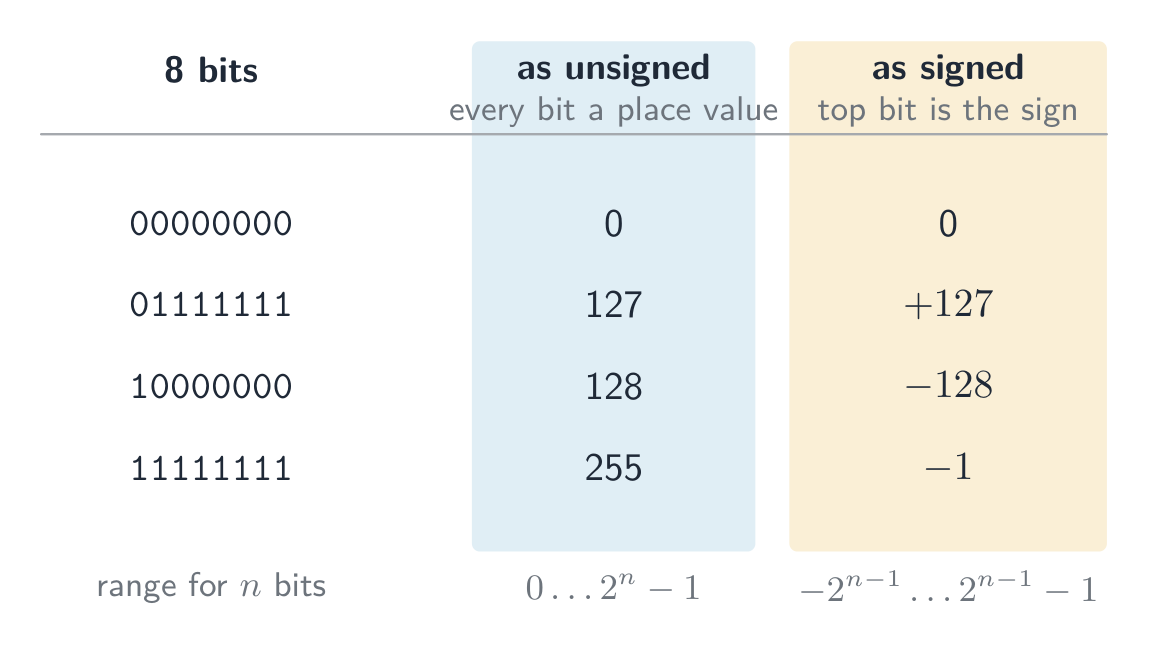
So $11100010$ is negative; invert → $00011101$, add 1 → $00011110 = 30$, so it is $-30$. This is a signed integer 有符号整数 (unlike an unsigned 无符号 one). The range for $n$ bits is $-2^{n-1}$ to $+2^{n-1} - 1$; for 8 bits, $-128$ ($10000000$) to $+127$ ($01111111$).
The same bits mean different numbers depending on the agreed reading. As an unsigned integer every bit is a place value, so 8 bits run from $0$ to $255$; as a signed two's-complement integer the top bit is the sign, so the same 8 bits run from $-128$ to $+127$. The pattern $11111111$ is $255$ read one way and $-1$ read the other — nothing in the bits themselves says which.
The same byte read as unsigned and as signed: only the agreed interpretation tells them apart  8-bit two's complement: the sign bit splits the range into negative ($-128$ to $-1$) and positive ($0$ to $127$)
Worked example. What denary value does the 8-bit two's-complement number $10110100$ represent?
The MSB is 1, so it is negative. Invert → $01001011$, add 1 → $01001100 = 76$, so the value is $-76$. Check with place values: $-128 + 32 + 16 + 4 = -76$.
Worked example. Write $-108$ as a 12-bit two's-complement integer.
Start from $+108$ in 12 bits: $108 = 64 + 32 + 8 + 4$, so
0000 0110 1100. Invert every bit:1111 1001 0011. Add 1:1111 1001 0100. Check with place values, where the top bit is worth $-2^{11} = -2048$: $-2048 + 1024 + 512 + 256 + 128 + 16 + 4 = -108$. ✓For 12 bits the range is $-2048$ (
1000 0000 0000) to $+2047$ (0111 1111 1111). Questions that ask for the smallest and largest values want these two patterns, so learn the rule: the most negative number is a 1 followed by zeros; the most positive is a 0 followed by ones.An arithmetic shift 算术移位 moves every bit left or right but keeps the sign: a shift right by one place halves the value and copies the sign bit into the empty space on the left, so a negative number stays negative (
1111 1001 0100shifted right three places is1111 1111 0010, which is $-14$: $-108 / 8 = -13.5$, and a shift right rounds down). A shift left doubles the value. Shifts belong to the assembly instruction set in topic 4, but this question is asked with the number work here.Overflow in signed arithmetic happens when the true result falls outside this range — spotted when the sign bit flips wrongly (two positives giving a negative, or two negatives giving a positive).
One's complement
Before two's complement, an older scheme called one's complement 反码 represented a negative number by simply inverting every bit of the positive — there is no "add 1" step.
- $+30 = 00011110$, so in one's complement $-30 = 11100001$ (just the inverse).
- Drawback: it has two zeros — $00000000$ ($+0$) and $11111111$ ($-0$) — which wastes a bit pattern and makes arithmetic awkward.
Two's complement (invert and add 1) removes the negative zero: it has a single zero and lets addition and subtraction use the same circuit. That is why modern computers store signed integers in two's complement, not one's complement.
ExploreBinary & signed integers
byte = Σ place values
See how an 8-bit pattern maps to a number (and how it would overflow past 255).
ExploreTwo's complement signed bits
The leftmost bit carries a negative place value. Flip any bit — or hit Negate (invert every bit, then add 1) — and watch the signed value change.
Vocabulary TrainEnglish Chinese Pinyin Overflow 溢出 yì chū register 寄存器 jì cún qì two's complement 补码 bǔ mǎ most significant bit 最高有效位 zuì gāo yǒu xiào wèi sign bit 符号位 fú hào wèi signed integer 有符号整数 yǒu fú hào zhěng shù unsigned 无符号 wú fú hào arithmetic shift 算术移位 suàn shù yí wèi one's complement 反码 fǎn mǎ 1.1
Binary Coded Decimal (BCD)
In BCD 二进码十进数, each denary digit is written as its own 4-bit pattern. The number $93$ is
1001 0011in BCD — not binary 93 ($01011101$). Each nibble uses only 0–9; patterns $1010$–$1111$ are invalid.BCD reading:
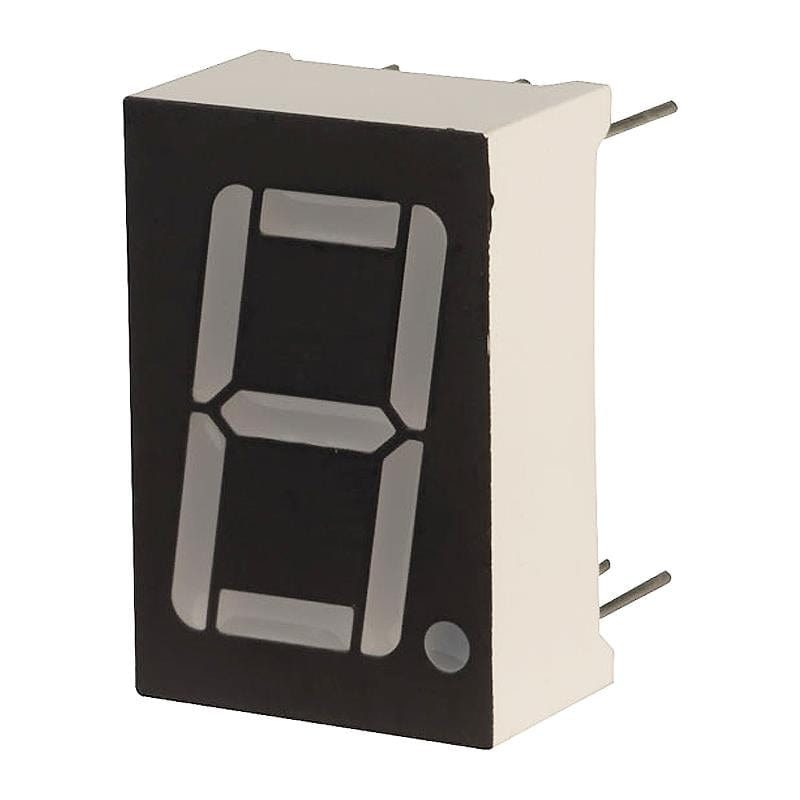
0010 0111 0101→ 2, 7, 5 → 275.Use: calculators, digital clocks, and devices that show denary digits — each digit drives a 7-segment display 七段显示器. Currency code often uses BCD to avoid the rounding errors of converting fractions like 0.1 to binary.
A "justify" answer must link the use to a property of BCD: each denary digit has its own 4 bits, so a digit can be sent straight to its display, or added digit by digit, with no conversion of the whole number; and a decimal fraction such as $0.10$ is stored exactly, which a binary fraction cannot do.
A seven-segment display shows one denary digit, often driven by BCD Vocabulary TrainEnglish Chinese Pinyin BCD 二进码十进数 èr jìn mǎ shí jìn shù 7-segment display 七段显示器 qī duàn xiǎn shì qì 1.1
Hexadecimal — practical uses

Hex is a compact way to write binary (1 hex digit = 4 bits):
A byte is two nibbles; each nibble is one hex digit - memory addresses 内存地址 in low-level programming —
0x7FFE. - colour values in HTML/CSS —
#FF8800. - MAC addresses —
AC:DE:48:00:11:22.
Hex does not change the stored data — it just makes binary easier for humans.
Vocabulary TrainEnglish Chinese Pinyin memory addresses 内存地址 nèi cún dì zhǐ 1.1
Character codes

Computers store text as numbers; each character has a numeric code point 码点 set by a character set 字符集.
ASCII
- ASCII uses 7 bits — 128 code points. Basic Latin letters, digits, punctuation, and control codes.
- Extended ASCII uses 8 bits — 256 code points; the lower 128 match ASCII, the upper 128 vary by region.
Each character is stored as a number — a few ASCII code points in denary and binary Unicode
- Unicode is a universal character set covering almost every script, plus symbols and emoji.
- common encodings 编码: UTF-8 (1–4 bytes, ASCII-compatible), UTF-16 (2 or 4 bytes), UTF-32 (fixed 4 bytes).
Why Unicode beats ASCII
- it represents far more characters (every script, emoji); ASCII covers only basic English.
- files are portable with no code-page confusion, and allow multilingual text in one document.
- trade-off: Unicode files are usually larger for English-only text.
When a question asks for differences, give them in pairs with numbers: ASCII uses 7 bits (extended ASCII 8), so 128 (256) characters; Unicode uses up to 32 bits (UTF-8 uses 1 to 4 bytes), so more than a million code points. ASCII covers basic English only; Unicode covers every script, and its first 128 code points are the ASCII ones. In UTF-8 an English letter still takes 1 byte, so a 40-letter English file name is 40 bytes in ASCII and in UTF-8 alike, while a Chinese character takes 3 bytes.
ExploreA character is stored as a number
Each character has a code number — 'A' is 65. Flip the bits to see that code in binary and hex, exactly how the computer holds it.
Vocabulary TrainEnglish Chinese Pinyin code point 码点 mǎ diǎn character set 字符集 zì fú jí encodings 编码 biān mǎ 1.2
Bitmap images
Syllabus
Candidates should be able to: Notes and guidance Show understanding of how data for a bitmapped image are encoded Use and understand the terms: pixel, file header, image resolution, screen resolution, colour depth / bit depth Perform calculations to estimate the file size for a bitmap image Show understanding of the effects of changing elements of a bitmap image on the image quality and file size Use the terms: image resolution, colour depth / bit depth Show understanding of how data for a vector graphic are encoded Use the terms: drawing object, property, drawing list Justify the use of a bitmap image or a vector graphic for a given task Show understanding of how sound is represented and encoded Use the terms: sampling, sampling rate, sampling resolution, analogue and digital data Show understanding of the impact of changing the sampling rate and resolution Including the impact on file size and accuracy Source: Cambridge International syllabus
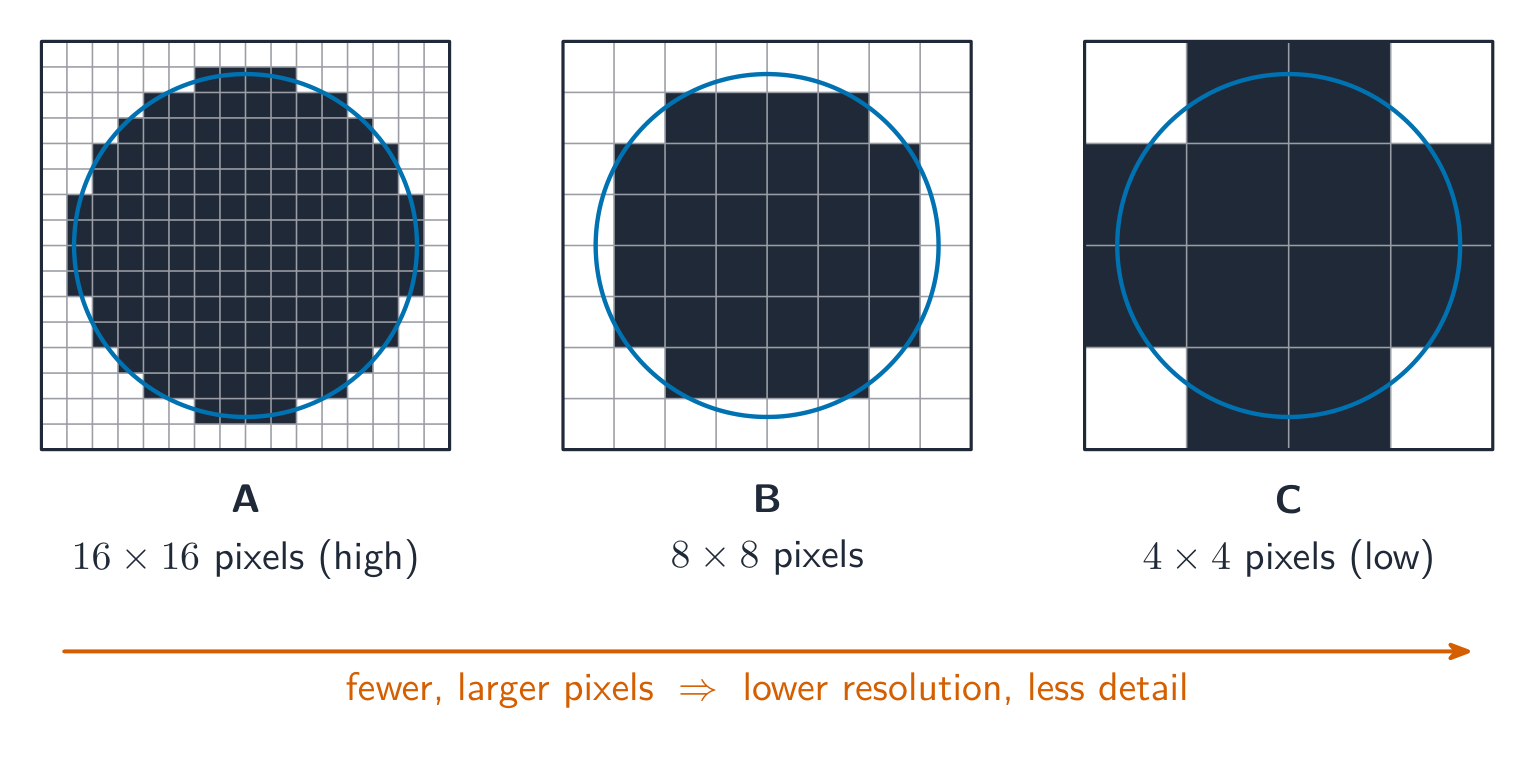
A bitmap 位图 image (also called a bitmapped image) stores the colour of every pixel 像素 in a grid. At the start of the file a file header 文件头 records the image's metadata — its width, height and colour depth — so software knows how to read the pixel data that follows.
- image resolution 图像分辨率: the bitmap's own size, width × height in pixels (e.g. 1920 × 1080).
- screen resolution 屏幕分辨率: the width × height the display can show. If an image's resolution is larger than the screen it is scaled down to fit; a low-resolution image looks blocky when stretched onto a higher-resolution screen.
- colour depth 颜色深度 (bit depth 位深度): bits per pixel. 1 bit → black/white; 8 bits → 256 colours; 24 bits → 16.7 million ("true colour").
The same image stored at three resolutions, from high (A) to low (C): fewer, larger pixels mean less detail File size
$$\text{size in bits} = \text{width} \times \text{height} \times \text{bit depth}.$$Divide by 8 for bytes, by 1024 for KiB, etc. Example: a $3000 \times 2000$ image at 24 bpp is $3000 \times 2000 \times 24 = 1.44 \times 10^{8}$ bits $\approx 17.2\ \text{MiB}$.
State the units you used. The mark scheme accepts $1\ \text{MB} = 10^{6}$ bytes (the SI prefix) or $1\ \text{MiB} = 1024 \times 1024$ bytes (the binary prefix), as long as your working shows which one; the same image is $18.0\ \text{MB}$ or $17.2\ \text{MiB}$. Add the size of the file header if the question gives one.
A video is a sequence of bitmap images, each one a frame 帧. Before compression its size is the size of one frame $\times$ the frame rate 帧率 (frames per second) $\times$ the duration in seconds: 30 frames per second of $1920 \times 1080$ pixels at 24 bits is $30 \times 1920 \times 1080 \times 24 \approx 1.5 \times 10^{9}$ bits, about $187\ \text{MB}$, for every second. That is why video is always compressed.
Changing settings
- lower resolution → smaller file, less detail (looks blocky when enlarged).
- lower colour depth → smaller file, but smooth shades show banding.
- higher of either → larger file, better quality.
Vocabulary TrainEnglish Chinese Pinyin bitmap 位图 wèi tú pixel 像素 xiàng sù file header 文件头 wén jiàn tóu image resolution 图像分辨率 tú xiàng fēn biàn lǜ screen resolution 屏幕分辨率 píng mù fēn biàn lǜ colour depth 颜色深度 yán sè shēn dù bit depth 位深度 wèi shēn dù frame 帧 zhēn frame rate 帧率 zhēn lǜ 1.2
Vector graphics
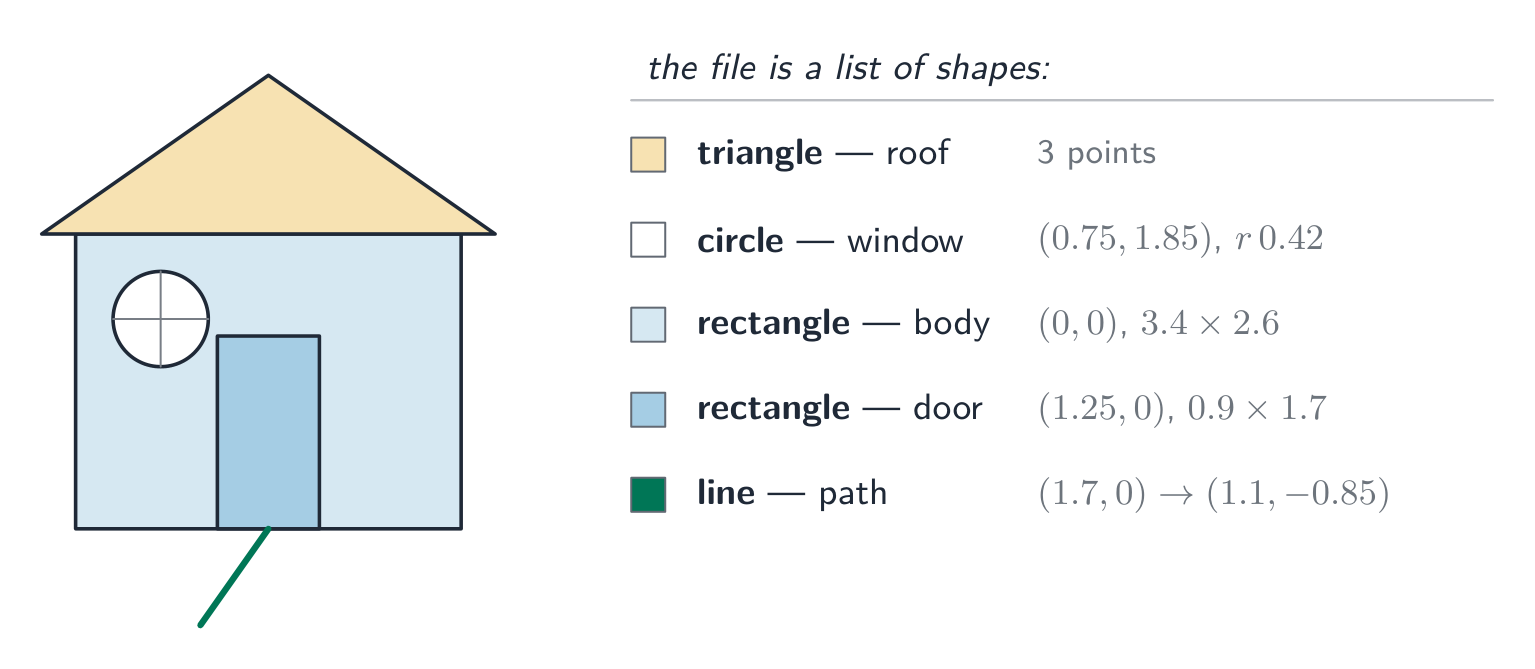
A vector graphic 矢量图形 stores the instructions to draw the image as a drawing list 绘图列表 — an ordered list of drawing objects 绘图对象 (geometric primitives 图元: lines, curves, polygons, circles). Each drawing object has properties 属性 such as colour, fill, line width and position (coordinates). To show it, the program renders 渲染 the drawing list at any resolution needed.
A vector image is built from labelled geometric shapes, each with attributes Bitmap vs vector
Task Better choice Why Photograph Bitmap Complex pixel-level detail can't be described as shapes. Logo, icon, sign Vector Sharp edges; scales to any size without blur. Engineering drawing Vector Precise geometry and scaling. Painting, texture Bitmap Smooth tonal detail per area. Vector advantage: it scales without losing quality — a vector logo stays sharp at any size, while a bitmap blurs when enlarged. Vector disadvantage: it cannot describe arbitrary pixel detail (photographs).
A "justify" answer links the choice to the task. "The logo must appear on a business card and on a billboard, so it should be a vector graphic: it is stored as drawing objects and is re-rendered sharply at any size, whereas a bitmap would show its pixels when enlarged." For a photograph the argument runs the other way: there are no shapes to describe, so every pixel's colour must be stored.

Enlarged, a bitmap's pixels turn jagged; a vector stays smooth at any size ExploreComputing concept lab
Classify concrete examples by the computing idea they demonstrate.
Vocabulary TrainEnglish Chinese Pinyin vector graphic 矢量图形 shǐ liàng tú xíng drawing list 绘图列表 huì tú liè biǎo drawing objects 绘图对象 huì tú duì xiàng primitives 图元 tú yuán properties 属性 shǔ xìng renders 渲染 xuàn rǎn 1.2
Sound
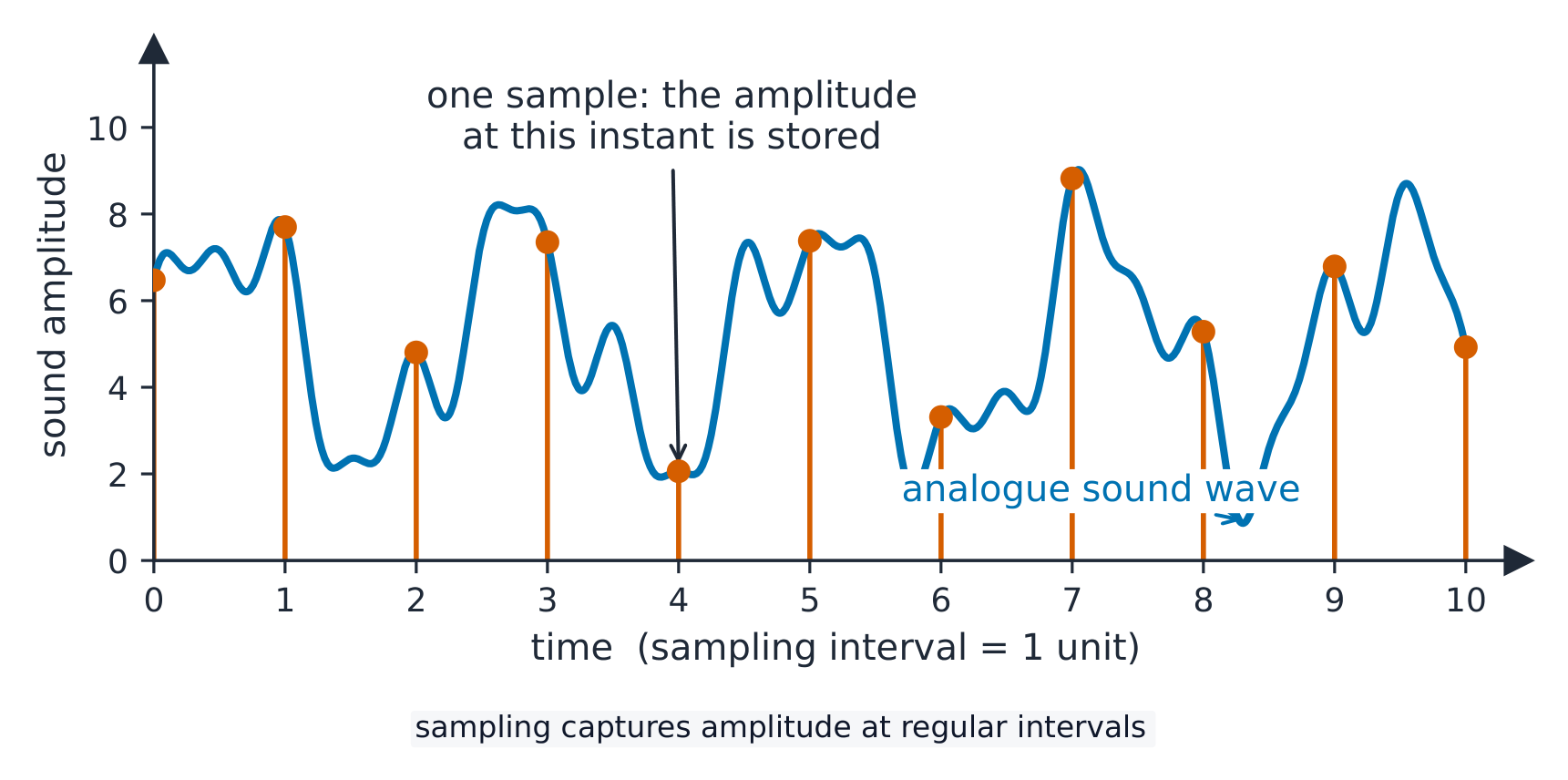
A continuous wave of analogue data 模拟数据 (the sound) is converted into digital data 数字数据 by sampling 采样:
- sampling rate 采样率 — samples per second (Hz). CD quality is $44.1\ \text{kHz}$.
- sampling resolution 采样分辨率 (bit depth) — bits per sample's amplitude 振幅. CD quality is 16 bits.
Sampling a sound wave: its amplitude is read at each time interval File size
$$\text{size in bits} = \text{sampling rate} \times \text{resolution} \times \text{duration} \times \text{channels}.$$A 10-second stereo CD clip: $44100 \times 16 \times 10 \times 2 = 14\,112\,000$ bits $\approx 1.68\ \text{MiB}$.
Changing settings
- higher sampling rate → captures higher pitches, larger file.
- higher sample resolution → finer amplitude steps, less quantisation 量化 noise, larger file.
- lower of either → smaller file, clear quality loss.
(The sampling rate must be at least twice the highest frequency you want to keep.)
ExploreSound sampling
y = a sin(bt + c)
Sampling measures a sound wave at regular intervals — a higher rate copies it more truly.
Vocabulary TrainEnglish Chinese Pinyin analogue data 模拟数据 mó nǐ shù jù digital data 数字数据 shù zì shù jù sampling 采样 cǎi yàng sampling rate 采样率 cǎi yàng lǜ sampling resolution 采样分辨率 cǎi yàng fēn biàn lǜ amplitude 振幅 zhèn fú quantisation 量化 liàng huà 1.3
Compression
Syllabus
Candidates should be able to: Notes and guidance Show understanding of the need for and examples of the use of compression Show understanding of lossy and lossless compression and justify the use of a method in a given situation Show understanding of how a text file, bitmap image, vector graphic and sound file can be compressed Including the use of run-length encoding (RLE) Source: Cambridge International syllabus
Compression 压缩 reduces file size, saving storage and transmission bandwidth 带宽. Two kinds:
- lossless 无损 — the original data is recovered exactly (text, programs, ZIP/PNG).
- lossy 有损 — some detail is dropped for much smaller files (JPEG, MP3, video).
When to use which
- lossless for documents, source code, medical images — anything needing exact data.
- lossy for streaming media. Real-time video streaming uses lossy compression because it must send huge amounts of data in real time over limited bandwidth; lossless would not shrink it enough. Raw HD video is gigabytes per minute, so without compression the picture would keep freezing.
A "justify" answer names the method, then the reason from the situation: "Lossless, because the spreadsheet must be restored exactly; a single changed value would make the accounts wrong." Or: "Lossy, because the photographs are viewed on a phone screen where the dropped detail is not visible, and the smaller files upload faster and use less storage."
Lossless methods
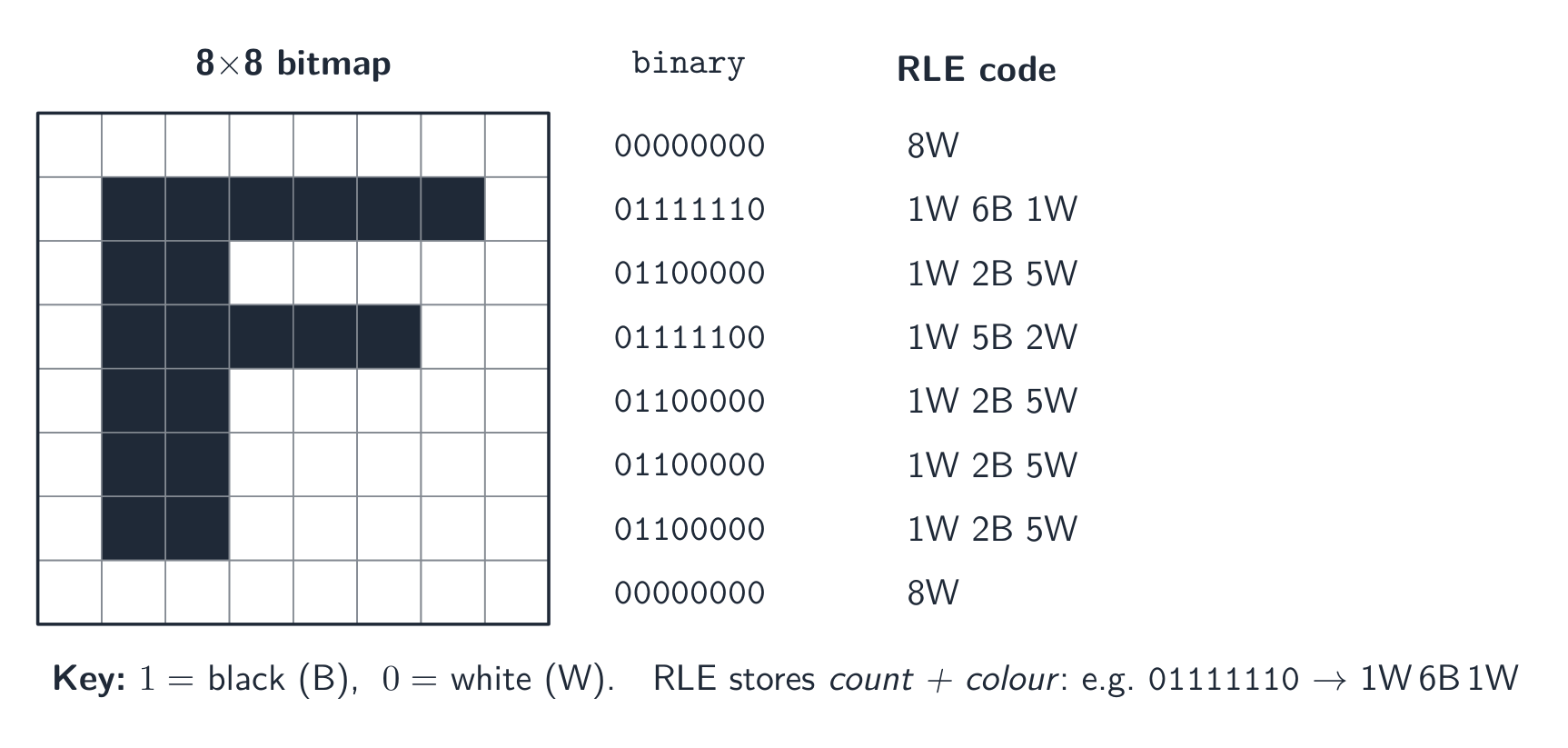
- run-length encoding 行程编码 (RLE): store "the next $n$ values are $x$" instead of repeating $x$. Great for flat areas; useless for noisy data.
- dictionary methods 字典编码 (ZIP, PNG): replace repeated byte sequences with a short reference. Good for text and code.
- Huffman coding 霍夫曼编码: give short codes to common symbols and long codes to rare ones, bringing the average code length near the data's entropy 熵.
How each kind of file is compressed:
- text file: dictionary methods and Huffman coding turn repeated words and common characters into short codes. Text must stay lossless, because one changed character changes the meaning.
- bitmap image: RLE for runs of identical pixels (icons, diagrams, black-and-white scans); lossy JPEG for photographs, or a lower colour depth or resolution.
- vector graphic: the drawing list is already small; remove drawing objects that are not needed, store coordinates to fewer decimal places, or apply a lossless method such as ZIP to the file.
- sound file: lossy MP3 or AAC removes what the ear cannot hear; a lower sampling rate or resolution is also lossy; lossless formats keep every sample and shrink the file much less.
Run-length encoding of the letter F in an $8\times8$ black-and-white grid 
Dictionary coding: each repeated sequence is stored once, and every occurrence becomes a short index 
Huffman coding: the commonest symbol gets the shortest code, so BANANA needs 10 bits instead of 12 Lossy methods
- images (JPEG): drop fine detail and colour differences the eye barely sees.
- sound (MP3, AAC): drop pitches we hear less well, and quiet sounds hidden by louder ones.
- video combines spatial 空间 compression (within each frame, like JPEG) with temporal 时间 compression (most frames store only the differences from the previous frame).

Compression methods: lossless versus lossy, with common examples ExploreRun-length encoding
Watch a run of repeated symbols get squashed into a count — simple lossless compression.
Vocabulary TrainEnglish Chinese Pinyin Compression 压缩 yā suō bandwidth 带宽 dài kuān lossless 无损 wú sǔn lossy 有损 yǒu sǔn run-length encoding 行程编码 xíng chéng biān mǎ dictionary methods 字典编码 zì diǎn biān mǎ Huffman coding 霍夫曼编码 huò fū màn biān mǎ entropy 熵 shāng spatial 空间 kōng jiān temporal 时间 shí jiān 1.3
Definitions the examiner accepts
A definition question is marked against fixed wording. Learn these exactly, and give one answer only.
Term Definition bit a single binary digit, 0 or 1 byte a group of 8 bits binary prefix a multiplier that is a power of 2 (kibi = 1024) rather than a power of 10 (kilo = 1000) two's complement a way of representing signed integers in which the most significant bit has a negative place value overflow the result of a calculation is too large to be represented in the number of bits available Binary Coded Decimal each denary digit is stored as its own 4-bit binary pattern character set the set of characters a computer can represent, each with its own binary code pixel the smallest element of a bitmap image, storing one colour value image resolution the number of pixels in an image, given as width by height screen resolution the number of pixels a display can show, given as width by height colour depth the number of bits used to store the colour of one pixel sampling rate the number of samples of the sound taken per second sampling resolution the number of bits used to store the amplitude of one sample lossless compression compression from which the original data can be recovered exactly lossy compression compression that permanently removes some data, so the original cannot be recovered run-length encoding replacing a run of repeated values with one value and a count 1.3
Exam tips
- Show working for base conversions: denary → binary by place values, binary → hexadecimal in nibbles (groups of 4 bits).
- For two's complement the MSB is negative; to negate, invert and add 1; watch for overflow when the sign bit flips wrongly.
- Distinguish bitmap (pixels; file size $=$ width $\times$ height $\times$ colour depth) from vector (drawing commands; scales without loss).
- Sound file size depends on sample rate $\times$ bit depth $\times$ time — more of each means better quality but a bigger file.
- Compare lossless vs lossy compression and give a use for each.
Common mistakes
- Explaining an overflow with "the answer was greater than 255" or "it has 9 bits". State the word size the question gave, then say the result cannot be represented in it.
- Making a negative number by setting the top bit to 1 and leaving the rest (sign and magnitude). Two's complement means invert every bit of the positive value, then add 1.
- Forgetting to pad a converted number to the register width the question asks for.
- Mixing bits and bytes in a file-size calculation. Work in bits, divide by 8 once, and say whether you used 1000 or 1024.
- Answering "describe" in everyday words ("the picture gets worse"). Use the syllabus terms: fewer colours, banding, lower image resolution, larger pixels.
-
2
Communication
2.1
Networks: purpose and benefits
Syllabus
Candidates should be able to: Notes and guidance Show understanding of the purpose and benefits of networking devices Show understanding of the characteristics of a LAN (local area network) and a WAN (wide area network) Explain the client-server and peer-to-peer models of networked computers Roles of the different computers within the network and subnetwork models Benefits and drawbacks of each model Justify the use of a model for a given situation Show understanding of thin-client and thick-client and the differences between them Show understanding of the bus, star, mesh and hybrid topologies Understand how packets are transmitted between two hosts for a given topology Justify the use of a topology for a given situation Show understanding of cloud computing Including the use of public and private clouds Benefits and drawbacks of cloud computing Show understanding of the differences between and implications of the use of wireless and wired networks Describe the characteristics of copper cable, fibre-optic cable, radio waves (including WiFi), microwaves, satellites Describe the hardware that is used to support a LAN Including switch, server, Network Interface Card (NIC), Wireless Network Interface Card (WNIC), Wireless Access Points (WAP), cables, bridge, repeater Describe the role and function of a router in a network Show understanding of Ethernet and how collisions are detected and avoided Including Carrier Sense Multiple Access/Collision Detection (CSMA/CD) Show understanding of bit streaming Methods of bit streaming, i.e. real-time and on-demand Importance of bit rates broadband speed on bit streaming Show understanding of the differences between the World Wide Web (WWW) and the internet Describe the hardware that is used to support the internet Including modems, PSTN (Public Switched Telephone Network), dedicated lines, cell phone network Explain the use of IP addresses in the transmission of data over the internet Including: • format of an IP address including IPv4 and IPv6 • use of subnetting in a network • how an IP address is associated with a device on a network • difference between a public IP address and a private IP address and the implications for security • difference between a static IP address and a dynamic IP address Explain how a Uniform Resource Locator (URL) is used to locate a resource on the World Wide Web (WWW) and the role of the Domain Name Service (DNS) Source: Cambridge International syllabus
A network 网络 is a set of computing devices connected so they can communicate and share resources. Benefits:
- sharing resources (printers, file servers, internet) — cheaper than equipping each computer.
- sharing data — many users access the same files.
- central management — install software, manage users and back up once on a server.
- communication — email, video calls, messaging.
- remote access — work from anywhere.
ExploreNetwork route lab
Follow data from a device through network hardware and protocols.
Vocabulary TrainEnglish Chinese Pinyin network 网络 wǎng luò 2.1
LAN vs WAN
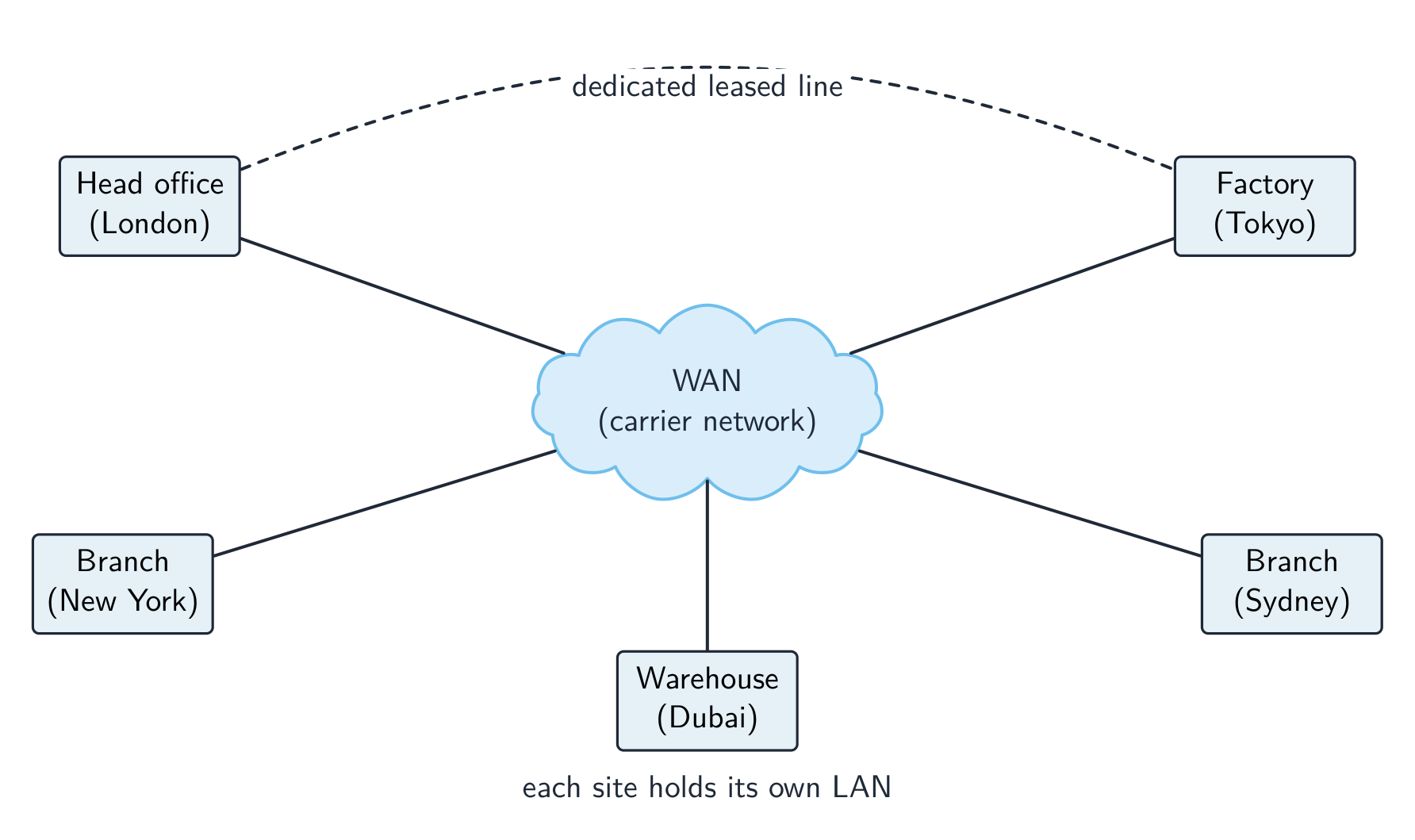
A local area network 局域网 (LAN) covers a small area — a home, office or school, usually owned by the organisation, with high data rates and low latency 延迟.
A wide area network 广域网 (WAN) covers a large area — a city, country, or the world (the internet is the largest WAN). It uses telecom-company infrastructure — often the Public Switched Telephone Network 公共交换电话网 (PSTN), leased lines or fibre — with lower data rates and higher latency. A WAN connects LANs together.
For "give two characteristics of a LAN": it covers a small geographical area (one site or building); the hardware is owned by the organisation, not leased from a telecom company; it connects through its own switches, cables and access points. For "two ways a WAN is different": it covers a large geographical area; it uses third-party (leased or public) infrastructure; data rates are lower and latency higher; it usually joins several LANs. A school on one site is a LAN; a company with offices in two cities needs a WAN, with a leased line or the internet between the sites. Justify the choice with the area covered and who owns the links.
A wide-area network links many systems across a large area Vocabulary TrainEnglish Chinese Pinyin local area network 局域网 jú yù wǎng latency 延迟 yán chí wide area network 广域网 guǎng yù wǎng Public Switched Telephone Network 公共交换电话网 gōng gòng jiāo huàn diàn huà wǎng 2.1
Client-server and peer-to-peer

Client-server
- powerful machines act as servers 服务器, providing services (files, web pages, email).
- other machines are clients 客户端 that request services.
- central and easy to manage, but the server is a single point of failure unless backed up.
In a client-server network, clients request services from a central server Peer-to-peer (P2P)
- all machines are equal peers; each can be both client and server (peer-to-peer 对等网络).
- resources are spread across the peers — no central server. Robust to one failure, but harder to keep secure and consistent.
Choosing a model. Client-server suits a school or a business: files are stored and backed up centrally, a user logs in with one account from any machine, software and security are managed once, and the server can be a powerful machine. The drawbacks are the cost of the server and of a technician, and that the server is a single point of failure. Peer-to-peer suits a few friends sharing files or a game: no server to buy, easy to set up, and each user keeps control of their own machine. The drawbacks the scheme lists: files are spread across many machines, so they are hard to back up and a file is unavailable when its owner's machine is off; each machine must be secured separately; and a peer that serves the others slows down. An online game played through a web browser with other users is the client-server model: the browser is the client, and the game and its shared virtual world run on the company's server, which keeps every player's view consistent.
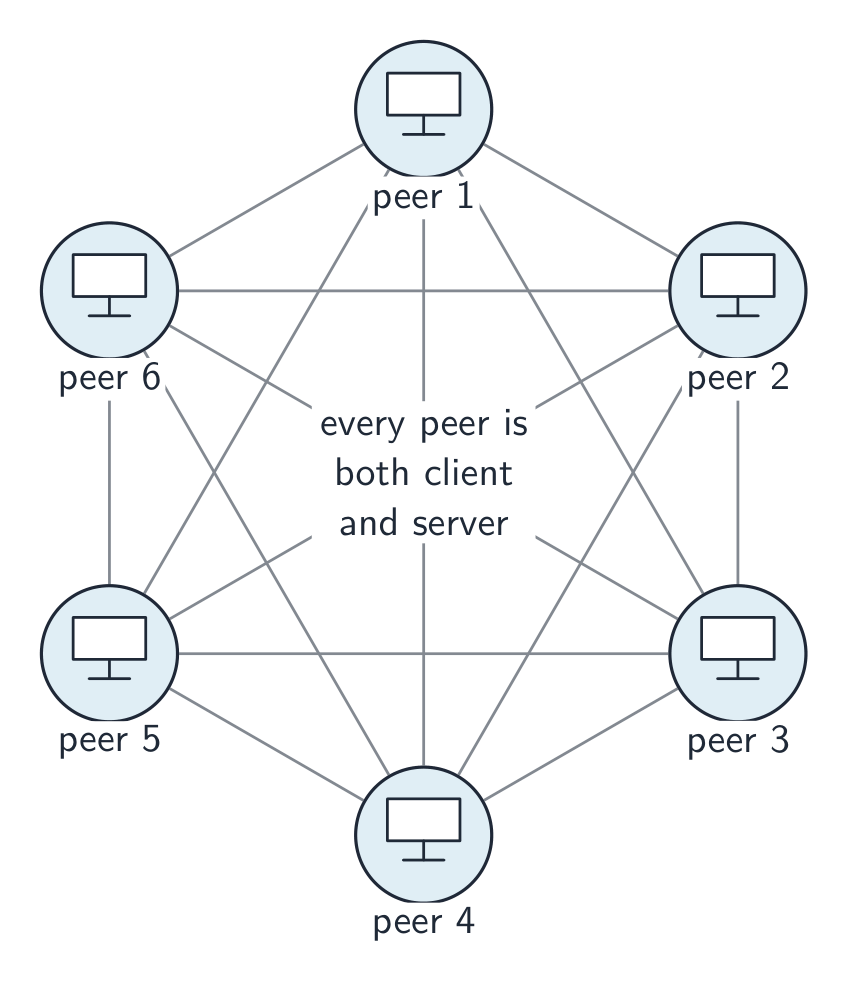
In a peer-to-peer network, every node is both client and server Vocabulary TrainEnglish Chinese Pinyin servers 服务器 fú wù qì clients 客户端 kè hù duān peer-to-peer 对等网络 duì děng wǎng luò 2.1
Thin and thick clients
A thin client 瘦客户端 does little processing locally and relies on a powerful server (web terminals, remote desktops). A thick client 胖客户端 has strong local processing and storage and runs full applications itself (a normal desktop PC).
Feature Thin client Thick client Local processing minimal substantial Local storage minimal substantial Reliance on network high lower Server load high lower The roles: in a thin-client model the server does the processing and stores the data, and the client only sends input and shows the output. A cheap terminal is enough, and everything is backed up and updated on the server, but nothing works if the network or the server fails. In a thick-client model the client runs the software and stores files itself, so it can work with no network connection and puts less load on the server, at the cost of more powerful (and more expensive) clients that must each be updated and secured. A school computer room can run thin clients (cheap, centrally managed); a video editor needs a thick client.
Vocabulary TrainEnglish Chinese Pinyin thin client 瘦客户端 shòu kè hù duān thick client 胖客户端 pàng kè hù duān 2.1
Network topologies
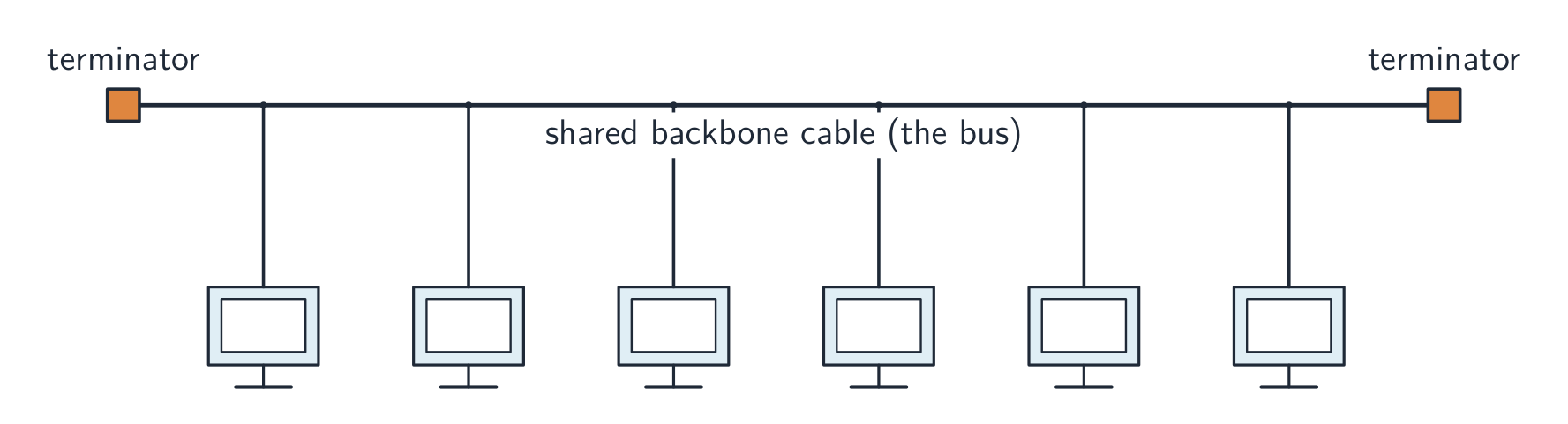
The topology 拓扑 is how the nodes and links are arranged.
- bus 总线 — all devices on one shared cable. Cheap; the whole LAN fails if the bus fails; performance drops as more devices share the bandwidth 带宽.
- star 星形 — every device connects to a central switch. One device failing does not affect others; the switch failing brings all down. Most common today.
- mesh 网状 — every device links directly to others, with many paths. Very fault-tolerant 容错 (traffic reroutes) but needs lots of cabling.
- hybrid — a mix (a star in each office, mesh links between offices).
Bus topology: all devices share one cable with a terminator at each end 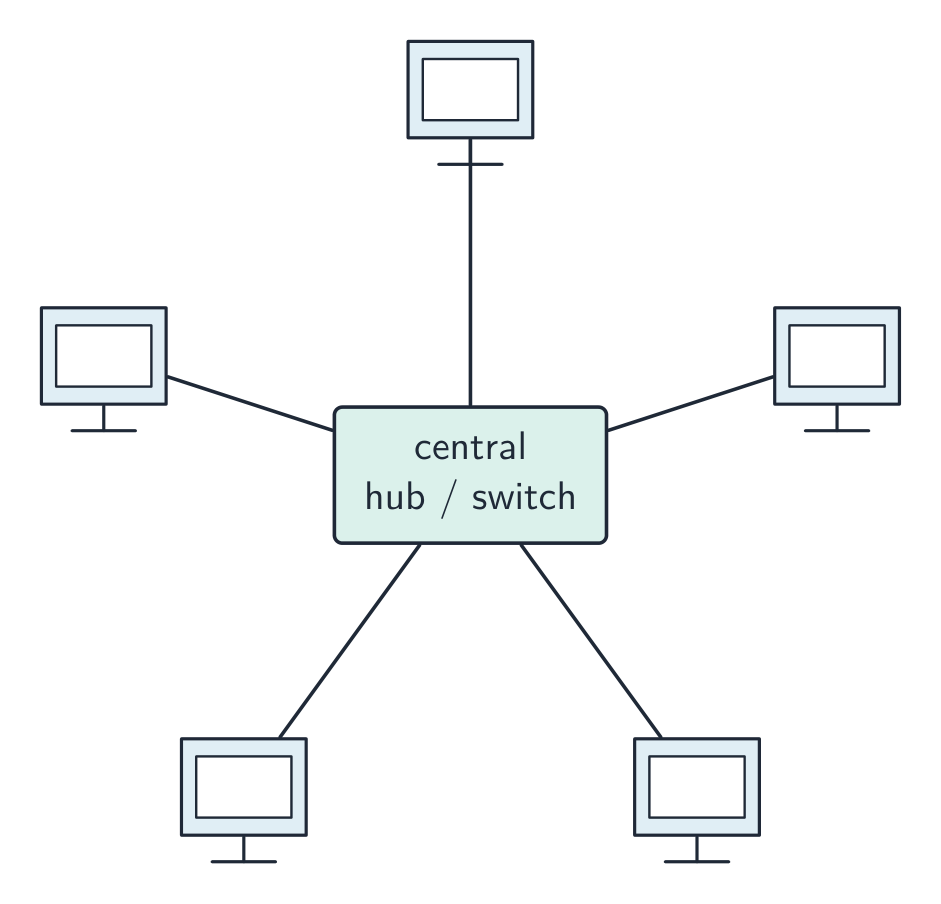
Star topology: every device connects to a central hub or switch 
Mesh topology: every device links directly to the others 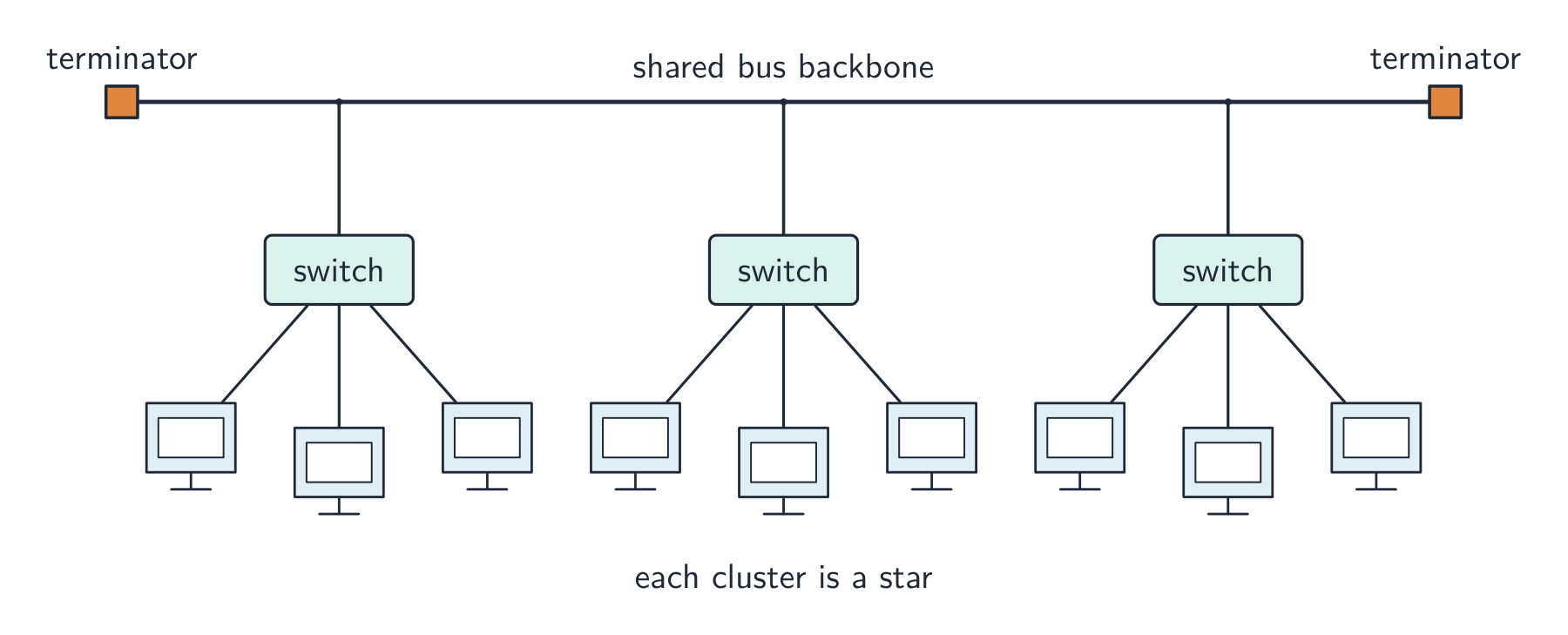
Hybrid topology: star clusters joined by a central bus How packets travel in each topology
Bus: the sending device puts the packet on the shared cable; every device sees it, and only the one whose address matches accepts it. Only one device can transmit at a time, so collisions happen (CSMA/CD, below). Star: the sender passes the packet to the central switch, which reads the destination address and forwards it only down the cable to that device; two other devices can talk at the same time. Mesh: the packet is passed from node to node along one of several possible routes until it reaches the destination; if a link fails, another route is used.
To justify a topology: a star for a classroom or an office (a failed cable affects one device; a device is easy to add; with a switch there are no collisions); a mesh where reliability matters most (a hospital, the internet's backbone); a bus only where cost matters and few devices share it. "Draw the star topology" means: the switch in the middle, one line from the switch to each computer, and the server (and the router, if there is one) on their own lines to the switch.
ExploreCompare the network topologies
Tap through the four topologies. Each trades off cost, speed and how well it survives a failure — notice what breaks the whole network in each one.
Vocabulary TrainEnglish Chinese Pinyin topology 拓扑 tuò pū bus 总线 zǒng xiàn bandwidth 带宽 dài kuān star 星形 xīng xíng mesh 网状 wǎng zhuàng fault-tolerant 容错 róng cuò 2.1
Cloud computing
Cloud computing 云计算 delivers computing services (servers, storage, software) over the internet, hosted by a third party. Benefits: scalability 可扩展性 (pay for what you need), lower cost, access from anywhere, and reliable redundant data centres. Drawbacks: needs internet, your data is held by a third party, and possible vendor lock-in.
For the one-mark definition: cloud computing is on-demand computing services (storage, processing, software) provided over the internet by a third party. A public cloud 公有云 is owned by a provider and shared by many customers over the internet; a private cloud 私有云 is dedicated to one organisation, on its own hardware or hosted for it alone. Benefits the scheme accepts: files are accessible from any device with an internet connection; storage scales up and down as needed; the provider handles the hardware, backups and security updates; there is no local server to buy or maintain. Drawbacks: no access without an internet connection; the data is on a third party's hardware, so security and privacy depend on the provider; an ongoing subscription cost; the provider could fail or be attacked; large files may be slow to transfer. A "why does the company use a public cloud" answer says that they need no hardware of their own, pay only for what they use, and their users can reach it from anywhere.
Vocabulary TrainEnglish Chinese Pinyin Cloud computing 云计算 yún jì suàn scalability 可扩展性 kě kuò zhǎn xìng public cloud 公有云 gōng yǒu yún private cloud 私有云 sī yǒu yún 2.1
Wired vs wireless
- wired (Ethernet 以太网 over twisted-pair 双绞线 or fibre-optic 光纤): higher speed, lower latency, fewer errors, more secure.
- wireless (Wi-Fi, Bluetooth, cellular): no cables, devices can move, but slower, prone to interference and eavesdropping.
For the same generation, wired wins on speed and reliability; wireless wins on convenience.
Transmission media
Medium Characteristics copper cable (twisted pair, coaxial) cheap and easy to install; carries an electrical signal; affected by electromagnetic interference; the signal weakens with distance, so repeaters are needed; lower bandwidth than fibre fibre-optic cable light pulses in a glass core; very high bandwidth; long distances without repeaters; immune to interference; hard to tap, so secure; expensive and needs skilled installation radio waves (including WiFi) no cable, so devices can move; a range of tens of metres, weakened by walls; a shared frequency, so interference and lower speed; can be intercepted, so needs encryption microwaves higher-frequency radio for point-to-point links; needs a line of sight; affected by rain and buildings; high bandwidth satellites reach remote areas and the whole globe; a long delay (latency), because the signal travels to orbit and back; affected by weather; expensive The exam asks for the comparison in both directions. Wired beats wireless on speed, reliability (no interference), security (a cable must be physically tapped) and consistency; wireless beats wired on mobility, the cost of installation, and adding a device without cabling. Allowing both lets students move around with laptops and phones while the fixed desktops keep the faster, more secure connection, and a device with no network port can still connect. Satellite instead of copper reaches places no cable can, but with more delay, weather interference and higher cost.
Vocabulary TrainEnglish Chinese Pinyin Ethernet 以太网 yǐ tài wǎng twisted-pair 双绞线 shuāng jiǎo xiàn fibre-optic 光纤 guāng xiān 2.1
LAN hardware

- network interface card 网络接口卡 (NIC) — lets a device send and receive on the network; has a unique MAC address MAC地址 (a 48-bit hardware address). A wireless device uses a wireless network interface card 无线网络接口卡 (WNIC).
- switch 交换机 — forwards Ethernet frames only to the port for the destination MAC address.
- hub 集线器 — a simpler device that copies traffic to all ports (now obsolete).
- wireless access point 无线接入点 (WAP) — lets wireless clients join a wired LAN.
- cabling — twisted-pair for short runs; fibre-optic for longer, faster runs.
- server — a computer that provides a service to the other devices: files, printing, web pages, email storage.
- bridge 网桥 — joins two LAN segments into one network, passing traffic between them.
- repeater 中继器 — receives a weakened signal and retransmits it at full strength, to extend a cable's reach.
A WNIC's functions, for a four-mark describe: it converts the data into radio signals and back; it carries the device's unique MAC address; it connects the device to a wireless access point and follows the wireless protocol (which channel and frequency to use); and it decodes the incoming signals for the device. Two devices that can physically connect thirty computers with NICs: a switch, or a hub.
A network switch: each device's cable plugs into one of its ports 
An RJ-45 plug on a twisted-pair Ethernet cable 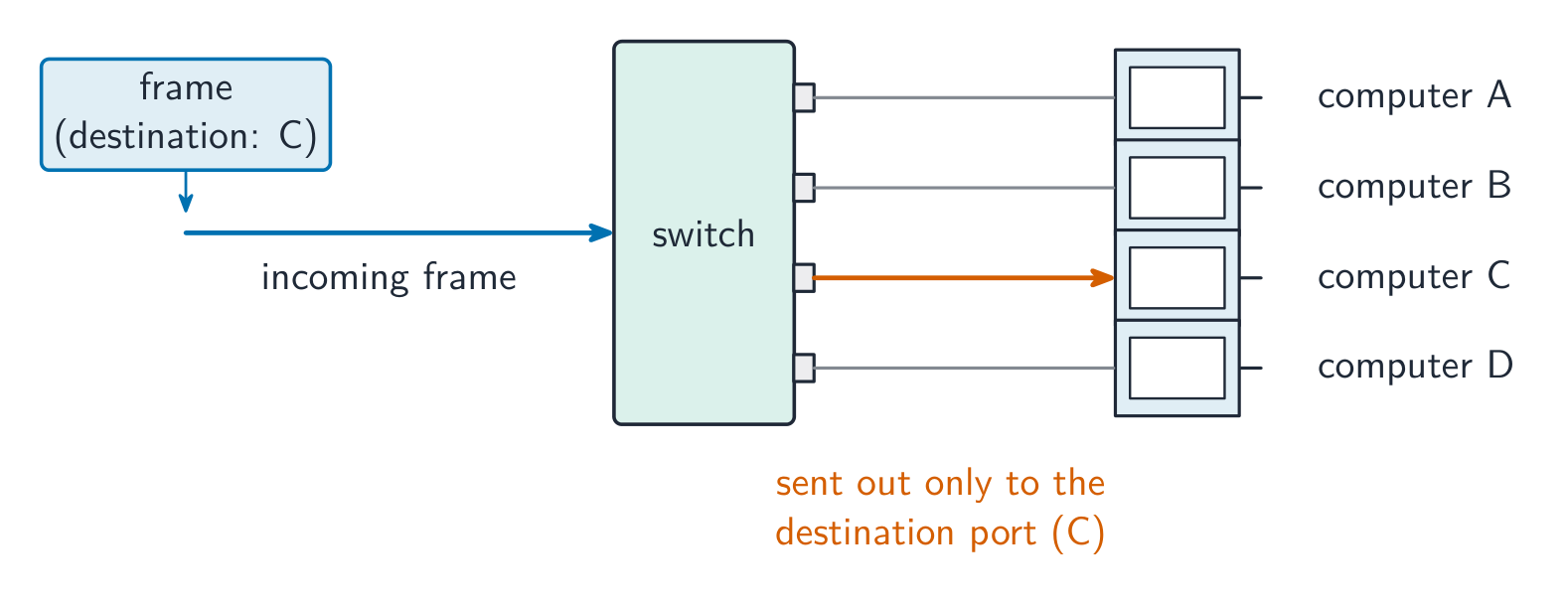
A switch sends each frame only to the port for its destination Vocabulary TrainEnglish Chinese Pinyin network interface card 网络接口卡 wǎng luò jiē kǒu kǎ wireless network interface card 无线网络接口卡 wú xiàn wǎng luò jiē kǒu kǎ switch 交换机 jiāo huàn jī hub 集线器 jí xiàn qì wireless access point 无线接入点 wú xiàn jiē rù diǎn bridge 网桥 wǎng qiáo repeater 中继器 zhōng jì qì MAC address MAC地址 MAC dì zhǐ 2.1
Routers
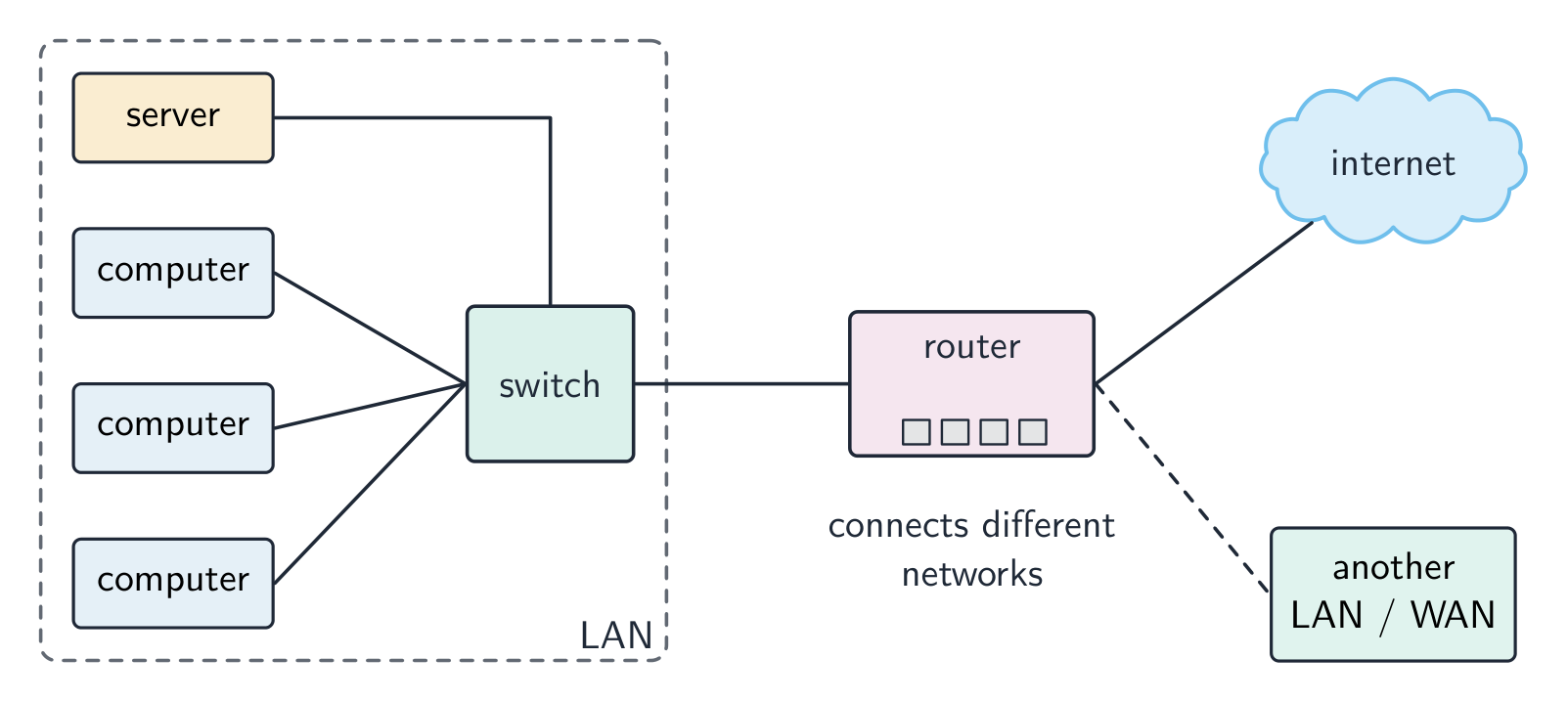
A router 路由器 connects different networks and forwards data between them — usually at the boundary of a LAN and the internet. It does:
- forwarding — reads each packet 数据包's destination IP address IP地址 and sends it out the right port, using a routing table 路由表.
- network address translation 网络地址转换 (NAT) — lets many private LAN addresses share one public IP.
- DHCP 动态主机配置协议 — hands out private IP addresses to LAN devices.
- firewall 防火墙 — blocks unwanted incoming traffic.
In packet switching 分组交换 a message is split into packets that are sent independently. Each router reads a packet's destination IP address, looks up the next hop in its routing table and forwards it, so the packets of one message may take different routes and are reassembled in order at the destination. A router does receive packets, forward them between networks and hand out IP addresses; it does not find the IP address for a URL (DNS does that) and it does not store web pages. A home router also contains the modem and the wireless access point, so one box connects the LAN to the internet.
A router connects a LAN to the internet or another network Vocabulary TrainEnglish Chinese Pinyin router 路由器 lù yóu qì packet 数据包 shù jù bāo routing table 路由表 lù yóu biǎo network address translation 网络地址转换 wǎng luò dì zhǐ zhuǎn huàn DHCP 动态主机配置协议 dòng tài zhǔ jī pèi zhì xié yì firewall 防火墙 fáng huǒ qiáng packet switching 分组交换 fēn zǔ jiāo huàn IP address IP地址 IP dì zhǐ 2.1
Ethernet and CSMA/CD

Ethernet is the standard (protocol) for wired LANs: devices are joined by twisted-pair or fibre cable, data is sent in frames that carry the source and destination MAC addresses, and a shared medium uses CSMA/CD to deal with collisions. On shared media a collision 冲突 can happen when two devices send at once. The protocol is CSMA/CD 载波侦听多路访问/冲突检测 (Carrier Sense Multiple Access with Collision Detection):
- carrier sense — listen before sending; wait if the cable is busy.
- multiple access — many devices share the medium.
- collision detection — keep listening while sending; a clash is a collision.
- on a collision, both stop, send a brief "jam" signal, then wait a random backoff time before retrying.
The three tasks, in the scheme's words: the device listens (senses the carrier) before transmitting; it keeps checking for a collision while it transmits; on a collision it stops, sends a jam signal, waits a random time and retransmits.
Modern switched Ethernet uses full-duplex 全双工 point-to-point links, so collisions no longer happen.
The CSMA/CD process for handling collisions on shared media Vocabulary TrainEnglish Chinese Pinyin collision 冲突 chōng tū CSMA/CD 载波侦听多路访问/冲突检测 zài bō zhēn tīng duō lù fǎng wèn / chōng tū jiǎn cè full-duplex 全双工 quán shuāng gōng 2.1
Bit streaming

Bit streaming 流式传输 sends multimedia as a continuous stream that the receiver plays as it arrives, instead of downloading the whole file first.
- real-time (live): captured and streamed as it happens (live sport, video calls). You cannot rewind; low latency is vital.
- on-demand: pre-recorded on a server (YouTube, Netflix). You can pause and rewind; the server can buffer 缓冲 ahead.
Real-time streaming works as a short pipeline:
- capture and sample the source (a camera or microphone).
- encode it, using compression 压缩 to shrink the data.
- send it across the network as packets.
- the receiver buffers a little, then plays it live — dropping any packet that arrives late, because a live stream cannot wait for it.
Lossy 有损 compression is used here: moving pictures hide small losses, and the stream must be small enough to fit the bandwidth.
Why a video is compressed before real-time streaming: the uncompressed stream would need more bandwidth than the connection has, so frames would arrive late and the playback would stall. Compression cuts the number of bits, so the bit rate 比特率 stays below the broadband speed, the delay stays small, and less storage and cost are needed at both ends. The bit rate must be lower than the connection's speed: a higher bit rate gives better quality but needs a faster connection, and if the data arrives more slowly than it is played, the buffer empties and the video freezes. On-demand streaming can buffer more of the file ahead, so it copes with a slower connection; real-time streaming cannot.
Data streams from the server into a buffer before the media player reads it Vocabulary TrainEnglish Chinese Pinyin Bit streaming 流式传输 liú shì chuán shū buffer 缓冲 huǎn chōng compression 压缩 yā suō Lossy 有损 yǒu sǔn bit rate 比特率 bǐ tè lǜ 2.1
The internet and the World Wide Web

The internet 互联网 is a global network of networks using a common protocol 协议 suite (TCP/IP). The World Wide Web 万维网 (WWW) is a service that runs over it: hyperlinked documents identified by URLs, viewed in browsers via HTTP/HTTPS. Email and file transfer are other internet services that are not part of the WWW.
Webmail uses both: the WWW, because the mailbox is a web page reached through a URL in a browser over HTTP; and the internet, because the email itself travels across the network of networks (email is a separate internet service from the web).
The Web is one service running on top of the Internet Hardware that supports the internet
- modem 调制解调器 — converts the computer's digital signal into an analogue signal for a telephone line, and back again at the other end (modulation and demodulation).
- PSTN — the public telephone network of exchanges and lines; a dial-up or DSL connection carries internet data over it.
- dedicated line 专线 — a leased line between an organisation and its ISP: always on, with a fixed bandwidth that is not shared, so faster and more reliable, but expensive.
- cell phone network 蜂窝网络 — the phone sends data by radio to the nearest cell tower (base station); the towers are linked to the phone company's network, which routes the data to the internet; as the phone moves, it is handed over from one cell to the next.

Three ways to reach the internet: a modem and the PSTN, a dedicated line, and the cell phone network Vocabulary TrainEnglish Chinese Pinyin internet 互联网 hù lián wǎng protocol 协议 xié yì World Wide Web 万维网 wàn wéi wǎng modem 调制解调器 tiáo zhì jiě tiáo qì dedicated line 专线 zhuān xiàn cell phone network 蜂窝网络 fēng wō wǎng luò 2.1
IP addresses
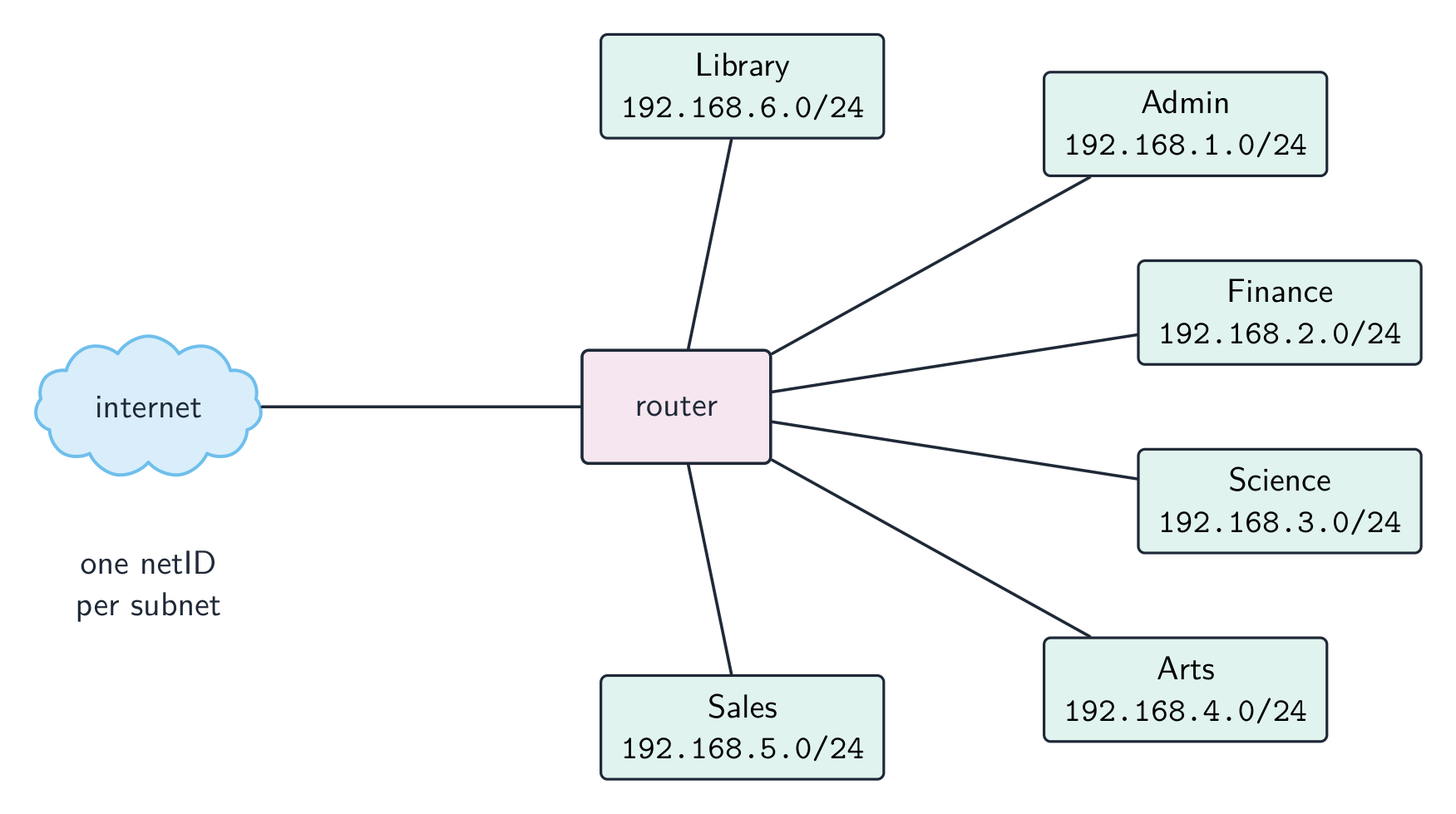
An IP address uniquely identifies a device.
- IPv4 — 32-bit, four denary numbers 0–255 (
192.168.1.10); about $4.3 \times 10^{9}$ addresses (now exhausted). - IPv6 — 128-bit, eight groups of four hex digits; about $3.4 \times 10^{38}$ addresses.
IPv4 is written as four groups of denary numbers separated by dots; each group is an 8-bit number, so it runs from 0 to 255. IPv6 is written as eight groups of four hexadecimal digits separated by colons,
2001:0db8:0000:0000:0000:ff00:0042:8329, and a run of zero groups can be shortened to::. So192.168.3.2is not IPv6: it has four groups, not eight, separated by dots rather than colons, and its groups are denary, not hexadecimal.256.0.0.Ais not a valid address of either kind: an IPv4 group cannot exceed 255 and cannot be a letter, and IPv6 would need colons and eight groups.Subnetting
A network can be split into subnets 子网. The IP address splits into a network part and a host part, given by a subnet mask 子网掩码 (e.g.
255.255.255.0= first 24 bits are network). Subnetting improves management, cuts broadcast traffic, and improves security.The two parts of an address in a subnetwork: the network ID (the first bits, the same for every device in that subnet, given by the ones in the mask) and the host ID (the remaining bits, unique to each device). Benefits of subnetting, for "describe two benefits": less traffic on each part, because broadcasts stay inside their subnet; better security, because one department's traffic is kept from the others; easier management and fault-finding; more efficient use of the addresses. Two devices with the mask
255.255.255.0are in different subnets when their first three groups differ.Splitting a network into subnets, one netID per department Public vs private addresses
- private addresses are used within a LAN and are not routable on the internet (e.g.
192.168.0.0/16). - a public IP address is globally unique and routable, assigned by an ISP 互联网服务提供商.
Devices behind NAT with private addresses are not directly reachable from the internet, giving some protection.
The descriptions the tables want: a public address is visible on the internet and unique across it, allocated by the ISP; a private address is visible only inside the LAN, is reused by many LANs, and needs NAT to reach the internet. A static address never changes (set by hand or reserved, as a server needs); a dynamic address is allocated by DHCP each time the device connects and may change.
Static vs dynamic
- a static IP address is fixed; used for servers that must be found at a known address.
- a dynamic IP address is assigned by DHCP and may change; easier for client devices and uses a limited address pool efficiently.
Worked example. A host has IP address
192.168.10.130with subnet mask255.255.255.192. Which network is it on, and is192.168.10.200on the same one? The mask's last octet,192, is11000000in binary, so the first 26 bits are the network part and the last 6 bits address the host. That makes the subnets step in blocks of $256 - 192 = 64$:.0,.64,.128,.192. The address130falls in the block starting at.128, so the host is on network192.168.10.128/26, whose usable hosts run.129to.190(.191is the broadcast address).200falls in the next block (.192), so it is on a different subnet and traffic between the two must pass through a router. Get the block size from the mask first ($256$ minus the mask octet) - guessing from the first three octets is what makes these go wrong.Vocabulary TrainEnglish Chinese Pinyin subnets 子网 zi wǎng subnet mask 子网掩码 zi wǎng yǎn mǎ ISP 互联网服务提供商 hù lián wǎng fú wù tí gōng shāng 2.1
URL and DNS
A URL 统一资源定位符 (Uniform Resource Locator) locates a resource on the WWW:
https://www.example.com/about/contact.html protocol domain name path- protocol:
http,https, etc. - domain name 域名: a readable server address.
- path: the resource on that server.
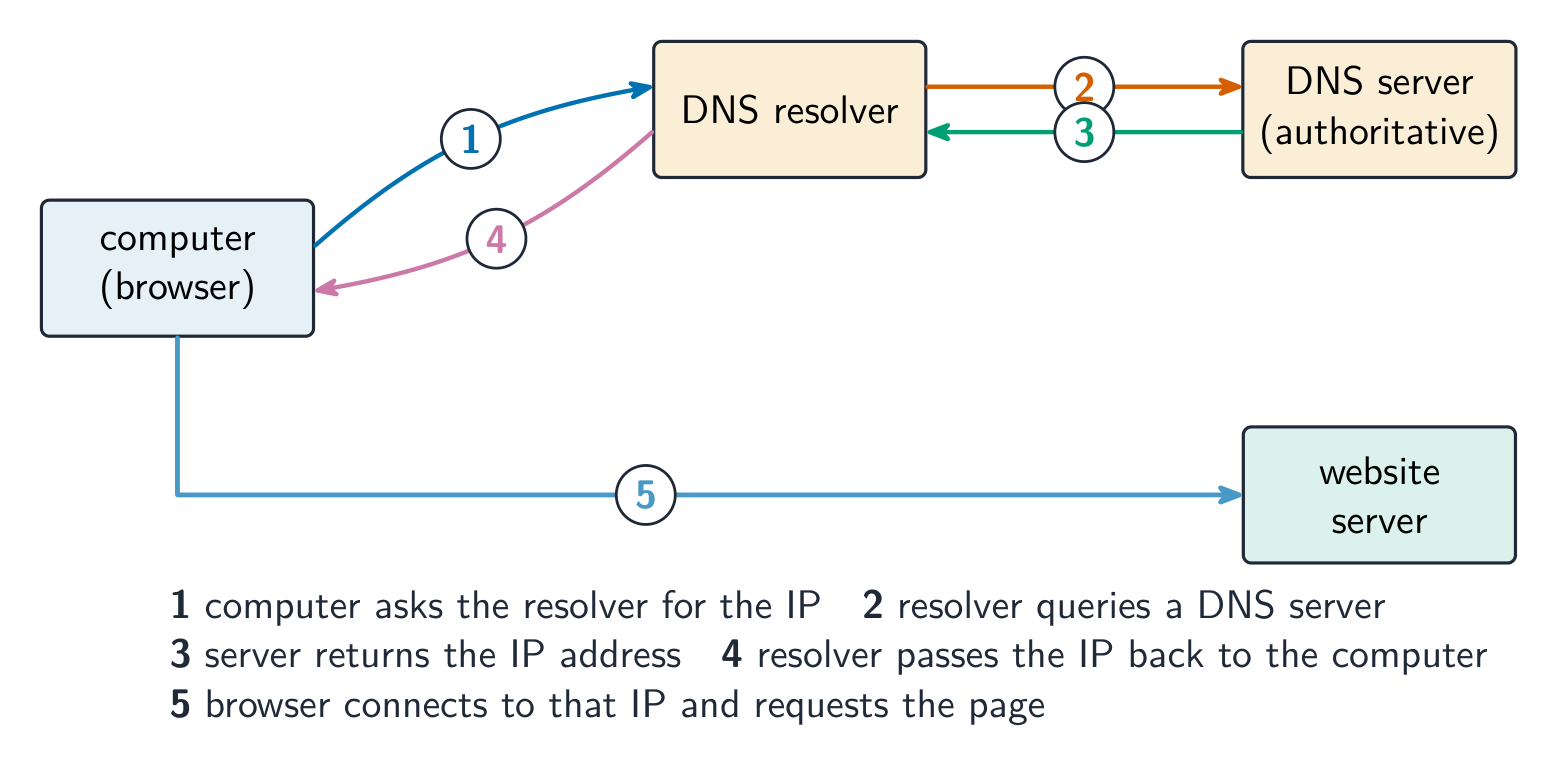
The Domain Name System 域名系统 (DNS, also called the Domain Name Service) is a distributed set of servers that turns domain names into IP addresses. When you type a URL, the browser asks a DNS resolver for the IP, which queries DNS servers (root → top-level → authoritative) until it finds it; the browser then connects to that IP and requests the path. DNS saves humans from memorising IP addresses and lets a site change server without changing its name.
For "explain how the browser uses the URL": the browser splits the URL into the protocol, the domain name and the path; it sends the domain name to a DNS server, which returns the matching IP address (a cache on the computer or at the ISP may answer first); it opens a connection to that IP address using the protocol (HTTPS on port 443); it sends a request for the path; and the web server returns the page, which the browser renders. If the DNS lookup fails, the browser reports that the server cannot be found.
How DNS finds a website's IP address before the browser connects ExploreHow DNS finds a website
Step through a DNS lookup. The network routes by IP, not by name — so before anything loads, DNS must turn the domain name into an IP address.
Vocabulary TrainEnglish Chinese Pinyin URL 统一资源定位符 tǒng yī zī yuán dìng wèi fú domain name 域名 yù míng Domain Name System 域名系统 yù míng xì tǒng 2.1
Definitions the examiner accepts
A definition question is marked against fixed wording. Learn these exactly.
Term Definition LAN a network covering a small geographical area, usually one site, whose hardware is owned by the organisation WAN a network covering a large geographical area, joining LANs through third-party (leased or public) links client-server a model in which client computers request services from a central, more powerful server that provides them peer-to-peer a model in which every computer is equal and can act as both client and server, with no central server thin client a client that does little processing or storage itself and depends on the server for both thick client a client that does its own processing and storage and can work without the server mesh topology a topology in which each device is connected directly to many others, giving more than one route between two devices cloud computing on-demand computing services (storage, processing, software) provided over the internet by a third party Ethernet the standard protocol for wired LANs, sending data in frames and using CSMA/CD on a shared medium switch a device that forwards each frame only to the port of its destination MAC address, within a LAN router a device that connects networks and forwards packets between them by their destination IP address bit streaming sending a continuous stream of bits so that the receiver plays the media as it arrives, without downloading the whole file first internet the global network of networks that uses the TCP/IP protocols World Wide Web the collection of hyperlinked web pages, identified by URLs and accessed over the internet through a browser URL the address that locates a resource on the web: protocol, domain name and path DNS the service that translates a domain name into the IP address of the server that holds the resource 2.1
Exam tips
- Distinguish LAN vs WAN and client-server vs peer-to-peer by who stores and controls the resources.
- Match each topology (bus, star, mesh) to its advantages and drawbacks (cost, reliability, collisions).
- Know the job of each device: a switch directs within a LAN by MAC address, a router routes between networks by IP.
- Explain bit streaming and why buffering is needed (data arrives at a different rate from playback).
- Distinguish IPv4 vs IPv6 and public vs private addresses; DNS turns a URL into an IP address.
Common mistakes
- Saying a switch works by IP address. A switch forwards by MAC address inside the LAN; the router forwards by IP address between networks.
- Treating the internet and the World Wide Web as the same thing. The web is one service that runs over the internet; email and file transfer are others.
- Giving "faster" as the whole comparison of wired and wireless. Say faster and more reliable and more secure, and give the wireless side (mobility, no cabling) when the question asks for a comparison.
- Writing that a router finds the IP address for a URL. DNS does that; the router forwards packets to it.
- Describing IPv6 with dots and denary groups. Eight groups of four hexadecimal digits, separated by colons.
- Drawing a star topology as a ring or a chain. Every device has its own line to the switch in the middle.
-
3
Hardware
3.1
Computers and their components

Syllabus
Candidates should be able to: Notes and guidance Show understanding of the need for input, output, primary memory and secondary (including removable) storage Show understanding of embedded systems Including: benefits and drawbacks of embedded systems Describe the principal operations of hardware devices Including: Laser printer, 3D printer, microphone, speakers, magnetic hard disk, solid state (flash) memory, optical disc reader/writer, touchscreen, virtual reality headset Show understanding of the use of buffers Explain the differences between Random Access Memory (RAM) and Read Only Memory (ROM) Including their use in a range of devices and systems Explain the differences between Static RAM (SRAM) and Dynamic RAM (DRAM) Including the use of SRAM and DRAM in a range of devices and systems and the reasons for using one instead of the other depending on the device and its use Explain the difference between Programmable ROM (PROM), Erasable Programmable ROM (EPROM) and Electrically Erasable Programmable ROM (EEPROM) Show an understanding of monitoring and control systems Including: • difference between monitoring and control • use of sensors (including temperature, pressure, infra-red, sound) and actuators • importance of feedback Source: Cambridge International syllabus
A general-purpose computer has four building blocks:
- input devices 输入设备 — get data in (keyboard, mouse, microphone, scanner, sensors).
- output devices 输出设备 — give results out (monitor, speakers, printer, actuators).
- primary memory 主存储器 — fast memory the processor 处理器 (CPU) reaches directly (RAM and ROM). Holds the running program and its data.
- secondary storage 辅助存储器 — slower, larger, keeps programs and data when not in use (hard disk, SSD, optical disc, USB stick).
The syllabus asks why each is needed. Input devices are needed because the computer can only work on data and instructions that have been entered. Output devices are needed to present the results in a form people can use. Primary memory is needed because the processor can only execute instructions and use data that are held in memory it can address directly, and it must reach them fast. Secondary storage is needed because primary memory is volatile and small: programs and data must survive the power being switched off, in a larger and cheaper store, and removable storage lets data be moved between computers or kept as a backup.
A keyboard: a common input device for typing text and commands 
A mouse: a pointing input device 
A flatbed scanner: an input device that turns a paper page into a digital image 
A monitor: a common output device that displays the screen image ExploreTap the blocks of a computer system
Explore the four blocks plus the CPU. Data flows input → processing → output, while primary memory holds the running program and secondary storage keeps it for later.
ExploreNetwork route lab
Follow data from a device through network hardware and protocols.
Vocabulary TrainEnglish Chinese Pinyin input devices 输入设备 shū rù shè bèi output devices 输出设备 shū chū shè bèi primary memory 主存储器 zhǔ cún chǔ qì processor 处理器 chǔ lǐ qì secondary storage 辅助存储器 fǔ zhù cún chǔ qì 3.1
Embedded systems
An embedded system 嵌入式系统 is a computer built into another device to do one fixed job (washing machine, microwave, car engine unit, thermostat).
- benefits: optimised for one task, so it is small, uses little power and is cheap to make in volume; reliable, because it runs one fixed program with few chances to go wrong; starts quickly and needs no user set-up; easy to use through a simple interface.
- drawbacks: limited to its one task, so it cannot be upgraded to do more; hard to update (its firmware 固件 may need special tools or cannot be changed at all); difficult to troubleshoot, and usually the whole device must be replaced when it fails; if it is connected to a network it can be a security weakness, because its software is rarely patched.
A "describe the drawbacks" question wants each drawback as a full point: what the limitation is and what it means for the user, for example "the firmware cannot be updated, so a security fault found later cannot be fixed".
Vocabulary TrainEnglish Chinese Pinyin embedded system 嵌入式系统 qiàn rù shì xì tǒng firmware 固件 gù jiàn 3.1
Principal hardware devices
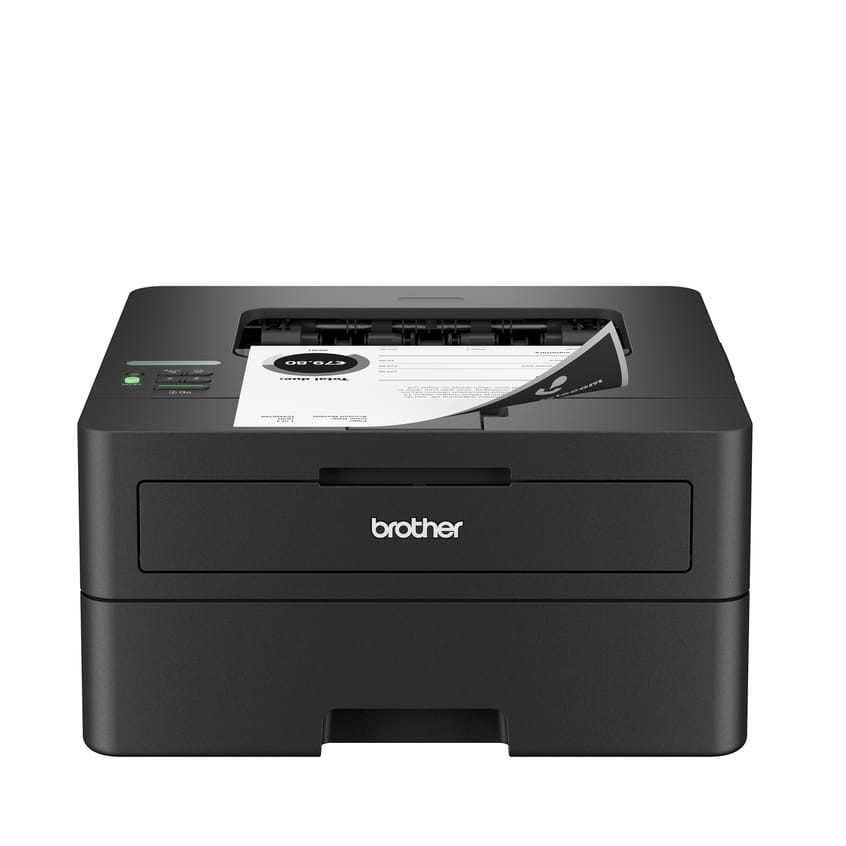
Laser printer
A laser printer 激光打印机 scans the page image onto a charged photosensitive drum 感光鼓. Toner 墨粉 sticks to the charged areas, transfers to the paper, and is melted on by a fuser. Fast, sharp, high-volume.
A laser printer: fast, sharp printing using a charged drum and toner How it works, in the steps the mark scheme lists:
- The data for the page is sent to the printer's buffer.
- The drum is given a uniform electrostatic charge.
- A laser, reflected off a rotating mirror, scans the page image onto the drum, removing the charge where it strikes, so the charge left on the drum matches the image.
- Toner, a charged powder, is attracted to the charged parts of the drum only.
- The paper is given the opposite charge and rolled against the drum, so the toner transfers onto it.
- The fuser 定影器, a pair of heated rollers, melts the toner into the paper. The drum is then discharged and cleaned for the next page.
3D printer
A 3D printer 3D打印机 builds an object layer by layer: FDM melts plastic filament through a nozzle; stereolithography cures liquid resin with a UV laser. Used for prototypes and custom medical parts.

An FDM 3D printer builds an object layer by layer by melting plastic filament How it works:
- A model of the object is designed in CAD software (or scanned).
- Slicing software divides the model into thin horizontal layers and produces the instructions for each one.
- The printer builds the object one layer at a time: an FDM printer melts plastic filament 塑料丝 and lays it down through a moving nozzle; a resin printer cures liquid resin with a laser or UV light; a powder printer fuses powder with a laser.
- Each layer bonds to the layer below, and the platform (or nozzle) moves by one layer's thickness.
- When the last layer is done, any support material is removed. Uses include prototypes, custom medical parts such as prosthetics, and spare parts printed on demand.
Microphone and speakers
A microphone 麦克风 turns sound into an electrical signal (a diaphragm vibrates, changing capacitor 电容器 charge or coil position); the signal is digitised by an analogue-to-digital converter 模数转换器 (ADC). A speaker does the reverse — a varying signal drives a coil in a magnetic field, moving a cone to make sound.
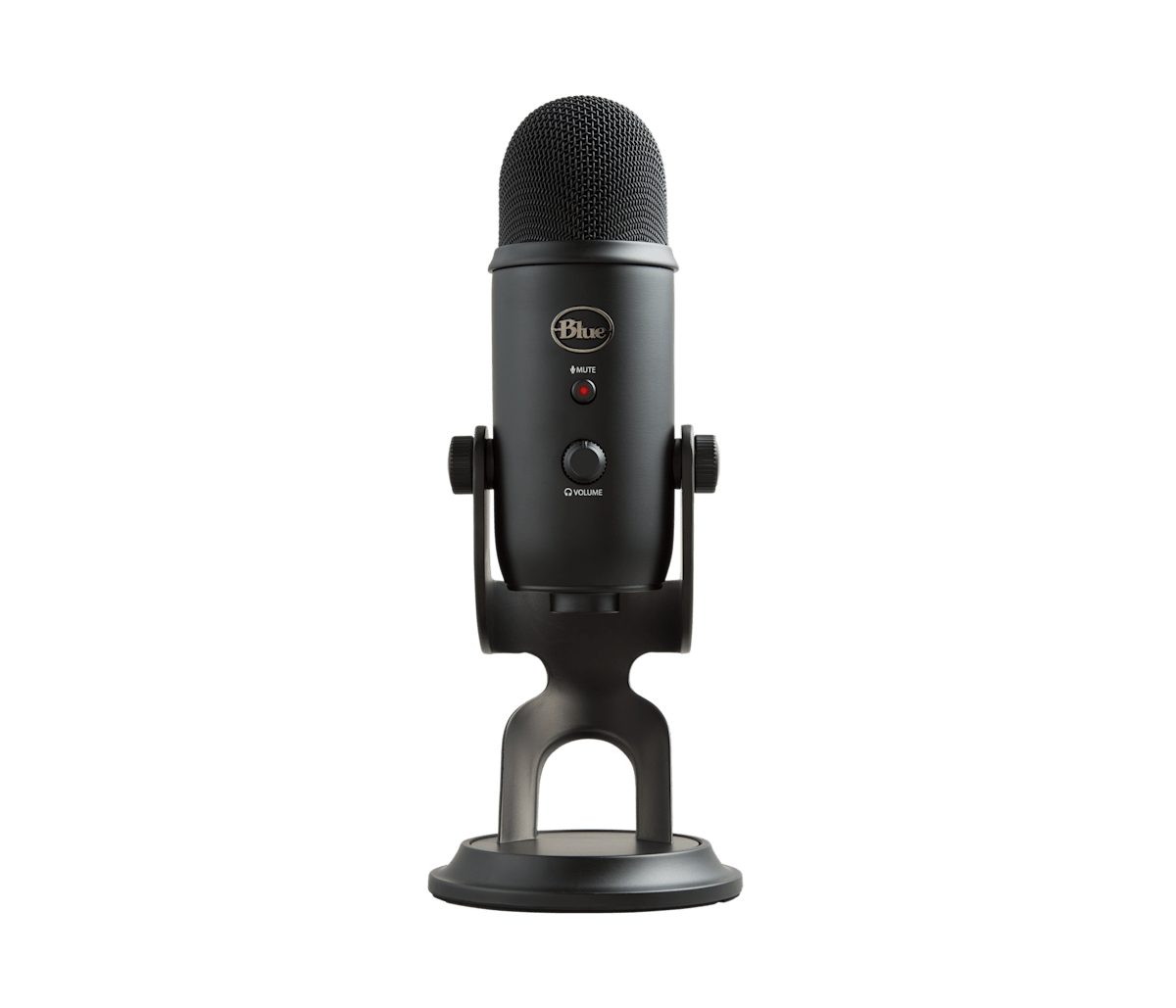
A microphone turns sound into an electrical signal 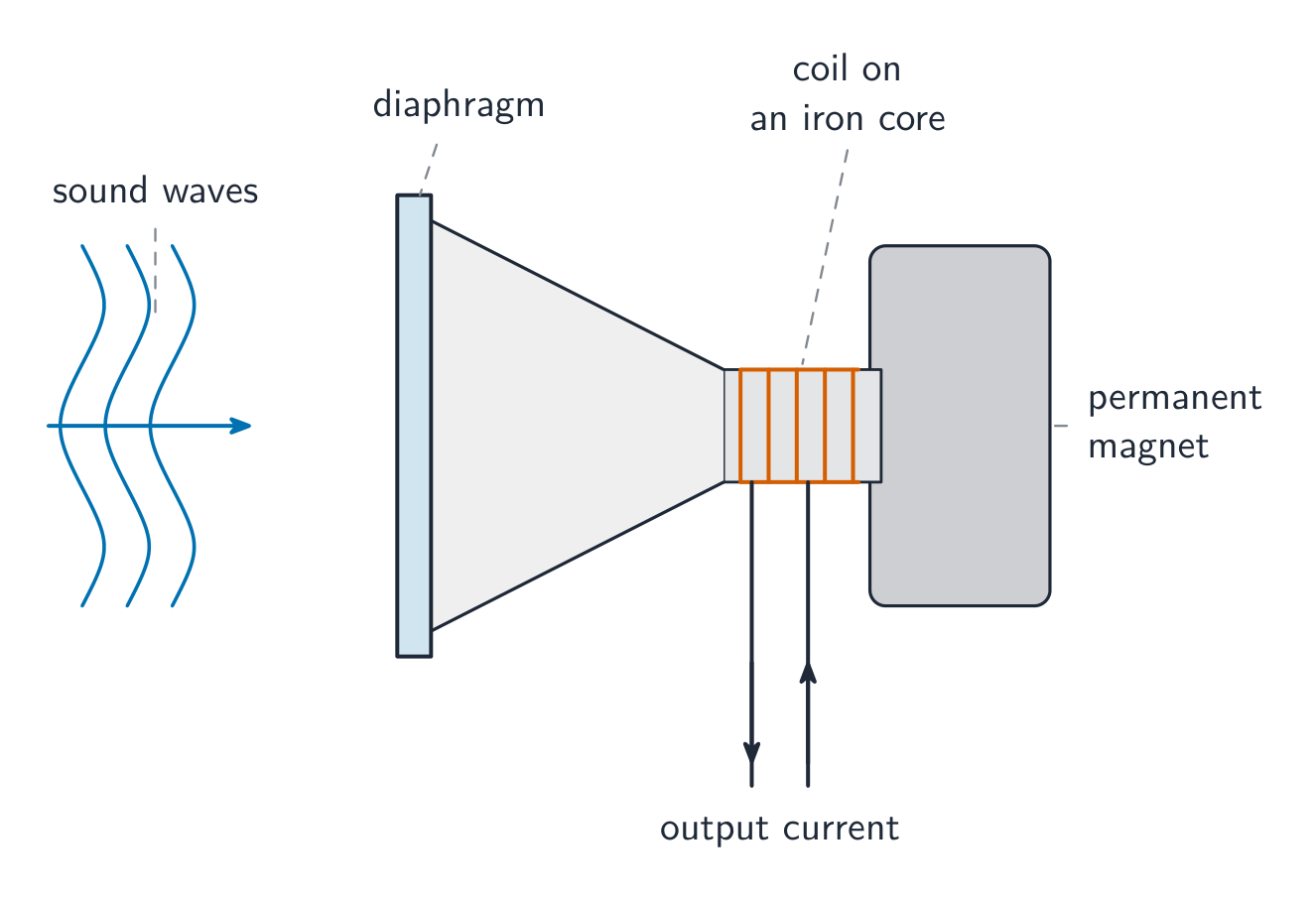
Inside a microphone: sound vibrates the diaphragm and coil to produce a current 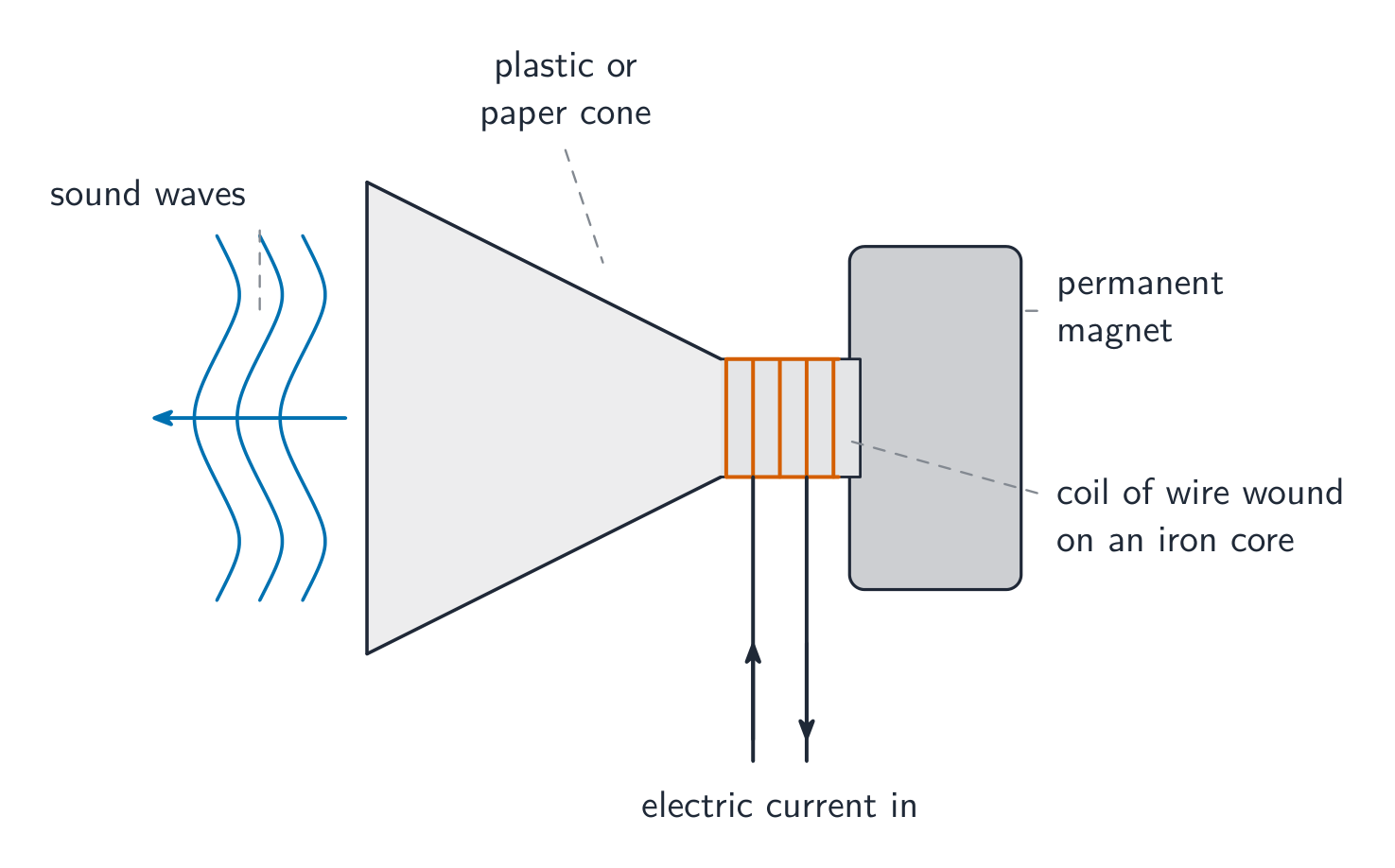
Inside a loudspeaker: a varying current in the coil moves the cone to make sound How a microphone works: sound waves make a diaphragm 膜片 vibrate; in a dynamic microphone a coil attached to the diaphragm moves in a magnetic field, so a varying current is induced in it, and in a condenser microphone the diaphragm is one plate of a capacitor whose capacitance changes as it moves; the varying analogue signal is then sampled by an ADC and stored as digital data. A speaker runs the chain backwards: a digital-to-analogue converter 数模转换器 (DAC) produces a varying current, the current in the coil creates a changing magnetic field that pushes against the permanent magnet, the coil and cone move in and out, and the cone's movement makes pressure waves in the air.
Magnetic hard disk (HDD)
A hard disk 硬盘 stores data on spinning platters coated with magnetic material. Each platter has tracks 磁道 divided into sectors 扇区. A read/write head 读写头 floats just above and magnetises tiny regions (write) or senses them (read). Cheap per gigabyte, but slower than SSDs and has moving parts.
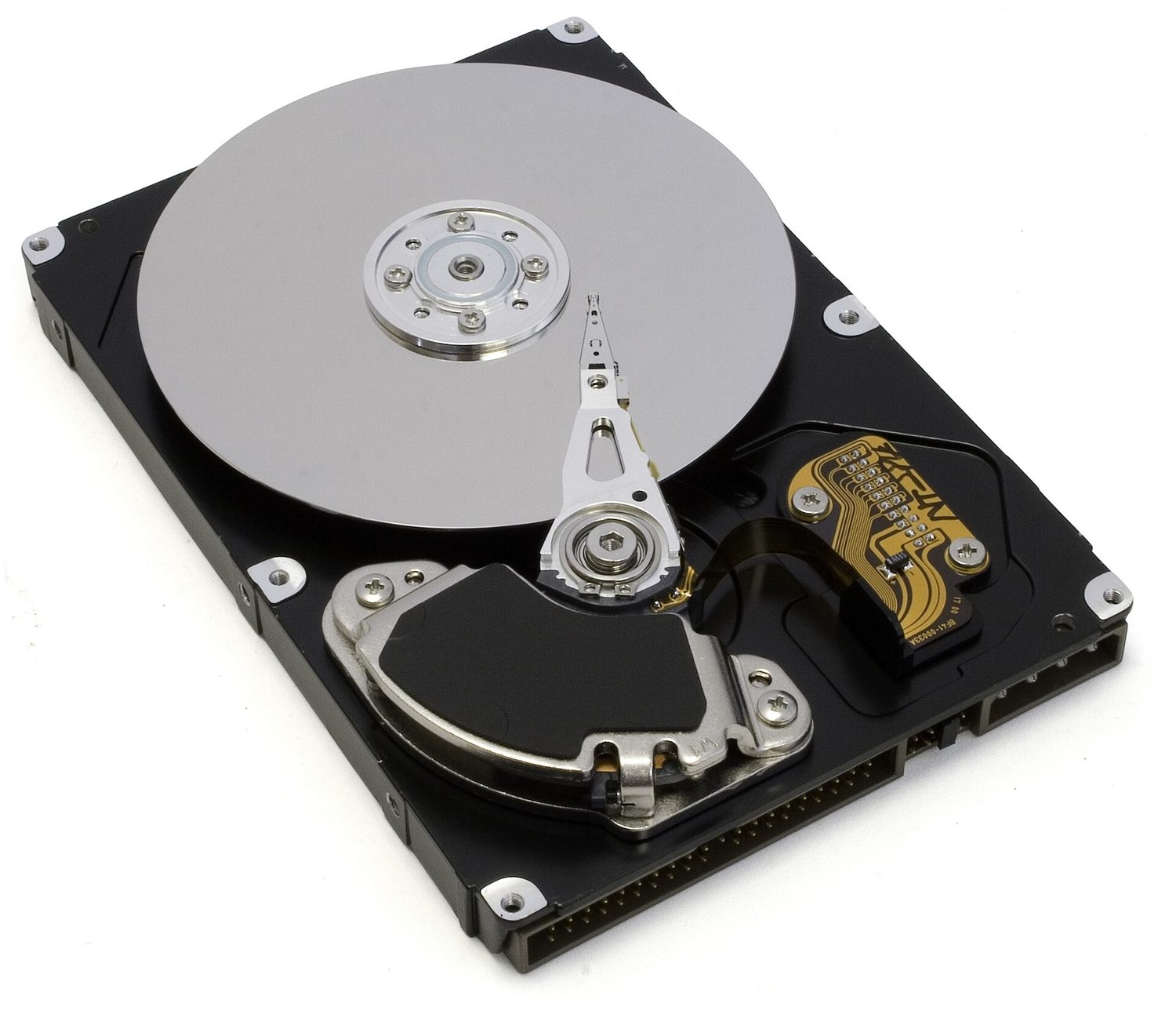
An opened hard disk: the actuator arm carries the read/write head over a platter 
Tracks and sectors on a hard disk platter How it works: the platters spin at high speed (thousands of revolutions per minute); each surface is divided into concentric tracks and each track into sectors; read/write heads on actuator arms 磁头臂 move across the platters to the right track; to write, the head magnetises a tiny region with one of two polarities, representing 0 or 1; to read, it detects the polarity as the region passes beneath it. The delays, waiting for the arm to reach the track and for the sector to spin round, are why a hard disk is slower than an SSD.
Solid-state (flash) memory
A solid-state drive 固态硬盘 stores data as charge in transistors 晶体管, with no moving parts. Faster random access than HDDs, tougher, lower power, but dearer per gigabyte; each cell wears out after many writes.

Inside an SSD: data is stored in flash memory chips, with no moving parts (compare the hard disk above) How it works: each cell is a floating-gate transistor 浮栅晶体管; a charge trapped on the floating gate represents a bit and stays there when the power is off; a controller chip maps each address to a cell and spreads writes across the cells, because a cell survives only a limited number of writes.
Magnetic hard disk Solid-state drive Moving parts platters and heads none Speed slower: seek and rotation delays much faster random access Cost per gigabyte lower higher Robustness damaged by knocks; noisy; more power shock-resistant; silent; less power Lifetime many rewrites; wears mechanically limited write cycles per cell A "why a server uses hard disks rather than SSDs" question wants the left column: cheaper per gigabyte for very large capacities, a long life under constant rewriting, and easier data recovery.
Optical disc
A laser detects reflections from tiny pits on an optical disc 光盘 (CD, DVD, Blu-ray). The drive is an optical disc reader/writer: writing uses a stronger laser to change the surface's reflectivity.
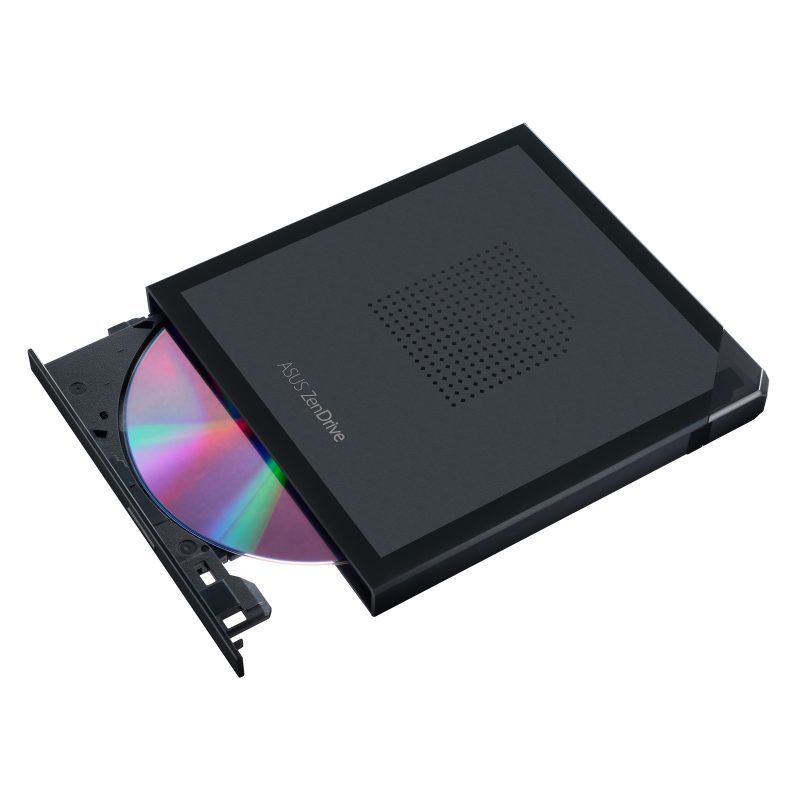
An optical disc drive: a laser reads tiny pits on a CD, DVD or Blu-ray disc How it works: the disc carries one long spiral track of pits 凹坑 and lands 平台 (the flat areas between them); the disc spins and a laser is focused on the track; light reflected from a land differs from light reflected at the edge of a pit, and a light sensor reads each change as a 1 and no change as a 0. Writing uses a stronger laser to change the reflectivity of a dye or alloy layer. A Blu-ray uses a blue laser with a shorter wavelength, so its pits are smaller and closer together, which is why it holds more data than a DVD.
Touchscreen
A touchscreen 触摸屏 senses contact. Resistive 电阻式: two conductive layers pressed together; works with anything but is less accurate. Capacitive 电容式: a finger disturbs a charge field; accurate, multi-touch, used in phones.

A touchscreen senses where a finger touches the glass How it works: a resistive screen has two thin conductive layers separated by spacers; pressing pushes the top layer onto the bottom one, closing a circuit at that point, and the controller reads the voltage to find the coordinates. A capacitive screen has a glass layer coated with a transparent conductor that holds a charge; a finger touching it draws a tiny current, the current is measured at each corner, and the controller works out the touch position from the differences. Capacitive screens respond to a light touch and to several fingers at once, but not to a gloved finger or an ordinary stylus.
Virtual reality headset
A virtual reality 虚拟现实 (VR) headset has two small displays (one per eye) and motion sensors (accelerometer 加速度计, gyroscope 陀螺仪) that track head movement so the scene shifts as you look around.

A virtual reality headset: two small displays and motion sensors track the head How it works: each eye sees its own display through a lens, and the two images differ slightly, so the brain sees depth; sensors (accelerometer, gyroscope, sometimes cameras) report where the head is and which way it points; the computer re-renders the scene from that viewpoint many times a second, so turning the head turns the view; headphones give sound that matches the direction. Used for games, for training such as flight or surgery simulators, and for viewing designs before they are built.
Vocabulary TrainEnglish Chinese Pinyin laser printer 激光打印机 jī guāng dǎ yìn jī drum 感光鼓 gǎn guāng gǔ Toner 墨粉 mò fěn fuser 定影器 dìng yǐng qì filament 塑料丝 sù liào sī microphone 麦克风 mài kè fēng capacitor 电容器 diàn róng qì analogue-to-digital converter 模数转换器 mó shù zhuǎn huàn qì diaphragm 膜片 mó piàn digital-to-analogue converter 数模转换器 shù mó zhuǎn huàn qì hard disk 硬盘 yìng pán tracks 磁道 cí dào sectors 扇区 shàn qū read/write head 读写头 dú xiě tóu actuator arms 磁头臂 cí tóu bì solid-state drive 固态硬盘 gù tài yìng pán transistors 晶体管 jīng tǐ guǎn floating-gate transistor 浮栅晶体管 fú zhà jīng tǐ guǎn optical disc 光盘 guāng pán pits 凹坑 āo kēng lands 平台 píng tái touchscreen 触摸屏 chù mō píng Resistive 电阻式 diàn zǔ shì Capacitive 电容式 diàn róng shì virtual reality 虚拟现实 xū nǐ xiàn shí accelerometer 加速度计 jiā sù dù jì gyroscope 陀螺仪 tuó luó yí 3D printer 3D打印机 3D dǎ yìn jī 3.1
Buffers
A buffer 缓冲 is memory that holds data temporarily while it moves between devices of different speeds. Example: the CPU writes a document to a printer buffer quickly, then is free to do other work while the printer prints from the buffer at its own pace. Buffers stop the fast device waiting for the slow one (also used in streaming, the keyboard, and disk access).
"State why a 3D printer needs a buffer": the computer sends the print data much faster than the printer can build the layers, so the data is held in the buffer until the printer is ready for it, and the processor is freed to do other work. When the buffer runs low the printer sends an interrupt 中断 to ask for more (topic 4). A video stream works the same way: the buffer fills ahead of playback so a short drop in the network speed does not stop the picture.
Vocabulary TrainEnglish Chinese Pinyin buffer 缓冲 huǎn chōng interrupt 中断 zhōng duàn 3.1
RAM and ROM
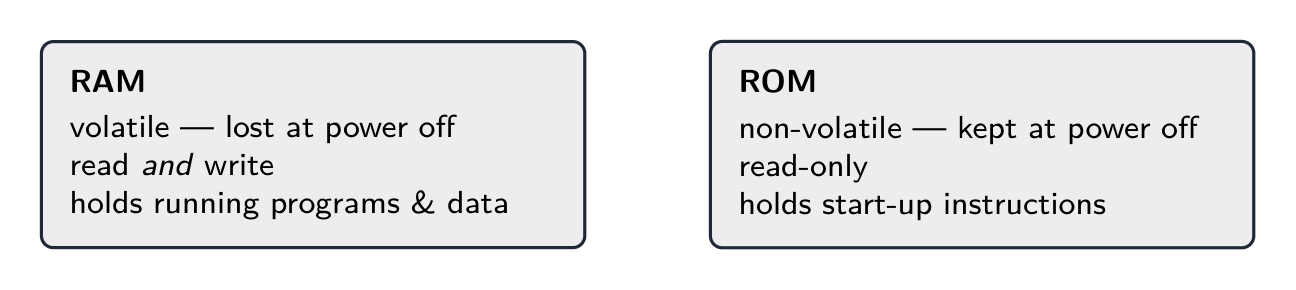
- RAM 随机存取存储器 (Random Access Memory) — volatile 易失性 (loses data without power). Holds the OS, running programs and their data; read and written constantly.
- ROM 只读存储器 (Read-Only Memory) — non-volatile 非易失性 (keeps data without power). Usually written once; holds firmware needed at start-up (the BIOS / boot loader).
RAM is volatile and read/write; ROM is non-volatile and read-only ROM starts the system; RAM then holds the active work.
RAM ROM Volatile? yes: contents lost when the power is off no: contents kept without power Read/write? read and written constantly read only in normal use Holds the operating system, running programs and their data the firmware and bootstrap program that start the computer Size large, and can usually be increased small and fixed Typical use the main memory of a computer or phone the start-up code of a PC; the whole program of an embedded system such as a washing machine More RAM lets a computer hold more programs and data at once, so it swaps less between memory and disk and runs faster; that is the answer to "explain why the computer with more RAM performs better".

A RAM module (DIMM) plugs into the motherboard as the computer's fast main memory ExploreDevice and storage lab
Classify computing examples by what job they do in a system.
Vocabulary TrainEnglish Chinese Pinyin RAM 随机存取存储器 suí jī cún qǔ cún chǔ qì volatile 易失性 yì shī xìng ROM 只读存储器 zhī dú cún chǔ qì non-volatile 非易失性 fēi yì shī xìng 3.1
SRAM vs DRAM
- SRAM 静态RAM (Static RAM) stores each bit in a flip-flop 触发器 of several transistors. Fast, but expensive and not dense. Used for CPU cache 高速缓存.
- DRAM 动态RAM (Dynamic RAM) stores each bit as charge on a tiny capacitor. Cheaper and denser but slower, and must be refreshed 刷新 (rewritten) thousands of times a second. Used for main memory.
Use SRAM for small fast memory (cache); DRAM for large main memory.
SRAM DRAM Each bit stored in a flip-flop of several transistors one capacitor and one transistor Needs refreshing? no yes, thousands of times a second Speed faster slower Density and cost fewer bits per chip, more expensive more bits per chip, cheaper Power uses less power when idle uses more, because of the refresh Used for processor cache main memory, including in embedded systems "Explain why the embedded system uses DRAM": it needs a large amount of memory at low cost in a small space, and its speed requirement is modest, so the cheaper, denser DRAM is the right choice; SRAM is kept for the small cache where speed matters most.
Vocabulary TrainEnglish Chinese Pinyin SRAM 静态 jìng tài flip-flop 触发器 chù fā qì cache 高速缓存 gāo sù huǎn cún DRAM 动态 dòng tài refreshed 刷新 shuā xīn 3.1
PROM, EPROM and EEPROM
ROM variants you can program after manufacture:
- PROM (Programmable ROM) — written once (fuses burned by a programmer); cannot be changed.
- EPROM (Erasable Programmable ROM) — erased by strong UV light through a window, then rewritten (whole chip at once).
- EEPROM (Electrically Erasable Programmable ROM) — erased and rewritten electrically, a byte at a time, in circuit. Flash memory is a derivative optimised for block erase.
PROM EPROM EEPROM Written once, by the user with a programmer many times many times Erased by cannot be erased ultraviolet light through a quartz window an electrical signal Erases nothing the whole chip at once a byte or block at a time Must be removed from the circuit to reprogram? not applicable yes no "Give two differences between EPROM and EEPROM" wants two rows of this table, each stated for both types.
3.1
Monitoring and control systems
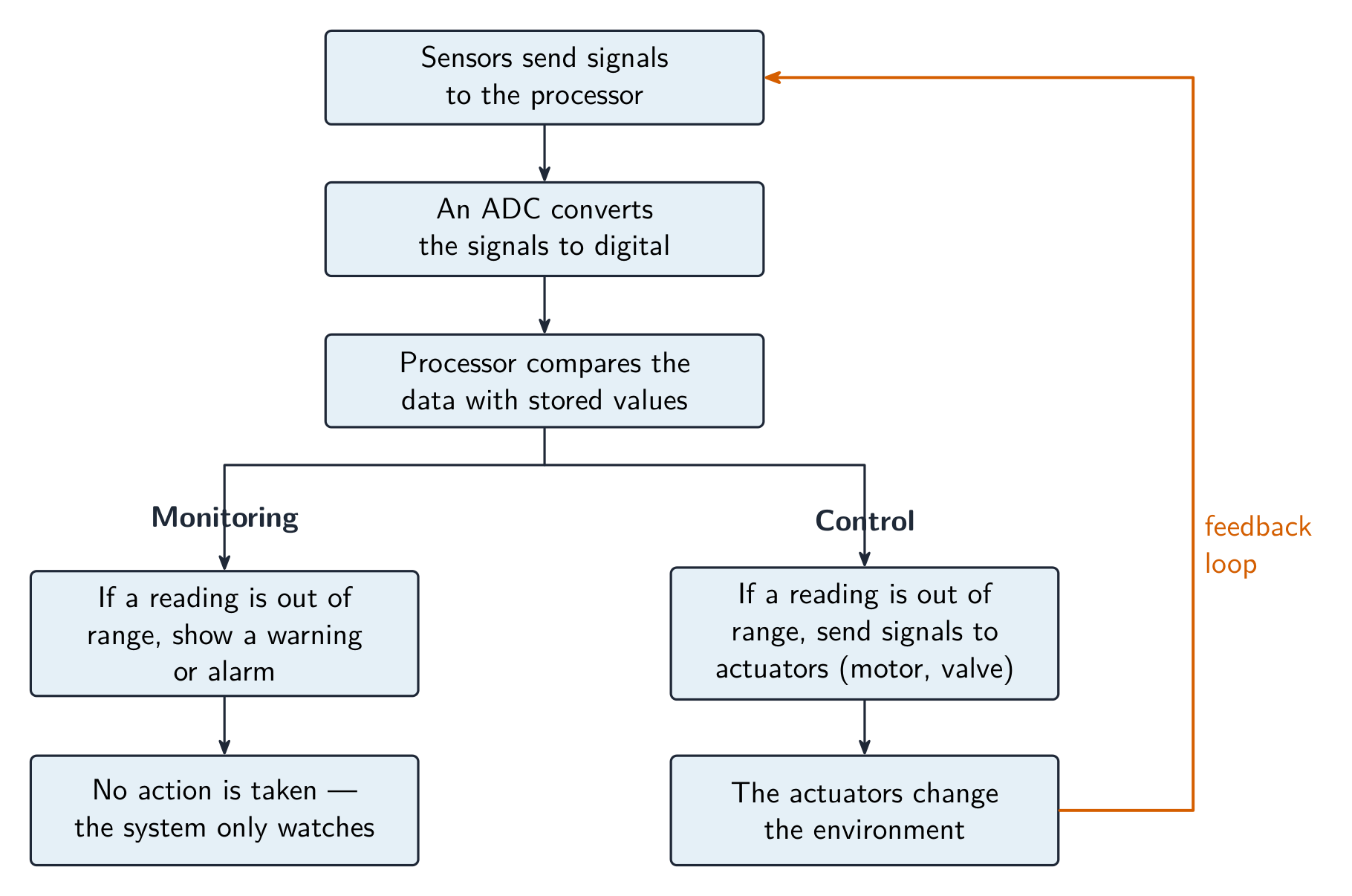
Both read sensors; the difference is what they do next.
- monitoring 监控 — collects and reports data but takes no action (a weather station logging readings).
- control system 控制系统 — uses sensor data to decide and act through actuators, usually in a feedback loop (a thermostat turning a boiler on/off).
The three-mark "describe the differences" answer: a monitoring system only measures, records or displays the readings, and at most raises a warning; a control system compares each reading with a preset value 预设值 and, if it is outside the range, sends signals to actuators that change the physical process; the change is then measured again, so a control system contains feedback and a monitoring system does not. Whether a given system is one or the other is decided by that test: a bridge system that measures a vehicle's height and switches on a warning sign is monitoring, because nothing it does changes the vehicle; a system that lowers a barrier is control.
Worked example. Describe how an automated system opens a door when a person is within 2 metres and closes it when nobody is.
An infra-red or ultrasonic sensor measures the distance to anything in front of the door; the analogue reading is converted to digital by an ADC and sent to the processor; the processor compares the distance with the preset 2 metres; if it is less, the processor sends a signal to the actuator (a motor) to open the door; the sensor keeps measuring, and when no reading below 2 metres is received the processor signals the motor to close the door. The repeated measuring after each action is the feedback that stops the door opening and closing at the wrong times.
Monitoring reports data; a control system acts through a feedback loop Sensors and actuators
A sensor 传感器 turns a physical quantity into a signal: temperature (a thermistor 热敏电阻 or thermocouple), pressure (strain gauge), infra-red, sound. Analogue signals need an ADC first. An actuator 执行器 does the reverse — turns a signal into an action (a motor, valve, heater, buzzer).

A thermistor: a temperature sensor whose resistance changes with heat 
A small electric motor: an actuator that turns a signal into movement Feedback
In a control system the actuator changes the environment, which the sensors then re-measure — a feedback 反馈 loop. Without feedback the system cannot correct itself or know when to stop (a thermostat with no temperature feedback would heat forever).
ExploreThe control feedback loop
Tap round the loop a thermostat or autopilot repeats. A control system doesn't just read the world — it acts, then re-measures, correcting itself again and again.
Vocabulary TrainEnglish Chinese Pinyin monitoring 监控 jiān kòng control system 控制系统 kòng zhì xì tǒng preset value 预设值 yù shè zhí sensor 传感器 chuán gǎn qì thermistor 热敏电阻 rè mǐn diàn zǔ actuator 执行器 zhí xíng qì feedback 反馈 fǎn kuì 3.2
Logic gates

Syllabus
Candidates should be able to: Notes and guidance Use the following logic gate symbols: [NOT, AND, OR, NAND, NOR, XOR] Understand and define the functions of: NOT, AND, OR, NAND, NOR and XOR (EOR) gates All gates except the NOT gate will have two inputs only. Construct the truth table for each of the logic gates above Construct a logic circuit From: • a problem statement • a logic expression • a truth table Construct a truth table From: • a problem statement • a logic circuit • a logic expression Construct a logic expression From: • a problem statement • a logic circuit • a truth table Source: Cambridge International syllabus
The half adder: XOR + AND add two bits A logic gate 逻辑门 is a small circuit that does one Boolean 布尔 operation. Inputs and outputs are 0 (false, low) or 1 (true, high). Know the symbol, function and truth table 真值表 for each gate.
The symbols for the six logic gates NOT (inverter)
A NOT A 0 1 1 0 AND — output 1 only if all inputs are 1
A B A AND B 0 0 0 0 1 0 1 0 0 1 1 1 OR — output 1 if at least one input is 1
A B A OR B 0 0 0 0 1 1 1 0 1 1 1 1 NAND (NOT AND) — output 0 only when all inputs are 1
A B A NAND B 0 0 1 0 1 1 1 0 1 1 1 0 NOR (NOT OR) — output 1 only when all inputs are 0
A B A NOR B 0 0 1 0 1 0 1 0 0 1 1 0 XOR (Exclusive OR, also called EOR) — output 1 if the inputs are different
A B A XOR B 0 0 0 0 1 1 1 0 1 1 1 0 ExploreLogic gates
Switch the inputs and pick a gate. Each gate has its own rule — the building blocks of every digital circuit.
Vocabulary TrainEnglish Chinese Pinyin logic gate 逻辑门 luó jí mén Boolean 布尔 bù ěr truth table 真值表 zhēn zhí biǎo 3.2
Logic circuits
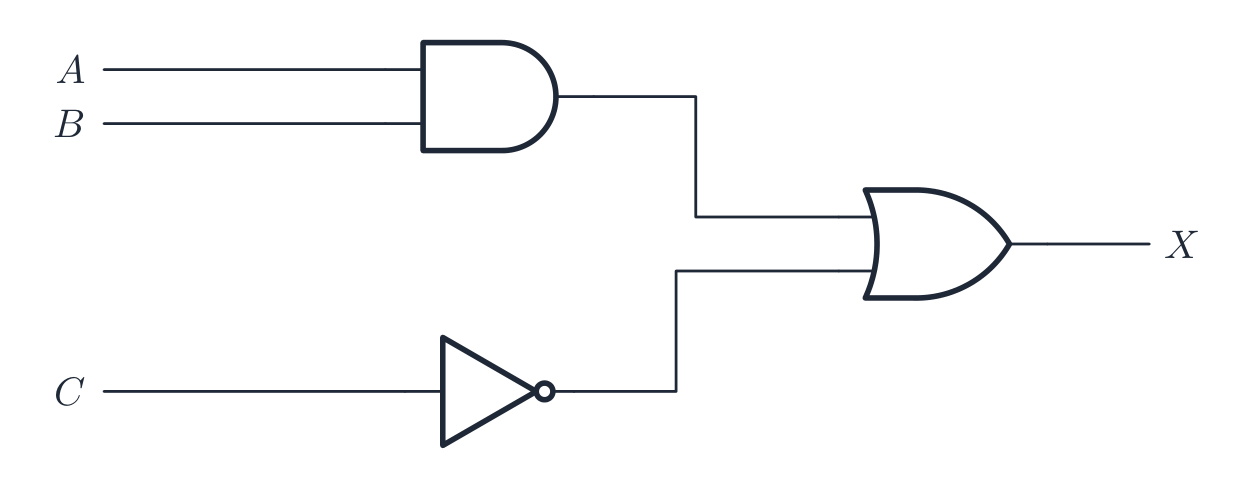
A logic circuit 逻辑电路 is a network of gates that carries out a Boolean expression. You should be able to move between a problem statement, a logic expression, a truth table, and a circuit diagram.
The paper writes expressions in words,
X = (A AND NOT B) OR (B AND C), and accepts the algebraic form $X = A\overline{B} + BC$ where a dot (or nothing) is AND, a plus is OR, and a bar is NOT. Use whichever the question uses.From expression to circuit
Draw one gate per operator and wire them up. For $X = (A \text{ AND } B) \text{ OR } (\text{NOT } C)$: a NOT gate on $C$, an AND gate on $A$ and $B$, then an OR gate on the two results.
Gates wired together to carry out a Boolean expression From circuit to expression
Work forwards from the inputs, labelling each gate's output, until you reach the final output.
Worked example. Write the expression for the circuit below, then complete its truth table.
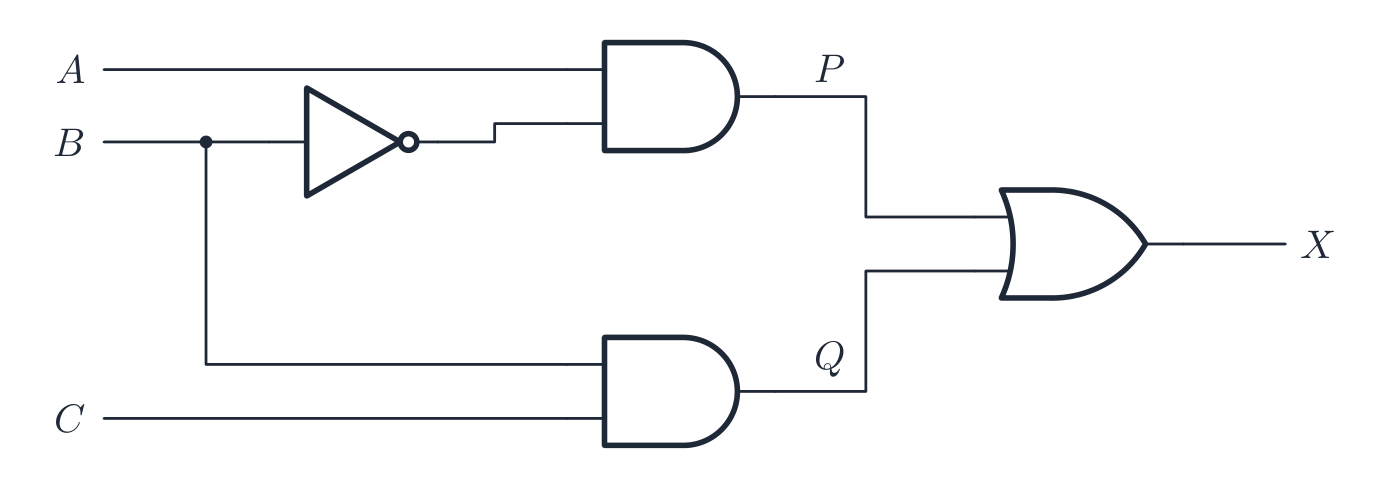
Label every intermediate output: here P is A AND NOT B and Q is B AND C, so X is P OR Q Label the gate outputs: $P = A \text{ AND NOT } B$, $Q = B \text{ AND } C$, so $X = P \text{ OR } Q = (A \text{ AND NOT } B) \text{ OR } (B \text{ AND } C)$. Then give the truth table a column for each intermediate output, so every row can be checked one gate at a time:
A B C NOT B P Q X 0 0 0 1 0 0 0 0 0 1 1 0 0 0 0 1 0 0 0 0 0 0 1 1 0 0 1 1 1 0 0 1 1 0 1 1 0 1 1 1 0 1 1 1 0 0 0 0 0 1 1 1 0 0 1 1 Drawing a circuit from an expression is the same walk in reverse: start from the innermost brackets, draw one gate per operator, draw a NOT gate on the wire of any input that appears with NOT, keep the inputs on the left and the single output on the right, and label the output with its letter. Every line must end at a gate input or the output; a line that goes nowhere loses the mark.
From circuit to truth table
For $n$ inputs there are $2^{n}$ rows. List every input combination; for each, work out the internal gates then the output.
From truth table to expression (sum of products)
For each row that outputs 1, write an AND of the inputs (with NOT on any input that is 0 in that row); OR these together. Example: a table that is 1 only on $(A=0,B=1)$ and $(A=1,B=0)$ gives $\overline{A}B + A\overline{B}$, which is $A \text{ XOR } B$.
From a problem statement
Turn the English into a Boolean expression first: "A and B" → A AND B; "A or B or both" → A OR B; "exactly one of A and B" → A XOR B; "neither A nor B" → A NOR B; "not both" → A NAND B.
Worked example. A machine's alarm $X$ sounds when the guard is open ($A=1$) and either the motor is running ($B=1$) or the temperature is high ($C=1$). Write the Boolean expression, and give the rows where $X=1$. Turn the English into logic one clause at a time: "either B or C" is $B + C$, and "A and that" is $X = A\cdot(B + C)$. For the rows, $X=1$ needs $A=1$ and at least one of $B$, $C$ equal to 1 - so $(A,B,C) = (1,0,1)$, $(1,1,0)$ and $(1,1,1)$, three rows out of eight. Notice $A=0$ can never sound the alarm, whatever $B$ and $C$ do. Bracket the OR before ANDing it: $X = A\cdot B + C$ is a different circuit altogether, one that would sound the alarm on a high temperature even with the guard closed.
ExploreHalf adder
Wire XOR and AND to the same two inputs: XOR gives the sum bit, AND gives the carry. Click A and B.
ExploreLogic circuits
gates combine into circuits
Each gate has a fixed rule; chaining them builds every circuit — start with one gate.
Vocabulary TrainEnglish Chinese Pinyin logic circuit 逻辑电路 luó jí diàn lù 3.2
Definitions the examiner accepts
A definition question is marked against fixed wording. Learn these exactly, and give one answer only.
Term Definition embedded system a computer system with a dedicated function built into a larger device buffer an area of memory that temporarily stores data while it is transferred between devices working at different speeds RAM volatile memory that can be read from and written to, holding the programs and data in use ROM non-volatile memory whose contents cannot be changed in normal use, holding the start-up instructions SRAM static RAM that stores each bit in a flip-flop and needs no refreshing DRAM dynamic RAM that stores each bit as a charge on a capacitor and must be refreshed continually monitoring system a system that uses sensors to measure and report on a physical process without changing it control system a system that uses sensor readings to decide on and carry out actions, through actuators, that change a physical process sensor a device that measures a physical quantity and converts it into a signal for the computer actuator a device that converts a signal from the computer into a physical action feedback the output of a control system being measured and fed back as input so that the system can correct itself logic gate an electronic circuit that performs a Boolean operation on one or more binary inputs to give one binary output truth table a table listing every combination of inputs to a logic circuit with the output for each 3.2
Exam tips
- Distinguish RAM (volatile, read/write) from ROM (non-volatile, holds the bootstrap); SRAM (cache, faster) from DRAM (main memory, needs refreshing).
- For a logic circuit, build the Boolean expression gate by gate, then a truth table covering every input combination.
- Learn the symbol, expression and truth table for each gate (AND, OR, NOT, NAND, NOR, XOR).
- Explain a buffer (a temporary store bridging two different speeds) and the role of an interrupt.
Common mistakes
- Naming the device instead of describing its operation. "It uses a laser" earns nothing; the steps (charge the drum, laser removes charge, toner attracted, transferred, fused) earn the marks.
- Saying a monitoring system "controls" something. If nothing changes the physical process, it is monitoring; add the actuator and the feedback and it becomes control.
- Writing that RAM "stores files permanently" or that ROM "stores the user's data". RAM is volatile working memory; ROM holds the fixed start-up instructions.
- A truth table with fewer than $2^{n}$ rows, or rows in a random order. Count in binary from 000 to 111 so no combination is missed.
- Drawing two lines from one output of a gate to be safe, or leaving a wire that ends nowhere. Draw exactly the connections the expression needs.
-
4
Processor Fundamentals
4.1
Von Neumann architecture
Syllabus
Candidates should be able to: Notes and guidance Show understanding of the basic Von Neumann model for a computer system and the stored program concept Show understanding of the purpose and role of registers, including the difference between general purpose and special purpose registers Special purpose registers including: • Program Counter (PC) • Memory Data Register (MDR) • Memory Address Register (MAR) • The Accumulator (ACC) • Index Register (IX) • Current Instruction Register (CIR) • Status Register Show understanding of the purpose and roles of the Arithmetic and Logic Unit (ALU), Control Unit (CU) and system clock, Immediate Access Store (IAS) Show understanding of how data are transferred between various components of the computer system using the address bus, data bus and control bus Show understanding of how factors contribute to the performance of the computer system Including: • processor type and number of cores • the bus width • clock speed • cache memory Understand how different ports provide connection to peripheral devices Including connection to: • Universal Serial Bus (USB) • High Definition Multimedia Interface (HDMI) • Video Graphics Array (VGA) Describe the stages of the Fetch-Execute (F-E) cycle Describe and use 'register transfer' notation to describe the F-E cycle Show understanding of the purpose of interrupts Including: • possible causes of interrupts • applications of interrupts • use of an Interrupt Service Routine (ISR) • when interrupts are detected during the fetch-execute cycle • how interrupts are handled Source: Cambridge International syllabus
The fetch-decode-execute cycle The Von Neumann architecture 冯·诺依曼体系结构 underlies almost every general-purpose computer:
- a single memory — the Immediate Access Store 立即存取存储器 (IAS) — holds both program instructions and data (the stored program 存储程序 concept).
- a processor 处理器 (CPU) fetches instructions from memory and runs them one at a time.
- instructions run in order unless a branch changes the flow.
The stored-program idea is what makes a computer flexible: change the program and you change what it does, with no rewiring.
ExploreTap the parts of a Von Neumann computer
Explore each block. The CPU (control unit, ALU, registers) talks to a single main memory over the buses — and that one shared memory for instructions AND data is the Von Neumann idea.
Vocabulary TrainEnglish Chinese Pinyin Von Neumann architecture 冯·诺依曼体系结构 féng · nuò yī màn tǐ xì jié gòu Immediate Access Store 立即存取存储器 lì jí cún qǔ cún chǔ qì stored program 存储程序 cún chǔ chéng xù processor 处理器 chǔ lǐ qì RAM 随机存取存储器 suí jī cún qǔ cún chǔ qì 4.1
The CPU's main parts

All of these parts sit inside one small chip. The diagram later in this section shows how they connect; the photo below shows the real thing.
A modern CPU: the whole processor is one small chip (here seen from below, showing the contacts) 
The matching CPU socket on the motherboard: the chip's contacts press onto these pins Arithmetic and Logic Unit (ALU)
The ALU 算术逻辑单元 does the arithmetic (add, subtract, …) and logic (AND, OR, comparisons). It takes operands from registers 寄存器 and puts results back in a register.
Control Unit (CU)
The control unit 控制单元 decodes each instruction and sends the control signals to carry it out — opening data paths, telling the ALU what to do, and controlling memory reads and writes.
System clock
The clock sends a steady stream of pulses that keep the CPU in step. Each instruction takes a fixed number of cycles, and the clock speed 时钟频率 (e.g. 3.8 GHz) is one factor in performance.
"Explain how the CU and the system clock work together": the clock emits pulses at a fixed frequency; the control unit uses each pulse to move the fetch-execute cycle on by one step, sending its control signals in time with the pulses, so every part of the processor changes state together. A faster clock means more steps per second, up to the point where the circuits cannot settle between pulses.
Registers
Registers are tiny, very fast stores inside the CPU. The special purpose registers 专用寄存器 each have a fixed job in the cycle:
- Program Counter 程序计数器 (PC) — the address of the next instruction.
- Memory Address Register 内存地址寄存器 (MAR) — the address being read or written.
- Memory Data Register 内存数据寄存器 (MDR) — the data going to or from memory.
- Current Instruction Register 当前指令寄存器 (CIR) — the instruction being decoded.
- Accumulator 累加器 (ACC) — the value the ALU is working on.
- Status Register 状态寄存器 — holds flags 标志 (carry, zero, negative, overflow) used by branches. Each flag is one bit, set or cleared by the ALU after an operation: the zero flag after a comparison that matched, the carry flag when an addition overflowed the register, the negative flag when a result is negative. A conditional jump reads the flags to decide whether to branch, and an overflow flag can raise an interrupt.
- Index Register 变址寄存器 — an offset added to an address in indexed addressing; incrementing it steps through an array one element at a time.
The "complete the table describing the role of each register" question wants one precise sentence per register in these terms: the PC holds the address of the next instruction to be fetched; the MAR holds the address of the location being read from or written to; the MDR holds the data or instruction just read from, or about to be written to, that location; the CIR holds the instruction currently being decoded and executed; the ACC holds the result of the last arithmetic or logic operation.
General-purpose registers 通用寄存器 are used by the programmer for temporary values during a calculation. Movements of data between registers and memory are written in register transfer 寄存器传送 notation — e.g.
MAR ← [PC]("copy the contents of PC into MAR").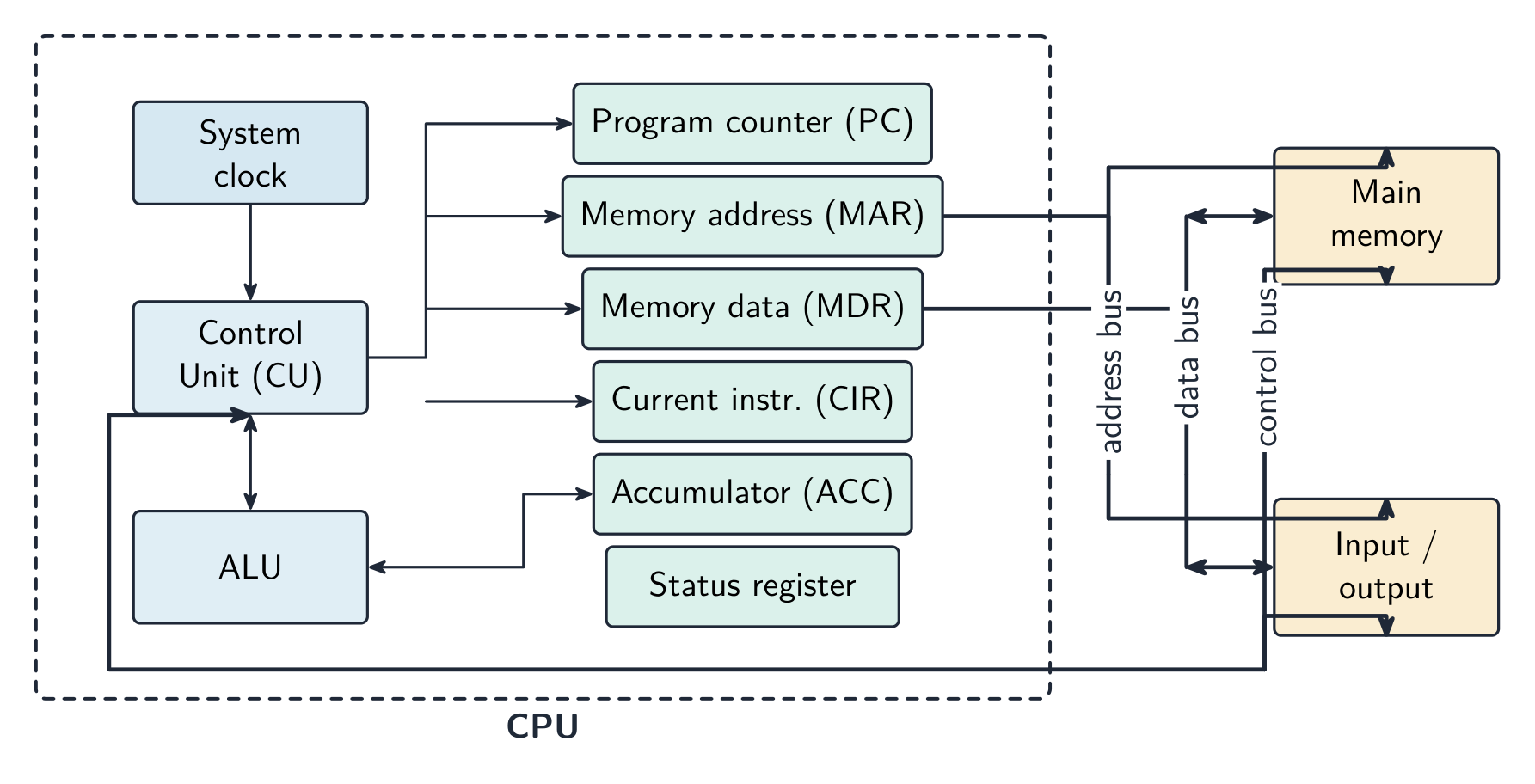
The Von Neumann CPU: registers, control unit and ALU linked by buses Vocabulary TrainEnglish Chinese Pinyin ALU 算术逻辑单元 suàn shù luó jí dān yuán registers 寄存器 jì cún qì control unit 控制单元 kòng zhì dān yuán clock speed 时钟频率 shí zhōng pín lǜ special purpose registers 专用寄存器 zhuān yòng jì cún qì Program Counter 程序计数器 chéng xù jì shù qì Memory Address Register 内存地址寄存器 nèi cún dì zhǐ jì cún qì Memory Data Register 内存数据寄存器 nèi cún shù jù jì cún qì Current Instruction Register 当前指令寄存器 dāng qián zhǐ lìng jì cún qì Accumulator 累加器 lěi jiā qì Status Register 状态寄存器 zhuàng tài jì cún qì flags 标志 biāo zhì Index Register 变址寄存器 biàn zhǐ jì cún qì General-purpose registers 通用寄存器 tōng yòng jì cún qì register transfer 寄存器传送 jì cún qì chuán sòng 4.1
Buses

Three internal buses 总线 (sets of parallel wires) connect the parts:
- address bus 地址总线 — carries the memory address. One-way (CPU → memory).
- data bus 数据总线 — carries the data. Two-way.
- control bus 控制总线 — carries control signals (read, write, interrupt). Two-way.
An $n$-bit address bus can reach $2^{n}$ memory locations. The data-bus width sets how many bits move per access (often the word size).
The three system buses connecting the CPU, memory and input/output Vocabulary TrainEnglish Chinese Pinyin buses 总线 zǒng xiàn address bus 地址总线 dì zhǐ zǒng xiàn data bus 数据总线 shù jù zǒng xiàn control bus 控制总线 kòng zhì zǒng xiàn 4.1
What affects performance
- clock speed — more cycles per second.
- number of cores 核心 — a multi-core CPU runs several threads at once.
- word size 字长 — a 64-bit CPU handles 64-bit chunks per cycle and can address far more memory than a 32-bit one.
- amount of RAM 随机存取存储器 — more RAM holds more of the working set; too little forces the OS to page 页 to disk.
- cache memory 高速缓存 size — more cache cuts average memory access time.
- secondary storage 辅助存储器 type — an SSD loads programs far faster than an HDD.
- bus width and speed — wider/faster buses move data more quickly.
Match the specs to the workload: a quad-core beats a dual-core on parallel work, but higher per-core speed wins on single-threaded work.
Each factor is a two-mark answer with a reason attached:
- More cores: each core can fetch and execute its own instruction at the same time, so several programs, or the threads of one program, run in parallel. But a program must be written to use more than one core, so doubling the cores does not double the speed.
- Higher clock speed: more fetch-execute cycles per second, so more instructions per second; the limit is the heat produced.
- Wider bus: a wider data bus moves more bits in each transfer, so fewer transfers are needed for the same data; a wider address bus can address more memory locations.
- Cache memory: a small, fast memory inside or next to the processor that keeps the instructions and data used most recently or most often. Reading them from cache is much faster than from RAM, so the processor spends less time waiting.
"Explain why the new computer performs better" is answered by comparing the two specifications line by line: a higher clock speed executes more instructions per second, more cores run more tasks at once, more cache means fewer slow accesses to RAM, and more RAM means fewer transfers to disk.
Vocabulary TrainEnglish Chinese Pinyin number of cores 核心 hé xīn word size 字长 zì zhǎng amount of RAM 随机存取存储器 suí jī cún qǔ cún chǔ qì page 页 yè cache memory 高速缓存 gāo sù huǎn cún secondary storage 辅助存储器 fǔ zhù cún chǔ qì cores 核心 hé xīn 4.1
Ports
A port 端口 is a physical socket for connecting a peripheral 外围设备:
- USB (Universal Serial Bus) — general-purpose (keyboards, drives, phones).
- HDMI (High Definition Multimedia Interface) — digital video and audio to a screen.
- VGA (Video Graphics Array) — older analogue video output to a monitor.
- Ethernet (RJ-45) — wired LAN. Audio jacks — headphones/microphone.
Different ports use different signals, so an HDMI cable will not fit a USB socket. USB-C is unusual in carrying video, data and power.
"Explain how the computer connects to the monitor through HDMI": the HDMI port sends the video and the audio as one digital signal down a single cable, so no conversion to analogue is needed and the picture is not degraded; the cable carries high-definition resolutions and the monitor's own port decodes the signal. A USB device is plug-and-play: when it is connected the computer detects it, identifies it, loads or installs the driver it needs, and can supply it with power, all without a restart.
Vocabulary TrainEnglish Chinese Pinyin port 端口 duān kǒu peripheral 外围设备 wài wéi shè bèi 4.1
Fetch-Execute cycle

The CPU repeats the fetch-execute cycle 取指-执行周期, one run per machine instruction.
Fetch
- the PC's address is copied to the MAR.
- the PC is incremented to point to the next instruction.
- a read signal goes over the control bus.
- memory puts the instruction on the data bus.
- it is copied into the MDR, then into the CIR.
The exam asks for these steps in register transfer notation 寄存器传送记法, where
[X]means the contents of register X and[[MAR]]means the contents of the memory location whose address is in the MAR:MAR ← [PC] the address of the next instruction goes to the MAR PC ← [PC] + 1 the PC now points to the following instruction MDR ← [[MAR]] the instruction at that address is read into the MDR CIR ← [MDR] the instruction is copied into the CIR for decodingThe order matters: the PC is incremented straight after its address has been copied, so that a jump executed later can still overwrite it. During execution the same notation describes each instruction; for
LDD 200, for example,MAR ← 200,MDR ← [[MAR]],ACC ← [MDR].The register transfers in a fetch: PC → MAR → memory → MDR → CIR, with the PC incremented Decode
The CU decodes the instruction in the CIR — what operation, and which operands or addresses.
Execute
The CU carries it out: arithmetic/logic goes to the ALU (result to the ACC); a load/store moves data between memory and a register; a branch changes the PC. Then the cycle repeats.

The fetch-execute cycle, with a check for interrupts each time ExploreThe fetch-execute cycle
Tap round the loop the CPU repeats billions of times a second. Watch how fetch uses the PC/MAR/MDR/CIR registers, then decode and execute act on what was fetched.
ExploreThe fetch–execute cycle
Step through how the CPU runs one instruction — fetch it from memory, decode it, then execute it, over and over.
Vocabulary TrainEnglish Chinese Pinyin fetch-execute cycle 取指-执行周期 qǔ zhǐ - zhí xíng zhōu qī register transfer notation 寄存器传送记法 jì cún qì chuán sòng jì fǎ 4.1
Interrupts
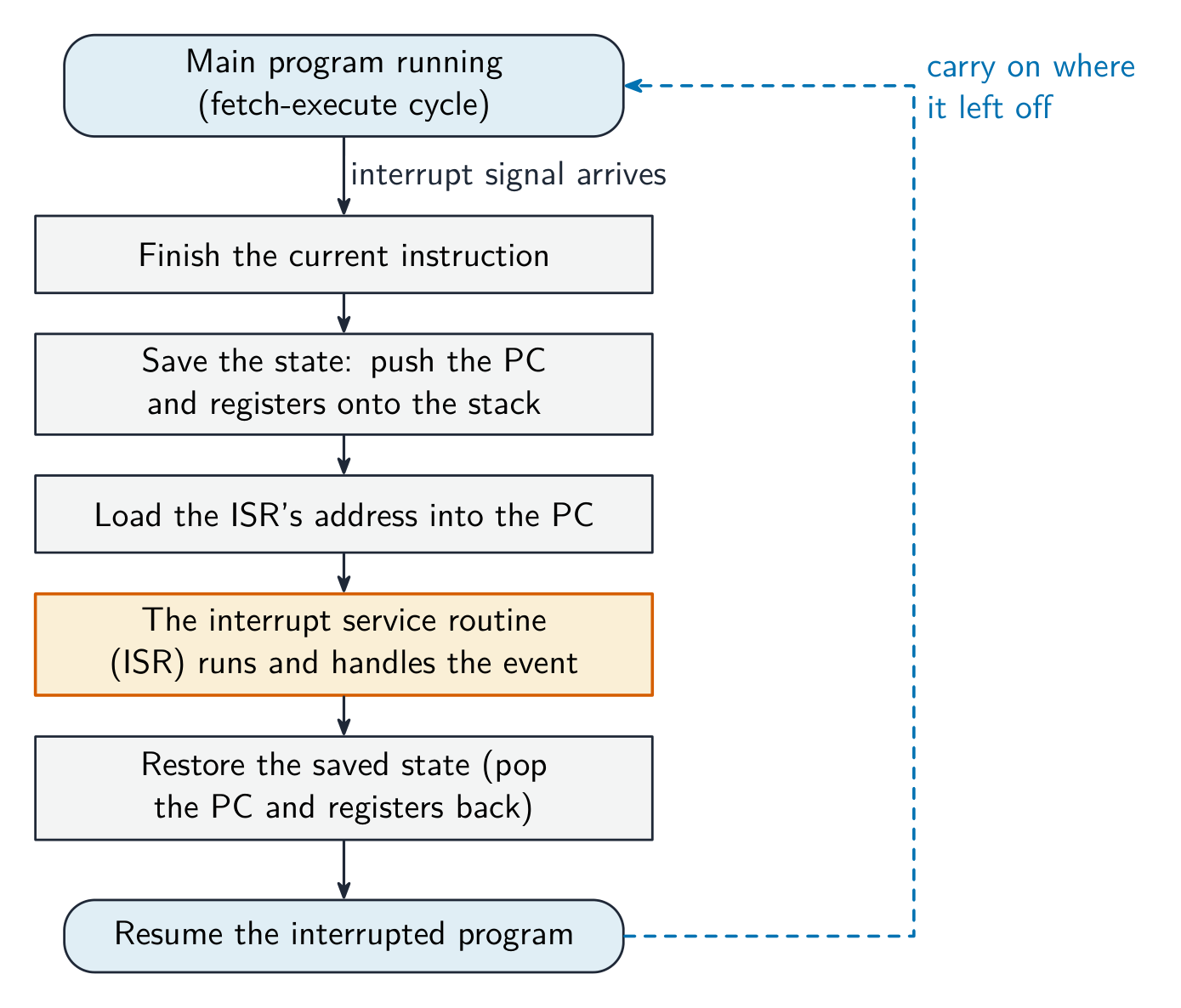
An interrupt 中断 is a signal that pauses the normal cycle so the CPU can handle an urgent event (a key press, a packet arriving, a hardware fault, division by zero, the OS timer).
Handling one:
- finish the current instruction.
- save the state (PC and registers).
- load the address of the interrupt service routine 中断服务程序 (ISR) into the PC and run it.
- the ISR handles the event.
- restore the saved state and carry on.
Interrupts let the system respond promptly without the CPU constantly checking devices, and are how the OS multitasks.
"Explain how an interrupt from an input device is detected and handled in the F-E cycle" is a four-mark answer with these points: the device sends an interrupt signal that sets the interrupt flag in the interrupt register 中断寄存器; the processor checks that register at the end of every fetch-execute cycle, after the current instruction has finished executing; if a flag is set and the interrupt has a higher priority than the current task, the contents of the PC and the other registers are saved onto the stack 栈; the address of the interrupt service routine is loaded into the PC and the routine runs; when it finishes, the saved values are restored from the stack and the interrupted program continues from where it stopped.
Causes worth naming: a hardware interrupt from a device (a key pressed, a printer buffer empty, a network packet arriving), a software interrupt from a fault (division by zero, an illegal instruction, arithmetic overflow), a timer interrupt from the operating system marking the end of a time slice, and a power failure warning.
How an interrupt fits into the fetch-execute cycle Vocabulary TrainEnglish Chinese Pinyin interrupt 中断 zhōng duàn interrupt service routine 中断服务程序 zhōng duàn fú wù chéng xù interrupt register 中断寄存器 zhōng duàn jì cún qì stack 栈 zhàn 4.2
Assembly language and machine code

Syllabus
Candidates should be able to: Notes and guidance Show understanding of the relationship between assembly language and machine code Describe the different stages of the assembly process for a two-pass assembler Apply the two-pass assembler process to a given simple assembly language program Trace a given simple assembly language program Show understanding that a set of instructions are grouped Including the following groups: • Data movement • Input and output of data • Arithmetic operations • Unconditional and conditional instructions • Compare instructions Show understanding of and be able to use different modes of addressing Including immediate, direct, indirect, indexed, relative Source: Cambridge International syllabus
The CPU actually runs machine code 机器码 — bit patterns, specific to one architecture. Assembly language 汇编语言 is a readable form, with one instruction per machine instruction, written using mnemonics 助记符 like
LDD,ADD,JMP. An assembler 汇编器 translates it to machine code.An assembler turns mnemonics into machine-code bit patterns Two-pass assembler
A two-pass assembler reads the source twice:
- pass 1 builds a symbol table 符号表: each time a label 标签 (like
LOOP:) appears, record its address; no code yet. - pass 2 generates code: translate each instruction, and when one refers to a label (like
JMP LOOP), look up its address in the symbol table.
Two passes handle forward references 前向引用 (a jump to a label defined later).
Worked example. Apply the two-pass process to this program, whose first instruction is stored at address 100.
        LDD  COUNT
LOOP:   DEC  ACC
        CMP  #0
        JPN  LOOP
        END
COUNT:  5
Pass 1 reads each line, counts the address it will occupy, and records every label in the symbol table:
LOOP= 101 (theDECline) andCOUNT= 105 (the data line). No code is produced. Pass 2 reads the program again and translates each line into machine code, replacing each mnemonic by its opcode 操作码 and each symbolic address by the number from the symbol table:LDD COUNTbecomes the opcode forLDDwith operand 操作数 105, andJPN LOOPbecomes the opcode forJPNwith operand 101. The jump back toLOOPcould have been resolved in one pass, but a jump forward to a label not yet seen could not, which is why the assembler makes two.Example instruction set
Cambridge uses a small generic set, printed in the paper's reference table, with one general-purpose register, the accumulator (ACC), and an index register (IX). An operand written
#nis a denary number,Bna binary number and&na hexadecimal number;<address>is a location number or a label.Group Instruction What it does Data movement LDM #nload the number n into ACC (immediate) LDD <address>load the contents of the address into ACC (direct) LDI <address>the address holds another address; load the contents of that one into ACC (indirect) LDX <address>add IX to the address and load the contents of the result into ACC (indexed) LDR #nload the number n into IX MOV <register>copy ACC into the named register (IX) STO <address>store the contents of ACC at the address Input and output INread a key press and put its ASCII code in ACC OUToutput the character whose ASCII code is in ACC Arithmetic ADD <address>/ADD #nadd the contents of the address, or the number, to ACC SUB <address>/SUB #nsubtract from ACC INC <register>/DEC <register>add 1 to, or subtract 1 from, ACC or IX Compare CMP <address>/CMP #ncompare ACC with the contents of the address, or with n, and set the flag CMI <address>compare ACC with the contents of the address held at the address (indirect) Jump JMP <address>jump to the address unconditionally JPE <address>/JPN <address>jump if the last compare was equal / not equal Bit manipulation AND,OR,XORwith#n,Bn,&nor<address>bitwise operation on ACC LSL #n/LSR #nshift ACC logically n places left or right ENDend the program The "assembly language instructions are grouped" question wants the group names, and an instruction from each: data movement, input and output, arithmetic, unconditional and conditional jumps, compare, and bit manipulation.
ExploreHow a two-pass assembler works
Step through it. The assembler reads your code twice: pass 1 just finds where every label lives, so pass 2 can fill in the addresses — that is how a jump to a label defined later still works.
Vocabulary TrainEnglish Chinese Pinyin machine code 机器码 jī qì mǎ Assembly language 汇编语言 huì biān yǔ yán mnemonics 助记符 zhù jì fú assembler 汇编器 huì biān qì symbol table 符号表 fú hào biǎo label 标签 biāo qiān forward references 前向引用 qián xiàng yǐn yòng opcode 操作码 cāo zuò mǎ operand 操作数 cāo zuò shù 4.2
Addressing modes
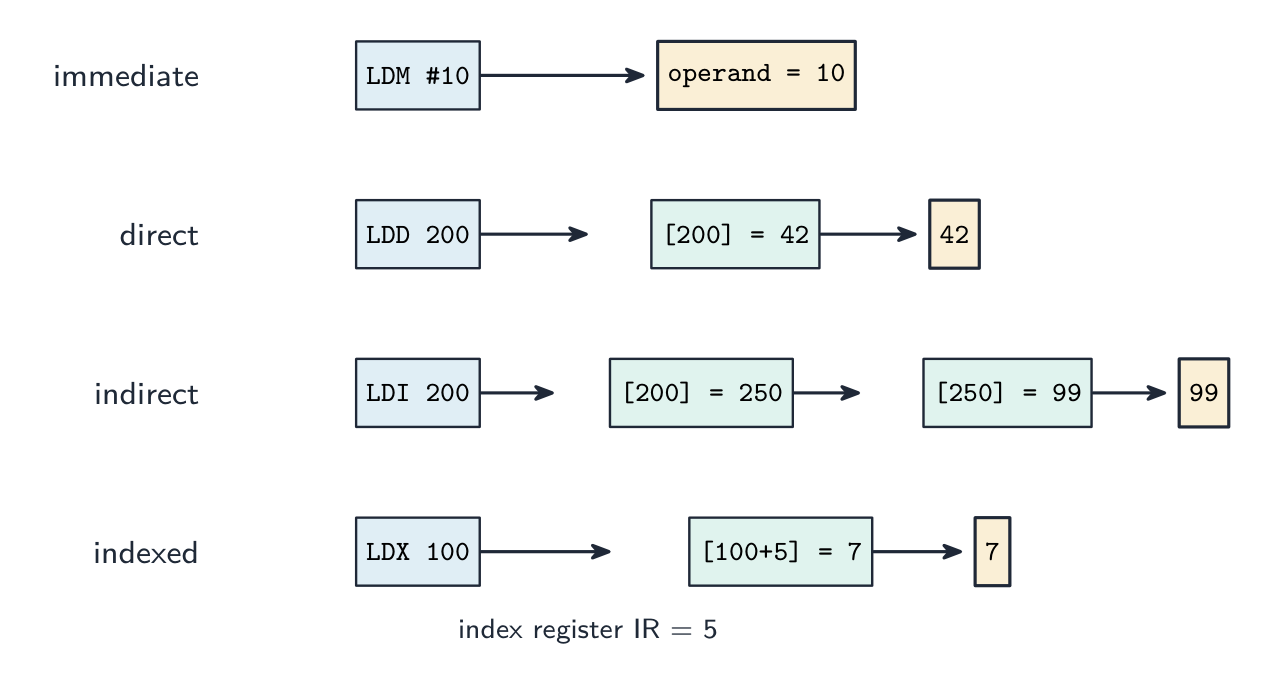
The addressing mode 寻址方式 (the modes of addressing) says how the CPU finds the operand:
- immediate addressing 立即寻址 — the operand is the value in the instruction.
LDM #10loads 10. - direct addressing 直接寻址 — the instruction holds an address; the operand is the value there.
LDD 200. - indirect addressing 间接寻址 — the instruction holds an address that holds another address, which is the data.
LDI 200. - indexed addressing 变址寻址 — effective address is
address + index register; used for arrays.LDX 100with IR = 5 reads address 105.
(Relative addressing 相对寻址 gives the address as an offset from the PC — used for jumps.)
How each addressing mode reaches its operand — immediate, direct, indirect and indexed Worked example. Memory holds: location
200=250, location250=99, location105=7. The index register holds5. What is in the accumulator after each ofLDM #200,LDD 200,LDI 200andLDX 100? Follow how far each mode has to look.LDM #200is immediate - the operand is the number written in the instruction, so the accumulator holds 200.LDD 200is direct - go to location 200 and take what is there: 250.LDI 200is indirect - location 200 holds 250, which is another address, so go on to location 250: 99.LDX 100is indexed - add the index register to the address, $100 + 5 = 105$, and read location 105: 7. Count the hops to keep them apart: immediate 0, direct 1, indirect 2, indexed 1 (once the index has been added).Vocabulary TrainEnglish Chinese Pinyin addressing mode 寻址方式 xún zhǐ fāng shì immediate addressing 立即寻址 lì jí xún zhǐ direct addressing 直接寻址 zhí jiē xún zhǐ indirect addressing 间接寻址 jiàn jiē xún zhǐ indexed addressing 变址寻址 biàn zhǐ xún zhǐ Relative addressing 相对寻址 xiāng duì xún zhǐ 4.2
Tracing an assembly program
To trace it: make a table with columns for the PC, ACC, index register, each variable and any flags. Step through the instructions, updating the table after each; follow branches when they change the PC; stop at
END. A common pattern is a loop over an array using indexed addressing.Worked example. Trace this program. Address 200 holds 5 and address 201 holds 0.
100   LDD  200
101   CMP  #0
102   JPE  108
103   OUT
104   DEC  ACC
105   STO  200
106   LDD  201
107   JMP  100
108   END
Write one row for each instruction executed, filling in only the columns that change:
Instruction ACC 200 201 Output start 5 0 LDD 2005 CMP #0JPE 108not taken OUTcharacter with code 5 DEC ACC4 STO 2004 LDD 2010 JMP 100LDD 2004 and so on, until
LDD 200loads 0, the compare sets the equal flag,JPE 108is taken and the program ends. Three things the examiner checks: aCMPchanges no register, only a flag; a jump not taken still counts as executed; andOUToutputs a character, so it goes in the output column, not the ACC column. "State the effect of changingLDD 10toLDM #10": the ACC would hold the number 10 instead of the contents of address 10.4.3
Binary shifts

Syllabus
Candidates should be able to: Notes and guidance Show understanding of and perform binary shifts Logical, arithmetic and cyclic Left shift, right shift Show understanding of how bit manipulation can be used to monitor/control a device Carry out bit manipulation operations Test and set a bit (using bit masking) Instruction Label | Opcode | Operand Explanation AND #n / Bn / &n Bitwise AND operation of the contents of ACC with the operand AND Bitwise AND operation of the contents of ACC with the contents of XOR #n / Bn / &n Bitwise XOR operation of the contents of ACC with the operand XOR Bitwise XOR operation of the contents of ACC with the contents of OR #n / Bn / &n Bitwise OR operation of the contents of ACC with the operand OR Bitwise OR operation of the contents of ACC with the contents of LSL #n Bits in ACC are shifted logically n places to the left. Zeros are introduced on the right hand end LSR #n Bits in ACC are shifted logically n places to the right. Zeros are introduced on the left hand end Labels an instruction Gives a symbolic address All questions will assume there is only one general purpose register available (Accumulator) ACC denotes Accumulator IX denotes Index Register can be an absolute or symbolic address # denotes a denary number, e.g. #123 B denotes a binary number, e.g. B01001010 & denotes a hexadecimal number, e.g. &4A Source: Cambridge International syllabus
A logical shift 逻辑移位 moves all the bits left or right by some places, filling new positions with 0.
- left shift by 1 (
LSL #1) — bits move left, a 0 enters on the right; for an unsigned number this is × 2. - right shift by 1 (
LSR #1) — bits move right, a 0 enters on the left; for an unsigned number this is integer ÷ 2.
Shifting by $n$ places multiplies or divides by $2^{n}$. Example:
00001011(11)LSL #1→00010110(22).Bits shifted off the end are lost, so the multiplication is only correct while they were zeros.
LSL #2on the two's-complement integer11001010gives00101000: the two 1s that fell off the left are gone, the sign bit has changed, and the result is no longer four times the original.An arithmetic right shift keeps the sign bit so a negative signed number stays negative. A cyclic shift 循环移位 (rotate) feeds the bit that drops off one end back in at the other end, so no bits are lost.
"Show the result of an arithmetic right shift of 3 places on
10011110": copy the sign bit into each vacated place,11110011. The same shift on01011100gives00001011. A cyclic left shift of 1 on10000110gives00001101: the leading 1 reappears on the right.Logical left ($\times 2$), logical right ($\div 2$) and arithmetic right (keeps the sign bit) The difference between the two right shifts is a single bit. Take
11110000, which is 240 read as unsigned and $-16$ read as signed.LSR #1brings in a 0 and gives01111000$= 120$, which is the correct half of 240.ASR #1copies the sign bit instead and gives11111000$= -8$, which is the correct half of $-16$. Neither is wrong — each halves the value under one reading.
Logical and arithmetic right shift on the same byte: only the bit that enters on the left differs Bit manipulation for monitoring/control
Embedded devices often use one bit 位 of a register per signal (e.g. bit $n$ = LED $n$). Using a mask 掩码 — bit masking — you can:
- set bit $n$:
R = R ORa mask with bit $n$ set. - clear bit $n$:
R = R ANDa mask with bit $n$ clear and the rest set. - toggle bit $n$:
R = R XORa mask with bit $n$ set. - test bit $n$:
R ANDthe mask, then check if the result is non-zero.
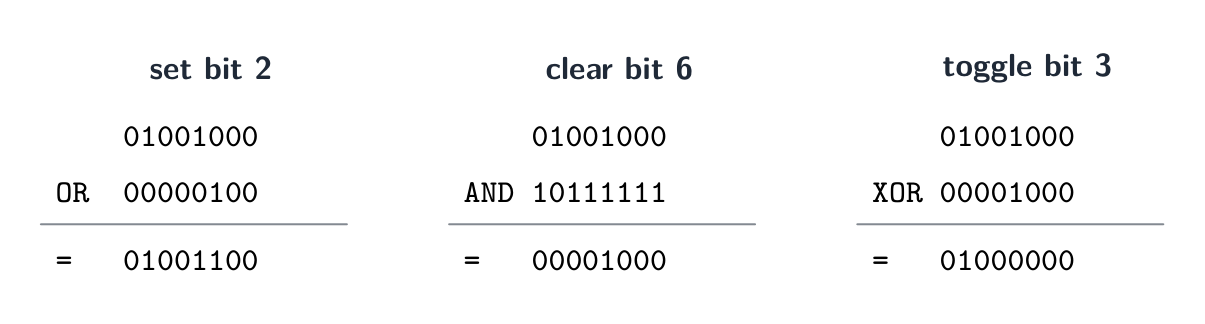
Set a bit with OR, clear it with AND, toggle it with XOR — each using a mask Bit manipulation is fast, uses little memory, and lets one byte hold up to 8 on/off states.
In the exam's instruction set these are
AND,ORandXORwith a mask written as a denary, binary or hexadecimal operand. With the ACC holding10101100:Instruction Mask Result in ACC Effect AND B000011110000111100001100keeps only the low four bits (clears the others) OR #10000000110101101sets the least significant bit, leaving the rest unchanged XOR &FF1111111101010011inverts every bit AND B00001000thenCMP #00000100000001000tests bit 3: the compare is not equal, so bit 3 was set LSL #210110000shifts left two places, losing the top two bits LSR #300010101shifts right three places, zeros entering on the left "Write the instruction that sets the least significant bit to 1 and leaves the others unchanged":
OR #1, orOR B00000001. To clear a bit useANDwith a mask that has a 0 in that place and 1s elsewhere; to test a bit,ANDwith a mask that has a 1 only in that place, then compare the result with zero. In a monitoring device, one bit of a register per sensor lets a singleANDcheck whether a particular sensor is on, and oneORswitches an actuator's control bit on without disturbing the others.ExploreShift and mask the bits of a byte
Pick an operator and watch each result bit. A left shift (<<) moves every bit up one place (×2); a right shift (>>) moves them down (÷2); AND with a mask clears the bits you don't want.
Vocabulary TrainEnglish Chinese Pinyin logical shift 逻辑移位 luó jí yí wèi cyclic shift 循环移位 xún huán yí wèi bit 位 wèi mask 掩码 yǎn mǎ 4.3
Definitions the examiner accepts
A definition question is marked against fixed wording. Learn these exactly, and give one answer only.
Term Definition stored program concept the program instructions and the data are both held in main memory, and instructions are fetched and executed one at a time register a small, very fast storage location inside the processor with a specific purpose Program Counter the register holding the address of the next instruction to be fetched Memory Address Register the register holding the address of the memory location being read from or written to Memory Data Register the register holding the data or instruction just read from, or about to be written to, memory Current Instruction Register the register holding the instruction currently being decoded and executed Accumulator the general-purpose register holding the result of the last arithmetic or logic operation cache memory small, fast memory close to the processor holding frequently used instructions and data interrupt a signal from a device or program that causes the processor to pause the current task and run an interrupt service routine assembly language a low-level language in which each mnemonic instruction corresponds to one machine-code instruction immediate addressing the operand is the value written in the instruction direct addressing the operand is the contents of the address written in the instruction indirect addressing the address in the instruction holds the address of the operand indexed addressing the operand's address is the address in the instruction plus the contents of the index register relative addressing the operand's address is given as an offset from the address of the current instruction logical shift every bit moves the given number of places and zeros fill the vacated places 4.3
Exam tips
- Learn the fetch-execute cycle in register-transfer terms (PC, MAR, MDR, CIR, ACC) and what increments the PC.
- Name each register's job; the address bus is one-way, the data bus is two-way.
- Distinguish the addressing modes (immediate, direct, indirect, indexed) — a frequent question.
- Explain how clock speed, number of cores, cache size and word length affect performance.
- For a binary shift, state whether it is logical or arithmetic; a left shift multiplies by 2, a right shift divides by 2.
Common mistakes
- Saying the PC holds the current instruction, or the MDR holds an address. The PC holds the address of the next instruction; the MDR holds data or an instruction, never an address.
- Leaving the increment of the PC out of the fetch, or putting it after the execute. It happens as soon as the address has been copied to the MAR.
- Reading
LDD 10as "load 10".LDD 10loads the contents of address 10;LDM #10loads the number 10. - Putting a value in the ACC column for
CMPorOUT. A compare sets a flag only; an output goes to the output column. - Saying an interrupt is handled "immediately". The processor finishes the current instruction and checks for interrupts at the end of the cycle.
- Using a logical right shift on a negative two's-complement number. Only an arithmetic shift keeps the sign bit.
-
5
System Software
5.1
Operating systems

Syllabus
Candidates should be able to: Notes and guidance Explain why a computer system requires an Operating System (OS) Explain the key management tasks carried out by the Operating System Including memory management, file management, security management, hardware management (input/output/peripherals), process management Show understanding of the need for typical utility software provided with an Operating System Including disk formatter, virus checker, defragmentation software, disk contents analysis / disk repair software, file compression, back-up software Show understanding of program libraries Including: • software under development is often constructed using existing code from program libraries • the benefits to the developer of software constructed using library files, including Dynamic Link Library (DLL) files Source: Cambridge International syllabus
Why a computer needs an OS
Hardware on its own can only fetch and run instructions — it knows nothing about files, programs, networks or users. The operating system 操作系统 (OS) is the software layer that:
- manages the hardware (processor 处理器, memory, I/O, storage) for the running programs.
- provides services (file system, network, user accounts) through a clear interface, so programs need not talk to the hardware directly.
- provides a user interface (command line, GUI, touch).
- lets several programs share the hardware safely — each gets fair CPU time and is kept out of the others' memory.
Without an OS, every program would need its own drivers, and only one program could safely run at a time.
A desktop operating system manages the screen, files and programs for the user 
A smartphone runs a mobile operating system such as Android Key management tasks
- process management 进程管理 — load programs, schedule them on the CPU, switch between them, and kill misbehaving ones. (A running program is a process 进程.)
- memory management 内存管理 — give memory to processes, keep them apart, and use virtual memory 虚拟内存 / paging 分页 so the working set can exceed physical RAM 随机存取存储器.
- file management — organise files and folders on secondary storage 辅助存储器, control permissions, prevent write corruption.
- device management (hardware management) — handle I/O and peripherals through device drivers 设备驱动, buffer data, manage interrupts, and give a uniform interface.
- security management — accounts, permissions, firewall, encryption.
- user interface and networking.
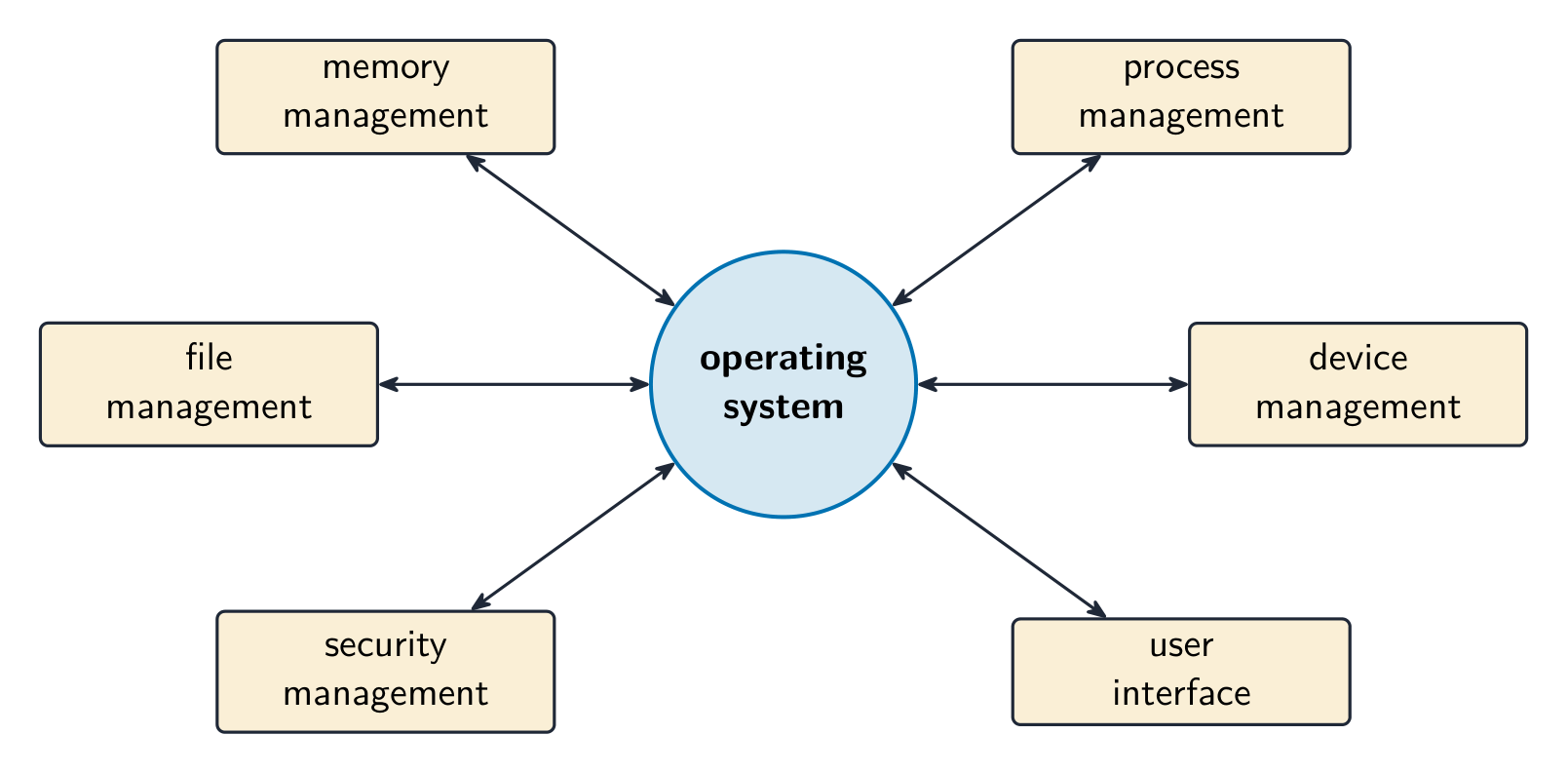
The main jobs the operating system manages 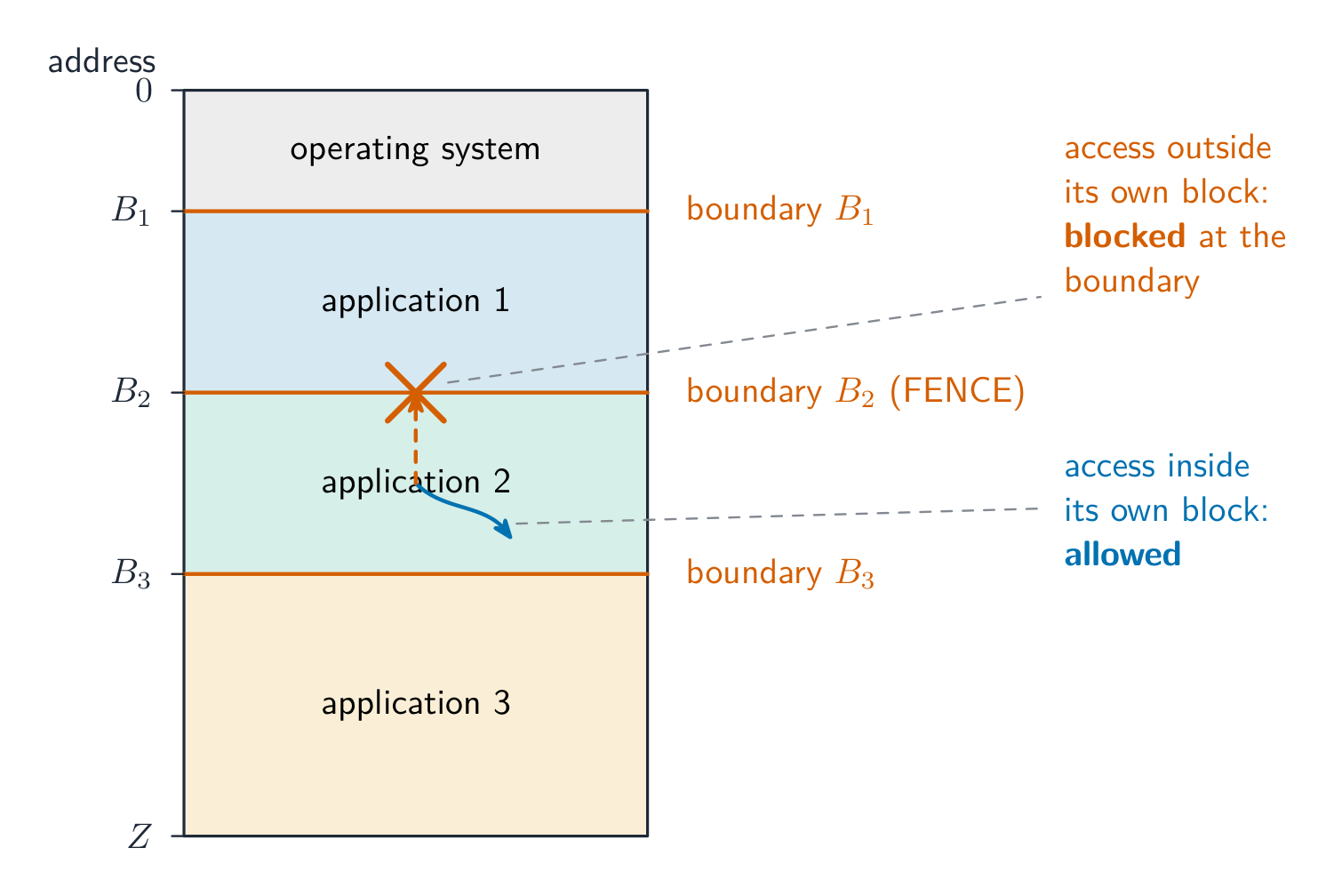
Memory protection keeps each application in its own block of memory Utility software
Most OSes include utility programs 实用程序 to maintain the system:

Utility programs: antivirus, backup, compression and defragmenter - disk formatter — a file / disk management tool that prepares a disk (sets up its file system); related tools copy, move and delete files.
- defragmentation software (disk defragmenter 碎片整理) — moves the pieces of fragmented files together on a hard disk to cut seek time (not useful on SSDs).
- disk contents analysis / disk repair software — check disk integrity and fix file-system errors and bad sectors.
- back-up software (backup 备份) — copies user data elsewhere so it can be recovered.
- virus checker (antivirus 杀毒软件) — scans for malware and quarantines threats.
- firewall 防火墙 — filters network traffic by rules.
- file compression (compression 压缩) / archiving; system monitor; updates.
Bundling these with the OS saves the user installing each one.
ExploreWhere the operating system sits
Tap each layer. The OS is the middle layer — it sits between your applications and the hardware, sharing the machine safely so programs never touch the hardware directly.
Vocabulary TrainEnglish Chinese Pinyin operating system 操作系统 cāo zuò xì tǒng processor 处理器 chǔ lǐ qì process management 进程管理 jìn chéng guǎn lǐ process 进程 jìn chéng memory management 内存管理 nèi cún guǎn lǐ virtual memory 虚拟内存 xū nǐ nèi cún paging 分页 fēn yè RAM 随机存取存储器 suí jī cún qǔ cún chǔ qì secondary storage 辅助存储器 fǔ zhù cún chǔ qì device driver 设备驱动 shè bèi qū dòng utility program 实用程序 shí yòng chéng xù disk defragmenter 碎片整理 suì piàn zhěng lǐ backup 备份 bèi fèn antivirus 杀毒软件 shā dú ruǎn jiàn firewall 防火墙 fáng huǒ qiáng compression 压缩 yā suō 5.1
Program libraries

A program library 程序库 is pre-written code (subroutines 子程序, classes, modules) that programs reuse instead of writing it themselves — e.g. a maths library, a network library, a graphics library.
A new program reusing ready-made routines from libraries Benefits: saves time (off-the-shelf code), reliable (well-tested, widely used), and standardised (consistent behaviour).
- a static library 静态库 is copied into the executable at compile time (stands alone, but larger and needs rebuilding to update).
- a dynamic library 动态库 (DLL, Dynamic Link Library;
.so) is loaded at run time (smaller executables, shared by many programs, updated once for all).
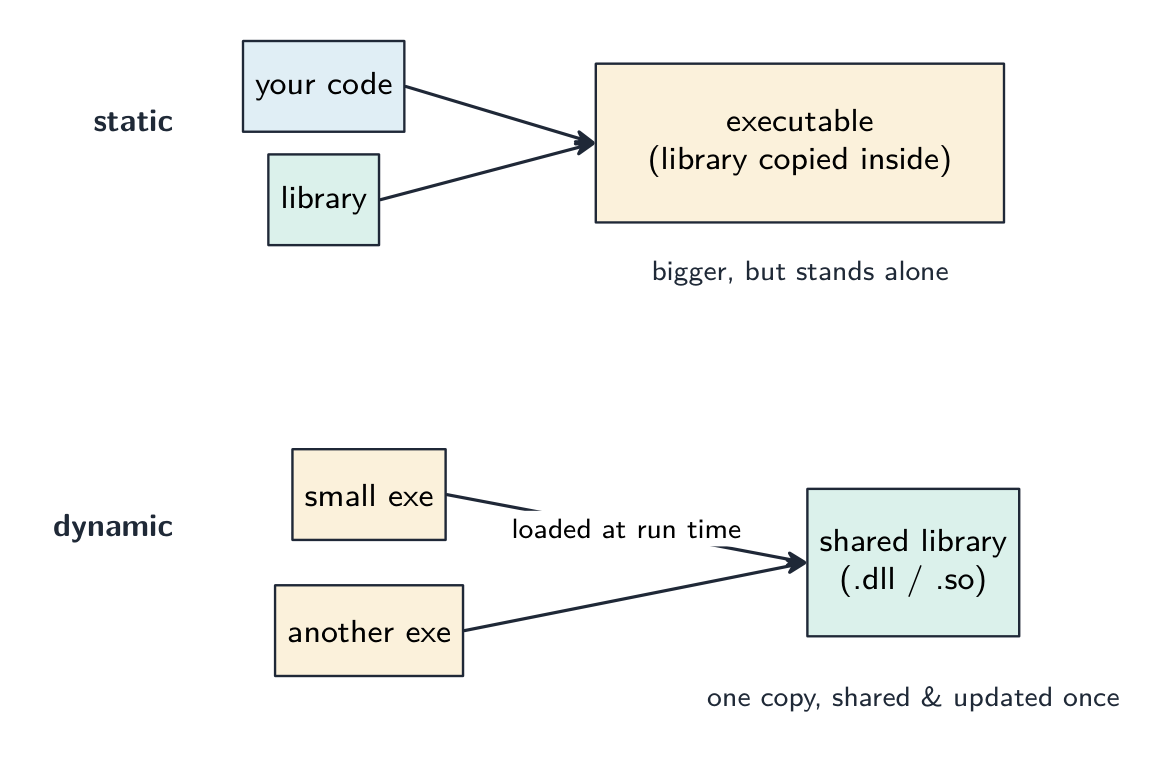
Static: the library is copied into the executable. Dynamic: a shared library file is loaded at run time ExploreComputing concept lab
Classify concrete examples by the computing idea they demonstrate.
Vocabulary TrainEnglish Chinese Pinyin program library 程序库 chéng xù kù subroutines 子程序 zi chéng xù static library 静态库 jìng tài kù dynamic library 动态库 dòng tài kù 5.2
Language translators

Syllabus
Candidates should be able to: Notes and guidance Show understanding of the need for: • assembler software for the translation of an assembly language program • a compiler for the translation of a high-level language program • an interpreter for translation and execution of a high-level language program Explain the benefits and drawbacks of using either a compiler or interpreter and justify the use of each Show awareness that high-level language programs may be partially compiled and partially interpreted, such as Java (console mode) Describe features found in a typical Integrated Development Environment (IDE) Including: • for coding, including context-sensitive prompts • for initial error detection, including dynamic syntax checks • for presentation, including prettyprint, expand and collapse code blocks • for debugging, including single stepping, breakpoints, i.e. variables, expressions, report window Source: Cambridge International syllabus
You write source code; the computer runs machine code 机器码. A translator 翻译器 converts between them.
Assembler
An assembler 汇编器 translates assembly language 汇编语言 into machine code, one instruction per instruction. Used for low-level code (embedded systems, drivers).
Compiler
A compiler 编译器 translates a high-level program into machine code once, before it runs.
- it reports all errors at compile time; once clean, it produces a stand-alone executable 可执行文件 that runs without the compiler installed and can be run many times.
- generally faster at run time (no translation while running), but tied to one CPU/OS — recompile for each platform.
Interpreter
An interpreter 解释器 translates and runs a high-level program one line at a time, producing no executable.
- it reports an error when it reaches that line, then stops; you can fix it and continue — good for development.
- the interpreter must be installed to run the program; generally slower (each run re-translates), but easy to port across platforms.
A compiler translates once into a standalone program; an interpreter translates line by line, every run Choosing between them
Use a compiler when: Use an interpreter when: run-time speed matters you want fast edit–run cycles distributing to users without dev tools writing cross-platform scripts the program runs many times the program is small or run once teaching beginners Hybrid: Java
Java is compiled into bytecode 字节码 (a platform-independent intermediate form), which a virtual machine 虚拟机 (the JVM) then interprets — or uses just-in-time compilation 即时编译 to turn hot parts into native code. So errors are caught early, the bytecode runs anywhere with a JVM ("write once, run anywhere"), and long-running programs reach near-native speed. C# and Python use similar designs.

Java compiles to portable bytecode that any JVM runs — write once, run anywhere Worked example. Java source is compiled to bytecode, which a JVM then interprets. Why use both, instead of compiling straight to machine code? A compiler produces machine code for one processor and operating system, so a program compiled on one machine will not run on another. Java's compiler instead targets a virtual machine, so the bytecode it produces is identical everywhere; each platform then supplies its own JVM to interpret that bytecode into its own native instructions. One compiled file therefore runs anywhere a JVM exists - "write once, run anywhere". The price is speed: interpreting bytecode is slower than running native code, which is why a real JVM also uses JIT compilation to turn frequently-run bytecode into native code while the program runs. Name both sides - the marks are for portability bought at the cost of speed.
ExploreThe compiler route: source to running program
Step through how a compiler works — translating the whole program once, before it runs. Contrast it with an interpreter, which translates and runs one line at a time.
Vocabulary TrainEnglish Chinese Pinyin machine code 机器码 jī qì mǎ translator 翻译器 fān yì qì assembler 汇编器 huì biān qì assembly language 汇编语言 huì biān yǔ yán compiler 编译器 biān yì qì executable 可执行文件 kě zhí xíng wén jiàn interpreter 解释器 jiě shì qì bytecode 字节码 zì jié mǎ virtual machine 虚拟机 xū nǐ jī just-in-time compilation 即时编译 jí shí biān yì 5.2
Integrated Development Environment (IDE)

An integrated development environment 集成开发环境 (IDE) brings the tools to write, test and debug code into one application:
An IDE bundles the editor, a Run button and a debugger - source code editor with syntax highlighting 语法高亮 (keywords, strings, comments in different colours), auto-indent and bracket matching.
- auto-complete 自动补全 — suggests names and shows function parameters as you type.
- translator integration — compile/run with one keystroke; errors shown inline.
- debugger 调试器 — set breakpoints 断点 to pause, step through line by line, and inspect variables.
- version control 版本控制 integration (git), project management, a help system, refactoring 重构 tools (safe renaming), and unit test 单元测试 integration.
An IDE speeds development by putting writing → running → debugging → fixing behind one interface. Common IDEs: Visual Studio, PyCharm, Eclipse, VS Code.

A debugger: set a breakpoint, run, then pause to inspect variables and step through the code Vocabulary TrainEnglish Chinese Pinyin integrated development environment 集成开发环境 jí chéng kāi fā huán jìng syntax highlighting 语法高亮 yǔ fǎ gāo liàng auto-complete 自动补全 zì dòng bǔ quán debugger 调试器 tiáo shì qì breakpoints 断点 duàn diǎn version control 版本控制 bǎn běn kòng zhì refactoring 重构 zhòng gòu unit test 单元测试 dān yuán cè shì 5.2
Exam tips
- List the OS's jobs (memory, process, file, device and security management) — "manages resources" alone is too vague.
- Compare compiler vs interpreter vs assembler: what each translates and when errors are reported.
- Explain what an IDE provides (editor, debugger, error diagnostics, auto-complete).
-
6
Security, privacy and data integrity
6.1
Security, privacy and integrity — three different ideas
Syllabus
Candidates should be able to: Notes and guidance Explain the difference between the terms security, privacy and integrity of data Show appreciation of the need for both the security of data and the security of the computer system Describe security measures designed to protect computer systems, ranging from the stand-alone PC to a network of computers Including user accounts, passwords, authentication techniques such as digital signatures and biometrics, firewall, anti-virus software, anti-spyware, encryption Show understanding of the threats to computer and data security posed by networks and the internet Including malware (virus, spyware), hackers, phishing, pharming Describe methods that can be used to restrict the risks posed by threats Describe security methods designed to protect the security of data Including encryption, access rights Source: Cambridge International syllabus
These sound alike but mean different things:
- security 安全 — protecting data from unauthorised 未授权 access, change or destruction.
- privacy 隐私 — an individual's right to control who sees their personal data, with consent and a clear purpose.
- integrity 完整性 — the data being accurate and complete — not corrupted or accidentally changed.
A file can be secure (only the right people can open it) but lack integrity (a typo corrupted it); or accurate but not private (anyone can read it). All three are needed.
The differences the scheme wants, one sentence each: security is keeping the data safe from loss and from unauthorised access; privacy is keeping the data confidential, so that only those with the right to see it can; integrity is the data being correct, consistent and complete. So "the difference between security and privacy": security is about protecting the data from being accessed, changed or lost by people who should not; privacy is about the individual's right to decide who may see their personal data. "The difference between security and integrity": security protects the data from unauthorised access; integrity is about the data being accurate and up to date, which validation and verification protect.
ExploreRisk and responsibility lab
Sort examples by the rule, risk or protection involved.
Vocabulary TrainEnglish Chinese Pinyin security 安全 ān quán unauthorised 未授权 wèi shòu quán privacy 隐私 yǐn sī integrity 完整性 wán zhěng xìng 6.1
Why security matters
Two things to protect: the data itself (keep it confidential, intact and available) and the computer system (a compromised system can attack others, steal credentials, or be held to ransom).
"Why does the school need to keep both secure?" Data: it is personal and confidential, so it must not be read, changed or deleted by an unauthorised person, and its loss would stop the school working. System: an intruder who reaches the computer system can install malware, use it to attack other systems, damage the hardware or software, or lock it with ransomware; a secure system is the first line of defence for the data on it.
6.1
Threats from networks and the internet

Threats fall into three groups.
A man-in-the-middle attacker sits between the two parties 1. Malware 恶意软件 (malicious software) — harmful programs:
- virus 病毒 — self-copying code that attaches to other programs and spreads when they run.
- worm 蠕虫 — self-copying code that spreads over networks 网络 with no user action.
- Trojan horse 木马 — looks useful but hides malicious code.
- spyware 间谍软件 — secretly collects information (keystrokes, passwords).
- ransomware 勒索软件 — encrypts your files and demands payment.
- adware 广告软件 — pushes unwanted adverts.
2. Tricking people (social attacks):
- phishing 网络钓鱼 — fake emails/sites that trick users into giving credentials.
- pharming 域名欺骗 — redirects a user to a fake site even when they type the correct address.
- social engineering 社会工程 — tricking people into giving up information.
The scheme's descriptions of the four named threats: a virus is malicious software that replicates (copies itself), attaches itself to other files and deletes or corrupts data; spyware is malicious software that records the user's key presses and actions and sends them to a third party, to obtain passwords and personal data; a phishing email pretends to come from a legitimate organisation and contains a link to a fake website where the user is asked for personal or bank details; pharming is malicious code installed on the user's computer or on a web server that redirects the user to a fake website even though they typed the correct address. Similarities of spyware and a virus: both are malware, both are installed without the user's knowledge, both can send data to a third party or damage the system; the difference is that a virus replicates itself while spyware records and transmits information. Phishing and pharming both lead the user to a fake website that collects their data; phishing needs the user to click a link in an email, pharming works through code on the computer or the DNS server and needs no email.
3. Attacks on the network:
- hacking 黑客入侵 by hackers 黑客 — unauthorised access, often via weak passwords or software flaws.
- denial of service 拒绝服务 (DoS/DDoS) — floods a server so real users cannot reach it.
- eavesdropping 窃听 — capturing data in transit (a risk on open Wi-Fi).
- man-in-the-middle 中间人攻击 — an attacker secretly relays or alters messages between two parties.
Worked example. Identify and describe two threats to the data on a school network, and give a different prevention method for each.
Threat 1, malware: a virus copied onto a computer from an email attachment or a download replicates itself and corrupts or deletes files; prevention: anti-virus software that scans files and is kept up to date. Threat 2, hacking: an unauthorised person gains access to the network, for example by guessing a weak password, and reads or changes the data; prevention: a firewall that blocks unauthorised connections, or strong passwords with two-factor authentication. A third pair, phishing: an email leads a user to a fake site that collects their login; prevention: training users to check the sender and the URL, and filtering email. The measure must match the threat: encryption does not stop a virus, and anti-virus software does not stop phishing.
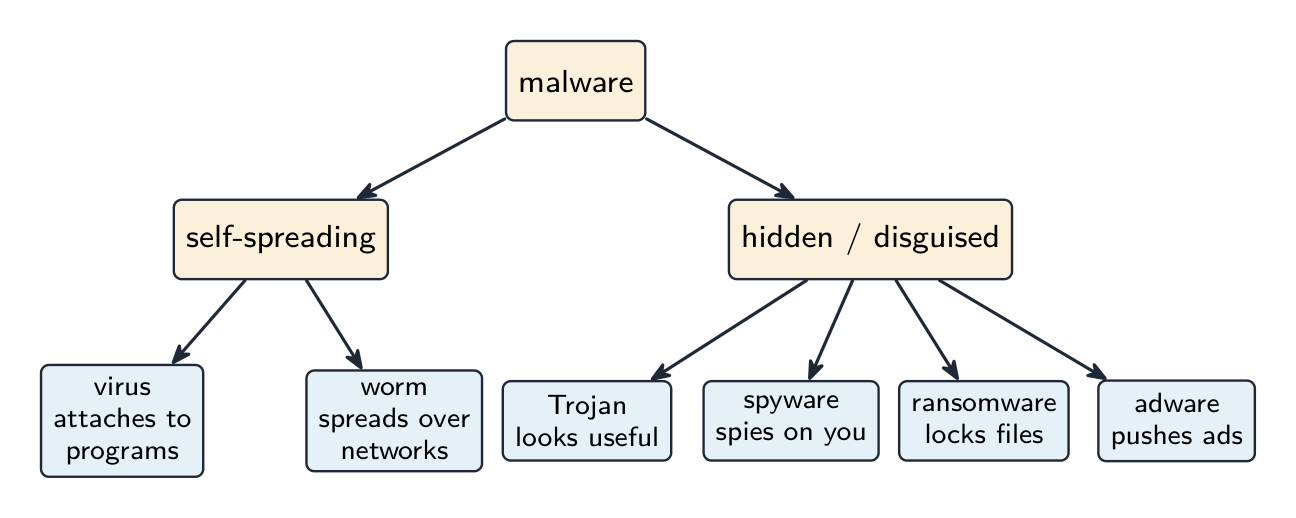
Malware by behaviour: self-spreading (virus, worm) versus hidden/disguised (Trojan, spyware, ransomware, adware) Vocabulary TrainEnglish Chinese Pinyin 1. Malware 恶意软件 è yì ruǎn jiàn virus 病毒 bìng dú worm 蠕虫 rú chóng networks 网络 wǎng luò Trojan horse 木马 mù mǎ spyware 间谍软件 jiàn dié ruǎn jiàn ransomware 勒索软件 lè suǒ ruǎn jiàn adware 广告软件 guǎng gào ruǎn jiàn phishing 网络钓鱼 wǎng luò diào yú pharming 域名欺骗 yù míng qī piàn social engineering 社会工程 shè huì gōng chéng hacking 黑客入侵 hēi kè rù qīn hackers 黑客 hēi kè denial of service 拒绝服务 jù jué fú wù eavesdropping 窃听 qiè tīng man-in-the-middle 中间人攻击 zhōng jiān rén gōng jī 6.1
Security measures

Measures protect both the security of data (against loss, theft or corruption) and the security of the computer system (its hardware, software and network).
A standalone PC
- a strong password; antivirus kept up to date; prompt software updates; backup 备份 to separate media; full-disk encryption 加密; a locked screen.
A networked PC
All the above, plus a firewall 防火墙, per-user permissions (admin rights only for admins), central management of user accounts 用户账户, and audit logs 审计日志 (who logged in, what they touched).
How the measures work, in the wording the scheme awards:
- firewall: examines every incoming and outgoing transmission and compares it with set criteria (a whitelist or blacklist of addresses, ports and protocols); blocks any that do not meet the criteria; can prevent access to certain sites and warn of unauthorised access attempts.
- encryption: the data is scrambled (encoded) with a key into ciphertext, so an intercepted copy cannot be understood without the key; the receiver uses a key to decrypt it. It protects data in transmission and in storage, but it does not stop the data being intercepted or deleted.
- passwords and user accounts: only a user who knows the password can log in; a strong password (long, mixed characters, changed regularly) cannot be guessed; accounts lock after repeated failures; each account carries its own access rights.
- anti-virus and anti-spyware software: scans files and programs against a database of known malware signatures, checks behaviour, quarantines or deletes what it finds, and must be updated so that new malware is recognised.
- access rights: each user (or group) is given permissions for each file or table, such as read-only or read and write, so a user cannot see or change data that is not theirs; a database can also present each user with a view containing only the fields they need.
- biometrics: the device captures an image of the face, fingerprint or iris, converts it to digital data, compares it with the stored data for that user and allows access only on a match; it cannot be forgotten, lent or guessed like a password.
- backups: a copy of the data on separate media, kept off-site, so that lost or corrupted data can be restored.
To restrict the risks of malware, in three marks: install anti-malware software and keep it updated; use a firewall; do not open attachments or download files from unknown sources; keep the operating system and applications patched; and train users.
A firewall sits between the user's computer and the internet Across the internet
- VPN 虚拟专用网 — encrypts traffic between the user and the corporate gateway.
- HTTPS / TLS — encrypt web traffic.
- digital signatures 数字签名 — prove who sent a message and that it was not altered in transit.
- intrusion detection — watches traffic for known attack patterns.
How a digital signature authenticates a document (five marks): the sender puts the message through a hash function to produce a digest; the sender encrypts the digest with their private key, and that encrypted digest is the digital signature; the message and the signature are sent together; the receiver decrypts the signature with the sender's public key to recover the digest; the receiver hashes the received message and compares the two digests; if they match, the message came from the sender (only they hold the private key) and was not altered in transmission. A signature proves who sent the message and that it is intact; it does not hide the contents, which is what encryption of the message is for.
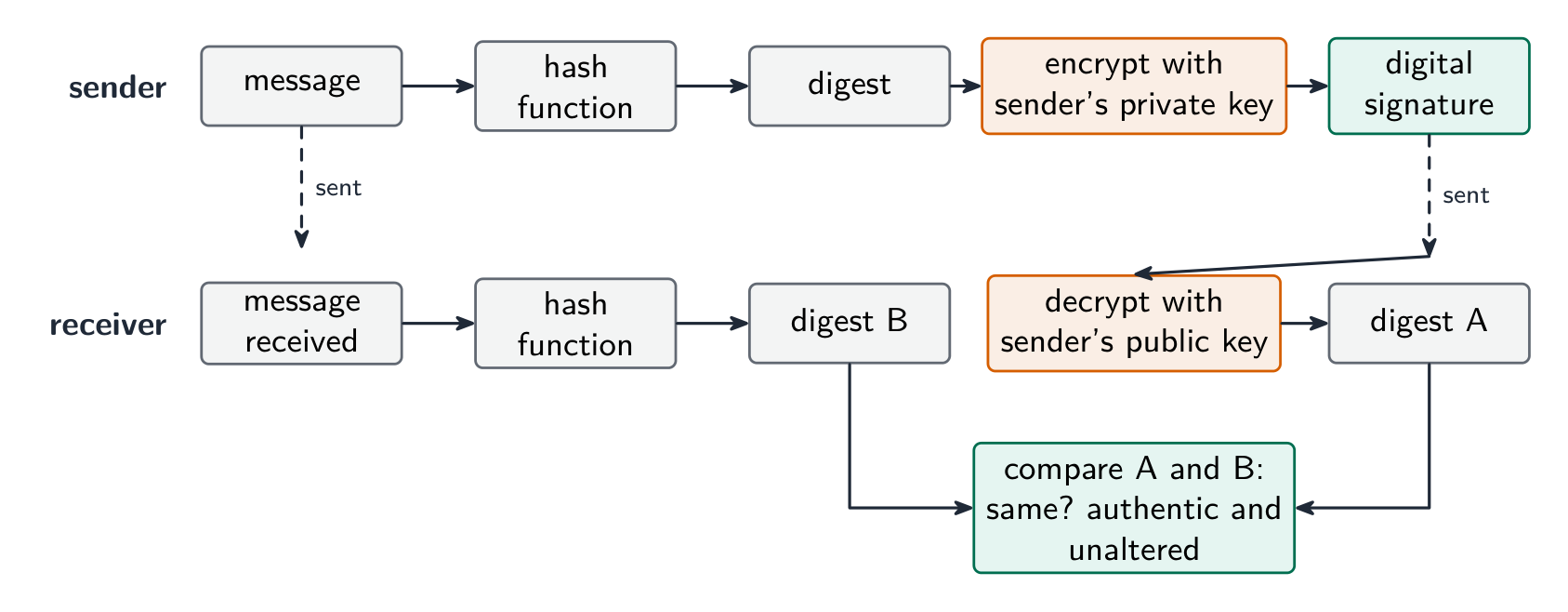
A digital signature: a hash of the message, encrypted with the sender's private key, checked by the receiver against a fresh hash Vocabulary TrainEnglish Chinese Pinyin backup 备份 bèi fèn encryption 加密 jiā mì firewall 防火墙 fáng huǒ qiáng user accounts 用户账户 yòng hù zhàng hù audit logs 审计日志 shěn jì rì zhì VPN 虚拟专用网 xū nǐ zhuān yòng wǎng digital signatures 数字签名 shù zì qiān míng 6.1
Matching measures to threats
- interception in transit → encrypt the data (HTTPS, VPN). Intercepted ciphertext is useless without the key.
- unauthorised access → strong authentication 身份验证 (long passwords; two-factor authentication 双因素认证 with a phone code or key); user authorisation 授权; lock-out after failed logins.
- malware → anti-virus software and anti-spyware 反间谍软件 with real-time scanning; patching; avoid untrusted downloads.
- phishing → user training; email filtering; check the URL before entering credentials.
- internal threats → the least-privilege 最小权限 principle (give each user only what they need); auditing.
- DDoS → rate limiting and traffic filtering.
For confidential data crossing the internet, the scheme's method is encryption: the data is encoded with a key into ciphertext, so that an unauthorised person who intercepts it cannot read it, and only the intended receiver, who has the key, can decode it. For a program file sent by email for testing, the same answer applies (encrypt the file, or send it over an encrypted connection), together with a password on the file itself.
Vocabulary TrainEnglish Chinese Pinyin authentication 身份验证 shēn fèn yàn zhèng two-factor authentication 双因素认证 shuāng yīn sù rèn zhèng authorisation 授权 shòu quán anti-spyware 反间谍软件 fǎn jiàn dié ruǎn jiàn least-privilege 最小权限 zuì xiǎo quán xiàn 6.1
Protecting the data itself
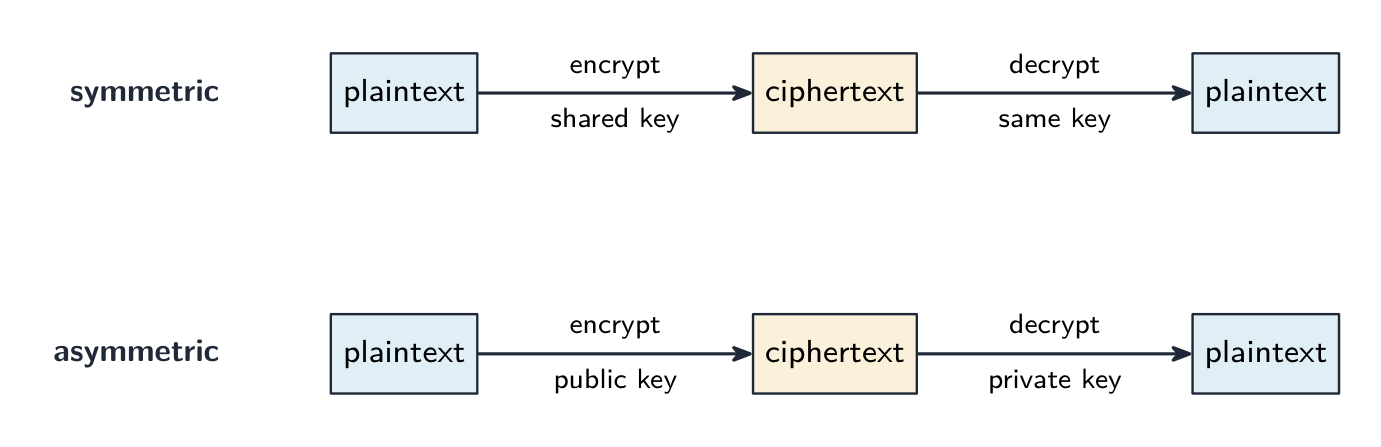
- encryption — turn plaintext 明文 into ciphertext 密文 with a key. Symmetric encryption 对称加密 (AES) uses one shared key; asymmetric encryption 非对称加密 (RSA) uses a public key 公钥 and a private key 私钥. Protects data at rest and in transit.
- access control 访问控制 — file permissions (read/write/execute) and access rights 访问权限, enforced by the OS.
- authentication — authentication techniques verify the user: something you know (password), have (token, phone), or are (biometrics 生物识别 — fingerprint, face, iris); strongest combined.
- backups — keep copies (some off-site) so loss or corruption is recoverable.
- physical security — locked server rooms, cable locks.
Access rights in a database, described for three marks: each user is given an account with a username and password; the database administrator assigns each account permissions for each table, such as read-only, read and write, or no access; users see only the tables and fields they are allowed to, so a customer cannot open the staff table and a clerk can read but not change the prices. The DBMS enforces this with its access rights and with views, and it can encrypt the stored data as well.
Symmetric uses one shared key; asymmetric uses a public key to encrypt and a private key to decrypt 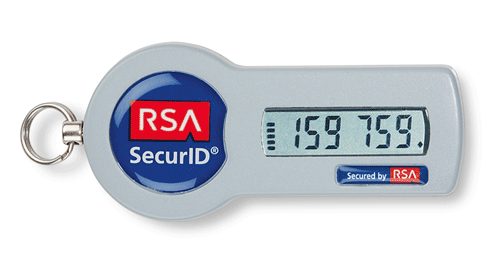
A security token shows a changing code for two-factor authentication ("something you have") 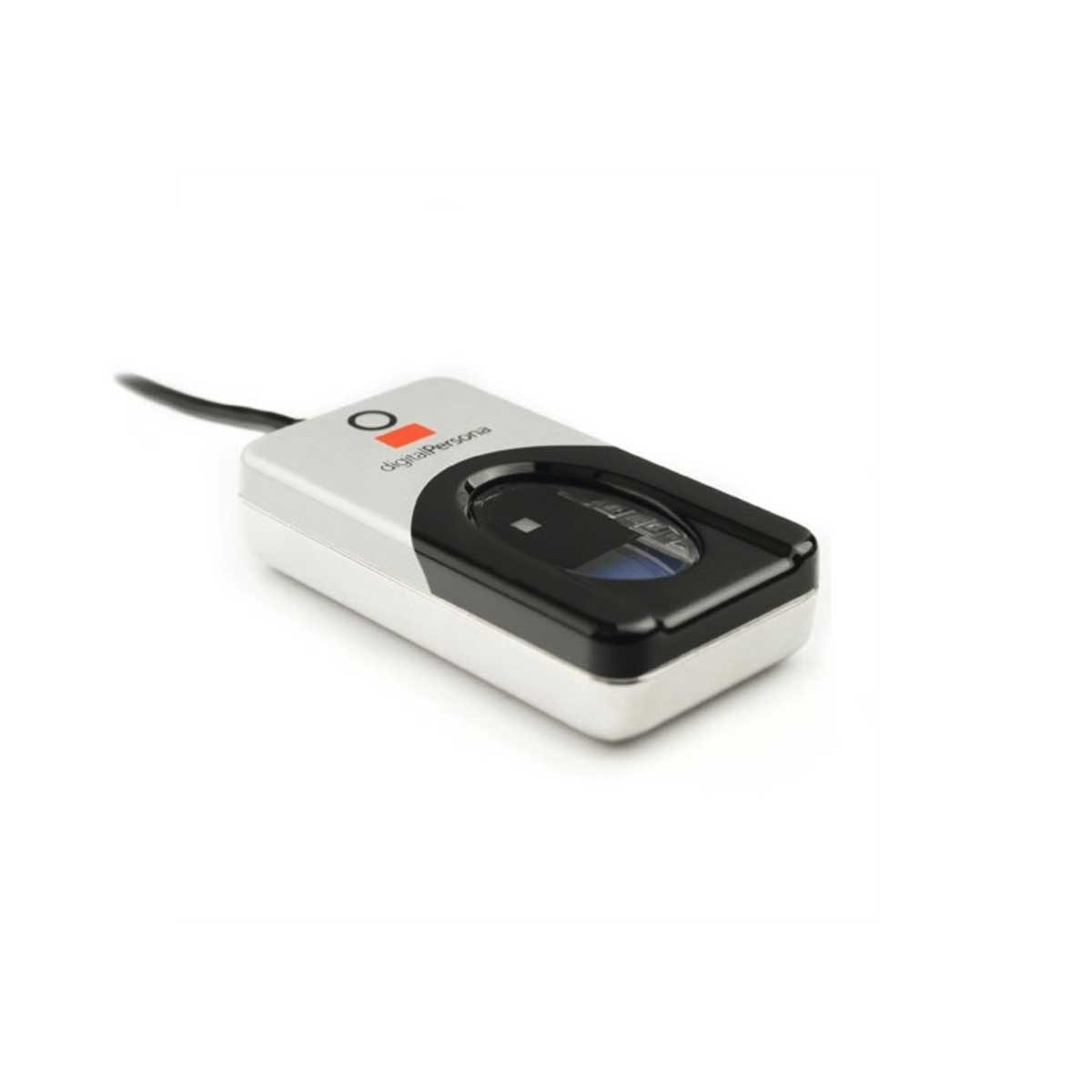
A fingerprint reader checks "something you are" — a feature of the person, not a password ExploreEncrypt with a Caesar cipher
Change the shift — that is the key. Each letter slides that many places along the alphabet to make the ciphertext, and the same key slides it back. That shared key is symmetric encryption in miniature.
Vocabulary TrainEnglish Chinese Pinyin plaintext 明文 míng wén ciphertext 密文 mì wén Symmetric encryption 对称加密 duì chèn jiā mì asymmetric encryption 非对称加密 fēi duì chèn jiā mì public key 公钥 gōng yào private key 私钥 sī yào access control 访问控制 fǎng wèn kòng zhì access rights 访问权限 fǎng wèn quán xiàn biometrics 生物识别 shēng wù shí bié 6.2
Data integrity
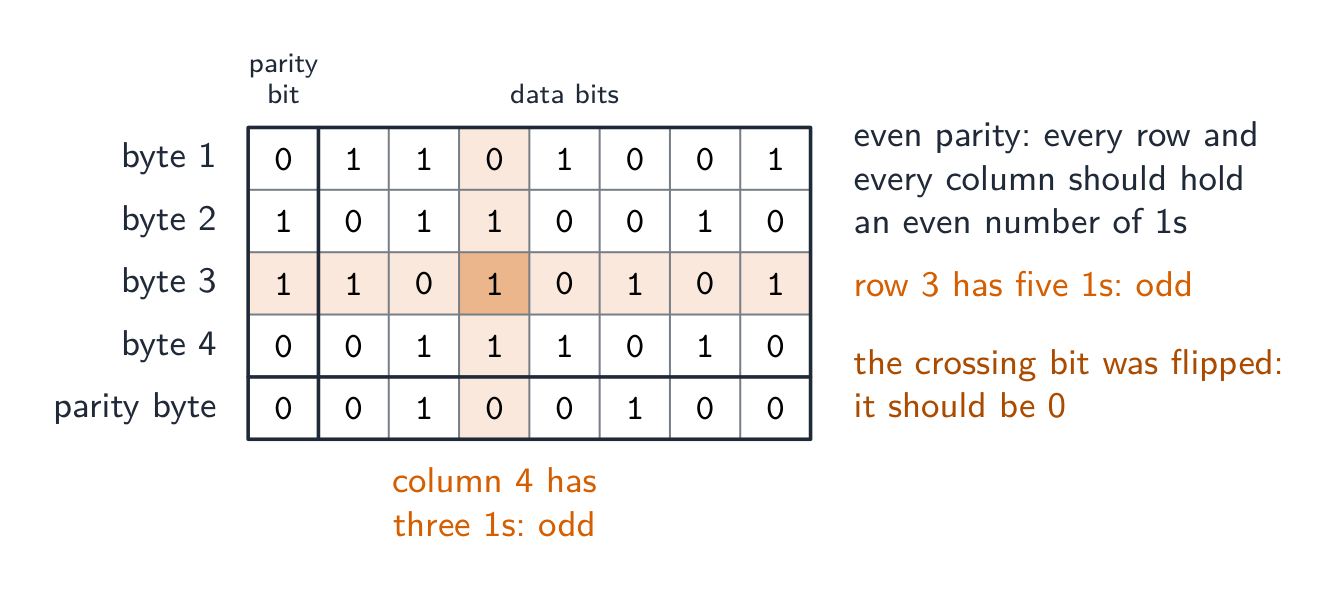
Syllabus
Candidates should be able to: Notes and guidance Describe how data validation and data verification help protect the integrity of data Describe and use methods of data validation Including range check, format check, length check, presence check, existence check, limit check, check digit Describe and use methods of data verification during data entry and data transfer During data entry including visual check, double entry During data transfer including parity check (byte and block), checksum Source: Cambridge International syllabus
Data has integrity when it is accurate and complete. Two techniques: data validation (catch bad data before storing) and data verification (confirm data was entered or transferred correctly).
Validation — does the data make sense?
Validation 验证 checks data against sensible rules, automatically:
- range check — within limits (a month is 1–12).
- limit check — on the correct side of a single limit (e.g. age ≥ 18).
- existence check — the referenced item exists (e.g. a product code is in the table).
- length check — the right number of characters.
- type / character check — the right kind of data (a phone field allows only digits).
- format check — matches a pattern (an email must contain
@). - presence check — required fields are not empty.
- check digit 校验位 — an extra digit computed from the others (ISBN, card numbers) that spots transcription errors.
Worked example. In a simple check-digit scheme the check digit is the remainder when the sum of the digits is divided by $10$, appended to the number. The number $4162$ has digit sum $13$, so it is stored as $41623$. A user types $14623$: the first two digits are swapped, but the sum is still $13$, so the check digit still matches and the error is not caught. A user who types $41523$ is caught, because $4 + 1 + 5 + 2 = 12$ gives check digit $2$. A scheme that catches swapped digits weights each position differently, as the ISBN-13 check does (weights $1, 3, 1, 3, \ldots$, then the digit that makes the total a multiple of $10$). A check digit is validation: it tests the number against a rule at the moment it is entered.
- lookup check and consistency check (e.g. delivery date ≥ order date).
Validation catches data that is wrongly formatted, but not data that is the right format yet factually wrong ("Bob" for "Bib").
Worked example. Identify the validation check each piece of pseudocode performs.
Pseudocode Check IF x < 0 OR x > 10 THEN OUTPUT "Invalid"range check: the value must lie between two limits IF x = "" THEN OUTPUT "Invalid"presence check: the field must not be empty IF NOT(x = "Red" OR x = "Yellow" OR x = "Blue") THEN OUTPUT "Invalid"lookup (existence) check: the value must be one of a list IF LENGTH(x) <> 6 THEN OUTPUT "Invalid"length check: the right number of characters IF MID(x, 1, 1) < "A" OR MID(x, 1, 1) > "Z" THEN OUTPUT "Invalid"format check: a particular character must be a letter To validate a car registration number that must be one letter, three digits and two letters: a format check tests each position against its pattern, and a length check confirms six characters. To validate a date of birth: a format check (
DD/MM/YYYY), a range check (the month is $1$ to $12$, the year is not in the future) and a presence check (it is not left blank). A mark between $0$ and the maximum for the test needs a type check (an integer) and a range check, with the upper limit read from the test's own record: that is how validation protects integrity, by refusing data that could not be correct.Verification — was the data entered or transferred correctly?
Verification 核对 checks the data was not changed in moving from one place to another.
During entry: double entry (type it twice and compare, as for a new password) or visual check.
In the scheme's words, double entry is entering the data twice, by the same person or by two people, and having the computer compare the two versions and report any difference; a visual check is the person comparing what is on the screen with the original source document and correcting any difference before saving. Both protect integrity by making sure the stored data matches the source. Even after validation and verification the data can still be wrong: it can be sensible and match the source, yet the source itself was wrong, or the user typed a different but valid value from the one intended.
During transfer (bits can flip):
- parity check 奇偶校验 — an extra bit makes the number of 1s even (even parity) or odd. The receiver re-counts. Catches single-bit errors.
- checksum 校验和 — the sender sends a summary value of the data; the receiver recomputes it and compares.
- cyclic redundancy check 循环冗余校验 (CRC) — a stronger checksum using polynomial division, catching many more error types.
A parity block check 奇偶块校验 goes further and locates the error. Arrange the bytes in a grid: give each byte a row parity bit, then compute one extra parity byte whose bits are the column parity of the bytes above. A single flipped bit now fails one row and one column – their intersection pinpoints exactly which bit changed, so it can even be corrected.
Worked example. Four bytes are sent with even parity, followed by a parity byte. Find the bit that was corrupted.
A parity block check: the row that fails and the column that fails cross at the flipped bit Count the 1s in each row and each column. Every row and column should have an even number; byte 3 has five and column 4 has three. The bit where that row and that column cross is the one that changed, so it is reset from 1 to 0. A parity check on its own detects an error in a byte but cannot say which bit; two errors in the same byte cancel and pass unnoticed. A checksum, explained for three marks: the sender puts the block of data through an algorithm that produces a checksum value; the data and the checksum are sent together; the receiver runs the same algorithm on the data it received; if the two checksums match, the data is accepted, and if not, it is rejected and sent again.
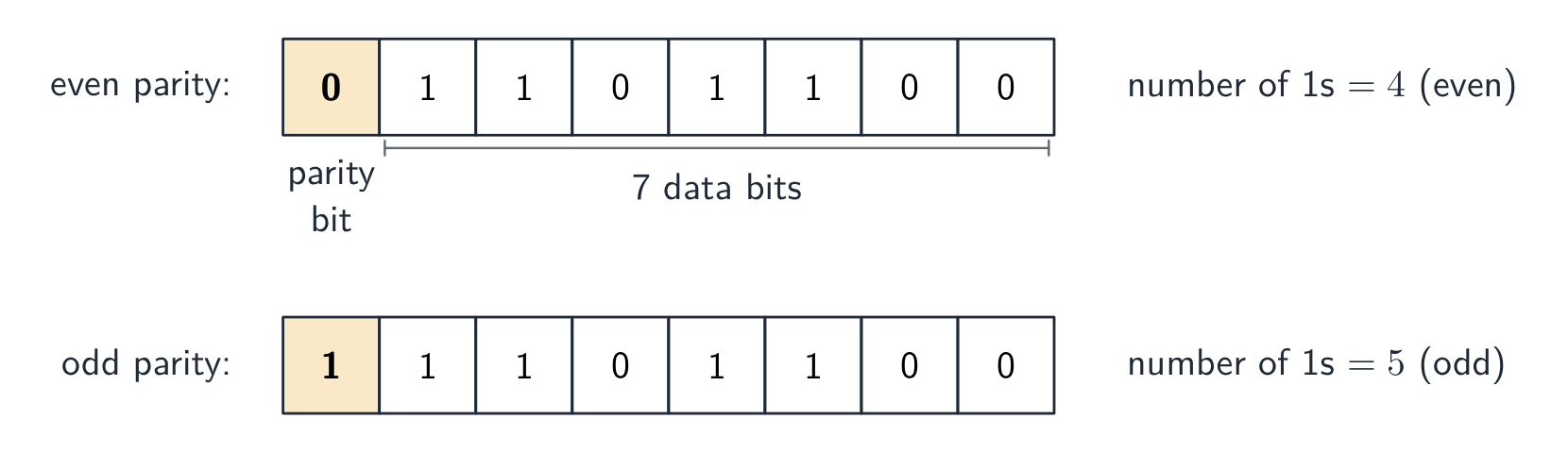
The parity bit is set to make the number of 1s even or odd 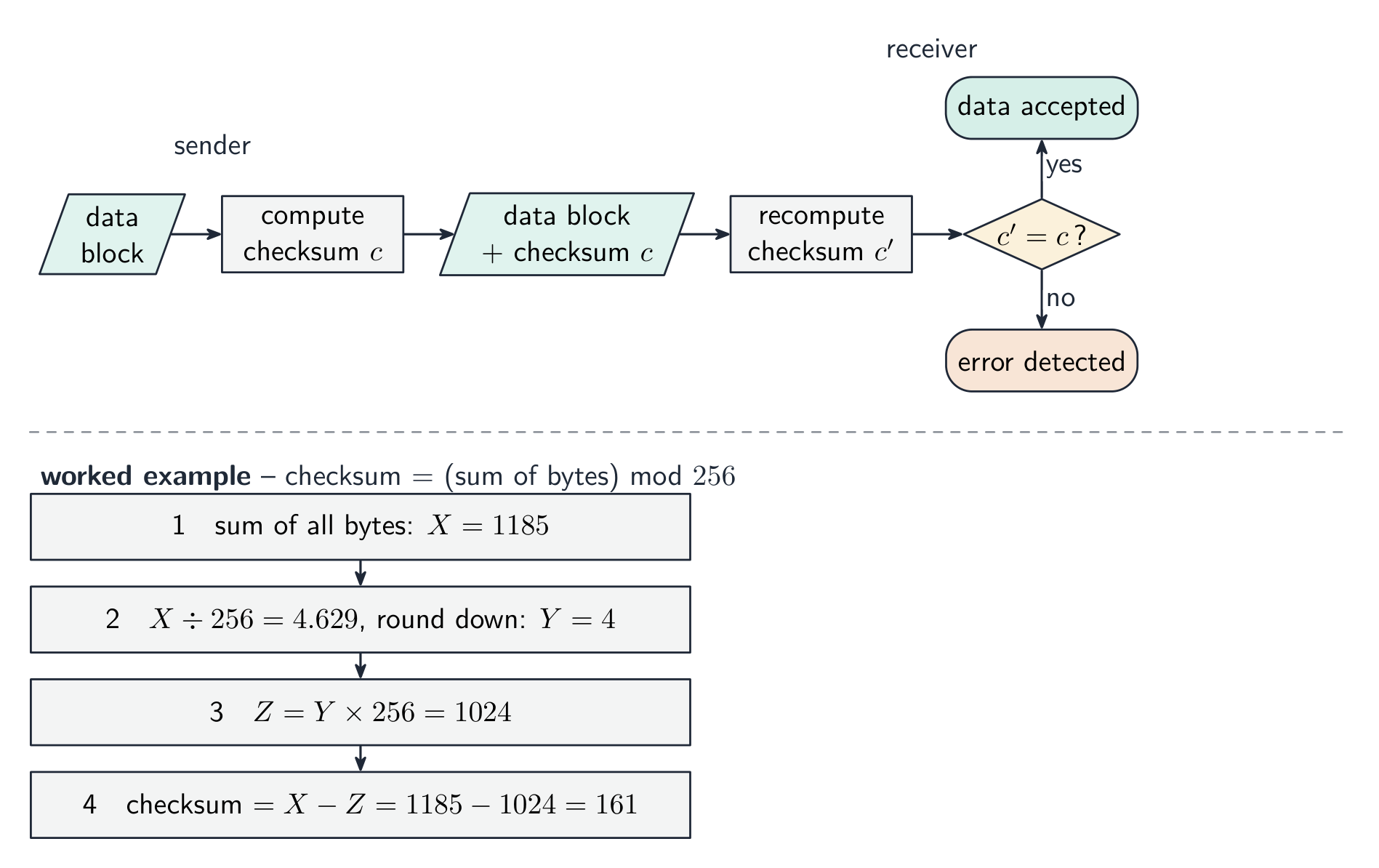
Working out a checksum for a block of data Verification only proves what arrived matches what was sent — not that the data is correct, and not against deliberate tampering. Validation asks "is this sensible?"; verification asks "was this copied correctly?" — use both.
The table questions sort the methods by when they are used: during data entry, double entry and a visual check; during data transfer, a parity check (byte or block) and a checksum. Transferring video files from a camera to a server uses a checksum: the camera computes it, the server recomputes it, a mismatch means retransmit.
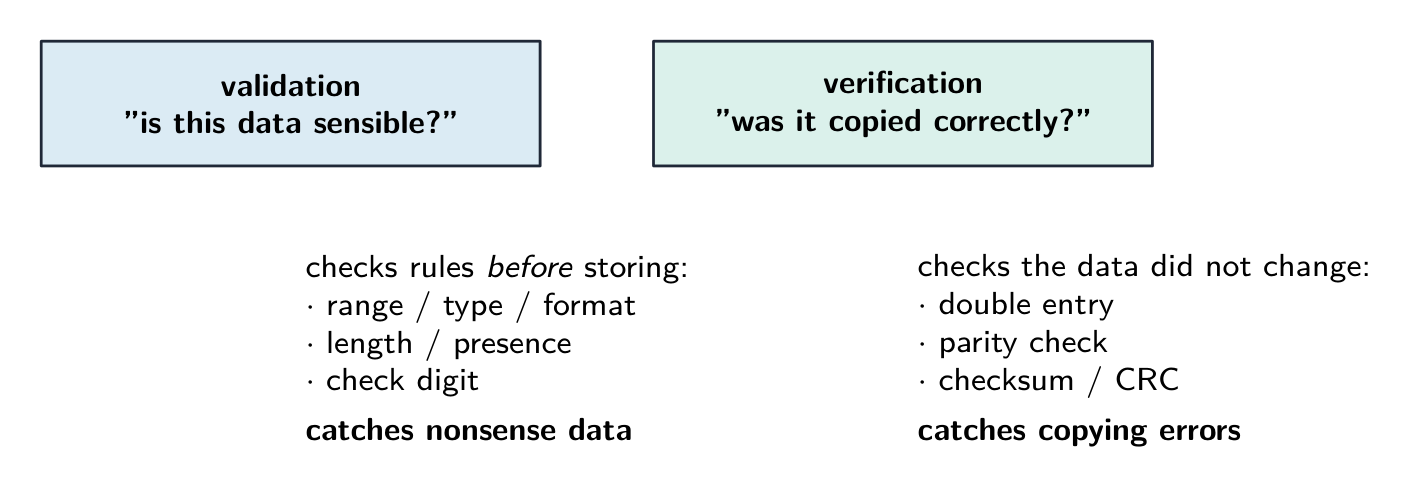
Validation checks the data makes sense; verification checks it was copied without change Worked example. A user types their date of birth as
31/02/2009, and types their email address twice. Which check catches which error, and what is the difference? Validation asks "is this data sensible?" - the computer tests it against a rule, and a format or range check rejects31/02/2009because February never has 31 days. Verification asks "was this data entered correctly?" - typing the email twice is double entry, and comparing the two copies catches a typing slip. The limit is what makes this a favourite question: validation can never tell you the data is right, only that it is possible -01/02/2009passes every validation rule even if the user was actually born on a different day. Say what each check can and cannot catch.ExploreComputing concept lab
Classify concrete examples by the computing idea they demonstrate.
Vocabulary TrainEnglish Chinese Pinyin Validation 验证 yàn zhèng check digit 校验位 jiào yàn wèi Verification 核对 hé duì parity check 奇偶校验 jī ǒu jiào yàn checksum 校验和 jiào yàn hé cyclic redundancy check 循环冗余校验 xún huán rǒng yú jiào yàn parity block check 奇偶块校验 jī ǒu kuài jiào yàn 6.2
Definitions the examiner accepts
A definition question is marked against fixed wording. Learn these exactly.
Term Definition data security keeping data safe from loss and from unauthorised access, change or deletion data privacy keeping data confidential, so that it is seen only by those who have the right to see it data integrity the data being accurate, consistent and complete malware malicious software that is installed without the user's knowledge to damage a system or steal data virus malware that replicates itself, attaches to other files and corrupts or deletes data spyware malware that records the user's key presses or actions and sends them to a third party phishing an email pretending to be from a legitimate organisation that leads the user to a fake website to collect personal data pharming malicious code that redirects the user to a fake website even when the correct address is entered firewall hardware or software that examines all traffic entering or leaving a system against set criteria and blocks what does not meet them encryption scrambling data with a key into ciphertext, so that it cannot be understood without the key to decrypt it digital signature a hash of a message encrypted with the sender's private key, used to prove who sent it and that it was not altered data validation an automatic check that entered data is reasonable and follows set rules data verification a check that data has been entered or transferred correctly, by comparing it with the source or with a recomputed value check digit an extra digit calculated from the other digits of a number and appended to it, so that an error in the number can be detected parity check an extra bit added to a byte so that the number of 1s is even (or odd), which the receiver recounts checksum a value calculated from a block of data by an algorithm and sent with it, recalculated by the receiver and compared 6.2
Exam tips
- Keep the three ideas separate: security (keeping data safe), privacy (who may see it), integrity (keeping it correct).
- Match each threat (malware, hacking, phishing, interception) to a measure (firewall, encryption, authentication, access rights).
- Encryption protects confidentiality, not integrity — use a checksum, parity or check digit for integrity.
- Distinguish a virus, worm and Trojan and how each spreads.
Common mistakes
- Giving the same measure for two threats, or a measure that does not fit the threat. Each threat in the table needs a different prevention that actually stops it.
- Naming a measure without saying how it works. "Firewall" scores when it is followed by "compares traffic with set criteria and blocks what fails".
- Calling validation a check that the data is correct. Validation checks that data is reasonable; verification checks that it matches the source. Neither proves it is true.
- Saying a digital signature encrypts the message. It encrypts a hash of the message with the private key; the receiver decrypts it with the public key and compares hashes.
- Describing a check digit as verification, or a parity check as validation. The check digit is a validation rule on entry; parity and checksums verify a transfer.
- Writing that a virus "sends data to a third party" and spyware "replicates". The replicating one is the virus; the recording one is spyware.
-
7
Ethics and Ownership
7.1
Ethics for computing professionals
Syllabus
Candidates should be able to: Notes and guidance Show understanding of the need for and purpose of ethics as a computing professional Understand the importance of joining a professional ethical body including BCS (British Computer Society), IEEE (Institute of Electrical and Electronic Engineers) Show understanding of the need to act ethically and the impact of acting ethically or unethically for a given situation Show understanding of the need for copyright legislation Show understanding of the different types of software licencing and justify the use of a licence for a given situation Licences to include free Software Foundation, the Open Source Initiative, shareware and commercial software Show understanding of Artificial Intelligence (AI) Understand the impact of AI including social, economic and environmental issues Understand the applications of AI Source: Cambridge International syllabus
A computing professional is someone whose work — software, systems, networks, data — affects other people. Because the work is technical, others often cannot judge whether it was done well or honestly. So the profession follows shared ethics 伦理 (principles for good behaviour).
Why ethics matters
- trust — users and employers trust professionals to act in their interest. Without that trust, software loses credibility.
- impact — software runs medical devices, banking, vehicles. Careless or dishonest work can hurt people.
Professional bodies (BCS, ACM, IEEE) publish codes of ethics for members.
CCTV raises privacy concerns — one of the ethical issues a computing professional must weigh 
Discarded electronics (e-waste) are a growing environmental cost of computing 
Software development affects the public's wellbeing in several ways Typical principles
- public interest first — protect the safety and welfare of those affected.
- honesty and competence — be honest about your skills; don't claim expertise you lack.
- confidentiality 保密性 — protect clients' and employers' private information.
- avoid conflicts of interest 利益冲突 — don't take work where your interest clashes with the client's.
- keep your skills current; respect intellectual property 知识产权 and privacy 隐私; treat colleagues fairly.
Joining a professional body
The syllabus names two: the BCS (British Computer Society) and the IEEE (Institute of Electrical and Electronics Engineers). Both publish a code of conduct 行为准则 that members agree to follow. The benefits of joining, in the scheme's words: a set of ethical guidelines to follow, so decisions are not left to personal judgement; training, conferences and publications that keep the member up to date; advice and support, including legal help, when a problem arises; and recognised professional status, so employers and clients trust the member's work. The consequences of not joining: no guidance on ethical decisions, so the programmer may act unethically without realising; less credibility with employers and customers, so it is harder to win work; no support in a dispute; and being out of date with developments and law. The purpose of a code of conduct (two marks): to create a safe, respectful and professional working environment, and to make sure every employee understands what is expected and the consequences of their actions.
Worked example. Explain why a programmer needs to act ethically towards colleagues and towards the public.
Colleagues: treat them fairly and without discrimination; respect their work, their ideas and their confidential information; be honest about mistakes and give credit where it is due; support their development rather than undermine it. The public: protect their personal data and privacy; produce software that is safe, reliable and properly tested, because faults can cause harm; be honest about what the software can do; take on only work within your competence; obey the law and consider the wider effects on society and the environment. Each side earns marks for a reason and its consequence, not for the word "fair" alone.
Acting ethically vs unethically
Acting ethically protects users, strengthens reputation, reduces legal risk, and builds trust. Acting unethically (skipping testing, hiding bugs, misusing data) can harm real users, lead to dismissal or legal action, damage reputation, and erode trust in technology generally.
When you face a borderline decision: identify whose interests are affected, check the code of ethics and the law, weigh the consequences, ask a trusted senior, and choose the option that protects users above short-term convenience.
Worked example. Your team's new AI hiring tool sorts CVs ten times faster, but you notice it rejects more older applicants. Shipping it pleases your manager, but it treats one group unfairly. The ethical choice is to hold it back until the bias is fixed — public interest and fairness come before short-term convenience.
Ethics also applies to users. A student who connects a personal computer to the school network should respect other people's privacy and data, not use social media inappropriately or bully others, not download or share copyrighted material, not introduce malware or try to access systems they are not allowed to, and use the network for the purpose it was provided. A "give three ethical considerations" answer lists three of these.
ExploreRisk and responsibility lab
Sort examples by the rule, risk or protection involved.
Vocabulary TrainEnglish Chinese Pinyin ethics 伦理 lún lǐ confidentiality 保密性 bǎo mì xìng avoid conflicts of interest 利益冲突 lì yì chōng tū intellectual property 知识产权 zhī shí chǎn quán privacy 隐私 yǐn sī code of conduct 行为准则 xíng wéi zhǔn zé conflicts of interest 利益冲突 lì yì chōng tū 7.1
Copyright

Copyright 版权 is the legal right of the creator of an original work to control how it is copied, distributed, modified and performed. It applies automatically (no registration) to source code, software, documents, images, audio and video.
Without copyright, anyone could copy software freely, the developer would not be paid, and plagiarism would be legal. With copyright, developers can earn from their work (encouraging more software), users know who made it, and re-use happens on the developer's terms through licensing. Copyright lasts a long time (often 70 years after the creator's death). General ideas and algorithms are not covered by copyright but may be covered by a patent 专利.
Why a programmer should copyright a program, in the scheme's words: to be identified as the owner and author (formal recognition of ownership); so that there are legal consequences if anyone copies or steals it; to restrict competitors from selling the same work; and to be able to earn money by licensing it. Copyright applies to the program as written; a different program that does the same job does not infringe it.
Copyright is automatic and long-lasting; a patent must be filed and lasts about 20 years ExploreRisk and responsibility lab
Sort examples by the rule, risk or protection involved.
Vocabulary TrainEnglish Chinese Pinyin Copyright 版权 bǎn quán patent 专利 zhuān lì 7.1
Software licences
A software licence 软件许可证 is a contract granting permission to use software on the owner's terms; choosing and applying one is called software licencing.
Commercial (proprietary)
- commercial software is sold: you buy a licence; the software is used only within its terms.
- the source code is not given (a proprietary 专有 product); you cannot modify or redistribute it.
- examples: Microsoft Office, Adobe Photoshop, most games.
Used when the developer wants revenue per user and to keep control of the code.
Open-source
- the source code is public; users can read, modify and redistribute it (open-source 开源).
- permissive licences (MIT, BSD) allow almost any use; copyleft 著佐权 licences (GPL) require that modified versions are released under the same licence ("share-alike").
- the Free Software Foundation (FSF) and the Open Source Initiative (OSI) promote and approve open-source licences.
The syllabus names both, and they are marked as distinct answers. Free Software (the FSF's term) means free as in freedom, not price: the user may run the program for any purpose, study and change it (so the source code must be available), redistribute copies, and distribute modified versions; a fee may still be charged for a copy. Open Source (the OSI's definition) requires that the source code is available, that the program may be modified and redistributed, and that the licence does not discriminate against any person or field of use. "Identify two licence types that let other people edit and redistribute the program" is answered with these two.
- examples: Linux, Python, Apache.
Used when the developer wants the software widely used and improved by the community.
Freeware and shareware
- freeware 免费软件 — free of charge, no source code, may be redistributed but not modified (Acrobat Reader, WhatsApp).
- shareware 共享软件 — free for a trial period, then you pay to keep using it; no source code.
The scheme's descriptions: shareware is distributed free for a trial (a limited time or limited features) and the user pays to continue using the full version; commercial software is sold for a fee, the source code is not supplied, the licence protects the developer's intellectual property, and the fee usually buys support and updates. Benefits of shareware to the programmer: users can try the program before buying, so they are more likely to purchase; it spreads widely at almost no advertising cost; and those who keep it pay. Benefits of a commercial licence: the developer earns a fee for every copy; the code and its rights stay protected; and the income funds support, updates and further development.
Type Cost Source Redistribute Modify Commercial Paid No No No Open-source Free Yes Yes Often, with conditions Freeware Free No Yes No Shareware Free trial, then paid No Sometimes No Choosing a licence from the developer's goal To justify a licence choice, link it to the developer's goal (revenue, reach, community), the user's needs (cost, customising), and the use case.
Worked example. A programmer has written a game to sell to the public. Identify the most appropriate licence and justify it.
A commercial licence: the game is sold for a fee, so the programmer earns money from every copy; the source code is not released, so nobody can copy the game or change it and sell it as their own; the licence protects the intellectual property; and buyers receive updates and support. Open source would not fit, because the source code would be available, so the game could be copied, changed and redistributed without payment.
Worked example. A program helps shoppers by reading product labels aloud. Explain why an open source licence might not be appropriate.
The source code would be accessible, so it could be changed; a changed version might output the wrong product information, so shoppers could buy the wrong item; and the programmer would lose control over the quality and safety of what is distributed under the program's name. Going the other way, programs are released as open source so that other developers can improve and extend them, so that they are adopted widely at no cost, and so that users can adapt them to their own needs.
Vocabulary TrainEnglish Chinese Pinyin software licence 软件许可证 ruǎn jiàn xǔ kě zhèng proprietary 专有 zhuān yǒu open-source 开源 kāi yuán copyleft 著佐权 zhù zuǒ quán freeware 免费软件 miǎn fèi ruǎn jiàn shareware 共享软件 gòng xiǎng ruǎn jiàn 7.1
Artificial Intelligence (AI)

Artificial intelligence 人工智能 builds systems that do tasks once thought to need human intelligence — recognising speech and images, translating, playing games, driving.
Most modern AI uses machine learning 机器学习 — algorithms that improve at a task by learning patterns from large amounts of data, instead of being programmed step by step. Deep learning 深度学习, using neural networks 神经网络 with many layers, is the leading approach today.
Everyday examples
AI tasks split into two kinds — understanding input, and producing output or decisions.
Understanding input:
- speech recognition 语音识别 — spoken words to text (voice assistants).
- image recognition 图像识别 — finding objects, faces or text in images.
Producing output or decisions:
- machine translation 机器翻译 — automatic translation between languages.
- recommendation systems 推荐系统 — suggesting products, videos or music.
- autonomous vehicles 自动驾驶汽车 and robots.
A common exam scenario: a program reads a label with a camera, translates it, and reads it aloud — using optical character recognition 光学字符识别 to find the words, machine translation to convert them, and text-to-speech 文本转语音 for the audio.
A common scenario: OCR → machine translation → text-to-speech reads a foreign label aloud A four-mark "explain how AI is used" answer follows the pipeline step by step: image recognition (OCR) analyses the pixels of the photograph to locate the characters; the patterns of pixels are converted into individual characters and words; machine translation converts the words into the user's language; and text-to-speech produces the spoken output. Each step is a mark.
Benefits
- accessibility — speech/image AI helps users with impairments; translation helps non-native speakers.
- productivity — automating repetitive tasks frees people for creative work.
- decision support — AI spots patterns in huge datasets (medical diagnosis, fraud detection).
- always available, and personalised to each user.
Impacts: social, economic, environmental
The syllabus asks for the impact of AI under three headings, and a question names one of them. Give the impact and its consequence.
- Social: benefits — a label-reading program helps people with a visual impairment, people who cannot read the language, and people with reading difficulties; facial recognition at an airport speeds up identity checks and can stop wanted people entering. Harms — facial recognition can misidentify people and tracks everyone without consent, so privacy is lost; students who use AI to do their homework may not develop reasoning and problem-solving skills, may rely on it instead of learning, and may lose the collaboration and face-to-face communication that working together brings.
- Economic: an AI fault-diagnosis module in a repair garage diagnoses faults faster and more accurately, so more vehicles are repaired per day and costs fall; but fewer skilled mechanics may be needed, so jobs are lost, and the module must be bought and maintained. More generally, AI raises productivity and creates new jobs in some fields while removing routine jobs in others.
- Environmental: training and running large models uses a great deal of electricity and water for cooling in data centres, and the hardware becomes e-waste; on the other side, AI is used to cut energy use in buildings, optimise transport and monitor the environment.
- Ethical (the classroom question): an AI that marks work or watches students must be fair to every student, must not leak their data, must be explainable when it makes a decision about them, and must not replace the judgement of a teacher where that matters.
Concerns
- bias 偏见 — unfair patterns in the training data become unfair AI decisions (hiring, lending).
- job displacement — AI may replace some roles.
- privacy — training often uses large amounts of personal data.
- transparency — large models are "black boxes", hard to explain.
- accountability — when AI is wrong, who is responsible: developer, user, or operator?
- misuse — deepfakes, misinformation, surveillance.

How bias gets into AI: biased data → a biased model → unfair decisions Professionals must understand the limits of the AI they build, inform users, and reduce harm.
ExploreComputing concept lab
Classify concrete examples by the computing idea they demonstrate.
Vocabulary TrainEnglish Chinese Pinyin Artificial intelligence 人工智能 rén gōng zhì néng machine learning 机器学习 jī qì xué xí Deep learning 深度学习 shēn dù xué xí neural networks 神经网络 shén jīng wǎng luò speech recognition 语音识别 yǔ yīn shí bié image recognition 图像识别 tú xiàng shí bié machine translation 机器翻译 jī qì fān yì recommendation systems 推荐系统 tuī jiàn xì tǒng autonomous vehicles 自动驾驶汽车 zì dòng jià shǐ qì chē optical character recognition 光学字符识别 guāng xué zì fú shí bié text-to-speech 文本转语音 wén běn zhuǎn yǔ yīn bias 偏见 piān jiàn 7.1
Definitions the examiner accepts
A definition question is marked against fixed wording. Learn these exactly.
Term Definition ethics the moral principles that govern how a person behaves, in a profession the standards set out in its code of conduct code of conduct the rules an organisation or professional body sets for how its members must behave copyright the legal right of the creator of an original work to control how it is copied, distributed and modified software licence the legal agreement that states how a piece of software may be used, copied and distributed commercial software software sold for a fee, without source code, under a licence that protects the developer's intellectual property free software (FSF) software whose users are free to run, study, change and redistribute it, so its source code is available open source (OSI) software whose source code is available and which may be modified and redistributed under its licence shareware software distributed free for a trial period or with limited features, after which the user pays to continue freeware software that is free of charge to use and copy, but whose source code is not released and may not be modified artificial intelligence computer systems that perform tasks which normally need human intelligence, such as recognising images and speech machine learning a form of AI in which a system improves at a task by learning patterns from data rather than by explicit programming 7.1
Exam tips
- Answer ethics questions against a professional code of conduct (public interest, competence, honesty), not personal opinion.
- Distinguish copyright (protects the expression) from a patent (protects an invention).
- Compare software licences: proprietary, open-source, freeware, shareware and FOSS.
Common mistakes
- Giving a personal opinion ("it is wrong") instead of a reason with a consequence ("faulty software could harm users, so it must be tested").
- Treating free software and freeware as the same thing. Free software is about the freedom to study and change the code; freeware is merely free of charge.
- Saying open source means free of charge. It means the source code is available and may be modified and redistributed; a fee may still be charged.
- Writing that copyright must be registered. It applies automatically to the work as written.
- Naming an impact without its consequence. "Job losses" scores when it is tied to why: the AI does the diagnosis, so fewer mechanics are needed.
- Describing what AI is instead of how it is used. The marks are for the steps: recognise, convert, translate, speak.
-
8
Databases
8.1
File-based storage and its limits
Syllabus
Candidates should be able to: Notes and guidance Show understanding of the limitations of using a file-based approach for the storage and retrieval of data Describe the features of a relational database that address the limitations of a file-based approach Show understanding of and use the terminology associated with a relational database model Including entity, table, record, field, tuple, attribute, primary key, candidate key, secondary key, foreign key, relationship (one-to-many, one-to-one, many-to-many), referential integrity, indexing Use an entity-relationship (E-R) diagram to document a database design Show understanding of the normalisation process First Normal Form (1NF), Second Normal Form (2NF) and Third Normal Form (3NF) Explain why a given set of database tables are, or are not, in 3NF Produce a normalised database design for a description of a database, a given set of data, or a given set of tables Source: Cambridge International syllabus
Before databases, programs stored data in flat files 平面文件 — usually one file per program. This is fine for small data but breaks down at scale.
File-based storage keeps data in separate files, like papers in a filing cabinet — hard to search and easy to duplicate Limitations
- data redundancy 数据冗余 — the same data (a customer's address) is held in several files.
- data inconsistency 数据不一致 — redundant copies updated separately get out of sync.
- data dependence — programs are tied to the file format; change the format and every program must be rewritten.
- hard to enforce integrity 完整性, hard to share safely, weak querying, and weak per-field security.

The files themselves are stored on devices such as hard disk drives 
The file-based approach: each program keeps its own files A relational database 关系数据库 fixes these by storing data in tables managed by one piece of software (the DBMS) that all programs use.
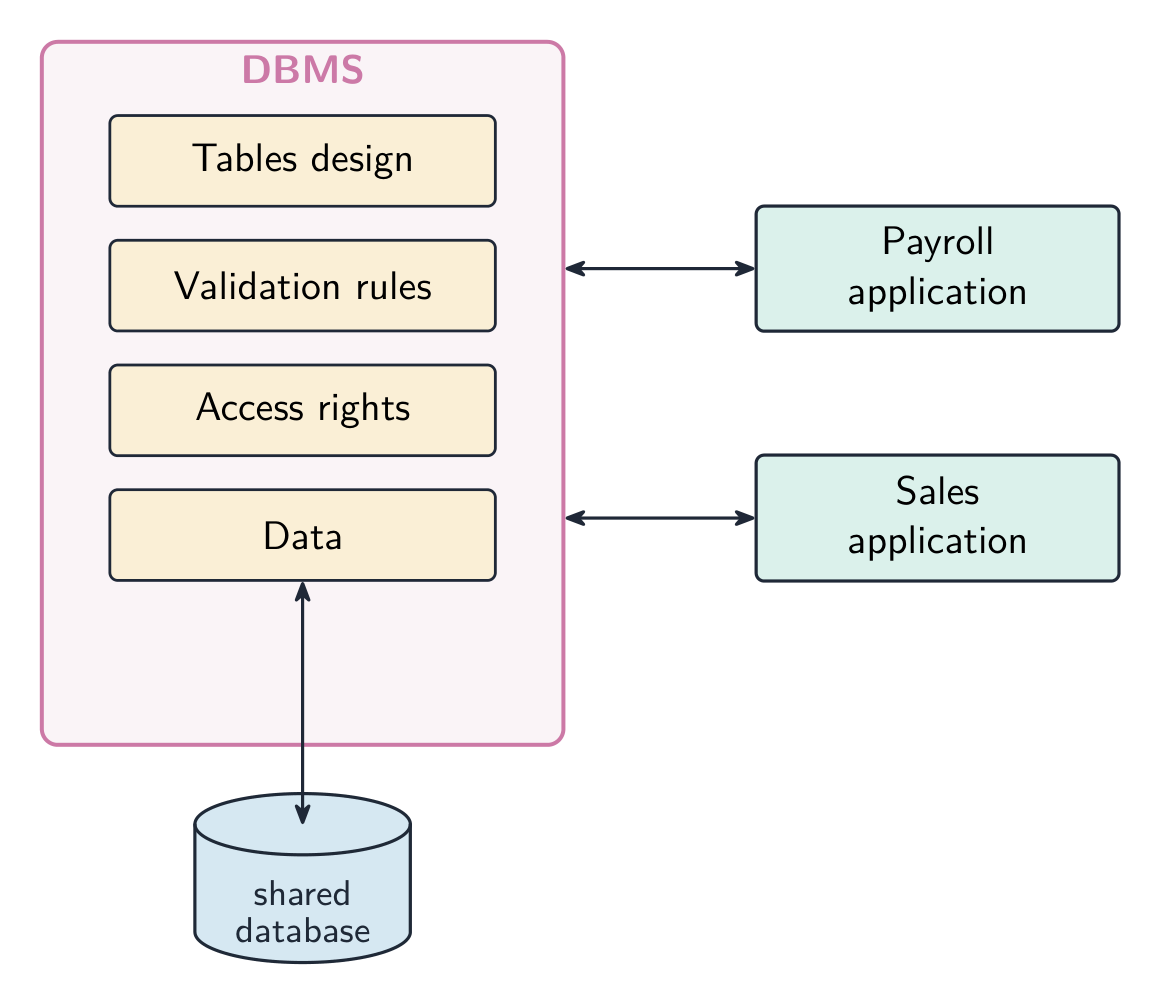
The database approach: one DBMS serves all the programs Vocabulary TrainEnglish Chinese Pinyin flat files 平面文件 píng miàn wén jiàn data redundancy 数据冗余 shù jù rǒng yú data inconsistency 数据不一致 shù jù bù yī zhì integrity 完整性 wán zhěng xìng relational database 关系数据库 guān xì shù jù kù 8.1
Relational model — terms
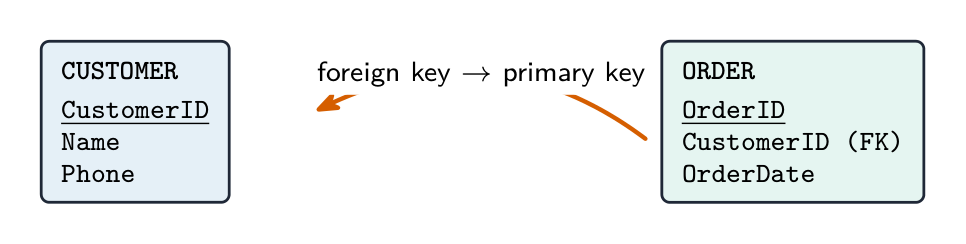
- table 表 (relation) — a grid of rows and columns; one table per type of entity 实体 (e.g.
CUSTOMER). - record 记录 (row, also called a tuple 元组) — one row; one instance of the entity.
- field 字段 (column, also called an attribute 属性) — one column; one piece of information about each record.
- primary key 主键 — a field (or fields) that uniquely identifies each record; never null or duplicated.
- foreign key 外键 — a field whose value matches the primary key of another table, linking the two.
- composite key 复合键 — a primary key made of two or more fields together.
- candidate key 候选键 — any field(s) that could be the primary key.
- secondary key 次键 — a non-primary field that is indexed for fast searching.
- indexing 索引 — building an index on a field so look-ups and joins run faster.
- referential integrity 参照完整性 — every foreign-key value must match an existing primary key (no orphan records).
A table is written in shorthand with the primary key underlined and foreign keys noted:
CUSTOMER(CustomerID, Name, Phone)
ORDER(OrderID, CustomerID, OrderDate)   -- CustomerID is FK → CUSTOMER
A foreign key links two tables: ORDER.CustomerID matches the primary key CUSTOMER.CustomerID ExploreRead a relational table with SELECT
A relational table is just rows (records) and columns (fields). WHERE keeps the rows that match a condition; SELECT then keeps only the columns you asked for.
Vocabulary TrainEnglish Chinese Pinyin table 表 biǎo entity 实体 shí tǐ record 记录 jì lù field 字段 zì duàn primary key 主键 zhǔ jiàn foreign key 外键 wài jiàn composite key 复合键 fù hé jiàn candidate key 候选键 hòu xuǎn jiàn referential integrity 参照完整性 cān zhào wán zhěng xìng tuple 元组 yuán zǔ attribute 属性 shǔ xìng secondary key 次键 cì jiàn indexing 索引 suǒ yǐn 8.1
Entity-relationship (E-R) diagrams

An entity-relationship diagram 实体关系图 shows the structure: each entity is a rectangle, each relationship a line, with the cardinality 基数 marked at each end:
- one-to-one (1:1).
- one-to-many 一对多 (1:M) — each Customer has many Orders; each Order has one Customer.
- many-to-many (M:N) — Students take many Courses, and Courses have many Students.
An E-R diagram: one class has many students 
Crow's-foot symbols for the cardinality of a relationship A many-to-many relationship cannot be stored directly. Break it into two one-to-many relationships through a link table 连接表 holding the two foreign keys:
ENROLMENT(StudentID, CourseID, EnrolmentDate)
A link table resolves a many-to-many relationship into two one-to-many relationships Vocabulary TrainEnglish Chinese Pinyin entity-relationship diagram 实体关系图 shí tǐ guān xì tú cardinality 基数 jī shù one-to-many 一对多 yī duì duō link table 连接表 lián jiē biǎo 8.1
Normalisation

Normalisation 规范化 organises tables to cut redundancy and inconsistency, going through normal forms 范式 in order.
- First normal form (1NF) — every field holds a single (atomic 原子) value, with no repeating groups, and a primary key.
- Second normal form (2NF) — in 1NF, and every non-key field depends on the whole primary key (only matters for a composite key).
- Third normal form (3NF) — in 2NF, and every non-key field depends only on the primary key, not on another non-key field (no transitive dependency 传递依赖).
A 3NF design stores each fact once, so insert/update/delete anomalies disappear. The trade-off is more tables and more joins. Aim for 3NF.
To produce a 3NF design: find the entities and their attributes; choose a primary key for each; split repeating/non-atomic fields (1NF); split fields depending on part of a composite key (2NF); split fields depending transitively on the key (3NF); add foreign keys for the relationships.
Normalisation removes redundancy by splitting repeated data into its own table Worked example. The table
ORDER(OrderID, CustomerID, CustomerName, ProductID, Quantity)has the composite primary key(OrderID, ProductID). Normalise it to 3NF. Test each non-key field against the key.Quantitydepends on bothOrderIDandProductID, which is fine. ButCustomerIDdepends onOrderIDalone - only part of the composite key. That is a partial dependency, so the table is not in 2NF. Split it intoORDER_LINE(OrderID, ProductID, Quantity)andORDER(OrderID, CustomerID, CustomerName). Now test 3NF: in that newORDERtable,CustomerNamedepends onCustomerID, which is not the key - a transitive dependency. Split again:ORDER(OrderID, CustomerID)andCUSTOMER(CustomerID, CustomerName). Name the dependency that breaks each form (partial breaks 2NF, transitive breaks 3NF); "it has repeated data" describes the symptom and earns nothing.Vocabulary TrainEnglish Chinese Pinyin normalisation 规范化 guī fàn huà normal forms 范式 fàn shì atomic 原子 yuán zi transitive dependency 传递依赖 chuán dì yī lài 8.2
Database Management System (DBMS)
Syllabus
Candidates should be able to: Notes and guidance Show understanding of the features provided by a Database Management System (DBMS) that address the issues of a file based approach Including: • data management, including maintaining a data dictionary • data modelling • logical schema • data integrity • data security, including backup procedures and the use of access rights to individuals / groups of users Show understanding of how software tools found within a DBMS are used in practice Including the use and purpose of: • developer interface • query processor Source: Cambridge International syllabus
A DBMS 数据库管理系统 manages the database centrally. Features that fix the file-based limits:
- data dictionary 数据字典 — a description of every table, field, type and key; programs query it instead of hard-coding the structure.
- redundancy/consistency control — each fact stored once.
- concurrent access 并发访问 control — locks and transactions let many users work at once.
- backup 备份 and recovery; security and per-user permissions.
- integrity rules — keys, unique and range constraints, enforced centrally.
- transactions 事务 — a group of operations that all succeed or all fail.
- views 视图 — virtual tables that show each user "their" slice of the data.
- data management 数据管理 and data modelling 数据建模 — control how data is stored and define its structure as a logical schema 逻辑模式 (the logical design, independent of physical storage).
- data integrity 数据完整性 and data security 数据安全 — enforce correctness and control access centrally.
- a query processor 查询处理器 runs queries; a developer interface 开发者接口 gives tools and APIs for building applications.
Its tools include a data-dictionary editor, a query builder, a forms builder, a report generator, user management, and an SQL editor.
ExploreDatabase service lab
Watch how a DBMS turns a query into safe shared data access.
ExploreDatabase service lab
Watch how a DBMS turns a query into safe shared data access.
Vocabulary TrainEnglish Chinese Pinyin DBMS 数据库管理系统 shù jù kù guǎn lǐ xì tǒng data dictionary 数据字典 shù jù zì diǎn concurrent access 并发访问 bìng fā fǎng wèn backup 备份 bèi fèn transactions 事务 shì wù views 视图 shì tú data management 数据管理 shù jù guǎn lǐ data modelling 数据建模 shù jù jiàn mó logical schema 逻辑模式 luó jí mó shì data integrity 数据完整性 shù jù wán zhěng xìng data security 数据安全 shù jù ān quán query processor 查询处理器 chá xún chǔ lǐ qì developer interface 开发者接口 kāi fā zhě jiē kǒu 8.3
DDL and DML

Syllabus
Candidates should be able to: Notes and guidance Show understanding that the DBMS carries out all creation/modification of the database structure using its Data Definition Language (DDL) Show understanding that the DBMS carries out all queries and maintenance of data using its DML Show understanding that the industry standard for both DDL and DML is Structured Query Language (SQL) Understand a given SQL statement Understand given SQL (DDL) statements and be able to write simple SQL (DDL) statements using a sub-set of statements Create a database (CREATE DATABASE) Create a table definition (CREATE TABLE), including the creation of attributes with appropriate data types: • CHARACTER • VARCHAR(n) • BOOLEAN • INTEGER • REAL • DATE • TIME change a table definition (ALTER TABLE) add a primary key to a table (PRIMARY KEY (field)) add a foreign key to a table (FOREIGN KEY (field) REFERENCES Table (Field)) Write an SQL script to query or modify data (DML) which are stored in (at most two) database tables Queries including SELECT... FROM, WHERE, ORDER BY, GROUP BY, INNER JOIN, SUM, COUNT, AVG Data maintenance including INSERT INTO, DELETE FROM, UPDATE Source: Cambridge International syllabus
SQL 结构化查询语言 (Structured Query Language) has two halves:
DDL builds the database structure; DML works with the data - Data Definition Language 数据定义语言 (DDL) — creates or changes the structure (tables, keys, constraints).
- Data Manipulation Language 数据操纵语言 (DML) — works with the data (insert, update, delete, query 查询).
DDL basics
CREATE TABLE CUSTOMER (
  CustomerID INTEGER PRIMARY KEY,
  Name VARCHAR(50) NOT NULL,
  Phone VARCHAR(20)
);
Add a foreign key:
CREATE TABLE ORDER (
  OrderID INTEGER PRIMARY KEY,
  CustomerID INTEGER,
  OrderDate DATE,
  FOREIGN KEY (CustomerID) REFERENCES CUSTOMER(CustomerID)
);
Modify and drop:
ALTER TABLE CUSTOMER ADD Email VARCHAR(100);
DROP TABLE CUSTOMER;
Common types:
INTEGER,REAL,VARCHAR(n),CHAR(n)(alsoCHARACTER(n)),DATE,TIME,BOOLEAN,DECIMAL(p, s).DML basics
Query with
SELECT:
A SELECT query returns only the rows that match its condition SELECT Name, Phone FROM CUSTOMER WHERE City = 'London' ORDER BY Name ASC;SELECTlists fields,FROMnames the table,WHEREfilters rows,ORDER BYsorts.A join 连接 combines two tables using a foreign-key relationship:
SELECT C.Name, O.OrderDate
FROM CUSTOMER C INNER JOIN ORDER O
  ON C.CustomerID = O.CustomerID
WHERE O.OrderDate >= '2024-01-01';
Aggregate functions 聚合函数 (
COUNT,SUM,AVG,MIN,MAX) are often used withGROUP BY:SELECT CustomerID, COUNT(*) AS NumOrders FROM ORDER GROUP BY CustomerID;Insert, update, delete:
INSERT INTO CUSTOMER (CustomerID, Name, Phone)
VALUES (101, 'Ada Lovelace', '020-1234-5678');

UPDATE CUSTOMER SET Phone = '020-9999-0000' WHERE CustomerID = 101;

DELETE FROM CUSTOMER WHERE CustomerID = 101;
Always put a
WHEREclause onUPDATEandDELETE, or the change hits every row.Tips for exam SQL
- use the exact table and field names from the question.
- quote strings with single quotes (
'Smith'); don't quote numbers. - comparisons:
=,<,>,<=,>=,<>. LIKE 'A%'matches anything starting with A (%= any string,_= one character);IN (1,2,3);BETWEEN 10 AND 20.- combine conditions with
AND/OR/NOT, and end each statement with a semicolon.
ExploreStitch two tables with INNER JOIN
A join matches rows where the foreign key equals the primary key — here Orders.CustomerID = Customer.CustomerID — and combines each matching pair into one wider row.
ExploreSELECT … WHERE
Step through a query: WHERE keeps the rows that match, then SELECT picks the columns you asked for.
Vocabulary TrainEnglish Chinese Pinyin SQL 结构化查询语言 jié gòu huà chá xún yǔ yán Data Definition Language 数据定义语言 shù jù dìng yì yǔ yán Data Manipulation Language 数据操纵语言 shù jù cāo zòng yǔ yán query 查询 chá xún join 连接 lián jiē aggregate functions 聚合函数 jù hé hán shù 8.3
Exam tips
- Define the terms exactly: entity, attribute, primary key, foreign key, and the relationship types (1:1, 1:many, many:many).
- Give a reason at each normal form: 1NF (no repeating groups), 2NF (no partial dependency), 3NF (no non-key dependency).
- Explain what a DBMS provides (data independence, security, integrity, concurrent access).
- Distinguish DDL (define the structure) from DML (query and change the data).
-
9
Algorithm Design and Problem-solving
9.1
Computational thinking

Syllabus
Candidates should be able to: Notes and guidance Show an understanding of abstraction Need for and benefits of using abstraction Describe the purpose of abstraction Produce an abstract model of a system by only including essential details Describe and use decomposition Break down problems into sub-problems leading to the concept of a program module (procedure / function) Source: Cambridge International syllabus
Computational thinking 计算思维 is the set of mental tools for analysing a problem and designing a solution a computer can run. Two key ones are abstraction and decomposition.
Computational thinking breaks a big problem into smaller, easier parts — like solving a jigsaw Abstraction
Abstraction 抽象 means keeping the essential features of a problem and ignoring the irrelevant detail, giving a simpler model.
Examples:
- a train-network map keeps the stations and lines but drops the geography.
- a class in object-oriented programming keeps only the attributes and methods the system needs.
- a function hides a piece of work behind a name.
A full model of any real problem would be too big to reason about, so abstraction is essential.
The examiner asks for the purpose of abstraction and for its benefits. Purpose: to produce a simpler model of a problem that contains only the details needed to solve it. Benefits: the problem is easier to understand and to program; the program is smaller and faster to write and test; the same model can be reused for similar problems. When you are asked to produce an abstract model of a system, list only the data and actions the task needs. For a school timetable that means the classes, rooms, teachers and periods; it does not mean the colour of the rooms or the age of the teachers.
Abstraction keeps the essentials (stations and lines) and drops irrelevant detail (the geography) Decomposition
Decomposition 分解 means breaking a large problem into smaller sub-problems, each easier to solve and tackled one at a time.
- find the main parts of the task.
- break each into smaller sub-tasks.
- continue until each is small enough to design directly.
- solve the small tasks and combine them.
For stock control: "manage stock" → "record sales", "record deliveries", "produce reports" → ("record sales") "look up product", "decrease stock count", "save the transaction". Decomposition makes big problems manageable, lets a team divide the work, and gives modular code — each module becomes a procedure 过程 or function.
"Explain why decomposition is used" is a three-mark question with a fixed shape. Give three separate benefits: each sub-problem 子问题 is small enough to design, code and test on its own; different programmers can work on different modules 模块 at the same time; a module that already exists (or a library routine) can be reused, and a fault is easier to find because it lies inside one module. A structure chart (topic 12) is the diagram of a decomposition: the program at the top, its modules beneath, and the data passed between them.
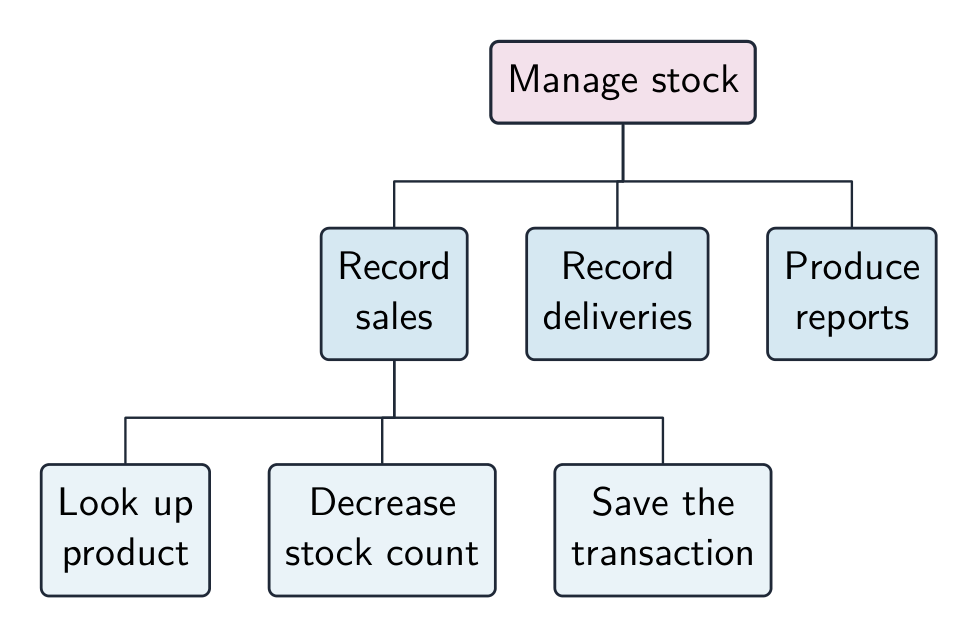
Decomposing a program into modules and sub-modules ExploreSolving a problem the computational way
Step through the four cornerstones in the order you'd use them — break the problem down, spot what repeats, strip it to essentials, then write the steps.
Vocabulary TrainEnglish Chinese Pinyin Computational thinking 计算思维 jì suàn sī wéi Abstraction 抽象 chōu xiàng Decomposition 分解 fēn jiě procedure 过程 guò chéng sub-problem 子问题 zi wèn tí modules 模块 mó kuài 9.2
Algorithms
Syllabus
Candidates should be able to: Notes and guidance Show understanding that an algorithm is a solution to a problem expressed as a sequence of defined steps Use suitable identifier names for the representation of data used by a problem and represent these using an identifier table Write pseudocode that contains input, process and output Write pseudocode using the three basic constructs of sequence, selection and iteration (repetition) Document a simple algorithm using a structured English description, a flowchart or pseudocode Write pseudocode from: • a structured English description • a flowchart Draw a flowchart from: • a structured English description • pseudocode Describe and use the process of stepwise refinement to express an algorithm to a level of detail from which the task may be programmed Use logic statements to define parts of an algorithm solution Source: Cambridge International syllabus
Bubble sort, pass by pass An algorithm 算法 is a solution expressed as a sequence of defined steps. Each step is unambiguous 无歧义 (one meaning), deterministic 确定性 (same input → same output), finite (the steps end), and effective (each can be done). An algorithm says what to do, independent of the programming language used to implement it.
ExploreSelection: follow the IF / ELSE branches
Drag the score and watch which branch runs. Selection tests each condition in turn and takes the FIRST one that is true — that is how IF … ELSE IF … ELSE works.
Vocabulary TrainEnglish Chinese Pinyin algorithm 算法 suàn fǎ unambiguous 无歧义 wú qí yì deterministic 确定性 què dìng xìng 9.2
Identifier table

When you start an algorithm, list every piece of data in an identifier table 标识符表 — its identifier 标识符 (the variable 变量 name), data type 数据类型, and description. The exam's table has exactly these three columns:
Identifier Data type Description CategorySTRINGthe product category SaleDateDATEwhen the item was sold ItemCostREALcost of the item InStockBOOLEANTRUEif in stockSalesARRAY[1:30] OF REALthe last 30 daily sales totals Use descriptive names (
ItemCost, notx): an identifier starts with a letter, contains no spaces, and is written the same way every time it appears. Common types areINTEGER,REAL,STRING,CHAR,BOOLEAN,DATE, plus arrays. The table forces you to name every piece of data before writing code, and a "complete the identifier table" question gives one mark for each correct data type or description, so write the type exactly as the pseudocode guide does.An identifier table names every piece of data before you write code Vocabulary TrainEnglish Chinese Pinyin identifier table 标识符表 biāo shí fú biǎo identifier 标识符 biāo shí fú variable 变量 biàn liàng data type 数据类型 shù jù lèi xíng 9.2
Pseudocode — the three basic constructs

Pseudocode 伪代码 is a structured, language-neutral way to describe algorithms.
The three building blocks of any algorithm: sequence, selection and iteration 1. Sequence
Steps run one after another (sequence 顺序):
INPUT Name
INPUT Age
OUTPUT "Hello", Name
2. Selection
A choice of which steps run, based on a condition (selection 选择):
IF Age >= 18 THEN
    OUTPUT "Adult"
ELSE
    OUTPUT "Minor"
ENDIF
For more options, use
CASE OF ... ENDCASE.3. Iteration
Repeating a block (iteration 迭代, a loop 循环):
FOR i ← 1 TO 10
    OUTPUT i
NEXT i
A WHILE loop tests the condition before each pass (may run zero times); a REPEAT...UNTIL loop tests after each pass (always runs at least once).
WHILE Total < 100 DO
    INPUT Value
    Total ← Total + Value
ENDWHILE

REPEAT
    INPUT Mark
UNTIL Mark >= 0 AND Mark <= 100
A WHILE loop tests before the body runs; a REPEAT ... UNTIL loop tests after it, so its body always runs at least once Choosing the loop is itself a mark:
FORwhen you know how many times (a count-controlled loop 计数循环);WHILEwhen the loop might not run at all (a pre-condition loop 前测循环);REPEAT ... UNTILwhen it must run at least once, as in validating an input (a post-condition loop 后测循环). A "describe the iteration construct" answer names the construct, says where the condition is tested, and gives the consequence (zero times or at least once).Common operations
- assignment 赋值:
x ← 5(an arrow;=is for comparison). - input/output:
INPUT variable,OUTPUT expression. - comparisons
=,<>,<,>,<=,>=; logicAND,OR,NOT. - arithmetic
+ - * /, plusDIV(integer division) andMOD(remainder). - strings:
LENGTH,LEFT,RIGHT,MID, and&for concatenation 拼接 (joining).
The pseudocode the exam expects
Every pseudocode answer is marked against Cambridge's published pseudocode guide. Write these forms exactly:
Construct Pseudocode declare a variable DECLARE Total : INTEGERdeclare an array DECLARE Marks : ARRAY[1:30] OF REALa constant CONSTANT MaxTries = 3assignment Total ← Total + Valueinput and output INPUT NameandOUTPUT "Hello ", Nameseveral options CASE OF Choice...1 : OUTPUT "Add"...OTHERWISE OUTPUT "Error"...ENDCASEcount-controlled loop FOR i ← 1 TO 10 STEP 2...NEXT ipre-condition loop WHILE Total < 100 DO...ENDWHILEpost-condition loop REPEAT...UNTIL Mark >= 0integer division and remainder DIVandMOD:17 DIV 5 = 3,17 MOD 5 = 2string functions LENGTH(S),LEFT(S, 3),RIGHT(S, 2),MID(S, 2, 4),UCASE(S),LCASE(S)conversions INT(3.7) = 3,NUM_TO_STR(12),STR_TO_NUM("4.5"),ASC('A') = 65,CHR(66) = 'B'a random number RAND(100)gives a real number from 0 up to (but not including) 100;INT(RAND(100)) + 1gives an integer from 1 to 100Two habits earn marks on every question: declare every variable you use, with the type from your identifier table, and initialise 初始化 every counter 计数器 and total (
Count ← 0,Total ← 0) before the loop that changes it.Input → Process → Output
Every program follows this shape:
INPUT Length
INPUT Width
Area ← Length * Width
OUTPUT "Area = ", Area
Listing the inputs and outputs first makes the algorithm cleaner.
Worked example. Write pseudocode that inputs 100 integers and outputs how many of them, and the total of those, that lie between 10 and 20 inclusive.
Identifier table:
Count : INTEGER(loop counter),Value : INTEGER(the integer just input),InRange : INTEGER(how many were in range),Total : INTEGER(their sum).DECLARE Count, Value, InRange, Total : INTEGER InRange ← 0 Total ← 0 FOR Count ← 1 TO 100 INPUT Value IF Value >= 10 AND Value <= 20 THEN InRange ← InRange + 1 Total ← Total + Value ENDIF NEXT Count OUTPUT InRange, TotalIf the question then asks you to "identify two constructs and state how each is used", answer in the same shape: iteration, the
FORloop, repeats the input 100 times; selection, theIFstatement, adds a value only when it is in range.Worked example. A program picks a secret integer from 1 to 100. The user guesses until they are right; after each wrong guess the program says "Too low" or "Too high", and at the end it outputs how many guesses were made.
Identifier table:
Secret : INTEGER(the number to guess),Guess : INTEGER(the user's input),Tries : INTEGER(how many guesses so far).DECLARE Secret, Guess, Tries : INTEGER Secret ← INT(RAND(100)) + 1 Tries ← 0 REPEAT INPUT Guess Tries ← Tries + 1 IF Guess < Secret THEN OUTPUT "Too low" ELSE IF Guess > Secret THEN OUTPUT "Too high" ENDIF ENDIF UNTIL Guess = Secret OUTPUT "You took ", Tries, " guesses"A
REPEAT ... UNTILloop is the right choice because the user must guess at least once. The marks are for: the random number in the right range, a loop that ends on a correct guess, the counter that starts at zero and increases inside the loop, the two messages under the right conditions, and the final output.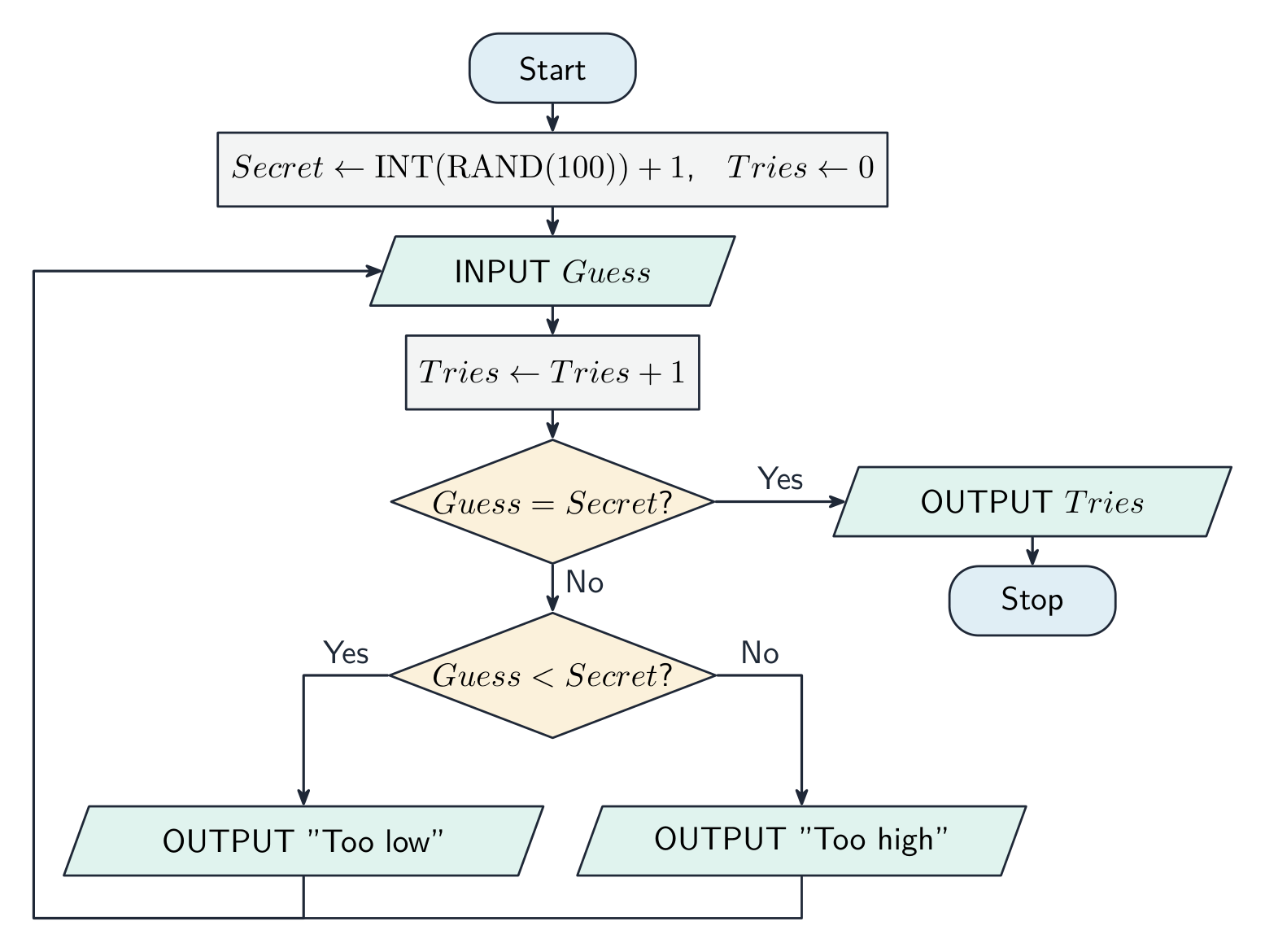
The same guessing game as a flowchart: the two decision diamonds are the two IF statements, and the return arrow is the REPEAT ... UNTIL loop Worked example. Output two different random integers, each between $-10$ and $10$ inclusive.
There are 21 possible values, so
INT(RAND(21))gives 0 to 20 and subtracting 10 shifts it to the range $-10$ to $10$. The second number must be generated again until it differs from the first:DECLARE First, Second : INTEGER First ← INT(RAND(21)) - 10 REPEAT Second ← INT(RAND(21)) - 10 UNTIL Second <> First OUTPUT First, Second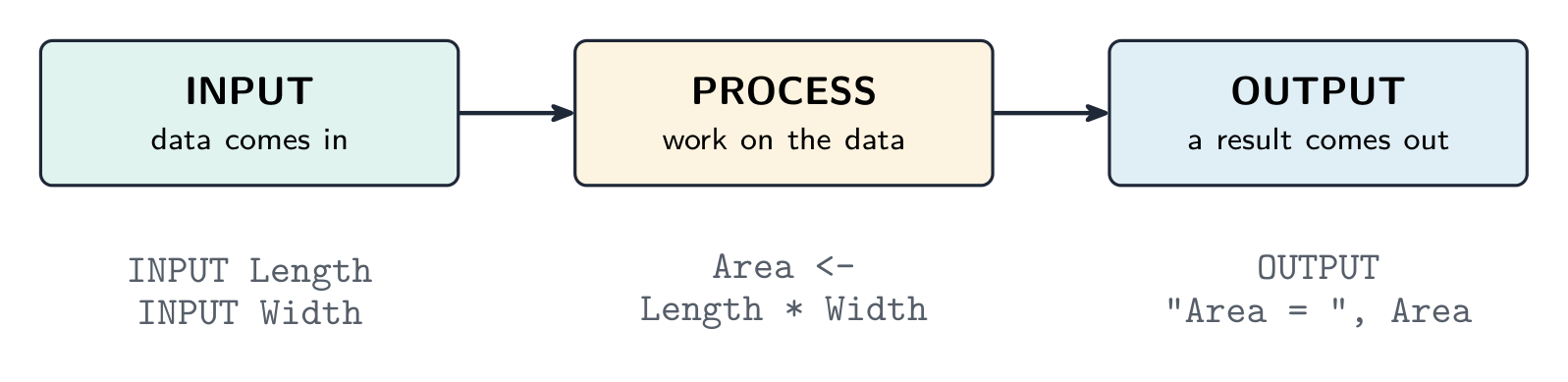
Every program follows the Input, Process, Output shape ExploreIF … ELSE selection
Change the value and watch which branch runs — how a program makes a decision.
Vocabulary TrainEnglish Chinese Pinyin Pseudocode 伪代码 wěi dài mǎ sequence 顺序 shùn xù selection 选择 xuǎn zé iteration 迭代 dié dài loop 循环 xún huán count-controlled loop 计数循环 jì shù xún huán pre-condition loop 前测循环 qián cè xún huán post-condition loop 后测循环 hòu cè xún huán assignment 赋值 fù zhí concatenation 拼接 pīn jiē initialise 初始化 chū shǐ huà counter 计数器 jì shù qì 9.2
Three notations

The same algorithm can be written three ways.
- structured English 结构化英语 — natural language with indentation and fixed keywords; good for a high-level description.
- flowchart 流程图 — a diagram with standard shapes:
Shape Meaning Rounded rectangle Start / Stop Parallelogram Input / Output Rectangle Process Diamond Decision Arrow Flow of control - pseudocode — the keyword notation above; closest to code.
You should be able to convert between any pair: each
IFis a decision diamond, each loop is a back-arrow, and a sequence is stacked rectangles.Converting a flowchart into pseudocode: start at the terminator and follow the arrows in order; a parallelogram becomes
INPUTorOUTPUT; a rectangle becomes an assignment; a diamond with two exits that rejoin further down becomesIF ... THEN ... ELSE ... ENDIF; a diamond whose one exit arrows back upwards is a loop, and it is aWHILEloop if the diamond comes before the repeated boxes and aREPEAT ... UNTILloop if it comes after them. Converting the other way, draw exactly one box per statement and one diamond per condition, and label every exit of a diamondYesorNo.A flowchart for averaging a list of numbers, using the standard shapes Vocabulary TrainEnglish Chinese Pinyin structured English 结构化英语 jié gòu huà yīng yǔ flowchart 流程图 liú chéng tú 9.2
Stepwise refinement

Stepwise refinement 逐步求精 starts with a high-level outline and expands each step until it is small enough to code. For an average of $n$ numbers:
Level 1:
Read in the numbers
Compute the average
Output the average
Level 2:
INPUT n
total ← 0
FOR i ← 1 TO n
    INPUT value
    total ← total + value
NEXT i
average ← total / n
OUTPUT average
Each refinement keeps the previous structure and adds detail.
A six-mark "apply stepwise refinement" question gives you a high-level outline and wants each step expanded into the concrete statements a programmer could code. Keep the steps in the same order, name the data each step reads or produces, and stop when every line is a single input, assignment, output, loop or condition. For example, "validate the password" becomes: input the password; check its length is at least 8; check it contains at least one digit; output "accepted" if both checks pass, otherwise output "rejected".
Stepwise refinement: expand each high-level step into detailed pseudocode ExploreStepwise refinement: outline to code
Step down the levels. You start with the whole task in one line and keep expanding each step into smaller ones — until every step is simple enough to code directly.
Vocabulary TrainEnglish Chinese Pinyin Stepwise refinement 逐步求精 zhú bù qiú jīng 9.2
Logic statements
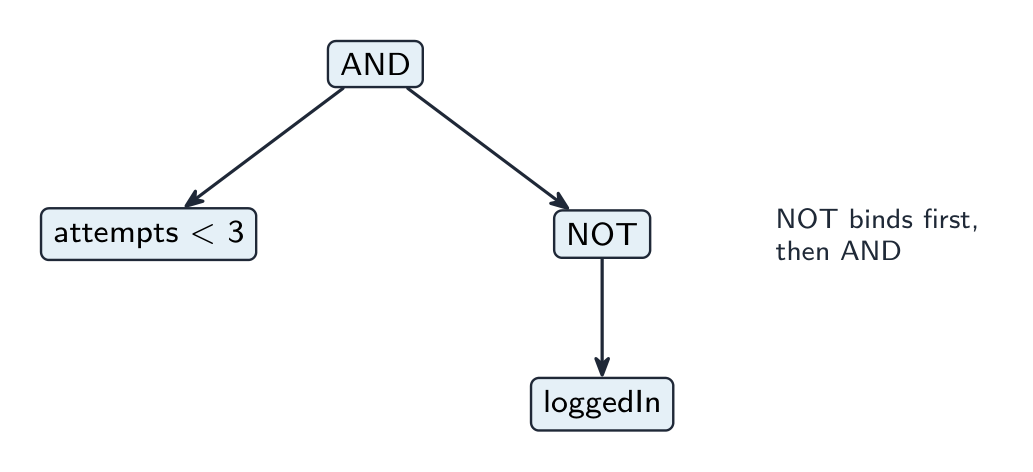
A logic statement 逻辑语句 is a Boolean 布尔 condition that controls branching, built from comparisons (
x > 10), connectives (AND,OR,NOT) and brackets. Use it as the condition ofIF,WHILEorREPEAT...UNTIL:WHILE attempts < 3 AND NOT loggedIn DO INPUT password IF password = correctPassword THEN loggedIn ← TRUE ELSE attempts ← attempts + 1 ENDIF ENDWHILEPrecedence 优先级 (highest to lowest):
NOT, thenAND, thenOR. Use brackets when unsure. Common mistakes:a = 1 OR 2is wrong — writea = 1 OR a = 2.NOT a > 5meansNOT (a > 5), i.e.a <= 5.NOT (A AND B)is the same as(NOT A) OR (NOT B)(De Morgan's law 德摩根定律) — handy for simplifying conditions.
Turning a sentence into a logic statement is a skill the papers test directly. "A ticket is free for anyone under 5 or over 65" becomes
Age < 5 OR Age > 65. "A mark is valid if it is a whole number from 0 to 100" becomesMark >= 0 AND Mark <= 100. "The loop stops when the file is finished or ten records have been read" becomesUNTIL EOF(File) OR Count = 10. Write each comparison in full:Age > 65andAge < 5, neverAge > 65 OR < 5.Precedence: NOT binds to loggedIn first, then AND combines the two sides Worked example. Write an identifier table and pseudocode to read 10 numbers and output the largest. The identifier table names each variable with its data type and purpose:
Count : INTEGER(loop counter),Num : REAL(the number just read),Max : REAL(largest so far).Max ← -999999 FOR Count ← 1 TO 10 INPUT Num IF Num > Max THEN Max ← Num ENDIF NEXT Count OUTPUT MaxThe design decision carrying the marks is initialising
Max: it must start lower than any possible input - or, safer still, be set to the first number read. Initialise it to0and the algorithm wrongly returns 0 for a list of negative numbers, a bug your trace only exposes if the test data include a negative.Vocabulary TrainEnglish Chinese Pinyin logic statement 逻辑语句 luó jí yǔ jù Boolean 布尔 bù ěr Precedence 优先级 yōu xiān jí De Morgan's law 德摩根定律 dé mó gēn dìng lǜ 9.2
Definitions the examiner accepts
A definition question is marked against fixed wording. Learn these exactly, and give one answer only.
Term Definition abstraction keeping the essential details of a problem and leaving out the details that are not needed decomposition breaking a problem down into smaller sub-problems, each of which can be solved separately algorithm a solution to a problem expressed as a sequence of defined steps identifier table a table listing each identifier used in an algorithm with its data type and a description of its purpose pseudocode a structured, language-independent way of writing the steps of an algorithm flowchart a diagram that shows the steps and decisions of an algorithm using standard symbols joined by arrows sequence statements executed one after another in the order written selection choosing which statements to execute according to a condition iteration repeating a group of statements while, or until, a condition holds stepwise refinement breaking each step of an outline into smaller steps, repeatedly, until each step can be coded directly logic statement a condition built from comparisons and the operators AND, OR and NOT that evaluates to TRUE or FALSE 9.2
Exam tips
- Define an algorithm as an unambiguous, finite, deterministic sequence of steps, independent of language.
- Use the three constructs correctly — sequence, selection, iteration — and keep an identifier table with data types.
- Break a problem down by decomposition and abstraction, then stepwise refinement.
- Write pseudocode that would actually run: declare variables and follow the exam's pseudocode style.
Common mistakes
- Using
=to assign a value. Assignment is←;=is a comparison. - Forgetting
ENDIF,ENDWHILE,ENDCASEorNEXT. Every construct closes, and the closing word is where the mark for the construct is checked. - Not initialising a total or counter before the loop, so the algorithm adds to a value that never existed.
- Using a
FORloop when the number of repetitions is unknown. Reading until a sentinel value or a correct guess needsWHILEorREPEAT ... UNTIL. - Writing
Age > 65 OR < 5. Each side ofORandANDmust be a complete comparison. - Answering "explain why decomposition is used" with one benefit written three ways. Three marks need three different benefits.
-
10
Data Types and Structures
10.1
Choosing data types
Syllabus
Candidates should be able to: Notes and guidance Select and use appropriate data types for a problem solution including integer, real, char, string, Boolean, date (pseudocode will use the following data types: INTEGER, REAL, CHAR, STRING, BOOLEAN, DATE, ARRAY, FILE) Show understanding of the purpose of a record structure to hold a set of data of different data types under one identifier Write pseudocode to define a record structure Write pseudocode to read data from a record structure and save data to a record structure Source: Cambridge International syllabus
Every variable needs a data type 数据类型 — the kind of value it holds and the operations allowed:
INTEGER— a whole number (42,-7). For counts, indexes, IDs.REAL— a number with a fractional part (3.14). For money, measurements.STRING— characters in quotes ("Hello"). For text.CHAR— a single character ('A').BOOLEAN—TRUEorFALSE. For flags.DATE— a calendar date.
Pick the smallest precise type that fits:
INTEGERfor whole counts,BOOLEANfor flags (not the strings"yes"/"no").The "give the appropriate data type" tables are decided by how the value is used: the average mark of a class is
REAL(it has a fractional part); an email address isSTRING; the number of students isINTEGER; whether a student has paid isBOOLEAN; a date of birth isDATE; an array index is alwaysINTEGER; a single grade letter isCHAR; a phone number is aSTRING, because it starts with0and is never used in arithmetic. ABOOLEANis used for a flag with only two states: whether a search has found its target, whether a member has paid, whether a seat is booked. For the identifier table, the variable name must be meaningful too:NumberOfPeople, notn.Vocabulary TrainEnglish Chinese Pinyin data type 数据类型 shù jù lèi xíng 10.1
Records

A record 记录 (a record structure 记录结构) holds several fields of different types under one name — useful when several values describe one thing.
TYPE TStockItem
    DECLARE ItemID : INTEGER
    DECLARE Category : STRING
    DECLARE ItemCost : REAL
    DECLARE InStock : BOOLEAN
ENDTYPE
This defines the type
TStockItem; declare variables of it:DECLARE Item1 : TStockItem DECLARE Items : ARRAY[1:100] OF TStockItemUse dot notation to reach each field 字段:
Item1.Category ← "Fruit"
OUTPUT Item1.Category, " costs ", Item1.ItemCost
Use a record when values always belong together (a customer, a stock item); use separate variables for unrelated values.
Worked example. A club stores, for each student, a student ID (a string), a name, a date of birth and up to three club numbers (integers). Write pseudocode to declare the record type, an array to hold $3000$ students, and a statement that stores a name in the first element.
TYPE Student
    DECLARE StudentID : STRING
    DECLARE Name : STRING
    DECLARE DateOfBirth : DATE
    DECLARE Club : ARRAY[1:3] OF INTEGER
ENDTYPE

DECLARE Membership : ARRAY[1:3000] OF Student
Membership[1].Name ← "Li Wei"
The marks:
TYPEwith the identifier andENDTYPE; each field declared with a suitable type; the array declared with its bounds andOF Student; the field reached with the index and a dot. A "state the error in the record declaration" question usually points at a missingENDTYPE, a field with no type, or a field declared as aSTRINGthat must hold arithmetic. Two conventions score marks on their own: an unused element is marked with a value that cannot be real data (an empty string,-1, an ID of0), and it is good practice to use the same marker everywhere so that every module can recognise an unused slot; an unused club field is0. The benefits of an array of records, for a "state three benefits": all the data for one entity is held under one identifier; the fields can have different data types; one array replaces several parallel arrays that would have to be kept in step; the whole set can be processed by one loop or passed as one parameter; and adding a field changes the type definition only. For one customer the suitable structure is a record (fields of different types under one name); for all customers it is an array of records.A record holds several fields of different types under one name ExploreA record groups fields under one name
A record bundles related fields together. Each field is a named label you reach with dot notation — Item1.Category — not by a numeric index.
Vocabulary TrainEnglish Chinese Pinyin record 记录 jì lù record structure 记录结构 jì lù jié gòu field 字段 zì duàn 10.2
Arrays

Syllabus
Candidates should be able to: Notes and guidance Use the technical terms associated with arrays Including index, upper bound and lower bound Select a suitable data structure (1D or 2D array) to use for a given task Write pseudocode for 1D and 2D arrays Write pseudocode to process array data Sort using a bubble sort Search using a linear search Source: Cambridge International syllabus
An array 数组 is an ordered collection of items of the same type, under one name, reached by an index 索引.
- element 元素 — one item in the array.
- bounds 边界 — the lowest and highest valid indices.
- dimension 维度 — 1-D (a list), 2-D (a table), etc.
- lower bound 下界 and upper bound 上界 — the first and last valid index; the number of elements is upper bound minus lower bound plus one, and for a 2-D array the product of the two counts.
So in
ThisArray[n] ← 42the array has one dimension, the index is the variablen(anINTEGER), and the element at that index receives42. Before an array can be declared you need its data type as well as its bounds. To declare $120$ values that may include a decimal place:DECLARE Data : ARRAY[1:120] OF REAL; a $150$-row, two-column table of strings:DECLARE Data : ARRAY[1:150, 1:2] OF STRING, which has $300$ elements. The benefits of an array over separate variables, for a two-mark explain: one identifier instead of thirty; the elements can be processed by a loop with the index as the counter; the size is easy to change; and the whole set can be passed to a module as one parameter. An array can also replace a chain of selection statements:DaysInMonth[Month]looks up the answer directly instead of twelveIFclauses, which is shorter, faster to write and easier to maintain.1-D arrays
DECLARE Names : ARRAY[1:5] OF STRING
Names[3] ← "Cara"
OUTPUT Names[3]
Process every element with a
FORloop:FOR i ← 1 TO 5 OUTPUT Names[i] NEXT iA 1-D array (a list) with indices and bounds 2-D arrays (2D array)
DECLARE Grid : ARRAY[1:3, 1:4] OF INTEGER
Grid[2, 3] ← 99
The first index is the row, the second the column. Use nested loops to visit every cell. Use 1-D for a single sequence, 2-D for two natural dimensions (a grid, rows × columns).

A 2-D array (a table) with row and column indices Common operations
A linear search 线性查找 checks each element until found:
FOR i ← 1 TO n
    IF A[i] = Target THEN
        OUTPUT "Found at ", i
    ENDIF
NEXT i
To find a sum, count, maximum or minimum, set a running variable then sweep through:
Max ← A[1]
FOR i ← 2 TO n
    IF A[i] > Max THEN Max ← A[i]
NEXT i
A bubble sort 冒泡排序 puts an array in order: pass through it comparing each adjacent pair and swapping any that are out of order; repeat the passes until one pass makes no swaps.
Paper 2 asks for these algorithms both as pseudocode and as steps in words, and sometimes in their "efficient" form:
- Largest value: set
Largestto the first element; for each remaining element, if it is bigger thanLargest, store it inLargest; after the loop outputLargest. For the position of the largest, keep a second variable that stores the index each timeLargestchanges. - Linear search returning a position: set
FoundAt ← -1before the loop (a value that can never be a valid index, so it means "not found"); loop through the array; when the element matches, store the index and leave the loop; after the loop testFoundAt. - Count or output the non-blank elements: compare each element with the marker for an unused element (
""or-1) and count or output only those that differ. - Remove an item: find its index by a linear search; move every later element one place towards the start, so the gap closes; mark the last element as unused (or decrease the count).
- Insert into a sorted array: find the first index whose element is larger; move that element and every later one one place towards the end; store the new value in the gap.
- Efficient bubble sort: a
Swappedflag so that the passes stop as soon as a pass makes no swap, and an upper limit that falls by one each pass because the largest value has already reached the end.
REPEAT
    Swapped ← FALSE
    FOR Index ← 1 TO Limit - 1
        IF Data[Index] > Data[Index + 1] THEN
            Temp ← Data[Index]
            Data[Index] ← Data[Index + 1]
            Data[Index + 1] ← Temp
            Swapped ← TRUE
        ENDIF
    NEXT Index
    Limit ← Limit - 1
UNTIL Swapped = FALSE
The marks are for the outer loop that repeats until no swaps, the flag set inside the
IF, the three-line swap with a temporary variable, and the shrinking limit. A sort in "steps" (stepwise refinement) is: repeat until sorted; on each pass compare adjacent pairs; swap a pair that is out of order; after each pass the largest unsorted value is at the end. Two 1-D arrays of records or of parallel data are processed with one loop and one index; a 2-D array needs a nested loop, the outer over rows and the inner over columns, and a search in one row fixes the row index and loops over the column.
One pass of a bubble sort: adjacent pairs are compared and swapped, bubbling the largest value to the end ExploreA 2-D array
Pick a row and column to read one element — how a grid of data is stored and indexed.
Vocabulary TrainEnglish Chinese Pinyin array 数组 shù zǔ index 索引 suǒ yǐn element 元素 yuán sù bounds 边界 biān jiè dimension 维度 wéi dù lower bound 下界 xià jiè upper bound 上界 shàng jiè linear search 线性查找 xiàn xìng chá zhǎo bubble sort 冒泡排序 mào pào pái xù 10.3
Files
Syllabus
Candidates should be able to: Notes and guidance Show understanding of why files are needed Write pseudocode to handle text files that consist of one or more lines Source: Cambridge International syllabus
A file 文件 is data stored on secondary storage 辅助存储器, kept between program runs. Variables in RAM disappear when the program ends, so to save data permanently (high scores, records, settings) the program writes to a file. Files also let programs share data and restart from a saved state.
Variables in RAM vanish when the program ends; a file on disk persists between runs A text file 文本文件 holds one or more lines of readable characters; programs read and write text files line by line. Open a file before use and close it after:
OPENFILE "data.txt" FOR READ // or FOR WRITE, FOR APPEND WHILE NOT EOF("data.txt") DO READFILE "data.txt", LineString OUTPUT LineString ENDWHILE CLOSEFILE "data.txt"EOFtests the end of file 文件结束 before reading. To write:OPENFILE "log.txt" FOR WRITE FOR i ← 1 TO 100 WRITEFILE "log.txt", "Event " & i NEXT i CLOSEFILE "log.txt"Always close every file — otherwise buffered writes may be lost and other programs may be locked out.
Why files (two marks): the data is kept after the program ends, so it is available the next time the program runs; it can be shared with other programs; and it can hold more than fits in memory. The characteristic of a text file that lets a program work through it is that it is a sequence of lines, read one after another from the start. The three modes:
READto read from the start;WRITEto create a new file, which deletes any existing contents, so it cannot be used to add to a file;APPENDto add lines at the end of an existing file. TestEOFbefore every read, and open the file only once, even when several modules use it.Worked example. Write pseudocode for a procedure
LastLines(FileName : STRING)that outputs the last three lines of a text file, in order.PROCEDURE LastLines(BYVAL FileName : STRING) DECLARE LineX, LineY, LineZ : STRING LineX ← "" LineY ← "" LineZ ← "" OPENFILE FileName FOR READ WHILE NOT EOF(FileName) DO LineX ← LineY LineY ← LineZ READFILE FileName, LineZ ENDWHILE CLOSEFILE FileName OUTPUT LineX OUTPUT LineY OUTPUT LineZ ENDPROCEDUREEach new line pushes the previous three along, so when the file ends the three variables hold its last three lines; a file with fewer lines outputs empty strings. To output the first five lines, count the lines read and stop the loop at five or at
EOF, whichever comes first; a file that is empty is detected byEOFbeingTRUEimmediately after opening.Fields in a line. A text file holds strings, so a record is written as one line with its fields joined by a separator 分隔符 character, and each number or Boolean converted with
NUM_TO_STR(and read back withSTR_TO_NUM, or by comparing with"TRUE"). Choose a separator that can never appear in the data: a comma or|for names and numbers, never a space when a name may contain one. If a field may contain any character, the separator can be confused with data; the fix is to put each field on its own line, or to write the field's length before it. One item per line is simple to read back but uses more lines and makes a record harder to see as a unit. Reading a file whose lines are in a known order (ascending by an ID) allows the search to stop as soon as a larger ID is read, instead of reading to the end. A save file that is created each time the game is saved needs a meaningful filename, for instance the player's name and the date and time, so that any earlier save can be restored.
One line of a text file is one record: fields joined by a separator, converted to their types when read back ExploreHandling a file: open → use → close
Step through the lifecycle every file follows. The two easy-to-forget parts are testing EOF while reading in a loop, and always closing at the end.
Vocabulary TrainEnglish Chinese Pinyin file 文件 wén jiàn secondary storage 辅助存储器 fǔ zhù cún chǔ qì text file 文本文件 wén běn wén jiàn end of file 文件结束 wén jiàn jié shù separator 分隔符 fēn gé fú 10.4
Abstract Data Types (ADTs)

Syllabus
Candidates should be able to: Notes and guidance Show understanding that an ADT is a collection of data and a set of operations on those data Show understanding that a stack, queue and linked list are examples of ADTs Describe the key features of a stack, queue and linked list and justify their use for a given situation Use a stack, queue and linked list to store data Candidates will not be required to write pseudocode for these structures, but they should be able to add, edit and delete data from these structures Describe how a queue, stack and linked list can be implemented using arrays Source: Cambridge International syllabus
Linked list: insert by rewiring pointers Stack vs queue: LIFO and FIFO An Abstract Data Type 抽象数据类型 (ADT) is a collection of data plus operations on it, defined by what it does, not how it is stored. The user works only through the operations; the implementation is hidden, so it can change without affecting code that uses the ADT. Know three: stack, queue, linked list.
The one-mark definition: an ADT is a collection of data together with a set of operations on that data. A stack, a queue, a linked list, a binary tree and an array are all ADTs. To justify a choice: a queue when items must be handled in the order they arrived (print jobs, key presses, customers in a shop), because it is first in, first out; a stack when the most recent item must be handled first (undo, going back through web pages, reversing an order, the return addresses of nested calls), because it is last in, first out; a linked list when items are inserted and deleted in the middle of an ordered sequence often, because only pointers change and nothing has to be shifted. To compare a stack and a queue: both are linear structures of items with an order, both are implemented with an array and pointers, and both need a check for full before adding and for empty before removing; a stack has one pointer and adds and removes at the same end, a queue has two pointers and adds at one end and removes at the other.
Stack
A stack 栈 works in LIFO 后进先出 order (Last In, First Out). Operations: push 入栈 (add to the top), pop 出栈 (remove from the top), peek (look at the top), and tests for empty/full. Uses: undo history, function-call return addresses, expression parsing, backtracking.
Push and pop change the top pointer; the base pointer stays put Worked example. A stack of characters holds, from the bottom,
'P','N','Z','X','Y','W', with the top-of-stack pointer at'W'(memory location 202 of 200–207). The operationsPOP,POP,PUSH 'A',PUSH 'B',POPare performed. What is on the stack, and where does the pointer point?The two pops remove
'W'then'Y'; the pushes add'A'then'B'in their places; the last pop removes'B'. The stack now holds'P','N','Z','X','A'and the pointer is at'A', location 203. The value that has been on the stack longest is the bottom item,'P'; at most five further pops are possible before the stack is empty, and a pop on an empty stack is an error, which is whyPop()tests for empty first. APush()function that returnsTRUEon success first tests whether the pointer is at the top of the array (full) and returnsFALSEif so. The array elements need no initialising before use, because the pointer alone says which elements are in use.
A pile of books is a stack you can see. You can only add or take a book from the top, so the last one you put on is the first one you take off — that is exactly LIFO Queue
A queue 队列 works in FIFO 先进先出 order (First In, First Out). Operations: enqueue 入队 (add to the rear), dequeue 出队 (remove from the front), and tests for empty/full. Uses: print spooling, scheduling, breadth-first search, buffering.
Enqueue adds at the rear; dequeue removes from the front To describe adding an item: check that the queue is not full; store the item at the position given by the end-of-queue pointer; increment the end pointer (and the count). To describe removing: check that the queue is not empty; read the item at the front pointer; increment the front pointer (and decrement the count). State the convention you use: if the end pointer marks the next free space, front and end pointers being equal means the queue is empty; if it marks the last item, equal pointers mean one item. In a linear queue the front pointer only ever moves forward, so cells behind it are wasted; that is what the circular queue below fixes. The two features of a queue to state: items are added at the rear and removed from the front, so the first item added is the first removed.

A line of people is a queue you can see. You join at the back and are served from the front, so whoever waited longest is served first — that is exactly FIFO Linked list
A linked list 链表 stores data as a sequence of nodes 节点. Each node holds a value and a pointer 指针 to the next node; a head pointer marks the start, and the last node's pointer is a sentinel (e.g.
NULL). Operations: insert, delete, search, and traverse 遍历 (visit each node in order). Its advantage over an array is cheap insertion/deletion (just adjust pointers); its disadvantage is slow random access (you must follow pointers from the head).
A linked list: each node points to the next Adding a node in order (four marks): traverse the list from the head, following the pointers, until the node before the position is found (the last node whose value is smaller); take a free node and store the new value in it; set the new node's pointer to the address the previous node pointed to; set the previous node's pointer to the new node. If the new value belongs at the front, the head pointer is changed instead. Deleting a node: find the node before it, and set that node's pointer to the address the deleted node pointed to, so the list bypasses it; the freed node returns to the free list. Compared with a 1-D array, inserting or deleting in a linked list needs no shifting of the other items, and the list can grow until memory runs out; the cost is the extra pointer stored with every item, and that reaching the $n$th item means following $n$ pointers, since there is no direct index.
ExploreA linked list: nodes joined by pointers
Each node stores a value and a pointer to the next node. Inserting or deleting just re-links pointers — no items shift along, unlike an array.
ExploreStacks and queues
Push and pop. A stack is last-in-first-out; a queue is first-in-first-out — two key ADTs.
Vocabulary TrainEnglish Chinese Pinyin Abstract Data Type 抽象数据类型 chōu xiàng shù jù lèi xíng stack 栈 zhàn LIFO 后进先出 hòu jìn xiān chū push 入栈 rù zhàn pop 出栈 chū zhàn queue 队列 duì liè FIFO 先进先出 xiān jìn xiān chū enqueue 入队 rù duì dequeue 出队 chū duì linked list 链表 liàn biǎo nodes 节点 jié diǎn pointer 指针 zhǐ zhēn traverse 遍历 biàn lì 10.4
Implementing ADTs using arrays

Stack using an array
Hold items in
Stack[1:MaxSize]with an integerTop(0 when empty).Push(x): ifTop = MaxSizethe stack is full (overflow 溢出); elseTop ← Top + 1;Stack[Top] ← x.Pop(): ifTop = 0the stack is empty (underflow 下溢); else returnStack[Top]andTop ← Top - 1.
Queue using a circular array
A simple queue lets
FrontandRearmarch off the end, wasting the start. The fix is a circular array 循环数组 — when a pointer reachesMaxSizeit wraps back to 1:Enqueue(x): check full; elseRear ← (Rear MOD MaxSize) + 1;Queue[Rear] ← x.Dequeue(): check empty; else returnQueue[Front]andFront ← (Front MOD MaxSize) + 1.
Track a separate count to tell empty from full.
The algorithm for the end pointer, in words: if the count equals the size, report that the queue is full and stop; otherwise add one to the end pointer; if it is now past the last index, set it to the first index; store the item there and add one to the count. The declarations that a five-mark "describe the declaration and initialisation" answer lists: the array with its size and element type; a front pointer and an end pointer, both initialised to the first index (or the front to the first index and the end to the next free space); and a count of items, initialised to $0$.
For example, with
MaxSize = 6: ifRear = 5, then(5 MOD 6) + 1 = 6, so the next item goes in cell 6; ifRear = 6, then(6 MOD 6) + 1 = 1, so the pointer wraps back to cell 1.A circular queue wraps the pointers back to the start of the array Linked list using an array
Use an array of records, each with a
Nextindex:TYPE TNode DECLARE Value : INTEGER DECLARE Next : INTEGER // index of the next node, or -1 for end ENDTYPE DECLARE Nodes : ARRAY[1:MaxSize] OF TNode DECLARE Head : INTEGER // index of first node, -1 if empty DECLARE FreeListHead : INTEGER // first available free nodeA free list 空闲列表 chains the unused slots, just as the data list chains its used ones. To insert: take a slot from
FreeListHead, set the new node's value andNext, and update the previous node'sNext(orHead). To delete: unlink the node and return its slot to the free list. This gives the flexibility of a linked structure with the static allocation of an array.
A linked list stored in an array: a data array and a pointer array Worked example. A linked list is held in a
Dataarray and aPointerarray, withStartpointing to index 1. The list is 1 → 3 → 4 (index 1 holdsD40, index 3 holdsD32, index 4 holdsD11, whose pointer is $\emptyset$); the free list starts at index 2 and continues 2 → 5. InsertD6betweenD32andD11.Take the first free node, index 2, and set
FreeStartto its pointer, 5; storeD6inData[2]; setPointer[2]to the valuePointer[3]held, which is 4; setPointer[3]to 2. The list reads 1 → 3 → 2 → 4 and the free list is 5 → $\emptyset$. The answer to "how can the linked list be implemented" is exactly these parts: an array (or array of records) for the data, a parallel array for the pointers holding indices, a start pointer, a free-list pointer and a null value such as $-1$ for the end.Worked example. A circular queue is held in an array of size 5 (indices 0 to 4) with
Front = 3,Rear = 3and one item stored. Two items are added, then two are removed. Where are the pointers, and why use a circular queue at all? Every move uses(pointer + 1) MOD size, so the pointers wrap. Adding twice movesRear: $3 \rightarrow 4$, then $4 \rightarrow 0$ (because $(4+1) \bmod 5 = 0$), soRear = 0and three items are stored. Removing twice movesFrontthe same way: $3 \rightarrow 4$, then $4 \rightarrow 0$, leavingFront = 0and one item. The wrap is the whole point: in a linear array queue the pointers march to the end and the freed space at the front is wasted even when the queue is empty. Remember a queue removes at the Front and adds at the Rear - a stack uses one pointer for both.ExploreImplementing ADTs with arrays
FIFO
A queue is first-in-first-out — enqueue at the back, dequeue from the front.
Vocabulary TrainEnglish Chinese Pinyin overflow 溢出 yì chū underflow 下溢 xià yì circular array 循环数组 xún huán shù zǔ free list 空闲列表 kòng xián liè biǎo 10.4
Definitions the examiner accepts
A definition question is marked against fixed wording. Learn these exactly.
Term Definition record a data structure that holds a set of data items (fields) of different data types under one identifier array a data structure that holds a fixed number of elements of the same data type under one identifier, each accessed by an index index the number that identifies one element of an array upper bound, lower bound the largest and smallest valid index of an array text file a file that stores data as lines of characters, which a program reads and writes one line at a time abstract data type a collection of data together with a set of operations on that data stack a list in which items are added to and removed from the same end, the top, so the last item added is the first removed (LIFO) queue a list in which items are added at the rear and removed from the front, so the first item added is the first removed (FIFO) linked list a list in which each node holds a data item and a pointer to the next node, with a start pointer to the first node pointer a variable that holds the address (or index) of a node or of a position in a structure linear search checking each element in turn from the first until the target is found or the end is reached bubble sort repeated passes through the array comparing adjacent pairs and swapping those out of order, until a pass makes no swaps 10.4
Exam tips
- Choose the right data structure and justify it (a record for mixed fields, a 2-D array for a grid).
- Know how to implement a stack, queue and linked list with an array and pointers (top; front/rear; next).
- Distinguish an ADT (its behaviour) from its implementation (array plus pointers).
Common mistakes
- A record declaration without
ENDTYPE, or fields without types. Every field is aDECLAREline with a type. - Reading past the end of a file, or writing with
WRITEwhen the file must keep its contents. TestEOFbefore each read; useAPPENDto add. - Writing a number to a text file without converting it. A file holds strings:
NUM_TO_STRout,STR_TO_NUMback. - Forgetting the checks.
Pushand enqueue test for full first;Popand dequeue test for empty first, and the answer says so. - Losing the rest of the list when inserting a node. Set the new node's pointer to the old next node before changing the previous node's pointer.
- A linear search that never says "not found". Initialise the position to $-1$ and test it after the loop.
-
11
Programming
11.1
Programming basics

Syllabus
Candidates should be able to: Notes and guidance Implement and write pseudocode from a given design presented as either a program flowchart or structured English Write pseudocode statements for: • the declaration and initialisation of constants • the declaration of variables • the assignment of values to variables • expressions involving any of the arithmetic or logical operators input from the keyboard and output to the console Use built-in functions and library routines Any functions not given in the pseudocode guide will be provided String manipulation functions will always be given Source: Cambridge International syllabus
Programming turns a design into instructions written as code 
A programmer writes the code and tests it as they go From design to code
You should be able to turn a design — a flowchart 流程图 (program flowchart) or structured English 结构化英语 — into pseudocode 伪代码, and then into a real language:
- find the variables 变量 and their data types 数据类型.
- turn input/output boxes into
INPUT/OUTPUT. - turn decision diamonds into
IF...ELSE...ENDIF(orCASE). - turn loop arrows into
WHILE,REPEAT...UNTIL, orFOR. - turn process boxes into assignments or calculations.
- check by tracing a small input.
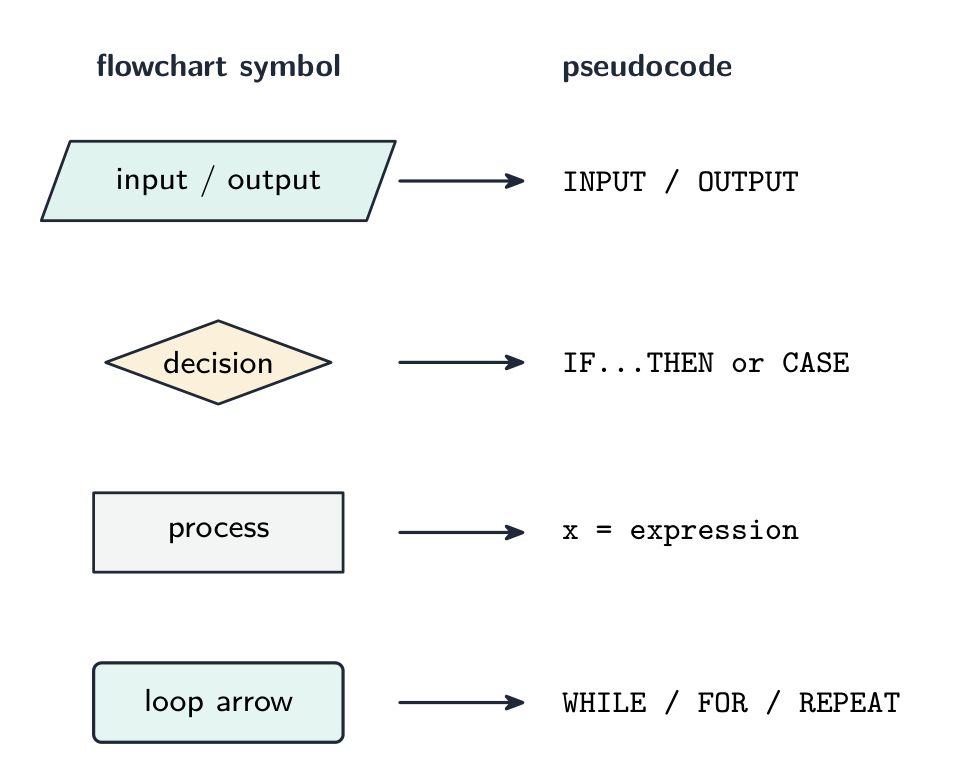
Each flowchart symbol becomes a pseudocode keyword Constants and variables
A constant 常量 holds a value that never changes; a variable holds one that may change. Declare them with a type:
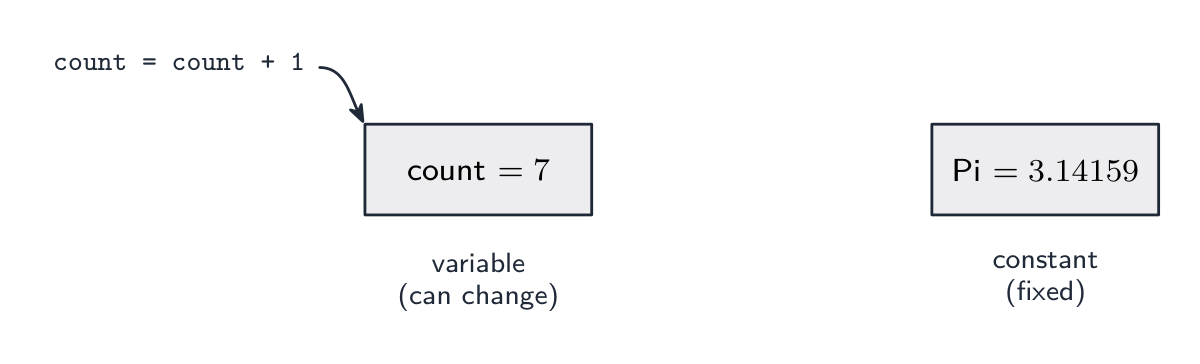
A variable's value can change; a constant stays fixed CONSTANT Pi ← 3.14159 DECLARE Radius : REAL DECLARE Area : REAL Radius ← 5 Area ← Pi * Radius * RadiusUse constants for fixed values that recur (
Pi,MaxScore); they make code clearer and easy to change in one place.In the exam, a constant is the answer to "identify a more appropriate way of representing" a fixed value, such as a tax rate or a maximum score, that appears at several places in the pseudocode. The benefits the scheme lists: the value is set once and cannot be changed accidentally by the program; a change is made in one place and reaches every statement that uses it; the identifier gives the value a meaning (
MaxScorerather than100), so the code is easier to read and to check; and there is less risk of a typing error in a long value such as3.14159. A "state a value that could be replaced by a constant" question wants the literal from the pseudocode (0.2,40), not a new name.Every variable is declared once, with an identifier 标识符 (its name) and a data type, before it is used. The six types in the 9618 pseudocode guide:
Type Holds Written in the code as Typical use INTEGERwhole numbers 42,-3a count, an array index, a loop counter REALnumbers with a fractional part 3.75a price, an average CHARone character 'A'(single quotes)a grade letter, a menu key STRINGa sequence of characters "Hello"(double quotes)a name, a postcode BOOLEANTRUEorFALSETRUEa flag such as FoundDATEa calendar date 12/05/2026a date of birth A "give the appropriate data type" question is answered from how the variable is used in the pseudocode: a value with a decimal point is
REAL; something set toTRUEorFALSEisBOOLEAN; a value in single quotes isCHAR; a value used as an array index, or withDIVandMOD, isINTEGER. Write the type in capitals, spelled as the guide spells it.Worked example. State the appropriate data type for each variable.
Found ← FALSE Initial ← 'K' Price ← 12.99 Count ← Count + 1 Name ← "Li Wei"FoundisBOOLEAN(it holdsFALSE);InitialisCHAR(one character in single quotes);PriceisREAL(a decimal value);CountisINTEGER(a counter that goes up by one);NameisSTRING(text in double quotes).Assignment and expressions
Use
←for assignment 赋值:Total ← Total + 1 Average ← Sum / CountExpressions use operators 运算符:
- arithmetic
+ - * /, plusDIV(integer division) andMOD(remainder):7 DIV 2 = 3;7 MOD 2 = 1. - comparisons
=,<>,<,>,<=,>=. - logic
AND,OR,NOT.
Precedence 优先级 (highest to lowest):
NOT→* / DIV MOD→+ -→ comparisons →AND→OR. Use brackets when unsure.Input and output
OUTPUT "Enter your name:"
INPUT Name
OUTPUT "Hello, ", Name
Built-in functions and library routines
Many tasks have ready-made library routines 库例程, so you need not write them. The Paper 2 insert 附页 lists the ones you may use, with their exact names, parameters and return types; any other function a question needs is given in the question. The names below are the 9618 names — the IGCSE names (
UCASE,VAL,STR) are not accepted.A program library 程序库 holds routines that have already been written, compiled and tested; a program calls them instead of writing its own. The benefits the scheme accepts, for a "state three benefits" question: the routines are already tested, so they are less likely to contain errors; they save development time; they may do things the programmer could not write (complex statistics, graphics); they are written by experts and reused across many programs; and a routine with a fixed interface can be called from anywhere in the program.
Routine Returns Example LENGTH(s)the number of characters in sLENGTH("Hello") = 5LEFT(s, n)/RIGHT(s, n)the first / last ncharactersRIGHT("Hello", 2) = "lo"MID(s, start, n)ncharacters from positionstart(positions count from 1)MID("Hello", 2, 3) = "ell"TO_UPPER(s)/TO_LOWER(s)sin capitals / in small lettersTO_UPPER("ab1") = "AB1"NUM_TO_STR(x)/STR_TO_NUM(s)a number as a string / a string as a number STR_TO_NUM("3.5") = 3.5IS_NUM(s)TRUEifsis a valid numberIS_NUM("12a") = FALSEASC(c)/CHR(n)the character code of c/ the character with codenASC('A') = 65,CHR(66) = 'B'INT(x)the whole-number part of xINT(7.9) = 7RAND(n)a random real number from 0 up to, but not including, nINT(RAND(6)) + 1is a dice rollDAY(d),MONTH(d),YEAR(d)the parts of a DATEYEAR(TODAY())DAYINDEX(d),SETDATE(d, m, y),TODAY()the day of the week (1 = Sunday); a date built from three integers; today's date EOF(f)TRUEwhen the filefhas no more lines to readWHILE NOT EOF("data.txt")Strings are joined with
&(concatenation 连接):"A" & "BC"is"ABC". Use the exact names from the insert, with the parameters in its order.Dates and random numbers come up as one-line statements.
SETDATE(17, 11, 2007)builds 17 November 2007;12 - MONTH(MyDOB)is the number of months from the month of birth to the end of the year;IF DAYINDEX(MyDOB) = 5 THENtests for a Thursday, because Sunday is day 1.RAND(n)returns a real number from0up to, but not including,n, so a random integer fromLowtoHighinclusive isINT(RAND(High - Low + 1)) + Low:INT(RAND(21)) - 10gives a value from-10to10.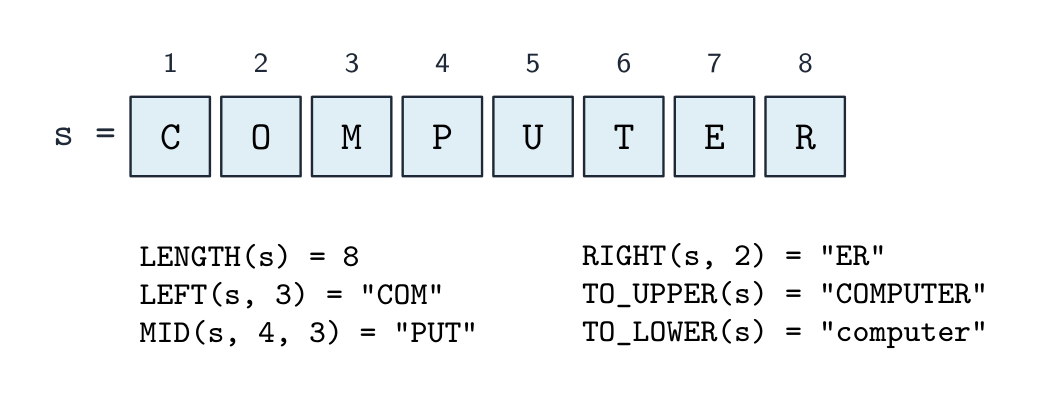
The common string routines acting on s = "COMPUTER"(positions 1–8)Worked example. Evaluate each expression, given
Word ← "Program",Code ← 'Q'andN ← 7.Expression Value Why LENGTH(Word)7seven characters MID(Word, 4, 2)"gr"two characters, starting at position 4 LEFT(Word, 3) & "!""Pro!"joined with &TO_UPPER(RIGHT(Word, 2))"AM"the inner function runs first ASC(Code) - ASC('A')16'Q'is 81 and'A'is 65N DIV 2 + N MOD 243 + 1NUM_TO_STR(N) & "th""7th"the number becomes a string first INT(N / 2)33.5cut to its whole partWork from the inside out, and keep the quotes:
"7"is a string and7is a number.Worked example. Each statement may contain an error in its use of a function or operator. Describe the error, or write NO ERROR. (Assume every variable has the correct type.)
Statement Error Result ← 2 & 4&joins strings;2and4are integers, so+is neededSubString ← MID("pseudocode", 4, 1)NO ERROR: one character from position 4, "u"IF x = 3 OR 4 THENORneeds a Boolean on each side:IF x = 3 OR x = 4 THENResult ← Status AND INT(x / 2)ANDneeds two Booleans;INT(x / 2)is an integerMessage ← "Done" + LENGTH(MyString)+cannot add a string to an integer:"Done" & NUM_TO_STR(LENGTH(MyString))Every operator works on particular types:
&on strings,+ - * / DIV MODon numbers,AND OR NOTon Booleans, and= <>on two values of the same type. An "evaluate each expression, or write ERROR" table is marked the same way:LENGTH(42)and"A" + 1are ERROR, because the type does not match the function or the operator.Worked example. With
Points ← 100,Active ← TRUEandExempt ← FALSE, evaluate each expression.Expression Value Why (Points > 99) OR ActiveTRUEboth sides are true; one would do (Points MOD 2 = 0) OR ExemptTRUE100 MOD 2is0(Points <= 75) AND (Active OR Exempt)FALSEthe first side is false, and ANDneeds both(Active OR NOT Active) AND NOT ExemptTRUEActive OR NOT Activeis always trueThe last expression simplifies:
X OR NOT XisTRUEwhateverXis, so the whole expression is justNOT Exempt. Evaluate the brackets first, thenNOT, thenAND, thenOR.ExploreA variable is a labelled box
Each assignment stores one value in a named box; reassigning the same name overwrites it. Step through the program and watch each box take its current value.
Vocabulary TrainEnglish Chinese Pinyin flowchart 流程图 liú chéng tú structured English 结构化英语 jié gòu huà yīng yǔ pseudocode 伪代码 wěi dài mǎ variables 变量 biàn liàng data types 数据类型 shù jù lèi xíng constant 常量 cháng liàng identifier 标识符 biāo shí fú assignment 赋值 fù zhí operators 运算符 yùn suàn fú Precedence 优先级 yōu xiān jí library routines 库例程 kù lì chéng insert 附页 fù yè program library 程序库 chéng xù kù concatenation 连接 lián jiē 11.2
Selection
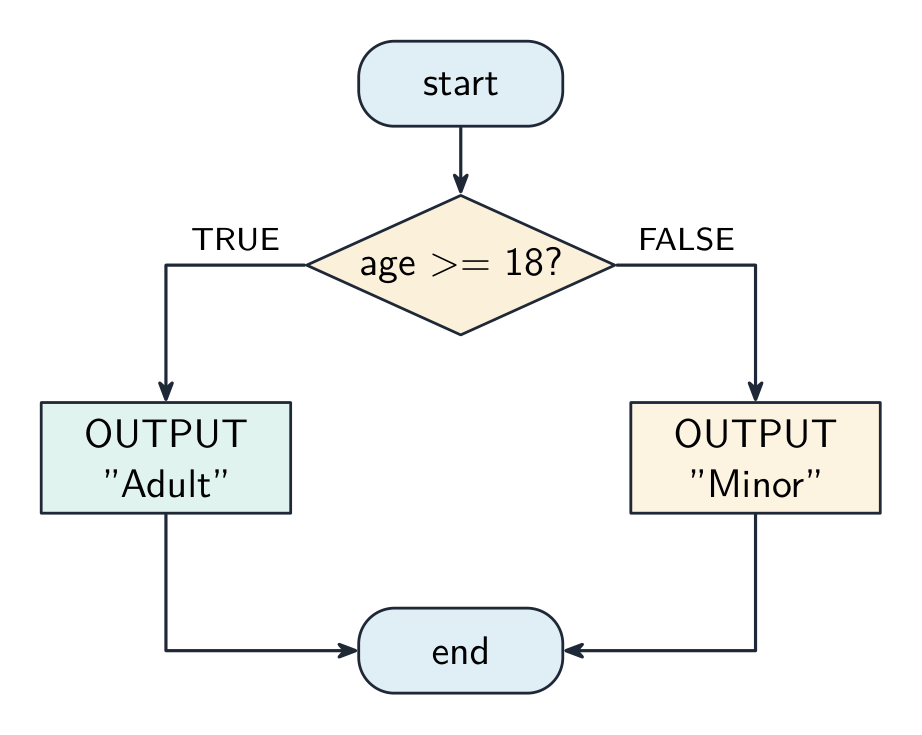
Syllabus
Candidates should be able to: Notes and guidance Use pseudocode to write: • an ‘IF’ statement including the ‘ELSE’ clause and nested IF statements • a ‘CASE’ structure • a ‘count-controlled’ loop: • a ‘post-condition’ loop • a ‘pre-condition’ loop Justify why one loop structure may be better suited to solve a problem than the others Source: Cambridge International syllabus
Selection 选择 chooses which steps run.
IF age >= 18 THEN
    OUTPUT "Adult"
ELSE
    OUTPUT "Minor"
ENDIF
An IF...ELSE tests the condition once, then runs exactly one branch For more than two cases you can use a nested 嵌套 IF, but deep nesting is hard to read — a
CASEis cleaner when testing one value against several options:CASE OF Grade "A": OUTPUT "Excellent" "B": OUTPUT "Good" OTHERWISE: OUTPUT "Try again" ENDCASECambridge
CASEallows single values, value lists (1, 2, 3:), and ranges (1 TO 5:).A nested IF is an IF inside a branch of another IF. Each
IFneeds its ownENDIF, and the examiner checks that every construct is closed:IF Mark >= 50 THEN IF Mark >= 80 THEN OUTPUT "Distinction" ELSE OUTPUT "Pass" ENDIF ELSE OUTPUT "Fail" ENDIFBoundaries are where marks are lost. "A mark of 50 or more passes" is
Mark >= 50, notMark > 50; the lastCASEbranch, for "anything else", is writtenOTHERWISE, not a condition such as> 200. A wrong comparison here is a logic error 逻辑错误: the program runs, but gives the wrong output for some inputs — and a trace table with a boundary value such as50is how you find it.
A CASE statement runs the branch that matches the value Worked example. Rewrite this with the same functionality, without using a CASE structure.
CASE OF MySwitch
    1: ThisChar ← 'a'
    2: ThisChar ← 'y'
    3: ThisChar ← '7'
    OTHERWISE: ThisChar ← '*'
ENDCASE
Each value becomes a branch of a chain of IFs, and
OTHERWISEbecomes the lastELSE:IF MySwitch = 1 THEN ThisChar ← 'a' ELSE IF MySwitch = 2 THEN ThisChar ← 'y' ELSE IF MySwitch = 3 THEN ThisChar ← '7' ELSE ThisChar ← '*' ENDIF ENDIF ENDIFTwo clauses that assign the same value are merged into one clause with a value list:
1, 2: ThisChar ← 'a'. The guards are tested in order: with ranges such as1 TO 50:followed by40 TO 60:, a value of45takes the first branch that matches, so an assignment in a later branch may never be performed — and when the earlier branches already cover every possible value, theOTHERWISEbranch is never reached either.Going the other way, nested IFs that test several Booleans are clearer as one condition per outcome:
IF A AND B AND C THEN CALL Sub1(), thenIF A AND B AND NOT C THEN CALL Sub2(), and so on. Joining tests withANDandORremoves the nesting, andIF A THENis accepted in place ofIF A = TRUE THEN.ExploreSelection (IF / ELSE)
Change the input and see which branch runs — the essence of selection.
Vocabulary TrainEnglish Chinese Pinyin Selection 选择 xuǎn zé nested 嵌套 qiàn tào logic error 逻辑错误 luó jí cuò wù 11.2
Iteration

Iteration 迭代 repeats a block. Three loops differ in how many times the body runs.
Count-controlled (FOR) loop
A count-controlled loop 计数循环 — use it when you know how many times to repeat:
FOR i ← 1 TO 10
    OUTPUT i
NEXT i
A
STEPcan change the count (e.g.FOR i ← 10 TO 1 STEP -1). Best for a fixed number of repeats or processing each element of an array 数组.Pre-condition (WHILE) loop
A pre-condition loop 前测循环 tests the condition before each pass, so it may run zero times:
WHILE total < 100 DO
    INPUT n
    total ← total + n
ENDWHILE
Post-condition (REPEAT...UNTIL) loop
A post-condition loop 后测循环 tests the condition after each pass, so it always runs at least once:
REPEAT
    INPUT password
UNTIL password = correctPassword
Choosing the right loop
The three loops differ in where the condition is tested — before the body (WHILE), after it (REPEAT), or a set number of times (FOR) - count known up front → FOR.
- may need zero passes → WHILE.
- always at least one pass → REPEAT...UNTIL.
Justify your choice by whether the count is known and whether the body must run at least once. A typical question gives a scenario ("ask for a password until correct, but always ask at least once") and asks which loop fits.
The two marks are for the name of the loop and the reason, in the scheme's words: count-controlled, because the number of iterations is known before the loop starts; post-condition, because the loop body must be executed at least once; pre-condition, because the loop may not need to execute at all. A loop over the four elements of an array that has been written as a
WHILEwith a counter is "not the most appropriate": the count, four, is known, so aFORloop fits.Worked example. Which loop suits each task? (a) print the 12 times table; (b) keep reading numbers until the user enters 0; (c) ask for a password until it is correct. Choose by asking how many times the body runs and when the test happens. (a) The count is known in advance (12), so use a FOR loop. (b) The count is unknown, and the very first input might already be 0 - so the test must come before the body: a WHILE loop, which runs zero or more times. (c) The count is unknown, but you must always ask at least once before there is anything to test - so the test comes after the body: a REPEAT...UNTIL, which runs one or more times. The deciding question is whether the body must run at least once: WHILE may run zero times, REPEAT always runs once.
Dry running with a trace table
A trace table 跟踪表 records the value of each variable as you dry run 手工跟踪 (work through by hand) an algorithm. It is how you test a loop on paper, and a six-mark question on most Paper 2s.
DECLARE Count, Total : INTEGER
Count ← 1
Total ← 0
WHILE Total < 10
    Total ← Total + Count * 2
    Count ← Count + 1
ENDWHILE
OUTPUT Count, Total
Count Total Total < 10 OUTPUT 1 0 TRUE 2 2 TRUE 3 6 TRUE 4 12 FALSE 4, 12 Rules that earn the marks: one column per variable, in the order the question gives; write a value only when it changes; start a new row each time the loop repeats; evaluate the condition with the current values, and stop the moment it is
FALSE; put the output in its own column, exactly as it would appear. Trace the algorithm as written, not the one you think was intended — if it never stops, say so.Worked example. Which constructs does each line use — selection, iteration or a subroutine call?
Pseudocode Selection Iteration Subroutine IF Ready = TRUE THEN CALL Start() ENDIFyes yes FOR I ← 1 TO 20 ... NEXT Iyes WHILE NOT IsFull() ... ENDWHILEyes yes CASE OF Key ... OTHERWISE ... ENDCASEyes IFandCASEare selection;FOR,WHILEandREPEATare iteration; a name followed by brackets —Start(),IsFull()— is a call to a procedure or a function, wherever it appears, including inside a condition.ExploreTrace a loop, pass by pass
A trace table records each variable after every pass of the loop. Watch the counter i climb while the running total builds up — exactly what an exam trace question asks you to fill in.
ExploreTracing a loop
Step through the loop and watch the variables change each pass — exactly what a trace table records.
Vocabulary TrainEnglish Chinese Pinyin Iteration 迭代 dié dài count-controlled loop 计数循环 jì shù xún huán array 数组 shù zǔ pre-condition loop 前测循环 qián cè xún huán post-condition loop 后测循环 hòu cè xún huán trace table 跟踪表 gēn zōng biǎo dry run 手工跟踪 shǒu gōng gēn zōng 11.3
Procedures and functions

Syllabus
Candidates should be able to: Notes and guidance Define and use a procedure Explain where in the construction of an algorithm it would be appropriate to use a procedure Use parameters A procedure may have none, one or more parameters A parameter can be passed by reference or by value Define and use a function Explain where in the construction of an algorithm it is appropriate to use a function A function is used in an expression, e.g. the return value replaces the call Use the terminology associated with procedures and functions including procedure/function header, procedure/function interface, parameter, argument, return value Write efficient pseudocode Source: Cambridge International syllabus
Structured programming 结构化编程 builds a program from small named subroutines 子程序, each with one job.
Procedure
A procedure 过程 is a named block that does an action; it may take parameters 参数 but does not return a value.
PROCEDURE Greet(name : STRING)
    OUTPUT "Hello, ", name
ENDPROCEDURE

CALL Greet("Ada")
Function
A function 函数 is like a procedure but it returns a value that becomes part of an expression.
FUNCTION Square(x : INTEGER) RETURNS INTEGER
    RETURN x * x
ENDFUNCTION

result ← Square(5) + 1     // result = 26
Use a procedure when the subroutine performs an action; use a function when it computes a value for the caller.
The syllabus asks where in the construction of an algorithm each is appropriate. A procedure is appropriate where the same group of steps is needed at several points (validate an input, print a menu, swap two values): the steps are written once and
CALLed by name. A function is appropriate where a single value must be calculated and then used in an expression — a total, aTRUE/FALSEresult, the larger of two numbers — because the return value 返回值 replaces the call:IF IsValid(Code) THEN.A procedure does an action and returns nothing; a function returns a value you use in an expression Parameters
A parameter is a variable a subroutine declares to receive input; the values the caller supplies are arguments 实参. Two ways to pass them:
- pass by value 传值 — the routine gets a copy; changes inside it do not affect the caller. Use for inputs it only reads.
- pass by reference 传引用 — the routine gets a reference to the caller's variable; changes do affect the caller. Use when it must update a parameter.
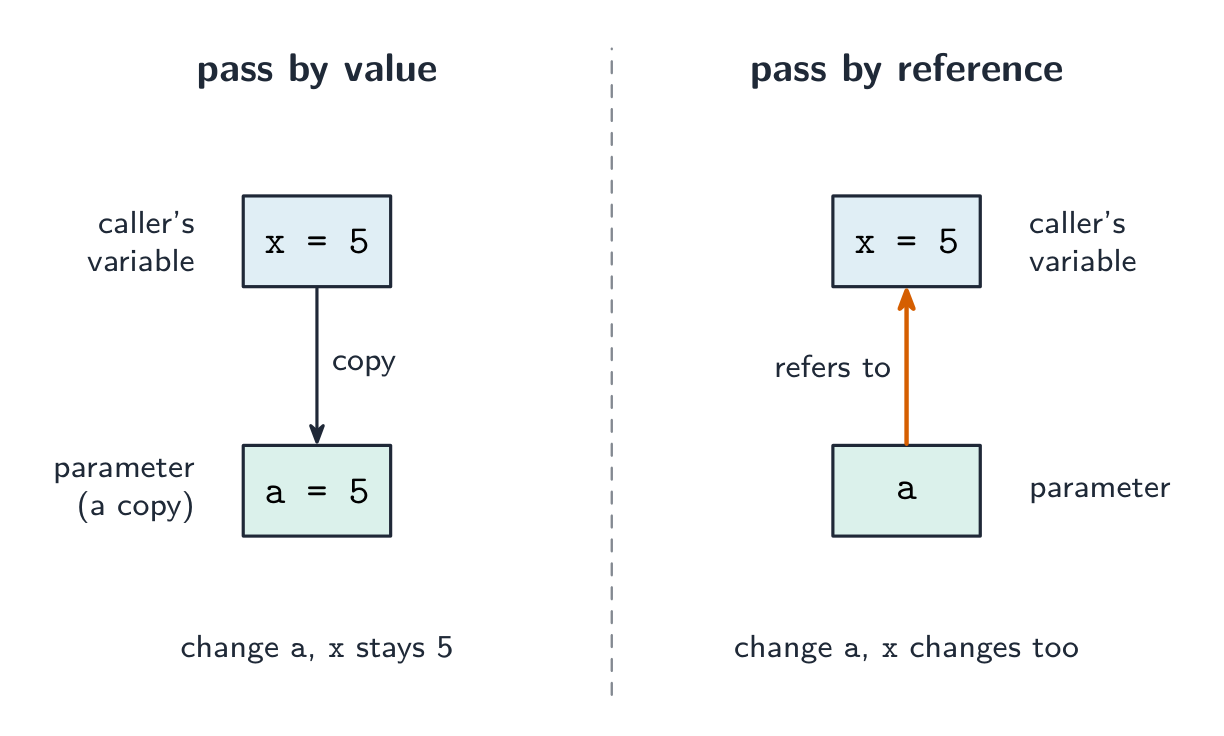
Pass by value copies the value into a new box; pass by reference lets the routine change the caller's own variable PROCEDURE Swap(BYREF a : INTEGER, BYREF b : INTEGER) DECLARE temp : INTEGER temp ← a a ← b b ← temp ENDPROCEDURECambridge pseudocode writes the mode in the header,
BYVALorBYREF, before each parameter. If neither is written,BYVALis assumed, so a routine that must change the caller's variable —Swap, or a procedure that updates a running total — needsBYREFin its header.Worked example. What is output?
PROCEDURE Adjust(BYREF X : INTEGER, BYVAL Y : INTEGER) X ← X + Y Y ← Y * 2 ENDPROCEDURE A ← 5 B ← 3 CALL Adjust(A, B) OUTPUT A, BXis a reference toA, soAbecomes8.Yis a copy ofB, so doublingYleavesBat3. The output is8, 3. Had the header saidBYVAL X,Awould still be5.Local vs global variables
A local variable 局部变量 is declared inside a subroutine and exists only while it runs. A global variable 全局变量 is declared outside and is visible everywhere. Prefer locals and parameters — heavy use of globals makes code hard to follow and test. (The region where a name is visible is its scope 作用域.)
The one-line difference: a global variable can be accessed from anywhere in the program, a local variable only inside the subroutine that declares it. Benefits of local variables the scheme accepts: the same identifier can be used in another subroutine without a clash; the value cannot be changed accidentally by other parts of the program; the memory is released when the subroutine ends; and the subroutine is self-contained, so it can be tested on its own and reused in another program.
A local variable is created each time the subroutine is called and destroyed when it returns, so it cannot carry a value from one call to the next. A procedure that builds up a string over repeated calls therefore needs that string to be global (or passed
BYREF). IfMyStringis changed from a global to a local declared insideMyOutput(), every call starts with a new, emptyMyString, the text added by earlier calls is lost, and the procedure "does not work as expected".
A local variable is a new, empty box on every call; only a global variable (or a BYREF parameter) keeps a value between calls 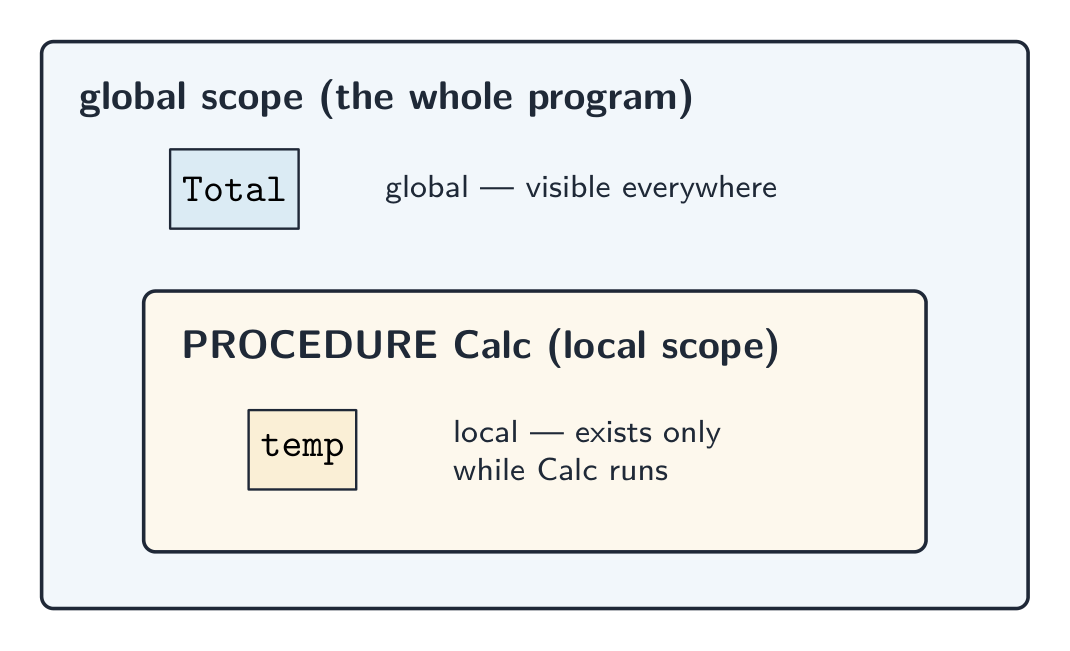
A global variable is visible everywhere; a local variable exists only inside its own procedure When to use a subroutine
Use a subroutine when:
- the same logic appears in more than one place — write it once, call it many times.
- a block has a clear named purpose — the name documents what it does.
- the program is complex — break it into parts (decomposition 分解).
- you want to test a piece in isolation.
Don't make them so tiny that the call costs more than the work inside.
Terminology
- definition — the
PROCEDURE ... ENDPROCEDURE(or function) block. - call — where it is invoked. argument — a value passed in. parameter — the variable that receives it.
- return value — what a function passes back.
- procedure/function header — the first line giving the name and parameters (
PROCEDURE Name(params)orFUNCTION Name(params) RETURNS type). - procedure/function interface / signature 签名 — name + parameters + return type: what a caller must know to use it.
Worked example. Describe each term used in the header
FUNCTION Pass2(Count : INTEGER) RETURNS BOOLEAN.Term Meaning FUNCTIONa subroutine that returns a value Pass2the identifier used to call it Countthe parameter: the identifier that receives the argument passed in INTEGERthe data type of the parameter RETURNS BOOLEANthe data type of the value the function returns The two identifiers in
PROCEDURE MyProc(Count : INTEGER, Message : STRING)are parameters: they receive the values passed in when the procedure is called, and are used inside it like local variables.To convert a procedure into a function: change
PROCEDUREtoFUNCTIONand addRETURNS <type>; replace theOUTPUT(or theBYREFparameter that carried the result out) with aRETURNstatement; and change every call so that the returned value is used,Result ← Unpack(Text)instead ofCALL Unpack(Text, Result). For a "write the header" question, write the whole line:FUNCTION Calculate(Expression : STRING) RETURNS INTEGER. An array parameter is passed by reference, so a procedure that writes into an array changes the caller's array.When a program gains a new module, the interface is what is agreed first: the name, the parameters (how many, in what order, of what type) and the return type, plus any global data the module reads or writes. A module that sends a reminder before a due date needs the record (or its index) as a parameter and returns nothing, so it is a procedure; the main program calls it once per record.
Writing a module for Paper 2
Half of Paper 2 is "write pseudocode for module X". The scheme awards a mark per feature, so a module that is not finished still scores for every correct part. The parts the examiner looks for:
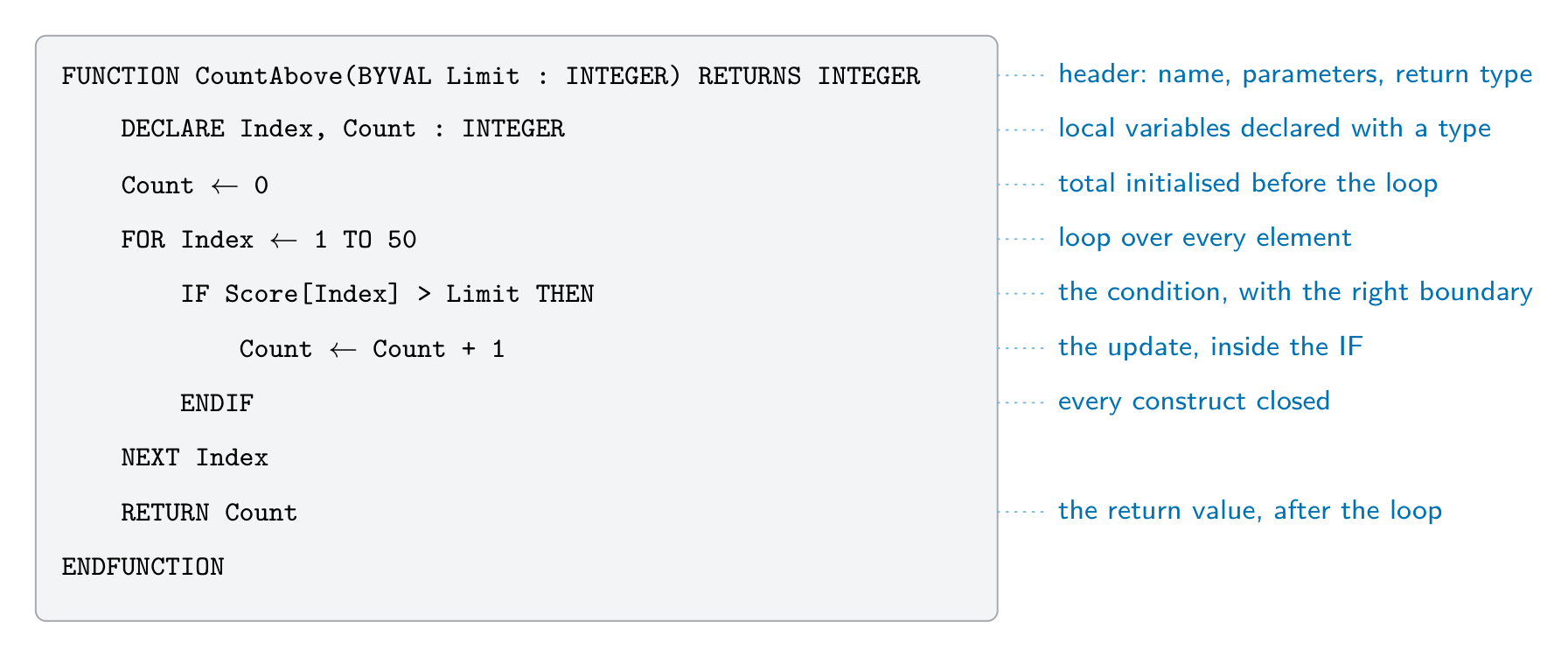
Each part of a module answer carries its own mark, so write all of them even when one is uncertain - The header, as the question describes it:
PROCEDURE Name(Param : TYPE)orFUNCTION Name(Param : TYPE) RETURNS TYPE, withBYREFwhere the routine must change the argument. - Local declarations:
DECLAREevery local variable with its type, and initialise counters and totals (Count ← 0). - The loop that visits every element:
FOR Index ← 1 TO 50for an array whose size is given;WHILE NOT EOF(...)for a file. - The condition, with the right comparison and boundary, on the right item:
IF Score[Index] > Limit THEN. - The update inside the branch: the count increased, the value stored, or the message output.
- The end:
RETURNonce, after the loop, in a function;ENDFUNCTIONorENDPROCEDURE; and everyIF,FORandWHILEclosed.
Worked example. A global array
Score : ARRAY[1:50] OF INTEGERholds test scores. Write a functionCountAbove(Limit : INTEGER)that returns how many scores are greater thanLimit.FUNCTION CountAbove(BYVAL Limit : INTEGER) RETURNS INTEGER DECLARE Index, Count : INTEGER Count ← 0 FOR Index ← 1 TO 50 IF Score[Index] > Limit THEN Count ← Count + 1 ENDIF NEXT Index RETURN Count ENDFUNCTIONMarks: the header with its parameter and
RETURNS INTEGER;Countdeclared and set to0; a loop over all 50 elements; the comparison> Limit(not>=); the count updated inside theIF;RETURN Countafter the loop. The main program uses the return value in an expression or an output:OUTPUT "Above 70: ", CountAbove(70).Worked example. Write a function
IsValid(Code : STRING)that returnsTRUEwhenCodeis two capital letters followed by four digits — the format 格式AB1234— andFALSEotherwise.FUNCTION IsValid(BYVAL Code : STRING) RETURNS BOOLEAN DECLARE Index : INTEGER DECLARE Ch : STRING IF LENGTH(Code) <> 6 THEN RETURN FALSE ENDIF FOR Index ← 1 TO 6 Ch ← MID(Code, Index, 1) IF Index <= 2 THEN IF Ch < "A" OR Ch > "Z" THEN RETURN FALSE ENDIF ELSE IF Ch < "0" OR Ch > "9" THEN RETURN FALSE ENDIF ENDIF NEXT Index RETURN TRUE ENDFUNCTIONThe length check comes first, so
MIDis never asked for a position that does not exist. Validation 验证 like this returns aBOOLEANso the caller can writeIF IsValid(Entry) THEN ... ELSE OUTPUT "Invalid code" ENDIF: a message to the user is output by the caller, not by the function — a function calculates, a procedure acts.Worked example. Write a function
IsPalindrome(Word : STRING)that returnsTRUEwhenWordreads the same backwards, such as"RACECAR".Compare the characters from the two ends, moving inwards: position
Indexis paired with positionLen - Index + 1, and only the first half needs testing.
A palindrome check pairs position iwith positionLen - i + 1and stops at the middleFUNCTION IsPalindrome(BYVAL Word : STRING) RETURNS BOOLEAN DECLARE Len, Index : INTEGER Len ← LENGTH(Word) FOR Index ← 1 TO Len DIV 2 IF MID(Word, Index, 1) <> MID(Word, Len - Index + 1, 1) THEN RETURN FALSE ENDIF NEXT Index RETURN TRUE ENDFUNCTIONThe same three tools — a
FORover the positions,MID(s, i, 1)to read one character, and&to build a new string — answer most string modules on Paper 2: counting how often a character occurs (IF MID(s, i, 1) = Ch THEN Count ← Count + 1), replacing every instance of a character (add eitherNewCharor the original character toNewStringat each position), hiding all but the last four digits of a card number (add'*'for every position up toLen - 4), or writing your ownMID()by joining the characters fromStarttoStart + Length - 1. AskingMIDfor a position past the end of the string is a run-time error, so checkLENGTHfirst.Files. Values in variables disappear when the program ends, so a module that must keep data for the next run writes it to a file:
OPENFILE "scores.txt" FOR WRITE, oneWRITEFILE "scores.txt", NUM_TO_STR(Score[Index])per line inside the loop, andCLOSEFILE "scores.txt"once, after the loop; reading back usesFOR READ,READFILEandWHILE NOT EOF("scores.txt"). Topic 10 has the full file section; here the marks are for opening in the right mode, the read or write inside the loop, and closing once after it.ExploreThe call stack: push on call, pop on return
Calling a subroutine pushes a new frame on top; returning pops it and hands a value back to the caller. The call that is running is always the frame on top.
Vocabulary TrainEnglish Chinese Pinyin Structured programming 结构化编程 jié gòu huà biān chéng subroutines 子程序 zi chéng xù procedure 过程 guò chéng parameters 参数 cān shù function 函数 hán shù return value 返回值 fǎn huí zhí arguments 实参 shí cān pass by value 传值 chuán zhí pass by reference 传引用 chuán yǐn yòng local variable 局部变量 jú bù biàn liàng global variable 全局变量 quán jú biàn liàng scope 作用域 zuò yòng yù decomposition 分解 fēn jiě signature 签名 qiān míng format 格式 gé shì Validation 验证 yàn zhèng 11.3
Writing efficient pseudocode

Three features that make pseudocode easier to understand — the answer to a "state three features" question — are meaningful identifiers (
Total, nott), indentation of the statements inside each construct, and comments (// ...) that explain the purpose; keywords in capitals, one statement per line and blank lines between sections are also accepted. Efficient pseudocode goes further:- move invariants out of loops — if a value (an invariant 不变量) does not change with the loop counter, compute it once before the loop.
- exit a loop early when the answer is found (stop a linear search 线性查找 as soon as the target appears).
- avoid redundant work — store a result and reuse it instead of recomputing.
- choose the right data structure — an array beats many separate variables when the items belong together.
- replace deep nested IFs with CASE when testing one value against many.
- comment the intent, not the mechanics (
// validate the postcode, not// loop 6 times). - use meaningful names (
numberOfPupils, notn) and initialise variables before use.
Move unchanging work out of the loop so it runs once Vocabulary TrainEnglish Chinese Pinyin invariant 不变量 bù biàn liàng linear search 线性查找 xiàn xìng chá zhǎo 11.3
Testing and errors
Three kinds of error, each found in a different way:
Error What it is Example Found by syntax error 语法错误 a statement that breaks the rules of the language a missing ENDIF;OUTPT "Hi"the translator, before the program runs run-time error 运行时错误 the program runs, but a statement cannot be carried out division by zero; an array index of 0 or 51; a function called with an invalid parameter; a loop that never ends, so the program "freezes" while running: the program stops or hangs logic error the program runs to the end, but the output is wrong >where>=was needed; a total never set to0testing with a trace table and chosen test data An IDE 集成开发环境 helps find the last two: a breakpoint 断点 stops the program at a chosen line; single stepping 单步执行 then runs one statement at a time; and the report (or watch) window shows the value of each variable at that moment, so the line where a value goes wrong is seen directly. Test methods and test data are in topic 12.
Vocabulary TrainEnglish Chinese Pinyin syntax error 语法错误 yǔ fǎ cuò wù run-time error 运行时错误 yùn xíng shí cuò wù IDE 集成开发环境 jí chéng kāi fā huán jìng breakpoint 断点 duàn diǎn single stepping 单步执行 dān bù zhí xíng 11.3
Definitions the examiner accepts
A definition question is marked against fixed wording. Learn these exactly.
Term Definition procedure a subroutine that carries out a task (a sequence of steps) and does not return a value; it is called with CALLfunction a subroutine that returns a single value to the point where it was called, so it can be used in an expression parameter the identifier in a subroutine header that receives a value or a reference when the subroutine is called argument the value (or variable) supplied in the call, matched to a parameter passing by value a copy of the argument's value is given to the subroutine, so changes inside it do not affect the original variable passing by reference the address of the variable is given to the subroutine, so changes inside it change the original variable header the first line of a subroutine definition: its name, its parameters and, for a function, its return type interface what a calling program must know to use a subroutine: its name, its parameters (number, order, type) and its return type return value the value a function passes back to the expression that called it local variable declared inside a subroutine; it exists only while the subroutine runs and can be used only inside it global variable declared outside every subroutine; it can be used anywhere in the program count-controlled loop repeats a fixed number of times, controlled by a counter ( FOR ... NEXT)pre-condition loop tests its condition before each iteration, so the body may never run ( WHILE ... ENDWHILE)post-condition loop tests its condition after each iteration, so the body runs at least once ( REPEAT ... UNTIL)constant a named value that cannot change while the program runs subroutine a self-contained block of code that performs a task and is called by name: a procedure or a function library routine a subroutine that has already been written and tested, and is available to be called from a program 11.3
Exam tips
- Distinguish a procedure (no return value) from a function (returns a value); know pass by value vs by reference.
- Choose the right loop: count-controlled (FOR) when the number of repeats is known, condition-controlled (WHILE/REPEAT) otherwise.
- Distinguish local vs global variables and scope; prefer local variables in reusable modules.
- Use the insert's exact routine names and parameter order;
UCASEandVALare IGCSE names and score nothing here. - In a "write pseudocode" answer the header, the declarations, the loop, the condition, the update and the
RETURNeach carry a mark: write all six parts, even if one is uncertain.
Common mistakes
- Calling a function and not using what it returns. Assign the result, or use it in the expression or output:
Sorted ← BubbleSort(MyArray, 7). - Passing a length one out:
6for a seven-element array, or the last index where the length was wanted. Decide whether the parameter is a length or an index, and check that the last element is visited. - Closing a file inside the loop that reads it. Open once, close once, after the loop.
- Using the input as a filename directly. Add the extension the question gave:
FileName ← Choice & ".txt". - Leaving constructs open. Every
IFneeds itsENDIF, everyFORitsNEXT, everyWHILEitsENDWHILE, and every function itsRETURN; the scheme has a mark for it. - Wrong boundaries:
>for "at least" (which is>=), or aFORthat starts at0for an array declared[1:50]. - A counter or total that is never set to
0before the loop. - In a trace table, rewriting every variable on every row, or changing a value before the statement that changes it has run.
- Half a condition:
IF x = 3 OR 4— each side ofORandANDmust be a complete comparison. And+does not join strings;&does. - Declaring as local a value that must survive between calls. A running total or a string built up over several calls is global or
BYREF.
-
12
Software Development
12.1
Program development life cycle

Syllabus
Candidates should be able to: Notes and guidance Show understanding of the purpose of a development life cycle Show understanding of the need for different development life cycles depending on the program being developed Including: waterfall, iterative, rapid application development (RAD) Describe the principles, benefits and drawbacks of each type of life cycle Show understanding of the analysis, design, coding, testing and maintenance stages in the program development life cycle Source: Cambridge International syllabus
A development life cycle 开发生命周期 is the set of stages from idea to finished, maintained software. It exists to plan, manage and control a project — to build the right product, on time, with good quality.
Software is built by teams who follow a development life cycle to stay coordinated 
A flowchart plans a program's logic during the design stage of the cycle Why a life cycle is needed
It manages complexity (break a big program into phases), coordinates teams, tracks progress with milestones, builds in testing, records design decisions for later, and manages risk.
Why there are different ones
No single life cycle fits every project, so several development life cycles exist. The choice depends on the size and complexity, how clear the requirements 需求 are at the start, how much change is expected, the risk level, the team, and the deadline.
Common models
- Waterfall 瀑布模型 — a linear sequence (Analysis → Design → Coding → Testing → Maintenance), each stage finished before the next. Clear and well-documented; good for stable requirements, but poor at coping with mid-project change, and the customer sees nothing working until the end.
- Iterative model 迭代模型 — repeated passes, each producing a partial version that is reviewed and refined. Catches problems earlier; good when requirements are discovered over time, but harder to estimate.
- Rapid Application Development 快速应用开发 (RAD) — heavy use of a prototype 原型 and user feedback. Very fast first delivery; good for changing requirements, but depends on user availability and suits smaller systems.
- Agile 敏捷 — short iterations ("sprints"), constant collaboration and testing. Flexible and adaptive, but needs a committed customer and a skilled team.
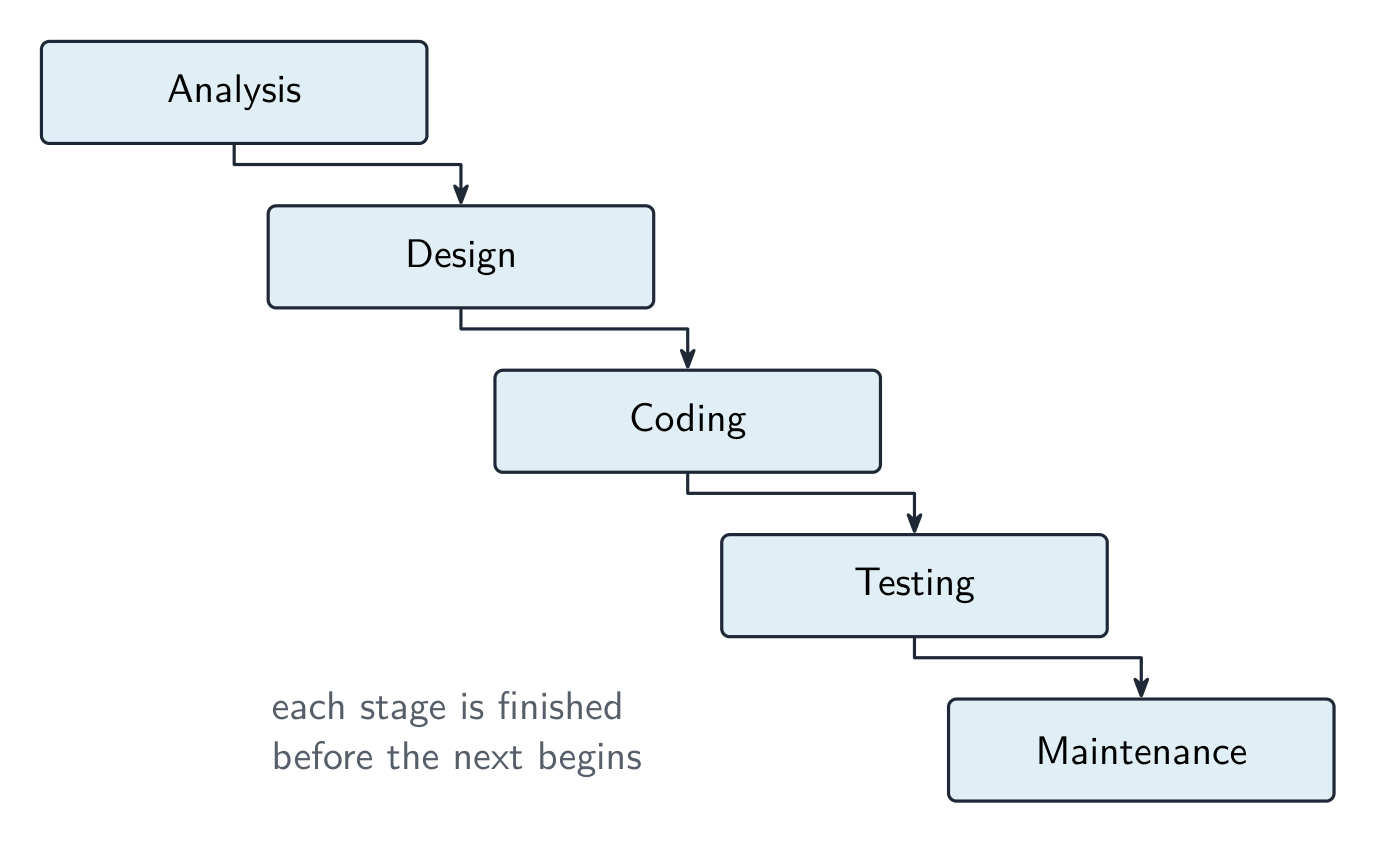
The waterfall model: each stage is finished before the next begins 
The iterative model: repeated passes refine the program 
Rapid application development: teams work on parts in parallel The standard stages
- analysis — find what the program must do; gather and document requirements.
- design — decide how: data structures, algorithms, modules, interface, file layouts.
- coding (implementation 实现**)** — write the source code following the design.
- testing — run against test data and fix bugs.
- maintenance 维护 — after release, keep it working and useful.
ExploreThe program development life cycle
Step through the stages every project passes through. Getting the requirements right in analysis matters most — a mistake caught in testing is far costlier to fix than one caught early.
ExploreSoftware process lab
Classify development examples by the stage or tool they belong to.
Vocabulary TrainEnglish Chinese Pinyin development life cycle 开发生命周期 kāi fā shēng mìng zhōu qī requirements 需求 xū qiú waterfall 瀑布模型 pù bù mó xíng iterative model 迭代模型 dié dài mó xíng rapid application development 快速应用开发 kuài sù yìng yòng kāi fā prototype 原型 yuán xíng agile 敏捷 mǐn jié implementation 实现 shí xiàn maintenance 维护 wéi hù 12.2
Program design tools
Syllabus
Candidates should be able to: Notes and guidance Use a structure chart to decompose a problem into sub-tasks and express the parameters passed between the various modules/procedures/functions which are part of the algorithm design Describe the purpose of a structure chart Construct a structure chart for a given problem Derive equivalent pseudocode from a structure chart Show understanding of the purpose of state-transition diagrams to document an algorithm Source: Cambridge International syllabus
Structure chart
A structure chart 结构图 shows the hierarchical decomposition 分解 of a program into modules (subroutines 子程序) and the parameters 参数 passed between them. Each module is a rectangle; lines link caller (above) to callee (below); small arrows show data going down and results coming back up. The design can then be turned into equivalent pseudocode 伪代码.
                CalculatePay
            /        |         \
       GetEmployee  CalculateBonus  CalculateTax
       Returns:     Takes: sales    Takes: gross
       employeeID   Returns: bonus  Returns: tax
It is a design-stage tool, and you can read the procedure signatures off it.
A structure chart: modules with the parameters passed between them State-transition diagram
A state-transition diagram 状态转换图 shows the states 状态 a system can be in and the events that move it between them — good for vending machines, traffic lights, user interfaces. State-transition diagrams are used to document the behaviour of an algorithm or system. Each state is a circle; each transition is an arrow labelled with the event.
   coin inserted               item selected
[Idle] --------------→ [Awaiting selection] ----------→ [Dispensing]
It makes missing transitions easy to spot ("what if a second coin is inserted while awaiting selection?").
A state-transition diagram for a door lock with code 259 ExploreSoftware process lab
Classify development examples by the stage or tool they belong to.
Vocabulary TrainEnglish Chinese Pinyin structure chart 结构图 jié gòu tú decomposition 分解 fēn jiě subroutines 子程序 zi chéng xù parameters 参数 cān shù state-transition diagram 状态转换图 zhuàng tài zhuǎn huàn tú states 状态 zhuàng tài pseudocode 伪代码 wěi dài mǎ 12.3
Errors
Syllabus
Candidates should be able to: Notes and guidance Show understanding of ways of exposing and avoiding faults in programs Locate and identify the different types of errors • syntax errors • logic errors • run-time errors Correct identified errors Show understanding of the methods of testing available and select appropriate data for a given method Including dry run, walkthrough, white-box, black-box, integration, alpha, beta, acceptance, stub Show understanding of the need for a test strategy and test plan and their likely contents Choose appropriate test data for a test plan Including normal, abnormal and extreme/boundary Show understanding of the need for continuing maintenance of a system and the differences between each type of maintenance Including perfective, adaptive, corrective Analyse an existing program and make amendments to enhance functionality Source: Cambridge International syllabus
- syntax error 语法错误 — breaks the language's grammar (missing bracket, misspelled keyword). Caught at translation time; the program won't run until fixed.
- run-time error 运行时错误 — happens while running (divide by zero, file not found, array index out of range). The program crashes or raises an exception; fix by adding checks.
- logic error 逻辑错误 — the program runs but gives wrong results (using
+for-, an off-by-one loop, conditions in the wrong order). The hardest to find; the only sign is wrong output, so use careful testing and tracing.
When each error shows up: syntax at translation, run-time during the run, logic in the output Vocabulary TrainEnglish Chinese Pinyin syntax error 语法错误 yǔ fǎ cuò wù run-time error 运行时错误 yùn xíng shí cuò wù logic error 逻辑错误 luó jí cuò wù 12.3
Testing methods
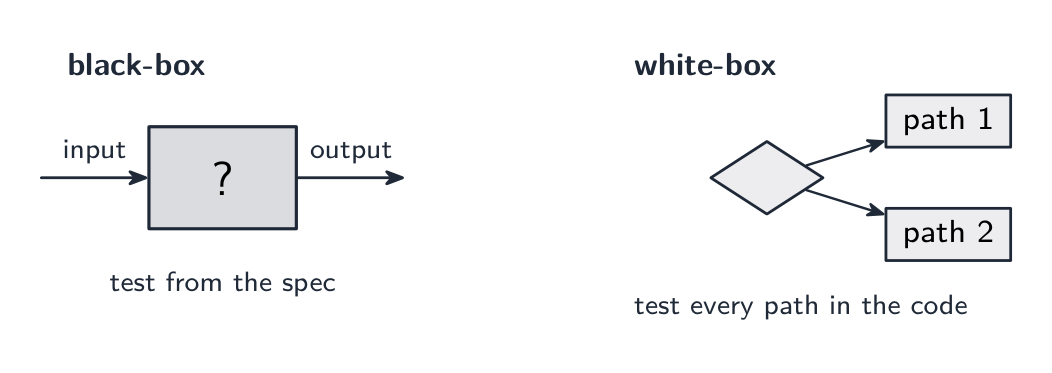
- dry run 手工跟踪 — trace the code on paper, writing each variable's value in a table.
- walkthrough 走查 — a team review of the code.
- white-box testing 白盒测试 — designed from the code's internal structure, covering every statement, branch and loop.
- black-box testing 黑盒测试 — designed from the specification only: feed inputs, check outputs.
- integration testing 集成测试 — combine modules and test the interfaces between them.
- alpha testing α测试 — by the developers/in-house before release; beta testing β测试 — by a limited group of real users in their own environment.
- acceptance testing 验收测试 — by the customer, to decide if the product is fit for purpose.
- stub 桩 — a placeholder for a module that does not exist yet, so the structure can be tested top-down.
Black-box tests the specification; white-box tests the code paths Vocabulary TrainEnglish Chinese Pinyin dry run 手工跟踪 shǒu gōng gēn zōng walkthrough 走查 zǒu chá white-box testing 白盒测试 bái hé cè shì black-box testing 黑盒测试 hēi hé cè shì integration testing 集成测试 jí chéng cè shì alpha testing α测试 α cè shì beta testing β测试 β cè shì acceptance testing 验收测试 yàn shōu cè shì stub 桩 zhuāng 12.3
Test strategy and test plan
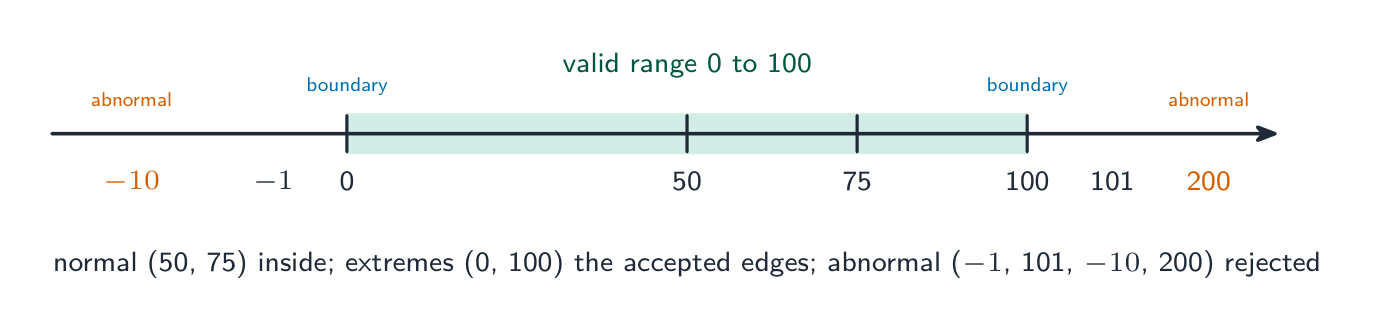
A test strategy 测试策略 is the high-level approach — which kinds of testing, who does them, when, and the criteria to move on. A test plan 测试计划 is the detailed list of tests — each with input data, expected output, and a column for the actual output.
Choosing test data
For each field or condition, include three kinds:
- normal data 正常数据 — typical values inside the valid range (for marks 0–100:
50,75). - abnormal data 异常数据 — values that should be rejected (
-10,200,"abc"). - extreme data 极端数据 — the largest and smallest values still accepted (
0and100). - boundary data 边界数据 — values at the edges, where off-by-one errors hide (each accepted extreme and the rejected value just outside it:
0/-1,100/101).
Test data for a 0–100 field: normal inside, extremes at the boundaries, abnormal outside Worked example. A field accepts an exam mark from 0 to 100. Give test data of each kind with its expected result. Normal:
50- accepted, a typical value inside the range. Abnormal:-10,200,"abc"- all rejected, being out of range or the wrong data type. Extreme:0and100- the largest and smallest values that are still accepted. Boundary: the pairs straddling each edge --1rejected alongside0accepted, and100accepted alongside101rejected. Every value must carry its expected result, or the test plan proves nothing. Extreme and boundary are the pair most often confused: an extreme value sits inside and is accepted, while a boundary test is always a pair either side of the edge - which is exactly where off-by-one errors hide.Vocabulary TrainEnglish Chinese Pinyin test strategy 测试策略 cè shì cè lüè test plan 测试计划 cè shì jì huà normal data 正常数据 zhèng cháng shù jù abnormal data 异常数据 yì cháng shù jù boundary data 边界数据 biān jiè shù jù extreme data 极端数据 jí duān shù jù 12.3
Maintenance

Most of a program's lifetime cost is in maintenance. Three kinds:
Three kinds of maintenance: perfective, adaptive and corrective - perfective maintenance 完善性维护 — improving performance or features even though it works (a faster query, a new option).
- adaptive maintenance 适应性维护 — keeping it working in a changing environment (a new OS, a new API, a legal change).
- corrective maintenance 纠正性维护 — fixing bugs found in use.
A program may need all three throughout its life.
Vocabulary TrainEnglish Chinese Pinyin perfective maintenance 完善性维护 wán shàn xìng wéi hù adaptive maintenance 适应性维护 shì yìng xìng wéi hù corrective maintenance 纠正性维护 jiū zhèng xìng wéi hù 12.3
Amending an existing program
When asked to add a feature or fix a bug:
- read the existing code until you understand the algorithm and data flow.
- find where the change goes — which subroutine, which lines.
- make the change as small as possible — don't rewrite working code.
- update related parts — every caller of a changed parameter list, every routine using a changed data structure.
- test the new behaviour and the old (regression testing 回归测试 — check you broke nothing).
- document the change.
Clear comments, meaningful names, decomposed subroutines and a structure chart make a program much easier to amend — which is why the design tools matter even after the first release.
Vocabulary TrainEnglish Chinese Pinyin regression testing 回归测试 huí guī cè shì 12.3
Exam tips
- Compare development models (waterfall, iterative, RAD) and know the stages of the program development life cycle.
- Distinguish syntax, logic and run-time errors and how each is found.
- Choose test data of three kinds — normal, boundary and erroneous — and give an example of each for the stated range.
- Distinguish the types of maintenance (corrective, adaptive, perfective).
-
13
Data Representation
13.1
User-defined data types

Syllabus
Candidates should be able to: Notes and guidance Show understanding of why user-defined types are necessary Define and use non-composite types Including enumerated, pointer Define and use composite data types Including set, record and class/object Choose and design an appropriate user-defined data type for a given problem Source: Cambridge International syllabus
The built-in types (
INTEGER,REAL,STRING,CHAR,BOOLEAN) cover the simplest cases. For richer problems you can define user-defined types 用户定义类型, making the code clearer and the compiler stricter.Why they are needed
A built-in
STRINGlets you store nonsense in a field that should hold one of a few legal values; a user-defined type can restrict it. Real entities are usually a collection of values of different types. AndDECLARE Taxi : Vehicleis clearer (self-documenting) thanDECLARE Taxi : STRING.Non-composite types
Enumerated type
An enumerated type 枚举类型 has values that are a fixed list of named constants:
TYPE Vehicle = (M100, M230, T101, T102, T120, T150)
DECLARE MyTaxi : Vehicle
MyTaxi ← T102
The names are values of the new type (stored internally as small integers); you cannot assign anything outside the list. Uses: days of the week, colours, status codes.
An enumerated type is a fixed list of named values Pointer type
A pointer 指针 holds the memory address of another variable (or
NULLfor "no target"). Pointers build dynamic structures (linked lists, trees) and pass references without copying.TYPE PNode = ^TNode // pointer to a TNode DECLARE p : PNode p ← NEW TNode p^.Value ← 42 // dereference to reach the fieldsTo dereference 解引用 (
p^) means to reach the variable it points to.
A pointer holds an address; p^dereferences it to reach the node's fieldsComposite types
A composite type 复合类型 (one of the composite data types) groups several values under one name.
A set is an unordered collection of unique values 
A record groups fields of different types under one name - record 记录 (Topic 10) — fields of different types in a
TYPE ... ENDTYPEblock. - set 集合 — an unordered collection of unique values, with operations add, remove, membership test, union, intersection:
DECLARE Available : SET OF Colour Available ← {Red, Blue} IF Green IN Available THEN ...- class 类 / object 对象 — the OOP composite type, combining data fields (attributes 属性) with operations on them (methods 方法). An object is an instance of a class:
CLASS Taxi
    PRIVATE Capacity : INTEGER
    PUBLIC FUNCTION GetCapacity() RETURNS INTEGER
        RETURN Capacity
    ENDFUNCTION
ENDCLASS
Choosing a type
Use enumerated for a value from a fixed list, pointer for indirection, record for a group of fields, set for an unordered unique collection, and class when you need state and behaviour together.
ExploreProgramming concept lab
Connect examples to the programming idea they show.
Vocabulary TrainEnglish Chinese Pinyin user-defined type 用户定义类型 yòng hù dìng yì lèi xíng enumerated type 枚举类型 méi jǔ lèi xíng pointer 指针 zhǐ zhēn dereference 解引用 jiě yǐn yòng composite type 复合类型 fù hé lèi xíng record 记录 jì lù set 集合 jí hé class 类 lèi object 对象 duì xiàng attributes 属性 shǔ xìng methods 方法 fāng fǎ 13.2
File organisation and access
Syllabus
Candidates should be able to: Notes and guidance Show understanding of the methods of file organisation and select an appropriate method of file organisation and file access for a given problem Including serial, sequential (using a key field), random (using a record key) Show understanding of methods of file access Including Sequential access for serial and sequential files Direct access for sequential and random files Show understanding of hashing algorithms Describe and use different hashing algorithms to read from and write data to a random/sequential file Source: Cambridge International syllabus
File organisation 文件组织 is how the data is laid out; file access is how the program reaches a record.
- serial file 串行文件 — records in the order added, no sorting. Access is sequential only; appending is fast; searching is slow. Used for logs and audit trails.
- sequential file 顺序文件 — records sorted by a key. Searching is faster (you can stop early or binary-search); inserting is slow (records must shift). Used for master files updated in batch.
- random (direct-access) file 随机文件 — records at positions computed from the key (often by a hash). Direct access by key is very fast; reading in key order is harder. Used for large lookup tables and customer accounts.
Serial file: records are kept in the order they were added 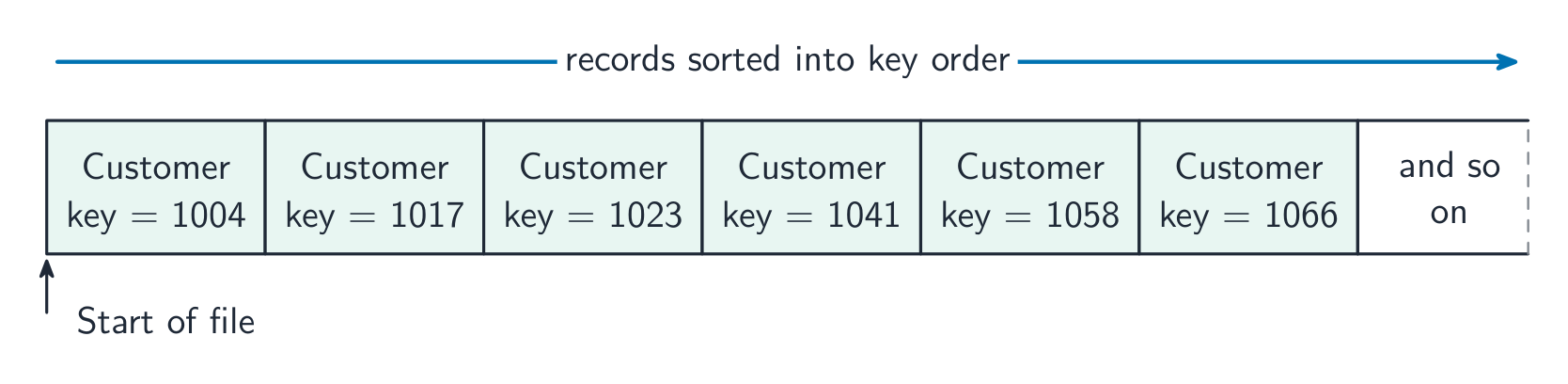
Sequential file: records are sorted by a key field 
Random file: records sit at positions computed from the key The two access methods are sequential access 顺序存取 (read from start to end) and direct access 直接存取 (jump straight to a known position). Match the structure to the dominant operation: single-key lookups favour random; in-order reports favour sequential.
ExploreFile access route
Follow a file from storage to program and back safely.
Vocabulary TrainEnglish Chinese Pinyin file organisation 文件组织 wén jiàn zǔ zhī serial file 串行文件 chuàn xíng wén jiàn sequential file 顺序文件 shùn xù wén jiàn random (direct-access) file 随机文件 suí jī wén jiàn sequential access 顺序存取 shùn xù cún qǔ direct access 直接存取 zhí jiē cún qǔ 13.2
Hashing

A hash function 散列函数 (a hashing algorithm) takes a record key and produces an address where the record is stored. A good one is fast, deterministic 确定性, and spreads keys evenly.
Common hashing algorithms for $N$ slots: modulo hash
address ← key MOD N; folding (split the key, add the pieces, MOD N); a string hash (sum the character codes, MOD N).A collision 冲突 is when two keys hash to the same address. Three ways to resolve it:
Strategy How it works Trade-off linear probing 线性探测 use the next free slot (wrapping around) simple, but keys cluster chaining 链接法 each slot points to a linked list 链表 of records no clustering, but uses more memory rehashing apply a second hash function spreads keys, but more work Resolving a hash collision: linear probing uses the next free slot; chaining keeps a linked list per slot To search: hash the key, read that slot; if the keys match you are done, else follow the resolution strategy until a match or an empty slot. To insert: hash the key, write to that slot or the next free one. Keep the load factor 装填因子 (records ÷ slots) below about 70% for near-O(1) lookups.
ExploreA hash table
Watch each key get hashed to a bucket. A good hash spreads keys out so lookups stay fast.
Vocabulary TrainEnglish Chinese Pinyin deterministic 确定性 què dìng xìng hash function 散列函数 sàn liè hán shù collision 冲突 chōng tū linear probing 线性探测 xiàn xìng tàn cè chaining 链接法 liàn jiē fǎ linked list 链表 liàn biǎo load factor 装填因子 zhuāng tián yīn zi 13.3
Floating-point numbers

Syllabus
Candidates should be able to: Notes and guidance Describe the format of binary floating-point real numbers Use two's complement form Understand of the effects of changing the allocation of bits to mantissa and exponent in a floating-point representation Convert binary floating-point real numbers into denary and vice versa Normalise floating-point numbers Understand the reasons for normalisation Show understanding of the consequences of a binary representation only being an approximation to the real number it represents (in certain cases) Understand how underflow and overflow can occur Show understanding that binary representations can give rise to rounding errors Source: Cambridge International syllabus
To store real numbers of very different sizes, computers use a floating-point 浮点 format — a binary form of scientific notation, with two fields:
- a mantissa 尾数 — the significant digits.
- an exponent 指数 — the power of 2 to multiply by.
Both are stored as two's complement 补码 integers. The value is
$$\text{number} = \text{mantissa} \times 2^{\text{exponent}}.$$Read the mantissa as a binary fraction — the first bit after the point is worth $1/2$, the next $1/4$, then $1/8$, and so on. So
0.1010000is $1/2 + 1/8 = 0.625$; with exponent00000010(= 2) the value is $0.625 \times 2^{2} = 2.5$.The place values of an 8-bit mantissa and an 8-bit exponent Converting
- binary → denary: read the mantissa (use two's-complement rules if negative) as a fraction, read the exponent as a signed integer, then multiply mantissa by $2^{\text{exponent}}$.
- denary → binary: write the number as a binary fraction × a power of 2, then store the mantissa and exponent in the agreed formats.
Worked example. A number has mantissa
10110000and exponent00000011. Find its denary value.The exponent
00000011is $+3$. The mantissa begins with a 1, so it is negative. Read as1.0110000in two's complement, the sign bit is worth $-1$ and the fraction bits add $\tfrac{1}{4} + \tfrac{1}{8} = 0.375$, so the mantissa is $-1 + 0.375 = -0.625$. Then$$\text{number} = -0.625 \times 2^{3} = -5.0.$$Worked example. Store $+2.5$ in this format.
In binary $2.5 = 10.1$. Written as a normalised fraction, $2.5 = 0.101 \times 2^{2}$. So the mantissa is
01010000(sign bit 0, then.101) and the exponent is00000010($= 2$).Normalisation
A number is normalised 规格化 when the first significant bit is immediately after the binary point (no wasted leading zeros). This maximises precision, because every mantissa bit carries information. To normalise, shift the mantissa left and decrease the exponent (or shift right and increase it) until the first significant bit is in place; the value is unchanged. For negative (two's-complement) mantissas, the sign bit (1) is followed immediately by a 0.

Normalising: shift the mantissa left to remove leading zeros, lowering the exponent by the same amount Approximation and rounding errors
Many denary reals cannot be stored exactly in binary — e.g. $0.1_{10}$ is the repeating binary fraction $0.000110011\ldots_{2}$, which must be truncated. Consequences:
- rounding errors 舍入误差 build up over many operations (
0.1 + 0.2is not exactly0.3). - comparisons fail — test
ABS(x - 0.3) < 1e-9instead ofx = 0.3. - subtracting two nearly-equal values loses precision.
- overflow 溢出 (a result too large for the exponent's range) and underflow 下溢 (a result too small, rounding to zero) occur when the exponent runs out of range.
For exact needs (currency), use fixed-point 定点 or BCD 二进码十进数 instead of floating-point.
ExploreBuild a floating-point number
Flip the mantissa and exponent bits to make a value, and check whether it is normalised.
ExploreNormalising a floating-point number
Step through normalisation. Shifting the mantissa to remove wasted leading zeros — and adjusting the exponent to match — keeps the value the same but spends every bit on precision.
Vocabulary TrainEnglish Chinese Pinyin floating-point 浮点 fú diǎn mantissa 尾数 wěi shù exponent 指数 zhǐ shù two's complement 补码 bǔ mǎ normalised 规格化 guī gé huà rounding errors 舍入误差 shě rù wù chā fixed-point 定点 dìng diǎn BCD 二进码十进数 èr jìn mǎ shí jìn shù overflow 溢出 yì chū underflow 下溢 xià yì 13.3
Exam tips
- For floating-point binary → denary, read the mantissa as a fraction and the exponent as a signed integer, then multiply; a negative mantissa follows two's-complement rules.
- Normalise by shifting until the first digit after the point differs from the sign bit — this maximises precision.
- Explain rounding, overflow and underflow errors and why $0.1$ cannot be stored exactly.
- Compare file organisation (serial, sequential, direct) and how hashing finds a record quickly.
- record 记录 (Topic 10) — fields of different types in a
-
14
Communication and internet technologies
14.1
Why protocols are needed
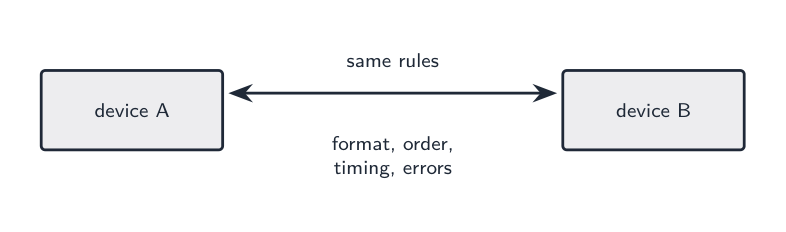
Syllabus
Candidates should be able to: Notes and guidance Show understanding of why a protocol is essential for communication between computers Show understanding of how protocol implementation can be viewed as a stack, where each layer has its own functionality Show understanding of the TCP/IP protocol suite Four Layers (Application, Transport, Internet, Link) Purpose and function of each layer Application when a message is sent from one host to another on the internet Show understanding of protocols (HTTP, FTP, POP3, IMAP, SMTP, BitTorrent) and their purposes BitTorrent protocol provides peer-to-peer file sharing Source: Cambridge International syllabus
A protocol 协议 is a set of rules for how devices communicate. Both ends must follow the same rules, or one side's signals are meaningless to the other. Protocols define the format of the data (where addresses and payload sit), the order of messages (who speaks first, when to acknowledge), the meaning of each message, the timing (timeouts, retransmits), and what to do on error. Without an agreed protocol, communication fails — like two people speaking different languages with no translator.
A protocol is the shared rules: format, order, timing and errors Vocabulary TrainEnglish Chinese Pinyin protocol 协议 xié yì 14.1
Layered protocols
Networking is complex, so it is split into layers 层, each with one focused job, talking only to the layer above and below. Benefits: modularity 模块化 (replace one layer — say Ethernet with Wi-Fi — without touching the others), standardisation (vendors interoperate), and abstraction 抽象 (you ignore details handled elsewhere). The internet uses the TCP/IP protocol suite 协议栈 (4 layers).
Vocabulary TrainEnglish Chinese Pinyin layers 层 céng modularity 模块化 mó kuài huà abstraction 抽象 chōu xiàng protocol suite 协议栈 xié yì zhàn 14.1
TCP/IP protocol suite

Layer Purpose Examples Application what the user program does HTTP, FTP, SMTP, IMAP Transport end-to-end delivery between processes TCP, UDP Internet routing packets between networks IP Link sending bits over the physical medium Ethernet, Wi-Fi The four layers of the TCP/IP protocol suite Application layer
The application layer 应用层 gives services to user programs and defines the protocols they speak (HTTP for web, SMTP for email). This is where a programmer most often works.
Transport layer
The transport layer 传输层 delivers data end-to-end between processes, identified by port numbers 端口号. Two protocols:
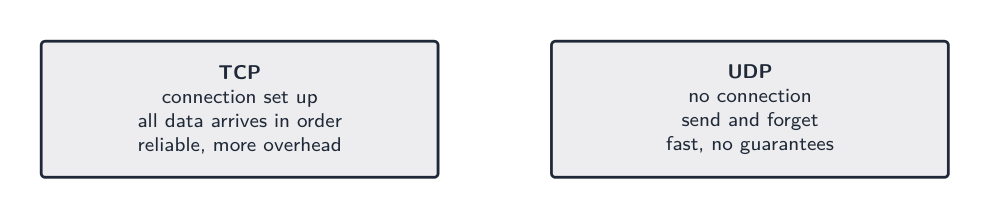
TCP connects and delivers in order; UDP sends and forgets - TCP 传输控制协议 — connection-oriented 面向连接: sets up a connection, ensures all data arrives in order, retransmits lost packets 数据包, controls flow. Reliable but with overhead. Used by HTTP, HTTPS, SMTP, FTP.
- UDP 用户数据报协议 — connectionless 无连接: sends and forgets, with no acknowledgements or ordering. Low overhead, no guarantees. Used for streaming, DNS and gaming, where speed beats reliability.
Internet layer
The internet layer 网络层 carries packets between hosts using IP. Each packet has a source and destination IP address IP地址, and routers 路由器 forward it onward. It does not guarantee delivery — that is TCP's job.
A home router does this job for your house: it reads each packet's destination address and sends it on towards the internet, and back to the right device.
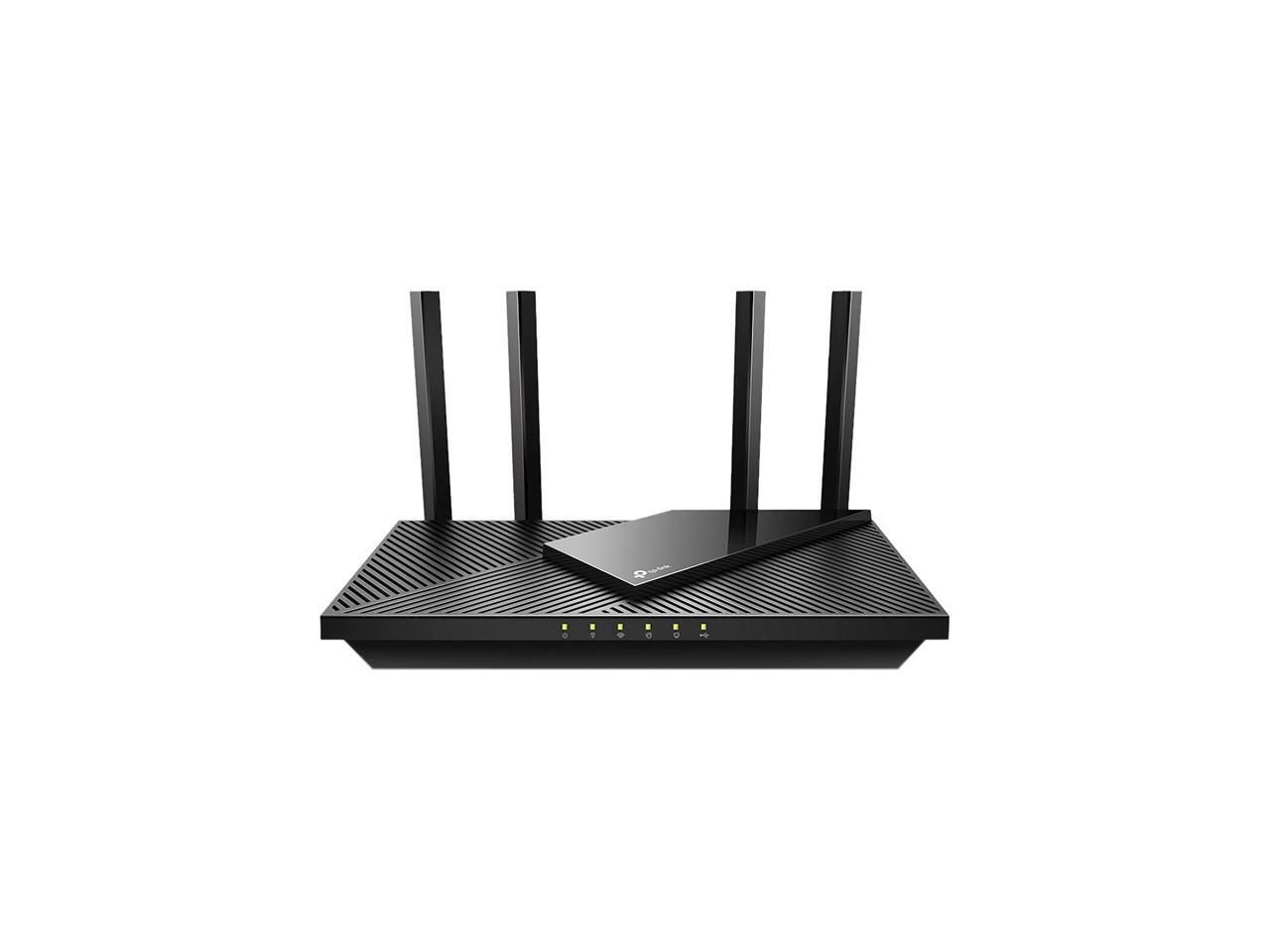
A home Wi-Fi router: it forwards packets between your devices and the internet Before the router reaches the wider internet, a modem 调制解调器 connects the home to the internet provider over the provider's cable or phone line. Its lights show the link is up and online.
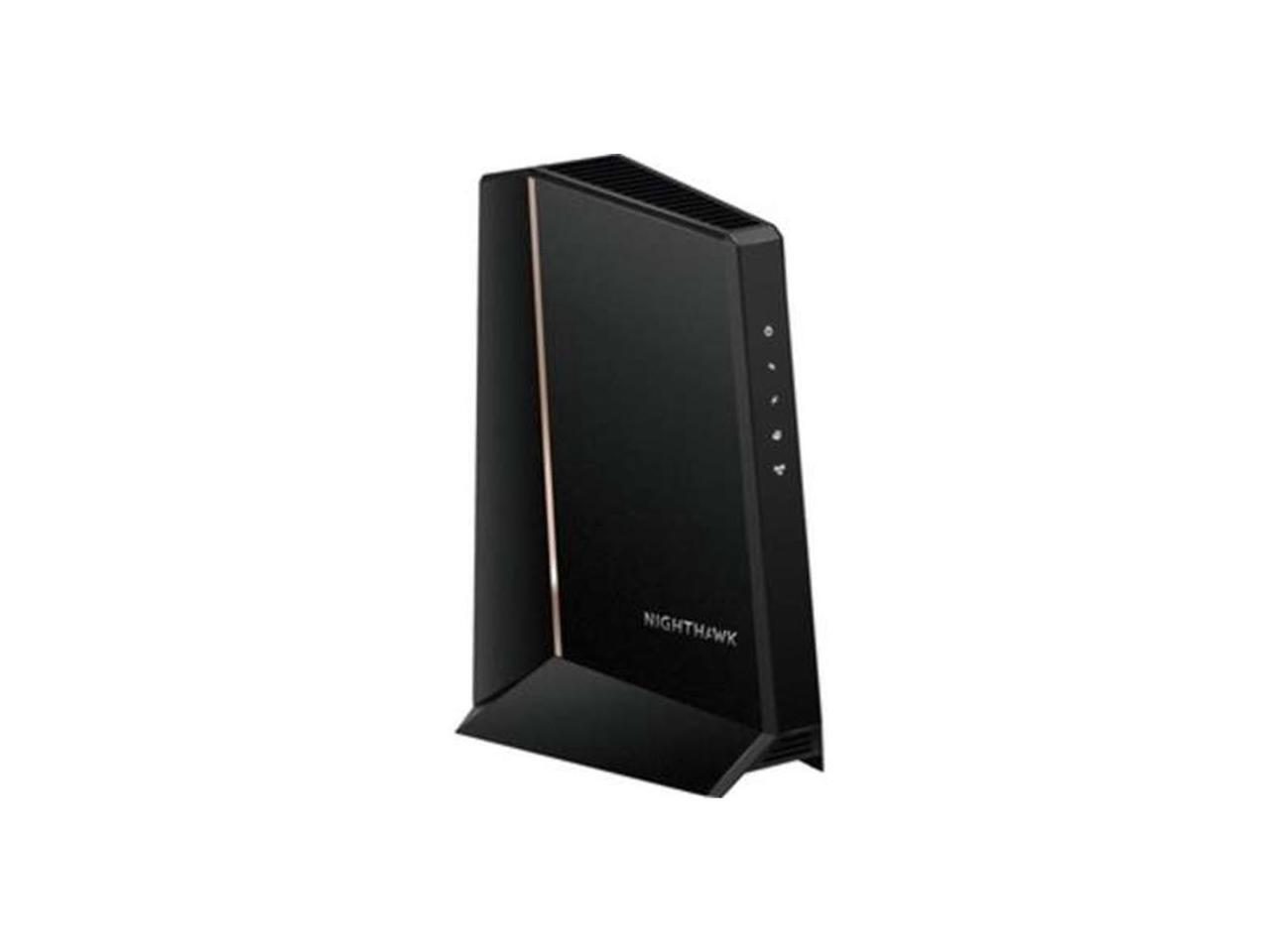
A cable modem connects a home network to the internet provider Link layer
The link layer 链路层 sends bits over one physical link (Ethernet, Wi-Fi). It adds a frame header with MAC addresses MAC地址 and handles medium access (e.g. CSMA/CD 载波侦听多路访问/冲突检测 on Ethernet).
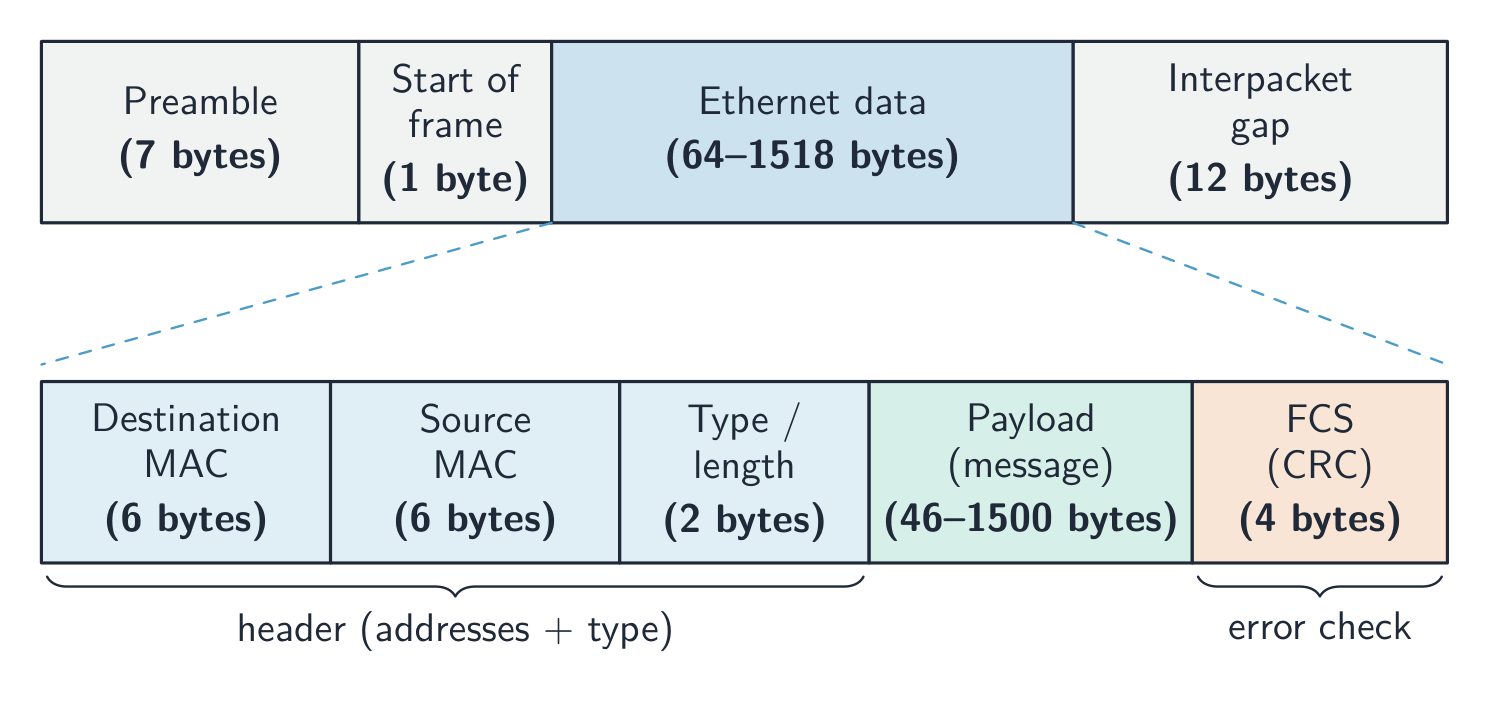
The parts of a typical Ethernet frame On a wired local network, a switch 交换机 joins many devices together. Each device plugs into a port with an Ethernet cable (an RJ45 plug), and the switch uses the MAC addresses in each frame to send it only to the correct port.
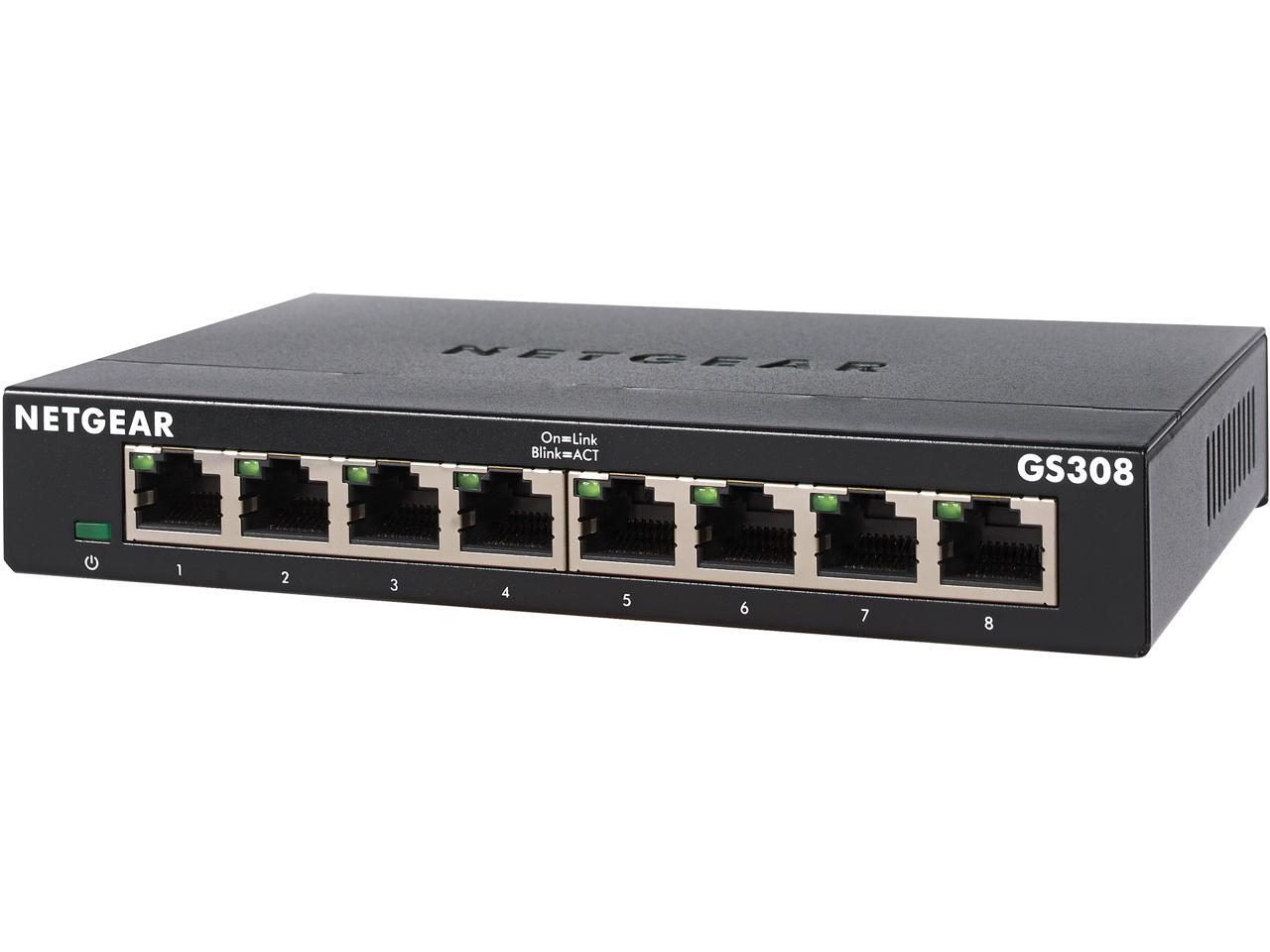
A network switch connects many wired devices on a local network The physical link can be a copper wire, a radio signal (Wi-Fi), or a fibre-optic cable 光纤. In a fibre-optic cable, the bits travel as flashes of light through very thin strands of glass, which is fast and carries data a long way.

A fibre-optic cable: data travels as light through thin glass strands A radio link can reach much further. A satellite dish 卫星天线 sends and receives radio signals to and from a satellite, carrying data to places that wired links cannot easily reach.
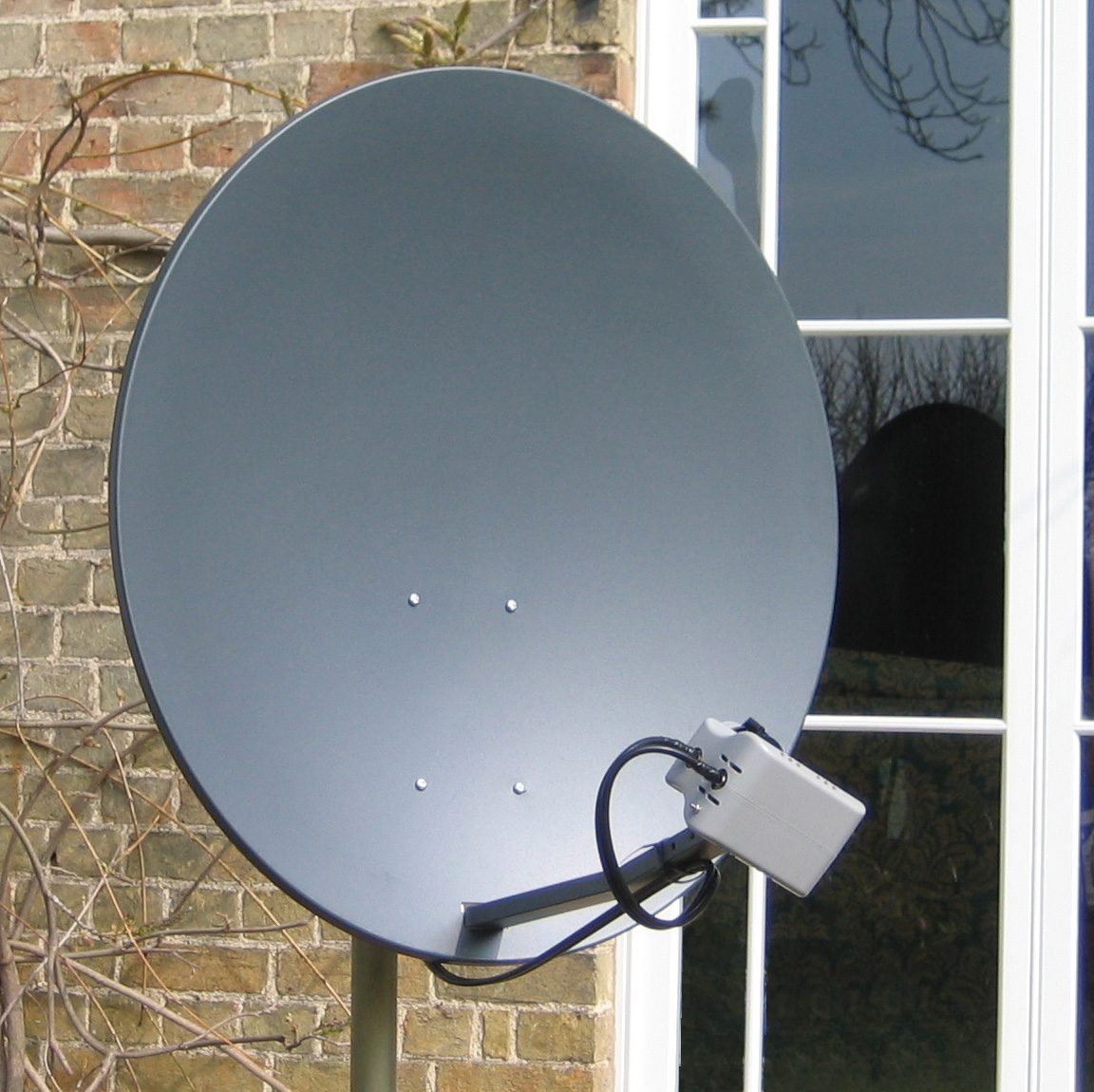
A satellite dish sends and receives data by radio over a long distance ExploreTap the four layers of the TCP/IP model
Explore each layer. Data travels DOWN the stack as it's sent (each layer adds its header) and back UP as it's received — and any layer can be swapped without touching the others.
Vocabulary TrainEnglish Chinese Pinyin application layer 应用层 yìng yòng céng transport layer 传输层 chuán shū céng port numbers 端口号 duān kǒu hào TCP 传输控制协议 chuán shū kòng zhì xié yì connection-oriented 面向连接 miàn xiàng lián jiē packets 数据包 shù jù bāo UDP 用户数据报协议 yòng hù shù jù bào xié yì connectionless 无连接 wú lián jiē internet layer 网络层 wǎng luò céng IP address IP地址 IP dì zhǐ routers 路由器 lù yóu qì modem 调制解调器 tiáo zhì jiě tiáo qì link layer 链路层 liàn lù céng MAC addresses MAC地址 MAC dì zhǐ CSMA/CD 载波侦听多路访问/冲突检测 zài bō zhēn tīng duō lù fǎng wèn chōng tū jiǎn cè switch 交换机 jiāo huàn jī fibre-optic 光纤 guāng xiān satellite dish 卫星天线 wèi xīng tiān xiàn 14.1
Common application-layer protocols
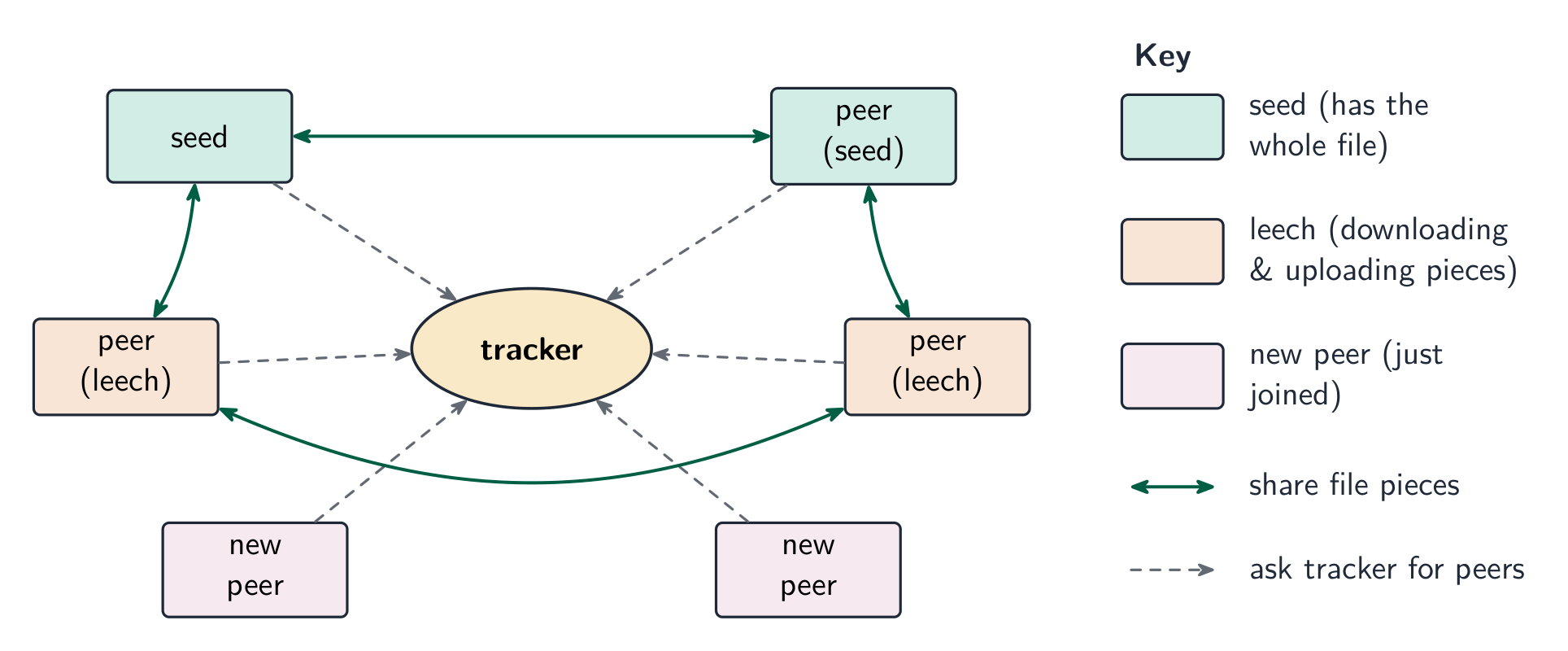
- HTTP 超文本传输协议 — browsers fetch web pages from servers (over TCP, port 80). HTTPS is HTTP over TLS — encrypted, port 443.
- FTP 文件传输协议 — transfer files between client and server.
- SMTP 简单邮件传输协议 — send email between client and server, and between servers. Receiving uses POP3 or IMAP.
- POP3 — downloads email and usually deletes it from the server. IMAP — leaves email on the server and syncs across devices, so the same inbox appears everywhere.
- BitTorrent — a peer-to-peer 对等网络 protocol; a file is split into pieces downloaded from many peers in parallel, so no single server carries all the load.
BitTorrent: a tracker helps peers find each other, then they share file pieces directly ExploreNetwork route lab
Follow data from a device through network hardware and protocols.
Vocabulary TrainEnglish Chinese Pinyin HTTP 超文本传输协议 chāo wén běn chuán shū xié yì FTP 文件传输协议 wén jiàn chuán shū xié yì SMTP 简单邮件传输协议 jiǎn dān yóu jiàn chuán shū xié yì peer-to-peer 对等网络 duì děng wǎng luò 14.2
Circuit switching vs packet switching

Syllabus
Candidates should be able to: Notes and guidance Show understanding of circuit switching Benefits, drawbacks and where it is applicable Show understanding of packet switching Benefits, drawbacks and where it is applicable Show understanding of the function of a router in packet switching Explain how packet switching is used to pass messages across a network, including the internet Source: Cambridge International syllabus
Circuit switching
A dedicated path is set up between the two ends before any data is sent (circuit switching 电路交换), reserved for the whole conversation, then released. It gives reserved bandwidth 带宽 and in-order delivery, but is inefficient during silences and slow to set up. Classic example: the traditional telephone network.
Circuit switching: one dedicated path is reserved end to end Packet switching
The data is split into packets, each sent independently (packet switching 分组交换). Each packet carries the destination address; routers make per-packet decisions, so packets may take different routes and arrive out of order, and the destination reassembles them. It is efficient (one link is multiplexed 多路复用 across many conversations), robust (reroute around a failure), but has variable latency 延迟 and possible loss (TCP handles reliability). Used by the internet.
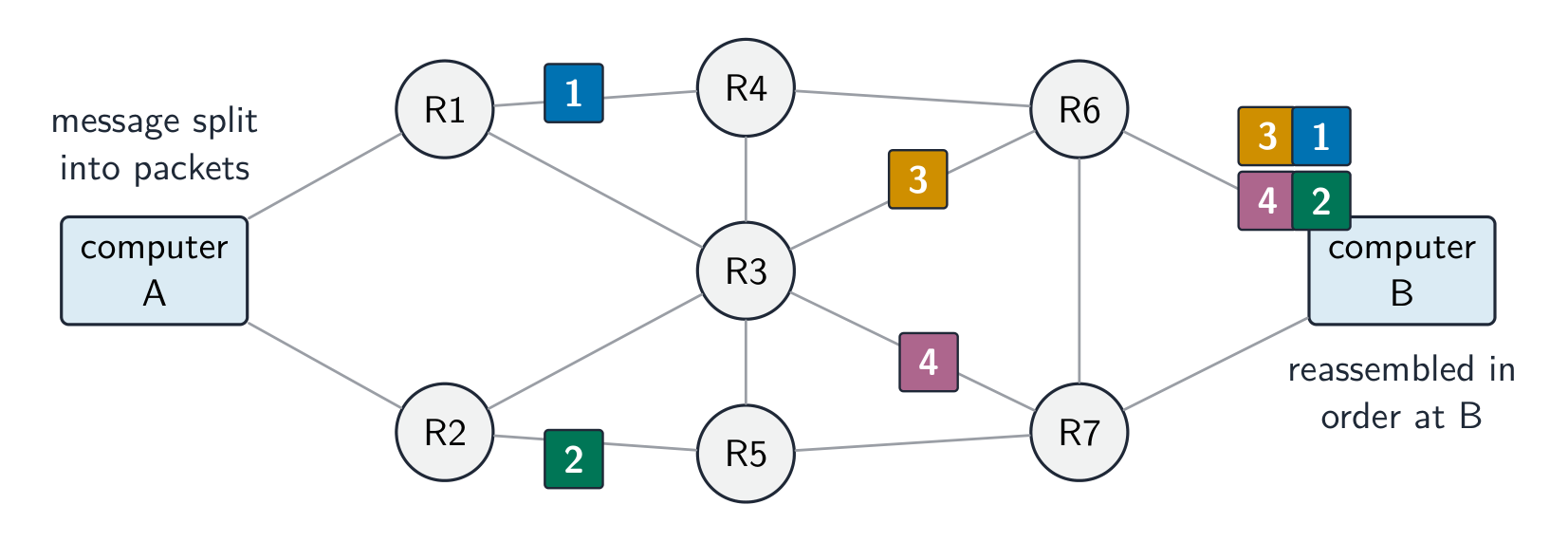
Packet switching: packets travel independently and may take different routes Aspect Circuit switching Packet switching Path dedicated, reserved shared, per-packet Setup time slow none Bandwidth use inefficient efficient Order in order may be out of order Robustness one failure cuts the circuit reroute around failures Suits constant-rate flows (voice) bursty flows (web, email) Modern networks use packet switching for its efficiency and resilience.
Describing packet switching in a few sentences
A good exam answer: "The message is broken into small packets. Each packet carries the destination and source addresses and a sequence number. Each packet travels through the network independently, with routers choosing the next hop per packet. Packets may take different paths and arrive out of order. The destination uses the sequence numbers to reassemble the message, and missing packets can be requested again."
Worked example. A phone call and a large file download share a network. Which switching method suits each, and why? A phone call needs a steady stream with low delay, and it would suffer badly if pieces arrived late or out of order - so circuit switching suits it: a dedicated path is set up for the whole call and its capacity is reserved for the duration. A file download does not care about timing or arrival order, because the receiver reassembles it, and it benefits from using whatever capacity happens to be spare - so packet switching suits it: the file is split into packets that travel independently, each carrying source and destination addresses and a sequence number, with routers choosing a next hop per packet. Name the property of the traffic that decides it: reserved capacity and low delay for the call, efficiency and resilience for the download.
ExploreA packet's journey across the internet
Step through packet switching. The message is split up, each packet finds its own way, and the destination puts them back together — which is why the internet is so efficient and hard to break.
Vocabulary TrainEnglish Chinese Pinyin circuit switching 电路交换 diàn lù jiāo huàn bandwidth 带宽 dài kuān packet switching 分组交换 fēn zǔ jiāo huàn multiplexed 多路复用 duō lù fù yòng latency 延迟 yán chí 14.2
Exam tips
- Explain why protocols and layers are used: each layer has one job and can change independently.
- Place common protocols in the TCP/IP stack (HTTP/FTP/SMTP application; TCP/UDP transport; IP internet).
- Compare circuit switching vs packet switching (a dedicated path vs independent packets) with a use for each.
-
15
Hardware and Virtual Machines
15.1
RISC vs CISC processors
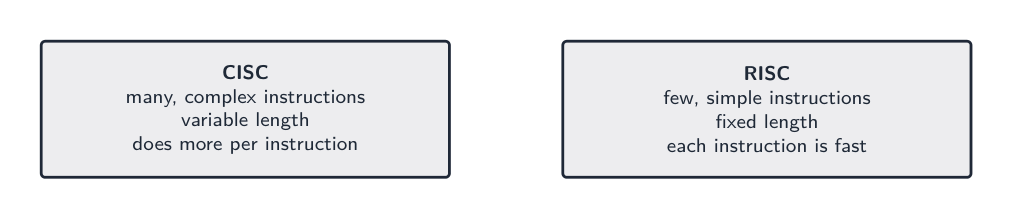
Syllabus
Candidates should be able to: Notes and guidance Show understanding of Reduced Instruction Set Computers (RISC) and Complex Instruction Set Computers (CISC) processors Differences between RISC and CISC Understand interrupt handling on CISC and RISC processors Show understanding of the importance/use of pipelining and registers in RISC processors Show understanding of the four basic computer architectures SISD, SIMD, MISD, MIMD Show understanding of the characteristics of massively parallel computers Show understanding of the concept of a virtual machine Give examples of the role of virtual machines Understand the benefits and limitations of virtual machines Source: Cambridge International syllabus
Two styles of CPU design. The CPU itself plugs into the motherboard 主板, the main board that links the processor, the memory and every other part of the computer together.
CISC has many complex instructions; RISC has few simple ones 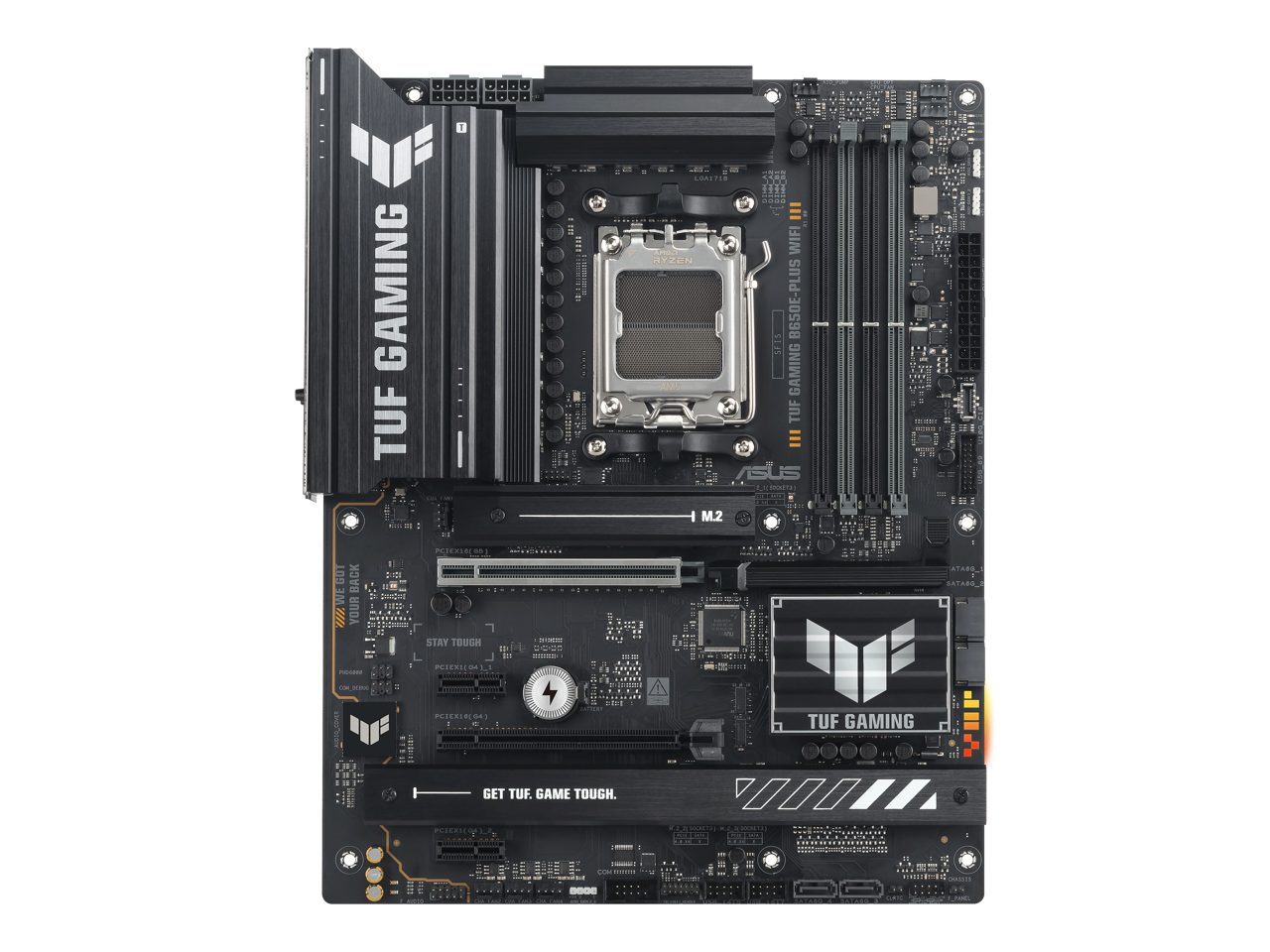
A motherboard links the CPU, memory and other parts together CISC
A CISC 复杂指令集 (Complex Instruction Set Computers) has many, often complex instructions (one may do several memory accesses and operations), of variable length, so decoding is intricate. It does more per instruction in hardware. Examples: Intel x86.
RISC
A RISC 精简指令集 (Reduced Instruction Set Computers) has a small set of simple instructions, each doing one basic operation, all of fixed length (fast to decode). Only load and store touch memory; everything else is register 寄存器-to-register. Programs are longer but each instruction is quick and predictable, which suits pipelining. Examples: ARM, RISC-V.
Feature CISC RISC Instruction set many few Instruction length variable fixed Memory access many instructions only load/store Pipeline-friendly harder naturally Per-instruction cycles varies usually 1 The trade-off is doing more per instruction (CISC) vs doing each instruction faster and more predictably (RISC). Modern Intel chips translate CISC instructions into simpler RISC-like micro-ops internally.
Vocabulary TrainEnglish Chinese Pinyin motherboard 主板 zhǔ bǎn CISC 复杂指令集 fù zá zhǐ lìng jí RISC 精简指令集 jīng jiǎn zhǐ lìng jí register 寄存器 jì cún qì 15.1
Pipelining

A pipeline 流水线 processes instructions in overlapping stages, like an assembly line: Fetch → Decode → Execute (in the ALU 算术逻辑单元) → Memory access → Write back. Each stage works on a different instruction at once, so once the pipeline is full, one instruction completes per cycle. RISC's fixed-length, simple instructions make every stage take the same time. A pipeline can stall on a hazard 冒险 — a data hazard (an instruction needs a result not ready yet) or a control hazard (a branch makes the next address unknown).
Pipelining overlaps the stages of six instructions, so one finishes each cycle RISC chips keep data in many registers because memory is slow and registers are fast; the compiler allocates values to registers wisely.
A processor running this fast gives off a lot of heat, so a heat-sink 散热器 and fan sit on top of it. The metal fins spread the heat and the fan blows it away, keeping the CPU cool enough to work.

A CPU heat-sink and fan carry heat away from the processor ExploreHow pipelining fills up
Step through the clock cycles. Once the pipeline is full, a new instruction finishes every cycle — even though each one still takes several stages — because the stages of different instructions overlap.
Vocabulary TrainEnglish Chinese Pinyin pipeline 流水线 liú shuǐ xiàn ALU 算术逻辑单元 suàn shù luó jí dān yuán hazard 冒险 mào xiǎn heat-sink 散热器 sàn rè qì 15.1
Flynn's taxonomy

Flynn's taxonomy 弗林分类 sorts computers by the number of instruction and data streams:
- SISD — one instruction, one data stream (a traditional single core).
- SIMD 单指令多数据 — one instruction works on many data items at once (GPUs, CPU vector extensions). Great for images, video, scientific arrays.
- MISD — several operations on the same data; rare, mostly theoretical.
- MIMD 多指令多数据 — many processors run different instructions on different data (multi-core CPUs, clusters). The most general.
SIMD: many processors run the same instruction on different data A graphics card 显卡 (with its GPU) is a real example of SIMD hardware: it has thousands of small cores that run the same instruction on many pixels or numbers at once, which is why GPUs are so fast for images, video and machine learning.

A graphics card: its GPU runs the same instruction on many data items at once (SIMD) 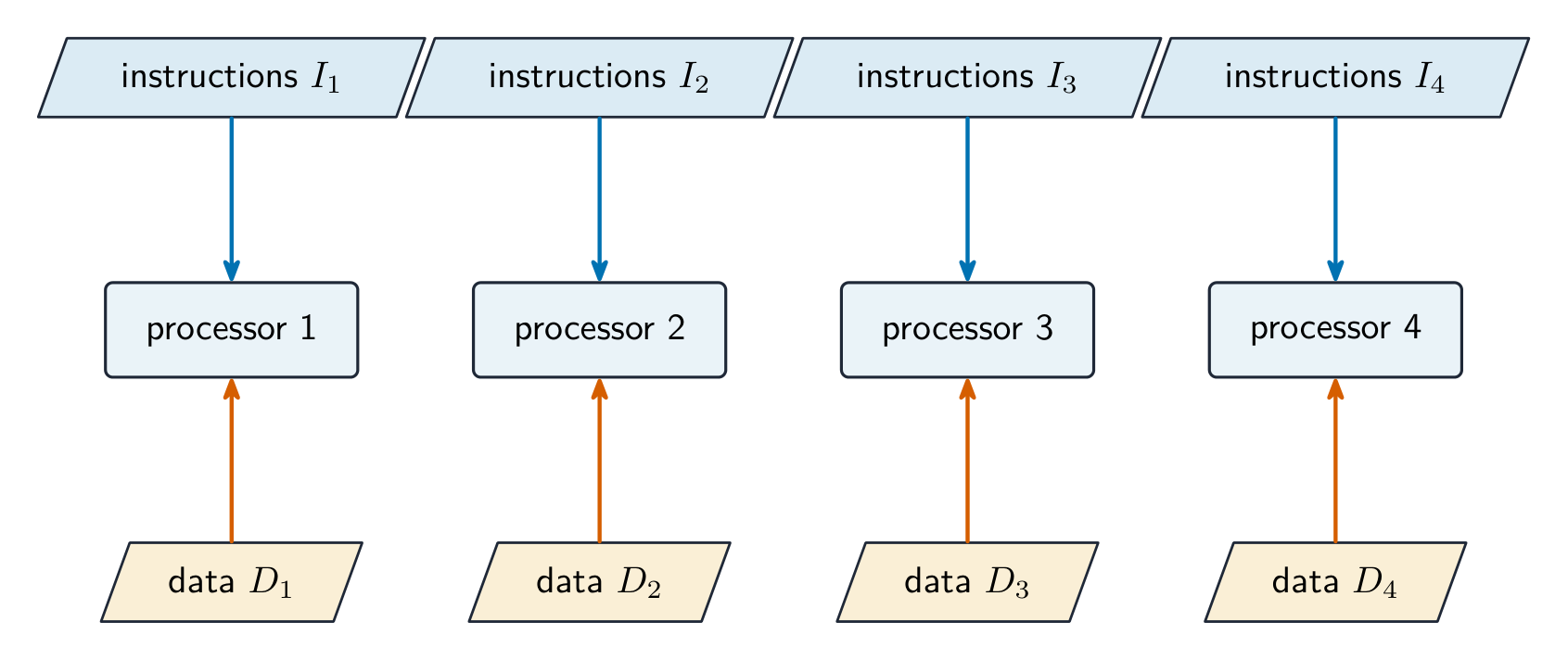
MIMD: each processor runs its own instructions on its own data Vocabulary TrainEnglish Chinese Pinyin Flynn's taxonomy 弗林分类 fú lín fēn lèi SIMD 单指令多数据 dān zhǐ lìng duō shù jù MIMD 多指令多数据 duō zhǐ lìng duō shù jù graphics card 显卡 xiǎn kǎ 15.1
Massively parallel computers

A massively parallel 大规模并行 system uses thousands of processors on a fast network, each with its own memory (distributed memory 分布式内存), exchanging data by messages. It is MIMD, needs specially-written software (MPI, CUDA), and suits climate simulation, large machine learning 机器学习 training, and astrophysics. The largest supercomputers 超级计算机 are massively parallel.
The processors live in tall server 服务器 racks, often filling a whole room (a data centre 数据中心), wired together so they can work on one big problem at the same time.
Rows of servers in a data centre, like those used for massively parallel computing Vocabulary TrainEnglish Chinese Pinyin massively parallel 大规模并行 dà guī mó bìng xíng distributed memory 分布式内存 fēn bù shì nèi cún machine learning 机器学习 jī qì xué xí supercomputers 超级计算机 chāo jí jì suàn jī server 服务器 fú wù qì data centre 数据中心 shù jù zhōng xīn 15.1
Virtual machines
A virtual machine 虚拟机 (VM) is a software emulation of a whole computer — the software inside sees a CPU, memory and disks that look real but are managed by host software.
- a system VM runs a complete OS. A hypervisor 虚拟机监控器 creates and manages VMs, each booting its own guest OS. Uses: run different OSes on one machine; server consolidation; sandboxing 沙箱 (risky software runs isolated); snapshots.
- a process (language) VM runs one program in portable bytecode 字节码 — the JVM (Java), the CLR (.NET), CPython. Benefits: portability ("write once, run anywhere"), runtime safety checks, and just-in-time compilation 即时编译 for near-native speed. The cost is an extra layer and needing the VM installed.
ExploreComputing concept lab
Classify concrete examples by the computing idea they demonstrate.
Vocabulary TrainEnglish Chinese Pinyin virtual machine 虚拟机 xū nǐ jī hypervisor 虚拟机监控器 xū nǐ jī jiān kòng qì sandboxing 沙箱 shā xiāng bytecode 字节码 zì jié mǎ just-in-time compilation 即时编译 jí shí biān yì 15.2
Boolean algebra
Syllabus
Candidates should be able to: Notes and guidance Produce truth tables for logic circuits including half adders and full adders May include logic gates with more than two inputs Show understanding of a flip-flop (SR, JK) Draw a logic circuit and derive a truth table for a flip-flop Understand of the role of flip-flops as data storage elements Show understanding of Boolean algebra Understand De Morgan’s laws Perform Boolean algebra using De Morgan’s laws Simplify a logic circuit/expression using Boolean algebra Show understanding of Karnaugh maps (K-map) Understand of the benefits of using Karnaugh maps Solve logic problems using Karnaugh maps Source: Cambridge International syllabus
The half adder: XOR + AND add two bits Boolean algebra 布尔代数 simplifies Boolean 布尔 expressions, which can equally be described by truth tables 真值表. Symbols:
+for OR,·for AND (often omitted), an overbar for NOT.Key laws include commutative, associative and distributive (as in ordinary algebra), plus:
- identity $A + 0 = A$, $A \cdot 1 = A$; null $A + 1 = 1$, $A \cdot 0 = 0$.
- idempotent $A + A = A$; inverse $A + \overline{A} = 1$, $A \cdot \overline{A} = 0$.
- De Morgan's laws 德摩根定律: $(A + B)' = A' \cdot B'$; $(A \cdot B)' = A' + B'$ — negate the whole, swap AND/OR, negate each operand.
- absorption 吸收律: $A + AB = A$.
Simplifying reduces the number of terms, so the resulting logic circuit has fewer gates. Example: $Z = AB + A\overline{B} = A(B + \overline{B}) = A$.
ExploreBoolean algebra
A·B, A+B, Ā …
Boolean algebra is just these gates written as expressions — compare the truth tables.
ExploreBoolean truth tables
Pick an operator and the inputs to build its truth table — the algebra behind logic circuits.
Vocabulary TrainEnglish Chinese Pinyin Boolean algebra 布尔代数 bù ěr dài shù Boolean 布尔 bù ěr De Morgan's laws 德摩根定律 dé mó gēn dìng lǜ absorption 吸收律 xī shōu lǜ truth table 真值表 zhēn zhí biǎo 15.2
Karnaugh maps
A Karnaugh map 卡诺图 (K-map) simplifies a Boolean expression by grouping adjacent 1s from a truth table. Columns and rows use Gray code 格雷码 order (
00,01,11,10) so adjacent cells differ in one variable.Place a 1 in each cell where the output is 1. Find rectangular groups of 1s whose sides are powers of 2 (1, 2, 4, 8), wrapping around edges if it makes a bigger group. The larger the group, the simpler the term: a group of 2 drops one variable, a group of 4 drops two, and so on — variables that change within the group disappear. OR the group terms together for the simplified expression. Cover every 1 using as few, as large, groups as possible.
Worked example. A Karnaugh map for $A$ and $B$ has 1s in the cells $\overline{A}B$ and $AB$. Simplify. The two 1s are adjacent - they share the $B=1$ column - so group them as a rectangle of 2. Inside that group $B$ stays 1 throughout while $A$ changes from 0 to 1, and any variable that changes within a group disappears. So the group leaves simply $X = B$. Compare that with the sum of products read straight off the table, $\overline{A}B + AB$: the same circuit, two gates fewer. Two rules do most of the work - make each group as large as possible (a group of 2 drops one variable, 4 drops two, 8 drops three), and remember the map wraps around its edges, so the leftmost and rightmost columns are adjacent. That wrap is the grouping most candidates miss.
Vocabulary TrainEnglish Chinese Pinyin Karnaugh map 卡诺图 kǎ nuò tú Gray code 格雷码 gé léi mǎ 15.2
Half adder and full adder

A half adder 半加器 adds two single bits $A$ and $B$, giving a sum $S$ and a carry 进位 $C$:
A B S C 0 0 0 0 0 1 1 0 1 0 1 0 1 1 0 1 So $S = A \text{ XOR } B$ and $C = A \text{ AND } B$. It ignores any carry-in — hence "half".
A half adder, as a block and as a circuit of an XOR and an AND gate A full adder 全加器 adds three bits ($A$, $B$, carry-in), giving a sum and a carry-out: $S = A \text{ XOR } B \text{ XOR } C_{\text{in}}$. It can be built from two half adders plus an OR gate. Chaining full adders (each carry-out feeding the next carry-in) makes a multi-bit "ripple-carry" adder.
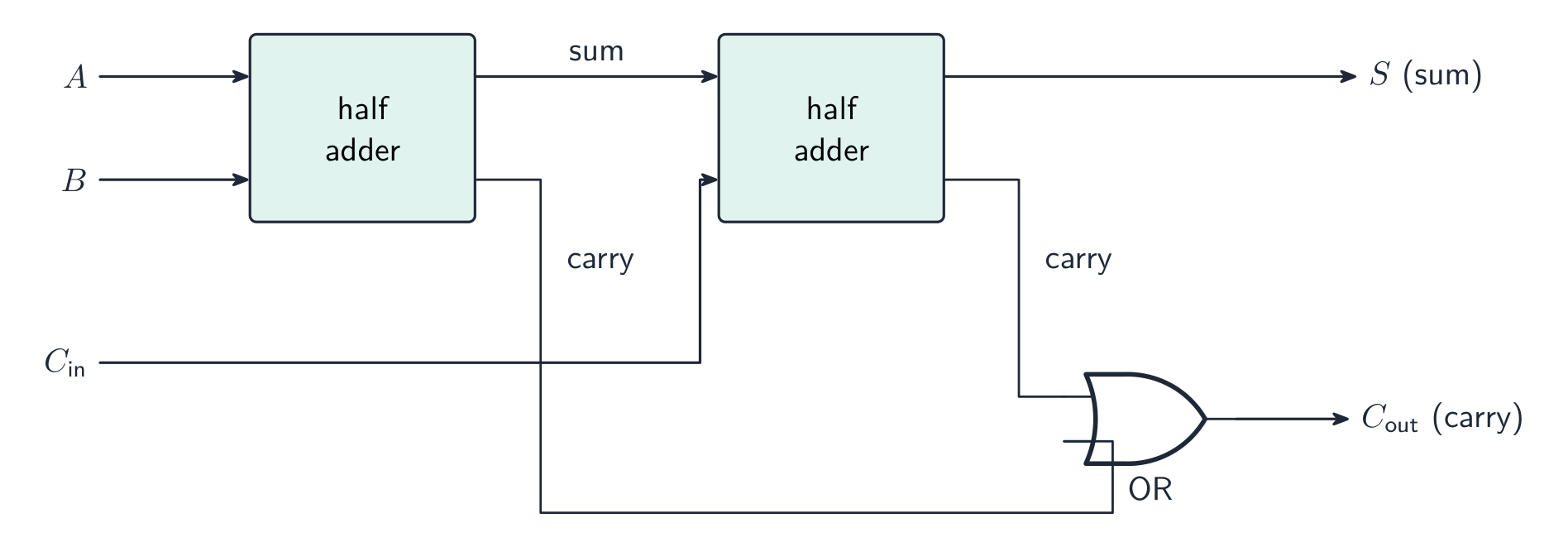
A full adder is built from two half adders and an OR gate ExploreThe gates inside an adder
A half-adder's sum bit is an XOR gate and its carry is an AND gate — toggle A and B and watch the truth-table row light up.
Vocabulary TrainEnglish Chinese Pinyin half adder 半加器 bàn jiā qì carry 进位 jìn wèi full adder 全加器 quán jiā qì 15.2
Flip-flops
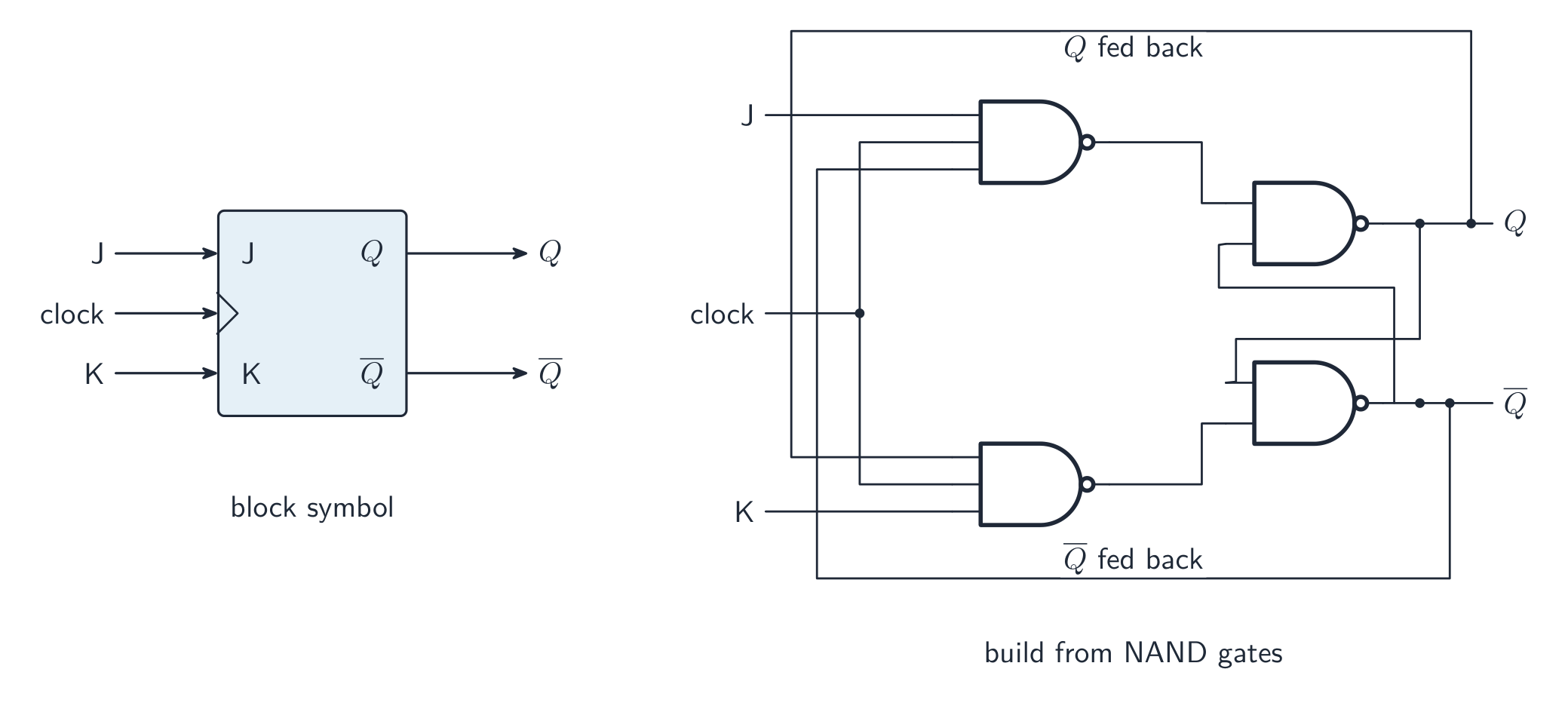
A flip-flop 触发器 is a bistable 双稳态 circuit — two stable states (0 and 1) — that remembers its state. It stores one bit and is the basic element of registers and SRAM.
SR flip-flop
An SR flip-flop SR触发器 has inputs S (set) and R (reset) and outputs Q and $\overline{Q}$.
S=1,R=0sets Q to 1;S=0,R=1resets it to 0;S=0,R=0holds;S=1,R=1is invalid. Built from two cross-coupled NOR gates.JK flip-flop
A JK flip-flop JK触发器 improves on it by using the previously-invalid
1,1input as a toggle 翻转 (the output flips). This makes it ideal for building counters 计数器 (a chain of toggling flip-flops). It is usually clocked — inputs act only on a clock edge, keeping flip-flops synchronised.A JK flip-flop: its symbol and a build from NAND gates Flip-flops are the building blocks of registers (n bits = n flip-flops), counters, and SRAM 静态RAM cells.
Vocabulary TrainEnglish Chinese Pinyin flip-flop 触发器 chù fā qì bistable 双稳态 shuāng wěn tài SR flip-flop SR触发器 SR chù fā qì JK flip-flop JK触发器 JK chù fā qì toggle 翻转 fān zhuǎn counters 计数器 jì shù qì SRAM 静态RAM jìng tài RAM 15.2
Exam tips
- Compare RISC vs CISC (simple, fast, uniform instructions vs complex ones) and why RISC suits pipelining.
- Simplify logic with Boolean algebra / Karnaugh maps — group the 1s in powers of two.
- Explain a half adder vs full adder (the full adder handles a carry-in) and what a flip-flop stores.
- Place a machine in Flynn's taxonomy (SISD, SIMD, MISD, MIMD).
-
16
System Software
16.1
How an OS maximises use of resources

Syllabus
Candidates should be able to: Notes and guidance Show understanding of how an OS can maximise the use of resources Describe the ways in which the user interface hides the complexities of the hardware from the user Show understanding of process management The concept of multi-tasking and a process The process states: running, ready and blocked The need for scheduling and the function and benefits of different scheduling routines (including round robin, shortest job first, first come first served, shortest remaining time) How the kernel of the OS acts as an interrupt handler and how interrupt handling is used to manage low-level scheduling Show understanding of virtual memory, paging and segmentation for memory management The concepts of paging, virtual memory and segmentation The difference between paging and segmentation How pages can be replaced How disk thrashing can occur Source: Cambridge International syllabus
A computer has many resources (CPU time, memory, disk, I/O) and many programs competing for them. The OS shares them fairly and efficiently so each is well used and the system stays responsive:
The OS shares the CPU, memory, disk and I/O between programs - multi-tasking 多任务 — switch the CPU quickly between processes so several seem to run at once.
- memory management — give each process the memory it needs; use disk paging 分页 when RAM runs out.
- spooling 假脱机 and buffering — print jobs queue on disk so the CPU never waits for the printer.
- caching — keep recently-used disk data in cache 高速缓存 / RAM.

The processor is a key resource the OS shares between competing tasks 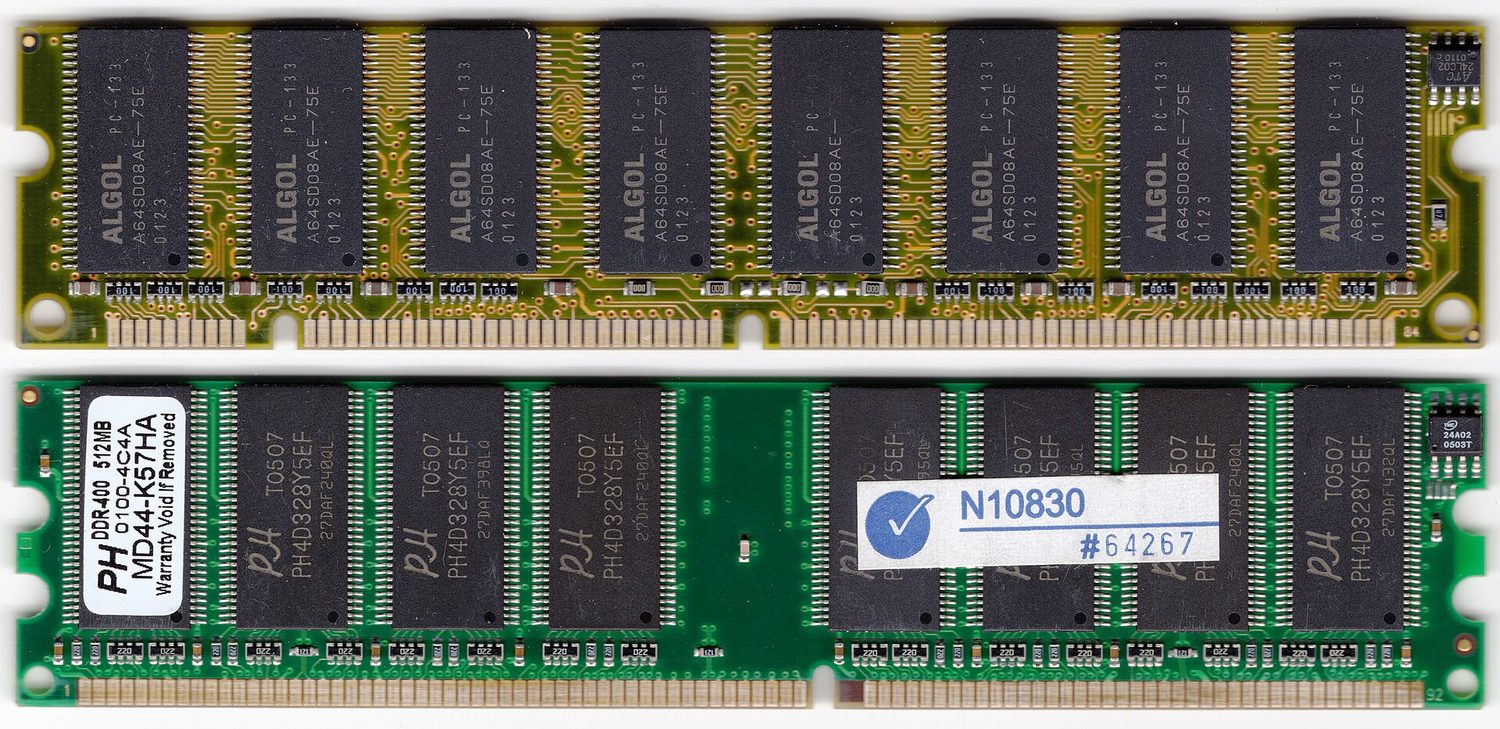
The OS also manages memory (RAM), deciding what to keep in it and what to page out to disk Vocabulary TrainEnglish Chinese Pinyin multi-tasking 多任务 duō rèn wù paging 分页 fēn yè spooling 假脱机 jiǎ tuō jī cache 高速缓存 gāo sù huǎn cún 16.1
The user interface
The user interface hides the hardware behind friendly abstractions: the user sees windows, menus and folders, not addresses or sectors. One click on an icon makes the OS find the program on disk, allocate memory, load it and start it. A CLI (command line) is powerful and scriptable for experts; a GUI (graphical) is easier to learn. Most systems offer both.
16.1
Process management
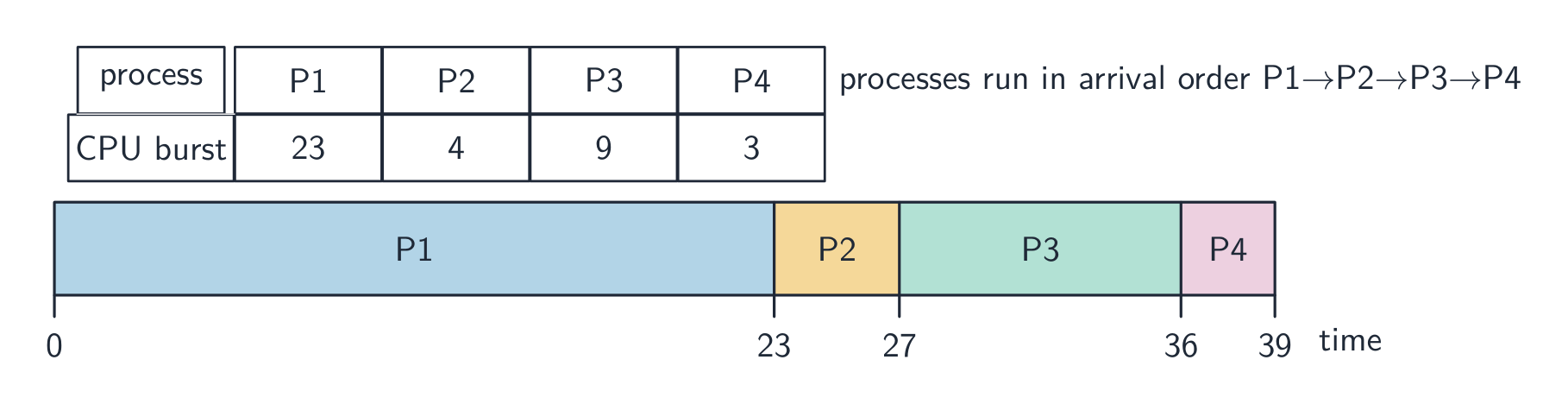
A process 进程 is a program in execution — its code, current state, memory and open files.
Scheduling
The scheduler 调度器 chooses which ready process runs next, and for how long:
- round robin 轮转 — each process gets a fixed time slice 时间片, then goes to the back of the queue.
- first-come-first-served; shortest job first; shortest remaining time (run the job with the least work left); priority; multilevel feedback queues.
The trade-off is responsiveness vs throughput vs fairness.
First-come-first-served scheduling of four processes 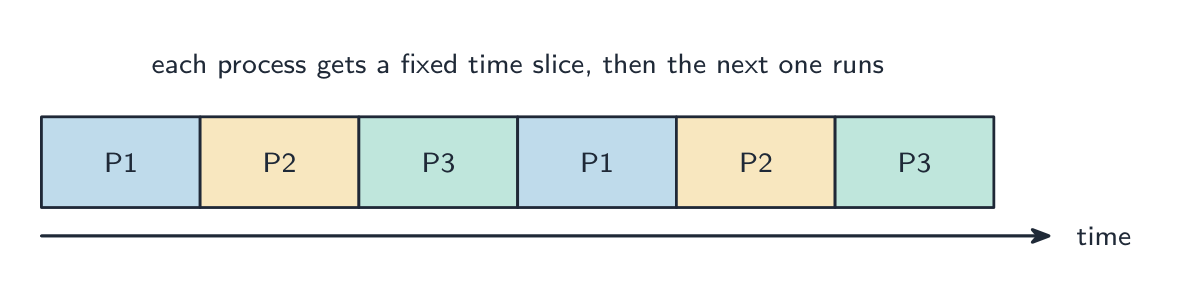
Round-robin: each process gets a fixed time slice in turn, then the next runs (unlike first-come-first-served) Process states
A process is new, ready (waiting for the CPU), running, blocked 阻塞 (waiting for I/O or a lock), or terminated. When its time slice ends it goes running → ready; when it requests I/O it goes running → blocked; when the I/O finishes it goes blocked → ready.
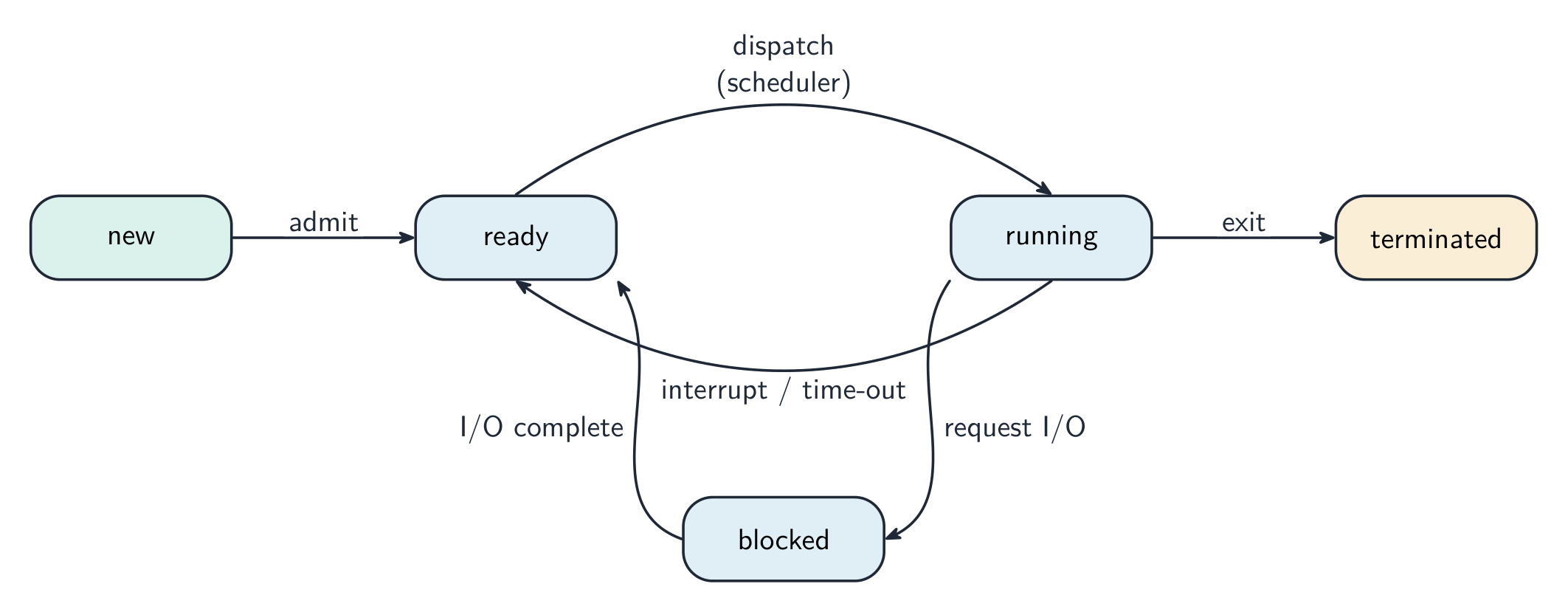
A process moves between the new, ready, running, blocked and terminated states Process control block and context switch
For each process the OS keeps a process control block 进程控制块 (PCB) — the saved program counter, registers, state and memory info.

A context switch saves one process's state and loads another's - a context switch 上下文切换 suspends one process and starts another: it saves the state into one PCB and restores it from another. This small cost is paid on every switch.
- the kernel 内核 (the core of the OS) acts as an interrupt handler 中断处理程序. When a device or the timer raises an interrupt, interrupt handling 中断处理 saves the running process and runs the right routine — this is what drives low-level scheduling.
Inter-process communication
Processes are isolated, so the OS provides inter-process communication 进程间通信: pipes 管道 (one program's output feeds another's input), shared memory 共享内存 (a region several processes can use), and message passing.
ExploreThe life of a process
Tap round the loop a process travels. It only runs when the scheduler picks it; needing I/O sends it to blocked, and finishing its time slice sends it back to ready — round and round until it's done.
Vocabulary TrainEnglish Chinese Pinyin process 进程 jìn chéng scheduler 调度器 diào dù qì round robin 轮转 lún zhuàn time slice 时间片 shí jiān piàn blocked 阻塞 zǔ sè process control block 进程控制块 jìn chéng kòng zhì kuài context switch 上下文切换 shàng xià wén qiè huàn inter-process communication 进程间通信 jìn chéng jiān tōng xìn pipes 管道 guǎn dào shared memory 共享内存 gòng xiǎng nèi cún kernel 内核 nèi hé interrupt handler 中断处理程序 zhōng duàn chǔ lǐ chéng xù interrupt handling 中断处理 zhōng duàn chǔ lǐ 16.1
Virtual memory, paging, segmentation
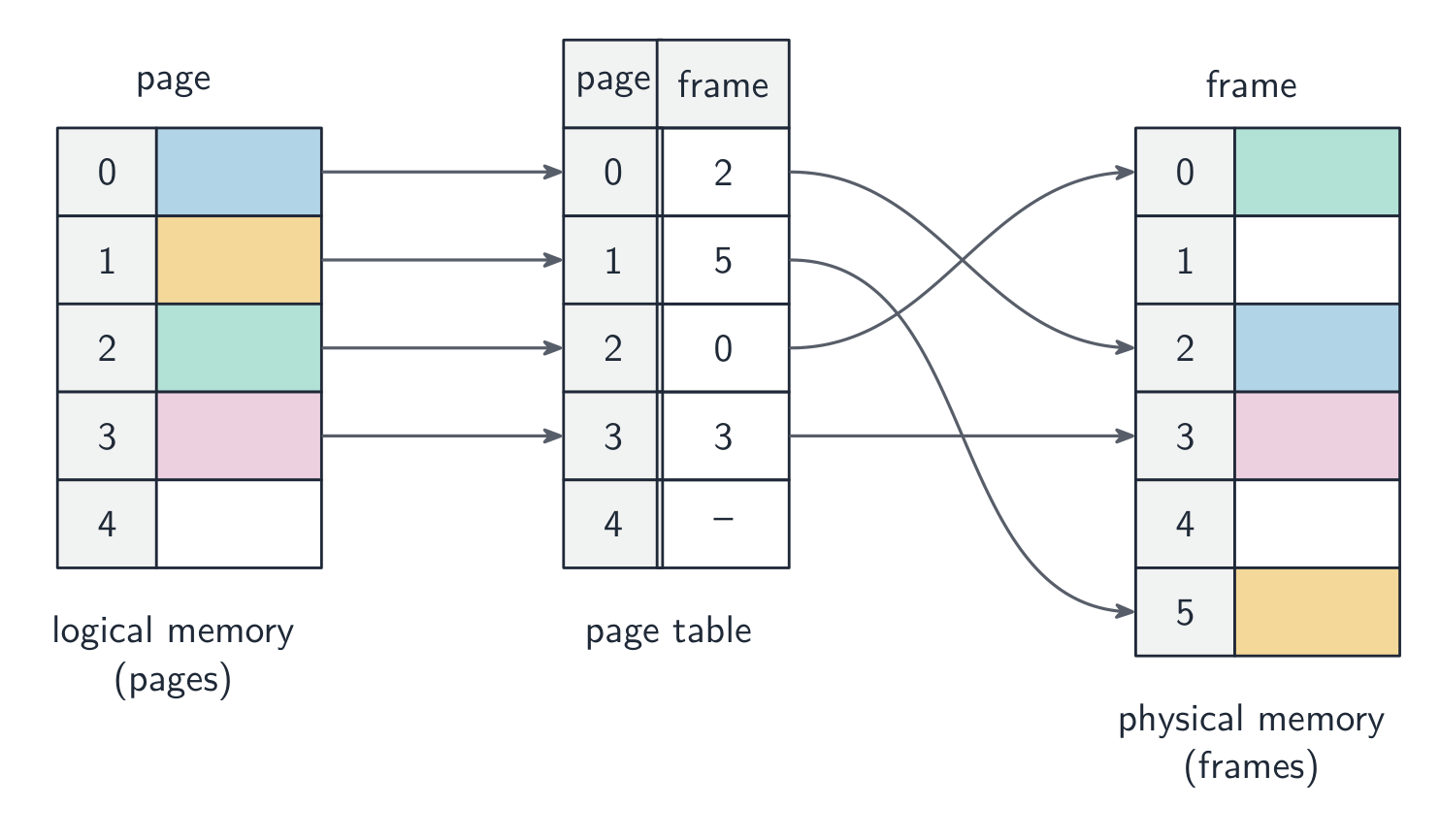
Each process gets its own virtual address space 虚拟地址空间 — a clean, contiguous range of addresses the OS maps to physical memory. This gives each process a simple space, protects processes from each other, and lets the total memory exceed physical RAM.
In paging, the virtual space is split into fixed-size pages 页 and physical memory into same-sized frames 页框. A page table maps each page to a frame. If an accessed page is not in RAM — a page fault 缺页 — the OS reads it from the swap file 交换文件 into a frame, evicting another page if RAM is full. Frequent faults cause thrashing 抖动 (disk thrashing), where the OS spends most of its time swapping pages instead of doing useful work.
Paging maps each page of logical memory to a frame of physical memory In segmentation 分段, memory is split into variable-sized logical segments (code, stack, heap), each with its own permissions. Many systems use paging within segments.
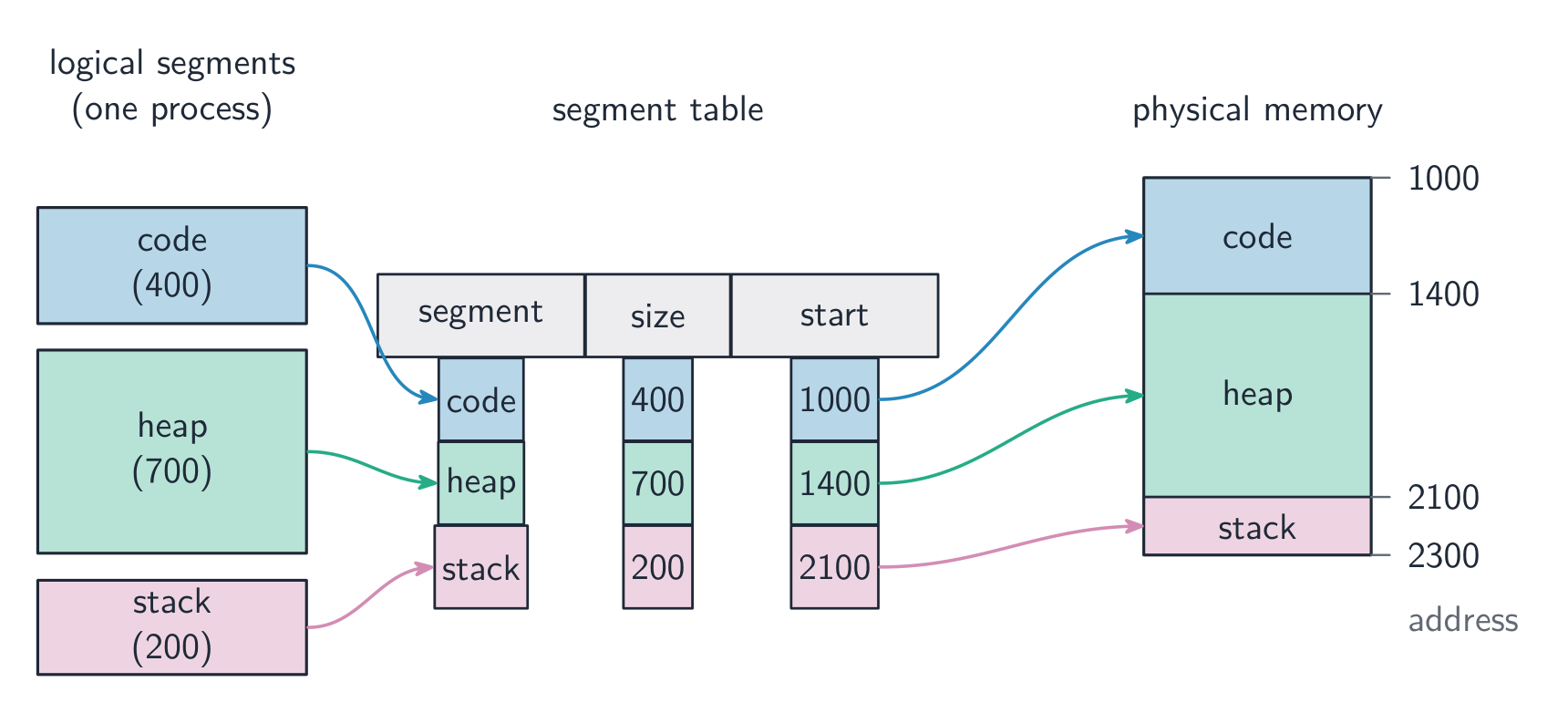
Segmentation maps variable-sized segments using a segment map table ExploreWhat happens on a page fault
Step through a page fault. When the program touches a page that isn't in RAM, the OS quietly fetches it from disk and updates the page table — so the program sees more memory than physically exists.
Vocabulary TrainEnglish Chinese Pinyin virtual address space 虚拟地址空间 xū nǐ dì zhǐ kōng jiān pages 页 yè frames 页框 yè kuāng page fault 缺页 quē yè swap file 交换文件 jiāo huàn wén jiàn thrashing 抖动 dǒu dòng segmentation 分段 fēn duàn 16.2
How an interpreter runs a program
Syllabus
Candidates should be able to: Notes and guidance Show understanding of how an interpreter can execute programs without producing a translated version Show understanding of the various stages in the compilation of a program Including lexical analysis, syntax analysis, code generation and optimisation Show understanding of how the grammar of a language can be expressed using syntax diagrams or Backus-Naur Form (BNF) notation Show understanding of how Reverse Polish Notation (RPN) can be used to carry out the evaluation of expressions Source: Cambridge International syllabus
An interpreter 解释器 translates and runs the source at the same time. For each statement it reads the line, does lexical and syntax analysis, checks types, then executes the action, and moves on. Errors are reported immediately and it usually stops; no executable is produced. The translation is redone every run (slower), but it gives fast development feedback and is portable.
Vocabulary TrainEnglish Chinese Pinyin interpreter 解释器 jiě shì qì 16.2
Stages of compilation

A compiler 编译器 turns source into machine code 机器码 in phases:
- lexical analysis 词法分析 — the lexer groups characters into tokens 词法单元 (keywords, identifiers, operators, literals), discarding whitespace and comments.
- syntax analysis (parsing) 语法分析 — check the tokens fit the grammar and build an abstract syntax tree 抽象语法树. A missing bracket gives a syntax error 语法错误.
- semantic analysis 语义分析 — check the program makes sense (variables declared, types match).
- code generation 代码生成 — walk the tree and emit target code, choosing registers and layouts.
- code optimisation 代码优化 — remove redundant work, fold constants, reorder for the pipeline.
The output is an executable.
The phases of compilation, from source code to an optimised executable ExploreThe phases of compilation
Step through what a compiler does to your source. Each phase hands its output to the next — characters become tokens, tokens become a tree, the tree becomes optimised machine code.
Vocabulary TrainEnglish Chinese Pinyin compiler 编译器 biān yì qì machine code 机器码 jī qì mǎ lexical analysis 词法分析 cí fǎ fēn xī tokens 词法单元 cí fǎ dān yuán syntax analysis (parsing) 语法分析 yǔ fǎ fēn xī abstract syntax tree 抽象语法树 chōu xiàng yǔ fǎ shù syntax error 语法错误 yǔ fǎ cuò wù semantic analysis 语义分析 yǔ yì fēn xī code generation 代码生成 dài mǎ shēng chéng code optimisation 代码优化 dài mǎ yōu huà 16.2
Grammar: BNF and syntax diagrams
A grammar 文法 says which token sequences are valid programs.
Backus-Naur Form 巴科斯-诺尔范式 (BNF) is textual. A production rule 产生式 has the form:
<symbol> ::= alternative1 | alternative2 | ...Each alternative is a sequence of terminal 终结符 symbols (literal text) and non-terminal 非终结符 symbols (other rule names):
<digit>      ::= 0 | 1 | 2 | 3 | 4 | 5 | 6 | 7 | 8 | 9
<identifier> ::= <letter> | <identifier> <letter> | <identifier> <digit>
The recursive third rule expresses "a letter followed by any number of letters or digits". An
IFstatement:<if-statement> ::= IF <condition> THEN <statement> ENDIF | IF <condition> THEN <statement> ELSE <statement> ENDIFA syntax diagram 语法图 (railroad diagram) shows the same thing graphically: boxes for non-terminals, rounded boxes for terminals, arrows for valid paths, loops for repetition. The two notations are equivalent. The parser uses the grammar to decide whether a program is valid.
A syntax (railroad) diagram for an assignment statement Vocabulary TrainEnglish Chinese Pinyin grammar 文法 wén fǎ Backus-Naur Form 巴科斯-诺尔范式 bā kē sī - nuò ěr fàn shì production rule 产生式 chǎn shēng shì terminal 终结符 zhōng jié fú non-terminal 非终结符 fēi zhōng jié fú syntax diagram 语法图 yǔ fǎ tú 16.2
Reverse Polish Notation (RPN)
In infix 中缀 notation the operator sits between its operands (
3 + 4 * 2), needing brackets and precedence rules. In Reverse Polish Notation 逆波兰表示法 (RPN, postfix 后缀) the operator follows its operands (3 4 2 * +), needing no brackets.Converting infix to RPN
Use an operator stack 栈. Scan left to right: output an operand; for an operator, first pop any stacked operators of higher or equal precedence 优先级 to the output, then push it; push
(; on)pop to output until the matching(. At the end, pop all operators. Example:(3 + 4) * 2→3 4 + 2 *.Evaluating RPN
Use a stack of operands. Scan left to right: push each operand; on an operator, pop the top two, apply it, and push the result. Evaluating
3 4 2 * +:Token Stack 33 43, 4 23, 4, 2 *3, 8 +11 Result: 11. RPN needs no brackets at evaluation time and suits a stack machine — which is how the JVM and many bytecode 字节码 interpreters work.
Worked example. Convert $(A + B) \times (C - D)$ to RPN, then evaluate $(3 + 4) \times (5 - 2)$. Scan left to right using an operator stack. Push
(; outputA; push+; outputB; on)pop back to the matching(, givingA B +so far. Push×, and the second bracket behaves the same way, givingC D -. At the end pop the×. Result:A B + C D - ×. To evaluate the numbers, use a stack of operands: push 3, push 4;+pops both and pushes 7; push 5, push 2;-pops both and pushes 3;×pops 7 and 3 and pushes 21. Two things make these reliable: the operands keep their original order through the conversion (only the operators move), and every operator acts on the two values immediately below it on the stack.ExploreOperator precedence — what RPN removes
In ordinary infix maths × and ÷ bind tighter than + and −, so you must apply rules in the right order. Reverse Polish Notation writes the operands first (3 4 2 × + 1 −), fixing the order so no precedence rules are needed.
Vocabulary TrainEnglish Chinese Pinyin infix 中缀 zhōng zhuì Reverse Polish Notation 逆波兰表示法 nì bō lán biǎo shì fǎ postfix 后缀 hòu zhuì stack 栈 zhàn precedence 优先级 yōu xiān jí bytecode 字节码 zì jié mǎ 16.2
Exam tips
- List the stages of compilation (lexical, syntax and semantic analysis, code generation, optimisation) and what each does.
- Explain virtual memory and paging (disk used as extra RAM) and its cost (disk thrashing).
- Evaluate Reverse Polish Notation with a stack — no brackets are needed.
- Use BNF or a syntax diagram to test whether a string is valid.
-
17
Security
17.1
How encryption works

Syllabus
Candidates should be able to: Notes and guidance Show understanding of how encryption works Including the use of public key, private key, plain text, cipher text, encryption, symmetric key cryptography and asymmetric key cryptography How the keys can be used to send a private message from the public to an individual/organisation How the keys can be used to send a verified message to the public How data is encrypted and decrypted, using symmetric and asymmetric cryptography Purpose, benefits and drawbacks of quantum cryptography Show awareness of the Secure Socket Layer (SSL) / Transport Layer Security (TLS) Purpose of SSL/TLS Use of SSL/TLS in client-server communication Situations where the use of SSL/TLS would be appropriate Show understanding of digital certification How a digital certificate is acquired How a digital certificate is used to produce digital signatures Source: Cambridge International syllabus
Encryption 加密 turns readable plaintext 明文 (plain text) into unreadable ciphertext 密文 (cipher text) using a maths operation that depends on a key. Only someone with the right key can reverse it — decryption 解密 — to get the plaintext back. An attacker who intercepts the ciphertext without the key sees only meaningless data, because trying every possible key would take far too long. A newer approach, quantum cryptography 量子密码学, uses quantum physics to share a key in a way that reveals any eavesdropper.
The Enigma machine encrypted messages in the Second World War — an early, mechanical cipher device 
Encryption scrambles plaintext with a key; decryption reverses it Symmetric encryption
Symmetric encryption 对称加密 (symmetric key cryptography) uses the same key for both encryption and decryption, so sender and receiver must both hold the secret key. It is fast and good for bulk data (a whole disk, a video stream). Its problem is key distribution 密钥分发: how do you share the key safely in the first place? Asymmetric encryption solves this.
Symmetric encryption uses the same secret key at both ends Asymmetric encryption (public-key)
Asymmetric encryption 非对称加密 (asymmetric key cryptography) gives each user a pair of related keys: a public key 公钥 they publish, and a private key 私钥 they keep secret. Data encrypted with the public key can be decrypted only with the matching private key, and vice versa.

Each user has a public key to share and a private key to keep secret To send a secret message to Alice: get her published public key, encrypt with it, and send. Only Alice — holding the matching private key — can decrypt. No prior key exchange is needed. The trade-off is that it is much slower than symmetric, so it is not used for large data.
A private key must stay secret, so it is sometimes kept on a small hardware security key 硬件安全密钥. You plug it in or tap it to prove who you are, and the secret key never leaves the device.
A hardware security key stores a secret key to prove who you are Hybrid approach (used by almost every real system)
Use asymmetric encryption to exchange a fresh session key 会话密钥, then use that symmetric key for the data:
- the client makes a random session key.
- it encrypts the session key with the server's public key.
- the server decrypts it with its private key.
- both ends now share the session key and use fast symmetric encryption for the rest.
This is how HTTPS and SSH work.

The hybrid approach: asymmetric crypto shares a session key once, then fast symmetric encryption protects the data Hashing (related, not encryption)
A cryptographic hash 密码散列 function takes any input and gives a fixed-size digest 摘要 such that the same input always gives the same digest, it is infeasible to find two inputs with the same digest, and a tiny change in input changes the digest completely. Hashing is one-way — you cannot get the input back. It is used for storing password checks, integrity 完整性 checks, and digital signatures.

A cryptographic hash gives a fixed digest; a tiny input change changes it completely, and it cannot be reversed ExploreHashing and the avalanche effect
A hash is one-way: easy to compute, practically impossible to reverse. A tiny change in the input flips a large, unpredictable part of the output — the avalanche effect that makes hashes good for passwords.
ExploreThe Caesar cipher
Shift each letter to encrypt the message. A simple cipher shows the idea of a key — and why a small key is easy to break.
Vocabulary TrainEnglish Chinese Pinyin encryption 加密 jiā mì plaintext 明文 míng wén ciphertext 密文 mì wén decryption 解密 jiě mì symmetric encryption 对称加密 duì chèn jiā mì key distribution 密钥分发 mì yào fēn fā asymmetric encryption 非对称加密 fēi duì chèn jiā mì public key 公钥 gōng yào private key 私钥 sī yào hardware security key 硬件安全密钥 yìng jiàn ān quán mì yào session key 会话密钥 huì huà mì yào cryptographic hash 密码散列 mì mǎ sàn liè digest 摘要 zhāi yào integrity 完整性 wán zhěng xìng quantum cryptography 量子密码学 liàng zǐ mì mǎ xué 17.1
SSL / TLS
TLS 传输层安全 (Transport Layer Security, the successor to the Secure Socket Layer, SSL) is a protocol that gives encryption and authentication for data sent over a network. It encrypts the data in transit, authenticates the server with a certificate, and provides integrity (detecting tampering).
Outline of a TLS handshake:
- the client connects and proposes cipher options.
- the server picks one and sends its digital certificate (with its public key) — issuing and validating these certificates is digital certification.
- the client checks the certificate.
- the two ends exchange a fresh session key using asymmetric crypto.
- all later traffic uses fast symmetric encryption with the session key.
The result is an encrypted, authenticated, integrity-checked tunnel for higher-level protocols (HTTP, SMTP). It is appropriate wherever sensitive information is sent: HTTPS web browsing, online banking and payments, secure email, and VPNs.
ExploreThe TLS handshake
Step through what happens before a padlock appears. The slow public-key crypto is used only to agree a shared key; the actual page then travels under fast symmetric encryption.
Vocabulary TrainEnglish Chinese Pinyin TLS 传输层安全 chuán shū céng ān quán 17.1
Digital certificates
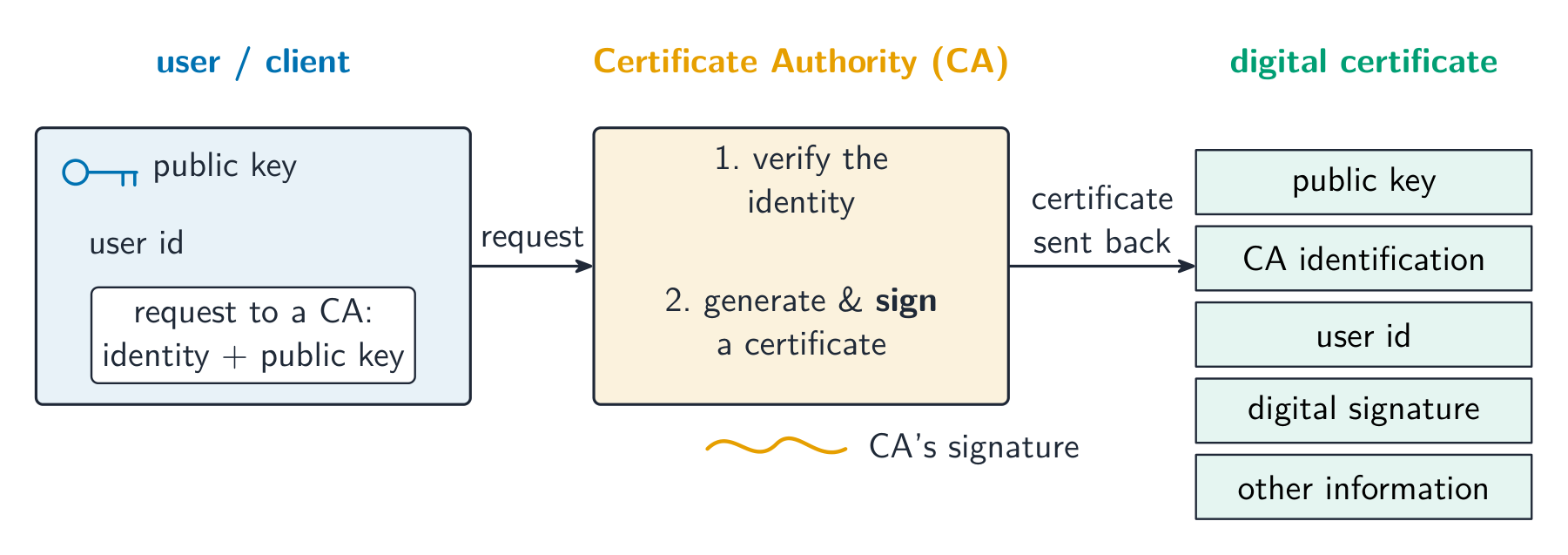
A digital certificate 数字证书 binds an identity (a domain, an organisation) to a public key, and is signed by a trusted Certificate Authority 证书颁发机构 (CA). It contains the subject (who it identifies), the subject's public key, the issuer (the CA), a validity period, and the CA's signature over all of it.
A Certificate Authority issues a digital certificate binding an identity to a public key To verify one, the client (which holds a list of trusted root CAs):
- checks the expiry dates.
- checks the subject name matches the URL.
- checks it is signed by a trusted CA, using the CA's public key to verify the signature.
- follows the certificate chain up to a trusted root.
If anything fails, the browser shows the "Your connection is not private" warning. When it verifies cleanly, the client knows the identity was vetted by a trusted CA, the public key really belongs to that identity, and the certificate is current.
Vocabulary TrainEnglish Chinese Pinyin digital certificate 数字证书 shù zì zhèng shū Certificate Authority 证书颁发机构 zhèng shū bān fā jī gòu 17.1
Digital signatures
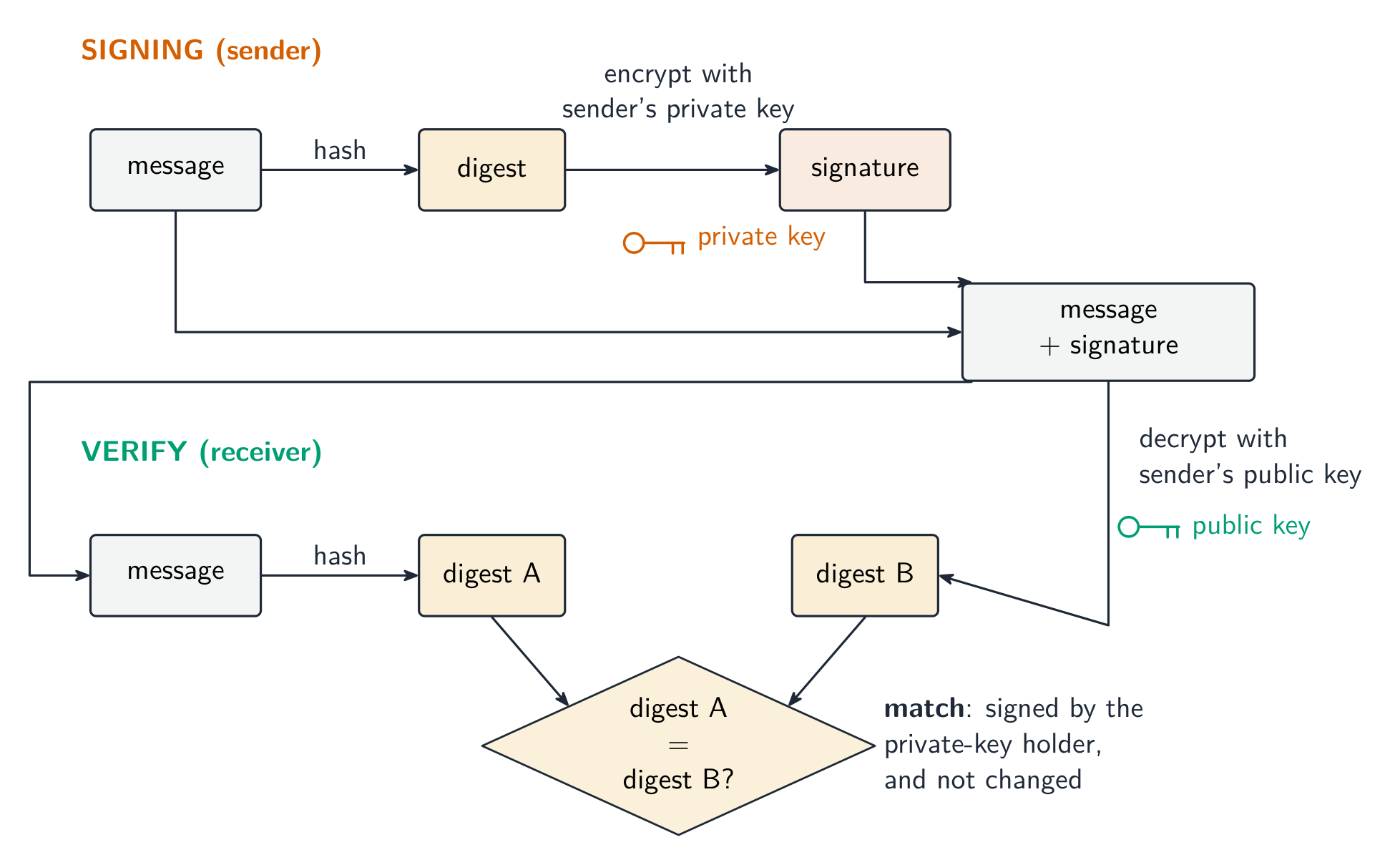
A digital signature 数字签名 proves who signed a message and that it was not changed. To sign:
- compute a cryptographic hash of the message.
- encrypt the hash with the sender's private key — that is the signature.
- send the message and the signature.
To verify: compute the hash of the received message; decrypt the signature with the sender's public key to get the sender's hash; compare. If they match, the message was signed by the holder of the private key (authentication 身份验证) and was not changed (integrity). A signature does not hide the message — for confidentiality as well, encrypt and sign.
Signing hashes the message and encrypts the digest with the private key; the receiver checks it with the public key Putting it together
A secure request to
https://www.bank.com: the server sends its certificate; the client verifies it against trusted CAs; the client uses the server's public key to exchange a session key; then data flows encrypted with that key. Encryption stops eavesdroppers, the certificate proves the server's identity, and integrity checks stop a man-in-the-middle 中间人攻击 altering the data.Worked example. Alice sends Bob a contract. She wants Bob to be certain it came from her and was not altered, and she wants nobody else to be able to read it. Which keys does she use, and in which direction? These are two different jobs needing two different key pairs. For the signature (authentication and integrity): Alice hashes the contract and encrypts that hash with her own private key; Bob decrypts it with Alice's public key and compares it against his own hash of the message. Only Alice holds her private key, so only she could have produced it. For confidentiality: Alice encrypts the contract itself with Bob's public key, so only Bob's private key can open it. One rule keeps all four straight: you sign with your own private key and encrypt with the recipient's public key. A signature on its own does not hide the message.
Vocabulary TrainEnglish Chinese Pinyin digital signature 数字签名 shù zì qiān míng authentication 身份验证 shēn fèn yàn zhèng man-in-the-middle 中间人攻击 zhōng jiān rén gōng jī 17.1
Exam tips
- Distinguish symmetric encryption (one shared key, fast) from asymmetric (a public/private key pair).
- Explain the TLS handshake and why a digital certificate from a CA proves identity.
- Explain a digital signature: hash the message, then encrypt the hash with the private key — it proves integrity and origin.
-
18
Artificial Intelligence (AI)
18.1
What AI is

Syllabus
Candidates should be able to: Notes and guidance Show understanding of how graphs can be used to aid Artificial Intelligence (AI) Purpose and structure of a graph Use A algorithm* and Dijkstra’s algorithm to perform searches on a graph Candidates will not be required to write algorithms to set up, access, or perform searches on graphs Show understanding of how artificial neural networks have helped with machine learning Show understanding of Deep Learning, Machine Learning and Reinforcement Learning and the reasons for using these methods. Understand machine learning categories, including supervised learning, unsupervised learning Show understanding of back propagation of errors and regression methods in machine learning Source: Cambridge International syllabus
Artificial intelligence 人工智能 (AI) builds systems that do tasks normally needing human intelligence — recognising speech and images, translating, playing games, driving, generating text. Most modern AI uses machine learning 机器学习 — algorithms that learn patterns from data instead of being programmed step by step. Within it, deep learning 深度学习, using neural networks 神经网络 with many layers, has been dominant since the 2010s.
A humanoid robot 人形机器人 puts many of these abilities into one body: it uses AI to see faces, understand speech and move its face and arms in a lifelike way.
A humanoid robot uses AI to see, listen and respond like a person 
Deep learning is part of machine learning, which is part of AI ExploreAI learning type lab
Classify AI examples by the type of learning or concern involved.
Vocabulary TrainEnglish Chinese Pinyin artificial intelligence 人工智能 rén gōng zhì néng machine learning 机器学习 jī qì xué xí deep learning 深度学习 shēn dù xué xí neural networks 神经网络 shén jīng wǎng luò humanoid robot 人形机器人 rén xíng jī qì rén 18.1
Graphs in AI
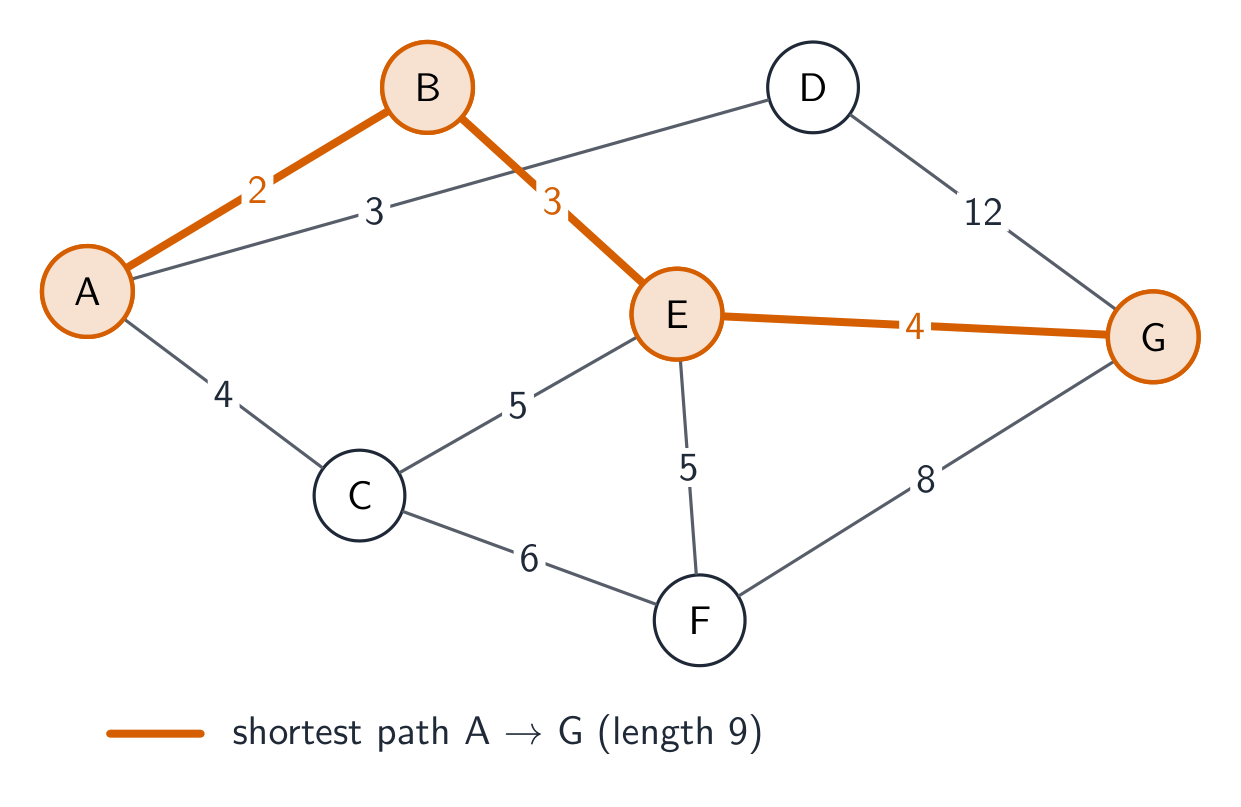
Many AI problems sit on a graph 图 — nodes 节点 (states, places) joined by edges 边 (moves, relationships).
- pathfinding: roads form a graph; the shortest route is a graph search (Dijkstra's algorithm, the A* algorithm).
- game playing: each board position is a node, each move an edge; minimax 极小化极大 with alpha-beta pruning searches the game tree.
- state-space search: a planning problem is moving between states by applying operators to reach a goal.
- knowledge representation: a semantic network 语义网络 has concepts as nodes and relationships as edges ("dog IS-A animal"); a knowledge graph 知识图谱 stores facts about the world for search engines and assistants.
AI problems often sit on a graph; here the shortest path is highlighted Standard tools for navigating graphs include breadth-first search 广度优先搜索 and depth-first search 深度优先搜索.
Vocabulary TrainEnglish Chinese Pinyin graph 图 tú nodes 节点 jié diǎn edges 边 biān minimax 极小化极大 jí xiǎo huà jí dà semantic network 语义网络 yǔ yì wǎng luò knowledge graph 知识图谱 zhī shí tú pǔ breadth-first search 广度优先搜索 guǎng dù yōu xiān sōu suǒ depth-first search 深度优先搜索 shēn dù yōu xiān sōu suǒ 18.1
Artificial neural networks (ANNs)
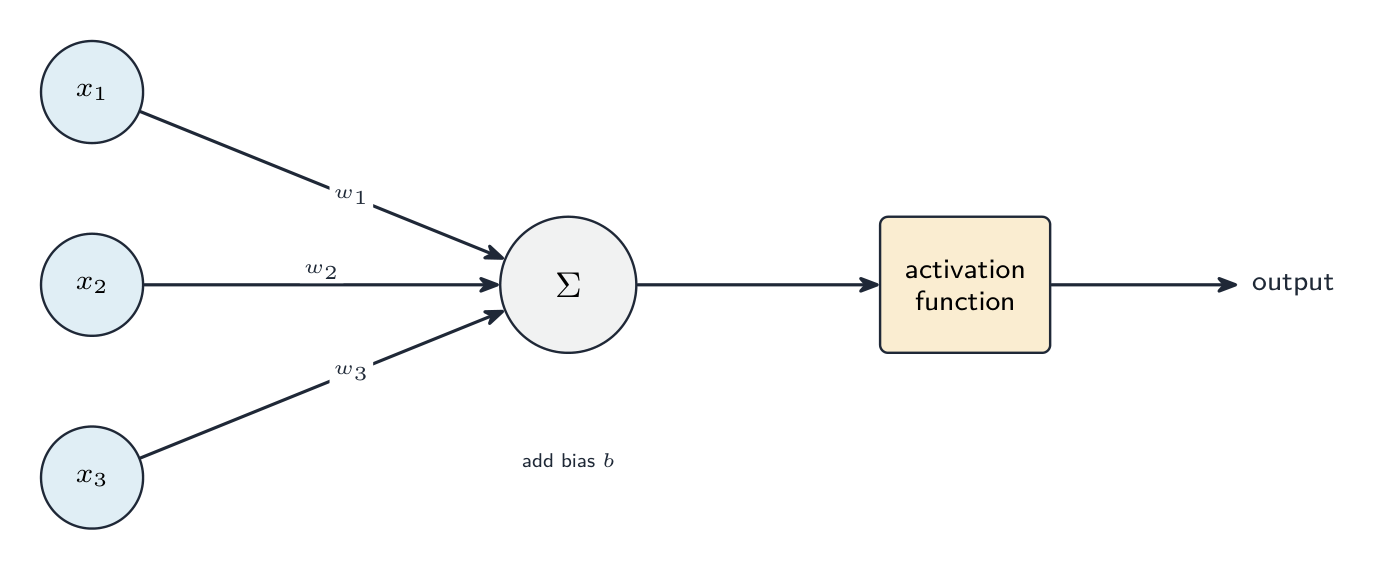
An ANN is inspired by the brain's neurons. An artificial neuron 人工神经元:
- takes several input values, multiplies each by a weight 权重, and adds them up with a bias term 偏置项.
- applies an activation function 激活函数 (a non-linear function such as ReLU) to the sum.
- outputs the result, which feeds neurons further on.
A single neuron: each input times its weight, summed with a bias, then an activation function Neurons sit in layers: an input layer, one or more hidden layers 隐藏层 (where useful internal patterns are learned), and an output layer. With many hidden layers it is a deep neural network 深度神经网络, and training it is deep learning.
A neural network with an input layer, two hidden layers and an output layer ANNs let models learn complex patterns straight from raw data (pixels, audio, text) without hand-designed features — driving breakthroughs in image recognition 图像识别, speech recognition 语音识别, machine translation 机器翻译, and game playing. They do well with large amounts of data, noisy or very complex input, and patterns too hard to capture with explicit rules.
ExploreTap the parts of a neural network
Explore the layers. Data flows left to right: the input layer takes the features, the hidden layers learn patterns, and the output layer gives the answer — with every connection carrying a weight that training adjusts.
Vocabulary TrainEnglish Chinese Pinyin artificial neuron 人工神经元 rén gōng shén jīng yuán weight 权重 quán zhòng bias term 偏置项 piān zhì xiàng activation function 激活函数 jī huó hán shù hidden layers 隐藏层 yǐn cáng céng deep neural network 深度神经网络 shēn dù shén jīng wǎng luò image recognition 图像识别 tú xiàng shí bié speech recognition 语音识别 yǔ yīn shí bié machine translation 机器翻译 jī qì fān yì 18.1
Machine learning, deep learning, reinforcement learning

Machine learning
The umbrella term — any algorithm that learns from data. Three paradigms:
- supervised learning 监督学习 — the data has labels 标签 (images tagged "cat"/"dog"); the algorithm learns input → label. Used for classification 分类 (a category) and regression.
- unsupervised learning 无监督学习 — no labels; the algorithm finds structure, e.g. a cluster 聚类 of similar customers.
- reinforcement learning (below).
Use ML when explicit rules would be impractical (spam filters, recommendations, fraud detection).
Supervised learning: a model is trained on labelled data, then recognises new data Deep learning
A subset of ML using deep neural networks. Lower layers learn simple patterns (edges, phonemes), higher layers combine them into abstract concepts. It needs lots of data and lots of compute (GPUs); for small datasets, simpler ML methods often do better.
Reinforcement learning
In reinforcement learning 强化学习, an agent 智能体 acts in an environment; each action changes the state and returns a reward 奖励. The agent learns a policy 策略 (a strategy) that maximises the total reward over time, by trial and error with no labels up front. Used for sequential-decision problems — games, robot control, autonomous driving.
Reinforcement learning: the agent acts, the environment returns a new state and a reward, and the agent learns from it A self-driving car 自动驾驶汽车 is a real example. Lidar 激光雷达 and camera sensors (the spinning unit on the roof) build a live picture of the road, and a learned policy decides how to steer, speed up and brake safely.

A self-driving car uses cameras and lidar sensors to see the road around it 
Industrial robot arms on a production line: reinforcement learning can teach a robot to control its movements Vocabulary TrainEnglish Chinese Pinyin supervised learning 监督学习 jiān dū xué xí labels 标签 biāo qiān classification 分类 fēn lèi unsupervised learning 无监督学习 wú jiān dū xué xí cluster 聚类 jù lèi reinforcement learning 强化学习 qiáng huà xué xí agent 智能体 zhì néng tǐ reward 奖励 jiǎng lì policy 策略 cè lüè self-driving car 自动驾驶汽车 zì dòng jià shǐ qì chē lidar 激光雷达 jī guāng léi dá 18.1
Training an ANN: backpropagation

Training adjusts the weights so outputs match the targets. The standard method is backpropagation 反向传播 (back propagation of errors) with gradient descent 梯度下降. For each training example:
- forward pass — feed the input through to the output.
- compute the error with a loss function 损失函数 (a single number for how wrong the output is).
- backward pass — propagate the error backwards, finding each weight's gradient (how much it contributed to the error) using the chain rule.
- update the weights by a small step (set by the learning rate 学习率) that reduces the error.
Repeat over many examples and many passes (epochs 训练轮次) until the error stops shrinking. The name "back" comes from step 3: the error flows from the output back towards the input, so every weight's gradient is found in one sweep. After training, a new input needs only one forward pass to get a prediction.
Training adjusts the weights to reach the minimum error Vocabulary TrainEnglish Chinese Pinyin backpropagation 反向传播 fǎn xiàng chuán bō gradient descent 梯度下降 tī dù xià jiàng loss function 损失函数 sǔn shī hán shù learning rate 学习率 xué xí lǜ epochs 训练轮次 xùn liàn lún cì 18.1
Regression

Some tasks predict a number (a house price, tomorrow's temperature) — regression 回归, as opposed to classification (a category).
Linear regression 线性回归 fits a straight line (or hyperplane):
$$y = m_{1} x_{1} + m_{2} x_{2} + \ldots + m_{n} x_{n} + c.$$Choose the coefficients to minimise the sum of squared errors against the training data. Use it when the relationship looks roughly linear and you want an interpretable model. For curved data, use polynomial, decision-tree, or neural-network regression methods — same idea: define a model, define a loss, and adjust the parameters to minimise it. Regression and classification are both supervised; the choice depends on whether the answer is a number or a category.
Linear regression fits the line that makes the total squared error (the dashed gaps) as small as possible ExploreFitting a regression line
Drag the controls. Linear regression draws the straight line that makes the squared distances to the data points as small as possible — then it predicts a number for any new input.
Vocabulary TrainEnglish Chinese Pinyin regression 回归 huí guī linear regression 线性回归 xiàn xìng huí guī 18.1
How AI is used in a real scenario
Many exam scenarios use the same pattern — a deep-learning model trained on labelled data, often several combined into a pipeline:
- customer identification at an automated shop: the system is trained on labelled face images; a camera captures a face; image recognition extracts a representation; it is matched against registered customers; the closest match identifies the person.
- reading text from images: image recognition finds text regions; optical character recognition 光学字符识别 extracts the characters; machine translation converts them; text-to-speech 文本转语音 reads them aloud.
- checkout item-detection: object-detection AI, trained on labelled product images, sees which items go into a basket and charges the account.
By the time a user interacts with the system, the model is fast — it only does forward-pass inference; the intelligence is in the patterns learned during training.
Worked example. For each task, say whether it needs regression or classification, and what the output layer of an ANN would look like: (a) predict tomorrow's temperature; (b) decide whether an email is spam. Ask what kind of thing is being predicted. (a) A temperature is a number on a continuous scale, so this is regression, and the output layer is a single neuron holding that value. (b) Spam or not-spam is a category, so this is classification, and the output gives a probability per class. Both are supervised learning: each needs labelled examples to train on, and training adjusts the weights by backpropagation to reduce the error. The deciding question is simply number-or-category - not how difficult the task feels.
Vocabulary TrainEnglish Chinese Pinyin optical character recognition 光学字符识别 guāng xué zì fú shí bié text-to-speech 文本转语音 wén běn zhuǎn yǔ yīn 18.1
Exam tips
- Distinguish machine learning, deep learning and reinforcement learning with an example of each.
- Describe an ANN (input, hidden and output layers; weighted connections) and how backpropagation adjusts weights to cut error.
- Distinguish supervised vs unsupervised learning; regression predicts a continuous value.
-
19
Computational thinking and Problem-solving
19.1
Searching algorithms

Syllabus
Candidates should be able to: Notes and guidance Show understanding of linear search and binary search methods Write an algorithm to implement a linear search Write an algorithm to implement a binary search The conditions necessary for the use of a binary search How the performance of a binary search varies according to the number of data items Show understanding of insertion sort and bubble sort methods Write an algorithm to implement an insertion sort Write an algorithm to implement a bubble sort Performance of a sorting routine may depend on the initial order of the data and the number of data items Show understanding of and use Abstract Data Types (ADT) Write algorithms to find an item in each of the following: linked list, binary tree Write algorithms to insert an item into each of the following: stack, queue, linked list, binary tree Write algorithms to delete an item from each of the following: stack, queue, linked list Show understanding that a graph is an example of an ADT. Describe the key features of a graph and justify its use for a given situation. Candidates will not be required to write code for a graph structure Show how it is possible for ADTs to be implemented from another ADT Describe the following ADTs and demonstrate how they can be implemented from appropriate built-in types or other ADTs: stack, queue, linked list, dictionary, binary tree Show understanding that different algorithms which perform the same task can be compared by using criteria (e.g. time taken to complete the task and memory used) Including use of Big O notation to specify time and space complexity Source: Cambridge International syllabus
Big O: how algorithms scale Insertion sort: slide each card into place Bubble sort, pass by pass Binary search: halve and conquer A search finds a target value in a collection (often an array 数组) and returns its position, or "not found".
Searching a sorted list, like a phone book, is far faster than checking every entry one by one Linear search
A linear search 线性查找 walks from start to end, comparing each element with the target:
FOR i ← 1 TO n
    IF A[i] = target THEN RETURN i
NEXT i
RETURN -1   // not found
No preparation is needed, so it works on any list. Worst case O($n$) (target at the end or absent); best case 1 comparison. Use it on unsorted data or small lists. (The returned
-1is a sentinel value — an impossible position that means "not found"; the caller testsIF result = -1.)
Linear search checks every letter in turn — 23 comparisons to find W Binary search
A binary search 二分查找 needs the data sorted. Look at the middle element; if it is the target, done; if the target is smaller, search the left half, else the right half — halving the range each time:
low ← 1
high ← n
WHILE low <= high DO
    mid ← (low + high) DIV 2
    IF A[mid] = target THEN RETURN mid
    IF A[mid] < target THEN
        low ← mid + 1
    ELSE
        high ← mid - 1
    ENDIF
ENDWHILE
RETURN -1
Worst case O($\log_{2} n$) — for a million items, about 20 comparisons. Much faster than linear search on large sorted arrays, but you must sort first (a one-off O($n \log n$) cost), worth it if you search many times.
Binary search halves the range each step (low / mid / high) — just 3 comparisons to find W ExploreLinear vs binary search
Search for a value. Binary search halves the list each step (only on sorted data); linear search checks one by one.
Vocabulary TrainEnglish Chinese Pinyin array 数组 shù zǔ linear search 线性查找 xiàn xìng chá zhǎo binary search 二分查找 èr fēn chá zhǎo 19.1
Sorting algorithms
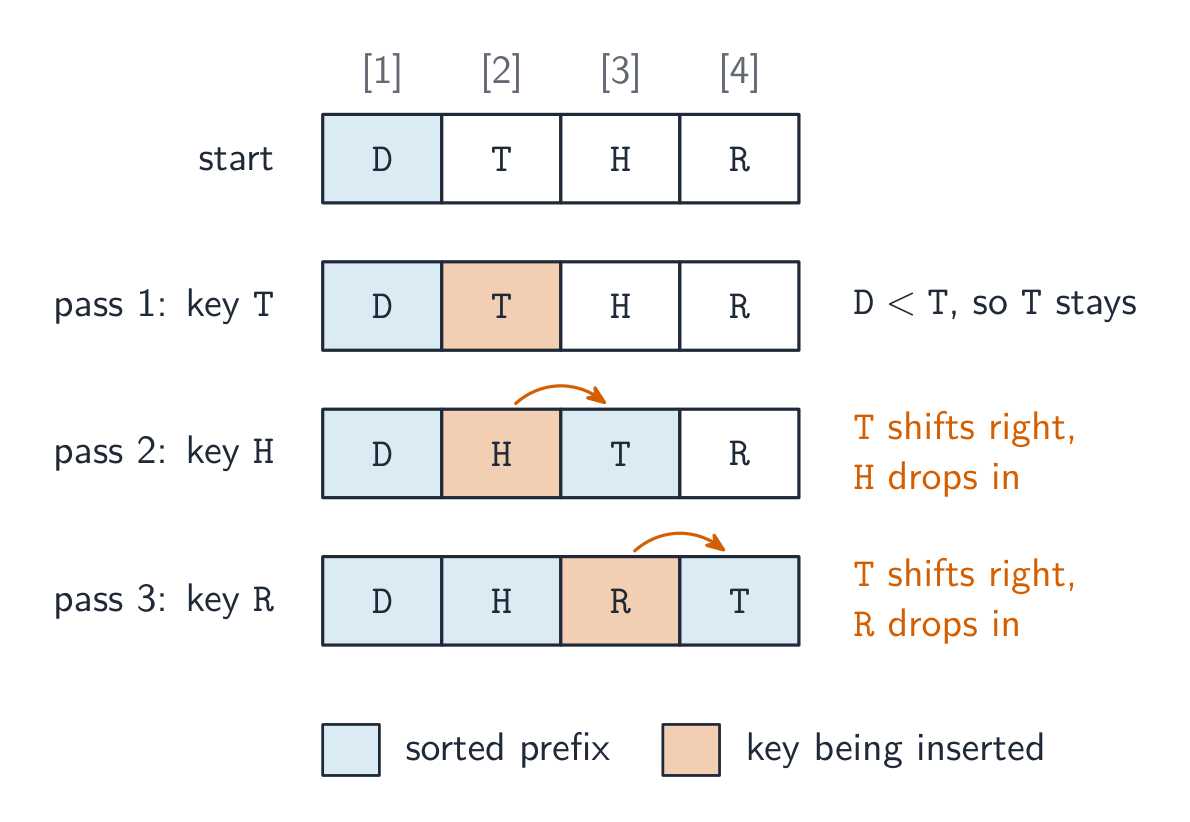
Bubble sort
A bubble sort 冒泡排序 repeatedly walks the array, swapping adjacent pairs that are out of order, so the largest "bubbles" to the end each pass:
FOR pass ← 1 TO n - 1
    swapped ← FALSE
    FOR i ← 1 TO n - pass
        IF A[i] > A[i + 1] THEN
            temp ← A[i]
            A[i] ← A[i + 1]
            A[i + 1] ← temp
            swapped ← TRUE
        ENDIF
    NEXT i
    IF swapped = FALSE THEN EXIT FOR   // already sorted
NEXT pass
Best case O($n$) (already sorted, with the early exit); average/worst O($n^{2}$). Simple but slow for large $n$.
Insertion sort
An insertion sort 插入排序 builds a sorted prefix from the left, inserting each new element into place by shifting larger ones right:
FOR i ← 2 TO n
    key ← A[i]
    j ← i - 1
    WHILE j >= 1 AND A[j] > key DO
        A[j + 1] ← A[j]
        j ← j - 1
    ENDWHILE
    A[j + 1] ← key
NEXT i
Best case O($n$) (already sorted); worst O($n^{2}$). Good for small or nearly-sorted arrays. It sorts in place 原地 and is stable 稳定 (keeps the order of equal elements).
Tracing a sort
A common task is to show the array after each outer pass. For
[D, T, H, R]with insertion sort: pass 1 (key T) no change; pass 2 (key H) →[D, H, T, R]; pass 3 (key R) →[D, H, R, T].An insertion sort of [D, T, H, R], shifting each key into its place pass by passExploreWatch a sort run
Step through a sort and watch the bars settle into order — how a sorting algorithm works pass by pass.
Vocabulary TrainEnglish Chinese Pinyin bubble sort 冒泡排序 mào pào pái xù insertion sort 插入排序 chā rù pái xù in place 原地 yuán dì stable 稳定 wěn dìng 19.1
ADTs in algorithms

The Abstract Data Types (ADTs) from Topic 10 appear inside many algorithms: a stack 栈 drives depth-first traversal and undo; a queue 队列 drives breadth-first traversal and print ordering; a linked list 链表 lets data grow and shrink.
ADTs can be built from other ADTs, not just from arrays: a queue from two stacks; a stack from a linked list (push = prepend a head node 节点); a queue from a linked list with head and tail pointers 指针; a binary tree 二叉树 from nodes with two child pointers; a dictionary 字典 stores key→value pairs (often on a hash table). Layering this way separates concerns — the algorithm using the ADT need not know how it is built.
A binary tree: each node has up to two child nodes 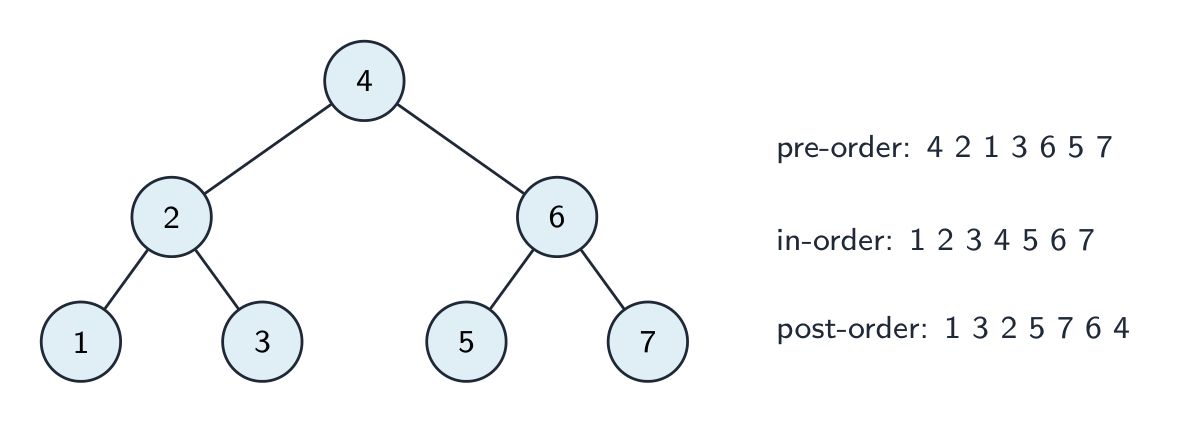
Three depth-first traversals of a binary tree: pre-order, in-order (sorted order) and post-order Vocabulary TrainEnglish Chinese Pinyin stack 栈 zhàn queue 队列 duì liè linked list 链表 liàn biǎo node 节点 jié diǎn pointers 指针 zhǐ zhēn binary tree 二叉树 èr chā shù dictionary 字典 zì diǎn 19.1
Comparing algorithms
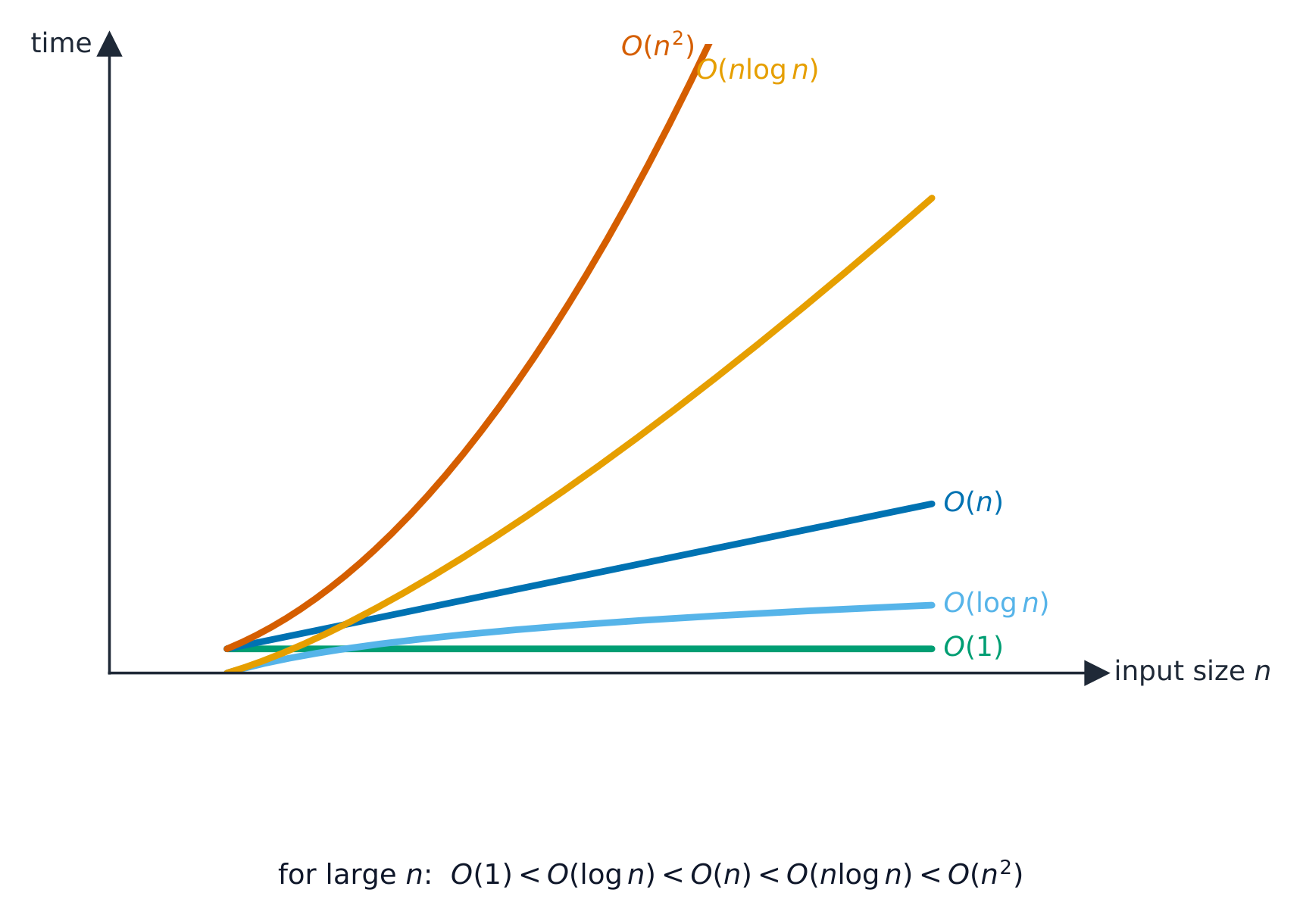
Time complexity
Time complexity 时间复杂度 is how the running time grows with input size $n$, written in Big-O notation 大O表示法 (the dominant term): O(1) constant, O($\log n$) binary search, O($n$) linear search, O($n \log n$) good sorts, O($n^{2}$) bubble/insertion sort. A smaller order is better at scale, even if another algorithm is faster for small $n$.
To make that concrete: to sort a million items, an $O(n \log n)$ sort finishes in a fraction of a second, while an $O(n^{2})$ sort can take minutes.
Worked example. A sorted list holds $1000$ items. How many comparisons does each search need in the worst case?
A linear search checks items one at a time, so it may need up to $1000$ comparisons — this is $O(n)$. A binary search halves the list each step, so it needs at most $\lceil \log_2 1000 \rceil = 10$ comparisons — this is $O(\log n)$. Doubling the list to $2000$ items adds only one comparison to the binary search, but up to another $1000$ to the linear search — which is why the order of growth, not raw speed, decides the winner at scale.
How the common orders of growth compare: a smaller order wins at scale 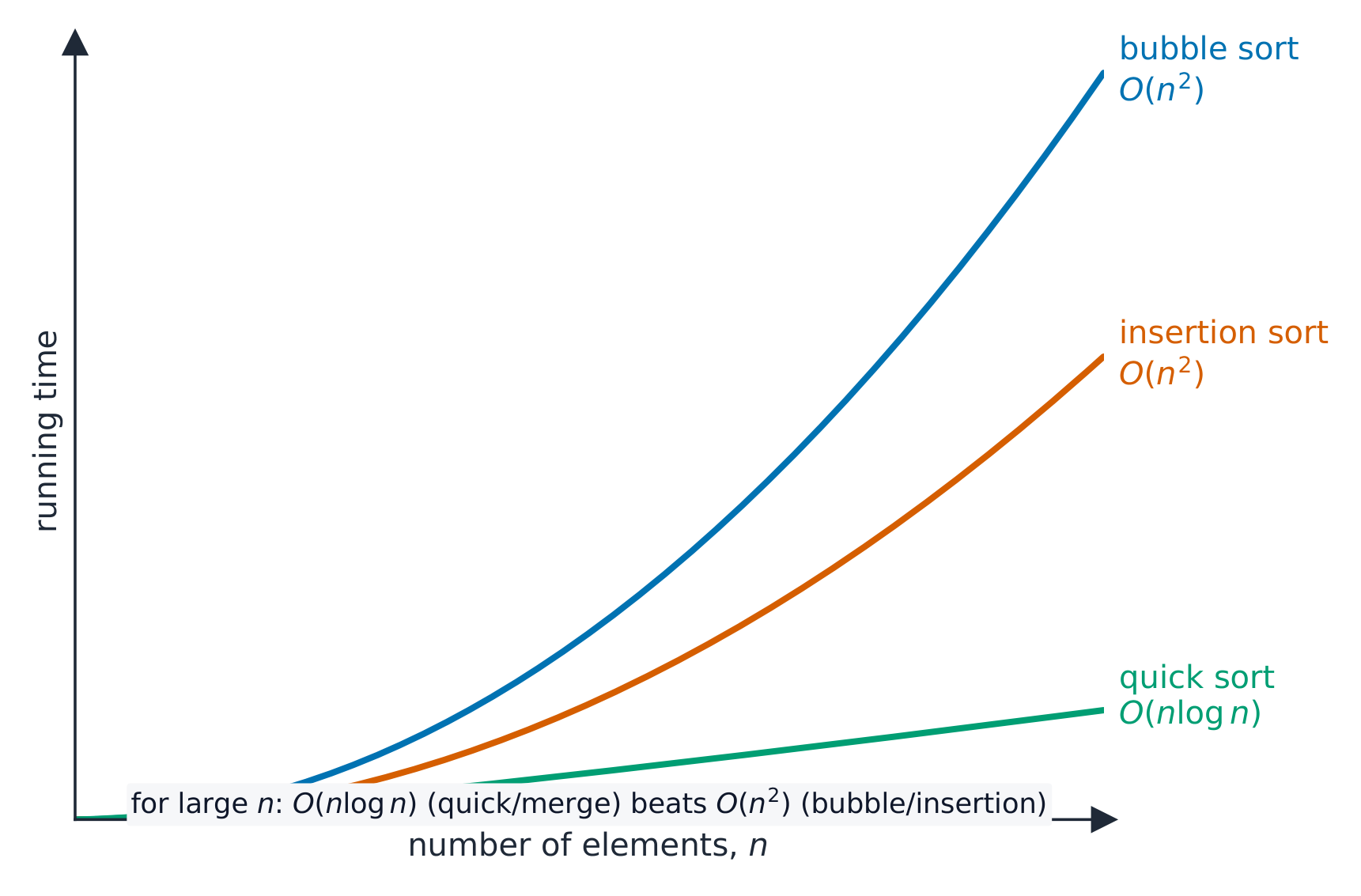
How sorting time grows with the number of elements $n$: $O(n^2)$ sorts climb away from an $O(n\log n)$ sort Space complexity
Space complexity 空间复杂度 is the extra memory needed. Bubble and insertion sort use O(1) extra (in place); merge sort uses O($n$); recursion uses stack memory proportional to its depth. There is often a time–memory trade-off.
Other criteria
Simplicity (easier to code and maintain), stability, and adaptiveness (faster on nearly-sorted data). The right algorithm depends on the data and the constraints.
ExploreHow running time grows with n
Slide n upward and compare the curves: O(1) and O(log n) stay almost flat, O(n) rises steadily, O(n²) explodes. This is why Big-O — not a stopwatch — is how we compare algorithms on large inputs.
ExploreBig-O growth
Change the input size n and compare how fast each algorithm's work grows — the idea behind time complexity.
Vocabulary TrainEnglish Chinese Pinyin time complexity 时间复杂度 shí jiān fù zá dù Big-O notation 大O表示法 dà O biǎo shì fǎ space complexity 空间复杂度 kōng jiān fù zá dù 19.2
Recursion

Syllabus
Candidates should be able to: Notes and guidance Show understanding of recursion Essential features of recursion How recursion is expressed in a programming language Write and trace recursive algorithms When the use of recursion is beneficial Show awareness of what a compiler has to do to translate recursive programming code Use of stacks and unwinding Source: Cambridge International syllabus
Recursion: the call stack winds up and unwinds Recursive algorithms use recursion 递归: the routine calls itself with a smaller version of the same problem, until a base case 基本情形 ends the chain. It has two parts: the base case (small enough to solve directly — without it the recursion never stops) and the recursive case 递归情形 (reduce the input and call itself).
Factorial 阶乘:
FUNCTION Factorial(n : INTEGER) RETURNS INTEGER
    IF n = 0 OR n = 1 THEN
        RETURN 1
    ELSE
        RETURN n * Factorial(n - 1)
    ENDIF
ENDFUNCTION
Recursion is natural for self-similar problems: trees, divide-and-conquer 分治 (binary search, merge sort), and nested data. When it is a poor fit, a loop is usually cleaner.
Tracing a recursive call
For
Factorial(4): the calls go down toFactorial(1)=1, then unwinding multiplies back up:2*1=2,3*2=6,4*6=24. Final result24. Track each pending call on a stack.Recursion uses the call stack: calls push frames down to the base case, then returns unwind back up Risks
- infinite recursion if the base case is missed — crashes with a stack overflow 栈溢出.
- high memory use for deep recursion.
- slow if it repeats work (naive Fibonacci is exponential — use a loop or memoisation 记忆化).
ExploreRecursion unwinds from the leaves up
Step through fib(4) in the order the calls actually finish: the leaves (base cases) resolve first, then each parent combines its children. Notice fib(2) is computed twice — that repeated work is why naive recursion is slow.
Vocabulary TrainEnglish Chinese Pinyin recursion 递归 dì guī base case 基本情形 jī běn qíng xíng recursive case 递归情形 dì guī qíng xíng factorial 阶乘 jiē chéng divide-and-conquer 分治 fēn zhì stack overflow 栈溢出 zhàn yì chū memoisation 记忆化 jì yì huà 19.2
What the compiler does for recursive code
Recursion needs each call to have its own copy of its parameters 参数 and local variables 局部变量. The compiler keeps these on the call stack 调用栈. For each call it pushes a stack frame 栈帧 holding the parameters, the local variables, and the return address 返回地址 (where to resume in the caller). When the function returns, the return value is handed back, the frame is popped, and control resumes at the return address.
Because each call has its own frame, recursive calls don't trample each other's variables. The stack can grow large for deep recursion, which is why very deep recursion may overflow it. This is the same call-and-return mechanism used for ordinary (non-recursive) calls — there is no special "recursion mechanism".
Vocabulary TrainEnglish Chinese Pinyin parameters 参数 cān shù local variables 局部变量 jú bù biàn liàng call stack 调用栈 diào yòng zhàn stack frame 栈帧 zhàn zhēn return address 返回地址 fǎn huí dì zhǐ 19.2
Exam tips
- Match each algorithm to its Big-O: linear search $O(n)$, binary search $O(\log n)$, bubble/insertion $O(n^2)$, good sorts $O(n \log n)$.
- Binary search needs a sorted list and halves the search space each step.
- A recursive routine needs a base case and a call to itself; explain how deep recursion overflows the call stack.
- Trace a sort or search with a table when asked, showing each pass.
-
20
Further Programming
20.1
Programming paradigms

Syllabus
Candidates should be able to: Notes and guidance Understanding what is meant by a programming paradigm Show understanding of the characteristics of a number of programming paradigms: • Low-level Low-level Programming: • understanding of and ability to write low-level code that uses various addressing modes: immediate, direct, indirect, indexed and relative • Imperative (Procedural) Imperative (Procedural) programming: • Assumed knowledge and understanding of Structural Programming (see details in AS content section 11.3) • understanding of and ability to write imperative (procedural) programming code that uses variables, constructs, procedures and functions. See details in AS content • Object Oriented Object-Oriented Programming (OOP): • understanding of the terminology associated with OOP (including objects, properties/attributes, methods, classes, inheritance, polymorphism, containment (aggregation), encapsulation, getters, setters, instances) • understanding of how to solve a problem by designing appropriate classes • understanding of and ability to write code that demonstrates the use of OOP • Declarative Declarative programming: • understanding of and ability to solve a problem by writing appropriate facts and rules based on supplied information • understanding of and ability to write code that can satisfy a goal using facts and rules Source: Cambridge International syllabus
A programming paradigm 编程范式 is a style of programming — a way of structuring programs, with its own ideas and language features. Four programming paradigms are in this syllabus.
Four paradigms: low-level, imperative, object-oriented and declarative Low-level programming
Programming close to the hardware in machine code 机器码 or assembly language 汇编语言, where each instruction maps to what the CPU runs. It gives direct access to registers 寄存器 and memory addresses 内存地址, using different addressing modes 寻址方式 (immediate, direct, indirect, indexed and relative). It is very fast and compact, but architecture-specific, tedious, and hard to maintain. This is low-level 低级 programming, used for device drivers, firmware and bootloaders.
Imperative (procedural) programming
In imperative programming 命令式编程 the programmer writes a sequence of commands that change the program's state — assignments, conditionals, loops, function calls. Variables 变量 hold state; statements change it; code is organised into procedures and functions (also called structured or structural programming). This is the style of Topics 9 and 11 (Python, C). Strong when the algorithm has clear sequential steps.
Object-oriented programming (OOP)
In object-oriented programming 面向对象编程 programs are built from objects 对象 — units combining data (attributes 属性) and operations (methods 方法). Objects are instances 实例 of classes 类. The four pillars:
- encapsulation 封装 — an object's data is hidden behind its methods; outside code uses the public methods only, not the data directly. This protects the object and lets its internals change without breaking callers. For example, a
BankAccounthides itsbalance; you change it only throughdeposit()andwithdraw(), which can enforce a rule like "never go below zero". - inheritance 继承 — a subclass 子类 specialises a superclass 父类, inheriting its attributes and methods and adding or overriding 重写 them. Models "is-a" ("a Manager is an Employee").
- polymorphism 多态 — different objects respond to the same method call differently; the caller need not know the exact type. Every
ShapehasArea(), and aCircleand aRectangleeach implement it their own way. - abstraction 抽象 — show a simple interface and hide the implementation.
Other terms:
- a constructor 构造函数 is a special method run when an object is created, to set up its attributes.
- getters and setters read and write an object's attributes (its properties) through methods.
- aggregation 聚合 and containment 包含 build an object from other objects (a "has-a" relationship).
OOP is used for large systems, GUIs, simulations and games.
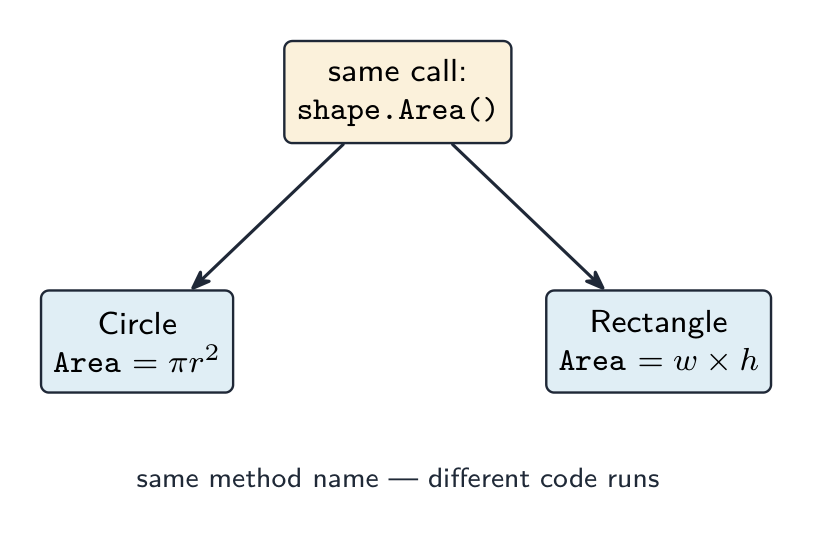
Polymorphism: the same method call runs each object's own code 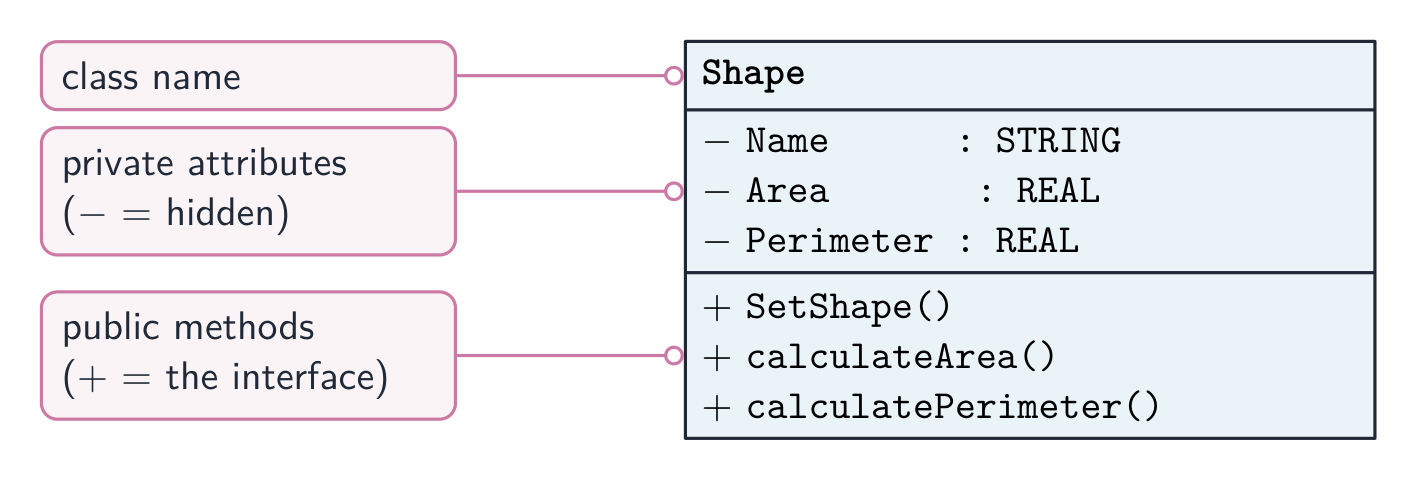
A class diagram for a Shape: private attributes and public methods 
Inheritance: partTime and fullTime are subclasses of employee 
Encapsulation: an object's data is private, reached only through its public methods Declarative programming
In declarative programming 声明式编程 you say what to compute, not how — the runtime works out the steps. Two kinds:
- functional programming 函数式编程 — built from pure functions 纯函数 (no side effects 副作用; same input always gives the same output) composed together. Examples: Haskell, Lisp.
- logic programming 逻辑编程 — state facts and rules; the engine answers a goal (query) by inference. Example: Prolog.
A familiar declarative example is SQL 结构化查询语言:
SELECT * FROM Customer WHERE Country = 'UK'says what you want, not how to walk the records.Comparing paradigms
Paradigm Strength Typical languages Low-level maximum control, speed assembly Imperative direct, intuitive C, Python Object-oriented modular, models entities Java, C#, Python Functional clear, no side effects Haskell, F# Logic inference, rules Prolog Database data queries SQL Modern languages often mix paradigms — Python supports all of procedural, OOP and functional. The right one depends on the problem.
ExploreProgramming concept lab
Connect examples to the programming idea they show.
Vocabulary TrainEnglish Chinese Pinyin programming paradigm 编程范式 biān chéng fàn shì machine code 机器码 jī qì mǎ assembly language 汇编语言 huì biān yǔ yán registers 寄存器 jì cún qì memory addresses 内存地址 nèi cún dì zhǐ low-level 低级 dī jí imperative programming 命令式编程 mìng lìng shì biān chéng variables 变量 biàn liàng object-oriented programming 面向对象编程 miàn xiàng duì xiàng biān chéng objects 对象 duì xiàng attributes 属性 shǔ xìng methods 方法 fāng fǎ instances 实例 shí lì classes 类 lèi encapsulation 封装 fēng zhuāng inheritance 继承 jì chéng subclass 子类 zi lèi superclass 父类 fù lèi overriding 重写 zhòng xiě polymorphism 多态 duō tài abstraction 抽象 chōu xiàng constructor 构造函数 gòu zào hán shù declarative programming 声明式编程 shēng míng shì biān chéng functional programming 函数式编程 hán shù shì biān chéng pure functions 纯函数 chún hán shù side effects 副作用 fù zuò yòng logic programming 逻辑编程 luó jí biān chéng SQL 结构化查询语言 jié gòu huà chá xún yǔ yán addressing modes 寻址方式 xún zhǐ fāng shì aggregation 聚合 jù hé containment 包含 bāo hán 20.2
File processing
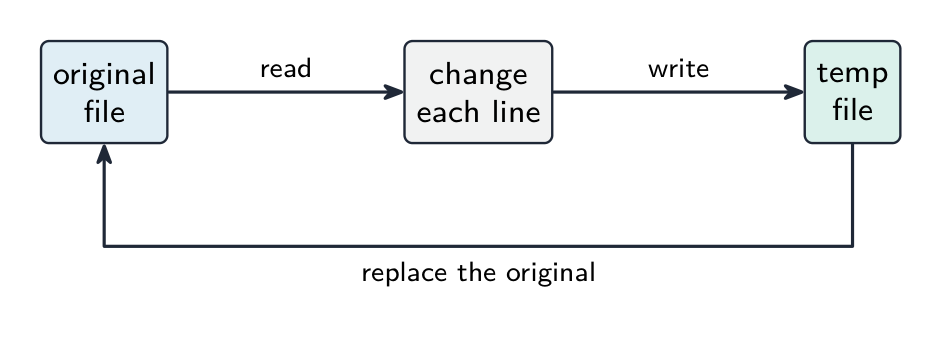
Syllabus
Candidates should be able to: Notes and guidance Write code to perform file-processing operations Open (in read, write, append mode) and close a file Read a record from a file and write a record to a file Perform file-processing operations on serial, sequential, random files Show understanding of an exception and the importance of exception handling Know when it is appropriate to use exception handling Write program code to use exception handling Source: Cambridge International syllabus
This extends the file 文件 handling from Topic 10, processing serial, sequential and random (direct-access) files. Pseudocode operations:
OPENFILE name FOR READ | WRITE | APPEND(READ opens an existing file, WRITE creates/overwrites, APPEND adds to the end);READFILE name, line;WRITEFILE name, value;CLOSEFILE name; andEOF(name)which is TRUE at the end.Read a whole file:
OPENFILE "names.txt" FOR READ
WHILE NOT EOF("names.txt") DO
    READFILE "names.txt", thisName
    OUTPUT thisName
ENDWHILE
CLOSEFILE "names.txt"
Search a file (stop when found):
found ← FALSE
OPENFILE "people.txt" FOR READ
WHILE NOT EOF("people.txt") AND NOT found DO
    READFILE "people.txt", line
    IF line = target THEN found ← TRUE
ENDWHILE
CLOSEFILE "people.txt"
Updating a file in place
Most languages can't edit a text file in place. Instead: open the original for READ and a temporary file for WRITE; for each line, write the new version if it should change, else the original; close both; then replace the original with the temp file. The same pattern handles deleting lines (skip them) and inserting lines.
Updating a file in place: read the original, write changes to a temp file, then replace the original Pitfalls
Forgetting to close a file (data may be lost); opening for WRITE when you meant APPEND (overwrites everything); reading past
EOF; hard-coded paths — a path like/Users/Admin/data.txtbreaks on another machine, so use a relative constant such asDataFile = "./data/scores.txt".ExploreFile access route
Follow a file from storage to program and back safely.
Vocabulary TrainEnglish Chinese Pinyin file 文件 wén jiàn 20.2
Exception handling
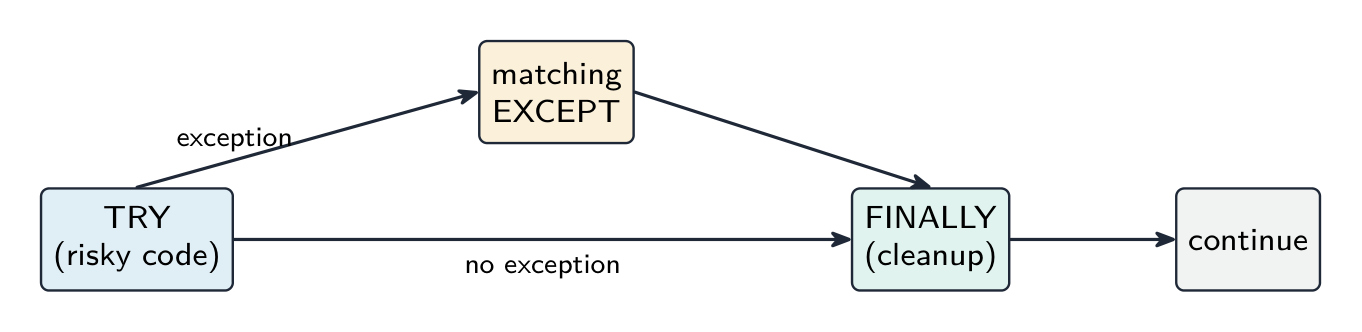
An exception 异常 is an error or unexpected condition during execution — divide by zero, file not found, network failure, an array 数组 index out of range. Exception handling 异常处理 lets a program detect it and respond gracefully instead of crashing.
It matters because real programs face errors that cannot be prevented up front (files moved, networks down, bad input); without it, every operation needs its own
IFcheck; and it separates the normal flow from the error handling, so the main path reads cleanly. For example, a file may be deleted by another user between your program checking it exists and actually opening it — you cannot prevent that, only handle the failure when it happens.Pattern
TRY
    OPENFILE "data.txt" FOR READ
    READFILE "data.txt", line
    OUTPUT line
    CLOSEFILE "data.txt"
EXCEPT FileNotFound
    OUTPUT "Sorry, the file does not exist."
EXCEPT ReadError
    OUTPUT "Sorry, error reading the file."
ENDTRY
The
TRYblock holds the code that might fail; the first matchingEXCEPTblock runs. Real languages also have a catch-allEXCEPTand aFINALLYblock that runs whether or not an exception happened — useful for cleanup (closing files).Exception flow: an exception jumps to the matching EXCEPT; FINALLY always runs before the program continues Raising an exception
A subroutine that detects an error can raise 抛出 an exception so the caller handles it:
PROCEDURE Divide(a : INTEGER, b : INTEGER) RETURNS INTEGER
    IF b = 0 THEN
        RAISE DivideByZero
    ENDIF
    RETURN a DIV b
ENDPROCEDURE
Where to handle exceptions
Handle them close to the error if the response is simple (a message, a retry), or higher up the call stack 调用栈 if only the outer code knows what to do (a top-level GUI loop logs the error and shows a friendly dialog). Don't swallow exceptions silently — at least log them, or debugging becomes impossible.
Common exceptions:
FileNotFound,IOError,DivisionByZero,IndexOutOfRange,InvalidArgument,NullReference,OutOfMemory. Wrapping each failing operation in aTRYwith the rightEXCEPThandlers gives a program that degrades gracefully instead of crashing.Worked example. A text file of members needs one member's phone number changed. Why can the program not simply overwrite that line, and what is the pattern? A text file's lines are different lengths, and the file has no gaps to absorb a difference: a longer replacement would run into the next record, and a shorter one would leave part of the old line behind. So the pattern is to open the original for READ and a temporary file for WRITE, read every line in turn, writing the new version for the line that changes and the original line for all the others, close both, then replace the original with the temporary file. The same shape handles deleting (skip the line) and inserting (write the extra line). Note that every line gets written, not only the changed one - writing just the new record and losing the rest of the file is the classic slip.
ExploreHow exception handling flows
Step through what happens when code fails. The exception jumps out of the normal flow to a handler, FINALLY cleans up either way, and the program carries on instead of crashing.
Vocabulary TrainEnglish Chinese Pinyin array 数组 shù zǔ exception 异常 yì cháng exception handling 异常处理 yì cháng chǔ lǐ raise 抛出 pāo chū call stack 调用栈 diào yòng zhàn 20.2
Exam tips
- Distinguish the paradigms (procedural, object-oriented, declarative, low-level) and when each suits a problem.
- For OOP, define class, object, inheritance, encapsulation and polymorphism with a short example.
- Explain exception handling (try/catch) and why it beats letting the program crash.
- encapsulation 封装 — an object's data is hidden behind its methods; outside code uses the public methods only, not the data directly. This protects the object and lets its internals change without breaking callers. For example, a