Реализация ADT с использованием массивов.
| English | Русский |
|---|---|
| overflow/ˌəʊvəˈfləʊ/ | переполнение |
| underflow/ˌʌndəˈfləʊ/ | переполнение вниз (underflow) |
| circular array/ˈsɜːkjʊlə əˈreɪ/ | циклический массив |
| free list/friː lɪst/ | свободный список |
There is no such thing as a stack in memory
- Open a computer and look for the stack. You will not find one. Memory is one enormous array of numbered cells, and that is all there is.
- Every stack, every queue, every linked list is that array plus two or three integer variables that remember where things are. Push is "add one to a number and store"; dequeue is "read a cell and add one to a different number".
- The whole of this lesson is bookkeeping: which pointers, which checks, and what happens at the edges.
- The exam asks you to describe the declarations, walk the pointers through a few operations, and say why the checks are there.
A stack in an array
- Hold the items in
Stack[1:MaxSize]with an integerTop, 0 when the stack is empty. - Push(x): if
Top = MaxSizethe stack is full, an overflow 溢出; otherwiseTop ← Top + 1andStack[Top] ← x. - Pop(): if
Top = 0the stack is empty, an underflow 下溢; otherwise returnStack[Top]andTop ← Top − 1.

The array never moves; only Top does
Добавление элемента в уже заполненный стек вызывает переполнение стека ______.
Overflow = push при Top = MaxSize; извлечение из пустого стека (Top = 0) — это underflow.
Соотнесите каждое условие стека на массиве с его значением.
Top считает элементы: 0 = пусто, MaxSize = полно; два случая ошибок — это underflow и overflow.
Worked example: declare and initialise the stack
- Describe the declarations and initialisation needed to implement a stack of up to 50 integers using an array. [5]
- An array of 50 elements of type
INTEGER,DECLARE Stack : ARRAY[1:50] OF INTEGER, to hold the items. - A constant or variable
MaxSizeset to 50, so that push can test for full. - An
INTEGERtop-of-stack pointer,Top, initialised to 0 to show the stack is empty; pop tests it for underflow, and push compares it withMaxSizefor overflow.
Что должно входить в объявление и инициализацию стека на массиве? Выберите все подходящие варианты.
Стеку нужен один указатель Top. Указатель front принадлежит очереди.
A queue in a plain array
- Two pointers:
Frontfor the next item to leave,Rearfor the next free space. Enqueue stores atRearand moves it on; dequeue reads atFrontand moves it on. - Both pointers only ever move forward, so after a few operations they march off the end of the array while the cells at the start sit empty and unusable.
- The fix is to let the pointers wrap around.
The circular array
- A circular array 循环数组 wraps a pointer back to the first cell when it passes the last: with 1-based indices,
Rear ← (Rear MOD MaxSize) + 1. - Enqueue(x): check not full;
Rear ← (Rear MOD MaxSize) + 1;Queue[Rear] ← x. Dequeue(): check not empty; returnQueue[Front];Front ← (Front MOD MaxSize) + 1. - Keep a separate count: when the queue is completely full and when it is completely empty the two pointers are in the same relative position, so the pointers alone cannot tell the two apart.
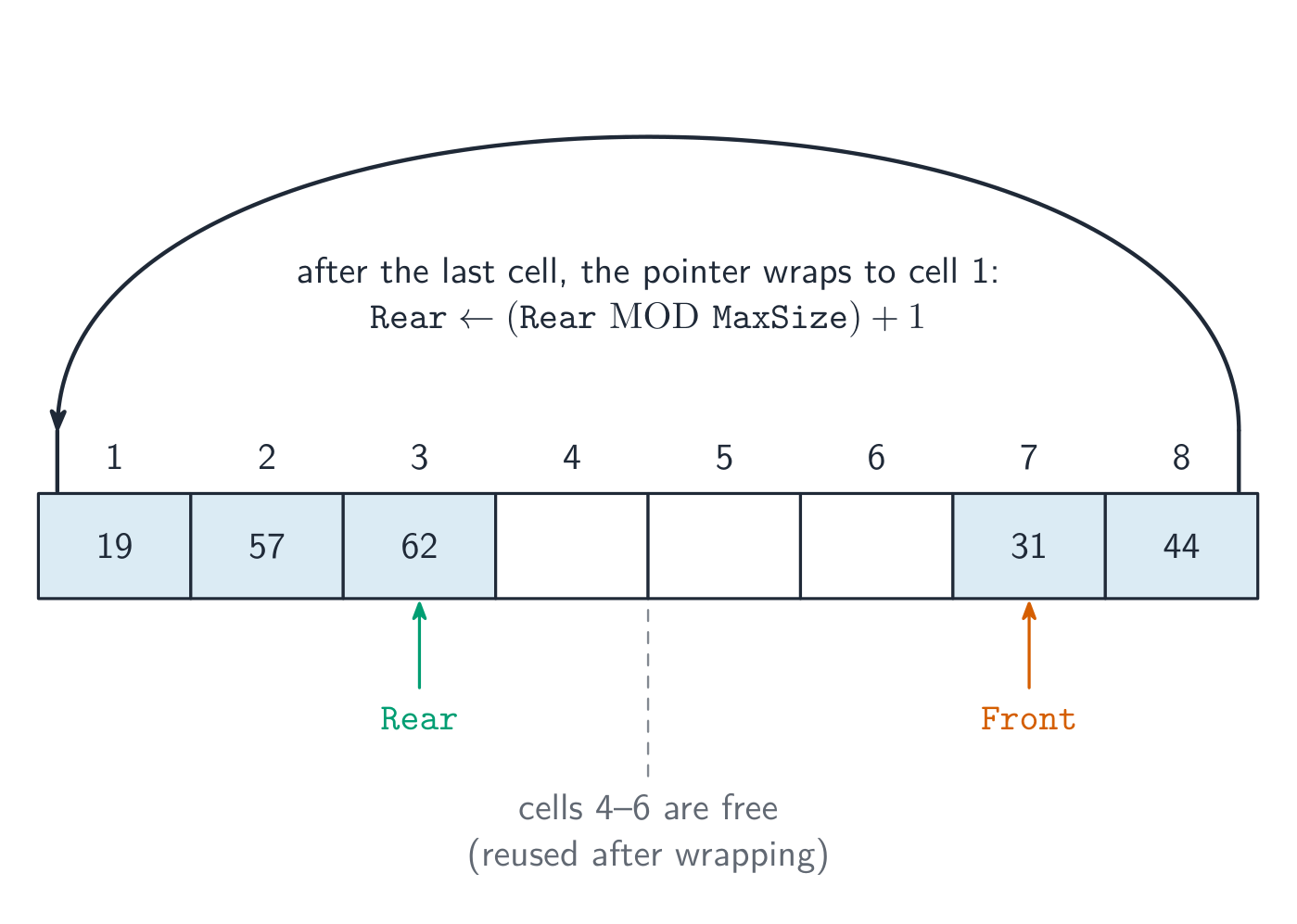
After the last cell comes the first cell
Реализация ADT с помощью массивов.
FIFO.
Очередь работает по принципу FIFO — enqueue сзади, dequeue с фронта.
Зачем использовать циклический массив для очереди?
Линейная очередь тратит ячейки в начале по мере продвижения Front; зацикливание с помощью MOD переиспользует их.
Циклическая очередь использует MOD, чтобы указатели front/rear зацикливались и переиспользовали ячейки, освобожденные в начале массива.
(pointer MOD MaxSize) + 1 возвращает индекс к первой ячейке, поэтому линейная очередь больше не тратит ячейки, которые passed указатель Front.
Worked example: walk the pointers
- With
MaxSize = 6: ifRear = 5, then(5 MOD 6) + 1 = 6, so the next item goes in cell 6. IfRear = 6, then(6 MOD 6) + 1 = 1: the pointer wraps to cell 1. - A circular queue is held in an array of size 5, indices 0 to 4, with
Front = 3,Rear = 3and one item stored. Two items are added, then two removed. With 0-based indices each move is(pointer + 1) MOD 5. - Adding twice moves
Rear: 3 → 4, then 4 → 0, because (4 + 1) MOD 5 = 0. Removing twice movesFront: 3 → 4 → 0. One item remains, at index 0, and the queue reused the cells freed at the start of the array.
Циклическая очередь использует ячейки с 1 по 6, и Rear = 6. После операции Rear ← (Rear MOD 6) + 1, куда попадет следующий элемент?
6 MOD 6 = 0, плюс 1 дает 1. Указатель возвращается к началу массива.
Worked example: the enqueue algorithm in words
- Describe the algorithm for adding an item to a circular queue. [4]
- If the count equals the size, report that the queue is full and stop.
- Otherwise add one to the rear pointer; if it is now past the last index, set it to the first index.
- Store the item at the rear pointer and add one to the count.
Расставьте шаги добавления в циклическую очередь по порядку.
Проверка, перемещение, зацикливание, сохранение, счетчик. Именно зацикливание делает массив циклическим.
A linked list in an array
- Use an array of node records, each with a
Nextindex;-1marks the end. AHeadindex marks the first node,-1if the list is empty. - The unused slots are chained into a free list 空闲列表 from
FreeListHead, exactly as the data list chains its used ones.
TYPE TNode
    DECLARE Value : INTEGER
    DECLARE Next  : INTEGER     // index of the next node, or -1
ENDTYPE
DECLARE Nodes : ARRAY[1:MaxSize] OF TNode
DECLARE Head : INTEGER          // -1 when empty
DECLARE FreeListHead : INTEGER  // first unused slot
- Insert: take the slot at
FreeListHead, set itsValueandNext, then rewire the previous node'sNextorHead. Delete: unlink the node and return its slot to the front of the free list.
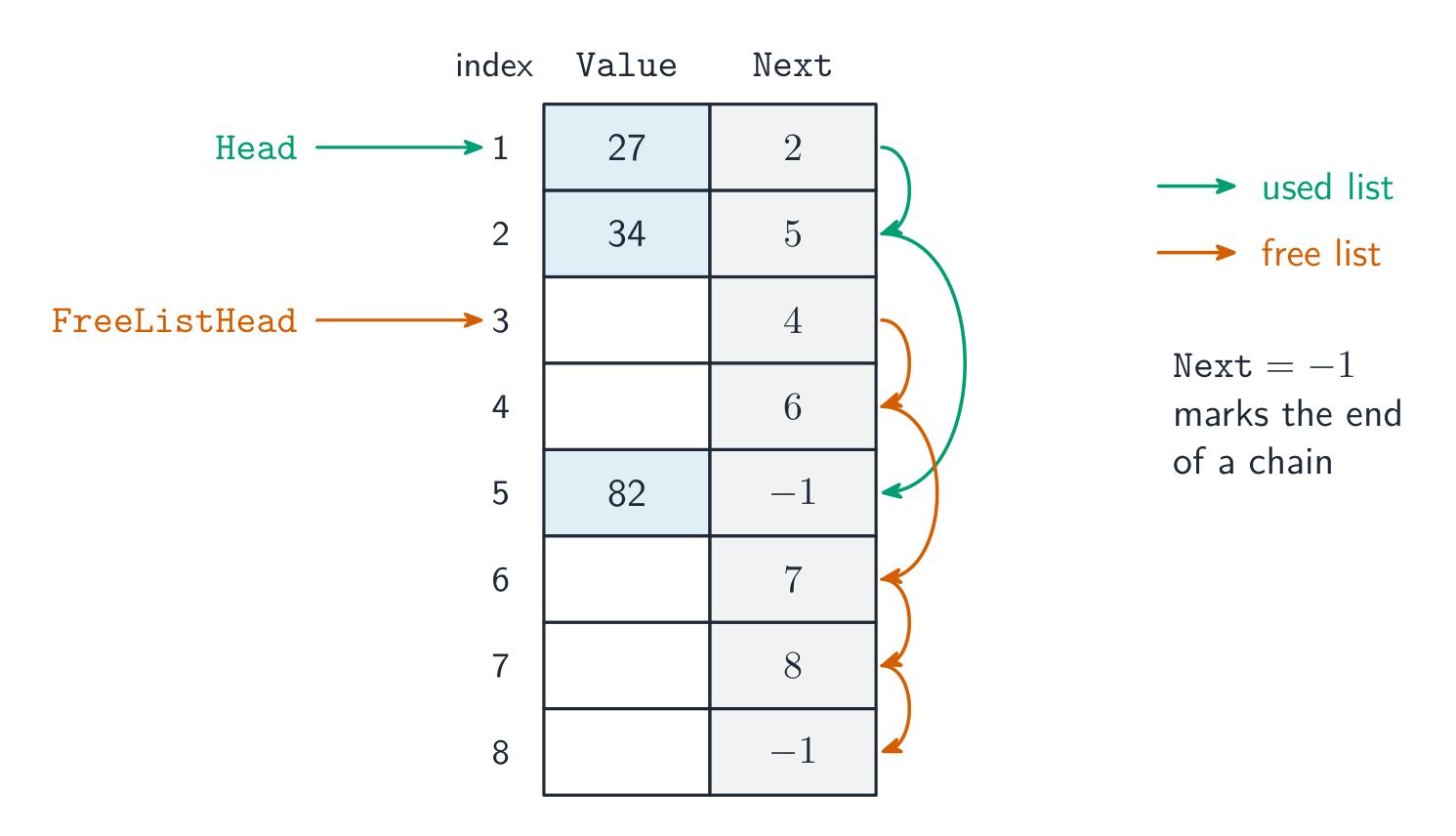
Two lists share one array: the data list and the free list
В связном списке на основе массива свободный список:
Свободный список связывает резервные ячейки, поэтому при вставке можно захватить одну, а при удалении — вернуть; это похоже на второй связный список пустых ячеек.
Worked example: insert into the array-held list
DataandPointerarrays hold the list 1 → 3 → 4, withStart = 1; index 1 holdsD40, index 3 holdsD32, index 4 holdsD11with a null pointer. The free list starts at index 2 and continues 2 → 5. InsertD6betweenD32andD11.- Take the first free node, index 2, and set
FreeStartto its pointer, 5. StoreD6inData[2]. - Set
Pointer[2]to the valuePointer[3]held, which is 4. Then setPointer[3]to 2. - The list now reads 1 → 3 → 2 → 4 and the free list is 5 → null. The implementation, if asked: an array for the data, a parallel array (or record field) for the pointers, a start pointer, and a free-list pointer.
В разобранном примере после вставки D6 свободный список начинается с индекса ____.
Индекс 2 был взят из свободного списка, поэтому FreeStart перемещается туда, куда указывал индекс 2, то есть на 5.
При вставке в список указатель предыдущего узла следует изменить до установки указателя нового узла.
Сначала установите указатель нового узла на старый следующий узел. Если сначала перепровести предыдущий узел, адрес остальной части списка будет утерян.
Marks that slip away
- The checks come first: full before push or enqueue, empty before pop or dequeue. Describe them; they are marks.
- The wrap formula depends on the indices:
(Rear MOD MaxSize) + 1for 1-based,(Rear + 1) MOD Sizefor 0-based. Match the question's bounds. - The count is what tells a full circular queue from an empty one. Pointers alone cannot.
- Set the new node's
Nextbefore rewiring the previous node, and return a deleted node's slot to the free list, or the array slowly fills with unreachable cells.
You've got it
- stack in an array:
Stack[1:MaxSize]and aToppointer starting at 0;Top = MaxSizeis overflow,Top = 0is underflow - circular queue:
FrontandRearwrap withMOD; a separate count distinguishes full from empty - linked list in an array: node records with a
Nextindex, aHead, and a free list chaining the spare slots - every operation is check, then pointer arithmetic, then store or read; the ADT's behaviour is unchanged by how it is stored