Half-equations and charge · Equações semi e carga
| English | Português |
|---|---|
| half-equations/hɑːf ɪˈkweɪʒnz/ | equações parciais |
| reduction/rɪˈdʌkʃn/ | redução |
| oxidation/ˌɒksɪˈdeɪʃn/ | oxidação |
Electrons at the electrodes
- At each electrode, ions either gain or lose electrons. We track this with half-equations 半反应式.
- They show exactly what happens to the electrons.
Elétrons nos eletrodos
- Em cada eletrodo, íons ganham ou perdem elétrons. Rastreamos isso com equações semi-reações 半反应式.
- Elas mostram exatamente o que acontece com os elétrons.
In OIL RIG, oxidation is: · Em OIL RIG, oxidação é:
Oxidation Is Loss of electrons.
OIL RIG
- A handy memory aid: OIL RIG.
- Oxidation Is Loss (of electrons); Reduction Is Gain (of electrons).
In electrolysis, positive ions are reduced at the cathode and negative ions are oxidised at the anode
OIL RIG
- Uma dica útil de memorização: OIL RIG.
- Oxidação É Perdida (de elétrons); Redução É Ganha (de elétrons).
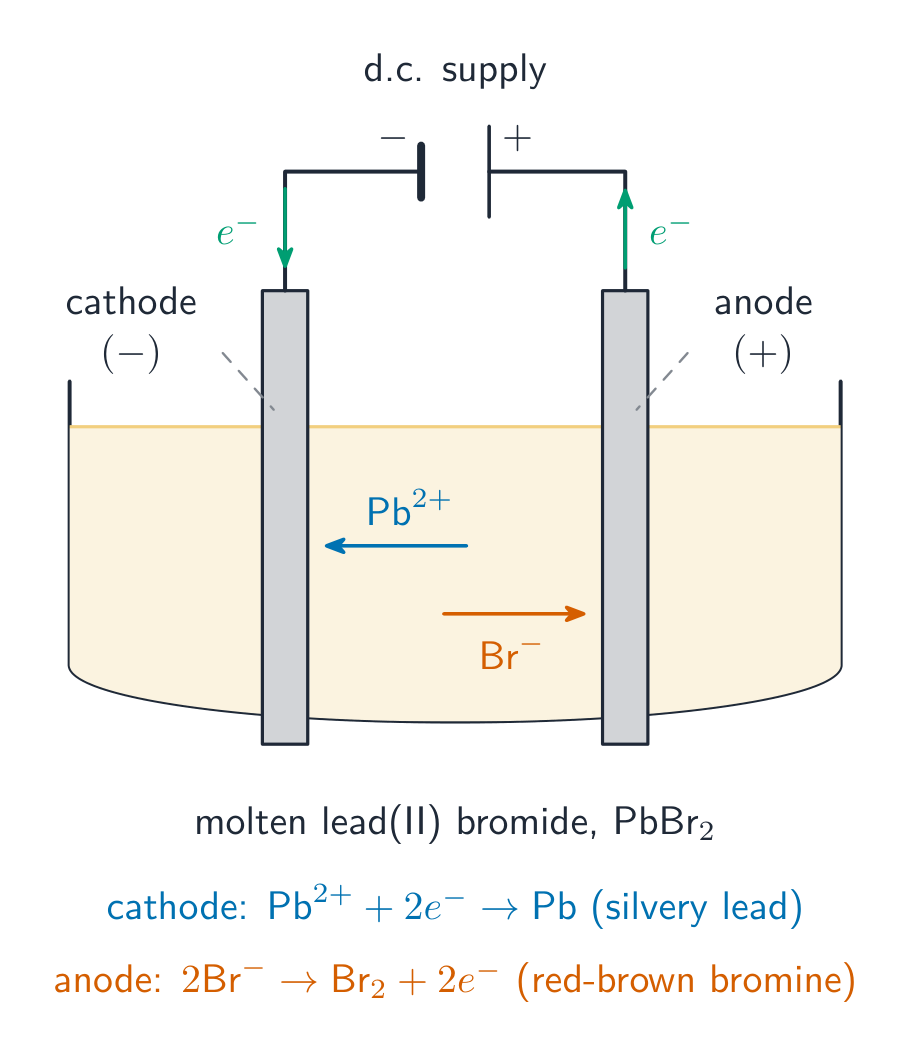
Na eletrólise, íons positivos são reduzidos no catodo e íons negativos são oxidados no ânodo
At the cathode, positive ions: · No cátodo, íons positivos:
Reduction Is Gain — at the cathode. · Reduction Is Gain — no cátodo.
Reduction is the gain of electrons. · Redução é o ganho de elétrons.
Reduction Is Gain (RIG).
At the cathode, positive ions ______ electrons. · No cátodo, íons positivos ______ elétrons.
Cathode = reduction = gain of electrons. · Cátodo = redução = ganho de elétrons.
At the cathode (reduction 还原)
- Positive ions gain electrons at the cathode.
- Example: Na⁺ + e⁻ → Na (sodium ion gains one electron to become sodium metal).
No catodo (redução 还原)
- Íons positivos ganham elétrons no catodo.
- Exemplo: Na⁺ + e⁻ → Na (íon sódio ganha um elétron para se tornar metal sódio).
The half-equation 2Cl⁻ → Cl₂ + 2e⁻ shows: · A equação semi 2Cl⁻ → Cl₂ + 2e⁻ mostra:
Chloride ions lose electrons — oxidation at the anode. · Íons cloreto perdem elétrons — oxidação no ânodo.
At the anode (oxidation 氧化)
- Negative ions lose electrons at the anode.
- Example: 2Cl⁻ → Cl₂ + 2e⁻ (chloride ions lose electrons to form chlorine gas).
Worked example. Electrolysing molten sodium chloride: at the cathode Na⁺ + e⁻ → Na (reduction); at the anode 2Cl⁻ → Cl₂ + 2e⁻ (oxidation). Sodium forms at one electrode, chlorine at the other.
No ânodo (oxidação 氧化)
- Íons negativos perdem elétrons no ânodo.
- Exemplo: 2Cl⁻ → Cl₂ + 2e⁻ (íons cloreto perdem elétrons para formar gás cloro).
Exemplo resolvido. Eletrólise de cloreto de sódio fundido: no catodo Na⁺ + e⁻ → Na (redução); no ânodo 2Cl⁻ → Cl₂ + 2e⁻ (oxidação). Sódio forma-se em um eletrodo, cloro no outro.
Reduction and oxidation at the electrodes · Redução e oxidação nos eletrodos
Cations reach the cathode and GAIN electrons (reduction); anions reach the anode and LOSE electrons (oxidation). Step to the discharge stage to see the half-equations. · Cations atingem o cátodo e GANHAM elétrons (redução); ânions atingem o ânodo e PERDEM elétrons (oxidação). Passe à etapa de descarga para ver as equações semi.
You've got it
- half-equations show the electrons gained or lost at each electrode
- OIL RIG: Oxidation Is Loss, Reduction Is Gain (of electrons)
- cathode = reduction (gain e⁻); anode = oxidation (lose e⁻)
Entendeu?
- equações semi-reação mostram os elétrons ganhos ou perdidos em cada eletrodo
- OIL RIG: Oxidação É Perda, Redução É Ganho (de elétrons)
- catodo = redução (ganha e⁻); ânodo = oxidação (perde e⁻)