Circuits with Capacitors and Inductors (LC Circuits) · Circuitos com Capacitores e Indutores (Circuitos LC)
| English | Português |
|---|---|
| oscillate/ˈɒsɪleɪt/ | oscilar |
| resonance/ˈrezənəns/ | ressonância |
Energy sloshing back and forth — an electrical pendulum
- Charge a capacitor, connect it to an inductor, and something surprising happens.
- The energy doesn't just drain away — it swings back and forth.
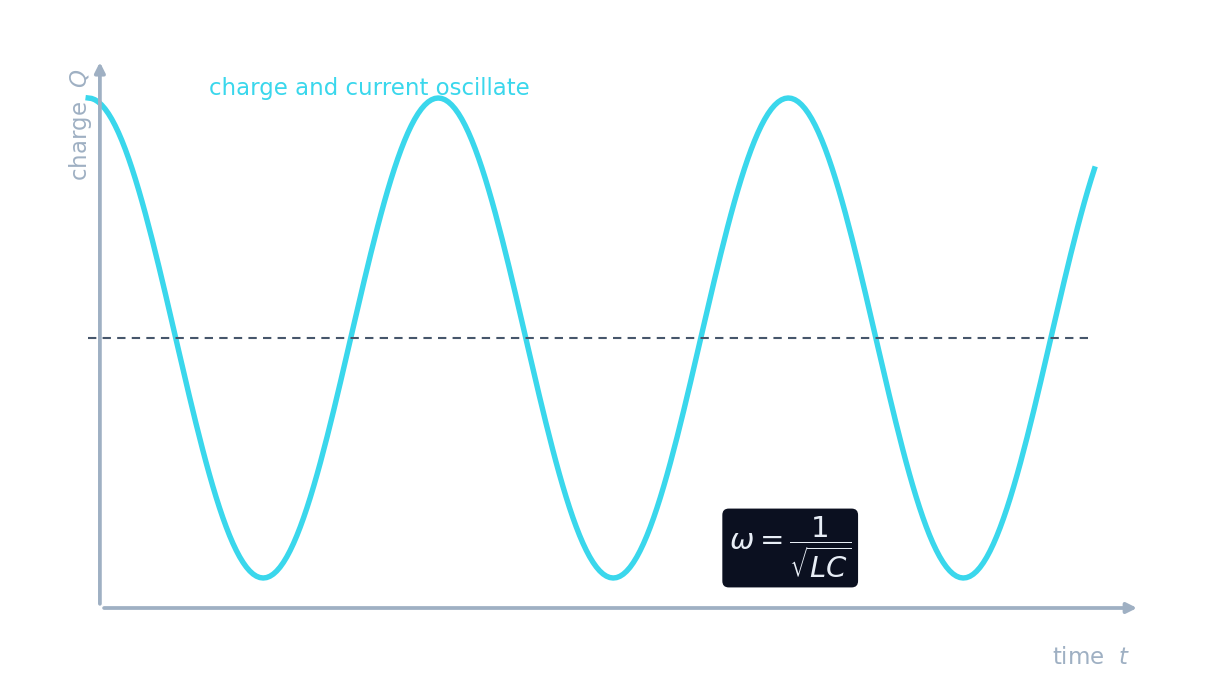
- The charge and current oscillate 振荡, like a pendulum swinging.
- A capacitor and inductor together make an LC circuit — the heart of a radio.
Energia oscilando de um lado para o outro — um pêndulo elétrico
- Carregue um capacitor, conecte-o a um indutor e algo surpreendente acontece.
- A energia não apenas se dissipa — ela oscila de volta e forth.
- A carga e a corrente oscilam 振荡, como um pêndolo balançando.
- Um capacitor e um indutor juntos formam um circuito LC — o coração de um rádio.
Energy trades between C and L
- The capacitor starts full: all the energy is in its electric field.
- It discharges through the inductor, driving a current.
- Now the energy is in the inductor's magnetic field.
- The inductor keeps the current going, recharging the capacitor the other way — and it repeats.
A energia troca entre C e L
- O capacitor começa carregado: toda a energia está em seu campo elétrico.
- Ele descarrega através do indutor, impulsionando uma corrente.
- Agora a energia está no campo magnético do indutor.
- O indutor mantém a corrente fluindo, recarregando o capacitor no sentido oposto — e isso se repete.
In an LC circuit, energy trades between: · Em um circuito LC, a energia troca entre:
Energy sloshes between the capacitor's E field and the inductor's B field. · A energia oscila entre o campo E do capacitor e o campo B do indutor.
The oscillation frequency
- The charge swings sinusoidally at angular frequency $\omega = \dfrac{1}{\sqrt{LC}}$.
- A bigger $L$ or $C$ means slower oscillation (a lower frequency).
- With no resistance the oscillation, in principle, never dies out.
- The current is largest just as the capacitor is empty, and vice versa.
A frequência da oscilação
- A carga oscila sinusoidalmente com frequência angular $\omega = \dfrac{1}{\sqrt{LC}}$.
- Um $L$ ou $C$ maior significa oscilação mais lenta (frequência menor).
- Sem resistência, a oscilação, em princípio, nunca cessa.
- A corrente é máxima quando o capacitor está vazio, e vice-versa.
The angular frequency of an LC circuit is: · A frequência angular de um circuito LC é:
$\omega = 1/\sqrt{LC}$ sets the oscillation rate. · $\omega = 1/\sqrt{LC}$ define a taxa de oscilação.
An LC circuit has $L = 4\ \text{H}$ and · e $C = 1\ \text{F}$. Find $\omega$ (in rad/s). · Um circuito LC tem $L = 4\ \text{H}$ e $C = 1\ \text{F}$. Encontre $\omega$ (em rad/s).
$\omega = 1/\sqrt{LC} = 1/\sqrt{4} = 0.5\ \text{rad/s}$.
Just like a mass on a spring
- The LC circuit is the exact electrical twin of a mass–spring oscillator.
- Charge $Q$ plays the role of position; current $I$ plays the role of velocity.
- Inductance $L$ is like mass (inertia); $1/C$ is like the spring constant.
- Both obey the same equation, so both give simple harmonic motion.
Assim como uma massa numa mola
- O circuito LC é o gêmeo elétrico exato de um oscilador massa-mola.
- A carga $Q$ desempenha o papel da posição; a corrente $I$ desempenha o papel da velocidade.
- A indutância $L$ é como a massa (inércia); $1/C$ é como a constante da mola.
- Ambos seguem a mesma equação, portanto ambos produzem movimento harmônico simples.
LC circuit oscillations · Oscilações de circuito LC
In an LC circuit energy sloshes between the capacitor and the inductor - the electrical version of simple harmonic motion. · Em um circuito LC, a energia oscila entre o capacitor e o indutor - a versão elétrica do movimento harmônico simples.
An LC circuit is the electrical analogue of a mass oscillating on a spring. · Um circuito LC é o análogo elétrico de uma massa oscilando em uma mola.
Charge ~ position, current ~ velocity, L ~ mass, 1/C ~ spring constant. · Carga ~ posição, corrente ~ velocidade, L ~ massa, 1/C ~ constante da mola.
Select all · todos true statements about LC circuits. · Selecione todas as afirmações verdadeiras sobre circuitos LC.
Oscillation, ω = 1/√(LC), SHM analogy. An ideal LC loses no energy — it just swaps. · Oscilação, ω = 1/√(LC), analogia MHS. Um LC ideal não perde energia — apenas trocam.
Why it matters: tuning a radio
- Every radio station broadcasts at its own frequency.
- An LC circuit resonates 共振 strongly at $\omega = 1/\sqrt{LC}$ and ignores the rest.
- Turning the tuning dial changes $C$, shifting which station you pick up.
- LC resonance is how a receiver plucks one signal from the air.
Por que importa: sintonizando um rádio
- Cada estação de rádio transmite em sua própria frequência.
- Um circuito LC ressoa 共振 fortemente em $\omega = 1/\sqrt{LC}$ e ignora os demais.
- Girar o botão de sintonia altera $C$, mudando qual estação você capta.
- A ressonância LC é como um receptor puxa um único sinal do ar.
A radio uses an LC circuit's strong ____ at one frequency to pick a station. · Um rádio usa a forte ____ de um circuito LC em uma frequência específica para sintonizar uma emissora.
LC resonance at $\omega = 1/\sqrt{LC}$ selects one station. · Ressonância LC em $\omega = 1/\sqrt{LC}$ seleciona uma emissora.
An LC circuit has $L = 1\ \text{H}$ and $C = 0.25\ \text{F}$. Find its angular frequency.
- $\omega = \dfrac{1}{\sqrt{LC}} = \dfrac{1}{\sqrt{1 \times 0.25}} = \dfrac{1}{0.5}$.
- $\omega = 2\ \text{rad/s}$.
Um circuito LC tem $L = 1\ \text{H}$ e $C = 0.25\ \text{F}$. Encontre sua frequência angular.
- $\omega = \dfrac{1}{\sqrt{LC}} = \dfrac{1}{\sqrt{1 \times 0.25}} = \dfrac{1}{0.5}$.
- $\omega = 2\ \text{rad/s}$.
In an ideal LC circuit the energy is never lost — it just swaps between the capacitor and inductor forever. The current is largest when the capacitor is empty (all magnetic energy), not when it is full. Line up energy and charge carefully.
Em um circuito LC ideal, a energia nunca é perdida — ela apenas troca eternamente entre o capacitor e o indutor. A corrente é maior quando o capacitor está vazio (toda energia magnética), não quando está cheio. Alinhe energia e carga cuidadosamente.
An LC circuit oscillates as energy trades between the capacitor's electric field and the inductor's magnetic field, at $\omega = 1/\sqrt{LC}$. It is the electrical twin of a mass on a spring (SHM), and its resonance is how a radio tunes to one station.
Um circuito LC oscila enquanto a energia troca entre o campo elétrico do capacitor e o campo magnético do indutor, em $\omega = 1/\sqrt{LC}$. É o gêmeo elétrico de uma massa numa mola (MHS), e sua ressonância é como um rádio sintoniza uma única estação.