Magnetic Flux · Fluxo Magnético
| English | Português |
|---|---|
| magnetic flux/mæɡˈnetɪk flʌks/ | fluxo magnético |
| webers/ˈveɪbəz/ | webers |
How much magnetism threads through this loop?
- Hold a wire loop in a magnetic field and count the field lines passing through.
- That "amount of field through the loop" is magnetic flux 磁通量.
- It is the magnetic twin of the electric flux from the Gauss unit.
- And a change in it is what makes generators and transformers work.
Quanta magnetismo atravessa este laço?
- Segure um laço de fio em um campo magnético e conte as linhas de campo passando através.
- Essa "quantidade de campo através do laço" é fluxo magnético 磁通量.
- É o gêmeo magnético do fluxo elétrico da unidade de Gauss.
- E uma variação nele é o que faz geradores e transformadores funcionarem.
Flux is B through an area
- Give the loop an area vector $\vec A$ along its normal.
- The flux is $\Phi_B = \vec B \cdot \vec A = BA\cos\theta$.
- $\theta$ is the angle between the field and the loop's normal.
- Face-on to the field gives maximum flux; edge-on gives zero.
Fluxo é B através de uma área
- Dê ao laço um vetor de área $\vec A$ ao longo de sua normal.
- O fluxo é $\Phi_B = \vec B \cdot \vec A = BA\cos\theta$.
- $\theta$ é o ângulo entre o campo e a normal do laço.
- De frente para o campo dá fluxo máximo; de borda dá zero.
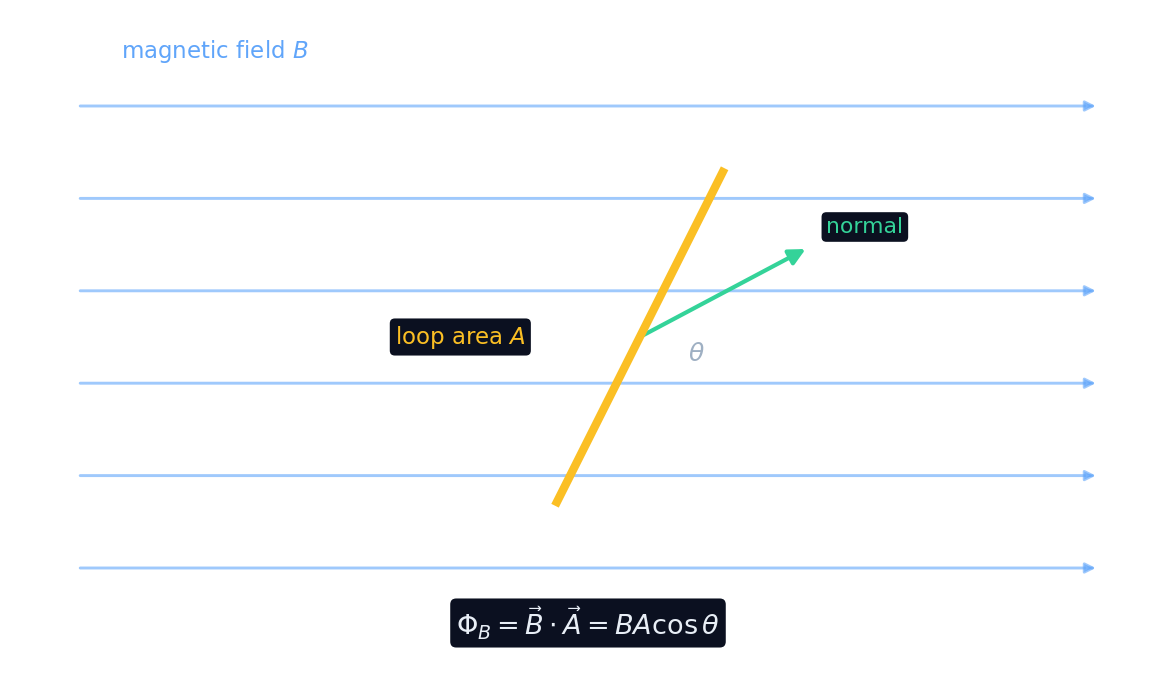
Magnetic flux through a flat loop is: · O fluxo magnético através de um laço plano é:
$\Phi_B = \vec B \cdot \vec A = BA\cos\theta$.
A $2\ \text{T}$ field passes straight through ($\theta = 0$) a $0.3\ \text{m}^2$ loop. Find the flux (in Wb). · Um campo $2\ \text{T}$ passa diretamente através ($\theta = 0$) de um laço $0.3\ \text{m}^2$. Encontre o fluxo (em Wb).
$\Phi_B = BA\cos 0 = 2 \times 0.3 \times 1 = 0.6\ \text{Wb}$.
A loop lying edge-on to the field ($\theta = 90^\circ$) has zero flux. · Um laço posicionado de borda ao campo ($\theta = 90^\circ$) tem fluxo zero.
$\cos 90^\circ = 0$, so $\Phi_B = 0$ edge-on. · $\cos 90^\circ = 0$, então $\Phi_B = 0$ de borda.
Three ways to change the flux
- Change the field strength $B$ (move a magnet closer or farther).
- Change the area $A$ the field passes through (stretch or shrink the loop).
- Change the angle $\theta$ (rotate the loop in the field).
- Any of these three changes the flux — and that is what induces an EMF.
Três formas de mudar o fluxo
- Mude a intensidade do campo $B$ (aproxime ou afaste um ímã).
- Mude a área $A$ pela qual o campo passa (esticar ou encolher o laço).
- Mude o ângulo $\theta$ (gire o laço no campo).
- Qualquer uma dessas três mudanças altera o fluxo — e isso é o que induz uma FEM.
Select all · todos the ways to change the flux through a loop. · Selecione todas as maneiras de alterar o fluxo através de um laço.
Flux changes by altering B, A, or θ. Colour has nothing to do with it. · O fluxo muda alterando B, A ou θ. A cor não tem nada a ver com isso.
Units and varying fields
- Magnetic flux is measured in webers 韦伯 (1 Wb $= 1\ \text{T}\cdot\text{m}^2$).
- For a uniform field and flat loop, just use $\Phi_B = BA\cos\theta$.
- If the field varies across the loop, integrate: $\Phi_B = \int \vec B \cdot d\vec A$.
- A coil of $N$ turns links $N$ times the flux of one loop.
Unidades e campos variáveis
- Fluxo magnético é medido em webers 韦伯 (1 Wb $= 1\ \text{T}\cdot\text{m}^2$).
- Para um campo uniforme e laço plano, basta usar $\Phi_B = BA\cos\theta$.
- Se o campo varia através do laço, integre: $\Phi_B = \int \vec B \cdot d\vec A$.
- Uma bobina de $N$ voltas acopla $N$ vezes o fluxo de um único laço.
When is the magnetic flux greatest? · Quando o fluxo magnético é maior?
Magnetic flux depends on how the loop is oriented in the field. Sort each case. · O fluxo magnético depende de como o laço está orientado no campo. Classifique cada caso.
The SI unit of magnetic flux is the ____. · A unidade SI de fluxo magnético é o ____.
1 weber $= 1\ \text{T·m}^2$.
Why flux matters
- On its own, a steady flux does nothing special.
- But a changing flux drives a current in the loop.
- The faster the flux changes, the bigger the effect.
- That link — flux change to induced EMF — is the next lesson.
Por que o fluxo importa
- Sozinho, um fluxo constante não faz nada especial.
- Mas um fluxo variável impulsiona uma corrente no laço.
- Quanto mais rápido o fluxo muda, maior o efeito.
- Essa ligação — mudança de fluxo para FEM induzida — é a próxima lição.
What actually induces an EMF in a loop? · O que realmente induz uma FEM em um laço?
Only a changing flux drives an induced EMF. · Apenas um fluxo variável impulsiona uma FEM induzida.
A $0.5\ \text{T}$ field passes straight through ($\theta = 0$) a loop of area $0.2\ \text{m}^2$.
- $\Phi_B = BA\cos\theta = 0.5 \times 0.2 \times 1$.
- $\Phi_B = 0.1\ \text{Wb}$.
Um campo $0.5\ \text{T}$ passa reto através ($\theta = 0$) de um laço de área $0.2\ \text{m}^2$.
- $\Phi_B = BA\cos\theta = 0.5 \times 0.2 \times 1$.
- $\Phi_B = 0.1\ \text{Wb}$.
The angle $\theta$ is measured from the loop's normal, not from its face. A loop lying edge-on to the field ($\theta = 90^\circ$) has zero flux even though the field is strong — a classic angle trap.
O ângulo $\theta$ é medido a partir da normal do laço, não de sua face. Um laço posicionado de borda ao campo ($\theta = 90^\circ$) tem fluxo zero mesmo com o campo sendo forte — uma armadilha clássica de ângulo.
Magnetic flux is the field through a loop: $\Phi_B = \vec B \cdot \vec A = BA\cos\theta$ (webers). You can change it by changing $B$, the area $A$, or the angle $\theta$. A changing flux is what induces an EMF — the key to the whole unit.
Fluxo magnético é o campo através de um laço: $\Phi_B = \vec B \cdot \vec A = BA\cos\theta$ (webers). Você pode mudá-lo alterando $B$, a área $A$, ou o ângulo $\theta$. Um fluxo variável é o que induz uma FEM — a chave para toda a unidade.