Magnetism and Moving Charges · Magnetismo e Cargas em Movimento
| English | Português |
|---|---|
| right-hand rule/raɪt hænd ruːl/ | regra da mão direita |
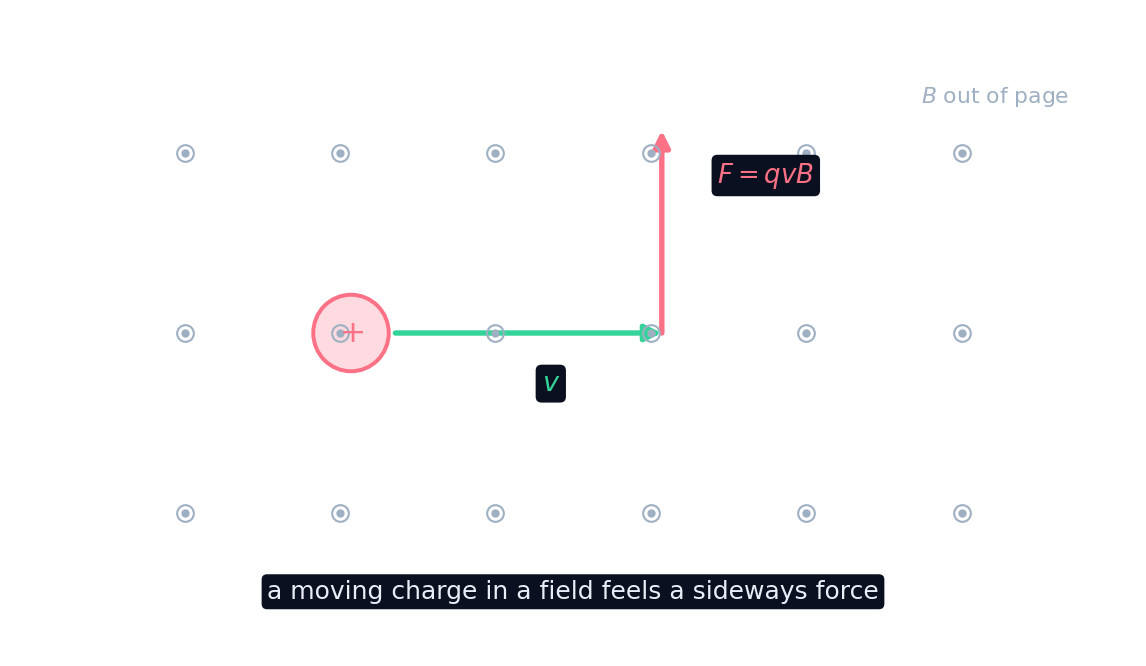
A magnet ignores a still charge but shoves a moving one sideways
- Place a charge at rest near a magnet — nothing happens.
- Send it flying across the field — it swerves to the side.
- The magnetic force acts only on a moving charge.
- And it pushes at right angles to the motion, not along it.
Um ímã ignora uma carga quieta, mas empurra uma móvel lateralmente
- Coloque uma carga em repouso perto de um ímã — nada acontece.
- Envie-a cruzando o campo — ela desvia para o lado.
- A força magnética age apenas sobre uma carga em movimento.
- E empurra perpendicularmente ao movimento, não ao longo dele.
A magnetic field exerts a force on a charge only when the charge is: · Um campo magnético exerce uma força sobre uma carga apenas quando a carga está:
The magnetic force $F = qvB$ needs a nonzero velocity. · A força magnética $F = qvB$ precisa de velocidade não nula.
The force law: F = qvB
- The magnetic force is $F = qvB\sin\theta$, where $\theta$ is the angle between $\vec v$ and $\vec B$.
- It is maximum when the charge moves across the field ($\theta = 90^\circ$).
- It is zero when the charge moves along the field ($\theta = 0$).
- A faster charge or a stronger field gives a bigger push.
A lei da força: F = qvB
- A força magnética é $F = qvB\sin\theta$, onde $\theta$ é o ângulo entre $\vec v$ e $\vec B$.
- É máxima quando a carga cruza o campo ($\theta = 90^\circ$).
- É zero quando a carga se move paralelamente ao campo ($\theta = 0$).
- Uma carga mais rápida ou um campo mais forte gera um empurrão maior.
Force on a current · Força sobre uma corrente
Set the field and current directions and use the right-hand rule to predict the force. · Defina as direções do campo e da corrente e use a regra da mão direita para prever a força.
A $3\ \text{C}$ charge moves at $4\ \text{m/s}$ across a $2\ \text{T}$ field ($\theta = 90^\circ$). Find $F$ (in N). · Uma carga $3\ \text{C}$ move-se a $4\ \text{m/s}$ através de um campo $2\ \text{T}$ ($\theta = 90^\circ$). Encontre $F$ (em N).
$F = qvB = 3 \times 4 \times 2 = 24\ \text{N}$.
A charge moving exactly along the field ($\theta = 0$) feels no magnetic force. · Uma carga movendo-se exatamente ao longo do campo ($\theta = 0$) não sente força magnética.
$\sin 0 = 0$, so $F = qvB\sin\theta = 0$. · $\sin 0 = 0$, logo $F = qvB\sin\theta = 0$.
The right-hand rule sets the direction
- The force is perpendicular to both the velocity and the field.
- Point your fingers along $\vec v$, curl them toward $\vec B$: the thumb gives the force (right-hand rule 右手定则).
- For a negative charge, the force is the opposite way.
- That is why the two are always at right angles to the motion.
A regra da mão direita define a direção
- A força é perpendicular a ambos a velocidade e o campo.
- Aponte os dedos na direção de $\vec v$, curve-os em direção a $\vec B$: o polegar indica a força (regra da mão direita 右手定则).
- Para uma carga negativa, a força é no sentido oposto.
- É por isso que as duas estão sempre em ângulo reto em relação ao movimento.
The direction of the magnetic force is found with the ____-hand rule. · A direção da força magnética é encontrada com a regra da ____-mão.
The right-hand rule gives the force on a positive charge. · A regra da mão direita dá a força sobre uma carga positiva.
A sideways force makes a circle
- A force always perpendicular to $\vec v$ can only turn the charge, not speed it up.
- So a charge in a uniform field moves in a circle.
- The radius is $r = \dfrac{mv}{qB}$ — faster or heavier means a wider circle.
- This is how mass spectrometers and particle accelerators bend beams.
Uma força lateral forma um círculo
- Uma força sempre perpendicular a $\vec v$ só pode desviar a carga, não aumentá-la.
- Assim, uma carga em um campo uniforme move-se em um círculo.
- O raio é $r = \dfrac{mv}{qB}$ — velocidade maior ou massa maior significam um círculo mais largo.
- É assim que espectrômetros de massas e aceleradores de partículas curvam feixes.
Select all · todos true statements about the magnetic force on a charge. · Selecione todas as afirmações verdadeiras sobre a força magnética numa carga.
Needs motion, perpendicular, no work. It never speeds the charge up. · Precisa de movimento, perpendicular, sem trabalho. Nunca aumenta a velocidade da carga.
The magnetic force does no work
- Because $\vec F \perp \vec v$, the force never adds to the speed.
- It changes only the direction of motion, not the kinetic energy.
- So a magnetic field can steer a charge but never make it faster.
- Speeding up needs an electric field, not a magnetic one.
A força magnética não realiza trabalho
- Por causa de $\vec F \perp \vec v$, a força nunca aumenta a velocidade.
- Ela altera apenas a direção do movimento, não a energia cinética.
- Logo, um campo magnético pode desviar uma carga, mas nunca fazê-la acelerar.
- Acelerar exige um campo elétrico, não um magnético.
The magnetic force on a moving charge: · A força magnética sobre uma carga em movimento:
Since $F \perp v$, it does no work — only the direction changes. · Como $F \perp v$, ela não realiza trabalho — apenas a direção muda.
A charge of $2\ \text{C}$ moves at $3\ \text{m/s}$ across a $0.5\ \text{T}$ field ($\theta = 90^\circ$).
- $F = qvB = 2 \times 3 \times 0.5 = 3\ \text{N}$.
- The force is perpendicular to the velocity, so the charge curves.
Uma carga de $2\ \text{C}$ move-se a $3\ \text{m/s}$ através de um campo $0.5\ \text{T}$ ($\theta = 90^\circ$).
- $F = qvB = 2 \times 3 \times 0.5 = 3\ \text{N}$.
- A força é perpendicular à velocidade, então a carga curva-se.
The magnetic force does no work — it only bends the path, never changes the speed. So "the magnetic field speeds up the charge" is always wrong. And a charge moving along the field ($\theta = 0$) feels no force at all.
A força magnética não realiza trabalho — ela apenas curva a trajetória, nunca muda a velocidade. Então "o campo magnético acelera a carga" está sempre errado. E uma carga movendo-se ao longo do campo ($\theta = 0$) sente nenhuma força.
A magnetic field pushes only a moving charge: $F = qvB\sin\theta$, perpendicular to both $\vec v$ and $\vec B$ (right-hand rule). The force does no work, so it bends the path into a circle of radius $r = mv/qB$ without changing the speed.
Um campo magnético empurra apenas uma carga em movimento: $F = qvB\sin\theta$, perpendicular a ambos $\vec v$ e $\vec B$ (regra da mão direita). A força não realiza trabalho, então curva a trajetória em um círculo de raio $r = mv/qB$ sem alterar a velocidade.