Vectors (Further Pure 1) · Vetores (Further Pure 1)
| English | Português |
|---|---|
| plane/pleɪn/ | plano |
| skew/skjuː/ | assimetria |
| vector product/ˈvektə ˈprɒdʌkt/ | produto vetorial |
| normal vector/ˈnɔːml ˈvektə/ | vetor normal |
| perpendicular/ˌpɜːpənˈdɪkjʊlə/ | perpendiculares |
| parallelogram/ˌpærəˈleləɡræm/ | paralelogramo |
| anti-commutative/ˈænti ˈkɒmjuːtətɪv/ | anti-comutativo |
The mathematics of 3D space
- How do you find the distance from a point to a plane 平面? The angle between two surfaces? The shortest path between two skew 异面 lines?
- Planes and the vector product 向量积 give you the tools to solve all these problems — essential for engineering, architecture, and computer graphics.
A matemática do espaço 3D
- Como encontrar a distância de um ponto a um plano 平面? O ângulo entre duas superfícies? O caminho mais curto entre duas retas reversas 异面 linhas?
- Planos e o produto vetorial 向量积 fornecem as ferramentas para resolver todos esses problemas — essenciais para engenharia, arquitetura e computação gráfica.
Equations of planes
- A plane can be written in several forms:
The normal vector 法向量 n is perpendicular 垂直 to the plane; the scalar-product form is n·r = d.
- Cartesian: $ax + by + cz = d$
- Vector: $\mathbf{r}\cdot\mathbf{n} = p$ (where $\mathbf{n}$ is the normal vector)
- Parametric: $\mathbf{r} = \mathbf{a} + \lambda\mathbf{b} + \mu\mathbf{c}$
Worked example. A plane has normal $\mathbf{n} = \begin{pmatrix} 2 \\ -1 \\ 3 \end{pmatrix}$ and passes through $(1, 0, 2)$. Equation: $2x - y + 3z = 2(1) - 0 + 3(2) = 8$.
Equações de planos
- Um plano pode ser escrito de várias formas:

O vetor normal 法向量 n é perpendicular 垂直 ao plano; a forma de produto escalar é n·r = d.
- Cartesiana: $ax + by + cz = d$
- Vetorial: $\mathbf{r}\cdot\mathbf{n} = p$ (onde $\mathbf{n}$ é o vetor normal)
- Paramétrica: $\mathbf{r} = \mathbf{a} + \lambda\mathbf{b} + \mu\mathbf{c}$
Exemplo resolvido. Um plano tem normal $\mathbf{n} = \begin{pmatrix} 2 \\ -1 \\ 3 \end{pmatrix}$ e passa por $(1, 0, 2)$. Equação: $2x - y + 3z = 2(1) - 0 + 3(2) = 8$.
Vectors · Vetores
a · b = |a||b|cos θ
The · A dot product is zero exactly when two vectors are perpendicular. · O produto escalar é zero exatamente quando dois vetores são perpendiculares.
Scalar and vector products can find the shortest distance between two skew lines. · Produtos escalares e vetoriais podem encontrar a menor distância entre duas retas reversas.
These products let you compute distances, angles and intersections in 3D, including skew-line distances. · Esses produtos permitem calcular distâncias, ângulos e interseções em 3D, incluindo distâncias entre retas reversas.
A plane has equation 2x − y + 3z = 8. The normal vector has components (2, −1, ?). Find the missing component. · Um plano tem equação 2x − y + 3z = 8. O vetor normal tem componentes (2, −1, ?). Encontre a componente faltante.
The coefficients of x, y, z in ax + by + cz = d give the normal vector (a, b, c) = (2, −1, 3). · Os coeficientes de x, y, z em ax + by + cz = d fornecem o vetor normal (a, b, c) = (2, −1, 3).
The vector (cross) product
- The vector product $\mathbf{a}\times\mathbf{b} = |\mathbf{a}||\mathbf{b}|\sin\theta\,\hat{\mathbf{n}}$ gives a vector perpendicular to both.
- Its length equals the area of the parallelogram 平行四边形 spanned by $\mathbf{a}$ and $\mathbf{b}$.
Order matters. $\mathbf{a}\times\mathbf{b} = -\mathbf{b}\times\mathbf{a}$. The vector product is anti-commutative 反交换 — swapping the order reverses the direction.
Forces like wind and water are vectors, with both size and direction
O produto vetorial (cruzado)
- O produto vetorial $\mathbf{a}\times\mathbf{b} = |\mathbf{a}||\mathbf{b}|\sin\theta\,\hat{\mathbf{n}}$ resulta em um vetor perpendicular a ambos.
- Seu comprimento é igual à área do paralelogramo 平行四边形 gerado por $\mathbf{a}$ e $\mathbf{b}$.
A ordem importa. $\mathbf{a}\times\mathbf{b} = -\mathbf{b}\times\mathbf{a}$. O produto vetorial é anti-comutativo 反交换 — inverter a ordem inverte a direção.

Forças como vento e água são vetores, com magnitude e direção
The vector product a × b gives a vector that is: · O produto vetorial a × b resulta em um vetor que é:
a × b is perpendicular to both vectors; its length is |a||b|sin θ. · a × b é perpendicular a ambos os vetores; seu comprimento é |a||b|sin θ.
The magnitude |a × b| equals the: · A magnitude |a × b| é igual à:
|a × b| = |a||b|sin θ, which is the parallelogram's area. · |a × b| = |a||b|sin θ, que é a área do paralelogramo.
The vector product is commutative: a × b = b × a. · O produto vetorial é comutativo: a × b = b × a.
The vector product is anti-commutative: a × b = −(b × a). Swapping the order reverses the direction. · O produto vetorial é anticomutativo: a × b = −(b × a). Inverter a ordem inverte a direção.
If |a| = 3, |b| = 4, and the angle between them is 30°, |a × b| = |a||b|sin θ. Find it. · Se |a| = 3, |b| = 4, e o ângulo entre eles é 30°, |a × b| = |a||b|sin θ. Encontre-o.
|a × b| = 3 × 4 × sin 30° = 12 × 0.5 = 6.
Applications
- With scalar and vector products: distances, angles, where lines and planes meet, and the shortest distance between skew lines.
- Distance from point to plane: $d = \dfrac{|ax_0 + by_0 + cz_0 - d|}{\sqrt{a^2 + b^2 + c^2}}$.
The vector product is perpendicular to both vectors; its length is the parallelogram area
Aplicações
- Com produtos escalar e vetorial: distâncias, ângulos, interseções de retas e planos, e a menor distância entre retas reversas.
- Distância de ponto a plano: $d = \dfrac{|ax_0 + by_0 + cz_0 - d|}{\sqrt{a^2 + b^2 + c^2}}$.
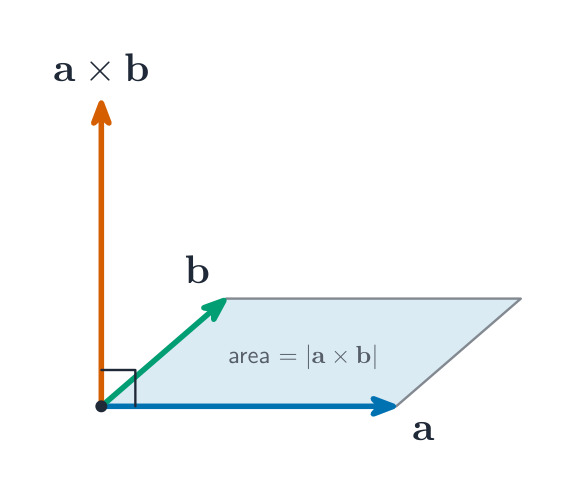
O produto vetorial é perpendicular a ambos os vetores; seu comprimento é a área do paralelogramo
Finding the normal
- The normal to a plane containing two vectors $\mathbf{b}$ and $\mathbf{c}$ is $\mathbf{n} = \mathbf{b} \times \mathbf{c}$.
- This is the quickest way to find the Cartesian equation from a parametric form.
Encontrando o vetor normal
- O vetor normal a um plano contendo dois vetores $\mathbf{b}$ e $\mathbf{c}$ é $\mathbf{n} = \mathbf{b} \times \mathbf{c}$.
- Esta é a maneira mais rápida de encontrar a equação cartesiana a partir da forma paramétrica.
You've got it
- a plane: $ax + by + cz = d$ or $\mathbf{r}\cdot\mathbf{n} = p$
- the vector product $\mathbf{a}\times\mathbf{b}$ is perpendicular to both; $|\mathbf{a}\times\mathbf{b}|$ = parallelogram area
- use it for distances, angles, intersections, and skew-line distances
Entendeu?
- Um plano: $ax + by + cz = d$ ou $\mathbf{r}\cdot\mathbf{n} = p$
- o produto vetorial $\mathbf{a}\times\mathbf{b}$ é perpendicular a ambos; $|\mathbf{a}\times\mathbf{b}|$ = área do paralelogramo
- use-o para distâncias, ângulos, interseções e distâncias entre retas reversas