Homeostasis in plants · Homeostase em plantas
| English | Português |
|---|---|
| stomata/ˈstəʊmətə/ | estômatos |
| transpiration/trænspəˈreɪʃn/ | transpiração |
| guard cell/ɡɑːd sel/ | célula estomática |
| turgid/ˈtɜːdʒɪd/ | turgescida |
| water stress/ˈwɔːtə stres/ | estresse hídrico |
| abscisic acid/əbˈsɪzɪk ˈæsɪd/ | ácido abscísico |
How plants control water loss
- Stomata 气孔 are pores in a leaf.
- The plant opens and closes them to balance two needs.
- A drought hormone can shut them to save water.
Como as plantas controlam a perda de água
- Estômatos 气孔 são poros em uma folha.
- A planta abre e fecha-os para equilibrar duas necessidades.
- Um hormônio de seca pode fechá-los para economizar água.
Guard cells close the stomata to reduce water loss when the plant is short of water. · Células-guarda fecham os estômatos para reduzir a perda de água quando a planta está com escassez hídrica.
Closing the stomata is how a plant conserves water — part of homeostasis in plants. · O fechamento dos estômatos é como uma planta conserva água — parte da homeostase em plantas.
A plant opens and closes its stomata to balance: · Uma planta abre e fecha seus estômatos para equilibrar:
Open stomata let CO₂ in for photosynthesis but also let water escape, so the plant must balance the two. · Estômatos abertos deixam entrar CO₂ para a fotossíntese, mas também deixam a água escapar, de modo que a planta deve equilibrar os dois.
A balancing act
- Open stomata let in carbon dioxide for photosynthesis.
- But open stomata also lose water by transpiration 蒸腾作用.
- So stomata usually open by day and close at night, on a daily rhythm.
Um ato de equilíbrio
- Estômatos abertos deixam entrar dióxido de carbono para fotossíntese.
- Mas estômatos abertos também perdem água por transpiração 蒸腾作用.
- Assim, estômatos geralmente abrem durante o dia e fecham à noite, num ritmo diário.
How a stoma opens · Como um estômata abre
Step through it. Guard cells pump in ions, draw in water by osmosis, swell turgid and bend apart — opening the pore. · Passe por ela. Células-guarda bombam íons para dentro, atraem água por osmose, inham-se turgentes e curvam-se separadamente — abrindo o poro.
Guard cells open a stoma by: · Células-guarda abrem um estômata por:
Taking in ions lowers their water potential; water enters, the guard cells swell turgid and bend apart. · A captação de íons reduz seu potencial hídrico; a água entra, as células-guarda inham-se turgentes e curvam-se separadamente.
Put the opening of a stoma in order. · Coloque a abertura de um estômata em ordem.
Pump ions → water in by osmosis → turgid → bend apart → open. Losing the ions reverses it and the stoma closes. · Bombar íons → água entra por osmose → turgente → curvar-se separadamente → abrir. Perder os íons inverte o processo e o estômata fecha.
How guard cells 保卫细胞 work
- Each stoma is opened and closed by two guard cells:
- to open: guard cells pump in ions → water potential falls → water enters by osmosis → they swell turgid 膨胀 and bend apart, opening the pore.
- to close: ions leave → water follows out → guard cells go floppy → the pore shuts.
Guard cells swell turgid to open the stoma, and go floppy to close it
Como as células-guarda 保卫细胞 funcionam
- Cada estômato é aberto e fechado por duas células-guarda:
- para abrir: células-guarda bombam íons para dentro → potencial hídrico cai → água entra por osmose → elas inham turgescência 膨胀 e se curvam para longe, abrindo o poro.
- para fechar: íons saem → água segue para fora → células-guarda ficam flácidas → o poro fecha.
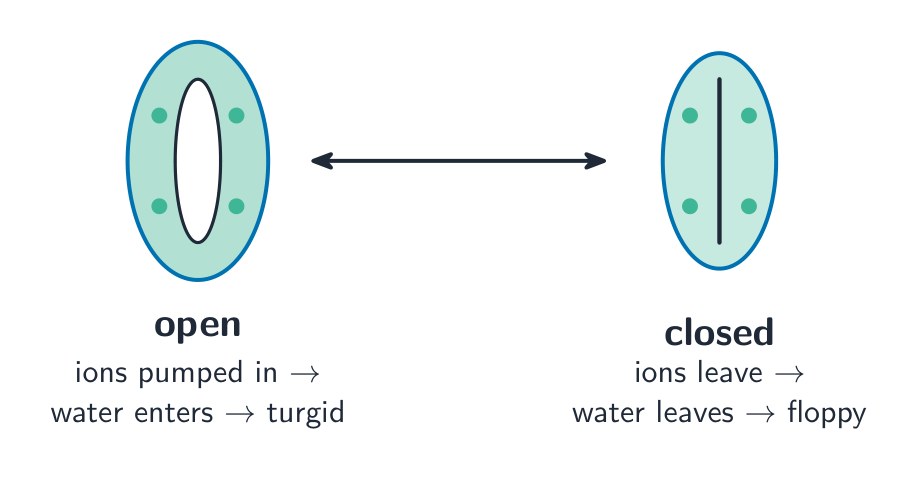
Células-guarda inham turgescência para abrir o estômato, e ficam flácidas para fechá-lo
When a plant is short of water, abscisic acid (ABA): · Quando uma planta está com escassez de água, o ácido abscísico (ABA):
ABA is released under water stress and triggers stomatal closure to conserve water. · O ABA é liberado sob estresse hídrico e desencadeia o fechamento dos estômatos para conservar água.
When a plant is short of water, the hormone ______ makes its stomata close. · Quando uma planta está com escassez de água, o hormônio ______ faz seus estômatos fecharem.
ABA is the stress hormone that triggers stomatal closure to save water. · O ABA é o hormônio de estresse que desencadeia o fechamento dos estômatos para economizar água.
Inside the guard cells, the second messenger in ABA signalling is: · Dentro das células-guarda, o segundo mensageiro na sinalização do ABA é:
Calcium ions act as the second messenger that brings about stomatal closure in response to ABA. · Íons de cálcio atuam como o segundo mensageiro que provoca o fechamento dos estômatos em resposta ao ABA.
Water stress 水分胁迫 and ABA
- When the plant is short of water (water stress), it releases the hormone abscisic acid 脱落酸 (ABA).
- ABA makes the guard cells lose ions and water, so the stomata close and save water.
- Inside the guard cells, calcium ions act as a second messenger.
Estresse hídrico 水分胁迫 e ABA
- Quando a planta está com falta de água (estresse hídrico), ela libera o hormônio ácido abscísico 脱落酸 (ABA).
- ABA faz as células-guarda perderem íons e água, assim os estômatos fecham e economizam água.
- Dentro das células-guarda, íons de cálcio atuam como um segundo mensageiro.
You've got it
- stomata balance CO₂ in (photosynthesis) vs water loss (transpiration)
- guard cells open the pore by taking in ions + water (turgid); close it by losing them (floppy)
- under water stress, ABA makes stomata close to save water
- calcium ions act as the second messenger in the guard cells
Entendeu?
- estômatos equilibram CO₂ para dentro (fotossíntese) vs perda de água (transpiração)
- células-guarda abrem o poro absorvendo íons + água (turgescência); fecham perdendo-os (flácidas)
- sob estresse hídrico, ABA faz estômatos fecharem para economizar água
- íons de cálcio atuam como o segundo mensageiro nas células-guarda