Mode of action of enzymes · Modo de ação das enzimas
| English | Português |
|---|---|
| enzyme/ˈenzaɪm/ | enzima |
| catalyst/ˈkætəlɪst/ | catalisador |
| intracellular/ˌɪntrəˈseljʊlə/ | intracelular |
| extracellular/ˌekstrəˈseljʊlə/ | extracelular |
| active site/ˈæktɪv saɪt/ | sítio ativo |
| substrate/ˈsʌbstreɪt/ | substrato |
| complementary/ˌkɒmplɪˈmentəri/ | complementar |
| induced fit/ɪnˈdjuːst fɪt/ | ajuste induzido |
| activation energy/ˌæktɪˈveɪʃn ˈenədʒi/ | energia de ativação |
Enzymes 酶: nature's catalysts 催化剂
- Most reactions in a cell would be far too slow to keep you alive.
- Enzymes speed them up — by millions of times — without being used up.
- They are globular proteins, and their shape is everything.
Enzimas 酶: catalisadores naturais 催化剂
- A maioria das reações em uma célula seria muito lenta para te manter vivo.
- Enzimas aceleram-nas — milhões de vezes — sem serem consumidas.
- São proteínas globulares, e sua forma é tudo.
Which best describes an enzyme? · Qual descreve melhor uma enzima?
Enzymes are globular protein catalysts: they speed reactions and are not used up, so each one works again and again. · As enzimas são catalisadores proteicos globulares: elas aceleram reações e não são consumidas, então cada uma funciona repetidamente.
Where enzymes work
- Intracellular 细胞内 enzymes work inside the cell that made them — e.g. catalase, which breaks down harmful hydrogen peroxide.
- Extracellular 细胞外 enzymes are secreted to work outside the cell — e.g. amylase, released into the gut to digest starch.
- Either way, an enzyme is a catalyst: it speeds a reaction and is not used up, so it works again and again.
Yeast enzymes ferment sugar, giving off bubbles of carbon dioxide.
Onde as enzimas atuam
- Enzimas intracelulares 细胞内 funcionam dentro da célula que as produziu — ex.: catalase, que decompõe o peróxido de hidrogênio nocivo.
- Enzimas extracelulares 细胞外 são secretadas para atuar fora da célula — ex.: amilase, liberada no intestino para digerir amido.
- De qualquer forma, uma enzima é um catalisador: acelera uma reação e não é consumida, podendo agir repetidamente.
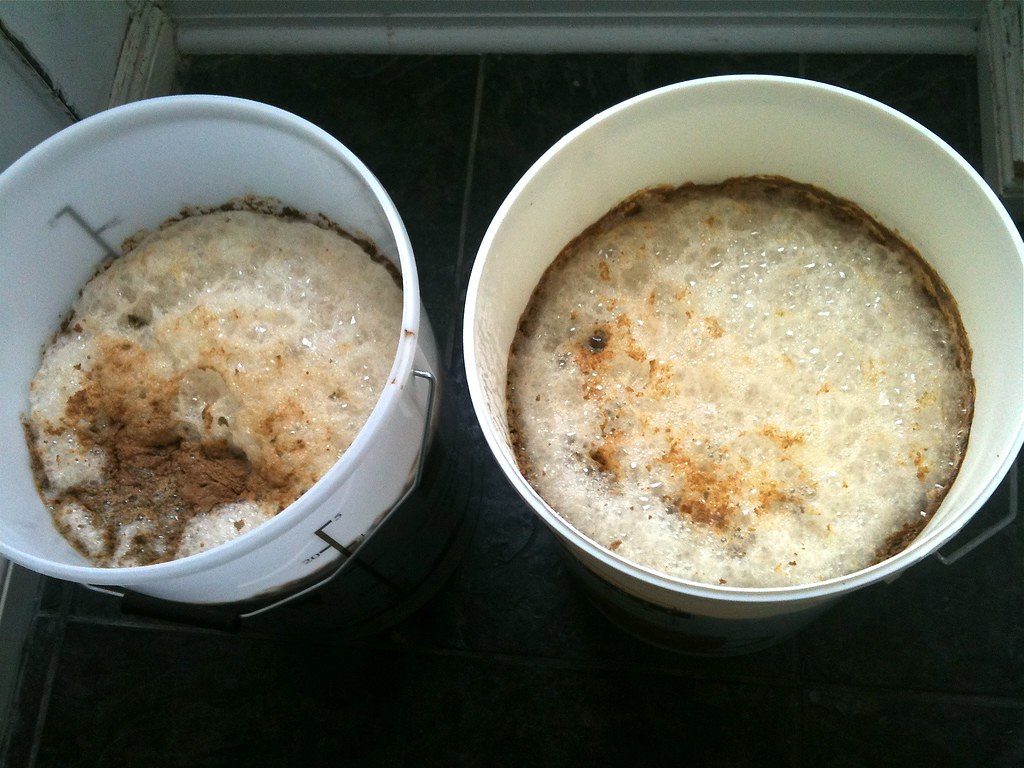
Enzimas de levedura fermentam açúcar, liberando bolhas de dióxido de carbono.
Select all · todos the correct statements about where enzymes work. · Selecione todas as afirmações corretas sobre onde as enzimas atuam.
Catalase is intracellular and amylase is extracellular. Extracellular means it works outside the cell, so the third statement is false. · A catalase é intracelular e a amilase é extracelular. Extracelular significa que atua fora da célula, então a terceira afirmação é falsa.
The active site 活性位点 and specificity
- Each enzyme has a pocket called the active site. The molecule it acts on is the substrate 底物.
- The substrate binds to form an enzyme–substrate complex; the reaction happens, then the products leave and free the site.
- An enzyme is specific — its active site is complementary 互补 to just one substrate's shape, and no other.
Biological washing powders contain enzymes that digest food and blood stains.
O sítio ativo 活性位点和特异性
- Cada enzima tem um bolso chamado sítio ativo. A molécula sobre a qual atua é o substrato 底物.
- O substrato liga-se para formar um complexo enzima-substrato; a reação ocorre, então os produtos saem e liberam o sítio.
- Uma enzima é específica — seu sítio ativo é complementar 互补 apenas à forma de um único substrato, e nenhum outro.

Detergentes biológicos contêm enzimas que digerem manchas de comida e sangue.
Match each term to its meaning. · Combine cada termo com seu significado.
The substrate binds in the active site to form the enzyme–substrate complex; the reaction makes the product, which is then released. · O substrato liga-se ao sítio ativo para formar o complexo enzima-substrato; a reação produz o produto, que é então liberado.
An enzyme is specific because: · Uma enzima é específica porque:
Specificity comes from the active site's shape being complementary to one substrate and no other. · A especificidade vem da forma do sítio ativo ser complementar a um substrato e nenhum outro.
The catalytic cycle
- The substrate slots into the active site, forming an enzyme–substrate complex.
- Bonds are strained, the reaction happens, and the products are released.
- The enzyme is left unchanged — free to bind again, thousands of times a second.
O ciclo catalítico
- O substrato encaixa-se no sítio ativo, formando um complexo enzima-substrato.
- As ligações são tensionadas, a reação ocorre e os produtos são liberados.
- A enzima fica inalterada — livre para ligar novamente, milhares de vezes por segundo.
The catalytic cycle · O ciclo catalítico
Step through the cycle. The enzyme binds its substrate, the reaction happens, the products leave — and the same · mesmo enzyme is free to go again. · Passe pelo ciclo. A enzima liga seu substrato, a reação ocorre, os produtos saem — e a mesma enzima fica livre para ir novamente.
Put the steps of the catalytic cycle in order. · Coloque as etapas do ciclo catalítico em ordem.
Bind → react → release → reset. The enzyme is unchanged, so it repeats the cycle thousands of times a second. · Ligar → reagir → soltar → resetar. A enzima é inalterada, então repete o ciclo milhares de vezes por segundo.
Lock-and-key vs induced fit 诱导契合
- Lock-and-key: the active site is a fixed shape; only a substrate with the matching shape fits, like a key in a lock.
- Induced fit: the active site is not quite the right shape at first — when the substrate binds, the site moulds around it for a tight grip.
- Induced fit matches the evidence better.
The lock-and-key and induced-fit models of how a substrate fits the active site
Chave-fechadura vs ajuste induzido 诱导契合
- Chave-fechadura: o sítio ativo tem uma forma fixa; apenas um substrato com a forma correspondente se encaixa, como uma chave na fechadura.
- Ajuste induzido: o sítio ativo não é exatamente a forma certa inicialmente — quando o substrato se liga, o sítio se modela ao redor dele para um aperto firme.
- O ajuste induzido corresponde melhor às evidências.
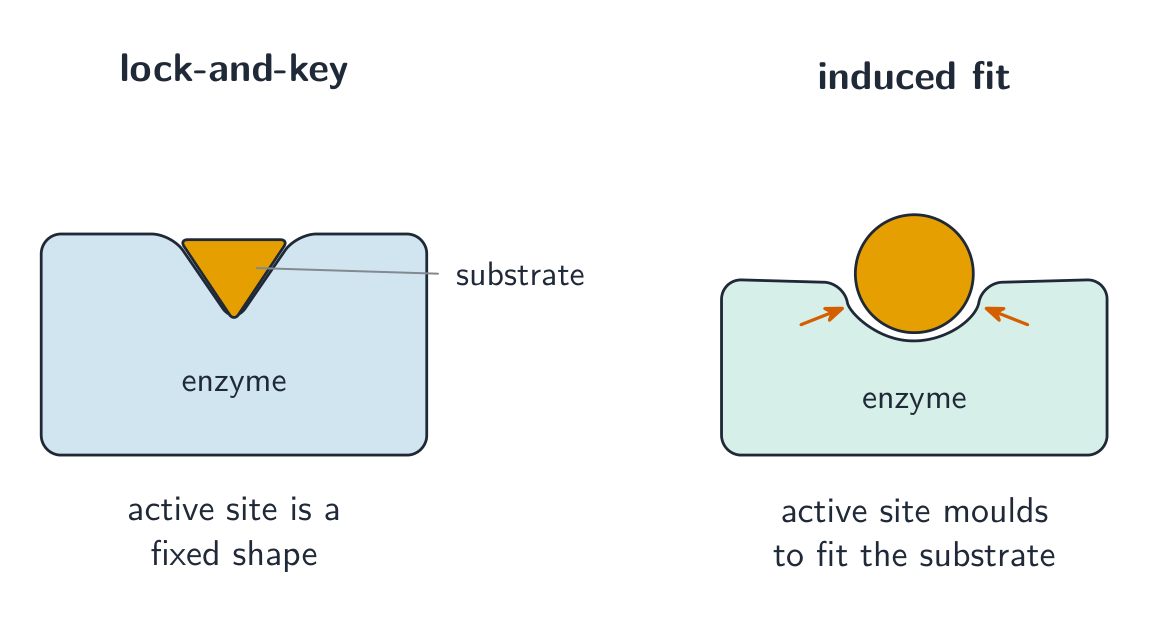
Os modelos de chave-fechadura e ajuste induzido de como um substrato se encaixa no sítio ativo
In the induced-fit model the active site is completely rigid and never changes shape. · No modelo de ajuste induzido, o sítio ativo é completamente rígido e nunca muda de forma.
That describes lock-and-key. In induced fit the active site moulds around the substrate as it binds — a tighter grip that fits the evidence better. · Isso descreve chave-fechadura. No ajuste induzido, o sítio ativo molda-se ao redor do substrato enquanto ele se liga — uma aderência mais firme que se adapta melhor às evidências.
The specific molecule that an enzyme acts on is called its ______. · A molécula específica sobre a qual uma enzima age é chamada de ______.
The substrate binds in the active site, where the enzyme converts it into product. · O substrato liga-se ao sítio ativo, onde a enzima o converte em produto.
Lowering activation energy 活化能
- Every reaction needs a starting "push" of energy — the activation energy.
- An enzyme lowers the activation energy, so the reaction can run fast at the cell's normal temperature instead of needing high heat.
Reduzindo a energia de ativação 活化能
- Toda reação precisa de um "empurrão" inicial de energia — a energia de ativação.
- Uma enzima reduz a energia de ativação, permitindo que a reação corra rapidamente à temperatura normal da célula, sem precisar de calor intenso.
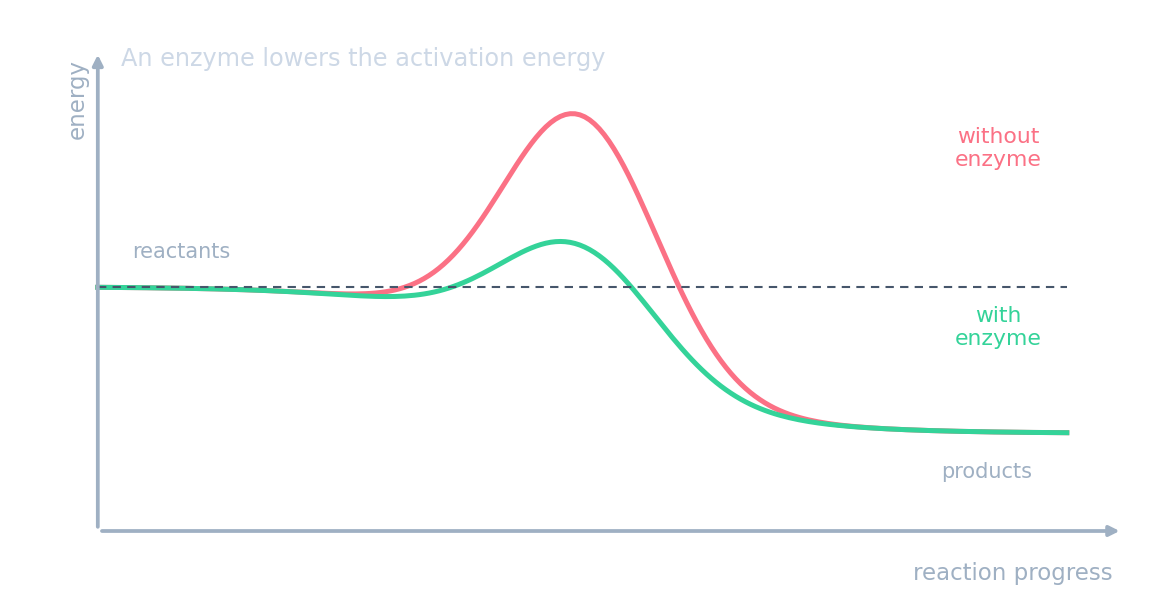
How does an enzyme speed up a reaction? · Como uma enzima acelera uma reação?
Enzymes lower the activation energy, so the reaction proceeds quickly at normal cell temperatures. · As enzimas reduzem a energia de ativação, permitindo que a reação ocorra rapidamente em temperaturas celulares normais.
You've got it
- enzymes = globular protein catalysts; not used up; intracellular (catalase) or extracellular (amylase)
- active site + substrate → enzyme–substrate complex → products leave
- specific: active site is complementary to one substrate (lock-and-key / induced fit)
- enzymes work by lowering the activation energy
Entendeu?
- enzimas = catalisadores de proteínas globulares; não consumidas; intracelular (catalase) ou extracelular (amilase)
- sítio ativo + substrato → complexo enzima-substrato → produtos saem
- específico: o sítio ativo é complementar a um único substrato (fechadura e chave / ajuste induzido)
- as enzimas funcionam reduzindo a energia de ativação