Pular para o conteúdo
Matérias

Gramática Inglesa · Nível A1

  • 1 The verb to be
    1.1

    am / is / are

    verbo be: am / is / are variam conforme o sujeito

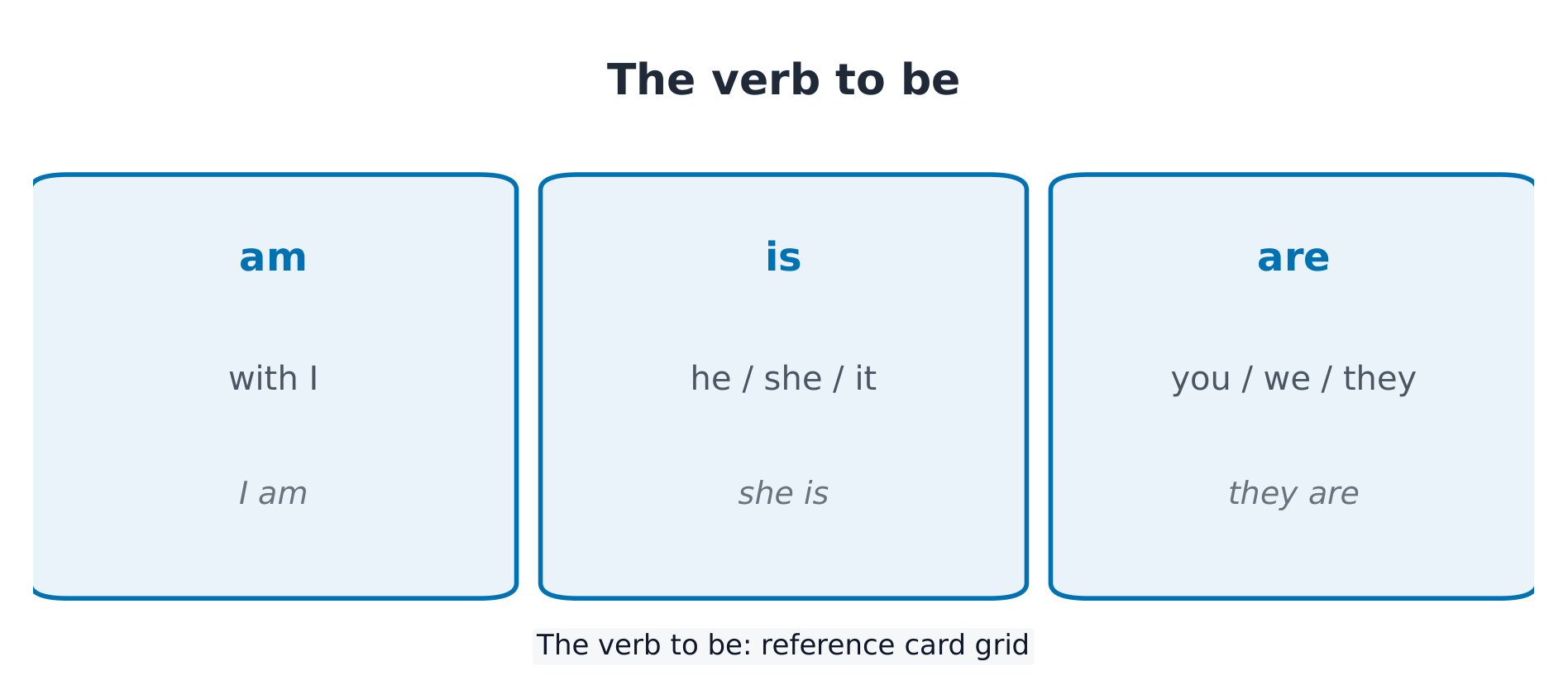
    O verbo be (o verbo to be) significa "ser / estar". Ele varia conforme o sujeito e tem três formas:

    • I → am
    • he / she / it → is
    • you / we / they → are

    我I 是am 一名a 学生student.

    我是一名学生。

    她She 是is 开心happy.

    她很开心。

    他们They (是)are 来自from 中国China.

    他们来自中国。

    Nota Abreviações comuns na fala: I'm, you're, he's, she's, it's, we're, they're.

    1.2

    否定与疑问

    Negativo: adicione not depois do verbo be (geralmente abreviado).

    他He 不是is not 一名a 老师teacher.

    Ele não é professor. (= He isn't a teacher.)

    Interrogativo: mova o verbo be para antes do sujeito.

    (是吗)Are 你you 准备好ready?

    你准备好了吗?

    Respostas curtas: Yes, I am. / No, I'm not.

    Nota Abreviações negativas: is not → isn't, are not → aren't; mas am not só se abrevia como I'm not (não existe ~~amn't~~).

    常见错误

    • ❌ ~~He busy.~~ → ✓ He is busy. — Em chinês "ele está muito ocupado" pode não ter verbo, mas uma frase em inglês deve ter verbo. Use be para ligar quando o predicativo for adjetivo ou substantivo e não houver outro verbo (He is busy); se já houver um verbo comum, não use be (I go to school).
    • ❌ ~~I am go to school.~~ → ✓ I go to school. — be e verbos comuns não podem ser usados juntos; "ir" exige apenas go.
    • ❌ ~~They is my friends.~~ → ✓ They are my friends. — Sujeitos no plural (you / we / they) usam are.
    • ❌ ~~I am agree.~~ → ✓ I agree. — agree (concordar) já é um verbo, não use am antes dele.
    • ❌ ~~Are you ready? — Yes, I'm.~~ → ✓ Yes, I am. — No final de respostas curtas afirmativas não se usa abreviação (diga Yes, I am); mas respostas curtas negativas geralmente terminam com abreviação negativa (No, he isn't / No, I can't; para primeira pessoa é No, I'm not, pois não existe amn't).
  • 2 Subject pronouns
    2.1

    I, you, he, she, it, we, they

    主语代词与物主词

    Os pronomes pessoais do caso reto (subject pronouns) substituem o sujeito e vêm antes do verbo:

    • I(eu), you(você / vocês), he(ele), she(ela)
    • it(ele/ela/isto), we(nós), they(eles/delas/os/as/as/es)

    他He 是is 我的my 哥哥brother.

    他是我哥哥。

    我们We 喜欢like 音乐music.

    我们喜欢音乐。

    用法要点:

    • I 永远大写,不管在句子哪里。
    • Coisas e animais usam it: This is my bag. It is new.(Este é minha bolsa. Ela é nova.)*
    • Pessoas ou coisas no plural usam they: The books are here. They are mine.(Os livros estão aqui. Eles são meus.)*

    Nota Os pronomes retos vêm antes do verbo; não confunda com os pronomes oblíquos que virão depois (me, him, her...).

    常见错误

    • ❌ ~~My mother is a doctor. He is very kind.~~ → ✓ She is very kind. — Na fala chinesa "ele / ela" têm som igual, mas em inglês he / she devem ser distinguidos.
    • ❌ ~~Me am a student.~~ → ✓ I am a student. — Para fazer o papel de sujeito, use I, não me.
    • ❌ ~~My friend he is tall.~~ → ✓ My friend is tall. — O sujeito é dito uma vez; não repita "substantivo + pronome" (o hábito chinês de dizer "meu amigo ele..." não se aplica ao inglês).
    • ❌ ~~Is raining.~~ → ✓ It is raining. — Frases em inglês devem ter sujeito; tempo, hora e data começam com it.
  • 3 Possessive adjectives
    3.1

    my, your, his, her, our, their

    adjetivos possessivos: my / your / his / her

    Os adjetivos possessivos (possessive adjectives) indicam "de quem" e vêm antes do substantivo:

    • I → my(meu/milha), you → your(seu/sua/vossa), he → his(dele/dele)
    • she → her(dela/dela), it → its(dele/dela/isto), we → our(nosso/nossa), they → their(deles/delas)

    这This 是is 我的my 包bag.

    这是我的包。

    她的Her 名字name 是is 露西Lucy.

    她的名字叫露西。

    用法要点:

    • Após os adjetivos possessivos sempre vem um substantivo: my book, their house.
    • Eles não mudam conforme singular/plural do substantivo: my book, my books (my permanece invariável).

    Nota Cuidado para distinguir its (dele/dela, sem apóstrofo) e it's (= it is). Exemplo: The dog wags its tail.(O cachorro abaixa sua cauda.)*

    常见错误

    • ❌ ~~This is she book.~~ → ✓ This is her book. — Antes do substantivo, use a forma possessiva: he → his, she → her.
    • ❌ ~~He is me friend.~~ → ✓ He is my friend. — A forma possessiva de I é my.
    • ❌ ~~The dog wags it's tail.~~ → ✓ ...wags its tail. — it's = it is; "dele/dela" é its, sem apóstrofo.
    • ❌ ~~Their is a park near here.~~ → ✓ There is a park near here. — their (deles) e there (há / lá) têm som idêntico; não misture na escrita.
  • 4 this, that, these, those
    4.1

    this com that

    próximo/distante × singular/plural: this / that / these / those

    Os demonstrativos (demonstratives) indicam "qual". Para singular, use this e that:

    • this(este): próximo de quem fala.
    • that(aquele): distante de quem fala.

    这This 是is 我的my 手机phone.

    这是我的手机。(近)

    那That 是is 你的your 车car.

    那是你的车。(远)

    4.2

    these com those

    Para plural, use these e those:

    • these(estes): próximos. those(aqueles): distantes.

    这些These 是are 我的my 书books.

    这些是我的书。

    那些Those 是are 她的her 朋友friends.

    那些是她的朋友。

    对照记忆:

    • Próximo → this (singular) / these (plural).
    • Distante → that (singular) / those (plural).

    Nota these / those vêm antes de substantivos no plural: these books, não ~~these book~~.

    常见错误

    • ❌ ~~these book~~ → ✓ these books — after these / those deve vir sempre um substantivo no plural.
    • ❌ ~~This books are mine.~~ → ✓ These books are mine. — Se o substantivo é plural, o demonstrativo também deve ser.
    • ❌ Ao discar pelo telefone, diga ~~I am Tom.~~ → ✓ This is Tom. — Em inglês, ao apresentar-se por telefone, usa-se this is.
    • Lembre-se dos pares: this / these (perto) costumam ir com here; that / those (longe) costumam ir com there.
  • 5 a, an e plurais
    5.1

    a com an

    a / an: veja a pronúncia (consoante vs vogal)

    a e an significam "um/uma" e vêm antes de substantivos contáveis no singular. Escolha baseada na pronúncia:

    • a + som de consoante: a book, a dog, a cat.
    • an + som de vogal: an apple, an egg, an orange.

    我I 有have 一个a 笔pen.

    我有一支笔。

    她She 吃eats 一个an 苹果apple.

    她吃一个苹果。

    Nota Observe o som, não a letra: an hour (h muda), a university (soa como "yu-").

    5.2

    名词复数

    表示"不止一个"时,名词用复数,通常加 -s:

    • Adicione -s geralmente: book → books, car → cars.
    • Palavras terminadas em -s / -sh / -ch / -x, adicione -es: bus → buses, box → boxes.
    • Consoante + y, y vira i e adiciona -es: baby → babies, city → cities.

    我I 有have 两two 猫cats.

    我有两只猫。

    不规则复数(要背):

    • man → men, woman → women, child → children.
    • foot → feet, tooth → teeth, person → people.

    Nota Não use a / an antes de substantivos no plural: ~~a books~~ ✗ → books / two books ✓.

    常见错误

    • ❌ ~~I have dog.~~ → ✓ I have a dog. — Em chinês pode-se dizer "tenho cachorro", mas em inglês substantivos contáveis singulares exigem a / an (ou my, the, etc.).
    • ❌ ~~an university~~ → ✓ a university; ❌ ~~a hour~~ → ✓ an hour — Olhe a pronúncia, não as letras: university começa com consoante /j/, h de hour muda.
    • ❌ ~~two book~~ → ✓ two books — Substantivos em chinês não têm plural, mas em inglês números seguidos de substantivo exigem -s, erro mais comum.
    • ❌ ~~three childs~~ → ✓ three children — Plurais irregulares devem ser memorizados separadamente: men, women, children, feet, teeth, people.
    • ❌ ~~a people~~ → ✓ a person(uma pessoa) / people(pessoas muitas) — people já é plural.
  • 6 there is e there are
    6.1

    单数与复数

    There is (singular) / There are (plural)

    there is / there are significam "haver / existir" (algo existe num lugar).

    • There is + singular / incontável: There is a book.
    • There are + plural: There are two books.

    (有)There 有is 一只a 猫cat 在on (冠词)the 沙发上sofa.

    沙发上有一只猫。

    (有)There 有are 三three 书books 在on (冠词)the 桌上desk.

    桌上有三本书。

    Nota Na fala, there is freqüentemente abreviado como there's: There's a problem.

    6.2

    否定与疑问

    Negativo: there is not / there are not (abreviado: there isn't / there aren't).

    (有)There 没有isn't 任何any 牛奶milk.

    没有牛奶了。

    Interrogativo: mova is / are para antes de there.

    (有吗)Is (有)there 一家a 银行bank 附近near 这里here?

    这附近有银行吗?

    Respostas curtas: Yes, there is. / No, there isn't.

    Nota Em frases negativas e interrogativas, use any: Is there any water?(Tem água?)

    常见错误

    • ❌ ~~Here has many people.~~ → ✓ There are many people here. — O "ter/haver" em "há muita gente aqui" indica existência; em inglês use there is / there are, não traduza literalmente com have.
    • ❌ ~~There have a book on the desk.~~ → ✓ There is a book on the desk. — After there use is / are; não existe "there have".
    • ❌ ~~There is two cats.~~ → ✓ There are two cats. — Se o substantivo seguinte é plural, use are.
    • ❌ ~~There are a milk.~~ → ✓ There is some milk. — milk é incontável: use there is + some, não a.
  • 7 ter
    7.1

    have got / has got

    have got / has got

    have got significa "ter/possuir" (= have), muito comum no inglês britânico.

    • I / you / we / they → have got
    • he / she / it → has got

    我I 有have got 一个a 兄弟brother.

    Tenho um irmão. (= I have a brother.)

    她She 有has got 蓝色blue 眼睛eyes.

    她有一双蓝眼睛。

    Nota Na fala, freqüentemente abreviado: I've got, she's got, they've got. Significado igual a have / has.

    7.2

    否定与疑问

    Negativo: haven't got / hasn't got.

    他He 没有hasn't got 一辆a 车car.

    他没有车。

    Interrogativo: mova Have / Has para antes do sujeito.

    (有吗)Have 你you 有got 一支a 笔pen?

    你有笔吗?

    Respostas curtas: Yes, I have. / No, I haven't.

    Nota have got usa-se mais para estados momentâneos de "ter"; para falar de passado ou hábitos, use have / had normal.

    常见错误

    • ❌ ~~She have got long hair.~~ → ✓ She has got long hair. — he / she / it usa has got.
    • ❌ ~~I have got not a car.~~ → ✓ I haven't got a car. — not vem depois de have / has, depois abrevie.
    • ❌ ~~Do you have got a pen?~~ → ✓ Have you got a pen? / Do you have a pen? — Ambas as perguntas estão corretas, mas não as misture.
    • ❌ ~~Yes, I have got.~~ → ✓ Yes, I have. — Respostas curtas param em have / has, sem levar got.
  • 8 Present simple
    8.1

    习惯与第三人称 -s

    一般现在时:反复的习惯

    Present Simple (present simple) fala sobre hábitos e fatos. A forma básica é o verbo na forma original.

    我I 喜欢like 茶tea.

    我喜欢茶。

    Quando o sujeito é he / she / it, o verbo recebe -s:

    他He 踢plays 足球football.

    他踢足球。

    拼写:

    • Geralmente adicione -s: like → likes.
    • Terminações em -s / -sh / -ch / -x / -o, adicione -es: go → goes, watch → watches.
    • Consoante + y, y vira i e adiciona -es: study → studies.

    Nota Só he / she / it recebem -s; I / you / we / they usam a forma original: They like tea.

    8.2

    否定与疑问

    Hábitos diários: I have breakfast every morning.

    Para negações e perguntas, use o auxiliar do / does (he / she / it usa does).

    Negação: Sujeito + don't / doesn't + verbo na forma base.

    我I 不don't 喜欢like 咖啡coffee.

    我不喜欢咖啡。

    Pergunta: Do / Does + sujeito + verbo na forma base ?

    (助动词)Does 她she 住live 这里here?

    她住在这里吗?

    Atenção: ao usar do / does, o verbo volta para a forma base(sem -s):~~Does she lives~~ ✗ → Does she live ✓。

    常见错误

    • ❌ ~~He go to school by bus.~~ → ✓ He goes to school by bus. — Esquecer de adicionar -s na terceira pessoa do singular é o erro mais frequente; revise após escrever.
    • ❌ ~~She doesn't likes coffee.~~ → ✓ She doesn't like coffee. — Ao usar does / doesn't, o verbo volta para a forma base.
    • ❌ ~~I very like English.~~ → ✓ I like English very much. — "Muito" em chinês não deve ser traduzido literalmente; very não pode modificar verbos diretamente.
    • ❌ ~~You like tea?~~ → ✓ Do you like tea? — Perguntas devem começar com do / does, não apenas com entonação ascendente.
  • 9 can
    9.1

    能力与请求

    can: habilidade, negação, pergunta

    can indica habilidade("saber / poder") ou é usado para pedidos. É seguido por verbo na forma base, igual para todas as pessoas.

    我I 会can 游泳swim.

    我会游泳。

    能Can 你you 帮help 我me?

    你能帮我一下吗?

    Atenção: can é seguido por forma base:~~can to swim~~ ✗、~~can swims~~ ✗ → can swim ✓。

    9.2

    否定与疑问

    Negação: cannot(abreviado can't) + verbo na forma base.

    她She 不会can't 开车drive.

    她不会开车。

    Pergunta: coloque Can antes do sujeito.

    能Can 他he 做饭cook?

    他会做饭吗?

    Respostas curtas:Yes, I can. / No, I can't.

    Atenção: can não tem -s, nem usa do / does: pergunte diretamente Can he…?, não ~~Does he can…?~~

    常见错误

    • ❌ ~~She cans drive.~~ → ✓ She can drive. — can não tem terceira pessoa -s, mesmo formato para todos os sujeitos.
    • ❌ ~~I don't can swim.~~ → ✓ I can't swim. — A negação de can é direta com not(can't), sem don't.
    • ❌ ~~He can sings very good.~~ → ✓ He can sing very well. — Após can use verbo na forma base; para modificar verbos use o advérbio well, não good。
    • ❌ ~~You can help me?~~ → ✓ Can you help me? — Ao pedir ajuda, mova can antes do sujeito。
  • 10 Imperatives
    10.1

    命令与指示

    祈使句:命令、否定、请求

    Imperativos são usados para dar ordens, dar instruções ou fazer pedidos. Comece diretamente com verbo na forma base, sem sujeito。

    打开Open (冠词)the 门door 请, please.

    请把门打开。

    坐Sit 下down.

    坐下。

    Negação: adicione Don't antes。

    不要Don't (是)be 迟到late.

    别迟到。

    用法要点:

    • Adicionar please torna mais educado:Please come in.(Entre, por favor。)
    • Também usado para rotas e instruções:Turn left.(Virar à esquerda。)Mix the eggs.(Bater os ovos。)

    Atenção: imperativos não usam sujeito:~~You open the door~~(ao dar ordem)→ Open the door。

    常见错误

    • ❌ ~~Please open door.~~ → ✓ Please open the door. — Artigos também não podem ser omitidos em imperativos。
    • ❌ ~~Don't to touch it.~~ → ✓ Don't touch it. — Após don't, vá direto para o verbo na forma base, sem to。
    • ❌ ~~No talk in class!~~ → ✓ Don't talk in class! / No talking! — Para proibir algo, use don't + forma base; após no use -ing ou substantivo。
    • ❌ ~~You sit down!~~ → ✓ Sit down, please. — Ordenar com you soa bruto; para ser educado, adicione please ou mude para Can you…?
  • 11 Question words
    11.1

    what, where, who

    疑问词:问事物/地点/人/时间

    Palavras interrogativas (question words) vêm no início da pergunta para questionar informações específicas。

    • what(o que), where(onde), who(quem)

    什么What 是is 你的your 名字name?

    你叫什么名字?

    哪里Where (助动词)do 你you 住live?

    你住在哪里?

    谁Who 是is 那个that 男人man?

    那个男人是谁?

    Atenção: palavras interrogativas geralmente são seguidas por verbo be ou auxiliar do / does:Where do you work?

    11.2

    when, why, how

    • when(quando), why(por que), how(como / de que maneira)

    什么时候When 是is (冠词)the 派对party?

    派对什么时候?

    为什么Why (是)are 你you 难过sad?

    你为什么难过?

    怎么How (助动词)do 你you 拼写spell 它it?

    这个怎么拼?

    Atenção: how também pode combinar com adjetivos para perguntar grau:How old are you?(Quantos anos você tem?)How much is it?(Quanto custa?)

    常见错误

    • ❌ ~~Where you live?~~ → ✓ Where do you live? — Após palavra interrogativa ainda é necessário do / does ou be, não pode ir direto para o sujeito。
    • ❌ ~~What means this word?~~ → ✓ What does this word mean? — mean é um verbo comum: palavra interrogativa + does + sujeito + forma base。
    • ❌ ~~Why you are late?~~ → ✓ Why are you late? — Se houver verbo be na frase, mova-o antes do sujeito。
    • ❌ ~~How to spell it?~~ → ✓ How do you spell it? — Traduzir literalmente "Como se escreve?" perde sujeito e auxiliar; é preciso completar。
  • 12 Preposições de lugar
    12.1

    in, on, under

    preposições de lugar: in / on / under

    Preposições de lugar indicam onde algo está。

    • in(dentro de), on(sobre / em cima), under(embaixo de)

    (冠词)The 钥匙keys 在are 在...里in (冠词)the 包里bag.

    钥匙在包里。

    (冠词)The 书book 在is 在...上on (冠词)the 桌上table.

    书在桌上。

    (冠词)The 猫cat 在is 在...下under (冠词)the 椅子下chair.

    猫在椅子下面。

    12.2

    next to, between, behind

    • next to(ao lado de), between(entre), behind(atrás de), in front of(na frente de)

    (冠词)The 商店shop 在is 旁边next to (冠词)the 银行bank.

    商店在银行旁边。

    她She 坐sits 之间between 汤姆Tom 和and 萨姆Sam.

    她坐在汤姆和萨姆之间。

    Atenção: between significa "entre dois", geralmente seguido por A and B:between the door and the window。

    常见错误

    • ❌ ~~The picture is in the wall.~~ → ✓ The picture is on the wall. — quadros pendurados na parede têm contato superficial, use on。
    • ❌ ~~I read it on the book.~~ → ✓ …in the book. — Conteúdo dentro de livros usa in; pessoas em fotos também usam in the photo。
    • ❌ ~~The shop is next the bank.~~ → ✓ next to the bank — next to são duas palavras, to não pode ser omitido。
    • ❌ ~~between the door with the window~~ → ✓ between the door and the window — between tem coligação fixa A and B。

Entrar ou criar conta

IGCSE, A-Level & AP