Mutation and variant interpretation
Introduced| English | Meaning |
|---|---|
| variant of uncertain significance | A DNA change whose link to disease is not yet known. |
| synonymous | Of a DNA change: altering a codon without changing the amino acid. |
| missense | Of a DNA change: replacing one amino acid with another. |
| nonsense | Of a DNA change: creating a premature stop codon. |
| frameshift/ˈfreɪmʃɪft/ | A change in how codons are grouped after insertion or deletion of a nucleotide number that is not a multiple of three in a coding sequence. |
| splice-site | The short sequence at an exon-intron boundary that tells the cell where to cut and join the RNA. |
| copy number variants | Stretches of DNA that are deleted or duplicated, so a person has fewer or more than two copies. |
| haploinsufficiency | When one working copy of a gene is not enough for normal function. |
| dominant negative | A mutant protein that interferes with the normal protein from the other allele, so one faulty copy has more than half the effect. |
"Variant of uncertain significance"
- A genetic report names a single changed letter and adds four words: of uncertain significance. A family now has to decide what to do with that.
- Interpreting variants is the daily work of medical genetics: a graded chain of evidence, not a yes or no.
Single-letter changes
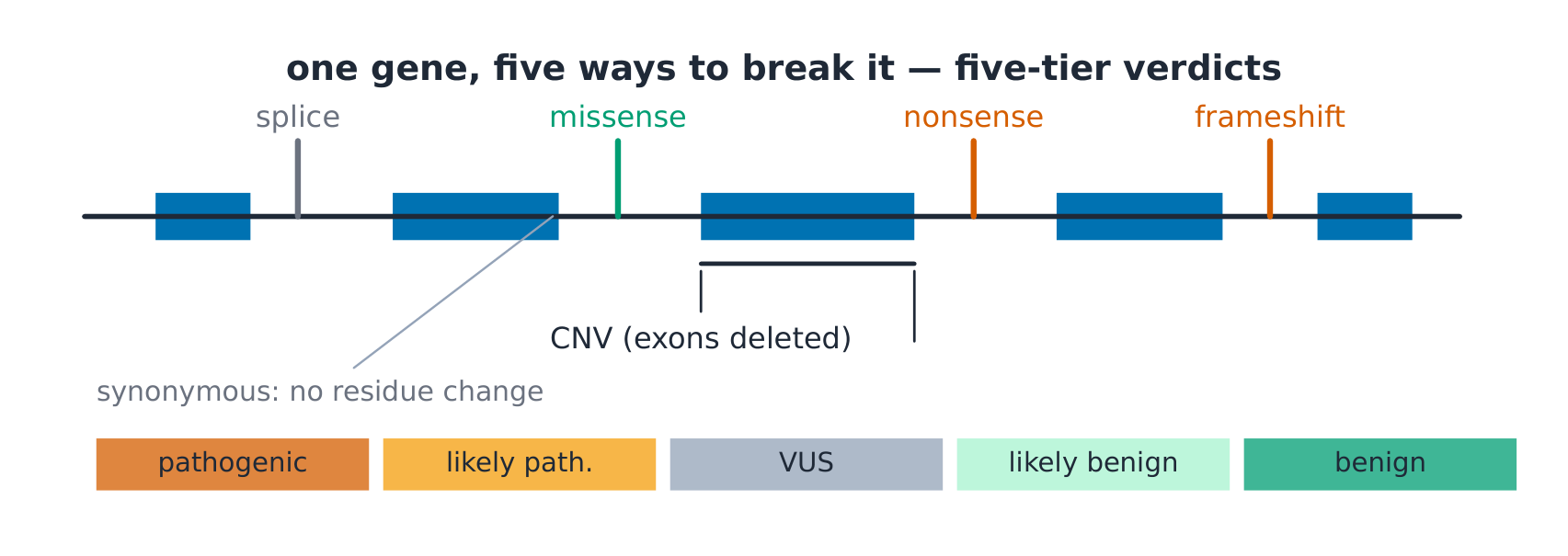
- A synonymous 同义 variant changes a codon but not the amino acid. A missense 错义 variant swaps one amino acid for another.
- A nonsense 无义 variant creates an early stop codon, so the protein is cut short or the message is destroyed: usually serious.
A single-letter change turns a codon into a stop codon. What type of variant is it?
Difficulty 1/5 · 100 coins + a small bonus on first completion today
A new stop codon cuts the protein short. A frameshift needs an insertion or deletion.
Bigger changes
- A frameshift 移码 is an insertion or deletion whose length is not a multiple of 3: every codon after it is misread. A splice-site 剪接位点 variant changes how exons are joined.
- Copy number variants 拷贝数变异 (CNVs) delete or duplicate whole exons or genes.
Substitution or frameshift
Substitute one base and only one codon changes. Delete one base and every codon after it is regrouped and misread; delete three and the frame is restored with one amino acid lost.
Match each variant type to its effect.
Difficulty 2/5 · 140 coins + a small bonus on first completion today
The type predicts how badly the protein is damaged.
Six bases are deleted from a coding exon. How many amino acids are lost, assuming the frame is kept?
Difficulty 2/5 · 140 coins + a small bonus on first completion today
6 ÷ 3 = 2 codons. Because 6 is a multiple of 3, the frame is kept.
Deleting 4 bases from a coding exon shifts the reading frame.
Difficulty 1/5 · 100 coins + a small bonus on first completion today
4 is not a multiple of 3, so every codon after the deletion is read in the wrong frame.
Five verdicts
- Laboratories place each variant in one of five tiers: pathogenic, likely pathogenic, variant of uncertain significance 意义未明变异 (VUS), likely benign and benign.
- The evidence: how common it is in healthy people, computer predictions, laboratory tests of function, whether it tracks the disease in the family, and how well the gene is linked to the disease.
Put the five verdicts in order, from most to least likely to cause disease.
Difficulty 3/5 · 200 coins + a small bonus on first completion today
The VUS sits in the middle, where the evidence points neither way.
Frequency comes first
- A variant common in healthy people cannot cause a rare, severe, early disease. Population databases such as gnomAD are checked before anything else.
- A variant predicted to be "damaging" but carried by 1% of healthy people is usually harmless background.
The gene's mechanism decides which variants count
- If one working copy is not enough, haploinsufficiency 单倍剂量不足, then truncating variants (nonsense, frameshift) cause disease. PAX6 in aniridia is an example.
- If a faulty protein spoils its normal partner, a dominant negative 显性负效应 effect, missense variants matter more. In a recessive gene, one variant makes a healthy carrier.
Worked example: the frequency check
- (Fictional) A dominant disease affects 1 person in 10 000; a variant is carried by 1 person in 100.
- Even if this variant caused every case, only $\dfrac{1/10\,000}{1/100} = \dfrac{1}{100}$ of carriers could be affected. It cannot be a fully penetrant cause, whatever the computer predicts.
A dominant disease affects 1 person in 20 000, and a variant is carried by 1 person in 200. Even if the variant caused every case, at most what percentage of its carriers could be affected?
Difficulty 2/5 · 140 coins + a small bonus on first completion today
(1/20 000) ÷ (1/200) = 1/100 = 1%, far too common to be a fully penetrant cause.
Worked example: the VUS conversation
- (Fictional) A missense VUS in a breast-cancer gene is found in a woman with breast cancer. It is not treated as pathogenic, and her relatives are not tested for it.
- It may be reclassified later, if it is found to track the disease in families or appears in many more patients. The plain sentence: "We found a spelling change; we do not yet know whether it matters."
What is the right response to a VUS in a breast-cancer gene?
Difficulty 1/5 · 100 coins + a small bonus on first completion today
A VUS is unknown. Decisions rest on the personal and family history until new evidence reclassifies the variant.
Three common slips
- "A VUS is probably pathogenic." It is explicitly unknown, and acting on it can mislead a whole family.
- "Predicted damaging means disease-causing." Prediction is weak evidence; frequency and family data count more.
- "Every deletion shifts the frame." A deletion of 3 or 6 bases removes amino acids but keeps the frame.
Recap
- Variant types: synonymous, missense, nonsense, frameshift, splice-site and CNV.
- Five tiers, from benign to pathogenic; a VUS stays a VUS until new evidence moves it.
- Frequency is the first filter, and the gene's mechanism decides which variant types count.