Cell signalling
Introduced| English | Meaning |
|---|---|
| signal transduction/ˈsɪɡnl trænsˈdʌkʃn/ | The process by which a cell converts a received signal into a sequence of internal responses. |
| G-protein-coupled receptor | A receptor with seven membrane-spanning helices that, when bound, activates a G protein inside the cell. |
| second messenger/ˈsekənd ˈmesɪndʒə/ | An intracellular molecule or ion that carries a signal onward after a receptor is activated. |
| receptor tyrosine kinase | A receptor that pairs up on binding its ligand and phosphorylates tyrosines on itself, starting a signalling cascade such as Ras-MAPK. |
| GTPase | An enzyme, such as Ras or a G-protein alpha subunit, that is switched on by binding GTP and off by hydrolysing it to GDP. |
| phosphodiesterase | An enzyme that breaks down cyclic AMP or cyclic GMP and so ends their signal. |
| cholera toxin | The bacterial toxin that locks a stimulatory G protein on, so gut cells make cyclic AMP nonstop and secrete chloride and water. |
Messages at the door
- Hormones, neurotransmitters and growth factors are instructions arriving at the cell surface. Signal transduction 信号转导 turns a message outside into chemistry inside.
- Roughly half of all drugs act at this layer.
Two classic cascades
- A G-protein-coupled receptor G蛋白偶联受体 (GPCR): the hormone stays outside, a G-protein switch passes the signal on, and adenylyl cyclase makes the second messenger 第二信使 cAMP, which turns on PKA.
- A receptor tyrosine kinase 受体酪氨酸激酶 (RTK) adds phosphate to itself; adaptor proteins pass the signal to RAS and the MAPK growth pathway.
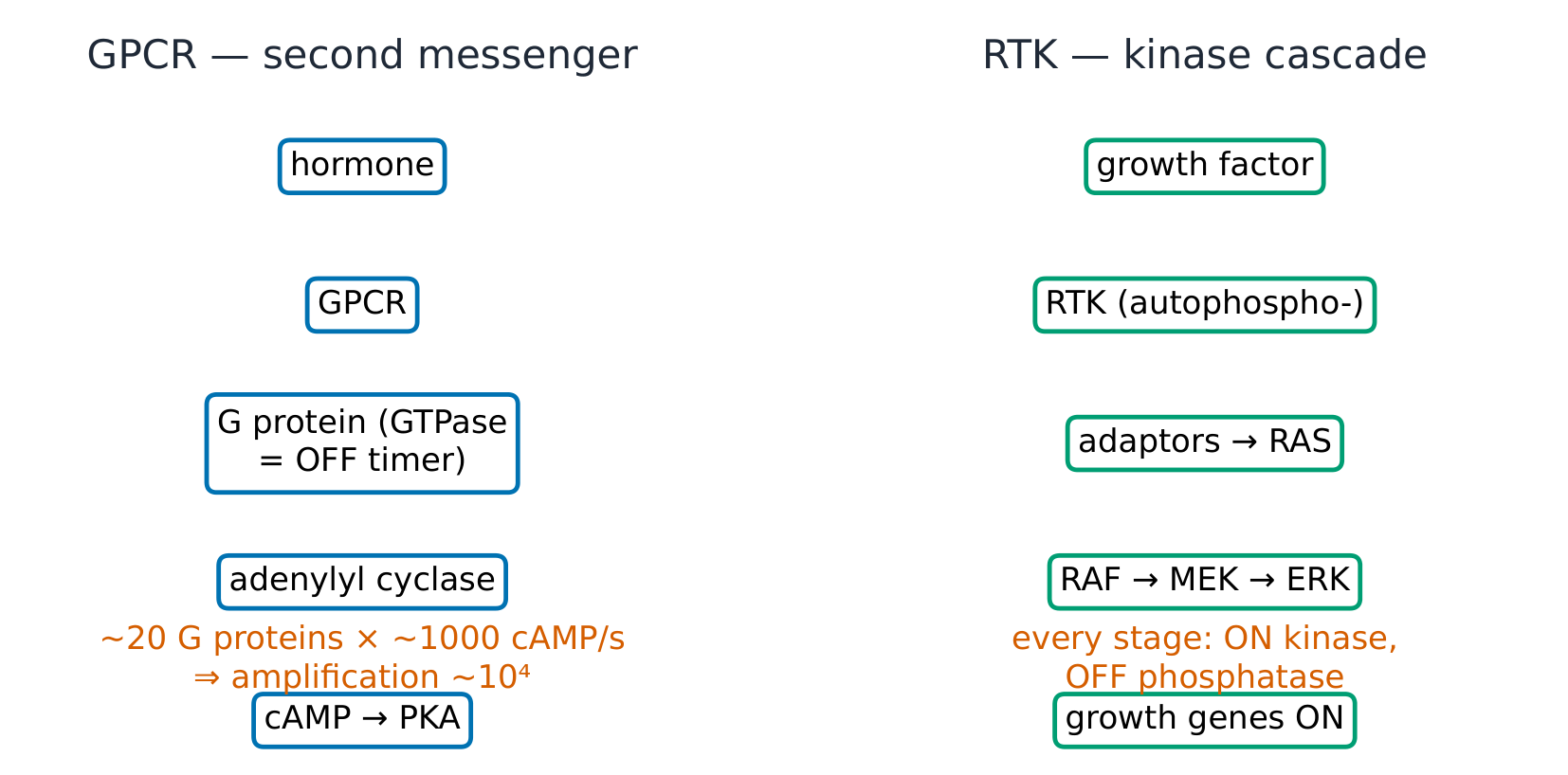
Put the GPCR cascade in order.
Difficulty 3/5 · 200 coins + a small bonus on first completion today
Each step relays the message and multiplies it; the hormone never enters the cell.
Gains multiply
- One receptor turns on about 20 G-proteins, and each cyclase makes about 1000 cAMP per second. The gains multiply: about $20\times1000 = 2\times10^{4}$ cAMP per second from one hormone molecule.
- cAMP rises from about 10 nM at rest to about 1 µM at a full pulse: a hundredfold switch in seconds.
Receptor, relay, response
Raise the signal and watch the response saturate. Remove the receptor or block the relay and the same hormone does nothing; each stage is a control point and a drug target.
Where does the roughly 10⁴-fold amplification from hormone to cAMP come from?
Difficulty 1/5 · 100 coins + a small bonus on first completion today
Stage gains multiply: about 20 G-proteins × about 1000 cAMP per second per cyclase is about 10⁴ second messengers per hormone.
One receptor activates 20 G-proteins; each turns on one cyclase making 1000 cAMP per second for 3 seconds. How many cAMP molecules result?
Difficulty 2/5 · 140 coins + a small bonus on first completion today
20 × 1000 × 3 = 60 000 molecules from one hormone molecule.
Every ON has an OFF
- Gα splits its own GTP (its GTPase GTP酶 activity), switching itself off within seconds. Phosphodiesterase 磷酸二酯酶 destroys cAMP, and phosphatases remove phosphates.
- Amplification and reset are the same machinery seen from two sides: each stage is a control point, and a drug target.
What is the built-in OFF timer of a GPCR pathway?
Difficulty 1/5 · 100 coins + a small bonus on first completion today
Gα hydrolyses its own GTP, resetting the switch in seconds; phosphodiesterase does the same job for cAMP.
Worked example: the cAMP ledger
- At rest, 10 nM cAMP in a $2\times10^{-12}$ L liver cell is $10^{-8}\times2\times10^{-12}\times6.0\times10^{23} \approx 12\,000$ molecules.
- Ten active cyclases at 1000 per second make 10 000 in one second: almost the whole resting pool. So the OFF enzymes matter as much as the ON ones.
A cell of volume 2 × 10⁻¹² L holds cAMP at 1 µM after a hormone pulse. How many cAMP molecules is that, in thousands? (Avogadro's number is 6.0 × 10²³.)
Difficulty 2/5 · 140 coins + a small bonus on first completion today
10⁻⁶ × 2 × 10⁻¹² × 6.0 × 10²³ = 1.2 × 10⁶ molecules, 1200 thousand: a hundred times the resting 12 000.
Worked example: the switch welded on
- (Fictional outbreak) Patients have huge watery diarrhoea within hours. Cholera toxin 霍乱毒素 modifies Gαs so its GTPase cannot work: the OFF timer is gone.
- Cyclase runs non-stop, cAMP stays at maximum, and gut cells push Cl⁻ out through CFTR (unit 1.2's door), with water following. Treatment is fluid replacement until the modified proteins are replaced.
How does cholera toxin cause watery diarrhoea?
Difficulty 1/5 · 100 coins + a small bonus on first completion today
Gs stuck on → cyclase always on → maximal cAMP → Cl⁻ out through CFTR, with water following. The missing OFF timer is the whole disease.
Three common slips
- "The hormone enters the cell." GPCR ligands stay outside; steroid hormones do enter, by a different mechanism.
- Forgetting the OFF enzymes. Second messengers are destroyed all the time; caffeine works partly by blocking phosphodiesterase.
- Linear cascades. Real pathways are full of feedback.
Adrenaline acting on a GPCR must enter the cell to raise cAMP.
Difficulty 1/5 · 100 coins + a small bonus on first completion today
GPCR ligands stay outside; the receptor and G-protein carry the signal across. Steroid hormones are the ones that enter.
Match each ON step to the enzyme that switches it OFF.
Difficulty 2/5 · 140 coins + a small bonus on first completion today
Every amplifying stage has a matching reset, and each pair is a drug target.
Recap
- GPCR → G-protein → cyclase → cAMP → PKA; RTK → RAS → MAPK.
- Stage gains multiply to about $10^{4}$; every ON stage has an OFF enzyme.
- Cholera is the GTPase switched off for good, so the signal never stops.