Small-signal: the circuit, differentiated
Introduced| English | Meaning |
|---|---|
| small-signal model | small-signal model |
| transconductance | transconductance |
| emitter degeneration | emitter degeneration |
A whisper made loud
- A microphone gives a few millivolts riding on nothing; a speaker needs volts. The transistor in between is biased at a steady point, and the signal is a small wiggle around it.
- For small wiggles, a curved device law looks straight. This lesson replaces the transistor with that straight-line version and reads the gain off it.
Linearise at the Q-point
- The small-signal model 小信号模型 replaces each device by its slopes at the bias point. DC supplies become shorts to ground, and coupling capacitors become shorts at signal frequency.
- The key slope is the transconductance 跨导 $g_{m} = \dfrac{\partial i_{out}}{\partial v_{in}}$: how much output current a small input voltage produces.
In the small-signal model, a DC supply rail becomes signal ground.
Difficulty 1/5 · 100 coins + a small bonus on first completion today
A constant voltage has no wiggle, so for the signal it behaves as a short to ground. The same holds for large coupling and bypass capacitors at signal frequency.
The BJT's hybrid-π model
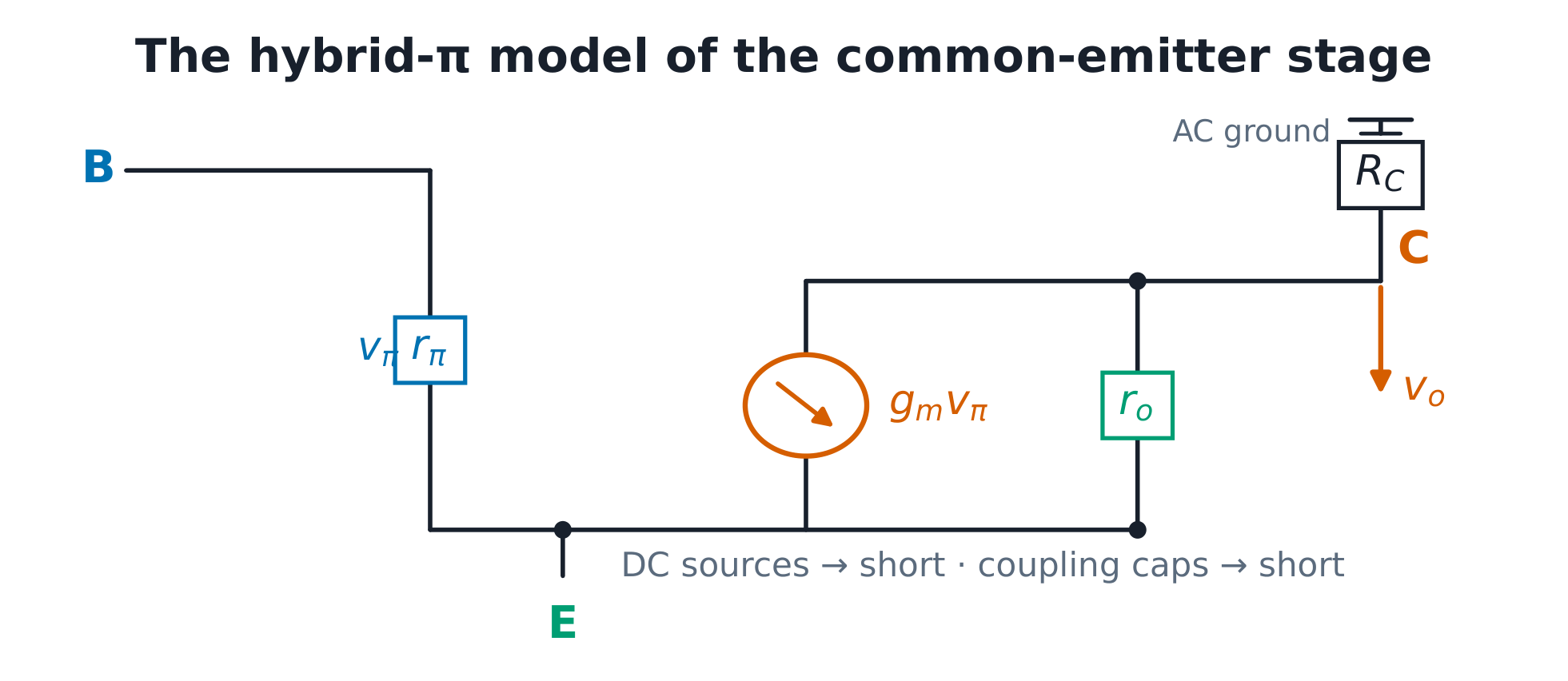
- Differentiate $I_{C} = I_{S}e^{V_{BE}/V_{T}}$: $g_{m} = \dfrac{I_{C}}{V_{T}}$. The base looks like $r_{\pi} = \dfrac{\beta}{g_{m}}$, and $r_{o}$ models the slight slope of the output curves.
- At $I_{C} = 0.99\,\text{mA}$ with $\beta = 100$: $g_{m} = \dfrac{0.99}{26} = 38.1\,\text{mS}$ and $r_{\pi} = \dfrac{100}{38.1\,\text{mS}} = 2.6\,\text{k}\Omega$.
At I_C = 0.99 mA and β = 100: g_m and r_π are
Difficulty 1/5 · 100 coins + a small bonus on first completion today
$g_{m} = \dfrac{I_{C}}{V_{T}} = \dfrac{0.99}{26} = 38.1$ mS; $r_{\pi} = \dfrac{\beta}{g_{m}} = 2.6$ kΩ. Both come from differentiating the exponential at the Q-point.
What is a BJT's g_m at I_C = 2.6 mA, in mS (V_T = 26 mV)?
Difficulty 2/5 · 140 coins + a small bonus on first completion today
$\dfrac{2.6\,\text{mA}}{26\,\text{mV}} = 100$ mS. Transconductance is proportional to bias current, whatever the transistor.
Worked example: the common-emitter gain
- With $R_{E}$ bypassed by a capacitor, the output current $g_{m}v_{\pi}$ flows through $R_{C} \parallel r_{o}$: $A_{v} = -g_{m}(R_{C} \parallel r_{o})$.
- $R_{C} = 2.2\,\text{k}\Omega$, $r_{o} = 50\,\text{k}\Omega$: $A_{v} = -38.1\,\text{mS} \times 2.11\,\text{k}\Omega = -80$. Without $r_{o}$ it would be $-84$. The minus sign means the stage inverts.
A common-emitter stage has g_m = 40 mS and R_C = 5 kΩ, with R_E bypassed and r_o very large. What is the gain?
Difficulty 2/5 · 140 coins + a small bonus on first completion today
$A_{v} = -g_{m}R_{C} = -0.04 \times 5000 = -200$: inverting, with a large but β- and temperature-dependent gain.
Emitter degeneration
- Remove the bypass so $R_{E} = 1\,\text{k}\Omega$ carries signal too: $A_{v} = -\dfrac{g_{m}R_{C}}{1 + g_{m}R_{E}} = -\dfrac{84}{39.1} = -2.14$.
- When $g_{m}R_{E} \gg 1$ this tends to $-\dfrac{R_{C}}{R_{E}} = -2.2$, set by resistors alone. Emitter degeneration 发射极负反馈 trades gain for a stable, linear one.
Un-bypassing R_E = 1 kΩ drops the CE gain from −84 to
Difficulty 1/5 · 100 coins + a small bonus on first completion today
$-\dfrac{g_{m}R_{C}}{1 + g_{m}R_{E}} = -\dfrac{84}{39.1} = -2.14$, and $-\dfrac{R_{C}}{R_{E}} = -2.2$: within 2.4% because $g_{m}R_{E} = 38 \gg 1$.
The MOSFET's version
- Differentiate the square law: $g_{m} = \dfrac{2I_{D}}{V_{GS} - V_{t}}$. At 1.125 mA with 1.5 V of overdrive: $g_{m} = 1.5\,\text{mS}$, and a common-source stage with $R_{D} = 3\,\text{k}\Omega$ gives $-4.5$.
- A BJT at the same current has $g_{m} = 43.3\,\text{mS}$, 29 times more. The MOSFET's gift is its gate: no input current at all.
A small-signal model is a tangent at the bias point
$g_m=\left.\frac{\partial i}{\partial v}\right|_Q$
Start with the worked 0.99 mA BJT bias and recover gm about 38.1 mS, input resistance about 2.6 kΩ and bypassed gain about −80. Widen the input excursion to see the curved current law leave its tangent. Switch device at the same bias current to compare gm fairly, then select the MOSFET worked bias of 1.125 mA for gm 1.5 mS and gain −4.5.
At the same 1.125 mA bias, the BJT's transconductance is about
Difficulty 1/5 · 100 coins + a small bonus on first completion today
$\dfrac{1.125}{26} = 43.3$ mS for the BJT; the square law gives $\dfrac{2 \times 1.125}{1.5} = 1.5$ mS for this MOSFET. The MOSFET pays in $g_{m}$ for its zero gate current.
Three common slips
- $g_{m}$ from the estimated current. Use the exact Q-point once you have it.
- $-\dfrac{R_{C}}{R_{E}}$ without checking. It needs $g_{m}R_{E} \gg 1$.
- Treating the model as a new circuit. It is the same circuit, differentiated at its bias point.
Match each small-signal parameter to its formula.
Difficulty 2/5 · 140 coins + a small bonus on first completion today
Each formula is a derivative of the device law, taken at the Q-point.
Recap
- BJT: $g_{m} = \dfrac{I_{C}}{V_{T}}$, $r_{\pi} = \dfrac{\beta}{g_{m}}$; MOSFET: $g_{m} = \dfrac{2I_{D}}{V_{GS} - V_{t}}$.
- Common-emitter gain $-g_{m}(R_{C} \parallel r_{o})$; degenerated, about $-\dfrac{R_{C}}{R_{E}}$.
- The BJT gives more $g_{m}$ per milliamp; the MOSFET draws no gate current.