Perception: three questions before a verdict
Introduced| English | Meaning |
|---|---|
| attribution theory | the study of how people explain causes as internal or external, stable or changing |
| fundamental attribution error/ˌfʌndəˈmentl ətrɪˈbjuːʃn ˈerə/ | The tendency to overemphasise personal characteristics and underestimate situational influences when explaining others' behaviour. |
The manager judges what she sees
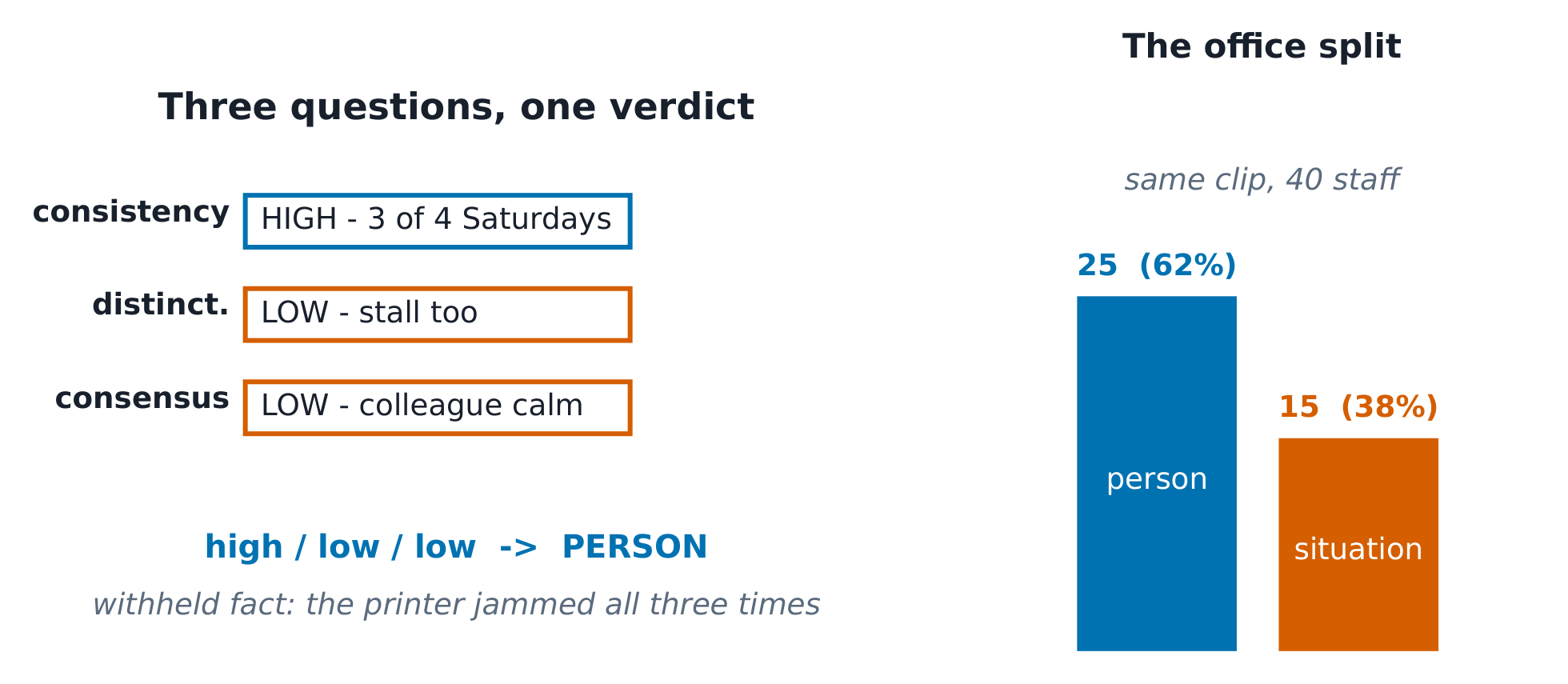
- The customer films a chef snapping at a waiter; the clip goes round the office. Asked why, 25 of 40 staff say personality, 15 say circumstances. Same clip, two verdicts.
- Perception is not a camera; attribution is not a court. Both can be audited — with three questions.
The three-question audit
- Attribution theory 归因理论 judges behaviour on consistency (over time?), distinctiveness (only here, or everywhere?), consensus (does everyone act this way here?).
- High consistency + LOW distinctiveness + LOW consensus → person. The reverse → situation. The fundamental attribution error 基本归因错误 is skipping the situation questions.
Which question does this evidence answer?
Route each piece of evidence to consistency, distinctiveness or consensus - and name the bias in the flawed judgements.
Of 40 staff, 25 say personality. The share, in %?
Difficulty 2/5 · 140 coins + a small bonus on first completion today
$25/40 = 62.5\%$ - a majority person-verdict on one clip, before the printer fact.
Consistency HIGH, distinctiveness LOW, consensus LOW. The cube points to:
Difficulty 1/5 · 100 coins + a small bonus on first completion today
The pattern says: this person, everywhere, alone - person. Adding the printer-jam fact restores the situation; the verdict is only as good as its evidence list.
If every crew member snaps when the printer jams, consensus is low.
Difficulty 1/5 · 100 coins + a small bonus on first completion today
Everyone acting the same way HERE is HIGH consensus - which points to the situation, not the person. The calm colleague was the low-consensus fact.
Biases with names
- Halo: one vivid strength grades the whole person (the "brilliant" waiter who never restocks). Recency: the last fortnight is the year. Contrast: judged against the previous candidate, not the criteria.
- The actor–observer gap: others are personalities, you are circumstances. Same error, different seats.
Match each judgement to its bias.
Difficulty 2/5 · 140 coins + a small bonus on first completion today
Named biases are auditable - unnamed ones are just Tuesday.
The audit question for any attribution is:
Difficulty 1/5 · 100 coins + a small bonus on first completion today
If no evidence could change your mind, you are not judging - you are decorating a decision already made.
The halo-defective rating of the new waiter is repaired by:
Difficulty 1/5 · 100 coins + a small bonus on first completion today
Separate criteria remove the halo's seat at the table - the same design unit 8.6 uses for appraisal.
The actor-observer gap predicts the founder will explain her own short Saturday by:
Difficulty 1/5 · 100 coins + a small bonus on first completion today
We grant ourselves the situation and deny others theirs. The gap is why a second rater - and the three questions - exist.
Trends before categories
- The oldest crew member mis-keys two tablet orders in month one, none in month two. Calling it an age fact commits the ultimate attribution error — a stereotype doing a verdict's job.
- Track the trend within the person before invoking the category about the group: stereotyped staff disengage exactly when you need them learning.
Calling two mis-keyed orders an age fact is a fair summary once training is counted.
Difficulty 1/5 · 100 coins + a small bonus on first completion today
Month one: two errors; month two after training: none. The trend within the person refutes the category - and stereotyped staff disengage when you need them learning.
Recency, in numbers
- A waiter scores 4 out of 5 every month for ten months, then 2 in the last two. The year's mean is $44/12 = \mathbf{3.67}$, but a manager who remembers the last fortnight writes 2.
- A one-line rating each month keeps the year on the record. Then the late dip becomes a question (what changed?) instead of the verdict.
Monthly ratings: 4 for ten months, then 2 and 2. Year mean (two decimals)?
Difficulty 2/5 · 140 coins + a small bonus on first completion today
$(10 \times 4 + 2 \times 2)/12 = 44/12 = 3.67$.
The last two months are the best evidence of a whole year's performance.
Difficulty 1/5 · 100 coins + a small bonus on first completion today
That is recency bias: the year mean is 3.67, not 2.
Worked example: the chef, through the cube
- The chef snaps on most busy nights (consistency high), at suppliers and the cleaner too (distinctiveness low), and no other chef does (consensus low). High, low, low: a person cause, so the answer is a coaching conversation.
- Now add the withheld fact: the ticket printer jammed all evening and every cook was snapping. Consensus is high and the behaviour is distinctive to that night: a situation cause, so fix the printer first.
Every cook snapped on the night the printer jammed, and the chef rarely does otherwise. The cube points to:
Difficulty 1/5 · 100 coins + a small bonus on first completion today
High consensus and high distinctiveness point to the situation.
Three perception slips
- Judging on the vivid instance. Recency is not evidence.
- Grading the whole person from one trait. That is the halo.
- Explaining others by personality, yourself by circumstances. The actor–observer gap.
Recap
- Consistency, distinctiveness, consensus — ask all three or the verdict is a mood.
- The audit question: what would I need to see to flip the verdict?
- Trends within the person beat categories about the group.