Promotion: honest denominators
Introduced| English | Meaning |
|---|---|
| attribution/ətrɪˈbjuːʃn/ | Assigning credit for a sale to the marketing touchpoints that led to it. |
| payback period/ˈpeɪbæk ˈpɪərɪəd/ | The time until the cumulative cash or contribution from a spend covers the spend itself. |
£3,600 and every arrow measured
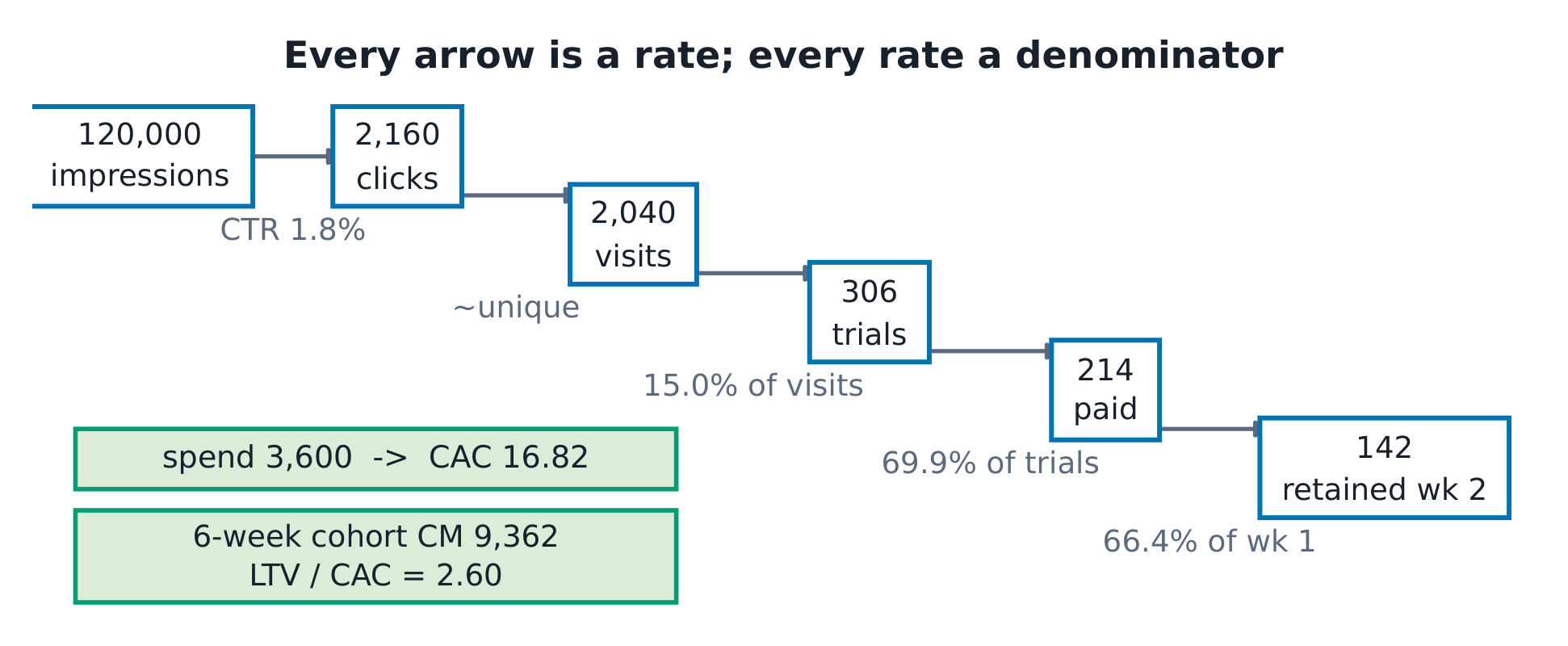
- The month-1 funnel: 120,000 impressions → 1.8% CTR = 2,160 clicks → 2,040 unique visits → 306 trials (15.0% of visits) → 214 paid (69.9%) → 142 retained (66.4%). Spend £3,600 → CAC £16.82.
- Digital marketing's gift is that everything is measurable; its curse is that everything measurable is not therefore meaningful. Denominators are the unit.
The funnel, read honestly
- Every arrow is a rate; every rate is a numerator over a denominator, stated together: 15.0% of VISITS is not 14.2% of CLICKS is not 0.26% of impressions.
- CAC = spend ÷ new customers — and the spend must include every cost of the decision (the founder's cousin's design work belongs in it).
Spend 3,600; 214 new paid subscribers. CAC, to two decimals?
Difficulty 2/5 · 140 coins + a small bonus on first completion today
$3{,}600/214 = £16.82$ - with ALL decision costs in the numerator, or the number flatters itself.
306 trials over 2,040 unique visits. The rate, in % (one decimal)?
Difficulty 2/5 · 140 coins + a small bonus on first completion today
$306/2{,}040 = 15.0\%$ - over VISITS. Over clicks (2,160) it is 14.2%; over impressions, 0.26%. Same people, three numbers.
"15% conversion" is a complete, usable metric.
Difficulty 1/5 · 100 coins + a small bonus on first completion today
Over which base? 15% of visits, 14.2% of clicks and 0.26% of impressions are three different truths - the denominator is part of the metric.
CAC meets LTV
- Each subscriber takes one box a week: 5 × £2.52 = £12.60 after delivery. Six-week cohort contribution (214, 142, 121, 103, 88, 75 subscriber-weeks × £12.60): £9,362 → LTV/CAC = 2.60 ✓. The healthy range most operators cite is ≥ 3, which this churn reaches only in week 8.
- The lever is retention, not CTR: +5 points of week-2 retention ≈ £135 a week of contribution; no plausible click-rate gain buys that.
What does this metric actually measure?
Route metrics to their numerators and denominators, and flag the gameable ones.
Six-week cohort CM 9,362 (743 subscriber-weeks x 12.60) against CAC 16.82 on 214. The ratio, two decimals?
Difficulty 2/5 · 140 coins + a small bonus on first completion today
$9{,}362/3{,}600 = 2.60$ - short of the healthy 3; retention is the lever.
Week-2 retention: 142 of 214. The rate, in % (one decimal)?
Difficulty 2/5 · 140 coins + a small bonus on first completion today
$142/214 = 66.36\%$ - the number the whole LTV model stands on; +5 points here beats any CTR gain.
Match each metric to its fraction.
Difficulty 2/5 · 140 coins + a small bonus on first completion today
Name the fraction and the metric stops being a mood.
Attribution defaults lie
- A buyer saw a podcast ad, searched, clicked a retargeting ad, bought — last-click hands retargeting the credit, every quarter, forever.
- Two repairs: holdout tests (turn retargeting off for a random city — did sales fall by the claimed amount?) and incrementality thinking: credit only orders that would NOT have happened otherwise.
A headline rewrite lifts CTR from 1.8% to 2.6% and the trial rate falls from 15.0% to 11.8%. Net effect on trials?
Difficulty 1/5 · 100 coins + a small bonus on first completion today
Clicks rise to $120{,}000 \times 0.026 = 3{,}120$; at 11.8% of (approx.) visits, trials do not improve - and the cohort quality drops. Gameable metrics trade tomorrow for today.
Retargeting claims 40% of conversions on last-click. The decisive test?
Difficulty 1/5 · 100 coins + a small bonus on first completion today
Incrementality is the only question: orders that would NOT have happened otherwise. The funnel measures pipes; experiments measure pressure.
When does the campaign pay back?
- The payback period 回收期 is the time until cumulative contribution covers the spend. Week 1 earns $214 \times £12.60 = £2{,}696$, short of the £3,600.
- Week 2 adds $142 \times £12.60 = £1{,}789$, taking the total to £4,486: the campaign pays back during week 2. Investors ask this question before they ask about LTV.
Cohort of 214 then 142 subscribers at £12.60 a subscriber-week: contribution after two weeks (£)?
Difficulty 2/5 · 140 coins + a small bonus on first completion today
$(214 + 142) \times 12.60 = 4{,}486$.
Worked example: the cost that was left out
- The founder's cousin gave £400 of design work. Counted honestly, the spend is £4,000 and $CAC = 4{,}000/214 = \mathbf{£18.69}$.
- LTV/CAC falls from 2.60 to $9{,}362/4{,}000 = \mathbf{2.34}$, further from the 3 most operators want. Free work is still a cost of the decision.
Spend £3,600 plus £400 of donated design work, 214 new customers: CAC (two decimals, £)?
Difficulty 2/5 · 140 coins + a small bonus on first completion today
$4{,}000/214 = 18.69$.
Cohort LTV £9,362 against a full spend of £4,000: LTV/CAC (two decimals)?
Difficulty 2/5 · 140 coins + a small bonus on first completion today
$9{,}362/4{,}000 = 2.34$.
Three measurement slips
- Optimising CTR into clickbait. The rate rises as the denominator fills with the wrong people.
- Comparing CAC across periods with different channel mixes.
- Quoting LTV/CAC from churn assumptions nobody re-tests.
Recap
- Rates are numerator-over-denominator, stated in the same breath.
- CAC 16.82 vs 6-week LTV/CAC 2.60 — retention is the lever.
- Attribution defaults lie; holdouts tell the truth.