Relative frequency and expected frequency
Introduced| English | Meaning |
|---|---|
| bias/ˈbaɪəs/ | A systematic tendency for a chance device to favour particular outcomes rather than behave as intended. |
| fair/feə/ | Unbiased: a fair coin has equally likely sides, and a fair die has equally likely faces. |
| relative frequency/ˈrelətɪv ˈfriːkwənsi/ | The number of occurrences of an outcome divided by the total number of observations or trials. |
| trial/ˈtraɪəl/ | trial |
| random/ˈrændəm/ | Describing outcomes governed by chance rather than being individually predictable with certainty. |
| ordered pair/ˈɔːdəd peə/ | ordered pair |
| expected frequency/ekˈspektɪd ˈfriːkwənsi/ | The predicted count of an outcome: probability × number of trials. |
Does 60 heads prove a coin is biased 偏倚?
- A club gets 60 heads in 100 coin flips. The observed proportion is $\dfrac{60}{100}=0.6$, but a fair 公平 coin can also give an uneven result by chance.
- A fair coin has probability $\dfrac{1}{2}$ of heads on each flip. Bias means the chances differ from the fair model. More evidence helps us judge the model; a finite experiment does not prove it with certainty.
Use results to estimate probability
- Relative frequency 相对频率 is an estimate based on what happened. Use experiments when a probability is unknown, or to compare results with a known model.
- Count all the trials 试验, including failures. The estimate lies between $0$ and $1$; a percentage needs a further multiplication by $100$.
A drawing pin lands point-up 84 times in 200 drops. Its relative frequency of point-up is $\dfrac{84}{200}=0.42$, or $42\%$. The other 116 drops must stay in the denominator.
Relative frequency is calculated as:
Difficulty 1/5 · 100 coins + a small bonus on first completion today
Relative frequency = successes ÷ number of trials.
A drawing pin is dropped 200 times and lands point-up 84 times. The relative frequency of point-up is (to 2 dp):
Difficulty 2/5 · 140 coins + a small bonus on first completion today
84/200 = 0.42.
A spinner lands on blue 63 times in 150 spins. Estimate P(blue), as a decimal.
Difficulty 2/5 · 140 coins + a small bonus on first completion today
63 ÷ 150 = 0.42.
A test has 28 successes and 12 failures. Which calculation gives the relative frequency of success?
Difficulty 1/5 · 100 coins + a small bonus on first completion today
All 40 trials belong in the denominator, not only failures.
More evidence, with limits
- With the same method and stable chances, more trials usually give a more reliable estimate. The next trial can still move the estimate away from the true probability.
- Random 随机 means an individual result is decided by chance. It does not mean equally likely: a biased coin can still give random results. More trials do not repair a bent spinner or an unrepresentative sample.

These illustrative results could come from one fair-coin experiment. Between 20 and 50 flips, the estimate moves away from 0.5.
Under unchanged conditions, increasing the number of comparable trials usually gives a more reliable probability estimate.
Difficulty 1/5 · 100 coins + a small bonus on first completion today
Larger comparable experiments usually reduce chance variation in the proportion, but each added trial need not move the estimate closer.
Every additional trial must move the relative frequency closer to the true probability.
Difficulty 1/5 · 100 coins + a small bonus on first completion today
Chance variation can move it away. A large comparable experiment is usually more reliable overall.
A coin gives heads with probability 0.8 and tails with probability 0.2. Which description fits?
Difficulty 1/5 · 100 coins + a small bonus on first completion today
Random results can have unequal probabilities. A fair coin has equal chances of heads and tails.
Equally likely pairs, unequal totals
- For two independent fair six-sided dice, there are $6\times6=36$ equally likely ordered pairs 有序数对. A cell records the first die and the second die; $(1,6)$ and $(6,1)$ are different cells.
- The totals $2$ to $12$ are not equally likely. Six cells give $7$, so $\text{P}(7)=\dfrac{6}{36}=\dfrac{1}{6}$. Only one gives $2$, so $\text{P}(2)=\dfrac{1}{36}$.
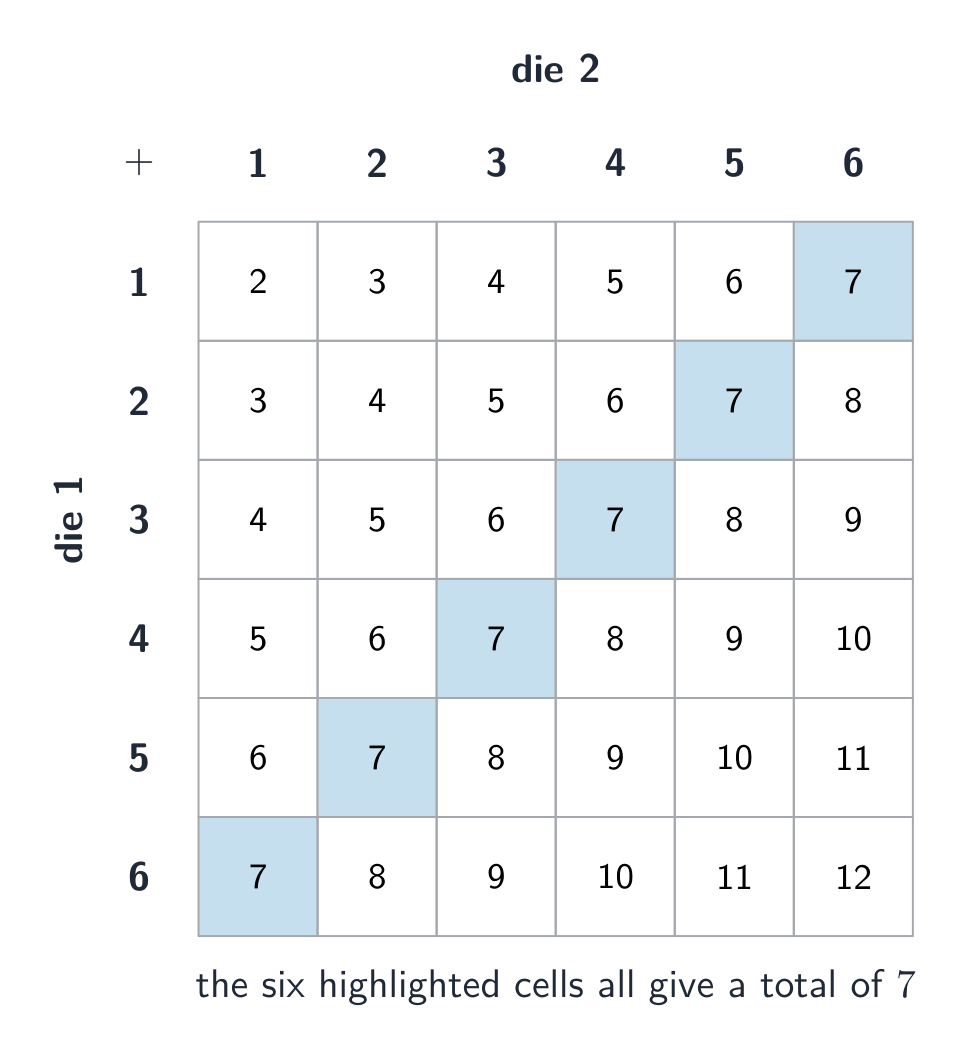
Two-dice probability
Compare observed proportions with theoretical probabilities for two independent fair dice. Each bar and its mark use the same probability scale; finite results vary.
For two independent fair six-sided dice, why is a total of 7 more likely than a total of 2?
Difficulty 1/5 · 100 coins + a small bonus on first completion today
Each ordered pair has probability 1/36. Count cells for a total, not just the number of totals.
Expected frequency 期望频数 counts future events
- Expected frequency is a predicted count, using a probability and a number of trials. Keep the probability as a fraction or decimal: $20\%=0.2$.
- Use the same probability for the stated trials. For fixed probability, doubling the number of trials doubles the expected count.
Expected does not mean guaranteed. An expected count can be non-integer: $0.3\times15=4.5$. A single experiment has a whole-number count, but its long-run average need not be a whole number.

Expected frequency = P(event) × number of ______.
Difficulty 1/5 · 100 coins + a small bonus on first completion today
Expected frequency = probability × number of trials.
A bus is late with probability 0.15 on each school day. Over 120 school days, what is the expected number of late days?
Difficulty 2/5 · 140 coins + a small bonus on first completion today
0.15 × 120 = 18; the actual number may differ.
An event has probability 0.3 in each of 15 trials. How should an expected count of 4.5 be interpreted?
Difficulty 1/5 · 100 coins + a small bonus on first completion today
Expected counts are not probabilities and can be non-integer. Do not round automatically unless asked.
Worked examples: choose the right direction
- For a fair die, $\text{P}(\text{six})=\dfrac{1}{6}$. In 300 rolls, the expected count is $\dfrac{1}{6}\times300=50$. It is not a promise of exactly 50 sixes.
- A machine has a constant probability $0.2$ of rejecting an item. In 50 items, the expected rejected count is $0.2\times50=10$. Relative frequency instead starts with an observed count and divides by the total.
The probability of rolling a six is 1/6. How many sixes are expected in 300 rolls?
Difficulty 2/5 · 140 coins + a small bonus on first completion today
(1/6) × 300 = 50.
A machine rejects each item with constant probability 0.2. How many rejected items are expected in 50 items?
Difficulty 2/5 · 140 coins + a small bonus on first completion today
0.2 × 50 = 10.
A factory estimates that 6% of its items are faulty. If conditions stay similar, how many faulty items are expected among 450 items?
Difficulty 2/5 · 140 coins + a small bonus on first completion today
6% = 0.06, so 0.06 × 450 = 27.
Estimate a future count from an experiment
- The drawing pin gave $84$ point-up results in $200$ drops. Use $0.42$ as an estimated probability: in another $500$ drops, predict $0.42\times500=210$ point-up results.
- This prediction assumes similar conditions. For a population estimate, the tested sample must represent that population; selecting only visibly damaged items would not estimate the defect rate of all items fairly.
Combine counts before dividing. Two comparable batches give 12 successes in 40 trials and 36 in 60. Together the relative frequency is $\dfrac{12+36}{40+60}=0.48$, not the unweighted average of $0.3$ and $0.6$.
Two comparable experiments have 18 successes in 60 trials and 52 successes in 100 trials. Estimate the probability using all the results.
Difficulty 2/5 · 140 coins + a small bonus on first completion today
(18 + 52) ÷ (60 + 100) = 70/160 = 0.4375. Combine counts, not an unweighted average.
A random sample of 250 items contains 8 faulty items. Estimate how many faulty items there are in 2000 similar items.
Difficulty 2/5 · 140 coins + a small bonus on first completion today
8/250 = 0.032, then 0.032 × 2000 = 64. This relies on a representative sample and similar conditions.
Explain your prediction
- Decide whether a question asks for a probability estimate or an expected count. Show the calculation, then interpret the answer in the context.
- Check whether the method and conditions justify using the probability. Explain why an actual count can differ from an expected count.
The probability of an event is 1/4. In 80 trials, how many times is it expected?
A quarter of 80 is 20.
A shop tests 75 visibly damaged packages from a delivery and finds 30 faulty items. A student predicts that 40% of every item in the delivery is faulty. Explain the calculation and judge the prediction.
State the method, show the arithmetic and qualify the conclusion using the information given.
A coin gives 13 heads in 20 flips. A student says it must be biased and that another 20 flips must give 7 heads to balance the first set. Evaluate both claims.
State the method, show the arithmetic and qualify the conclusion using the information given.
A stable process has success probability 0.35 per trial. How many trials give an expected 91 successes? Explain why this cannot guarantee 91 actual successes.
State the method, show the arithmetic and qualify the conclusion using the information given.
Keep the two calculations separate
- Relative frequency: observed successes divided by all trials. More comparable trials usually help, but not at every step.
- Expected frequency: probability multiplied by trials. It is a count prediction, not a guaranteed result.
- Random does not mean fair. For two fair independent dice, the 36 ordered pairs are equally likely; their totals are not.
Review the same event with probability 1/4 over 80 trials. Which expected count is correct?
Difficulty 1/5 · 100 coins + a small bonus on first completion today
80 × 1/4 = 20. Repeated practice uses the same data here; the actual count is not guaranteed to be 20.