Combined events
Introduced| English | Meaning |
|---|---|
| independent/ˌɪndɪˈpendənt/ | Describing quantities, events or choices that do not depend on one another in the relationship being considered. |
| mutually exclusive/ˈmjuːtʃuːəli eksˈkluːsɪv/ | Describing events that cannot occur together in the same trial. |
| sample space/ˈsæmpl speɪs/ | The set of all possible outcomes of a random experiment. |
| replacement/rɪˈpleɪsmənt/ | replacement |
| tree diagram/triː ˈdaɪəɡræm/ | A branching diagram showing possible stages, outcomes or classifications and their relationships. |
How hard is it to win the prize?
- A school-fair game gives a prize only for a six on a fair die and heads on a fair coin. The die and coin act independently. Which outcomes win?
- For combined events, check the situation before choosing a rule. Multiplication of the two separate probabilities needs independent 独立的 events; simple addition needs mutually exclusive 互斥 events.
Count equally likely outcomes
- A sample space 样本空间 diagram lists the possibilities. Two independent fair six-sided dice give $6\times6=36$ equally likely ordered pairs. The pair $(2,6)$ differs from $(6,2)$.
- For a total of $8$, count $(2,6),(3,5),(4,4),(5,3),(6,2)$. There are five winning cells, so the probability is $\dfrac{5}{36}$. The eleven possible totals from $2$ to $12$ are not equally likely.
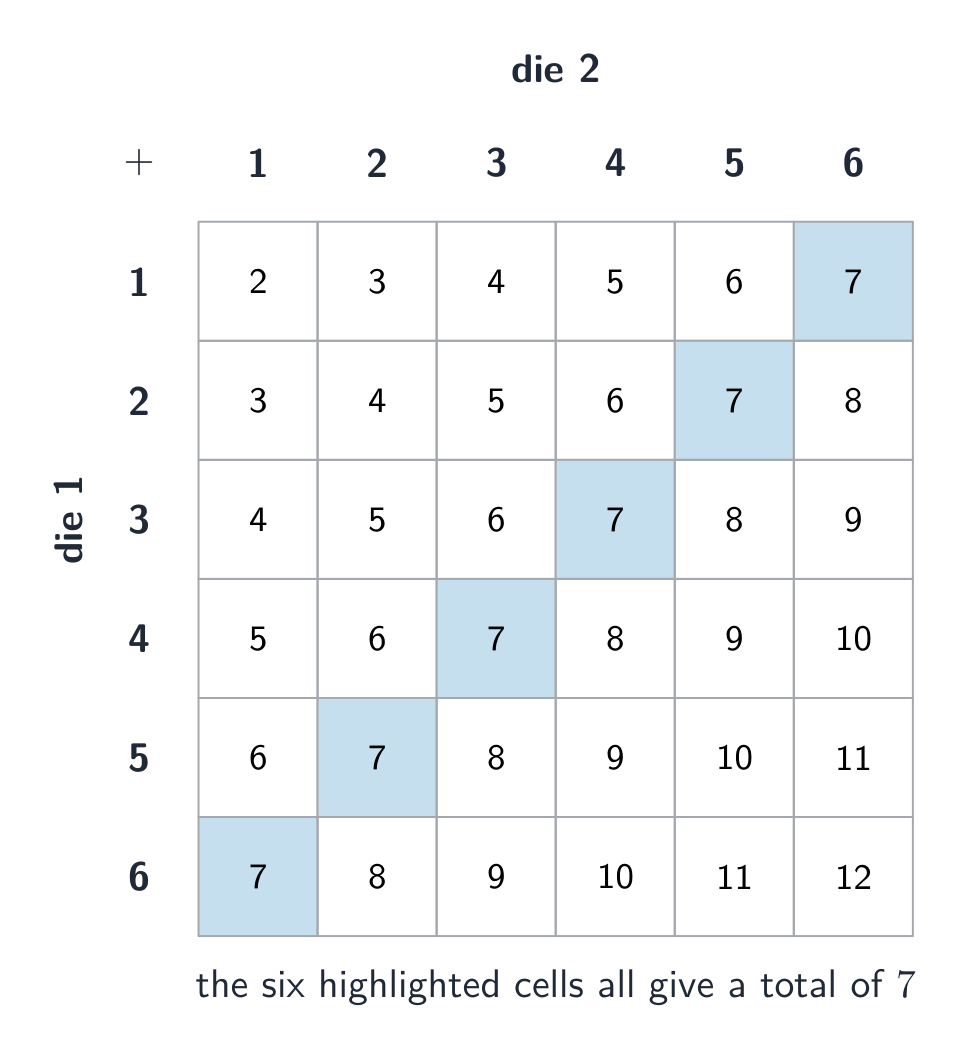
For the highlighted total, 7, there are six cells. Use the same 36-cell grid to find other totals.
Two independent fair six-sided dice are rolled. How many ordered pairs total 7?
Difficulty 2/5 · 140 coins + a small bonus on first completion today
The pairs are (1,6), (2,5), (3,4), (4,3), (5,2), (6,1).
For two independent fair six-sided dice, each total from 2 to 12 is equally likely.
Difficulty 1/5 · 100 coins + a small bonus on first completion today
There is one pair for 2 and six pairs for 7. Cells are equally likely; totals are not.
AND for independent events
- Events are independent when knowing one result does not change the probability of the other. For the fair die and fair coin, a six still has probability $\dfrac{1}{6}$ whatever the coin shows.
- The game has $6\times2=12$ equally likely die-and-coin outcomes. Only $(6,\text{heads})$ wins. Multiplying gives the same answer as counting.
The chance of winning is $\dfrac{1}{6}\times\dfrac{1}{2}=\dfrac{1}{12}$. It is smaller than either separate chance: both requirements must be met.
For two independent events both happening (AND), you:
Difficulty 1/5 · 100 coins + a small bonus on first completion today
Independence permits P(A and B) = P(A) × P(B).
A fair six-sided die and a fair coin act independently. What is the chance of a six and heads?
Difficulty 1/5 · 100 coins + a small bonus on first completion today
Only one of the 12 equally likely die-and-coin pairs wins.
The probability of A and B can be greater than the probability of A alone.
Difficulty 1/5 · 100 coins + a small bonus on first completion today
Both events can happen only among the outcomes where A happens.
OR when events cannot happen together
- Mutually exclusive events cannot both happen in the same trial. On one fair die, a $1$ and a $6$ are mutually exclusive, so the chance of “$1$ or $6$” is $\dfrac{1}{6}+\dfrac{1}{6}=\dfrac{1}{3}$.
- “Even” and “greater than $4$” can both happen: $6$ belongs to both. Simply adding their probabilities would count that result twice. Use the actual outcomes or the separate regions of a Venn diagram.
For mutually exclusive events, P(A or B) = P(A) + P(B).
Difficulty 1/5 · 100 coins + a small bonus on first completion today
They cannot occur together, so there is no overlap to count twice.
On one fair six-sided die, what is the probability of an even number or a number greater than 4?
Difficulty 1/5 · 100 coins + a small bonus on first completion today
The selected outcomes are 2, 4, 5 and 6, giving 4/6 = 2/3. Count 6 only once.
Count an overlap once
- In this diagram, $\text{P}(A)=0.3+0.2=0.5$ and $\text{P}(B)=0.2+0.1=0.3$. Both events means only the overlap: $0.2$.
- Either event, including both, means the three regions inside the circles: $0.3+0.2+0.1=0.6$. Adding $0.5+0.3$ would count the overlap twice. Neither has probability $0.4$, so $0.6+0.4=1$.

For Extended, the symbols for both and either are $A\cap B$ and $A\cup B$. The region-counting method is the same.
Do not choose a rule from the words AND or OR alone. Check independence before multiplying separate event probabilities. Add mutually exclusive outcomes or paths so that no result is counted twice.
A probability Venn diagram has A only 0.3, both 0.2, B only 0.1 and neither 0.4. Find the probability of A or B, as a decimal.
Difficulty 2/5 · 140 coins + a small bonus on first completion today
Add the three regions inside either circle: 0.3 + 0.2 + 0.1 = 0.6.
A probability Venn diagram has A only 0.3, both 0.2, B only 0.1 and neither 0.4. Find the probability of both A and B, as a decimal.
Difficulty 2/5 · 140 coins + a small bonus on first completion today
Both means just the overlap, 0.2.
Follow a tree with replacement 放回
- Draw twice at random from 2 red and 3 blue counters. Replace the first counter and mix thoroughly. Each draw then has red probability $\dfrac{2}{5}$ and blue probability $\dfrac{3}{5}$.
- A tree diagram 树状图 shows both stages. Multiply along a complete path: RR has probability $\dfrac{2}{5}\times\dfrac{2}{5}=\dfrac{4}{25}$. The four path probabilities add to $1$.

In the interactive tree, A means first red and B means second red. Its default probabilities are 0.4 and 0.4; this model assumes independent stages.
Independent events tree
At the default, A is first red and B is second red for two draws with replacement from 2 red and 3 blue counters. Both second-stage splits use the same probability because the stages are independent.
On a tree diagram, you ______ along each complete path and add the probabilities of the wanted paths.
Difficulty 1/5 · 100 coins + a small bonus on first completion today
Multiply along a complete path, then add the separate paths you want.
Two counters are drawn at random with replacement from 2 red and 3 blue counters. The probability of two reds is 4/b. Find b.
Difficulty 2/5 · 140 coins + a small bonus on first completion today
Each red branch is 2/5, so the product is 4/25.
A probability tree has four complete paths with probabilities 4/25, 6/25, 6/25 and 9/25. What is their sum?
Difficulty 2/5 · 140 coins + a small bonus on first completion today
These paths cover all outcomes once: (4 + 6 + 6 + 9)/25 = 1.
Exactly one and at least one
- For the same two draws, exactly one red includes RB and BR. These paths cannot both happen in one pair of draws, so add: $\dfrac{6}{25}+\dfrac{6}{25}=\dfrac{12}{25}$.
- At least one red includes RR as well. Either add $\dfrac{4+6+6}{25}=\dfrac{16}{25}$, or subtract the no-red path from $1$: $1-\dfrac{9}{25}=\dfrac{16}{25}$. Do not use just one mixed path for “exactly one”.
Two counters are drawn at random with replacement from 2 red and 3 blue counters. Find the probability of exactly one red, as a decimal.
Difficulty 2/5 · 140 coins + a small bonus on first completion today
RB and BR each have probability 6/25. Their sum is 12/25 = 0.48.
Two counters are drawn at random with replacement from 2 red and 3 blue counters. Find the probability of at least one red, as a decimal.
Difficulty 2/5 · 140 coins + a small bonus on first completion today
Subtract the no-red path: 1 − (3/5) × (3/5) = 16/25 = 0.64.
Without replacement: Extended
- Now use a bag of 3 red and 5 blue counters. Without replacement, one counter is removed. After a first red, the next red chance is $\dfrac{2}{7}$; after a first blue, it is $\dfrac{3}{7}$. The number of red counters does not decrease when a blue is taken.
- For two reds, multiply the successive branch probabilities: $\dfrac{3}{8}\times\dfrac{2}{7}=\dfrac{3}{28}$. With replacement it would be $\dfrac{3}{8}\times\dfrac{3}{8}=\dfrac{9}{64}$. Core combined-event questions use replacement; without replacement is Extended.

Extended: a bag has 3 red and 5 blue counters. One blue is drawn and not replaced. The next red probability is a/7. Find a.
Difficulty 2/5 · 140 coins + a small bonus on first completion today
Removing blue leaves all 3 red counters among the 7 counters remaining.
Extended: two counters are drawn at random without replacement from 3 red and 5 blue counters. Which calculation gives the probability of two reds?
Difficulty 1/5 · 100 coins + a small bonus on first completion today
After one red, 2 red remain among 7 counters.
Choose and explain your method
- For a new question, identify the equally likely outcomes or draw a labelled tree. State whether counters are replaced, and show every wanted path.
- Check the answer against the situation. “Exactly one”, “at least one”, “both” and “neither” select different outcomes. An AND result cannot exceed the chance of either event alone.
Two independent fair six-sided dice are rolled. Find the probability of a total of 10. List the ordered pairs that support your answer.
A total of 10 has three cells; (4,6) and (6,4) are different ordered pairs.
A bag has 1 red and 3 blue counters. Two counters are drawn at random with replacement. Find the probability of exactly one red and the probability of at least one red. Explain the difference.
Replacement keeps each red chance at 1/4; the words select different paths.
In a group of 30 students, a Venn diagram shows A only 8, both A and B 4, B only 6 and neither 12. A student is chosen at random. Find P(A or B) and P(A and B), explaining how you avoid double counting.
The overlap is part of the union, but it is not an additional fourth region.
Check the conditions, then calculate
- Use equally likely sample-space cells to count favourable outcomes out of the total.
- For independent events, multiply their probabilities for AND. For mutually exclusive events or paths, add for OR. In overlapping sets, count each region once.
- On a tree, multiply along a complete path, then add the wanted paths. Without replacement, update each branch using what remains.
Review: two independent fair six-sided dice are rolled. How many ordered pairs give a total of 9?
Difficulty 1/5 · 100 coins + a small bonus on first completion today
The pairs are (3,6), (4,5), (5,4) and (6,3).