Writing an essay
IntroducedTwo kinds of essay
- An essay gives your ideas about a topic in an organised way.
- Discursive: look at both sides of the topic.
- Argumentative: argue for one main view.
An essay needs a position, not a traffic jam of opinions.
For, against or off-topic?
Sort your brainstorm before you write — and throw out everything off-topic.
A discursive essay…
Difficulty 1/5 · 100 coins + a small bonus on first completion today
Discursive = balanced, both sides.
An argumentative essay argues for ___ main view. (one / two)
Difficulty 1/5 · 100 coins + a small bonus on first completion today
Argumentative = one clear view.
Plan and structure
- Introduction: name the topic and your approach.
- Body: one main idea per paragraph, with reasons.
- Conclusion: bring your ideas together.
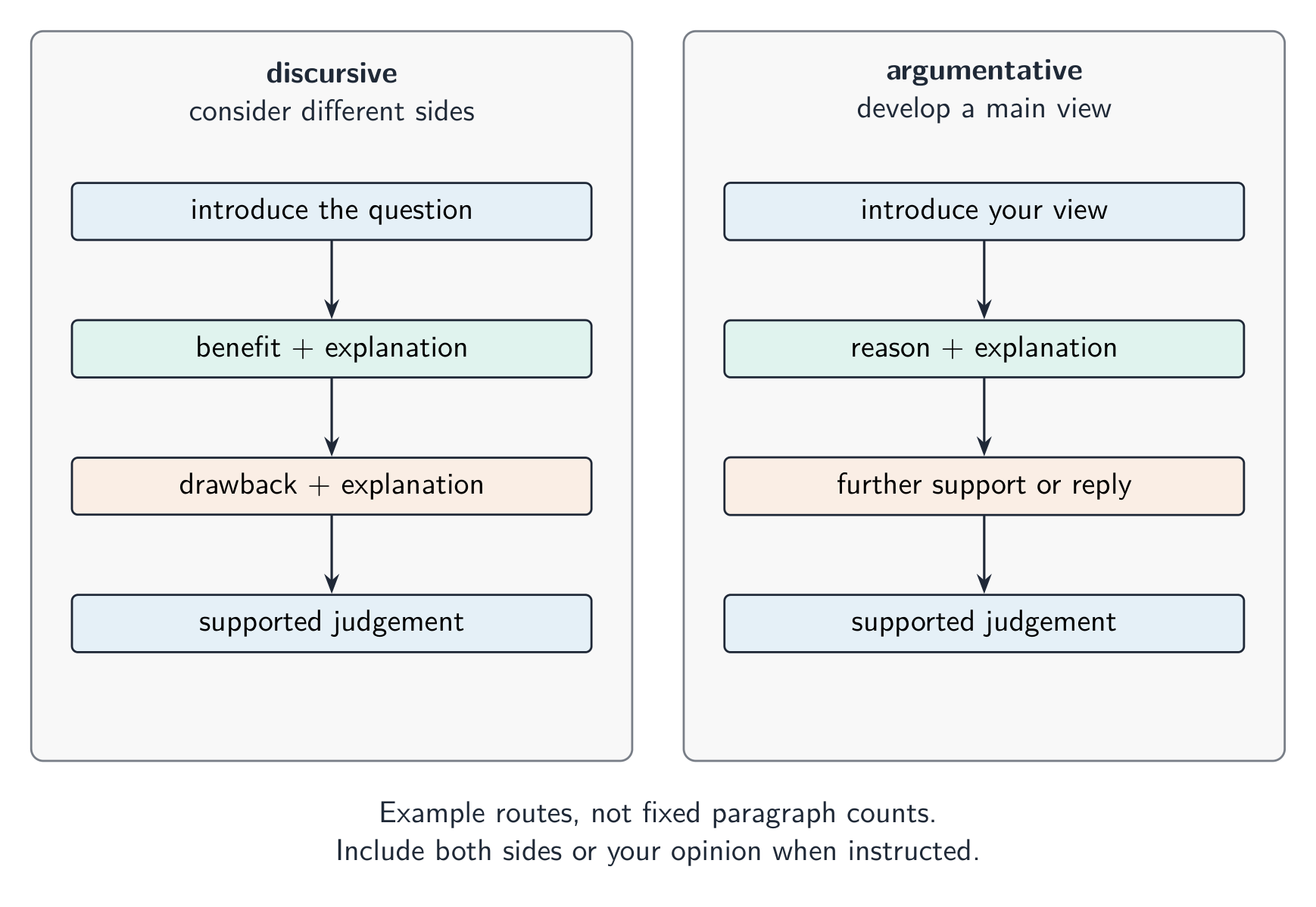
Two essay shapes: discursive weighs both sides; argumentative argues one view
Where does your conclusion go?
Difficulty 1/5 · 100 coins + a small bonus on first completion today
The conclusion comes last and sums up.
Match each essay part to its job.
Difficulty 2/5 · 140 coins + a small bonus on first completion today
Each part has one job — when every part does its job, the essay argues itself.
Reasons and examples
- Support each point with a reason or an example.
- Use linking words to connect ideas.
- Keep a formal, organised style.
Write one sentence giving your opinion on school uniforms, with a reason.
Difficulty 3/5 · 200 coins + a small bonus on first completion today
Example: 'I think uniforms are useful because they save time in the morning.'
Two-minute plan, both sides
- Question: "Should school start later in the morning?"
- FOR: more sleep → better focus; fewer late arrivals. AGAINST: school ends later; bus timetables clash.
- Discursive: give both columns a paragraph each, then your balanced view.
- Argumentative: pick one column, and use the strongest point from the other as your "although…".
A full exam answer
Exercise 6 task: Your class has discussed whether school should start later in the morning. Write an essay for your teacher giving your views.
Should school start later in the morning?
Many teenagers feel tired in the first lesson, so some people believe the school day should start an hour later.
The strongest argument for a later start is sleep. Teenagers naturally fall asleep late, so an 8 a.m. start leaves many of them with only six or seven hours. Students who sleep more concentrate better and are less likely to arrive late.
However, a later start would also mean finishing later. This would cut into sports, music and homework time, and it could clash with the bus timetables that many families depend on.
In my view, the benefits are greater than the problems, although the change needs planning. Starting thirty minutes later, and moving buses to match, would give students more rest without making the day much longer.
- Content: both sides are developed with reasons, and the conclusion gives a clear, qualified view.
- Language: a formal register, topic sentences, and linking words that build the argument (However, although, In my view).
- Discursive = both sides; argumentative = one view.
- Introduction → body paragraphs → conclusion.
- Support points; connect ideas with linking words.