Writing an article
IntroducedWhat an article is for
- An article is for a magazine, a newspaper or a website.
- It informs or entertains a general reader.
- You usually give your own view, with reasons.
An article title is a front door, not the whole building.
Who reads an article?
Difficulty 1/5 · 100 coins + a small bonus on first completion today
An article is written for many general readers.
Catch the reader
- A strong title and first line catch the reader's interest.
- Ask a question, or start with a surprising fact.
- Keep the reader wanting to read more.
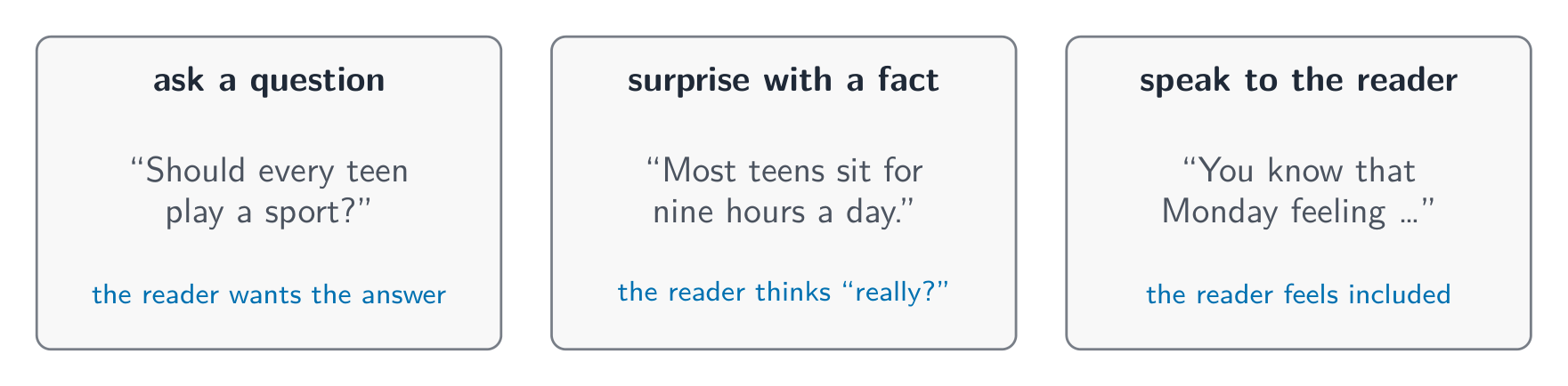
Three ways to catch the reader's interest in your first lines
Hook or snooze?
A hook makes the reader need line two; a snooze announces the topic and loses them.
A dull title is fine for an article.
Difficulty 1/5 · 100 coins + a small bonus on first completion today
A catchy title is needed to grab interest.
Write a catchy first line for an article about your favourite hobby.
Difficulty 3/5 · 200 coins + a small bonus on first completion today
Example: 'Could one small hobby change your whole week?'
Lively language
- Shape: introduction → middle → short conclusion.
- Use varied words and sentence lengths.
- You can speak to the reader directly with 'you'.
Put the parts of an article in order.
Difficulty 3/5 · 200 coins + a small bonus on first completion today
Title and opening first, then the points, then a conclusion.
An article has an introduction, a developed middle and a short ____.
Difficulty 1/5 · 100 coins + a small bonus on first completion today
The conclusion draws the ideas together and leaves the reader with a clear final thought.
Hook, then deliver
- Task: an article for the school magazine about learning an instrument.
- Headline: "The Ten-Minute Musician" — short, curious, no full stop.
- Hook: "Did you know ten minutes of practice a day beats a two-hour cram on Sunday?"
- Then deliver: your view plus reasons, and an ending that echoes the hook: "Ten minutes. Every day. That's the whole secret."
Match the hook technique to its example.
Difficulty 2/5 · 140 coins + a small bonus on first completion today
Four reliable hooks — pick the one that fits your topic and audience.
An article for a school magazine argues for a quiet reading room. Which sentence best addresses its readers?
Difficulty 1/5 · 100 coins + a small bonus on first completion today
Direct address suits a magazine article for students. The alternatives belong to a formal letter or report.
An interesting opening is enough; the article does not need reasons or development.
Difficulty 1/5 · 100 coins + a small bonus on first completion today
The opening attracts attention, but the middle must deliver useful ideas and supporting reasons.
A full exam answer
Exercise 6 task: Your school magazine wants articles about a useful skill. Write about learning an instrument: why it helps, how to practise, and one mistake to avoid.
The Ten-Minute Musician
Did you know that ten minutes of practice a day beats a two-hour cram on Sunday? I learned this the hard way with the guitar.
Playing an instrument does more than make music. It trains your memory and your patience, and it gives you a way to relax after a long day of lessons.
The secret is little and often. Pick one short piece, play it slowly, and only speed up when it sounds clean. A phone timer helps you stop before you get bored.
The biggest mistake is giving up after a week because your fingers hurt. That pain fades, and so does the frustration, once your first song comes together.
So find an instrument, set your timer and start today. Ten minutes. Every day. That's the whole secret.
- Content: why, how and the mistake each get a paragraph with a reason or an example.
- Language: a title, a question as the hook, direct address with you, and short sentences at the end for effect.
- An article is for many readers; it informs or entertains.
- A catchy title and opening grab interest.
- Lively, varied language keeps energy up.