Gases, pressure and volume
Introduced| English | Meaning |
|---|---|
| pressure/ˈpreʃə/ | Force acting normally per unit area. |
| volume/ˈvɒljuːm/ | The amount of three-dimensional space occupied. |
| Boyle's law/bɔɪlz lɔː/ | For a fixed amount of gas at constant temperature, pressure is inversely proportional to volume in the ideal-gas approximation. |
A warmer gas needs a movable boundary to expand
- Push a sealed bicycle-pump plunger: the trapped gas pushes back. Gas pressure 压强 comes from particles colliding with the container walls.
- To predict volume 体积, state what can change and what is held constant. Keep the amount of gas fixed; do not silently allow gas to leak out.
Gas pressure is caused by particles:
Difficulty 1/5 · 100 coins + a small bonus on first completion today
Collisions with the walls create pressure.
Change the pressure at constant temperature
- Increasing the pressure on a fixed amount of gas at constant temperature reduces its volume. Particles become closer together and strike the walls more frequently, giving the greater pressure.
- Decreasing the pressure lets the gas expand. Average particle speed stays the same if temperature stays the same; the particles neither grow nor multiply. The inverse pressure–volume relationship is called Boyle's law 玻意耳定律.

Explain the change using spaces between particles and wall collisions; the dots themselves have not become smaller.
Compress a fixed amount of gas
At constant temperature, decreasing volume increases pressure because the same particles hit the walls more frequently. Particle size and number stay unchanged.
At constant temperature, if the volume of a gas decreases, the pressure:
Difficulty 1/5 · 100 coins + a small bonus on first completion today
Smaller volume → more frequent collisions → higher pressure.
Increasing the pressure on a fixed amount of gas at constant temperature increases its volume.
Difficulty 1/5 · 100 coins + a small bonus on first completion today
False. The gas is compressed: volume decreases, the particles are closer together and wall collisions are more frequent.
For a fixed amount of gas at constant temperature, decreasing the external pressure allows its volume to ______.
Difficulty 1/5 · 100 coins + a small bonus on first completion today
At constant temperature the gas expands when the pressure on it is reduced.
Change the temperature at constant pressure
- Heat gas in a sealed syringe with a freely moving plunger under constant external pressure. Particles gain kinetic energy and move faster. The plunger moves out until the gas pressure again balances the external pressure: volume increases.
- Cool the gas while keeping pressure constant and its volume decreases. Faster motion is a temperature effect; a larger volume is possible because the boundary can move.
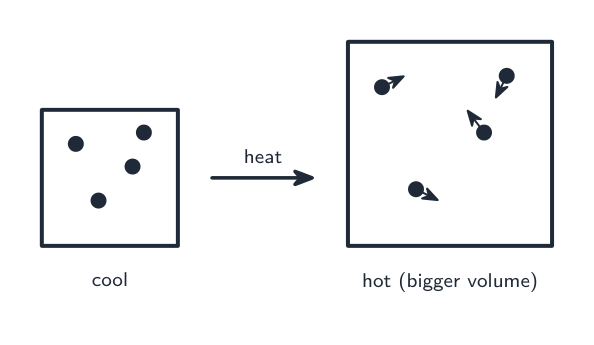
The particle count stays the same. This expanding-container model requires constant pressure and a boundary able to move.
A fixed amount of gas is warmed in a sealed syringe with a freely moving plunger under constant external pressure. Its volume:
Difficulty 1/5 · 100 coins + a small bonus on first completion today
The boundary can move. Heating increases particle speed; the gas expands until pressure again balances the constant external pressure. Particle size and number stay unchanged.
Treat the following as separate changes to sealed gas syringes. A: temperature decreases while external pressure stays constant. B: external pressure decreases while temperature stays constant. Predict each volume change and explain the different particle causes.
A: volume decreases; particles lose kinetic energy and move more slowly, and the plunger moves in until the gas pressure balances the same external pressure. B: volume increases as the lower external pressure allows expansion; particle speed stays the same because temperature is unchanged. Both changes keep the gas amount fixed.
Test the prediction in a rigid container
- A sealed rigid container has a fixed volume. Heating makes particles faster and their collisions with the walls more frequent and harder, so pressure increases instead of volume.
- “Heating always expands a gas” misses the container condition. Use constant pressure for the temperature–volume prediction; use constant temperature for the pressure–volume prediction.
A movable syringe and a rigid flask contain the same gas and are both warmed without losing gas. At constant external pressure the syringe's volume grows. The flask cannot expand in this model, so its volume stays fixed and its pressure rises.
A sealed rigid flask and a sealed syringe with a freely moving plunger are both warmed. The syringe has constant external pressure. Predict the change in volume and pressure for each. Explain why the same heating does not give the same volume result.
Rigid flask: volume stays constant and pressure rises because faster particles hit its walls more frequently and harder. Syringe: volume increases until internal pressure balances the constant external pressure again, so final pressure is unchanged. Both keep the same amount of gas; only the syringe has a movable boundary.
Combine changes only when the evidence allows it
- Heating at constant pressure increases volume; lowering pressure at constant temperature also increases volume. If both changes occur, they support expansion in the same direction.
- If temperature and pressure both increase, their effects on volume oppose each other. Without more information, do not claim that the volume must increase or decrease.
For a fixed amount of gas, both temperature and external pressure increase. A student predicts a larger volume because the gas was heated. Is that conclusion justified from these facts alone? Contrast this with heating while reducing external pressure.
The conclusion is not justified. Heating tends to increase volume at constant pressure, but increasing pressure tends to decrease it at constant temperature; their combined result needs more information. Heating and reducing external pressure both favour increased volume, so they support expansion in the same direction.
You've got it
- Fixed amount, fixed temperature: increasing pressure decreases gas volume.
- Fixed amount, fixed pressure: increasing temperature increases gas volume.
- Fixed volume: heating raises pressure. Explain with particle motion and wall collisions, not growing particles.