Diffusion
Introduced| English | Meaning |
|---|---|
| diffusion/dɪˈfjuːʒn/ | The net movement of particles from higher to lower concentration due to their random motion. |
| concentration/ˌkɒnsənˈtreɪʃn/ | The amount of a substance per unit volume of a mixture or solution. |
| relative molecular mass/ˈrelətɪv məˈlekjʊlə mæs/ | The mass of a molecule relative to one twelfth of the mass of a carbon-12 atom, found by adding its atoms' relative atomic masses. |
Colour spreads without stirring
- Place a coloured solution beside clear water and its particles gradually spread through the liquid. Diffusion 扩散 is the net spreading of particles from higher to lower concentration 浓度.
- Particles move continuously in random directions. More leave the concentrated region than return from the dilute region, producing net spreading without a plan or a pump.
Diffusion produces net spreading of particles from a region of:
Difficulty 1/5 · 100 coins + a small bonus on first completion today
Random motion causes net spreading from higher to lower concentration, although individual particles move in all directions.
Separate random motion from net movement
- Individual particles move in all directions, including back towards the high-concentration region. Net movement describes the overall result of many particles; it does not mean every particle travels one way.
- After the concentration becomes uniform, particles keep moving randomly. There is no further net spreading in one direction. Diffusion occurs in liquids as well as gases.
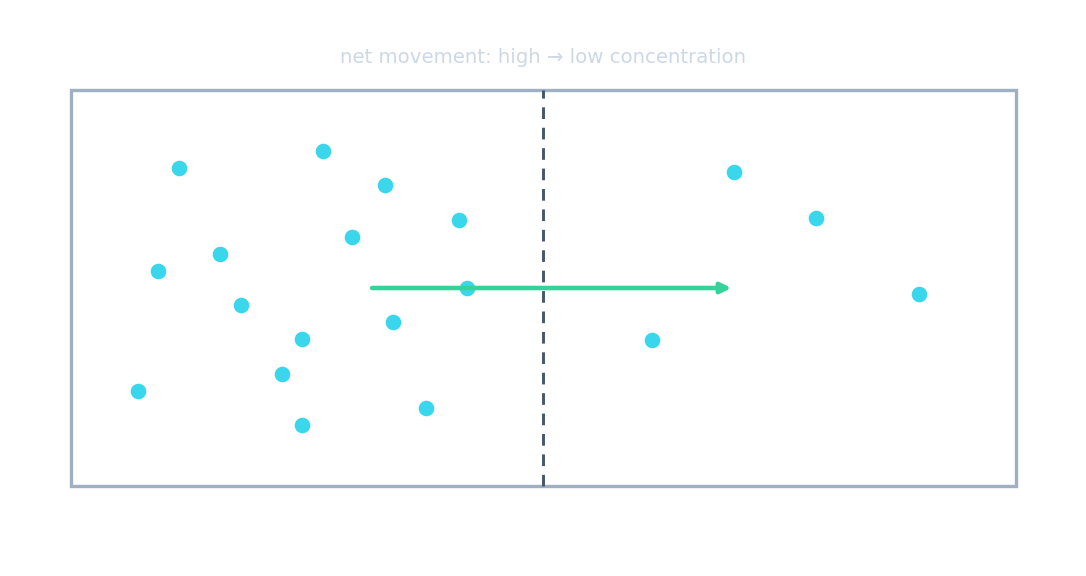
Evenly mixed is not motionless. The particles do not stop when the colour looks uniform.
Watch particles diffuse
Set up a concentration difference and watch the particles spread out. Diffusion is the net movement of particles from where they are crowded to where they are not — driven by their own random motion, no stirring needed.
Diffusion
Release the cloud and the particles spread on their own from the crowded corner until they fill the box evenly — diffusion, sped up by heat.
Diffusion is evidence that particles are in constant random motion.
Difficulty 1/5 · 100 coins + a small bonus on first completion today
Particles move randomly, so concentration differences gradually even out without stirring; random motion continues after mixing.
A dye has become evenly spread through still water. A student says diffusion has used up the particles’ movement, so they have stopped. Explain what continues and what has disappeared.
Dye and water particles continue moving randomly in all directions; movement is not used up by mixing. The concentration difference and resulting net spreading in one direction have disappeared. Equal concentration does not mean individual particles stop or stop crossing between regions.
Compare gas masses at the same temperature
- A gas with a lower relative molecular mass 相对分子质量 diffuses faster at the same temperature: its molecules move faster on average. Compare molecular masses, not the number of letters in a formula.
- For example, nitrogen N₂ has a relative molecular mass of 28 and carbon dioxide CO₂ has 44, so nitrogen diffuses faster in comparable conditions. Raising temperature also increases particle motion, so hold it constant when comparing the mass effect.
Diffusion happens faster when the temperature is:
Difficulty 1/5 · 100 coins + a small bonus on first completion today
Hotter particles move faster, so they diffuse faster.
At the same temperature and under comparable conditions, which gas molecules diffuse faster?
Difficulty 1/5 · 100 coins + a small bonus on first completion today
Gas molecules with smaller relative molecular mass move faster on average at the same temperature and diffuse faster.
Hydrogen H₂ (relative molecular mass 2) and carbon dioxide CO₂ (44) diffuse under comparable conditions at the same temperature. Which diffuses faster? Explain using particle motion.
Lighter gas particles diffuse faster.
At the same temperature under comparable conditions, rank methane CH₄ (relative molecular mass 16), oxygen O₂ (32) and carbon dioxide CO₂ (44) from fastest to slowest diffusion. Evaluate “the molecule with the most atoms must diffuse slowest”.
Fastest to slowest: CH₄, O₂, CO₂. Lower relative molecular mass gives faster average molecular motion and faster diffusion at the same temperature. Counting atoms alone fails: methane has five atoms per molecule yet the smallest molecular mass of these gases.
Explain the unequal distances in a tube
- In the illustrated demonstration, ammonia NH₃ and hydrogen chloride HCl diffuse from opposite ends and react to form a white ring of solid ammonium chloride. Their relative molecular masses are 17 and 36.5.
- Ammonia diffuses faster and travels farther in the same time, so the ring appears nearer the hydrogen chloride end. The two starting gases form a new substance; the ring is not just a gas changing state.
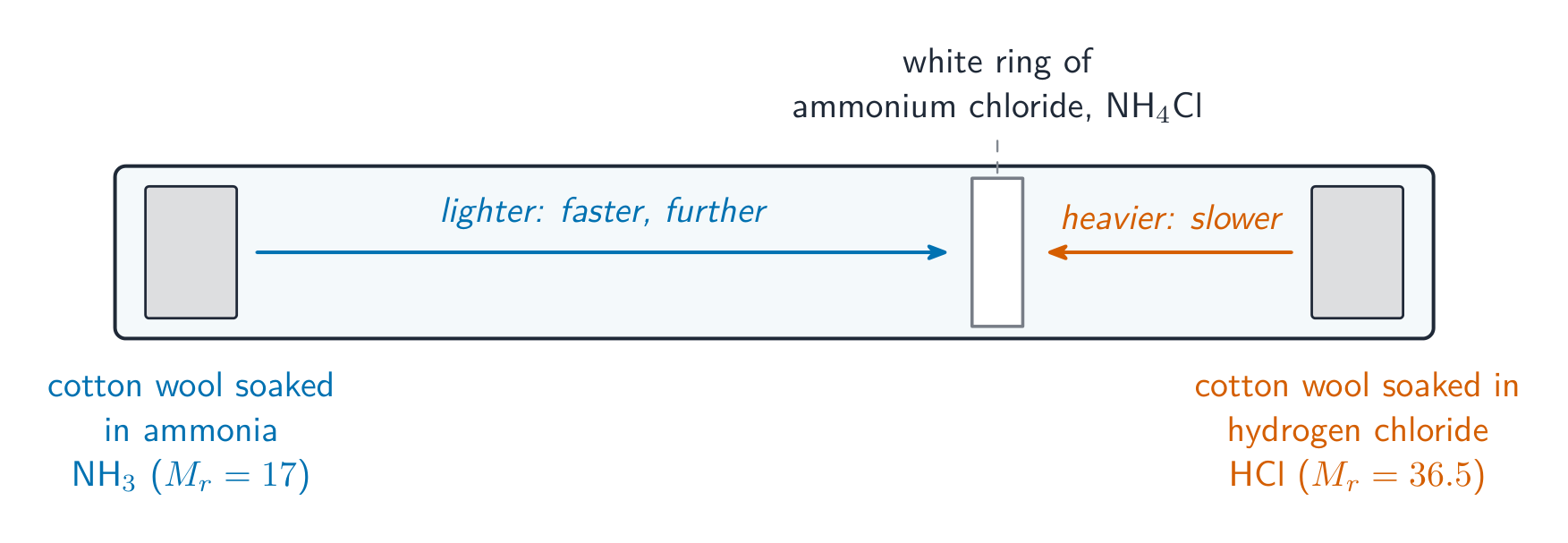
Use the same temperature and starting time when explaining this distance comparison.
A horizontal tube now has hydrogen chloride at the LEFT end and ammonia at the RIGHT end, released together at the same temperature. Predict which end the ammonium chloride ring is nearer and which gas travels farther. Explain why the white solid is a reaction product rather than a change of state of either gas.
The ring is nearer the LEFT hydrogen chloride end. Ammonia has lower relative molecular mass (17 versus 36.5), diffuses faster and travels farther from the right end in the same time. Ammonia and hydrogen chloride react to form a different substance, ammonium chloride; a physical change of state would keep the substance the same.
Keep the observation and explanation distinct
- “The colour spreads” is an observation; “particles move randomly and mix” is its particle explanation. A change of colour alone does not mean new particles have been created.
- In the simple solid model, particles vibrate around fixed positions and cannot mix freely as they do in a liquid or gas. Gas-flow currents can also carry smells, so a smell reaching you is not proof that diffusion was the only transport process.
Diffusion takes place readily in liquids and in a ______.
Difficulty 1/5 · 100 coins + a small bonus on first completion today
Particles in liquids and gases can move past one another and mix.
When a dye is evenly mixed through still water, what are its particles doing?
Difficulty 1/5 · 100 coins + a small bonus on first completion today
The net concentration difference has disappeared, but random particle motion continues.
You've got it
- Diffusion has net spreading down a concentration difference, with random motion in all directions.
- Random motion continues after a uniform mixture forms.
- At the same temperature, lower-mass gas molecules move faster on average and diffuse faster. Link the comparison to the observed result.