Changes of state
Introduced| English | Meaning |
|---|---|
| melting/ˈmeltɪŋ/ | The change of a substance from solid to liquid. |
| boiling/ˈbɔɪlɪŋ/ | Vaporisation throughout a liquid when its vapour pressure matches the surrounding pressure. |
| boiling point/ˈbɔɪlɪŋ pɔɪnt/ | The temperature at which a liquid's vapour pressure equals the surrounding pressure. |
| changes of state/ˈtʃeɪndʒɪz ɒv steɪt/ | Physical changes between solid, liquid and gas that keep the substance the same. |
| freezing/ˈfriːzɪŋ/ | The change of state from liquid to solid. |
| condensing/kənˈdensɪŋ/ | Changing from gas to liquid. |
| evaporating/ɪˈvæpəreɪtɪŋ/ | Changing from liquid to gas at the liquid's surface. |
| subliming/sʌˈblaɪmɪŋ/ | Changing directly from solid to gas without becoming a liquid first. |
| kinetic energy/kɪˈnetɪk ˈenədʒi/ | The energy an object has because of its motion. |
| melting point/ˈmeltɪŋ pɔɪnt/ | The temperature at which a solid and its liquid phase can coexist in equilibrium at a specified pressure. |
| heating curve/ˈhiːtɪŋ kɜːv/ | A graph showing how the temperature of a substance changes with time as energy is supplied. |
| cooling curve/ˈkuːlɪŋ kɜːv/ | A graph showing how the temperature of a substance changes with time as energy is transferred to the surroundings. |
A drying floor does not need to boil
- Melting 熔化 changes a solid to a liquid; boiling 沸腾 changes liquid to gas throughout the liquid. A floor dries without reaching the boiling point 沸点.
- These changes of state 状态变化 keep the substance the same. They change particle arrangement and energy, rather than breaking water molecules into hydrogen and oxygen.
Name the direction of the change
- Melting is solid → liquid; freezing 凝固 is liquid → solid. Condensing 凝结 is gas → liquid. Both evaporating 蒸发 and boiling are liquid → gas.
- Subliming 升华 means solid → gas directly, as with solid iodine. Melting is also different from dissolving: a solid becoming part of an aqueous solution is not simply becoming its own liquid.
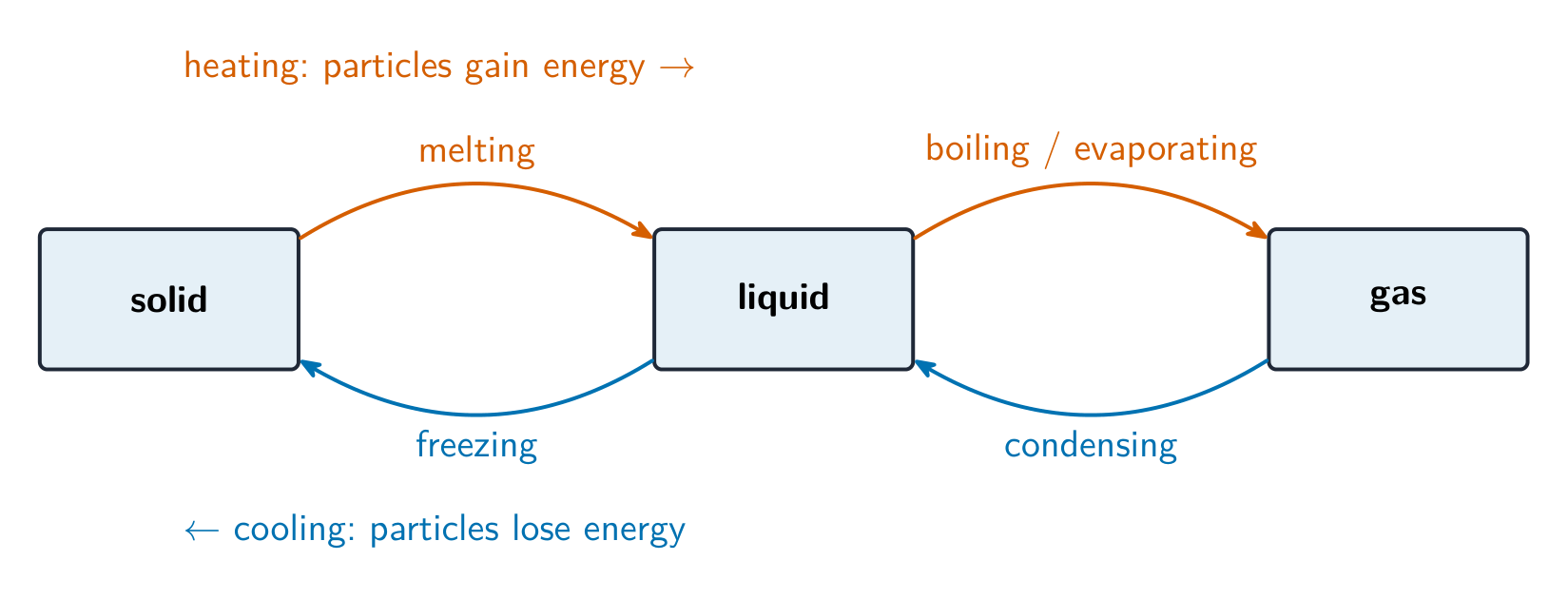
Follow the arrow before naming the process: gas → liquid is condensation, even if the starting gas is invisible.
Heating a substance through its states
Step up the temperature. Adding heat gives the particles more energy until they break free — and the temperature pauses at each change of state while the energy does that work.
The change from solid to liquid is called:
Difficulty 1/5 · 100 coins + a small bonus on first completion today
Solid → liquid is melting.
The change from gas to liquid is called:
Difficulty 1/5 · 100 coins + a small bonus on first completion today
Gas → liquid is condensing.
Distinguish evaporation from boiling
- Evaporation occurs at the surface at temperatures below the boiling point: some sufficiently energetic particles escape. Boiling occurs throughout the liquid, with bubbles of the substance's gas forming within it.
- The boiling point depends on pressure. For pure water at ordinary atmospheric pressure it is about 100 °C. Surface loss from water at 60 °C is evaporation, not proof that its boiling point is 60 °C.
At fixed pressure, a pure liquid boils at a fixed temperature called its ______ point.
Difficulty 1/5 · 100 coins + a small bonus on first completion today
The boiling point is specified at a stated pressure; it is not the same at every pressure.
Water in an open dish is at 60 °C under ordinary atmospheric pressure. Water vapour leaves its surface without bubbles forming throughout. Name and explain the change.
Evaporation can happen below the boiling point.
A wet cloth dries at 25 °C under ordinary atmospheric pressure. Which process removes its water?
Difficulty 1/5 · 100 coins + a small bonus on first completion today
The liquid has not reached its boiling point.
Two dishes contain pure water at ordinary atmospheric pressure. In A, water at 35 °C slowly leaves the surface. In B, water at 100 °C forms water-vapour bubbles throughout. Name each process and explain why “both produce gas” is not enough to distinguish them.
A is evaporation at the surface below the boiling point. B is boiling throughout the liquid at its boiling point. Both are liquid-to-gas changes, so location and the temperature relative to the boiling point distinguish them.
Explain where the supplied energy goes
- Away from a change of state, heating increases average kinetic energy 动能 and temperature: particles move faster, or vibrate more vigorously in a solid. Cooling reduces average kinetic energy.
- During melting or boiling of a pure substance at fixed pressure, energy overcomes attractions between particles. Average kinetic energy and temperature remain constant during the change. In water, the bonds within each molecule remain intact.
Ice and liquid water coexist at the melting point 熔点. Energy can keep entering while ice melts, although the thermometer stays at the same temperature. A flat temperature reading does not mean that heating has stopped.
A solid is heated and stays below its melting point. Its particles gain:
Difficulty 1/5 · 100 coins + a small bonus on first completion today
Away from a change of state, heating raises average kinetic energy and temperature. The particles still vibrate about fixed positions.
A pure solid at fixed pressure keeps rising in temperature throughout melting.
Difficulty 1/5 · 100 coins + a small bonus on first completion today
False. Temperature stays constant while solid and liquid coexist during melting; supplied energy overcomes attractions between particles.
During melting of pure ice at fixed pressure, a student says: “The temperature rises as bonds inside water molecules break, producing hydrogen and oxygen.” Correct both scientific errors and state the substances present part-way through melting.
Temperature remains constant at the melting point while solid and liquid water coexist. Energy overcomes attractions between water particles; bonds within the water molecules are not broken into hydrogen and oxygen. Both states contain water molecules and the process is a physical change.
Interpret a heating curve 加热曲线
- A heating curve shows temperature against time. On each rising section there is one state warming; the first plateau is melting with solid and liquid together, and the second is boiling with liquid and gas together.
- Compare energy inputs using time only if the heating rate is constant. A longer plateau then receives more energy; a horizontal line does not mean zero energy input.
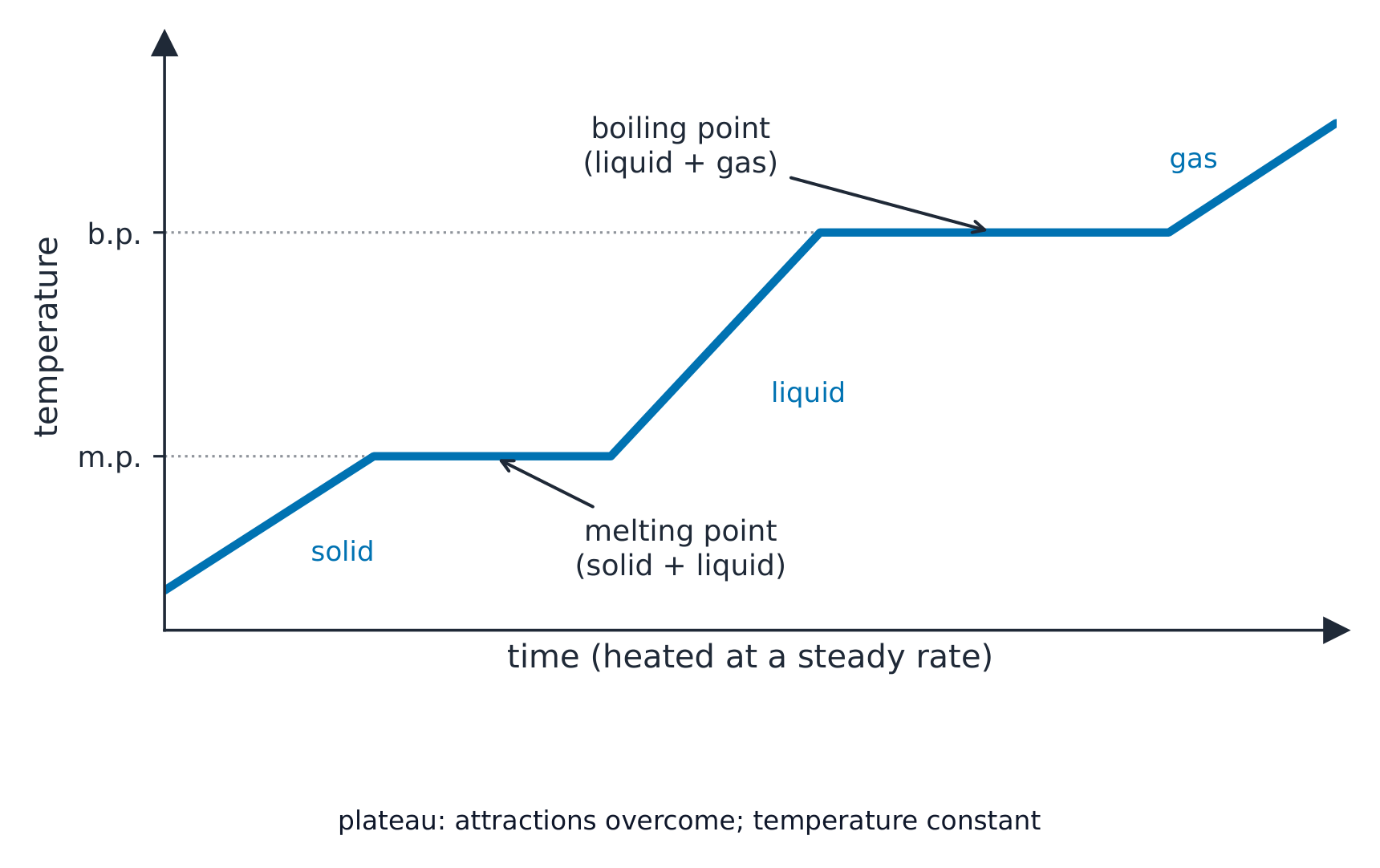
At fixed pressure, a pure substance's melting and boiling temperatures stay constant while each change is taking place.
A pure substance is heated at a constant rate at fixed pressure. Its melting plateau lasts 2 min and its boiling plateau lasts 5 min. A student says both sections absorb zero energy because their slopes are zero. Evaluate the claim and state which section receives more energy.
Both plateaux receive energy although temperature and average kinetic energy stay constant; the energy overcomes attractions during the state change. The boiling plateau receives more energy because the same heater supplies energy for 5 min rather than 2 min. This comparison needs the stated constant heating rate.
Interpret a cooling curve 冷却曲线 in the other direction
- On a cooling curve, falling single-state sections show decreasing average kinetic energy. At a condensation or freezing plateau, energy still transfers to the surroundings while temperature stays constant.
- Read the original curve below from G to L, starting with a gas. J–K is freezing at 20 °C, with liquid and solid present. At the end of K, freezing is complete; K–L is the solid cooling.

This is a model pure substance at fixed pressure. The letters identify sections; use the axes to read temperatures and durations.
Use the G–L cooling curve. Identify the change and the two states present during H–I; read its temperature. At 5 min, identify the state and read its temperature. Compare particle motion during I–J with motion during J–K, and state whether thermal energy leaves during J–K.
H–I is condensation, with gas and liquid at 80 °C. At 5 min the substance is liquid at 60 °C. During I–J its average kinetic energy decreases and motion slows. During J–K freezing occurs at 20 °C: liquid and solid coexist, average kinetic energy stays constant while particles become fixed in the solid arrangement. Thermal energy still leaves to the surroundings.
You've got it
- State the starting state, final state and correct process name.
- A rising or falling temperature changes average kinetic energy; a plateau can still transfer energy.
- Heating and cooling curves run through the state changes in opposite directions. Keep purity and pressure conditions in view.