Solids, liquids and gases
Introduced| English | Meaning |
|---|---|
| liquid/ˈlɪkwɪd/ | A state of matter with a definite volume but no fixed shape, which flows to fit its container. |
| particles/ˈpɑːtɪklz/ | Small units of matter, such as atoms, molecules, ions or subatomic entities. |
| particle model/ˈpɑːtɪkl ˈmɒdl/ | A model explaining the properties of matter using the separation, arrangement and motion of its particles. |
| solid/ˈsɒlɪd/ | A state of matter with a definite shape and volume; its particles vibrate around fixed positions in the simple particle model. |
| vibrate/vaɪˈbreɪt/ | To move repeatedly to and fro about an equilibrium position. |
| gas/ɡæs/ | A state of matter with neither a fixed shape nor a fixed volume, which expands to fill its container. |
Why does water pour but ice keeps its shape?
- Ice, liquid 液体 water and water vapour contain the same water particles 粒子. Their separation, arrangement and motion differ; the water molecules do not become different substances.
- The particle model 粒子模型 links what you observe to what the particles do. State both the property and the particle explanation.
The dots represent particles; the spaces between them are not filled with another substance in this model.
The idea that all matter is made of tiny moving particles is the ______ model.
Difficulty 1/5 · 100 coins + a small bonus on first completion today
The particle model explains the three states.
Solids 固体 keep a shape because positions are fixed
- In the simple solid model, particles are very close together in a regular arrangement. They vibrate 振动 about fixed positions; fixed positions do not mean no motion.
- A solid keeps its shape and volume because particles cannot move freely past one another. It is difficult to compress because there is very little space between particles.
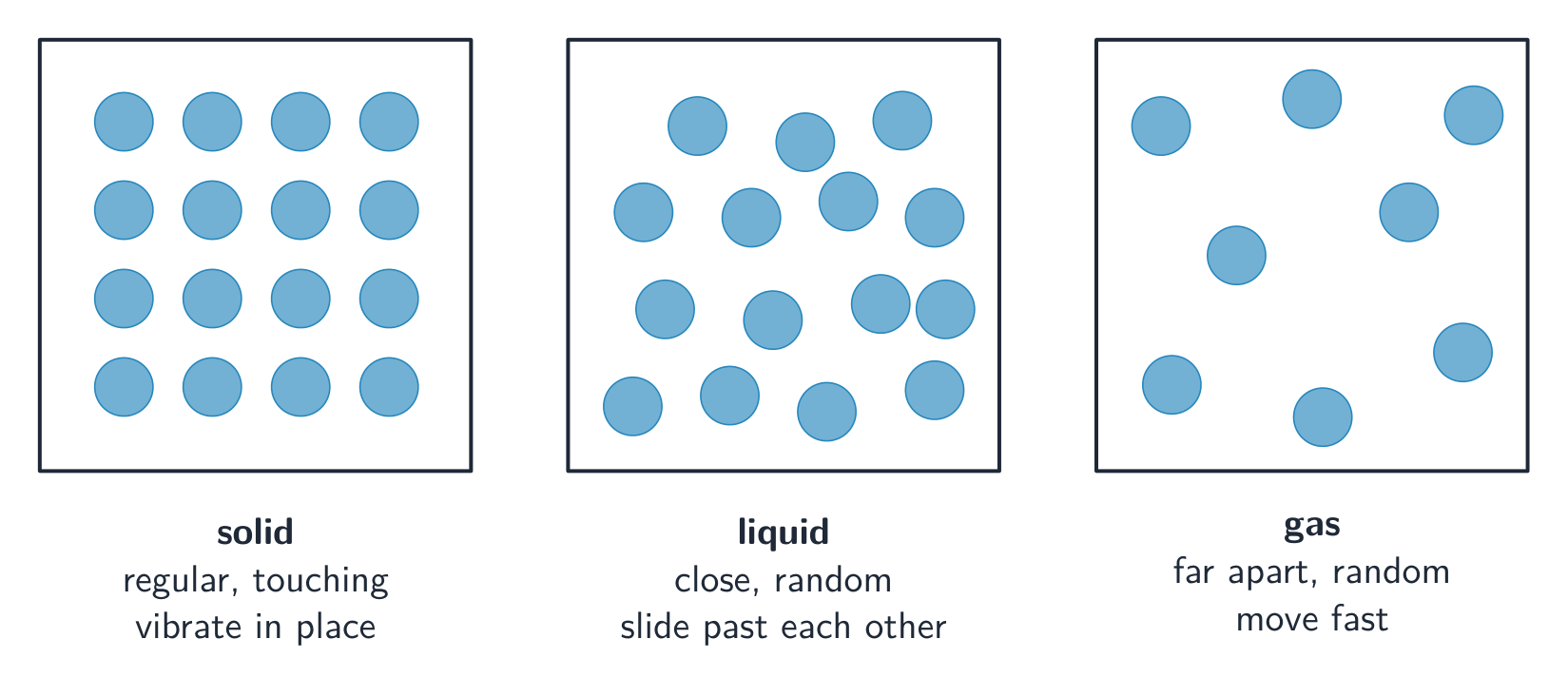
These are separate samples, not a before-and-after particle count. “Random” describes arrangement; “slide past each other” describes motion.
States of matter
Heat the box and watch the particles break free: a vibrating solid melts to a flowing liquid, then spreads out as a gas. Same particles — just more energy.
In a solid, the particles:
Difficulty 1/5 · 100 coins + a small bonus on first completion today
Solids have closely packed, vibrating particles.
Liquids flow while their particles stay close
- In a liquid, particles remain close together but have a random arrangement. They move and slide past each other, allowing the liquid to flow and take its container's shape.
- A liquid has a nearly fixed volume and is difficult to compress. Changing the shape of the container changes the arrangement of the sample, not the size of its particles.
Pour 50 cm³ of water into a wider beaker. The water becomes shallower but still occupies about 50 cm³. Moving particles allow the shape to change; their close separation prevents large compression.
A liquid takes the shape of its container because its particles:
Difficulty 1/5 · 100 coins + a small bonus on first completion today
Liquid particles slide, so liquids flow.
A student writes: “Liquid particles are randomly arranged, so they must be far apart and easily compressed.” Identify the correct part and correct the two false inferences.
Random arrangement is correct, but it describes the lack of a regular pattern, not large separation. Liquid particles remain close together, so a liquid is difficult to compress. They can slide past each other, which explains flow.
Gases 气体 fill the available space
- In a gas, particles are far apart, randomly arranged and moving rapidly in random directions. They spread through the available container rather than keeping a fixed shape or volume.
- A gas is easily compressed because the gaps can be reduced. The particles themselves are not squeezed smaller. A liquid's ability to flow does not mean its particles are as far apart as a gas's.
A gas spreads to fill its container because its particles are:
Difficulty 1/5 · 100 coins + a small bonus on first completion today
Fast, widely spaced particles fill the available space.
Ice, water and steam are made of the same particles.
Difficulty 1/5 · 100 coins + a small bonus on first completion today
Only the arrangement and energy differ, not the substance.
For each state, give its shape, volume and ease of compression. Then explain why a liquid can flow but is difficult to compress, while a gas can flow and is easily compressed.
Solid: fixed shape and volume, difficult to compress. Liquid: no fixed shape but nearly fixed volume, difficult to compress. Gas: neither fixed shape nor fixed volume, easily compressed. Liquid particles are close but move past each other. Gas particles also move, but have large gaps which can be reduced.
On paper draw eight particles of one substance in each of three equal boxes: solid, liquid and gas. Keep particle identity and size the same. Show arrangement and separation, and annotate how the particles move. Explain one limitation of a still diagram.
Solid: eight equal particles closely and regularly arranged, with vibration about fixed positions. Liquid: eight close particles in an irregular arrangement that can slide past one another. Gas: eight widely spaced, randomly arranged particles moving rapidly in random directions. A still diagram cannot itself show continuous motion or the three-dimensional structure. A teacher must review the actual sketches.
Warming a solid changes its motion first
- Below its melting point, a warmed solid remains solid. Its particles gain energy and vibrate more vigorously while remaining around fixed positions.
- Do not explain warming by saying that particles grow or stop touching. A change in temperature is not automatically a change of state.
A solid is warmed but remains below its melting point. Describe its particle arrangement and motion before and after warming. Explain why fixed positions do not mean that particles are stationary.
Particles in a solid are packed in place and only vibrate.
A different solid is cooled without changing state. Which description remains correct?
Difficulty 1/5 · 100 coins + a small bonus on first completion today
A solid keeps its shape because the particles stay in place.
You've got it
- Describe three separate features: separation, arrangement and motion.
- Close particles explain difficult compression; motion past neighbours explains flow.
- A solid's fixed positions still allow vibration. Changes of state keep the substance's particle identity.