Your learning plan · Continue · Review →
终于 (finally, at last)
IntroducedYour saved position stays in this browser. Resuming does not complete the lesson or answer its questions.
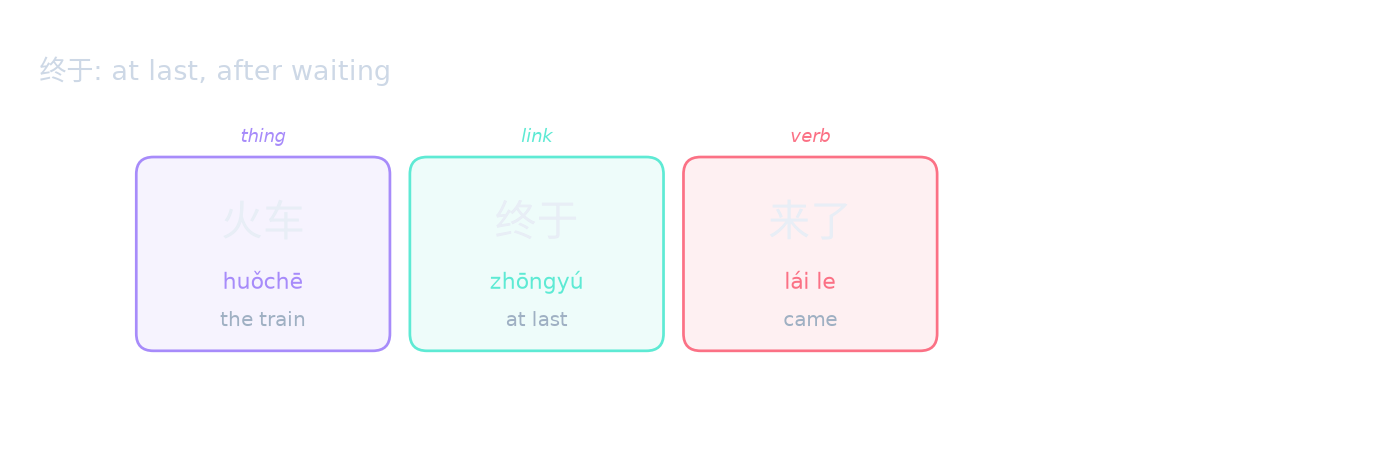
After a two-hour wait
- The train was delayed and you have been waiting on the platform since six. At eight it pulls in.
- train火车finally终于to come来(completed / change)了! — "The train has finally come!"
Subject + finally终于 + Verb (+ (completed / change)了)
- finally终于 = "finally, at last": a result comes after a long wait, effort or process. It goes before the verb.
- Because it reports an outcome that has now happened, the sentence usually ends with (completed / change)了 or uses Verb + (completed / change)了.
I我finally终于found找到了my我的keys钥匙。
Complete: “After a week of rain, the sun has finally come out.” 下了一个星期的雨,太阳____出来了。
Difficulty 1/5 · 100 coins + a small bonus on first completion today
A long wait ends, so 终于 + verb + 了.
After effort or after a long process
- he他study学(completed / change)了three years三年,finally终于got into考上(completed / change)了university大学。 — "After three years of study, he finally got into university."
- The outcome need not be good news: he他busy忙(completed / change)了一个月,finally终于to fall ill病倒(completed / change)了。 — "After a month of overwork he finally fell ill."
he他study学了three years三年,finally终于got into考上了university大学。
Build: “I finally found my keys.”
Difficulty 3/5 · 200 coins + a small bonus on first completion today
Subject + 终于 + Verb + 了 + object.
终于 can only introduce good news.
Difficulty 1/5 · 100 coins + a small bonus on first completion today
It reports any outcome reached after a long process, e.g. 他终于病倒了.
What finally终于 needs
- It needs a long wait or process before it; it does not mean "at the end of a list". For "lastly", use final最后.
- Put finally终于 after the subject, before the verb: he他finally终于to come来(completed / change)了, not finally终于he他to come来(completed / change)了 in ordinary speech.
finally终于 versus final最后
- final最后 orders events: we / us我们early先to have a meal吃饭,final最后to go去to see看the film电影 — "First we ate, and last we went to a film."
- finally终于 adds the feeling of a long wait reaching its end: wait等(completed / change)了two两个hours小时,the film电影finally终于start开始(completed / change)了。
wait等了two两个hours小时,the film电影finally终于start开始了。
“First we went to the museum, and lastly we went shopping.” Which word fills the gap? 我们先去了博物馆,____去买东西。
Difficulty 1/5 · 100 coins + a small bonus on first completion today
最后 marks the last step in a sequence; there is no long wait here.
Recap
- finally终于 + Verb (+ (completed / change)了) = finally, at last, after a long wait or effort; the outcome may be welcome or not.
- finally终于 goes before the verb. For the last step in a sequence, use final最后.
Read the full reference: HSK 3 grammar — Adverbs.
The train was delayed and you have been waiting on the platform since six. At eight it pulls in. Close the examples. Say a Mandarin response, then write it in Chinese. Explain briefly in English what the lesson’s pattern adds. Compare with the model, then change one detail and try again.
This is supported productive practice. Compare meaning and structure; your answer need not copy the model. A partner or teacher must hear the spoken response to comment on pronunciation.